
MICROELECTRONICS & VLSI DESIGNMONSOON 2013
OBJECTIVE
 Study of 4H-SiC Superjunction power diode by
simulation
2
METHODOLOGY
 Literature survey
 Simulations using semiconductor simulation software
Sentaurus
3
Overview
 Introduction
 Breakdown voltage(BV) & Specific on-resistance(Ronsp)
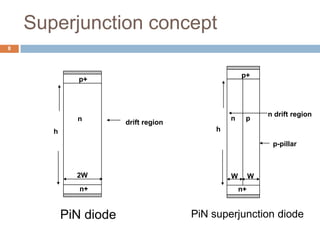
 Superjunction concept
 Different material comparison
 Benefits of Silicon Carbide(SiC)
 Results
 Work plan
4
Introduction
 In conventional power devices, there is a well known trade-
off between specific on resistance and breakdown voltage [1]
 The idea of a superjunction has been used to improve this
relationship from power law to linear [2]
[1] C. Hu, “Optimum doping profile for minimum ohmic resistance and high breakdown
voltage,” IEEE Trans Electron Devices, Vol.ED-26, pp.243-245, Mar. 1979.
[2] Jian Chen, Weifeng Sun et al, “A Review of Superjunction Vertical Diffused MOSFET”,
IETE Technical review, Vol29, Issue1, Jan-Feb 2012.
5.2
BVRonsp
5
How breakdown occurs?
 BV of a power device is an important parameter
governing reverse blocking capability
 How breakdown occurs?
 Impact ionization, a multiplicative phenomenon leads
to avalanche of carriers when breakdown voltage is
reached
 BV and ND (donor concentration in the uniformly doped
n region) relation in a P+N diode is given by [3]
4/315
100.3)4( DNSiCHBV
6
[3] B.J. Baliga, “Breakdown Voltage,” in Silicon Carbide Power Devices, World Scientific Publishing,
Singapore 2005, pp. 42-43
Specific on resistance
 Inverse relation between Ronsp and ND in a P+N diode is
given by[3]
 A higher Ronsp adversely affects the performance of the
device by increasing conducting loss and lowering
switching speed
 In conventional power devices the ideal trade-off
between Ronsp and BV
Dn
D
onsp
Nq
W
R
5.2
BVRonsp Si limit
7
[3] B.J. Baliga, “Breakdown Voltage,” in Silicon Carbide Power Devices, World Scientific Publishing,
Singapore 2005, pp. 42-43
Superjunction concept
PiN diode
n p
n drift region
p-pillar
h
WW
p+
n+
n drift region
h
2W
p+
n+
8
PiN superjunction diode
Superjunction concept
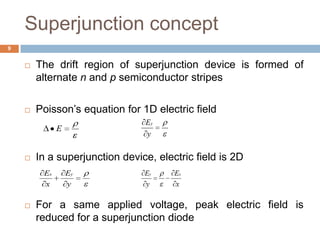
 The drift region of superjunction device is formed of
alternate n and p semiconductor stripes
 Poisson’s equation for 1D electric field
 In a superjunction device, electric field is 2D
 For a same applied voltage, peak electric field is
reduced for a superjunction diode
E
y
Ey
y
E
x
E yx
x
E
y
E xy
9
Superjunction concept
 p pillar does not contribute to on-state conduction in the
on-state
 For a given breakdown voltage, a higher doped drift
region can be used and specific on resistance can be
reduced
 The relation between Ronsp and BV now becomes
 Width(W) of the p and n pillar are should be small as
compared with the height(h), so that horizontal depletion
takes place at a relatively low voltage
BVRonsp
10
MATERIAL PARAMETERS
11
MATERIAL 6H-
SiC
4H-
SiC
3C-
SiC
Si GaAs
Dielectric constant 9.66 9.7 9.72 11.8 13.1
Band gap(eV) at 300K 3.0 3.2 2.3 1.1 1.42
Intrinsic carrier concentration(cm-3) 10-5 10-7 10 1010 1.8*106
Mobility(μn)(cm2/Vs)
ND=1016 cm-3
par:60
per:400
par:800
per:800
750 1200 6500
Mobility(μp)(cm2/Vs)
ND=1016 cm-3
90 115 40 420 320
Breakdown field (MVcm-1)
at ND=1017 cm-3
par:3.2
per: >1
par:3.0 >1.5 0.6 0.6
Thermal conductivity(Wcm-1K-1) 3-5 3-5 3-5 1.5 0.5
[4] http://www.tf.uni-
Why SiC?
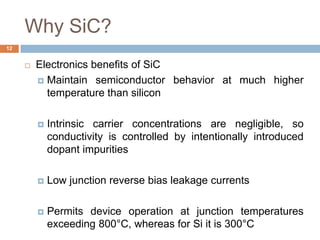
 Electronics benefits of SiC
 Maintain semiconductor behavior at much higher
temperature than silicon
 Intrinsic carrier concentrations are negligible, so
conductivity is controlled by intentionally introduced
dopant impurities
 Low junction reverse bias leakage currents
 Permits device operation at junction temperatures
exceeding 800°C, whereas for Si it is 300°C
12
Why SiC?
 Allows device to be thinner and doped heavily, which
implies decrease in blocking region resistance
 More efficient removal of heat from active device
 More efficient cooling, so cooling hardware requirement for
the device is less
 Advantages 4H-SiC
 Carrier mobility substantially higher compared with 6H SiC
 More isotropic nature compared to other polytypes
13
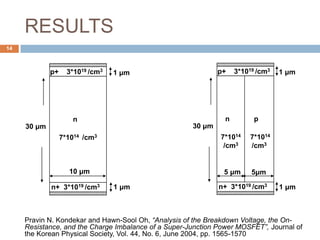
RESULTS
Pravin N. Kondekar and Hawn-Sool Oh, “Analysis of the Breakdown Voltage, the On-
Resistance, and the Charge Imbalance of a Super-Junction Power MOSFET”, Journal of
the Korean Physical Society, Vol. 44, No. 6, June 2004, pp. 1565-1570
n
7*1014
/cm3
p
7*1014
/cm3
30 μm
5μm5 μm
p+ 3*1019 /cm3
n+ 3*1019 /cm3
1 μm
1 μm
14
n
7*1014 /cm3
30 μm
10 μm
p+ 3*1019 /cm3
n+ 3*1019 /cm3
1 μm
1 μm
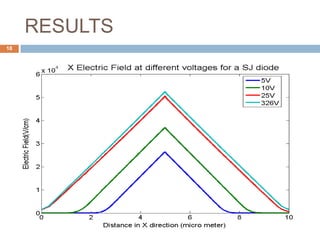
RESULTS
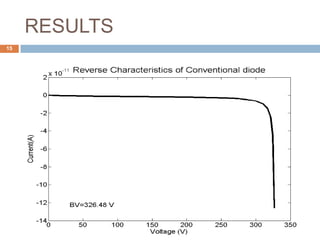
15
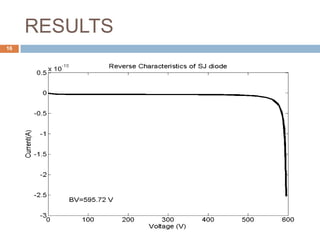
RESULTS
16
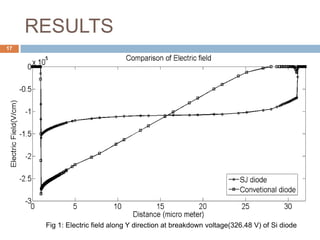
RESULTS
17
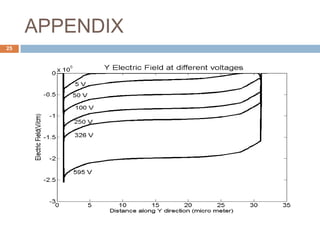
Fig 1: Electric field along Y direction at breakdown voltage(326.48 V) of Si diode
RESULTS
18
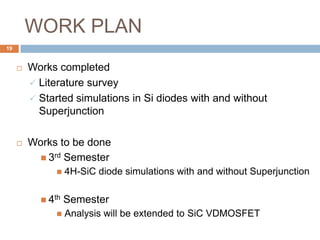
WORK PLAN
 Works completed
 Literature survey
 Started simulations in Si diodes with and without
Superjunction
 Works to be done
 3rd Semester
 4H-SiC diode simulations with and without Superjunction
 4th Semester
 Analysis will be extended to SiC VDMOSFET
19
20
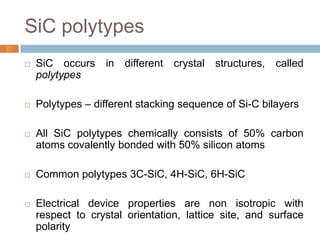
SiC polytypes
 SiC occurs in different crystal structures, called
polytypes
 Polytypes – different stacking sequence of Si-C bilayers
 All SiC polytypes chemically consists of 50% carbon
atoms covalently bonded with 50% silicon atoms
 Common polytypes 3C-SiC, 4H-SiC, 6H-SiC
 Electrical device properties are non isotropic with
respect to crystal orientation, lattice site, and surface
polarity
21
APPENDIX
22
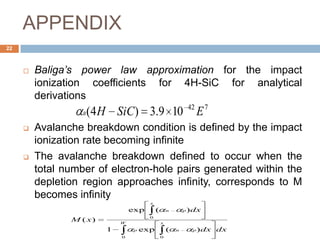
 Baliga’s power law approximation for the impact
ionization coefficients for 4H-SiC for analytical
derivations
 Avalanche breakdown condition is defined by the impact
ionization rate becoming infinite
 The avalanche breakdown defined to occur when the
total number of electron-hole pairs generated within the
depletion region approaches infinity, corresponds to M
becomes infinity
742
109.3)4( ESiCHB
W x
pnp
x
pn
dxdx
dx
xM
0 0
0
)(exp1
)(exp
)(
APPENDIX
23
C
D
E
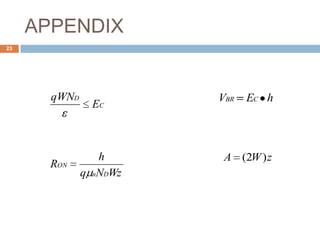
qWN hEV CBR
WzNq
h
R
Dn
ON
zWA )2(
APPENDIX
24
D
i
P
P
A
i
N
N
N
n
L
D
N
n
L
D
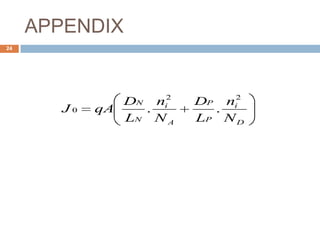
qAJ
22
0 ..
APPENDIX
25
Superjunction concept
 Width(W) of the p and n pillar are should be small as
compared with the height(h), so that horizontal depletion
takes place at a relatively low voltage
 n and the p pillars will be completely depleted well
before the breakdown voltage is reached
 Doping and widths of p and n pillar are chosen such a
way that breakdown happens at the p+ -n drift layer
junction
26
27
 High breakdown field + High thermal conductivity + High
operational junction temperatures = High power density
and efficiency

SUPERJUNCTION IN Silicon Carbide Diodes

  • 1.
    MICROELECTRONICS & VLSIDESIGNMONSOON 2013
  • 2.
    OBJECTIVE  Study of4H-SiC Superjunction power diode by simulation 2
  • 3.
    METHODOLOGY  Literature survey Simulations using semiconductor simulation software Sentaurus 3
  • 4.
    Overview  Introduction  Breakdownvoltage(BV) & Specific on-resistance(Ronsp)  Superjunction concept  Different material comparison  Benefits of Silicon Carbide(SiC)  Results  Work plan 4
  • 5.
    Introduction  In conventionalpower devices, there is a well known trade- off between specific on resistance and breakdown voltage [1]  The idea of a superjunction has been used to improve this relationship from power law to linear [2] [1] C. Hu, “Optimum doping profile for minimum ohmic resistance and high breakdown voltage,” IEEE Trans Electron Devices, Vol.ED-26, pp.243-245, Mar. 1979. [2] Jian Chen, Weifeng Sun et al, “A Review of Superjunction Vertical Diffused MOSFET”, IETE Technical review, Vol29, Issue1, Jan-Feb 2012. 5.2 BVRonsp 5
  • 6.
    How breakdown occurs? BV of a power device is an important parameter governing reverse blocking capability  How breakdown occurs?  Impact ionization, a multiplicative phenomenon leads to avalanche of carriers when breakdown voltage is reached  BV and ND (donor concentration in the uniformly doped n region) relation in a P+N diode is given by [3] 4/315 100.3)4( DNSiCHBV 6 [3] B.J. Baliga, “Breakdown Voltage,” in Silicon Carbide Power Devices, World Scientific Publishing, Singapore 2005, pp. 42-43
  • 7.
    Specific on resistance Inverse relation between Ronsp and ND in a P+N diode is given by[3]  A higher Ronsp adversely affects the performance of the device by increasing conducting loss and lowering switching speed  In conventional power devices the ideal trade-off between Ronsp and BV Dn D onsp Nq W R 5.2 BVRonsp Si limit 7 [3] B.J. Baliga, “Breakdown Voltage,” in Silicon Carbide Power Devices, World Scientific Publishing, Singapore 2005, pp. 42-43
  • 8.
    Superjunction concept PiN diode np n drift region p-pillar h WW p+ n+ n drift region h 2W p+ n+ 8 PiN superjunction diode
  • 9.
    Superjunction concept  Thedrift region of superjunction device is formed of alternate n and p semiconductor stripes  Poisson’s equation for 1D electric field  In a superjunction device, electric field is 2D  For a same applied voltage, peak electric field is reduced for a superjunction diode E y Ey y E x E yx x E y E xy 9
  • 10.
    Superjunction concept  ppillar does not contribute to on-state conduction in the on-state  For a given breakdown voltage, a higher doped drift region can be used and specific on resistance can be reduced  The relation between Ronsp and BV now becomes  Width(W) of the p and n pillar are should be small as compared with the height(h), so that horizontal depletion takes place at a relatively low voltage BVRonsp 10
  • 11.
    MATERIAL PARAMETERS 11 MATERIAL 6H- SiC 4H- SiC 3C- SiC SiGaAs Dielectric constant 9.66 9.7 9.72 11.8 13.1 Band gap(eV) at 300K 3.0 3.2 2.3 1.1 1.42 Intrinsic carrier concentration(cm-3) 10-5 10-7 10 1010 1.8*106 Mobility(μn)(cm2/Vs) ND=1016 cm-3 par:60 per:400 par:800 per:800 750 1200 6500 Mobility(μp)(cm2/Vs) ND=1016 cm-3 90 115 40 420 320 Breakdown field (MVcm-1) at ND=1017 cm-3 par:3.2 per: >1 par:3.0 >1.5 0.6 0.6 Thermal conductivity(Wcm-1K-1) 3-5 3-5 3-5 1.5 0.5 [4] http://www.tf.uni-
  • 12.
    Why SiC?  Electronicsbenefits of SiC  Maintain semiconductor behavior at much higher temperature than silicon  Intrinsic carrier concentrations are negligible, so conductivity is controlled by intentionally introduced dopant impurities  Low junction reverse bias leakage currents  Permits device operation at junction temperatures exceeding 800°C, whereas for Si it is 300°C 12
  • 13.
    Why SiC?  Allowsdevice to be thinner and doped heavily, which implies decrease in blocking region resistance  More efficient removal of heat from active device  More efficient cooling, so cooling hardware requirement for the device is less  Advantages 4H-SiC  Carrier mobility substantially higher compared with 6H SiC  More isotropic nature compared to other polytypes 13
  • 14.
    RESULTS Pravin N. Kondekarand Hawn-Sool Oh, “Analysis of the Breakdown Voltage, the On- Resistance, and the Charge Imbalance of a Super-Junction Power MOSFET”, Journal of the Korean Physical Society, Vol. 44, No. 6, June 2004, pp. 1565-1570 n 7*1014 /cm3 p 7*1014 /cm3 30 μm 5μm5 μm p+ 3*1019 /cm3 n+ 3*1019 /cm3 1 μm 1 μm 14 n 7*1014 /cm3 30 μm 10 μm p+ 3*1019 /cm3 n+ 3*1019 /cm3 1 μm 1 μm
  • 15.
  • 16.
  • 17.
    RESULTS 17 Fig 1: Electricfield along Y direction at breakdown voltage(326.48 V) of Si diode
  • 18.
  • 19.
    WORK PLAN  Workscompleted  Literature survey  Started simulations in Si diodes with and without Superjunction  Works to be done  3rd Semester  4H-SiC diode simulations with and without Superjunction  4th Semester  Analysis will be extended to SiC VDMOSFET 19
  • 20.
  • 21.
    SiC polytypes  SiCoccurs in different crystal structures, called polytypes  Polytypes – different stacking sequence of Si-C bilayers  All SiC polytypes chemically consists of 50% carbon atoms covalently bonded with 50% silicon atoms  Common polytypes 3C-SiC, 4H-SiC, 6H-SiC  Electrical device properties are non isotropic with respect to crystal orientation, lattice site, and surface polarity 21
  • 22.
    APPENDIX 22  Baliga’s powerlaw approximation for the impact ionization coefficients for 4H-SiC for analytical derivations  Avalanche breakdown condition is defined by the impact ionization rate becoming infinite  The avalanche breakdown defined to occur when the total number of electron-hole pairs generated within the depletion region approaches infinity, corresponds to M becomes infinity 742 109.3)4( ESiCHB W x pnp x pn dxdx dx xM 0 0 0 )(exp1 )(exp )(
  • 23.
  • 24.
  • 25.
  • 26.
    Superjunction concept  Width(W)of the p and n pillar are should be small as compared with the height(h), so that horizontal depletion takes place at a relatively low voltage  n and the p pillars will be completely depleted well before the breakdown voltage is reached  Doping and widths of p and n pillar are chosen such a way that breakdown happens at the p+ -n drift layer junction 26
  • 27.
    27  High breakdownfield + High thermal conductivity + High operational junction temperatures = High power density and efficiency