
Using virtual reality when learning
foreign languages
• Dr. Eileen O’Connor
• State University of New York (SUNY) – Empire State College
• April 18, 2017
• Agenda
 Overview
 Educational perspectives on virtual reality learning
 Accessing Second Life and open-source islands
 Examples of islands and environments
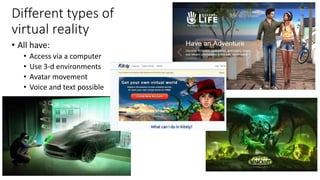
Different types of
virtual reality
• All have:
• Access via a computer
• Use 3-d environments
• Avatar movement
• Voice and text possible
Why use virtual reality to learn
foreign language?
• Language input options with Second Life
• Meet with native speakers in the target language
• Engage in historical / cultural experiences
• Visit language-learning focused locations
• Immerse yourself in a different language with less personal “stress”
Learning within the space itself – automatic
gestures are available
• “. . . if the association of a gesture to a word can enhance verbal
memory, then VR offers a privileged medium in which to implement
the training. In fact, it gives users the opportunity to see themselves
moving in the environment while being comfortably seated in a chair.”
Frontiers in Psychology – Educational Psychology, 06 November 2014, C.
Repetto
• http://journal.frontiersin.org/article/10.3389/fpsyg.2014.01280/full
Use the social aspects of learning another
language
• “Using virtual reality in language teaching can foster learning in that
learners can behave differently in an online platform. People’s
behavior can change or at least appear to be different when working
online compared to the behavior they would display in a classroom
setting . . . Teachers can benefit from this situation by integrating
virtual reality into traditional classrooms. Virtual reality is an ideal
language learning environment that includes social learning,
immersive learning, creativity and relevance. In 3D virtual
environment, learners meet with others; they share and use their
creativity by means of telepresence”
• http://www.partedres.com/archieve/spi_15_2/3_per_15_spi_2_3_Page_21_26.pdf
• Participatory Educational Research (PER) Special Issue 2015-II, pp., 21-26; 5-7 November, 2015 Available online at
http://www.partedres.com ISSN: 2148-6123 http://dx.doi.org/10.17275/per.15.spi.2.3
• A Content Analysis of Virtual Reality Studies in Foreign Language Education
• Ekrem SOLAK* and Gamze ERDEM
Reduced learning anxiety & increased
creativity
• “The related studies have consistently found that VLEs increase learner
autonomy and self-efficacy, reduce learning anxiety, and foster creativity.
VR presents a realistic virtual space and visible “classmates” who assist
students in gaining a sense of participation and building emotional bonds
(positive or negative) with their collaborative partners.”
• “Regardless of the original purposes for which VLEs were designed,
researchers in the computer-assisted language learning (CALL) field have
tried to employ pedagogical principles and practices that are innovative
and theoretically grounded to understand the pedagogical values of VLEs in
language learning.”
• http://www.ifets.info/journals/18_4/37.pdf
• Lin, T. J., & Lan, Y. J. (2015). Language Learning in Virtual Reality Environments: Past, Present, and
Future. Educational Technology & Society, 18 (4), 486–497.
Practice the language with native speakers
• http://www.ifets.info/journals/18_4/37.pdf
• Lin, T. J., & Lan, Y. J. (2015). Language Learning in Virtual Reality Environments: Past, Present, and
Future. Educational Technology & Society, 18 (4), 486–497.
• “The FL setting was found to be the most common in the VR
publications analyzed. This is not surprising, given that FL learners
often do not have ready access to a suitable environment in which
to practice and use the target language. VLEs can overcome this
difficulty by providing an immersive and authentic environment to
socially interact with native speakers.”
• VR research seems to be potentially useful but the role of the teacher
in creating the pedagogical interactions has yet to be studied
adequately
Various ways that Virtual Reality can be used
in foreign language learning
• As an immersive environment to participate in a foreign language
without having to travel to distant locations; safe space within which
to work
• As a location to visit with colleagues from course and/or with the
course instructor
• As a place to immerse yourself in another culture, particularly if there
are authentic buildings and events from that culture
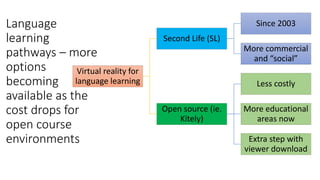
Language
learning
pathways – more
options
becoming
available as the
cost drops for
open course
environments
Virtual reality for
language learning
Second Life (SL)
Since 2003
More commercial
and “social”
Open source (ie.
Kitely)
Less costly
More educational
areas now
Extra step with
viewer download
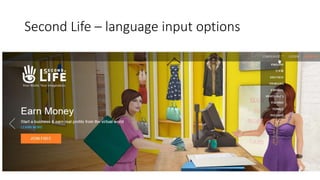
Second Life – language input options
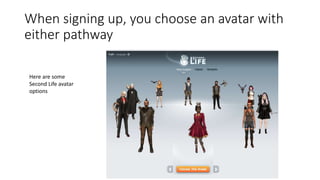
When signing up, you choose an avatar with
either pathway
Here are some
Second Life avatar
options
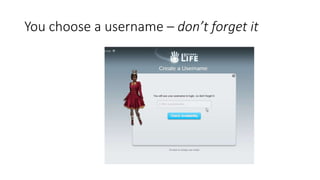
You choose a username – don’t forget it
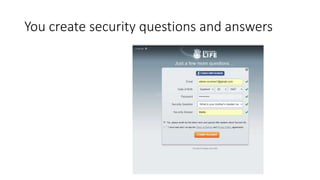
You create security questions and answers
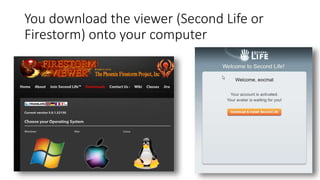
You download the viewer (Second Life or
Firestorm) onto your computer
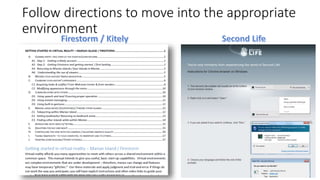
Follow directions to move into the appropriate
environment
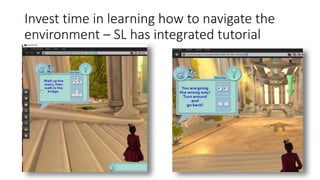
Invest time in learning how to navigate the
environment – SL has integrated tutorial
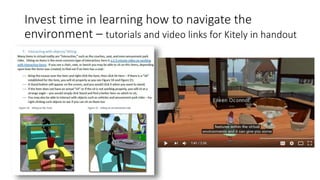
Invest time in learning how to navigate the
environment – tutorials and video links for Kitely in handout
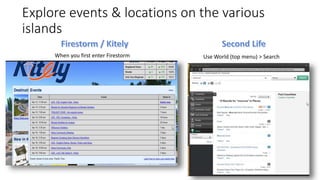
Explore events & locations on the various
islands
When you first enter Firestorm Use World (top menu) > Search
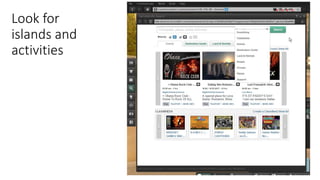
Look for
islands and
activities
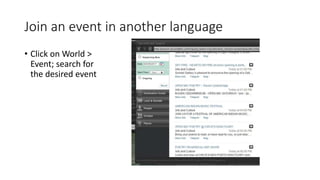
Join an event in another language
• Click on World >
Event; search for
the desired event
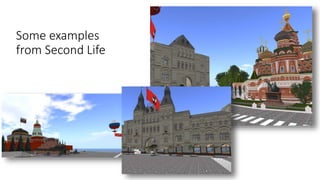
Some examples
from Second Life
Some examples
from Second Life
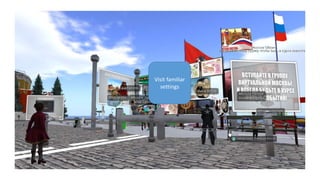
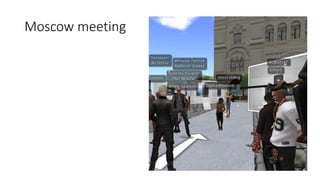
Visit familiar
settings
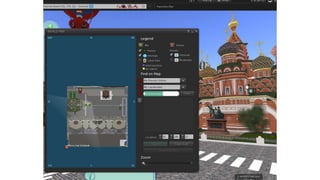
Moscow meeting
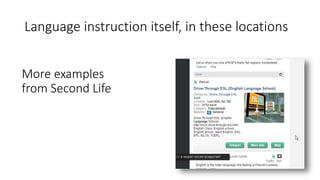
Language instruction itself, in these locations
More examples
from Second Life
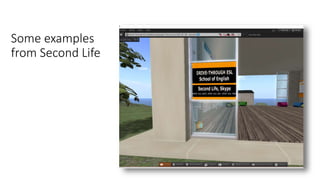
Some examples
from Second Life
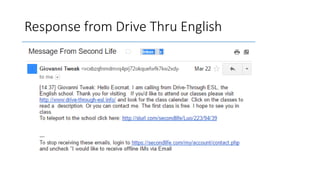
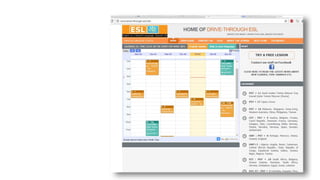
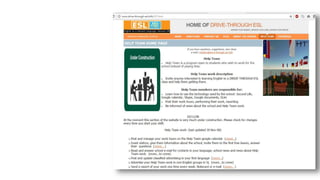
Response from Drive Thru English
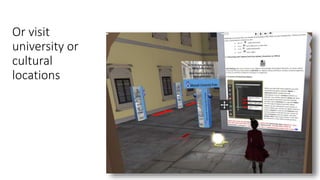
Or visit
university or
cultural
locations
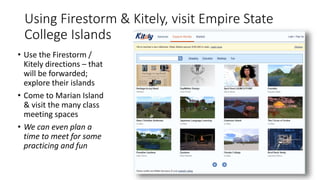
Using Firestorm & Kitely, visit Empire State
College Islands
• Use the Firestorm /
Kitely directions – that
will be forwarded;
explore their islands
• Come to Marian Island
& visit the many class
meeting spaces
• We can even plan a
time to meet for some
practicing and fun
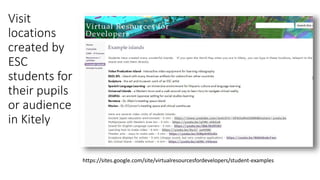
Visit
locations
created by
ESC
students for
their pupils
or audience
in Kitely
https://sites.google.com/site/virtualresourcesfordevelopers/student-examples
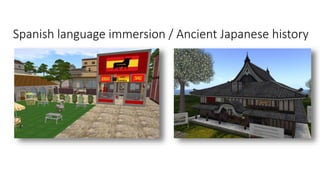
Spanish language immersion / Ancient Japanese history
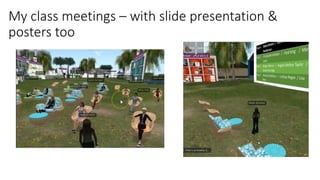
My class meetings – with slide presentation &
posters too
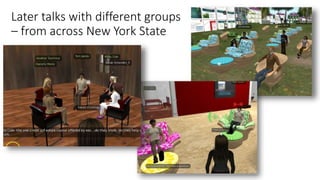
Later talks with different groups
– from across New York State
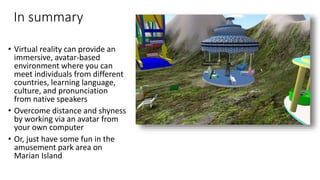
In summary
• Virtual reality can provide an
immersive, avatar-based
environment where you can
meet individuals from different
countries, learning language,
culture, and pronunciation
from native speakers
• Overcome distance and shyness
by working via an avatar from
your own computer
• Or, just have some fun in the
amusement park area on
Marian Island

Using virtual reality for learning foreign languages

  • 1.
    Using virtual realitywhen learning foreign languages • Dr. Eileen O’Connor • State University of New York (SUNY) – Empire State College • April 18, 2017 • Agenda  Overview  Educational perspectives on virtual reality learning  Accessing Second Life and open-source islands  Examples of islands and environments
  • 2.
    Different types of virtualreality • All have: • Access via a computer • Use 3-d environments • Avatar movement • Voice and text possible
  • 3.
    Why use virtualreality to learn foreign language? • Language input options with Second Life • Meet with native speakers in the target language • Engage in historical / cultural experiences • Visit language-learning focused locations • Immerse yourself in a different language with less personal “stress”
  • 4.
    Learning within thespace itself – automatic gestures are available • “. . . if the association of a gesture to a word can enhance verbal memory, then VR offers a privileged medium in which to implement the training. In fact, it gives users the opportunity to see themselves moving in the environment while being comfortably seated in a chair.” Frontiers in Psychology – Educational Psychology, 06 November 2014, C. Repetto • http://journal.frontiersin.org/article/10.3389/fpsyg.2014.01280/full
  • 5.
    Use the socialaspects of learning another language • “Using virtual reality in language teaching can foster learning in that learners can behave differently in an online platform. People’s behavior can change or at least appear to be different when working online compared to the behavior they would display in a classroom setting . . . Teachers can benefit from this situation by integrating virtual reality into traditional classrooms. Virtual reality is an ideal language learning environment that includes social learning, immersive learning, creativity and relevance. In 3D virtual environment, learners meet with others; they share and use their creativity by means of telepresence” • http://www.partedres.com/archieve/spi_15_2/3_per_15_spi_2_3_Page_21_26.pdf • Participatory Educational Research (PER) Special Issue 2015-II, pp., 21-26; 5-7 November, 2015 Available online at http://www.partedres.com ISSN: 2148-6123 http://dx.doi.org/10.17275/per.15.spi.2.3 • A Content Analysis of Virtual Reality Studies in Foreign Language Education • Ekrem SOLAK* and Gamze ERDEM
  • 6.
    Reduced learning anxiety& increased creativity • “The related studies have consistently found that VLEs increase learner autonomy and self-efficacy, reduce learning anxiety, and foster creativity. VR presents a realistic virtual space and visible “classmates” who assist students in gaining a sense of participation and building emotional bonds (positive or negative) with their collaborative partners.” • “Regardless of the original purposes for which VLEs were designed, researchers in the computer-assisted language learning (CALL) field have tried to employ pedagogical principles and practices that are innovative and theoretically grounded to understand the pedagogical values of VLEs in language learning.” • http://www.ifets.info/journals/18_4/37.pdf • Lin, T. J., & Lan, Y. J. (2015). Language Learning in Virtual Reality Environments: Past, Present, and Future. Educational Technology & Society, 18 (4), 486–497.
  • 7.
    Practice the languagewith native speakers • http://www.ifets.info/journals/18_4/37.pdf • Lin, T. J., & Lan, Y. J. (2015). Language Learning in Virtual Reality Environments: Past, Present, and Future. Educational Technology & Society, 18 (4), 486–497. • “The FL setting was found to be the most common in the VR publications analyzed. This is not surprising, given that FL learners often do not have ready access to a suitable environment in which to practice and use the target language. VLEs can overcome this difficulty by providing an immersive and authentic environment to socially interact with native speakers.” • VR research seems to be potentially useful but the role of the teacher in creating the pedagogical interactions has yet to be studied adequately
  • 8.
    Various ways thatVirtual Reality can be used in foreign language learning • As an immersive environment to participate in a foreign language without having to travel to distant locations; safe space within which to work • As a location to visit with colleagues from course and/or with the course instructor • As a place to immerse yourself in another culture, particularly if there are authentic buildings and events from that culture
  • 9.
    Language learning pathways – more options becoming availableas the cost drops for open course environments Virtual reality for language learning Second Life (SL) Since 2003 More commercial and “social” Open source (ie. Kitely) Less costly More educational areas now Extra step with viewer download
  • 10.
    Second Life –language input options
  • 11.
    When signing up,you choose an avatar with either pathway Here are some Second Life avatar options
  • 12.
    You choose ausername – don’t forget it
  • 13.
    You create securityquestions and answers
  • 14.
    You download theviewer (Second Life or Firestorm) onto your computer
  • 15.
    Follow directions tomove into the appropriate environment
  • 16.
    Invest time inlearning how to navigate the environment – SL has integrated tutorial
  • 17.
    Invest time inlearning how to navigate the environment – tutorials and video links for Kitely in handout
  • 18.
    Explore events &locations on the various islands When you first enter Firestorm Use World (top menu) > Search
  • 19.
  • 20.
    Join an eventin another language • Click on World > Event; search for the desired event
  • 21.
  • 23.
  • 24.
  • 25.
  • 26.
    Language instruction itself,in these locations More examples from Second Life
  • 27.
  • 28.
    Response from DriveThru English
  • 31.
  • 32.
    Using Firestorm &Kitely, visit Empire State College Islands • Use the Firestorm / Kitely directions – that will be forwarded; explore their islands • Come to Marian Island & visit the many class meeting spaces • We can even plan a time to meet for some practicing and fun
  • 33.
    Visit locations created by ESC students for theirpupils or audience in Kitely https://sites.google.com/site/virtualresourcesfordevelopers/student-examples
  • 34.
    Spanish language immersion/ Ancient Japanese history
  • 35.
    My class meetings– with slide presentation & posters too
  • 36.
    Later talks withdifferent groups – from across New York State
  • 37.
    In summary • Virtualreality can provide an immersive, avatar-based environment where you can meet individuals from different countries, learning language, culture, and pronunciation from native speakers • Overcome distance and shyness by working via an avatar from your own computer • Or, just have some fun in the amusement park area on Marian Island