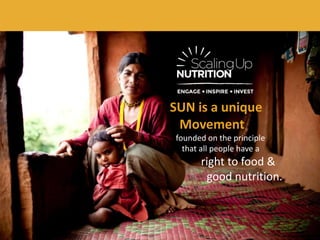
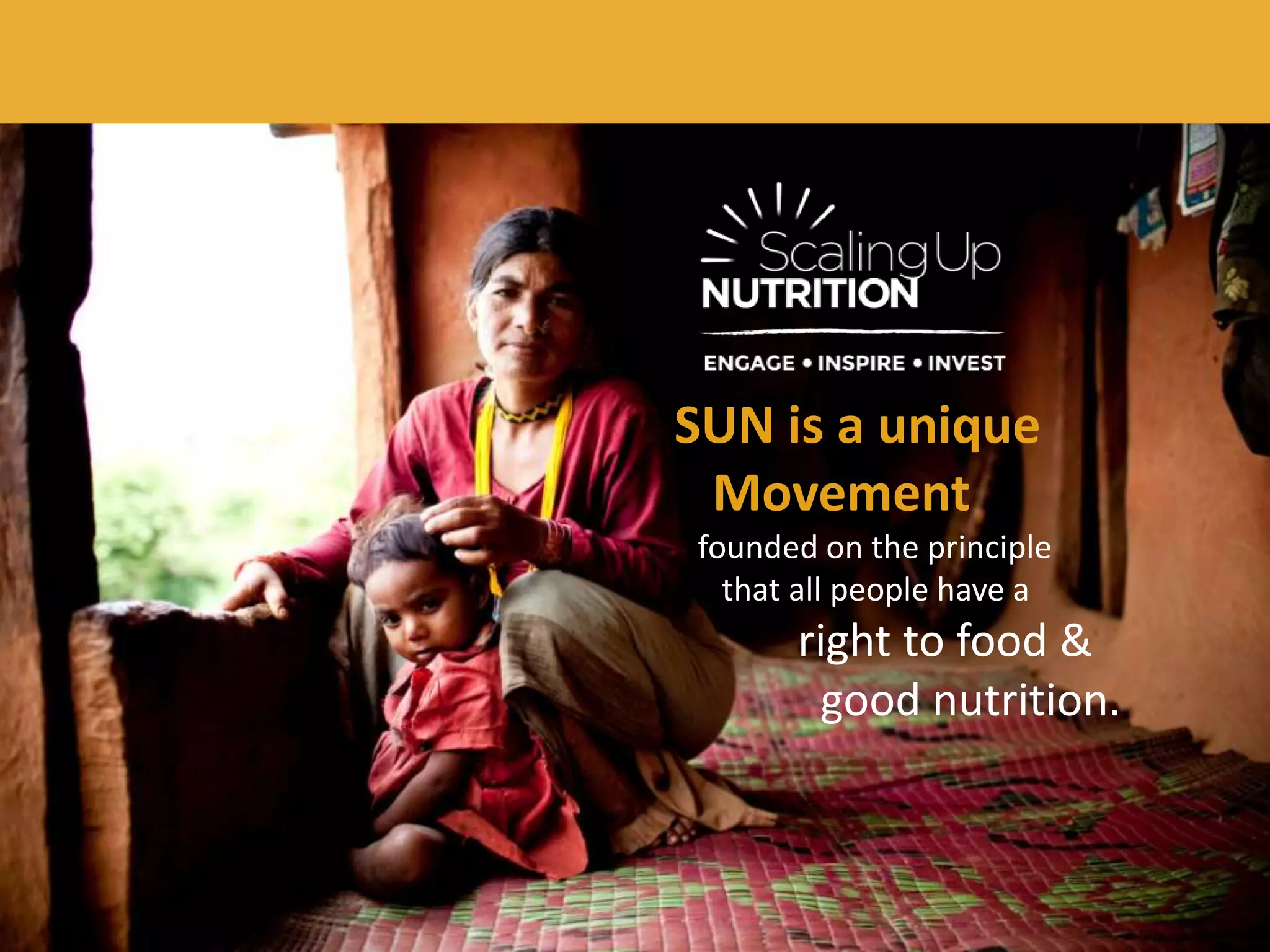
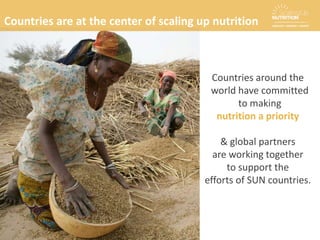
SUN is a unique
Movement
founded on the principle
that all people have a
right to food &
good nutrition.
Over 165 million children under 5
are stunted as a result of malnutrition.
• 52 million children are too thin and require special
treatment.
• At the same time, 43 million children are overweight -
some as a result of poverty, when families are unable to
afford a balanced, nutritious diet.
• 2 billion people are deficient in key vitamins & minerals
Why nutrition? The facts
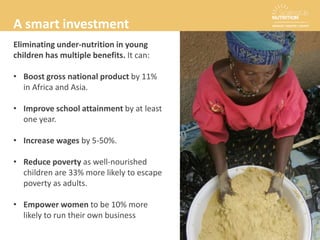
Eliminating under-nutrition in young
children has multiple benefits. It can:
• Boost gross national product by 11%
in Africa and Asia.
• Improve school attainment by at least
one year.
• Increase wages by 5-50%.
• Reduce poverty as well-nourished
children are 33% more likely to escape
poverty as adults.
• Empower women to be 10% more
likely to run their own business
A smart investment
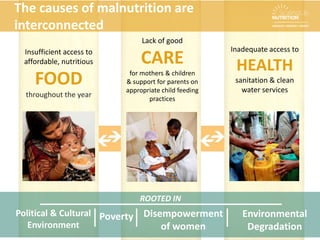
ROOTED IN
Poverty Disempowerment
of women
Political & Cultural
Environment
Insufficient access to
affordable, nutritious
FOOD
throughout the year
Lack of good
CARE
for mothers & children
& support for parents on
appropriate child feeding
practices
Inadequate access to
HEALTH
sanitation & clean
water services
The causes of malnutrition are
interconnected
Environmental
Degradation
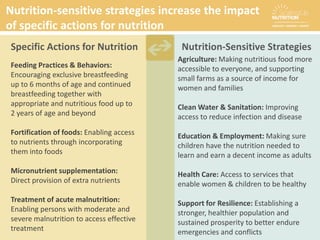
Feeding Practices & Behaviors:
Encouraging exclusive breastfeeding
up to 6 months of age and continued
breastfeeding together with
appropriate and nutritious food up to
2 years of age and beyond
Fortification of foods: Enabling access
to nutrients through incorporating
them into foods
Micronutrient supplementation:
Direct provision of extra nutrients
Treatment of acute malnutrition:
Enabling persons with moderate and
severe malnutrition to access effective
treatment
Agriculture: Making nutritious food more
accessible to everyone, and supporting
small farms as a source of income for
women and families
Clean Water & Sanitation: Improving
access to reduce infection and disease
Education & Employment: Making sure
children have the nutrition needed to
learn and earn a decent income as adults
Health Care: Access to services that
enable women & children to be healthy
Support for Resilience: Establishing a
stronger, healthier population and
sustained prosperity to better endure
emergencies and conflicts
Nutrition-Sensitive StrategiesSpecific Actions for Nutrition
Nutrition-sensitive strategies increase the impact of
specific actions for nutrition
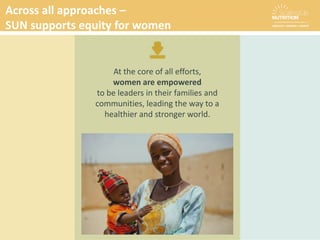
Across all approaches –
enabling equity for women
At the core of all efforts,
women are empowered
to be leaders in their families and
communities, leading the way to a
healthier and stronger world.
The SUN approach
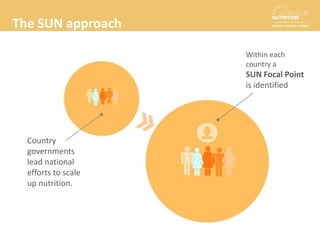
Country
governments
lead national
efforts to scale
up nutrition.
Within each
country a
SUN Focal Point
is identified
The SUN approach
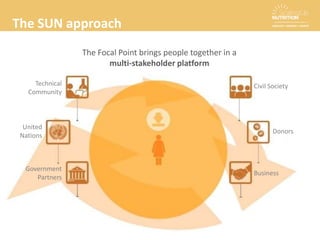
The Focal Point brings people together in a
multi-stakeholder platform
Technical
Community
United
Nations
Government
Partners
Civil Society
Donors
Business
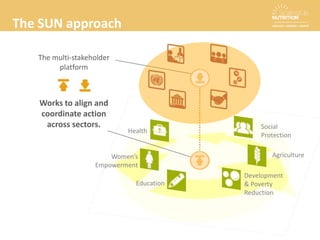
The SUN approach
The multi-stakeholder
platform
Works to align and
coordinate action
across sectors.
Women’s
Empowerment
Health
Development
& Poverty
Reduction
Agriculture
Education
Social
Protection
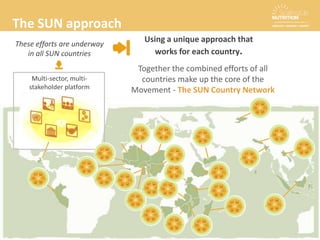
The SUN approach
Using a unique approach that
works for each country.
These efforts are underway
in all SUN countries
Multi-sector, multi-
stakeholder platform
Together the combined efforts of all
countries make up the core of the
Movement - The SUN Country Network
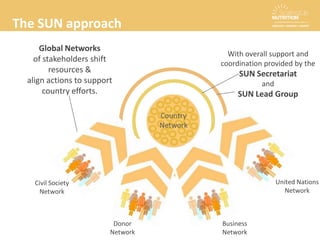
With overall support and
coordination provided by the
SUN Secretariat
and
SUN Lead Group
Country
Network
Donor
Network
Civil Society
Network
Business
Network
United Nations
Network
Global Networks
of stakeholders shift
resources &
align actions to support
country efforts.
The SUN approach
September 2013
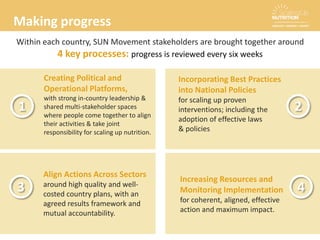
Making progress
Creating Political and
Operational Platforms,
with strong in-country leadership &
shared multi-stakeholder spaces
where people come together to align
their activities & take joint
responsibility for scaling up nutrition.
Incorporating Best Practices
into National Policies
for scaling up proven
interventions; including the
adoption of effective laws
& policies
Align Actions Across Sectors
around high quality and well-
costed country plans, with an
agreed results framework and
mutual accountability.
Increasing Resources and
Monitoring Implementation
for coherent, aligned, effective
action and maximum impact.
1 2
3 4
Within each country, SUN Movement stakeholders are brought together around
4 key processes: progress is reviewed every six weeks
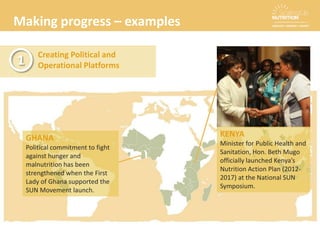
Making progress – examples
Creating Political and
Operational Platforms1
GHANA
Political commitment to fight
against hunger and
malnutrition has been
strengthened when the First
Lady of Ghana supported the
SUN Movement launch.
KENYA
Minister for Public Health and
Sanitation, Hon. Beth Mugo
officially launched Kenya’s
Nutrition Action Plan (2012-
2017) at the National SUN
Symposium.
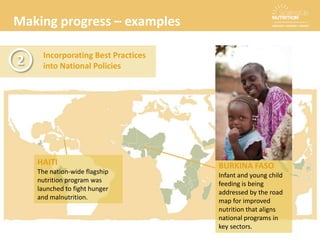
Making progress – examples
Incorporating Best Practices
into National Policies2
BURKINA FASO
Infant and young child
feeding is being
addressed by the road
map for improved
nutrition that aligns
national programs in
key sectors.
HAITI
The nation-wide flagship
nutrition program was
launched to fight hunger
and malnutrition.
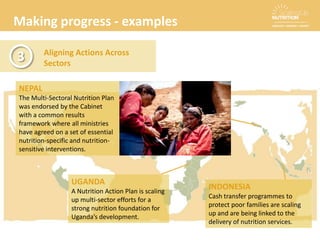
Making progress - examples
Aligning Actions Across
Sectors
3
NEPAL
The Multi-Sectoral Nutrition Plan
was endorsed by the Cabinet
with a common results
framework where all ministries
have agreed on a set of essential
nutrition-specific and nutrition-
sensitive interventions.
UGANDA
A Nutrition Action Plan is scaling
up multi-sector efforts for a
strong nutrition foundation for
Uganda’s development.
INDONESIA
Cash transfer programmes to
protect poor families are scaling
up and are being linked to the
delivery of nutrition services.
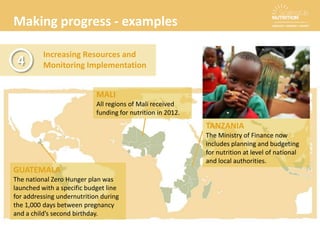
Making progress - examples
Increasing Resources and
Monitoring Implementation4
GUATEMALA
The national Zero Hunger plan was
launched with a specific budget line
for addressing undernutrition during
the 1,000 days between pregnancy
and a child’s second birthday.
MALI
All regions of Mali received
funding for nutrition in 2012.
TANZANIA
The Ministry of Finance now
includes planning and budgeting
for nutrition at level of national
and local authorities.
Tracking and reporting impact
Establishing targets to measure impact: Countries are encouraged to
establish their own targets for nutrition goals in the following areas:
• Universal access to affordable nutritious food, clean water, sanitation, healthcare and
social protection
• Increased adoption of practices that contribute to good nutrition (such as exclusive
breastfeeding in the first six months of life)
• Optimal growth of children, demonstrated as reduced levels of stunting (low height for
age) and wasting (low weight for height)
• Improved micronutrient status, especially in women and children, demonstrated as
reduced levels of micronutrient deficiency
Annual SUN Movement Progress Report: Released in September each
year by the SUN Movement Secretariat, the report provides updates on
progress in achieving the Movement’s goals and strategic objectives.
Supporting global impact
Together, countries and supporting stakeholders are
collectively working to reach the global targets set out by the
World Health Assembly 2012 Resolution:
Reducing and maintaining childhood
wasting to less than 5%
Target 1:
Target 2:
Target 3:
Target 4:
Target 5:
Target 6:
40% reduction of the global number of
children under 5 who are stunted
50% reduction of anemia in women of
reproductive age
30% reduction of low birth weight
No increase in childhood overweight
Increase exclusive breastfeeding rates in
the first 6 months up to at least 50%
to learn and adapt through regular sharing of the relevant
critical lessons, what works and what does not, across sectors,
countries and stakeholders.
SUN principles of engagement
Be transparent
about impact:
all stakeholders to transparently and honestly demonstrate the
impact of collective action.
through open multi-stakeholder partnerships that bring proven
solutions and interventions to scale.
Be inclusive:
act in line with a commitment to uphold the equity and rights of
all women, men and their children.
Be rights-based:
Be willing
to negotiate:
when conflicts arise, as can be expected with diverse partners
working together, hold the intention to resolve conflicts and
reach a way forward.
Be mutually
accountable:
act so all stakeholders feel responsible for and are held collectively
accountable to the joint commitments.
Be cost effective: establish priorities on evidenced-based analysis of what will have
the greatest and most sustainable impact for the least cost.
Be continuously
communicative:
The SUN Movement evolves.
2010
2011
2012
The way forward.
SUN Framework for
Action is developed
& endorsed by over
100 global entities –
establishing the
foundation for the
Movement.
SUN builds
momentum and
commitment for
scaling up
nutrition –
19 countries join
the Movement.
The Movement grows
to 33 countries & a
high-level group of 27
international leaders
are appointed to the
SUN Lead Group &
endorse the SUN
Movement Strategy
for 2012-2015
In 2013, SUN will focus
on mobilizing resources
behind
national movements, to
achieve measurable
progress & impact.
The SUN Movement
is growing in numbers & strength
100+ global stakeholders
are providing support to
50 countries
with the opportunity to reach
over
82.8 million stunted
children
BANGLADESH
INDONESIA
KYRGYZSTAN
LAOPDR
MYANMAR
NEPAL
PAKISTAN
SRI LANKA
TAJIKISTAN
VIETNAM
YEMEN
ASIA
50 countries: 21 rapidly reducing prevalence of stunting
COSTARICA
ELSALVADOR
GUATEMALA
HAITI
PERU
BENIN
BURKINAFASO
BURUNDI
CAMEROON
CHAD
COMOROS
COTED’IVOIRE
DEMOCRATICREPUBLICOF
CONGO
REPUBLICofCONGO
ETHIOPIA
GAMBIA
NIGERIA
RWANDA
SENEGAL
SIERRALEONE
SOUTHSUDAN
SWAZILAND
TANZANIA
TOGO
UGANDA
ZAMBIA
ZIMBABWE
AFRICA
Since2000,21SUNCountries(indicatedinRED)
haveacceleratetheiraverageannualrateofreductionofchronicmalnutrition
(orstunting)
inchildrenunder5yearsat
morethan2%peryear
LATIN AMERICA
GHANA
GUINEA
GUINEA-BISSAU
KENYA
LIBERIA
MADAGASCAR
MALAWI
MALI
MAURITANIA
MOZAMBIQUE
NAMIBIA
NIGER March 2014
Together….
We are revealing what
has been hidden to all.
We are making healthier
& stronger societies.
Our goal is a better
world for all
…especially our
children
Thank you
• Slide 4 – Why Nutrition The Facts: UNICEF-WHO-The World Bank: Joint child malnutrition estimates -
Levels and trends. Global Database on Child Growth and Malnutrition
• Slide 6 – A Smart Investment: Lawrence Haddad. Child Growth=Sustainable Economic Growth: Why
we should invest in Nutrition. May 2013
• Slide 7- Experts Agree: Copenhagen Consensus: Solving the world’s challenges. May 2012
• Slides 31- SUN Countries’ success in reducing stunting: The number of countries with AARRs greater
than 2% is calculated based on historical data from 2000 to beginning of 2014. This figure is currently
under review, and the new number will be reported once the reanalysis of latest available data is
finished.
The SUN Movement Secretariat is supported by Canada, France, Germany, Ireland, the Netherlands, the
United Kingdom and the European Union.
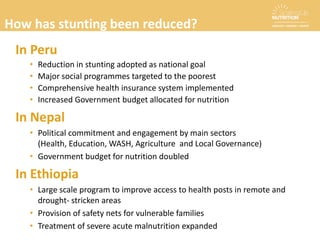
How has stunting been reduced?References and Technical Notes
April 2014

SUN Movement Presentation - April 2014 (ENGLISH)

  • 1.
    SUN is aunique Movement founded on the principle that all people have a right to food & good nutrition.
  • 2.
    Over 165 millionchildren under 5 are stunted as a result of malnutrition. • 52 million children are too thin and require special treatment. • At the same time, 43 million children are overweight - some as a result of poverty, when families are unable to afford a balanced, nutritious diet. • 2 billion people are deficient in key vitamins & minerals Why nutrition? The facts
  • 3.
    Eliminating under-nutrition inyoung children has multiple benefits. It can: • Boost gross national product by 11% in Africa and Asia. • Improve school attainment by at least one year. • Increase wages by 5-50%. • Reduce poverty as well-nourished children are 33% more likely to escape poverty as adults. • Empower women to be 10% more likely to run their own business A smart investment
  • 4.
    ROOTED IN Poverty Disempowerment ofwomen Political & Cultural Environment Insufficient access to affordable, nutritious FOOD throughout the year Lack of good CARE for mothers & children & support for parents on appropriate child feeding practices Inadequate access to HEALTH sanitation & clean water services The causes of malnutrition are interconnected Environmental Degradation
  • 5.
    Feeding Practices &Behaviors: Encouraging exclusive breastfeeding up to 6 months of age and continued breastfeeding together with appropriate and nutritious food up to 2 years of age and beyond Fortification of foods: Enabling access to nutrients through incorporating them into foods Micronutrient supplementation: Direct provision of extra nutrients Treatment of acute malnutrition: Enabling persons with moderate and severe malnutrition to access effective treatment Agriculture: Making nutritious food more accessible to everyone, and supporting small farms as a source of income for women and families Clean Water & Sanitation: Improving access to reduce infection and disease Education & Employment: Making sure children have the nutrition needed to learn and earn a decent income as adults Health Care: Access to services that enable women & children to be healthy Support for Resilience: Establishing a stronger, healthier population and sustained prosperity to better endure emergencies and conflicts Nutrition-Sensitive StrategiesSpecific Actions for Nutrition Nutrition-sensitive strategies increase the impact of specific actions for nutrition
  • 6.
    Across all approaches– enabling equity for women At the core of all efforts, women are empowered to be leaders in their families and communities, leading the way to a healthier and stronger world.
  • 7.
    The SUN approach Country governments leadnational efforts to scale up nutrition. Within each country a SUN Focal Point is identified
  • 8.
    The SUN approach TheFocal Point brings people together in a multi-stakeholder platform Technical Community United Nations Government Partners Civil Society Donors Business
  • 9.
    The SUN approach Themulti-stakeholder platform Works to align and coordinate action across sectors. Women’s Empowerment Health Development & Poverty Reduction Agriculture Education Social Protection
  • 10.
    The SUN approach Usinga unique approach that works for each country. These efforts are underway in all SUN countries Multi-sector, multi- stakeholder platform Together the combined efforts of all countries make up the core of the Movement - The SUN Country Network
  • 11.
    With overall supportand coordination provided by the SUN Secretariat and SUN Lead Group Country Network Donor Network Civil Society Network Business Network United Nations Network Global Networks of stakeholders shift resources & align actions to support country efforts. The SUN approach September 2013
  • 12.
    Making progress Creating Politicaland Operational Platforms, with strong in-country leadership & shared multi-stakeholder spaces where people come together to align their activities & take joint responsibility for scaling up nutrition. Incorporating Best Practices into National Policies for scaling up proven interventions; including the adoption of effective laws & policies Align Actions Across Sectors around high quality and well- costed country plans, with an agreed results framework and mutual accountability. Increasing Resources and Monitoring Implementation for coherent, aligned, effective action and maximum impact. 1 2 3 4 Within each country, SUN Movement stakeholders are brought together around 4 key processes: progress is reviewed every six weeks
  • 13.
    Making progress –examples Creating Political and Operational Platforms1 GHANA Political commitment to fight against hunger and malnutrition has been strengthened when the First Lady of Ghana supported the SUN Movement launch. KENYA Minister for Public Health and Sanitation, Hon. Beth Mugo officially launched Kenya’s Nutrition Action Plan (2012- 2017) at the National SUN Symposium.
  • 14.
    Making progress –examples Incorporating Best Practices into National Policies2 BURKINA FASO Infant and young child feeding is being addressed by the road map for improved nutrition that aligns national programs in key sectors. HAITI The nation-wide flagship nutrition program was launched to fight hunger and malnutrition.
  • 15.
    Making progress -examples Aligning Actions Across Sectors 3 NEPAL The Multi-Sectoral Nutrition Plan was endorsed by the Cabinet with a common results framework where all ministries have agreed on a set of essential nutrition-specific and nutrition- sensitive interventions. UGANDA A Nutrition Action Plan is scaling up multi-sector efforts for a strong nutrition foundation for Uganda’s development. INDONESIA Cash transfer programmes to protect poor families are scaling up and are being linked to the delivery of nutrition services.
  • 16.
    Making progress -examples Increasing Resources and Monitoring Implementation4 GUATEMALA The national Zero Hunger plan was launched with a specific budget line for addressing undernutrition during the 1,000 days between pregnancy and a child’s second birthday. MALI All regions of Mali received funding for nutrition in 2012. TANZANIA The Ministry of Finance now includes planning and budgeting for nutrition at level of national and local authorities.
  • 17.
    Tracking and reportingimpact Establishing targets to measure impact: Countries are encouraged to establish their own targets for nutrition goals in the following areas: • Universal access to affordable nutritious food, clean water, sanitation, healthcare and social protection • Increased adoption of practices that contribute to good nutrition (such as exclusive breastfeeding in the first six months of life) • Optimal growth of children, demonstrated as reduced levels of stunting (low height for age) and wasting (low weight for height) • Improved micronutrient status, especially in women and children, demonstrated as reduced levels of micronutrient deficiency Annual SUN Movement Progress Report: Released in September each year by the SUN Movement Secretariat, the report provides updates on progress in achieving the Movement’s goals and strategic objectives.
  • 18.
    Supporting global impact Together,countries and supporting stakeholders are collectively working to reach the global targets set out by the World Health Assembly 2012 Resolution: Reducing and maintaining childhood wasting to less than 5% Target 1: Target 2: Target 3: Target 4: Target 5: Target 6: 40% reduction of the global number of children under 5 who are stunted 50% reduction of anemia in women of reproductive age 30% reduction of low birth weight No increase in childhood overweight Increase exclusive breastfeeding rates in the first 6 months up to at least 50%
  • 19.
    to learn andadapt through regular sharing of the relevant critical lessons, what works and what does not, across sectors, countries and stakeholders. SUN principles of engagement Be transparent about impact: all stakeholders to transparently and honestly demonstrate the impact of collective action. through open multi-stakeholder partnerships that bring proven solutions and interventions to scale. Be inclusive: act in line with a commitment to uphold the equity and rights of all women, men and their children. Be rights-based: Be willing to negotiate: when conflicts arise, as can be expected with diverse partners working together, hold the intention to resolve conflicts and reach a way forward. Be mutually accountable: act so all stakeholders feel responsible for and are held collectively accountable to the joint commitments. Be cost effective: establish priorities on evidenced-based analysis of what will have the greatest and most sustainable impact for the least cost. Be continuously communicative:
  • 20.
    The SUN Movementevolves. 2010 2011 2012 The way forward. SUN Framework for Action is developed & endorsed by over 100 global entities – establishing the foundation for the Movement. SUN builds momentum and commitment for scaling up nutrition – 19 countries join the Movement. The Movement grows to 33 countries & a high-level group of 27 international leaders are appointed to the SUN Lead Group & endorse the SUN Movement Strategy for 2012-2015 In 2013, SUN will focus on mobilizing resources behind national movements, to achieve measurable progress & impact.
  • 21.
    The SUN Movement isgrowing in numbers & strength 100+ global stakeholders are providing support to 50 countries with the opportunity to reach over 82.8 million stunted children
  • 22.
    BANGLADESH INDONESIA KYRGYZSTAN LAOPDR MYANMAR NEPAL PAKISTAN SRI LANKA TAJIKISTAN VIETNAM YEMEN ASIA 50 countries:21 rapidly reducing prevalence of stunting COSTARICA ELSALVADOR GUATEMALA HAITI PERU BENIN BURKINAFASO BURUNDI CAMEROON CHAD COMOROS COTED’IVOIRE DEMOCRATICREPUBLICOF CONGO REPUBLICofCONGO ETHIOPIA GAMBIA NIGERIA RWANDA SENEGAL SIERRALEONE SOUTHSUDAN SWAZILAND TANZANIA TOGO UGANDA ZAMBIA ZIMBABWE AFRICA Since2000,21SUNCountries(indicatedinRED) haveacceleratetheiraverageannualrateofreductionofchronicmalnutrition (orstunting) inchildrenunder5yearsat morethan2%peryear LATIN AMERICA GHANA GUINEA GUINEA-BISSAU KENYA LIBERIA MADAGASCAR MALAWI MALI MAURITANIA MOZAMBIQUE NAMIBIA NIGER March 2014
  • 23.
    Together…. We are revealingwhat has been hidden to all. We are making healthier & stronger societies. Our goal is a better world for all …especially our children Thank you
  • 24.
    • Slide 4– Why Nutrition The Facts: UNICEF-WHO-The World Bank: Joint child malnutrition estimates - Levels and trends. Global Database on Child Growth and Malnutrition • Slide 6 – A Smart Investment: Lawrence Haddad. Child Growth=Sustainable Economic Growth: Why we should invest in Nutrition. May 2013 • Slide 7- Experts Agree: Copenhagen Consensus: Solving the world’s challenges. May 2012 • Slides 31- SUN Countries’ success in reducing stunting: The number of countries with AARRs greater than 2% is calculated based on historical data from 2000 to beginning of 2014. This figure is currently under review, and the new number will be reported once the reanalysis of latest available data is finished. The SUN Movement Secretariat is supported by Canada, France, Germany, Ireland, the Netherlands, the United Kingdom and the European Union. How has stunting been reduced?References and Technical Notes April 2014