Transforming Nutrition: Ideas, Policy and Outcomes
Convened by the research consortium Transform Nutrition, which is
funded by the UK Department for International Development (DFID).
With special thanks to Children’s Investment Fund Foundation (CIFF)
for providing full scholarships for four of our participants.
Facilitated by the Institute of Development Studies (IDS) and the
International Food Policy Research Institute (IFPRI)
Summer School
July 13-18, 2015
Introduction
Transforming Nutrition: Ideas, Policy and Outcomes
Lawrence Haddad, IFPRI
Purnima Menon, IFPRI
Nick Nisbett, IDS
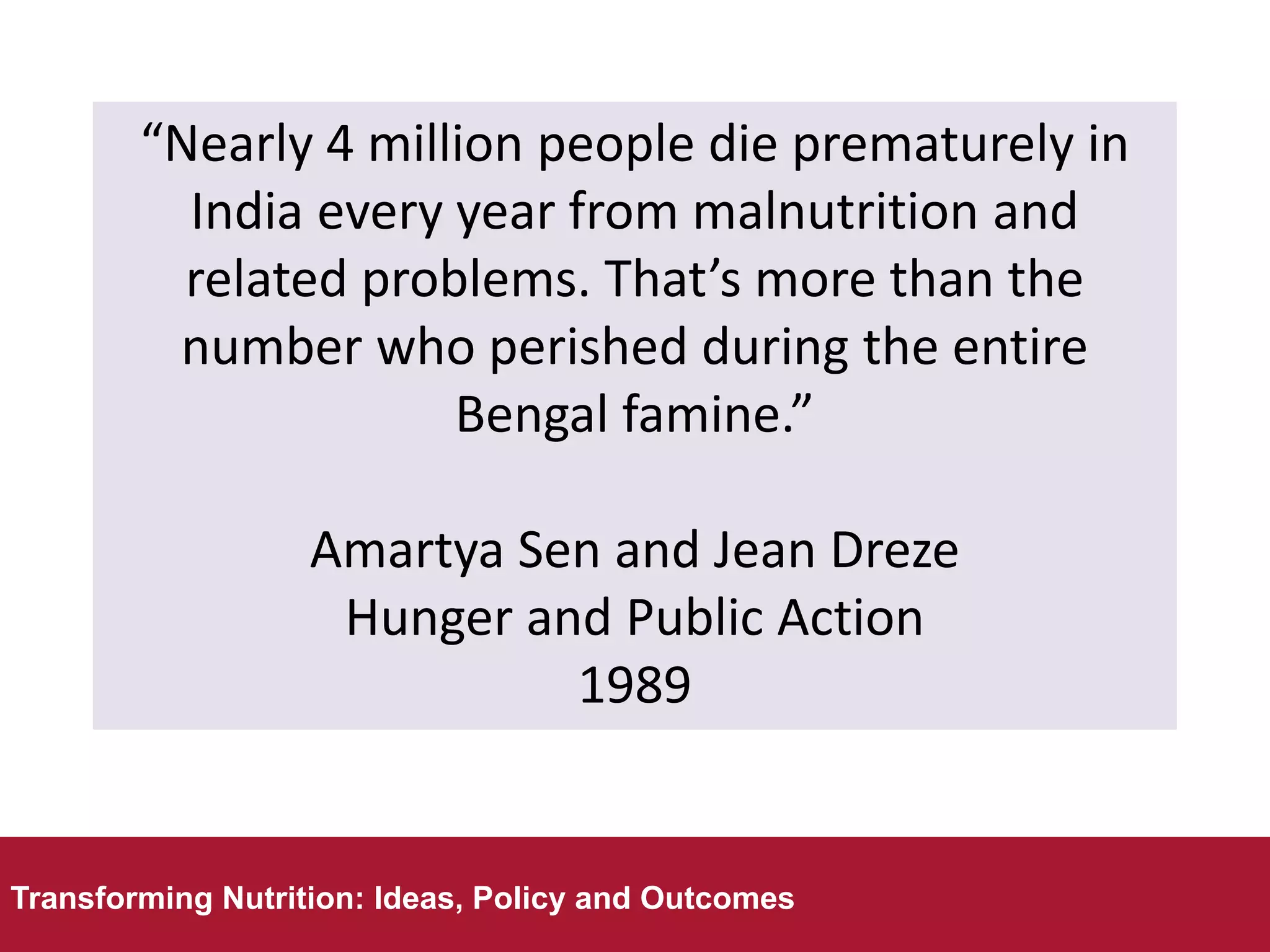
“Nearly 4 million people die prematurely in
India every year from malnutrition and
related problems. That’s more than the
number who perished during the entire
Bengal famine.”
Amartya Sen and Jean Dreze
Hunger and Public Action
1989
Transforming Nutrition: Ideas, Policy and Outcomes
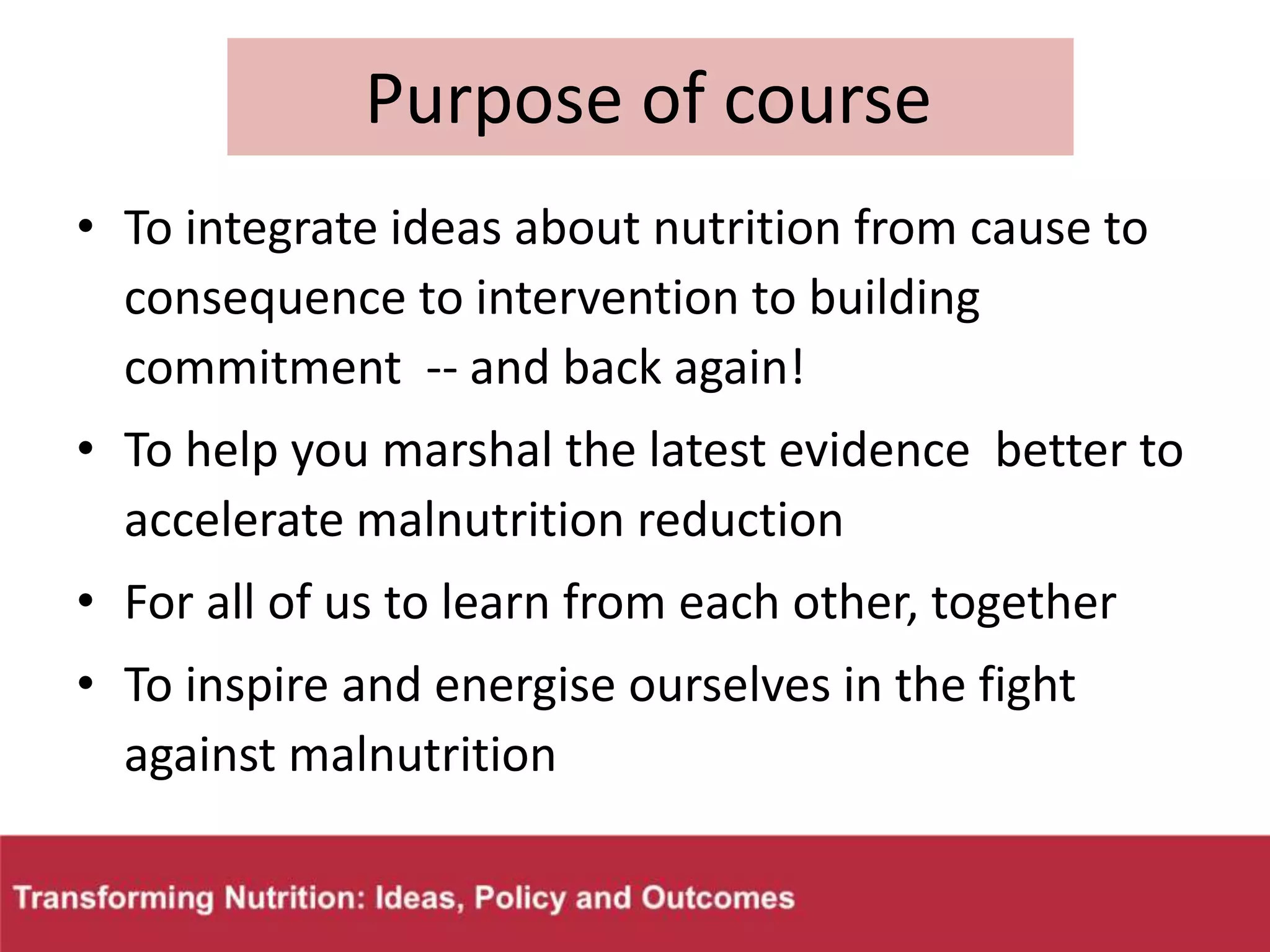
Purpose of course
• To integrate ideas about nutrition from cause to
consequence to intervention to building
commitment -- and back again!
• To help you marshal the latest evidence better to
accelerate malnutrition reduction
• For all of us to learn from each other, together
• To inspire and energise ourselves in the fight
against malnutrition
Introductions of participants
who are we and why are we here?
what do we hope to get out of the
course?
and what is our biggest worry?
Definitions of Malnutrition
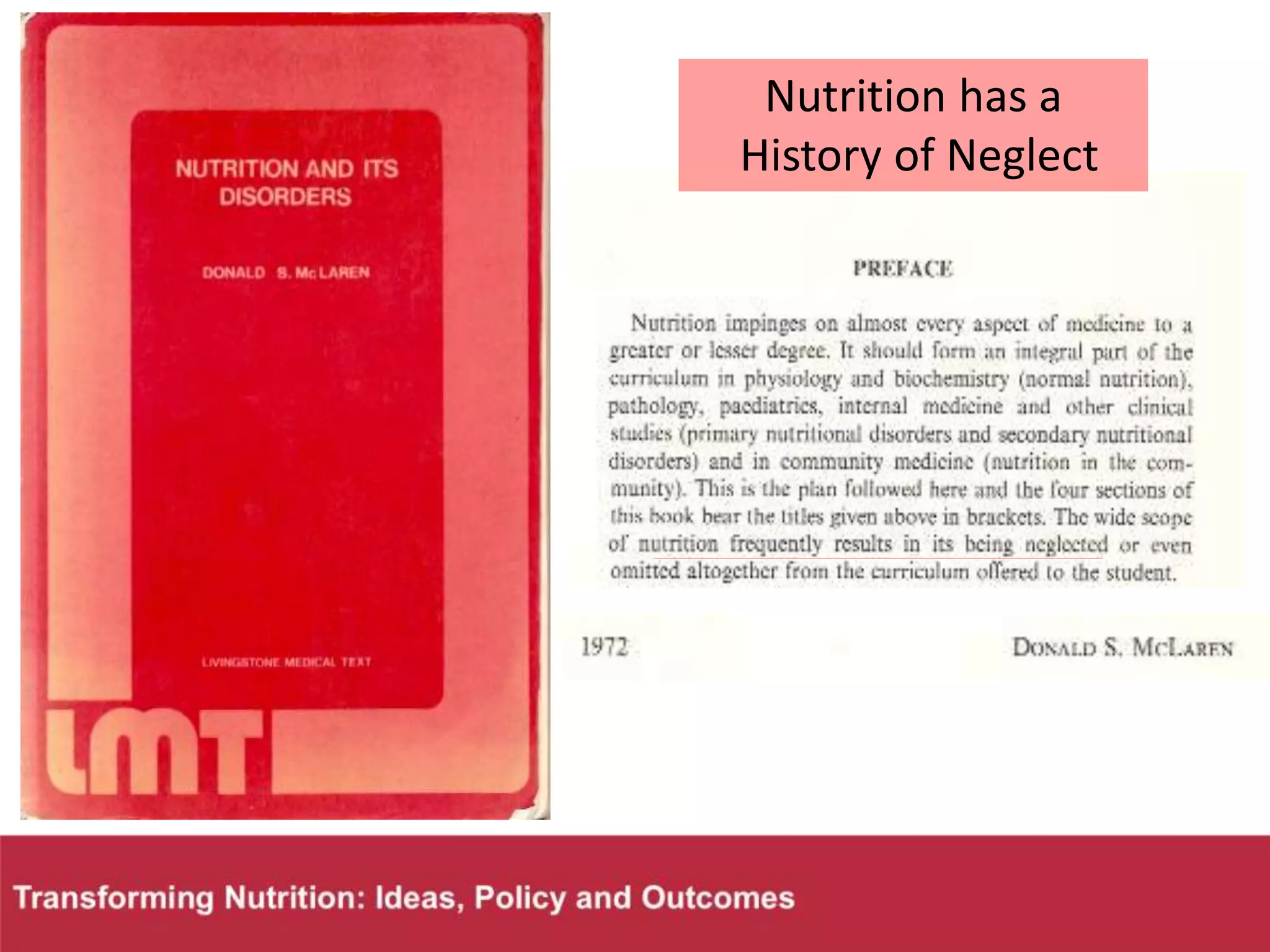
Nutrition has a
History of Neglect
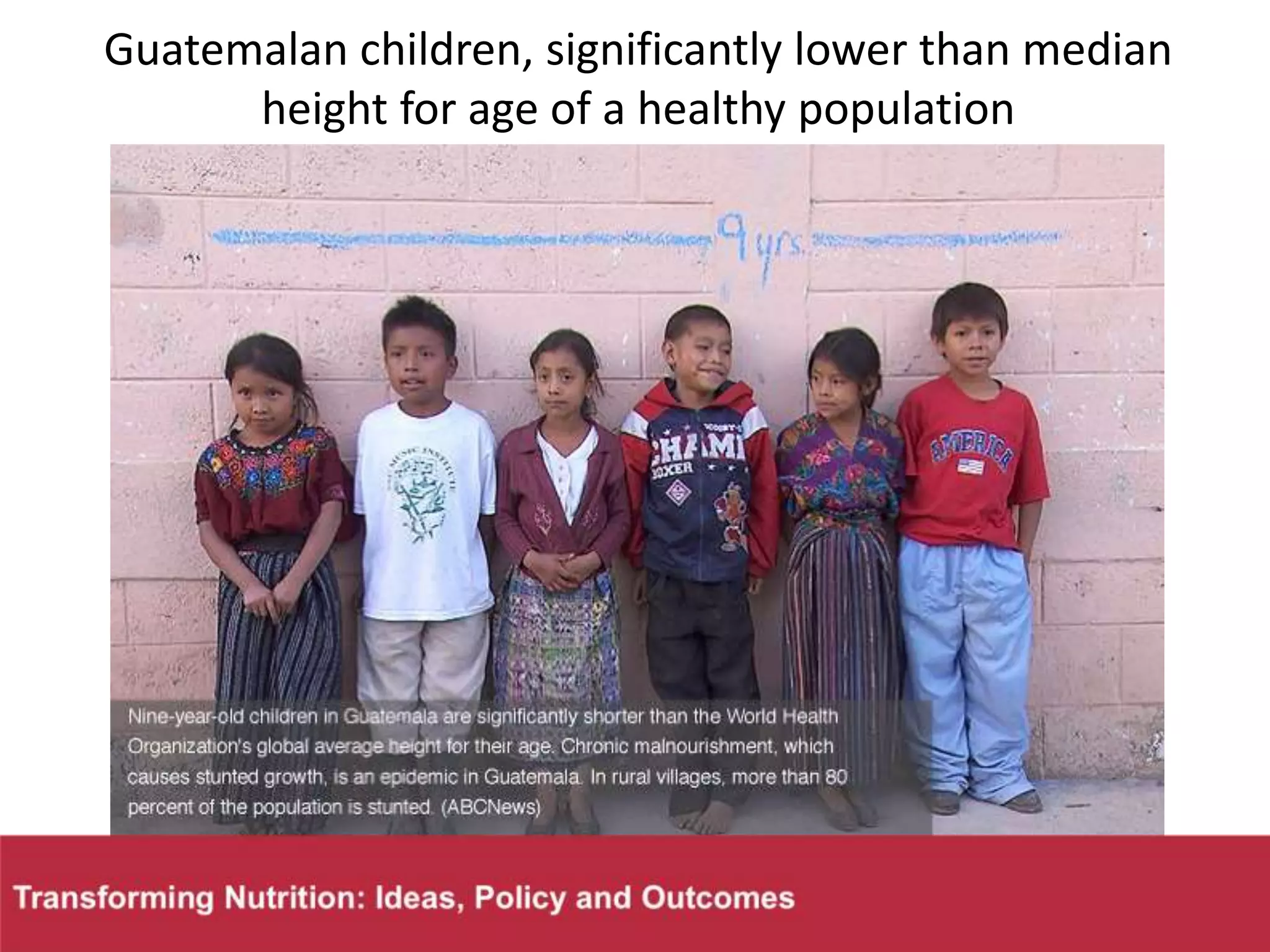
Guatemalan children, significantly lower than median
height for age of a healthy population
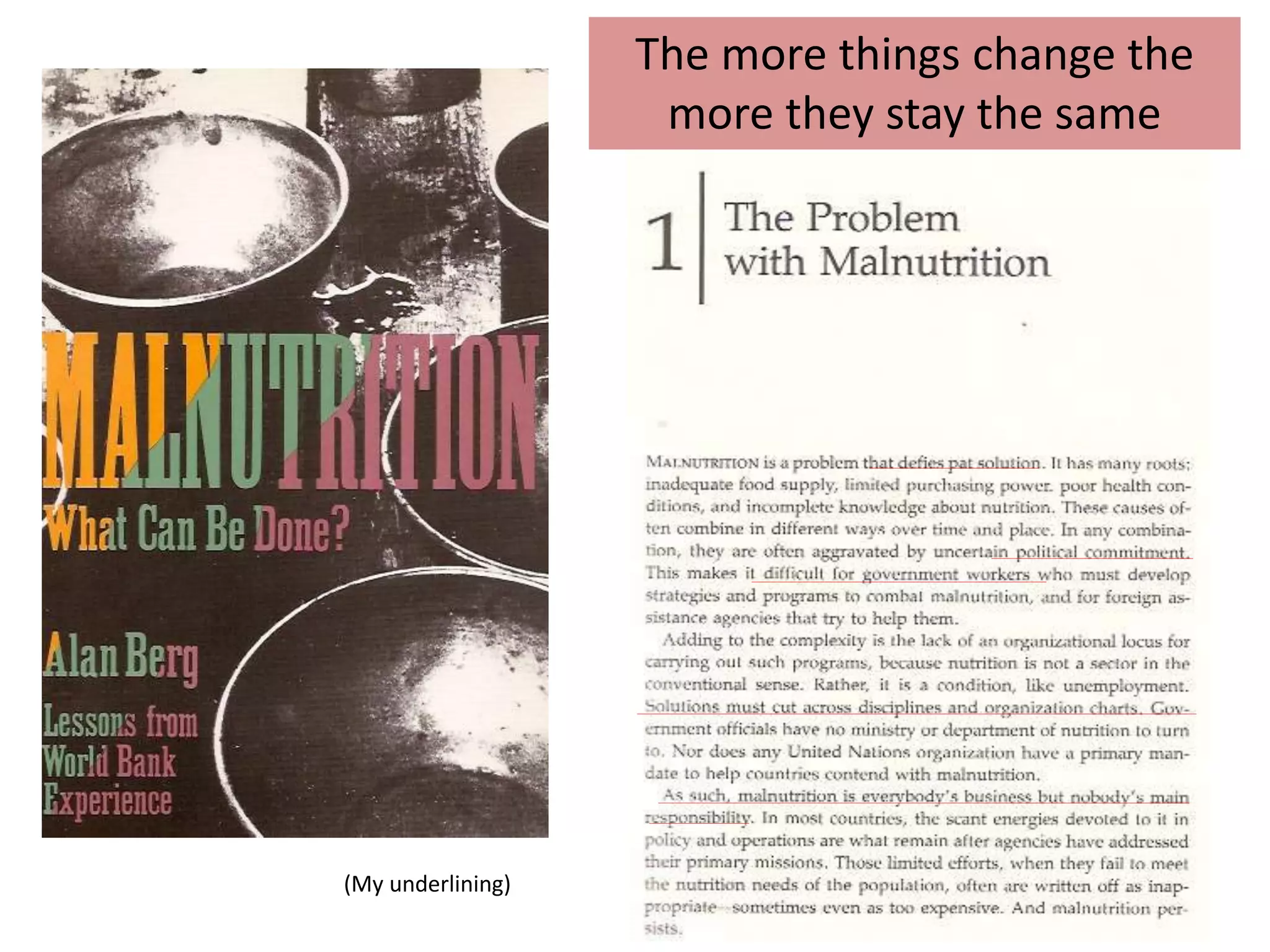
(My underlining)
The more things change the
more they stay the same
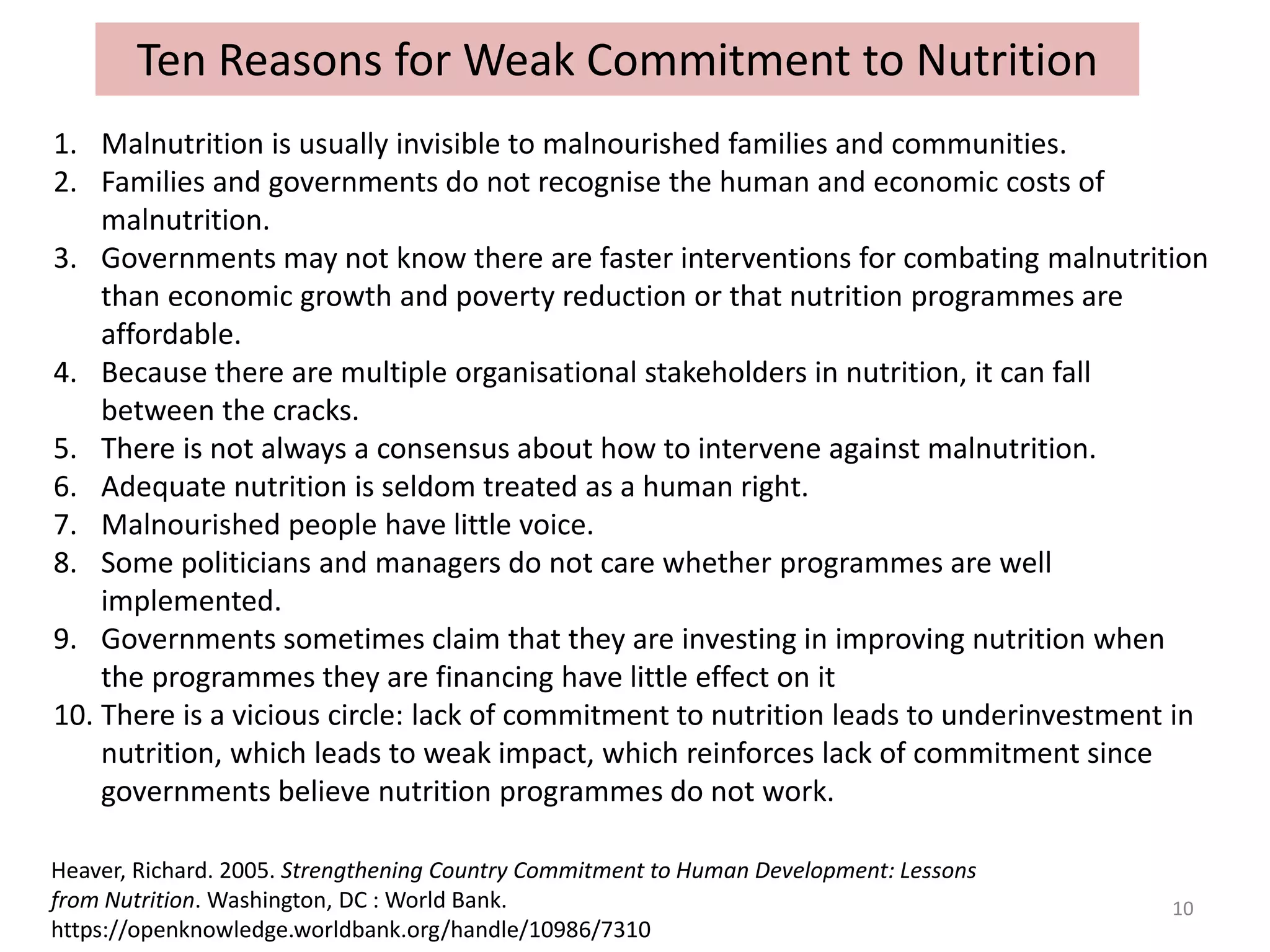
Ten Reasons for Weak Commitment to Nutrition
Heaver, Richard. 2005. Strengthening Country Commitment to Human Development: Lessons
from Nutrition. Washington, DC : World Bank.
https://openknowledge.worldbank.org/handle/10986/7310
10
1. Malnutrition is usually invisible to malnourished families and communities.
2. Families and governments do not recognise the human and economic costs of
malnutrition.
3. Governments may not know there are faster interventions for combating malnutrition
than economic growth and poverty reduction or that nutrition programmes are
affordable.
4. Because there are multiple organisational stakeholders in nutrition, it can fall
between the cracks.
5. There is not always a consensus about how to intervene against malnutrition.
6. Adequate nutrition is seldom treated as a human right.
7. Malnourished people have little voice.
8. Some politicians and managers do not care whether programmes are well
implemented.
9. Governments sometimes claim that they are investing in improving nutrition when
the programmes they are financing have little effect on it
10. There is a vicious circle: lack of commitment to nutrition leads to underinvestment in
nutrition, which leads to weak impact, which reinforces lack of commitment since
governments believe nutrition programmes do not work.
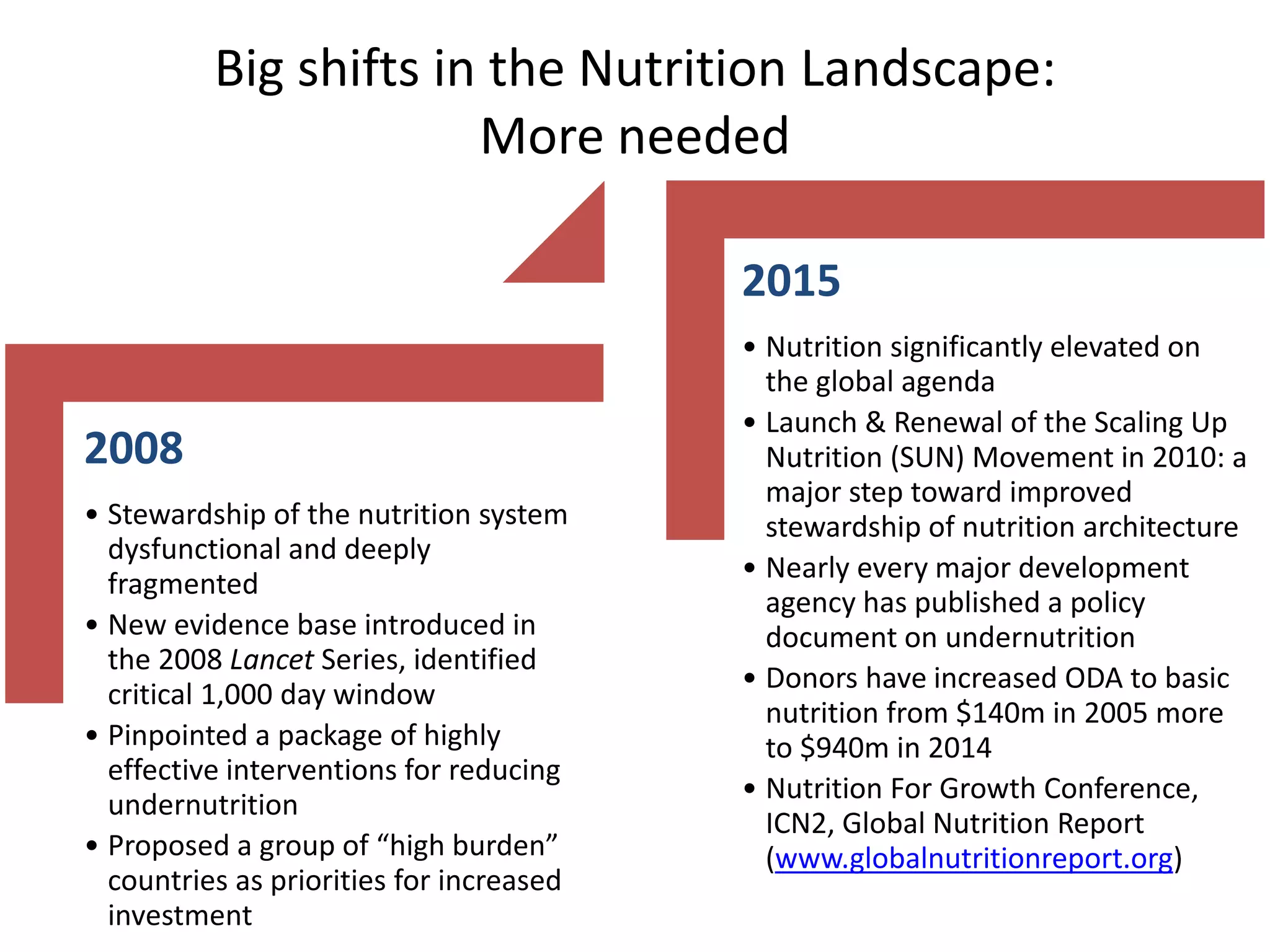
Big shifts in the Nutrition Landscape:
More needed
2008
• Stewardship of the nutrition system
dysfunctional and deeply
fragmented
• New evidence base introduced in
the 2008 Lancet Series, identified
critical 1,000 day window
• Pinpointed a package of highly
effective interventions for reducing
undernutrition
• Proposed a group of “high burden”
countries as priorities for increased
investment
2015
• Nutrition significantly elevated on
the global agenda
• Launch & Renewal of the Scaling Up
Nutrition (SUN) Movement in 2010: a
major step toward improved
stewardship of nutrition architecture
• Nearly every major development
agency has published a policy
document on undernutrition
• Donors have increased ODA to basic
nutrition from $140m in 2005 more
to $940m in 2014
• Nutrition For Growth Conference,
ICN2, Global Nutrition Report
(www.globalnutritionreport.org)
Day Session Topic Day Session Topic
Monday 1 Intro + Objectives Thursday 1 Enabling environment 2
2 Definitions and Distribution 2 Group work 3
lunch lunch
3 Causes 3 Evaluating what works and why
4 Consequences 4 Group work 4
dinner Welcome dinner dinner Dinner
Tuesday 1 What works-Nutrition Specific 1 Friday 1 Presentation of group work
2 What works-Nutrition Specific 2 2 Presentation of group work
lunch lunch
3 Group work 1 3 Finding common threads and
close
4 What works-Nutrition Sensitive 1 4 Certificates & Awards
dinner Dinner
Course Outline
Weds 1 What works-Nutrition Sensitive 2
2 Group work 2
lunch
3 Enabling environment 1
4 2 country case studies
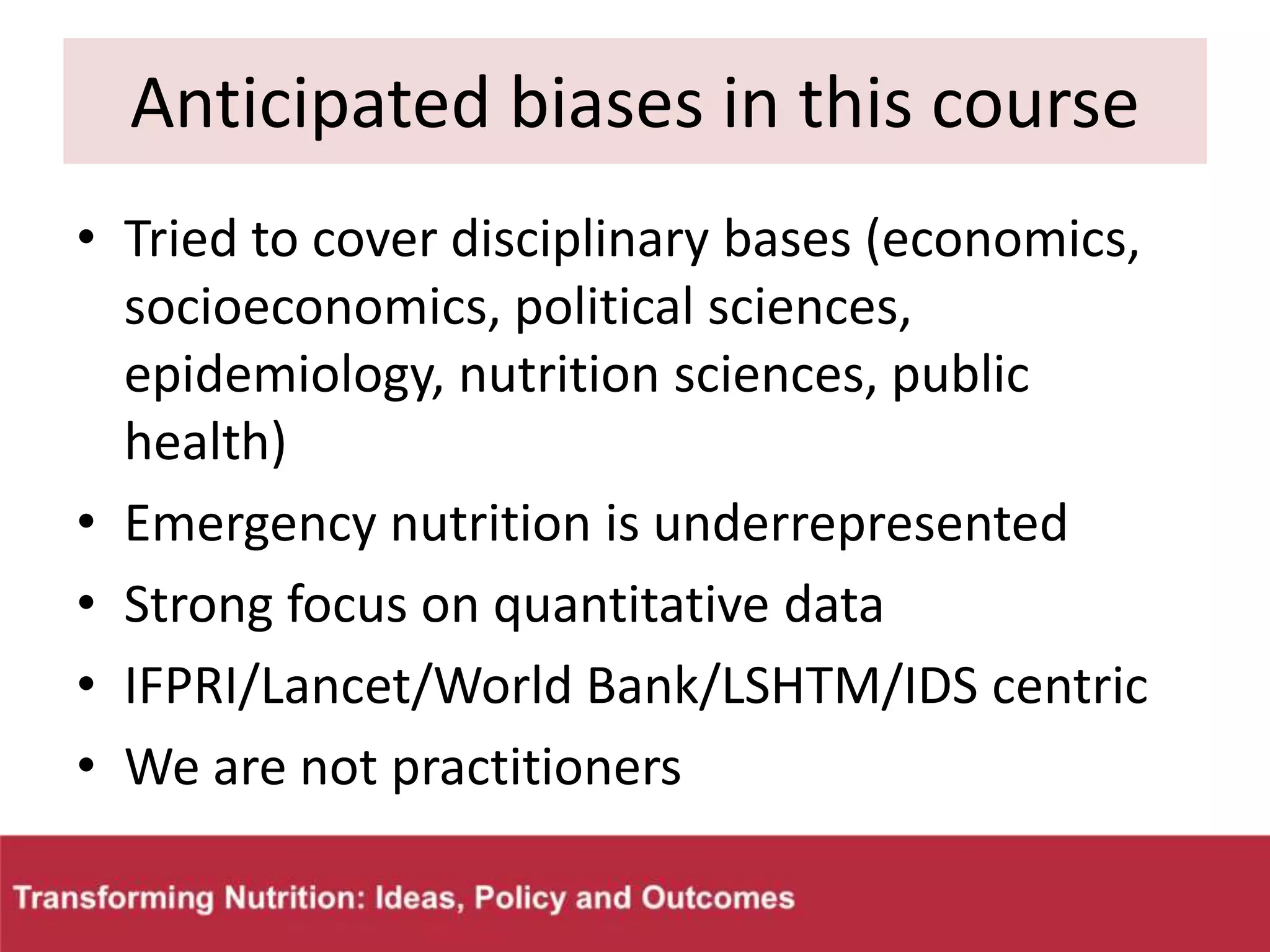
Anticipated biases in this course
• Tried to cover disciplinary bases (economics,
socioeconomics, political sciences,
epidemiology, nutrition sciences, public
health)
• Emergency nutrition is underrepresented
• Strong focus on quantitative data
• IFPRI/Lancet/World Bank/LSHTM/IDS centric
• We are not practitioners
Ground Rules

Day 1 session 1 (2015) intro

  • 1.
    Transforming Nutrition: Ideas,Policy and Outcomes Convened by the research consortium Transform Nutrition, which is funded by the UK Department for International Development (DFID). With special thanks to Children’s Investment Fund Foundation (CIFF) for providing full scholarships for four of our participants. Facilitated by the Institute of Development Studies (IDS) and the International Food Policy Research Institute (IFPRI) Summer School July 13-18, 2015
  • 2.
    Introduction Transforming Nutrition: Ideas,Policy and Outcomes Lawrence Haddad, IFPRI Purnima Menon, IFPRI Nick Nisbett, IDS
  • 3.
    “Nearly 4 millionpeople die prematurely in India every year from malnutrition and related problems. That’s more than the number who perished during the entire Bengal famine.” Amartya Sen and Jean Dreze Hunger and Public Action 1989 Transforming Nutrition: Ideas, Policy and Outcomes Transforming Nutrition: Ideas, Policy and Outcomes
  • 4.
    Purpose of course •To integrate ideas about nutrition from cause to consequence to intervention to building commitment -- and back again! • To help you marshal the latest evidence better to accelerate malnutrition reduction • For all of us to learn from each other, together • To inspire and energise ourselves in the fight against malnutrition
  • 5.
    Introductions of participants whoare we and why are we here? what do we hope to get out of the course? and what is our biggest worry?
  • 6.
  • 7.
  • 8.
    Guatemalan children, significantlylower than median height for age of a healthy population
  • 9.
    (My underlining) The morethings change the more they stay the same
  • 10.
    Ten Reasons forWeak Commitment to Nutrition Heaver, Richard. 2005. Strengthening Country Commitment to Human Development: Lessons from Nutrition. Washington, DC : World Bank. https://openknowledge.worldbank.org/handle/10986/7310 10 1. Malnutrition is usually invisible to malnourished families and communities. 2. Families and governments do not recognise the human and economic costs of malnutrition. 3. Governments may not know there are faster interventions for combating malnutrition than economic growth and poverty reduction or that nutrition programmes are affordable. 4. Because there are multiple organisational stakeholders in nutrition, it can fall between the cracks. 5. There is not always a consensus about how to intervene against malnutrition. 6. Adequate nutrition is seldom treated as a human right. 7. Malnourished people have little voice. 8. Some politicians and managers do not care whether programmes are well implemented. 9. Governments sometimes claim that they are investing in improving nutrition when the programmes they are financing have little effect on it 10. There is a vicious circle: lack of commitment to nutrition leads to underinvestment in nutrition, which leads to weak impact, which reinforces lack of commitment since governments believe nutrition programmes do not work.
  • 11.
    Big shifts inthe Nutrition Landscape: More needed 2008 • Stewardship of the nutrition system dysfunctional and deeply fragmented • New evidence base introduced in the 2008 Lancet Series, identified critical 1,000 day window • Pinpointed a package of highly effective interventions for reducing undernutrition • Proposed a group of “high burden” countries as priorities for increased investment 2015 • Nutrition significantly elevated on the global agenda • Launch & Renewal of the Scaling Up Nutrition (SUN) Movement in 2010: a major step toward improved stewardship of nutrition architecture • Nearly every major development agency has published a policy document on undernutrition • Donors have increased ODA to basic nutrition from $140m in 2005 more to $940m in 2014 • Nutrition For Growth Conference, ICN2, Global Nutrition Report (www.globalnutritionreport.org)
  • 12.
    Day Session TopicDay Session Topic Monday 1 Intro + Objectives Thursday 1 Enabling environment 2 2 Definitions and Distribution 2 Group work 3 lunch lunch 3 Causes 3 Evaluating what works and why 4 Consequences 4 Group work 4 dinner Welcome dinner dinner Dinner Tuesday 1 What works-Nutrition Specific 1 Friday 1 Presentation of group work 2 What works-Nutrition Specific 2 2 Presentation of group work lunch lunch 3 Group work 1 3 Finding common threads and close 4 What works-Nutrition Sensitive 1 4 Certificates & Awards dinner Dinner Course Outline Weds 1 What works-Nutrition Sensitive 2 2 Group work 2 lunch 3 Enabling environment 1 4 2 country case studies
  • 13.
    Anticipated biases inthis course • Tried to cover disciplinary bases (economics, socioeconomics, political sciences, epidemiology, nutrition sciences, public health) • Emergency nutrition is underrepresented • Strong focus on quantitative data • IFPRI/Lancet/World Bank/LSHTM/IDS centric • We are not practitioners
  • 14.