Dietary
Reference
Intakes
Dr CSN Vittal
DRI Process
• North American Initiative from Institute of Medicine
and Health Canada
• Introduced in 1967
• Intended to replace 1989 RDAs and 1990 RNIs
WHAT ARE DIETARY REFERENCE INTAKES
• Dietary Reference Intakes (DRIs) comprise a set of
nutrient-based reference values, each of which has
special uses.
Components of the DRIs
1. EAR: Estimated Average
Requirement
2. RDA: Recommended Dietary
Allowance
3. AI: Adequate Intake
4. UL: Tolerable Upper Intake Level
5. AMDR: Acceptable Macronutrient
Distribution Ranges
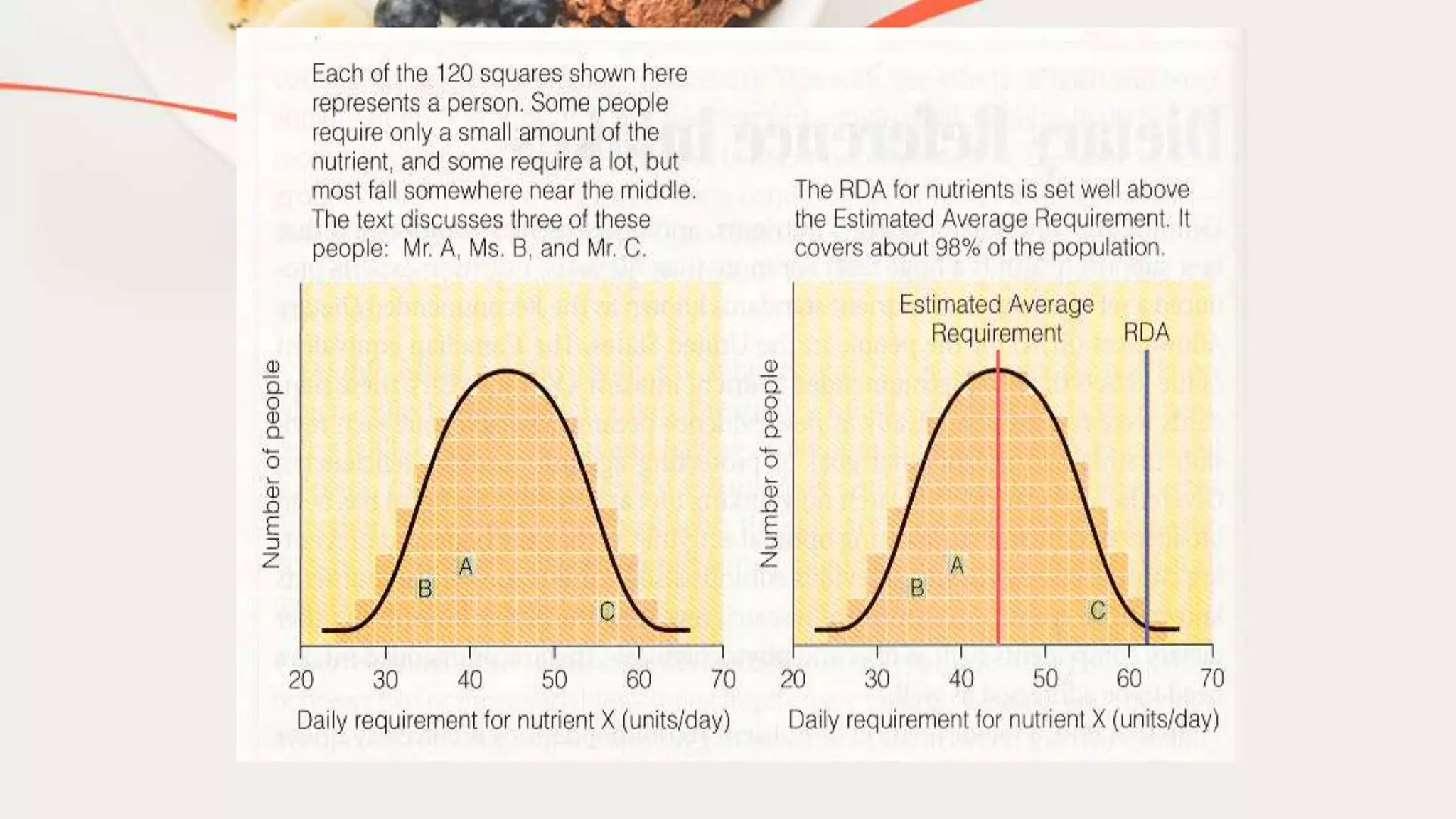
EAR and RDA values
• EAR
– obtain scientific data to estimate the
average requirement for a nutrient
– Add 2 SD to this value so that 98% of
popn has their requirement met
– Resulting value is RDA
• RDA = EAR + 2 SD
Use of DRIs
• Apply to healthy people
• RDA is generous: covers 98% of popn
• Compare to usual (average) intake, not
intake on any given day
• RDA is goal for an individual
• EAR used to assess groups
RDA
• RDA is the average daily dietary intake
level that is sufficient to meet the
nutrient requirement of nearly all (97 to
98 percent) healthy individuals in a
particular gender and life stage group
(life stage considers age and, when
applicable, pregnancy or lactation).
RDA
• The RDA for a nutrient is a value to be
used as a goal for dietary intake by
healthy individuals.
• The RDA is not intended to be used to
assess the diets of either individuals or
groups or to plan diets for groups.
Adequate Intake
• Nutrients Without an EAR – Do Not Have RDA
Need scientific studies to determine EAR
• The AI is based on observed or experimentally
determined estimates of nutrient intake by a
group (or groups) of healthy people.
• The main intended use of the AI is as a goal
for the nutrient intake of individuals.
• Calcium, Vitamin D, Fluoride, Biotin, Pantothenic acid (and all
infant values)
Tolerable Upper Intake Level
• For nutrients Recognized as Toxic
• Often based on case reports, not
studies
• ULs are useful because of the increased
interest in and availability of fortified
foods and the increased use of dietary
supplements.
Examples to Illustrate DRIs
• Vitamin C
• Has an EAR
• Has an RDA
• Has a UL
• Important yet not
much is known
• Calcium
• No EAR
• Has an AI
• Has a UL
• Important but
controversial
Vitamin C
• In cells Enzyme cofactor for collagen synthesis
• Involved in synthesis of hormones,
neurotransmittors
• Now recognized as important anti-oxidant
• Increases Fe absorption
•   plasma  urine excretion
•  in specialized tissues: WBCs
EAR and RDA for Vitamin C
• EAR = 75 mg for adult men
60 mg for women
• Based on following study:
– 7 healthy men lived in for 6 months
– Fed low C diet (5 mg/d) until depleted
– Given graded doses until steady state reached
– Measured serum, neutrophil, and urine ascorbate
EAR for Vitamin C
• At 100 mg, neutrophils were saturated with
acorbate in 4/7 subjects, but urine excretion
was high (25% of dose)
• At 60 mg, neutrophils were not quite saturated,
but urine excretion 0 %
• Panel chose value between 60 and 100 => 75
mg, as level of “adequate” vitamin C levels in
WBCs
RDA for Vitamin C
• Use RDA as a goal for an individual
• RDA = EAR + 2 SD
• Men: RDA = 75 + 2(7.5) = 90 mg
• Women: RDA = 60 + 2 (6) = 75 mg (rounded)
• Smokers – need more
– Add 35 mg to RDA
Toxicity of Vitamin C
• Many “problems” attributed to vitamin C
– Excess urinary oxalate excretion, increased uric acid
excretion in urine  kidney stones
– Pro-oxidant
–  Fe absorption  iron overload
–  serum B12
– Rebound scurvy
• DRI panel found no evidence for anything
except GI disturbances (osmotic diarrhea)
UL for Vitamin C
• Uncontrolled cases and several controlled
studies show that some people get GI
disturbances at >3 g
• 3 g = LOAEL
• Since UL is set so no risk of adverse effects,
Then UL = 3/1.5 = 2 g (~ NOAEL)
Thank You
• Dr CSN Vittal

Dietary Reference Intakes

  • 1.
  • 2.
    DRI Process • NorthAmerican Initiative from Institute of Medicine and Health Canada • Introduced in 1967 • Intended to replace 1989 RDAs and 1990 RNIs
  • 3.
    WHAT ARE DIETARYREFERENCE INTAKES • Dietary Reference Intakes (DRIs) comprise a set of nutrient-based reference values, each of which has special uses.
  • 4.
    Components of theDRIs 1. EAR: Estimated Average Requirement 2. RDA: Recommended Dietary Allowance 3. AI: Adequate Intake 4. UL: Tolerable Upper Intake Level 5. AMDR: Acceptable Macronutrient Distribution Ranges
  • 6.
    EAR and RDAvalues • EAR – obtain scientific data to estimate the average requirement for a nutrient – Add 2 SD to this value so that 98% of popn has their requirement met – Resulting value is RDA • RDA = EAR + 2 SD
  • 8.
    Use of DRIs •Apply to healthy people • RDA is generous: covers 98% of popn • Compare to usual (average) intake, not intake on any given day • RDA is goal for an individual • EAR used to assess groups
  • 9.
    RDA • RDA isthe average daily dietary intake level that is sufficient to meet the nutrient requirement of nearly all (97 to 98 percent) healthy individuals in a particular gender and life stage group (life stage considers age and, when applicable, pregnancy or lactation).
  • 10.
    RDA • The RDAfor a nutrient is a value to be used as a goal for dietary intake by healthy individuals. • The RDA is not intended to be used to assess the diets of either individuals or groups or to plan diets for groups.
  • 11.
    Adequate Intake • NutrientsWithout an EAR – Do Not Have RDA Need scientific studies to determine EAR • The AI is based on observed or experimentally determined estimates of nutrient intake by a group (or groups) of healthy people. • The main intended use of the AI is as a goal for the nutrient intake of individuals. • Calcium, Vitamin D, Fluoride, Biotin, Pantothenic acid (and all infant values)
  • 12.
    Tolerable Upper IntakeLevel • For nutrients Recognized as Toxic • Often based on case reports, not studies • ULs are useful because of the increased interest in and availability of fortified foods and the increased use of dietary supplements.
  • 13.
    Examples to IllustrateDRIs • Vitamin C • Has an EAR • Has an RDA • Has a UL • Important yet not much is known • Calcium • No EAR • Has an AI • Has a UL • Important but controversial
  • 14.
    Vitamin C • Incells Enzyme cofactor for collagen synthesis • Involved in synthesis of hormones, neurotransmittors • Now recognized as important anti-oxidant • Increases Fe absorption •   plasma  urine excretion •  in specialized tissues: WBCs
  • 15.
    EAR and RDAfor Vitamin C • EAR = 75 mg for adult men 60 mg for women • Based on following study: – 7 healthy men lived in for 6 months – Fed low C diet (5 mg/d) until depleted – Given graded doses until steady state reached – Measured serum, neutrophil, and urine ascorbate
  • 16.
    EAR for VitaminC • At 100 mg, neutrophils were saturated with acorbate in 4/7 subjects, but urine excretion was high (25% of dose) • At 60 mg, neutrophils were not quite saturated, but urine excretion 0 % • Panel chose value between 60 and 100 => 75 mg, as level of “adequate” vitamin C levels in WBCs
  • 17.
    RDA for VitaminC • Use RDA as a goal for an individual • RDA = EAR + 2 SD • Men: RDA = 75 + 2(7.5) = 90 mg • Women: RDA = 60 + 2 (6) = 75 mg (rounded) • Smokers – need more – Add 35 mg to RDA
  • 18.
    Toxicity of VitaminC • Many “problems” attributed to vitamin C – Excess urinary oxalate excretion, increased uric acid excretion in urine  kidney stones – Pro-oxidant –  Fe absorption  iron overload –  serum B12 – Rebound scurvy • DRI panel found no evidence for anything except GI disturbances (osmotic diarrhea)
  • 19.
    UL for VitaminC • Uncontrolled cases and several controlled studies show that some people get GI disturbances at >3 g • 3 g = LOAEL • Since UL is set so no risk of adverse effects, Then UL = 3/1.5 = 2 g (~ NOAEL)
  • 20.
    Thank You • DrCSN Vittal