COPPER
-Smita Shinde
-Prathamesh Shasane
B016
INTRODUCTION
• Copper is an essential trace element that is vital to the
health of living organisms.
• In humans, copper is essential to proper functioning of
organs and metabolic processes.
• Human body has complex homeostatic mechanisms
which attempt to ensure a constant supply of available
copper
• Adult humans contain 100 to 150 mg of
copper
– 65 mg - muscles,
– 23 mg - bones
– 18 mg - liver. It occurs as:
• Erythrocuprein,
• Hepatocuprein and
• Cerebrocuprein.
SOURCES
• Average diet provides 2 to 4 mg/day in the form of
meat, shellfish, legumes, nuts and cereals. Milk and
milk-products are poor sources.[1]
• oysters, liver, whole grain breads, dark green leafy
vegetables and chocolate are other sources.[2]
FUNCTIONS
• Copper is required in synthesis of hemoglobin, although it is not a
component of Hb.[1]
• Copper works together with iron to form RBCs. [2]
• Keeps nerve cells and immune system healthy.[2]
• It helps form collagen (key part of bones & connective tissue). [2]
• Acts as antioxidant. [2]
• Copper helps body absorb iron.[2]
FUNCTIONS[1]
• Role in enzyme action
• Helps in Fe++ metabolism
• Maturation of Elastin
• Formation of bones and maintenance of myelin sheath
ABSORPTION
• Primarily absorbed from the duodenum.About 32% of the
dietary Cu can be absorbed. Phytates,Zinc, Mo, Cd, Ag, Hg
and high amount of Vit. C inhibit Cu absorption.
• Requires special mechanism due to its insoluble nature.
• Plasma: After absorption, Cu enters plasma, where it is
bound to amino acids, particularly histidine and serum
albumin.
EXCRETION
• Under normal conditions, 85 to 99 per cent of
the ingested Cu is excreted in the faeces via
the bile and remaining 1 to 15 per cent in the
urine.
RECOMMENDED DAILY ALLOWANCE
(RDA)
PEDIATRIC AGE GROUP:
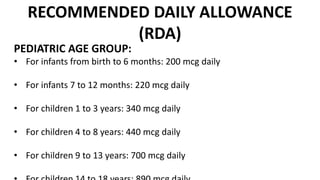
• For infants from birth to 6 months: 200 mcg daily
• For infants 7 to 12 months: 220 mcg daily
• For children 1 to 3 years: 340 mcg daily
• For children 4 to 8 years: 440 mcg daily
• For children 9 to 13 years: 700 mcg daily
RECOMMENDED DAILY ALLOWANCE
(RDA)
ADULT AGE GROUP:
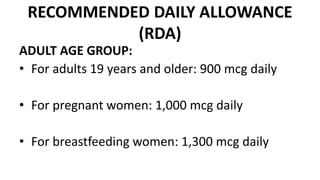
• For adults 19 years and older: 900 mcg daily
• For pregnant women: 1,000 mcg daily
• For breastfeeding women: 1,300 mcg daily
• If you take a copper supplement, you should
also take a zinc supplement (8 to 15 mg of zinc
for every 1 mg of copper), as an imbalance of
these two minerals can cause other health
problems.[3]
• For your body to use copper, you need to have a
balance of zinc and manganese.[3]
Cu DEFICIENCY MANIFESTATIONS
• Loss of weight
• Bone disorders
• Anaemia
• Grey hair
• Myocardial atrophy
• Demyelination of neurons
Top 10 Copper Rich Foods List
1) Beef liver
2) Sunflower seeds
3) Lentils
4) Almonds
5) Dried apricots
6) Dark chocolate
7) Blackstrap molasses
8) Asparagus
9) Mushrooms
10) Turnip greens
REFERENCE
1. MN Chatterjea, Rana Shinde; Textbook of Medical
Biochemistry; Section Four, Chap 33; Page 623-624
2. http://www.healthsupplementsnutritionalguide.com/re
commended-daily-allowances/
3. http://umm.edu/health/medical/altmed/supplement/c
opper

Copper Nutrition.

  • 1.
  • 2.
    INTRODUCTION • Copper isan essential trace element that is vital to the health of living organisms. • In humans, copper is essential to proper functioning of organs and metabolic processes. • Human body has complex homeostatic mechanisms which attempt to ensure a constant supply of available copper
  • 3.
    • Adult humanscontain 100 to 150 mg of copper – 65 mg - muscles, – 23 mg - bones – 18 mg - liver. It occurs as: • Erythrocuprein, • Hepatocuprein and • Cerebrocuprein.
  • 4.
    SOURCES • Average dietprovides 2 to 4 mg/day in the form of meat, shellfish, legumes, nuts and cereals. Milk and milk-products are poor sources.[1] • oysters, liver, whole grain breads, dark green leafy vegetables and chocolate are other sources.[2]
  • 5.
    FUNCTIONS • Copper isrequired in synthesis of hemoglobin, although it is not a component of Hb.[1] • Copper works together with iron to form RBCs. [2] • Keeps nerve cells and immune system healthy.[2] • It helps form collagen (key part of bones & connective tissue). [2] • Acts as antioxidant. [2] • Copper helps body absorb iron.[2]
  • 6.
    FUNCTIONS[1] • Role inenzyme action • Helps in Fe++ metabolism • Maturation of Elastin • Formation of bones and maintenance of myelin sheath
  • 7.
    ABSORPTION • Primarily absorbedfrom the duodenum.About 32% of the dietary Cu can be absorbed. Phytates,Zinc, Mo, Cd, Ag, Hg and high amount of Vit. C inhibit Cu absorption. • Requires special mechanism due to its insoluble nature. • Plasma: After absorption, Cu enters plasma, where it is bound to amino acids, particularly histidine and serum albumin.
  • 8.
    EXCRETION • Under normalconditions, 85 to 99 per cent of the ingested Cu is excreted in the faeces via the bile and remaining 1 to 15 per cent in the urine.
  • 9.
    RECOMMENDED DAILY ALLOWANCE (RDA) PEDIATRICAGE GROUP: • For infants from birth to 6 months: 200 mcg daily • For infants 7 to 12 months: 220 mcg daily • For children 1 to 3 years: 340 mcg daily • For children 4 to 8 years: 440 mcg daily • For children 9 to 13 years: 700 mcg daily
  • 10.
    RECOMMENDED DAILY ALLOWANCE (RDA) ADULTAGE GROUP: • For adults 19 years and older: 900 mcg daily • For pregnant women: 1,000 mcg daily • For breastfeeding women: 1,300 mcg daily
  • 11.
    • If youtake a copper supplement, you should also take a zinc supplement (8 to 15 mg of zinc for every 1 mg of copper), as an imbalance of these two minerals can cause other health problems.[3] • For your body to use copper, you need to have a balance of zinc and manganese.[3]
  • 12.
    Cu DEFICIENCY MANIFESTATIONS •Loss of weight • Bone disorders • Anaemia • Grey hair • Myocardial atrophy • Demyelination of neurons
  • 16.
    Top 10 CopperRich Foods List 1) Beef liver 2) Sunflower seeds 3) Lentils 4) Almonds 5) Dried apricots 6) Dark chocolate 7) Blackstrap molasses 8) Asparagus 9) Mushrooms 10) Turnip greens
  • 17.
    REFERENCE 1. MN Chatterjea,Rana Shinde; Textbook of Medical Biochemistry; Section Four, Chap 33; Page 623-624 2. http://www.healthsupplementsnutritionalguide.com/re commended-daily-allowances/ 3. http://umm.edu/health/medical/altmed/supplement/c opper