• Introduction 
• Training Module 
• Studio 
• E.N.G 
• OB 
• Earth Station 
• Transmitter 
• Conclusions 
• Refrences
Doordarshan is an Indian public service broadcaster, a division of Prasar Bharati. It is 
one of the largest broadcasting organisations in India in terms of 
the studio and transmitter infrastructure. Doordarshan had a modest beginning with an 
experimental telecast starting in Delhi on 15 September 1959, with a small transmitter 
and a make shift studio. The regular daily transmission started in 1965 as a part of All 
India Radio. National telecasts were introduced in 1982. Recently, it has also started 
broadcasting on Digital Terrestrial Transmitters. On 15 September 2009, Doordarshan 
celebrated its 50th anniversary. The DD provides television, radio, online and mobile 
services throughout metropolitan and regional India, as well as overseas through the 
Indian Network and Radio India. For the London Olympics, live telecasts of the opening 
and closing ceremonies of the games were broadcast on its national channel. DD 
sports channel has provided round the clock coverage of sport events. Now more than 
90 percent of the Indian population can receive Doordarshan (DD National) 
programmes through a network of nearly 1,400 terrestrial transmitters. There are about 
46 Doordarshan studios producing TV programmes today.
Doordarshan has the following main departments which manage the production, 
storage transmission and maintenance of the Channels: 
 STUDIO 
 ENG Section 
 NLE 
 OB 
 EARTH STATION 
 TRANSMITTER 
Each of these departments are discussed in detail with due stress to the relevant 
engineering aspects.
A studio is an artist's or worker's workroom, or the catchall term for an artist and 
their employees who work within that studio. This can be for the purpose 
of photography, graphic design, filmmaking, animation, industrial 
design, radio or television production broadcasting or the making of music. The 
term is also used for the workroom of dancers, often specified to dance studio. 
In doordarshan studio’s is divided into different sections: 
• C.A.R(Central Apparatus Room) 
In broadcast facilities, a central apparatus room (CAR, pronounced "C-A-R"), 
central machine room, or central equipment room (CER), or central technical 
area (CTA), or rack room is where shared equipment common to all technical 
areas is located. Some broadcast facilities have several of these rooms. It should 
be air-conditioned, however low-noise specifications such as acoustical 
treatments are optional. Equipment is connected either directly with an attached 
foldout monitor, keyboard and mouse or remotely via KVM switch, or remote 
desktop.
• P.C.R(Production Control Room) 
The production control room (PCR)or studio control room (SCR) is the place in a 
television studio in which the composition of the outgoing program takes place.(An SCR is 
also often the acronym for the Satellite Control Room, from here TV feeds are sent to & 
received from the local Satellite used by the TV station) The production control room is 
occasionally also called a studio control room (SCR) or a "gallery" Master control is distinct 
from a PCR in television studios where the activities such as switching from camera to 
camera are coordinated. A transmission control room (TCR) is usually smaller in size and is 
a scaled down version of central casting. 
• M.C.R(Master Control Room) 
The Master control room (MCR) houses equipment that is too noisy or runs too hot for 
the Production control room (PCR). It also makes sure that coax cable and other wire 
lengths and installation requirements keep within manageable lengths, since most high-quality 
wiring runs only between devices in this room.
Electronic news-gathering (ENG) is a broadcast news industry description 
of television producers, reporters and editors making use of electronic video and 
audio technologies for gathering and presenting news. Recording and reporting 
events and activities as they happen is what news is all about. 
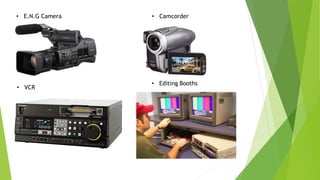
The various equipments used in ENG section are: 
 ENG Camera 
 Camcorder 
 VCR 
 Editing Booths
• E.N.G Camera • Camcorder 
• VCR 
• Editing Booths
Non-linear editing enables direct access to any video frame in a digital video clip, without 
needing to play or scrub/shuttle through adjacent footage to reach it, as was necessary 
with historical video tape linear editing systems. 
In Doordarshan Kendra, eight non-linear editing booths are there. 
Two kind of operating system are used in NLEs. 
• DPS Velocity (Windows - O.S.) 
• Adobe Premiere (Windows - O.S.) 
• Grass Valley Edius (Windows - O.S.) 
• Final Cut Pro (FCP) (MAC - O.S.)
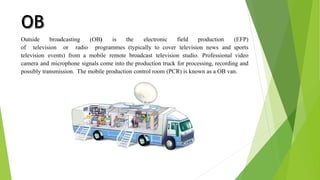
Outside broadcasting (OB) is the electronic field production (EFP) 
of television or radio programmes (typically to cover television news and sports 
television events) from a mobile remote broadcast television studio. Professional video 
camera and microphone signals come into the production truck for processing, recording and 
possibly transmission. The mobile production control room (PCR) is known as a OB van.
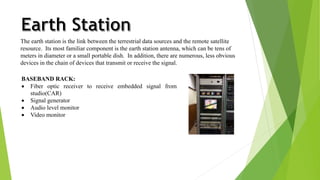
The earth station is the link between the terrestrial data sources and the remote satellite 
resource. Its most familiar component is the earth station antenna, which can be tens of 
meters in diameter or a small portable dish. In addition, there are numerous, less obvious 
devices in the chain of devices that transmit or receive the signal. 
BASEBAND RACK: 
 Fiber optic receiver to receive embedded signal from 
studio(CAR) 
 Signal generator 
 Audio level monitor 
 Video monitor
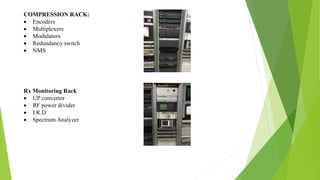
COMPRESSION RACK: 
 Encoders 
 Multiplexers 
 Modulators 
 Redundancy switch 
 NMS 
Rx Monitoring Rack 
 UP convertor 
 RF power divider 
 I.R.D 
 Spectrum Analyzer
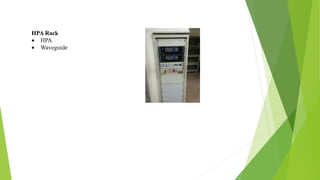
HPA Rack 
 HPA 
 Waveguide
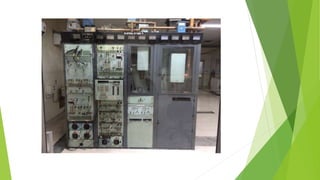
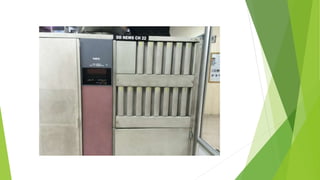
A television transmitter is a device which broadcasts an electromagnetic signal to 
the television receivers. Television transmitters may be analog or digital. 
Transmitter station refers to terrestrial infrastructure for transmitting radio frequency signals. 
The station maybe used for wireless communication, broadcasting, microwave link, mobile 
telephone or other purposes. 
Terrestrial transmission: 
A transmission from point A to point B that doesn’t make use of satellites. 
If the transmission is straight from point A to point B, then the maximize range it's a bit more 
of the horizon (depending on what frequency are you transmitting) 
Use of repeaters can extend the range. 
LF MF HF VHF UHF are the most common frequencies used for terrestrial communications.
The technology currently in use at PrasarBharati has improved significantly. At this stage there has 
been advancement in signal reception quality as systems are changing from analog to digital with 
the advancement in different audio and video compression techniques. For Doordarshan, DTH 
(Direct To Home Service) satellite services have become more user friendly and also evolution of 
SDTV into HDTV have made it a popular product among the people of India. It is also accessible 
from remote areas with more channel and better reception.
1. http://en.wikipedia.org/wiki/studio 
2. http://en.wikipedia.org/wiki/Central_apparatus_room 
3. http://en.wikipedia.org/wiki/production_control_room 
4. http://en.wikipedia.org/wiki/outside_broadcasting 
5. http://en.wikipedia.org/wiki/Transmitter 
6. http://prasarbharati.gov.in/ 
7. Antennas & Propagation,CS 6710, Spring 2010, Rajmohan Rajaraman 
8. Electromagnetic Radiations and antennas, whites EE 382 
9. Transmission Techniques for Digital Terrestrial TV Broadcasting By Hikmet Sari, 
Georges Karan and Issabelle Jeanclaude
Summer Training At Doordarshan

Summer Training At Doordarshan

  • 2.
    • Introduction •Training Module • Studio • E.N.G • OB • Earth Station • Transmitter • Conclusions • Refrences
  • 3.
    Doordarshan is anIndian public service broadcaster, a division of Prasar Bharati. It is one of the largest broadcasting organisations in India in terms of the studio and transmitter infrastructure. Doordarshan had a modest beginning with an experimental telecast starting in Delhi on 15 September 1959, with a small transmitter and a make shift studio. The regular daily transmission started in 1965 as a part of All India Radio. National telecasts were introduced in 1982. Recently, it has also started broadcasting on Digital Terrestrial Transmitters. On 15 September 2009, Doordarshan celebrated its 50th anniversary. The DD provides television, radio, online and mobile services throughout metropolitan and regional India, as well as overseas through the Indian Network and Radio India. For the London Olympics, live telecasts of the opening and closing ceremonies of the games were broadcast on its national channel. DD sports channel has provided round the clock coverage of sport events. Now more than 90 percent of the Indian population can receive Doordarshan (DD National) programmes through a network of nearly 1,400 terrestrial transmitters. There are about 46 Doordarshan studios producing TV programmes today.
  • 4.
    Doordarshan has thefollowing main departments which manage the production, storage transmission and maintenance of the Channels:  STUDIO  ENG Section  NLE  OB  EARTH STATION  TRANSMITTER Each of these departments are discussed in detail with due stress to the relevant engineering aspects.
  • 5.
    A studio isan artist's or worker's workroom, or the catchall term for an artist and their employees who work within that studio. This can be for the purpose of photography, graphic design, filmmaking, animation, industrial design, radio or television production broadcasting or the making of music. The term is also used for the workroom of dancers, often specified to dance studio. In doordarshan studio’s is divided into different sections: • C.A.R(Central Apparatus Room) In broadcast facilities, a central apparatus room (CAR, pronounced "C-A-R"), central machine room, or central equipment room (CER), or central technical area (CTA), or rack room is where shared equipment common to all technical areas is located. Some broadcast facilities have several of these rooms. It should be air-conditioned, however low-noise specifications such as acoustical treatments are optional. Equipment is connected either directly with an attached foldout monitor, keyboard and mouse or remotely via KVM switch, or remote desktop.
  • 6.
    • P.C.R(Production ControlRoom) The production control room (PCR)or studio control room (SCR) is the place in a television studio in which the composition of the outgoing program takes place.(An SCR is also often the acronym for the Satellite Control Room, from here TV feeds are sent to & received from the local Satellite used by the TV station) The production control room is occasionally also called a studio control room (SCR) or a "gallery" Master control is distinct from a PCR in television studios where the activities such as switching from camera to camera are coordinated. A transmission control room (TCR) is usually smaller in size and is a scaled down version of central casting. • M.C.R(Master Control Room) The Master control room (MCR) houses equipment that is too noisy or runs too hot for the Production control room (PCR). It also makes sure that coax cable and other wire lengths and installation requirements keep within manageable lengths, since most high-quality wiring runs only between devices in this room.
  • 7.
    Electronic news-gathering (ENG)is a broadcast news industry description of television producers, reporters and editors making use of electronic video and audio technologies for gathering and presenting news. Recording and reporting events and activities as they happen is what news is all about. The various equipments used in ENG section are:  ENG Camera  Camcorder  VCR  Editing Booths
  • 8.
    • E.N.G Camera• Camcorder • VCR • Editing Booths
  • 9.
    Non-linear editing enablesdirect access to any video frame in a digital video clip, without needing to play or scrub/shuttle through adjacent footage to reach it, as was necessary with historical video tape linear editing systems. In Doordarshan Kendra, eight non-linear editing booths are there. Two kind of operating system are used in NLEs. • DPS Velocity (Windows - O.S.) • Adobe Premiere (Windows - O.S.) • Grass Valley Edius (Windows - O.S.) • Final Cut Pro (FCP) (MAC - O.S.)
  • 10.
    Outside broadcasting (OB)is the electronic field production (EFP) of television or radio programmes (typically to cover television news and sports television events) from a mobile remote broadcast television studio. Professional video camera and microphone signals come into the production truck for processing, recording and possibly transmission. The mobile production control room (PCR) is known as a OB van.
  • 11.
    The earth stationis the link between the terrestrial data sources and the remote satellite resource. Its most familiar component is the earth station antenna, which can be tens of meters in diameter or a small portable dish. In addition, there are numerous, less obvious devices in the chain of devices that transmit or receive the signal. BASEBAND RACK:  Fiber optic receiver to receive embedded signal from studio(CAR)  Signal generator  Audio level monitor  Video monitor
  • 12.
    COMPRESSION RACK: Encoders  Multiplexers  Modulators  Redundancy switch  NMS Rx Monitoring Rack  UP convertor  RF power divider  I.R.D  Spectrum Analyzer
  • 13.
    HPA Rack HPA  Waveguide
  • 14.
    A television transmitteris a device which broadcasts an electromagnetic signal to the television receivers. Television transmitters may be analog or digital. Transmitter station refers to terrestrial infrastructure for transmitting radio frequency signals. The station maybe used for wireless communication, broadcasting, microwave link, mobile telephone or other purposes. Terrestrial transmission: A transmission from point A to point B that doesn’t make use of satellites. If the transmission is straight from point A to point B, then the maximize range it's a bit more of the horizon (depending on what frequency are you transmitting) Use of repeaters can extend the range. LF MF HF VHF UHF are the most common frequencies used for terrestrial communications.
  • 17.
    The technology currentlyin use at PrasarBharati has improved significantly. At this stage there has been advancement in signal reception quality as systems are changing from analog to digital with the advancement in different audio and video compression techniques. For Doordarshan, DTH (Direct To Home Service) satellite services have become more user friendly and also evolution of SDTV into HDTV have made it a popular product among the people of India. It is also accessible from remote areas with more channel and better reception.
  • 18.
    1. http://en.wikipedia.org/wiki/studio 2.http://en.wikipedia.org/wiki/Central_apparatus_room 3. http://en.wikipedia.org/wiki/production_control_room 4. http://en.wikipedia.org/wiki/outside_broadcasting 5. http://en.wikipedia.org/wiki/Transmitter 6. http://prasarbharati.gov.in/ 7. Antennas & Propagation,CS 6710, Spring 2010, Rajmohan Rajaraman 8. Electromagnetic Radiations and antennas, whites EE 382 9. Transmission Techniques for Digital Terrestrial TV Broadcasting By Hikmet Sari, Georges Karan and Issabelle Jeanclaude