
PRESENTATION
ON
INPLANT TRAINING
Presented by
Reshmi R
Reg. No. 80421
5/17/2015 1
5/17/2015 2
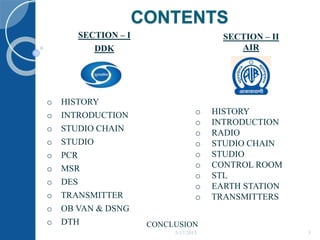
CONTENTS
SECTION – I
DDK
o HISTORY
o INTRODUCTION
o STUDIO CHAIN
o STUDIO
o PCR
o MSR
o DES
o TRANSMITTER
o OB VAN & DSNG
o DTH
SECTION – II
AIR
o HISTORY
o INTRODUCTION
o RADIO
o STUDIO CHAIN
o STUDIO
o CONTROL ROOM
o STL
o EARTH STATION
o TRANSMITTERS
5/17/2015 3
CONCLUSION
SECTION- I
DDK
5/17/2015 4
HISTORY
o Doordarshan (DD) is an Indian public service broadcaster run by
Prasar Bharati.
o First service started on 15th Sept. 1959.
o TV services were separated from AIR in 1979.
o In 1982, Doordarshan Kendra (DDK) as a national broadcaster
came into existence.
o DDK Thiruvananthapuram was inaugurated on 1st January 1985.
5/17/2015 5
INTRODUCTION
o Doordarshan is India’s national TV channel.
o DD has over 1500 transmitters and is one of the largest
broadcasting organizations in the world.
o DDK Thiruvananthapuram is a part of the DD India.
o DDK Thiruvananthapuram is equipped with 2 studios, 2 terrestrial
transmitters & 1 digital up-link station.
5/17/2015 6
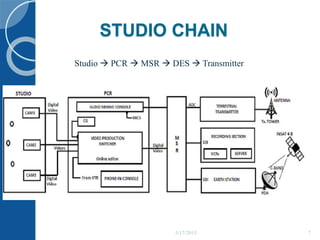
STUDIO CHAIN
Studio  PCR  MSR  DES  Transmitter
5/17/2015 7
STUDIO
o Studio is an arrangement in which production of programs take place.
o There are two studios in DDK
Small studio - for news production
Large studio - main studio
o Main components of a studio
TV Camera
Lighting
Microphone
5/17/2015 8
1. Camera
o Studio TV camera is the beginning of the video signal.
o A typical video camera consists of the following sections :
a) A Camera lens and optics : To form optical image on the
face plate of a pick up device.
b) A transducer or pick up device : To convert optical image
into an electrical signal.
c) Electronics : To process output of a transducer to get a
CCVS signal.
5/17/2015 9
2. Lighting
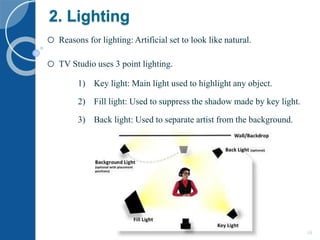
o Reasons for lighting: Artificial set to look like natural.
o TV Studio uses 3 point lighting.
1) Key light: Main light used to highlight any object.
2) Fill light: Used to suppress the shadow made by key light.
3) Back light: Used to separate artist from the background.
5/17/2015 10
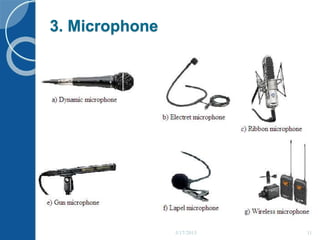
3. Microphone
5/17/2015 11
PRODUCTION CONTROL
ROOM (PCR)
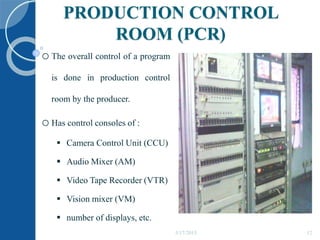
oThe overall control of a program
is done in production control
room by the producer.
oHas control consoles of :
 Camera Control Unit (CCU)
 Audio Mixer (AM)
 Video Tape Recorder (VTR)
 Vision mixer (VM)
 number of displays, etc.
5/17/2015 12
PCR (Contd…)
o CCU : Controls aperture, optical focus, zoom of the lens system etc.
o AM : Combining, routing, and changing the level, timbre of audio
signals.
o VTR : All the programs shot in the camera are simultaneously
recorded and playbacks the videos as and when required.
o VM : Enables the producer to select the desired sources or a
combination of the sources to compose the program. 3 types of
switching or transitions between various sources takes place in VM:
 Mixing
 Wiping
 Keying
5/17/2015 13
MASTER SWITCHING ROOM
(MSR)
5/17/2015 14
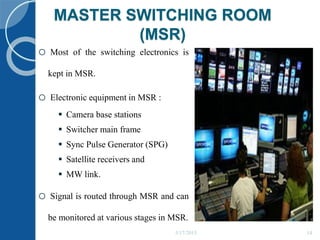
o Most of the switching electronics is
kept in MSR.
o Electronic equipment in MSR :
 Camera base stations
 Switcher main frame
 Sync Pulse Generator (SPG)
 Satellite receivers and
 MW link.
o Signal is routed through MSR and can
be monitored at various stages in MSR.
DIGITAL EARTH STATION
(DES)
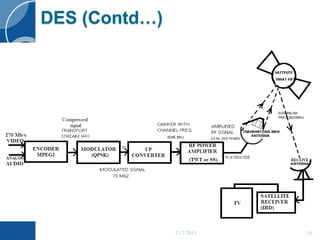
o Earth Station is the unit from where programme signal is sent to the
satellite (uplink) and Programme signal transmitted by the satellite is
received at the earth station (downlink).
o Satellite: INSAT 3A
o Uplink frequency: 6036.5 MHz ( C band)
o Downlink frequency: 3811.5 MHz (S band)
o The whole system operates with DVB-T/MPEG2 standard for
terrestrial transmission.
o Systems operate in redundant mode and takes over in the event of
failure of the main chain.
5/17/2015 15
DES (Contd…)
5/17/2015 16
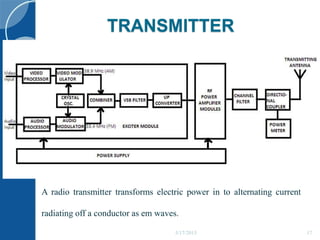
TRANSMITTER
A radio transmitter transforms electric power in to alternating current
radiating off a conductor as em waves.
5/17/2015 17
OB VAN & DSNG
o OB Van is used for live broadcasting.
o Divided into 4 parts:
 Production area or sitting area for all directors &
producers.
 Audio section
 Video section.
 Transmission where the signal is for quality control
purposes & transmitted or sent to other trucks.
o If there is a live program to be telecast following options can be chosen:
 Microwave link
 DSNG (digital satellite news gathering) : Used for direct
uplinking or transmission to MSR.
o OB van is known as the mobile studio and the DSNG van as the mobile
earth station.
5/17/2015 18
OB VAN & DSNG (Contd…)
5/17/2015 19
DIRECT-TO-HOME (DTH)
o DTH or Direct Satellite Broadcasting (DBS) is the distribution of
television signals from high powered geo-stationary satellites to a
small dish antenna and satellite receivers at home.
o DTH services are fully digital, so it can offer value added services.
o It is the only free-to-air satellite television service in India.
o Insat 4B satellite is used to broadcast 64 FTA mpeg-2 channels and 24
mpeg-4 channels in Ku-Band.
5/17/2015 20
SECTION- II
AIR
5/17/2015 21
HISTORY
oAIR is the India’s national broadcaster established in 1930.
o It is one of the largest radio networks in the world.
o It is officially known as Akashvani.
o AIR’s motto is ” Bahujan Hitaya : Bahujan Sukhaya ”.
o AIR today has a network of 149 MW, 54 SW and 177 FM transmitters.
5/17/2015 22
INTRODUCTION
o Radio is a powerful mass medium used in imparting information and
giving entertainment.
o AIR has a three-tier system of broadcasting.
 National
 Regional
 Local
o The principal ingredients of AIR's programme output are music, talks,
interviews and discussions, newscasts, plays, features and
documentaries, educational broadcasts, outside broadcasts etc.
5/17/2015 23
RADIO
5/17/2015 24
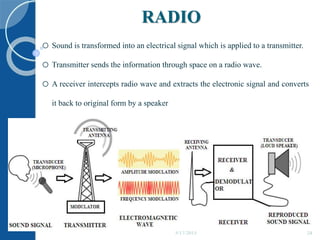
o Sound is transformed into an electrical signal which is applied to a transmitter.
o Transmitter sends the information through space on a radio wave.
o A receiver intercepts radio wave and extracts the electronic signal and converts
it back to original form by a speaker
STUDIO CHAIN
5/17/2015 25
STUDIO
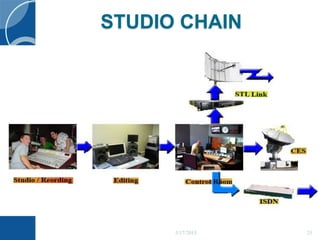
o Requires electronic equipment to generate programs.
o AIR Thiruvananthapuram has 7 studios. They are:
a) Recording studios:
i. Talk studio: recording of programs like interview.
ii. Drama studio
iii. Music studio: Light music studio & classical music
studio.
b) Playback studios:
i. PB1 for Regional channel (MW)
ii. PB2 for IGNOU and NEWS
iii. PB3 for Ananthapuri FM
5/17/2015 26
Functions of studio
5/17/2015 27
1) Recording:
 Electrical or mechanical inscription of sound waves.
2) Editing:
 Recorded audio signals are edited by using editing software
(Sony Sound forge ).
3) Scheduling:
 Edited audio clips are saved and scheduled for transmission.
 Uses AIR Browser software.
4) Playback:
 Edited audio signals ready for transmission are played in the
transmission studios before sending it to the control room.
 AIR Virtual Studio is the software used here.
CONTROL ROOM
5/17/2015 28
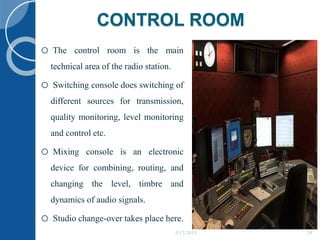
o The control room is the main
technical area of the radio station.
o Switching console does switching of
different sources for transmission,
quality monitoring, level monitoring
and control etc.
o Mixing console is an electronic
device for combining, routing, and
changing the level, timbre and
dynamics of audio signals.
o Studio change-over takes place here.
STUDIO TRANSMITTER LINK
(STL)
5/17/2015 29
oSTL sends a radio station’s audio from the broadcast studio to a radio
transmitter in another location.
oIn AIR, the transmission link refers to the communication channel that
connects the studio to the transmitters.
oLinks used in AIR:
 Microwave links
 ISDN ( Integrated Services Digital Network )
 Leased line
 Captive Earth Station (CES) for satellite uplink.
EARTH STATION
5/17/2015 30
oAIR requires Captive Earth Stations to uplink its programs for
distribution through satellite.
oMain components:
 The BBIF Rack houses the subsystems used in Baseband processing
and Encoding/Modulation of signals.
 The HPA Rack houses the subsystems used in upconversion,
amplification of the RF signal.
 The Monitoring Rack houses all the receiving equipment for reception
of downlinked signals.
TRANSMITTERS IN AIR
5/17/2015 31
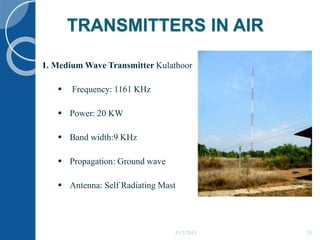
1. Medium Wave Transmitter Kulathoor
 Frequency: 1161 KHz
 Power: 20 KW
 Band width:9 KHz
 Propagation: Ground wave
 Antenna: Self Radiating Mast
TRANSMITTERS IN AIR
(Contd…)
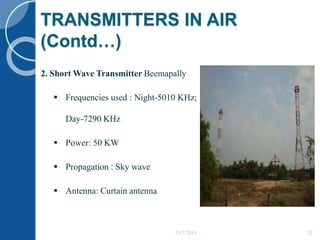
2. Short Wave Transmitter Beemapally
 Frequencies used : Night-5010 KHz;
Day-7290 KHz
 Power: 50 KW
 Propagation : Sky wave
 Antenna: Curtain antenna
5/17/2015 32
TRANSMITTERS IN AIR
(Contd...)
5/17/2015 33
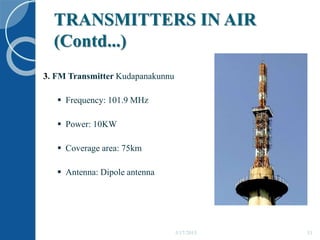
3. FM Transmitter Kudapanakunnu
 Frequency: 101.9 MHz
 Power: 10KW
 Coverage area: 75km
 Antenna: Dipole antenna
CONCLUSION
5/17/2015 34
oWe have undergone industrial training at Doordarshan Kendra and All
India Radio, Thiruvananthapuram for a period of 1 month.
oIn this training, most of the theoretical knowledge that has been gained
during the course of studies is put to test.
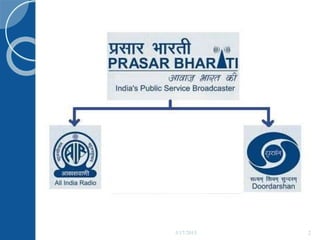
oBoth Doordarshan and All India Radio are divisions of Prasar Bharati and
is a mass medium of communication.
oThese are Free to Air service providers.
oIt was a great experience to learn about the organizations and the
technologies used there.
QUERIES
5/17/2015 35
THANK YOU…
5/17/2015 36

Presentation on Industrial training

  • 1.
  • 2.
  • 3.
    CONTENTS SECTION – I DDK oHISTORY o INTRODUCTION o STUDIO CHAIN o STUDIO o PCR o MSR o DES o TRANSMITTER o OB VAN & DSNG o DTH SECTION – II AIR o HISTORY o INTRODUCTION o RADIO o STUDIO CHAIN o STUDIO o CONTROL ROOM o STL o EARTH STATION o TRANSMITTERS 5/17/2015 3 CONCLUSION
  • 4.
  • 5.
    HISTORY o Doordarshan (DD)is an Indian public service broadcaster run by Prasar Bharati. o First service started on 15th Sept. 1959. o TV services were separated from AIR in 1979. o In 1982, Doordarshan Kendra (DDK) as a national broadcaster came into existence. o DDK Thiruvananthapuram was inaugurated on 1st January 1985. 5/17/2015 5
  • 6.
    INTRODUCTION o Doordarshan isIndia’s national TV channel. o DD has over 1500 transmitters and is one of the largest broadcasting organizations in the world. o DDK Thiruvananthapuram is a part of the DD India. o DDK Thiruvananthapuram is equipped with 2 studios, 2 terrestrial transmitters & 1 digital up-link station. 5/17/2015 6
  • 7.
    STUDIO CHAIN Studio PCR  MSR  DES  Transmitter 5/17/2015 7
  • 8.
    STUDIO o Studio isan arrangement in which production of programs take place. o There are two studios in DDK Small studio - for news production Large studio - main studio o Main components of a studio TV Camera Lighting Microphone 5/17/2015 8
  • 9.
    1. Camera o StudioTV camera is the beginning of the video signal. o A typical video camera consists of the following sections : a) A Camera lens and optics : To form optical image on the face plate of a pick up device. b) A transducer or pick up device : To convert optical image into an electrical signal. c) Electronics : To process output of a transducer to get a CCVS signal. 5/17/2015 9
  • 10.
    2. Lighting o Reasonsfor lighting: Artificial set to look like natural. o TV Studio uses 3 point lighting. 1) Key light: Main light used to highlight any object. 2) Fill light: Used to suppress the shadow made by key light. 3) Back light: Used to separate artist from the background. 5/17/2015 10
  • 11.
  • 12.
    PRODUCTION CONTROL ROOM (PCR) oTheoverall control of a program is done in production control room by the producer. oHas control consoles of :  Camera Control Unit (CCU)  Audio Mixer (AM)  Video Tape Recorder (VTR)  Vision mixer (VM)  number of displays, etc. 5/17/2015 12
  • 13.
    PCR (Contd…) o CCU: Controls aperture, optical focus, zoom of the lens system etc. o AM : Combining, routing, and changing the level, timbre of audio signals. o VTR : All the programs shot in the camera are simultaneously recorded and playbacks the videos as and when required. o VM : Enables the producer to select the desired sources or a combination of the sources to compose the program. 3 types of switching or transitions between various sources takes place in VM:  Mixing  Wiping  Keying 5/17/2015 13
  • 14.
    MASTER SWITCHING ROOM (MSR) 5/17/201514 o Most of the switching electronics is kept in MSR. o Electronic equipment in MSR :  Camera base stations  Switcher main frame  Sync Pulse Generator (SPG)  Satellite receivers and  MW link. o Signal is routed through MSR and can be monitored at various stages in MSR.
  • 15.
    DIGITAL EARTH STATION (DES) oEarth Station is the unit from where programme signal is sent to the satellite (uplink) and Programme signal transmitted by the satellite is received at the earth station (downlink). o Satellite: INSAT 3A o Uplink frequency: 6036.5 MHz ( C band) o Downlink frequency: 3811.5 MHz (S band) o The whole system operates with DVB-T/MPEG2 standard for terrestrial transmission. o Systems operate in redundant mode and takes over in the event of failure of the main chain. 5/17/2015 15
  • 16.
  • 17.
    TRANSMITTER A radio transmittertransforms electric power in to alternating current radiating off a conductor as em waves. 5/17/2015 17
  • 18.
    OB VAN &DSNG o OB Van is used for live broadcasting. o Divided into 4 parts:  Production area or sitting area for all directors & producers.  Audio section  Video section.  Transmission where the signal is for quality control purposes & transmitted or sent to other trucks. o If there is a live program to be telecast following options can be chosen:  Microwave link  DSNG (digital satellite news gathering) : Used for direct uplinking or transmission to MSR. o OB van is known as the mobile studio and the DSNG van as the mobile earth station. 5/17/2015 18
  • 19.
    OB VAN &DSNG (Contd…) 5/17/2015 19
  • 20.
    DIRECT-TO-HOME (DTH) o DTHor Direct Satellite Broadcasting (DBS) is the distribution of television signals from high powered geo-stationary satellites to a small dish antenna and satellite receivers at home. o DTH services are fully digital, so it can offer value added services. o It is the only free-to-air satellite television service in India. o Insat 4B satellite is used to broadcast 64 FTA mpeg-2 channels and 24 mpeg-4 channels in Ku-Band. 5/17/2015 20
  • 21.
  • 22.
    HISTORY oAIR is theIndia’s national broadcaster established in 1930. o It is one of the largest radio networks in the world. o It is officially known as Akashvani. o AIR’s motto is ” Bahujan Hitaya : Bahujan Sukhaya ”. o AIR today has a network of 149 MW, 54 SW and 177 FM transmitters. 5/17/2015 22
  • 23.
    INTRODUCTION o Radio isa powerful mass medium used in imparting information and giving entertainment. o AIR has a three-tier system of broadcasting.  National  Regional  Local o The principal ingredients of AIR's programme output are music, talks, interviews and discussions, newscasts, plays, features and documentaries, educational broadcasts, outside broadcasts etc. 5/17/2015 23
  • 24.
    RADIO 5/17/2015 24 o Soundis transformed into an electrical signal which is applied to a transmitter. o Transmitter sends the information through space on a radio wave. o A receiver intercepts radio wave and extracts the electronic signal and converts it back to original form by a speaker
  • 25.
  • 26.
    STUDIO o Requires electronicequipment to generate programs. o AIR Thiruvananthapuram has 7 studios. They are: a) Recording studios: i. Talk studio: recording of programs like interview. ii. Drama studio iii. Music studio: Light music studio & classical music studio. b) Playback studios: i. PB1 for Regional channel (MW) ii. PB2 for IGNOU and NEWS iii. PB3 for Ananthapuri FM 5/17/2015 26
  • 27.
    Functions of studio 5/17/201527 1) Recording:  Electrical or mechanical inscription of sound waves. 2) Editing:  Recorded audio signals are edited by using editing software (Sony Sound forge ). 3) Scheduling:  Edited audio clips are saved and scheduled for transmission.  Uses AIR Browser software. 4) Playback:  Edited audio signals ready for transmission are played in the transmission studios before sending it to the control room.  AIR Virtual Studio is the software used here.
  • 28.
    CONTROL ROOM 5/17/2015 28 oThe control room is the main technical area of the radio station. o Switching console does switching of different sources for transmission, quality monitoring, level monitoring and control etc. o Mixing console is an electronic device for combining, routing, and changing the level, timbre and dynamics of audio signals. o Studio change-over takes place here.
  • 29.
    STUDIO TRANSMITTER LINK (STL) 5/17/201529 oSTL sends a radio station’s audio from the broadcast studio to a radio transmitter in another location. oIn AIR, the transmission link refers to the communication channel that connects the studio to the transmitters. oLinks used in AIR:  Microwave links  ISDN ( Integrated Services Digital Network )  Leased line  Captive Earth Station (CES) for satellite uplink.
  • 30.
    EARTH STATION 5/17/2015 30 oAIRrequires Captive Earth Stations to uplink its programs for distribution through satellite. oMain components:  The BBIF Rack houses the subsystems used in Baseband processing and Encoding/Modulation of signals.  The HPA Rack houses the subsystems used in upconversion, amplification of the RF signal.  The Monitoring Rack houses all the receiving equipment for reception of downlinked signals.
  • 31.
    TRANSMITTERS IN AIR 5/17/201531 1. Medium Wave Transmitter Kulathoor  Frequency: 1161 KHz  Power: 20 KW  Band width:9 KHz  Propagation: Ground wave  Antenna: Self Radiating Mast
  • 32.
    TRANSMITTERS IN AIR (Contd…) 2.Short Wave Transmitter Beemapally  Frequencies used : Night-5010 KHz; Day-7290 KHz  Power: 50 KW  Propagation : Sky wave  Antenna: Curtain antenna 5/17/2015 32
  • 33.
    TRANSMITTERS IN AIR (Contd...) 5/17/201533 3. FM Transmitter Kudapanakunnu  Frequency: 101.9 MHz  Power: 10KW  Coverage area: 75km  Antenna: Dipole antenna
  • 34.
    CONCLUSION 5/17/2015 34 oWe haveundergone industrial training at Doordarshan Kendra and All India Radio, Thiruvananthapuram for a period of 1 month. oIn this training, most of the theoretical knowledge that has been gained during the course of studies is put to test. oBoth Doordarshan and All India Radio are divisions of Prasar Bharati and is a mass medium of communication. oThese are Free to Air service providers. oIt was a great experience to learn about the organizations and the technologies used there.
  • 35.
  • 36.