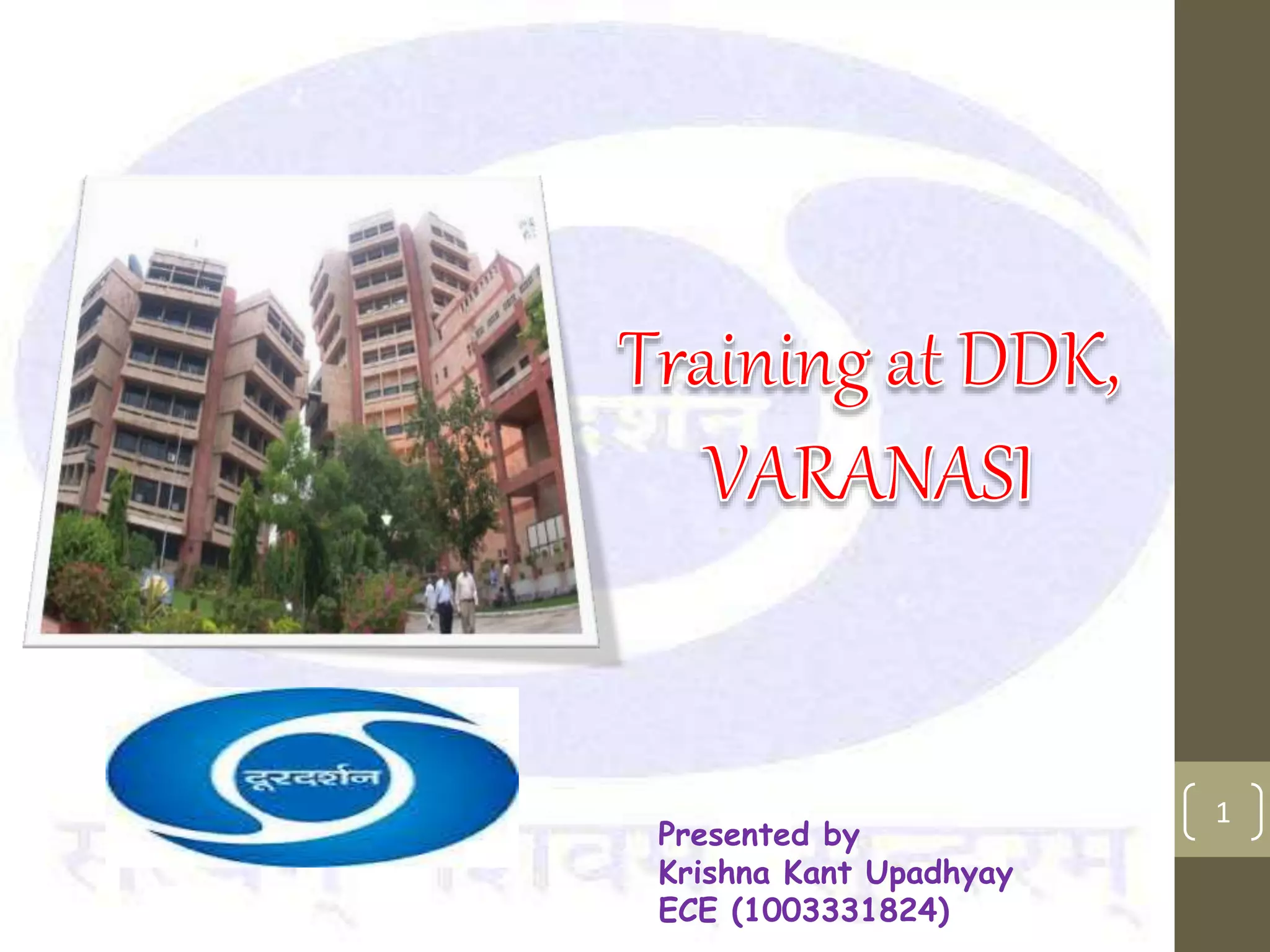
on
1
Presented by
Krishna Kant Upadhyay
ECE (1003331824)
Contents
• Introduction
• TV Studio
• Vision mixer
• Audio & video chain
• MSR
• Earth station
• OB VAN & DSNG
2
Introduction
process of sending information to a
distant place is called Broadcasting.
• Means of Broadcasting in India:
1. Terrestrial
2. Satellite
3. Internet
• Both AIR & DD make use of both
Terrestrial & satellite. 3
Introductioncontd…
• Broadcasting started in India in the year
1923.
• AIR was formed in the year 1936.
• In 1947, AIR was covering 2.5% & about
11% of land & population respectively.
• 1st T.V Station was established in Delhi in
1959
• T.V was separated from AIR in 1976
• DD has 1500 Transmitters and 70
Production centers across the Country.
4
TVstudio
5
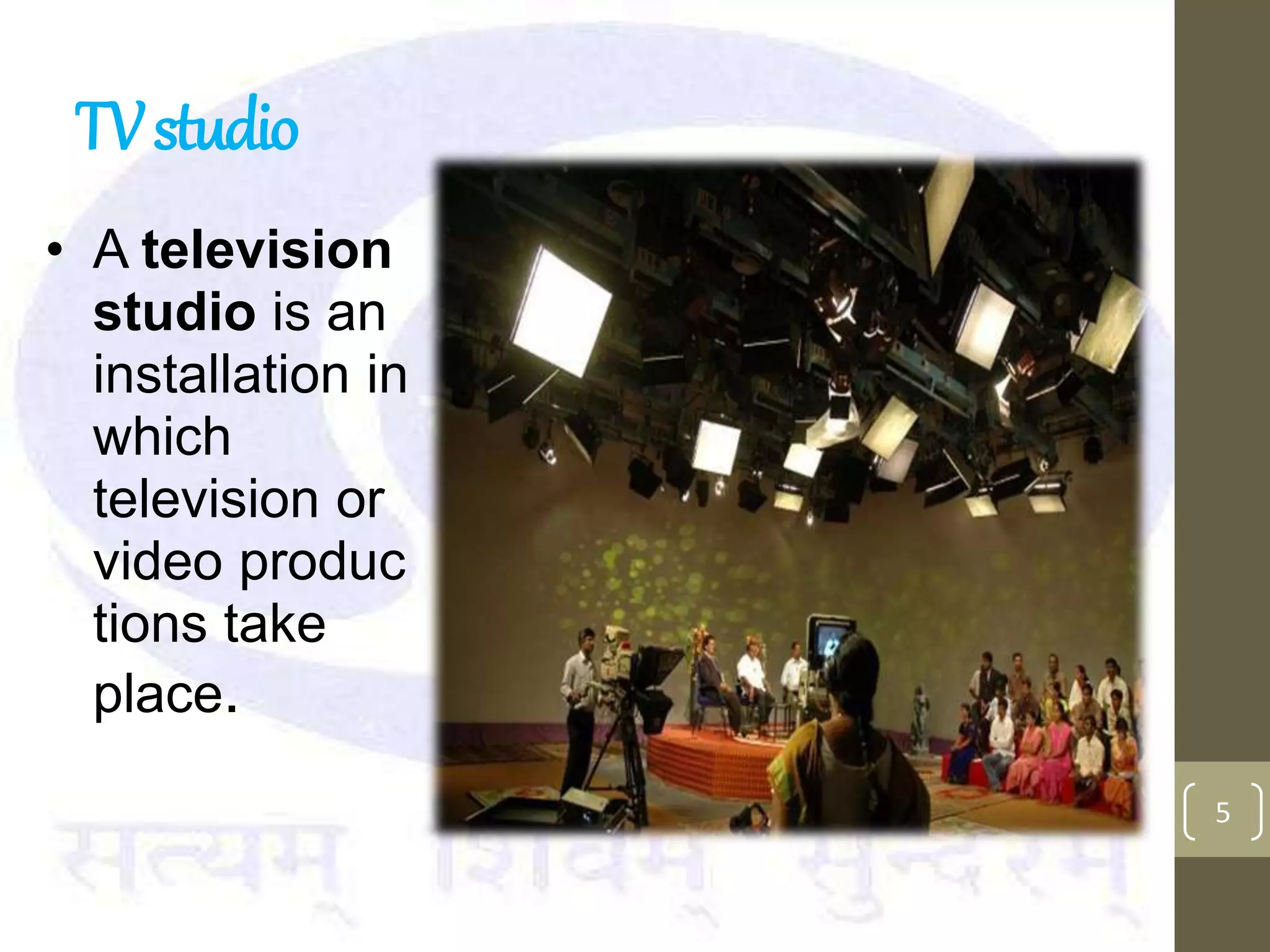
• A television
studio is an
installation in
which
television or
video produc
tions take
place.
ComponentsofTVstudio
• Camera
• Lighting
• Microphones
• Vision mixer and Audio consoles
• MSR
• VTR
• Acoustics
• Post production and video effects
• Supporting services like AC, UPS
6
VisionMixer
7
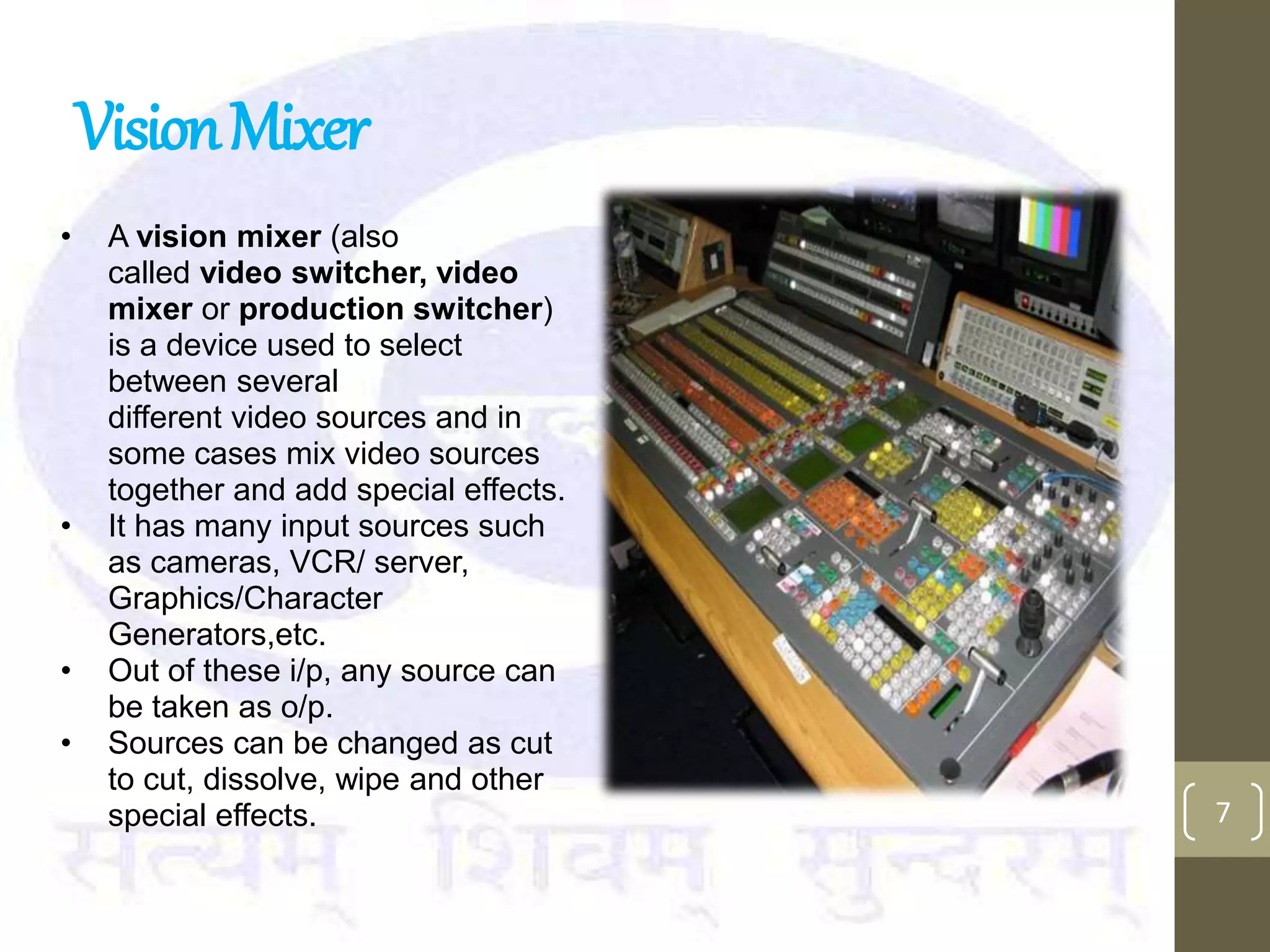
• A vision mixer (also
called video switcher, video
mixer or production switcher)
is a device used to select
between several
different video sources and in
some cases mix video sources
together and add special effects.
• It has many input sources such
as cameras, VCR/ server,
Graphics/Character
Generators,etc.
• Out of these i/p, any source can
be taken as o/p.
• Sources can be changed as cut
to cut, dissolve, wipe and other
special effects.
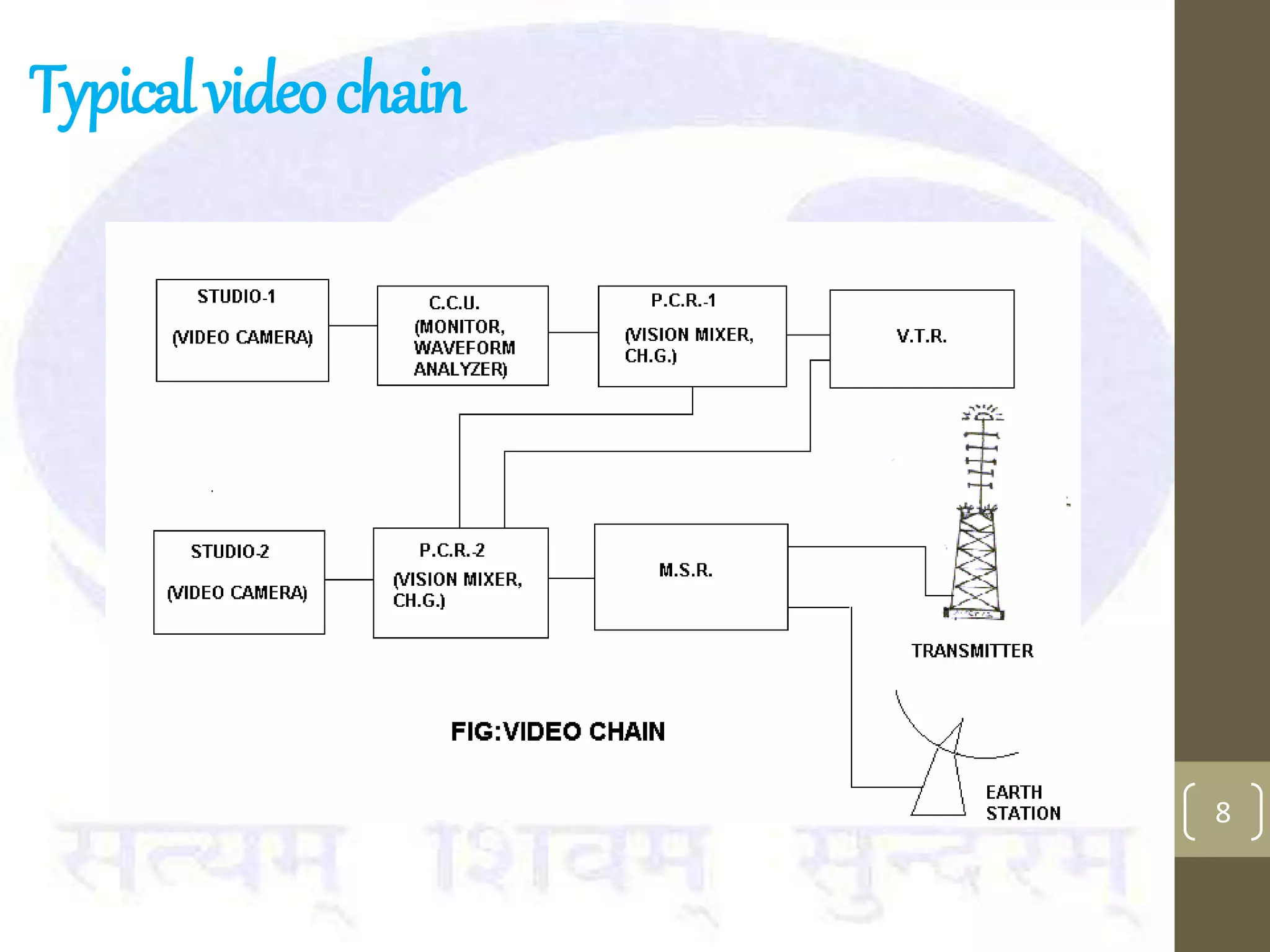
Typicalvideochain
8
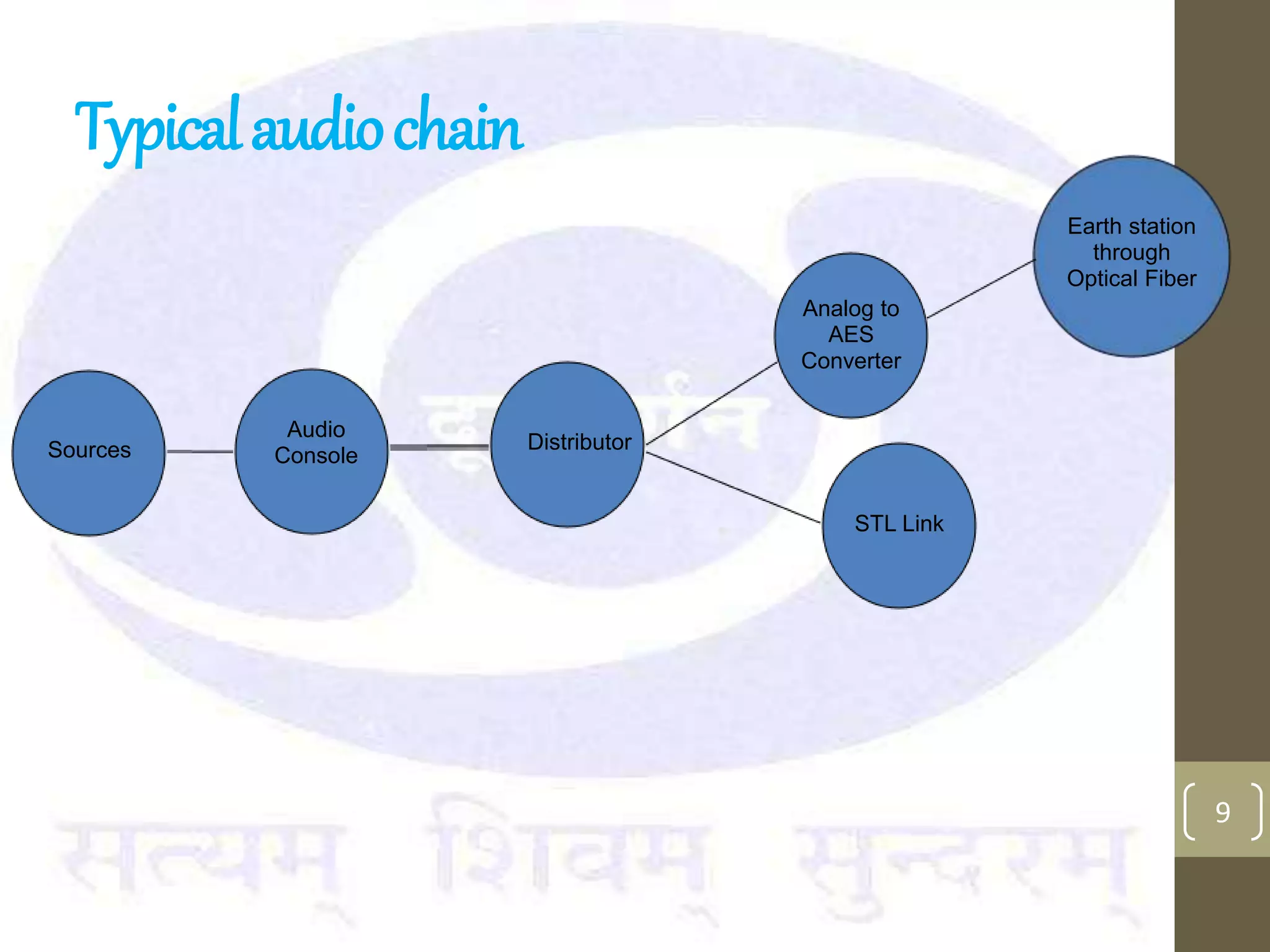
Typicalaudiochain
9
Distributor
Audio
Console
Analog to
AES
Converter
Earth station
through
Optical Fiber
STL Link
Sources
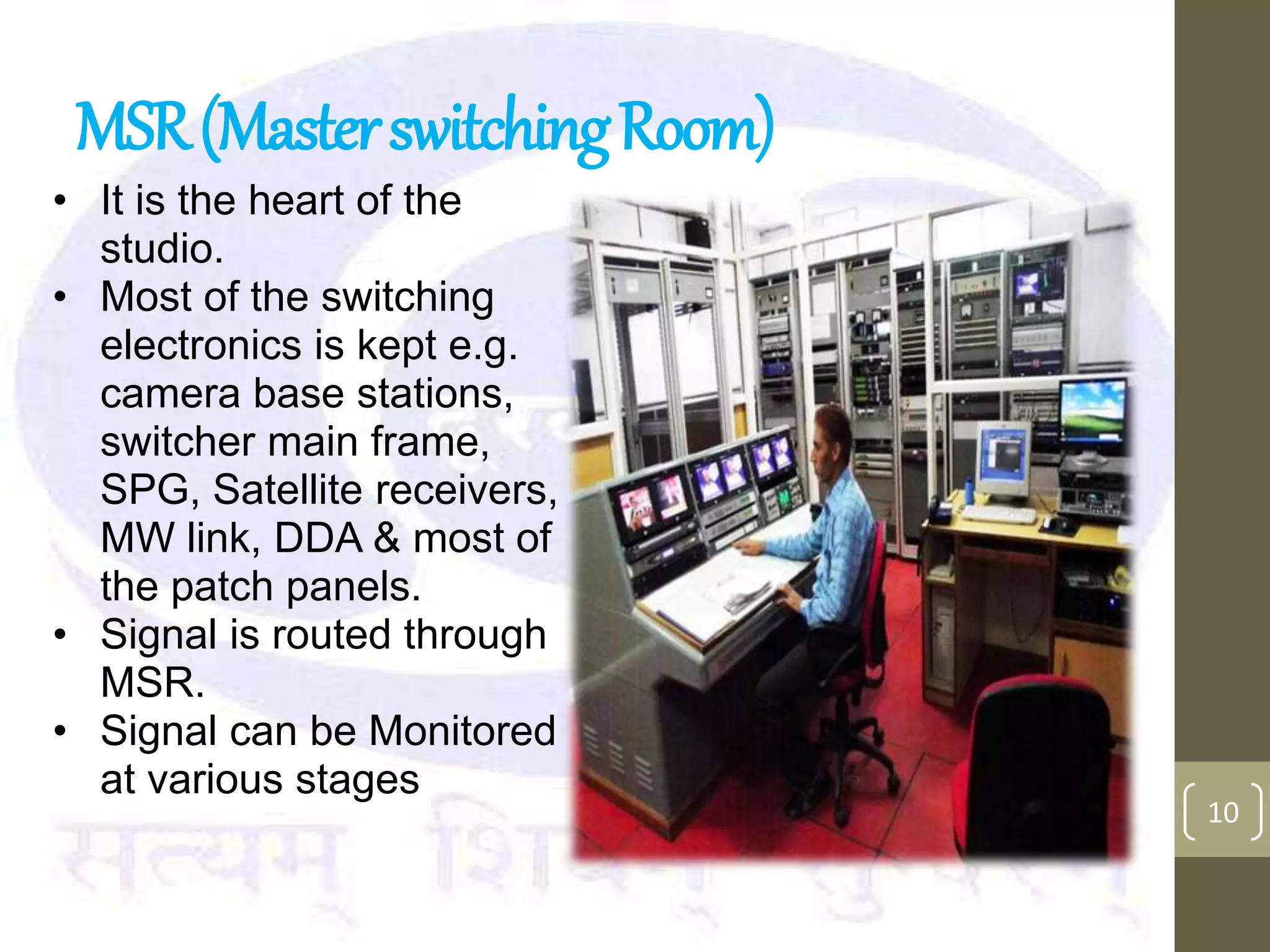
MSR(MasterswitchingRoom)
• It is the heart of the
studio.
• Most of the switching
electronics is kept e.g.
camera base stations,
switcher main frame,
SPG, Satellite receivers,
MW link, DDA & most of
the patch panels.
• Signal is routed through
MSR.
• Signal can be Monitored
at various stages
10
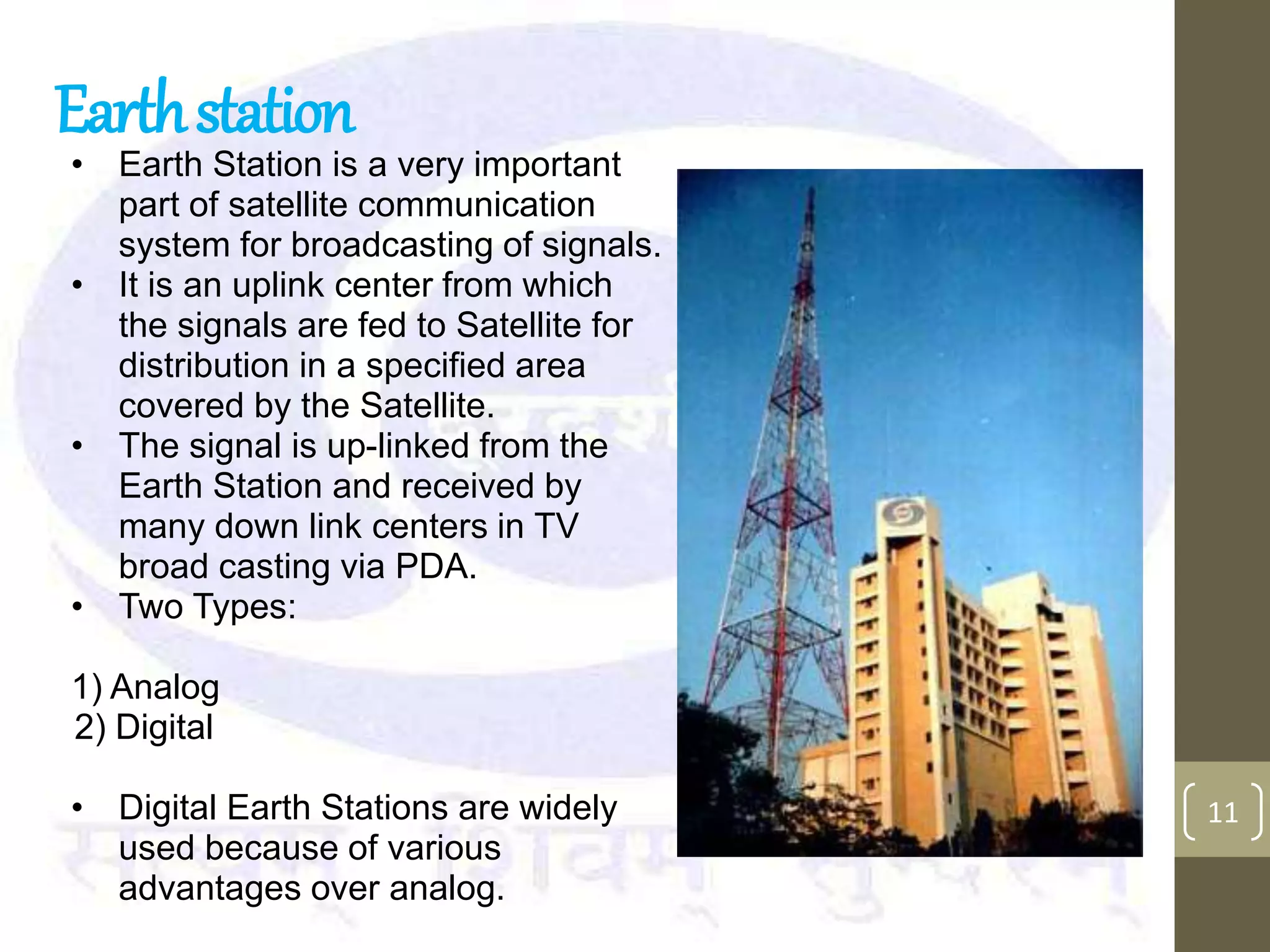
Earthstation
11
• Earth Station is a very important
part of satellite communication
system for broadcasting of signals.
• It is an uplink center from which
the signals are fed to Satellite for
distribution in a specified area
covered by the Satellite.
• The signal is up-linked from the
Earth Station and received by
many down link centers in TV
broad casting via PDA.
• Two Types:
1) Analog
2) Digital
• Digital Earth Stations are widely
used because of various
advantages over analog.
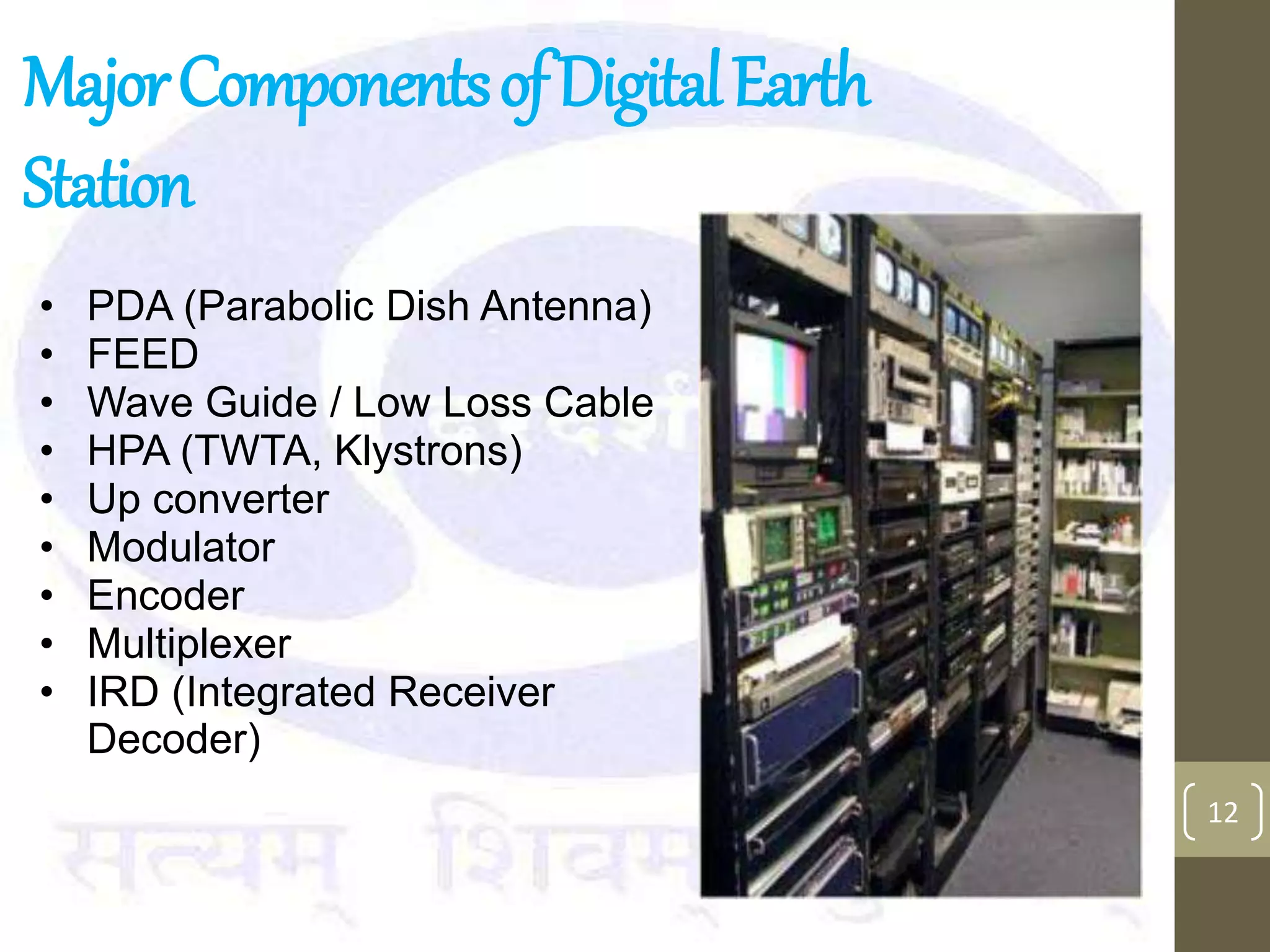
MajorComponentsofDigitalEarth
Station
12
• PDA (Parabolic Dish Antenna)
• FEED
• Wave Guide / Low Loss Cable
• HPA (TWTA, Klystrons)
• Up converter
• Modulator
• Encoder
• Multiplexer
• IRD (Integrated Receiver
Decoder)
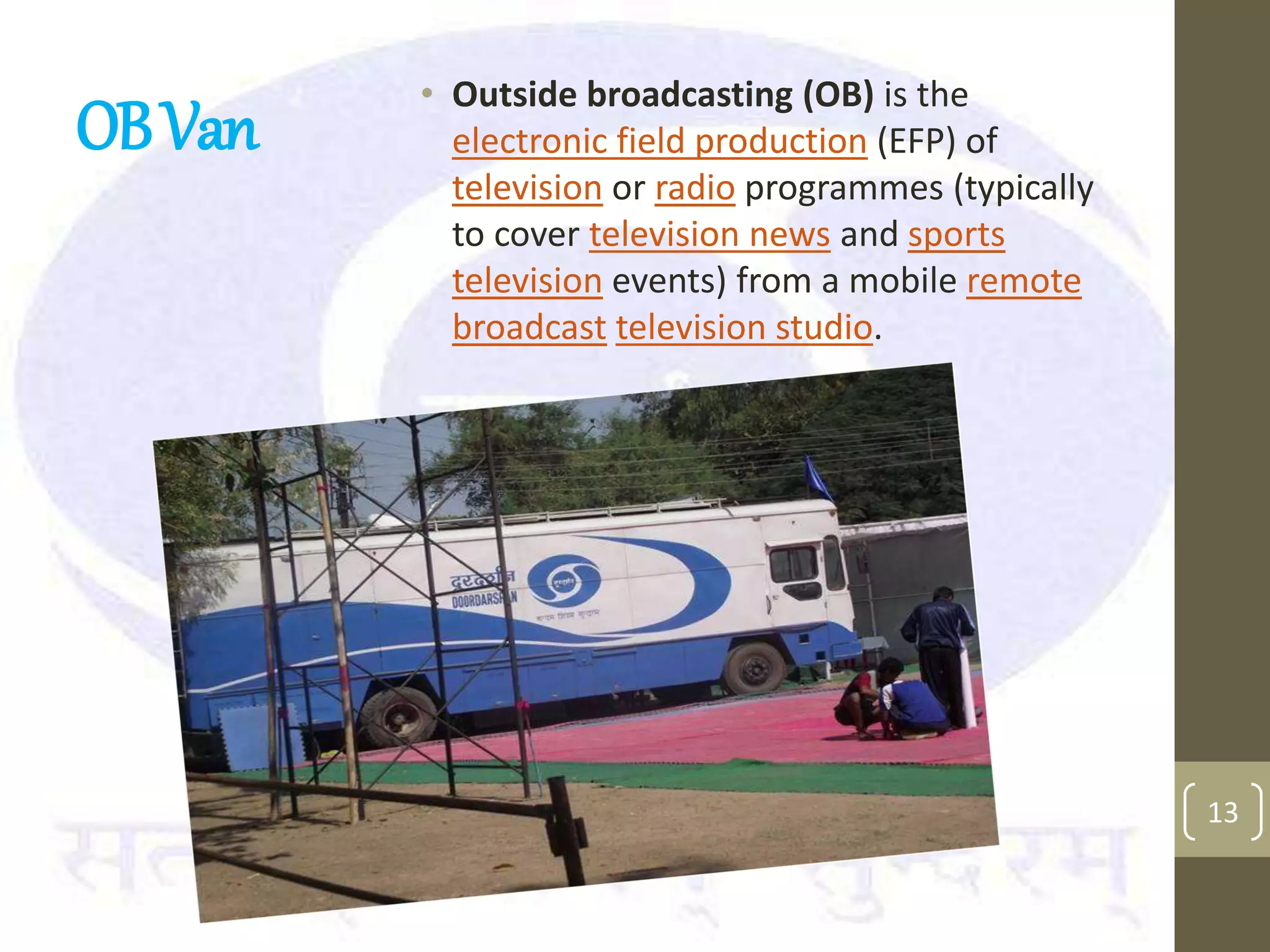
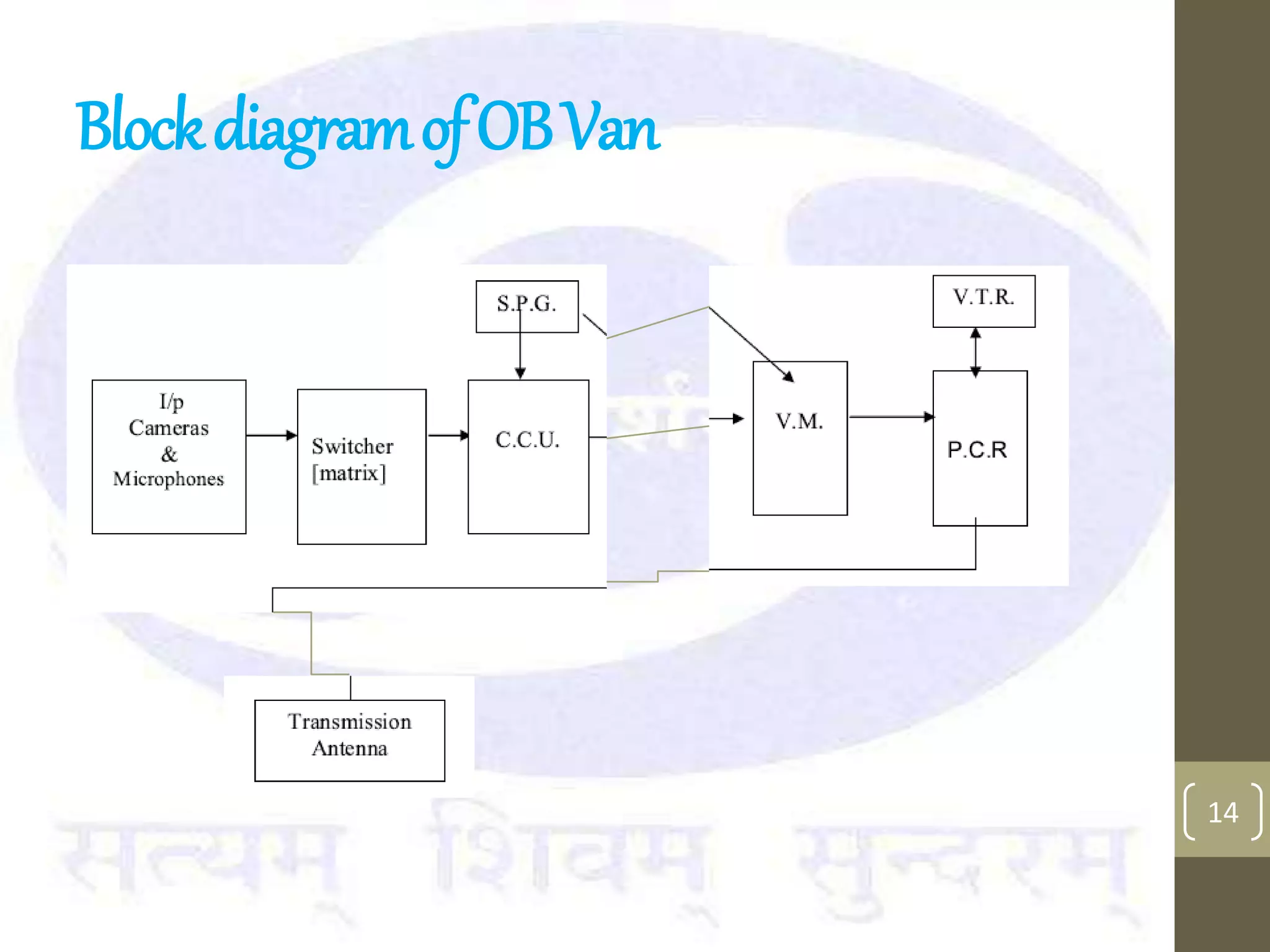
OBVan
• Outside broadcasting (OB) is the
electronic field production (EFP) of
television or radio programmes (typically
to cover television news and sports
television events) from a mobile remote
broadcast television studio.
13
BlockdiagramofOBVan
14
OBVan
• A typical OB Van is usually divided into 4 parts.
• The first and largest part is the production area or
sitting area for all directors & producers.
• The second part of a van is for the audio engineer.
• The 3rd part of the van is video tape
• The 4th part is transmission where the signal is
monitored by and engineered for quality control
purposes and is transmitted or sent to other trucks.
15
If there is a live program to be telecast following options can be
choosed.
 Microwave link
 DSNG (digital satellite news gathering)
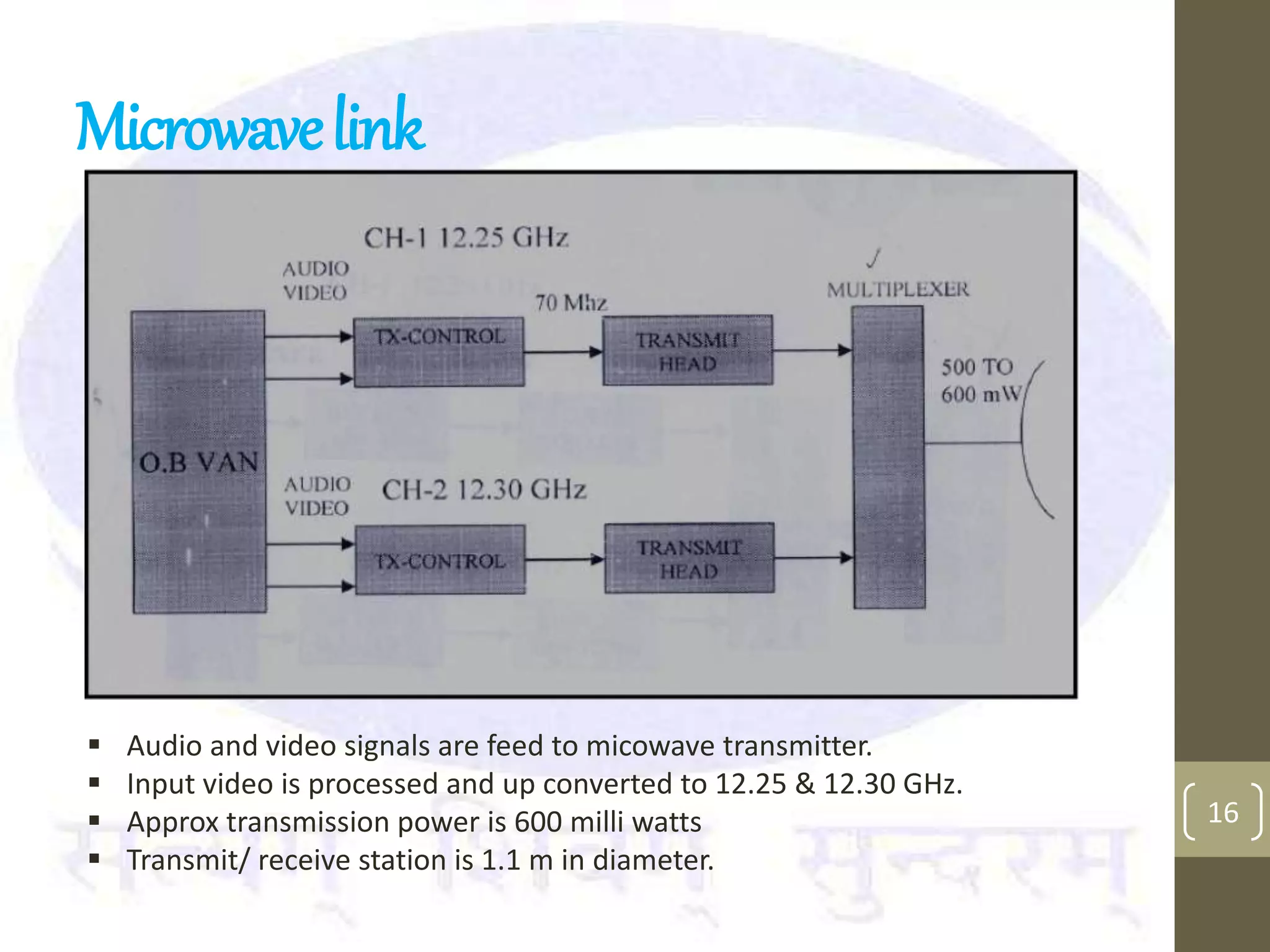
Microwavelink
16
 Audio and video signals are feed to micowave transmitter.
 Input video is processed and up converted to 12.25 & 12.30 GHz.
 Approx transmission power is 600 milli watts
 Transmit/ receive station is 1.1 m in diameter.
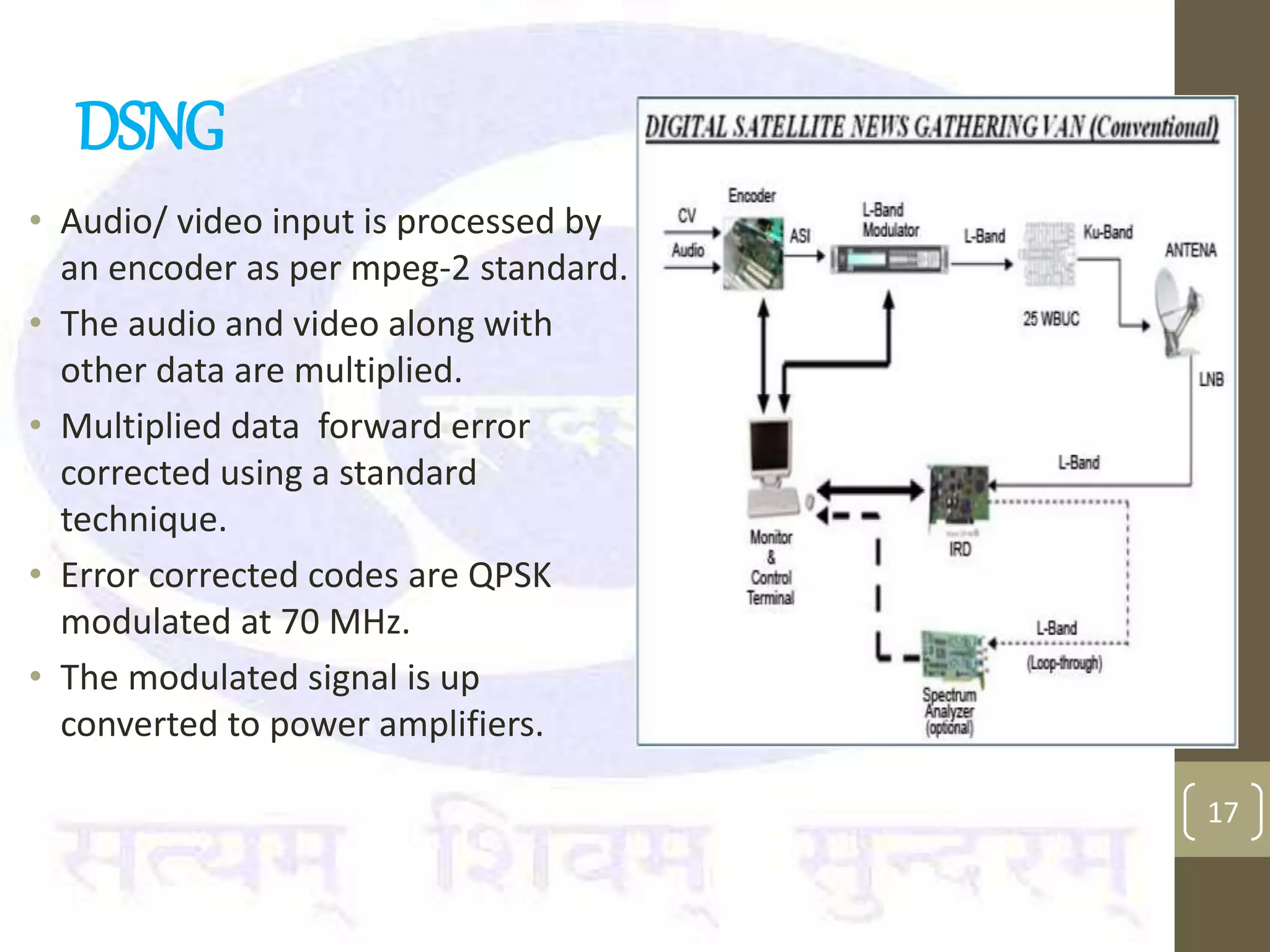
DSNG
• Audio/ video input is processed by
an encoder as per mpeg-2 standard.
• The audio and video along with
other data are multiplied.
• Multiplied data forward error
corrected using a standard
technique.
• Error corrected codes are QPSK
modulated at 70 MHz.
• The modulated signal is up
converted to power amplifiers.
17
Thank you…
18
Any queries ?

Final presentation of DDK

  • 1.
    on 1 Presented by Krishna KantUpadhyay ECE (1003331824)
  • 2.
    Contents • Introduction • TVStudio • Vision mixer • Audio & video chain • MSR • Earth station • OB VAN & DSNG 2
  • 3.
    Introduction process of sendinginformation to a distant place is called Broadcasting. • Means of Broadcasting in India: 1. Terrestrial 2. Satellite 3. Internet • Both AIR & DD make use of both Terrestrial & satellite. 3
  • 4.
    Introductioncontd… • Broadcasting startedin India in the year 1923. • AIR was formed in the year 1936. • In 1947, AIR was covering 2.5% & about 11% of land & population respectively. • 1st T.V Station was established in Delhi in 1959 • T.V was separated from AIR in 1976 • DD has 1500 Transmitters and 70 Production centers across the Country. 4
  • 5.
    TVstudio 5 • A television studiois an installation in which television or video produc tions take place.
  • 6.
    ComponentsofTVstudio • Camera • Lighting •Microphones • Vision mixer and Audio consoles • MSR • VTR • Acoustics • Post production and video effects • Supporting services like AC, UPS 6
  • 7.
    VisionMixer 7 • A visionmixer (also called video switcher, video mixer or production switcher) is a device used to select between several different video sources and in some cases mix video sources together and add special effects. • It has many input sources such as cameras, VCR/ server, Graphics/Character Generators,etc. • Out of these i/p, any source can be taken as o/p. • Sources can be changed as cut to cut, dissolve, wipe and other special effects.
  • 8.
  • 9.
  • 10.
    MSR(MasterswitchingRoom) • It isthe heart of the studio. • Most of the switching electronics is kept e.g. camera base stations, switcher main frame, SPG, Satellite receivers, MW link, DDA & most of the patch panels. • Signal is routed through MSR. • Signal can be Monitored at various stages 10
  • 11.
    Earthstation 11 • Earth Stationis a very important part of satellite communication system for broadcasting of signals. • It is an uplink center from which the signals are fed to Satellite for distribution in a specified area covered by the Satellite. • The signal is up-linked from the Earth Station and received by many down link centers in TV broad casting via PDA. • Two Types: 1) Analog 2) Digital • Digital Earth Stations are widely used because of various advantages over analog.
  • 12.
    MajorComponentsofDigitalEarth Station 12 • PDA (ParabolicDish Antenna) • FEED • Wave Guide / Low Loss Cable • HPA (TWTA, Klystrons) • Up converter • Modulator • Encoder • Multiplexer • IRD (Integrated Receiver Decoder)
  • 13.
    OBVan • Outside broadcasting(OB) is the electronic field production (EFP) of television or radio programmes (typically to cover television news and sports television events) from a mobile remote broadcast television studio. 13
  • 14.
  • 15.
    OBVan • A typicalOB Van is usually divided into 4 parts. • The first and largest part is the production area or sitting area for all directors & producers. • The second part of a van is for the audio engineer. • The 3rd part of the van is video tape • The 4th part is transmission where the signal is monitored by and engineered for quality control purposes and is transmitted or sent to other trucks. 15 If there is a live program to be telecast following options can be choosed.  Microwave link  DSNG (digital satellite news gathering)
  • 16.
    Microwavelink 16  Audio andvideo signals are feed to micowave transmitter.  Input video is processed and up converted to 12.25 & 12.30 GHz.  Approx transmission power is 600 milli watts  Transmit/ receive station is 1.1 m in diameter.
  • 17.
    DSNG • Audio/ videoinput is processed by an encoder as per mpeg-2 standard. • The audio and video along with other data are multiplied. • Multiplied data forward error corrected using a standard technique. • Error corrected codes are QPSK modulated at 70 MHz. • The modulated signal is up converted to power amplifiers. 17
  • 18.