Comparative
Literature in India
Maharaja Krishnakumarsinhji Bhavnagar University
Smt. S. B. Gardi, Department of English
Presented by -
Darshan Vagh
Bhumiba Gohil
Dhatri Parmar
Date - 3rd January 2025
Agend
a
1.Introduction
2.The team
3.Ice breaker
4.Competitive analysis
5.Conclusions
6.Contact
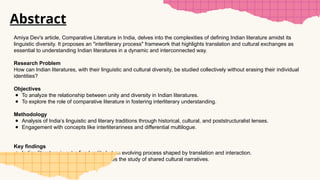
Abstract
Amiya Dev's article, Comparative Literature in India, delves into the complexities of defining Indian literature amidst its
linguistic diversity. It proposes an "interliterary process" framework that highlights translation and cultural exchanges as
essential to understanding Indian literatures in a dynamic and interconnected way.
Research Problem
How can Indian literatures, with their linguistic and cultural diversity, be studied collectively without erasing their individual
identities?
Objectives
● To analyze the relationship between unity and diversity in Indian literatures.
● To explore the role of comparative literature in fostering interliterary understanding.
Methodology
● Analysis of India’s linguistic and literary traditions through historical, cultural, and poststructuralist lenses.
● Engagement with concepts like interliterariness and differential multilogue.
Key findings
● Indian literature is not a fixed entity but an evolving process shaped by translation and interaction.
● Recognizing linguistic plurality enhances the study of shared cultural narratives.
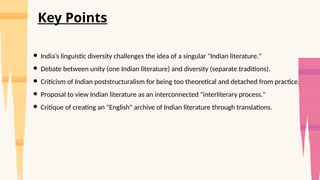
● India’s linguistic diversity challenges the idea of a singular "Indian literature."
● Debate between unity (one Indian literature) and diversity (separate traditions).
● Criticism of Indian poststructuralism for being too theoretical and detached from practice.
● Proposal to view Indian literature as an interconnected "interliterary process."
● Critique of creating an "English" archive of Indian literature through translations.
Key Points
Key Arguments
Amiya Dev:-
●Indian literature is not a single, homogeneous entity but comprises diverse "Indian literatures."
●Viewing Indian literatures as entirely separate is problematic; there are significant connections and
interactions among them.
●Diversity and distinctness should coexist with the recognition of shared "Indian commonality."
●Advocates for an "interliterary" approach that highlights interactions, overlaps, and thematic
connections across Indian literatures.
●Indian literature is an ongoing process of exchange and evolution, not a fixed or static concept.
Gurbhagat Singh:-
● Critiques French, American, and Goethean approaches as inadequate for India's diversity.
● Proposes "differential multilogue" to celebrate differences in Indian literatures.
● Supports poststructuralist skepticism of "Indian literature" to prevent centralization and power accumulation.
Jaydev:-
● Criticizes Indian fiction's trend of "existentialist aestheticism."
● Advocates for a "cultural differential approach" to preserve diversity without homogenization.
● Emphasizes the importance of fluidity and multiplicities in Indian literature, resisting narratives of fixed unity.
Aijaz Ahmad:-
● Highlights limitations in defining "Indian literature" compared to the richness of individual literatures in 22 languages.
● Critiques attempts to create a unified "Indian literature" that overshadow regional and linguistic identities.
● Opposes nation-state-driven identity constructions in literature.
Perspectives from Key
Scholars
Darshan’s Learning Outcomes
● I now have a deeper understanding of how diverse and complex Indian literatures are, and why they
can’t be seen as one unified entity.
● I learned to appreciate the balance between recognizing the distinctiveness of each literature and
identifying common threads that connect them.
● The idea of "interliterary processes" helped me see Indian literature as a dynamic and evolving
interaction between languages and cultures.
● I realized the importance of avoiding homogenization, which can overshadow the richness of individual
literatures.
● Key perspectives from scholars like Gurbhagat Singh, Jaydev, and Aijaz Ahmad taught me to approach
Indian literatures with respect for diversity and context.
●Unparalleled linguistic diversity of India - 22 officially
recognised languages, more than 221 other languages
and many regional dialects.
●“Is Indian literature, in the singular, a valid category, or are
we rather to speak of Indian literatures in the plural?”
The Problem of Unity in Diversity
●Sahitya Akademi’s motto: “
●Hegemonic Apprehensions
●Encroaching upon the individualities of the diverse literatures.
●“
CONCEPT MAP
Simple
idea
Awesome
idea
Brilliant
idea
Creative
idea
Great
idea
Cool
idea
Lorem ipsum dolor sit amet,
consectetur adipiscing elit.
Sed non orci hendrerit augue
interdum lacinia at egestas
dolor. Vivamus elementum
pulvinar tempus.
Lorem ipsum dolor sit amet,
consectetur adipiscing elit.
Sed non orci hendrerit augue
interdum lacinia at egestas
dolor. Vivamus elementum
pulvinar tempus.
Lorem ipsum dolor sit amet,
consectetur adipiscing elit.
Sed non orci hendrerit augue
interdum lacinia at egestas
dolor. Vivamus elementum
pulvinar tempus.
Lorem ipsum dolor sit amet,
consectetur adipiscing elit.
Sed non orci hendrerit augue
interdum lacinia at egestas
dolor. Vivamus elementum
pulvinar tempus.
Lorem ipsum dolor sit amet,
consectetur adipiscing elit.
Sed non orci hendrerit augue
interdum lacinia at egestas
dolor. Vivamus elementum
pulvinar tempus.
Lorem ipsum dolor sit amet,
consectetur adipiscing elit.
Sed non orci hendrerit augue
interdum lacinia at egestas
dolor. Vivamus elementum
pulvinar tempus.
THE BEST IDEAS WRONG IDEAS
Great
idea!
Creative
idea!
Awesom
e idea!
Larana Company
• VALUES
Lorem ipsum dolor sit
amet, consectetur
adipiscing elit. Sed non
orci hendrerit augue
interdum lacinia at
egestas dolor. Vivamus
elementum pulvinar
tempus.
COMPETITO
R 1
• BRAND
IDENTITY
• MISSION • VISION
Lorem ipsum dolor sit
amet, consectetur
adipiscing elit. Sed non orci
hendrerit augue interdum
lacinia at egestas dolor.
Vivamus elementum
pulvinar tempus.
Lorem ipsum dolor sit
amet, consectetur
adipiscing elit. Sed non orci
hendrerit augue interdum
lacinia at egestas dolor.
Vivamus elementum
pulvinar tempus.
Lorem ipsum dolor sit
amet, consectetur
adipiscing elit. Sed non
orci hendrerit augue
interdum lacinia at
egestas dolor. Vivamus
elementum pulvinar
tempus.
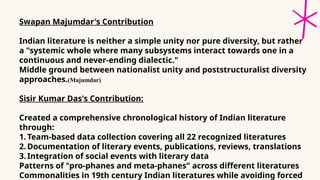
Swapan Majumdar's Contribution
Indian literature is neither a simple unity nor pure diversity, but rather
a "systemic whole where many subsystems interact towards one in a
continuous and never-ending dialectic."
Middle ground between nationalist unity and poststructuralist diversity
approaches.(Majumdar)
Sisir Kumar Das's Contribution:
Created a comprehensive chronological history of Indian literature
through:
1.Team-based data collection covering all 22 recognized literatures
2.Documentation of literary events, publications, reviews, translations
3.Integration of social events with literary data
Patterns of "pro-phanes and meta-phanes" across different literatures
Commonalities in 19th century Indian literatures while avoiding forced
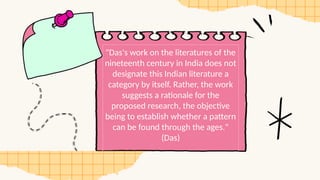
"Das's work on the literatures of the
nineteenth century in India does not
designate this Indian literature a
category by itself. Rather, the work
suggests a rationale for the
proposed research, the objective
being to establish whether a pattern
can be found through the ages."
(Das)
K.M. George's Work:
●Only covered 15 literatures instead of all recognized ones
●Restrictive generic bias
●Showed Western hegemony in categorization
"Poetry, for instance, was discussed in terms of 'traditional' and
'modern' but as if traditional was exclusively Indian and modern
the result of a Western impact."
Lacked true comparative analysis: "comparison was only suggested,
that is, the reader was required to make whatever comparison was
necessary or appropriate."(George)
Umashankar Joshi and Institutional Development:
Significance: As the first president INCLA represented the unity
Conclusions :
●The article proposes that Indian literature should be understood as an
"interliterary condition" rather than a fixed entity
●Importance of "situs" (location) in theoretical approaches
●CL provides a framework for understanding the unity-diversity dialectic
●Inter-Indian reception and translation
●Indian literature as "ever in the making"
●Emphasizes the need to develop comparative approaches specific to
Indian contexts
Limitations Noted:
Challenge of dealing with multiple languages and translations
Risk of hegemonic approaches through English or Hindi translations
Difficulty in balancing unity and diversity without compromising either
Ahmad, Aijaz. "'Indian Literature': Notes towards the Definition of a Category." In Theory: Classes,
Nations,
Literatures. Aijaz Ahmad. London: Verso, 1992.
Bernheimer, Charles, ed. Comparative Literature in the Age of Multiculturalism. Baltimore: The Johns
Hopkins
UP, 1995.
Das, Sisir Kumar. A History of Indian Literature. Vol 1: 1800-1910: Western Impact / Indian Response. New
Delhi: Sahitya Akademi, 1991.
Dev, A. (2000). Comparative literature in India. CLCWeb Comparative Literature and Culture, 2(4).
https://doi.org/10.7771/1481-4374.1093
Durisin, Dionýz. Theory of Interliterary Process. Bratislava: VEDA/Slovak Academy of Sciences, 1989.
Gálik, Marián. "Interliterariness as a Concept in Comparative Literature." CLCWeb: Comparative Literature
and
Culture: A WWWeb Journal 2.4 (2000): <http://docs.lib.purdue.edu/clcweb/vol2/iss4/8>.
George, K.M., ed. Comparative Indian Literature. Madras and Trichur: Macmillan and Kerala Sahitya
Akademi,
1984-85. 2 vols.
References :
Jaidev. The Culture of Pastiche: Existential Aestheticism in the Contemporary Hindi Novel. Simla:
Indian
Institute of Advanced Study, 1993.
Majumdar, Swapan. Comparative Literature: Indian Dimensions. Calcutta: Papyrus, 1985.
Mukherjee, Sujit. Translation as Discovery. New Delhi: Allied Publishers, 1981. 15-73.
Ngugi, wa Thiong'o. "On the Abolition of the English Department." Homecoming: Essays on African
and
Caribbean Literature, Culture and Politics. By Ngugi wa Thiong'o. London: Heinemann, 1972. 145-
50.
Singh, Gurbhagat. "Differential Multilogue: Comparative Literature and National Literatures."
Differential
Multilogue: Comparative Literature and National Literatures. Ed. Gurbhagat Singh. Delhi: Ajanta
Publications, 1991. 11-19.
"University Grants Commission Circular Letter." No. F5-5-85 (HR-1) New Delhi (25 March 1986).
THANK
YOU!

Comparative Literature in India...........................................................

  • 1.
    Comparative Literature in India MaharajaKrishnakumarsinhji Bhavnagar University Smt. S. B. Gardi, Department of English Presented by - Darshan Vagh Bhumiba Gohil Dhatri Parmar Date - 3rd January 2025
  • 2.
  • 3.
    Abstract Amiya Dev's article,Comparative Literature in India, delves into the complexities of defining Indian literature amidst its linguistic diversity. It proposes an "interliterary process" framework that highlights translation and cultural exchanges as essential to understanding Indian literatures in a dynamic and interconnected way. Research Problem How can Indian literatures, with their linguistic and cultural diversity, be studied collectively without erasing their individual identities? Objectives ● To analyze the relationship between unity and diversity in Indian literatures. ● To explore the role of comparative literature in fostering interliterary understanding. Methodology ● Analysis of India’s linguistic and literary traditions through historical, cultural, and poststructuralist lenses. ● Engagement with concepts like interliterariness and differential multilogue. Key findings ● Indian literature is not a fixed entity but an evolving process shaped by translation and interaction. ● Recognizing linguistic plurality enhances the study of shared cultural narratives.
  • 4.
    ● India’s linguisticdiversity challenges the idea of a singular "Indian literature." ● Debate between unity (one Indian literature) and diversity (separate traditions). ● Criticism of Indian poststructuralism for being too theoretical and detached from practice. ● Proposal to view Indian literature as an interconnected "interliterary process." ● Critique of creating an "English" archive of Indian literature through translations. Key Points
  • 5.
    Key Arguments Amiya Dev:- ●Indianliterature is not a single, homogeneous entity but comprises diverse "Indian literatures." ●Viewing Indian literatures as entirely separate is problematic; there are significant connections and interactions among them. ●Diversity and distinctness should coexist with the recognition of shared "Indian commonality." ●Advocates for an "interliterary" approach that highlights interactions, overlaps, and thematic connections across Indian literatures. ●Indian literature is an ongoing process of exchange and evolution, not a fixed or static concept.
  • 6.
    Gurbhagat Singh:- ● CritiquesFrench, American, and Goethean approaches as inadequate for India's diversity. ● Proposes "differential multilogue" to celebrate differences in Indian literatures. ● Supports poststructuralist skepticism of "Indian literature" to prevent centralization and power accumulation. Jaydev:- ● Criticizes Indian fiction's trend of "existentialist aestheticism." ● Advocates for a "cultural differential approach" to preserve diversity without homogenization. ● Emphasizes the importance of fluidity and multiplicities in Indian literature, resisting narratives of fixed unity. Aijaz Ahmad:- ● Highlights limitations in defining "Indian literature" compared to the richness of individual literatures in 22 languages. ● Critiques attempts to create a unified "Indian literature" that overshadow regional and linguistic identities. ● Opposes nation-state-driven identity constructions in literature. Perspectives from Key Scholars
  • 7.
    Darshan’s Learning Outcomes ●I now have a deeper understanding of how diverse and complex Indian literatures are, and why they can’t be seen as one unified entity. ● I learned to appreciate the balance between recognizing the distinctiveness of each literature and identifying common threads that connect them. ● The idea of "interliterary processes" helped me see Indian literature as a dynamic and evolving interaction between languages and cultures. ● I realized the importance of avoiding homogenization, which can overshadow the richness of individual literatures. ● Key perspectives from scholars like Gurbhagat Singh, Jaydev, and Aijaz Ahmad taught me to approach Indian literatures with respect for diversity and context.
  • 8.
    ●Unparalleled linguistic diversityof India - 22 officially recognised languages, more than 221 other languages and many regional dialects. ●“Is Indian literature, in the singular, a valid category, or are we rather to speak of Indian literatures in the plural?” The Problem of Unity in Diversity ●Sahitya Akademi’s motto: “ ●Hegemonic Apprehensions ●Encroaching upon the individualities of the diverse literatures. ●“
  • 9.
    CONCEPT MAP Simple idea Awesome idea Brilliant idea Creative idea Great idea Cool idea Lorem ipsumdolor sit amet, consectetur adipiscing elit. Sed non orci hendrerit augue interdum lacinia at egestas dolor. Vivamus elementum pulvinar tempus. Lorem ipsum dolor sit amet, consectetur adipiscing elit. Sed non orci hendrerit augue interdum lacinia at egestas dolor. Vivamus elementum pulvinar tempus. Lorem ipsum dolor sit amet, consectetur adipiscing elit. Sed non orci hendrerit augue interdum lacinia at egestas dolor. Vivamus elementum pulvinar tempus. Lorem ipsum dolor sit amet, consectetur adipiscing elit. Sed non orci hendrerit augue interdum lacinia at egestas dolor. Vivamus elementum pulvinar tempus. Lorem ipsum dolor sit amet, consectetur adipiscing elit. Sed non orci hendrerit augue interdum lacinia at egestas dolor. Vivamus elementum pulvinar tempus. Lorem ipsum dolor sit amet, consectetur adipiscing elit. Sed non orci hendrerit augue interdum lacinia at egestas dolor. Vivamus elementum pulvinar tempus.
  • 10.
    THE BEST IDEASWRONG IDEAS Great idea! Creative idea! Awesom e idea!
  • 11.
    Larana Company • VALUES Loremipsum dolor sit amet, consectetur adipiscing elit. Sed non orci hendrerit augue interdum lacinia at egestas dolor. Vivamus elementum pulvinar tempus. COMPETITO R 1 • BRAND IDENTITY • MISSION • VISION Lorem ipsum dolor sit amet, consectetur adipiscing elit. Sed non orci hendrerit augue interdum lacinia at egestas dolor. Vivamus elementum pulvinar tempus. Lorem ipsum dolor sit amet, consectetur adipiscing elit. Sed non orci hendrerit augue interdum lacinia at egestas dolor. Vivamus elementum pulvinar tempus. Lorem ipsum dolor sit amet, consectetur adipiscing elit. Sed non orci hendrerit augue interdum lacinia at egestas dolor. Vivamus elementum pulvinar tempus.
  • 12.
    Swapan Majumdar's Contribution Indianliterature is neither a simple unity nor pure diversity, but rather a "systemic whole where many subsystems interact towards one in a continuous and never-ending dialectic." Middle ground between nationalist unity and poststructuralist diversity approaches.(Majumdar) Sisir Kumar Das's Contribution: Created a comprehensive chronological history of Indian literature through: 1.Team-based data collection covering all 22 recognized literatures 2.Documentation of literary events, publications, reviews, translations 3.Integration of social events with literary data Patterns of "pro-phanes and meta-phanes" across different literatures Commonalities in 19th century Indian literatures while avoiding forced
  • 13.
    "Das's work onthe literatures of the nineteenth century in India does not designate this Indian literature a category by itself. Rather, the work suggests a rationale for the proposed research, the objective being to establish whether a pattern can be found through the ages." (Das)
  • 14.
    K.M. George's Work: ●Onlycovered 15 literatures instead of all recognized ones ●Restrictive generic bias ●Showed Western hegemony in categorization "Poetry, for instance, was discussed in terms of 'traditional' and 'modern' but as if traditional was exclusively Indian and modern the result of a Western impact." Lacked true comparative analysis: "comparison was only suggested, that is, the reader was required to make whatever comparison was necessary or appropriate."(George) Umashankar Joshi and Institutional Development: Significance: As the first president INCLA represented the unity
  • 15.
    Conclusions : ●The articleproposes that Indian literature should be understood as an "interliterary condition" rather than a fixed entity ●Importance of "situs" (location) in theoretical approaches ●CL provides a framework for understanding the unity-diversity dialectic ●Inter-Indian reception and translation ●Indian literature as "ever in the making" ●Emphasizes the need to develop comparative approaches specific to Indian contexts Limitations Noted: Challenge of dealing with multiple languages and translations Risk of hegemonic approaches through English or Hindi translations Difficulty in balancing unity and diversity without compromising either
  • 16.
    Ahmad, Aijaz. "'IndianLiterature': Notes towards the Definition of a Category." In Theory: Classes, Nations, Literatures. Aijaz Ahmad. London: Verso, 1992. Bernheimer, Charles, ed. Comparative Literature in the Age of Multiculturalism. Baltimore: The Johns Hopkins UP, 1995. Das, Sisir Kumar. A History of Indian Literature. Vol 1: 1800-1910: Western Impact / Indian Response. New Delhi: Sahitya Akademi, 1991. Dev, A. (2000). Comparative literature in India. CLCWeb Comparative Literature and Culture, 2(4). https://doi.org/10.7771/1481-4374.1093 Durisin, Dionýz. Theory of Interliterary Process. Bratislava: VEDA/Slovak Academy of Sciences, 1989. Gálik, Marián. "Interliterariness as a Concept in Comparative Literature." CLCWeb: Comparative Literature and Culture: A WWWeb Journal 2.4 (2000): <http://docs.lib.purdue.edu/clcweb/vol2/iss4/8>. George, K.M., ed. Comparative Indian Literature. Madras and Trichur: Macmillan and Kerala Sahitya Akademi, 1984-85. 2 vols. References :
  • 17.
    Jaidev. The Cultureof Pastiche: Existential Aestheticism in the Contemporary Hindi Novel. Simla: Indian Institute of Advanced Study, 1993. Majumdar, Swapan. Comparative Literature: Indian Dimensions. Calcutta: Papyrus, 1985. Mukherjee, Sujit. Translation as Discovery. New Delhi: Allied Publishers, 1981. 15-73. Ngugi, wa Thiong'o. "On the Abolition of the English Department." Homecoming: Essays on African and Caribbean Literature, Culture and Politics. By Ngugi wa Thiong'o. London: Heinemann, 1972. 145- 50. Singh, Gurbhagat. "Differential Multilogue: Comparative Literature and National Literatures." Differential Multilogue: Comparative Literature and National Literatures. Ed. Gurbhagat Singh. Delhi: Ajanta Publications, 1991. 11-19. "University Grants Commission Circular Letter." No. F5-5-85 (HR-1) New Delhi (25 March 1986).
  • 18.