
Welcome
to a talk on
e resources for research
by
Sujit R. Chandak
17th of July 2010 @ MDSMC



OBJECTIVES

What is research
Resources in research

 E- resources









Why
What
How
Benefits
Dangers

TYPES/ DETAILING/ LISTING
Q&A
What is research
Any Scientific Enquiry is Research.
In actual practice it covers:


1.

Study of a phenomena

2.

Analysis of a revolution

3.

Survey, Facts, Outcomes, Events etc.

4.

Solution of a problem

5.

Basis of Policy
Resources in research


Tools used in Research:
1.

Books/Encyclopedia/Journals/other reading
matter

2.

Libraries

3.

Data-base/ archives

4.

Tools to create required data

5.

Testing of hypothesis tools

6.

Publicizing the finding / creating new knowledge
base
E- resources






The computing / connecting revolution has
altered many a things: VIRTUAL
Brought about many changes in research
and its processes
Tools of research- resources- have also
changed in their characteristic
E- resources - What?


When the delivery mechanism of these
resources is electronic. It includes all the
available resources and more…..
1.

Books/Encyclopedia/Journals/other reading
matter

2.

Libraries

3.

Data-base/ archives

4.

Tools to create required data

5.

Testing of hypothesis tools

6.

Publicizing the finding / creating new knowledge
base
E- resources - why?


Ease of access/ delivery/ storage/ retrieval
use



World wide sharing



Suits scholarship
E- resources - How?






Machine, Connectivity & Privileges…
Know-how to use- methodology-easier to
learn than physical resources
Golden rule: Use & Contribute
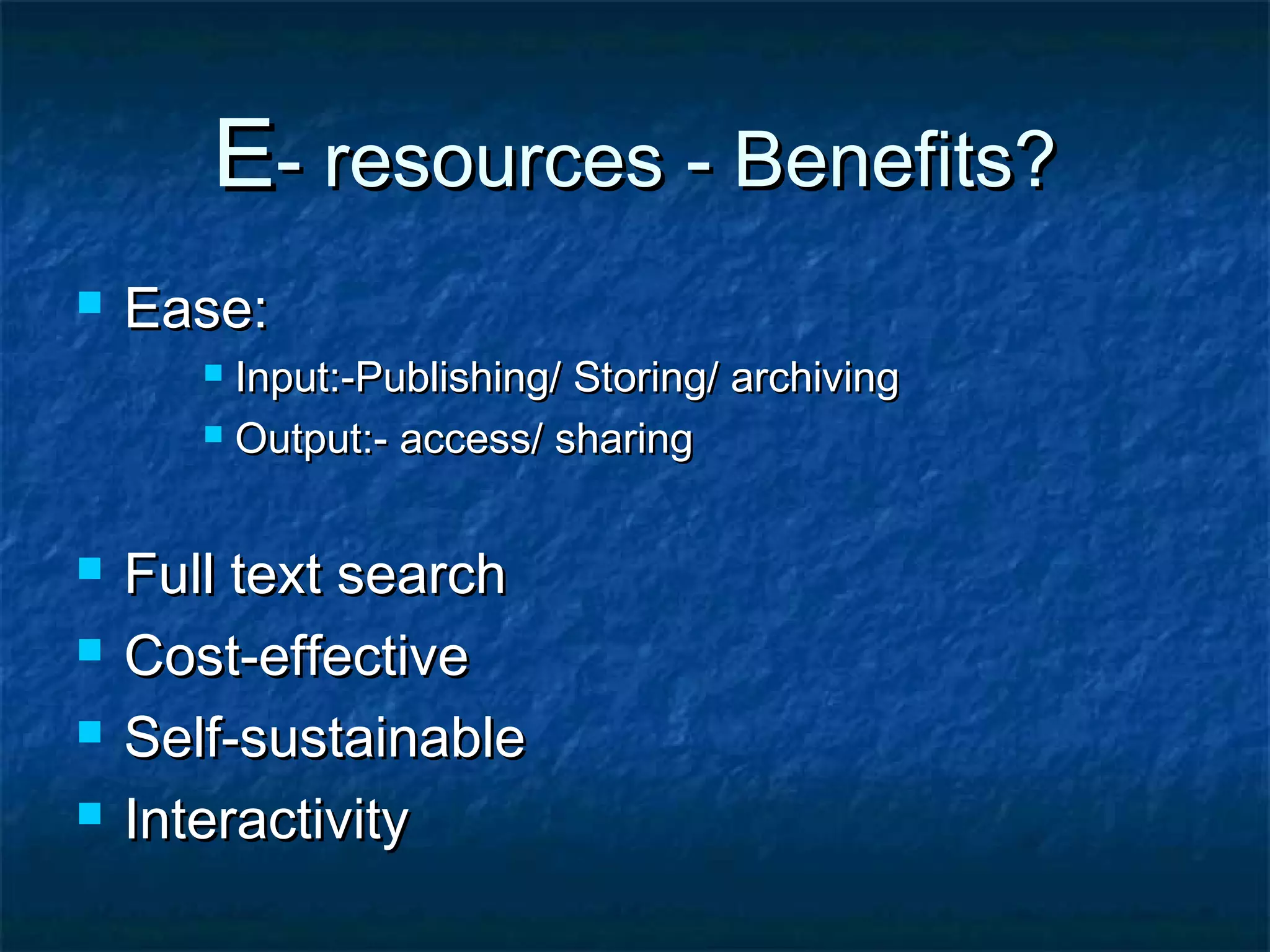
E- resources - Benefits?


Ease:
Input:-Publishing/ Storing/ archiving
 Output:- access/ sharing







Full text search
Cost-effective
Self-sustainable
Interactivity
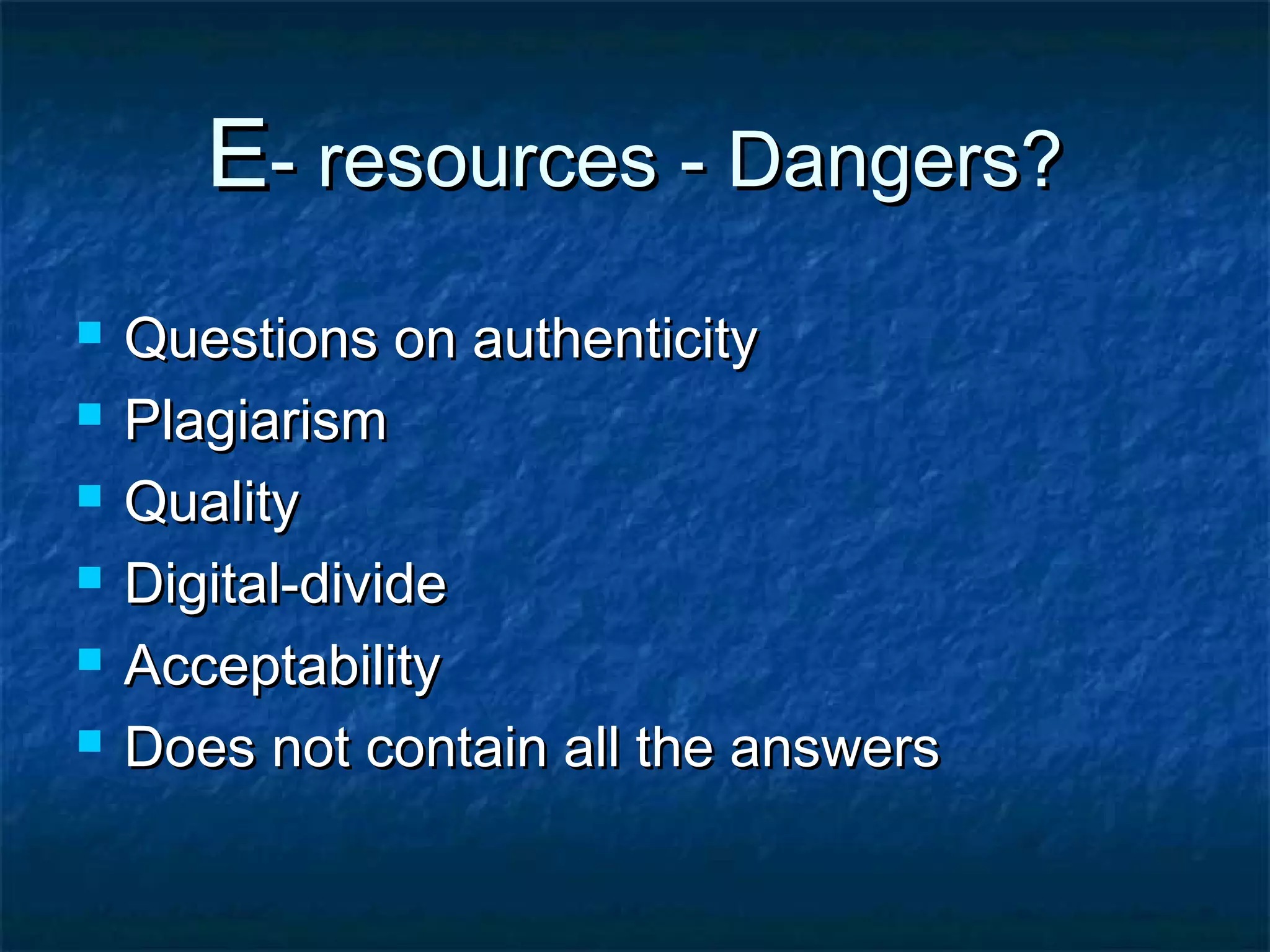
E- resources - Dangers?







Questions on authenticity
Plagiarism
Quality
Digital-divide
Acceptability
Does not contain all the answers
E- resources - Dangers?

NOT ANY DIFFERENT FROM
THE PHYSICAL WORLD
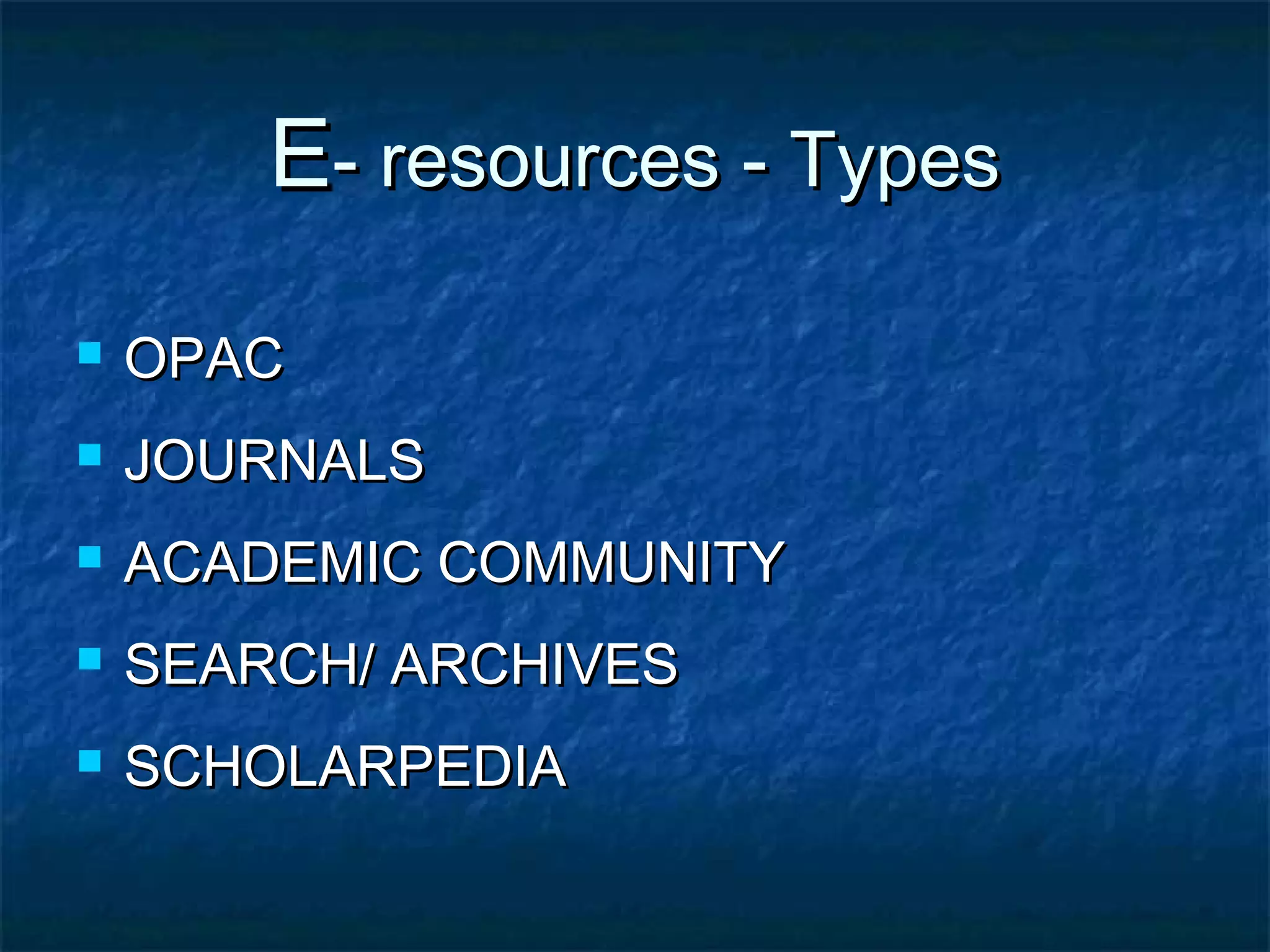
E- resources - Types


OPAC



JOURNALS



ACADEMIC COMMUNITY



SEARCH/ ARCHIVES



SCHOLARPEDIA
E- resources - OPAC


Online Public Access Catalogue



These are catalogues of reputed libraries
which are there for all to access



Many a times other than title and content
details they also contain a v. short
summary of the work
E- resources - OPAC


IGIDR



E F L UNIVERSITY



IITs



Institute of Advanced studies, Shimla



Most of the institution with a really good
library
E- resources - JOURNALS


Journals are so many that they pose a
challenge in terms of reading and
searching and doing research



Problem is also that of storing these
journals
E- resources – JOURNALS
an example



JSTOR is an online system for archiving
academic journals. It provides full-text
searches of digitized back issues of
several hundred well-known journals
dating back to 1665 in the case of the
“Philosophical Transactions of the Royal

Society.”
E- resources – JOURNALS
an example



As of September 23, 2009, Jstor
contained 1,079 journal titles in 18
collections representing 51 disciplines,
and 262,042 individual journal issues,
totaling over 33.7 million pages of text.



Other such services are also there…
E- resources - ACADEMIC
COMMUNITY



Creation of and exchange between
academic community becomes a much
less cumbersome task



ITHAKA



NETWORKING SITES
E- resources - SEARCH/
ARCHIVES



Archiving is an activity which is of great
importance for both a research who has
finished and one who is starting



Maximum benefit accrued to archives



Search – its part of research – electronic
search and search engines
E- resources -

SCHOLARPEDIA


Scholarpedia , the peer-reviewed openaccess encyclopedia written by scholars
from all around the world



Scholarpedia feels and looks like
Wikipedia as it uses “MediaWiki”
E- resources - SCHOLARPEDIA


Initial authorship and review are similar to a
print journal so that Scholarpedia articles
could be cited, articles are not frozen and
outdated, but dynamic, subject to an ongoing
process of improvement moderated by their
curators. This allows Scholarpedia to be upto-date, yet maintain the highest quality of
content.
Thanks
sujitchandak@gmail.com

E resources

  • 1.
    Welcome to a talkon e resources for research by Sujit R. Chandak 17th of July 2010 @ MDSMC
  • 2.
      OBJECTIVES What is research Resourcesin research  E- resources        Why What How Benefits Dangers TYPES/ DETAILING/ LISTING Q&A
  • 3.
    What is research AnyScientific Enquiry is Research. In actual practice it covers:  1. Study of a phenomena 2. Analysis of a revolution 3. Survey, Facts, Outcomes, Events etc. 4. Solution of a problem 5. Basis of Policy
  • 4.
    Resources in research  Toolsused in Research: 1. Books/Encyclopedia/Journals/other reading matter 2. Libraries 3. Data-base/ archives 4. Tools to create required data 5. Testing of hypothesis tools 6. Publicizing the finding / creating new knowledge base
  • 5.
    E- resources    The computing/ connecting revolution has altered many a things: VIRTUAL Brought about many changes in research and its processes Tools of research- resources- have also changed in their characteristic
  • 6.
    E- resources -What?  When the delivery mechanism of these resources is electronic. It includes all the available resources and more….. 1. Books/Encyclopedia/Journals/other reading matter 2. Libraries 3. Data-base/ archives 4. Tools to create required data 5. Testing of hypothesis tools 6. Publicizing the finding / creating new knowledge base
  • 7.
    E- resources -why?  Ease of access/ delivery/ storage/ retrieval use  World wide sharing  Suits scholarship
  • 8.
    E- resources -How?    Machine, Connectivity & Privileges… Know-how to use- methodology-easier to learn than physical resources Golden rule: Use & Contribute
  • 9.
    E- resources -Benefits?  Ease: Input:-Publishing/ Storing/ archiving  Output:- access/ sharing      Full text search Cost-effective Self-sustainable Interactivity
  • 10.
    E- resources -Dangers?       Questions on authenticity Plagiarism Quality Digital-divide Acceptability Does not contain all the answers
  • 11.
    E- resources -Dangers? NOT ANY DIFFERENT FROM THE PHYSICAL WORLD
  • 12.
    E- resources -Types  OPAC  JOURNALS  ACADEMIC COMMUNITY  SEARCH/ ARCHIVES  SCHOLARPEDIA
  • 13.
    E- resources -OPAC  Online Public Access Catalogue  These are catalogues of reputed libraries which are there for all to access  Many a times other than title and content details they also contain a v. short summary of the work
  • 14.
    E- resources -OPAC  IGIDR  E F L UNIVERSITY  IITs  Institute of Advanced studies, Shimla  Most of the institution with a really good library
  • 15.
    E- resources -JOURNALS  Journals are so many that they pose a challenge in terms of reading and searching and doing research  Problem is also that of storing these journals
  • 16.
    E- resources –JOURNALS an example  JSTOR is an online system for archiving academic journals. It provides full-text searches of digitized back issues of several hundred well-known journals dating back to 1665 in the case of the “Philosophical Transactions of the Royal Society.”
  • 17.
    E- resources –JOURNALS an example  As of September 23, 2009, Jstor contained 1,079 journal titles in 18 collections representing 51 disciplines, and 262,042 individual journal issues, totaling over 33.7 million pages of text.  Other such services are also there…
  • 18.
    E- resources -ACADEMIC COMMUNITY  Creation of and exchange between academic community becomes a much less cumbersome task  ITHAKA  NETWORKING SITES
  • 19.
    E- resources -SEARCH/ ARCHIVES  Archiving is an activity which is of great importance for both a research who has finished and one who is starting  Maximum benefit accrued to archives  Search – its part of research – electronic search and search engines
  • 20.
    E- resources - SCHOLARPEDIA  Scholarpedia, the peer-reviewed openaccess encyclopedia written by scholars from all around the world  Scholarpedia feels and looks like Wikipedia as it uses “MediaWiki”
  • 21.
    E- resources -SCHOLARPEDIA  Initial authorship and review are similar to a print journal so that Scholarpedia articles could be cited, articles are not frozen and outdated, but dynamic, subject to an ongoing process of improvement moderated by their curators. This allows Scholarpedia to be upto-date, yet maintain the highest quality of content.
  • 22.