Willing is not enough, we must do
Bruce lee
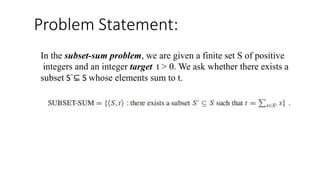
Problem Statement:
In the subset-sum problem, we are given a finite set S of positive
integers and an integer target t > 0. We ask whether there exists a
subset S`⊆ S whose elements sum to t.
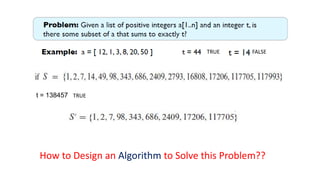
TRUE FALSE
t = 138457 TRUE
How to Design an Algorithm to Solve this Problem??
Brute Force??
Making all possible Subsets
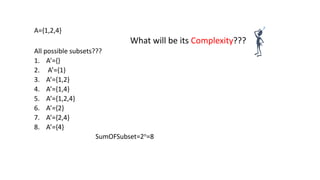
A={1,2,4}
What will be its Complexity???
All possible subsets???
1. A’={}
2. A’={1}
3. A’={1,2}
4. A’={1,4}
5. A’={1,2,4}
6. A’={2}
7. A’={2,4}
8. A’={4}
SumOFSubset=2n=8
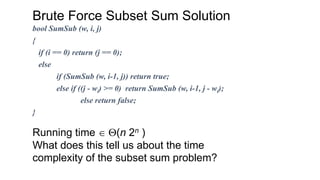
Brute Force Subset Sum Solution
Running time Q(n 2n )
What does this tell us about the time
complexity of the subset sum problem?
bool SumSub (w, i, j)
{
if (i == 0) return (j == 0);
else
if (SumSub (w, i-1, j)) return true;
else if ((j - wi) >= 0) return SumSub (w, i-1, j - wi);
else return false;
}
Complexity
0( 2n N)
All possible subsets and time required to sum them.
Brute Force??? No, thanks
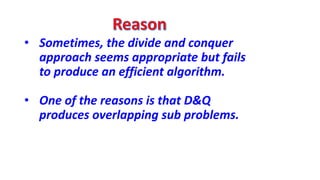
Why is this Failing???
• Sometimes, the divide and conquer
approach seems appropriate but fails
to produce an efficient algorithm.
• One of the reasons is that D&Q
produces overlapping sub problems.
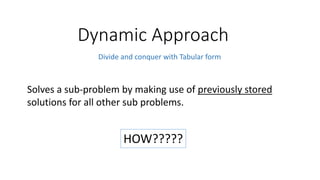
Dynamic Approach
Divide and conquer with Tabular form
Solves a sub-problem by making use of previously stored
solutions for all other sub problems.
HOW?????
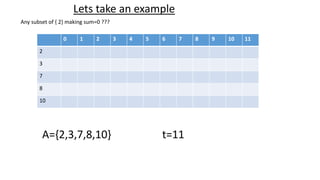
Lets take an example
0 1 2 3 4 5 6 7 8 9 10 11
2
3
7
8
10
A={2,3,7,8,10} t=11
Any subset of { 2} making sum=0 ???
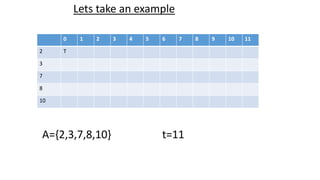
Lets take an example
0 1 2 3 4 5 6 7 8 9 10 11
2 T
3
7
8
10
A={2,3,7,8,10} t=11
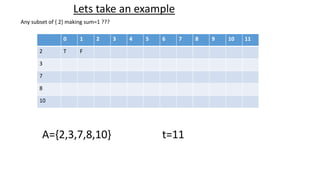
Lets take an example
0 1 2 3 4 5 6 7 8 9 10 11
2 T F
3
7
8
10
A={2,3,7,8,10} t=11
Any subset of { 2} making sum=1 ???
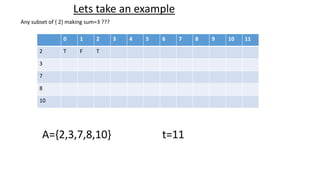
Lets take an example
0 1 2 3 4 5 6 7 8 9 10 11
2 T F T
3
7
8
10
A={2,3,7,8,10} t=11
Any subset of { 2} making sum=3 ???
Lets take an example
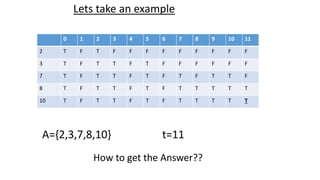
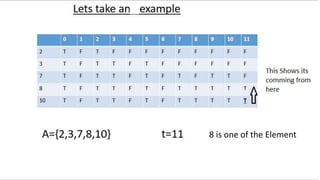
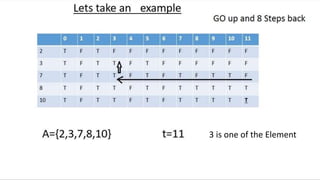
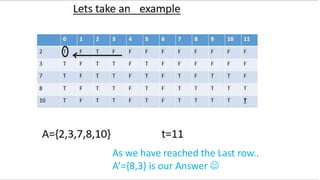
0 1 2 3 4 5 6 7 8 9 10 11
2 T F T F F F F F F F F F
3 T F T T F T F F F F F F
7 T F T T F T F T F T T F
8 T F T T F T F T T T T T
10 T F T T F T F T T T T T
A={2,3,7,8,10} t=11
How to get the Answer??
8 is one of the Element
3 is one of the Element
As we have reached the Last row..
A’={8,3} is our Answer 
18
Dynamic Programming Algorithm
bool SumSub (w , n , m)
{
1. t[0,0] = true; for (j = 1 to m) t[0,j] = false;
2. for (i = 1 to n)
3. for (j = 0 to m)
4. t[i,j] = t[i-1,j];
5. if ((j-wi) >= 0)
6. t[i,j] = t[i-1,j] || t[i-1, j – wi];
7. return t[n,m];
}
i-1,
j - wi
i-1,
j
i , j
Its Complexity???
Time complexity is T(n) = O(m) + O(nm) = O(nm)
Application
Traveling Salesperson Problem
–Input: a graph of cities and roads
with distance connecting them and a
minimum total distant
–Output: either a path that visits each
with a cost less than the minimum,
or “no”.
• If given a path, easy to check if it
visits every city with less than
minimum distance travelled.
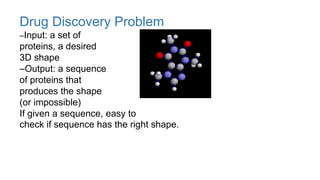
Drug Discovery Problem
–Input: a set of
proteins, a desired
3D shape
–Output: a sequence
of proteins that
produces the shape
(or impossible)
If given a sequence, easy to
check if sequence has the right shape.
THE END

Subset sum problem Dynamic and Brute Force Approch

  • 1.
    Willing is notenough, we must do Bruce lee
  • 2.
    Problem Statement: In thesubset-sum problem, we are given a finite set S of positive integers and an integer target t > 0. We ask whether there exists a subset S`⊆ S whose elements sum to t.
  • 3.
    TRUE FALSE t =138457 TRUE How to Design an Algorithm to Solve this Problem??
  • 4.
    Brute Force?? Making allpossible Subsets
  • 5.
    A={1,2,4} What will beits Complexity??? All possible subsets??? 1. A’={} 2. A’={1} 3. A’={1,2} 4. A’={1,4} 5. A’={1,2,4} 6. A’={2} 7. A’={2,4} 8. A’={4} SumOFSubset=2n=8
  • 6.
    Brute Force SubsetSum Solution Running time Q(n 2n ) What does this tell us about the time complexity of the subset sum problem? bool SumSub (w, i, j) { if (i == 0) return (j == 0); else if (SumSub (w, i-1, j)) return true; else if ((j - wi) >= 0) return SumSub (w, i-1, j - wi); else return false; }
  • 7.
    Complexity 0( 2n N) Allpossible subsets and time required to sum them. Brute Force??? No, thanks Why is this Failing???
  • 8.
    • Sometimes, thedivide and conquer approach seems appropriate but fails to produce an efficient algorithm. • One of the reasons is that D&Q produces overlapping sub problems.
  • 9.
    Dynamic Approach Divide andconquer with Tabular form Solves a sub-problem by making use of previously stored solutions for all other sub problems. HOW?????
  • 10.
    Lets take anexample 0 1 2 3 4 5 6 7 8 9 10 11 2 3 7 8 10 A={2,3,7,8,10} t=11 Any subset of { 2} making sum=0 ???
  • 11.
    Lets take anexample 0 1 2 3 4 5 6 7 8 9 10 11 2 T 3 7 8 10 A={2,3,7,8,10} t=11
  • 12.
    Lets take anexample 0 1 2 3 4 5 6 7 8 9 10 11 2 T F 3 7 8 10 A={2,3,7,8,10} t=11 Any subset of { 2} making sum=1 ???
  • 13.
    Lets take anexample 0 1 2 3 4 5 6 7 8 9 10 11 2 T F T 3 7 8 10 A={2,3,7,8,10} t=11 Any subset of { 2} making sum=3 ???
  • 14.
    Lets take anexample 0 1 2 3 4 5 6 7 8 9 10 11 2 T F T F F F F F F F F F 3 T F T T F T F F F F F F 7 T F T T F T F T F T T F 8 T F T T F T F T T T T T 10 T F T T F T F T T T T T A={2,3,7,8,10} t=11 How to get the Answer??
  • 15.
    8 is oneof the Element
  • 16.
    3 is oneof the Element
  • 17.
    As we havereached the Last row.. A’={8,3} is our Answer 
  • 18.
    18 Dynamic Programming Algorithm boolSumSub (w , n , m) { 1. t[0,0] = true; for (j = 1 to m) t[0,j] = false; 2. for (i = 1 to n) 3. for (j = 0 to m) 4. t[i,j] = t[i-1,j]; 5. if ((j-wi) >= 0) 6. t[i,j] = t[i-1,j] || t[i-1, j – wi]; 7. return t[n,m]; } i-1, j - wi i-1, j i , j Its Complexity??? Time complexity is T(n) = O(m) + O(nm) = O(nm)
  • 19.
    Application Traveling Salesperson Problem –Input:a graph of cities and roads with distance connecting them and a minimum total distant –Output: either a path that visits each with a cost less than the minimum, or “no”. • If given a path, easy to check if it visits every city with less than minimum distance travelled.
  • 20.
    Drug Discovery Problem –Input:a set of proteins, a desired 3D shape –Output: a sequence of proteins that produces the shape (or impossible) If given a sequence, easy to check if sequence has the right shape.
  • 21.