Download to read offline
![Dynamic Programming
Dynamic Programming (DP) is an algorithmic technique for solving an optimization problem by
breaking it down into simpler subproblems and utilizing the fact that the optimal solution to the
overall problem depends upon the optimal solution to its subproblems.
Dynamic programming approach is similar to divide and conquer in breaking down the problem
into smaller and yet smaller possible sub-problems. But unlike, divide and conquer, these sub-
problems are not solved independently. Rather, results of these smaller sub-problems are
remembered and used for similar or overlapping sub-problems.
Dynamic programming is used where we have problems, which can be divided into similar sub-
problems, so that their results can be re-used.
Example
The following computer problems can be solved using dynamic programming approach −
Fibonacci number series
Knapsack problem
Tower of Hanoi
All pair shortest path by Floyd-Warshall
Shortest path by Dijkstra
Project scheduling
0–1 Knapsack Problem
In the 0-1 Knapsack problem, we are given a set of items, each with a weight and a value, and we
need to determine the number of each item to include in a collection so that the total weight is less
than or equal to a given limit and the total value is large as possible.
Please note that the items are invisible, we can either take an item or not (0-1) property. For
example,
Input:
value = [20, 5, 10, 40, 15, 25]
weight = [1, 2, 3, 8, 7, 4]
Maximum Weight, W = 10
Output: Knapsack value is 60
value = 20 + 40 = 60
weight = 1 + 8 = 9 < W](https://image.slidesharecdn.com/0-1knapsackproblem-210706143541/85/0-1-knapsack-problem-1-320.jpg)
![Dynamic Programming
Dynamic Programming (DP) is an algorithmic technique for solving an optimization problem by
breaking it down into simpler subproblems and utilizing the fact that the optimal solution to the
overall problem depends upon the optimal solution to its subproblems.
Dynamic programming approach is similar to divide and conquer in breaking down the problem
into smaller and yet smaller possible sub-problems. But unlike, divide and conquer, these sub-
problems are not solved independently. Rather, results of these smaller sub-problems are
remembered and used for similar or overlapping sub-problems.
Dynamic programming is used where we have problems, which can be divided into similar sub-
problems, so that their results can be re-used.
Example
The following computer problems can be solved using dynamic programming approach −
Fibonacci number series
Knapsack problem
Tower of Hanoi
All pair shortest path by Floyd-Warshall
Shortest path by Dijkstra
Project scheduling
0–1 Knapsack Problem
In the 0-1 Knapsack problem, we are given a set of items, each with a weight and a value, and we
need to determine the number of each item to include in a collection so that the total weight is less
than or equal to a given limit and the total value is large as possible.
Please note that the items are invisible, we can either take an item or not (0-1) property. For
example,
Input:
value = [20, 5, 10, 40, 15, 25]
weight = [1, 2, 3, 8, 7, 4]
Maximum Weight, W = 10
Output: Knapsack value is 60
value = 20 + 40 = 60
weight = 1 + 8 = 9 < W](https://image.slidesharecdn.com/0-1knapsackproblem-210706143541/75/0-1-knapsack-problem-1-2048.jpg)

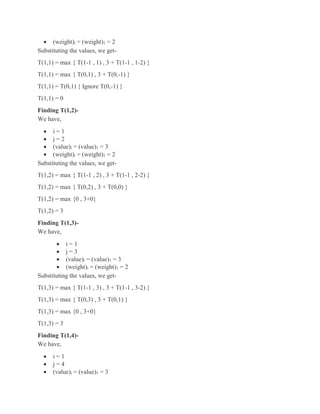
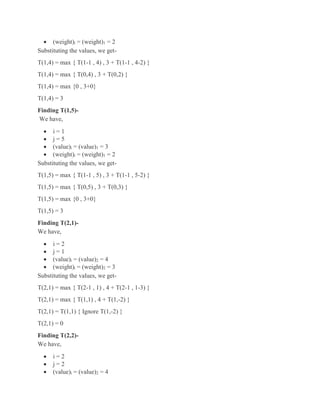
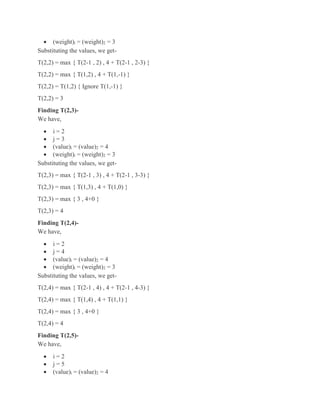
![ (weight)i = (weight)2 = 3
Substituting the values, we get-
T(2,5) = max { T(2-1 , 5) , 4 + T(2-1 , 5-3) }
T(2,5) = max { T(1,5) , 4 + T(1,2) }
T(2,5) = max { 3 , 4+3 }
T(2,5) = 7
Similarly, compute all the entries.
After all the entries are computed and filled in the table, we get the following table-
0 1 2 3 4 5
0 0 0 0 0 0 0
1 0 0 3 3 3 3
2 0 0 3 4 4 7
3 0 0 3 4 5 7
4 0 0 3 4 5 7
The last entry represents the maximum possible value that can be put into the knapsack.
So, maximum possible value that can be put into the knapsack = 7.
Algorithm of Knapsack Problem
KNAPSACK (n, W)
1. for w = 0, W
2. do V [0,w] ← 0
3. for i=0, n
4. do V [i, 0] ← 0
5. for w = 0, W
6. do if (wi≤ w & vi + V [i-1, w - wi]> V [i -1,W])
7. then V [i, W] ← vi + V [i - 1, w - wi]
8. else V [i, W] ← V [i - 1, w]](https://image.slidesharecdn.com/0-1knapsackproblem-210706143541/85/0-1-knapsack-problem-6-320.jpg)

Dynamic programming is an algorithmic technique that breaks down optimization problems into subproblems. It solves subproblems only once and stores the results for future use, unlike divide-and-conquer which solves subproblems independently. Examples where dynamic programming can be applied include the knapsack problem, Fibonacci numbers, shortest paths, and project scheduling. The 0-1 knapsack problem involves selecting items with weights and values to maximize the total value within a weight limit, where each item is either fully included or not.


