Introduction to Retrieval-
Augmented Generation
(RAG)
Module 1
1. Understanding RAG: Definition and Overview
2. Importance and Use Cases: Why RAG, Components of
RAG
3. Retriever: Purpose and Function, Generator: Purpose
and Function
4. Integration of Retriever and Generator
5. Langchain Overview: Introduction to Langchain, Key
Features and Benefits
Outline
Understanding RAG: Definition and
Overview
o
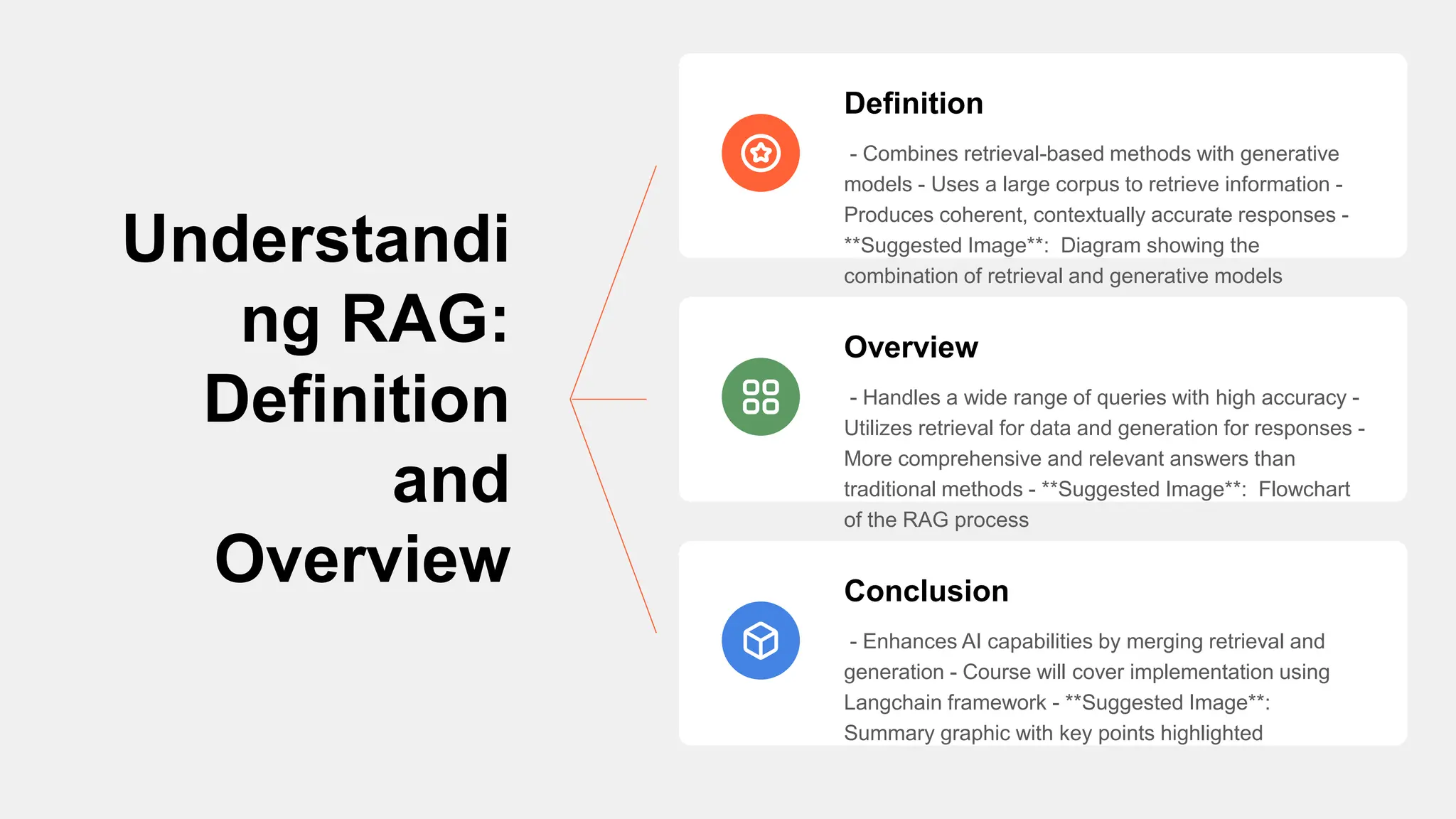
Definition
- Combines retrieval-based methods with generative
models - Uses a large corpus to retrieve information -
Produces coherent, contextually accurate responses -
**Suggested Image**: Diagram showing the
combination of retrieval and generative models
o
Overview
- Handles a wide range of queries with high accuracy -
Utilizes retrieval for data and generation for responses -
More comprehensive and relevant answers than
traditional methods - **Suggested Image**: Flowchart
of the RAG process
o
Conclusion
- Enhances AI capabilities by merging retrieval and
generation - Course will cover implementation using
Langchain framework - **Suggested Image**:
Summary graphic with key points highlighted
Understandi
ng RAG:
Definition
and
Overview
Importance and Use Cases: Why
RAG, Components of RAG
Importance and Use Cases: Why RAG,
Components of RAG
o
Importance
- Combines strengths of retrieval
and generative models -
Produces accurate and
contextually rich responses -
Mitigates issues with traditional
generative models - **Suggested
Image**: Infographic showing the
advantages of RAG
o
Use Cases
- Customer Support: Automates
responses using knowledge base
- Healthcare: Provides accurate
info by retrieving medical
literature - Education: Generates
answers using educational
resources - Legal: Synthesizes
information from legal documents
- **Suggested Image**: Icons
representing each use case
o
Components
- Retriever: Fetches relevant
documents based on query -
Generator: Formulates coherent
response from retrieved info -
**Suggested Image**: Diagram
showing components of RAG
Retriever: Purpose and Function,
Generator: Purpose and Function
o
Retriever
- Searches and fetches relevant documents from large
corpus - Uses vector embeddings and semantic search
- Ranks most relevant documents - **Suggested
Image**: Illustration of the retrieval process
o
Generator
- Processes retrieved data to generate coherent
response - Uses advanced language models (e.g.,
OpenAI) - Produces human-like text - **Suggested
Image**: Illustration of the generation process
o
Conclusion
- Retriever and generator work in tandem - Provides
accurate and contextually rich responses - **Suggested
Image**: Diagram showing the interaction between
retriever and generator
Retriever:
Purpose and
Function,
Generator:
Purpose and
Function
Integration of Retriever and
Generator
Integration of Retriever and Generator
- Query Processing:
Encode input query -
Retrieval: Search for
relevant documents - Data
Preparation: Format
retrieved documents -
Generation: Produce
coherent response - Post-
Processing: Ensure quality
and relevance -
**Suggested Image**: Step-
Integration Process
- Query Processing:
Encode input query -
Retrieval: Search for
relevant documents - Data
Preparation: Format
retrieved documents -
Generation: Produce
coherent response - Post-
Processing: Ensure quality
and relevance -
**Suggested Image**: Step-
Example
- Query Processing:
Encode input query -
Retrieval: Search for
relevant documents - Data
Preparation: Format
retrieved documents -
Generation: Produce
coherent response - Post-
Processing: Ensure quality
and relevance -
**Suggested Image**: Step-
Conclusion
Langchain Overview: Introduction to
Langchain, Key Features and
Benefits
Detail 1 Aliquyam vulputate
rebum clita justo sit nonumy
diam.
Item 1 Click to add text
Detail 1 Aliquyam vulputate
rebum clita justo sit nonumy
diam.
Item 2 Click to add text
Detail 1 Aliquyam vulputate
rebum clita justo sit nonumy
diam.
Item 3 Click to add text
Detail 1 Aliquyam vulputate
rebum clita justo sit nonumy
diam.
Item 4 Click to add text
Langchain
Overview:
Introduction to
Langchain, Key
Features and
Benefits

A gentle exploration of Retrieval Augmented Generation

  • 1.
    Introduction to Retrieval- AugmentedGeneration (RAG) Module 1
  • 2.
    1. Understanding RAG:Definition and Overview 2. Importance and Use Cases: Why RAG, Components of RAG 3. Retriever: Purpose and Function, Generator: Purpose and Function 4. Integration of Retriever and Generator 5. Langchain Overview: Introduction to Langchain, Key Features and Benefits Outline
  • 3.
  • 4.
    o Definition - Combines retrieval-basedmethods with generative models - Uses a large corpus to retrieve information - Produces coherent, contextually accurate responses - **Suggested Image**: Diagram showing the combination of retrieval and generative models o Overview - Handles a wide range of queries with high accuracy - Utilizes retrieval for data and generation for responses - More comprehensive and relevant answers than traditional methods - **Suggested Image**: Flowchart of the RAG process o Conclusion - Enhances AI capabilities by merging retrieval and generation - Course will cover implementation using Langchain framework - **Suggested Image**: Summary graphic with key points highlighted Understandi ng RAG: Definition and Overview
  • 5.
    Importance and UseCases: Why RAG, Components of RAG
  • 6.
    Importance and UseCases: Why RAG, Components of RAG o Importance - Combines strengths of retrieval and generative models - Produces accurate and contextually rich responses - Mitigates issues with traditional generative models - **Suggested Image**: Infographic showing the advantages of RAG o Use Cases - Customer Support: Automates responses using knowledge base - Healthcare: Provides accurate info by retrieving medical literature - Education: Generates answers using educational resources - Legal: Synthesizes information from legal documents - **Suggested Image**: Icons representing each use case o Components - Retriever: Fetches relevant documents based on query - Generator: Formulates coherent response from retrieved info - **Suggested Image**: Diagram showing components of RAG
  • 7.
    Retriever: Purpose andFunction, Generator: Purpose and Function
  • 8.
    o Retriever - Searches andfetches relevant documents from large corpus - Uses vector embeddings and semantic search - Ranks most relevant documents - **Suggested Image**: Illustration of the retrieval process o Generator - Processes retrieved data to generate coherent response - Uses advanced language models (e.g., OpenAI) - Produces human-like text - **Suggested Image**: Illustration of the generation process o Conclusion - Retriever and generator work in tandem - Provides accurate and contextually rich responses - **Suggested Image**: Diagram showing the interaction between retriever and generator Retriever: Purpose and Function, Generator: Purpose and Function
  • 9.
  • 10.
    Integration of Retrieverand Generator - Query Processing: Encode input query - Retrieval: Search for relevant documents - Data Preparation: Format retrieved documents - Generation: Produce coherent response - Post- Processing: Ensure quality and relevance - **Suggested Image**: Step- Integration Process - Query Processing: Encode input query - Retrieval: Search for relevant documents - Data Preparation: Format retrieved documents - Generation: Produce coherent response - Post- Processing: Ensure quality and relevance - **Suggested Image**: Step- Example - Query Processing: Encode input query - Retrieval: Search for relevant documents - Data Preparation: Format retrieved documents - Generation: Produce coherent response - Post- Processing: Ensure quality and relevance - **Suggested Image**: Step- Conclusion
  • 11.
    Langchain Overview: Introductionto Langchain, Key Features and Benefits
  • 12.
    Detail 1 Aliquyamvulputate rebum clita justo sit nonumy diam. Item 1 Click to add text Detail 1 Aliquyam vulputate rebum clita justo sit nonumy diam. Item 2 Click to add text Detail 1 Aliquyam vulputate rebum clita justo sit nonumy diam. Item 3 Click to add text Detail 1 Aliquyam vulputate rebum clita justo sit nonumy diam. Item 4 Click to add text Langchain Overview: Introduction to Langchain, Key Features and Benefits