SUBROUTINES
SUBROUTINES
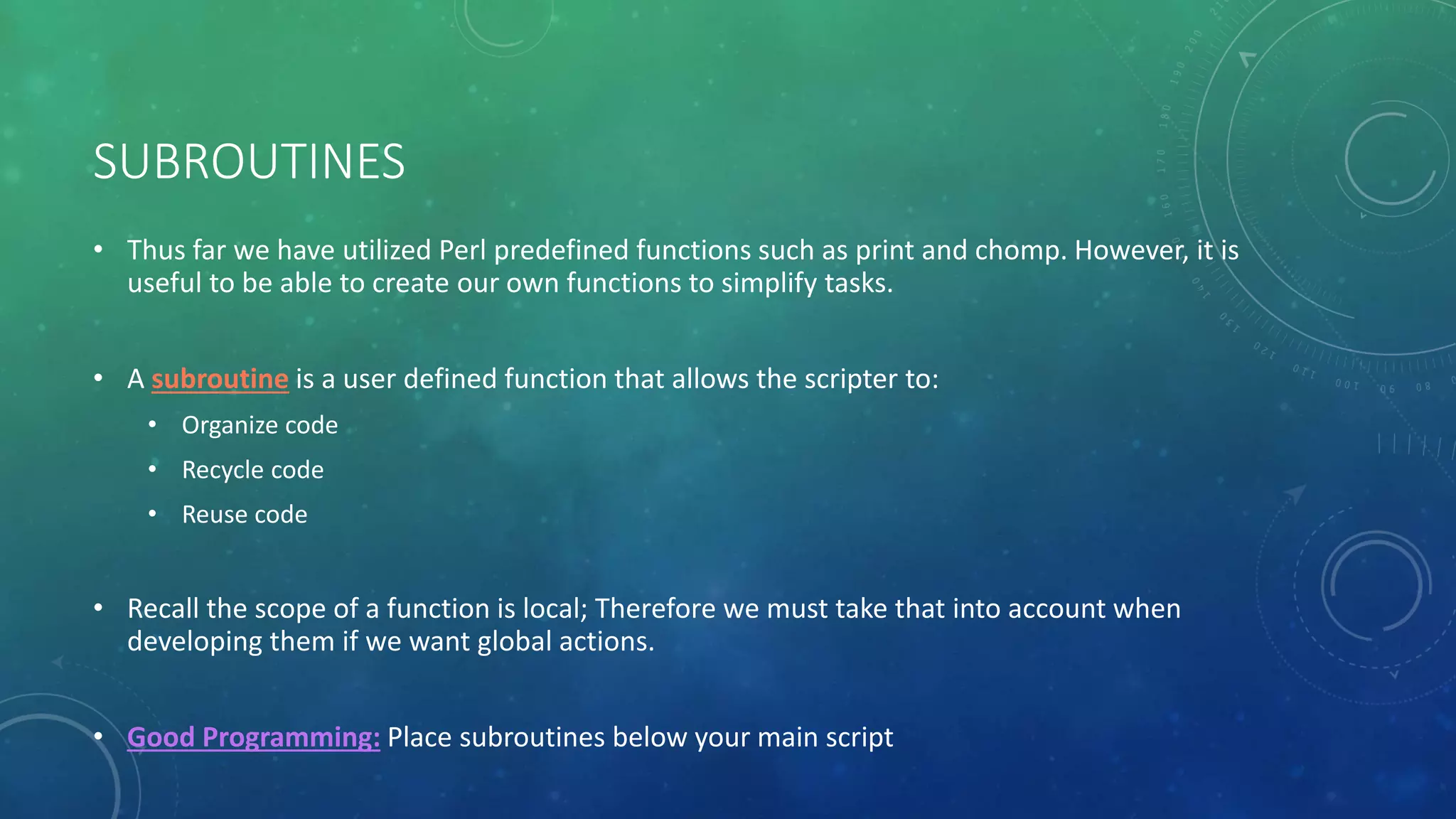
• Thus far we have utilized Perl predefined functions such as print and chomp. However, it is
useful to be able to create our own functions to simplify tasks.
• A subroutine is a user defined function that allows the scripter to:
• Organize code
• Recycle code
• Reuse code
• Recall the scope of a function is local; Therefore we must take that into account when
developing them if we want global actions.
• Good Programming: Place subroutines below your main script
DEFINING A SUBROUTINE
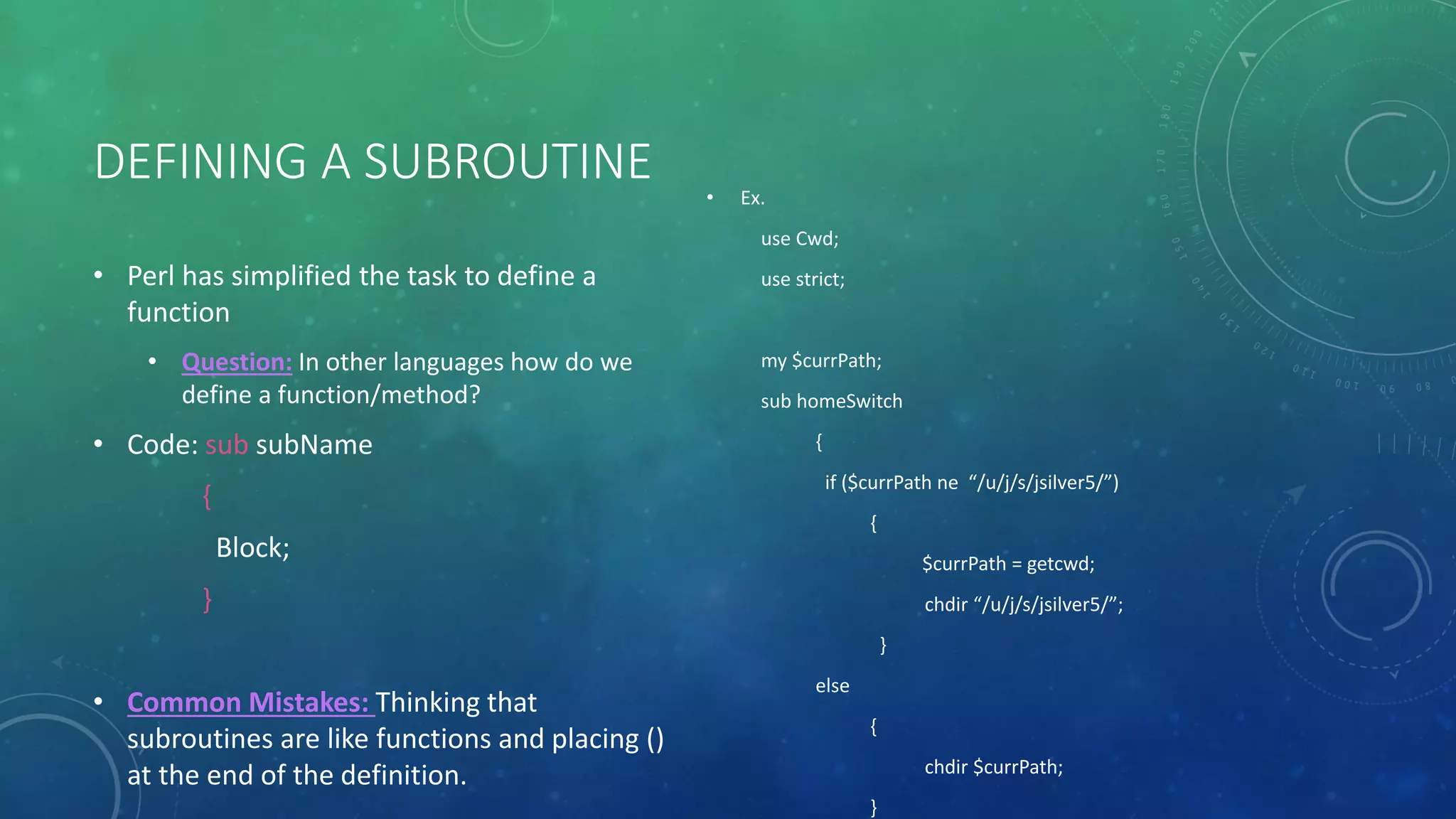
• Perl has simplified the task to define a
function
• Question: In other languages how do we
define a function/method?
• Code: sub subName
{
Block;
}
• Common Mistakes: Thinking that
subroutines are like functions and placing ()
at the end of the definition.
• Ex.
use Cwd;
use strict;
my $currPath = getcwd;
sub homeSwitch
{
if ($currPath ne “/u/j/s/jsilver5/”)
{
$currPath = getcwd;
chdir “/u/j/s/jsilver5/”;
}
else
{
chdir $currPath;
}
}
INVOKING/CALLING A SUBROUTINE
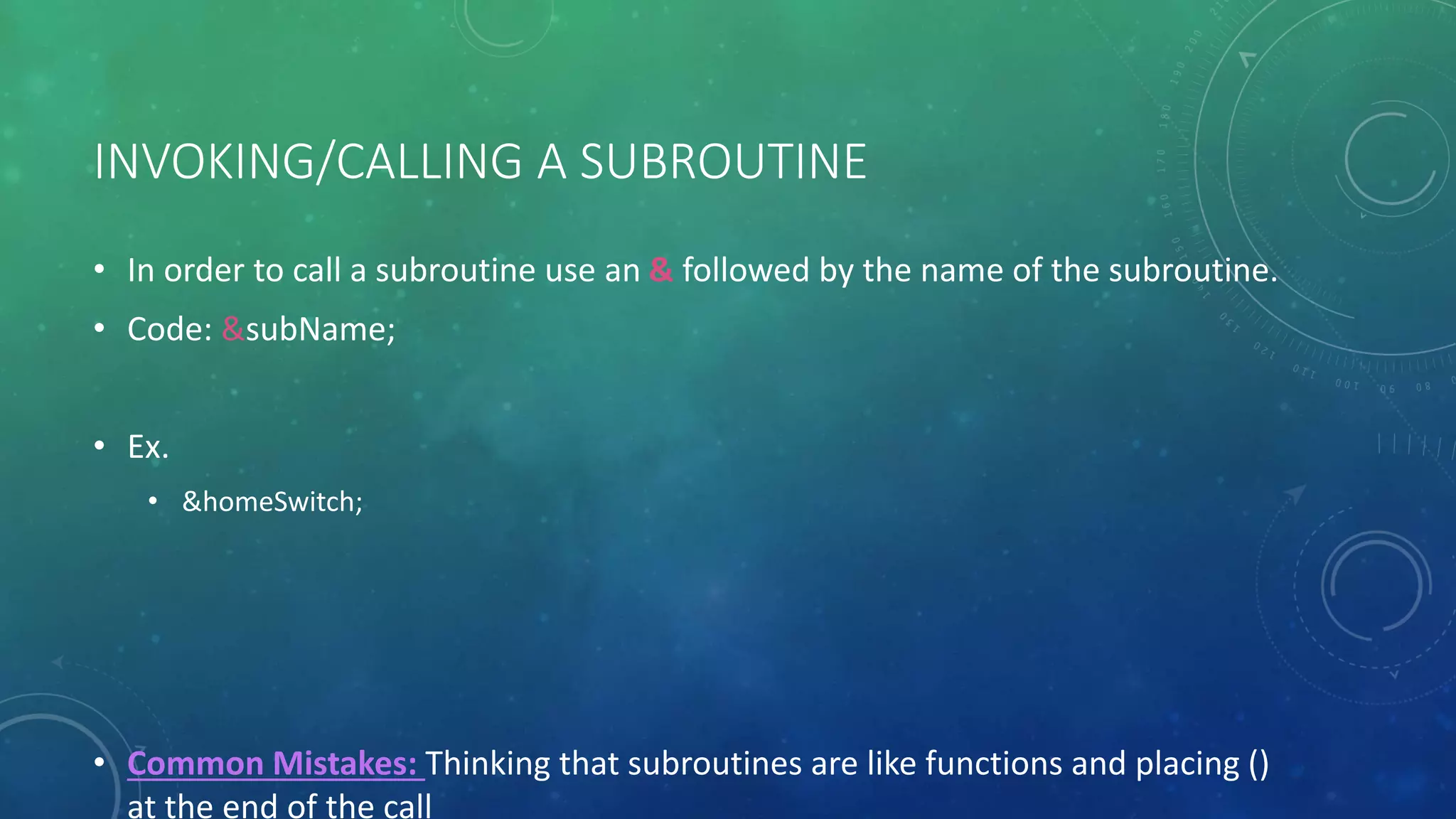
• In order to call a subroutine use an & followed by the name of the subroutine.
• Code: &subName;
• Ex.
• &homeSwitch;
• Common Mistakes: Thinking that subroutines are like functions and placing ()
at the end of the call
MAKE IT WORTHWHILE WITH A RETURN
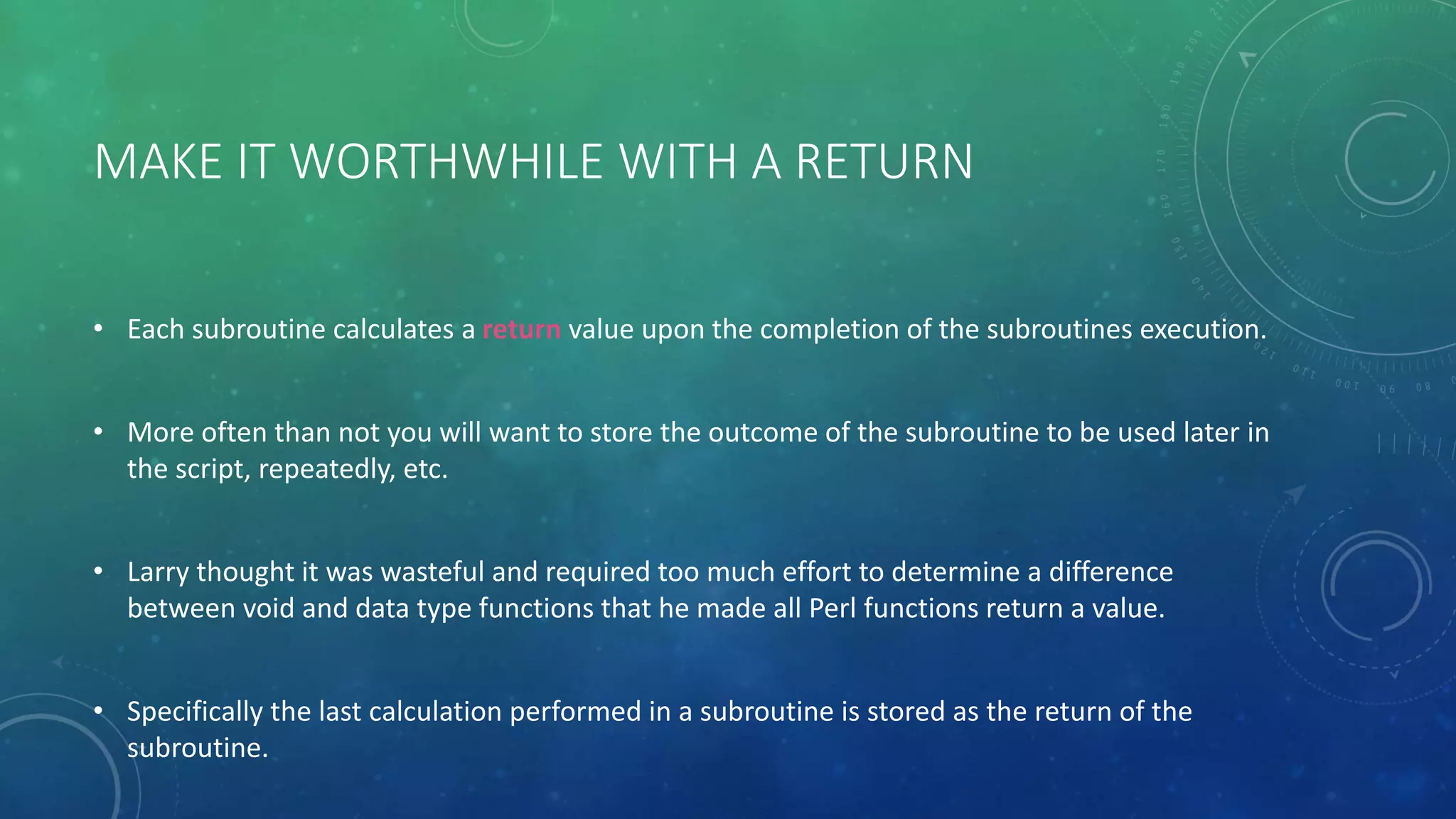
• Each subroutine calculates a return value upon the completion of the subroutines execution.
• More often than not you will want to store the outcome of the subroutine to be used later in
the script, repeatedly, etc.
• Larry thought it was wasteful and required too much effort to determine a difference
between void and data type functions that he made all Perl functions return a value.
• Specifically the last calculation performed in a subroutine is stored as the return of the
subroutine.
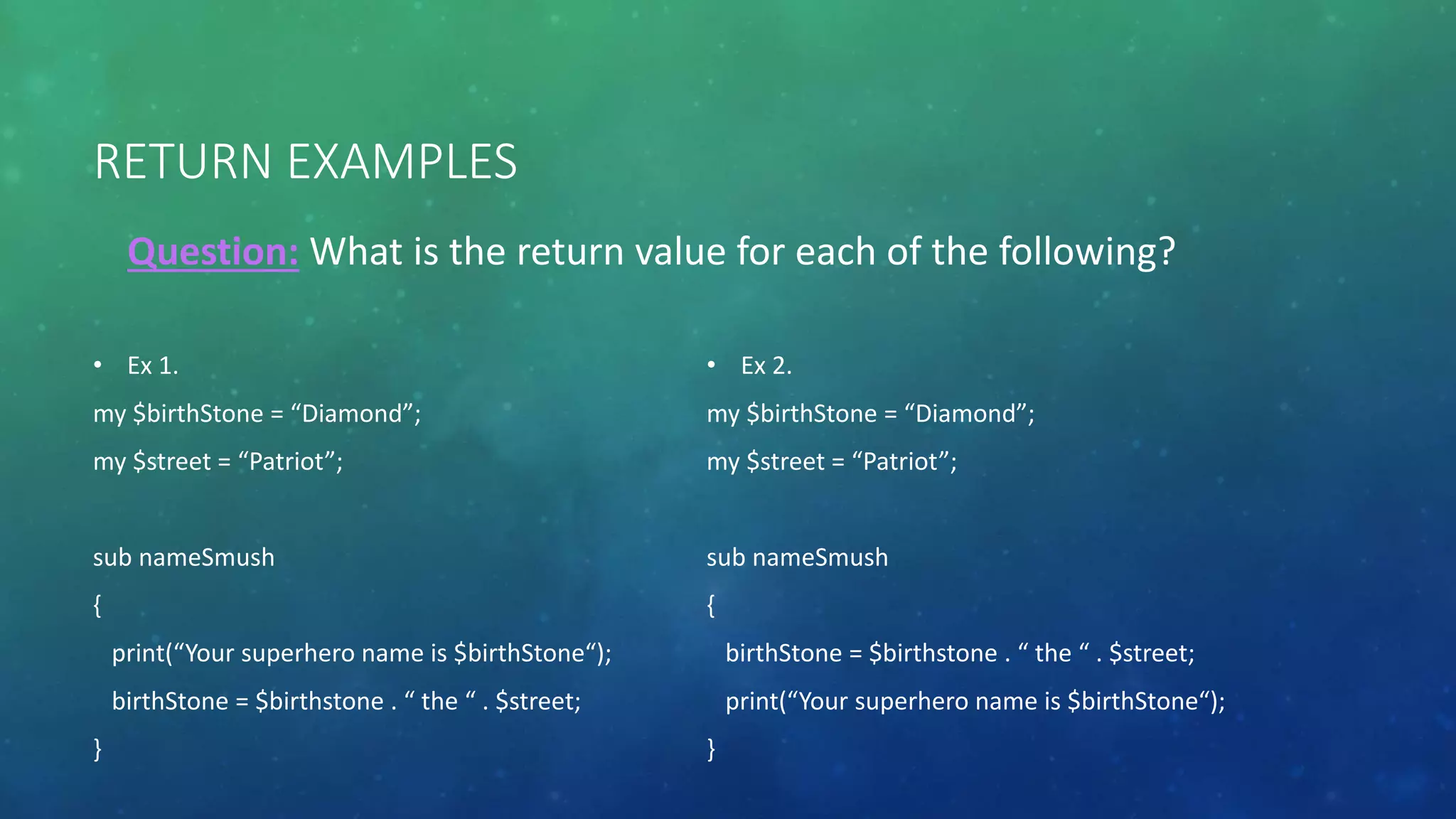
RETURN EXAMPLES
Question: What is the return value for each of the following?
• Ex 2
my $birthStone = “Diamond”;
my $street = “Patriot”;
sub nameSmush
{
birthStone = $birthstone . “ the “ . $street;
}
print(&nameSmush);
• Ex 3
my $birthStone = “Diamond”;
my $street = “Patriot”;
sub nameSmush
{
$birthStone = $birthstone . “ the “ . $street;
print(“Your superhero name is $birthStone“);
}
$testVar = &nameSmush;
• Ex 1.
my $birthStone = “Diamond”;
my $street = “Patriot”;
sub nameSmush
{
birthStone = $birthstone . “ the “ .
$street;
}
&nameSmush;

Subroutines

  • 1.
  • 2.
    SUBROUTINES • Thus farwe have utilized Perl predefined functions such as print and chomp. However, it is useful to be able to create our own functions to simplify tasks. • A subroutine is a user defined function that allows the scripter to: • Organize code • Recycle code • Reuse code • Recall the scope of a function is local; Therefore we must take that into account when developing them if we want global actions. • Good Programming: Place subroutines below your main script
  • 3.
    DEFINING A SUBROUTINE •Perl has simplified the task to define a function • Question: In other languages how do we define a function/method? • Code: sub subName { Block; } • Common Mistakes: Thinking that subroutines are like functions and placing () at the end of the definition. • Ex. use Cwd; use strict; my $currPath = getcwd; sub homeSwitch { if ($currPath ne “/u/j/s/jsilver5/”) { $currPath = getcwd; chdir “/u/j/s/jsilver5/”; } else { chdir $currPath; } }
  • 4.
    INVOKING/CALLING A SUBROUTINE •In order to call a subroutine use an & followed by the name of the subroutine. • Code: &subName; • Ex. • &homeSwitch; • Common Mistakes: Thinking that subroutines are like functions and placing () at the end of the call
  • 5.
    MAKE IT WORTHWHILEWITH A RETURN • Each subroutine calculates a return value upon the completion of the subroutines execution. • More often than not you will want to store the outcome of the subroutine to be used later in the script, repeatedly, etc. • Larry thought it was wasteful and required too much effort to determine a difference between void and data type functions that he made all Perl functions return a value. • Specifically the last calculation performed in a subroutine is stored as the return of the subroutine.
  • 6.
    RETURN EXAMPLES Question: Whatis the return value for each of the following? • Ex 2 my $birthStone = “Diamond”; my $street = “Patriot”; sub nameSmush { birthStone = $birthstone . “ the “ . $street; } print(&nameSmush); • Ex 3 my $birthStone = “Diamond”; my $street = “Patriot”; sub nameSmush { $birthStone = $birthstone . “ the “ . $street; print(“Your superhero name is $birthStone“); } $testVar = &nameSmush; • Ex 1. my $birthStone = “Diamond”; my $street = “Patriot”; sub nameSmush { birthStone = $birthstone . “ the “ . $street; } &nameSmush;