Virtuous Lazyness
  For Your Data

  Doing it once and
knowing you've done it.

  Steve Lembark
Workhorse Computing
 lembark@wrkhors.com
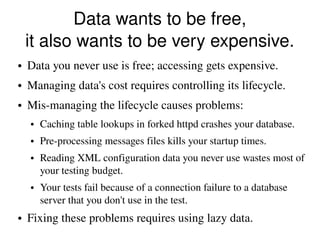
Data wants to be free,
    it also wants to be very expensive.
●   Data you never use is free; accessing gets expensive.
●   Managing data's cost requires controlling its lifecycle.
●   Mis­managing the lifecycle causes problems:
    ●   Caching table lookups in forked httpd crashes your database.
    ●   Pre­processing messages files kills your startup times.
    ●   Reading XML configuration data you never use wastes most of 
        your testing budget.
    ●   Your tests fail because of a connection failure to a database 
        server that you don't use in the test.
●   Fixing these problems requires using lazy data.
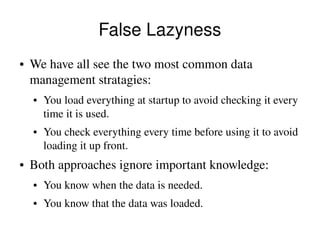
False Lazyness
●   We have all see the two most common data 
    management stratagies:
    ●   You load everything at startup to avoid checking it every 
        time it is used.
    ●   You check everything every time before using it to avoid 
        loading it up front.
●   Both approaches ignore important knowledge:
    ●   You know when the data is needed.
    ●   You know that the data was loaded.
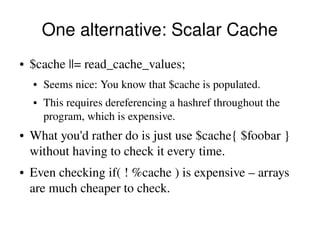
One alternative: Scalar Cache
●   $cache ||= read_cache_values;
    ●   Seems nice: You know that $cache is populated.
    ●   This requires dereferencing a hashref throughout the 
        program, which is expensive. 
●   What you'd rather do is just use $cache{ $foobar } 
    without having to check it every time.
●   Even checking if( ! %cache ) is expensive – arrays 
    are much cheaper to check.
True Lazyness:
                Do Something Once
●   Truly Lazy data means loading you data when you 
    need it and knowing that it is loaded.
●   Perl gives us – of course – more than one way:
    ●   Trampoline objects and subroutines.
    ●   “state” variables, introduced in v5.10.
●   Trampolines are flyweight objects – data structures or 
    subroutines that transform themselves when used.
●   State variables are assigned only once, at runtime, the 
    first time they are used.
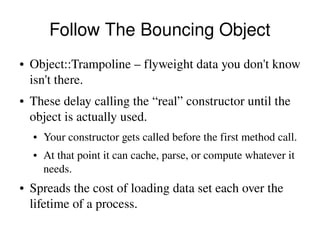
Follow The Bouncing Object
●   Object::Trampoline – flyweight data you don't know 
    isn't there.
●   These delay calling the “real” constructor until the 
    object is actually used.
    ●   Your constructor gets called before the first method call.
    ●   At that point it can cache, parse, or compute whatever it 
        needs.
●   Spreads the cost of loading data set each over the 
    lifetime of a process.
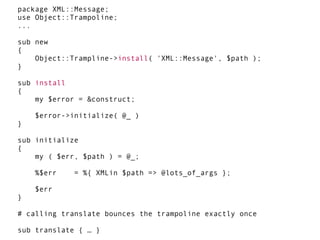
Example: Delay Expensive XML
●   Use an initializer to read and parse the XML.
●   The Object::Trampoline calls your constructor once 
    to transform the object the first time you call a 
    method.
●   Parsing the XML is pushed off until you actually use 
    the data.
●   Requires using a hashref – and possibly methods – 
    to access the data.
package XML::Message;
use Object::Trampoline;
...

sub new
{
    Object::Trampline->install( 'XML::Message', $path );
}

sub install
{
    my $error = &construct;

    $error->initialize( @_ )
}

sub initialize
{
    my ( $err, $path ) = @_;

    %$err    = %{ XMLin $path => @lots_of_args };

    $err
}

# calling translate bounces the trampoline exactly once

sub translate { … }
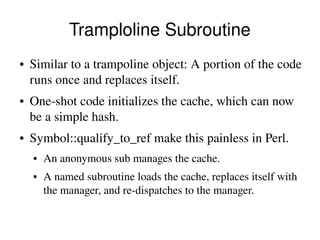
Tramploline Subroutine
●   Similar to a trampoline object: A portion of the code 
    runs once and replaces itself.
●   One­shot code initializes the cache, which can now 
    be a simple hash.
●   Symbol::qualify_to_ref make this painless in Perl.
    ●   An anonymous sub manages the cache.
    ●   A named subroutine loads the cache, replaces itself with 
        the manager, and re­dispatches to the manager.
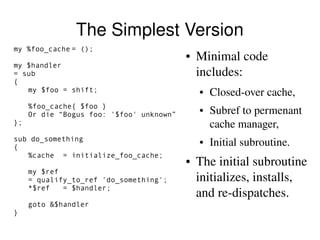
The Simplest Version
my %foo_cache = ();
                                          ●   Minimal code 
my $handler
= sub                                         includes:
{
   my $foo = shift;                           ●   Closed­over cache,
     %foo_cache{ $foo }
     Or die “Bogus foo: '$foo' unknown”
                                              ●   Subref to permenant 
};                                                cache manager,
sub do_something
{
                                              ●   Initial subroutine.
   %cache = initialize_foo_cache;
                                          ●   The initial subroutine 
     my $ref
     = qualify_to_ref 'do_something';         initializes, installs, 
     *$ref   = $handler;
                                              and re­dispatches.
     goto &$handler
}
BEGIN Blocks Are Cleaner
BEGIN
{
   my $name = 'foo_handler';           ●   The block isolates 
   my $ref   = qualify_to_ref $name;
   my %cache = ();                         cache, ref, and 
    my $handler                            sub variables; 
    = sub
    {                                      allows re­cycling 
       %cache{ $_[0] } or die ...
    };                                     the ref.
    *$ref
    = sub
                                       ●   This is also rather 
    {
       %cache   = init_the_cache;
                                           amenable to 
        *$ref   = $handler;
                                           installation by 
                                           module.
        goto &$handler
    }
}
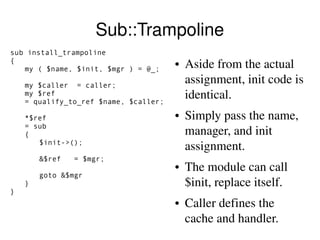
Sub::Trampoline
sub install_trampoline
{
   my ( $name, $init, $mgr ) = @_;
                                       ●   Aside from the actual 
    my $caller = caller;
                                           assignment, init code is 
    my $ref
    = qualify_to_ref $name, $caller;
                                           identical.
    *$ref                              ●   Simply pass the name, 
    = sub
    {                                      manager, and init 
       $init->();
                                           assignment.
        &$ref   = $mgr;
                                       ●   The module can call 
        goto &$mgr
    }                                      $init, replace itself.
}
                                       ●   Caller defines the 
                                           cache and handler.
Using Sub::Trampoline
use Sub::Trampoline;

my %cache1   = ();
my @cache2   = ();

my $cache1_mgr
= sub { $cache1{ $_[0] } or croak "Unknown '$_[0]'" };

my $cache2_mgr
= sub { first { $_ eq $_[0] } @cache2 } };

my $init_cache1 = sub { %cache1 = select_from_hell }
sub init_cache2 { @cache2 = XMLin $nasty_messy_xml_struct }

install_trampoline( subone     => $init_cache1, $cache1_mgr );
install_trampoline( known      => &init_cache2, $cache2_mgr );

my $value1   = subone $key1;

if( known $value )
{ … }
else
{ carp “Unknown: '$value'” }
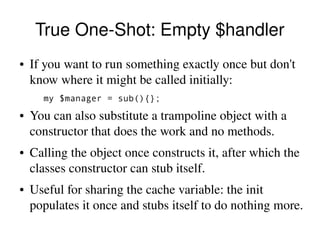
True One­Shot: Empty $handler
●   If you want to run something exactly once but don't 
    know where it might be called initially:
      my $manager = sub(){};
●   You can also substitute a trampoline object with a 
    constructor that does the work and no methods.
●   Calling the object once constructs it, after which the 
    classes constructor can stub itself.
●   Useful for sharing the cache variable: the init 
    populates it once and stubs itself to do nothing more.
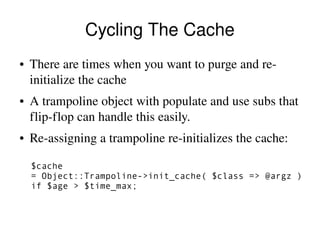
Cycling The Cache
●   There are times when you want to purge and re­
    initialize the cache
●   A trampoline object with populate and use subs that 
    flip­flop can handle this easily.
●   Re­assigning a trampoline re­initializes the cache:

    $cache
    = Object::Trampoline->init_cache( $class => @argz )
    if $age > $time_max;
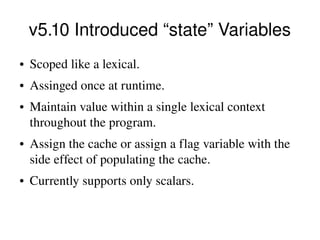
v5.10 Introduced “state” Variables
●   Scoped like a lexical.
●   Assinged once at runtime.
●   Maintain value within a single lexical context 
    throughout the program.
●   Assign the cache or assign a flag variable with the 
    side effect of populating the cache.
●   Currently supports only scalars.
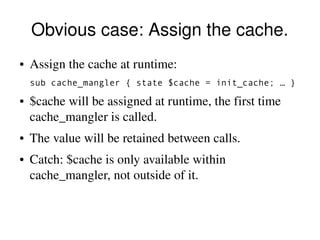
Obvious case: Assign the cache.
●   Assign the cache at runtime:
    sub cache_mangler { state $cache = init_cache; … }
●   $cache will be assigned at runtime, the first time 
    cache_mangler is called.
●   The value will be retained between calls.
●   Catch: $cache is only available within 
    cache_mangler, not outside of it.
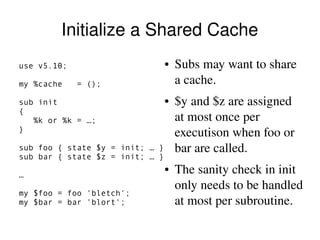
Initialize a Shared Cache
use v5.10;                       ●   Subs may want to share 
my %cache    = ();                   a cache.
sub init                         ●   $y and $z are assigned 
{
   %k or %k = …;                     at most once per 
}
                                     executison when foo or 
sub foo { state $y = init; … }       bar are called.
sub bar { state $z = init; … }

…
                                 ●   The sanity check in init 
                                     only needs to be handled 
my $foo = foo 'bletch';
my $bar = bar 'blort';               at most per subroutine.
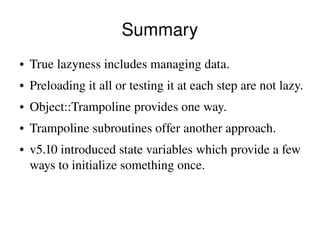
Summary
●   True lazyness includes managing data.
●   Preloading it all or testing it at each step are not lazy.
●   Object::Trampoline provides one way.
●   Trampoline subroutines offer another approach.
●   v5.10 introduced state variables which provide a few 
    ways to initialize something once.

Lazy Data Using Perl

  • 1.
    Virtuous Lazyness For Your Data Doing it once and knowing you've done it. Steve Lembark Workhorse Computing lembark@wrkhors.com
  • 2.
    Data wants to be free, it also wants to be very expensive. ● Data you never use is free; accessing gets expensive. ● Managing data's cost requires controlling its lifecycle. ● Mis­managing the lifecycle causes problems: ● Caching table lookups in forked httpd crashes your database. ● Pre­processing messages files kills your startup times. ● Reading XML configuration data you never use wastes most of  your testing budget. ● Your tests fail because of a connection failure to a database  server that you don't use in the test. ● Fixing these problems requires using lazy data.
  • 3.
    False Lazyness ● We have all see the two most common data  management stratagies: ● You load everything at startup to avoid checking it every  time it is used. ● You check everything every time before using it to avoid  loading it up front. ● Both approaches ignore important knowledge: ● You know when the data is needed. ● You know that the data was loaded.
  • 4.
    One alternative: Scalar Cache ● $cache ||= read_cache_values; ● Seems nice: You know that $cache is populated. ● This requires dereferencing a hashref throughout the  program, which is expensive.  ● What you'd rather do is just use $cache{ $foobar }  without having to check it every time. ● Even checking if( ! %cache ) is expensive – arrays  are much cheaper to check.
  • 5.
    True Lazyness: Do Something Once ● Truly Lazy data means loading you data when you  need it and knowing that it is loaded. ● Perl gives us – of course – more than one way: ● Trampoline objects and subroutines. ● “state” variables, introduced in v5.10. ● Trampolines are flyweight objects – data structures or  subroutines that transform themselves when used. ● State variables are assigned only once, at runtime, the  first time they are used.
  • 6.
    Follow The Bouncing Object ● Object::Trampoline – flyweight data you don't know  isn't there. ● These delay calling the “real” constructor until the  object is actually used. ● Your constructor gets called before the first method call. ● At that point it can cache, parse, or compute whatever it  needs. ● Spreads the cost of loading data set each over the  lifetime of a process.
  • 7.
    Example: Delay Expensive XML ● Use an initializer to read and parse the XML. ● The Object::Trampoline calls your constructor once  to transform the object the first time you call a  method. ● Parsing the XML is pushed off until you actually use  the data. ● Requires using a hashref – and possibly methods –  to access the data.
  • 8.
    package XML::Message; use Object::Trampoline; ... subnew { Object::Trampline->install( 'XML::Message', $path ); } sub install { my $error = &construct; $error->initialize( @_ ) } sub initialize { my ( $err, $path ) = @_; %$err = %{ XMLin $path => @lots_of_args }; $err } # calling translate bounces the trampoline exactly once sub translate { … }
  • 9.
    Tramploline Subroutine ● Similar to a trampoline object: A portion of the code  runs once and replaces itself. ● One­shot code initializes the cache, which can now  be a simple hash. ● Symbol::qualify_to_ref make this painless in Perl. ● An anonymous sub manages the cache. ● A named subroutine loads the cache, replaces itself with  the manager, and re­dispatches to the manager.
  • 10.
    The Simplest Version my %foo_cache =(); ● Minimal code  my $handler = sub includes: { my $foo = shift; ● Closed­over cache, %foo_cache{ $foo } Or die “Bogus foo: '$foo' unknown” ● Subref to permenant  }; cache manager, sub do_something { ● Initial subroutine. %cache = initialize_foo_cache; ● The initial subroutine  my $ref = qualify_to_ref 'do_something'; initializes, installs,  *$ref = $handler; and re­dispatches. goto &$handler }
  • 11.
    BEGIN Blocks Are Cleaner BEGIN { my $name = 'foo_handler'; ● The block isolates  my $ref = qualify_to_ref $name; my %cache = (); cache, ref, and  my $handler sub variables;  = sub { allows re­cycling  %cache{ $_[0] } or die ... }; the ref. *$ref = sub ● This is also rather  { %cache = init_the_cache; amenable to  *$ref = $handler; installation by  module. goto &$handler } }
  • 12.
    Sub::Trampoline sub install_trampoline { my ( $name, $init, $mgr ) = @_; ● Aside from the actual  my $caller = caller; assignment, init code is  my $ref = qualify_to_ref $name, $caller; identical. *$ref ● Simply pass the name,  = sub { manager, and init  $init->(); assignment. &$ref = $mgr; ● The module can call  goto &$mgr } $init, replace itself. } ● Caller defines the  cache and handler.
  • 13.
    Using Sub::Trampoline use Sub::Trampoline; my %cache1 = (); my @cache2 = (); my $cache1_mgr = sub { $cache1{ $_[0] } or croak "Unknown '$_[0]'" }; my $cache2_mgr = sub { first { $_ eq $_[0] } @cache2 } }; my $init_cache1 = sub { %cache1 = select_from_hell } sub init_cache2 { @cache2 = XMLin $nasty_messy_xml_struct } install_trampoline( subone => $init_cache1, $cache1_mgr ); install_trampoline( known => &init_cache2, $cache2_mgr ); my $value1 = subone $key1; if( known $value ) { … } else { carp “Unknown: '$value'” }
  • 14.
    True One­Shot: Empty $handler ● If you want to run something exactly once but don't  know where it might be called initially: my $manager = sub(){}; ● You can also substitute a trampoline object with a  constructor that does the work and no methods. ● Calling the object once constructs it, after which the  classes constructor can stub itself. ● Useful for sharing the cache variable: the init  populates it once and stubs itself to do nothing more.
  • 15.
    Cycling The Cache ● There are times when you want to purge and re­ initialize the cache ● A trampoline object with populate and use subs that  flip­flop can handle this easily. ● Re­assigning a trampoline re­initializes the cache: $cache = Object::Trampoline->init_cache( $class => @argz ) if $age > $time_max;
  • 16.
    v5.10 Introduced “state” Variables ● Scoped like a lexical. ● Assinged once at runtime. ● Maintain value within a single lexical context  throughout the program. ● Assign the cache or assign a flag variable with the  side effect of populating the cache. ● Currently supports only scalars.
  • 17.
    Obvious case: Assign the cache. ● Assign the cache at runtime: sub cache_mangler { state $cache = init_cache; … } ● $cache will be assigned at runtime, the first time  cache_mangler is called. ● The value will be retained between calls. ● Catch: $cache is only available within  cache_mangler, not outside of it.
  • 18.
    Initialize a Shared Cache use v5.10; ● Subs may want to share  my %cache = (); a cache. sub init ● $y and $z are assigned  { %k or %k = …; at most once per  } executison when foo or  sub foo { state $y = init; … } bar are called. sub bar { state $z = init; … } … ● The sanity check in init  only needs to be handled  my $foo = foo 'bletch'; my $bar = bar 'blort'; at most per subroutine.
  • 19.
    Summary ● True lazyness includes managing data. ● Preloading it all or testing it at each step are not lazy. ● Object::Trampoline provides one way. ● Trampoline subroutines offer another approach. ● v5.10 introduced state variables which provide a few  ways to initialize something once.