
USE OF
FUNCTIONAL SCALES IN CARDIO-
PULMONARY CONDITION`
Dr.Abhijit Diwate Associate Professor
Cardio-Vascular & Respiratory PT
DVVPF College of Physiotherapy,
Ahmednagar 414111
Objectives
1. Introduction
2. Importance of Outcome scale
3. Factors Affecting Patient Outcomes
4. Classification of Scales in Cardio-Pulmonary
condition
5. References
IMPORTANCE OF OUTCOMES SCALES
• To demonstrate accountability.
• To improve clinical & management decision
making
for optimal care delivery.
• For research.
• As incentive.
INTENSIVE CARE UNIT (ICU)
1. Acute Physiology And Chronic Health Evaluation
(APACHE) I,II,III,IV
2. Simplified Acute Physiology Score (SAPS) I, II, III
3. Mortality Probability Model (MPM) I, II
4. Organ Dysfunction Score (ODS)
• Logistic Organ Dysfunction Score (LODS)
• Multiple Organ Dysfunction Score (MODS)
• Sequential Organ Failure Assessment (SOFA)
ACUTE PHYSIOLOGY AND CHRONIC HEALTH
EVALUATION (APACHE) I,II,III,IV
APACHE I
(knaus in 1981)
Purpose
Used for classifying disease severity & predicting
hospital mortality.
Description
34 consensuses determined physiological
variables collected over 32 hours of ICU weighted
on a 4 point scale.
APACHE II
(knaus in 1985)
Purpose
• Used to describe morbidity of patient when
comparing outcome with other patients.
• Predicted mortalities are averaged for groups of
patients in order to specify the group's morbidity
APACHE III
(Knaus in 1991)
Purpose
• To predict ICU mortality rates.
Description
12 physiological variables based weighted with a grade
higher than APACHE & APACHE-ll, in addition to age &
seven chronic health conditions.
Total of 299 points, 252 for physiological variables, 23 for
chronic health, and 24 for age.
APACHE IV
(Jack E.Zimmerman, Andrew A Kramer in 2006)
Purpose
Provides ICU length of stay prediction equations.
Description
Remodelling APACHE III with same physiological
variables & weights but different predictor
variables & refined statistical methods.
SIMPLIFIED ACUTE PHYSIOLOGY SCORE
(SAPS)
SAPS I(France in 1984)
Purpose
• Risk stratifying ICU patient by prognosis
• Describing severity and categorizing by
prognosis
• Explaining cost differences among patient with
similar diagnosis.
SAPS II (Le Gall in 1993)
Purpose
• Describe morbidity of patient & group of patients
when comparing outcome with other patients or
group of patients.
Description
• Includes 17 variables: 12 physiological variables,
age, type of admission, & 3 variables related to
underlying disease.
SAPS 3 (2005)
Purpose
Examine variability in resource use between ICUs
using standardized resource use parameter
based on length of stay in ICU.
MORTALITY PROBABILITY MODEL (MPM)
MPM
Developer
First MPM developed from data from patients in
ICU.
Description
Consists of an admission model using 7
admission variables, & a 24-hour model using
seven 24-hour variables.
MPM II
Description
Consists of two scores:
• MPM0 (the admission model) contains 15
variables
• MPM24 (24-hour model) contains 5 of admission
variables & 8 additional variables & is designed for
patients who stay in ICU for more than 24 hours.
MPM 0-III
Description
• Uses 16 variables, including 3 physiological
parameters, obtained within 1 hour of ICU
admission.
• MPM0 characterization based on patient
condition largely before ICU care begins.
ORGAN DYSFUNCTION SCORES
Purpose
Describe degree of organ dysfunction rather than
to predict survival.
Most commonly used scores in general ICU
patients:
• Logistic Organ Dysfunction System (LODS)
• Multiple Organ Dysfunction Score (MODS)
• Sequential organ function association (SOFA)
LOGISTIC ORGAN DYSFUNCTION SCORE
(LODS)
(Le Gall in 1996)
Description
• Using multiple logistic regressions, 12 variables
were selected to represent function of 6 organ
systems (neurologic, cardiovascular, renal,
pulmonary, hematologic, hepatic).
MULTIPLE ORGAN DYSFUNCTION SCORE
(MODS)
(Marshall JC, Cook DJ, et al in 1995)
Description
• Development was based on literature review.
• 7 organ systems were selected (respiratory,
cardiovascular, renal, hepatic, hematological,
central nervous system, gastrointestinal).
SEQUENTIAL ORGAN FAILURE
ASSESSMENT (SOFA)
(Vincent JL, Moreno R et al in1994)
Description
• Six organ systems (respiratory, cardiovascular,
renal, hepatic, central nervous, coagulation)
were selected based on a review of the
literature.
• Function of each system scored from 0 (normal
function) to 4 (most abnormal), giving a
possible score of 0 to 24.
CARDIAC-SPECIFIC OUTCOME SCALES
1. Minnesota Living with Heart Failure Questionnaire
(LHFQ)
2. Kansas Cardiomyopathy
3. MacNew Quality of Life after Myocardial Infarction
(MacNew QLMI)
4. Seattle Angina Questionnaire (SAQ)
5. The New York Heart Association Functional
Classification (NYHA)
MINNESOTA LIVING WITH HEART FAILURE
QUESTIONNAIRE (MLHFQ)(Rector in 1987)
Minnesota-HF-Questionnaire_Rector.pdf
Purpose
Evaluating the quality of life of patients with heart
failure.
Description
• Contains 21 questions
KANSAS CITY CARDIOMYOPATHY
QUESTIONNAIRE
(KCCQ)(Green et al)KansasCity-
CardiomyopathyQuestionnaire_Spertus.pdf
Introduction
• Self-administered, 23-item questionnaire
• Provide a better description of Health Related
QoL in patients with CHF
MACNEW QUALITY OF LIFE AFTER
MYOCARDIAL INFARCTION (MACNEW
QLMI)MACNEW HEART DISEASE HEALTH.docx
Purpose
• Assess HRQL for patients with different
manifestations of heart disease, such as angina
pectoris, myocardial infarction, heart failure, &
arrhythmia & interventions (such as CABG,
pacemaker implant or CR).
SEATTLE ANGINA QUESTIONNAIRE (SAQ)
(Spertus JA, Winder JA et al)seattle angina
questionaire.pdf
Purpose
Measurement of functional status of patients with
coronary artery disease(CAD).
Description
• Self-administered 19-item questionnaire
measuring HRQoL in patients with CAD.
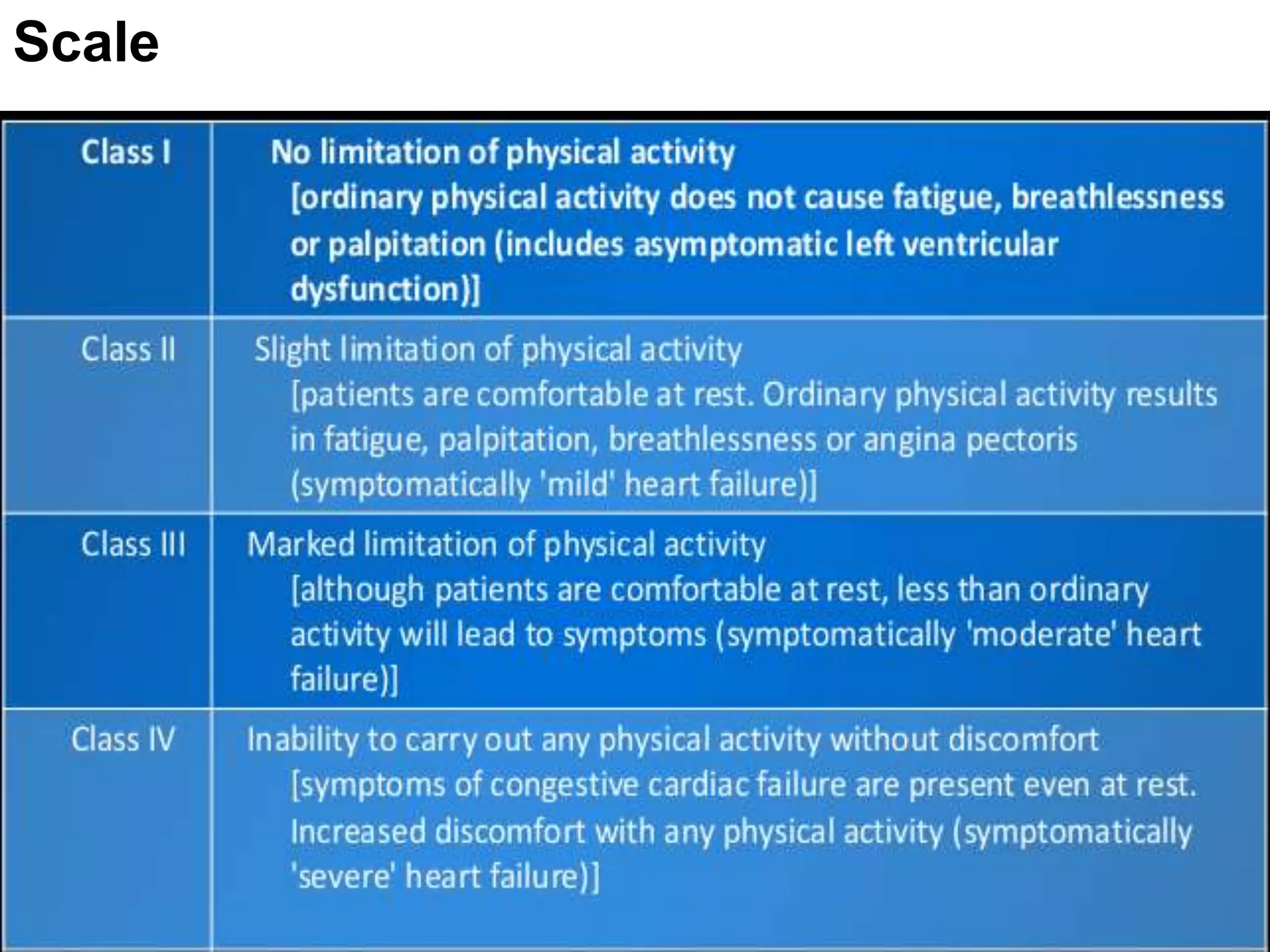
NYHA FUNCTIONAL CLASSIFICATION
Purpose
• Evaluate the effect of cardiac symptoms on
patient’s daily activity.
Description
• Grade the severity of functional limitations in a
patient with heart failure.
• Frequently used in clinical research.
• Functional class tends to deteriorate unevenly
overtime, so severity of symptoms cannot be
compared with severity of underlying problem.
• Favourable or adverse effects on functional
capacity can occur with changes in medication &
diet in absence of any measurable changes in
heart function.
Scale
PULMONARY-SPECIFIC OUTCOME SCALE
1.Chronic Respiratory Disease Questionnaire
(CRQ)
2. St. George’s Respiratory Questionnaire
(SGRQ)
3. Pulmonary Functional Status Scale (PFSS)
4. Pulmonary Functional Status & Dyspnea
Questionnaire(PFSDQ)
5. Baseline Dyspnea Index/Transitional Dyspnea
Index
6. Modified Medical Research Council (MRC)
Dyspnea Scale
7. Borg Scale
8. Visual analogue Scale
9. COPD Self Efficacy Scale
GENERAL QUALITY OF LIFE MEASURES
1. Sickness Impact Profile (SIP)
2. Medical Outcomes Study Short Form (SF-36)
3. Nottingham Health Profile (NHP)
SICKNESS IMPACT PROFILE(SIP)
Introduction
• Provides a broad measure of client perceived
health related dysfunction based on how illness
changes daily activities and behaviours.
SHORT FORM HEALTH SURVEY – 36 (SF-36)
(John E Ware, Cathy D et al)Short Form- 36.pdf
Purpose
• Comparing relative burden of diseases,
evaluating effectiveness of different treatments,
and identifying “at- risk” individuals.
• General populations, elderly individuals.
NOTTINGHAM HEALTH PROFILE
Nottingham h p.pdf
Introduction
Intended for Primary health care, to provide a
brief indication of a patient’s perceived
emotional, social and physical health problems.
Summary
• Importance of Outcome scale
• Factors Affecting Patient Outcomes
•Classification of Scales in CardioPulmonary
condition
THANK YOU

Functional scales in cardio pulmonary condition

  • 1.
    USE OF FUNCTIONAL SCALESIN CARDIO- PULMONARY CONDITION` Dr.Abhijit Diwate Associate Professor Cardio-Vascular & Respiratory PT DVVPF College of Physiotherapy, Ahmednagar 414111
  • 2.
    Objectives 1. Introduction 2. Importanceof Outcome scale 3. Factors Affecting Patient Outcomes 4. Classification of Scales in Cardio-Pulmonary condition 5. References
  • 3.
    IMPORTANCE OF OUTCOMESSCALES • To demonstrate accountability. • To improve clinical & management decision making for optimal care delivery. • For research. • As incentive.
  • 4.
    INTENSIVE CARE UNIT(ICU) 1. Acute Physiology And Chronic Health Evaluation (APACHE) I,II,III,IV 2. Simplified Acute Physiology Score (SAPS) I, II, III 3. Mortality Probability Model (MPM) I, II 4. Organ Dysfunction Score (ODS) • Logistic Organ Dysfunction Score (LODS) • Multiple Organ Dysfunction Score (MODS) • Sequential Organ Failure Assessment (SOFA)
  • 5.
    ACUTE PHYSIOLOGY ANDCHRONIC HEALTH EVALUATION (APACHE) I,II,III,IV APACHE I (knaus in 1981) Purpose Used for classifying disease severity & predicting hospital mortality. Description 34 consensuses determined physiological variables collected over 32 hours of ICU weighted on a 4 point scale.
  • 6.
    APACHE II (knaus in1985) Purpose • Used to describe morbidity of patient when comparing outcome with other patients. • Predicted mortalities are averaged for groups of patients in order to specify the group's morbidity
  • 7.
    APACHE III (Knaus in1991) Purpose • To predict ICU mortality rates. Description 12 physiological variables based weighted with a grade higher than APACHE & APACHE-ll, in addition to age & seven chronic health conditions. Total of 299 points, 252 for physiological variables, 23 for chronic health, and 24 for age.
  • 8.
    APACHE IV (Jack E.Zimmerman,Andrew A Kramer in 2006) Purpose Provides ICU length of stay prediction equations. Description Remodelling APACHE III with same physiological variables & weights but different predictor variables & refined statistical methods.
  • 9.
    SIMPLIFIED ACUTE PHYSIOLOGYSCORE (SAPS) SAPS I(France in 1984) Purpose • Risk stratifying ICU patient by prognosis • Describing severity and categorizing by prognosis • Explaining cost differences among patient with similar diagnosis.
  • 10.
    SAPS II (LeGall in 1993) Purpose • Describe morbidity of patient & group of patients when comparing outcome with other patients or group of patients. Description • Includes 17 variables: 12 physiological variables, age, type of admission, & 3 variables related to underlying disease.
  • 11.
    SAPS 3 (2005) Purpose Examinevariability in resource use between ICUs using standardized resource use parameter based on length of stay in ICU.
  • 12.
    MORTALITY PROBABILITY MODEL(MPM) MPM Developer First MPM developed from data from patients in ICU. Description Consists of an admission model using 7 admission variables, & a 24-hour model using seven 24-hour variables.
  • 13.
    MPM II Description Consists oftwo scores: • MPM0 (the admission model) contains 15 variables • MPM24 (24-hour model) contains 5 of admission variables & 8 additional variables & is designed for patients who stay in ICU for more than 24 hours.
  • 14.
    MPM 0-III Description • Uses16 variables, including 3 physiological parameters, obtained within 1 hour of ICU admission. • MPM0 characterization based on patient condition largely before ICU care begins.
  • 15.
    ORGAN DYSFUNCTION SCORES Purpose Describedegree of organ dysfunction rather than to predict survival. Most commonly used scores in general ICU patients: • Logistic Organ Dysfunction System (LODS) • Multiple Organ Dysfunction Score (MODS) • Sequential organ function association (SOFA)
  • 16.
    LOGISTIC ORGAN DYSFUNCTIONSCORE (LODS) (Le Gall in 1996) Description • Using multiple logistic regressions, 12 variables were selected to represent function of 6 organ systems (neurologic, cardiovascular, renal, pulmonary, hematologic, hepatic).
  • 17.
    MULTIPLE ORGAN DYSFUNCTIONSCORE (MODS) (Marshall JC, Cook DJ, et al in 1995) Description • Development was based on literature review. • 7 organ systems were selected (respiratory, cardiovascular, renal, hepatic, hematological, central nervous system, gastrointestinal).
  • 18.
    SEQUENTIAL ORGAN FAILURE ASSESSMENT(SOFA) (Vincent JL, Moreno R et al in1994) Description • Six organ systems (respiratory, cardiovascular, renal, hepatic, central nervous, coagulation) were selected based on a review of the literature. • Function of each system scored from 0 (normal function) to 4 (most abnormal), giving a possible score of 0 to 24.
  • 19.
    CARDIAC-SPECIFIC OUTCOME SCALES 1.Minnesota Living with Heart Failure Questionnaire (LHFQ) 2. Kansas Cardiomyopathy 3. MacNew Quality of Life after Myocardial Infarction (MacNew QLMI) 4. Seattle Angina Questionnaire (SAQ) 5. The New York Heart Association Functional Classification (NYHA)
  • 20.
    MINNESOTA LIVING WITHHEART FAILURE QUESTIONNAIRE (MLHFQ)(Rector in 1987) Minnesota-HF-Questionnaire_Rector.pdf Purpose Evaluating the quality of life of patients with heart failure. Description • Contains 21 questions
  • 21.
    KANSAS CITY CARDIOMYOPATHY QUESTIONNAIRE (KCCQ)(Greenet al)KansasCity- CardiomyopathyQuestionnaire_Spertus.pdf Introduction • Self-administered, 23-item questionnaire • Provide a better description of Health Related QoL in patients with CHF
  • 22.
    MACNEW QUALITY OFLIFE AFTER MYOCARDIAL INFARCTION (MACNEW QLMI)MACNEW HEART DISEASE HEALTH.docx Purpose • Assess HRQL for patients with different manifestations of heart disease, such as angina pectoris, myocardial infarction, heart failure, & arrhythmia & interventions (such as CABG, pacemaker implant or CR).
  • 23.
    SEATTLE ANGINA QUESTIONNAIRE(SAQ) (Spertus JA, Winder JA et al)seattle angina questionaire.pdf Purpose Measurement of functional status of patients with coronary artery disease(CAD). Description • Self-administered 19-item questionnaire measuring HRQoL in patients with CAD.
  • 24.
    NYHA FUNCTIONAL CLASSIFICATION Purpose •Evaluate the effect of cardiac symptoms on patient’s daily activity. Description • Grade the severity of functional limitations in a patient with heart failure. • Frequently used in clinical research.
  • 25.
    • Functional classtends to deteriorate unevenly overtime, so severity of symptoms cannot be compared with severity of underlying problem. • Favourable or adverse effects on functional capacity can occur with changes in medication & diet in absence of any measurable changes in heart function.
  • 26.
  • 27.
    PULMONARY-SPECIFIC OUTCOME SCALE 1.ChronicRespiratory Disease Questionnaire (CRQ) 2. St. George’s Respiratory Questionnaire (SGRQ) 3. Pulmonary Functional Status Scale (PFSS) 4. Pulmonary Functional Status & Dyspnea Questionnaire(PFSDQ)
  • 28.
    5. Baseline DyspneaIndex/Transitional Dyspnea Index 6. Modified Medical Research Council (MRC) Dyspnea Scale 7. Borg Scale 8. Visual analogue Scale 9. COPD Self Efficacy Scale
  • 29.
    GENERAL QUALITY OFLIFE MEASURES 1. Sickness Impact Profile (SIP) 2. Medical Outcomes Study Short Form (SF-36) 3. Nottingham Health Profile (NHP)
  • 30.
    SICKNESS IMPACT PROFILE(SIP) Introduction •Provides a broad measure of client perceived health related dysfunction based on how illness changes daily activities and behaviours.
  • 31.
    SHORT FORM HEALTHSURVEY – 36 (SF-36) (John E Ware, Cathy D et al)Short Form- 36.pdf Purpose • Comparing relative burden of diseases, evaluating effectiveness of different treatments, and identifying “at- risk” individuals. • General populations, elderly individuals.
  • 32.
    NOTTINGHAM HEALTH PROFILE Nottinghamh p.pdf Introduction Intended for Primary health care, to provide a brief indication of a patient’s perceived emotional, social and physical health problems.
  • 33.
    Summary • Importance ofOutcome scale • Factors Affecting Patient Outcomes •Classification of Scales in CardioPulmonary condition
  • 34.