SUBJECT-VERB
AGREEMENT
EVERY VERB MUST
AGREE WITH ITS SUBJECT
Plural
Subject

Singular
Subject

Singular
Verb

Plural
Verb
The Stupidity of English
Grammar


To make a noun plural, we add –s





Singular: girl
Plural: girls

To make a verb plural, we take away
the –s.



Singular: he talks
Plural: they talk
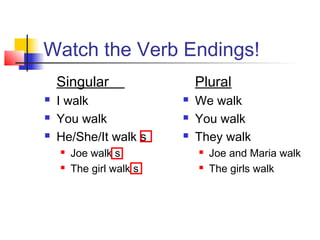
Watch the Verb Endings!
Singular




I walk
You walk
He/She/It walk s



Joe walk s
The girl walk s

Plural




We walk
You walk
They walk



Joe and Maria walk
The girls walk
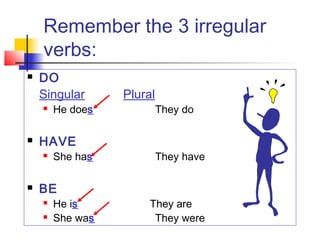
Remember the 3 irregular
verbs:


DO
Singular




HAVE




He does

She has

BE



He is
She was

Plural

They do

They have

They are
They were
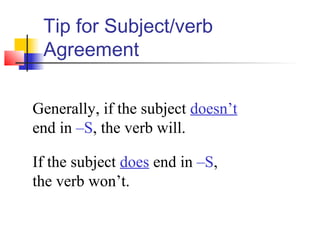
Tip for Subject/verb
Agreement
Generally, if the subject doesn’t
end in –S, the verb will.
If the subject does end in –S,
the verb won’t.
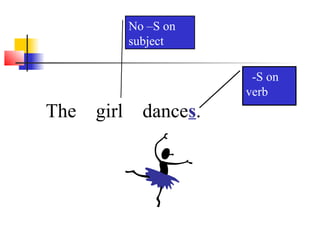
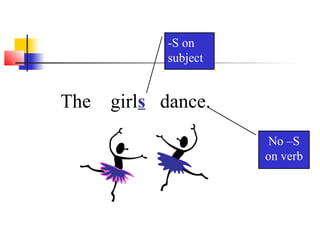
No –S on
subject
-S on
verb

The

girl

dances.
-S on
subject

The

girls dance.
No –S
on verb
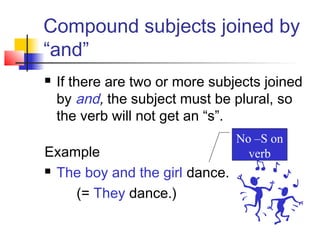
Compound subjects joined by
“and”


If there are two or more subjects joined
by and, the subject must be plural, so
the verb will not get an “s”.

Example
 The boy and the girl dance.
(= They dance.)

No –S on
verb
Compound subjects joined by
“or”
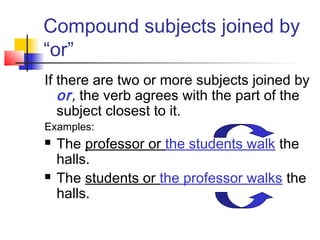
If there are two or more subjects joined by
or, the verb agrees with the part of the
subject closest to it.
Examples:




The professor or the students walk the
halls.
The students or the professor walks the
halls.
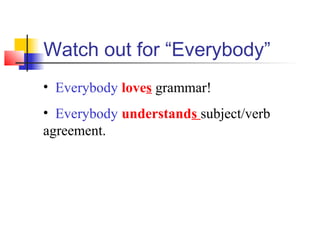
Watch out for “Everybody”
• Everybody loves grammar!
• Everybody understands subject/verb
agreement.
Possible Pitfalls
Sometimes, several words come between
the subject and the verb.
The student, though she had lots of problems in
other schools, finds/find (?) her new class easy.
 The student, though she had lots of problems
in other schools, finds her new class easy.
 The student finds her new class easy.

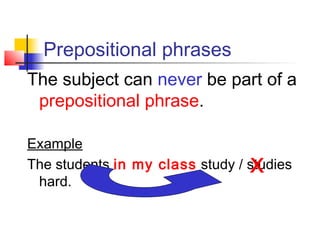
Prepositional phrases
The subject can never be part of a
prepositional phrase.
Example
The students in my class study / studies
X
hard.
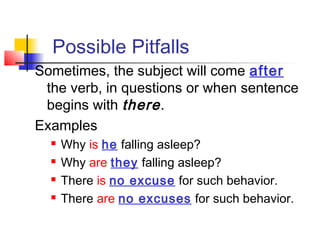
Possible Pitfalls
Sometimes, the subject will come after
the verb, in questions or when sentence
begins with there .
Examples





Why is he falling asleep?
Why are they falling asleep?
There is no excuse for such behavior.
There are no excuses for such behavior.
Possible Pitfalls
Relative Pronouns (who/which/that) can be
either singular or plural, depending on the
word they refer to.


The student who works hard will succeed.



The students who work hard will succeed.
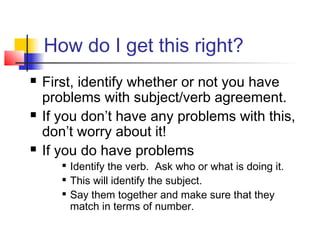
How do I get this right?






First, identify whether or not you have
problems with subject/verb agreement.
If you don’t have any problems with this,
don’t worry about it!
If you do have problems




Identify the verb. Ask who or what is doing it.
This will identify the subject.
Say them together and make sure that they
match in terms of number.
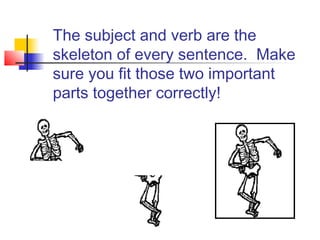
The subject and verb are the
skeleton of every sentence. Make
sure you fit those two important
parts together correctly!

Subject verb agreement

  • 1.
  • 2.
    EVERY VERB MUST AGREEWITH ITS SUBJECT Plural Subject Singular Subject Singular Verb Plural Verb
  • 3.
    The Stupidity ofEnglish Grammar  To make a noun plural, we add –s    Singular: girl Plural: girls To make a verb plural, we take away the –s.   Singular: he talks Plural: they talk
  • 4.
    Watch the VerbEndings! Singular    I walk You walk He/She/It walk s   Joe walk s The girl walk s Plural    We walk You walk They walk   Joe and Maria walk The girls walk
  • 5.
    Remember the 3irregular verbs:  DO Singular   HAVE   He does She has BE   He is She was Plural They do They have They are They were
  • 6.
    Tip for Subject/verb Agreement Generally,if the subject doesn’t end in –S, the verb will. If the subject does end in –S, the verb won’t.
  • 7.
    No –S on subject -Son verb The girl dances.
  • 8.
  • 9.
    Compound subjects joinedby “and”  If there are two or more subjects joined by and, the subject must be plural, so the verb will not get an “s”. Example  The boy and the girl dance. (= They dance.) No –S on verb
  • 10.
    Compound subjects joinedby “or” If there are two or more subjects joined by or, the verb agrees with the part of the subject closest to it. Examples:   The professor or the students walk the halls. The students or the professor walks the halls.
  • 11.
    Watch out for“Everybody” • Everybody loves grammar! • Everybody understands subject/verb agreement.
  • 12.
    Possible Pitfalls Sometimes, severalwords come between the subject and the verb. The student, though she had lots of problems in other schools, finds/find (?) her new class easy.  The student, though she had lots of problems in other schools, finds her new class easy.  The student finds her new class easy. 
  • 13.
    Prepositional phrases The subjectcan never be part of a prepositional phrase. Example The students in my class study / studies X hard.
  • 14.
    Possible Pitfalls Sometimes, thesubject will come after the verb, in questions or when sentence begins with there . Examples     Why is he falling asleep? Why are they falling asleep? There is no excuse for such behavior. There are no excuses for such behavior.
  • 15.
    Possible Pitfalls Relative Pronouns(who/which/that) can be either singular or plural, depending on the word they refer to.  The student who works hard will succeed.  The students who work hard will succeed.
  • 16.
    How do Iget this right?    First, identify whether or not you have problems with subject/verb agreement. If you don’t have any problems with this, don’t worry about it! If you do have problems    Identify the verb. Ask who or what is doing it. This will identify the subject. Say them together and make sure that they match in terms of number.
  • 17.
    The subject andverb are the skeleton of every sentence. Make sure you fit those two important parts together correctly!