SUBJECT-VERB AGREEMENT
EVERY VERB MUST AGREE WITH ITS SUBJECTPluralSubjectSingularSubjectSingularVerbPluralVerb
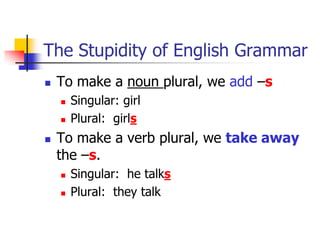
The Stupidity of English GrammarTo make a noun plural, we add –sSingular: girl Plural:  girlsTo make a verb plural, we take away the –s.Singular:  he talksPlural:  they talk
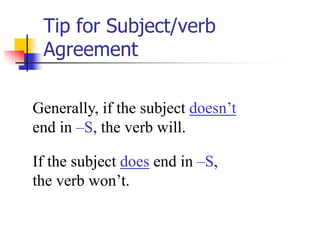
Tip for Subject/verb Agreement Generally, if the subject doesn’tend in –S, the verb will. If the subject does end in –S, the verb won’t.
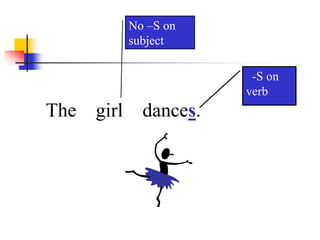
No –S on subject-S on verbThe    girl    dances.
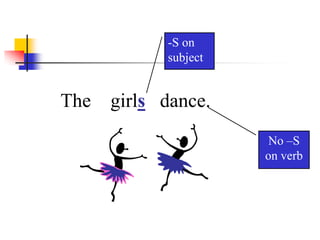
-S on subjectThe    girls   dance.No –S on verb
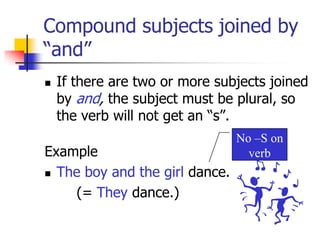
Compound subjects joined by “and”If there are two or more subjects joined by and,the subject must be plural, so the verb will not get an “s”.ExampleTheboy and the girl dance.		(= They dance.)No –S on verb
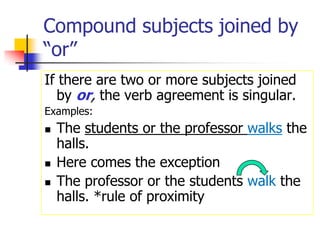
Compound subjects joined by “or”If there are two or more subjects joined by or, the verb agreement is singular.  Examples:The students or the professor walksthe halls.Here comes the exceptionThe professor or the students walk the halls. *rule of proximity
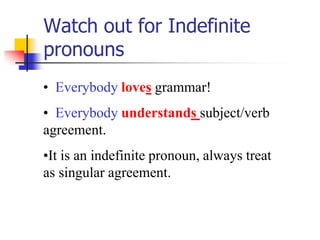
Watch out for Indefinite pronouns Everybodyloves grammar!
Everybodyunderstands subject/verb agreement.
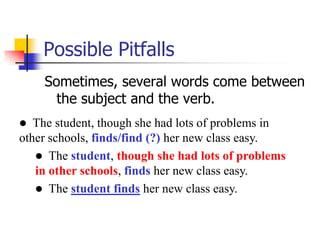
It is an indefinite pronoun, always treat as singular agreement. Possible PitfallsSometimes, several words come between the subject and the verb.  The student, though she had lots of problems in other schools, finds/find (?) her new class easy.
  The student, though she had lots of problems in other schools, finds her new class easy.
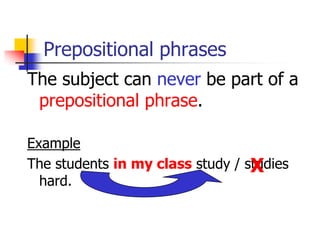
  The student finds her new class easy.Prepositional phrasesThe subject can never be part of a prepositional phrase.ExampleThe students in my class study / studies  hard.X
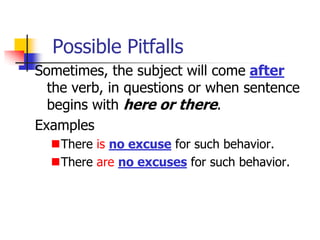
Possible PitfallsSometimes, the subject will come after the verb, in questions or when sentence begins with here or there.ExamplesThere isno excuse for such behavior.There areno excuses for such behavior.
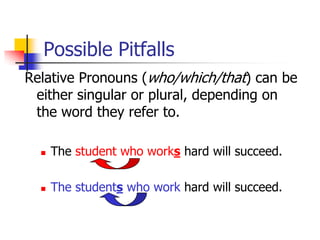
Possible PitfallsRelative Pronouns (who/which/that) can be either singular or plural, depending on the word they refer to.The student who works hard will succeed.The students who work hard will succeed.
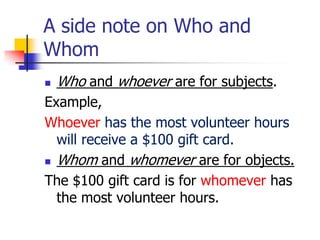
A side note on Who and WhomWho and whoever are for subjects.Example, Whoever has the most volunteer hours will receive a $100 gift card. Whom and whomever are for objects.The $100 gift card is for whomever has the most volunteer hours.
How do I get this right?First, identify whether or not you have problems with subject/verb agreement.If you don’t have any problems with this, don’t worry about it!If you do have problems Identify the verb.  Ask who or what is doing it.This will identify the subject.Say them together and make sure that they match in terms of number.

Subject verb agreement 1

  • 1.
  • 2.
    EVERY VERB MUSTAGREE WITH ITS SUBJECTPluralSubjectSingularSubjectSingularVerbPluralVerb
  • 3.
    The Stupidity ofEnglish GrammarTo make a noun plural, we add –sSingular: girl Plural: girlsTo make a verb plural, we take away the –s.Singular: he talksPlural: they talk
  • 4.
    Tip for Subject/verbAgreement Generally, if the subject doesn’tend in –S, the verb will. If the subject does end in –S, the verb won’t.
  • 5.
    No –S onsubject-S on verbThe girl dances.
  • 6.
    -S on subjectThe girls dance.No –S on verb
  • 7.
    Compound subjects joinedby “and”If there are two or more subjects joined by and,the subject must be plural, so the verb will not get an “s”.ExampleTheboy and the girl dance. (= They dance.)No –S on verb
  • 8.
    Compound subjects joinedby “or”If there are two or more subjects joined by or, the verb agreement is singular. Examples:The students or the professor walksthe halls.Here comes the exceptionThe professor or the students walk the halls. *rule of proximity
  • 9.
    Watch out forIndefinite pronouns Everybodyloves grammar!
  • 10.
  • 11.
    It is anindefinite pronoun, always treat as singular agreement. Possible PitfallsSometimes, several words come between the subject and the verb. The student, though she had lots of problems in other schools, finds/find (?) her new class easy.
  • 12.
    Thestudent, though she had lots of problems in other schools, finds her new class easy.
  • 13.
    Thestudent finds her new class easy.Prepositional phrasesThe subject can never be part of a prepositional phrase.ExampleThe students in my class study / studies hard.X
  • 14.
    Possible PitfallsSometimes, thesubject will come after the verb, in questions or when sentence begins with here or there.ExamplesThere isno excuse for such behavior.There areno excuses for such behavior.
  • 15.
    Possible PitfallsRelative Pronouns(who/which/that) can be either singular or plural, depending on the word they refer to.The student who works hard will succeed.The students who work hard will succeed.
  • 16.
    A side noteon Who and WhomWho and whoever are for subjects.Example, Whoever has the most volunteer hours will receive a $100 gift card. Whom and whomever are for objects.The $100 gift card is for whomever has the most volunteer hours.
  • 17.
    How do Iget this right?First, identify whether or not you have problems with subject/verb agreement.If you don’t have any problems with this, don’t worry about it!If you do have problems Identify the verb. Ask who or what is doing it.This will identify the subject.Say them together and make sure that they match in terms of number.