PSYCHOLINGUISTICS
1. PALENDJA ETTA T
2. YESSI FITRIANI
3. TRI ASTUTI HANDAYANI
4. BAYU WIJAYA
5. CHYNTIA VIA DORA
6. ARLEDIAN PANGESTU
BROCA’S AREA
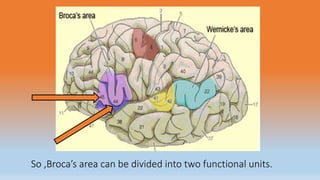
Defined as comprising brodmann areas 44 and 45
Which lie anterior to the premotor cortex
Area 44 and 45 contribute to verbal fluency
So ,Broca’s area can be divided into two functional units.
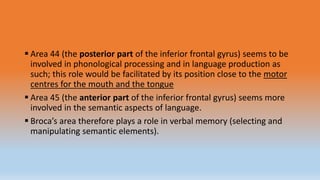
 Area 44 (the posterior part of the inferior frontal gyrus) seems to be
involved in phonological processing and in language production as
such; this role would be facilitated by its position close to the motor
centres for the mouth and the tongue
 Area 45 (the anterior part of the inferior frontal gyrus) seems more
involved in the semantic aspects of language.
 Broca’s area therefore plays a role in verbal memory (selecting and
manipulating semantic elements).
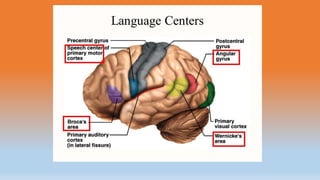
Wernicke’s area
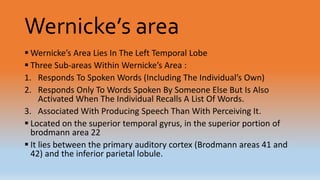
 Wernicke’s Area Lies In The Left Temporal Lobe
 Three Sub-areas Within Wernicke’s Area :
1. Responds To Spoken Words (Including The Individual’s Own)
2. Responds Only To Words Spoken By Someone Else But Is Also
Activated When The Individual Recalls A List Of Words.
3. Associated With Producing Speech Than With Perceiving It.
 Located on the superior temporal gyrus, in the superior portion of
brodmann area 22
 It lies between the primary auditory cortex (Brodmann areas 41 and
42) and the inferior parietal lobule.
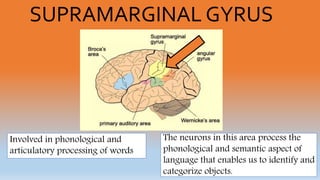
SUPRAMARGINAL GYRUS
Involved in phonological and
articulatory processing of words
The neurons in this area process the
phonological and semantic aspect of
language that enables us to identify and
categorize objects.
SUPRAMARGINAL AND ANGULAR
GYRUS
 The supramarginal gyrus and the angular gyrus work together by linking
words with meanings. These two parts of the brain also work together to
receive somatosensory - visual and audio inputs from other parts of the
brain.
 The Angular Gyrus (Together With The Posterior Cingulate Gyrus) Seems
More Involved In Semantic Processing.
 The Right Angular Gyrus Also Contributes To Semantic Processing Of
Language.
 The auditory cortex lets us recognize sounds, an essential prerequisite for
understanding language.
 The visual cortex, see the outside world, is also crucial for language,
because it enables us to read words and to recognize objects as the first
step in identifying them by a name.
WERNICKES FUNCTION
Functions of Wernicke's Area include:
• Language Comprehension
• Semantic Processing
• Language Recognition
• Language Interpretation
Location
• Wernicke's area is located in the left temporal lobe, posterior to the
primary auditory complex.
LANGUAGE PROCESSING
 Speech and language processing are complex functions that involve
several parts of the cerebral cortex.
 Wernicke's area, Broca's area, and the angular gyrus are three regions
vital to language processing and speech.
 Wernicke's area is connected to Broca's area by a group of nerve fiber
bundles called the arcuate fascilicus. While Wernicke's area helps us
to understand language, Broca's area helps us to accurately
communicate our ideas to others through speech.
 The angular gyrus, located in the parietal lobe, is a region of the brain
that helps us to utilize different types of sensory information to
comprehend language.
WERNICKES APHASIA
 Individuals with damage to the posterior temporal lobe region,
where Wernicke's area is located, may develop a condition called
Wernicke's aphasia or fluent aphasia.
 These individuals have difficulty comprehending language and
communicating ideas.
 These individuals lose the ability to connect words with their
appropriate meanings.
 They are often unaware that what they are saying does not make
sense.
BROCA’S FUNCTION
Broca's area is involved in several functions of the body including:
 Speech Production
 Facial Neuron Control
 Language Processing
LOCATION
Broca's area is found in the forebrain division of the brain. Directionally,
Broca's area is located in the lower portion of the left frontal lobe, and
it controls motor functions involved with speech production.
LANGUAGE PROCESSING
 Broca's area helps us to accurately communicate our ideas to others
through speech. It is also involved in language comprehension.
 Broca's area is connected to another language area of the brain
known as Wernicke's area via a group of nerve fiber bundles called
the arcuate fasciculus. Wernicke's area, located in the temporal lobe,
processes both written and spoken language.
 Another brain area associated with language is called the angular
gyrus. The angular gyrus helps us utilize different types of sensory
information to comprehend language.
BROCA’S APHASIA
 Damage to Broca's area of the brain results in a condition called
Broca's aphasia.
 People with Broca's aphasia have difficulty with speech production.
Their speech is slow, not grammatically correct, and consists primarily
of simple words.
 These individuals understand language but have a difficult time
articulating and communicating ideas verbally.
 These individuals have difficulty repeating words or phrases properly
but are able to comprehend language and speak coherently.
THE ANGULAR GYRUS FUNCTION
 Language: The angular gyrus works to change audio stimuli into visual
stimuli, and visual stimuli into audio.
 Memory Retrieval: Another purpose is to retrieve content and episodic
memories, and also to check if the memory that is retrieved has any
contradictions with what was expected.
 Mathematics: the angular gyrus is the most responsible for exact
calculations. Therefore, a person with a more active angular gyrus will have
better mathematical capabilities.
 Awareness: The angular gyrus is extremely important in a person's
consciousness of being aware of their own bodies, and what consequences
are to take place due to any action/movement that they make.
 Control of Motor Skills: It helps a person perform actions that he/she has
observed or done before, by retrieving memories, and it helps to interpret
3D spaces and objects.
EFFECTS OF DAMAGE IN ANGULAR
GYRUS
 Alexia and Agraphia: any damage to this area can result in a condition called
alexia, where although a person can see the words, he will be unable to
understand what he is reading, or not even write down words which he hears.
 Dyslexia: If the processing of audio-visual inputs is poor in this region, it can lead
to dyslexia.
 Anomia: Damage to this region can also lead to anomia, where one cannot name
people or objects.
 Finger Agnosia: One cannot identify which finger is which through touch. It can
also lead to difficulties in differentiating between the left and right directions.
 Acalcula: One usually experiences difficulties while attempting to solve even
simple problems of arithmetic.

Psycholinguistics

  • 1.
    PSYCHOLINGUISTICS 1. PALENDJA ETTAT 2. YESSI FITRIANI 3. TRI ASTUTI HANDAYANI 4. BAYU WIJAYA 5. CHYNTIA VIA DORA 6. ARLEDIAN PANGESTU
  • 4.
    BROCA’S AREA Defined ascomprising brodmann areas 44 and 45 Which lie anterior to the premotor cortex Area 44 and 45 contribute to verbal fluency
  • 5.
    So ,Broca’s areacan be divided into two functional units.
  • 6.
     Area 44(the posterior part of the inferior frontal gyrus) seems to be involved in phonological processing and in language production as such; this role would be facilitated by its position close to the motor centres for the mouth and the tongue  Area 45 (the anterior part of the inferior frontal gyrus) seems more involved in the semantic aspects of language.  Broca’s area therefore plays a role in verbal memory (selecting and manipulating semantic elements).
  • 7.
    Wernicke’s area  Wernicke’sArea Lies In The Left Temporal Lobe  Three Sub-areas Within Wernicke’s Area : 1. Responds To Spoken Words (Including The Individual’s Own) 2. Responds Only To Words Spoken By Someone Else But Is Also Activated When The Individual Recalls A List Of Words. 3. Associated With Producing Speech Than With Perceiving It.  Located on the superior temporal gyrus, in the superior portion of brodmann area 22  It lies between the primary auditory cortex (Brodmann areas 41 and 42) and the inferior parietal lobule.
  • 8.
    SUPRAMARGINAL GYRUS Involved inphonological and articulatory processing of words The neurons in this area process the phonological and semantic aspect of language that enables us to identify and categorize objects.
  • 9.
    SUPRAMARGINAL AND ANGULAR GYRUS The supramarginal gyrus and the angular gyrus work together by linking words with meanings. These two parts of the brain also work together to receive somatosensory - visual and audio inputs from other parts of the brain.  The Angular Gyrus (Together With The Posterior Cingulate Gyrus) Seems More Involved In Semantic Processing.  The Right Angular Gyrus Also Contributes To Semantic Processing Of Language.  The auditory cortex lets us recognize sounds, an essential prerequisite for understanding language.  The visual cortex, see the outside world, is also crucial for language, because it enables us to read words and to recognize objects as the first step in identifying them by a name.
  • 10.
    WERNICKES FUNCTION Functions ofWernicke's Area include: • Language Comprehension • Semantic Processing • Language Recognition • Language Interpretation Location • Wernicke's area is located in the left temporal lobe, posterior to the primary auditory complex.
  • 11.
    LANGUAGE PROCESSING  Speechand language processing are complex functions that involve several parts of the cerebral cortex.  Wernicke's area, Broca's area, and the angular gyrus are three regions vital to language processing and speech.  Wernicke's area is connected to Broca's area by a group of nerve fiber bundles called the arcuate fascilicus. While Wernicke's area helps us to understand language, Broca's area helps us to accurately communicate our ideas to others through speech.  The angular gyrus, located in the parietal lobe, is a region of the brain that helps us to utilize different types of sensory information to comprehend language.
  • 12.
    WERNICKES APHASIA  Individualswith damage to the posterior temporal lobe region, where Wernicke's area is located, may develop a condition called Wernicke's aphasia or fluent aphasia.  These individuals have difficulty comprehending language and communicating ideas.  These individuals lose the ability to connect words with their appropriate meanings.  They are often unaware that what they are saying does not make sense.
  • 13.
    BROCA’S FUNCTION Broca's areais involved in several functions of the body including:  Speech Production  Facial Neuron Control  Language Processing LOCATION Broca's area is found in the forebrain division of the brain. Directionally, Broca's area is located in the lower portion of the left frontal lobe, and it controls motor functions involved with speech production.
  • 14.
    LANGUAGE PROCESSING  Broca'sarea helps us to accurately communicate our ideas to others through speech. It is also involved in language comprehension.  Broca's area is connected to another language area of the brain known as Wernicke's area via a group of nerve fiber bundles called the arcuate fasciculus. Wernicke's area, located in the temporal lobe, processes both written and spoken language.  Another brain area associated with language is called the angular gyrus. The angular gyrus helps us utilize different types of sensory information to comprehend language.
  • 15.
    BROCA’S APHASIA  Damageto Broca's area of the brain results in a condition called Broca's aphasia.  People with Broca's aphasia have difficulty with speech production. Their speech is slow, not grammatically correct, and consists primarily of simple words.  These individuals understand language but have a difficult time articulating and communicating ideas verbally.  These individuals have difficulty repeating words or phrases properly but are able to comprehend language and speak coherently.
  • 16.
    THE ANGULAR GYRUSFUNCTION  Language: The angular gyrus works to change audio stimuli into visual stimuli, and visual stimuli into audio.  Memory Retrieval: Another purpose is to retrieve content and episodic memories, and also to check if the memory that is retrieved has any contradictions with what was expected.  Mathematics: the angular gyrus is the most responsible for exact calculations. Therefore, a person with a more active angular gyrus will have better mathematical capabilities.  Awareness: The angular gyrus is extremely important in a person's consciousness of being aware of their own bodies, and what consequences are to take place due to any action/movement that they make.  Control of Motor Skills: It helps a person perform actions that he/she has observed or done before, by retrieving memories, and it helps to interpret 3D spaces and objects.
  • 17.
    EFFECTS OF DAMAGEIN ANGULAR GYRUS  Alexia and Agraphia: any damage to this area can result in a condition called alexia, where although a person can see the words, he will be unable to understand what he is reading, or not even write down words which he hears.  Dyslexia: If the processing of audio-visual inputs is poor in this region, it can lead to dyslexia.  Anomia: Damage to this region can also lead to anomia, where one cannot name people or objects.  Finger Agnosia: One cannot identify which finger is which through touch. It can also lead to difficulties in differentiating between the left and right directions.  Acalcula: One usually experiences difficulties while attempting to solve even simple problems of arithmetic.