Studying Politics Scientifically Andrew Martin PS 372
What is empirical research? Empirical research provides a scientific mean of obtaining knowledge. Knowledge is obtained through objective observation. Empirical verification requires that a statement or theory be proven true through observation.
© Jack Kurtz
© Greeneville Sun
 
 
Authoritarian Mode Mystical Mode Rationalistic Mode Approaches to Knowledge Nachmias-Nachmias (2000)‏
Approaches to Knowledge Nachmias-Nachmias (2000)‏ Nachmias-Nachmias (2000)‏ Authoritarian Mode -- Knowledge or truth comes from some socially or politically sanctioned producers of Knowledge
 
© Fox News, The Daily Mirror, CNN
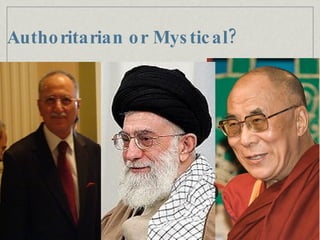
Approaches to Knowledge Nachmias-Nachmias (2000)‏ Mystical Mode -- Knowledge or truth comes from authorities on the supernatural (Ex: Prophets, Diviners, Ministers, etc.)‏
 
Authoritarian or Mystical?
Approaches to Knowledge Nachmias-Nachmias (2000)‏ Rationalistic Mode -- Knowledge or truth can be obtained by  from strict adherence to the rules of logic.
All humans are mortal. Socrates is a human. Therefore Socrates is mortal. Formal Logic
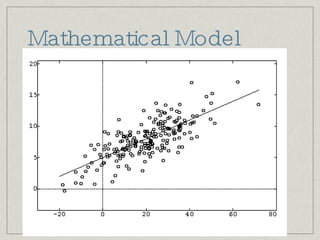
Mathematical Model
Scientific Knowledge Scientific knowledge is both verifiable or falsifiable. Statements or hypotheses can in theory be proven or refuted. Scientific “laws” are repeatedly amended or discarded. (Ex: Laws of Physics)‏ Scientific knowledge is non-normative.
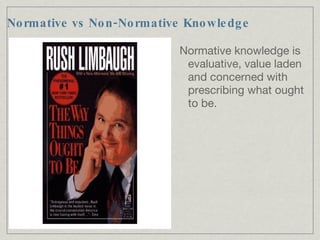
Normative vs Non-Normative Knowledge Normative knowledge is evaluative, value laden and concerned with prescribing what ought to be.
Normative vs Non-Normative Knowledge Non-normative knowledge is concerned not with evaluation or prescription but with factual or objective determinations.
Journalists vs.Political Scientists Journalists: Analysts say it would probably backfire if the Obama campaign decided to attack GOP VP Nominee Sarah Palin because her 17-Year-Old daughter is pregnant. (Normative)‏ Political Scientists: Does invoking an opponent’s sex scandal increase a candidate’s probability of winning an election? (Non-Normative)‏
Scientific Explanation Logic vs. Empirical Explanations There are deductive explanations based on logic and probabilistic explanations based on probability or induction.
Deductive Explanations Are  tautological  and not  empirical . In other words, they are assumed to be true by virtue of their logical form and not based on actual observation (Nachmias-Nachmias).
Example of Deduction All labs are yellow. My dog Winston is a lab. Therefore, Winston is yellow.
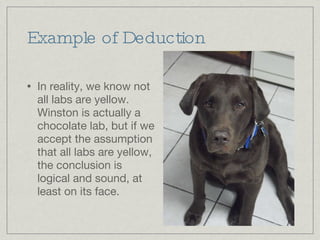
Example of Deduction In reality, we know not all labs are yellow. Winston is actually a chocolate lab, but if we accept the assumption that all labs are yellow, the conclusion is logical and sound, at least on its face.
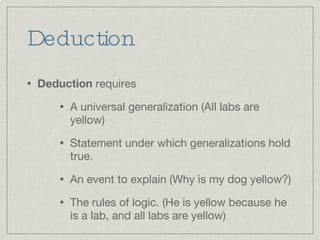
Deduction Deduction  requires  A universal generalization (All labs are yellow)‏ Statement under which generalizations hold true. An event to explain (Why is my dog yellow?)‏ The rules of logic. (He is yellow because he is a lab, and all labs are yellow)‏
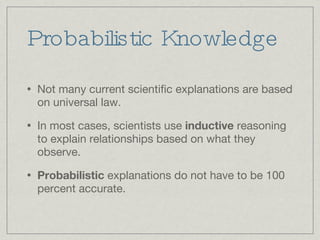
Probabilistic Knowledge Not many current scientific explanations are based on universal law.  In most cases, scientists use  inductive  reasoning to explain relationships based on what they observe.  Probabilistic  explanations do not have to be 100 percent accurate.
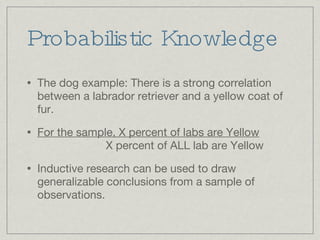
Probabilistic Knowledge The dog example: There is a strong correlation between a labrador retriever and a yellow coat of fur. For the sample, X percent of labs are Yellow   X percent of ALL lab are Yellow Inductive research can be used to draw generalizable conclusions from a sample of observations.
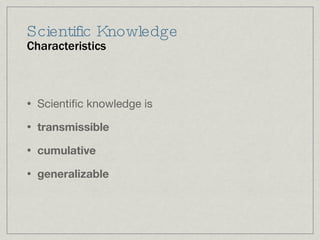
Scientific Knowledge Characteristics Scientific knowledge is  transmissible cumulative generalizable
Transmissible Scientific knowledge is  transmissible . Research can be replicated and analyzed.
Cumulative Scientific knowledge is  cumulative . Substantive findings and research methods are based upon prior knowledge. The University of Kentucky's mens basketball team has a cumulative record of  2023-638-1 (.760)
Generalizable Scientific knowledge is  generalizable . In other words, it has applicability to most observable cases.
What is theory?
What is theory? A  theory  is a statement or series of statements that organize, explain and predict phenomena.
What is theory? Theory drives every aspect of the research process. It is crucial for theory to lead to specific, testable predictions.
What is theory? The level of confidence one has in a theory should increase as more observations support the theory’s predictions. Scientists should aim for  parsimony  when constructing theory.
Parsimony To make theory more parsimonious, scientists must rely on fewer explanatory factors while retaining a theory’s generalizability.
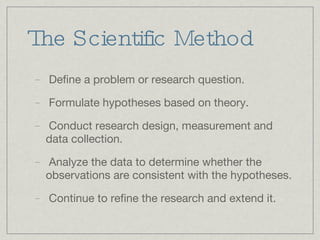
The Scientific Method Define a problem or research question. Formulate hypotheses based on theory. Conduct research design, measurement and data collection. Analyze the data to determine whether the observations are consistent with the hypotheses. Continue to refine the research and extend it.
Nachmias-Nachmias
Social Science vs. Natural Science Social scientists study the social lives of human beings. Anthropology Sociology Political Science Economics
Social Science vs. Natural Science Natural scientists study nature. Examples:  Biology Chemistry  Physics
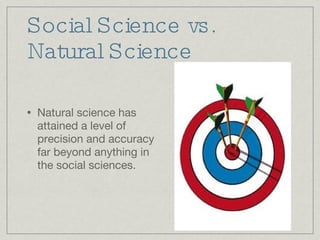
Social Science vs. Natural Science Natural science has attained a level of precision and accuracy far beyond anything in the social sciences.
Social Science vs. Natural Science Humans do not behave as predictably as natural objects such as atoms or various elements.
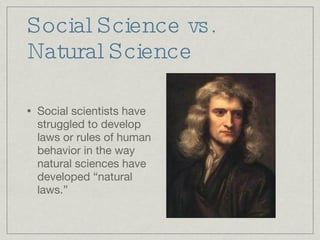
Social Science vs. Natural Science Social scientists have struggled to develop laws or rules of human behavior in the way natural sciences have developed “natural laws.”
Are the social sciences really sciences?
Practical Criticisms As stated, humans behave in an unpredictable and complex manner, making it difficult to erect any “laws” of human behavior.
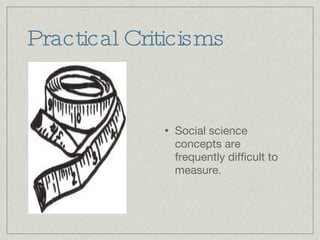
Practical Criticisms Social science concepts are frequently difficult to measure.
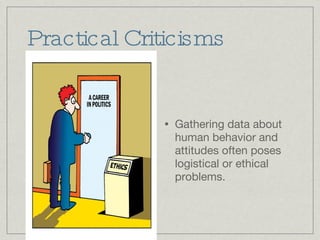
Practical Criticisms Gathering data about human behavior and attitudes often poses logistical or ethical problems.
Philosophical Criticisms Scientific research cannot explain all human behavior.
Philosophical Criticisms Humans are conscious subjects with subjective emotions and interpretations of reality.  Studying them requires empathy. (Interpretationists)‏
Philosophical Criticisms Constructivists  believe facts are largely constructed from cultural and historical experiences and practices.
Political Science History Traditional Political Science Traditional political science developed from studies of law, institutions and ethics. Most studies focused on development of organizations, and key concepts centered on formal powers. Political scientists primarily engaged in descriptive work.
Political Science History Behavioral Revolution Starting in the 1950s, European trained academics began introducing scientific research methods. Political scientists began collecting vast amounts of empirical data of voting with survey research. Development of computers allows for complex mathematical calculation.
 
Empirical Research is good because ... It allows political scientists to explain and predict political phenomena, not just describe them. Empirical science provides a more rigorous and precise test of political science theory than the traditionalist approach. Econometrics allows political scientists to observe relationships not picked up by common sense or intuition.
Empirical Research is bad because ... Political behavior research tends to downplay the importance of institutions and political processes. Even if one grants “objective” research is possible, it is not healthy for scholars to be detached from finding solutions to important problems such as poverty or despotism. Political science is too technocratic and abstract to be practically useful for citizens and government officials.

Studying politics scientifically

  • 1.
  • 2.
    What is empiricalresearch? Empirical research provides a scientific mean of obtaining knowledge. Knowledge is obtained through objective observation. Empirical verification requires that a statement or theory be proven true through observation.
  • 3.
  • 4.
  • 5.
  • 6.
  • 7.
    Authoritarian Mode MysticalMode Rationalistic Mode Approaches to Knowledge Nachmias-Nachmias (2000)‏
  • 8.
    Approaches to KnowledgeNachmias-Nachmias (2000)‏ Nachmias-Nachmias (2000)‏ Authoritarian Mode -- Knowledge or truth comes from some socially or politically sanctioned producers of Knowledge
  • 9.
  • 10.
    © Fox News,The Daily Mirror, CNN
  • 11.
    Approaches to KnowledgeNachmias-Nachmias (2000)‏ Mystical Mode -- Knowledge or truth comes from authorities on the supernatural (Ex: Prophets, Diviners, Ministers, etc.)‏
  • 12.
  • 13.
  • 14.
    Approaches to KnowledgeNachmias-Nachmias (2000)‏ Rationalistic Mode -- Knowledge or truth can be obtained by from strict adherence to the rules of logic.
  • 15.
    All humans aremortal. Socrates is a human. Therefore Socrates is mortal. Formal Logic
  • 16.
  • 17.
    Scientific Knowledge Scientificknowledge is both verifiable or falsifiable. Statements or hypotheses can in theory be proven or refuted. Scientific “laws” are repeatedly amended or discarded. (Ex: Laws of Physics)‏ Scientific knowledge is non-normative.
  • 18.

    Normative vs Non-NormativeKnowledge Normative knowledge is evaluative, value laden and concerned with prescribing what ought to be.
  • 19.
    Normative vs Non-NormativeKnowledge Non-normative knowledge is concerned not with evaluation or prescription but with factual or objective determinations.
  • 20.
    Journalists vs.Political ScientistsJournalists: Analysts say it would probably backfire if the Obama campaign decided to attack GOP VP Nominee Sarah Palin because her 17-Year-Old daughter is pregnant. (Normative)‏ Political Scientists: Does invoking an opponent’s sex scandal increase a candidate’s probability of winning an election? (Non-Normative)‏
  • 21.
    Scientific Explanation Logicvs. Empirical Explanations There are deductive explanations based on logic and probabilistic explanations based on probability or induction.
  • 22.
    Deductive Explanations Are tautological and not empirical . In other words, they are assumed to be true by virtue of their logical form and not based on actual observation (Nachmias-Nachmias).
  • 23.
    Example of DeductionAll labs are yellow. My dog Winston is a lab. Therefore, Winston is yellow.
  • 24.
    Example of DeductionIn reality, we know not all labs are yellow. Winston is actually a chocolate lab, but if we accept the assumption that all labs are yellow, the conclusion is logical and sound, at least on its face.
  • 25.
    Deduction Deduction requires A universal generalization (All labs are yellow)‏ Statement under which generalizations hold true. An event to explain (Why is my dog yellow?)‏ The rules of logic. (He is yellow because he is a lab, and all labs are yellow)‏
  • 26.
    Probabilistic Knowledge Notmany current scientific explanations are based on universal law. In most cases, scientists use inductive reasoning to explain relationships based on what they observe. Probabilistic explanations do not have to be 100 percent accurate.
  • 27.
    Probabilistic Knowledge Thedog example: There is a strong correlation between a labrador retriever and a yellow coat of fur. For the sample, X percent of labs are Yellow X percent of ALL lab are Yellow Inductive research can be used to draw generalizable conclusions from a sample of observations.
  • 28.
    Scientific Knowledge CharacteristicsScientific knowledge is transmissible cumulative generalizable
  • 29.
    Transmissible Scientific knowledgeis transmissible . Research can be replicated and analyzed.
  • 30.
    Cumulative Scientific knowledgeis cumulative . Substantive findings and research methods are based upon prior knowledge. The University of Kentucky's mens basketball team has a cumulative record of 2023-638-1 (.760)
  • 31.
    Generalizable Scientific knowledgeis generalizable . In other words, it has applicability to most observable cases.
  • 32.
  • 33.
    What is theory?A theory is a statement or series of statements that organize, explain and predict phenomena.
  • 34.
    What is theory?Theory drives every aspect of the research process. It is crucial for theory to lead to specific, testable predictions.
  • 35.
    What is theory?The level of confidence one has in a theory should increase as more observations support the theory’s predictions. Scientists should aim for parsimony when constructing theory.
  • 36.
    Parsimony To maketheory more parsimonious, scientists must rely on fewer explanatory factors while retaining a theory’s generalizability.
  • 37.
    The Scientific MethodDefine a problem or research question. Formulate hypotheses based on theory. Conduct research design, measurement and data collection. Analyze the data to determine whether the observations are consistent with the hypotheses. Continue to refine the research and extend it.
  • 38.
  • 39.
    Social Science vs.Natural Science Social scientists study the social lives of human beings. Anthropology Sociology Political Science Economics
  • 40.
    Social Science vs.Natural Science Natural scientists study nature. Examples: Biology Chemistry Physics
  • 41.
    Social Science vs.Natural Science Natural science has attained a level of precision and accuracy far beyond anything in the social sciences.
  • 42.
    Social Science vs.Natural Science Humans do not behave as predictably as natural objects such as atoms or various elements.
  • 43.
    Social Science vs.Natural Science Social scientists have struggled to develop laws or rules of human behavior in the way natural sciences have developed “natural laws.”
  • 44.
    Are the socialsciences really sciences?
  • 45.
    Practical Criticisms Asstated, humans behave in an unpredictable and complex manner, making it difficult to erect any “laws” of human behavior.
  • 46.
    Practical Criticisms Socialscience concepts are frequently difficult to measure.
  • 47.
    Practical Criticisms Gatheringdata about human behavior and attitudes often poses logistical or ethical problems.
  • 48.
    Philosophical Criticisms Scientificresearch cannot explain all human behavior.
  • 49.
    Philosophical Criticisms Humansare conscious subjects with subjective emotions and interpretations of reality. Studying them requires empathy. (Interpretationists)‏
  • 50.
    Philosophical Criticisms Constructivists believe facts are largely constructed from cultural and historical experiences and practices.
  • 51.
    Political Science HistoryTraditional Political Science Traditional political science developed from studies of law, institutions and ethics. Most studies focused on development of organizations, and key concepts centered on formal powers. Political scientists primarily engaged in descriptive work.
  • 52.
    Political Science HistoryBehavioral Revolution Starting in the 1950s, European trained academics began introducing scientific research methods. Political scientists began collecting vast amounts of empirical data of voting with survey research. Development of computers allows for complex mathematical calculation.
  • 53.
  • 54.
    Empirical Research isgood because ... It allows political scientists to explain and predict political phenomena, not just describe them. Empirical science provides a more rigorous and precise test of political science theory than the traditionalist approach. Econometrics allows political scientists to observe relationships not picked up by common sense or intuition.
  • 55.
    Empirical Research isbad because ... Political behavior research tends to downplay the importance of institutions and political processes. Even if one grants “objective” research is possible, it is not healthy for scholars to be detached from finding solutions to important problems such as poverty or despotism. Political science is too technocratic and abstract to be practically useful for citizens and government officials.