IS SOCIOLOGY A SCIENCE?
Learning objectives Explain the difference between a natural and a social science Outline the three positions of the debate that sociology is a science
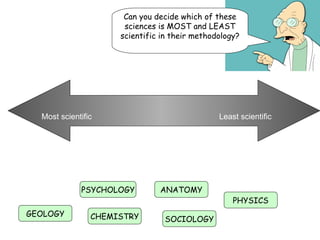
Most scientific Least scientific PHYSICS CHEMISTRY ANATOMY GEOLOGY PSYCHOLOGY SOCIOLOGY Can you decide which of these sciences is MOST and LEAST scientific in their methodology?
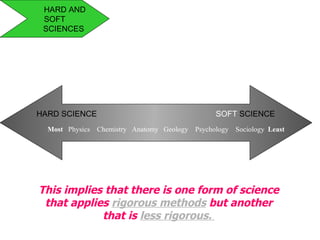
Most  Physics  Chemistry  Anatomy  Geology  Psychology  Sociology  Least    This implies that there is one form of science that applies  rigorous methods  but another that is  less rigorous.   HARD AND SOFT SCIENCES HARD SCIENCE SOFT  SCIENCE
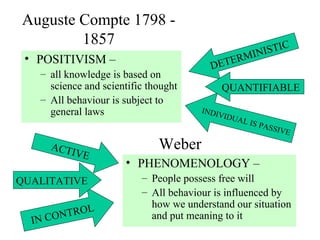
Auguste Compte 1798 - 1857 POSITIVISM –  all knowledge is based on science and scientific thought All behaviour is subject to general laws PHENOMENOLOGY –  People possess free will All behaviour is influenced by how we understand our situation and put meaning to it DETERMINISTIC INDIVIDUAL IS PASSIVE ACTIVE IN CONTROL QUANTIFIABLE QUALITATIVE Weber
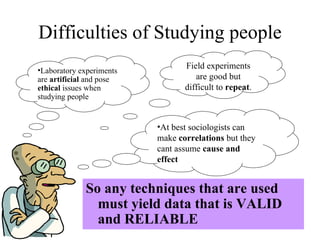
Difficulties of Studying people So any techniques that are used must yield data that is VALID and RELIABLE Laboratory experiments are  artificial  and pose  ethical  issues when studying people Field experiments are good but difficult to  repeat . At best sociologists can make  correlations  but they cant assume  cause and effect
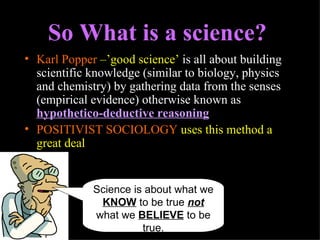
Karl Popper  –’good science’  is all about building scientific knowledge (similar to biology, physics and chemistry) by gathering data from the senses (empirical evidence) otherwise known as  hypothetico-deductive reasoning   POSITIVIST SOCIOLOGY  uses this method a great deal So What is a science? Science is about what we  KNOW  to be true  not  what we  BELIEVE  to be true.
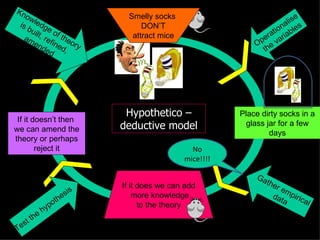
All smelly socks  attract mice If it doesn’t then  we can amend the theory or perhaps  reject it If it does we can add more knowledge to the theory Hypothetico – deductive model Place dirty socks in a glass jar for a few days Operationalise  the variables Gather empirical data Test the hypothesis Knowledge of theory is built, refined,  amended No mice!!!! Smelly socks  DON’T attract mice
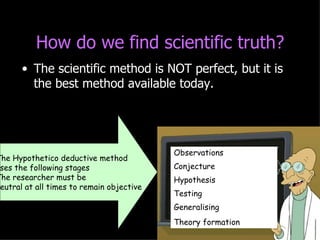
How do we find scientific truth? The scientific method is NOT perfect, but it is the best method available today. The Hypothetico deductive method  uses the following stages The researcher must be  neutral at all times to remain objective Observations Conjecture Hypothesis Testing Generalising Theory formation
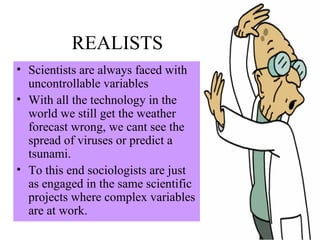
REALISTS Scientists are always faced with uncontrollable variables With all the technology in the world we still get the weather forecast wrong, we cant see the spread of viruses or predict a tsunami. To this end sociologists are just as engaged in the same scientific projects where complex variables are at work.
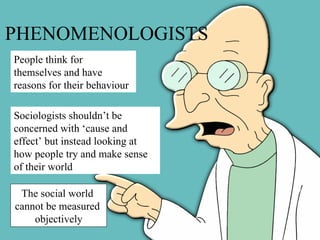
PHENOMENOLOGISTS People think for themselves and have reasons for their behaviour Sociologists shouldn’t be concerned with ‘cause and effect’ but instead looking at how people try and make sense of their world The social world  cannot be measured  objectively
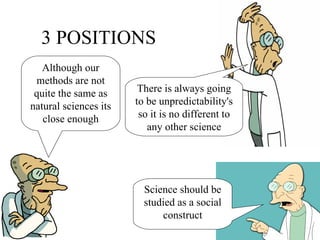
3 POSITIONS Science should be studied as a social construct There is always going to be unpredictability's so it is no different to any other science Although our methods are not quite the same as natural sciences its close enough
quick quiz? What is the realist view of social science? What does it mean to say that knowledge is socially constructed? What is the difference between natural and social science? Who was the first to consider sociology as a social science? Name one difficulty that sociologists face when carrying out research on people
Learning objectives Explain what is meant by a paradigm Outline the difference between induction and deduction methods Evaluate the feminists view of science
What colour are swans? How many wheels does a car have?
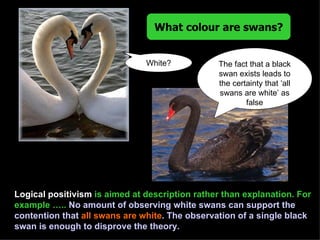
What colour are swans? White? Logical positivism  is aimed at description rather than explanation. For example …..  No amount of observing white swans can support the contention that  all swans are white . The observation of a single black swan is enough to disprove the theory. The fact that a black swan exists leads to the certainty that ‘all swans are white’ as false
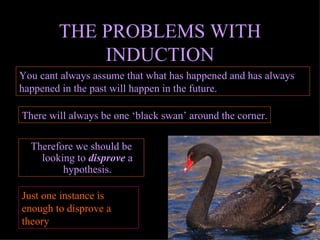
THE PROBLEMS   WITH INDUCTION Therefore we should be looking to  disprove  a hypothesis. You cant always assume that what has happened and has always happened in the past will happen in the future. There will always be one ‘black swan’ around the corner. Just one instance is enough to disprove a theory
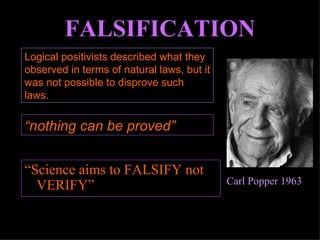
“ Science aims to FALSIFY not VERIFY” FALSIFICATION “ nothing can be proved” Carl Popper 1963 Logical positivists described what they observed in terms of natural laws, but it was not possible to disprove such laws.
FALSIFICATION AND MARXISM Popper rejected many sociological theories as being unscientific He was critical of Marxism because they failed to specify the exact circumstances of the proletariat revolution. Marxism cannot be falsified because ‘ come the revolution’  is always being pushed further into the future. The longer a theory has stood the test of time, and that researchers have failed to falsify, the closer it is to the truth .
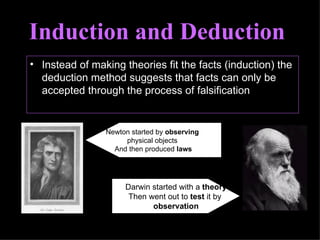
Instead of making theories fit the facts (induction) the deduction method suggests that facts can only be accepted through the process of falsification Induction and Deduction  Newton started by  observing  physical objects  And then produced  laws Darwin started with a  theory Then went out to  test  it by  observation
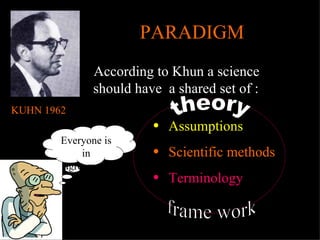
PARADIGM KUHN 1962 According to Khun a science should have  a shared set of : Assumptions Scientific methods Terminology Everyone is in agreement theory frame work
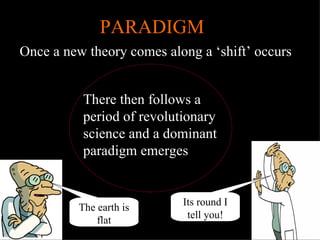
PARADIGM Once a new theory comes along a ‘shift’ occurs The earth is flat Its round I tell you! There then follows a period of revolutionary science and a dominant paradigm emerges
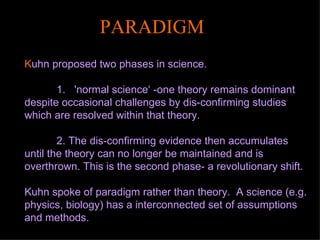
K uhn proposed two phases in science.  1.  'normal science‘ -one theory remains dominant despite occasional challenges by dis-confirming studies which are resolved within that theory.  2. The dis-confirming evidence then accumulates until the theory can no longer be maintained and is overthrown. This is the second phase- a revolutionary shift. Kuhn spoke of paradigm rather than theory.  A science (e.g. physics, biology) has a interconnected set of assumptions and methods.   PARADIGM
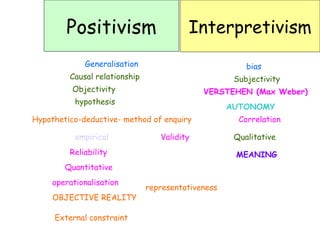
Positivism Interpretivism Subjectivity Objectivity Qualitative Quantitative Correlation Generalisation  empirical  Validity Reliability Causal relationship hypothesis operationalisation representativeness bias Hypothetico-deductive- method of enquiry OBJECTIVE REALITY VERSTEHEN (Max Weber) AUTONOMY MEANING External constraint

SociologyExchange.co.uk Shared Resource

  • 1.
  • 2.
    Learning objectives Explainthe difference between a natural and a social science Outline the three positions of the debate that sociology is a science
  • 3.
    Most scientific Leastscientific PHYSICS CHEMISTRY ANATOMY GEOLOGY PSYCHOLOGY SOCIOLOGY Can you decide which of these sciences is MOST and LEAST scientific in their methodology?
  • 4.
    Most Physics Chemistry Anatomy Geology Psychology Sociology Least   This implies that there is one form of science that applies rigorous methods but another that is less rigorous. HARD AND SOFT SCIENCES HARD SCIENCE SOFT SCIENCE
  • 5.
    Auguste Compte 1798- 1857 POSITIVISM – all knowledge is based on science and scientific thought All behaviour is subject to general laws PHENOMENOLOGY – People possess free will All behaviour is influenced by how we understand our situation and put meaning to it DETERMINISTIC INDIVIDUAL IS PASSIVE ACTIVE IN CONTROL QUANTIFIABLE QUALITATIVE Weber
  • 6.
    Difficulties of Studyingpeople So any techniques that are used must yield data that is VALID and RELIABLE Laboratory experiments are artificial and pose ethical issues when studying people Field experiments are good but difficult to repeat . At best sociologists can make correlations but they cant assume cause and effect
  • 7.
    Karl Popper –’good science’ is all about building scientific knowledge (similar to biology, physics and chemistry) by gathering data from the senses (empirical evidence) otherwise known as hypothetico-deductive reasoning POSITIVIST SOCIOLOGY uses this method a great deal So What is a science? Science is about what we KNOW to be true not what we BELIEVE to be true.
  • 8.
    All smelly socks attract mice If it doesn’t then we can amend the theory or perhaps reject it If it does we can add more knowledge to the theory Hypothetico – deductive model Place dirty socks in a glass jar for a few days Operationalise the variables Gather empirical data Test the hypothesis Knowledge of theory is built, refined, amended No mice!!!! Smelly socks DON’T attract mice
  • 9.
    How do wefind scientific truth? The scientific method is NOT perfect, but it is the best method available today. The Hypothetico deductive method uses the following stages The researcher must be neutral at all times to remain objective Observations Conjecture Hypothesis Testing Generalising Theory formation
  • 10.
    REALISTS Scientists arealways faced with uncontrollable variables With all the technology in the world we still get the weather forecast wrong, we cant see the spread of viruses or predict a tsunami. To this end sociologists are just as engaged in the same scientific projects where complex variables are at work.
  • 11.
    PHENOMENOLOGISTS People thinkfor themselves and have reasons for their behaviour Sociologists shouldn’t be concerned with ‘cause and effect’ but instead looking at how people try and make sense of their world The social world cannot be measured objectively
  • 12.
    3 POSITIONS Scienceshould be studied as a social construct There is always going to be unpredictability's so it is no different to any other science Although our methods are not quite the same as natural sciences its close enough
  • 13.
    quick quiz? Whatis the realist view of social science? What does it mean to say that knowledge is socially constructed? What is the difference between natural and social science? Who was the first to consider sociology as a social science? Name one difficulty that sociologists face when carrying out research on people
  • 14.
    Learning objectives Explainwhat is meant by a paradigm Outline the difference between induction and deduction methods Evaluate the feminists view of science
  • 15.
    What colour areswans? How many wheels does a car have?
  • 16.
    What colour areswans? White? Logical positivism is aimed at description rather than explanation. For example ….. No amount of observing white swans can support the contention that all swans are white . The observation of a single black swan is enough to disprove the theory. The fact that a black swan exists leads to the certainty that ‘all swans are white’ as false
  • 17.
    THE PROBLEMS WITH INDUCTION Therefore we should be looking to disprove a hypothesis. You cant always assume that what has happened and has always happened in the past will happen in the future. There will always be one ‘black swan’ around the corner. Just one instance is enough to disprove a theory
  • 18.
    “ Science aimsto FALSIFY not VERIFY” FALSIFICATION “ nothing can be proved” Carl Popper 1963 Logical positivists described what they observed in terms of natural laws, but it was not possible to disprove such laws.
  • 19.
    FALSIFICATION AND MARXISMPopper rejected many sociological theories as being unscientific He was critical of Marxism because they failed to specify the exact circumstances of the proletariat revolution. Marxism cannot be falsified because ‘ come the revolution’ is always being pushed further into the future. The longer a theory has stood the test of time, and that researchers have failed to falsify, the closer it is to the truth .
  • 20.
    Instead of makingtheories fit the facts (induction) the deduction method suggests that facts can only be accepted through the process of falsification Induction and Deduction Newton started by observing physical objects And then produced laws Darwin started with a theory Then went out to test it by observation
  • 21.
    PARADIGM KUHN 1962According to Khun a science should have a shared set of : Assumptions Scientific methods Terminology Everyone is in agreement theory frame work
  • 22.
    PARADIGM Once anew theory comes along a ‘shift’ occurs The earth is flat Its round I tell you! There then follows a period of revolutionary science and a dominant paradigm emerges
  • 23.
    K uhn proposedtwo phases in science. 1. 'normal science‘ -one theory remains dominant despite occasional challenges by dis-confirming studies which are resolved within that theory. 2. The dis-confirming evidence then accumulates until the theory can no longer be maintained and is overthrown. This is the second phase- a revolutionary shift. Kuhn spoke of paradigm rather than theory. A science (e.g. physics, biology) has a interconnected set of assumptions and methods. PARADIGM
  • 24.
    Positivism Interpretivism SubjectivityObjectivity Qualitative Quantitative Correlation Generalisation empirical Validity Reliability Causal relationship hypothesis operationalisation representativeness bias Hypothetico-deductive- method of enquiry OBJECTIVE REALITY VERSTEHEN (Max Weber) AUTONOMY MEANING External constraint