METHODS OF RESEARCH
Prepared By:
Ameer Salman Hussein
MA Methods of Teaching English
What is Research?
The term (research) can be defined with more than one definition
according to its type and its nature. The most notable definitions of
the research are:
 Research is the systematic, controlled, empirical and critical
investigation of hypothetical propositions about the presumed
relations among natural phenomena.
 It is an active and systematic process of inquiry in order to
discover, interpret or revise facts, behaviors, or theories, or to
make practical applications with the help of such facts, laws, or
theories.
What is Research?
 The term (research) is also used to describe the collection of
information about a particular subject.
 Research means a systematic investigation, including research
development, testing and evaluation, designed to develop or
contribute to generalizable knowledge.
Research Methodology
It can be defined as:
 The way in which the data are collected for the research project.
 All of techniques, methods and procedures adopted in terminology
work to carry out terminology research.
The Nature of Inquiry
People attempt to comprehend the world around them by
using three types of reasoning, they are:
1. deductive reasoning. (By Aristotle)
2. inductive reasoning. (By Francis Bacon )
3. inductive-deductive approach. (By John Dewey)
The Nature of Inquiry
Deductive reasoning begins with general statements (premises) and,
through logical argument, comes to a specific conclusion. A simple
example will provide a guide to how this works:
All living things will eventually die. (General statement – first premise)
This animal is a living thing. (Inference – second premise)
Therefore, this animal will eventually die. (Conclusion)
The Nature of Inquiry
Inductive reasoning of Aristotle starts from specific observations or
sensory experiences and then develops a general conclusion from
them. This simple example gives and indication of the line of
reasoning:
All the giraffes that I have seen have very long necks. (Repeated observations)
Therefore I conclude that all giraffes have long necks. (Conclusion)
The Nature of Inquiry
The inductive-deductive method combines Bacon’s inductive and
Aristotle’s deductive reasoning, resulting in the back-and-forth
process, and its contributions to the development of science fall into
three categories:
1. the suggestion of hypotheses
2. the logical development of these hypotheses
3. the clarification and interpretation of scientific findings and their
synthesis into a conceptual framework.
Characteristics of Research
Research has three characteristics in particular which distinguish it:
1. Research is systematic and controlled, basing on its operation on
the inductive-deductive method.
2. Research is empirical. The scientist turns to experience for
validation.
3. Research is self-correcting, especially the scientific one.
The Conceptions of social Reality
There are different ways of looking at social reality, the analysis here
is based on the work of Burrell and Morgan (1979), who identified
four sets of assumptions:
1. First, there are assumptions of an ontological kind which concern
the very nature or essence of the social phenomena being
investigated.
2. The second set of assumptions are of an epistemological kind.
These concern the very bases of knowledge – its nature and
forms, how it can be acquired, and how communicated to other
human beings.
The Conceptions of social Reality
3. The third set of assumptions concern human nature and, in
particular, the relationship between human beings and their
environment.
4. The three sets of assumptions identified above have direct
implications for the methodological concerns of researchers.
Positivism
The positivism is a philosophical term invented by the
French philosopher, Auguste Comte, in the nineteenth
century. He was the first thinker to use this word for a
philosophical position. It turns to observation and reason as
means of understanding behavior. It means that all genuine
knowledge is based on sense experience, and can be
advanced only by means of observation and experiment.
Positivism
Although the term positivism is used by philosophers and social
scientists, a residual meaning is always present and this derives from
an acceptance of natural science as the paradigm of human knowledge.
positivism is based on the idea that science is the only way to learn
about the truth. In other words, science can be specified as a
cornerstone in positivism research philosophy. Moreover, in positivism
studies the researcher is independent form the study and there are no
provisions for human interests within the study.
Positivism
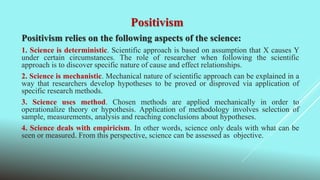
Positivism relies on the following aspects of the science:
1. Science is deterministic. Scientific approach is based on assumption that X causes Y
under certain circumstances. The role of researcher when following the scientific
approach is to discover specific nature of cause and effect relationships.
2. Science is mechanistic. Mechanical nature of scientific approach can be explained in a
way that researchers develop hypotheses to be proved or disproved via application of
specific research methods.
3. Science uses method. Chosen methods are applied mechanically in order to
operationalize theory or hypothesis. Application of methodology involves selection of
sample, measurements, analysis and reaching conclusions about hypotheses.
4. Science deals with empiricism. In other words, science only deals with what can be
seen or measured. From this perspective, science can be assessed as objective.
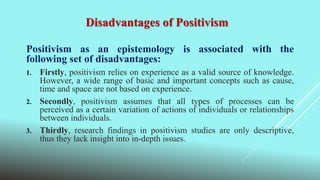
Disadvantages of Positivism
Positivism as an epistemology is associated with the
following set of disadvantages:
1. Firstly, positivism relies on experience as a valid source of knowledge.
However, a wide range of basic and important concepts such as cause,
time and space are not based on experience.
2. Secondly, positivism assumes that all types of processes can be
perceived as a certain variation of actions of individuals or relationships
between individuals.
3. Thirdly, research findings in positivism studies are only descriptive,
thus they lack insight into in-depth issues.
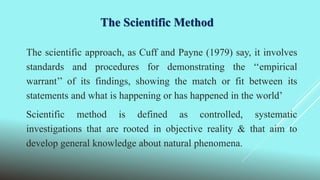
The Scientific Method
The scientific approach, as Cuff and Payne (1979) say, it involves
standards and procedures for demonstrating the ‘‘empirical
warrant’’ of its findings, showing the match or fit between its
statements and what is happening or has happened in the world’
Scientific method is defined as controlled, systematic
investigations that are rooted in objective reality & that aim to
develop general knowledge about natural phenomena.
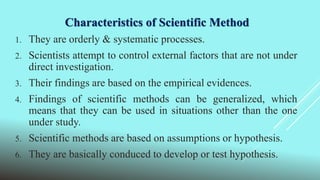
Characteristics of Scientific Method
1. They are orderly & systematic processes.
2. Scientists attempt to control external factors that are not under
direct investigation.
3. Their findings are based on the empirical evidences.
4. Findings of scientific methods can be generalized, which
means that they can be used in situations other than the one
under study.
5. Scientific methods are based on assumptions or hypothesis.
6. They are basically conduced to develop or test hypothesis.
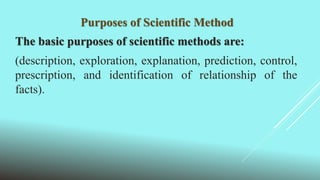
Purposes of Scientific Method
The basic purposes of scientific methods are:
(description, exploration, explanation, prediction, control,
prescription, and identification of relationship of the
facts).
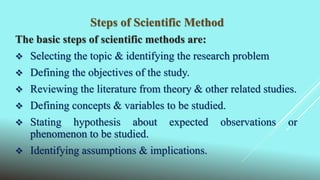
Steps of Scientific Method
The basic steps of scientific methods are:
 Selecting the topic & identifying the research problem
 Defining the objectives of the study.
 Reviewing the literature from theory & other related studies.
 Defining concepts & variables to be studied.
 Stating hypothesis about expected observations or
phenomenon to be studied.
 Identifying assumptions & implications.
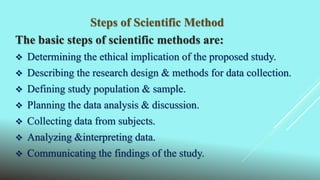
Steps of Scientific Method
The basic steps of scientific methods are:
 Determining the ethical implication of the proposed study.
 Describing the research design & methods for data collection.
 Defining study population & sample.
 Planning the data analysis & discussion.
 Collecting data from subjects.
 Analyzing &interpreting data.
 Communicating the findings of the study.
Criticism of Positivism and Scientific Method
in the second half of the nineteenth century, the revolt against
positivism occurred on a broad front, attracting some of the best
intellectuals in Europe – philosophers, scientists, social critics and
creative artists.
The target of anti-positivists’ attack has been science’s mechanistic
and reductionist view of nature which, by definition, defines life in
measurable terms rather than inner experience, and excludes notions
of choice, freedom, individuality, and moral responsibility, regarding
the universe as a living organism rather than as a machine
Criticism of Positivism and Scientific Method
Another challenge to the claims of positivism is Soren Kierkegaard,
who was concerned with individuals and their need to fulfil
themselves to the highest level of development, and he refused the
dehumanization of the individuals, and desired to free the people from
their illusions.
For Kierkegaard, ‘subjectivity and concreteness of truth are together
the light. Anyone who is committed to science, or to rule-governed
morality, is benighted, and needs to be rescued from his state of
darkness’
Criticism of Positivism and Scientific Method
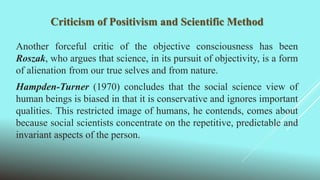
Another forceful critic of the objective consciousness has been
Roszak, who argues that science, in its pursuit of objectivity, is a form
of alienation from our true selves and from nature.
Hampden-Turner (1970) concludes that the social science view of
human beings is biased in that it is conservative and ignores important
qualities. This restricted image of humans, he contends, comes about
because social scientists concentrate on the repetitive, predictable and
invariant aspects of the person.
Criticism of Positivism and Scientific Method
Habermas in his view concludes that all knowledge becomes equated
with scientific knowledge. This neglects hermeneutic, aesthetic,
critical, moral, creative and other forms of knowledge. It reduces
behavior to technicism.
Positivism is unable to answer many interesting or important areas of
life, and it fails to take account of our unique ability to interpret our
experiences and represent them to ourselves. positivistic social
science is said to ignore the profound differences between itself and
the natural sciences.
Criticism of Positivism and Scientific Method
Positivism regards human behavior as passive, essentially determined
and controlled, thereby ignoring intention, individualism and
freedom.
Finally, the findings of positivistic social science are often said to be
so banal and trivial that they are of little consequence to those for
whom they are intended, namely, teachers, social workers,
counsellors, personnel managers, and the like.
Thank you for listening
Ameer Salman Hussein

Positivism and scientific research

  • 1.
    METHODS OF RESEARCH PreparedBy: Ameer Salman Hussein MA Methods of Teaching English
  • 2.
    What is Research? Theterm (research) can be defined with more than one definition according to its type and its nature. The most notable definitions of the research are:  Research is the systematic, controlled, empirical and critical investigation of hypothetical propositions about the presumed relations among natural phenomena.  It is an active and systematic process of inquiry in order to discover, interpret or revise facts, behaviors, or theories, or to make practical applications with the help of such facts, laws, or theories.
  • 3.
    What is Research? The term (research) is also used to describe the collection of information about a particular subject.  Research means a systematic investigation, including research development, testing and evaluation, designed to develop or contribute to generalizable knowledge.
  • 4.
    Research Methodology It canbe defined as:  The way in which the data are collected for the research project.  All of techniques, methods and procedures adopted in terminology work to carry out terminology research.
  • 5.
    The Nature ofInquiry People attempt to comprehend the world around them by using three types of reasoning, they are: 1. deductive reasoning. (By Aristotle) 2. inductive reasoning. (By Francis Bacon ) 3. inductive-deductive approach. (By John Dewey)
  • 6.
    The Nature ofInquiry Deductive reasoning begins with general statements (premises) and, through logical argument, comes to a specific conclusion. A simple example will provide a guide to how this works: All living things will eventually die. (General statement – first premise) This animal is a living thing. (Inference – second premise) Therefore, this animal will eventually die. (Conclusion)
  • 7.
    The Nature ofInquiry Inductive reasoning of Aristotle starts from specific observations or sensory experiences and then develops a general conclusion from them. This simple example gives and indication of the line of reasoning: All the giraffes that I have seen have very long necks. (Repeated observations) Therefore I conclude that all giraffes have long necks. (Conclusion)
  • 8.
    The Nature ofInquiry The inductive-deductive method combines Bacon’s inductive and Aristotle’s deductive reasoning, resulting in the back-and-forth process, and its contributions to the development of science fall into three categories: 1. the suggestion of hypotheses 2. the logical development of these hypotheses 3. the clarification and interpretation of scientific findings and their synthesis into a conceptual framework.
  • 9.
    Characteristics of Research Researchhas three characteristics in particular which distinguish it: 1. Research is systematic and controlled, basing on its operation on the inductive-deductive method. 2. Research is empirical. The scientist turns to experience for validation. 3. Research is self-correcting, especially the scientific one.
  • 10.
    The Conceptions ofsocial Reality There are different ways of looking at social reality, the analysis here is based on the work of Burrell and Morgan (1979), who identified four sets of assumptions: 1. First, there are assumptions of an ontological kind which concern the very nature or essence of the social phenomena being investigated. 2. The second set of assumptions are of an epistemological kind. These concern the very bases of knowledge – its nature and forms, how it can be acquired, and how communicated to other human beings.
  • 11.
    The Conceptions ofsocial Reality 3. The third set of assumptions concern human nature and, in particular, the relationship between human beings and their environment. 4. The three sets of assumptions identified above have direct implications for the methodological concerns of researchers.
  • 12.
    Positivism The positivism isa philosophical term invented by the French philosopher, Auguste Comte, in the nineteenth century. He was the first thinker to use this word for a philosophical position. It turns to observation and reason as means of understanding behavior. It means that all genuine knowledge is based on sense experience, and can be advanced only by means of observation and experiment.
  • 13.
    Positivism Although the termpositivism is used by philosophers and social scientists, a residual meaning is always present and this derives from an acceptance of natural science as the paradigm of human knowledge. positivism is based on the idea that science is the only way to learn about the truth. In other words, science can be specified as a cornerstone in positivism research philosophy. Moreover, in positivism studies the researcher is independent form the study and there are no provisions for human interests within the study.
  • 14.
    Positivism Positivism relies onthe following aspects of the science: 1. Science is deterministic. Scientific approach is based on assumption that X causes Y under certain circumstances. The role of researcher when following the scientific approach is to discover specific nature of cause and effect relationships. 2. Science is mechanistic. Mechanical nature of scientific approach can be explained in a way that researchers develop hypotheses to be proved or disproved via application of specific research methods. 3. Science uses method. Chosen methods are applied mechanically in order to operationalize theory or hypothesis. Application of methodology involves selection of sample, measurements, analysis and reaching conclusions about hypotheses. 4. Science deals with empiricism. In other words, science only deals with what can be seen or measured. From this perspective, science can be assessed as objective.
  • 15.
    Disadvantages of Positivism Positivismas an epistemology is associated with the following set of disadvantages: 1. Firstly, positivism relies on experience as a valid source of knowledge. However, a wide range of basic and important concepts such as cause, time and space are not based on experience. 2. Secondly, positivism assumes that all types of processes can be perceived as a certain variation of actions of individuals or relationships between individuals. 3. Thirdly, research findings in positivism studies are only descriptive, thus they lack insight into in-depth issues.
  • 16.
    The Scientific Method Thescientific approach, as Cuff and Payne (1979) say, it involves standards and procedures for demonstrating the ‘‘empirical warrant’’ of its findings, showing the match or fit between its statements and what is happening or has happened in the world’ Scientific method is defined as controlled, systematic investigations that are rooted in objective reality & that aim to develop general knowledge about natural phenomena.
  • 17.
    Characteristics of ScientificMethod 1. They are orderly & systematic processes. 2. Scientists attempt to control external factors that are not under direct investigation. 3. Their findings are based on the empirical evidences. 4. Findings of scientific methods can be generalized, which means that they can be used in situations other than the one under study. 5. Scientific methods are based on assumptions or hypothesis. 6. They are basically conduced to develop or test hypothesis.
  • 18.
    Purposes of ScientificMethod The basic purposes of scientific methods are: (description, exploration, explanation, prediction, control, prescription, and identification of relationship of the facts).
  • 19.
    Steps of ScientificMethod The basic steps of scientific methods are:  Selecting the topic & identifying the research problem  Defining the objectives of the study.  Reviewing the literature from theory & other related studies.  Defining concepts & variables to be studied.  Stating hypothesis about expected observations or phenomenon to be studied.  Identifying assumptions & implications.
  • 20.
    Steps of ScientificMethod The basic steps of scientific methods are:  Determining the ethical implication of the proposed study.  Describing the research design & methods for data collection.  Defining study population & sample.  Planning the data analysis & discussion.  Collecting data from subjects.  Analyzing &interpreting data.  Communicating the findings of the study.
  • 21.
    Criticism of Positivismand Scientific Method in the second half of the nineteenth century, the revolt against positivism occurred on a broad front, attracting some of the best intellectuals in Europe – philosophers, scientists, social critics and creative artists. The target of anti-positivists’ attack has been science’s mechanistic and reductionist view of nature which, by definition, defines life in measurable terms rather than inner experience, and excludes notions of choice, freedom, individuality, and moral responsibility, regarding the universe as a living organism rather than as a machine
  • 22.
    Criticism of Positivismand Scientific Method Another challenge to the claims of positivism is Soren Kierkegaard, who was concerned with individuals and their need to fulfil themselves to the highest level of development, and he refused the dehumanization of the individuals, and desired to free the people from their illusions. For Kierkegaard, ‘subjectivity and concreteness of truth are together the light. Anyone who is committed to science, or to rule-governed morality, is benighted, and needs to be rescued from his state of darkness’
  • 23.
    Criticism of Positivismand Scientific Method Another forceful critic of the objective consciousness has been Roszak, who argues that science, in its pursuit of objectivity, is a form of alienation from our true selves and from nature. Hampden-Turner (1970) concludes that the social science view of human beings is biased in that it is conservative and ignores important qualities. This restricted image of humans, he contends, comes about because social scientists concentrate on the repetitive, predictable and invariant aspects of the person.
  • 24.
    Criticism of Positivismand Scientific Method Habermas in his view concludes that all knowledge becomes equated with scientific knowledge. This neglects hermeneutic, aesthetic, critical, moral, creative and other forms of knowledge. It reduces behavior to technicism. Positivism is unable to answer many interesting or important areas of life, and it fails to take account of our unique ability to interpret our experiences and represent them to ourselves. positivistic social science is said to ignore the profound differences between itself and the natural sciences.
  • 25.
    Criticism of Positivismand Scientific Method Positivism regards human behavior as passive, essentially determined and controlled, thereby ignoring intention, individualism and freedom. Finally, the findings of positivistic social science are often said to be so banal and trivial that they are of little consequence to those for whom they are intended, namely, teachers, social workers, counsellors, personnel managers, and the like.
  • 26.
    Thank you forlistening Ameer Salman Hussein