THREE R’S AND AN M:  REMEMBERING WHAT YOU’VE READ AND HEARD LUNCH AND LEARN STUDENT SUCCESS
Do you think that reading your textbook and studying are the same thing? Or… do you have trouble remembering what you have read? READING VS. STUDYING
Requires that you put the material into your own words Making sense of what you have read Annotation Critical thinking REFLECTING: THINKING ABOUT INFORMATION
REHEARSING: GETTING INFO INTO YOUR MEMORY Acting on information in a way that it moves from STM to LTM Two basic ways of rehearsing Say it again Get it in writing
REHEARSING: GETTING INFO INTO YOUR MEMORY Say it again Repeat the information to yourself over and over Get it in writing Concept Cards Concept Maps Charts Time Lines Questions and Answers
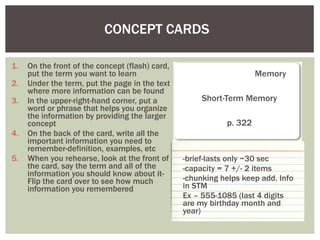
CONCEPT CARDS  On the front of the concept (flash) card, put the term you want to learn Under the term, put the page in the text where more information can be found In the upper-right-hand corner, put a word or phrase that helps you organize the information by providing the larger concept On the back of the card, write all the important information you need to remember-definition, examples, etc When you rehearse, look at the front of the card, say the term and all of the information you should know about it- Flip the card over to see how much information you remembered    Memory Short-Term Memory p. 322 -brief-lasts only ~30 sec -capacity = 7 +/- 2 items -chunking helps keep add. Info in STM Ex – 555-1085 (last 4 digits are my birthday month and year)
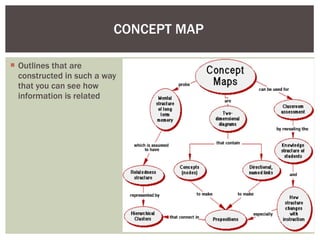
CONCEPT MAP Outlines that are constructed in such a way that you can see how information is related
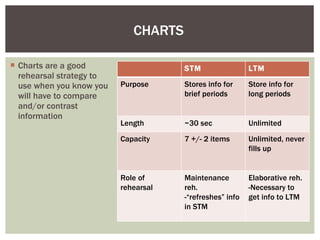
CHARTS Charts are a good rehearsal strategy to use when you know you will have to compare and/or contrast information  STM LTM Purpose Stores info for brief periods Store info for long periods Length ~30 sec Unlimited Capacity  7 +/- 2 items  Unlimited, never fills up Role of rehearsal Maintenance reh. -“refreshes” info in STM Elaborative reh.  -Necessary to get info to LTM
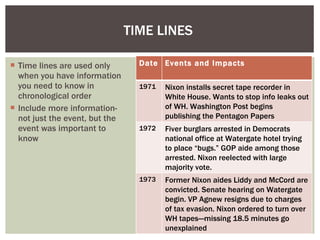
TIME LINES  Time lines are used only when you have information you need to know in chronological order Include more information- not just the event, but the event was important to know  Date Events and Impacts 1971 Nixon installs secret tape recorder in White House. Wants to stop info leaks out of WH. Washington Post begins publishing the Pentagon Papers 1972 Fiver burglars arrested in Democrats national office at Watergate hotel trying to place “bugs.” GOP aide among those arrested. Nixon reelected with large majority vote.  1973 Former Nixon aides Liddy and McCord are convicted. Senate hearing on Watergate begin. VP Agnew resigns due to charges of tax evasion. Nixon ordered to turn over WH tapes---missing 18.5 minutes go unexplained
QUESTIONS AND ANSWERS Begin with traditional question words/ If you know your test will focus mostly on memorizing info, concentrate on questions that begin with who, what, where, and when. If the test questions will be more thinking and synthesis questions, write quite a few why  and how questions  Use the right format. Put your questions on the left-hand side of your paper and the answers on the right.  When you study, cover up the answer to the question and talk through the info. Uncover the answer to see how accurate and complete your talk through was. Use highlighter to mark questions that you need to spend more time on.  Questions Answers Define and give an example of chunking. Chunking is the grouping of items together so that you can increase the capacity of STM Ex. Telephone # Why would you have trouble remembering this sequence of letters in your STM: imagoodstudent? Because 14 pieces of info exceeds the capacity of STM. It only holds 7+/- 2 pieces of info
Reviewing helps you to hold onto the info you’ve learned Ways to review: Talk-Through Cards Study Group REVIEWING: KEEPING INFO IN MEMORY
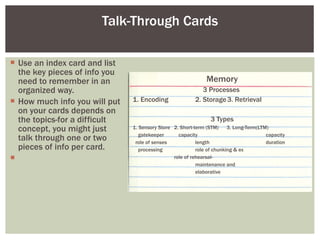
Talk-Through Cards Use an index card and list the key pieces of info you need to remember in an organized way.  How much info you will put on your cards depends on the topics-for a difficult concept, you might just talk through one or two pieces of info per card. Memory 3 Processes  1. Encoding 2. Storage 3. Retrieval 3 Types 1. Sensory Store  2. Short-term (STM)  3. Long-Term(LTM)  gatekeeper  capacity   capacity  role of senses length   duration processing  role of chunking & ex role of rehearsal- maintenance and  elaborative
STUDY GROUPS They include classmates, but not necessarily your good friends. They are relatively small. Five members is about the max any group should have.  All members pull their weight. The groups don’t take place of reflecting and rehearsing on your own. Study groups are best used for reviewing info, for troubleshooting difficult material, and for testing each other.  If you have regular study group, meet at the same time and place each week.
Professors expect you to be aware of any problems you are having understanding the material. If you are not understanding the material you can ask the professor, get a tutor, or get help from another student in class.  DON’T wait till the last minute to read over the material for your test. Make notes on any concepts you do not understand. MONITORING YOUR LEARNING
Keep up with your reading and other assignments. Think about your understanding of the concepts as you complete each assignment and hear lecture. Evaluate your learning at the end of each study period by quickly talking through or summarizing what you have learned. Be honest with yourself- if you don’t understand something, get help. MORE ON MONITORING YOUR LEARNING

Remembering Information

  • 1.
    THREE R’S ANDAN M: REMEMBERING WHAT YOU’VE READ AND HEARD LUNCH AND LEARN STUDENT SUCCESS
  • 2.
    Do you thinkthat reading your textbook and studying are the same thing? Or… do you have trouble remembering what you have read? READING VS. STUDYING
  • 3.
    Requires that youput the material into your own words Making sense of what you have read Annotation Critical thinking REFLECTING: THINKING ABOUT INFORMATION
  • 4.
    REHEARSING: GETTING INFOINTO YOUR MEMORY Acting on information in a way that it moves from STM to LTM Two basic ways of rehearsing Say it again Get it in writing
  • 5.
    REHEARSING: GETTING INFOINTO YOUR MEMORY Say it again Repeat the information to yourself over and over Get it in writing Concept Cards Concept Maps Charts Time Lines Questions and Answers
  • 6.
    CONCEPT CARDS On the front of the concept (flash) card, put the term you want to learn Under the term, put the page in the text where more information can be found In the upper-right-hand corner, put a word or phrase that helps you organize the information by providing the larger concept On the back of the card, write all the important information you need to remember-definition, examples, etc When you rehearse, look at the front of the card, say the term and all of the information you should know about it- Flip the card over to see how much information you remembered Memory Short-Term Memory p. 322 -brief-lasts only ~30 sec -capacity = 7 +/- 2 items -chunking helps keep add. Info in STM Ex – 555-1085 (last 4 digits are my birthday month and year)
  • 7.
    CONCEPT MAP Outlinesthat are constructed in such a way that you can see how information is related
  • 8.
    CHARTS Charts area good rehearsal strategy to use when you know you will have to compare and/or contrast information STM LTM Purpose Stores info for brief periods Store info for long periods Length ~30 sec Unlimited Capacity 7 +/- 2 items Unlimited, never fills up Role of rehearsal Maintenance reh. -“refreshes” info in STM Elaborative reh. -Necessary to get info to LTM
  • 9.
    TIME LINES Time lines are used only when you have information you need to know in chronological order Include more information- not just the event, but the event was important to know Date Events and Impacts 1971 Nixon installs secret tape recorder in White House. Wants to stop info leaks out of WH. Washington Post begins publishing the Pentagon Papers 1972 Fiver burglars arrested in Democrats national office at Watergate hotel trying to place “bugs.” GOP aide among those arrested. Nixon reelected with large majority vote. 1973 Former Nixon aides Liddy and McCord are convicted. Senate hearing on Watergate begin. VP Agnew resigns due to charges of tax evasion. Nixon ordered to turn over WH tapes---missing 18.5 minutes go unexplained
  • 10.
    QUESTIONS AND ANSWERSBegin with traditional question words/ If you know your test will focus mostly on memorizing info, concentrate on questions that begin with who, what, where, and when. If the test questions will be more thinking and synthesis questions, write quite a few why and how questions Use the right format. Put your questions on the left-hand side of your paper and the answers on the right. When you study, cover up the answer to the question and talk through the info. Uncover the answer to see how accurate and complete your talk through was. Use highlighter to mark questions that you need to spend more time on. Questions Answers Define and give an example of chunking. Chunking is the grouping of items together so that you can increase the capacity of STM Ex. Telephone # Why would you have trouble remembering this sequence of letters in your STM: imagoodstudent? Because 14 pieces of info exceeds the capacity of STM. It only holds 7+/- 2 pieces of info
  • 11.
    Reviewing helps youto hold onto the info you’ve learned Ways to review: Talk-Through Cards Study Group REVIEWING: KEEPING INFO IN MEMORY
  • 12.
    Talk-Through Cards Usean index card and list the key pieces of info you need to remember in an organized way. How much info you will put on your cards depends on the topics-for a difficult concept, you might just talk through one or two pieces of info per card. Memory 3 Processes 1. Encoding 2. Storage 3. Retrieval 3 Types 1. Sensory Store 2. Short-term (STM) 3. Long-Term(LTM) gatekeeper capacity capacity role of senses length duration processing role of chunking & ex role of rehearsal- maintenance and elaborative
  • 13.
    STUDY GROUPS Theyinclude classmates, but not necessarily your good friends. They are relatively small. Five members is about the max any group should have. All members pull their weight. The groups don’t take place of reflecting and rehearsing on your own. Study groups are best used for reviewing info, for troubleshooting difficult material, and for testing each other. If you have regular study group, meet at the same time and place each week.
  • 14.
    Professors expect youto be aware of any problems you are having understanding the material. If you are not understanding the material you can ask the professor, get a tutor, or get help from another student in class. DON’T wait till the last minute to read over the material for your test. Make notes on any concepts you do not understand. MONITORING YOUR LEARNING
  • 15.
    Keep up withyour reading and other assignments. Think about your understanding of the concepts as you complete each assignment and hear lecture. Evaluate your learning at the end of each study period by quickly talking through or summarizing what you have learned. Be honest with yourself- if you don’t understand something, get help. MORE ON MONITORING YOUR LEARNING

Editor's Notes

  • #3 Have you spent time reading your textbook and studying your notes, only to find that you can’t remember what you’ve read? Do you think that reading your textbook and studying are the same thing? If you answered yes to one or both of these questions, then mastering the 3 R’s and an M will help you significantly!
  • #4 Reflection = making sense of what you’re trying to learn, rather than just skimming over the material Annotation is a great way of reflecting because you have to think about what you’ve read before you annotate it. Put the information in your own words. Successful college students are critical thinkers – they become involved in their work but reflecting on the info they’ve just come in contact with.Rather than reading just to get the job done, or attending class just to be there, they engage in activities that keep them connected to the tasks, and they think about the material as they go along. Reflecting requires putting the info in your own words as a way of making sense of what you’ve just read.
  • #5 Short term memory holds info for up to 30 seconds, and it holds around 7 pieces of info at a time & Long term memory holds tons of info for a longer period of time – up to a lifetime even - The trick is getting info from STM to LTM Two basic ways of rehearsing: Repeat the info several times or write the info down Repeating can be done in your head or saying it our loud – just like actors learn their lines for a movie by repeating them over and over again Only problem is that you may have trouble remembering the info down the road when it’s no longer fresh in your mind Writing down the information gives you more of a permanent record to study from later – so writing the info down, and then saying it, is an even better way to lock the info into your LTM and have it here for later There are several ways to organize info when you’re trying to remember it: Concept Cards: “Flash Cards” – On the front of the card, put the term you want to learn; on the back, write all of the important info you want to remember – make your cards as you read rather than annotating – when you rehearse, look at the front of the card and then say the term and all of the info you should know about it (here’s where the talking part comes in). Then flip the card over to see how much you remembered. Good to use in classes with a lot of definitions and formulas to memorize! Concept Maps: Outlines that are constructed in such a way that you can see how info is related – this way, the relationships among ideas become clearer. Mapping works well for concepts where it’s important to see relationships. Charts: A good rehearsal strategy to use when you know that you will have to compare and/or contrast information. The most difficult thing about constructing charts is coming up with descriptors to compare and contrast on. It’s important that the descriptors are terms that can apply to all concepts that you wish to compare and contrast. Questions and Answers: These are sort of like the study guides your high school teachers may have given you to help you prepare for a big test – take it a step further and create your own study guide by writing questions and answering them in a way that allows you to test yourself. The secret is to make up good questions and then write out concise, yet complete, answers. Put your questions on the left-hand side of your paper and the answers on the right – when you study, cover up the answer to the question and talk thru the info – uncover the answer and check to see how accurate and complete your talk thru was. Use a highlighter to mark questions that you need to spend more time on.
  • #12 Unless you engage in activities that help you keep the ideas you have learned in your LTM, you are likely to forget them! When you review, figure out what is the most important to learn and concentrate on reviewing thatTwo great ways to review are talk-thru cards and study groups Talk thru cards: Use an index card and list the key pieces of info you need to remember in an organized way. How much info you put on the card will depend on the topic. Use your talk thru cards after you have looked thru your concepts cards, concepts maps, etc; your annotations and your lecture notes. Going thru your talk thru cards is one of the last things you’ll do before you take your exam. Start with the first major idea on the card, and say outloud what you know about it – make connections between and among this idea and other key ideas. Say the info outloud, because if you don’t, you can fool yourself into thinking you know the info when you really don’t. If you get stuck on something you’ve written on your card, go back to the source of the info (book, notes, etc) and read thru the rocky part again. Study groups: Meet for weekly review sessions with your study group – prehaps more frequently as test dates become closer. Study groups are best for reviewing info, for troubleshooting difficult material, and for testing each other – study groups should not take the place of reflecting and rehearsing on your own. Your study group should be used as a confirmation that you know and understand the material.
  • #15 College professors expect you to know when you’re having problems understanding something and to ask for help when you need it! When reading the text, or taking notes during lecture, make notes about ideas that confuse you – ask the professor to clarify ideas you don’t understand.
  • #16 The secret to monitoring is to do it as you go along. Monitoring during test preparation is also important, but if you haven’t monitored all along, it may be too late to do it well when it come time to prepare for an exam. Keep up with your reading and other assignments Think about your understanding of the concepts as you complete each assignment and hear lecture Evaluate your learning at the end of each studying period by talking quickly thru what you have learned Be honest with yourself – if you don’t understand something, don’t ignore it – get questions answered as they occur.