WHAT IS PROCRASTINATION?

   Procrastination is the avoidance of doing a task
 which needs to be accomplished. This can lead to
 feelings of guilt, inadequacy, depression and self-
 doubt among students. Procrastination has a high
potential for painful consequences. It interferes with
  the academic and personal success of students.
Procrastination can be hard to overcome because we come
                     up with too many excuses.
•    The following is a list of things we often tell ourselves:

      •   Mañana - "I'll do it tomorrow.”

      •   Contingent mañana - "I'll do it tomorrow, if ...”

      •   Grasshopperism - "I need to have some well-earned fun first.”

      •   Escapism - "I've got to get out for a while to clear my mind.”

      •   Impulsiveness - "My problem will be solved if I change my major, or attend a different
          college, or... “

      •   Music and reading - "I'll relax a while and then get started.”
FOUR SIMPLE REASONS FOR PROCRASTINATION

- Difficult- the task seems to hard to do
- Time-Consuming- the task swill take large blocks of
  time, and large blocks of time are unavailable until the
  weekend
- Lack of knowledge or skills- no one wants to make
  mistakes, so wait until your learn how before you start
- Fears- everyone will know you screwed up
FOUR COMPLEX REASONS FOR PROCRASTINATION
- Perfectionism- unrealistically high expectations or
  standards
- Anger/Hostility- if we are unhappy with someone,
  we’ll often withhold our best efforts
- Low Frustration Tolerance- circumstances
  overwhelm you easily
- Self- Downing – this happens when you continually
  minimize your own skills and abilities and express
  doubt about your ability to succeed
OTHER REASONS WHY STUDENTS PROCRASTINATE

 Poor Time Management

 Difficulty Concentrating

 Personal problems

 Boredom
OTHER CHARACTERISTICS/EXCUSES OF
PROCRASTINATORS

 •I'm Too Busy - procrastination may be used
 to call attention to how busy he/she is.

 •Stubbornness - procrastination may be used
 as an expression of stubbornness or pride.
OTHER CHARACTERISTICS/EXCUSES OF
              PROCRASTINATORS CONT.
Manipulative - procrastination may be used to control or
  manipulate the behavior of others.

Coping with Pressures - procrastination is often truly difficult to
  eradicate since the delay behavior has become a method of
  coping with day-to-day pressures and experiences.

A Frustrated Victim - the procrastinator often feels like a victim:
  he/she cannot understand his/her behavior or why he/she
  cannot get work done like others.
BENEFITS OF OVERCOMING PROCRASTINATION
•What are the benefits of overcoming procrastination?

   •Peace of mind, a feeling of strength and purpose, and a
   healthy feeling of being in charge of your life.

   •While procrastination makes you feel weak, useless, and
   helpless, taking charge of your life will make you feel
   strong, competent, and capable.

   •You will experience increased personal freedom!
STEPS TO THE CURE

• Realize you are delaying something unnecessarily.

• Discover the real reasons for your delay.
   • List them

• Dispute those real reasons and overcome them. Be vigorous.

• Begin the task.
PRACTICE WHAT YOU’VE LEARNED
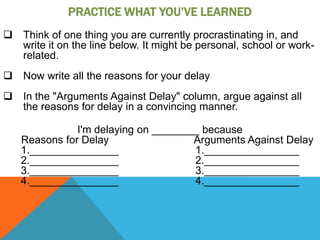
 Think of one thing you are currently procrastinating in, and
  write it on the line below. It might be personal, school or work-
  related.
 Now write all the reasons for your delay
 In the "Arguments Against Delay" column, argue against all
  the reasons for delay in a convincing manner.

              I'm delaying on ________ because
   Reasons for Delay                 Arguments Against Delay
   1._______________                 1.________________
   2._______________                 2.________________
   3._______________                 3.________________
   4._______________                 4.________________
HOW TO OVERCOME PROCRASTINATION
•Recognize self-defeating problems such as; fear and anxiety,
difficulty concentrating, poor time management, indecisiveness
and perfectionism.

•Identify your own goals, strengths and weaknesses, values and
priorities.

•Compare your actions with the values you feel you have. Are
your values consistent with your actions?

•Discipline yourself to use time wisely: Set priorities.
HOW TO OVERCOME PROCRASTINATION CONT.

•   Study in small blocks instead of long time periods.
•   Motivate yourself to study: Dwell on success, not on failure.
    Try to study in small groups.
•   Break large assignments into small tasks. Keep a reminder
    schedule and checklist.
•   Set realistic goals.
•   Modify your environment: Eliminate or minimize noise/
    distraction.

Procrastination

  • 2.
    WHAT IS PROCRASTINATION? Procrastination is the avoidance of doing a task which needs to be accomplished. This can lead to feelings of guilt, inadequacy, depression and self- doubt among students. Procrastination has a high potential for painful consequences. It interferes with the academic and personal success of students.
  • 3.
    Procrastination can behard to overcome because we come up with too many excuses. • The following is a list of things we often tell ourselves: • Mañana - "I'll do it tomorrow.” • Contingent mañana - "I'll do it tomorrow, if ...” • Grasshopperism - "I need to have some well-earned fun first.” • Escapism - "I've got to get out for a while to clear my mind.” • Impulsiveness - "My problem will be solved if I change my major, or attend a different college, or... “ • Music and reading - "I'll relax a while and then get started.”
  • 4.
    FOUR SIMPLE REASONSFOR PROCRASTINATION - Difficult- the task seems to hard to do - Time-Consuming- the task swill take large blocks of time, and large blocks of time are unavailable until the weekend - Lack of knowledge or skills- no one wants to make mistakes, so wait until your learn how before you start - Fears- everyone will know you screwed up
  • 5.
    FOUR COMPLEX REASONSFOR PROCRASTINATION - Perfectionism- unrealistically high expectations or standards - Anger/Hostility- if we are unhappy with someone, we’ll often withhold our best efforts - Low Frustration Tolerance- circumstances overwhelm you easily - Self- Downing – this happens when you continually minimize your own skills and abilities and express doubt about your ability to succeed
  • 6.
    OTHER REASONS WHYSTUDENTS PROCRASTINATE  Poor Time Management  Difficulty Concentrating  Personal problems  Boredom
  • 7.
    OTHER CHARACTERISTICS/EXCUSES OF PROCRASTINATORS •I'm Too Busy - procrastination may be used to call attention to how busy he/she is. •Stubbornness - procrastination may be used as an expression of stubbornness or pride.
  • 8.
    OTHER CHARACTERISTICS/EXCUSES OF PROCRASTINATORS CONT. Manipulative - procrastination may be used to control or manipulate the behavior of others. Coping with Pressures - procrastination is often truly difficult to eradicate since the delay behavior has become a method of coping with day-to-day pressures and experiences. A Frustrated Victim - the procrastinator often feels like a victim: he/she cannot understand his/her behavior or why he/she cannot get work done like others.
  • 9.
    BENEFITS OF OVERCOMINGPROCRASTINATION •What are the benefits of overcoming procrastination? •Peace of mind, a feeling of strength and purpose, and a healthy feeling of being in charge of your life. •While procrastination makes you feel weak, useless, and helpless, taking charge of your life will make you feel strong, competent, and capable. •You will experience increased personal freedom!
  • 10.
    STEPS TO THECURE • Realize you are delaying something unnecessarily. • Discover the real reasons for your delay. • List them • Dispute those real reasons and overcome them. Be vigorous. • Begin the task.
  • 11.
    PRACTICE WHAT YOU’VELEARNED  Think of one thing you are currently procrastinating in, and write it on the line below. It might be personal, school or work- related.  Now write all the reasons for your delay  In the "Arguments Against Delay" column, argue against all the reasons for delay in a convincing manner. I'm delaying on ________ because Reasons for Delay Arguments Against Delay 1._______________ 1.________________ 2._______________ 2.________________ 3._______________ 3.________________ 4._______________ 4.________________
  • 12.
    HOW TO OVERCOMEPROCRASTINATION •Recognize self-defeating problems such as; fear and anxiety, difficulty concentrating, poor time management, indecisiveness and perfectionism. •Identify your own goals, strengths and weaknesses, values and priorities. •Compare your actions with the values you feel you have. Are your values consistent with your actions? •Discipline yourself to use time wisely: Set priorities.
  • 13.
    HOW TO OVERCOMEPROCRASTINATION CONT. • Study in small blocks instead of long time periods. • Motivate yourself to study: Dwell on success, not on failure. Try to study in small groups. • Break large assignments into small tasks. Keep a reminder schedule and checklist. • Set realistic goals. • Modify your environment: Eliminate or minimize noise/ distraction.

Editor's Notes

  • #7 #1 procrastination means not managing time wisely. You may be uncertain of your priorities, goals and objectives; you may be overwhelmed. As a result, you keep putting off your academic assignments for a later date, or spending a great deal of time with your friends and social activities or worrying rather than completing you assignments. #2 - when you sit at your desk you find yourself daydreaming, staring into space, looking at pictures of your boyfriend/girlfriend, etc., instead of doing the task. Your environment is distracting and noisy. Your desk is cluttered and unorganized. You probably notice that all of the examples that you have just read promote time wasting and frustration. #3 - you may be overwhelmed with the task and afraid of getting a failing grade. As a result, you spend a great deal of time worrying about your upcoming exams, papers and projects, rather than completing them. #4-such as; "I cannot succeed in anything" and "I lack the necessary skills to perform the task" may allow you to stop yourself from getting work done. He may insist upon a high level of performance even though he may feel inadequate or incapable of actually achieving that level. The procrastinator may struggle with feelings of low self-confidence and low self-esteem.
  • #8 #1“Obviously I cannot do such and such because my affairs are so complicated and so demanding. That is why I am late, etc.” The procrastinator may even spend considerable time justifying his reasons, time that could be spent doing the work.
  • #9 #1 “They cannot start if I am not there.” Let's face it: deliberate delay drives others crazy.#2 Obviously if one is cured, others will put new demands and expectations upon you. It's easier to have an excuse, to delay, to put off.#3 The whole thing is a frustrating mystery. The reasons for his behavior are hidden from him.
  • #12 #2 . This may take five or ten minutes because some of them are really hidden from you. These reasons are the controlling influences. Write down as many as possible.#3 If you can argue against them successfully, you will be able to start the task.
  • #14 #1 For example, you will accomplish more if you study/work in 60 minute blocks and take frequent 10 minute breaks in between, than if you study/work for 2-3 hours straight, with no breaks. Reward yourself after you complete a task. #4 Ensure adequate lighting. Have necessary equipment at hand. Don't waste time going back and forth to get things. Don't get too comfortable when studying. A desk and straight-backed chair is usually best (a bed is no place to study). Be neat! Take a few minutes to straighten your desk. This can help to reduce day-dreaming.