ACCOMMODATION
AND
MODIFICATION
IN THE
CURRICULUM
Reporter:
JAIRA JANE M. TORRECAMPO
DEFINITION
OF TERMS
Reference:
https://www.washington.edu/doit/what-difference-between-accommodation-and-modification-student-
disability
ACCOMMODATION
- an alteration of environment, curriculum
format, or equipment that allows an
individual with a disability to gain access
to content and/or complete assigned
tasks.
EXAMPLES OF ACCOMMODATION
◦sign language interpreters for students who are deaf;
◦computer text-to-speech computer-based systems for students
with visual impairments or Dyslexia;
◦extended time for students with fine motor limitations, visual
impairments, or learning disabilities;
◦large-print books and worksheets for students with visual
impairments; and
◦trackballs and alternative keyboards for students who operate
standard mice and keyboards.
MODIFICATION
- a change in the curriculum. Modifications
are made for students with disabilities who are
unable to comprehend all of the content an
instructor is teaching.
EXAMPLE OF MODIFICATION
◦Assignments might be reduced in number
and modified significantly for an elementary
school student with cognitive impairments
that limits his/her ability to understand the
content in general education class in which
they are included.
APPLICATION OF
ACCOMMODATION
AND MODIFICATION
IN THE PHILIPPINE
SETTING
DepEd Order No. 044
s2021
Policy Guidelines on the Provision of Educational Programs and
Services for Learners with Disabilities in the K to 12 Basic
Education Program
ADAPTATION OF THE K-12
CURRICULUM FOR LWDS
To ensure that the curriculum is learner-centered,
contextualization and adaptations of the curriculum is
made in favor of the learner.
The following is made to access the K-12 Curriculum
based on the needs of the LWDs
◦ Essential adaptive curriculum
◦ Curriculum content adaptations
◦ Transition skills and competencies
◦ The K-12 Basic Education Curriculum for the Alternative Learning
Curriculum(ALS-K to 12) providing opportunities to develop basic and
functional literacy skills for learners with disabilities.
◦ Adaptation of Learning Resources and ICT
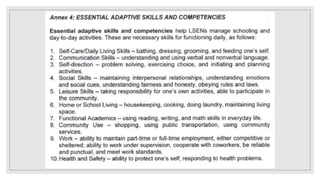
1. Essential Adaptive Curriculum
Designed to help learners with severe to profound disabilities
develop their skills in managing school and day-to-day activities.
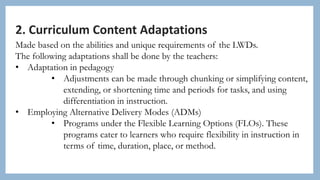
2. Curriculum Content Adaptations
Made based on the abilities and unique requirements of the LWDs.
The following adaptations shall be done by the teachers:
• Adaptation in pedagogy
• Adjustments can be made through chunking or simplifying content,
extending, or shortening time and periods for tasks, and using
differentiation in instruction.
• Employing Alternative Delivery Modes (ADMs)
• Programs under the Flexible Learning Options (FLOs). These
programs cater to learners who require flexibility in instruction in
terms of time, duration, place, or method.
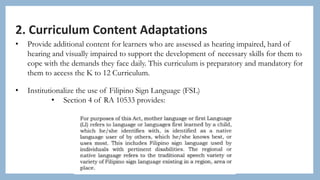
2. Curriculum Content Adaptations
• Provide additional content for learners who are assessed as hearing impaired, hard of
hearing and visually impaired to support the development of necessary skills for them to
cope with the demands they face daily. This curriculum is preparatory and mandatory for
them to access the K to 12 Curriculum.
• Institutionalize the use of Filipino Sign Language (FSL)
• Section 4 of RA 10533 provides:
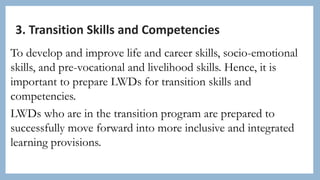
3. Transition Skills and Competencies
To develop and improve life and career skills, socio-emotional
skills, and pre-vocational and livelihood skills. Hence, it is
important to prepare LWDs for transition skills and
competencies.
LWDs who are in the transition program are prepared to
successfully move forward into more inclusive and integrated
learning provisions.
3. The K-12 Basic Education Curriculum for the Alternative
Learning Curriculum(ALS-K to 12) providing opportunities to
develop basic and functional literacy skills for learners with
disabilities.
An equivalent pathway to complete basic education not only for
out-of-school youth and adults but also for learners with
disabilities.
4. Adaptation of Learning Resources and ICT
Adaptations in resources are essential in ensuring that all learners with
disabilities can participate fully in all learning experiences in schools and in
communities.
These adaptations shall be through teacher-developed materials or assistive
devices and technologies.
Difference of ACCOMMODATION and
MODIFICATION
Reference:
https://www.washington.edu/doit/what-difference-between-accommodation-and-modification-student-disability
ACCOMMODATION - an alteration of environment, curriculum
format, or equipment that allows an individual with a disability to
gain access to content and/or complete assigned tasks.
MODIFICATION - a change in the curriculum. Modifications are
made for students with disabilities who are unable to comprehend
all of the content an instructor is teaching.
Application of accommodation and modification in
the Philippine setting
◦ Essential adaptive curriculum
◦ Curriculum content adaptations
◦ Transition skills and competencies
◦ The K-12 Basic Education Curriculum for the Alternative Learning
Curriculum(ALS-K to 12) providing opportunities to develop basic and
functional literacy skills for learners with disabilities.
◦ Adaptation of Learning Resources and ICT
DEPED ORDER NO. 044 S2021
THANK YOU SO
MUCH
FOR LISTENING
REPORTER: JAIRA JANE M TORRECAMPO

ACCOMMODATION AND MODIFICATION IN THE K-12 CURRICULUM

  • 1.
  • 2.
  • 3.
    ACCOMMODATION - an alterationof environment, curriculum format, or equipment that allows an individual with a disability to gain access to content and/or complete assigned tasks.
  • 4.
    EXAMPLES OF ACCOMMODATION ◦signlanguage interpreters for students who are deaf; ◦computer text-to-speech computer-based systems for students with visual impairments or Dyslexia; ◦extended time for students with fine motor limitations, visual impairments, or learning disabilities; ◦large-print books and worksheets for students with visual impairments; and ◦trackballs and alternative keyboards for students who operate standard mice and keyboards.
  • 5.
    MODIFICATION - a changein the curriculum. Modifications are made for students with disabilities who are unable to comprehend all of the content an instructor is teaching.
  • 6.
    EXAMPLE OF MODIFICATION ◦Assignmentsmight be reduced in number and modified significantly for an elementary school student with cognitive impairments that limits his/her ability to understand the content in general education class in which they are included.
  • 7.
  • 8.
    DepEd Order No.044 s2021 Policy Guidelines on the Provision of Educational Programs and Services for Learners with Disabilities in the K to 12 Basic Education Program
  • 9.
    ADAPTATION OF THEK-12 CURRICULUM FOR LWDS To ensure that the curriculum is learner-centered, contextualization and adaptations of the curriculum is made in favor of the learner.
  • 10.
    The following ismade to access the K-12 Curriculum based on the needs of the LWDs ◦ Essential adaptive curriculum ◦ Curriculum content adaptations ◦ Transition skills and competencies ◦ The K-12 Basic Education Curriculum for the Alternative Learning Curriculum(ALS-K to 12) providing opportunities to develop basic and functional literacy skills for learners with disabilities. ◦ Adaptation of Learning Resources and ICT
  • 11.
    1. Essential AdaptiveCurriculum Designed to help learners with severe to profound disabilities develop their skills in managing school and day-to-day activities.
  • 13.
    2. Curriculum ContentAdaptations Made based on the abilities and unique requirements of the LWDs. The following adaptations shall be done by the teachers: • Adaptation in pedagogy • Adjustments can be made through chunking or simplifying content, extending, or shortening time and periods for tasks, and using differentiation in instruction. • Employing Alternative Delivery Modes (ADMs) • Programs under the Flexible Learning Options (FLOs). These programs cater to learners who require flexibility in instruction in terms of time, duration, place, or method.
  • 14.
    2. Curriculum ContentAdaptations • Provide additional content for learners who are assessed as hearing impaired, hard of hearing and visually impaired to support the development of necessary skills for them to cope with the demands they face daily. This curriculum is preparatory and mandatory for them to access the K to 12 Curriculum. • Institutionalize the use of Filipino Sign Language (FSL) • Section 4 of RA 10533 provides:
  • 15.
    3. Transition Skillsand Competencies To develop and improve life and career skills, socio-emotional skills, and pre-vocational and livelihood skills. Hence, it is important to prepare LWDs for transition skills and competencies. LWDs who are in the transition program are prepared to successfully move forward into more inclusive and integrated learning provisions.
  • 16.
    3. The K-12Basic Education Curriculum for the Alternative Learning Curriculum(ALS-K to 12) providing opportunities to develop basic and functional literacy skills for learners with disabilities. An equivalent pathway to complete basic education not only for out-of-school youth and adults but also for learners with disabilities.
  • 17.
    4. Adaptation ofLearning Resources and ICT Adaptations in resources are essential in ensuring that all learners with disabilities can participate fully in all learning experiences in schools and in communities. These adaptations shall be through teacher-developed materials or assistive devices and technologies.
  • 18.
    Difference of ACCOMMODATIONand MODIFICATION Reference: https://www.washington.edu/doit/what-difference-between-accommodation-and-modification-student-disability ACCOMMODATION - an alteration of environment, curriculum format, or equipment that allows an individual with a disability to gain access to content and/or complete assigned tasks. MODIFICATION - a change in the curriculum. Modifications are made for students with disabilities who are unable to comprehend all of the content an instructor is teaching.
  • 19.
    Application of accommodationand modification in the Philippine setting ◦ Essential adaptive curriculum ◦ Curriculum content adaptations ◦ Transition skills and competencies ◦ The K-12 Basic Education Curriculum for the Alternative Learning Curriculum(ALS-K to 12) providing opportunities to develop basic and functional literacy skills for learners with disabilities. ◦ Adaptation of Learning Resources and ICT DEPED ORDER NO. 044 S2021
  • 20.
    THANK YOU SO MUCH FORLISTENING REPORTER: JAIRA JANE M TORRECAMPO

Editor's Notes

  • #2 Good day everyone! ? This time, I will discuss about the accommodation and modification in the curriculum. We will define the important terms in this topic, differentiate, and cite programs and adaptations that applied the accommodation and modification in the curriculum here in the Philippines.
  • #4 They allow students with disabilities to pursue a regular course of study. Since accommodations do not alter what is being taught, instructors should be able to implement the same grading scale for students with disabilities as they do for students without disabilities.
  • #6 This is when we need to modify the curriculum in order to prioritize the objectives needed as agreed in the IEP.
  • #9 This policy covers the provision of the following: educational services, assessment, curriculum, teachers, learning delivery, learning environment and resources, and roles and responsibilities of the different levels of governance. DepEd shall ensure that learners with disabilities are equally provided with opportunities to fully participate in the K to 12 Basic Education Program.
  • #10 The K to 12 curriculum offers various educational opportunities that are developmentally appropriate for learners and are based on their interests, strengths, and needs
  • #12 Essential adaptive skills and competencies help LWDs manage schooling and day-to-day activities and are necessary skills for functioning daily.
  • #16 The transition program and other related services shall provide LWDs the bridge from one phase, location, or situation to another to help them adjust.
  • #17 Its curriculum is organized into six interrelated learning strands that bring functional literacy and content knowledge together.
  • #18 Learning resources shall be aligned with the curriculum standards. ICT can support learners with disabilities