DIANNA MAY C. MACAPULAY
SUBORDINATION
-is a grammatical strategy to
communicate that one idea in a sentence
is more important than another idea in the
same sentence.
- is a means of joining a dependent
clause to an independent clause.
Subordinate Clause
*Dependent Clause
- is a group of words that contains a
subject and a verb but cannot stand alone as
a complete idea.
-is also called a subordinate clause.
*Independent Clause
- contains a subject and a verb and can
stand alone as a complete idea.
-is also called the main clause.
Example:
1. Because it is raining, we will stay home.
2. Before we play again, we should do our homework.
3. Although my points became clearer, I continued to
revise my prayer.
Note: Subordinate Clause is separated from the main clause
with a comma and would, if it stood alone, be a sentence
fragment. For example, “Although my points became
clearer” cannot stand alone as a sentence.
Examples of subordinate clauses joined with
independent clauses:
1.Even though I am scared of flying, I am
taking a plane to Spain.
2.Since I am graduating next month, I need
to start looking for a job.
3.Whereas my sister’s favorite subject is
math, I prefer English.
4.Jane’s essay had many grammatical errors
because she did not proofread it.
Notice that though subordinate
clauses beginning with “because” are
followed by a comma, “because” clauses
in the middle of a sentence are not
preceded by a comma.
Example:
1.Because I did not study, I failed the
test.
2.I failed the test because I did not study.
Subordinate Clauses as Parts of Speech
Subordinate clauses can be parts of speech, such
as adjective clauses and adverb clauses.
You can identify adjective clauses by looking for
who, where, that, and which at the beginning
of the clause.
You can identify adverb clauses by looking for
while
Noun clauses often begin with that.
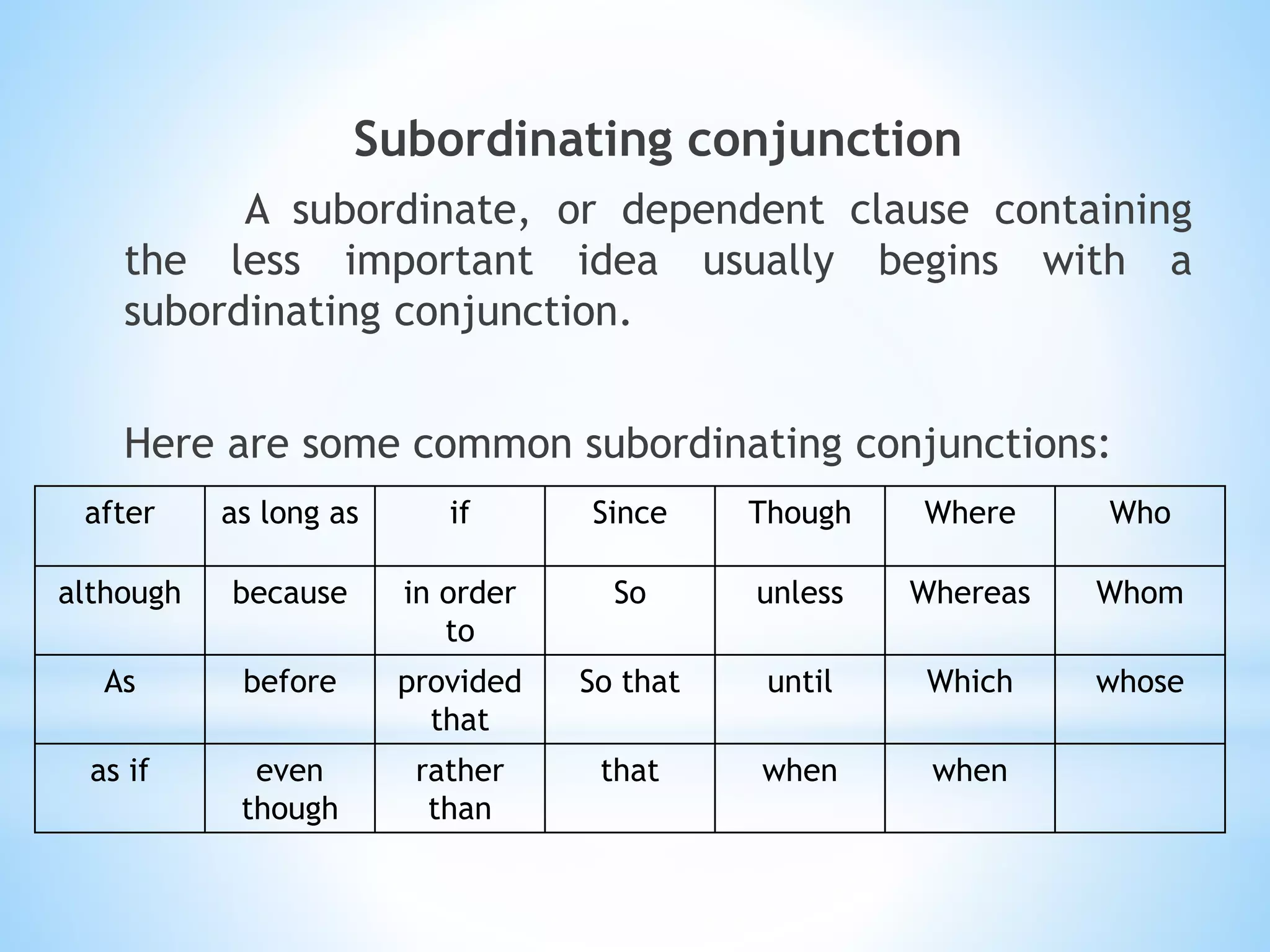
Subordinating conjunction
A subordinate, or dependent clause containing
the less important idea usually begins with a
subordinating conjunction.
Here are some common subordinating conjunctions:
after as long as if Since Though Where Who
although because in order
to
So unless Whereas Whom
As before provided
that
So that until Which whose
as if even
though
rather
than
that when when
Subordinating Conjunctions and their meanings
Time
after, before, once, since, until, when, whenever, while
• After you have handed in your report, you cannot revise it.
Reason or Cause
as, because, since
•Because you have handed in your report, you cannot revise
it.
Purpose or Result
in order that, so that, that
•I want to read your report so that I can evaluate it.
Condition
if even, if, provided that, unless
•Unless you have handed in your report, you can
revise it.
Contrast
although, even though, though, whereas, while
•Although you have handed in your report, you can
ask to revise it.
Choice
than, whether
•You took more time to revise than I did
before the lab report deadline.
Place or Location
where, wherever
•Wherever you say, I’ll come to hand in my
report.
What is the structure of a subordinate sentence?
A subordinate sentence starts the dependent clause
with either a subordinating conjunction or a relative pronoun.
Example:
*If they are very lucky, the passengers may glimpse dolphins
breaking water playfully near the ship.
*Pandas are solitary animals, which means they are difficult
to protect from extinction.
Dependent clauses are of two types: Adverb Clauses and
Adjective Clauses.
An adverb clause starts with a subordinating
conjunction. An adjective clause starts with a relative
pronoun.
Sentences with Adverb Clauses
Adverb Clause, Independent Clause
-After the sky grew dark, the wind died suddenly.
Independent clause, Adverb Clause
-Birds stopped singing, as they do during an eclipse.
Independent Clause, Adverb Clause
- The stores closed before the storm began.
Sentences with Adjective Clauses
Independent Clause, restrictive(essential)
adjective clause
-Weather forecasts warned of a storm that
might bring a thirty-inch snowfall.
Independent Clause,
nonrestrictive(nonessential) adjective clause
-Spring is the season for tornadoes, which may
have wind speeds over 220 miles an hour.
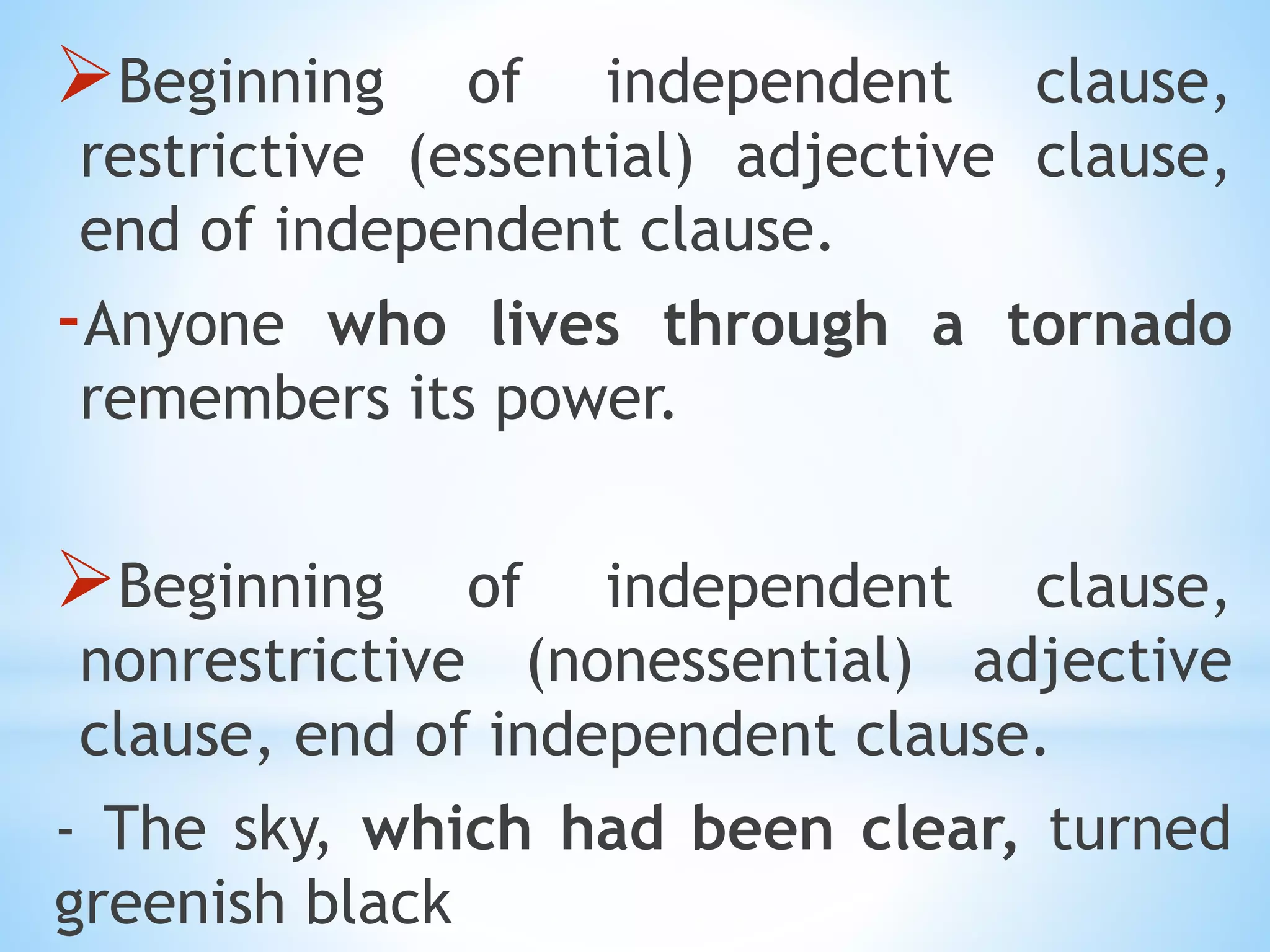
Beginning of independent clause,
restrictive (essential) adjective clause,
end of independent clause.
-Anyone who lives through a tornado
remembers its power.
Beginning of independent clause,
nonrestrictive (nonessential) adjective
clause, end of independent clause.
- The sky, which had been clear, turned
greenish black
THANK YOU FOR LISTENING
GOD BLESS 

Stuctures of Subordination

  • 1.
    DIANNA MAY C.MACAPULAY
  • 2.
    SUBORDINATION -is a grammaticalstrategy to communicate that one idea in a sentence is more important than another idea in the same sentence. - is a means of joining a dependent clause to an independent clause.
  • 3.
    Subordinate Clause *Dependent Clause -is a group of words that contains a subject and a verb but cannot stand alone as a complete idea. -is also called a subordinate clause. *Independent Clause - contains a subject and a verb and can stand alone as a complete idea. -is also called the main clause.
  • 4.
    Example: 1. Because itis raining, we will stay home. 2. Before we play again, we should do our homework. 3. Although my points became clearer, I continued to revise my prayer. Note: Subordinate Clause is separated from the main clause with a comma and would, if it stood alone, be a sentence fragment. For example, “Although my points became clearer” cannot stand alone as a sentence.
  • 5.
    Examples of subordinateclauses joined with independent clauses: 1.Even though I am scared of flying, I am taking a plane to Spain. 2.Since I am graduating next month, I need to start looking for a job. 3.Whereas my sister’s favorite subject is math, I prefer English. 4.Jane’s essay had many grammatical errors because she did not proofread it.
  • 6.
    Notice that thoughsubordinate clauses beginning with “because” are followed by a comma, “because” clauses in the middle of a sentence are not preceded by a comma. Example: 1.Because I did not study, I failed the test. 2.I failed the test because I did not study.
  • 7.
    Subordinate Clauses asParts of Speech Subordinate clauses can be parts of speech, such as adjective clauses and adverb clauses. You can identify adjective clauses by looking for who, where, that, and which at the beginning of the clause. You can identify adverb clauses by looking for while Noun clauses often begin with that.
  • 8.
    Subordinating conjunction A subordinate,or dependent clause containing the less important idea usually begins with a subordinating conjunction. Here are some common subordinating conjunctions: after as long as if Since Though Where Who although because in order to So unless Whereas Whom As before provided that So that until Which whose as if even though rather than that when when
  • 9.
    Subordinating Conjunctions andtheir meanings Time after, before, once, since, until, when, whenever, while • After you have handed in your report, you cannot revise it. Reason or Cause as, because, since •Because you have handed in your report, you cannot revise it. Purpose or Result in order that, so that, that •I want to read your report so that I can evaluate it.
  • 10.
    Condition if even, if,provided that, unless •Unless you have handed in your report, you can revise it. Contrast although, even though, though, whereas, while •Although you have handed in your report, you can ask to revise it.
  • 11.
    Choice than, whether •You tookmore time to revise than I did before the lab report deadline. Place or Location where, wherever •Wherever you say, I’ll come to hand in my report.
  • 12.
    What is thestructure of a subordinate sentence? A subordinate sentence starts the dependent clause with either a subordinating conjunction or a relative pronoun. Example: *If they are very lucky, the passengers may glimpse dolphins breaking water playfully near the ship. *Pandas are solitary animals, which means they are difficult to protect from extinction. Dependent clauses are of two types: Adverb Clauses and Adjective Clauses.
  • 13.
    An adverb clausestarts with a subordinating conjunction. An adjective clause starts with a relative pronoun. Sentences with Adverb Clauses Adverb Clause, Independent Clause -After the sky grew dark, the wind died suddenly. Independent clause, Adverb Clause -Birds stopped singing, as they do during an eclipse. Independent Clause, Adverb Clause - The stores closed before the storm began.
  • 14.
    Sentences with AdjectiveClauses Independent Clause, restrictive(essential) adjective clause -Weather forecasts warned of a storm that might bring a thirty-inch snowfall. Independent Clause, nonrestrictive(nonessential) adjective clause -Spring is the season for tornadoes, which may have wind speeds over 220 miles an hour.
  • 15.
    Beginning of independentclause, restrictive (essential) adjective clause, end of independent clause. -Anyone who lives through a tornado remembers its power. Beginning of independent clause, nonrestrictive (nonessential) adjective clause, end of independent clause. - The sky, which had been clear, turned greenish black
  • 17.
    THANK YOU FORLISTENING GOD BLESS 