PRESENTED BYPRESENTED BY ::
:M.AKBAR ALI:M.AKBAR ALI
PYP ( CBA )PYP ( CBA )
JAZAN UNIVERSITYJAZAN UNIVERSITY
PRESENTED BYPRESENTED BY ::
:M.AKBAR ALI:M.AKBAR ALI
PYP ( CBA )PYP ( CBA )
JAZAN UNIVERSITYJAZAN UNIVERSITY
In order to understand the concept ofIn order to understand the concept of
““Subordination“Subordination“
Let us have a look atLet us have a look at
the idea of a wordthe idea of a word
HYPOTAXISHYPOTAXIS
ArrangementArrangementVV
HYPO + TAXISHYPO + TAXIS
 HYPOHYPO ++ TAXISTAXIS
 BeneathBeneath
Example:- Ahmad can be ….. Whatever he wants to be.Example:- Ahmad can be ….. Whatever he wants to be.Whatever he wants to be.
Here a natural question arises as to :
What subordination in sentences is?
Here a natural question arises as to :
What subordination in sentences is?
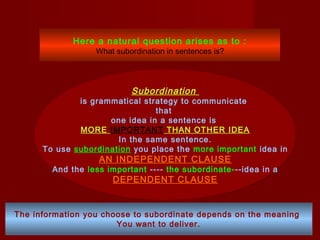
Subordination
is grammatical strategy to communicate
that
one idea in a sentence is
MORE IMPORTANT THAN OTHER IDEA
In the same sentence.
To use subordination you place the more important idea in
AN INDEPENDENT CLAUSE
And the less important ---- the subordinate---idea in a
DEPENDENT CLAUSE
Subordination
is grammatical strategy to communicate
that
one idea in a sentence is
MORE IMPORTANT THAN OTHER IDEA
In the same sentence.
To use subordination you place the more important idea in
AN INDEPENDENT CLAUSE
And the less important ---- the subordinate---idea in a
DEPENDENT CLAUSE
The information you choose to subordinate depends on the meaning
You want to deliver.
The information you choose to subordinate depends on the meaning
You want to deliver.
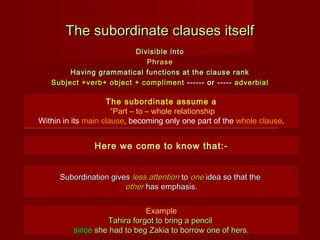
The subordinate clauses itselfThe subordinate clauses itself
Divisible intoDivisible into
PhrasePhrase
Having grammatical functions at the clause rankHaving grammatical functions at the clause rank
Subject +verb+ object + complimentSubject +verb+ object + compliment ------ or ----------- or ----- adverbialadverbial
The subordinate assume a
“Part – to – whole relationship
Within in its main clause, becoming only one part of the whole clause.
The subordinate assume a
“Part – to – whole relationship
Within in its main clause, becoming only one part of the whole clause.
Here we come to know that:-Here we come to know that:-
Subordination givesSubordination gives less attentionless attention toto oneone idea so that theidea so that the
otherother has emphasis.has emphasis.
Subordination givesSubordination gives less attentionless attention toto oneone idea so that theidea so that the
otherother has emphasis.has emphasis.
Example
Tahira forgot to bring a pencilTahira forgot to bring a pencil
sincesince she had to beg Zakia to borrow one of hers.she had to beg Zakia to borrow one of hers.
Example
Tahira forgot to bring a pencilTahira forgot to bring a pencil
sincesince she had to beg Zakia to borrow one of hers.she had to beg Zakia to borrow one of hers.
1: You can have the tickets since we can’t go.1: You can have the tickets since we can’t go.
2: Even though Akbar forgot to bring a pencil, he2: Even though Akbar forgot to bring a pencil, he
had to beg Tahira to borrow one of hers.had to beg Tahira to borrow one of hers.
3:He is not tall as she is.3:He is not tall as she is.
One thing is notable here…….One thing is notable here…….
We have joined the two clauses with the help of some words:We have joined the two clauses with the help of some words:
Since --- even though--- asSince --- even though--- as
We call these words asWe call these words as
coordinating conjunctionscoordinating conjunctions
Use coordinating conjunctions:Use coordinating conjunctions: andand,, butbut,, forfor,, oror,,
nornor,, yetyet, and, and soso..
Let us have a look at some of otherLet us have a look at some of other
coordinating conjunctionscoordinating conjunctions ::
Let us have a look at some of otherLet us have a look at some of other
coordinating conjunctionscoordinating conjunctions ::
 afterafter
 althoughalthough
 asas
 becausebecause
 beforebefore
 even thougheven though
 if, even ifif, even if
 in order thatin order that
 onceonce
 provided thatprovided that
 sincesince
 so [so [thatthat implied], so thatimplied], so that
 thanthan
 thatthat
 thoughthough
 unlessunless
 when, wheneverwhen, whenever
 where, wherever, whereaswhere, wherever, whereas
 whetherwhether
 whilewhile
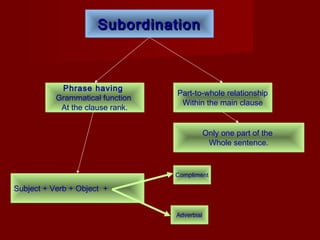
SubordinationSubordinationSubordinationSubordination
Phrase having
Grammatical function
At the clause rank.
Phrase having
Grammatical function
At the clause rank.
Part-to-whole relationship
Within the main clause
Part-to-whole relationship
Within the main clause
Subject + Verb + Object +Subject + Verb + Object +
Only one part of the
Whole sentence.
Only one part of the
Whole sentence.
ComplimentCompliment
AdverbialAdverbial
FURTHER SUBCATEGORIZATIONFURTHER SUBCATEGORIZATION
FORMFORM FUNCTIONFUNCTION
This way they take the form ofThis way they take the form of
Full clauseFull clause Reduced clauseReduced clause
Division of coordinate clausesDivision of coordinate clauses
FULLFULL
SUBORDINATSUBORDINAT
EE
Often exhibitOften exhibit
An over subordinator
and the grammatical functions
An over subordinator
and the grammatical functions
A subordinating clause functioning as
SUBJECT
A subordinating clause functioning as
SUBJECT
Whoever wants that bookWhoever wants that book can havecan have It.It.
Subordinating clauseSubordinating clause
SUBJECTSUBJECT VerbVerb OO
MAIN CLAUSEMAIN CLAUSE
A subordinating clause functioning as
OBJECT
A subordinating clause functioning as
OBJECT
II knowknow that you laid.that you laid.
SubordinateSubordinate
SUBJECTSUBJECT VerbVerb Direct ObjectDirect Object
MAIN CLAUSEMAIN CLAUSE
And the grammatical functions
A subordinating clause functioning as
COMPLIMENT
A subordinating clause functioning as
COMPLIMENT
FaizanFaizan Can beCan be Whatever he wants to beWhatever he wants to be
Subordinate ClauseSubordinate Clause
SS VerbVerb ComplimentCompliment
MAIN CLAUSEMAIN CLAUSE
A subordinating clause functioning as
ADVERBIAL
A subordinating clause functioning as
ADVERBIAL
Since we can’t goSince we can’t go youyou It.It.
Subordinate ClauseSubordinate Clause
ADVERBIALADVERBIAL SS OO
MAIN CLAUSEMAIN CLAUSE
Can haveCan have
VerbVerb
SUBORDINATE CLAUSE SUBDIVIDED INTO ………. CLAUSE LEVEL CONSTITUENTSUBORDINATE CLAUSE SUBDIVIDED INTO ………. CLAUSE LEVEL CONSTITUENT
SinceSince wewe can’t gocan’t go youyou can havecan have It.It.
SUBORDINATORSUBORDINATOR SubjectSubject VerbVerb
SUBORDINATE CLAUSESUBORDINATE CLAUSE
ADVERBIALADVERBIAL SubjectSubject VerbVerb ObjectObject
Main ClauseMain Clause
The adverbial clause further sub divided into its functional constituentsThe adverbial clause further sub divided into its functional constituents
REDUCEDREDUCED
SUBORDINATESUBORDINATE
CLAUSESCLAUSES
REDUCEDREDUCED
SUBORDINATESUBORDINATE
CLAUSESCLAUSES
Missing many or
most of the constituent
Missing many or
most of the constituent
Usually
the subordinator, the subject
and the finite part of the verb.
Usually
the subordinator, the subject
and the finite part of the verb.
MM SSII SS II GGNN
II wantwant to beto be alonealone
Infinite verbInfinite verb complimentcompliment
Subordinating ClauseSubordinating Clause
SubjectSubject VerbVerb Direct ObjectDirect Object
Main ClauseMain Clause
An example of a reduced ( nonfinite) clause ( to be alone )
functioning as direct object of the main clause
An example of a reduced ( nonfinite) clause ( to be alone )
functioning as direct object of the main clause
the subordinatorthe subordinator
the subjectthe subject
the finite part of the verbthe finite part of the verb
To be aloneTo be alone can becan be very sad.very sad.
Subordinate ClauseSubordinate Clause
SubjectSubject VerbVerb ComplimentCompliment
Main ClauseMain Clause
An example of a reduced ( nonfinite) clause
functioning as subject of the main clause
An example of a reduced ( nonfinite) clause
functioning as subject of the main clause
II seemseem To be alone.To be alone.
Subordinate ClauseSubordinate Clause
SubjectSubject VerbVerb Subject ComplimentSubject Compliment
Main ClauseMain Clause
An example of a reduced ( nonfinite) clause
functioning as compliment of the main clause
An example of a reduced ( nonfinite) clause
functioning as compliment of the main clause
SentenceSentence
Multiple sentence
(two or more
Clauses)
Multiple sentence
(two or more
Clauses)
Simple sentence
Only
One clause
Simple sentence
Only
One clause
Subordination
(of clauses)
Subordination
(of clauses)
Coordination
(of clauses)
Coordination
(of clauses)FormsForms
FunctionsFunctions
FiniteFinite
NonfiniteNonfinite
Full ClauseFull Clause
Relative ClauseRelative Clause
-ed clause-ed clause
-ing clause-ing clause
Absolute clauseAbsolute clause
Infinitive clauseInfinitive clause
Verb less clauseVerb less clause
Nominal clauseNominal clause
Relative clauseRelative clause
Adverbial clauseAdverbial clause
Comparative clauseComparative clause
Forms of subordinate clauseForms of subordinate clause
SyndeticSyndetic AsyndeticAsyndetic
SentenceSentence
Multiple sentence
(two or more
Clauses)
Multiple sentence
(two or more
Clauses)
Simple sentence
Only
One clause
Simple sentence
Only
One clause
Subordination
(of clauses)
Subordination
(of clauses)
Coordination
(of clauses)
Coordination
(of clauses)FormsForms
FunctionsFunctions
FiniteFinite
NonfiniteNonfinite
Full ClauseFull Clause
Relative ClauseRelative Clause
-ed clause-ed clause
-ing clause-ing clause
Absolute clauseAbsolute clause
Infinitive clauseInfinitive clause
Verb less clauseVerb less clause
Nominal clauseNominal clause
Relative clauseRelative clause
Adverbial clauseAdverbial clause
Comparative clauseComparative clause
Forms of subordinate clauseForms of subordinate clause
SyndeticSyndetic AsyndeticAsyndetic
Full ClauseFull Clause
Relative ClauseRelative Clause
-ed clause-ed clause
-ing clause-ing clause
Absolute clauseAbsolute clause
Infinitive clauseInfinitive clause
Verb less clauseVerb less clause
Since he arrived, she left early.
Shocked by the news, she left early.
Hearing the news, she left early
Her hearing the news, she left early.
To hear the news, she left early.
Anxious and fearful, she left early.
Full ClauseFull Clause Since he arrived, she left early.
Hallmarks:
Since heSubordinator arrived
-ed clause-ed clause Shocked by the news, she left early.
S V
Nonfinite –ed verb at the beginning
Shocked
-ing clause-ing clause
Infinitive clauseInfinitive clause
Hearing the news, she left early
To hear the news, she left early.
Likewise
An “ing” clause fubctioning as subject
Hearing
subject
= Gerund
subject
Absolute clauseAbsolute clause Her hearing the news, she left early.
However
Begins with a pronoun
Her
That seem to function as subject
Verb less clauseVerb less clause Anxious and fearful, she left early.
And
Lack of verb Reduced form of a full subordinate clause

Subordination

  • 1.
    PRESENTED BYPRESENTED BY:: :M.AKBAR ALI:M.AKBAR ALI PYP ( CBA )PYP ( CBA ) JAZAN UNIVERSITYJAZAN UNIVERSITY PRESENTED BYPRESENTED BY :: :M.AKBAR ALI:M.AKBAR ALI PYP ( CBA )PYP ( CBA ) JAZAN UNIVERSITYJAZAN UNIVERSITY
  • 2.
    In order tounderstand the concept ofIn order to understand the concept of ““Subordination“Subordination“ Let us have a look atLet us have a look at the idea of a wordthe idea of a word HYPOTAXISHYPOTAXIS
  • 3.
    ArrangementArrangementVV HYPO + TAXISHYPO+ TAXIS  HYPOHYPO ++ TAXISTAXIS  BeneathBeneath Example:- Ahmad can be ….. Whatever he wants to be.Example:- Ahmad can be ….. Whatever he wants to be.Whatever he wants to be.
  • 4.
    Here a naturalquestion arises as to : What subordination in sentences is? Here a natural question arises as to : What subordination in sentences is? Subordination is grammatical strategy to communicate that one idea in a sentence is MORE IMPORTANT THAN OTHER IDEA In the same sentence. To use subordination you place the more important idea in AN INDEPENDENT CLAUSE And the less important ---- the subordinate---idea in a DEPENDENT CLAUSE Subordination is grammatical strategy to communicate that one idea in a sentence is MORE IMPORTANT THAN OTHER IDEA In the same sentence. To use subordination you place the more important idea in AN INDEPENDENT CLAUSE And the less important ---- the subordinate---idea in a DEPENDENT CLAUSE The information you choose to subordinate depends on the meaning You want to deliver. The information you choose to subordinate depends on the meaning You want to deliver.
  • 5.
    The subordinate clausesitselfThe subordinate clauses itself Divisible intoDivisible into PhrasePhrase Having grammatical functions at the clause rankHaving grammatical functions at the clause rank Subject +verb+ object + complimentSubject +verb+ object + compliment ------ or ----------- or ----- adverbialadverbial The subordinate assume a “Part – to – whole relationship Within in its main clause, becoming only one part of the whole clause. The subordinate assume a “Part – to – whole relationship Within in its main clause, becoming only one part of the whole clause. Here we come to know that:-Here we come to know that:- Subordination givesSubordination gives less attentionless attention toto oneone idea so that theidea so that the otherother has emphasis.has emphasis. Subordination givesSubordination gives less attentionless attention toto oneone idea so that theidea so that the otherother has emphasis.has emphasis. Example Tahira forgot to bring a pencilTahira forgot to bring a pencil sincesince she had to beg Zakia to borrow one of hers.she had to beg Zakia to borrow one of hers. Example Tahira forgot to bring a pencilTahira forgot to bring a pencil sincesince she had to beg Zakia to borrow one of hers.she had to beg Zakia to borrow one of hers.
  • 6.
    1: You canhave the tickets since we can’t go.1: You can have the tickets since we can’t go. 2: Even though Akbar forgot to bring a pencil, he2: Even though Akbar forgot to bring a pencil, he had to beg Tahira to borrow one of hers.had to beg Tahira to borrow one of hers. 3:He is not tall as she is.3:He is not tall as she is. One thing is notable here…….One thing is notable here……. We have joined the two clauses with the help of some words:We have joined the two clauses with the help of some words: Since --- even though--- asSince --- even though--- as We call these words asWe call these words as coordinating conjunctionscoordinating conjunctions
  • 7.
    Use coordinating conjunctions:Usecoordinating conjunctions: andand,, butbut,, forfor,, oror,, nornor,, yetyet, and, and soso.. Let us have a look at some of otherLet us have a look at some of other coordinating conjunctionscoordinating conjunctions :: Let us have a look at some of otherLet us have a look at some of other coordinating conjunctionscoordinating conjunctions ::  afterafter  althoughalthough  asas  becausebecause  beforebefore  even thougheven though  if, even ifif, even if  in order thatin order that  onceonce  provided thatprovided that  sincesince  so [so [thatthat implied], so thatimplied], so that  thanthan  thatthat  thoughthough  unlessunless  when, wheneverwhen, whenever  where, wherever, whereaswhere, wherever, whereas  whetherwhether  whilewhile
  • 8.
    SubordinationSubordinationSubordinationSubordination Phrase having Grammatical function Atthe clause rank. Phrase having Grammatical function At the clause rank. Part-to-whole relationship Within the main clause Part-to-whole relationship Within the main clause Subject + Verb + Object +Subject + Verb + Object + Only one part of the Whole sentence. Only one part of the Whole sentence. ComplimentCompliment AdverbialAdverbial
  • 9.
    FURTHER SUBCATEGORIZATIONFURTHER SUBCATEGORIZATION FORMFORMFUNCTIONFUNCTION This way they take the form ofThis way they take the form of Full clauseFull clause Reduced clauseReduced clause
  • 10.
    Division of coordinateclausesDivision of coordinate clauses FULLFULL SUBORDINATSUBORDINAT EE Often exhibitOften exhibit An over subordinator and the grammatical functions An over subordinator and the grammatical functions A subordinating clause functioning as SUBJECT A subordinating clause functioning as SUBJECT Whoever wants that bookWhoever wants that book can havecan have It.It. Subordinating clauseSubordinating clause SUBJECTSUBJECT VerbVerb OO MAIN CLAUSEMAIN CLAUSE A subordinating clause functioning as OBJECT A subordinating clause functioning as OBJECT II knowknow that you laid.that you laid. SubordinateSubordinate SUBJECTSUBJECT VerbVerb Direct ObjectDirect Object MAIN CLAUSEMAIN CLAUSE And the grammatical functions
  • 11.
    A subordinating clausefunctioning as COMPLIMENT A subordinating clause functioning as COMPLIMENT FaizanFaizan Can beCan be Whatever he wants to beWhatever he wants to be Subordinate ClauseSubordinate Clause SS VerbVerb ComplimentCompliment MAIN CLAUSEMAIN CLAUSE A subordinating clause functioning as ADVERBIAL A subordinating clause functioning as ADVERBIAL Since we can’t goSince we can’t go youyou It.It. Subordinate ClauseSubordinate Clause ADVERBIALADVERBIAL SS OO MAIN CLAUSEMAIN CLAUSE Can haveCan have VerbVerb SUBORDINATE CLAUSE SUBDIVIDED INTO ………. CLAUSE LEVEL CONSTITUENTSUBORDINATE CLAUSE SUBDIVIDED INTO ………. CLAUSE LEVEL CONSTITUENT SinceSince wewe can’t gocan’t go youyou can havecan have It.It. SUBORDINATORSUBORDINATOR SubjectSubject VerbVerb SUBORDINATE CLAUSESUBORDINATE CLAUSE ADVERBIALADVERBIAL SubjectSubject VerbVerb ObjectObject Main ClauseMain Clause The adverbial clause further sub divided into its functional constituentsThe adverbial clause further sub divided into its functional constituents
  • 12.
    REDUCEDREDUCED SUBORDINATESUBORDINATE CLAUSESCLAUSES REDUCEDREDUCED SUBORDINATESUBORDINATE CLAUSESCLAUSES Missing many or mostof the constituent Missing many or most of the constituent Usually the subordinator, the subject and the finite part of the verb. Usually the subordinator, the subject and the finite part of the verb. MM SSII SS II GGNN II wantwant to beto be alonealone Infinite verbInfinite verb complimentcompliment Subordinating ClauseSubordinating Clause SubjectSubject VerbVerb Direct ObjectDirect Object Main ClauseMain Clause An example of a reduced ( nonfinite) clause ( to be alone ) functioning as direct object of the main clause An example of a reduced ( nonfinite) clause ( to be alone ) functioning as direct object of the main clause the subordinatorthe subordinator the subjectthe subject the finite part of the verbthe finite part of the verb
  • 13.
    To be aloneTobe alone can becan be very sad.very sad. Subordinate ClauseSubordinate Clause SubjectSubject VerbVerb ComplimentCompliment Main ClauseMain Clause An example of a reduced ( nonfinite) clause functioning as subject of the main clause An example of a reduced ( nonfinite) clause functioning as subject of the main clause II seemseem To be alone.To be alone. Subordinate ClauseSubordinate Clause SubjectSubject VerbVerb Subject ComplimentSubject Compliment Main ClauseMain Clause An example of a reduced ( nonfinite) clause functioning as compliment of the main clause An example of a reduced ( nonfinite) clause functioning as compliment of the main clause
  • 14.
    SentenceSentence Multiple sentence (two ormore Clauses) Multiple sentence (two or more Clauses) Simple sentence Only One clause Simple sentence Only One clause Subordination (of clauses) Subordination (of clauses) Coordination (of clauses) Coordination (of clauses)FormsForms FunctionsFunctions FiniteFinite NonfiniteNonfinite Full ClauseFull Clause Relative ClauseRelative Clause -ed clause-ed clause -ing clause-ing clause Absolute clauseAbsolute clause Infinitive clauseInfinitive clause Verb less clauseVerb less clause Nominal clauseNominal clause Relative clauseRelative clause Adverbial clauseAdverbial clause Comparative clauseComparative clause Forms of subordinate clauseForms of subordinate clause SyndeticSyndetic AsyndeticAsyndetic
  • 15.
    SentenceSentence Multiple sentence (two ormore Clauses) Multiple sentence (two or more Clauses) Simple sentence Only One clause Simple sentence Only One clause Subordination (of clauses) Subordination (of clauses) Coordination (of clauses) Coordination (of clauses)FormsForms FunctionsFunctions FiniteFinite NonfiniteNonfinite Full ClauseFull Clause Relative ClauseRelative Clause -ed clause-ed clause -ing clause-ing clause Absolute clauseAbsolute clause Infinitive clauseInfinitive clause Verb less clauseVerb less clause Nominal clauseNominal clause Relative clauseRelative clause Adverbial clauseAdverbial clause Comparative clauseComparative clause Forms of subordinate clauseForms of subordinate clause SyndeticSyndetic AsyndeticAsyndetic
  • 16.
    Full ClauseFull Clause RelativeClauseRelative Clause -ed clause-ed clause -ing clause-ing clause Absolute clauseAbsolute clause Infinitive clauseInfinitive clause Verb less clauseVerb less clause Since he arrived, she left early. Shocked by the news, she left early. Hearing the news, she left early Her hearing the news, she left early. To hear the news, she left early. Anxious and fearful, she left early. Full ClauseFull Clause Since he arrived, she left early. Hallmarks: Since heSubordinator arrived -ed clause-ed clause Shocked by the news, she left early. S V Nonfinite –ed verb at the beginning Shocked
  • 17.
    -ing clause-ing clause InfinitiveclauseInfinitive clause Hearing the news, she left early To hear the news, she left early. Likewise An “ing” clause fubctioning as subject Hearing subject = Gerund subject Absolute clauseAbsolute clause Her hearing the news, she left early. However Begins with a pronoun Her That seem to function as subject Verb less clauseVerb less clause Anxious and fearful, she left early. And Lack of verb Reduced form of a full subordinate clause