
TRANSFORMATIONAL
GRAMMAR
LANGUAGE AND GRAMMAR
•From a linguistic perspective,
a grammar is a description of
a person’s linguistic
knowledge
DEFINITION OF LANGUAGE
-a language can be defined as an infinite
set of well- formed sentences
GRAMMAR
- A formal device with a finite set of
rules that generates the sentences in the
language
● a device for generating sentences in a
language
● it generates only the well- formed or
grammatically correct sentences of a language
since it is meant to create the rules and
principles which are in the mind or brain of a
native speaker
●Noam Chomsky believed that
grammar has recursive rules
allowing one to generate
grammatically correct sentences
over and over.
● Our brain has a mechanism which
can create language by following the
language principles and grammar.
● Transformational Process of the
Syntactic Structures according to
Chomsky’s Transformational Grammar
can be best summarized by adding,
deleting, moving, and substituting of
words. These changes take place
through specific rules, which are called
Transformational Rules.
Generally, any sentence
structure contains a noun
phrase (NP) and a verb
phrase(VP).
- In the sentence :
“ Vicki laughed.”
‘Vicki’ is a NP and ‘laughed’ is a VP.
The sentence could change to:
“The woman laughed.”
‘The woman’ is the NP and ‘laughed’ is the VP.
You can extend the sentence to:
“Vicki who lives near me laughed.”
“Vicki who lives near me” is the NP; “laughed” is the VP.
Expanding the sentence,
“Vicki who lives near me laughed loudly.”
The NP consists of “Vicki who lives near me” and the VP is “laughed
loudly.”
● Deep Structures are the input to the semantic
component, which describes their meaning.
●Surface structures are the input to the
phonological component, which describes their
sound.
●In short, deep structure determines meaning,
surface structure determines sound.
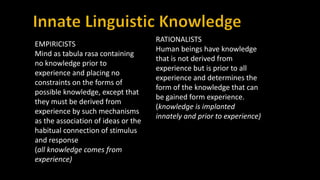
EMPIRICISTS
Mind as tabula rasa containing
no knowledge prior to
experience and placing no
constraints on the forms of
possible knowledge, except that
they must be derived from
experience by such mechanisms
as the association of ideas or the
habitual connection of stimulus
and response
(all knowledge comes from
experience)
RATIONALISTS
Human beings have knowledge
that is not derived from
experience but is prior to all
experience and determines the
form of the knowledge that can
be gained form experience.
(knowledge is implanted
innately and prior to experience)
●In the 1960’s, Chomsky introduced two central
ideas relevant to the construction and evaluation
of grammatical theories
First:
Distinction between
COMPETENCE and
PERFORMANCE
●Chomsky noted the obvious fact that people,
when speaking in the real world, often make
linguistic errors (e.g., starting a sentence and
then abandoning it midway through). He
argued that these errors in linguistic
performance were irrelevant to the study of
linguistic competence
●the knowledge that allows people to construct and understand grammatical
sentences
●”Minimalist Program” aims at the further development of ideas involving
economy of derivation and economy of representation
●a principle stating that
movements (i.e., transformations)
only occur in order to match
interpretable features with
uninterpretable features.
●the plural inflection on regular English nouns, e.g.,
dogs. The word dogs can only be used to refer to
several dogs, not a single dog , and so this inflection
contributes to meaning, making it interpretable. English
verbs are inflected according to the number of their
subject (e.g., “Dogs bite.” vs “A dog bites.”), but in most
sentences this inflection just duplicates the information
about number that the subject noun already has, and it
is therefore uninterpretable.
●the principle that grammatical
structures must exist for a purpose,
i.e., the structure of a sentence should
be no larger or more complex than
required to satisfy constraints on
grammaticality .
E N D

Transformational Grammar

  • 1.
  • 2.
    LANGUAGE AND GRAMMAR •Froma linguistic perspective, a grammar is a description of a person’s linguistic knowledge
  • 3.
    DEFINITION OF LANGUAGE -alanguage can be defined as an infinite set of well- formed sentences GRAMMAR - A formal device with a finite set of rules that generates the sentences in the language
  • 4.
    ● a devicefor generating sentences in a language ● it generates only the well- formed or grammatically correct sentences of a language since it is meant to create the rules and principles which are in the mind or brain of a native speaker
  • 5.
    ●Noam Chomsky believedthat grammar has recursive rules allowing one to generate grammatically correct sentences over and over. ● Our brain has a mechanism which can create language by following the language principles and grammar.
  • 6.
    ● Transformational Processof the Syntactic Structures according to Chomsky’s Transformational Grammar can be best summarized by adding, deleting, moving, and substituting of words. These changes take place through specific rules, which are called Transformational Rules.
  • 7.
    Generally, any sentence structurecontains a noun phrase (NP) and a verb phrase(VP).
  • 8.
    - In thesentence : “ Vicki laughed.” ‘Vicki’ is a NP and ‘laughed’ is a VP. The sentence could change to: “The woman laughed.” ‘The woman’ is the NP and ‘laughed’ is the VP. You can extend the sentence to: “Vicki who lives near me laughed.” “Vicki who lives near me” is the NP; “laughed” is the VP. Expanding the sentence, “Vicki who lives near me laughed loudly.” The NP consists of “Vicki who lives near me” and the VP is “laughed loudly.”
  • 9.
    ● Deep Structuresare the input to the semantic component, which describes their meaning. ●Surface structures are the input to the phonological component, which describes their sound. ●In short, deep structure determines meaning, surface structure determines sound.
  • 10.
    EMPIRICISTS Mind as tabularasa containing no knowledge prior to experience and placing no constraints on the forms of possible knowledge, except that they must be derived from experience by such mechanisms as the association of ideas or the habitual connection of stimulus and response (all knowledge comes from experience) RATIONALISTS Human beings have knowledge that is not derived from experience but is prior to all experience and determines the form of the knowledge that can be gained form experience. (knowledge is implanted innately and prior to experience)
  • 12.
    ●In the 1960’s,Chomsky introduced two central ideas relevant to the construction and evaluation of grammatical theories
  • 13.
  • 14.
    ●Chomsky noted theobvious fact that people, when speaking in the real world, often make linguistic errors (e.g., starting a sentence and then abandoning it midway through). He argued that these errors in linguistic performance were irrelevant to the study of linguistic competence
  • 15.
    ●the knowledge thatallows people to construct and understand grammatical sentences ●”Minimalist Program” aims at the further development of ideas involving economy of derivation and economy of representation
  • 16.
    ●a principle statingthat movements (i.e., transformations) only occur in order to match interpretable features with uninterpretable features.
  • 17.
    ●the plural inflectionon regular English nouns, e.g., dogs. The word dogs can only be used to refer to several dogs, not a single dog , and so this inflection contributes to meaning, making it interpretable. English verbs are inflected according to the number of their subject (e.g., “Dogs bite.” vs “A dog bites.”), but in most sentences this inflection just duplicates the information about number that the subject noun already has, and it is therefore uninterpretable.
  • 18.
    ●the principle thatgrammatical structures must exist for a purpose, i.e., the structure of a sentence should be no larger or more complex than required to satisfy constraints on grammaticality .
  • 19.