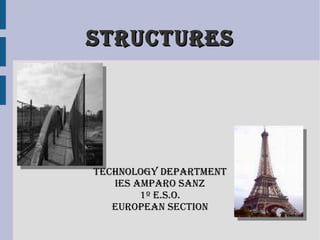
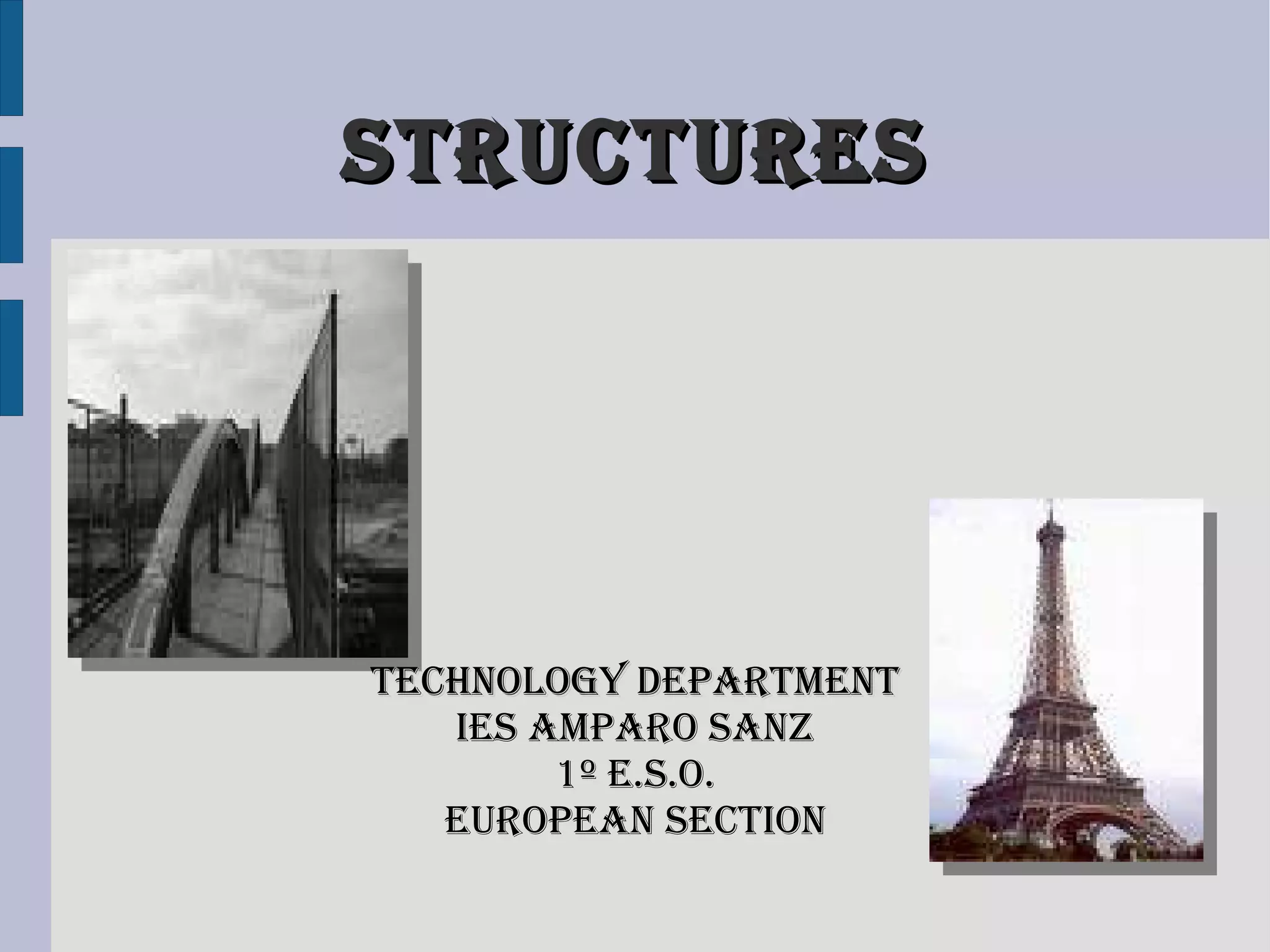
Structures Technology Department IES Amparo Sanz 1º E.S.O. European Section
INDEX Introduction Frame structures
Shell structures
Structural member
Redundant member What is force? Types of loads Types of force that act on a structure Tension
Compression/Pressure
Shear
Torsion
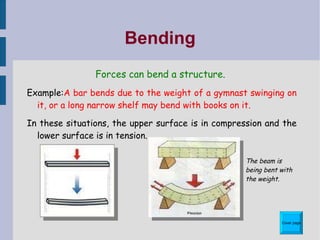
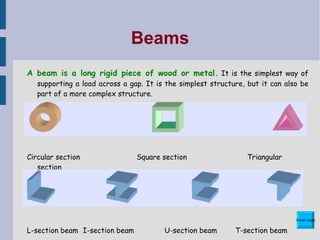
Bending Types of structures / Parts of structures. Beams
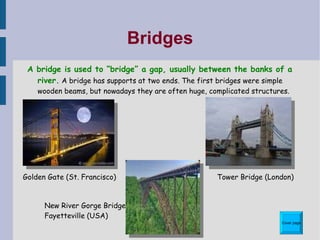
Bridges
Cantilevers
Columns and pillars
Ties
Struts
Triangulation Structures and the environment Damage to the environment Cover page
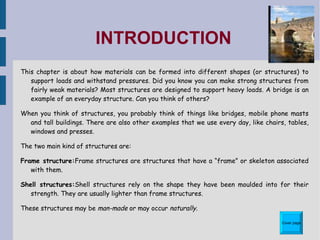
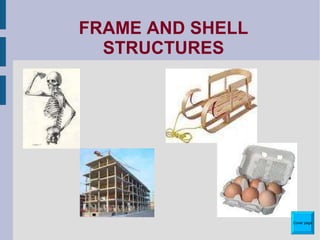
INTRODUCTION This chapter is about how materials can be formed into different shapes (or structures) to support loads and withstand pressures. Did you know you can make strong structures from fairly weak materials? Most structures are designed to support heavy loads. A bridge is an example of an everyday structure. Can you think of others? When you think of structures, you probably think of things like bridges, mobile phone masts and tall buildings. There are also other examples that we use every day, like chairs, tables, windows and presses. The two main kind of structures are: Frame structure: Frame structures are structures that have a “frame” or skeleton associated with them.
Shell structures: Shell structures rely on the shape they have been moulded into for their strength. They are usually lighter than frame structures. These structures may be  man-made  or may occur  naturally . Cover page
FRAME AND SHELL STRUCTURES Cover page
Structural Members STRUCTURAL MEMBER A structural member is a  part of a structure.  Tension Compression Redundant REDUNDANT MEMBER A  redundant member  is a part of a structure that is neither in tension nor compression. Redundant members can be removed from structures without the structure weakening. A good design has not redundant members. Cover page
What is a force? A force is a  push  or a  pull .   Forces can make things move.  Engines and motors make forces that cause machines to move. The force of gravity pulls everything downwards towards the earth. Force is measured in newtons (N), after  Sir Isaac Newton. TYPES OF LOADS:   Structures are built to support a load. Loads can be  static  (not moving) or  dynamic   (moving) Cover page
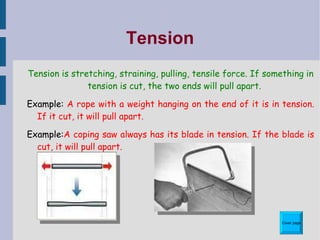
Types of forces that act on a structure Tension
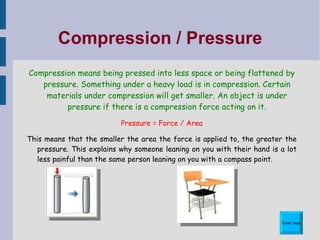
Compression / Pressure

Structures Presentation

  • 1.
    Structures Technology DepartmentIES Amparo Sanz 1º E.S.O. European Section
  • 2.
  • 3.
  • 4.
  • 5.
    Redundant member Whatis force? Types of loads Types of force that act on a structure Tension
  • 6.
  • 7.
  • 8.
  • 9.
    Bending Types ofstructures / Parts of structures. Beams
  • 10.
  • 11.
  • 12.
  • 13.
  • 14.
  • 15.
    Triangulation Structures andthe environment Damage to the environment Cover page
  • 16.
    INTRODUCTION This chapteris about how materials can be formed into different shapes (or structures) to support loads and withstand pressures. Did you know you can make strong structures from fairly weak materials? Most structures are designed to support heavy loads. A bridge is an example of an everyday structure. Can you think of others? When you think of structures, you probably think of things like bridges, mobile phone masts and tall buildings. There are also other examples that we use every day, like chairs, tables, windows and presses. The two main kind of structures are: Frame structure: Frame structures are structures that have a “frame” or skeleton associated with them.
  • 17.
    Shell structures: Shellstructures rely on the shape they have been moulded into for their strength. They are usually lighter than frame structures. These structures may be man-made or may occur naturally . Cover page
  • 18.
    FRAME AND SHELLSTRUCTURES Cover page
  • 19.
    Structural Members STRUCTURALMEMBER A structural member is a part of a structure. Tension Compression Redundant REDUNDANT MEMBER A redundant member is a part of a structure that is neither in tension nor compression. Redundant members can be removed from structures without the structure weakening. A good design has not redundant members. Cover page
  • 20.
    What is aforce? A force is a push or a pull . Forces can make things move. Engines and motors make forces that cause machines to move. The force of gravity pulls everything downwards towards the earth. Force is measured in newtons (N), after Sir Isaac Newton. TYPES OF LOADS: Structures are built to support a load. Loads can be static (not moving) or dynamic (moving) Cover page
  • 21.
    Types of forcesthat act on a structure Tension
  • 22.