Particle and Nuclear Physics
The students should be able to:
• infer from the results of the α-particle scattering experiment the existence and small
size of the nucleus
• describe a simple model for the nuclear atom to include protons, neutrons and
orbital electrons
Learning Objectives
Atoms
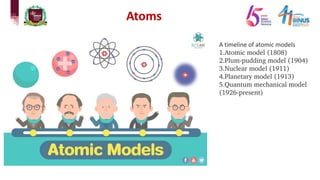
A timeline of atomic models
1.Atomic model (1808)
2.Plum-pudding model (1904)
3.Nuclear model (1911)
4.Planetary model (1913)
5.Quantum mechanical model
(1926-present)
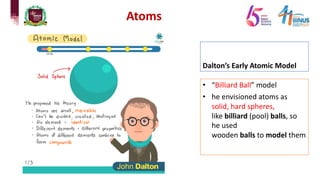
Dalton’s Early Atomic Model
• “Billiard Ball” model
• he envisioned atoms as
solid, hard spheres,
like billiard (pool) balls, so
he used
wooden balls to model them
Atoms
Atoms
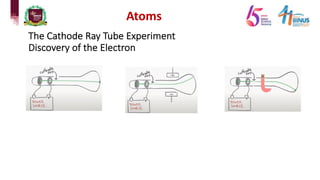
The Cathode Ray Tube Experiment
Discovery of the Electron
Atoms
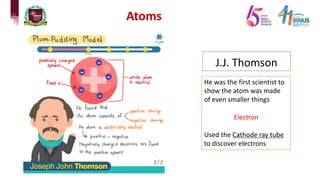
J.J. Thomson
He was the first scientist to
show the atom was made
of even smaller things
Electron
Used the Cathode ray tube
to discover electrons
Atoms
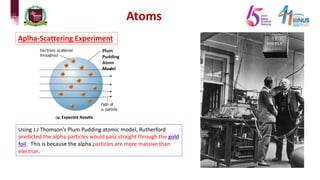
Using J.J Thomson’s Plum Pudding atomic model, Rutherford
predicted the alpha particles would pass straight through the gold
foil. This is because the alpha particles are more massive than
electron.
Aplha-Scattering Experiment
Atoms
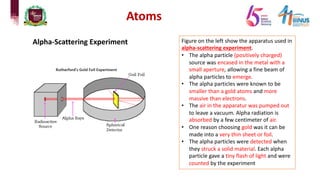
Figure on the left show the apparatus used in
alpha-scattering experiment.
• The alpha particle (positively charged)
source was encased in the metal with a
small aperture, allowing a fine beam of
alpha particles to emerge.
• The alpha particles were known to be
smaller than a gold atoms and more
massive than electrons.
• The air in the apparatur was pumped out
to leave a vacuum. Alpha radiation is
absorbed by a few centimeter of air.
• One reason choosing gold was it can be
made into a very thin sheet or foil.
• The alpha particles were detected when
they struck a solid material. Each alpha
particle gave a tiny flash of light and were
counted by the experiment
Alpha-Scattering Experiment
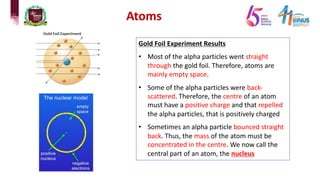
Gold Foil Experiment Results
• Most of the alpha particles went straight
through the gold foil. Therefore, atoms are
mainly empty space.
• Some of the alpha particles were back-
scattered. Therefore, the centre of an atom
must have a positive charge and that repelled
the alpha particles, that is positively charged
• Sometimes an alpha particle bounced straight
back. Thus, the mass of the atom must be
concentrated in the centre. We now call the
central part of an atom, the nucleus
Atoms
Atoms
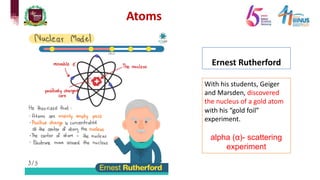
Ernest Rutherford
With his students, Geiger
and Marsden, discovered
the nucleus of a gold atom
with his “gold foil”
experiment.
alpha (α)- scattering
experiment
Atoms
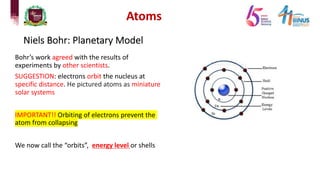
Niels Bohr: Planetary Model
Bohr’s work agreed with the results of
experiments by other scientists.
SUGGESTION: electrons orbit the nucleus at
specific distance. He pictured atoms as miniature
solar systems
IMPORTANT!! Orbiting of electrons prevent the
atom from collapsing
We now call the “orbits”, energy level or shells
Atoms
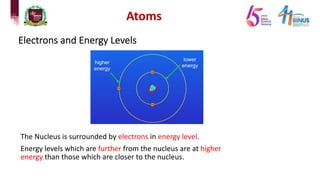
Electrons and Energy Levels
The Nucleus is surrounded by electrons in energy level.
Energy levels which are further from the nucleus are at higher
energy than those which are closer to the nucleus.
Atoms
Electrons and Energy Levels
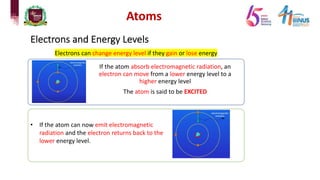
Electrons can change energy level if they gain or lose energy
• If the atom can now emit electromagnetic
radiation and the electron returns back to the
lower energy level.
If the atom absorb electromagnetic radiation, an
electron can move from a lower energy level to a
higher energy level
The atom is said to be EXCITED
Atoms
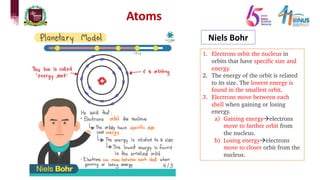
1. Electrons orbit the nucleus in
orbits that have specific size and
energy.
2. The energy of the orbit is related
to its size. The lowest energy is
found in the smallest orbit.
3. Electrons move between each
shell when gaining or losing
energy.
a) Gaining energyàelectrons
move to farther orbit from
the nucleus.
b) Losing energyàelectrons
move to closer orbit from the
nucleus.
Niels Bohr
Atoms
Protons and Neutrons
Further experiment by Rutherford found that
positive charge in the nucleus is actually made up of
small discreet positive particles called protons.
James Chadwick discovered that the nucleus also
contains neutrons. These have no charge, they are
neutral.
Atoms
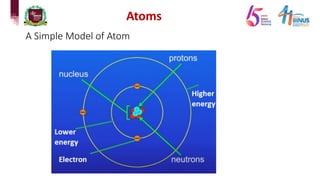
A Simple Model of Atom
Atoms
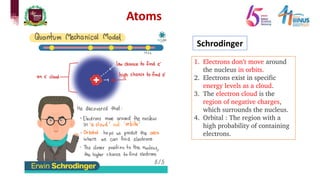
1. Electrons don’t move around
the nucleus in orbits.
2. Electrons exist in specific
energy levels as a cloud.
3. The electron cloud is the
region of negative charges,
which surrounds the nucleus.
4. Orbital : The region with a
high probability of containing
electrons.
Schrodinger
Learning Objectives
The students should be able to:
1. distinguish between nucleon number and proton number.
2. understand that isotopes are forms of the same element with different
numbers of neutrons in their nuclei.
3. understand and use the notation !
"
𝑋 for the representation of nuclides.
Nuclei
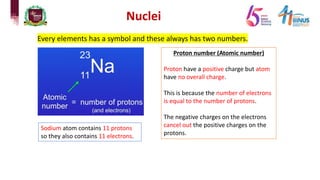
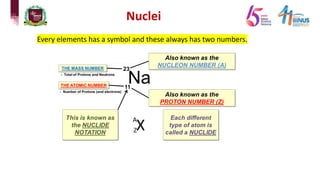
Every elements has a symbol and these always has two numbers.
Proton number (Atomic number)
Proton have a positive charge but atom
have no overall charge.
This is because the number of electrons
is equal to the number of protons.
The negative charges on the electrons
cancel out the positive charges on the
protons.
Sodium atom contains 11 protons
so they also contains 11 electrons.
Nuclei
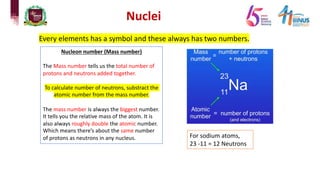
Every elements has a symbol and these always has two numbers.
Nucleon number (Mass number)
The Mass number tells us the total number of
protons and neutrons added together.
To calculate number of neutrons, substract the
atomic number from the mass number.
The mass number is always the biggest number.
It tells you the relative mass of the atom. It is
also always roughly double the atomic number.
Which means there’s about the same number
of protons as neutrons in any nucleus. For sodium atoms,
23 -11 = 12 Neutrons
Nuclei
Every elements has a symbol and these always has two numbers.
Nuclei
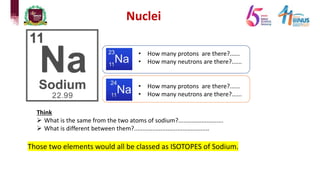
Think
Ø What is the same from the two atoms of sodium?...........................
Ø What is different between them?.............................................
Those two elements would all be classed as ISOTOPES of Sodium.
• How many protons are there?......
• How many neutrons are there?......
• How many protons are there?......
• How many neutrons are there?......
Nuclei
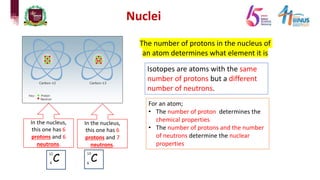
The number of protons in the nucleus of
an atom determines what element it is
Isotopes are atoms with the same
number of protons but a different
number of neutrons.
In the nucleus,
this one has 6
protons and 6
neutrons.
In the nucleus,
this one has 6
protons and 7
neutrons.
For an atom;
• The number of proton determines the
chemical properties
• The number of protons and the number
of neutrons determine the nuclear
properties
Nuclei and Radiation
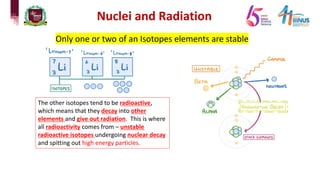
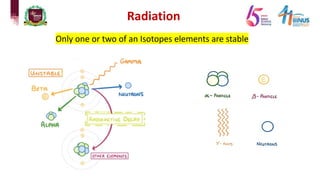
Only one or two of an Isotopes elements are stable
The other isotopes tend to be radioactive,
which means that they decay into other
elements and give out radiation. This is where
all radioactivity comes from – unstable
radioactive isotopes undergoing nuclear decay
and spitting out high energy particles.
Learning Objectives
The students should be able to:
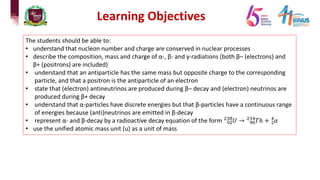
• understand that nucleon number and charge are conserved in nuclear processes
• describe the composition, mass and charge of α-, β- and γ-radiations (both β– (electrons) and
β+ (positrons) are included)
• understand that an antiparticle has the same mass but opposite charge to the corresponding
particle, and that a positron is the antiparticle of an electron
• state that (electron) antineutrinos are produced during β– decay and (electron) neutrinos are
produced during β+ decay
• understand that α-particles have discrete energies but that β-particles have a continuous range
of energies because (anti)neutrinos are emitted in β-decay
• represent α- and β-decay by a radioactive decay equation of the form !"
"#$
𝑈 → !%
"#&
𝑇ℎ + "
&
𝛼
• use the unified atomic mass unit (u) as a unit of mass
Radiation
Only one or two of an Isotopes elements are stable
Radiation
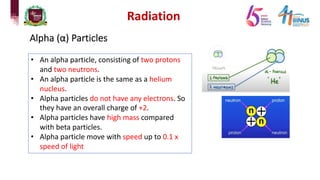
• An alpha particle, consisting of two protons
and two neutrons.
• An alpha particle is the same as a helium
nucleus.
• Alpha particles do not have any electrons. So
they have an overall charge of +2.
• Alpha particles have high mass compared
with beta particles.
• Alpha particle move with speed up to 0.1 x
speed of light
Alpha (α) Particles
Radiation
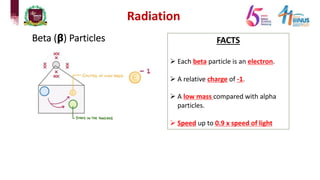
Beta (𝝱) Particles
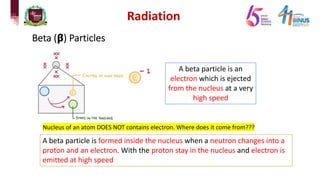
A beta particle is an
electron which is ejected
from the nucleus at a very
high speed
Nucleus of an atom DOES NOT contains electron. Where does it come from???
A beta particle is formed inside the nucleus when a neutron changes into a
proton and an electron. With the proton stay in the nucleus and electron is
emitted at high speed
Radiation
Beta (𝝱) Particles FACTS
Ø Each beta particle is an electron.
Ø A relative charge of -1.
Ø A low mass compared with alpha
particles.
Ø Speed up to 0.9 x speed of light
Radiation
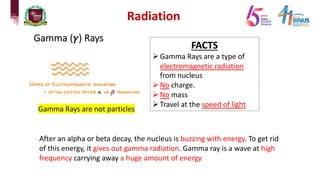
Gamma (𝛾) Rays
Gamma Rays are not particles
FACTS
ØGamma Rays are a type of
electromagnetic radiation
from nucleus
ØNo charge.
ØNo mass
ØTravel at the speed of light
After an alpha or beta decay, the nucleus is buzzing with energy. To get rid
of this energy, it gives out gamma radiation. Gamma ray is a wave at high
frequency carrying away a huge amount of energy
Radiation
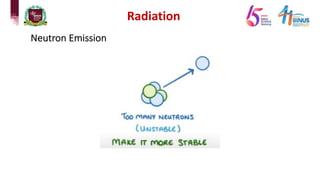
Neutron Emission
Radiation
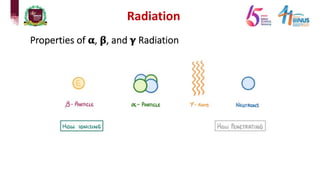
Properties of 𝛂, 𝛃, and 𝛄 Radiation
Radiation
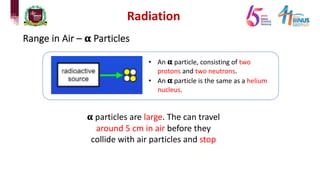
Range in Air – 𝛂 Particles
𝛂 particles are large. The can travel
around 5 cm in air before they
collide with air particles and stop
• An 𝛂 particle, consisting of two
protons and two neutrons.
• An 𝛂 particle is the same as a helium
nucleus.
Radiation
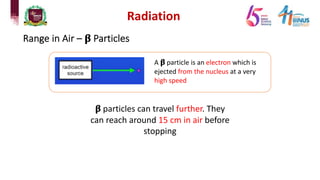
Range in Air – 𝛃 Particles
A 𝛃 particle is an electron which is
ejected from the nucleus at a very
high speed
𝛃 particles can travel further. They
can reach around 15 cm in air before
stopping
Radiation
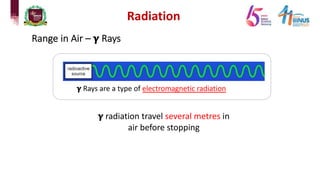
Range in Air – 𝛄 Rays
𝛄 Rays are a type of electromagnetic radiation
𝛄 radiation travel several metres in
air before stopping
Radiation
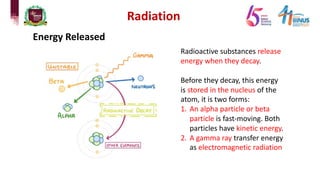
Energy Released
Radioactive substances release
energy when they decay.
Before they decay, this energy
is stored in the nucleus of the
atom, it is two forms:
1. An alpha particle or beta
particle is fast-moving. Both
particles have kinetic energy.
2. A gamma ray transfer energy
as electromagnetic radiation
Radiation
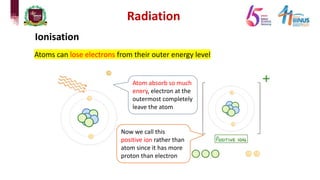
Atoms can lose electrons from their outer energy level
Atom absorb so much
enery, electron at the
outermost completely
leave the atom
Now we call this
positive ion rather than
atom since it has more
proton than electron
Ionisation
Radiation
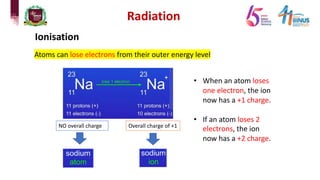
Atoms can lose electrons from their outer energy level
Ionisation
• When an atom loses
one electron, the ion
now has a +1 charge.
• If an atom loses 2
electrons, the ion
now has a +2 charge.
NO overall charge Overall charge of +1
Radiation
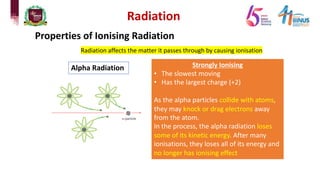
Properties of Ionising Radiation
Radiation affects the matter it passes through by causing ionisation
Alpha Radiation Strongly Ionising
• The slowest moving
• Has the largest charge (+2)
As the alpha particles collide with atoms,
they may knock or drag electrons away
from the atom.
In the process, the alpha radiation loses
some of its kinetic energy. After many
ionisations, they loses all of its energy and
no longer has ionising effect
Radiation
Properties of Ionising Radiation
Radiation affects the matter it passes through by causing ionisation
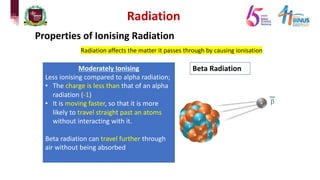
Beta Radiation
Moderately Ionising
Less ionising compared to alpha radiation;
• The charge is less than that of an alpha
radiation (-1)
• It is moving faster, so that it is more
likely to travel straight past an atoms
without interacting with it.
Beta radiation can travel further through
air without being absorbed
Radiation
Properties of Ionising Radiation
Radiation affects the matter it passes through by causing ionisation
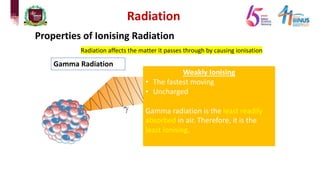
Gamma Radiation
Weakly Ionising
• The fastest moving
• Uncharged
Gamma radiation is the least readily
absorbed in air. Therefore, it is the
least ionising.
Radiation
Penetrating Power
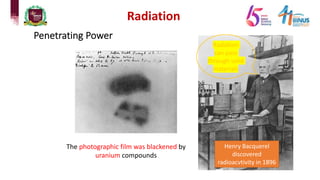
Radiation
can pass
through solid
materials
Henry Bacquerel
discovered
radioacvtivity in 1896
The photographic film was blackened by
uranium compounds
Radiation
What materials
can STOP alpha,
beta and gamma
radiation?
Radiation
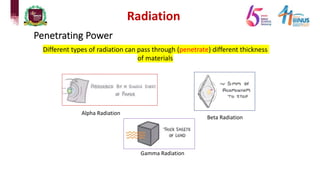
Different types of radiation can pass through (penetrate) different thickness
of materials
Penetrating Power
Alpha Radiation
Beta Radiation
Gamma Radiation
Radiation
Penetrating Power
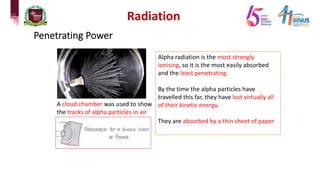
A cloud chamber was used to show
the tracks of alpha particles in air
Alpha radiation is the most strongly
ionising, so it is the most easily absorbed
and the least penetrating
By the time the alpha particles have
travelled this far, they have lost virtually all
of their kinetic energy.
They are absorbed by a thin sheet of paper
Radiation
Penetrating Power
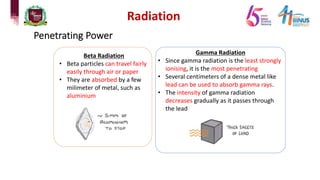
Beta Radiation
• Beta particles can travel fairly
easily through air or paper
• They are absorbed by a few
milimeter of metal, such as
aluminium
Gamma Radiation
• Since gamma radiation is the least strongly
ionising, it is the most penetrating
• Several centimeters of a dense metal like
lead can be used to absorb gamma rays.
• The intensity of gamma radiation
decreases gradually as it passes through
the lead
Particle and Nuclear Physics 1.pdf

Particle and Nuclear Physics 1.pdf

  • 1.
  • 2.
    The students shouldbe able to: • infer from the results of the α-particle scattering experiment the existence and small size of the nucleus • describe a simple model for the nuclear atom to include protons, neutrons and orbital electrons Learning Objectives
  • 3.
    Atoms A timeline ofatomic models 1.Atomic model (1808) 2.Plum-pudding model (1904) 3.Nuclear model (1911) 4.Planetary model (1913) 5.Quantum mechanical model (1926-present)
  • 4.
    Dalton’s Early AtomicModel • “Billiard Ball” model • he envisioned atoms as solid, hard spheres, like billiard (pool) balls, so he used wooden balls to model them Atoms
  • 5.
    Atoms The Cathode RayTube Experiment Discovery of the Electron
  • 6.
    Atoms J.J. Thomson He wasthe first scientist to show the atom was made of even smaller things Electron Used the Cathode ray tube to discover electrons
  • 7.
    Atoms Using J.J Thomson’sPlum Pudding atomic model, Rutherford predicted the alpha particles would pass straight through the gold foil. This is because the alpha particles are more massive than electron. Aplha-Scattering Experiment
  • 8.
    Atoms Figure on theleft show the apparatus used in alpha-scattering experiment. • The alpha particle (positively charged) source was encased in the metal with a small aperture, allowing a fine beam of alpha particles to emerge. • The alpha particles were known to be smaller than a gold atoms and more massive than electrons. • The air in the apparatur was pumped out to leave a vacuum. Alpha radiation is absorbed by a few centimeter of air. • One reason choosing gold was it can be made into a very thin sheet or foil. • The alpha particles were detected when they struck a solid material. Each alpha particle gave a tiny flash of light and were counted by the experiment Alpha-Scattering Experiment
  • 9.
    Gold Foil ExperimentResults • Most of the alpha particles went straight through the gold foil. Therefore, atoms are mainly empty space. • Some of the alpha particles were back- scattered. Therefore, the centre of an atom must have a positive charge and that repelled the alpha particles, that is positively charged • Sometimes an alpha particle bounced straight back. Thus, the mass of the atom must be concentrated in the centre. We now call the central part of an atom, the nucleus Atoms
  • 10.
    Atoms Ernest Rutherford With hisstudents, Geiger and Marsden, discovered the nucleus of a gold atom with his “gold foil” experiment. alpha (α)- scattering experiment
  • 11.
    Atoms Niels Bohr: PlanetaryModel Bohr’s work agreed with the results of experiments by other scientists. SUGGESTION: electrons orbit the nucleus at specific distance. He pictured atoms as miniature solar systems IMPORTANT!! Orbiting of electrons prevent the atom from collapsing We now call the “orbits”, energy level or shells
  • 12.
    Atoms Electrons and EnergyLevels The Nucleus is surrounded by electrons in energy level. Energy levels which are further from the nucleus are at higher energy than those which are closer to the nucleus.
  • 13.
    Atoms Electrons and EnergyLevels Electrons can change energy level if they gain or lose energy • If the atom can now emit electromagnetic radiation and the electron returns back to the lower energy level. If the atom absorb electromagnetic radiation, an electron can move from a lower energy level to a higher energy level The atom is said to be EXCITED
  • 14.
    Atoms 1. Electrons orbitthe nucleus in orbits that have specific size and energy. 2. The energy of the orbit is related to its size. The lowest energy is found in the smallest orbit. 3. Electrons move between each shell when gaining or losing energy. a) Gaining energyàelectrons move to farther orbit from the nucleus. b) Losing energyàelectrons move to closer orbit from the nucleus. Niels Bohr
  • 15.
    Atoms Protons and Neutrons Furtherexperiment by Rutherford found that positive charge in the nucleus is actually made up of small discreet positive particles called protons. James Chadwick discovered that the nucleus also contains neutrons. These have no charge, they are neutral.
  • 16.
  • 17.
    Atoms 1. Electrons don’tmove around the nucleus in orbits. 2. Electrons exist in specific energy levels as a cloud. 3. The electron cloud is the region of negative charges, which surrounds the nucleus. 4. Orbital : The region with a high probability of containing electrons. Schrodinger
  • 18.
    Learning Objectives The studentsshould be able to: 1. distinguish between nucleon number and proton number. 2. understand that isotopes are forms of the same element with different numbers of neutrons in their nuclei. 3. understand and use the notation ! " 𝑋 for the representation of nuclides.
  • 19.
    Nuclei Every elements hasa symbol and these always has two numbers. Proton number (Atomic number) Proton have a positive charge but atom have no overall charge. This is because the number of electrons is equal to the number of protons. The negative charges on the electrons cancel out the positive charges on the protons. Sodium atom contains 11 protons so they also contains 11 electrons.
  • 20.
    Nuclei Every elements hasa symbol and these always has two numbers. Nucleon number (Mass number) The Mass number tells us the total number of protons and neutrons added together. To calculate number of neutrons, substract the atomic number from the mass number. The mass number is always the biggest number. It tells you the relative mass of the atom. It is also always roughly double the atomic number. Which means there’s about the same number of protons as neutrons in any nucleus. For sodium atoms, 23 -11 = 12 Neutrons
  • 21.
    Nuclei Every elements hasa symbol and these always has two numbers.
  • 22.
    Nuclei Think Ø What isthe same from the two atoms of sodium?........................... Ø What is different between them?............................................. Those two elements would all be classed as ISOTOPES of Sodium. • How many protons are there?...... • How many neutrons are there?...... • How many protons are there?...... • How many neutrons are there?......
  • 23.
    Nuclei The number ofprotons in the nucleus of an atom determines what element it is Isotopes are atoms with the same number of protons but a different number of neutrons. In the nucleus, this one has 6 protons and 6 neutrons. In the nucleus, this one has 6 protons and 7 neutrons. For an atom; • The number of proton determines the chemical properties • The number of protons and the number of neutrons determine the nuclear properties
  • 24.
    Nuclei and Radiation Onlyone or two of an Isotopes elements are stable The other isotopes tend to be radioactive, which means that they decay into other elements and give out radiation. This is where all radioactivity comes from – unstable radioactive isotopes undergoing nuclear decay and spitting out high energy particles.
  • 25.
    Learning Objectives The studentsshould be able to: • understand that nucleon number and charge are conserved in nuclear processes • describe the composition, mass and charge of α-, β- and γ-radiations (both β– (electrons) and β+ (positrons) are included) • understand that an antiparticle has the same mass but opposite charge to the corresponding particle, and that a positron is the antiparticle of an electron • state that (electron) antineutrinos are produced during β– decay and (electron) neutrinos are produced during β+ decay • understand that α-particles have discrete energies but that β-particles have a continuous range of energies because (anti)neutrinos are emitted in β-decay • represent α- and β-decay by a radioactive decay equation of the form !" "#$ 𝑈 → !% "#& 𝑇ℎ + " & 𝛼 • use the unified atomic mass unit (u) as a unit of mass
  • 26.
    Radiation Only one ortwo of an Isotopes elements are stable
  • 27.
    Radiation • An alphaparticle, consisting of two protons and two neutrons. • An alpha particle is the same as a helium nucleus. • Alpha particles do not have any electrons. So they have an overall charge of +2. • Alpha particles have high mass compared with beta particles. • Alpha particle move with speed up to 0.1 x speed of light Alpha (α) Particles
  • 28.
    Radiation Beta (𝝱) Particles Abeta particle is an electron which is ejected from the nucleus at a very high speed Nucleus of an atom DOES NOT contains electron. Where does it come from??? A beta particle is formed inside the nucleus when a neutron changes into a proton and an electron. With the proton stay in the nucleus and electron is emitted at high speed
  • 29.
    Radiation Beta (𝝱) ParticlesFACTS Ø Each beta particle is an electron. Ø A relative charge of -1. Ø A low mass compared with alpha particles. Ø Speed up to 0.9 x speed of light
  • 30.
    Radiation Gamma (𝛾) Rays GammaRays are not particles FACTS ØGamma Rays are a type of electromagnetic radiation from nucleus ØNo charge. ØNo mass ØTravel at the speed of light After an alpha or beta decay, the nucleus is buzzing with energy. To get rid of this energy, it gives out gamma radiation. Gamma ray is a wave at high frequency carrying away a huge amount of energy
  • 31.
  • 32.
    Radiation Properties of 𝛂,𝛃, and 𝛄 Radiation
  • 33.
    Radiation Range in Air– 𝛂 Particles 𝛂 particles are large. The can travel around 5 cm in air before they collide with air particles and stop • An 𝛂 particle, consisting of two protons and two neutrons. • An 𝛂 particle is the same as a helium nucleus.
  • 34.
    Radiation Range in Air– 𝛃 Particles A 𝛃 particle is an electron which is ejected from the nucleus at a very high speed 𝛃 particles can travel further. They can reach around 15 cm in air before stopping
  • 35.
    Radiation Range in Air– 𝛄 Rays 𝛄 Rays are a type of electromagnetic radiation 𝛄 radiation travel several metres in air before stopping
  • 36.
    Radiation Energy Released Radioactive substancesrelease energy when they decay. Before they decay, this energy is stored in the nucleus of the atom, it is two forms: 1. An alpha particle or beta particle is fast-moving. Both particles have kinetic energy. 2. A gamma ray transfer energy as electromagnetic radiation
  • 37.
    Radiation Atoms can loseelectrons from their outer energy level Atom absorb so much enery, electron at the outermost completely leave the atom Now we call this positive ion rather than atom since it has more proton than electron Ionisation
  • 38.
    Radiation Atoms can loseelectrons from their outer energy level Ionisation • When an atom loses one electron, the ion now has a +1 charge. • If an atom loses 2 electrons, the ion now has a +2 charge. NO overall charge Overall charge of +1
  • 39.
    Radiation Properties of IonisingRadiation Radiation affects the matter it passes through by causing ionisation Alpha Radiation Strongly Ionising • The slowest moving • Has the largest charge (+2) As the alpha particles collide with atoms, they may knock or drag electrons away from the atom. In the process, the alpha radiation loses some of its kinetic energy. After many ionisations, they loses all of its energy and no longer has ionising effect
  • 40.
    Radiation Properties of IonisingRadiation Radiation affects the matter it passes through by causing ionisation Beta Radiation Moderately Ionising Less ionising compared to alpha radiation; • The charge is less than that of an alpha radiation (-1) • It is moving faster, so that it is more likely to travel straight past an atoms without interacting with it. Beta radiation can travel further through air without being absorbed
  • 41.
    Radiation Properties of IonisingRadiation Radiation affects the matter it passes through by causing ionisation Gamma Radiation Weakly Ionising • The fastest moving • Uncharged Gamma radiation is the least readily absorbed in air. Therefore, it is the least ionising.
  • 42.
    Radiation Penetrating Power Radiation can pass throughsolid materials Henry Bacquerel discovered radioacvtivity in 1896 The photographic film was blackened by uranium compounds
  • 43.
    Radiation What materials can STOPalpha, beta and gamma radiation?
  • 44.
    Radiation Different types ofradiation can pass through (penetrate) different thickness of materials Penetrating Power Alpha Radiation Beta Radiation Gamma Radiation
  • 45.
    Radiation Penetrating Power A cloudchamber was used to show the tracks of alpha particles in air Alpha radiation is the most strongly ionising, so it is the most easily absorbed and the least penetrating By the time the alpha particles have travelled this far, they have lost virtually all of their kinetic energy. They are absorbed by a thin sheet of paper
  • 46.
    Radiation Penetrating Power Beta Radiation •Beta particles can travel fairly easily through air or paper • They are absorbed by a few milimeter of metal, such as aluminium Gamma Radiation • Since gamma radiation is the least strongly ionising, it is the most penetrating • Several centimeters of a dense metal like lead can be used to absorb gamma rays. • The intensity of gamma radiation decreases gradually as it passes through the lead