

FEMTOCELLS : Past ,Present &
Future

Nisha Menon K
Mtech Communication Engg

25 October 2013

1
Outline
Introduction
 Motivation
 Working of femtocell
 Femtocell requirements
 Features of femtocell
 Challenges
 Benefits of femtocell
 Conclusion
 Reference


25 October 2013

2
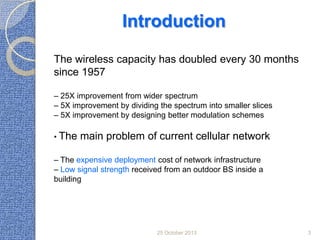
Introduction
The wireless capacity has doubled every 30 months
since 1957
– 25X improvement from wider spectrum
– 5X improvement by dividing the spectrum into smaller slices
– 5X improvement by designing better modulation schemes

• The

main problem of current cellular network

– The expensive deployment cost of network infrastructure
– Low signal strength received from an outdoor BS inside a
building

25 October 2013

3
Motivation
• Some

studies on wireless usage show

– More than 50% voice calls and more than 70% data traffic are
originated indoor

• Win-Win strategy
– Higher data rate and reliability for subscribers (User)
– Reduced amount of traffic on expensive macrocell network
(Operator)

25 October 2013

4
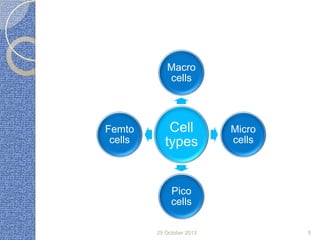
Macro
cells

Femto
cells

Cell
types

Micro
cells

Pico
cells
25 October 2013

5
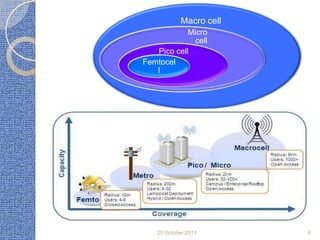
Macro cell
Micro
cell
Pico cell
Femtocel
l

25 October 2013

6
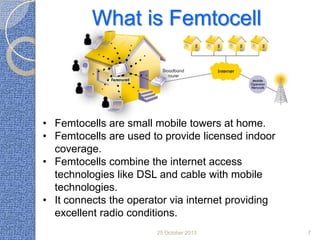
What is Femtocell

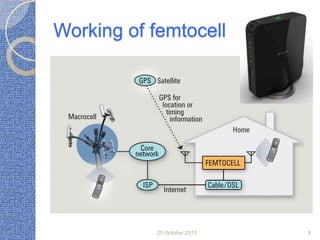
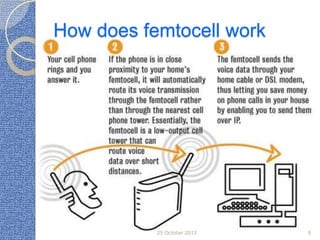
• Femtocells are small mobile towers at home.
• Femtocells are used to provide licensed indoor
coverage.
• Femtocells combine the internet access
technologies like DSL and cable with mobile
technologies.
• It connects the operator via internet providing
excellent radio conditions.
25 October 2013

7
Working of femtocell

25 October 2013

8
How does femtocell work

25 October 2013

9
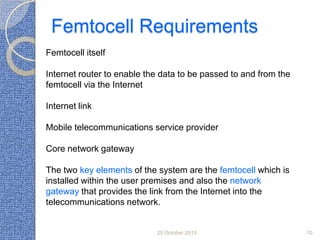
Femtocell Requirements
Femtocell itself
Internet router to enable the data to be passed to and from the
femtocell via the Internet
Internet link
Mobile telecommunications service provider
Core network gateway
The two key elements of the system are the femtocell which is
installed within the user premises and also the network
gateway that provides the link from the Internet into the
telecommunications network.

25 October 2013

10
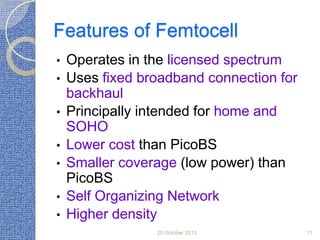
Features of Femtocell
•
•
•
•
•

•
•

Operates in the licensed spectrum
Uses fixed broadband connection for
backhaul
Principally intended for home and
SOHO
Lower cost than PicoBS
Smaller coverage (low power) than
PicoBS
Self Organizing Network
Higher density
25 October 2013

11
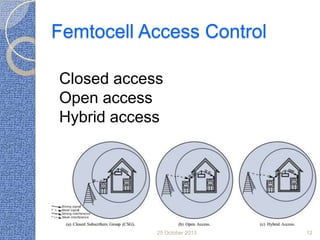
Femtocell Access Control
Closed access
Open access
Hybrid access

25 October 2013

12
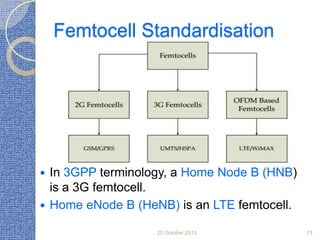
Femtocell Standardisation

In 3GPP terminology, a Home Node B (HNB)
is a 3G femtocell.
 Home eNode B (HeNB) is an LTE femtocell.


25 October 2013

13
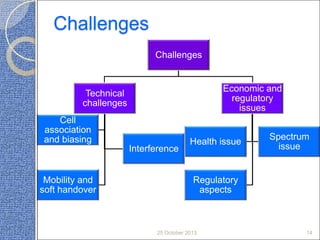
Challenges
Challenges

Economic and
regulatory
issues

Technical
challenges
Cell
association
and biasing
Interference
Mobility and
soft handover

Health issue

Spectrum
issue

Regulatory
aspects

25 October 2013

14
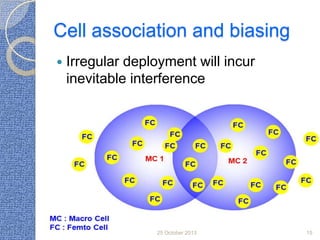
Cell association and biasing


Irregular deployment will incur
inevitable interference

25 October 2013

15
Interference analysis
Random placements of FAPs.
 Cochannel spectrum sharing between
femtocells and macrocells
 Two types of interferences


• Cross layer interference
• Situations in which the aggressor (FAP) and
the victim (macro cell user) of interference
belong the different network layers

• Co layer interference
• Here the aggressor(FAP) and the
victim(neighbour femto cell user) belong to
same network layer
25 October 2013

16
Proposed methods to overcome
interference


Interference cancellation technique
◦ Disregarded due to errors in the cancellation
process



Use of sectoral antennas at FAP
◦ Reducing interference by decreasing the
number of interferers




Dynamic selection of predefined antenna
patterns
Interference avoidance (power and
subchannel management)
◦ Good alternative
25 October 2013

17
Handover


Handover in femtocells highly depends upon the access
mode being used. The number of handover is very
large in the case of open access, while are reduced in
closed and hybrid access modes



Soft handover is not supported by femtocells

Inbound: handover occurs from the macro-cell or
standard cellular network to the femtocell.
 Outbound: handover occurs from the femtocell to the
macro-cell or standard cellular network.
 Femtocell to femtocell: There will be situations where
handover will occur between one femtocell and another
close by. This will be commonplace in offices that may
have a number of femtocells to give continuous
coverage within a building.


25 October 2013

18
Femtocell spectrum issues
Radio spectrum is a particularly scarce
resource, especially when large amounts
of data are required. Planning the
available spectrum so that it can be used
with the possible huge numbers of
femtocells can require careful attention,
although in some instances single
channel operation with main base
stations may be required
25 October 2013

19
Femtocell regulatory issues:
Femtocells operate in licensed or
regulated spectrum. Unlike Wi-Fi which
operates in unlicensed spectrum,
femtocells need regulatory approval.
The spectrum and radio regulations vary
from one country to the next and therefore
regulations may need to be changed in
each country. International agreement
may also be required, because private
individuals may take femtocells from one
country to the next.
25 October 2013

20
Femtocells and health issues:
As a femtocell is a cellular base
station, there could be public concern
regarding the levels of RF radiation
received
The power levels emitted by femtocells
are small - no greater than most Wi-Fi
access points which are common in very
many homes. As a result it is not
believed by the industry in general that
there are any health issues that should
cause any concern.
25 October 2013

21
BENEFITS OF FEMTOCELLS
Technical Advantages






Low Cost
Low Power
Easy to Use
Compatibility & Interoperability
Deployment

Customer’s point of view





Increased Indoor Coverage
Load sharing
Better Voice Quality
Better Data/Multimedia Experience

Wireless Operator’s point of view




Lower CAPEX and OPEX
Increased network capacity
Newer Revenue Opportunities
25 October 2013

22
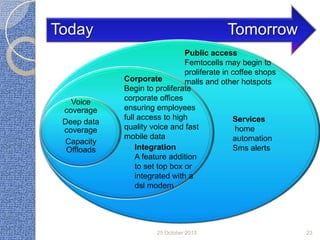
Today

Voice
coverage
Deep data
coverage
Capacity
Offloads

Tomorrow
Public access
Femtocells may begin to
proliferate in coffee shops
Corporate
malls and other hotspots
Begin to proliferate
corporate offices
ensuring employees
full access to high
Services
quality voice and fast
home
mobile data
automation
Integration
Sms alerts
A feature addition
to set top box or
integrated with a
dsl modem

25 October 2013

23
Conclusion


Unsatisfactory coverage and the increasing number of
application are two driving forces for femtocell
development



Femtocells have the potential to provide high-quality
network access to indoor users at low cost
– Improve coverage
– Provide huge capacity gain



Femtocells are considered to be the solution to meet the
future needs for high data rates and capacity in wireless
cellular networks.



The femtocells would also face tough competition from
the already established Wi-Fi technology and the
operators need to provide cheap services in order to
capture the future indoor wireless access market.
25 October 2013

24
Reference


Jeffrey G Andrews, Holger Claussen, Mischa Dohler, Sundeep
Rangan, Mark C Reed, “Femtocells: Past, Present and Future” IEEE
Communications Magazine, vol. 30,April 2012



V. Chandrasekhar, J. G. Andrews, and A. Gatherer, “Femtocell
networks:a survey,” IEEE Communications Magazine, vol. 46, no. 9,
pp.59–67, September 2008.



H. Claussen, L. T. W. Ho, and L. G. Samuel, “An overview of the
femtocell concept,” Bell Labs Technical Journal, vol. 13, no. 1, pp.
221–245, May 2008



P. Xia, V. Chandrasekhar, and J. G. Andrews, “Open vs. closed access
femtocells in the uplink,” IEEE Transactions on Wireless
Communications, vol. 9, no. 10, pp. 3798 – 3809, Dec. 2010



Informa Telecoms & Media, “Femtocell Market Status,” Femtoforum
whitepaper, 2011.

25 October 2013

25
Queries ???
25 October 2013

26
Thank you
25 October 2013

27

Femtocells

  • 1.
    FEMTOCELLS : Past,Present & Future Nisha Menon K Mtech Communication Engg 25 October 2013 1
  • 2.
    Outline Introduction  Motivation  Workingof femtocell  Femtocell requirements  Features of femtocell  Challenges  Benefits of femtocell  Conclusion  Reference  25 October 2013 2
  • 3.
    Introduction The wireless capacityhas doubled every 30 months since 1957 – 25X improvement from wider spectrum – 5X improvement by dividing the spectrum into smaller slices – 5X improvement by designing better modulation schemes • The main problem of current cellular network – The expensive deployment cost of network infrastructure – Low signal strength received from an outdoor BS inside a building 25 October 2013 3
  • 4.
    Motivation • Some studies onwireless usage show – More than 50% voice calls and more than 70% data traffic are originated indoor • Win-Win strategy – Higher data rate and reliability for subscribers (User) – Reduced amount of traffic on expensive macrocell network (Operator) 25 October 2013 4
  • 5.
  • 6.
  • 7.
    What is Femtocell •Femtocells are small mobile towers at home. • Femtocells are used to provide licensed indoor coverage. • Femtocells combine the internet access technologies like DSL and cable with mobile technologies. • It connects the operator via internet providing excellent radio conditions. 25 October 2013 7
  • 8.
  • 9.
    How does femtocellwork 25 October 2013 9
  • 10.
    Femtocell Requirements Femtocell itself Internetrouter to enable the data to be passed to and from the femtocell via the Internet Internet link Mobile telecommunications service provider Core network gateway The two key elements of the system are the femtocell which is installed within the user premises and also the network gateway that provides the link from the Internet into the telecommunications network. 25 October 2013 10
  • 11.
    Features of Femtocell • • • • • • • Operatesin the licensed spectrum Uses fixed broadband connection for backhaul Principally intended for home and SOHO Lower cost than PicoBS Smaller coverage (low power) than PicoBS Self Organizing Network Higher density 25 October 2013 11
  • 12.
    Femtocell Access Control Closedaccess Open access Hybrid access 25 October 2013 12
  • 13.
    Femtocell Standardisation In 3GPPterminology, a Home Node B (HNB) is a 3G femtocell.  Home eNode B (HeNB) is an LTE femtocell.  25 October 2013 13
  • 14.
    Challenges Challenges Economic and regulatory issues Technical challenges Cell association and biasing Interference Mobilityand soft handover Health issue Spectrum issue Regulatory aspects 25 October 2013 14
  • 15.
    Cell association andbiasing  Irregular deployment will incur inevitable interference 25 October 2013 15
  • 16.
    Interference analysis Random placementsof FAPs.  Cochannel spectrum sharing between femtocells and macrocells  Two types of interferences  • Cross layer interference • Situations in which the aggressor (FAP) and the victim (macro cell user) of interference belong the different network layers • Co layer interference • Here the aggressor(FAP) and the victim(neighbour femto cell user) belong to same network layer 25 October 2013 16
  • 17.
    Proposed methods toovercome interference  Interference cancellation technique ◦ Disregarded due to errors in the cancellation process  Use of sectoral antennas at FAP ◦ Reducing interference by decreasing the number of interferers   Dynamic selection of predefined antenna patterns Interference avoidance (power and subchannel management) ◦ Good alternative 25 October 2013 17
  • 18.
    Handover  Handover in femtocellshighly depends upon the access mode being used. The number of handover is very large in the case of open access, while are reduced in closed and hybrid access modes  Soft handover is not supported by femtocells Inbound: handover occurs from the macro-cell or standard cellular network to the femtocell.  Outbound: handover occurs from the femtocell to the macro-cell or standard cellular network.  Femtocell to femtocell: There will be situations where handover will occur between one femtocell and another close by. This will be commonplace in offices that may have a number of femtocells to give continuous coverage within a building.  25 October 2013 18
  • 19.
    Femtocell spectrum issues Radiospectrum is a particularly scarce resource, especially when large amounts of data are required. Planning the available spectrum so that it can be used with the possible huge numbers of femtocells can require careful attention, although in some instances single channel operation with main base stations may be required 25 October 2013 19
  • 20.
    Femtocell regulatory issues: Femtocellsoperate in licensed or regulated spectrum. Unlike Wi-Fi which operates in unlicensed spectrum, femtocells need regulatory approval. The spectrum and radio regulations vary from one country to the next and therefore regulations may need to be changed in each country. International agreement may also be required, because private individuals may take femtocells from one country to the next. 25 October 2013 20
  • 21.
    Femtocells and healthissues: As a femtocell is a cellular base station, there could be public concern regarding the levels of RF radiation received The power levels emitted by femtocells are small - no greater than most Wi-Fi access points which are common in very many homes. As a result it is not believed by the industry in general that there are any health issues that should cause any concern. 25 October 2013 21
  • 22.
    BENEFITS OF FEMTOCELLS TechnicalAdvantages      Low Cost Low Power Easy to Use Compatibility & Interoperability Deployment Customer’s point of view     Increased Indoor Coverage Load sharing Better Voice Quality Better Data/Multimedia Experience Wireless Operator’s point of view    Lower CAPEX and OPEX Increased network capacity Newer Revenue Opportunities 25 October 2013 22
  • 23.
    Today Voice coverage Deep data coverage Capacity Offloads Tomorrow Public access Femtocellsmay begin to proliferate in coffee shops Corporate malls and other hotspots Begin to proliferate corporate offices ensuring employees full access to high Services quality voice and fast home mobile data automation Integration Sms alerts A feature addition to set top box or integrated with a dsl modem 25 October 2013 23
  • 24.
    Conclusion  Unsatisfactory coverage andthe increasing number of application are two driving forces for femtocell development  Femtocells have the potential to provide high-quality network access to indoor users at low cost – Improve coverage – Provide huge capacity gain  Femtocells are considered to be the solution to meet the future needs for high data rates and capacity in wireless cellular networks.  The femtocells would also face tough competition from the already established Wi-Fi technology and the operators need to provide cheap services in order to capture the future indoor wireless access market. 25 October 2013 24
  • 25.
    Reference  Jeffrey G Andrews,Holger Claussen, Mischa Dohler, Sundeep Rangan, Mark C Reed, “Femtocells: Past, Present and Future” IEEE Communications Magazine, vol. 30,April 2012  V. Chandrasekhar, J. G. Andrews, and A. Gatherer, “Femtocell networks:a survey,” IEEE Communications Magazine, vol. 46, no. 9, pp.59–67, September 2008.  H. Claussen, L. T. W. Ho, and L. G. Samuel, “An overview of the femtocell concept,” Bell Labs Technical Journal, vol. 13, no. 1, pp. 221–245, May 2008  P. Xia, V. Chandrasekhar, and J. G. Andrews, “Open vs. closed access femtocells in the uplink,” IEEE Transactions on Wireless Communications, vol. 9, no. 10, pp. 3798 – 3809, Dec. 2010  Informa Telecoms & Media, “Femtocell Market Status,” Femtoforum whitepaper, 2011. 25 October 2013 25
  • 26.
  • 27.