Postcolonial Theory
  Presentation by Irene Jade
What is ‘Post-colonialism’?
   Colonialism
• control or governing influence of a nation over a dependent
  country, territory, or people.

      Post-colonialism
•   is an intellectual direction that exists since around the middle of the 20th
    century.
•   It developed from and mainly refers to the time after colonialism.
•   The post-colonial direction was created as colonial countries became
    independent.
•   Nowadays, aspects of post-colonialism can be found not only in sciences
    concerning history, literature and politics, but also in approach to culture
    and identity
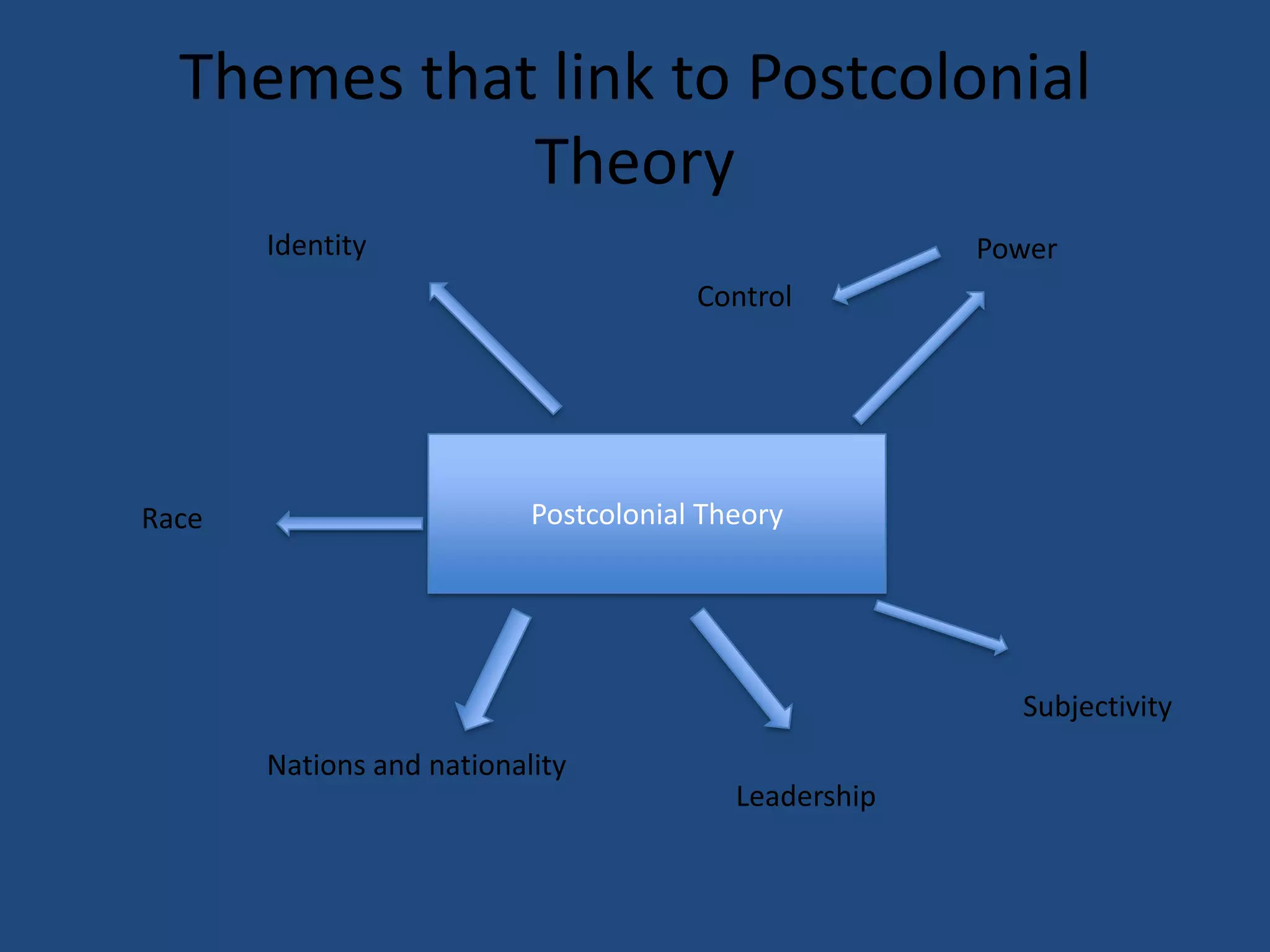
Themes that link to Postcolonial
             Theory
       Identity                                        Power
                                       Control


Race                       Postcolonial Theory


                                                         Subjectivity
       Nations and nationality
                                          Leadership
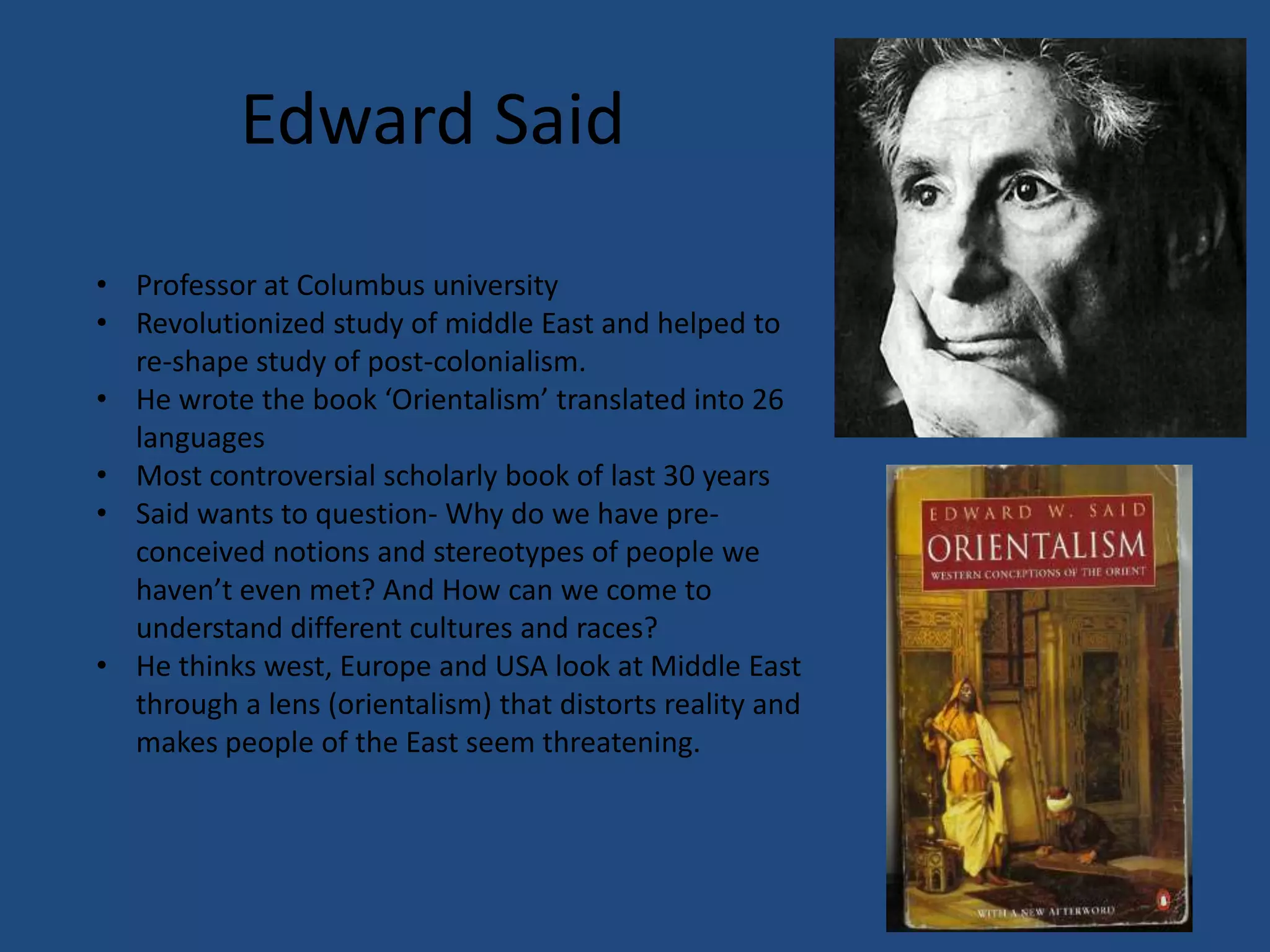
Edward Said
• Professor at Columbus university
• Revolutionized study of middle East and helped to
  re-shape study of post-colonialism.
• He wrote the book ‘Orientalism’ translated into 26
  languages
• Most controversial scholarly book of last 30 years
• Said wants to question- Why do we have pre-
  conceived notions and stereotypes of people we
  haven’t even met? And How can we come to
  understand different cultures and races?
• He thinks west, Europe and USA look at Middle East
  through a lens (orientalism) that distorts reality and
  makes people of the East seem threatening.
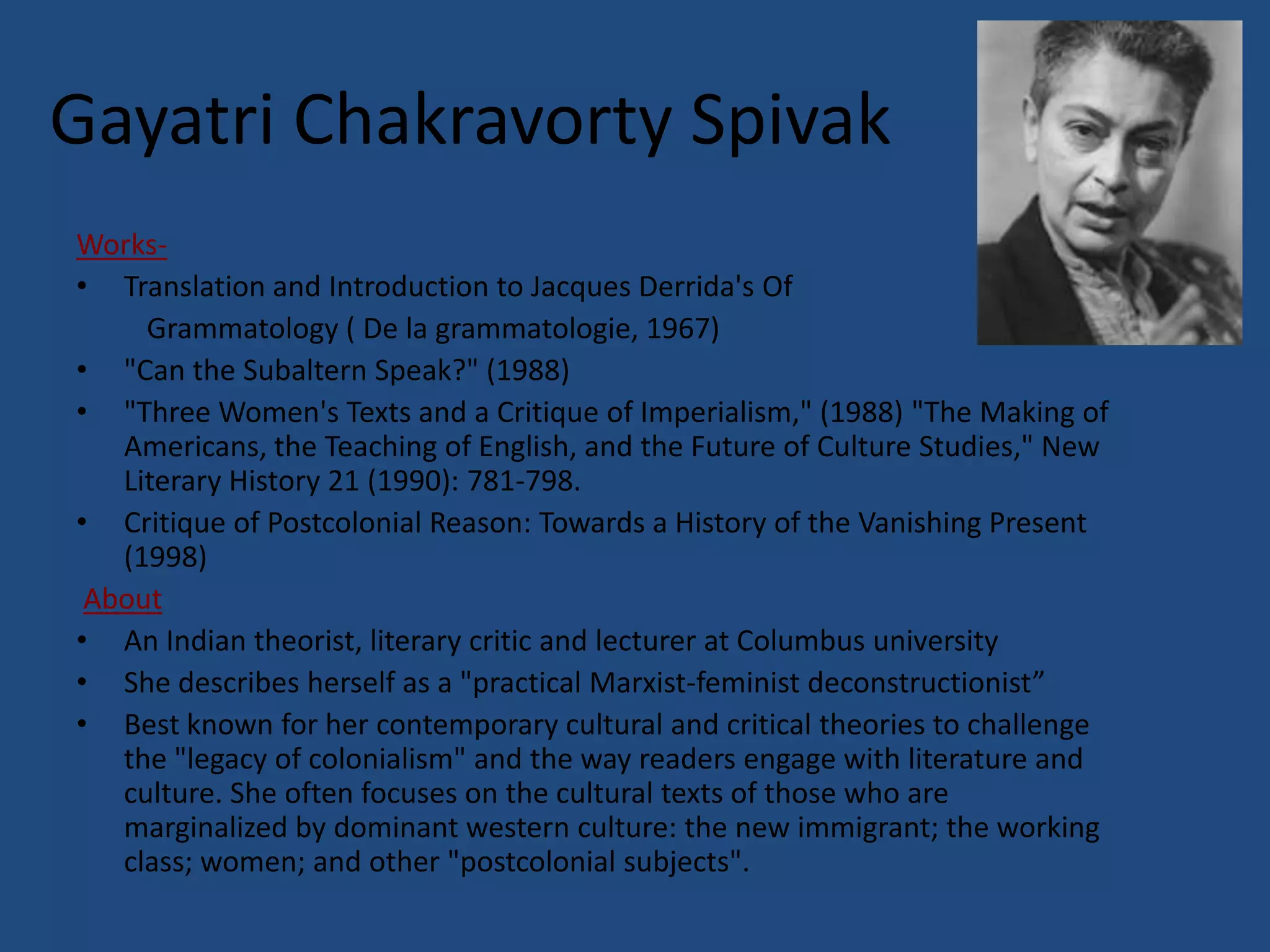
Gayatri Chakravorty Spivak
Works-
• Translation and Introduction to Jacques Derrida's Of
     Grammatology ( De la grammatologie, 1967)
• "Can the Subaltern Speak?" (1988)
• "Three Women's Texts and a Critique of Imperialism," (1988) "The Making of
   Americans, the Teaching of English, and the Future of Culture Studies," New
   Literary History 21 (1990): 781-798.
• Critique of Postcolonial Reason: Towards a History of the Vanishing Present
   (1998)
 About
• An Indian theorist, literary critic and lecturer at Columbus university
• She describes herself as a "practical Marxist-feminist deconstructionist”
• Best known for her contemporary cultural and critical theories to challenge
   the "legacy of colonialism" and the way readers engage with literature and
   culture. She often focuses on the cultural texts of those who are
   marginalized by dominant western culture: the new immigrant; the working
   class; women; and other "postcolonial subjects".
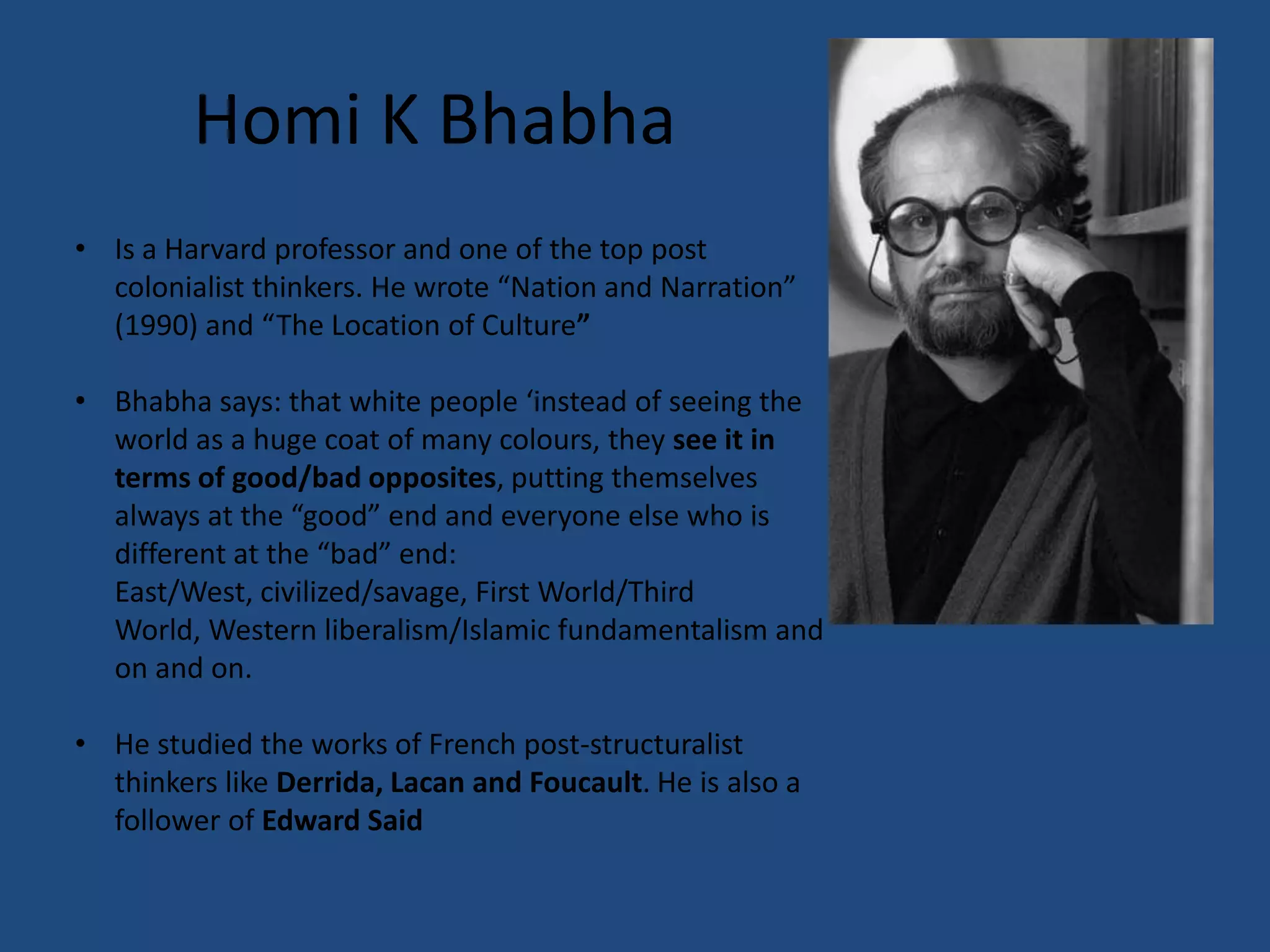
Homi K Bhabha
• Is a Harvard professor and one of the top post
  colonialist thinkers. He wrote “Nation and Narration”
  (1990) and “The Location of Culture”

• Bhabha says: that white people ‘instead of seeing the
  world as a huge coat of many colours, they see it in
  terms of good/bad opposites, putting themselves
  always at the “good” end and everyone else who is
  different at the “bad” end:
  East/West, civilized/savage, First World/Third
  World, Western liberalism/Islamic fundamentalism and
  on and on.

• He studied the works of French post-structuralist
  thinkers like Derrida, Lacan and Foucault. He is also a
  follower of Edward Said

Postcolonial theory

  • 1.
    Postcolonial Theory Presentation by Irene Jade
  • 2.
    What is ‘Post-colonialism’? Colonialism • control or governing influence of a nation over a dependent country, territory, or people. Post-colonialism • is an intellectual direction that exists since around the middle of the 20th century. • It developed from and mainly refers to the time after colonialism. • The post-colonial direction was created as colonial countries became independent. • Nowadays, aspects of post-colonialism can be found not only in sciences concerning history, literature and politics, but also in approach to culture and identity
  • 3.
    Themes that linkto Postcolonial Theory Identity Power Control Race Postcolonial Theory Subjectivity Nations and nationality Leadership
  • 4.
    Edward Said • Professorat Columbus university • Revolutionized study of middle East and helped to re-shape study of post-colonialism. • He wrote the book ‘Orientalism’ translated into 26 languages • Most controversial scholarly book of last 30 years • Said wants to question- Why do we have pre- conceived notions and stereotypes of people we haven’t even met? And How can we come to understand different cultures and races? • He thinks west, Europe and USA look at Middle East through a lens (orientalism) that distorts reality and makes people of the East seem threatening.
  • 5.
    Gayatri Chakravorty Spivak Works- •Translation and Introduction to Jacques Derrida's Of Grammatology ( De la grammatologie, 1967) • "Can the Subaltern Speak?" (1988) • "Three Women's Texts and a Critique of Imperialism," (1988) "The Making of Americans, the Teaching of English, and the Future of Culture Studies," New Literary History 21 (1990): 781-798. • Critique of Postcolonial Reason: Towards a History of the Vanishing Present (1998) About • An Indian theorist, literary critic and lecturer at Columbus university • She describes herself as a "practical Marxist-feminist deconstructionist” • Best known for her contemporary cultural and critical theories to challenge the "legacy of colonialism" and the way readers engage with literature and culture. She often focuses on the cultural texts of those who are marginalized by dominant western culture: the new immigrant; the working class; women; and other "postcolonial subjects".
  • 6.
    Homi K Bhabha •Is a Harvard professor and one of the top post colonialist thinkers. He wrote “Nation and Narration” (1990) and “The Location of Culture” • Bhabha says: that white people ‘instead of seeing the world as a huge coat of many colours, they see it in terms of good/bad opposites, putting themselves always at the “good” end and everyone else who is different at the “bad” end: East/West, civilized/savage, First World/Third World, Western liberalism/Islamic fundamentalism and on and on. • He studied the works of French post-structuralist thinkers like Derrida, Lacan and Foucault. He is also a follower of Edward Said