
–Johnny Appleseed
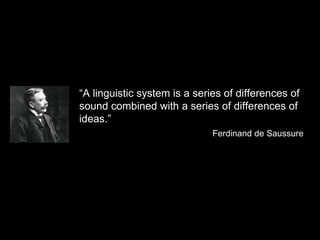
“A linguistic system is a series of differences of
sound combined with a series of differences of
ideas.”
Ferdinand de Saussure
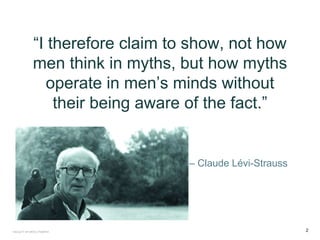
– Claude Lévi-Strauss
“I therefore claim to show, not how
men think in myths, but how myths
operate in men’s minds without
their being aware of the fact.”
FACULTY OF ARTS | FOAR701 2
FOAR701: Research paradigms (2017)
Structuralism*
3
Greg Downey
Department of Anthropology
Faculty of Arts
Macquarie University
greg.downey@mq.edu.au
@gregdowney1
* includes material by Prof. Nicole Anderson.
Caution!
Use of ‘structure.’
Structural functionalism v
structuralism and post-
structuralism.
Social v. mental.
FACULTY OF ARTS | FOAR701
4
Structuralism as a paradigm shift
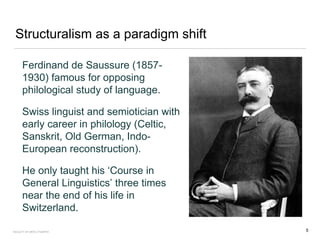
Ferdinand de Saussure (1857-
1930) famous for opposing
philological study of language.
Swiss linguist and semiotician with
early career in philology (Celtic,
Sanskrit, Old German, Indo-
European reconstruction).
He only taught his ‘Course in
General Linguistics’ three times
near the end of his life in
Switzerland.
FACULTY OF ARTS | FOAR701 5
Saussure – ‘Course in General Linguistics.’
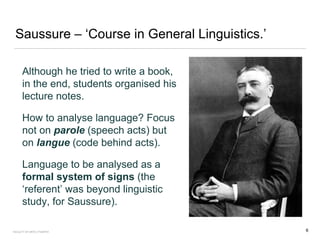
Although he tried to write a book,
in the end, students organised his
lecture notes.
How to analyse language? Focus
not on parole (speech acts) but
on langue (code behind acts).
Language to be analysed as a
formal system of signs (the
‘referent’ was beyond linguistic
study, for Saussure).
FACULTY OF ARTS | FOAR701 6
Saussure – ‘Course in General Linguistics.’
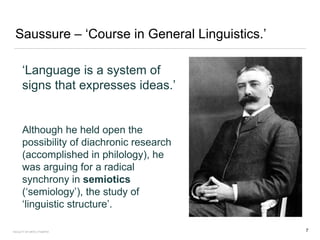
‘Language is a system of
signs that expresses ideas.’
Although he held open the
possibility of diachronic research
(accomplished in philology), he
was arguing for a radical
synchrony in semiotics
(‘semiology’), the study of
‘linguistic structure’.
FACULTY OF ARTS | FOAR701 7
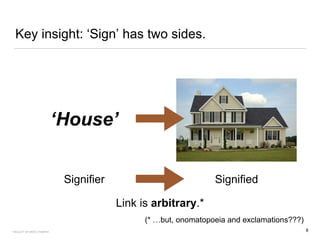
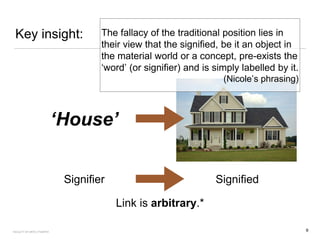
Key insight: ‘Sign’ has two sides.
Signifier Signified
‘House’
Link is arbitrary.*
FACULTY OF ARTS | FOAR701 8
(* …but, onomatopoeia and exclamations???)
Key insight:
Signifier Signified
‘House’
Link is arbitrary.*
The fallacy of the traditional position lies in
their view that the signified, be it an object in
the material world or a concept, pre-exists the
‘word’ (or signifier) and is simply labelled by it.
(Nicole’s phrasing)
FACULTY OF ARTS | FOAR701 9
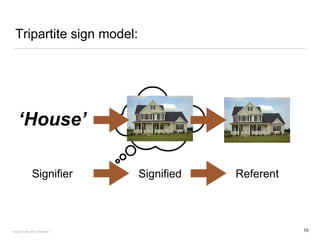
Tripartite sign model:
Signifier Signified
‘House’
FACULTY OF ARTS | FOAR701 10
Referent
FACULTY OF ARTS | FOAR701 11
Signs
Eagle by m. turan ercan from the Noun Project
bird
symbol index icon
physical
resemblance to
signified.
physical link to
signified.
e.g., smoke & fire
cultural and arbitrary
Charles Sanders Peirce
FACULTY OF ARTS | FOAR701 12
SignsSkull by Aleksandr Vector from the Noun Project
denotation connotation
associated ideas or
feelings
direct or specific
significance
Heart by Ali Coşkun from the Noun Project
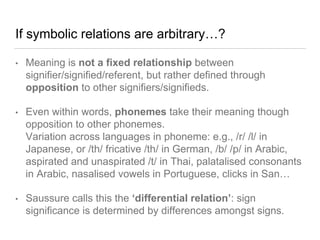
If symbolic relations are arbitrary…?
• Meaning is not a fixed relationship between
signifier/signified/referent, but rather defined through
opposition to other signifiers/signifieds.
• Even within words, phonemes take their meaning though
opposition to other phonemes.
Variation across languages in phoneme: e.g., /r/ /l/ in
Japanese, or /th/ fricative /th/ in German, /b/ /p/ in Arabic,
aspirated and unaspirated /t/ in Thai, palatalised consonants
in Arabic, nasalised vowels in Portuguese, clicks in San…
• Saussure calls this the ‘differential relation’: sign
significance is determined by differences amongst signs.
FACULTY OF ARTS | FOAR701 14
Semiotic relations
English ‘sheep’ ‘mutton’
French ‘mouton’
Sheep by Nook Fulloption from the Noun Project
FACULTY OF ARTS | FOAR701 15
ParadigmsSyntagms
Their tiger stood by my friend.
That wolf sat over your tree.
The dog walked on the floor.
My cat bounced under Nicole’s mat.
Your cow jumped above Anthony’s fridge.
(vertical)(horizontal)
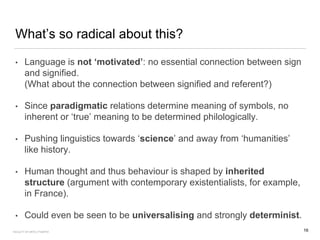
What’s so radical about this?
• Language is not ‘motivated’: no essential connection between sign
and signified.
(What about the connection between signified and referent?)
• Since paradigmatic relations determine meaning of symbols, no
inherent or ‘true’ meaning to be determined philologically.
• Pushing linguistics towards ‘science’ and away from ‘humanities’
like history.
• Human thought and thus behaviour is shaped by inherited
structure (argument with contemporary existentialists, for example,
in France).
• Could even be seen to be universalising and strongly determinist.
16FACULTY OF ARTS | FOAR701
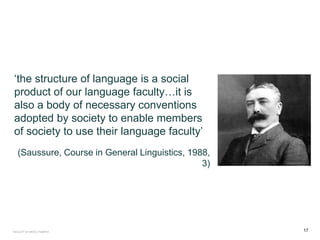
‘the structure of language is a social
product of our language faculty…it is
also a body of necessary conventions
adopted by society to enable members
of society to use their language faculty’
(Saussure, Course in General Linguistics, 1988,
3)
FACULTY OF ARTS | FOAR701 17
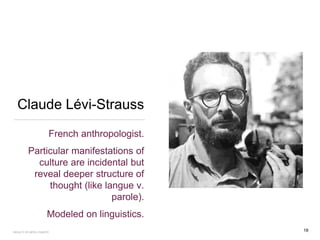
Claude Lévi-Strauss
French anthropologist.
Particular manifestations of
culture are incidental but
reveal deeper structure of
thought (like langue v.
parole).
Modeled on linguistics.
FACULTY OF ARTS | FOAR701
18
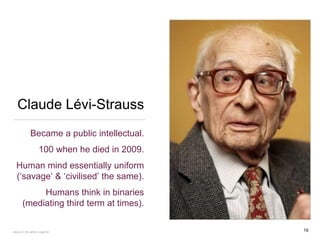
Claude Lévi-Strauss
Became a public intellectual.
100 when he died in 2009.
Human mind essentially uniform
(‘savage’ & ‘civilised’ the same).
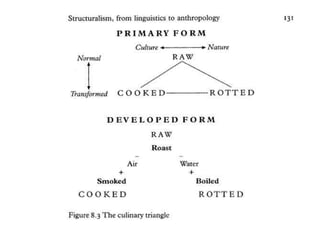
Humans think in binaries
(mediating third term at times).
FACULTY OF ARTS | FOAR701
19
FACULTY OF ARTS | FOAR701
“The unconscious activity of the mind consists in imposing
forms upon content, and if these forms are fundamentally
the same for all minds – ancient and modern, primitive and
civilized – it is necessary and sufficient to grasp the
unconscious structure underlying each institutions and
custom.”
(Lévi-Strauss, Structural Anthropology, 1963: 21)
Structural anthropology
• Systems arise from logical, not functional, structures.
e.g. kinship arises not from common descent but from the alliances formed
when man and woman marry (‘family’ only defined in opposition to others).
Incest taboo is not from biological problems but forces exogamous alliances
(borrowing from Marcel Mauss).
• Argues that if you know some relations between family members, you can
predict others based on their structure (systematic? scientific?).
• In The Savage Mind (translation problem), Lévi-Strauss argues that mind is
more like a bricoleur (savage mind) than an engineer (scientific mind).
Put him in conflict with Jean Paul Sartre.
• Four volume Mythologiques examines the structure underlying a single myth
with variations throughout all the Americas.
All variants were manifestations of a single underlying mytheme.
Myth often produces false resolution of irresolvable dichotomy.
21FACULTY OF ARTS | FOAR701
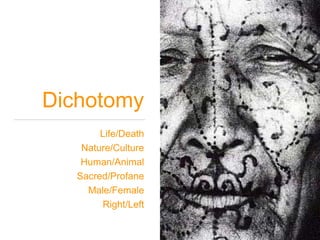
Dichotomy
Life/Death
Nature/Culture
Human/Animal
Sacred/Profane
Male/Female
Right/Left
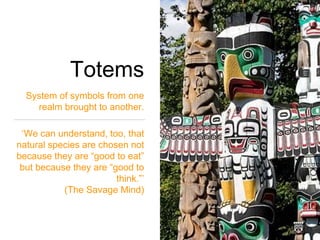
Totems
System of symbols from one
realm brought to another.
‘We can understand, too, that
natural species are chosen not
because they are “good to eat”
but because they are “good to
think.”’
(The Savage Mind)
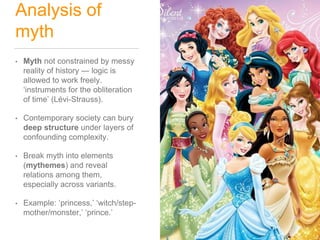
Analysis of
myth
• Myth not constrained by messy
reality of history — logic is
allowed to work freely.
‘instruments for the obliteration
of time’ (Lévi-Strauss).
• Contemporary society can bury
deep structure under layers of
confounding complexity.
• Break myth into elements
(mythemes) and reveal
relations among them,
especially across variants.
• Example: ‘princess,’ ‘witch/step-
mother/monster,’ ‘prince.’
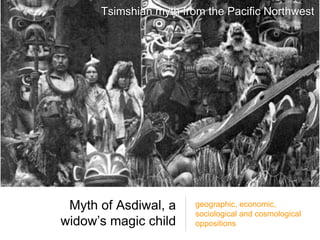
Myth of Asdiwal, a
widow’s magic child
geographic, economic,
sociological and cosmological
oppositions
Tsimshian myth from the Pacific Northwest
FACULTY OF ARTS | FOAR701
On the one hand it would seem that in
the course of a myth anything is likely
to happen…. But on the other hand,
this apparent arbitrariness is belied by
the astounding similarity between
myths collected in widely different
regions.
Therefore the problem: If the content of
myth is contingent, how are we to
explain the fact that myths throughout
the world are so similar?
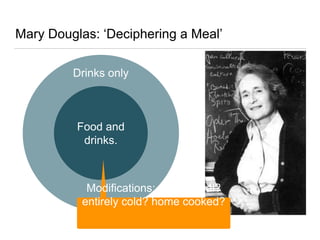
Mary Douglas: ‘Deciphering a Meal’
• Meals v. ‘Drinks.’
Snacks v. Meals v ‘Tea’ (paradigmatic).
• Syntagmatic relation amongst meals
(early, midday, late).
Within meals also structured (but not
drinks) both sequentially and in relations
or juxtapositions (multiple meats?
unsuccessful combinations? Sunday
different?).
• Contrasts: hot & cold, bland & spicy, liquid
& solid, starch & protein & veg…
• Relations are matched by food behaviour.
Mary Douglas: ‘Deciphering a Meal’
Drinks only
Food and
drinks.
Modifications: which meal?
entirely cold? home cooked?
Key components:
• Synchronic analysis.
• Deep structure (v.
surface manifestation)
exists only in the
collective (not
individual).
• Cognitive system (sign,
dichotomies…)
• Cognitive structural
determination (agency?).
30FACULTY OF ARTS | FOAR701
Assumptions
• Ontology: strong semiotic
constructionism &
idealism; critique of
possibility of ‘realism’.
• Epistemology: the role of
semiotic systems in
structuring thought affects
even the investigator.
• Methodology: careful, in
depth analysis but may be
over large set of examples.
31FACULTY OF ARTS | FOAR701
Variants of structuralism
• Structuralist linguistics – Ferdinand de Saussure, Charles Sanders Peirce
(US, semiotics including early Chomsky) — (influence is quite broad, including in
phonemics): Leonard Bloomfield (US), Louis Hjelmslev (Norway).
– (Prague, Moscow, Copenhagen): Roman Jakobson, Nikolay Trubetzkoy
(Prague), Vladimir Propp (Russian).
• Structuralist literary theory – Roland Barthes, Tzvetan Todorov, Northrop
Frye.
• Structural anthropology/history/sociology – Claude Lévi-Strauss, Marcel
Mauss (pre-structuralist - CL-S’s predecessor), Michel Foucault (early), Mary
Douglas, Marshall Sahlins, Pierre Bourdieu (some of his texts), Edmund Leach,
Rodney Needham.
• Structuralist psychoanalysis – Jacques Lacan.
• Structural marxism – Louis Althusser (philosophy), Nicos Poulantzas
(sociology), Maurice Godelier (anthropology).
32FACULTY OF ARTS | FOAR701
Influence of structuralism
• Encourages analytical imagination: especially uniting diverse realms of
culture or behaviour.
• Drives deeper analysis: goal of uniting different anagogic realms often
pushes deeper examination of structure beyond conscious awareness or
explicit content.
• Clear role for analyst: like psychoanalysis, assumption that consciousness
alone does not contain all that is operative (and alternative to Freudianism,
does not focus on individual biography or psyche).
• Cognitivist approaches: including many who would not call themselves
‘structuralist.’
• Revitalised comparative approaches: not constrained by single context if
structure is deep and potentially shared (universal? e.g. gender, taboo, pollution,
sacred…).
33FACULTY OF ARTS | FOAR701
Critiques of structuralism
• Reductionism is so radical that it eradicates most of content.
e.g. Catherine Belsey: ‘the structuralist danger of collapsing all
difference.’
• Social context and history also eradicated or ignored.
• Unclear that the ‘structure’ was actually present or product of
analytical techniques.
• Severely downplays individual ‘agency.’
• Some variants are universalising & require immense data.
• Also requires uniformity or self-sameness of structure
(variation?).
• Although claims to be more ‘scientific,’ structural analysis is
unfalsifiable and relies tremendously on skill of the analyst.
FACULTY OF ARTS | FOAR701 34
Thanks for your
attention!
Bibliography online at iLearn
Photos public domain at Pixabay
or as indicated.
FACULTY OF ARTS | FOAR701 35
References
• Douglas, M., 1972. Deciphering a meal. Daedalus, pp.61-81.
• Downey, Greg. 2009. ‘Thinking through Claude Lévo-Strauss.’
Neuroanthropology https://neuroanthropology.net/2009/11/08/thinking-through-
claude-levi-strauss/
• Lévi-Strauss, Claude. 1985 (1963). Structural analysis in linguistics and in
anthropology. In Robert Innis, ed. Semiotics-An Introductory Anthology. Indiana
University Press. Pp.110-128.
• White, Hayden. 1973. Introduction. In Metahistory (Baltimore). Pp. 1-42
• White, Hayden. 2014. The Practical Past. In The Practical Past (Evanston, Ill,).
Pp. 2-24.
• Whorf, Benjamin. 1956. The Relation of Habitual Thought and Behavior to
Language. In Language, Thought and Reality: Selected Writings. Cambridge:
MIT. Pp. 134-159.

Structuralism: Lecture for Research Paradigms (FOAR 701)

  • 1.
    –Johnny Appleseed “A linguisticsystem is a series of differences of sound combined with a series of differences of ideas.” Ferdinand de Saussure
  • 2.
    – Claude Lévi-Strauss “Itherefore claim to show, not how men think in myths, but how myths operate in men’s minds without their being aware of the fact.” FACULTY OF ARTS | FOAR701 2
  • 3.
    FOAR701: Research paradigms(2017) Structuralism* 3 Greg Downey Department of Anthropology Faculty of Arts Macquarie University greg.downey@mq.edu.au @gregdowney1 * includes material by Prof. Nicole Anderson.
  • 4.
    Caution! Use of ‘structure.’ Structuralfunctionalism v structuralism and post- structuralism. Social v. mental. FACULTY OF ARTS | FOAR701 4
  • 5.
    Structuralism as aparadigm shift Ferdinand de Saussure (1857- 1930) famous for opposing philological study of language. Swiss linguist and semiotician with early career in philology (Celtic, Sanskrit, Old German, Indo- European reconstruction). He only taught his ‘Course in General Linguistics’ three times near the end of his life in Switzerland. FACULTY OF ARTS | FOAR701 5
  • 6.
    Saussure – ‘Coursein General Linguistics.’ Although he tried to write a book, in the end, students organised his lecture notes. How to analyse language? Focus not on parole (speech acts) but on langue (code behind acts). Language to be analysed as a formal system of signs (the ‘referent’ was beyond linguistic study, for Saussure). FACULTY OF ARTS | FOAR701 6
  • 7.
    Saussure – ‘Coursein General Linguistics.’ ‘Language is a system of signs that expresses ideas.’ Although he held open the possibility of diachronic research (accomplished in philology), he was arguing for a radical synchrony in semiotics (‘semiology’), the study of ‘linguistic structure’. FACULTY OF ARTS | FOAR701 7
  • 8.
    Key insight: ‘Sign’has two sides. Signifier Signified ‘House’ Link is arbitrary.* FACULTY OF ARTS | FOAR701 8 (* …but, onomatopoeia and exclamations???)
  • 9.
    Key insight: Signifier Signified ‘House’ Linkis arbitrary.* The fallacy of the traditional position lies in their view that the signified, be it an object in the material world or a concept, pre-exists the ‘word’ (or signifier) and is simply labelled by it. (Nicole’s phrasing) FACULTY OF ARTS | FOAR701 9
  • 10.
    Tripartite sign model: SignifierSignified ‘House’ FACULTY OF ARTS | FOAR701 10 Referent
  • 11.
    FACULTY OF ARTS| FOAR701 11 Signs Eagle by m. turan ercan from the Noun Project bird symbol index icon physical resemblance to signified. physical link to signified. e.g., smoke & fire cultural and arbitrary Charles Sanders Peirce
  • 12.
    FACULTY OF ARTS| FOAR701 12 SignsSkull by Aleksandr Vector from the Noun Project denotation connotation associated ideas or feelings direct or specific significance Heart by Ali Coşkun from the Noun Project
  • 13.
    If symbolic relationsare arbitrary…? • Meaning is not a fixed relationship between signifier/signified/referent, but rather defined through opposition to other signifiers/signifieds. • Even within words, phonemes take their meaning though opposition to other phonemes. Variation across languages in phoneme: e.g., /r/ /l/ in Japanese, or /th/ fricative /th/ in German, /b/ /p/ in Arabic, aspirated and unaspirated /t/ in Thai, palatalised consonants in Arabic, nasalised vowels in Portuguese, clicks in San… • Saussure calls this the ‘differential relation’: sign significance is determined by differences amongst signs.
  • 14.
    FACULTY OF ARTS| FOAR701 14 Semiotic relations English ‘sheep’ ‘mutton’ French ‘mouton’ Sheep by Nook Fulloption from the Noun Project
  • 15.
    FACULTY OF ARTS| FOAR701 15 ParadigmsSyntagms Their tiger stood by my friend. That wolf sat over your tree. The dog walked on the floor. My cat bounced under Nicole’s mat. Your cow jumped above Anthony’s fridge. (vertical)(horizontal)
  • 16.
    What’s so radicalabout this? • Language is not ‘motivated’: no essential connection between sign and signified. (What about the connection between signified and referent?) • Since paradigmatic relations determine meaning of symbols, no inherent or ‘true’ meaning to be determined philologically. • Pushing linguistics towards ‘science’ and away from ‘humanities’ like history. • Human thought and thus behaviour is shaped by inherited structure (argument with contemporary existentialists, for example, in France). • Could even be seen to be universalising and strongly determinist. 16FACULTY OF ARTS | FOAR701
  • 17.
    ‘the structure oflanguage is a social product of our language faculty…it is also a body of necessary conventions adopted by society to enable members of society to use their language faculty’ (Saussure, Course in General Linguistics, 1988, 3) FACULTY OF ARTS | FOAR701 17
  • 18.
    Claude Lévi-Strauss French anthropologist. Particularmanifestations of culture are incidental but reveal deeper structure of thought (like langue v. parole). Modeled on linguistics. FACULTY OF ARTS | FOAR701 18
  • 19.
    Claude Lévi-Strauss Became apublic intellectual. 100 when he died in 2009. Human mind essentially uniform (‘savage’ & ‘civilised’ the same). Humans think in binaries (mediating third term at times). FACULTY OF ARTS | FOAR701 19
  • 20.
    FACULTY OF ARTS| FOAR701 “The unconscious activity of the mind consists in imposing forms upon content, and if these forms are fundamentally the same for all minds – ancient and modern, primitive and civilized – it is necessary and sufficient to grasp the unconscious structure underlying each institutions and custom.” (Lévi-Strauss, Structural Anthropology, 1963: 21)
  • 21.
    Structural anthropology • Systemsarise from logical, not functional, structures. e.g. kinship arises not from common descent but from the alliances formed when man and woman marry (‘family’ only defined in opposition to others). Incest taboo is not from biological problems but forces exogamous alliances (borrowing from Marcel Mauss). • Argues that if you know some relations between family members, you can predict others based on their structure (systematic? scientific?). • In The Savage Mind (translation problem), Lévi-Strauss argues that mind is more like a bricoleur (savage mind) than an engineer (scientific mind). Put him in conflict with Jean Paul Sartre. • Four volume Mythologiques examines the structure underlying a single myth with variations throughout all the Americas. All variants were manifestations of a single underlying mytheme. Myth often produces false resolution of irresolvable dichotomy. 21FACULTY OF ARTS | FOAR701
  • 22.
  • 23.
    Totems System of symbolsfrom one realm brought to another. ‘We can understand, too, that natural species are chosen not because they are “good to eat” but because they are “good to think.”’ (The Savage Mind)
  • 24.
    Analysis of myth • Mythnot constrained by messy reality of history — logic is allowed to work freely. ‘instruments for the obliteration of time’ (Lévi-Strauss). • Contemporary society can bury deep structure under layers of confounding complexity. • Break myth into elements (mythemes) and reveal relations among them, especially across variants. • Example: ‘princess,’ ‘witch/step- mother/monster,’ ‘prince.’
  • 25.
    Myth of Asdiwal,a widow’s magic child geographic, economic, sociological and cosmological oppositions Tsimshian myth from the Pacific Northwest
  • 26.
    FACULTY OF ARTS| FOAR701 On the one hand it would seem that in the course of a myth anything is likely to happen…. But on the other hand, this apparent arbitrariness is belied by the astounding similarity between myths collected in widely different regions. Therefore the problem: If the content of myth is contingent, how are we to explain the fact that myths throughout the world are so similar?
  • 28.
    Mary Douglas: ‘Decipheringa Meal’ • Meals v. ‘Drinks.’ Snacks v. Meals v ‘Tea’ (paradigmatic). • Syntagmatic relation amongst meals (early, midday, late). Within meals also structured (but not drinks) both sequentially and in relations or juxtapositions (multiple meats? unsuccessful combinations? Sunday different?). • Contrasts: hot & cold, bland & spicy, liquid & solid, starch & protein & veg… • Relations are matched by food behaviour.
  • 29.
    Mary Douglas: ‘Decipheringa Meal’ Drinks only Food and drinks. Modifications: which meal? entirely cold? home cooked?
  • 30.
    Key components: • Synchronicanalysis. • Deep structure (v. surface manifestation) exists only in the collective (not individual). • Cognitive system (sign, dichotomies…) • Cognitive structural determination (agency?). 30FACULTY OF ARTS | FOAR701
  • 31.
    Assumptions • Ontology: strongsemiotic constructionism & idealism; critique of possibility of ‘realism’. • Epistemology: the role of semiotic systems in structuring thought affects even the investigator. • Methodology: careful, in depth analysis but may be over large set of examples. 31FACULTY OF ARTS | FOAR701
  • 32.
    Variants of structuralism •Structuralist linguistics – Ferdinand de Saussure, Charles Sanders Peirce (US, semiotics including early Chomsky) — (influence is quite broad, including in phonemics): Leonard Bloomfield (US), Louis Hjelmslev (Norway). – (Prague, Moscow, Copenhagen): Roman Jakobson, Nikolay Trubetzkoy (Prague), Vladimir Propp (Russian). • Structuralist literary theory – Roland Barthes, Tzvetan Todorov, Northrop Frye. • Structural anthropology/history/sociology – Claude Lévi-Strauss, Marcel Mauss (pre-structuralist - CL-S’s predecessor), Michel Foucault (early), Mary Douglas, Marshall Sahlins, Pierre Bourdieu (some of his texts), Edmund Leach, Rodney Needham. • Structuralist psychoanalysis – Jacques Lacan. • Structural marxism – Louis Althusser (philosophy), Nicos Poulantzas (sociology), Maurice Godelier (anthropology). 32FACULTY OF ARTS | FOAR701
  • 33.
    Influence of structuralism •Encourages analytical imagination: especially uniting diverse realms of culture or behaviour. • Drives deeper analysis: goal of uniting different anagogic realms often pushes deeper examination of structure beyond conscious awareness or explicit content. • Clear role for analyst: like psychoanalysis, assumption that consciousness alone does not contain all that is operative (and alternative to Freudianism, does not focus on individual biography or psyche). • Cognitivist approaches: including many who would not call themselves ‘structuralist.’ • Revitalised comparative approaches: not constrained by single context if structure is deep and potentially shared (universal? e.g. gender, taboo, pollution, sacred…). 33FACULTY OF ARTS | FOAR701
  • 34.
    Critiques of structuralism •Reductionism is so radical that it eradicates most of content. e.g. Catherine Belsey: ‘the structuralist danger of collapsing all difference.’ • Social context and history also eradicated or ignored. • Unclear that the ‘structure’ was actually present or product of analytical techniques. • Severely downplays individual ‘agency.’ • Some variants are universalising & require immense data. • Also requires uniformity or self-sameness of structure (variation?). • Although claims to be more ‘scientific,’ structural analysis is unfalsifiable and relies tremendously on skill of the analyst. FACULTY OF ARTS | FOAR701 34
  • 35.
    Thanks for your attention! Bibliographyonline at iLearn Photos public domain at Pixabay or as indicated. FACULTY OF ARTS | FOAR701 35
  • 36.
    References • Douglas, M.,1972. Deciphering a meal. Daedalus, pp.61-81. • Downey, Greg. 2009. ‘Thinking through Claude Lévo-Strauss.’ Neuroanthropology https://neuroanthropology.net/2009/11/08/thinking-through- claude-levi-strauss/ • Lévi-Strauss, Claude. 1985 (1963). Structural analysis in linguistics and in anthropology. In Robert Innis, ed. Semiotics-An Introductory Anthology. Indiana University Press. Pp.110-128. • White, Hayden. 1973. Introduction. In Metahistory (Baltimore). Pp. 1-42 • White, Hayden. 2014. The Practical Past. In The Practical Past (Evanston, Ill,). Pp. 2-24. • Whorf, Benjamin. 1956. The Relation of Habitual Thought and Behavior to Language. In Language, Thought and Reality: Selected Writings. Cambridge: MIT. Pp. 134-159.

Editor's Notes

  • #6 Against the dominant cultural evolutionism and diffusionism of the day.
  • #7 Against the dominant cultural evolutionism and diffusionism of the day.
  • #8 Against the dominant cultural evolutionism and diffusionism of the day.