A report coordinated by Eurodad
STOP
Fifty Shades of Tax Dodging
The EU’s role in supporting an unjust global tax system
This report was coordinated by Eurodad with contributions
from civil society organisations in countries across Europe
including:
11.11.11 (Belgium); Centre national de coopération au
développement (CNCD-11.11.11) (Belgium); Glopolis (Czech
Republic); IBIS (Denmark); Demnet (Hungary); CCFD-Terre
Solidaire (France); Oxfam France (France); World Economy,
Ecology & Development (WEED) (Germany); Global Policy
Forum (Germany); Debt and Development Coalition Ireland
(DDCI) (Ireland); Re:Common (Italy); the Centre for Research
on Multinational Corporations (SOMO) (Netherlands); Instytut
Globalnej Odpowiedzialnosci (Poland); InspirAction (Spain);
Oxfam Intermón (Spain); Ekvilib Institute (Slovenia); Forum
Syd (Sweden); Christian Aid (UK).
A special acknowledgement goes to doctoral researcher
Martin Hearson of the London School of Economics and
Political Science (LSE) for providing data and valuable input
on the sections related to tax treaties.
Each chapter was written by – and is the responsibility
of – the nationally-based partners in the project, and does
not reflect the views of the rest of the project partners.
The chapter on Luxembourg was written by – and is the
responsibility of – Eurodad.
For more information, contact Eurodad:
Rue d’Edimbourg,
18 – 26 Mundo B building (3rd floor)
1050 Ixelles,
Brussels, Belgium
tel: +32 (0) 2 894 46 40
e-fax: +32 (0) 2 791 98 09
www.eurodad.org
Design and artwork: James Adams
Copy editing: Vicky Anning, Julia Ravenscroft and Zala Zbogar.
The authors believe that all of the details in this report are
factually accurate as of 5 October 2015.
The report has been produced with the financial assistance of the European
Union and Norad. The contents of this publication are the sole responsibility
of Eurodad, and the authors of this report and can in no way be taken to
reflect the views of the funders.
Acknowledgements
Glossary	4
Executive summary	 6
Global overview	 8
Report findings	 28
Recommendations	38
European Parliament	 39
European Commission	 42
Belgium	46
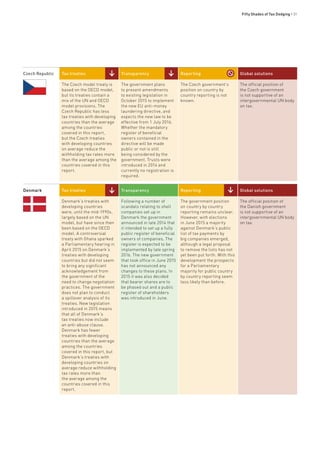
Czech Republic	 50
Denmark	53
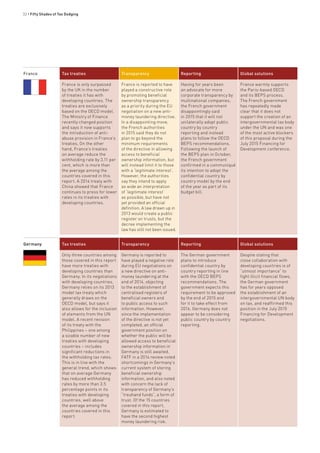
France	57
Germany	61
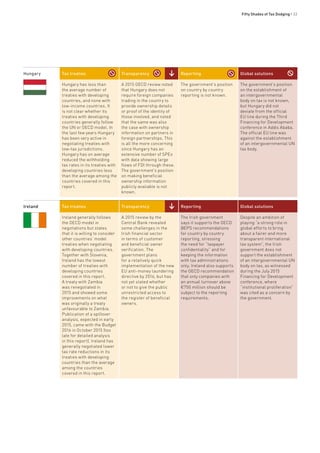
Hungary	65
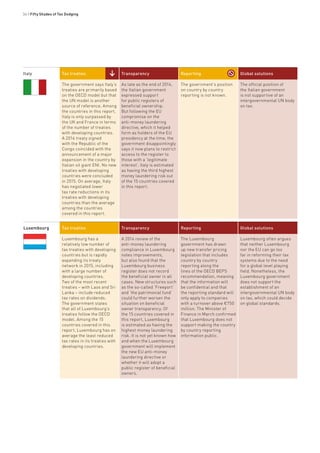
Ireland	70
Italy	74
Luxembourg	78
The Netherlands	 82
Poland	86
Slovenia	89
Spain	92
Sweden	95
United Kingdom	 98
Appendix	102
References	104
Contents
4 • Fifty Shades of Tax Dodging
Glossary
Advance Pricing Agreement (APA) See under Tax ruling.
Anti-Money Laundering Directive (AMLD)
An EU directive regulating issues related to money
laundering and terrorist financing, including public access to
information about the beneficial owners of companies, trusts
and similar legal structures. The 4th Anti-Money Laundering
Directive (Directive 2015/849) was adopted in May 2015.
Automatic Exchange of Information
A system whereby relevant information about the wealth
and income of a taxpayer – individual or company – is
automatically passed by the country where the income is
earned to the taxpayer’s country of residence. As a result,
the tax authority of a tax payer’s country of residence
can check its tax records to verify that the tax-payer has
accurately reported their foreign source income.
Base Erosion and Profit Shifting (BEPS)
This term is used to describe the shifting of taxable income
out of countries where the income was earned, usually to
zero – or low-tax countries, which results in ‘erosion’ of the
tax base of the countries affected, and therefore reduces
their revenues (see also below under ‘Transfer mispricing’).
Beneficial ownership
A legal term used to describe anyone who has the benefit
of ownership of an asset (for example, bank account, trust,
property) and yet nominally does not own the asset because
it is registered under another name.
Common Consolidated Corporate Tax Base (CCCTB)
CCCTB is a proposal that was first launched by the European
Commission in 2011. It entails a common EU system
for calculating the profits of multinational corporations
operating in the EU and dividing this profit among the EU
Member States based on a formula to assess the level of
business activity in each country. The proposal does not
specify what tax rate the Member States should apply to
the profit, but simply allocates the profit and leaves it to the
Member State to decide what tax to apply.
Controlled Foreign Corporation (CFC) rules
CFC rules allow countries to limit profit shifting by
multinational corporations by requesting that the company
reports on profits made in other jurisdictions where it
‘controls’ another corporate structure. There are many
different types of CFC rules with different definitions
regarding which kind of jurisdictions and incomes are covered.
General Anti-Avoidance Rule (GAAR)
GAAR refers to a broad set of different types of rules aimed
at limiting tax avoidance by multinational corporations in
cases where the abuse of tax rules has been detected.
Whereas GAARs can in some cases be used to prevent
tax avoidance by allowing tax administrations to deny
multinational corporations tax exemptions, they do not
address the general problem of lowering of withholding
taxes through tax treaties, nor do they address the general
division of taxing rights between nations.
Harmful tax practices
Harmful tax practices are policies that have negative
spillover effects on taxation in other countries, such as
eroding tax bases or distorting investments.
Illicit financial flows
There are two definitions of illicit financial flows. It can refer
to unrecorded private financial outflows involving capital that
is illegally earned, transferred or used. In a broader sense,
illicit financial flows can also be used to describe artificial
arrangements that have been put in place with the purpose
of circumventing the law or its spirit.
LuxLeaks
The LuxLeaks (or Luxembourg Leaks) scandal surfaced
in November 2014 when the International Consortium
of Investigative Journalists (ICIJ) exposed several
hundred secret tax rulings from Luxembourg, which had
been leaked by Antoine Deltour, a former employee of
PricewaterhouseCoopers (PwC). The LuxLeaks dossier
documented how hundreds of multinational corporations
were using the system in Luxembourg to lower their tax
rates, in some cases to less than 1 per cent.
Offshore jurisdictions or centres
Usually known as low-tax jurisdictions specialising in
providing corporate and commercial services to non-
resident offshore companies and individuals, and for the
investment of offshore funds. This is often combined with a
certain degree of secrecy. ‘Offshore’ can be used as another
word for tax havens or secrecy jurisdictions.
Patent box
A ‘patent box’ or ‘innovation box’ is a special tax regime that
includes tax exemptions for activities related to research
and innovation. These regimes have often been labelled a
type of ‘harmful tax practice’, since they have been used
by multinational corporations to avoid taxation by shifting
profits out of the countries where they do business and into a
patent box in a foreign country, where the profits are taxed at
very low levels or not at all.
Profit shifting See ‘Base erosion and profit shifting’.
Public country by country reporting (CBCR)
Country by country reporting would require multinational
companies to provide a breakdown of profits earned, taxes
owed and taxes paid, as well as an overview of their economic
activity in every country where they have subsidiaries,
including offshore jurisdictions. At a minimum, it would
include disclosure of the following information by each
transnational corporation in its annual financial statement:
•• A global overview of the corporation (or group): The name
of each country where it operates and the names of all its
subsidiary companies trading in each country of operation.
Fifty Shades of Tax Dodging • 5
•• The financial performance of the group in every country
where it operates, making the distinction between sales
within the group and to other companies, including profits,
sales and purchases.
•• The number of employees in each country where the
company operates.
•• The assets: All the property the company owns in that
country, its value and cost to maintain.
•• Tax information i.e. full details of the amounts owed and
actually paid for each specific tax.
Special purpose entity (SPE)
Special purpose entities, in some countries known as special
purpose vehicles or special financial institutions, are legal
entities constructed to fulfil a narrow and specific purpose.
Special purpose entities are used to channel funds to and
from third countries and are commonly established in
countries that provide specific tax benefits for such entities.
Swiss Leaks
The Swiss Leaks scandal broke in 2015 when the International
Consortium of Investigative Journalists (ICIJ) exposed 60,000
leaked files with details of more than 100,000 clients of the
bank HSBC in Switzerland. The material was originally leaked
by Hervé Falciani, a former computer engineer at the bank.
Among other things, the data showed how HSBC was helping
clients to set up secret bank accounts to hide fortunes from
tax authorities around the world, and assisting individuals
engaged in arms trafficking, blood diamonds and corruption
to hide their illicitly acquired assets.
Tax avoidance
Technically legal activity that results in the minimisation of
tax payments.
Tax evasion
Illegal activity that results in not paying or under-paying taxes.
Tax-related capital flight
For the purposes of this report, tax-related capital flight
is defined as the process whereby wealth holders, both
individuals and companies, perform activities to ensure the
transfer of their funds and other assets offshore rather than
into the banks of the country where the wealth is generated.
The result is that assets and income are often not declared
for tax purposes in the country where a person resides or
where a company has generated its wealth. This report
is not only concerned with illegal activities related to tax
evasion, but also the overall moral obligation to pay taxes
and governments’ responsibility to regulate accordingly to
ensure this happens. Therefore, this broad definition of tax-
related capital flight is applied throughout the report.
Tax ruling
A tax ruling is a written interpretation of the law issued by a
tax administration to a tax-payer. These can either be binding
or non-binging. Tax rulings cover a broad set of written
statements, many of which are uncontroversial. One type of
ruling is the so-called advance pricing agreements (APAs),
which are used by multinational corporations to get approval
of their transfer pricing methods. Tax rulings have attracted
increasing amounts of attention since they have been
known to be used by multinational corporations to obtain
legal certainty for tax avoidance practices. The documents
exposed in the LuxLeaks scandal were APAs.
Tax treaty
A legal agreement between jurisdictions to determine the
cross-border tax regulation and means of cooperation
between the two jurisdictions. Tax treaties often revolve
around questions about which of the jurisdictions has the
right to tax cross-border activities and at what rate. Tax
treaties can also include provisions for the exchange of tax
information between the jurisdictions but for the purpose of
this report, treaties that only relate to information exchange
(so-called Tax Information Exchange Agreements (TIEAs))
are considered to be something separate from tax treaties
that regulate cross-border taxation. TIEAs are therefore not
included in the term tax treaty.
Transfer Mispricing
This is where different subsidiaries of the same multinational
corporation buy and sell goods and services between
themselves at manipulated prices with the intention of
shifting profits into low tax jurisdictions. Trades between
subsidiaries of the same multinational are supposed to
take place ‘at arms-length’ ie based on prices on the open
market. Market prices can be difficult to quantify, however,
particularly in respect of the sale of intangible assets such
as services or intellectual property rights.
Transparency
Transparency is a method to ensure public accountability by
providing public insight into matters that are, or can be, of
public interest.
Whistleblower
A whistleblower is a person who reports or discloses
confidential information with the aim of bringing into the
open information on activities that have harmed or threaten
the public interest.
6 • Fifty Shades of Tax Dodging
Executive summary
In the past year, scandal after scandal has exposed
companies using loopholes in the tax system to avoid
taxation. Now more than ever, it is becoming clear that
citizens around the world are paying a high price for the
crisis in the global tax system, and the discussion about
multinational corporations and their tax tricks remains at
the top of the agenda. There is also a growing awareness
that the world’s poorest countries are even harder
impacted than the richest countries. In effect, the poorest
countries are paying the price for a global tax system they
did not create.
A large number of the scandals that emerged over the past
year have strong links to the EU and its Member States.
Many eyes have therefore turned to the EU leaders, who
claim that the problem is being solved and the public need
not worry. But what is really going on? What is the role of the
EU in the unjust global tax system, and are EU leaders really
solving the problem?
This report – the third in a series of reports - scrutinises the
role of the EU in the global tax crisis, analyses developments
and suggests concrete solutions. It is written by civil society
organisations (CSOs) in 14 countries across the EU. Experts
in each CSO have examined their national governments’
commitments and actions in terms of combating tax dodging
and ensuring transparency.
Each country is directly compared with its fellow EU Member
States on four critical issues: the fairness of their tax treaties
with developing countries; their willingness to put an end to
anonymous shell companies and trusts; their support for
increasing the transparency of economic activities and tax
payments of multinational corporations; and their attitude
towards letting the poorest countries have a seat at the
table when global tax standards are negotiated. For the
first time, this report not only rates the performance of EU
Member States, but also turns the spotlight on the European
Commission and Parliament too.
This report covers national policies and governments’
positions on existing and upcoming EU level laws, as well as
global reform proposals.
Overall, the report finds that:
•• Although tweaks have been made and some loopholes have
been closed, the complex and dysfunctional EU system of
corporate tax rulings, treaties, letterbox companies and
special corporate tax regimes still remains in place. On
some matters, such as the controversial patent boxes, the
damaging policies seem to be spreading in Europe. Defence
mechanisms against ‘harmful tax practices’ that have been
introduced by governments, only seem partially effective
and are not available to most developing countries. They
are also undermined by a strong political commitment
to continue so-called ‘tax competition’ between
governments trying to attract multinational corporations
with lucrative tax reduction opportunities – also known
as the ‘race to the bottom on corporate taxation’. The
result is an EU tax system that still allows a wide range of
options for tax dodging by multinational corporations.
•• On the question of what multinational corporations
pay in taxes and where they do business, EU citizens,
parliamentarians and journalists are still left in the
dark, as are developing countries. The political promises
to introduce ‘transparency’ turned out to mean that
tax administrations in developed countries, through
cumbersome and highly secretive processes, will
exchange information about multinational corporations
that the public is not allowed to see. On a more positive
note, some light is now being shed on the question of who
actually owns the companies operating in our societies,
as more and more countries introduce public or partially
public registers of beneficial owners. Unfortunately, this
positive development is being somewhat challenged by
the emergence of new types of mechanisms to conceal
ownership, such as new types of trusts.
•• Leaked information has become the key source of
public information about tax dodging by multinational
corporations. But it comes at a high price for the people
involved, as whistleblowers and even a journalist who
revealed tax dodging by multinational corporations are
now being prosecuted and could face years in prison.
The stories of these ‘Tax Justice Heroes’ are a harsh
illustration of the wider social cost of the secretive and
opaque corporate tax system that currently prevails.
•• More than 100 developing countries still remain
excluded from decision-making processes when global
tax standards and rules are being decided. In 2015,
developing countries made the fight for global tax
democracy their key battle during the Financing for
Development conference (FfD) in Addis Ababa. But the
EU took a hard line against this demand and played a key
role in blocking the proposal for a truly global tax body.
Not one single EU Member State challenged this approach
and, as a result, decision-making on global tax standards
and rules remains within a closed ‘club of rich countries’.
Fifty Shades of Tax Dodging • 7
A direct comparison of the 15 EU countries covered in this
report finds that:
•• France, once a leader in the demand for public access to
information about what multinational corporations pay
in tax, is no longer pushing the demand for corporate
transparency. Contrary to the promises of creating
‘transparency’, a growing number of EU countries are
now proposing strict confidentiality to conceal what
multinational corporations pay in taxes.
•• Denmark and Slovenia are playing a leading role when
it comes to transparency around the true owners of
companies. They have not only announced that they are
introducing public registers of company ownership, but
have also decided to restrict, or in the case of Slovenia,
avoided the temptation of introducing, opaque structures
such as trusts, which can offer alternative options for
hiding ownership. However, a number of EU countries,
including in particular Luxembourg and Germany, still
offer a diverse menu of options for concealing ownership
and laundering money.
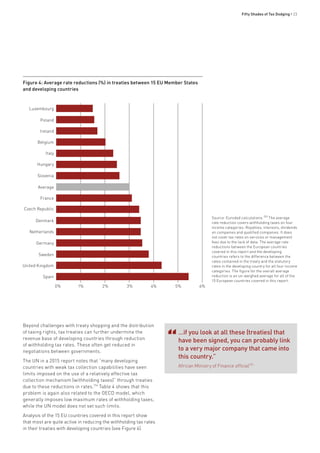
•• Among the 15 countries covered in this report, Spain
remains by far the most aggressive tax treaty negotiator,
and has managed to lower developing country tax rates by
an average 5.4 percentage points through its tax treaties
with developing countries.
•• The UK and France played the leading role in blocking
developing countries’ demand for a seat at the table when
global tax standards and rules are being decided.
8 • Fifty Shades of Tax Dodging
When used to their fullest potential and combined with good
public expenditure, taxes can build health systems that
save lives, fund our children’s education and help to create
more stable, equal, democratic and prosperous societies.
Taxes can also – when they are regressive and punitive –
exacerbate poverty and inequality.1
What is needed then are
tax systems that are just and fair. In developing countries,
where inequality is high, poverty is widespread and there
is an acute lack of basic social services, effective and
just tax systems are even more essential. Tax also has an
international dimension, given that harmful tax policies
in one country can undermine tax collection in other
countries.2
This report looks at the international aspect of
taxation by focusing on how Europe can support and protect
tax collection in developing countries by adopting fair
and responsible tax policies at home. By doing so Europe
will not only help to unlock development for some of the
poorest regions in the world, it will also help to address the
injustices of tax dodging in Europe. In short, this report is
about our shared need for tax justice.
The last few years have brought the tax debate to the boiling
point in Europe. A number of scandalous revelations about
the lack of tax payments by multinational companies and
the role that a number of European countries have played in
this made sure that tax dodging stayed in the public limelight
throughout the year. While some of the scandals concern
tax evasion – which is a type of tax dodging that entails
illegal activities – a number of the revelations concern tax
avoidance. This is a term used to describe tax dodging that
doesn’t entail a deliberate violation of tax laws, but rather
acting against the spirit of the law through aggressive tax
planning, which is in most cases fully legal.3
Despite being
legal, the tax avoidance of multinational corporations often
occurs at such a large scale that it is considered by many
people to be highly immoral and undesirable.4
With the public attention came a political promise to tackle
the scandals: G20 declarations,5
Organisation for Economic
Co-operation and Development (OECD) projects,6
EU action
plans7
and government announcements all promised to wage
war against the great tax dodging problem that could no
longer be ignored. This report analyses whether the promised
action was ever delivered, and whether those changes that
have been delivered will actually solve the problems.
Global overview
Box 1
Corporate casualties: How tax dodging hurts
European businesses
Since multinational companies have access to
cross-border tax planning they can lower their
tax rates in ways that is not possible for domestic
companies. Because of this, domestic companies are
often at a competitive disadvantage compared with
multinational companies. This is the message from
an eye-opening research report published by the
European Commission in 2015.10
The report looked at
20 EU Member States and found that, in all of them,
large domestic companies face a higher effective
corporate tax rate than multinational companies that
make use of tax planning techniques.
On average, the multinationals can get away with a
tax rate that is 3.5 percentage points lower than for
similar domestic companies.11
The study also found
that in three out of four of the 20 EU Member States,
small- and medium-sized enterprises (SMEs) faced a
higher effective tax rate than multinational companies,
despite the fact that almost all Member States give
sizeable tax subsidies to SMEs to increase their
competitiveness.12
It seems tackling tax dodging is not
just good for justice; it’s good for European business.
50.4 per cent
of the population in nine EU Member States surveyed
consider taxing the rich and subsidising the poor to be an
essential characteristic of democracy.8
87.4 per cent
of the population in eight EU Member States surveyed agree
that cheating on taxes is never justifiable.9
Fifty Shades of Tax Dodging • 9
1. Global developments 2015: A year of
scandals and promises
On 4 November 2014 all seemed well with the EU. A new
European Commission had been appointed four days before
and the new Commission President Jean-Claude Juncker
was off to a good start. However, the political honeymoon
was about to be seriously interrupted. On the morning of
5 November, the International Consortium of Investigative
Journalists (ICIJ) released a treasure trove of tax secrets
from Luxembourg that revealed the evidence of that
country’s massive undermining effect on the tax base of
other countries.13
As former Minister of Finance and Prime
Minister of Luxembourg, Jean-Claude Juncker was in the eye
of the political storm that followed.
In many ways, the revelations – quickly dubbed ‘LuxLeaks’ –
were telling of the year that was to come. It has been a year
dominated by tax dodging scandals, many of which have had
their epicentre in Europe. It has been a year where the scale
of tax dodging has been exposed and where politicians were
forced to answer a public cry for action.
Box 2
Under the spotlight: MNCs’ tax payments
89 per cent: Share of CEO’s of large company
concerned about the media’s coverage of company tax
payment in 2014. This was up from 60 per cent in 2011.
56 per cent: Share of European businesses surveyed
that experienced an increase in discussion and
scrutiny of corporate tax strategies in 2014. The
survey notes large differences across Europe, with
more than 80 per cent of businesses in the UK,
Luxembourg and France reporting increased scrutiny
in the last year, while a comparable increase was not
reported by most businesses in Central and Eastern
Europe. For example, in the Czech Republic 75 per
cent of businesses did not see any change in public
scrutiny compared to the previous year.14
Box 3
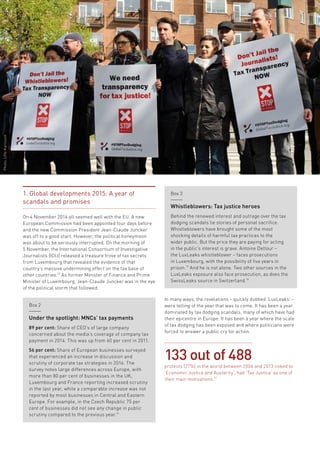
Whistleblowers: Tax justice heroes
Behind the renewed interest and outrage over the tax
dodging scandals lie stories of personal sacrifice.
Whistleblowers have brought some of the most
shocking details of harmful tax practices to the
wider public. But the price they are paying for acting
in the public’s interest is grave. Antoine Deltour –
the LuxLeaks whistleblower – faces prosecutions
in Luxembourg, with the possibility of five years in
prison.15
And he is not alone. Two other sources in the
LuxLeaks exposure also face prosecution, as does the
SwissLeaks source in Switzerland.16
133 out of 488
protests (27%) in the world between 2006 and 2013 linked to
‘Economic Justice and Austerity’, had ‘Tax Justice’ as one of
their main motivations.17
Photo:UffeKarlsson
10 • Fifty Shades of Tax Dodging
Box 4
The year of scandals: Europe at the epicentre
In just one year there has been a wealth of new
revelations about multinational companies’ tax
payments. Time and again, the companies exposed
turned out to have European countries at the heart
of their tax planning structures. Here are just a few
examples from the past year:
•• In November and December 2014, the LuxLeaks
dossier exposed tax rulings with hundreds of
multinational companies in Luxembourg.18
•• In February 2015, SwissLeaks laid bare the financial
information of more than 100,000 bank clients in a
Swiss bank.19
•• In February 2015, McDonald’s came under the
spotlight when a report was released on the fast
food giant’s tax payments. Among other things, the
report showed that McDonald’s reported a turnover
of more than €3.7 billion in one subsidiary with 13
employees in Luxembourg from 2009–13, leading to
tax payments of only €16 million.20
•• In June 2015, Walmart hit the news when a report
detailed the company’s tax practices. The report
pointed out that Walmart has subsidiaries in Ireland,
the Netherlands, Luxembourg, Spain, Cyprus and
Switzerland, despite not having any stores there.
The report details some of the tax saving effects
achieved through these European subsidiaries.21
•• Meanwhile, two separate studies on the mining
industry published in 2015 showed that the
Netherlands had been used to minimise tax
payments in Malawi and Greece.22
1.1 The elusive quest for reform of international
taxation
On the face of it, recent years have offered many new
political initiatives to reform the international tax system.
The OECD has come up with recommendations under the
project entitled Base Erosion and Profit Shifting (BEPS). The
EU has announced two tax packages during 2015 to deal with
the cross-border challenges of taxation. And governments
all over the world have announced change after change to try
to shore up their tax base.
1.2 BEPS: Reforming to preserve	
Base Erosion and Profit Shifting (BEPS) describes the
largely legal techniques multinational companies use to
dodge their tax responsibility. The term BEPS has also
become synonymous with the OECD-led project to adjust
the rules of international taxation. From its inception in
2013, the OECD gave itself two years to come up with
recommendations on 15 different issues.23
The project is a
testament to how far up the political agenda international
taxation has shot in recent years. However, as BEPS comes
to an end in 2015, it is also becoming abundantly clear that
it does not provide the solution to the very real problems
facing developing countries.
As far back as 2013, when the OECD started its BEPS
project, a few warning lights were flashing. BEPS builds on
an OECD-developed system of international taxation that
generally allocates more taxing rights to the country where
multinational organisations are based (which is often in the
OECD) and fewer taxing rights to the countries where the
multinational corporations do business (into which category
most developing countries fall).24
This broadly means that,
in cases where multinational companies have internal trade
between subsidiaries in developing and developed countries,
it is the latter that receives more rights to tax the flows and
hence to take more tax revenue.
The fairness of this distribution of taxing rights has long been
questioned.25
The OECD acknowledged at the outset of the
BEPS project that “a number of countries have expressed a
concern about how international standards … allocate taxing
rights.”26
Rather than deal with this concern, however, the
OECD chose to ignore it, stating in the inaugural programme
of BEPS in 2013 that the reforms “are not directly aimed
at changing the existing international standards on the
allocation of taxing rights on cross-border income.”27
This was one of the early indications that the OECD’s BEPS
initiative was not really about changing the fundamentals of
international taxation, but rather about offering reform that
“aims to patch up existing rules rather than re-examine their
foundation”, as civil society representatives expressed it.28
As the BEPS project unfolded, the impression of a reform
designed to preserve a system that has served the interests
of rich nations for decades was unfortunately only reinforced.
In mid-2014 the OECD itself acknowledged that the BEPS
agenda did not have a good overlap with the concerns of
developing countries, stating in a report to the G20 that
developing countries had “identified a number of issues,
such as tax incentives, which are of concern to them, but
which are not addressed in the Action Plan [of BEPS].”29
Fifty Shades of Tax Dodging • 11
After criticism stating that that BEPS was only a rich-man’s
club deciding on issues to promote their own interests, the
OECD announced towards the end of 2014 that 14 developing
countries would be offered closer involvement in the BEPS
process in addition to those that were involved as part of
the G20. However, this meant that more than 100 developing
countries were still excluded. This document that made
the announcement was aptly titled “The BEPS project and
developing countries: From consultation to participation”,
which raised the obvious question of what the point was of
involving developing countries a year after the BEPS action
plan had been decided, and after half of the agenda items had
been concluded. All in all, the attempt to counter the criticism
and include a small group of developing countries ended up
highlighting their very marginalisation in the process.
In September 2015, the G20 finance ministers adopted a
communique calling for the OECD to “prepare a framework
by early 2016 with the involvement of interested non-G20
countries and jurisdictions, particularly developing
economies, on an equal footing.” However, it is important to
note that this call is not an invitation for all countries to join
any decision-making process, but rather to join in following
the BEPS rules after they have been adopted.30
1.3 Will BEPS stop tax dodging?
In September 2015, the outcomes of the BEPS process were
presented. While the agreement reached included measures
on country by country reporting,32
which civil society
organisations had long been calling for, the OECD decision to
keep the information confidential and only make it available
to a very limited number of countries, caused great concern
(see Box 5).
But this was not the only problematic part of the
package. Instead of reaching agreement on abolishing
the controversial ‘patent boxes’ (see section 3.4), the
OECD countries adopted guidelines on how patent boxes
should be designed, and furthermore underlined that
all existing arrangements could continue with business
as usual until 2021.33
This decision caused civil society
representatives to point out that “The OECD approach will
simply legitimise ‘innovation box’ regimes and hence supply
a legal mechanism for profit shifting, encouraging states to
provide such benefits to companies. It will be particularly
damaging to developing countries, which may be used
as manufacturing platforms, while their tax base will be
drained by this legitimised profit-shifting. Such measures
should simply be condemned and eliminated.”34
Even before
the end of the project, a number of new OECD countries had
announced that they have started establishing patent boxes
(see section 4 on Report Findings).
On the issue of anti-abuse provisions, the BEPS process
managed to reach a welcome agreement.35
Unfortunately,
the concern remains that developing countries will not
be able to use these provisions to prevent tax avoidance
unless also given access to sufficient information about the
multinational corporations operating in their countries.36
The
agreement also doesn’t address the lowering of withholding
tax rates, which is a major concern regarding tax treaties
(see section 3.5 on Tax Treaties).
At the overall level, civil society expressed strong concern
that BEPS still sticks to the principle of ‘arm’s length
approach’, which means that subsidiaries of multinational
corporations are treated as independent companies rather
than one big company.37
It is this approach that allows a
multinational corporation to claim it has no profits in a
given country, while at the same time having very large and
untaxed profits in low tax jurisdictions.
Only 4 per cent
of large companies believe that all BEPS recommendations
will be implemented in all OECD countries.31
Only 5 per cent
of businesses plan to become more conservative in their tax
planning as a result of the BEPS project.38
12 • Fifty Shades of Tax Dodging
Another concerning point is that BEPS seems to be moving
the global tax system in a direction of increased complexity,
with a high number of very technical and in some cases
contradictory guidelines.46
This leads to the worry that the
use of secretive tax rulings – which was the core element of
the LuxLeaks scandal – will increase.47
These agreements
– also known as sweetheart deals – are currently the
commonly used way for tax administrations and businesses
to clarify what the rules will mean in reality for the
individual company.
Box 5
Country by country reporting (CBCR) asks multinational
companies to report on key financial data for each
country it operates in. It is one of the oldest demands
from tax justice campaigners. So when the OECD
announced under BEPS that it would recommend CBCR,
it seemed a real testament to how far the idea had come
since it was first proposed.
However, the fine print of the recommendations on
CBCR offered an example of how the OECD BEPS project
has been able to turn good ideas into bad decisions.
There are at least three big problems with the BEPS
recommendations in this area:
1.	 Size of companies: The BEPS recommends that
only companies with an annual turnover higher than
€750 million should be required to comply with
this type of reporting. According to the OECD’s own
estimates, this would exclude 85–90 per cent of all
multinational companies.39
This very high threshold
is particularly problematic for developing countries,
which typically host many junior multinational
companies that nonetheless can have enormous
impact on the national economy. For example, in
Sierra Leone in 2013 the mining companies Sierra
Rutile and London Mining accounted for 3 and 10
per cent of national Gross Domestic Product (GDP)
respectively.40
However, with annual turnovers of
€93 million and €226 million respectively, both
companies would have fallen far below the proposed
BEPS threshold of €750 million and would therefore
not have to prepare country by country reports,
according to the OECD.41
Citizens of developing
countries might often be interested in seeing such
reports, as questions about the low tax payments
from the extractive sector are often being raised.
2.	 Access to the public: It was decided that the country
by country reports should not be made public, but
instead should only made available to selected tax
administrations.42
This defies the point of CBCR, which
was always meant to be a transparency measure that
would spur behavioural change among multinational
companies based on their fear of reputational risk,
as well as being a tool for the public, journalists and
parliamentarians to hold companies and governments
to account. It would also mean a step backwards in
the EU, where fully public CBCR for the banking sector
has already been introduced by law.43
3.	 Sharing of report: BEPS recommends that the
country by country report should only be filed in
the country where the multinational company is
headquartered, which should then share the report
with other countries.44
Because most developing
countries are not yet at a stage where they have
enough capacity to participate in the current plans for
the automatic exchange of information, and have great
difficulties complying with the general confidentiality
requirements, they are unlikely to be able to receive
the report in this way. This means that a country such
as Sierra Leone will not be able to access information
explaining how the multinational corporations
operating in their country have structured themselves,
including whether the company has subsidiaries in low
tax jurisdictions and whether the company is claiming
to make large profits in countries where they have very
little real activity. In the words of Richard Murphy, who
conceived the concept of public country by country
reporting: “in that case it is quite clearly the case that
the OECD will be failing to deliver country by country
reporting for developing countries, who were always
intended to be one of its main beneficiaries.” 45
How BEPS turned good ideas into bad decisions: The case of country by country reporting
This means that a number of critical decisions about what
multinational corporations will pay in tax will be reached
in secret bilateral negotiations between the multinational
corporation and the individual tax administration. Although
the OECD and G20 countries will work towards automatic
exchange of information about tax rulings, 48
many developing
countries will not be able to comply with the confidentiality
requirements, and thus will not be able to access the
information. Similarly, citizens, parliamentarians and
journalists will not know how the new complex tax system is
being applied, and what multinational corporations are really
paying in taxes.
Fifty Shades of Tax Dodging • 13
1.4 A global representative reform of
international taxation
A genuine solution for developing countries would be to
initiate a truly global reform process of international taxation
where they have full right to equal participation. A proposal
for such a process was brought up in the United Nations
(UN) as far back as 2001, when a UN High-Level Panel on
Financing for Development proposed the establishment of
an ‘International Tax Organization’.49
Since then, it has been
a reoccurring conflict in the UN, where developing countries
have continuously pushed for the establishment of a global
tax body, which could give them an equal seat at the table
when global tax standards are decided.50
However, the proposal has been rejected by developed
countries, and in particular by the OECD Member States,
which have argued that the global decision making
should only take place at the OECD.51
Instead of an
intergovernmental body, it was decided to keep the UN’s
work on tax matters restricted to a UN expert committee on
tax, which can provide advice on tax matters but not make
intergovernmental decisions.52
In the negotiations leading up to the 3rd Financing for
Development conference in Addis Ababa, the Group of
77 (G77), which is a negotiating group representing 134
developing countries, once again highlighted the issue. Their
negotiator stated: “the fact remains that there is still no global
inclusive norm setting body for international tax cooperation
at the intergovernmental level. There is also not enough focus
on the development dimension of these issues. The group
reiterates its call […for] an intergovernmental subsidiary body
[…] to allow all member states, including developing countries,
to have an equal say on issues related to tax matters.”53
This call was supported by UN Secretary-General Ban Ki
Moon, who recommended that an intergovernmental body
on tax matters should be established under the auspices of
the UN.54
The discussion about the global tax body became the biggest
issue of debate during the Third Financing for Development
conference in Addis Ababa. However, in the end, the
developed countries ensured that the proposal to establish
an intergovernmental UN tax body was not included in the
outcome document – the Addis Ababa Action Agenda.55
This led to strong criticism from leading academics. Nobel
laureate Joseph Stiglitz criticised that “countries from which
the politically powerful tax evaders and avoiders come are
supposed to design a system to reduce tax evasion”,56
and
Professor José Antonio Ocampo, former Finance Minister of
Colombia, highlighted that “the domination of a select group
of countries over tax norms has meant that, in reality, the
global governance architecture for taxation has not kept pace
with globalization.” 57
But the Addis Ababa conference is unlikely to be the
last chapter of this story. In their closing statement, the
developing countries, through G77, underlined that they have
not changed their position and remain firmly committed to
pursuing the upgrade of the UN expert committee into an
intergovernmental tax committee.58
14 • Fifty Shades of Tax Dodging
2. Why international tax matters for
developing countries
There is increasing recognition, not least from developing
countries, that taxation is a key part of the answer to how
development could be financed.59
Several developing
countries are increasingly recognising the need not only
to attract foreign investors, but also to make sure that
investors pay taxes and contribute to development.
The 54 heads of state of the African Union sent an
important signal of this stance early in 2015 when they
adopted a report on illicit financial flows, along with
strong recommendations60
that identified profit shifting by
multinational companies as “by far the biggest culprits of
illicit outflows.”61
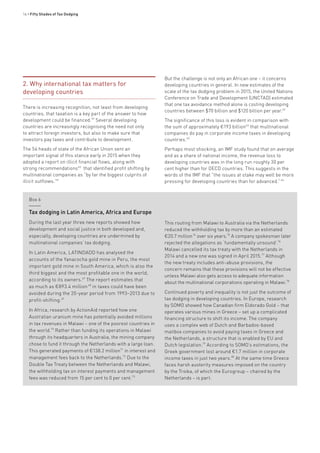
But the challenge is not only an African one – it concerns
developing countries in general. In new estimates of the
scale of the tax dodging problem in 2015, the United Nations
Conference on Trade and Development (UNCTAD) estimated
that one tax avoidance method alone is costing developing
countries between $70 billion and $120 billion per year.62
The significance of this loss is evident in comparison with
the sum of approximately €193 billion64
that multinational
companies do pay in corporate income taxes in developing
countries.65
Perhaps most shocking, an IMF study found that on average
and as a share of national income, the revenue loss to
developing countries was in the long run roughly 30 per
cent higher than for OECD countries. This suggests in the
words of the IMF that “the issues at stake may well be more
pressing for developing countries than for advanced.” 66
Box 6
Tax dodging in Latin America, Africa and Europe
During the last year three new reports showed how
development and social justice in both developed and,
especially, developing countries are undermined by
multinational companies’ tax dodging.
In Latin America, LATINDADD has analysed the
accounts of the Yanacocha gold mine in Peru, the most
important gold mine in South America, which is also the
third biggest and the most profitable one in the world,
according to its owners.67
The report estimates that
as much as €893.4 million 68
in taxes could have been
avoided during the 20-year period from 1993–2013 due to
profit-shifting.69
In Africa, research by ActionAid reported how one
Australian uranium mine has potentially avoided millions
in tax revenues in Malawi – one of the poorest countries in
the world.70
Rather than funding its operations in Malawi
through its headquarters in Australia, the mining company
chose to fund it through the Netherlands with a large loan.
This generated payments of €138.2 million71
in interest and
management fees back to the Netherlands.72
Due to the
Double Tax Treaty between the Netherlands and Malawi,
the withholding tax on interest payments and management
fees was reduced from 15 per cent to 0 per cent.73
This routing from Malawi to Australia via the Netherlands
reduced the withholding tax by more than an estimated
€20.7 million74
over six years.75
A company spokesman later
rejected the allegations as ‘fundamentally unsound’.76
Malawi cancelled its tax treaty with the Netherlands in
2014 and a new one was signed in April 2015.77
Although
the new treaty includes anti-abuse provisions, the
concern remains that these provisions will not be effective
unless Malawi also gets access to adequate information
about the multinational corporations operating in Malawi.78
Continued poverty and inequality is not just the outcome of
tax dodging in developing countries. In Europe, research
by SOMO showed how Canadian firm Eldorado Gold – that
operates various mines in Greece – set up a complicated
financing structure to shift its income. The company
uses a complex web of Dutch and Barbados-based
mailbox companies to avoid paying taxes in Greece and
the Netherlands, a structure that is enabled by EU and
Dutch legislation.79
According to SOMO’s estimations, the
Greek government lost around €1.7 million in corporate
income taxes in just two years.80
At the same time Greece
faces harsh austerity measures imposed on the country
by the Troika, of which the Eurogroup – chaired by the
Netherlands – is part.
Fifty Shades of Tax Dodging • 15
Developing countries are more prone to the negative effects
of tax dodging than developed countries in many ways. For
example, while only 3 per cent of corporate investments
in developed countries originate from ‘tax havens’,81
the
comparable figure for developing countries is 21 per cent
and the proportion rises to a full 41 per cent for transition
economies.82
Similarly, while 10 per cent of European wealth
is held offshore, the comparable figure in Africa is three
times higher at 30 per cent.83
Facing these challenges, some developing countries are
pushing back. As of 2014, the Kenyan tax administration
had successfully reclaimed approximately €210 million by
challenging multinational companies’ internal trading that
shifted profits out of the country,84
while in Bangladesh,
a newly established office will police the tax payments of
multinational companies.85
Late in 2014, China won its first
major tax claim against a multinational company, taking in
€103 million,86
and has subsequently promised “shock and
awe” tactics against tax avoiders.87
However, developing countries risk coming under immense
pressure for targeting multinational companies. Standing
up to the threat of reduced investments and being branded
a hostile investment destination can be difficult for most
developing countries to withstand.
And it is not just a matter of standing up to the pressure.
Even with the best of intentions, developing countries
are learning the same lesson as many rich countries are
learning – that making sure that multinational companies
do not dodge taxes requires international cooperation. This
is particularly the case for developing countries, which
often find that the decisions affecting them most on taxing
transnational investors are taken where the companies are
based − and very often that means Europe.
3. Europe’s role in upholding an unjust
international tax system
“The Union shall take account of the objectives of development
cooperation in the policies that it implements which are likely to
affect developing countries.”
The Lisbon Treaty, Article 20888
As the world’s biggest economy that is home to many
multinational companies and has close ties to developing
countries, Europe plays a central role in any discussion
on international tax justice. Europe has taken the lead in
the past, adopting policies that were pioneering such as
public country by country reporting for the financial sector.
However, as the many scandals of the last year have shown
(see Box 6), European policies are in some instances also
used to dodge taxes. Below we look at a number of aspects
of the international tax policies of Europe and their effect on
developing countries.
3.1 Bank secrecy and the lack of exchange of
information
The leak of banking information from the Swiss branch of
HSBC – Europe’s biggest bank – caused a major uproar
in 2015 and brought banking secrecy back into the public
spotlight.
What the so-called ‘SwissLeaks’ revelations exposed was
a banking system built on concealing money, with few
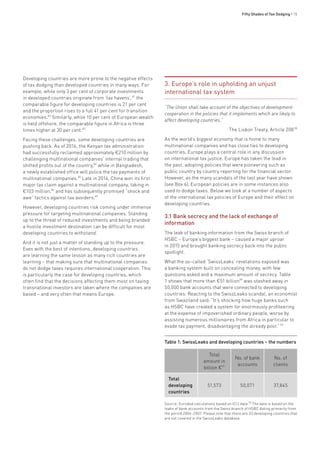
questions asked and a maximum amount of secrecy. Table
1 shows that more than €51 billion89
was stashed away in
50,000 bank accounts that were connected to developing
countries. Reacting to the SwissLeaks scandal, an economist
from Swaziland said: “It’s shocking how huge banks such
as HSBC have created a system for enormously profiteering
at the expense of impoverished ordinary people, worse by
assisting numerous millionaires from Africa in particular to
evade tax payment, disadvantaging the already poor.”90
Table 1: SwissLeaks and developing countries – the numbers
Total
amount in
billion €91
No. of bank
accounts
No. of
clients
Total
developing
countries
51,573 50,071 37,845
Source: Eurodad calculations based on ICIJ data.92
The data is based on the
leaks of bank accounts from the Swiss branch of HSBC dating primarily from
the period 2006–2007. Please note that there are 33 developing countries that
are not covered in the SwissLeaks database.
16 • Fifty Shades of Tax Dodging
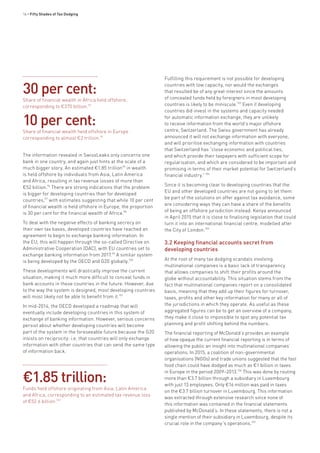
The information revealed in SwissLeaks only concerns one
bank in one country, and again just hints at the scale of a
much bigger story. An estimated €1.85 trillion95
in wealth
is held offshore by individuals from Asia, Latin America
and Africa, resulting in tax revenue losses of more than
€52 billion.96
There are strong indications that the problem
is bigger for developing countries than for developed
countries,97
with estimates suggesting that while 10 per cent
of financial wealth is held offshore in Europe, the proportion
is 30 per cent for the financial wealth of Africa.98
To deal with the negative effects of banking secrecy on
their own tax bases, developed countries have reached an
agreement to begin to exchange banking information. In
the EU, this will happen through the so-called Directive on
Administrative Cooperation (DAC), with EU countries set to
exchange banking information from 2017.99
A similar system
is being developed by the OECD and G20 globally.100
These developments will drastically improve the current
situation, making it much more difficult to conceal funds in
bank accounts in these countries in the future. However, due
to the way the system is designed, most developing countries
will most likely not be able to benefit from it.101
In mid-2014, the OECD developed a roadmap that will
eventually include developing countries in this system of
exchange of banking information. However, serious concerns
persist about whether developing countries will become
part of the system in the foreseeable future because the G20
insists on reciprocity: i.e. that countries will only exchange
information with other countries that can send the same type
of information back.
Fulfilling this requirement is not possible for developing
countries with low capacity, nor would the exchanges
that resulted be of any great interest since the amounts
of concealed funds held by foreigners in most developing
countries is likely to be miniscule.103
Even if developing
countries did invest in the systems and capacity needed
for automatic information exchange, they are unlikely
to receive information from the world’s major offshore
centre, Switzerland. The Swiss government has already
announced it will not exchange information with everyone,
and will prioritise exchanging information with countries
that Switzerland has “close economic and political ties,
and which provide their taxpayers with sufficient scope for
regularisation, and which are considered to be important and
promising in terms of their market potential for Switzerland’s
financial industry.”104
Since it is becoming clear to developing countries that the
EU and other developed countries are not going to let them
be part of the solutions on offer against tax avoidance, some
are considering ways they can have a share of the benefits
of being an offshore jurisdiction instead. Kenya announced
in April 2015 that it is close to finalising legislation that could
turn it into an international financial centre, modelled after
the City of London.105
3.2 Keeping financial accounts secret from
developing countries
At the root of many tax dodging scandals involving
multinational companies is a basic lack of transparency
that allows companies to shift their profits around the
globe without accountability. This situation stems from the
fact that multinational companies report on a consolidated
basis, meaning that they add up their figures for turnover,
taxes, profits and other key information for many or all of
the jurisdictions in which they operate. As useful as these
aggregated figures can be to get an overview of a company,
they make it close to impossible to spot any potential tax
planning and profit shifting behind the numbers.
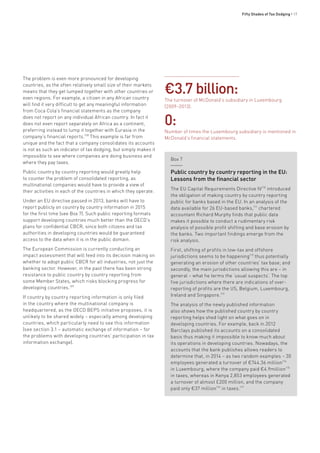
The financial reporting of McDonald’s provides an example
of how opaque the current financial reporting is in terms of
allowing the public an insight into multinational companies’
operations. In 2015, a coalition of non-governmental
organisations (NGOs) and trade unions suggested that the fast
food chain could have dodged as much as €1 billion in taxes
in Europe in the period 2009–2013.106
This was done by routing
more than €3.7 billion through a subsidiary in Luxembourg
with just 13 employees. Only €16 million was paid in taxes
on the €3.7 billion turnover in Luxembourg. This information
was extracted through extensive research since none of
this information was contained in the financial statements
published by McDonald’s. In these statements, there is not a
single mention of their subsidiary in Luxembourg, despite its
crucial role in the company´s operations.107
€1.85 trillion:
Funds held offshore originating from Asia, Latin America
and Africa, corresponding to an estimated tax revenue loss
of €52.6 billion.102
30 per cent:
Share of financial wealth in Africa held offshore,
corresponding to €370 billion.93
10 per cent:
Share of financial wealth held offshore in Europe
corresponding to almost €2 trillion.94
Fifty Shades of Tax Dodging • 17
The problem is even more pronounced for developing
countries, as the often relatively small size of their markets
means that they get lumped together with other countries or
even regions. For example, a citizen in any African country
will find it very difficult to get any meaningful information
from Coca Cola’s financial statements as the company
does not report on any individual African country. In fact it
does not even report separately on Africa as a continent,
preferring instead to lump it together with Eurasia in the
company’s financial reports.108
This example is far from
unique and the fact that a company consolidates its accounts
is not as such an indicator of tax dodging, but simply makes it
impossible to see where companies are doing business and
where they pay taxes.
Public country by country reporting would greatly help
to counter the problem of consolidated reporting, as
multinational companies would have to provide a view of
their activities in each of the countries in which they operate.
Under an EU directive passed in 2013, banks will have to
report publicly on country by country information in 2015
for the first time (see Box 7). Such public reporting formats
support developing countries much better than the OECD’s
plans for confidential CBCR, since both citizens and tax
authorities in developing countries would be guaranteed
access to the data when it is in the public domain.
The European Commission is currently conducting an
impact assessment that will feed into its decision making on
whether to adopt public CBCR for all industries, not just the
banking sector. However, in the past there has been strong
resistance to public country by country reporting from
some Member States, which risks blocking progress for
developing countries.109
If country by country reporting information is only filed
in the country where the multinational company is
headquartered, as the OECD BEPS initiative proposes, it is
unlikely to be shared widely – especially among developing
countries, which particularly need to see this information
(see section 3.1 – automatic exchange of information – for
the problems with developing countries’ participation in tax
information exchange).
Box 7
Public country by country reporting in the EU:
Lessons from the financial sector
The EU Capital Requirements Directive IV110
introduced
the obligation of making country by country reporting
public for banks based in the EU. In an analysis of the
data available for 26 EU-based banks,111
chartered
accountant Richard Murphy finds that public data
makes it possible to conduct a rudimentary risk
analysis of possible profit shifting and base erosion by
the banks. Two important findings emerge from the
risk analysis.
First, shifting of profits in low-tax and offshore
jurisdictions seems to be happening112
thus potentially
generating an erosion of other countries’ tax base; and
secondly, the main jurisdictions allowing this are – in
general – what he terms the ‘usual suspects’. The top
five jurisdictions where there are indications of over-
reporting of profits are the US, Belgium, Luxembourg,
Ireland and Singapore.113
The analysis of the newly published information
also shows how the published country by country
reporting helps shed light on what goes on in
developing countries. For example, back in 2012
Barclays published its accounts on a consolidated
basis thus making it impossible to know much about
its operations in developing countries. Nowadays, the
accounts that the bank publishes allows readers to
determine that, in 2014 – as two random examples – 30
employees generated a turnover of €744.36 million114
in Luxembourg, where the company paid €4.9million115
in taxes, whereas in Kenya 2,853 employees generated
a turnover of almost £200 million, and the company
paid only €37 million116
in taxes.117
€3.7 billion:
The turnover of McDonald’s subsidiary in Luxembourg
(2009–2013).
0:
Number of times the Luxembourg subsidiary is mentioned in
McDonald’s financial statements.
18 • Fifty Shades of Tax Dodging
Source: Eurodad calculations
118
Table 2: Number of listed companies that would report on
a country by country basis using the OECD BEPS threshold
and the proposed threshold of the European Parliament
Country
No. of listed
companies,
OECD BEPS
threshold
No. of listed
companies,
European
Parliament
proposed
threshold
Belgium 28 85
Czech Republic 3 6
Denmark 26 72
France 154 418
Germany 138 442
Hungary 3 14
Ireland 36 61
Italy 69 195
Luxembourg 26 54
Netherlands 61 110
Poland 29 237
Slovenia 6 27
Spain 48 108
Sweden 57 223
United Kingdom 262 778
EU 28 1,053 3,396
The OECD BEPS recommendations for country by country
reporting has a further shortcoming in that it only applies to
very large companies with an annual consolidated turnover
of more than €750 million. A current proposal from the
European Parliament119
would extend country by country
reporting to all ‘large undertakings’ as defined in an existing
EU directive.120
As Table 2 illustrates, the BEPS threshold
would only apply to a relatively small number of companies
while the threshold proposed by the European Parliament
would apply to significantly more companies. As the figures
in Table 2 only show listed companies they are merely
illustrative as both thresholds would also apply to non-listed
companies. They nonetheless show the large difference
in coverage with almost four times more listed companies
covered by the threshold suggested by the European
Parliament compared to the OECD BEPS threshold.
With the BEPS process jeopardising progress on country
by country reporting for developing countries, it is now up
to the EU and its Member States to push back, reaffirm that
its decision to make country by country reporting public for
banks was correct, and insist that public country by country
reporting should apply for all economic sectors and for a
wider group of companies than those under the high BEPS
threshold, for the benefit of all countries in the world.
3.3 Letterbox companies
Letterbox companies, or special purpose entities (SPEs),
are legal entities constructed to fulfill a narrow and specific
purpose. They usually have few or no employees and little
economic substance but they are often able to handle
large amounts of funds due to the favourable tax treatment
granted them in many countries. While the corporate income
tax rate is around 29 per cent in Luxembourg, for example,
their popular letterbox companies are only subject to a tax
of between 0.01 per cent and 0.05 per cent of the company’s
assets.121
As UNCTAD highlighted in 2013: “…international
efforts … have focused mostly on [offshore financial centres],
but SPEs are a far larger phenomenon.”122
Letterbox
companies can be managed by so-called trust and corporate
service providers. Financial Action Task Force (FATF) defines
such providers as “all those persons and entities that, on a
professional basis, participate in the creation, administration
and management of trusts and corporate vehicles.”123
Research by authorities and journalists has shown that such
corporate service providers help companies to avoid and
evade taxes.124
They can even be used for money laundering
activities,125
and at least in the Netherlands many have not
collected sufficient information about the risks associated
with their clients.126
Fifty Shades of Tax Dodging • 19
Europe is a major centre for routing investments through
letterbox companies. Luxembourg and the Netherlands
are particularly important in this respect, accounting
together for approximately a quarter of all the world’s FDI
stocks. Luxembourg alone accounts for 54 per cent of all
investments going out of Europe.127
Other European countries
such as Austria, Cyprus, Hungary and Spain also have
attractive SPE regimes.128
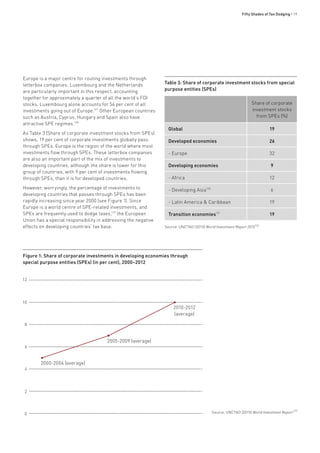
As Table 3 (Share of corporate investment stocks from SPEs)
shows, 19 per cent of corporate investments globally pass
through SPEs. Europe is the region of the world where most
investments flow through SPEs. These letterbox companies
are also an important part of the mix of investments to
developing countries, although the share is lower for this
group of countries, with 9 per cent of investments flowing
through SPEs, than it is for developed countries.
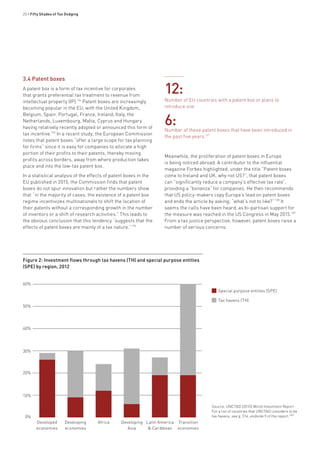
However, worryingly, the percentage of investments to
developing countries that passes through SPEs has been
rapidly increasing since year 2000 (see Figure 1). Since
Europe is a world centre of SPE-related investments, and
SPEs are frequently used to dodge taxes,129
the European
Union has a special responsibility in addressing the negative
effects on developing countries’ tax base.
Table 3: Share of corporate investment stocks from special
purpose entities (SPEs)
Share of corporate
investment stocks
from SPEs (%)
Global 19
Developed economies 26
- Europe 32
Developing economies 9
- Africa 12
- Developing Asia130
6
- Latin America & Caribbean 19
Transition economies131
19
Source: UNCTAD (2015) World Investment Report 2015132
Figure 1: Share of corporate investments in developing economies through
special purpose entities (SPEs) (in per cent), 2000–2012
Source: UNCTAD (2015) World Investment Report
133
0
2
4
6
8
10
12
2000-2004 (average)
2005-2009 (average)
2010-2012
(average)
20 • Fifty Shades of Tax Dodging
3.4 Patent boxes
A patent box is a form of tax incentive for corporates
that grants preferential tax treatment to revenue from
intellectual property (IP).134
Patent boxes are increasingly
becoming popular in the EU, with the United Kingdom,
Belgium, Spain, Portugal, France, Ireland, Italy, the
Netherlands, Luxembourg, Malta, Cyprus and Hungary
having relatively recently adopted or announced this form of
tax incentive.135
In a recent study, the European Commission
notes that patent boxes “offer a large scope for tax planning
for firms” since it is easy for companies to allocate a high
portion of their profits to their patents, thereby moving
profits across borders, away from where production takes
place and into the low-tax patent box.
In a statistical analysis of the effects of patent boxes in the
EU published in 2015, the Commission finds that patent
boxes do not spur innovation but rather the numbers show
that “in the majority of cases, the existence of a patent box
regime incentivizes multinationals to shift the location of
their patents without a corresponding growth in the number
of inventors or a shift of research activities.” This leads to
the obvious conclusion that this tendency “suggests that the
effects of patent boxes are mainly of a tax nature.”136
Meanwhile, the proliferation of patent boxes in Europe
is being noticed abroad. A contributor to the influential
magazine Forbes highlighted, under the title “Patent boxes
come to Ireland and UK, why not US?”, that patent boxes
can “significantly reduce a company’s effective tax rate”,
providing a “bonanza” for companies. He then recommends
that US policy-makers copy Europe’s lead on patent boxes
and ends the article by asking: “what’s not to like?”138
It
seems the calls have been heard, as bi-partisan support for
the measure was reached in the US Congress in May 2015.139
From a tax justice perspective, however, patent boxes raise a
number of serious concerns.
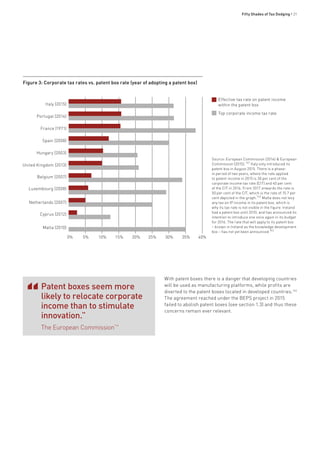
Figure 2: Investment flows through tax havens (TH) and special purpose entities
(SPE) by region, 2012
Special purpose entities (SPE)
Tax havens (TH)
12:
Number of EU countries with a patent box or plans to
introduce one.
6:Number of these patent boxes that have been introduced in
the past five years.137
Source: UNCTAD (2015) World Investment Report.
For a list of countries that UNCTAD considers to be
tax havens, see p. 214, endnote 9 of the report.140
0%
10%
20%
30%
40%
50%
60%
Developed
economies
Developing
economies
Africa Developing
Asia
Latin America
& Caribbean
Transition
economies
Fifty Shades of Tax Dodging • 21
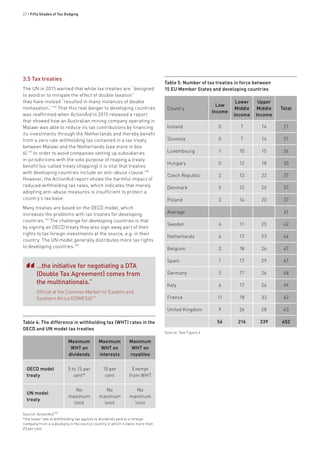
Source: European Commission (2014) & European
Commission (2015). 141
Italy only introduced its
patent box in August 2015. There is a phase-
in period of two years, where the rate applied
to patent income in 2015 is 30 per cent of the
corporate income tax rate (CIT) and 40 per cent
of the CIT in 2016. From 2017 onwards the rate is
50 per cent of the CIT, which is the rate of 15.7 per
cent depicted in the graph.142
Malta does not levy
any tax on IP income in its patent box, which is
why its tax rate is not visible in the figure. Ireland
had a patent box until 2010, and has announced its
intention to introduce one once again in its budget
for 2016. The rate that will apply to its patent box
– known in Ireland as the knowledge development
box – has not yet been announced.143
With patent boxes there is a danger that developing countries
will be used as manufacturing platforms, while profits are
diverted to the patent boxes located in developed countries.145
The agreement reached under the BEPS project in 2015
failed to abolish patent boxes (see section 1.3) and thus these
concerns remain ever relevant.
Effective tax rate on patent income
within the patent box
Top corporate income tax rate
Patent boxes seem more
likely to relocate corporate
income than to stimulate
innovation.”
The European Commission
144
‘‘
0% 5% 10% 15% 20% 25% 30% 35% 40%
Figure 3: Corporate tax rates vs. patent box rate (year of adopting a patent box)
Italy (2015)
Portugal (2014)
France (1971)
Spain (2008)
Hungary (2003)
United Kingdom (2013)
Belgium (2007)
Luxembourg (2008)
Netherlands (2007)
Cyprus (2012)
Malta (2010)
22 • Fifty Shades of Tax Dodging
Table 4: The difference in withholding tax (WHT) rates in the
OECD and UN model tax treaties
Maximum
WHT on
dividends
Maximum
WHT on
interests
Maximum
WHT on
royalties
OECD model
treaty
5 to 15 per
cent*
10 per
cent
Exempt
from WHT
UN model
treaty
No
maximum
limit
No
maximum
limit
No
maximum
limit
Source: ActionAid152
*the lower rate of withholding tax applies to dividends paid to a foreign
company from a subsidiary in the source country in which it owns more than
25 per cent.
3.5 Tax treaties
The UN in 2015 warned that while tax treaties are “designed
to avoid or to mitigate the effect of double taxation”
they have instead “resulted in many instances of double
nontaxation.”146
That this real danger to developing countries
was reaffirmed when ActionAid in 2015 released a report
that showed how an Australian mining company operating in
Malawi was able to reduce its tax contributions by financing
its investments through the Netherlands and thereby benefit
from a zero rate withholding tax contained in a tax treaty
between Malawi and the Netherlands (see more in box
6).147
In order to avoid companies setting up subsidiaries
in jurisdictions with the sole purpose of reaping a treaty
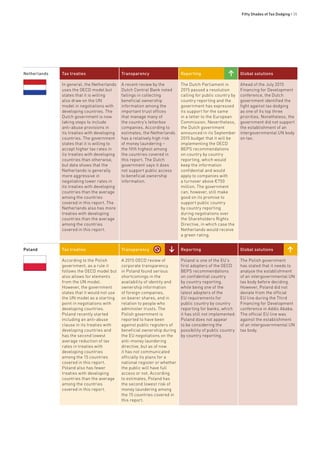
benefit (so-called treaty shopping) it is vital that treaties
with developing countries include an anti-abuse clause.148
However, the ActionAid report shows the harmful impact of
reduced withholding tax rates, which indicates that merely
adopting anti-abuse measures is insufficient to protect a
country’s tax base.
Many treaties are based on the OECD model, which
increases the problems with tax treaties for developing
countries.149
The challenge for developing countries is that
by signing an OECD treaty they also sign away part of their
rights to tax foreign investments at the source, e.g. in their
country. The UN model generally distributes more tax rights
to developing countries.150
Table 5: Number of tax treaties in force between
15 EU Member States and developing countries
Country
Low
Income
Lower
Middle
Income
Upper
Middle
Income
Total
Ireland 0 7 14 21
Slovenia 0 7 14 21
Luxembourg 1 10 15 26
Hungary 0 12 18 30
Czech Republic 2 13 22 37
Denmark 5 12 20 37
Poland 3 14 20 37
Average 41
Sweden 6 11 25 42
Netherlands 4 17 23 44
Belgium 3 18 26 47
Spain 1 17 29 47
Germany 5 17 26 48
Italy 6 17 26 49
France 11 18 33 62
United Kingdom 9 26 28 63
56 216 339 652
Source: See Figure 4
…the initiative for negotiating a DTA
(Double Tax Agreement) comes from
the multinationals.”
Official at the Common Market for Eastern and
Southern Africa (COMESA)151
‘‘
Fifty Shades of Tax Dodging • 23
Source: Eurodad calculations.153
The average
rate reduction covers withholding taxes on four
income categories: Royalties, interests, dividends
on companies and qualified companies. It does
not cover tax rates on services or management
fees due to the lack of data. The average rate
reductions between the European countries
covered in this report and the developing
countries refers to the difference between the
rates contained in the treaty and the statutory
rates in the developing country for all four income
categories. The figure for the overall average
reduction is an un-weighed average for all of the
15 European countries covered in this report.
…if you look at all these (treaties) that
have been signed, you can probably link
to a very major company that came into
this country.”
African Ministry of Finance official155
‘‘
Beyond challenges with treaty shopping and the distribution
of taxing rights, tax treaties can further undermine the
revenue base of developing countries through reduction
of withholding tax rates. These often get reduced in
negotiations between governments.
The UN in a 2015 report notes that “many developing
countries with weak tax collection capabilities have seen
limits imposed on the use of a relatively effective tax
collection mechanism (withholding taxes)” through treaties
due to these reductions in rates.154
Table 4 shows that this
problem is again also related to the OECD model, which
generally imposes low maximum rates of withholding taxes,
while the UN model does not set such limits.
Analysis of the 15 EU countries covered in this report show
that most are quite active in reducing the withholding tax rates
in their treaties with developing countries (see Figure 4).
Figure 4: Average rate reductions (%) in treaties between 15 EU Member States
and developing countries
Luxembourg
Poland
Ireland
Belgium
Italy
Hungary
Slovenia
Average
France
Czech Republic
Denmark
Netherlands
Germany
Sweden
United Kingdom
Spain
0% 1% 2% 3% 4% 5% 6%
24 • Fifty Shades of Tax Dodging
3.6 Tax rulings
The international rules for taxation of multinational
corporations remain uncertain and complex, and concerns
have been raised that the outcome of the OECD’s BEPS
process (see section 1.3) will only increase this problem.156
In order to have legal clarity, tax administrations can offer
companies or individuals tax rulings, including advance
pricing agreements (APAs), that make their tax position clear
and assures that the tax administration will not challenge
the tax practices agreed on. These types of agreements
can be effective ways to make the tax system more efficient
by bringing certainty to corporations. However, they can
also be misused to legitimise significant tax avoidance,
and so their use needs to be transparent and accountable.
Currently, these agreements are often negotiated bilaterally
between the multinational corporation and the national tax
administration, and are kept in secrecy.
The secret world of tax rulings for multinational
corporations became better known after the LuxLeaks
revelations in November 2014.157
A law professor has
described these tax rulings in the following way: “It’s like
taking your tax plan to the government and getting it blessed
ahead of time.”158
Such tax rulings have now become a
key tool in corporate tax avoidance. With provision for tax
rates lower than 1 per cent in some cases,159
multinational
companies flocked to Luxembourg’s tax department to get
a ruling. The audit company PwC that brokered the tax
rulings has since been accused in the UK’s Public Accounts
Committee of promoting tax avoidance on an industrial
scale.160
Along with other EU Member States, Luxembourg is
currently under investigation by the European Commission
for using tax rulings as a form of illegal state aid. The
Commission’s investigation was expanded in March 2015 to
include tax deals with McDonald’s.161
Shocking as the revelations from Luxembourg were, the
really disturbing thing about these leaks was that they only
involved one country and the tax rulings brokered by one
audit company. It is safe to say that LuxLeaks revealed
only the tip of the iceberg: underneath is a much wider and
deeper problem, since 22 of Europe’s Member States make
use of tax rulings and we can only guess at the provision for
lower corporate taxes that they involve. While Luxembourg is
one of the most active Member States in issuing tax rulings,
it is certainly not the only one. Figure 5 illustrates this,
showing only one type of tax ruling – the so-called Advance
Pricing Agreements (APAs).
The European Commission announced in March 2015 that
the details of tax rulings would be automatically exchanged
between Member States within the EU in an attempt to
discourage excessive rulings.162
Important as this step may be, it does nothing to assist
developing countries or the citizens of Europe in accessing
the tax rulings, and doesn’t address the underlying problem
of a complex, uncertain and very opaque tax system, where
governments often engage in ‘tax competition’ to attract
multinational corporations with opportunities to lower
their taxes, rather than work together to ensure a solid and
coherent tax system.163
Data from the Commission shows
that, out of the 547 APAs in force in EU Member States by
the end of 2013, 178 were with non-EU countries.164
The Commission is conducting an impact assessment to
look into the pros and cons of making parts of the tax rulings
public. This is expected to be ready by the beginning of 2016.
However, as is the usual case with the Commission’s impact
assessments, it will most likely not consider the interests of
developing countries when weighing up the pros and cons.
3.7 Excluding developing countries from decision
making
As has been highlighted above, the OECD BEPS reforms
have systematically been biased against the interests of
developing countries.
Europe plays a key role in upholding the current system,
which dictates that international taxation reform is discussed
and progressed through OECD and G20 forums, where more
than 100 developing countries are not represented. For
years, developing countries have been calling for the UN
to take over the international taxation reform process, as
this would allow all countries in the world to have a seat at
the table when decisions are to be taken. The EU played an
active role in blocking this proposal in the July Financing for
Development conference in Addis Ababa, where the question
of the global tax body was a key sticking point between
developed and developing countries.
In the early stages of the negotiations, the EU seemed to
indicate some openness to discussing the proposal, calling
for a cost-benefit analysis, more clarity of what the mandate
would be and reflections on the potential interlinkages with
between different bodies to avoid ‘wasteful duplication’.165
However, the EU’s line then changed to opposing the
intergovernmental tax body with a reference to the problem
of ‘institutional proliferation’ and their preference for
keeping the decision making at the OECD.166
The proposal
was also opposed by other developed countries, including the
United States167
and in the end it was not adopted.
Fifty Shades of Tax Dodging • 25
3.8 Building capacity or consensus?
Amid the accusations that the OECD is an unrepresentative
body for discussing international tax reform, and that is
not a disinterested ‘honest broker’ as it is sometimes
represented,169
the OECD has stressed the need to build the
capacities of developing countries’ tax administrations in
order for them to be able to implement global tax standards.
However, reducing the question of how developing countries
can raise more tax revenues to one of capacity misses the
inherently political nature of the problem and shifts the
onus onto developing countries and away from developed
countries. This was captured in a report adopted by the 54
African Union heads of state, which states: “it is somewhat
contradictory for developed countries to continue to provide
technical assistance and development aid (though at lower
levels) to Africa while at the same time maintaining tax rules
that enable the bleeding of the continent’s resources through
illicit financial outflows.”170
Source: European Commission 2014.168
The data on APAs in force at the end of 2013
is incomplete for Austria and missing for the
Netherlands (although data shows that the
Netherlands granted 228 APAs in 2013 alone).
The EU countries that do not currently have APA
programmes are: Bulgaria, Estonia, Croatia,
Cyprus, Malta and Slovenia. Greece has an APA
programme, but did not have any APAs in force by
the end of 2013. As there is no EU-wide definition
of APAs or when an APA is entered into force
there may be discrepancies in how the figures
were arrived at for each country.
Figure 5: Total number of Advance Pricing Agreements (APAs) in force by the end
of 2013 in selected EU Member States
Luxembourg
United Kingdom
Hungary
Spain
Italy
France
Czech Republic
Germany
Finland
EU Average
Poland
Slovakia
Denmark
Ireland
Belgium
Romania
Austria
Portugal
Sweden
0 20 40 60 80 100 120
Despite this contradiction, the need for capacity building
on taxation is undeniable in most developing countries: it
is estimated that African countries would have to hire an
additional 650,000 tax officials to have the same ratio of tax
officials to population as in OECD countries.171
However, capacity building can also be used to promote the
OECD’s policies in developing countries, and to increase
the pressure on developing countries to implement these,
regardless of whether they serve developing country interests
or not. This includes policies that have proven to be difficult to
operationalise in developing countries – such as the OECD’s
arm’s length principle to address transfer mispricing.172
26 • Fifty Shades of Tax Dodging
3.9 Hidden ownership of companies and trusts
A key challenge in the fight against tax evasion is that it is
so easy to hide money. Traditionally secret bank accounts
were the preferred choice for hiding wealth. However,
with the trend towards increased information exchange
between countries on bank account information (see
section 3.1 above), tax evaders, the corrupt and criminal
are increasingly turning to other sources of secrecy.
“Offshore banking is … becoming more sophisticated.
Wealthy individuals increasingly use shell companies,
trusts, holdings, and foundations as nominal owners of their
assets,”179
as noted by tax expert Gabriel Zucman.
These structures allow individuals to hold money
anonymously: instead of the person or group of people who
actually controls the funds being listed as the owner, the
apparent owner is a company or nominee director of that
company. Zucman notes that this leads to the worrying
phenomenon that more than 60 per cent of all foreign-
held deposits in Swiss banks belong to entities in the
British Virgin Islands, Jersey and Panama, all renowned
jurisdictions for setting up shell companies.180
The SwissLeaks revelations showed a similar pattern, with
20 per cent of bank accounts associated with Viet Nam
being held by offshore companies, and 30 per cent of those
associated with Kazakhstan.181
According to The Guardian, the
HSBC files shows that the bank actively advised some of its
wealthy clients to hide behind such shell companies to avoid
their bank information being subject to the new EU rules
on automatic information exchange.182
Some of these shell
companies and trusts are used for legitimate purposes; the
problem is that the secrecy they offer tends to attract those
with secrets to keep. And when it comes to finances, this
includes the world’s tax dodgers, money launderers, corrupt
dictators and the like. A World Bank review of more than 150
grand corruption scandals in developing countries found that
anonymous companies were used in more than 70 per cent
of the cases.183
To counter the widespread misuse of corporate secrecy
through shell companies and trusts, the EU adopted new
regulations on money laundering in 2015, which provides
that all EU Member States will have to create registers of
the real owner of shell companies and some trusts. This is
a major step forward as it will mean that individuals will no
longer be able to hide behind obscure lines of ownership.
However, the EU law-makers missed a huge opportunity for
transparency by deciding that only members of the public
who can demonstrate a ‘legitimate interest’ should have
access to the registers of real owners.184
Box 8
Tax inspectors without borders – a model for
capacity building?
According to the OECD, the Tax Inspectors Without
Borders initiative is to be used as a tool to build
developing country capacity to implement BEPS
solutions.173
As the OECD itself announces, it is a ‘dating
agency’ in which retired or in-service tax officials – both
from developed and developing administrations – are
deployed in developing countries to instruct them
how to audit multinational companies.174
The initiative
complements the programmes on capacity building on
transfer pricing in developing countries that the OECD
Task Force on Tax and Development has been carrying
out jointly with the World Bank and the European
Commission in 14 countries.175
Until now only pilot deployments have been in place,
with four EU countries involved: France in Senegal,
Italy in Albania, the Netherlands in Ghana and the UK in
Rwanda. It thus seems clear that EU countries will take
on a big part of the capacity building under this initiative.
Eurodad has analysed the pilot deployments in Ghana
and Rwanda and two main concerns have arisen.
First, the probability of conflicts of interests and the
involvement of the private sector. For example, in
the case of Rwanda, the programme, including the
deployment of UK inspectors, was managed by PwC – a
company that among other things played a very central
role in the LuxLeaks tax scandal.176
Second, the potential conflicts of interests between the
country deploying the experts and the host country. In
the case of Ghana, for example, the partner country,
the Netherlands, is also home country to several large
multinational corporations operating in Ghana.177
During the Third UN Financing for Development
Conference held in Addis Ababa in July, the initiative
was officially launched with the support of the UN
Development Programme (UNDP).178
Time will
determine whether the initiative will benefit developing
countries, or whether it will end up becoming a way to
promote other interests and export a failed approach to
international taxation.
Fifty Shades of Tax Dodging • 27
Figure 6: Money-laundering risks in 15 EU countries, 2015
78 per cent
of citizens in 18 EU Member States agree that their
government should require companies to publish the real
names of their shareholders and owners.186
Although it seems obvious that all citizens have a legitimate
interest in knowing who owns the companies that operate
in our society, particular interpretations of ‘legitimate
interest’ could be used by some Member States to exclude
the public’s access to this information. It is as yet unclear
whether tax administrations in developing countries, let
alone the public, will be allowed access to this information
under the EU regulation. Member States are, however, free
to go beyond the minimum requirements in the directive and
adopt fully public registers.
Source: Based on the Basel Institute of
Governance’s Anti-Money Laundering Index
2015.185
The index ranges from 0 (low risk of
money laundering) to 10 (high risk of money
laundering). The EU average includes all 28
Member States and is not weighted according to
population or other factors.
Luxembourg
Germany
Italy
Spain
Netherlands
France
United Kingdom
Belgium
Czech Republic
EU Average
Ireland
Denmark
Hungary
Sweden
Poland
Slovenia
0 1 2 3 4 5 6
28 • Fifty Shades of Tax Dodging
Report findings
4.1 Tax policies
Tax rulings
i
Tax rulings are common in most of the countries covered
in this report, although more so in a few countries (most
notably in the Netherlands and Luxembourg). In all except
one of the 15 countries covered in the report (Slovenia),
the governments allow for the granting of Advance Pricing
Agreements (APAs) to multinational corporations.
ii
Several
of the countries covered are currently subject to European
Commission state aid investigations in relation to their tax
rulings (Luxembourg, the Netherlands, Ireland and Belgium).
Shell companies
iii
In relation to shell companies, one of the biggest changes
of the year was that a number of countries covered in this
report for the first time started to report separately on the
foreign direct investment (FDI) flows going through their
special purpose entities (SPEs). Of the countries covered
in this report, the available data shows that routing of
FDI through SPEs is commonplace in almost half of them
(Luxembourg, the Netherlands, Hungary, Denmark, Spain
and Ireland).
Patent boxes
iv
The harmful tax practice commonly known as ‘patent boxes’
continues to spread in the EU. Out of the 28 EU Member
States, 12 countries have either already introduced or are in
the process of setting up a patent box, while Germany is still
considering the option. Despite the tough rhetoric against tax
dodging from many governments, it is noteworthy that half
of the EU’s patent boxes have been introduced within the last
five years, dispelling the notion that the EU has effectively
halted the implementation of new harmful tax measures.
Several of the countries covered in this report are either
adopting (Italy) or preparing legislation to adopt a patent
box (Ireland) in 2015. Despite the newly adopted OECD BEPS
package, which includes new guidelines on patent boxes,
existing patent boxes can – in accordance with the guidelines
– continue business as usual until 2021.
Tax treaties
v
The number of tax treaties with developing countries
continues to increase, but the increase is higher in some
countries (such as in Luxembourg) than others (for example,
in Sweden where no new treaties with developing countries
came into force in the period covered in this report). Other
countries (such as Hungary, Slovenia and Belgium) are
expanding their treaty network with low-tax jurisdictions.
In the past year, more of the 15 countries covered in this
report are beginning to include anti-abuse clauses in
their treaties with developing countries (for example, in
the Netherlands, Denmark, France and Poland). In other
countries, governments are increasingly pressured to
acknowledge the potential negative impact of their treaties
with developing countries (such as in Ireland, where the
government conducted a spillover analysis and in Denmark
where a Parliamentary hearing was held on the topic). Some
treaties with developing countries were also renegotiated
(as was the case in the Netherlands and Ireland) with some
improvements.
On average, Spain tends to be the worst among the 15
countries in terms of lowering withholding tax rates in its
treaties with developing countries. Spain’s new treaties with
Senegal (2014) and Nigeria (2015) cemented this trend.
4.2 Financial and corporate transparency
Banking scandals in some countries (notably Germany and
Sweden) turned the spotlight on the role of the financial
sector in Europe as far as facilitating tax dodging and money
laundering is concerned.
vi
Ownership transparency
vii
During the EU negotiations on the anti-money laundering
directive towards the end of 2014, some countries played a
constructive role (including France and Italy), while others
played a more negative role (such as Germany, Spain and
Poland). However, as the directive is being implemented by
the EU Member States, it is becoming clear that countries
that took the most ambitious stand in the negotiations are
not the ones showing leadership in implementation. Both
France and Italy have rejected the idea of establishing a
public register for beneficial owners of companies, for
example. The UK is in advanced stages of introducing a public
register of the beneficial owners of companies but regrettably
not for trusts. It seems they will be joined by Slovenia and
Denmark, which both state that they plan to implement
registers that will be available to the public without any
qualifying criteria. Unlike the UK, Slovenia and Denmark are
either in the process of restricting, on in the case of Slovenia
have refrained from offering, alternative opportunities for
concealing ownership, such as trusts, for example.
Some of the most troubling countries are still Luxembourg
and Germany, which together offer a diverse set of options
for concealing ownership and laundering money. However,
a significant number of countries have not yet formed a
position and will hopefully decide to implement fully public
registers in the year to come.
Fifty Shades of Tax Dodging • 29
Public reporting for multinational corporations
viii
Large movements have been seen on country by country
reporting over the past year. Of the 15 countries covered
in the report, nine governments state that they intend to
implement the OECD BEPS recommendations (France,
Germany, Ireland, Luxembourg, Poland, Slovenia, Spain,
Sweden and the UK), which will keep the reporting
confidential and only apply to very large companies. The
former champion, France, is no longer pushing this demand
and has instead joined the group of countries introducing
confidential country by country reporting. However, some
governments (the Netherlands, Belgium and the UK) have
indicated varying degrees of willingness to look into the
possibility of making the information public.
i.	 For more information, see section 3.6 on ’Tax rulings’ as well as the
national chapters
ii.	 For more information, see figure 5 in section 3.6 on ‘Tax Rulings’
iii.	 For more information, see section 3.3 on ’Letterbox companies’ as well as
the national chapters
iv.	 For more information, see section 3.4 on ‘Patent boxes’ as well as the
national chapters
v.	 For more information, see section 3.5 on ’Tax treaties’ as well as the
national chapters
vi.	 For more information, see the national chapters of Germany and Sweden
vii.	For more information, see section 3.9 on ’Hidden ownership of companies
and trusts’ as well as the national chapters
viii.	For more information, see section 1.3 on ’Will BEPS stop tax dodging’
as well as the chapters on the European Parliament, the European
Commission and the national chapters
ix.	 For more information, see section 3.7 on ’Excluding developing countries
from decision making’ as well as the national chapters
4.3 Global solutions
ix
None of the 15 countries covered in this report broke with the
official EU line at the July 2015 Financing for Development
conference, which regrettably opposed and successfully
blocked the establishment of an intergovernmental body on
taxation under the auspices of the UN. Among all of the 28
EU Member States, the UK and France played the leading
role in blocking the demand from developing countries
to have a seat at the table when global tax standards
and policies are being decided. Today, only the Slovenian
government is prepared to state that it supports the
establishment of such a body.
30 • Fifty Shades of Tax Dodging
See Appendix, p102, for a key to the following country rating system.
Specific findings
European
Commission
Tax treaties Transparency Reporting Global solutions
The Commission does
not seem to have a public
position on EU Member
States’ use of tax treaties
with developing countries.
The Commission
proposal for the new EU
anti-money laundering
directive did not initially
include public access
to beneficial ownership
information. At a late stage
of the negotiations on the
directive the Commission
suggested having some
public access, but only
among those who can
demonstrate a so-called
‘legitimate interest’,
without specifying what this
would mean in practice.
The Commissioner in
charge of taxation has on
several occasions voiced
his personal support
for public country by
country reporting, but the
Commission does not as yet
have a unified position on
the issue. The Commission
has been openly hostile to
the European Parliament’s
attempt to push for public
country by country reporting
through the review of
the Shareholders Rights
Directive. The Commission
is currently conducting
an impact assessment on
public corporate reporting
and will present its findings
in early 2016 after which
it is expected to develop
a more clear position on
public country by country
reporting.
A Communication issued
in 2015 by the Commission
supported the view that
developing countries
should implement decisions
made by the OECD and G20
on tax. At the July 2015
Financing for Development
conference the Commission
rejected the establishment
of an intergovernmental UN
body on tax.
European
Parliament
Tax treaties Transparency Reporting Global solutions
The European Parliament
stresses that EU Member
States should use the UN
model when negotiating
tax treaties with developing
countries and stresses the
need for policy coherence
for development in these
treaties. The Parliament
has also called for an
EU-wide standard on tax
treaties, and has called on
Member States to conduct
spillover analyses of their
tax treaties with developing
countries.
The European Parliament
stood firm on the principle
that the public should
have access to beneficial
ownership information in
the negotiations on the new
EU anti-money laundering
directive towards the end
of 2014. It has since urged
Member States to go beyond
the minimum requirements
of the new directive by
allowing unrestricted public
access to basic information
in the beneficial ownership
register.
The European Parliament
in 2015 discussed
amendments to a directive
to introduce public country
by country reporting. A
comfortable majority
voted for the proposal and
it has thus become the
position of the Parliament.
Negotiations on the
directive are thought to be
scheduled towards the end
of 2015.
The European Parliament
has repeatedly voiced its
support for the creation of
an intergovernmental UN
body on tax, last repeated
shortly before the 2015
Financing for Development
conference.
Belgium Tax treaties Transparency Reporting Global solutions
Belgium’s model treaty
contains many aspects
that are not suitable for
developing countries, but it
does include an anti-abuse
clause. Belgium has more
treaties with developing
countries than the average
among the countries
considered in this report,
but Belgium’s treaties
with developing countries
on average reduce the tax
rates less than the average
among the countries
covered in this report.
A 2015 FATF review found
considerable shortcomings
in Belgium’s anti-money
laundering framework,
but not in relation to the
registration and storing
of beneficial ownership
information. A taskforce yet
to be set up will consider
whether Belgium should
adopt a public register of
beneficial owners. Trusts
are not allowed under
Belgian law.
The Belgian government is
officially still awaiting the
outcome of the European
Commission impact
assessment on country
by country reporting and
will also conduct its own
national assessment before
forming its own position.
The Belgian government
does not support the
establishment of an
intergovernmental UN tax
body.
Fifty Shades of Tax Dodging • 31
Czech Republic Tax treaties Transparency Reporting Global solutions
The Czech model treaty is
based on the OECD model,
but its treaties contain a
mix of the UN and OECD
model provisions. The
Czech Republic has less
tax treaties with developing
countries than the average
among the countries
covered in this report,
but the Czech treaties
with developing countries
on average reduce the
withholding tax rates more
than the average among the
countries covered in this
report.
The government plans
to present amendments
to existing legislation in
October 2015 to implement
the new EU anti-money
laundering directive, and
expects the new law to be
effective from 1 July 2016.
Whether the mandatory
register of beneficial
owners contained in the
directive will be made
public or not is still
being considered by the
government. Trusts were
introduced in 2014 and
currently no registration is
required.
The Czech government’s
position on country by
country reporting is not
known.
The official position of
the Czech government
is not supportive of an
intergovernmental UN body
on tax.
Denmark Tax treaties Transparency Reporting Global solutions
Denmark’s treaties with
developing countries
were, until the mid-1990s,
largely based on the UN
model, but have since then
been based on the OECD
model. A controversial
treaty with Ghana sparked
a Parliamentary hearing in
April 2015 on Denmark’s
treaties with developing
countries but did not seem
to bring any significant
acknowledgement from
the government of the
need to change negotiation
practices. The government
does not plan to conduct
a spillover analysis of its
treaties. New legislation
introduced in 2015 means
that all of Denmark’s
tax treaties now include
an anti-abuse clause.
Denmark has fewer
treaties with developing
countries than the average
among the countries
covered in this report, but
Denmark’s treaties with
developing countries on
average reduce withholding
tax rates more than
the average among the
countries covered in this
report.
Following a number of
scandals relating to shell
companies set up in
Denmark the government
announced in late 2014 that
it intended to set up a fully
public register of beneficial
owners of companies. The
register is expected to be
implemented by late spring
2016. The new government
that took office in June 2015
has not announced any
changes to these plans. In
2015 it was also decided
that bearer shares are to
be phased out and a public
register of shareholders
was introduced in June.
The government position
on country by country
reporting remains unclear.
However, with elections
in June 2015 a majority
against Denmark’s public
list of tax payments by
big companies emerged,
although a legal proposal
to remove the lists has not
yet been put forth. With this
development the prospects
for a Parliamentary
majority for public country
by country reporting seem
less likely than before.
The official position of
the Danish government
is not supportive of an
intergovernmental UN body
on tax.
32 • Fifty Shades of Tax Dodging
France Tax treaties Transparency Reporting Global solutions
France is only surpassed
by the UK in the number
of treaties it has with
developing countries. The
treaties are exclusively
based on the OECD model.
The Ministry of Finance
recently changed position
and says it now supports
the introduction of anti-
abuse provision in France’s
treaties. On the other
hand, France’s treaties
on average reduce the
withholding rate by 3.11 per
cent, which is more than
the average among the
countries covered in this
report. A 2014 treaty with
China showed that France
continues to press for lower
rates in its treaties with
developing countries.
France is reported to have
played a constructive role
by promoting beneficial
ownership transparency
as a priority during the EU
negotiation on a new anti-
money laundering directive.
In a disappointing move,
the French authorities
in 2015 said they do not
plan to go beyond the
minimum requirements
of the directive in allowing
access to beneficial
ownership information, but
will instead limit it to those
with a ‘legitimate interest’.
However, the authorities
say they intend to apply
as wide an interpretation
of ‘legitimate interest’
as possible, but have not
yet provided an official
definition. A law drawn up in
2013 would create a public
register on trusts, but the
decree implementing the
law has still not been issued.
Having for years been
an advocate for more
corporate transparency by
multinational companies,
the French government
disappointingly said
in 2015 that it will not
unilaterally adopt public
country by country
reporting and instead
plans to follow the OECD
BEPS recommendations.
Following the launch of
the BEPS plan in October,
the French government
confirmed in a communiqué
its intention to adopt the
confidential country by
country model by the end
of the year as part of its
budget bill.
France warmly supports
the Paris-based OECD
and its BEPS process.
The French government
has repeatedly made
clear that it does not
support the creation of an
intergovernmental tax body
under the UN and was one
of the most active blockers
of this proposal during the
July 2015 Financing for
Development conference.
Germany Tax treaties Transparency Reporting Global solutions
Only three countries among
those covered in this report
have more treaties with
developing countries than
Germany. In its negotiations
with developing countries,
Germany relies on its 2013
model tax treaty which
generally draws on the
OECD model, but says it
also allows for the inclusion
of elements from the UN
model. A recent revision
of its treaty with the
Philippines – one among
a sizable number of new
treaties with developing
countries – includes
significant reductions in
the withholding tax rates.
This is in line with the
general trend, which shows
that on average Germany
has reduced withholding
rates by more than 3.5
percentage points in its
treaties with developing
countries, well above
the average among the
countries covered in this
report.
Germany is reported to
have played a negative role
during EU negotiations on
a new directive on anti-
money laundering at the
end of 2014, objecting
to the establishment of
centralised registers of
beneficial owners and
to public access to such
information. However,
since the implementation
of the directive is not yet
completed, an official
government position on
whether the public will be
allowed access to beneficial
ownership information in
Germany is still awaited.
FATF in a 2014 review noted
shortcomings in Germany’s
current system of storing
beneficial ownership
information, and also noted
with concern the lack of
transparency of Germany’s
“treuhand funds”, a form of
trust. Of the 15 countries
covered in this report,
Germany is estimated to
have the second highest
money laundering risk.
The German government
plans to introduce
confidential country by
country reporting in line
with the OECD BEPS
recommendations. The
government expects this
requirement to be approved
by the end of 2015 and
for it to take effect from
2016. Germany does not
appear to be considering
public country by country
reporting.
Despite stating that
close collaboration with
developing countries is of
“utmost importance” to
fight illicit financial flows,
the German government
has for years opposed
the establishment of an
intergovernmental UN body
on tax, and reaffirmed this
position in the July 2015
Financing for Development
negotiations.
Fifty Shades of Tax Dodging • 33
Hungary Tax treaties Transparency Reporting Global solutions
Hungary has less than
the average number of
treaties with developing
countries, and none with
low-income countries. It
is not clear whether its
treaties with developing
countries generally follow
the UN or OECD model. In
the last few years Hungary
has been very active in
negotiating treaties with
low-tax jurisdictions.
Hungary has on average
reduced the withholding
tax rates in its treaties with
developing countries less
than the average among the
countries covered in this
report.
A 2015 OECD review noted
that Hungary does not
require foreign companies
trading in the country to
provide ownership details
or proof of the identity of
those involved, and noted
that the same was also
the case with ownership
information on partners in
foreign partnerships. This
is all the more concerning
since Hungary has an
extensive number of SPEs
with data showing large
flows of FDI through these.
The government’s position
on making beneficial
ownership information
publicly available is not
known.
The government’s position
on country by country
reporting is not known.
The government’s position
on the establishment of
an intergovernmental
body on tax is not known,
but Hungary did not
deviate from the official
EU line during the Third
Financing for Development
conference in Addis Ababa.
The official EU line was
against the establishment
of an intergovernmental UN
tax body.
Ireland Tax treaties Transparency Reporting Global solutions
Ireland generally follows
the OECD model in
negotiations but states
that it is willing to consider
other countries’ model
treaties when negotiating
with developing countries.
Together with Slovenia,
Ireland has the lowest
number of treaties with
developing countries
covered in this report.
A treaty with Zambia
was renegotiated in
2015 and showed some
improvements on what
was originally a treaty
unfavourable to Zambia.
Publication of a spillover
analysis, expected in early
2015, came with the Budget
2016 in October 2015 (too
late for detailed analysis
in this report). Ireland has
generally negotiated lower
tax rate reductions in its
treaties with developing
countries than the average
among the countries
covered in this report.
A 2015 review by the
Central Bank revealed
some challenges in the
Irish financial sector
in terms of customer
and beneficial owner
verification. The
government plans
for a relatively quick
implementation of the new
EU anti-money laundering
directive by 2016, but has
not yet stated whether
or not to give the public
unrestricted access to
the register of beneficial
owners.
The Irish government
says it supports the OECD
BEPS recommendations
for country by country
reporting, stressing
the need for “taxpayer
confidentiality” and for
keeping the information
with tax administrations
only. Ireland also supports
the OECD recommendation
that only companies with
an annual turnover above
€750 million should be
subject to the reporting
requirements.
Despite an ambition of
playing “a strong role in
global efforts to bring
about a fairer and more
transparent international
tax system”, the Irish
government does not
support the establishment
of an intergovernmental UN
body on tax, as witnessed
during the July 2015
Financing for Development
conference, where
“institutional proliferation”
was cited as a concern by
the government.
34 • Fifty Shades of Tax Dodging
Italy Tax treaties Transparency Reporting Global solutions
The government says Italy’s
treaties are primarily based
on the OECD model but that
the UN model is another
source of reference. Among
the countries in this report,
Italy is only surpassed by
the UK and France in terms
of the number of treaties
with developing countries.
A 2014 treaty signed
with the Republic of the
Congo coincided with the
announcement of a major
expansion in the country by
Italian oil giant ENI. No new
treaties with developing
countries were concluded
in 2015. On average, Italy
has negotiated lower
tax rate reductions in its
treaties with developing
countries than the average
among the countries
covered in this report.
As late as the end of 2014,
the Italian government
expressed support
for public registers of
beneficial ownership.
But following the EU
compromise on the
anti-money laundering
directive, which it helped
form as holders of the EU
presidency at the time, the
government disappointingly
says it now plans to restrict
access to the register to
those with a ‘legitimate
interest’. Italy is estimated
as having the third highest
money laundering risk out
of the 15 countries covered
in this report.
The government’s position
on country by country
reporting is not known.
The official position of
the Italian government
is not supportive of an
intergovernmental UN body
on tax.
Luxembourg Tax treaties Transparency Reporting Global solutions
Luxembourg has a
relatively low number of
tax treaties with developing
countries but is rapidly
expanding its treaty
network in 2015, including
with a large number of
developing countries.
Two of the most recent
treaties – with Laos and Sri
Lanka – include reduced
tax rates on dividends.
The government states
that all of Luxembourg’s
treaties follow the OECD
model. Among the 15
countries covered in this
report, Luxembourg has on
average the least reduced
tax rates in its treaties with
developing countries.
A 2014 review of the
anti-money laundering
compliance in Luxembourg
notes improvements,
but also found that the
Luxembourg business
register does not record
the beneficial owner in all
cases. New structures such
as the so-called ‘Freeport’
and ‘the patrimonial fund’
could further worsen the
situation on beneficial
owner transparency. Of
the 15 countries covered in
this report, Luxembourg
is estimated as having the
highest money laundering
risk. It is not yet known how
and when the Luxembourg
government will implement
the new EU anti-money
laundering directive or
whether it will adopt a
public register of beneficial
owners.
The Luxembourg
government has drawn
up new transfer pricing
legislation that includes
country by country
reporting along the
lines of the OECD BEPS
recommendation, meaning
that the information will
be confidential and that
the reporting standard will
only apply to companies
with a turnover above €750
million. The Minister of
Finance in March confirmed
that Luxembourg does not
support making the country
by country reporting
information public.
Luxembourg often argues
that neither Luxembourg
nor the EU can go too
far in reforming their tax
systems due to the need
for a global level playing
field. Nonetheless, the
Luxembourg government
does not support the
establishment of an
intergovernmental UN body
on tax, which could decide
on global standards.
Fifty Shades of Tax Dodging • 35
Netherlands Tax treaties Transparency Reporting Global solutions
In general, the Netherlands
uses the OECD model but
states that it is willing
also draw on the UN
model in negotiations with
developing countries. The
Dutch government is now
taking steps to include
anti-abuse provisions in
its treaties with developing
countries. The government
states that it is willing to
accept higher tax rates in
its treaties with developing
countries than otherwise,
but data shows that the
Netherlands is generally
more aggressive in
negotiating lower rates in
its treaties with developing
countries than the average
among the countries
covered in this report. The
Netherlands also has more
treaties with developing
countries than the average
among the countries
covered in this report.
A recent review by the
Dutch Central Bank noted
failings in collecting
beneficial ownership
information among the
important trust offices
that manage many of
the country’s letterbox
companies. According to
estimates, the Netherlands
has a relatively high risk
of money laundering –
the fifth highest among
the countries covered in
this report. The Dutch
government says it does
not support public access
to beneficial ownership
information.
The Dutch Parliament in
2015 passed a resolution
calling for public country by
country reporting and the
government has expressed
its support for the same
in a letter to the European
Commission. Nevertheless,
the Dutch government
announced in its September
2015 budget that it will be
implementing the OECD
BEPS recommendations
on country by country
reporting, which would
keep the information
confidential and would
apply to companies with
a turnover above €750
million. The government
can, however, still make
good on its promise to
support public country
by country reporting
during negotiations over
the Shareholders Rights
Directive, in which case the
Netherlands would receive
a green rating.
Ahead of the July 2015
Financing for Development
conference, the Dutch
government identified the
fight against tax dodging
as one of its top three
priorities. Nonetheless, the
government did not support
the establishment of an
intergovernmental UN body
on tax.
Poland Tax treaties Transparency Reporting Global solutions
According to the Polish
government, as a rule it
follows the OECD model but
also allows for elements
from the UN model.
However, the government
states that it would not use
the UN model as a starting
point in negotiations with
developing countries.
Poland recently started
including an anti-abuse
clause in its treaties with
developing countries and
has the second lowest
average reduction of tax
rates in treaties with
developing countries
among the 15 countries
covered in this report.
Poland also has fewer
treaties with developing
countries than the average
among the countries
covered in this report.
A 2015 OECD review of
corporate transparency
in Poland found serious
shortcomings in the
availability of identity and
ownership information
of foreign companies,
on bearer shares, and in
relation to people who
administer trusts. The
Polish government is
reported to have been
against public registers of
beneficial ownership during
the EU negotiations on the
anti-money laundering
directive, but as of now
it has not communicated
officially its plans for a
national register or whether
the public will have full
access or not. According
to estimates, Poland has
the second lowest risk of
money laundering among
the 15 countries covered in
this report.
Poland is one of the EU’s
first adopters of the OECD
BEPS recommendations
on confidential country
by country reporting,
while being one of the
latest adopters of the
EU requirements for
public country by country
reporting for banks, which
it has still not implemented.
Poland does not appear
to be considering the
possibility of public country
by country reporting.
The Polish government
has stated that it needs to
analyse the establishment
of an intergovernmental UN
tax body before deciding.
However, Poland did not
deviate from the official
EU line during the Third
Financing for Development
conference in Addis Ababa.
The official EU line was
against the establishment
of an intergovernmental UN
tax body.
36 • Fifty Shades of Tax Dodging
Slovenia Tax treaties Transparency Reporting Global solutions
The government says its
treaties with developing
countries are not based
solely on either the UN
or OECD model. Together
with Ireland, Slovenia
has the fewest treaties
with developing countries
among the countries
covered in this report.
Slovenia falls just below
the average tax rate
reduction in its treaties
with developing countries
compared with the 15
countries covered in this
report.
The Slovene government
says it plans to implement
a register where the
general public will have
access to basic information
on beneficial owners
without any qualifying
criteria. Those that can
demonstrate a ‘legitimate
interest’ will have access to
a wider set of information.
The government has not
yet defined ‘legitimate
interest’ but plans to have
a legislative proposal
developed and passed
by the end of 2015. The
upcoming decisions on
how much information
to publish and how to
define ‘legitimate interest’
will determine whether
Slovenia will have a
truly public register of
beneficial owners, but
the announcements
show a positive intention.
In addition, Slovenia is
estimated as having the
lowest risk of money
laundering among the 15
countries covered in this
report.
The government has not
yet put forth a legislative
proposal for country by
country reporting but says
it supports the OECD BEPS
model and stresses that
the information should
be kept confidential. The
government implemented
the capital requirements
directive in 2015, but has
still not implemented
the article containing the
public country by country
reporting requirement for
banks, but says the Bank
of Slovenia will clarify what
is required to the country’s
banks.
The government
says it supports the
call to establish an
intergovernmental body on
taxation under the auspices
of the UN. However,
Slovenia did not deviate
from the EU line during
the July 2015 Financing for
Development conference,
where the EU blocked such
a measure.
Spain Tax treaties Transparency Reporting Global solutions
Spain primarily follows
the OECD model in tax
treaty negotiations, but
does include an anti-abuse
clause. Treaties concluded
with Senegal and Nigeria in
2014-15 showed significant
reductions in withholding
tax rates, and this follows
a general pattern as
Spain is by far the most
aggressive negotiator of
the 15 countries covered in
this report when it comes
to reducing withholding tax
rates in its treaties with
developing countries. On
average the withholding
rates in these treaties
have been reduced by 5.4
percentage points. Spain
also has more treaties with
developing countries than
the average among the
countries covered in this
report.
The government has not
yet decided the level of
access it will grant to the
public when implementing
the new EU anti-money
laundering directive.
However, the government
says it was strongly against
including a provision for
public beneficial ownership
registers in the directive
when it was negotiated,
which makes it likely that
the government will not
grant public access to
a register of beneficial
owners. Spain is estimated
as having the fourth highest
risk of money laundering
among the countries
covered in this report.
Spain will implement
country by country
reporting in line
with the OECD BEPS
recommendations, the
government announced in
2015. It does not appear
to be considering the
possibility of public country
by country reporting This
implies that it will not make
the information publicly
available and that it will
only apply to companies
with a turnover above €750
million.
Spain followed the EU
line of opposing an
intergovernmental UN
body on tax during the
July 2015 Financing for
Development negotiations.
However, the government
says the establishment
should be studied prior to
any decision, and considers
it necessary to at least
reinforce the current UN
tax expert committee.
Fifty Shades of Tax Dodging • 37
Sweden Tax treaties Transparency Reporting Global solutions
According to the
government, Swedish
treaties with developing
countries differ and do in
general primarily follow the
OECD or UN model. Among
the 15 countries covered in
this report, only two others
have on average reduced
the tax rates in their
treaties with developing
countries more. Sweden
also has more tax treaties
with developing countries
than the average among the
countries covered by this
report. The government
does not plan to conduct a
spillover analysis of its tax
treaties.
The government is still
undecided on whether to
allow wide public access
to beneficial ownership
information. A public
inquiry was appointed at
the end of 2014 to prepare
a proposal on how to
implement the new EU
anti-money laundering
directive in Sweden and
will include an assessment
on whether the register of
beneficial owners should
be public. The inquiry has
been delayed and has still
not presented its findings.
Despite two prominent
Swedish banks coming
under scrutiny for money
laundering in 2015, Sweden
is overall estimated as
having the third lowest
money laundering risk
among the countries
covered in this report.
Although a legislative
proposal has not yet been
put forth, the Swedish
government has said
that it intends to follow
the recommendations
on country by country
reporting under the
OECD BEPS project, and
does not appear to be
considering the possibility
of public country by country
reporting. This would keep
the reporting confidential
and would only cover
companies with a turnover
above €750 million.
Sweden does not support
the establishment of an
intergovernmental UN body
on tax, preferring instead to
see a stronger involvement
of developing countries in
the OECD BEPS process.
United Kingdom Tax treaties Transparency Reporting Global solutions
The UK has one of the
largest treaty networks
in the world and is still
expanding, with new
treaty negotiations with
developing countries in
2015. Worryingly, the
UK is only surpassed by
one country out of the
15 covered in this report
when it comes to the
average reduction of tax
rates in its treaties with
developing countries. On
the positive side, there
appears to be some minor
recognition of the link
between development and
tax treaties as DfID is now
consulted annually, and
development objectives
are now part of the HMRC
strategic plan. However,
this has not yet resulted
in any noticeable change.
The government continues
to oppose the idea of
conducting spillover
analysis of its tax system on
developing countries.
The UK was the first EU
country to pass legislation
to require a public register
of beneficial owners and
thereby provided crucial
credence to this idea during
EU negotiations on a new
anti-money laundering
directive. However, in the
same negotiations the UK
is reported to have played
a negative role by pushing
for a weak compromise on
trusts. The UK allows the
establishment of trusts,
and these are not covered
by the country’s public
beneficial ownership
register. Among the UK’s
Overseas Territories and
Crown Dependencies, there
are so far no signs of any
substantial moves towards
public registers.
The UK has been one
of the first countries to
commit to implementing
the OECD BEPS country
by country reporting
recommendations, with
the March 2015 budget
creating the legal powers
for the Treasury to
introduce legislation along
these lines. The debate on
whether the information
should be public has
been ongoing and most
parties addressed it in
their election manifestos
ahead of the May 2015
General Elections. The
Conservative Party that
formed the government
following elections has
committed to considering
the case for making country
by country reporting public
on a multilateral basis, and
it therefore remains to be
seen whether the UK will
support this or not.
The UK government was
one of the key blockers of
an intergovernmental UN
body on taxation during
the July 2015 Financing for
Development conference.
38 • Fifty Shades of Tax Dodging
Recommendations to EU Member States and
institutions
There are several recommendations that EU Member States
and the EU institutions can – and must – take forward to help
bring an end to the scandal of tax dodging. They are:
1.	 Adopt unqualified publicly accessible registries of the
beneficial owners of companies, trusts and similar
legal structures. The transposition of the EU anti-money
laundering directive provides an important opportunity
to do so, and governments must make sure to go beyond
the minimum requirements of the directive by introducing
full public access.
2.	 Adopt full country by country reporting for all large
companies and ensure that this information is publicly
available in an open data format that is machine
readable and centralised in a public registry. This
reporting should be at least as comprehensive as
suggested in the OECD BEPS reporting template,187
but
crucially should be made public and should cover all
companies that meet two or all of the following three
criteria: 1) balance sheet total of €20 million or more, 2)
net turnover of €40 million or more, 3) average number of
employees during the financial year of 250 or more. At EU
level, governments should support the adoption of public
country by country reporting for all sectors through the
negotiations on the Shareholders Rights Directive.
3.	 Carry out and publish spillover analyses of all national
and EU level tax policies, including special purpose
entities, tax treaties and incentives for multinational
corporations, in order to assess the impacts on
developing countries and remove policies and practices
that have negative impacts on developing countries.
4.	 Ensure that the new OECD-developed “Global Standard
on Automatic Information Exchange” includes a
transition period for developing countries that cannot
currently meet reciprocal automatic information
exchange requirements due to lack of administrative
capacity. This transition period should allow developing
countries to receive information automatically, even
though they might not have capacity to share information
from their own countries.
5.	 Undertake a rigorous study jointly with developing
countries, of the merits, risks and feasibility of more
fundamental alternatives to the current international tax
system, such as unitary taxation, with special attention
to the likely impact of these alternatives on developing
countries.
6.	 Establish an intergovernmental tax body under the
auspices of the UN with the aim of ensuring that
developing countries can participate equally in the global
reform of international tax rules. This forum should take
over the role currently played by the OECD to become the
main forum for international cooperation in tax matters
and related transparency issues.
7.	 All EU countries should publish data showing the flow
of investments through special purpose entities in their
countries.
8.	 Remove and stop the spread of existing patent boxes and
similar harmful structures
9.	 Publish the basic elements of all tax rulings granted
to multinational companies and move towards a clear
and less complex system for taxing multinational
corporations, which can make the excessive use of tax
rulings redundant.
10.	Adopt effective whistleblower protection to protect
those that act in the public’s interest by disclosing tax
dodging practices.
11.	Support a proposal on a Common Consolidated
Corporate Tax Base (CCCTB) at the EU that includes
consolidation and apportionment of profits, and avoid
introducing new mechanisms that can be abused by
multinational corporations to dodge taxes, including
mechanisms to offset cross-border losses without
consolidation (also known as the common corporate tax
base (CCTB) proposal).
12.	When negotiating tax treaties with developing countries,
EU countries should:
•• Adhere to the UN model rather than the OECD model
in order to avoid a bias towards developed country
interests.
•• Conduct a comprehensive impact assessment to
analyse the financial impacts on the developing
country and ensure that negative impacts are avoided.
•• Ensure a fair distribution of taxing rights between the
signatories to the treaty.
•• Desist from reducing withholding tax rates.
•• Ensure transparency around treaty negotiations,
including related policies and position of the
government, to allow stakeholders, including civil
society and parliamentarians, to scrutinise and follow
every negotiation process from the inception phase
until finalisation, including the intermediate steps in
the process.
Recommendations
Fifty Shades of Tax Dodging • 39
European Parliament
General overview
With the European Parliament traditionally an ally to tax
justice campaigners, new MEPs had to quickly define
their position on the subject after taking up office in 2014.
Almost immediately after starting their electoral term,
the MEPs had to decide whether or not to use their powers
to remove European Commission President Jean-Claude
Juncker following the troubling LuxLeaks revelations,
which date back to the period when he was Prime Minister
of Luxembourg. Through a messy compromise between
the largest political groups, Juncker was spared,189
but
tax justice remained on the agenda. Over the course of
just one year, the European Parliament (EP) has finalised
the negotiation of an important directive on beneficial
ownership transparency,190
adopted two key reports on
taxation with two more expected before the end of 2015,191
amended a Commission proposal for a directive to include
public country by country reporting and publication of tax
rulings,192
and established a special committee to look into
tax rulings and other harmful tax practices.193
However, the EP does not always present such a united
front. While all party groupings in the Parliament strongly
condemned the revelations of the LuxLeaks scandal and
demanded tough actions, several of the biggest political
groups ended up opposing a proposal to set up a strong
inquiry committee to investigate harmful tax practices.
Instead, the Parliament found consensus on setting up a
weaker special committee.194
Rather uniquely among the European institutions and
Member States, the EP continues to be a champion of the
developing countries’ perspective on tax justice. In 2015, the
EP cemented this impression by passing a progressive report
on tax and development that, among other things, called on
the Commission to put forth “an ambitious action plan … to
support developing countries fighting tax evasion and tax
avoidance and to help them set up fair, well-balanced, efficient
and transparent tax systems.”195
Such calls unfortunately often
go unheard due to the relatively weak powers granted to the
Parliament under the EU treaties when it comes to tax. This is
unfortunate because, in spite of its occasional shortcomings,
the Member States and Commission could still learn a lot
from what the only directly elected and most transparent of
the EU institutions has to say on tax.
Tax policies
Special purpose entities (SPEs)
In its Annual Tax Report 2015, the EP made a number of
important recommendations on special purpose entities
(SPEs). Member States were asked to “publish an impact
assessment of their Special Purpose Entities and similar
legal constructs.”196
This could be highly useful as it would
make clear what the impact of SPEs would be on other
countries’ tax base. Unfortunately, the EP report did not
make clear if the impact assessment should focus only on
other Member States’ tax base or whether it should also
focus on non-EU Member States, including developing
countries. Secondly, the report asked Member States to
publish “data showing the flow of investments through
such entities in their countries.” Such disaggregated data
only exists for a small number of Member States and
would make it easier to identify SPE structures that are
being abused to circumvent tax legislation. Lastly, and
perhaps most importantly, the EP called on Member States
to “introduce sufficiently strong substance requirements
for all such entities to ensure that they cannot be abused
for tax purposes.”197
Substance requirements ensure that
SPEs have some amount of economic activity in the country
of operation, as opposed to shell companies or letterbox
companies. These substance requirements can, for example,
take the form of a minimum number of employees. Taken
together, these three recommendations for Member
States on SPEs formed a good first step for assessing
and addressing the harmful effects that SPEs have on tax
collection in both developing and developed countries.
Patent boxes
The EP addressed the issue of patent boxes in its 2015 Annual
Tax Report, calling for “urgent action and binding measures
to counter the harmful aspects of tax incentives offered on
the income generated by intellectual property or ‘patent
boxes’.”198
While this is a welcome step, the implications of
this call are not clear, since the proposal does not specify
exactly what type of binding measures could be used.
“What worries me most is the fact that the reported practices (revealed in LuxLeaks) were manifestly legally possible in some
countries. This reality means that we need to urge the Member States to work with us to end systematic tax evasion practices in
Europe, be it in Luxembourg or any other country.”
Martin Schulz, President of the European Parliament188
40 • Fifty Shades of Tax Dodging
Tax rulings
The EP called for all tax rulings to be made public as far
back as 2013, long before the LuxLeaks scandal broke.199
Along the same lines, during the EP’s revision of the
Shareholders’ Rights Directive, an amendment was added
that would require big multinational companies to “publicly
disclose essential elements of and information regarding
tax rulings.”200
The amendment passed comfortably, with the
support of 408 MEPs. Further recommendations on the tax
rulings are expected to emerge from the special committee
set up after LuxLeaks.201
Tax treaties
In its June 2015 report on tax and development, the EP
pointed out that tax treaties “have become a key tool
for transnational enterprises shifting their profits out
of the countries where the profits have been earned, to
jurisdictions where Multinational Companies can pay little
or no taxes.”202
In relation to tax treaties with developing
countries, the Parliament included the following sound
recommendation: “when negotiating tax and investment
treaties with developing countries, income or profits
resulting from cross-border activities should be taxed in the
source country where value is extracted or created.”203
For
this purpose, the report stressed that the UN model makes
sure this happens by giving “a fair distribution of taxing
rights between source and residence countries”, and finally
highlighting the obligation EU Member States have to comply
with the principle of policy coherence for development
when negotiating treaties with developing countries.204
With
these recommendations, the EP demonstrates a sound
understanding of the challenges that tax treaties pose to
developing countries, and rightly identifies the UN model as
a better option compared to the OECD model.
A 2013 EP report on taxation encouraged the Commission
to work on common standards for tax treaties between
Member States and developing countries with the purpose
of “avoiding tax base erosion for these countries.”205
The
Parliament’s special committee, set up after LuxLeaks, is
currently considering echoing this call, recommending in its
draft report from July 2015 “a common EU framework for
bilateral tax treaties” and “the progressive substitution of
the huge number of bilateral individual tax treaties by EU/
third jurisdiction treaties.”206
In addition to these progressive
ideas, the EP has also strongly supported the need for
spillover analysis of “Member States’ corporate tax regimes
and their bilateral tax treaties with developing countries.”207
Financial and corporate transparency
Beneficial ownership
The Parliament has stood strong on the principle that the
beneficial owners of companies and trusts should not be
secret. In a landmark vote in March 2014, 643 MEPs voted
for this simple principle (with only 30 voting against).208
In
December 2014, the Parliament, Commission and Council
reached a compromise on the EU’s Fourth Anti-Money
Laundering Directive (AMLD). The Parliament must be
commended for their role in pushing both for centralised
registers and especially for public access to the registers
throughout the negotiations. The Parliament was quite alone
in pushing for public access, but by standing united across
political parties and insisting on the need for public scrutiny in
the fight against financial crime, progress was made, however
imperfect the deal might be in many ways. The Parliament
showed its continued resolve for public access when, a few
months after the deal on the AMLD, it urged Member States
“to use the available flexibility, provided for in particular in
the AMLD, towards the use of unrestricted public registers
with access to beneficial ownership information for
companies, trusts, foundations and other legal entities.”209
Public country by country reporting
In relation to country by country reporting, the Parliament
has also taken on the role as a promoter of public access.
The Parliament played a key role in pushing through public
country by country reporting for banks in the Capital
Requirements Directive in 2013 and has since then repeated
its call for public country by country reporting across all
sectors in its annual tax report and its report on tax and
development, both in 2015.210
However, when push came to
shove, when a number of parties tried to table amendments
to introduce public country by country reporting for all
sectors in the so-called Shareholders’ Rights Directive later
in 2015, the apparent consensus showed cracks. Despite
being passed at the committee stage by a narrow majority in
May 2015,211
several of the biggest parties on the right argued
against the public’s access to country by country reporting
and forced through a plenary vote on the draft directive.
After intense pressure and negotiations ahead of the plenary
vote, the amendment for public country by country reporting
managed to get a comfortable majority, with 404 MEPs
voting in favour and 127 against, while 174 abstained.212
The
vote was praised by civil society,213
and by the rapporteur
for the file, MEP Sergio Cofferati who stated that “we
cannot miss this opportunity [to introduce public country by
country reporting], in particular after Luxleaks and other
scandals.”214
With the EP’s position on the directive in place,
the next step will now be for the Commission, Council and
Parliament to negotiate until agreement can be reached.
Fifty Shades of Tax Dodging • 41
Automatic exchange of information
In relation to automatic exchange of information, the EP
Annual Report on Taxation 2015 included a strong and
progressive recommendation for the inclusion of developing
countries through “pilot projects … with developing countries
to be implemented for a transitional and non-reciprocal
period when implementing the new global standard.”215
The 2015 tax and development report passed by the EP in
June reaffirmed this recommendation216
and added that
“continuing support in terms of finance, technical expertise
and time is needed to allow developing countries to build the
required capacity to send and process information.” It was
important to stress, the report added, that “the new OECD
Global Standard on Automatic Exchange of Information
includes a transition period for developing countries,
recognising that by making this standard reciprocal, those
countries that do not have the resources and capacity to
set up the necessary infrastructure to collect, manage
and share the required information may effectively be
excluded.”217
With these recommendations, the EP has shown
itself as leader in the EU when it comes to the inclusion
of developing countries in the automatic exchange of
information.
EU solutions
Although there are several groups in the EP that are
sceptical of the EU, a broad majority of MEPs are still in
favour of more EU involvement on tax. The EP has repeatedly
encouraged the European Commission to take a more
proactive role on tax justice, not least exemplified in the
hearings of various Commissioners in the special committee
on tax rulings in 2015.218
The EP has also long been a strong
supporter of the CCCTB proposal for tax coordination across
the EU, a position reiterated in 2015.219
The Parliament’s
2015 Annual Tax Report also stresses that “coordinated
action at EU level … is necessary to pursue the application of
standards of transparency with regard to third countries.”220
However, the EP has also been critical of the current way
that tax coordination takes place in the EU, in particular with
the secretive Code of Conduct Group on Business Taxation
that meet under the EU Council. In 2015, the EP called for
a review of the group’s mandate “in order to improve its
effectiveness and provide ambitious results, for example by
introducing the obligation to publish tax breaks and subsidies
for corporations” and also asked the group to be more
transparent by publishing “an oversight of the extent to which
countries meet the recommendations set out by the group in
its six-monthly progress report to the finance ministers.”221
These proposals would all be welcomed corrections to the
largely ineffective Code of Conduct Group.
Global solutions
The EP has strongly signalled its support for the creation
of an intergovernmental UN body on tax. This has been
done through its 2015 Annual Tax Report and through the
development committee’s report on taxation.222
In the latter,
the EP “urges the EU and the Member States to ensure that
the UN taxation committee is transformed into a genuine
intergovernmental body, better equipped and with sufficient
additional resources, inside the framework of the UN
Economic and Social Council, ensuring that all countries
can participate on an equal footing in the formulation and
reform of global tax policies.”223
Coming a month before
the Financing for Development summit in Addis Ababa, the
recommendation was an important signal. However, as with
many of the EP’s progressive recommendations on tax,
the EU’s Member States are not bound by it in any way and
unfortunately chose to ignore it.
Conclusion
Despite the broad political representation and diversity
in the European Parliament, it is noteworthy that MEPs
have been able to agree on a number of very progressive
recommendations for Member States and the Commission
when it comes to tax. What is particularly encouraging
is that the EP has shown its commitment to addressing
how the EU’s tax policies affect developing countries and
have proposed several useful policy solutions. The EP has
not only put forth policy ideas, it has also fought for real
legislative victories on tax justice, most notably perhaps
on the Anti-Money Laundering Directive and most recently
in its review of the Shareholders’ Rights Directive. Where
the EP has been most effective so far is in pushing for
corporate transparency measures, where it has co-decision
powers. However, on issues directly linked to tax policies,
the EU treaties grant the EP few legislative powers and
they are often left on the sidelines issuing non-binding
recommendations.224
This is unfortunate as the EU and
its Member States could learn a lot from listening to the
Parliament’s continued support for tax justice.
Cynics will say that powerful groups within the EP prefer
issuing non-binding reports rather than fighting for real
influence, as exemplified in 2015 by the hesitation first to
topple Juncker over the LuxLeaks revelations, followed by the
failure to set up a strong inquiry committee to investigate the
leaks. Then finally some groups hesitated to support public
country by country reporting in a legislative proposal, despite
having supported non-binding calls for such a legislative
initiative for years. In spite of its shortcomings in terms of
legislative powers and some political groups’ unwillingness to
fight when it matters, the EP nevertheless remains one of the
strongest allies for developing countries and for tax justice.
42 • Fifty Shades of Tax Dodging
European Commission
General overview
Ahead of the European Parliament approving his
appointment, European Commission (EC) President
Jean-Claude Juncker made it clear that he considers this
Commission to be the “last chance Commission”, stating that
“either we succeed in bringing the European citizens closer
to Europe, or we will fail.”226
Shortly after getting the backing
of MEPs, the LuxLeaks scandal broke and Juncker later had
to admit that it had left him “weakened” since “LuxLeaks
suggests that I took part in operations that did not follow
basic ethical and moral rules.”227
Amidst these controversies, the Commission has tried hard
to demonstrate its commitment to fighting tax dodging.
This has happened through two tax packages in 2015 –
an emphasis on tax in the EC work programme, and by
pursuing and expanding a number of high-profile state aid
investigations initiated by the previous Commission into
Member States and their tax deals with some of the largest
multinational companies in the world. (The term ‘state aid’
is used here to describe tax deals given by a government,
which confer a selective benefit to a company not available to
others).
However, as the content of the tax packages have become
clear – and as we get further and further away from
LuxLeaks – there is increasingly a sense that the tough
rhetoric and new initiatives have not translated into action
that is commensurate with the challenges faced, especially
when it comes to presenting new legislative initiatives that
would effectively tackle tax dodging. Even more worryingly,
the few policy initiatives that have been presented under the
new EC fail to consider the interests of developing countries.
Tax policies
In line with the idea of the internal market, the EC has long
promoted the free flow of capital within the EU. The Parent
Subsidiary Directive and Interest and Royalties Directive
have been key in this regard, as they have removed the
withholding tax on cross-border flows within the EU.228
While the basic idea of the free flow of capital has not been
challenged, the Commission is increasingly recognising
that some multinational companies have misused these
directives to avoid being taxed at all.229
As a result, the
Commission has developed an anti-abuse provision for
the Parent Subsidiary Directive, which was adopted by the
Council in January 2015.230
It is currently working on a similar
provision for the Interest and Royalties Directive, although
it is proving difficult to get support for such a review among
the Member States.231
Such anti-abuse provisions allow
Member States to deny the tax benefits under the directives
to companies if their structures serve the “main purpose or
one of the main purposes of obtaining a tax advantage.”232
In June 2015, the Commission launched a package to
promote fair and efficient corporate taxation within the
EU.233
The measures in the package promised to “offer a
more coordinated corporate tax environment within the EU,
leading to fairer taxation, more stable revenues and a better
environment for businesses.”234
However, the package was
light on new legal initiatives. Perhaps the most significant
measure in the package was the announcement that the
CCCTB proposal235
for a coordinated approach to corporate
taxation in the EU would be revived. While the Commission
only expects to put forth a fully developed proposal in 2016,236
it has already indicated that the new proposal would allow
multinational companies to move freely losses from one EU
Member State to another, allowing them to lower their official
profits and thereby their tax payments.
At the same time, the Commission has also postponed
indefinitely the deadline for when the EU will consider
introducing a system that consolidates all the profits and
losses that a multinational corporation has made in the
different EU Member States.237
Civil society has pointed out
that these plans could open up new loopholes in the EU tax
system and thereby lead to more aggressive tax planning and
lower tax payments from multinational companies.238
The
Commission argues that at present it sees these changes as
necessary to get support for the proposal in the Council.239
“Tolerance has reached rock-bottom for companies that avoid paying their fair share of taxes, and for the regimes that enable
them to do this. We have to rebuild the link between where companies really make their profits and where they are taxed.”
Pierre Moscovici, Commissioner for Economic and Financial Affairs, Taxation and Customs225
Fifty Shades of Tax Dodging • 43
The package also announced a new list of 30 non-
cooperative jurisdictions, otherwise known as ‘tax havens’
or ‘secrecy jurisdictions’.240
The Commission decided to
use a relatively arbitrary criteria to compile the list, only
including those jurisdictions that were blacklisted by at least
ten Member States.241
There were no sanctions announced
for being on the list, with the Commission merely stating
that it would be willing “to coordinate possible counter-
measures,” without specifying what these measures might
be.242
Perhaps most critically, the list did not include any of
the many jurisdictions in the EU that play an essential role
for multinational companies’ tax planning strategies. On the
other hand, the list did include developing countries such as
Liberia, which only plays a marginal role in the international
financial and offshore system.243
Similarly, as The Guardian
pointed out, the list “includes the tiny Polynesian island
of Niue, where 1,400 people live in semi-subsistence —
but does not include Luxembourg, the EU’s wealthy tax
avoidance hub.” The Guardian also noted that “Jersey and
Switzerland, for example, were not named.”244
Patent boxes
A study published by the Commission in November 2014
seriously questioned the effectiveness of patent boxes,
noting that they are prone to aggressive tax planning and
that instead of spurring innovation they “seem more likely
to relocate corporate income.”245
Reflecting these concerns,
the Commission has previously sought to challenge the
UK patent box, and had been leading an investigation into
Member States’ use of patent boxes. However, following a
deal struck between Germany and the UK on the future use
of patent boxes in the EU, a Commission official in February
2015 indicated that the enquiries into patent boxes in Member
States had been called off.246
Reflecting the compromise
reached between the UK and Germany, the Commission’s
June corporate tax package announced that it would guide
Member States to implement their patent boxes in line
with the OECD’s recommendations developed under Base
Erosion and Profit Shifting (BEPS). It further warned Member
States that, if progress was not made within 12 months on
aligning their patent boxes with these recommendations, the
Commission would consider putting forward a legislative
proposal to force through change.247
While the Commission’s
focus on the problems associated with patent boxes are
much warranted, it is troubling that it is relying on the OECD
recommendations to solve the problems, as this approach
has been criticised for failing to limit the profit-shifting
opportunities inherent in patent boxes.248
Tax rulings
The Commission has used the powers of its state aid
investigations to challenge several Member States’ tax
rulings (see more below in the section on EU solutions).
In addition, it announced a legislative proposal for the
automatic exchange of tax rulings in March 2015.249
The
new proposal would – if adopted – grant the Commission an
oversight role on the number and type of tax rulings issued
by Member States. Apart from failing to disclose any new
information to the public, this proposal also fails developing
countries, as only countries within the EU would receive tax
rulings through exchange, despite what effects the rulings
might have on the tax base of countries outside the EU.
Previous EU-wide guidelines on Advance Pricing Agreements
(APAs) were developed by an expert group and approved
by the Commission in 2007.250
Civil society has criticised
these guidelines for failing to deal with the potential misuse
of rulings for aggressive tax planning purposes.251
It also
criticised the fact that the group that had written the
guidelines was dominated by multinational companies and
audit firms with a history of questionable tax practices.252
In a minor improvement, the Commission opened up for
a slightly more balanced composition of the group when
three civil society organisations were added as members in
2015.253
Whether there are any plans for the group to update
the Commission’s guidelines on APAs is yet unknown. An
investigation in early 2015 was launched by the European
Ombudsman to make Commission expert groups more
balanced and transparent. This could potentially put an
end to the past practices of asking companies and advisers
embroiled in tax controversies for advice on tax policies.254
Financial and corporate transparency
The Commission identified the lack of transparency as one of
the key drivers of aggressive tax planning in its March 2015
Tax Transparency package, stating that “lack of transparency
is … an incentive for enterprises to apply aggressive tax
planning.”255
Having got the diagnosis right, it was surprising
that the Commission failed to propose to make any new
information public.256
44 • Fifty Shades of Tax Dodging
Public country by country reporting
The March 2015 tax transparency package announced
plans to conduct an impact assessment of public country by
country reporting in the EU.257
While some had expected the
launch of an initiative on public country by country reporting
in its follow-up package on corporate taxation in June 2015,
the Commission instead re-announced its plans for an
impact assessment and also added a public consultation to
the process. The Commission expects to have the impact
assessment concluded at the latest by the first quarter of
2016.258
It is unclear why a completely new consultation and
impact assessment on public country by country reporting
was needed, since the Commission conducted one for
the financial sector as late as 2014. This found that public
country by country reporting would have “no significant
negative effects” on the economy, noting instead the
possibility of “some limited positive impact.”259
Some have
therefore raised concerns that the impact assessment is a
way to delay action.260
The Commission has voiced scepticism towards the European
Parliament’s attempt to introduce public country by country
reporting in the shareholders’ rights directive. For example,
while not rejecting the idea of this type of reporting, the
Commissioner for Justice, Consumer and Gender Equality
has made it clear that she considers the shareholders’ rights
directive the wrong process to discuss this type of reporting
standard for multinational companies.261
On a positive note, the Commissioner in charge of taxation
has openly voiced support for public country by country
reporting, stating “personally, I am in favour of full tax
transparency.”262
However, it remains to be seen whether
the Commission as a whole can get behind public country by
country reporting.
Beneficial ownership
While the European Parliament stood firm on the need for
public registers of the beneficial owners in negotiations
on the Anti-Money Laundering Directive, the Commission
proposal did not originally include access for the public.263
When pressed during negotiations on the directive in late
2014, the Commission proposed a confusing compromise
whereby only those members of the public who could
demonstrate a ‘legitimate interest’ would be allowed to
access the information, without specifying who would qualify
as having such ‘legitimate interest’.264
Automatic exchange of information
The Commission’s flagship initiative against tax evasion
remains the crack-down on banking secrecy through the
system of automatic exchange of information between tax
authorities. Towards the end of 2014, a Commission proposal
on this received backing from all Member States.265
Since
then important third countries such as Switzerland have also
been brought on board.266
Important as this is for Europe, it
delivers little benefits for developing countries, because their
inclusion in the system is not currently considered. An expert
group on automatic exchange of information presented a
report to the Commission in March 2015, recommending the
Commission to adopt a phased-in approach for developing
countries that would allow them to reap the benefits of
receiving the information of national account holders abroad,
while initially relaxing the requirements for them to be able
to exchange information themselves.267
However, there is
still little indication that the Commission will consider this
recommendation, raising the fear that developing countries
will not benefit from the EU’s attempt to make banking
secrecy a thing of the past.
EU solutions
After several years of inactivity, the Commission has in
recent years tried to revive the use of state aid investigations
to challenge harmful tax practices in Member States.
The current cases follow on from the Commission’s
decision in June 2013 to look into the tax rulings practices
in seven Member States,268
which was later expanded to
all Member States in December 2014.269
This has so far
resulted in six formal investigations being opened.270
The
cases have already been subject to major delays, partly
reflecting non-cooperation from the Member States under
investigation,271
and perhaps also reflecting that reportedly
only nine Commission staff members are assigned to the
highly technical cases.272
The Commissioner in charge of the
investigations has tried to caution that “there are limitations
to what state aid tools can do.”273
The Commissioner notes
that they cannot look into all problematic cases and cannot
redo tax rulings, and at best the investigations can hopefully
“inspire Member States to change their legislation.”274
However, such changes have so far been few and far between.
Fifty Shades of Tax Dodging • 45
According to information disclosed by the Commission to the
European Parliament’s special committee on tax rulings, the
Commission initiated 65 state aid cases in relation to taxation
in the period 1994 to 2012. The least active period in these 19
years was the five years leading up to 2012, when only two
cases were initiated.275
This compares to the 45 cases that
were initiated in the five-year period of 1998 to 2002, the five
most active years during this period.276
Against this backdrop,
it is clear that the pursuit of the current six active state aid
investigations on tax are a welcome improvement. However,
neither represents a particularly unique or ambitious level,
when seen in a historical perspective.
The Commission has always been the main driving force
behind the proposal for more coordinated corporate tax
enforcement in the EU in the form of the CCCTB proposal.
However, as explained, the current plans to re-launch a
watered down version of the CCCTB proposal has made
some wary of whether or not the proposal will actually
succeed in achieving more than opening up new doors for
even lower rates of taxation for multinational companies.277
Global solutions
On the issue of an intergovernmental body on tax matters
under the UN, the Commission has not put forward its own
public position. However, it has published a communication278
on the broader issues around financing for development,
including tax matters. Rather than responding to the call to
give developing countries a seat at the table when global tax
standards are decided, the communication underlined that
all countries must implement the global standards that are
being developed by the OECD and G20. This quite regressive
position was fortunately not picked up by the EU ministers,
when they adopted their position on the matter in May
2015.279
However, at the same time, the EU Member States
and the Commission, speaking with one voice in the UN
negotiations on Financing for Development, argued strongly
against the proposal to grant developing countries a seat at
the table.
Conclusion
Immediately after LuxLeaks, the Finance Ministers of
Germany, France and Italy wrote a letter to the Commission
calling on it to develop a “comprehensive” directive to tackle
tax dodging to be supported by Member States by the end of
2015.280
While the Commission has been active in the area of
state aid investigations, it is becoming clear as we approach
the deadline set by the three Finance Ministers that the
Commission has not been able to deliver a comprehensive
legislative response to the tax dodging challenge. The
Commission justifies the lack of progress by pointing to the
need for consensus within the Council. However, in the context
of a massive public outcry against tax dodging and Juncker’s
warning that this would be the last-chance Commission, such
an approach of aiming for the lowest common denominator in
the Council seems remarkably unambitious.
The transparency measures pursued by the Commission
so far have also been less than impressive. However, a
major opportunity for the Commission to deliver remains
in upcoming negotiations about the shareholders’ rights
directive, where the European Parliament has introduced the
proposal of having public country by country reporting and
making tax rulings public.
In a recent technical analysis, the Commission noted that
“there is evidence that tax base spill-overs are particularly
marked, when it comes to developing countries.”281
However,
whether it is the proposals on how to exchange tax rulings,
how to exchange banking information or the need for public
disclosure, the Commission has unfortunately done little to
reflect this insight in its policies, and seems instead to be
systematically ignoring the interests of developing countries.
Nonetheless, despite these serious shortcomings,the
Commission – with its strong powers to initiate new legislative
proposals and to coordinate Member States’ policies –
remains Europe’s best hope for addressing the tax dodging
scandal and stopping the endless race to the bottom on tax.
The citizens of Europe and abroad have yet to experience a
Commission that fully realises this responsibility.
46 • Fifty Shades of Tax Dodging
General overview
As in a number of other European countries, tax dodging
has been the subject of heated debate in Belgium following
a global coordinated effort by investigative journalists to
unveil various mechanisms of aggressive tax planning by
multinationals (LuxLeaks) and tax evasion using banking
secrecy provisions in secrecy jurisdictions (SwissLeaks).283
Revelations of secret sweetheart deals between the
Luxemburg authorities and more than 26 major Belgian
corporations284
increased pressure for a clear political
response to cross-border tax evasion and avoidance. In
March 2015 more than 20,000 people gathered in Brussels to
demand ‘fair taxation’.285
Following the formation of a new centre-right government
in September 2014, the political debate mainly focused
on the domestic tax agenda dominated by discussion of a
‘tax shift’ from labour to other economic activities such
as consumption, pollution and capital. In July 2015 the
government reached an agreement.286
A significant drop in
employer contributions to social security would be mainly
offset by increasing the tax burden on consumption. As
the government’s agreement would only marginally affect
capital (only a marginal tax on speculative share trading
was agreed) and potentially harmful tax regimes such as the
Notional Interest Deduction-scheme (NID) were left intact,
the reform was criticised by civil society, which had expected
a substantial contribution from capital through a fully
fledged capital gains tax.287
Belgium
Tax policies
According to the Ministry of Economy one of the top
ten reasons for investing in Belgium is its ‘competitive
tax regime’.288
Numerous corporate tax deductions are
available to foreign investors, including the ‘notional interest
deduction’ scheme,289
deductions for patent income,290
and
broad exemptions on capital gains from shares.291
Responding to LuxLeaks, the newly formed centre-right
Belgian government referred to a number of measures
it had already included in its coalition agreement, most
notably a ‘see-through tax’ or ‘Cayman Tax’. The initiative
aims to prevent Belgian residents from shifting assets to
offshore structures in order to avoid taxation in Belgium.
The new regime, fixed by law in August 2015,292
does not
prohibit setting up ‘offshore structures’ such as trusts and
foundations in low-tax jurisdictions, but allows the Belgian
tax authorities to ignore them for tax purposes (e.g. ‘see
through’ them) and collect tax from Belgian owners of such
structures as if the income in the offshore structure had
come directly to the owner.293
Critics argued the benefits
of this particular regime – initially estimated at €460
million annually294
– will be marginal as a consequence of
its complexity.295
This criticism was backed by the Court of
Accounts stating real budgetary impacts would be much
lower.296
Others were critical that the Cayman Tax only
affects physical persons and not corporations and cannot
be considered as a solution to aggressive corporate tax
planning and harmful tax competition between sovereign
states.297
Furthermore, the Cayman Tax regime may open a
loophole because taxpayers subject to the regime may be
exempt from additional audits into the origins of the assets in
offshore structures.
Another notable example of Belgian tax particularism is a
new scheme for the diamond sector. The so-called ‘Carat
Tax’ allows the taxable result of companies in the sizeable
diamond sector – mainly based in and around Antwerp – to
be determined on a lump-sum basis being 0.55 per cent of
the turnover rather than on profits.298
The argument for this
niche is to ensure better compliance of the diamond sector,
which is said to be particularly vulnerable to fraud while
simultaneously sustaining competitiveness of the sector in
Belgium. The regime is set to take effect from 2016 and is
estimated to increase the tax contribution of the sector by
250 per cent.299
“As a member of the European Union, Belgium has very little space to pursue its own economic policy. We must, therefore, be
very careful with tax harmonisation. Giving up our niche policy would be inappropriate.”
Johan Van Overtveldt, Belgium’s Finance Minister in December 2014282
Fifty Shades of Tax Dodging • 47
Because there have been concerns that the Carat Tax scheme
could constitute a form of illegal state aid under the EU rules,
the introduction of the new tax is subject to the prior approval
of the European Commission.300
A last example is the reaction
of the finance minister Van Overtveldt to the news of a
possible merger between brewing giants AB Inbev and SAB
Miller, and related rumors that AB Inbev was considering
moving its headquarters out of Belgium. In response, the
finance minister announced a reduction of the Belgian
withholding tax rate on dividend flows to shareholders in
treaty partner countries to less than 2%.301
Tax rulings
Following the LuxLeaks revelations, the Belgian newspaper
De Standaard revealed a particular type of ruling promoted
by Belgian tax authorities to attract the investment
of multinational companies.302
Group companies can
substantially reduce their tax liability in Belgium on the
basis of so-called ‘excess profit’ tax rulings. In essence, the
rulings allow multinational entities in Belgium to reduce
their corporate tax liability by ‘excess profits’ that allegedly
result from the advantage of being part of a multinational
group. Article 185 of the Belgian revenue tax code, modified
by the Law of 21 June 2004, allows for a reduction of taxable
company profits resulting from ‘profit shifting’ from a related
company abroad. This measure appears to be a form of
legally sanctioned ‘base erosion and profit shifting’, the
OECD official wording for corporate tax avoidance. The irony
is that this law was presented as the implementation in
Belgian tax law of Article 9 of the OECD model tax convention
on income and capital, which contains the main anti-abuse
provision of the OECD in matters of tax avoidance through
manipulation of transfer pricing, the so-called “arms-length
pricing principle”. The Belgian law actually achieves the
opposite result, that of endorsing profit shifting.303
In February 2015, the European Commission initiated an
investigation into this type of ruling. Commissioner Vestager,
in charge of competition policy, said: “this generalised
scheme would be a serious distortion of competition unduly
benefitting a selected number of multinationals”.304
Pending
the Commission’s conclusions, the Belgian ruling commission
decided to suspend all requests for this type of ruling.305
Tax rulings in Belgium are made public in an anonymised
format, and the Minister of Finance sends a report each year
to the Parliament regarding tax rulings.306
Special Purpose Entities (SPEs)
Apparently, the role of Special Purpose Entities (SPEs) in
the Belgian economy is limited and the legal framework is
restrictive. SPE structures exist in order to allow for the
securitisation of receivables and the establishment of pan-
European pension funds.
Patent box
Since 2008, the Belgian government has introduced a patent
income deduction (PID). The PID grants an 80 per cent
deduction for patent income applied on a gross basis, which
allows the effective tax rate on this income to be reduced to a
maximum of 6.8 per cent. This rate can be further decreased
with other deductions and combined with other tax incentives
such as notional interest deduction.307
According to the
European Commission, the patent box is relatively narrow
in scope compared to other countries, as it primarily covers
income from patents only.308
In 2014, it was reported that
medical giant GlaxoSmithKline (GSK) moved its vaccine
patents to Belgium for fiscal reasons,309
and in 2015 GSK
expanded its patent portfolio in Belgium to an approximate
€2.4 billion.310
In an interview, the Director of Public Affairs
for GSK’s vaccines stressed that the company considers
the patent box to be “necessary to promote innovation” and
encouraged the government to sustain the policy.311
Tax treaties
Belgium has negotiated double taxation agreements with
92 countries, while treaties with 29 additional countries
are signed but not yet in operation.312
Outside the European
Union, 38 per cent of tax treaties are with high-income
countries, 29 per cent and 28 per cent with upper and lower
middle-income countries respectively and 5 per cent with
low-income countries.313
Belgium’s model treaty314
contains
several features that can be very harmful for developing
countries, including low levels of taxation on dividends.315
The model includes an anti-abuse provision but it is
uncertain whether it is effective.316
In 2015, Belgian DTAs were subject to public debate after the
government asked parliament to ratify a new DTA with the
Seychelles,317
a jurisdiction that has often been associated
with aggressive tax planning and money laundering.318
The
treaty aimed to enhance economic integration with the small
island states even though current levels of mutual trade and
investment are quite modest.Although the treaty contains
an anti-abuse clause and limits tax benefits in Belgium
in cases where the effective tax rate on a certain type of
income in the Seychelles is below 15 per cent, it contains
several problematic aspects. First, if a Belgian company
receives dividends from a subsidiary in a third country, that
dividend is not liable to taxation, unless this subsidiary is
located in a low-tax jurisdiction. A company could use the
Belgian treaty network to protect its untaxed profits from all
Belgian and EU tax claims, turning Belgium effectively into a
conduit country. In this particular case, we would not advise
signing fully fledged DTAs with a low tax jurisdiction such as
the Seychelles but would recommend engaging instead in
negotiating agreements allowing for exchange of information.
48 • Fifty Shades of Tax Dodging
With Rwanda, Bermuda and Turkey, Belgium did finalise
negotiations aimed at aligning existing tax treaties to
include information exchange based on the OECD model
convention.320
This was clearly a good step, but it also
represented a missed opportunity to debate Belgium’s tax
treaty policy more broadly, taking into account the need for
an idependent spillover analysis of current tax treaties on
developing countries’ tax base.
Financial and corporate transparency
Financial and corporate transparency is absent in the new
government’s coalition agreement.321
Although Finance
Minister Johan Van Overtveldt (Nieuw-Vlaamse Alliantie
(N-VA)) emphasises that transparency is a key priority,322
the
level of ambition from the Belgian government on this front
seems to be limited.
Public reporting for multinational corporations
Belgium has implemented the EU provision for public
country by country reporting for the financial sector.323
Belgium has not yet defined its position on country by country
reporting for all sectors.324
Instead it is waiting for the
results of the EU impact assessment of country by country
reporting and plans to carry out its own assessment to see
what this would mean for the national tax administration.
The main concerns for the government seem to be additional
administrative burdens and costs for companies. According
to the global audit firm EY, it is expected that Belgium will
implement country by country reporting along the lines
of the OECD’s Base Erosion and Profit Shifting (BEPS)
recommendation,325
which seems to support the impression
of civil society: that the government prefers this option with
its confidential reporting format.
Ownership transparency
A review of Belgium’s anti-money laundering framework by
the intergovernmental Financial Action Task Force (FATF)
in early 2015 noted considerable shortcomings. However, in
general it assessed Belgium to be compliant with standards
related to transparency and beneficial ownership information
registration.326
Trusts cannot be created under Belgian law.321
Based on information provided by the relevant authorities,
many aspects with regard to the implementation of the new
EU anti-money laundering directive remain undecided.
This is particularly the case on the question of public
access to the register of beneficial ownership information,
which according to the officials depend on “whether this is
considered OK from a privacy law perspective”, and that it
“still needs to be debated and legally analysed”.328
A task
force on the implementation of the directive deciding on
these issues is yet to be set up.329
On a more positive note,
however, there seems to be a clear commitment to a register
that will be technically as accessible and user friendly as
possible (online, in English, easily searchable and Excel
exportable).330
EU solutions
Belgium is rarely a first mover on tax and transparency
issues at the EU level, as demonstrated by its lack of firm
positons on beneficial ownership transparency and public
country by country reporting. However, the government does
want to be seen as a loyal partner in implementing common
regulations.
Belgium supports the Commission’s proposal for a directive
on the automatic exchange of tax rulings and in June 2015,
announced that it will start exchanging its tax rulings already
from October 2015.331
The Finance Minister has stated
that Belgium is less supportive of tax harmonisation than
of coordination in the EU, and also that the government
supports the Commission’s plans to revive the proposal for
a Common Consolidated Corporate Tax Base in the EU (the
so-called CCCTB proposal).332
Fifty Shades of Tax Dodging • 49
Global solutions
The Belgian Policy Coherence for Development framework
does not explicitly mention tax as one of its priorities, but
Development Minister Alexander De Croo sees the issue as
an important aspect of policy coherence for development.333
Following the Financing for Development summit in July
2015 in Addis Ababa, Belgium joined the so-called Addis Tax
Initiative334
and included the IMF administered Tax Policy and
Administration Topical Trust Fund as one of its multilateral
development partners.335
However, there is a sense among
civil society that these developments have not yet resulted
in stronger actual coordination between the Ministry of
Finance and Belgium’s development ministry. The Belgian
position in Addis Ababa following the EU line on the issue of
the intergovernmental tax body was disappointing and there
is virtually no interest in carrying out spillover analysis of
Belgian tax policies on third countries, such as the impact of
tax treaties on developing countries.336
Conclusion
Tax justice remains a contentious issue as far as Belgian
public debate is concerned. Current reform within the
framework of the so-called tax shift leaves calls for a fair
sharing of the tax burden unanswered. In the meantime,
Belgium maintains its international tax policy based
on particular tax schemes that are designed to attract
investment in certain sectors with high added value. There
is a broad consensus in government that a small, open
economy is better off without a more harmonised tax system
at the EU level that would create a level playing field for all
EU businesses and citizens. This ‘fiscal particularism’ – such
as the Belgian patent box and other schemes – reduces the
corporate tax burden from the official rate of 33.99 per cent
to 17 per cent.337
This policy doctrine explains to a large
extent the wait-and-see attitude at the EU level and in other
international fora where measures to combat tax dodging
and increase transparency are discussed.
50 • Fifty Shades of Tax Dodging
Czech Republic
“It is not possible that an honest businessman pays taxes and his competitor does not, that is – he has a competitive advantage.”
Andrej Babiš, Vice Prime Minister and Minister of Finance, Czech Republic338
General overview
The Czech Minister of Finance likes to say that the Czech
Republic is among the leaders setting the tax agenda in
Brussels.339
In reality, however, although the Czech Republic
is not blocking a progressive tax agenda, it is very far from
being a ‘leader’. On a positive note, the Czech Republic
signed the Multilateral Agreement on Automatic Exchange of
Financial Account Information and fully implemented the EU
provision for public country by country reporting for banks.
On the other hand, the Czech government is displaying
little enthusiasm for including developing countries in
the negotiation of global tax rules and standards. On the
contrary, the Czech Ministry of Finance is championing
the OECD Base Erosion Profit Shifting (BEPS) process and
speaks against an upgrade of the UN Committee of Tax
Experts to an intergovernmental tax body.
Tax policies
As noted by the European Commission, the Czech Republic
“continues to suffer from a relatively high level of tax
evasion, although efforts are being made to counter this.”340
These efforts are mostly focused on value added tax (VAT)
and consumption tax. A special unit called “Tax Cobra” –
which is a joint team of the state police, financial directorate
and directorate of customs – has so far prevented financial
loss totalling CZK 1.9 billion (€70.3 million) according to its
own estimates.341
Although the government’s Specialised
Tax Office has undertaken a large nationwide control of the
transfer pricing procedures of large Czech companies,342
tax losses related to tax avoidance of big multinational
companies remains outside the main agenda of the
government.
However, this does not mean that the Czech Republic is not
negatively influenced by tax havens. According to estimates
by the General Financial Directorate, savings related
to Czech citizens in just three countries – Switzerland,
Liechtenstein and Austria – amount to CZK 100 billion (€3.7
billion), generating CZK 1.7 billion (€62.8 million) every
year in interest that is not taxed.343
If the capital gains were
properly taxed, this would generate about CZK 300 million
(€11.1 million). This is exactly the amount that Czech NGOs
are demanding from the government in terms of increasing
the level of Czech Official Development Assistance.344
In April 2015 the government approved a new Criminal
Code. This included a tightening of the legal definition of
tax evasion/fraud, implying that tax crimes that had not
yet been carried out but were still in the planning stage
would nonetheless be considered an offence.345
In case of
tax fraud that is prepared in an “organised group/manner”,
the crime could be punished with between five to ten years
of prison. The main focus of this change is to tighten the
criminal response to VAT carousel fraud, which is usually
prepared and committed in an organised manner. However,
in theory this could mean that tax planning by multinational
companies and wealthy individuals would also be considered
as a tax fraud.
Since 2014, the Czech Republic has been obliged to publish an
analysis of tax allowances. According to the latest available
figures obtained from the Ministry of Finance, tax allowances
connected to corporate income tax and investment incentives
were estimated for 2012 at CZK 5.5 billion (€203 million).346
However, the Ministry warns that, “Due to lack of reliable
data, the estimates do not include exemption for incomes
from profit share between subsidiary and parent companies.
We estimate the amount of this allowance to be tens of
billions of CZK...”347
This could mean that the Czech Republic
is providing much higher tax incentives to multinational
companies than is officially recorded.
Tax rulings
The Czech Republic has allowed tax rulings since 2006.
According to data from the European Commission, it had
34 Advance Pricing Agreements (APAs) in force at the end
of 2013, which is a significantly higher number than in big
Member States such as Germany and Poland.348
There are
indications that the number is likely to be higher today since
the Czech Republic received 30 requests for APAs in 2013
alone.349
Fifty Shades of Tax Dodging • 51
The Czech Republic was criticised in May 2014 by the
European Commission for delays in providing information
about companies that may have preferential tax deals.350
In a letter from 9 June 2015, the Czech Minister of Finance
informed the Chair of the European Parliament’s special
committee on tax rulings (TAXE) that “all necessary steps
[to share information about the tax ruling practice of the
Czech Republic with the European Commission]… should be
finalised in upcoming days.”351
Nevertheless, according to
the Ministry of Finance letter the “number of acts similar to
rulings issued in the Czech Republic is rather insignificant
and their nature fully corresponds to general standards.”352
In the letter the Czech Minister of Finance states that, “the
Commission’s legislative proposal of 18 March 2015, which
aims at improvement of the tax rulings’ transparency, was
strongly welcomed…”353
Special Purpose Entities (SPEs)
According to the OECD, SPEs are not significant in the Czech
Republic.354
Despite this overall assessment, a conference
held in June 2015 entitled “Slovakia and Czech Republic as
Tax Planning and Asset Protection Alternative for Ukrainian
Businesses” focused on the use of “special purpose vehicles
for international tax planning and asset protection.”355
Patent box
The Czech Republic does not have a patent box.356
However,
there are various research and development (R&D) tax
incentives that seem to be quite generous. According
to a Deloitte survey, the Czech Republic offers a super
deduction for costs incurred for qualified research activities.
Deduction for the costs incurred during the implementation
of R&D projects could be up to 200 per cent and tax relief of
corporate income for investments in technological centres
and strategic service centres could be up to ten years.357
Tax treaties
Regarding tax treaties with developing countries, according
to information from the Ministry of Finance one new tax
treaty with Colombia came into force358
and one older one
with Kazakhstan was updated (the new protocol has not yet
been ratified).359
Another tax treaty with Ghana is in process.
According to available information, the bilateral tax treaty
has already been approved by the Czech government.360
No
detailed information about the treaty itself or when it is going
to be approved by the Czech Parliament could be found. A
revised treaty with Luxembourg took effect from January
2015, replacing a treaty from 1991. The new treaty includes
lower withholding tax on several income categories, including
a zero per cent rate on dividends under certain conditions.361
In general, the Czech Republic uses a combination of the
UN and OECD models in its treaties. Before 1989 treaties
with some countries (i.e. China, Nigeria and Tunisia) were
negotiated using the UN model. Since joining the OECD, the
Czech Republic uses its own template based on the OECD
model.362
Financial and corporate transparency
Public reporting for multinational corporations
The Czech Republic implemented into Czech legislation the
exact wording of the Article 89 of the Capital requirements
directive (CRD IV), which includes country by country
reporting for banks with public access to these reports.363
Whether the Czech government would be willing to support
extending this reporting public requirement to other sectors
remains unknown.
Ownership transparency
At an EU Council meeting in January where the anti-money
laundering directive was approved, the Czech government
issued a statement that welcomed the deal. However, it
also criticised the directive for including a ten-year limit
for keeping records for criminal proceedings in relation to
money laundering, which it considered to be too short and
stated its preference for a minimum threshold instead of a
limit.364
The implementation of the directive is set to begin
this year. According to information provided by the Ministry
of Finance, an amendment to the current legislation will be
submitted to the government by the end of October 2015.365
The amendment would include two options for a register
of beneficial owners. The first version with a register
that is not accessible to the public, and a second version
would propose partly public access (part of which would
be publicly accessible, including the following information:
name, date of birth, country of residence and nationality of
beneficial owner).366
A final decision about which version
will be implemented will be made by the government during
the fall. The Ministry assumes the new law to be effective
from 1 July 2016.367
52 • Fifty Shades of Tax Dodging
Trusts – one of the most opaque instruments that allows
beneficial owners to be hidden – were introduced only
recently in the Czech Republic, in 2014.368
During the last
year, the General Financial Directorate specified the level of
information that trusts need to report regarding taxation.369
However, officials from the Ministry of Finance and Financial
Directorate admit in informal discussions that the current
form of trusts create very opaque structures.370
The Ministry
of Justice has indicated that trusts should be registered
in the register of trusts once it is established (currently no
registration is required). However, the new proposal has not
yet been discussed by the government.371
EU solutions
According to the recently published Strategy of the Czech
Republic in the EU, the Czech government “considers
the existence of tax havens within the EU a political
problem, a manifestation of improper behaviour and unfair
competition…” and “will seek the maximal information
access and overall global restrictions of tax havens”. The
Czech Minister of Finance likes to say that “after many
years Czech Republic is again the leader of tax agenda in
Brussels.”373
However, the Czech Republic was reportedly among
the opponents of the attempt to introduce a Common
Consolidated Corporate Tax Base (CCCTB) in the EU when
the proposal was first put forward in 2011.374
The current
position of the Czech government is not known.
Global solutions
The Ministry of Foreign Affairs conducted a very open
consultation process in February 2015, which included
representatives of development NGOs regarding the Czech
Republic’s framework position to the post-2015 development
agenda. The final document was approved by the government
and provided the basis for the Czech Republic’s position
on the Financing for Development process as well as the
Sustainable Development Goals negotiation of the outcome
documents.
In the Framework Position, the Czech government
“welcome[s] the reform of the global tax rules and
standards which significantly affect the ability of
governments to collect taxes, and which should stop
purposeful profit shifting to countries with more favourable
taxation.”375
Although the Czech Republic is in favour of
developing countries’ involvement in the tax negotiations,
unfortunately it does not “support up-grading the current
mandate of the UN Committee of Tax Experts” to an
intergovernmental tax body.376
According to unofficial information, it is mainly the Ministry
of Finance that insists on keeping the agenda of global tax
rules and standards purely within the OECD. The Ministry
of Foreign Affairs is more open to the idea of taking this
agenda to the global level, which was documented by the
official statement at the third Financing for Development
(FfD) conference in Addis Ababa this year.377
However, it is
the Ministry of Finance that outlines the position of the Czech
Republic. How much attention the Ministry of Finance pays
to this agenda is illustrated by the fact that it did not send a
single representative to the FfD conference in July.
Although the Ministry of Finance supports the adoption of
Automatic Exchange of Financial Account Information with
“as many jurisdiction[s] as possible,”378
no explicit reference
to the inclusion of developing countries is made.
It should be highlighted that the department of the Ministry
of Finance responsible for development cooperation never
responded to the questionnaire sent to them as part of
the research for this chapter. The MFA’s Development
Cooperation and Humanitarian Aid Department did not feel it
was suitable for them to respond. In the MFA’s case, there is
a need to increase capacity if more attention is to be given to
the policy coherence agenda (not only in relation to tax). On
the other hand, the main problem at the Ministry of Finance
is lack of political will and awareness of the developmental
dimension of tax agenda.
Conclusion
The Czech Republic does not block progressive initiatives
on tax transparency, but on the other hand it is definitely
not a leader in this agenda. Although the fight against tax
evasion is one of the priorities of the government, there is
still very little focus given to corporate tax avoidance. The
Czech Republic prefers the OECD instead of the UN as the
arena for negotiating global tax rules and standards. The
acknowledgement and understanding of the developmental
impacts of tax policies remains very weak, which is mostly
due to a lack of capacity at the Ministry of Foreign Affairs
on the one hand and a lack of interest from the Ministry of
Finance on the other.
Fifty Shades of Tax Dodging • 53
Denmark
“There has been a tendency towards a pronounced mistrust of businesses and way too much focus on their tax dodging.
I promise to change that rhetoric.”
Karsten Lauritzen, newly appointed Minister of Taxation, September 2015379
General overview
Over the past year, tax dodging has been a topic of heated
debate in Denmark. In particular, the leaks from Switzerland
and Luxembourg caused outrage and calls for political
action.380
The pressure for a political response became
particularly urgent when a Danish newspaper revealed that
the national tax authorities had ignored the now infamous
HSBC list for more than five years, 381
despite the fact it
contained more than 300 secret bank accounts held by
Danish citizens in Switzerland.382
As a response, a so-called “Tax Haven package” was
adopted in December 2014 by the government and all
political parties except the relatively small right-wing party
Liberal Alliance.383
The agreement included commitments
to improving corporate transparency and tightening fiscal
loopholes.384
A second package, which included further
measures to stop tax dodging, was passed in April 2015,
albeit this time with a smaller majority.385
Thus, the past
year has been important in fighting tax dodging in Denmark,
with increased public awareness of the issue, and new fiscal
regulation and agreements to tackle the problems across a
wide political spectrum.
Discussions about Denmark’s role in supporting developing
countries’ revenue mobilisation have been less prominent,
but have nonetheless been taking place. One example was a
Parliamentary hearing on Danish tax treaties with developing
countries in April 2015.386
Elections in June brought in a new government and, although
there has been no announcement about any official changes
in the government’s position on the fight against tax dodging,
visible cracks are already emerging in the governing
coalition’s support for corporate transparency.387
It is unclear
whether certain provisions in the second tax haven package
will be rolled back as the now governing party abstained
from voting for them before the elections.388
Tax policies
The increased awareness and focus on tax policies has
resulted in a number of new tax laws and initiatives to
combat tax dodging. Among these initiatives has been the
introduction of a ‘super’ General Anti-Abuse Rule (GAAR),
which came into force on 1 May 2015.389
The Danish ‘super
GAAR’ is noteworthy by going further than current EU
recommendations for anti-avoidance rules, which only cover
the Parent-Subsidiary Directive. On the other hand, the
Danish rules also cover the Interest & Royalties Directive
and the Merger Directive, as well as all of Denmark’s tax
treaties. This means that none of the tax benefits contained
in these directives or treaties can be acquired if one of the
main purposes of any arrangement or transaction was to
reap these benefits.390
Tax rulings
Denmark does grant tax rulings, including Advance
Pricing Agreements (APAs).391
According to the European
Commission, Denmark had 12 APAs in force at the end of
2013, of which ten were with non-EU member states.392
Denmark has in recent years increased the focus on transfer
pricing,393
and has changed the APA procedures as of 1 July
2015, stating that a ruling can be disregarded if the value
of an asset transferred subsequently deviates significantly
from the value approved in a ruling.394
The previous Minister
of Taxation justified this change with reference to the
difficulties of pricing intellectual property correctly.395
The
change follows several high-profile transfer pricing cases
including for Danish household names such as Pandora396
and Novo Nordisk.397
According to the tax authorities, they
had 76 cases of re-evaluation of transfer price amounting
to €2.72 billion in 2014 alone.398
The current ruling party did
not support the changes to the APA procedure,399
but since
assuming power in June 2015 they have not indicated any
plans to roll back the changes.
54 • Fifty Shades of Tax Dodging
Special Purpose Entities (SPEs)
Denmark has a certain type of shell company structure called
‘kommandit’ companies and it is possible to set up trusts. As
part of the December tax haven package, a law was passed
in April 2015 to ensure that the creator of a trust is taxed in a
manner that makes it more difficult to use these structures
to dodge taxes.400
The government has also initiated
investigations to outline the use of the kommandit structures
in tax dodging. The full investigation is set to finish by the
end of 2015. However, preliminary conclusions have already
resulted in the government planning to set up a new register
for the owners of kommandit companies, to avoid these
companies being used by foreigners to dodge taxes.401
Patent box
Denmark does not have a patent box and has no plans to
introduce one.402
Tax treaties
Denmark has 87 tax treaties with different countries around
the world, of which 37 are with developing countries.403
The
negotiations of treaties are conducted by the Ministry of
Taxation with no involvement of other ministries or external
actors – including the Foreign Ministry.404
The tax treaties
with developing countries were, until the mid-1990s, largely
based on the United Nations (UN) model, while subsequent
treaties are primarily based on the Organisation for Economic
Co-operation and Development (OECD) model. Asked if the
Ministry would consider once again using the UN model as a
starting point for negotiations with developing countries today,
the answer is no. Officials state that they prefer to “present the
same draft irrespective of the country we negotiate with.”405
However, a small step forward in Denmark’s treaties came
in 2015, with the adoption of the ‘super GAAR’ (see above).
This means that all Danish treaties now include an anti-abuse
clause, which was not the case before.406
It is problematic that the Danish tax treaties are negotiated
without the involvement of the Ministry of Foreign Affairs as it
results in a lack of policy coherence. This became very clear
in the autumn of 2014, when the government negotiated a tax
treaty with Ghana. The treaty has been highly criticised by
non-governmental organisations (NGOs) and left-wing parties
for being unfavourable towards Ghana. It has a tax rate of only
5 per cent on transferred assets to Danish subsidiaries, which
is lower than the 8 per cent stated in Ghanaian legislation.407
The treaty stands in sharp contrast to the Danish development
policy in Ghana, which has an explicit focus on strengthening
the Ghanaian tax system and domestic resource
mobilisation.408
Thus there is lack of coherence between
Danish tax policies and Danish development policies. This
misalignment sill happens despite the Danish Government’s
Policy Coherence for Development (PCD) plan, which is clearly
not being implemented by the Ministry of Taxation.409
A Parliamentary hearing was held in April 2015 on the effect
of Danish tax treaties with developing countries. Responding
to the critics of the Danish treaty with Ghana, the then
Minister of Taxation sought to offer reassurance that the deal
did not cheat Ghana of revenue, but at the same time he also
stated that “Denmark does not give development assistance
through tax treaties”, a statement that reaffirms the
government’s position that tax treaties should not be crafted
in a way that is more favourable to developing countries.410
The tax focus in the Danish PCD plan is on strengthening
and implementing fair tax systems, and creating synergies
between the fight against tax fraud and the promotion
of good governance within taxation.411
Furthermore, the
Ministry of Development and Trade in April presented a
plan on ‘tax and development’, which added extra funds of
€1.34 million to the Danish development work on tax.412
The
ministry focuses on advocacy and capacity building, with
a special focus on civil society, regional and international
organisations.413
The total value of the current and new
Danish tax and development agenda amounts to €75 million
until 2019.414
These are all welcomed initiatives, but it is
worrying that they are happening without coordination
with the Ministry of Taxation, which allows for the kind of
inconsistencies that the treaty with Ghana demonstrates.
A powerful tool to become aware and to better avoid these
inconsistencies would be for Denmark to carry out a spill-
over analysis of its tax practices on developing countries and
to ensure that, when Ministries’ objectives collide, then the
objective that overrules is the one in favour of development.
Unfortunately, the Tax Ministry has no plans to conduct a
spill-over analysis,415
nor to implement the PCD, which it
considers to belong under the Ministry of Foreign Affairs.416
Financial and corporate transparency
Seemingly inspired by a British model, the previous
government encouraged relevant stakeholders to establish a
‘Fair Tax mark’, a label that companies that live up to certain
standards can put on their products to show consumers
their commitment to fair and transparent taxation.417
The
government hopes that “…a fair tax-brand will bring the
transparency all the way to the counter, all the way to
consumers.”418
It remains to be seen whether these plans
will progress under the newly formed government.
Fifty Shades of Tax Dodging • 55
Public reporting for multinational corporations
Denmark has implemented the EU provision for country
by country reporting for the financial sector, and has
made it mandatory for financial institutions to publish
this information in their annual report.419
The previous
government declined to make their position on country by
country reporting for other sectors clear, but have expressed
objections about the inclusion of public country by country
reporting in the Shareholders Rights Directive, according to
one of Denmark’s business associations.420
Rather unique in the EU, the Danish tax authorities have
disclosed ‘open tax payments list’ since 2012, where the
public can see what companies, associations and funds
pay in corporation tax in Denmark.421
In December 2014, it
was decided to eventually expand the scope of these lists
to include corporate tax payments made in the last five
years.422
In a highly troubling development, the largest party
in the coalition (that supports the new government formed
after June 2015) has stated that they no longer support
these public lists.423
As the party of the current government
has previously been sceptical of the lists,424
their future is
uncertain. The prospects for a parliamentary majority in
favour of public country by country reporting seems less
favourable than for a long time.
Ownership transparency
Denmark took a major step forward on corporate
transparency when it announced in late 2014 that it would
create a public register of beneficial owners, being one of
only a handful of European countries having committed
to this important measure of transparency.425
The move
followed stories in the press showing that Denmark was
being marketed in Russia and Eastern Europe as the ideal
place to incorporate for tax purposes due to its secrecy
around the kommandit companies (see above). Among the
companies that decided to make use of this opaque company
structure was an Uzbek oil company that had routed more
than €1.3 billion through Denmark as well as a Ukrainian
pharmaceutical company that allegedly used the structure
to dodge €34 million in taxes.426
The public register is
expected to be implemented by late spring 2016.427
Further
transparency was secured when it was decided in 2015 that
bearer shares should be phased out, and that a public register
of shareholders was introduced as of the 15 June 2015.428
EU solutions
With the implementation of the Capital Requirements
Directive IV, a strong support for the EU’s proposal for the
automatic exchange of tax rulings,429
and a plan to implement
the Anti-Money Laundering Directive during the autumn
of 2015, Denmark is one of the countries at the forefront
of implementing EU policies on tax. Denmark has recently
shown resolve to go beyond the minimum recommendations
of EU regulation, going for a much more comprehensive
General Anti Avoidance Rule (GAAR) than suggested by the
Commission and signalling a will to make their register
of beneficial owners publicly available. At the same time,
Denmark rarely takes the lead when these issues are
negotiated at the EU level. Furthermore, the change of
government in June 2015 suggests that we may see a change
in the way that Denmark implements EU regulation as the
new coalition agreement states that the government will take
a more conservative approach to the adoption of directives
on corporate matters to limit ‘restrictive measures’ for the
business environment, and also plan to give the corporate
sector a bigger say on how Denmark adopts directives
related to corporate matters in future.430
If this corporate
advice is taken from multinational corporations rather than
small- and medium-sized enterprises, it could mean that
Denmark will become less progressive in the future.
In terms of the introduction of a Common Consolidated
Corporate Tax Base (CCCTB) at EU level, Denmark supports
the idea in principle, but stresses that any agreement should
not dilute the tax base, and it has not been a topic that
Denmark has pushed at the EU level.431
56 • Fifty Shades of Tax Dodging
Global solutions
The Danish Minister of Taxation until June 2015 was adamant
that Denmark should be in the lead globally on promoting
tax justice , stating in one interview that: “It is essential that
we place Denmark in a leading role in the fight against tax
havens […] We need to […] inspire other countries in the fight
against aggressive tax planning.”432
The former Danish government acknowledged the need
to find a global solution on international tax challenges in
order to finance the Sustainable Development Goals, and
it recognised that harmful tax practices are especially
damaging for developing countries.433
However, both the
former and the current Danish government strongly support
the OECD BEPS project, and believe that the global issues
should be solved within OECD as well as at the EU level.
Thus, Denmark does not support the establishment of an
intergovernmental body on tax under the UN where all
countries can be represented equally.434
This disappointing
position was further established at the conference for
financing for development, held in Addis Ababa in July 2015.435
Conclusion
Denmark has seen great improvement in national financial
and corporate tax transparency and has introduced new
measures through broad political agreement to fight tax
evasion and aggressive tax planning. The commitment to
a public accessible register of beneficial owners must be
especially commended, although a legislative proposal is
still being awaited. The next logical step for Denmark would
be to support public country by country reporting. However,
there are worrying signs that this type of transparency is
being resisted, not least since the change in government.
When it comes to implementing EU policies on taxation,
Denmark is one of the European countries taking a lead.
However, it rarely pushes an agenda forward during the
actual negotiations at the EU level. While the issue of tax
dodging has received increased attention over the recent
year, there is still very little focus on how Denmark’s own
tax policies impact on developing countries. Despite having
a Policy Coherence for Development plan with explicit
reference to taxation and the Danish government’s highly
commendable focus on taxation and good governance in
their development programmes, there is still very little
actual coordination with the Ministry of Taxation and
seemingly no interest in pushing for spill-over analysis or an
intergovernmental body on tax, where developing countries
would have a seat at the negotiating table.
Fifty Shades of Tax Dodging • 57
France
“Taxes must be paid by individuals or business and no one has the right – even legally – to place themselves beyond this obligation.”
Michel Sapin, French Finance Minister436
General overview
France has been at the centre of both the LuxLeaks and
SwissLeaks tax scandals. LuxLeaks was broken by the
French whistleblower Antoine Deltour, a former PwC auditor,
and French journalist Edouard Perrin. They are now both
standing trial in Luxembourg for revealing the dark secrets
of the Duchy.437
Of the companies exposed in LuxLeaks, 56
were connected with France.438
The French government
had already secured much of the SwissLeaks information
as far back as 2009 when French police raided the home of
whistleblower Hervé Falciani, a former employee HSBC’s
Swiss branch, and obtained a list of secret account holders
in Switzerland. Since then, this information has been
exchanged with a select number of countries. Of all the
countries covered in the SwissLeaks data, France had the
second highest number of clients, with €12.5 billion stashed
away in 9,187 clients’ accounts.439
While other countries
struggled to find a suitable response to the leaked HSBC
data, France showed resolve by so far reclaiming more than
€200 million in taxes and fines from the HSBC information,440
successfully convicting high-profile evaders,441
and taking
legal action against the HSBC branch in Switzerland.442
France has also showed some willingness in helping
developing countries reclaim some of its lost tax revenue by
sharing information from the Falciani list with India.443
Political scandals related to taxation continued to shock the
French public as the former leader of the National Front,
Jean-Marie Le Pen, was linked with a trust owning an HSBC
account in Switzerland,444
and former Interior Minister
Claude Guéant was accused of tax evasion.445
Several
multinational corporations, including the state-owned
companies EDF446
and Aéroport de Paris,447
as well as Total448
and McDonald’s,449
also came under fire for building tax
schemes to evade taxes.
Against this backdrop of numerous scandals, a
groundbreaking report published by the French central bank
in May 2015 outlined that just one form of tax dodging by
multinationals had reduced the French corporate tax base
by $8.4 billion in 2008. This corresponds to a loss of 10 per
cent of all the corporate income tax paid by multinational
companies.450
For a long time, the French government has been vocal
on the international stage in condemning tax dodging and
calling for swift action, whether directed at Luxembourg
or at the European Commission.451
Landmark policies have
also been passed, including France’s pioneering country by
country reporting obligation for banks, which became fully
operational in 2015. Despite this, there is a growing feeling
that France’s days as a moral leader against tax dodging are
quickly fading. Instead of pushing for increased tax justice
and transparency, the government is adopting an increasingly
pro-business approach: boosting tax credits and promoting
special corporate tax agreements behind closed doors.
This has coincided with the finalisation of the OECD’s Base
Erosion and Profit Shifting (BEPS) project, which the French
government supports warmly, and its unwillingness to go
beyond the recommendations emerging from this process.
France’s unconditional support of the OECD was also noted
during the Addis Ababa conference where it became clear
that France was one of the countries most strongly opposed
to the establishment of a universal tax body.
Tax policies
On paper France has the highest corporate income tax
rate in the EU. Unlike many other member states, this
has remained remarkably stable over the last decade.452
However, behind the seeming stability of the headline rates,
France is taking part in the same tax competition for lower
effective tax rates as its European neighbours through a
range of tax incentives. According to the 2015 Finance Bill,
these have an annual cost of more than 84 billion to the
public,453
nearly outstripping the entire education budget
of €88 billion.454
The largest revenue loss comes from an
incentive dedicated to creating competitiveness and jobs
(Crédit d’impôt Compétitivité et Emploi – CICE), which
leads to a revenue loss of €12.5 billion,455
nearly enough
to cover the French Social Security Deficit.456
Although
the CICE monitoring committee argues it is too early to
outline the impact of these tax credits on growth and jobs,457
the government has already reinforced the regulatory
framework to fight increased tax fraud. Companies seeking
the CICE incentive are now required to disclose a narrative
report projecting how the money will be spent.458
According
to Bercy itself, the CICE is one of the main causes of the
decline in tax revenue collected from companies in 2014.
Over a year, France’s corporate tax revenue decreased by
36.7%. Meanwhile, revenues derived from value added tax
(VAT) and income tax jumped by €5 billion.459
58 • Fifty Shades of Tax Dodging
France also offers large incentives on Research and
Development (R&D), with many of these being targeted at
small- and medium-sized enterprises (SMEs).460
One of the
most important incentives, which is one of the largest R&D
tax credits in the world461
– the Crédit Impôt Recherche (CIR)
– benefits as many as 2,000 foreign companies operating in
France.462
For 2015, the cost of the CIR incentive will amount
to €5.34 billion,463
more than 1.5 times the budget of €3.23
billion granted to the largest governmental research agency
(Centre nationale de la recherche scientifique – CNRS).464
Officially, the government argues that the CIR contributes to
boosting the R&D’s share in France’s total Gross Domestic
Product (GDP).465
A 2015 report commissioned by the French Senate outlined
large abuses in the allocation of the CIR.466
According
to the report, multinational companies are more likely
to take advantage of the CIR, using large networks of
suppliers and subsidiaries to siphon off money rather than
recruiting researchers.467
In 2014 and 2015, the world’s
third largest pharmaceutical company Sanofi, and the
top French automaker Renault came under fire. It was
discovered that they had both benefitted enormously from
the incentive while hiring few researchers or even, in
Renault’s case, slashing their R&D staff and budget.468,469
Faced with such blatant abuses, the French Senate launched
a parliamentary investigation of the CIR in December
2014.470
The investigations were gathered in a report
entitled “Investigation on the misappropriation of the CIR”,
which a majority in the Senate refused to publish due to
allegations that it was unfair and unbalanced. Excerpts
leaked in the press revealed that the report tackled both
the lack of monitoring capacities of the under-staffed fiscal
administration and the unwillingness of the government to
alter the R&D tax regime.471
In order to become more attractive for multinational
corporations, France is increasingly resorting to tax credits
and thereby fueling a European race to the bottom in terms
of corporate tax revenues. Another recent example of this is
the planned expansion of a tax credit system for the cinema
industry, which is currently being discussion as part of the
finance bill. This would allow blockbusters based in France
to reduce their tax bill by 30%.472
France has taken multiple initiatives in order to tackle
corporate tax dodging, especially following Luxleaks.
The government signed a performance clause with tax
authorities to focus on the biggest tax dodgers and to secure
at least 20 per cent of files ending up with penalties.473
Worried about the tax schemes of tech giants such as Google
or Facebook, France is currently assessing the opportunity
to tax their revenue based on bandwidth rather than their
reported profits in France, although the powers that be seem
more willing to push such an option at the EU level.474
Additional scandals related to the tax schemes of publicly
owned companies such as EDF and Aéroport de Paris
pushed the Finance Minister Michel Sapin to state that public
companies had to be “exemplary”. He sent a letter to all state
representatives on the boards of these companies urging
them to ask for a complete list of subsidiaries and their
location to be published.475
The Minister also stated that all
the subsidiaries that seemed to have been set up in countries
for tax purposes only would be closed down. Despite a public
row, a compulsory application of the comprehensive country
by country reporting to public companies does not seem to
be on the government’s agenda.476
Tax rulings
France offers multinational companies Advanced Pricing
Agreements (APAs). Although such agreements are not
necessarily problematic in themselves, the LuxLeaks
revelations demonstrated that they can be used to facilitate
tax dodging. France had 47 APAs in force at the end of
2013. This made it the European country with the fourth
most APAs (on revealed statistics – excluding Austria and
the Netherlands).477
The content of these APAs is legally
kept under the secret of tax administration. The Ministry of
Finance states that it does not support making the rulings
public.478
Patent box
In 2000, the French Parliament passed a bill decreasing
taxation on the licensing of patents from 33 per cent to 15 per
cent.479
According to 2014 figures, 200 companies benefitted
from the patent box system for a total cost of €400 million,480
the equivalent of the French public hospital deficit in 2013.481
Tax treaties
France remains one of the EU countries with the most tax
treaties signed with developing countries (62),482
including
the ten developing countries it does most trade with.
According to the French Finance Ministry, the tax treaties
used by France are exclusively based on the OECD model.483
This raises concerns that the taxing rights arising from
this trade is primarily granted to France rather than the
developing countries in question. Ministry officials also
state that they support the introduction of a new anti-abuse
clause in their treaties.484
As explained in section 3.5 on tax
treaties, such clauses can in some instances help prevent
treaty abuse, but do not address the primary concern with
tax treaties, namely the lowering of withholding tax rates in
developing countries.
Fifty Shades of Tax Dodging • 59
In December 2014, France signed a new tax treaty with
China to replace a previous treaty from 1984. The new treaty
shows both positive and negative aspects of the French
government’s approach to negotiating treaties. On the
positive side, the new treaty includes an anti-abuse clause, in
line with France’s new-found support for this provision.485
On
the negative side, the withholding tax rate on dividends has
been lowered from the previous rate of 10 per cent, which
is also the statutory rate in China, to a new reduced rate
of 5 per cent.486
Highlighting the problematic avenues that
such tax reductions can open up in terms of tax planning,
the accounting firm EY notes, in an analysis of the new
treaty, that “with the reduction of the withholding tax rate for
dividends under the New Treaty, France may be considered
as one of the preferred jurisdictions in Europe, both for
investments into China and for investments into Europe.”487
Financial and corporate transparency
Public reporting for multinational corporations
France has a history as perhaps the strongest advocate
among EU member states for public country by country
reporting. In 2013, France was the first European country
to adopt a provision for public country by country reporting
for its banking institutions. This pushed the EU to adopt a
similar provision shortly afterwards. In 2014, for the first
time, banks and credit institutions publicly disclosed a list
of their subsidiaries, revenues and number of employees
on a country by country basis. In 2015, financial institutions
also had to disclose their profits and losses before tax, the
taxes they pay and the public subsidies they receive. An
analysis of the data released in 2014 showed that French
banks generate a quarter of their international revenue
from low tax jurisdictions, with more than one third of their
subsidiaries abroad located in these kind of jurisdictions.488
Having led the way on public country by country reporting
(CBCR) for the financial sector, it had been hoped that France
would take the lead on extending this reporting requirement
to other sectors. Disappointingly, the Minister of Finance
dashed this hope in June 2015, stating that France will not
unilaterally adopt public country by country reporting for
other sectors, and that it supports the current OECD work
on CBCR, which would keep the information away from the
public.489
However, the Ministry is also following the work
of the impact assessment on public CBCR assessment
conducted by the European Commission and indicates some
willingness to follow the results of the assessment.490
In December 2014, France was the first country to implement
the European directives to increase transparency in
the extractive and forestry industries.491
Yet the bill was
described as a missed opportunity by NGOs that were
expecting the government to seize the opportunity of
the directives to apply a more complete public country
by country requirement along the lines of what exists
for the banks. Disappointingly, the government chose to
follow the minimum requirements of the directive and to
apply extremely low sanctions.492
As of October 2015, the
implementation decree is still pending.
Against a backdrop of increased pressure for transparency,
top French oil company Total decided to publicly disclose
a list of their 903 subsidiaries worldwide.493
Although Total
publicly stated that the company was currently implementing
exit strategies for nine of its subsidiaries operating in
“countries considered to be tax havens”,494
it did nothing
to justify the presence of 169 additional subsidiaries in
countries that have also been flagged by the Tax Justice
Network as countries that should be considered ‘tax
havens’.495,496
It also emerged that the company had left
as many as an additional 30 subsidiaries located in the
Netherlands off its list.497
Ownership transparency
As the European Council approved the Anti-Money
Laundering Directive, the French government encouraged
all EU member states to speed up the implementation of
the new directive.498
France is reported to have played a
constructive role during the negotiations on the directive,
being one of a small handful of member states that had
signalled support for implementing public registers of
beneficial owners.499
France appears to be willing to adopt
this directive through a ‘transparency package’, which was
announced for summer 2015 but has still not been discussed
in Parliament. Regarding trusts, the anti-fraud law adopted
in November 2013 introduces the basis for a public register
for a small number of French fiducies, but also for foreign
trusts where French residents participate as trustees,
settlors or beneficiaries. The decree implementing the law
is nevertheless still expected.500
While at the time when the
deal was reached on the anti-money laundering directive
it was expected that France would fully implement public
registers of beneficial owners,501
officials at the Finance
Ministry have since stated that the register will not be fully
public. However, they have guaranteed that virtually anyone
requiring access to the register will fall into the ‘legitimate
interest’ category.502
60 • Fifty Shades of Tax Dodging
EU solutions
France has the long-standing position as a champion of the
EU proposal on a Common Consolidated Corporate Tax Base
(CCCTB). Even before the many tax scandals hit France,
President François Hollande publicly pledged to push for a
European CCCTB by 2020.503
Research published in July 2014
by the French Conseil d’Analyse Economique (CAE) outlined
the feasibility of a CCCTB starting with a harmonisation of
the banking sector in a reduced number of EU countries.504
Finance Minister Michel Sapin also sent a letter co-signed
by his German and Italian counterparts, pushing for further
EU harmonisation.505
Yet as the European Commission
introduced a watered-down version of CCCTB as part of
their package on fairer corporate taxation – lacking the core
measure of consolidation – Sapin praised the EU for taking
ambitious steps to reform the tax system.506
Following the Luxleaks scandal, the French government
supported a first EU package on transparency allowing
for the automatic exchange of tax rulings. Sapin was very
vocal regarding the tax rulings granted by Luxembourg to
companies, stating that “aggressive tax planning [was] not
acceptable anymore” and the tax dodging was to be “tackled
at the global stage.”507
French authorities consider the
EU package as sufficient proof of transparency,508
despite
the fact that only tax authorities would have access to the
information, which would not entail any public transparency.
The government has not indicated any willingness to push for
further transparency or to go beyond EU initiatives.509
Global solutions
Whether within the EU or on the international stage, in a
few years France has changed from often taking unilateral
actions to lead the way against tax dodging to becoming
more passive. This has coincided with the OECD BEPS
reform project, which France is warmly in favour of and
which officials insist is the right forum for discussing tax
issues. As such, France has been repeatedly pledging its
support to the OECD and its BEPS action plan510
and has
expressed its intention to implement part of the BEPS
outcome (including confidential country by country reporting)
into law by the end of the year.511
Consequently, France is opposed to any UN initiative
regarding tax and transparency, such as the creation of a UN
intergovernmental tax body. This position has been repeatedly
expressed during the international rounds of negotiations.
Although the public explanation for such a position is that
a UN initiative would be inefficient and would embody an
“institutional proliferation”,512
the actual reason seems to
lie elsewhere: the creation of a UN tax body would shift the
decision-making agenda away from the restricted OECD
countries’ club, thus diminishing their power to shape the tax
agenda. Furthermore, it might mean that decision making
will no longer happen in Paris, where the OECD is based.
During the Financing for Development Conference last
July in Addis Ababa, France was one of the most active rich
countries to block this proposition, and, curiously, seemed to
be questioning multilateralism. Reflecting France’s view on
the central role of the OECD when it comes to taxation and
developing countries, the government remains one of the top
funders of the OECD initiative Tax Inspectors without Borders
(TIWB).513
Conclusion
Numerous tax scandals involving multinational companies
doing business in France were followed by sweeping
declarations from the French Government. The time of tax
dodging was “over”514
for multinational companies that could
not now “place themselves beyond this obligation.”513
Yet despite ambitious speeches, France showed little
determination to tackle tax dodging at home and refused
to push any legislation outside the EU and the OECD. This
strategy often ended up in delaying – if not killing – the
application of a fairer tax system, as exemplified by France’s
attitude in the FfD negotiations around the UN tax body.
The government’s argument for such a position has
consistently fallen on protecting business interests. Any
tax justice measure considered as harmful to the French
business environment has been delayed. And in terms of
the business environment, France is no amateur, granting
large tax incentives to businesses – particularly for R&D.
Despite large abuses of R&D tax incentives by multinational
companies revealed by several institutional reports and
investigations, the government seems unwilling to restrict
access to R&D tax credits and flags R&D as one of the
criteria of French attractiveness – at the potential expense of
other countries.
Once a leader in terms of promoting tax transparency in the
EU, France has definitely taken a much more conservative
approach over the recent year. Disappointingly, the Ministry
of Finance has stated that it will neither implement fully
public registers of beneficial owners nor support public
country by country reporting unless other countries push
for this. By taking such positions, there is a real sense
that France is quickly losing its previous reputation as a
champion of positive change on tax.
Fifty Shades of Tax Dodging • 61
Germany
“Just because something is legal, does not mean it is fair in tax terms. Multinationals must contribute their fair share to public
budgets – just like any other company has to.”
Wolfgang Schäuble, Minister of Finance, Germany516
General overview
Tax dodging has featured as a prominent media and policy
issue in Germany over the last year. The government has
continued its aggressive pursuit of tax evaders, securing
convictions of prominent public figures and purchasing
account information from Liechtenstein and Swiss
whistleblowers.517
These efforts have caused the number
of voluntary disclosures by Germans of previously hidden
offshore wealth to sky rocket, with an all-time record of
about 40,000 disclosures in 2014, and a further 10,000 in the
first half of 2015.518
Amidst a growing number of scandals
showing the role that the German financial industry has
played in facilitating tax dodging,519
the German authorities
have also pursued a number of investigations against some
of the biggest banks in the country.520
As the EU’s biggest Member State, Germany has a unique
opportunity to influence the tax agenda in the EU and
globally. The German government in some instances
uses this influence for good, actively encouraging more
coordination of tax issues in the EU and speaking out against
harmful tax practices such as patent boxes.521
Despite this
constructive role on coordination, the German government
plays a decidedly more negative role when it comes to
corporate transparency, where it is often a powerful
stumbling block against more progressive action in the EU.
The same unconstructive role is apparent when it comes to
supporting solutions that would help developing countries
and not only the EU.
Tax policies
According to an assessment in mid-2014 by the audit company
KPMG “never before has the topic [of tax avoidance] been
discussed so widely both in the press and by the German
public.”522
Despite this high level attention, 2015 has not
brought major reforms to Germany’s corporate tax system.
In December 2014 the Federal government and the Länder
governments set up a special working group to discuss
policy measures to address base erosion and profit shifting
(BEPS).523
However, by May 2015 the group had reportedly
only met once since January, leading the auditing firm EY to
note that they “do not expect more than first steps towards
BEPS implementation by the end of this year [2015].”524
The regulatory authorities have been active in trying to
pursue cases against tax dodging. In the process they
have exposed the important role of the sizeable German
financial sector in facilitating these practices. In February
2015, 150 tax agents raided Germany’s second largest
bank – Commerzbank – in relation to investigations into the
bank’s possible facilitating of clients’ tax evasion through
Luxembourg.525
The move is said to have led to a number of
other banks revisiting their practices in Luxembourg, and
resulted in one bank reportedly settling with the German
authorities for €22 million over their role in helping to set
up shell companies to hide funds in Luxembourg.526
Other
investigations into at least three more banks are ongoing.527
There has also been progress on what Der Spiegel has called
“one of the biggest tax scandals in postwar history”528
in
Germany – a structure that was reportedly set up by several
banks including Deutsche Bank and HypoVereinsbank.
According to the allegations, the banks helped taxpayers
to exploit loopholes in tax law that enabled taxpayers to get
two tax payment certificates for only one real tax payment
on the same share transaction. The problem stretches back
decades and the German authorities have tried to close the
loophole several times. While banks now state that their
advice was still legal (backed by at least one higher court
ruling, which was however largely annulled by the highest
German tax court, the Bundesfinanzhof, in 2014),529
the
German authorities insist that it was illegal. In July 2015,
HypoVereinsbank agreed to pay a fine of €20 million and also
to help the tax authorities with further investigations – the
first time ever that a large German bank has done so in this
kind of case.530
62 • Fifty Shades of Tax Dodging
Meanwhile, the investigation has been expanding as the
offices of Deutsche Bank were raided in June 2015 in relation
to the case.531
The UK tax authorities also became involved in
the case in 2014 at the behest of the German authorities.532
A trial against eight former Deutsche Bank employees
started after years of investigations into their possible
involvement in a massive value added tax (VAT) carousel
fraud with carbon emission certificates for which several
carbon traders had been sentenced already.533
The voluntary disclosure law was revised at the end of 2014.
Tax evaders, among others, will in the future only be free
from prosecution if they pay additional fees of 10-20 per cent
of the taxes dodged, and the threshold to be eligible for the
special favourable treatment was lowered from €50,000 to
€25,000.534
Relatively strict regulation – such as its controlled foreign
corporation (CFC) rules535
– means that German companies
are perhaps to some degree less engaged in the most
aggressive forms of tax planning than multinational
companies headquartered in other countries. However,
German companies also have many subsidiaries in countries
known to play a significant role in tax avoidance such as
the Netherlands or Luxembourg536
and have been part of
conflicts with foreign tax authorities on transfer pricing
issues such as Argentina537
and Vietnam.538
Research also
indicates that tax avoidance might add up to a tax base loss
of €92 billion a year in Germany.539
Tax rulings
Tax authorities provide ‘opinions’ on tax matters to
multinational corporations, and the European Commission is
at present investigating whether big business has enjoyed an
unfair advantage of this.540
Officially, Germany is not totally
opposed to any tax ruling but only to the ones they regard as
harmful,541
particularly if they favour one single firm beyond
the general tax law.
Germany offers Advance Pricing Agreements (APAs),
and had 21 of these at the end of 2013, of which 12 were
with companies based in unknown non-EU countries.542
In contrast to many other Member States that offer APAs,
Germany charges a relatively high fee of €20,000 for
companies seeking such rulings,543
which might partly
explain the relatively low number of rulings.
In July 2015, Germany reached an agreement on exchanging
APAs and tax rulings related to patent boxes with the
Netherlands, and it has been a strong proponent of the
automatic exchange of rulings within the EU.544
Special Purpose Entities (SPEs)
According to the OECD, the amount of foreign direct
investment (FDI) flowing through resident Special Purpose
Entities (SPEs) in Germany is not significant.546
Currently,
SPEs are defined both in the German Commercial Code
(Handelsgesetzbuch) and the German Banking Act
(Kreditwesengesetz). According to an analysis of the tax
treatment of the German holding company regime by a
website specialising in tax planning advice, Germany is “a
relatively attractive jurisdiction in which to set up a holding
company although not the most attractive.”547
Patent box
Germany does not have any special tax rates for interest or
royalty income in the form of a patent or licence box. The
only notable special tax regime is for ships, which are taxed
by size.547
In 2013, the German Minister of Finance called for a ban
on patent boxes and accused EU Member States that had
implemented such policies of going against the “European
spirit” and saying that “you could get the idea they are doing
it just to attract companies.”548
The German campaign
against patent boxes culminated in November 2014 when
a compromise was reached between the UK and Germany
on the acceptable use of patent boxes in the EU. The
compromise stressed, among other things, that the users of
patent boxes needed a certain degree of economic substance
in the country where they benefitted from these.549
The
compromise has subsequently been criticised for not solving
the basic problems associated with patent boxes.550
Amid the German government’s support for a compromise,
pressure from German industry mounted on the government
to also adopt a patent box.551
According to Der Spiegel, the
German Finance Ministry did consider significantly reducing
the rates of taxation on income from patents or licences to 10
or 15 per cent in 2014,552
but as of yet, no legislative proposal
has been put forward. Should Germany – previously the
most vocal critical voice of patent boxes – choose to adopt
one itself, it would signify a capitulation to the harmful tax
competition of this type in the EU.
Tax treaties
Germany has an extensive network of 48 tax treaties with
developing countries.553
New treaties are currently being
negotiated with Jordan, Qatar, Libya, Oman, Serbia and
Turkmenistan, while revisions and supplements are being
negotiated with several other states.554
A new treaty with
Costa Rica was finalised in 2014.555
Fifty Shades of Tax Dodging • 63
In a recent revision of its treaty with the Philippines, the
maximum withholding tax rates in the source country on
outgoing interest and royalty payments were significantly
lowered.556
As evident from a 2013 template for tax treaties released
by the Federal Ministry of Finance, Germany’s treaties
generally draw on the OECD model, although elements of
the UN model can be included.557
According to the Ministry,
the template is used for negotiations with all countries,558
regardless of whether they fall into the categories of
developed or developing nations, even though there can
be certain modifications with the latter. Notably, the 2013
template includes not only the objective of preventing double
taxation but also double non-taxation and tax avoidance.
It also includes various counter measures against tax
avoidance. The German government in 2014 reported that
it was not planning to carry out an impact assessment of
its tax policies to calculate the potential spillover effects on
developing countries.559
There are no indications that this
position has changed.
Financial and corporate transparency
Due to its large financial and banking sector, Germany has
for some time been a key location for money-laundering.560
Rough estimates put the scale of laundered money in
Germany within the range of €29 billion to €57 billion
annually.561
News headlines related to German banks and
money laundering have been frequent, and 2015 has been
no exception. In February, Deutsche Bank was issued with a
fine from regulators in South Africa for not complying with
anti-money laundering laws.562
In March just one German
bank, Commerzbank, was facing settlements of $1.45 billion
for violations of sanctions and various accusations of money
laundering.563
In June, Deutsche Bank and authorities in
the UK and US started an investigation into possible money
laundering for Russian clients, which reportedly involved
looking into transfers of about $6 billion over more than a
four-year period.564
Public reporting by multinational corporations
In mid-2015 the Government announced its intention to
implement country by country reporting along the lines
of the OECD’s Base Erosion and Profit Shifting (BEPS)
recommendations.565
This would imply that the information
would not be made publicly available, and that only the very
largest companies with an annual consolidated turnover of
more than €750 million would be included. The government
further announced that it was its intention that a law should
pass parliamentary approval by the end of 2015, in order for
the reporting requirement to take effect from 2016.566
Ownership transparency
In June 2014 the inter-governmental body the Financial
Action Task Force (FATF) reviewed Germany’s follow-
up on its recommendations from 2010, and found that
the government had not yet sufficiently addressed
shortcomings on documenting and storing beneficial
ownership information.567
The report also criticised the lack
of transparency in relation to a type of trust allowed under
German law called “Treuhand funds”.568
During negotiations at the EU level on the Anti-Money
Laundering Directive (AMLD) towards the end of 2014, it
was reported that Germany was against the creation of a
centralised register of beneficial owners due to a preference
for its existing system, where data on owners of bank
accounts are to be held by the banks (and can be accessed
by the authorities) but not stored centrally.569
Luckily, the
German position did not prevail as civil society organisations
have pointed out that this system had shortcomings.570
It
was also reported that Germany led a group of countries
that tried to restrict the information stored on beneficial
owners,571
as well as being against making beneficial
ownership information available to the public.572
With these
positions, the prospects for an ambitious implementation
of the AMLD that delivers fully public registers seem bleak,
but at the time of writing the government’s plans are not yet
confirmed on this matter.
Automatic exchange of information
Germany passed legislation in July 2015 to allow for
automatic exchange of information from 2017.573
Germany’s
approach is consistent with the international agreement on
automatic exchange of information, to which it is a signatory.
However, the German government has taken additional
steps by reportedly developing plans to “deposit a special
privacy policy with the OECD, to ensure that all countries
that operate the automatic exchange of tax information in the
future on the basis of the agreement with Germany comply
with the strict German privacy standard for the transmission
of personal and company-related data.”574
Whether this is
an indication that Germany will be more reluctant to share
information with developing countries is not yet known.
64 • Fifty Shades of Tax Dodging
EU solutions
Together with the governments of France and Italy,
the German government sent a letter to the European
Commission at the end of 2014, urging it to prioritise the
fight against tax dodging and to come up with a legislative
proposal to counter the erosion of tax bases across
Europe.575
In Council discussions, the German government has
reportedly been very supportive of a speedy implementation
of the automatic exchange of tax rulings in the EU, and has
also stressed the need for a reform of the Code of Conduct
on Business Taxation.576
As noted, the government has also
played a strong role in trying to stem the negative effects of
patent boxes in the EU.
Despite these positive efforts, Germany has often played
a less constructive role when it comes to corporate
transparency measures at the EU level. As noted, Germany
reportedly did not play a progressive role during the
negotiations of the EU AMLD. Similarly with regard to
country by country reporting, the German government has
previously hindered EU action in the negotiations for stricter
reporting requirements for companies in the extractive
industries.577
It was (unsuccessful) against the reporting
for banks, and in discussions seems reluctant to extend the
reporting to all sectors such as through the Shareholders
Rights Directive.
The German government’s position on the introduction of
an EU-wide Common Consolidated Corporate Tax Base
(CCCTB) is not easy to assess. While it openly rejected this
proposal some years ago,578
the government now might be
more open to the concept and have at least committed to the
“Common Tax Base” as a first step in the coalition treaty.579
However, in talks with the government, reservations about
the consolidation have been expressed (e.g. regarding
depreciation of pensions) and particularly on the formula
apportionment, arguing that it is very difficult to reach
agreement on.
Global solutions
In a response to the European Commission, the government
states that the fight against illicit financial flows is one
of its three priorities in relation to Policy Coherence for
Development. The government further states that, in order to
be successful in the fight against these flows, there is need
for “a close cooperation between different governmental
departments as well as between developing, emerging
and developed countries.”580
Despite this, Germany clearly
believes that standard setting or regulation of international
tax matters should remain at EU and OECD levels.
Consequently, Germany has been opposing the upgrade of
the Committee of Experts on International Cooperation in Tax
Matters – which it has been supporting financially beyond its
assessed contributions to the regular budget of the UN – to
an intergovernmental body for some years,581
including during
the Financing for Development negotiations in July 2015.
Conclusion
Germany is publicly committed to fighting tax fraud and
avoidance. As a strong supporter of EU coordination against
what it perceives as harmful tax practices, Germany has
been quite active relative to other EU Member States.
However, on further transparency and some initiatives to
fight tax dodging at the EU level, the government has played
a less constructive role. Germany also upholds secrecy
practices such as the trust structure (Treuhand funds).
As developments in 2015 once again revealed, the fight
against tax dodging in Germany is intrinsically linked to
its large financial sector, which the government seems
reluctant to regulate properly. On the positive side, 2015
seems to have brought increased pressure on the banks
from regulators, which have initiated new investigations and
have had an important victory on a long-running case on
tax dodging. Overall, the government seems more engaged
in terms of tackling the tax avoidance of companies after
the Luxembourg Leaks (LuxLeaks). However, judging by
its reluctance to support an inclusive global process for
international tax reform and its embracing of solutions that
exclude developing countries such as in its move towards
the OECD BEPS recommendations on country by country
reporting and non-public registers of beneficial owners,
the German government seems to ignore the interests of
developing countries.
Fifty Shades of Tax Dodging • 65
General overview
Hungary’s tax regime, although rarely discussed, offers a
number of opportunities that make it ideal for international
tax planning. Among these are the lack of withholding taxes,
a flexible and tax neutral regime for Special Purpose Entities
(SPEs), a patent box583
and limited registration requirements
for owners of foreign companies and partnerships.584
According to an international tax consultancy firm, while
Hungary has none of the harmful connotations of an offshore
tax haven, it can be a safe harbour for investors seeking the
most tax optimal structure without the risks to their brand
or heat from tax administrations in other countries.585
The
relatively high flow of foreign direct investment (FDI) through
Hungary’s sizeable sector of SPEs586
suggests that Hungary
does indeed play a role in international tax planning.
In recent years, Hungary has been through large rounds
of budget cuts on social security, social protection and
education.587
In an effort to cut its widening budget deficit,
Hungary has introduced nine different sector-specific taxes
(some of which have since been modified) over the past five
years, including a tax on advertisement, telecommunications
and financial institutions.588
These new taxes were heavily
criticised for placing extra burdens on banks, multinational
companies or individual actors, in the case of the
advertisement tax, and also for the manner in which they
were introduced – often in an ad hoc manner, according to
critics both in Hungary and the EU.589
Hungary’s National Tax and Customs Authority (NAV) itself
was at the centre of a scandal. The US Chargé d’Affaires
in Hungary announced that government officials, including
the then president of NAV, Ildikó Vida, had been banned
from entering the US due to allegations of involvement in
corruption.590
This diplomatic scandal came after claims
in 2013 from former NAV employee and whistleblower
András Horváth about systemic deficiencies in NAV’s
oversight, which had resulted in as much as HUF 1 trillion
(€3.4 billion591
) being lost to value added tax (VAT) fraud
annually.592
While an internal audit at NAV (supervised by
Ildikó Vida herself) found no systemic malpractice in the
organisation,593
an unrelated investigation by the State Audit
Office – which looked into activities of the Tax Authority from
2009 to 2013 – revealed a number of deficiencies in the rules
and regulations of the organisation and pointed out that, in
several instances, NAV had not adhered to its own policies
on oversight.594
Hungary
“We can say to Spar and to Philip Morris that if you won’t pay this tax [the sector specific tax on tobacco and retail], then you’ll pay
another, but one way or another, you’ll pay … You can go complain to the EU, but then you’ll just pay more.”
Janos Lazar, Minister of Prime Minister’s Office, Hungary582
Tax policies
In certain respects, Hungary’s tax system is quite unique
in the EU. While most European countries have in place a
progressive personal income tax system combined with a
flat-rate corporate income tax, Hungary has the reverse. It
has a flat-rate personal income tax rate of 16 per cent, the
third lowest rate in the EU.595
Its corporate income tax is
progressive, with a low 10 per cent rate applied to the tax
base up until €1.62 million and a 19 per cent rate above this
threshold, with an additional local business tax of up to 2
per cent.596
Not surprisingly, in 2012, corporate income taxes
contributed only 1.3 per cent of GDP (€1.2 billion), with only
Greece capturing less (1.1 per cent of GDP) in the EU.597
Hungary has introduced special tax schemes for micro-,
small- and medium-sized enterprises, offering lump-sum
tax options, depending on the number of employees and
annual revenue: these are EVA (simplified enterprise tax);
KATA (small taxpayers’ lump sum tax); and KIVA (small
business tax).598
In stark contrast to the relatively low
corporate income tax, Hungary has the highest VAT rate in
the EU at 27 per cent.599
The Hungarian government offers various tax incentives for
investment and R&D; it provides so-called VIP cash grants
to large investments, obtained through a discretionary
government decision600
that varies across regions, and
depends on the amount of the investment and the number
of jobs created.601
Other types of incentives include the
development tax allowance,602
which is a tax credit that is
available for up to ten years to decrease corporate income
tax liability.603
Cash grants and super deduction, corporate
tax credit, reduction in social security contributions and
up to 50 per cent corporate tax exemption on income from
royalties are offered specifically for R&D activity.604
After 2010, Hungary implemented a range of sector-specific
taxes, targeting advertisement, tobacco, finance, energy,
telecommunications and retail. These sector-specific taxes
are expected to bring in a projected boost to government
revenue of 1.9 per cent of GDP in 2015, with 1.2 per cent
of this being accounted for by the new taxes on financial
institutions.605
66 • Fifty Shades of Tax Dodging
In June 2015, the Hungarian Parliament approved the annual
budget, which included an amendment on the tobacco tax
becoming permanent, and a reduction in the controversial
tax on credit institutions to 0.31 per cent in 2016, and 0.21
per cent in 2017 and 2018.606
The reductions are expected to
reduce revenue from the financial sector by $219 million.607
The Advertisement Tax was also amended and will levy a
5.3 per cent flat tax on revenue over €318,000608
on media
companies instead of the originally planned progressive tax,
which was criticised by the EU.609
Tax rulings
Hungary offers tax rulings, including rulings related to
corporate income tax, which are binding for two years,
irrespective of any changes to the corporate tax regime.610
Hungary introduced an Advance Pricing Agreement (APA)
system in 2007 that can be applied to tangible or intangible
property, goods and services, as well as transfers, cost
sharing and intra-group loans.611
Hungary is notable in
the EU for being one of the Member States that grants
most APAs. According to data from the Commission, only
Luxembourg, the Netherlands and the UK had more APAs
in force at the end of 2013 than Hungary. Almost one in four
of these agreements were with companies based in non-EU
Member States.612
The rise in APAs is closely related to the setting up of a
separate Department for Market Price Determination and
Transfer Price Audit (Szokásos Piaci Ár-Megállapítási és
Transzferár Ellenőrzési Főosztály) within the Priority Affairs
and Large Taxpayers General Directorate613
in October
2010. After this department was set up, the number in APA
requests has grown significantly: from its introduction
in 2007 to 1 January 2009, there were only six requests
filed, while by the end of 2013, there were 80 separate APA
requests, according to the Large Taxpayers Tax and Customs
General Directorate of the National Tax and Customs
Administration (KAVFIG).614
Special Purpose Entities (SPEs)
Hungary is one of only four countries that, for many years,
have been reporting on the flows of FDI through Special
Purposes Entities (SPEs). The data has consistently shown
that a significant share of FDI in and out of Hungary goes
through SPEs. In 2013, 57 per cent of the total FDI flows into
Hungary went to SPEs, and 80 per cent of flows out of the
country originated from SPEs.615
At the end of 2014, Hungary
had the third largest share of FDI flows into SPEs (Speciális
Célú Vállalat – SCV) versus non-SPEs, after Luxembourg and
the Netherlands.616
Unlike most EU countries, Hungary levies no withholding
taxes on any income categories (dividends, interests,
royalties).617
Furthermore, capital gains realised by foreign
nationals are exempt from corporate income tax (except if
related to Hungarian real estate companies).618
The holding
regime is particularly attractive for foreigners, as Hungary’s
rules on controlled foreign companies only apply in cases
where a Hungarian holds 10 per cent or more control of
the company, or in cases where 50 per cent or more of the
revenue arises from Hungary.619
This suggests that the
relatively high portion of FDI flowing through the country’s
SPEs is part of tax planning techniques. The origin of the
FDI flows point to a similar conclusion, with 59 per cent of
all FDI flows into the country’s SPEs coming from the tax
favourable jurisdictions of Ireland, Luxembourg, Cayman
Islands, Bermuda, the British Virgin Islands and Jersey.620
It
is a similar story for the FDI outflows from Hungary’s SPEs,
where 70 per cent has Luxembourg and Switzerland as its
destination.621
Most of these jurisdictions provide little or no
FDI to Hungary when excluding SPEs.622
Patent box
Hungary has adopted a patent box scheme offering a
tax incentive with reduced corporate income tax rate for
patents.623
According to the European Commission, the
effective corporate tax rate for income derived from patents
is 10.3 per cent, which makes the Hungarian patent box
as favourable as the much-discussed and controversial
UK patent box.624
Other sources estimate that the effective
rate on the use of intellectual property can be lower than
5 per cent in some instances, and note that – compared to
other countries with patent boxes – the scope of intellectual
property (IP) covered in Hungary is “extremely wide”.625
Moreover, Hungary exempts the income from sales of IP
from capital gains taxation.626
Thus, it is no understatement
when a tax lawyer company states that Hungary offers a
“very attractive IP regime”.627
Tax treaties
Hungary has tax treaties with a number of developing
countries, and there is significant trade with these
jurisdictions. More than 15 per cent of Hungary’s exports
and more than 13 per cent of its imports come from just ten
developing countries with which Hungary has a tax treaty.628
Most of the treaties with these countries were negotiated in
the 1990s, with the exception of Serbia (2003), India (2005)
and Mexico (2011). While Hungary has several treaties with
developing countries, it does not have any with low-income
countries. It is not clear whether Hungary in general bases
its tax treaties with developing countries on the OECD or UN
model.
Fifty Shades of Tax Dodging • 67
In 2014, the Hungarian Ministry of Economics announced that
it would launch tax agreement negotiations with Andorra,
the British Virgin Islands, Liechtenstein and Panama, to
conclude double tax agreements with the latter two and tax
information exchange agreements with all the others.629
Recently, several other new tax treaties entered into force,
including treaties in October and November of 2014 with the
United Arab Emirates, Bahrain and Saudi Arabia, effective
from 1 January 2015.630
Hungary also has new tax treaties with some of Europe’s
most contentious tax jurisdictions: a tax agreement was
signed with Jersey in January 2014;631
a tax agreement
with Switzerland, negotiated in 2013, entered into force in
November 2014; a treaty with Liechtenstein, negotiated
in 2014, was concluded in June 2015; and the double
tax agreement with Luxembourg, negotiated since 2011
and concluded in March, will enter into force in 2016.632
According to one source, the treaties with Liechtenstein
and Luxembourg follow the OECD model.633
The treaty
with Switzerland completely exempts dividends paid
between banks in the two countries,634
thereby incentivising
the integration with the Swiss banking sector. These
developments are troubling as they imply that the
government is prioritising increasing the cross-border tax
planning opportunities in Hungary.
Tax and development
Hungary considers illicit financial flows and taxation to be
an integral part of the Policy Coherence for Development
agenda, but does not have a specific development policy on
these issues, according to the Department for International
Development of the Hungarian Ministry of Foreign Affairs
and Trade.635
In 2014, Hungary spent €8,900 on technical assistance for
developing countries on taxation, focusing mostly on training
and knowledge management in the international taxation
field, according to the Ministry of Foreign Affairs and Trade.636
Financial and corporate transparency
The SwissLeaks scandal exposed €106 million of funds
with ties to Hungary in the HSBC branch in Switzerland.637
However, according to estimates by the financial consultancy
Blochamps, this is only the tip of the iceberg, with over
€2.2 billion held by Hungarians in Austrian, Swiss and
Luxembourg accounts in 2014.638
In order to reclaim some
of these funds, the Hungarian government in 2013 set up
accounts where holders of offshore funds could place their
funds and invest them in government securities. According
to the government, this has so far brought €158 million
back from offshore locations into Hungary.639
Funds can
be withdrawn from the accounts with a tax rate of 10 per
cent after one year or tax-free after five years, with no set
deadline for the scheme, possibly hindering tax collection.640
Public reporting by multinational corporations
The Hungarian Central Bank writes about the EU Capital
Requirements Directive on its website, and states that
the text of the directive entered into relevant Hungarian
legislation on 1 January 2014.641
The government’s position on
extending country by country reporting to other sectors and
whether or not to make the information public is not known.
In a 2013 study on the transparency of corporate reporting in
Hungary conducted by Transparency International Hungary,
only one out of the nine large corporations headquartered
in Hungary and with subsidiaries abroad published all
relevant information on their subsidiaries’ annual financial
disclosure.642
In June 2015, the Hungarian Parliament passed legislation
concerning corporate reporting using International
Financial Reporting Standards (IFRS), making IFRS
reporting compulsory from 2017 for all companies traded
on a regulated market of a Member State of the European
Economic Area, and for credit institutions, and financial
enterprises that are subject to the same prudential
requirements as credit institutions, as well as – from 2018 –
for cooperative credit institutions.643
68 • Fifty Shades of Tax Dodging
Ownership transparency
The government’s position on the public’s access to
beneficial ownership information is not known, and likewise
its plans for the implementation of the EU’s new anti-money
laundering directive is not clear yet.
In 2015, the OECD Global Forum on Transparency and
Exchange of Information for Tax Purposes assessed Hungary
for its corporate and financial transparency, and rated it
“largely compliant”, noting several shortcomings.644
Among
these, the OECD highlights that while ownership information
on domestic companies is stored, there is “no requirement
for foreign companies having their place of management
in Hungary to keep ownership and identity information
in Hungary.”645
Furthermore, ownership information on
partners of foreign partnerships in Hungary is not kept
either. Given the fact that Hungary is a significant routing
destination of FDI, these are serious drawbacks.
Hungary introduced legislation in March 2014, which for the
first time allowed trust structures to be established.646
While
the legislation mandates authorities to keep information
on the identity of the trust’s settlors, the trustee and
beneficiaries, the OECD review recommends that, because
of a lack of prior experience with this practice in Hungary,
the government should closely monitor it.647
As the EU’s
new anti-money laundering directive exempts trusts from
transparency requirements applied to companies, this new
trust sector may attract illicit financial flows, if no stringent
transparency and monitoring measures are introduced by
the government.
It is worth noting that, in some other respects, Hungary is
ahead in corporate transparency. According to the 2011 Act
on National Assets, any company seeking grants has to be
able to present a clear ownership structure, with similar
requirements for public procurement.648
Companies owned
through non-EU, non-EEC and non-OECD countries that
Hungary does not have a tax treaty with are automatically
regarded as non-transparent and are therefore barred from
public procurement contracts and grants.649
EU solutions
The large number of recently introduced sector-specific
taxes have come under scrutiny by the European
Commission. In October 2014, the Commission criticised the
government’s plan to introduce a new tax on internet data
transfers, while domestically, large protests and criticism
from a number of professional organisations followed the
announcement of the plan.650
In March 2015, the European Commission opened an in-
depth investigation into the country’s Advertisement Tax Act
introduced in 2014. In July 2015 it initiated two separate in-
depth investigations into the tax on large tobacco companies
introduced in December 2014 with the Act XCIV of 2014 on the
health contribution of tobacco industry businesses, and into
the Hungarian Food Chain Act, amended in 2014.651
The Commission challenged the tobacco and advertisement
tax on the basis that they could provide state aid to smaller
operators, as the taxes apply progressive bands according to
turnover rather than profits, and issued injunctions in both
cases, prohibiting the use of progressive rates in these taxes
until the Commission’s investigation is concluded.652
Some
large multinational companies that were affected by the
legislation criticised the taxes, claiming that they are “openly
and clearly” targeting foreign companies.653
In response to
such complaints, the Minister of the Prime Minister’s Office
said, “You can go complain to the EU, but then you’ll just pay
more.”654
Needless to say, the many investigations from the
Commission and the government’s resolve to set its own
tax policies have resulted in a tense relationship between
Hungary and the EU when it comes to taxation.
While relevant Hungarian ministries have declined to
elaborate on the government’s position on the Common
Consolidated Corporate Tax Base or CCCTB (EU directive in
Hungarian Közös konszolidált társaságiadó-alap KKTA655
),
comments from the Prime Minister suggest that the
Hungarian government does not support it. On 25 March
2011, concerning the CCCTB and the Euro Plus Pact of
March 2011, the still sitting Prime Minister Viktor Orbán
said, “Hungary will not join the pact that the euro zone’s
heads of state and governments had agreed upon”. This was
because, as Orbán explained, it would eventually lead to the
harmonisation of the corporate tax base. He also said that
the acceptance of a harmonised corporate tax base across
Europe would mean a significant blow to economic growth in
Hungary, and the country would lose the independence of its
tax policy.656
It is not known whether the government would be open to the
new revised version of the CCCTB that the Commission has
announced in 2015.
Fifty Shades of Tax Dodging • 69
Global solutions
Hungary’s position on whether or not to establish an
intergovernmental body on taxation remains unclear.
At the Financing for Development conference in June 2015
the government sent a delegation consisting of the Ministry
of Foreign Affairs deputy state secretary responsible for
international cooperation and the head of the Department for
Development Cooperation and Humanitarian Aid. Officials
from the Hungarian Ministry for National Economy did not
travel to Addis Ababa. However, the ministry organised a
Central European regional conference on development
finance and private sector development for the week after
the conference. Representatives from ministries of foreign
affairs, ministries of finance, and development agencies from
Austria, the Czech Republic, Poland, Slovakia and Slovenia
attended, and participants discussed possible directions of
post-2015 development finance and development cooperation
for the countries of Central Europe.657
Conclusion
Hungary still offers very attractive corporate income
tax regimes in the EU, despite the sector-specific taxes
introduced from 2010 onwards, which target mostly
foreign-owned large corporations.658
Originally introduced
as extraordinary measures, sector-specific taxes have
generated over 5 per cent of the central budget revenue in
2014,659
making them an attractive tool for the government
to balance its budget. This past year has seen the Hungarian
government come under scrutiny by the EU a number of
times for the alleged discriminative nature of some of the
sector-specific taxes.
Hungary’s system of SPEs and its favourable holding regime
make it an attractive destination for tax planning purposes,
which is also reflected in the high rate of capital in transit in
the country.
On a positive note, there has been some improvement in
corporate transparency reporting, and recently adopted
legislation will introduce mandatory IFSB reporting form
2016 for domestic companies.
70 • Fifty Shades of Tax Dodging
General overview
A September 2015 poll showed that 70 per cent of Irish
respondents believe tax avoidance by multinationals is
morally wrong, even if legal.662
The past year has seen
Ireland take one significant step forward in tackling the
loophole that allowed the ‘Double Irish’ tax avoidance
mechanism as a result of international pressure, but also
a few steps back – expanding generous corporate R&D
incentives and introducing a patent box tax offering in 2015.
Ireland expanded its network of double taxation treaties,
including a somewhat improved one with Zambia; it
continued to be a location of choice for Special Purpose
Entities; and kept a watchful eye on EU and OECD initiatives
to advance the reform of international corporate taxation
standards. As the European Commission continues to
investigate Ireland’s tax arrangements with Apple in 2015,
the government insists that Ireland has broken no EU ‘state
aid’ rules in terms of the advisory tax opinions issued to the
corporation.
The Revenue Commissioners have been given enhanced
resources to address transfer pricing – but not to inquire
into transfer pricing transactions that may artificially boost
Irish profits; rather “to defend its tax base” in the face of
“international transfer pricing disputes… likely to grow in
number.”663
The publication date for a government spillover analysis on
the effect of Ireland’s tax system on developing countries
has been repeatedly pushed back through spring into
autumn 2015. Even before publication in October (too late for
analysis in this report), the study appears not to have gone
into the depth and detail that tax justice campaigners were
calling for.664
In a year of ongoing investigations of tax rulings by the
European Commission and European Parliament, when
the UN rapporteur on extreme poverty and human rights
stated that “nobody believes Ireland is not a tax haven” while
decrying the effects of the country’s tax system on developing
countries,665
and with the planned introduction of a patent
box, it is difficult to shake off the impression that Ireland
is still among those jurisdictions in the EU that are most
problematic when it comes to cross-border tax avoidance.
Ireland
“The 12.5% [corporation] tax rate never has been and never will be up for discussion … The Road Map660
responds to a changing
international environment and ensures that we continue to attract and retain companies of real substance offering real jobs. The
Road Map will improve Ireland’s R&D regime … enhance Ireland’s existing intangible asset tax provisions to make Ireland an even
more attractive location for companies to develop intellectual property.”
Irish Finance Minister Michael Noonan, Budget Speech 2015661
Tax policies
The government’s Finance Bill 2015 (introduced in October
2014) sought to put an end to the ‘Double Irish’ scheme used
by Google, Apple and others,666
by establishing “a default rule
that all companies incorporated in Ireland are tax resident
in Ireland,”667
unless otherwise determined under a bilateral
tax treaty. The change came into effect for new companies
from 1 January 2015, but a long transition period to January
2021 will apply for existing companies.668
Together with Budget 2015, the government published its
Road Map for Ireland’s Tax Competitiveness in which it
identified ten specific commitments and actions to enhance
its tax competitiveness.669
The road map provided for
“enhanced” incentives for R&D and internationally mobile
staff members, a Foreign Earnings Deduction tax scheme,
expansion of Ireland’s tax treaty network and increases
in tax authority resources “to defend its tax base” during
anticipated transfer pricing disputes. The Finance Bill also
included changes to strengthen the general anti-avoidance
and Mandatory Disclosure regimes.670
There is an increasing focus by the Revenue, through transfer
pricing law and practice, “on ensuring that multinational
profits are not understated,” Finance Minister Michael
Noonan stated in response to a written Parliamentary
Question in June 2015.671
From 2012 to the end of January
2014, “a number of transfer pricing interventions were
opened,” the Department of Finance has stated, but “to date,
none of these have given rise to additional tax revenues.”672
Tax rulings
Ireland states that it does not have a statutorily binding tax
ruling system but that the Revenue Commissioners, “in
certain limited circumstances, operate a system of non-
binding advance opinions where companies can seek advice
on the correct application of the law in their self-assessed
tax filings.”673
The European Commission is investigating
two advance opinions to Apple subsidiaries over a possible
breach of state aid rules. The Commission missed its June
2015 deadline for publishing its findings, citing delays from
some Member States among those under investigation
(Ireland, Luxembourg and the Netherlands), though not
specifying Ireland, as the reason for the delay.674
Fifty Shades of Tax Dodging • 71
The Revenue’s statutory requirement to protect the
confidentiality of taxpayer information means that it does not
publish details of tax opinions issued to taxpayers, Finance
Minister Noonan stated in June 2015.675
Opinions may be
made available on a ‘no-names’ basis by request under the
Freedom of Information Act.676
From information compiled to
respond to European Commission enquiries on tax rulings,
Minister Noonan disclosed that the Revenue had identified
99 advance opinions relating to corporation tax matters in
2010, 128 in 2011 and 108 in 2012.677
Ireland also had ten
Advance Pricing Agreements (APAs) in force by the end of
2013, according to data compiled by a European Commission
expert group.678
In accordance with its guidelines, the
Revenue “refuses to provide opinions whenever it considers
transactions would facilitate tax avoidance”; however, “it
does not record the number of such refusals.”679
Special Purpose Entities (SPEs)
Although Ireland does not collect statistics on SPEs in
general,680
it does so for Financial Vehicle Corporations
(FVCs) – a special type of SPE that deals in securitisation
transactions. These statistics show that Ireland holds
close to 23 per cent (more than €400 billion) of all assets
held by FVCs in the EU, making it the biggest FVC centre in
the EU.681
Ireland’s position as a preferred jurisdiction for
structured finance is related to Section 110 of the tax law,
which gives SPEs “a neutral tax position.”682
The favourable
tax treatment of Section 110 companies is responsible
for what one tax advisor calls “Ireland’s world renowned
big-ticket leasing industry”, with favourable treatment for
aircraft and shipping leasing.683
Despite the importance of SPEs in Ireland, the government
states that Ireland does not have a specific definition for
SPEs, and therefore cannot provide a definitive response in
relation to questions about them.684
Patent box
On the same day that the government announced the
phasing out of the ‘Double Irish’ tax avoidance structure, it
also announced the planned introduction of a Knowledge
Development Box, or patent box,685
having had one from the
1970s until 2010.686
The new Knowledge Development Box
scheme would be “best in class and at a low, competitive and
sustainable tax rate”, Minister Michael Noonan said in his
2015 Budget speech.687
Ireland states that the Knowledge Development Box (details
of which were announced too late for analysis in this report)
will comply with the so-called ‘modified nexus’ approach688
and holds that “there should be no unfavourable impact on
the tax base of any jurisdiction” if this approach was adhered
to by all countries.689
Ireland previously worried “whether
patent boxes might amount to a harmful tax regime”, but
welcomed EU and OECD examination of patent boxes.690
The results of the government’s consultation on the
patent box were released in July 2015.691
Legislation for
the knowledge development box will be included with the
Finance Bill in autumn 2015 and corporate income that
qualifies will be subject to a reduced rate of corporation tax
of 6.25 per cent.692
Tax treaties
Ireland has signed double taxation agreements with 72
countries (68 of those are currently in effect).693
Work to
expand this “will be accelerated where possible,” according to
the government.694
The latest treaties signed with developing
countries were renegotiations of existing treaties with Zambia
(March 2015) and Pakistan (April 2015),695
as well as a treaty
with Ukraine that entered into force in August 2015.696
The government sees its expansion of tax treaties with
African countries as part of its work towards policy
coherence for development, highlighting recent treaties
with Botswana (2013) and Ethiopia (2014) as positive steps
forward.697
This is despite research having shown that
Ireland’s former treaty with Zambia could have deprived
the country of tax revenues equivalent to €1 in every €14 of
Irish development aid to the country.698
Ireland has largely
favoured the OECD rather than UN model for tax treaty
negotiations with developing countries, but the government
states that it is happy to consider another country’s model
as the basis for negotiations.699
More recent treaties, such
as those with Zambia and Pakistan, reference elements of
both models. Analysis of the renegotiated Ireland-Zambia
treaty in 2015 shows that it is substantially better than the
1971 one it replaces and is generally more pro-development
than the OECD treaty model. However, there are still some
concerns,700
including the absence of an anti-abuse clause.
72 • Fifty Shades of Tax Dodging
Financial and corporate transparency
Ireland is “maintaining its commitment to ensuring an open
and transparent tax regime,” according to the government’s
2014 Road Map for Ireland’s Tax Competitiveness.701
A
September 2015 poll showed that 76 per cent of Irish
respondents thought that more detailed reporting by
multinational companies would show whether companies
were paying the correct amount of tax.702
In June 2015, the Central Bank warned that a 2016 review
of Ireland’s anti-money laundering practices by the
international Financial Action Task Force (FATF) would be
“quite a challenge”.703
That warning followed a February 2015
Central Bank review of the financial sector’s anti-money
laundering compliance, which found evidence of “incomplete
risk assessment” that lacked “thorough analysis”, “non-
adherence” to the bank’s own anti-money laundering policies
and other shortcomings.704
The report noted that “the
number and nature of issues identified suggests that more
work is required by banks in Ireland to effectively manage
Money Laundering and Terrorist Financing risk.”705
Public reporting by multinational corporations
The Department of Finance states that Ireland “supports the
OECD approach of Country by Country Reporting to Revenue
authorities only” in line with Ireland’s “legal commitment
to taxpayer confidentiality.”706
This means that there will be
no public access to the information from country by country
reporting, and that only companies exceeding a threshold
of €750m in annual consolidated group revenues will be
included.
Ownership transparency
A 2015 Central Bank review of the financial sector’s anti-
money laundering compliance found that a “sufficient
review of customer and beneficial owner verification
documentation is not completed or evidenced by branch
managers.”707
A similar review of credit unions found “lack
of documented procedures to identify and verify beneficial
owners where warranted.”708
Despite these shortcomings,
it is the government’s position that beneficial ownership of
companies should be known, and that provisions are already
in place (under information exchange agreements) when
authorities require this knowledge about companies and
trusts.709
It has not yet been decided within government, at
political or public service levels, how it will establish the
register required under the 4th EU Anti-Money Laundering
Directive, which government department or agency will
host the register, or whether the register will be public.710
Government officials state that Ireland is working towards
implementing the Directive into Irish law ahead of the
scheduled FATF assessment of the country in 2016.
Automatic exchange of information
Since 2001, Ireland has had a dedicated unit for
“uncovering and confronting the use of offshore accounts
by Irish resident individuals.”711
According to the Revenue
Commissioners, the unit has brought in more than €1 billion
in additional revenue.712
Following SwissLeaks, which revealed more than €3.5 billion
related to Ireland,713
in February 2014 the Revenue reported
to Ireland’s Public Accounts Committee on its follow-up
inquiries.714
The Revenue stated that it had assessed the
risk profiles of 270 corporations in the SwissLeaks files with
regard to possible tax evasion, resulting in 33 investigations;
and had recovered €4.6m in settlements, including from
one corporate case. There were no prosecutions concerning
corporate taxpayers.715
The Department of Finance stated in
June 2015 that it would further evaluate the HSBC Bank data
to possibly open more investigations.716
Ireland’s Department of Finance stated in June 2015 that
it considers data protection and confidentiality critical to
the automatic exchange of information. These, it said, “are
typically, although not always, associated with maturity of
a tax administration and will be key criteria for Ireland in
deciding which partner jurisdictions with whom to exchange
information.”717
Ireland is, therefore, likely to provide
information to a very select number of developing countries,
if any, in the near future.
EU solutions
Ireland is “committed to the ongoing work at EU level to deal
with tax evasion and avoidance,” the Department of Finance
states,718
but that should take into account the OECD work
programme on base erosion and profit-shifting, to avoid a
“conflicting approach”.719
Irish media often depict measures by the EU institutions to
curb tax dodging as a threat to the country’s 12.5 per cent
corporate income tax rate.720
Opposition to any EU-wide
harmonisation of that lies at the core of Irish government
antipathy towards a coordinated corporate tax system, such
as the Commission’s proposal for a Common Consolidated
Corporate Tax Base (CCCTB). Head of Government and
Taoiseach Enda Kenny stated in March 2015: “Ireland has
always objected to the proposal that was on the table in
respect of CCCTB… If the Commission comes forward
with a new set of proposals we will engage with that
constructively… but in respect of the proposal that was there,
we’ve always said from the very beginning that this is not
workable and we object to it.”721
Fifty Shades of Tax Dodging • 73
Meanwhile, the Commission’s state aid investigation as
to whether Ireland’s tax rulings to two Apple subsidiaries
constitute state aid that contravenes competition rules
continues into the latter half of 2015. The government has
said it will do everything it can to “ensure that they [the
Commission] have the full information they require,”722
but
that it is confident that there is no state aid rule breach in
this case. Finance Minister Michael Noonan stated in June
2015, replying to a Parliamentary Question, that “in the event
that the Commission forms the view that there was state
aid… Ireland will challenge this decision in the European
Courts, to continue to vigorously defend the Irish position.”723
Global solutions
The Department of Finance states that Ireland has taken an
active role in the OECD’s Base Erosion and Profit Shifting
(BEPS) project and, despite reservations, considers that “the
reports are a big step towards addressing problems in the
international tax environment.”724
The government considers the fight against tax avoidance
and evasion as a key component of its policy coherence
for development strategy, and states that the government
intends to play “a strong role in global efforts to bring
about a fairer and more transparent international taxation
system”725
Despite this, the Irish government does not favour
the establishment of an intergovernmental body on tax,
stating that “the current format of the UN Tax Committee,
a committee of independent experts, chosen on a broad
international basis, is appropriate.”726
Before the Financing
for Development summit in July 2015, Irish Aid stated that
the summit “should not lead to institutional proliferation, but
rather focus on improving cooperation among existing bodies
and ensure that all countries are in a position to fully benefit
from increased transparency at international level.”727
Conclusions
Ireland has tackled the loophole that allowed for the ‘Double
Irish’ scam, while insisting that the scheme was never
Irish but “came about due to mismatches caused by the
interaction between the domestic tax rules of Ireland and
other countries.”728
The government is engaging with the
OECD and EU on the shape of global corporate tax reform,
while striving “to reposition Ireland so as to be best able
to reap the benefits, in terms of sustainable foreign direct
investment, of a changed international tax landscape.”729
The government emphasises, as a core national interest,
Ireland’s corporate tax competitiveness as a means of
winning foreign direct investment (FDI) in a global economy.
It has prioritised an Intellectual Property regime for
corporations (through a patent box, expanded capital and
R&D allowances, a growing tax treaty network) to take
advantage of opportunities in the digital economy, while also
strengthening its capacity to defend Ireland’s tax base in
expected transfer pricing disputes.
In February 2015, UN Special Rapporteur on Extreme
Poverty and Human Rights Philip Alston, expressed
concerns at Ireland’s “range of schemes that look to all
the world to be designed to facilitate tax avoidance by
huge multinationals in return for a pittance of a reward
to Ireland.” Such “policies that give large multinationals
a free pass on tax are especially damaging to developing
countries” and raise serious human rights concerns: tax
policy and fiscal policy are human rights policy, he added.
Yet there seems little urgency around the Irish government’s
Spillover Analysis (conducted in 2014-15) of any possible
impact of Ireland’s tax policy on developing countries, or any
meaningful attempts to address developing countries’ call
for a truly global tax boy.
As things stand, there remains the clear risk identified by tax
experts730
that, without Ireland closing gaps in its corporate
taxation and incentives systems, along with its transfer
pricing regime, multinational corporations will continue to
create or operate aggressive tax dodging schemes from
Ireland that reduce their global liabilities and deny much-
needed tax revenues to low-income countries.
74 • Fifty Shades of Tax Dodging
Italy
“Gone are the days of thinking that those who consider themselves cunning will prevail.”
Matteo Renzi, Italian Prime Minister, November 2014731
General overview
Over the last 12 months tax issues have been high on
the political agenda in Italy. In March 2014, the Italian
government got a legislative mandate from the Parliament to
reform the taxation system.732
Legislation on tax expenditure,
sanctions, patent boxes and international tax rulings, among
others, has since been reviewed. At the same time, in July
2015 Italian Prime Minister Matteo Renzi announced what he
called a “Copernican Revolution” for the Italian tax system,
in which the country’s taxes will be reduced over the next
three years by €45 billion – a goal that is difficult to meet
without major expenditure cuts against the country’s still
high budget deficit.733
Italian prosecutors and tax authorities have continued
to investigate relevant cases of tax avoidance, including
cases widely reported in national media and involving
well-known individuals (such as singers Umberto Tozzi734
and Gino Paoli735
). Entrepreneur Flavio Briatore736
was this
year sentenced to 23 months probation for a €3.6 million
tax scam involving his super yacht – he says he will appeal
– while Italy’s World Cup winning football captain Fabio
Cannavaro737
has had property seized while the authorities
investigate his tax affairs.
Major corporations, including companies in the football
and IT sectors, have been subject to investigation while in
March 2015, Italian prosecutors reportedly wrapped up
investigations into €879 million of taxes thought to be saved
by Apple in Italy by structuring its investment through Ireland,
a move that could open up for a formal court case.738
More
generally, the Italian government claimed that its action
against tax dodging managed to detect €14.2 billion in 2014.739
Nevertheless it should be pointed out that very few people
are imprisoned in Italy for economic and financial crimes,
including tax crimes. In 2011, just 156 people were jailed
for these crimes in Italy, which is 0.4% of the population,
compared to the average of the 4.1% in Europe.740
Media attention on tax dodging issues further increased
due to the SwissLeaks and LuxLeaks scandals. Almost
7,500 clients associated with Italy were revealed in the
SwissLeaks database. Well-known entrepreneurs, such as
Flavio Briatore and Valentino Garavani (better known just as
Valentino), figured prominently in the list and Italy ranked
seventh among the countries with the largest dollar amount
in terms of files.741
Dozens of major Italian companies and
banks and financial intermediaries were also among the
companies exposed in the LuxLeaks documents.742
While domestic taxation has been the focus of much
attention in Italy, there has been little attention paid by the
Italian media and the public to tax justice and development
issues, including key international processes such as the UN
Financing for Development conference.
Tax policies
A working paper by Istat, Italy’s National Statistical Office,
has found that the tax burden on businesses in Italy fell by
9.9 per cent in 2014, providing savings to businesses of €2.6
billion. Istat found that, while 57.3 per cent of companies
benefited from the lower tax burden, the government’s
measures had little effect on reducing taxes for commercial
businesses and small- and medium-sized enterprises, for
which tax burdens are said to remain relatively high.743
Changes in 2015 in the taxation law have significantly limited
the definition of tax crimes by raising the threshold below
which tax evasion is not regarded as a crime any longer.
According to the government such a troubling development is
necessary to better align with the principle of proportionality
in punishment.744
More troubling still, in April 2015 new legislation on tax
avoidance was introduced by the government – and approved
by the Parliament in June 2015. It defines tax avoidance
as an “abuse of right”, which means it can only give rise
to administrative sanctions.745
This is a change compared
to previously, where certain cases of tax avoidance could
be a criminal offence in Italy. Furthermore, the statute of
limitations concerning cases of alleged tax avoidance has
been shortened, raising concerns that it will not be possible
to bring to justice those behind a number of past violations.
The government strongly supported these changes, arguing
that it would strengthen the rule of law. The decision
triggered several critiques by opposition forces as well as
leading magistrates in the country.746
Fifty Shades of Tax Dodging • 75
Italy has a so-called black list of tax havens, and to
discourage trade with these it does not recognise costs
related to transfers with these jurisdictions as deductible.747
However, over the course of this year, this tool against
companies’ tax dodging has come under increasing
pressure. First, the government introduced a draft decree
in 2015 – approved by the Parliament in June748
– which
seeks to soften this approach by limiting the non-deductible
part of the cost of the transfer to that which is above any
market price.749
Second, after signing information exchange
agreements, a long list of problematic jurisdictions have
been removed from Italy’s blacklist in 2015, including
Switzerland, Guernsey, Isle of Man, Monaco and Mauritius.750
At the end of 2014 the government introduced a voluntary
disclosure procedure to incentivise capital repatriation by
30 September 2015. Several questions still remain about the
effectiveness and adequacy of this proposal given that only a
small number of requests have been filed so far.751
Italy provides tax incentives for research and development
(R&D), which primarily consists of tax credits and
accelerated depreciation, benefiting both small- and
medium-sized enterprises as well as large corporations.
Overall, the support as a percentage of Gross Domestic
Product (GDP) is lower than in most other EU countries.752
It should be noted that, in a recent review covering 12 EU
Member States, Italy is by far the country with largest
reduction in government revenue through tax incentives
(tax expenditure) as a share of GDP (8.1%). The bulk of this
is related to tax expenditures from personal income tax and
value added tax (VAT), while less than 1 percentage point is
from corporate income taxation.753
Tax expenditures have
been reviewed by the government at the end of 2014 and
further adjustments are in the making to comply with the
annual budget law.
Tax rulings
A unilateral Advance Pricing Agreement (APA) procedure
is provided for by Italian law since 2003.754
According to the
European Commission, Italy had 47 APAs in force at the end
of 2013, with 18 of these granted alone in 2013, indicating an
increase in use.755
In April 2015, the Italian government issued an implementing
decree of its “investment package”, including a review of
the international tax ruling legislation in order to allow ad
hoc and ex-ante agreements between foreign companies
willing to invest in Italy and the government on specific
investments above €30 million.756
The decree “for the growth
and internationalisation of companies” was approved by the
Parliament in June 2015.757
The new rulings will help to give certainty to foreign investors
by assuring them that they will be able to avoid tax audits
and challenges by tax authorities and, according to a tax
advisor at a major international law firm, they could become
“a very interesting means of enhancing the attractiveness of
investing in Italy.”758
The decree also covers new expanded
opportunities for multinational companies already based in
Italy on a range of issues, including the use of tax treaties.
It is a paradox that Italian authorities are on the one hand
quite active in challenging multinational companies on
their tax payments, while at the same time promoting
this new regulation, which limits the possibility of the tax
administration to challenge these in the future.
Special Purpose Entities (SPEs)
Trusts are hardly incorporated in Italy, given that specific
legislation to establish trusts does not exist and only
international conventions apply in that regard, as well as
fiscal procedures by the national tax authority.759
Special
Purpose Entities (SPEs) follow under the supervision of
the Italian Central Bank. As a matter of fact, these entities
are primarily used in securitisation operations by financial
intermediaries (better known in these cases as special
purpose vehicles). According to the OECD, SPEs are neither
present nor significant in Italy.760
Patent box
Italy is the most recent EU member to implement a patent
box, with the decree to implement the tax reductions signed
in August 2015.761
The Italian government has already aligned
its practice to OECD Base Erosion and Profit Shifting (BEPS)
requirements under action point 5 (the so-called “modified
nexus approach”).762
In March 2015, the government
introduced a new law on the matter.763
New provisions
allow up to 50 per cent of income related to intellectual
property (IP) to be excluded for five years from the tax basis
if a tax treaty is in place between Italy and the company’s
home country.764
This could make it significantly easier for
multinational companies to lower their tax bill in Italy and
abroad and represents a worrying development.
Tax treaties
Italy has a relatively high number of tax treaties with
developing countries (49).765
The Ministry of Finance reports
that Italy’s treaties are based primarily on the OECD model,
but that the UN model is another source of reference.766
The latest treaty with a developing country was entered into
with the Republic of Congo in mid-2014.767
Italy’s oil giant ENI
is a major investor in the Congo and, during a state visit from
Prime Minister Renzi one month after the signing of the tax
treaty, he oversaw the signing of a new expansion agreement
between ENI and the government of the Congo.768
76 • Fifty Shades of Tax Dodging
In 2015, Italy has not negotiated any treaties with developing
countries, but have finalised a treaty with Hong Kong, a
jurisdiction known for its problematic role in facilitating tax
planning.769
Financial and corporate transparency
Italy received the Swissleaks list of account holders in
2010 and has since been cracking down on tax evaders and
banking secrecy. In 2015 the Supreme Court upheld that
the revenue authority could use the Swissleaks list in its
investigation.770
Italy has made a strong effort in 2015 to
sign information exchange agreements with a number of
jurisdictions known for banking secrecy or for facilitating
aggressive tax planning. This includes an agreement with
Switzerland signed in February 2015 for the automatic
exchange of tax information starting from 2018.771
This
agreement followed the public pressure on the heels of the
SwissLeaks scandal.
Public reporting for multinational corporations
The Italian government’s position on country by country
reporting for all sectors is not yet clear as no public
statements or legislative proposals have made clear
whether the government intends to follow the OECD BEPS
recommendations, or whether they will implement a more
ambitious public reporting requirement.
The Capital Requirements Directive IV, which contains
a public country by country reporting requirement for
the financial sector, was finally fully adopted into Italian
law in May 2015.772
Despite this, the Italian Central Bank
has already issued guidelines for the financial sector
since the end of 2013 on how to implement the country by
country reporting provisions of the directive.773
A specific
consultation on the implementation of article 89, which
contains the country by country reporting provision, was held
in mid-2014.774
The text of article 89 has been fully inserted
in Italian law without relevant modifications.775
In early 2015
several Italian banks – including some of the major ones –
and several financial intermediaries publicly disclosed on
their website country by country reporting data, including
income, profits and tax paid – while nothing got reported on
public subsidies received. The published data was often in
open and workable formats (such as .xls).776
Ownership transparency
The Bank of Italy released a stern warning in mid-2015 that
money laundering and tax evasion were widening, with the
number of suspicious bank transactions monitored in 2014
at 71,700. This was up by nearly 7,000 from 2013 and nearly
seven times more than reported in 2007.777
The concealment
of the real owners of laundered money is key for criminal
activity to flourish, which is why the issue of beneficial
ownership transparency has strong relevance for the Italian
economy.
Since the mid-1990s, Italy has had a publicly accessible
register of companies.778
According to the Italian civil code,
information in the public register is checked by a judge
appointed by the provincial court.779
In general terms,
the Italian government has previously supported the
establishment of public and centralised registers of beneficial
ownership information as a tool to fight tax avoidance.780
However, the recent compromised agreement in the anti-
money laundering directive at the European level seems to
have softened the government’s position in this regard.
Today the government is committed to a quick
implementation of the directive, possibly by the end of the
year or early 2016. However, it does not intend to move
beyond the compromise text reached in the European
negotiations, which requests to make central registers
accessible just to stakeholders with a “legitimate interest”.781
Based on a preliminary interpretation of the new directive,
the government would recognise as having a legitimate
interest those entities that have in their statute or mandate
the fight against money laundering, corruption and tax
avoidance, as well as journalists and media with an extensive
track record of investigating these matters, and possibly
economic actors engaged in direct relationships with those
specific companies being screened.782
It is still unclear how
the legal construct of the legitimate interest definition will be
inserted in the text of the implemented directive in order to
match existing jurisprudence in the country.
Fifty Shades of Tax Dodging • 77
EU solutions
The appointment of former Luxembourg Prime Minister
Jean-Claude Juncker as head of the European Commission
received a lot of media attention in Italy.783
In the second
semester of 2014, Italy held the rotating presidency of the EU
and in that period led negotiations on behalf of the European
Council on the revision of the anti-money laundering
directive, including significant tax-related provisions. Tense
negotiations prompted the Italian government to back down
in the end and to accept restrictions on the public’s access to
registers of beneficial owners of companies and no access to
information on trust owners.
At the same time the Italian government did not take any
specific public position on investigations by the European
Commission on state aid related to transfer pricing
arrangements, despite one of the cases involving the Italian
car-maker Fiat in Luxembourg.784
As a response to the LuxLeaks scandal, at the end of
November 2014 the Italian Finance Minister, together with
his colleagues from France and Germany, wrote to the
Commissioner for taxation calling for “common, binding
rules on corporate taxation to curb tax competition and fight
aggressive tax planning” at the EU level.785
Global solutions
The Italian government kept a low profile concerning the July
2015 UN Financing for Development conference, in particular
as concerns taxation issues. More specifically, the Italian
government has always supported the OECD’s Global Forum
process on tax and development as an important way to
include developing countries in the OECD-led work on this
matter and has been critical of the strengthening of a UN tax
committee on taxation matters.786
More generally, the strategic guidelines for international
development cooperation of Italy in 2013-2015 do not include
any reference to tax and development issues and little
attention is paid to domestic resource mobilisation.787
The Italian government is strongly supportive of the OECD
BEPS process and reports that it is satisfied overall with its
outcomes so far.788
Conclusion
Significant changes have taken place in Italian tax policies
over the last 12 months. Several developments are quite
troubling because they will allow more tax incentives for
multinational companies operating in Italy, not least through
the newly adopted patent box. This raises deep concerns
about the Italian government’s commitment to fighting tax
dodging in an effective manner.
While new European directives have been implemented
into the Italian law – including new requirements on the
disclosure of beneficial ownership of companies and
country by country reporting by multinational companies
in the financial sector – Italy tends to follow international
consensus around OECD BEPS. It has not advanced any
further improvements of the legislation, in particular on
public country by country reporting and tax rulings.
Disappointingly the Italian government has shown very little
interest in connecting the tax matter with development and
resists the establishment of a more effective body on tax
matters under the auspices of the UN.
78 • Fifty Shades of Tax Dodging
General overview
Luxembourg has long resented the label of ‘tax haven’ that
is so often applied to it. Repeated claims by the government
that they follow international standards and “have nothing
to hide”, 790
however, found a limited receptive audience in a
year where Luxembourg became the centre of attention with
headline-grabbing tax dodging scandals time and again.791
Most prominent of these were the LuxLeaks exposures in
November 2014 when hundreds of tax rulings were leaked.
The leak, considered a ‘Tsunami’ by the Minister of Finance
himself,792
brought condemnation from a wide number of EU
Member States793
with the German Economics Minister calling
the practices exposed “an axe to European solidarity”794
and the French, German and Italian Ministers of Finance
demanding action from the European Commission, stating
that the exposures had contributed to irreversibly shifting “the
limits of permissible tax competition” in the EU.795
The whistleblower who leaked the information that
led to the LuxLeaks scandal has been charged by the
Luxembourg courts and could face several years in prison.796
The prosecution led to a broad coalition of politicians,
campaigners, academics and journalists speaking out in
protest.797
Later, similar charges were brought against two
other individuals, one of them a French journalist who helped
expose the story.798
The scandal surrounding Luxembourg’s tax regime
deepened further when new research published in February
and June 2015 alleged that both McDonald’s and Walmart
had used structures in Luxembourg to lower their tax bills.799
Amid the scandals, the Minister of Finance reassured the
international community that the Luxembourg government
is working towards “more transparency and tax justice” and
that they are “on a train of reforms which is really a bullet
train.”800
And some steps forward can be seen in relation
to an easing of the previous strict banking secrecy, and by
putting in place for the first time a firm legal framework for
the country’s transfer pricing and tax rulings practices.
As LuxLeaks reaches its one-year anniversary, there is
however a sense that the government’s reform programme
has been characterised more by foot dragging than by
the promised bullet train, with the main features of the
Luxembourg model remaining intact.
Luxembourg
“If you have a situation where some companies pay zero taxes, this is terrible towards the middle class, towards the traders or
towards the taxpayer – to tell him, you pay your taxes and others don’t. Therefore it is important to talk about the tax base [...] The
fact to pay taxes nowhere is something Luxembourg is not endorsing.”
Prime Minister of Luxembourg Xavier Bettel, December 2014789
The scandals have brought public awareness not only
outside but more importantly in the country itself,
critical voices have arisen801
and it has slowly created a
controversial but constructive debate between stakeholders
from civil society, politics and the private sector.
Tax policies
Apart from the LuxLeaks revelations, several well-
documented case studies in 2015 showed how big
multinational companies were apparently able to use the
tax policies offered in Luxembourg to their advantage.
For example, one report showed that, despite not having
any shops in the Duchy, Walmart had 22 shell companies
there, holding assets of $64.2 billion. Through a number
of accounting operations, Walmart paid less than one per
cent tax on reported profits of $1.3 billion between 2010
and 2013.802
Similarly, another report documented how
McDonald’s made use of a shell company in Luxembourg
that employed only 13 people yet handled a turnover of €3.7
billion over the period 2009 to 2013, while paying only €16
million in taxes in Luxembourg.803
Despite such revelations, perhaps the biggest change in
the Luxembourg tax system in the last year did not focus
on closing loopholes in the corporate tax system, but was
instead a 2 per cent hike in its value added tax (VAT) rate,
which took effect in January 2015.804
The increase was to
make up for the expected shortfall in government revenue
as new EU rules on e-commerce took effect. The change
concerned Luxembourg’s 3 per cent VAT rate on e-commerce
– the lowest in the EU – which had led IT giants such as
Amazon and iTunes to set up their EU sales hubs there.805
From January 2015, new EU rules meant that VAT on
e-commerce would be charged at the point of purchase
rather than at the point of sale, which meant that companies
based in Luxembourg could no longer sell e-products to
other EU countries and pay the low 3 per cent VAT rate
in Luxembourg.806
Together with a ruling in March 2015
from the European Court of Justice, which successfully
challenged the low VAT rate on e-books,807
this meant that
Luxembourg stood to lose tax revenue at an estimated 1.8
per cent of GDP in just two years.808
While Luxembourg
loses out massively from the changes, other European
governments stand to benefit from an increase in their tax
base of approximately €700 million.809
Fifty Shades of Tax Dodging • 79
A bill tabled in August 2015 would implement a general
anti-avoidance rule in Luxembourg as well as an anti-hybrid
provision contained in the EU’s revised Parent-Subsidiary
Directive.810
This seeks to ensure that double non-taxation
does not take place, and that withholding tax exemption is
not granted to companies that structure themselves for
the sole or main purpose of reaping a tax benefit otherwise
granted under the directive.
As of January 2015, a new transfer pricing regime entered
into force in Luxembourg that brought Luxembourg’s rules
more closely in line with the OECD arm’s length principle,
and increased the documentation requirements for
multinational companies.811
Tax rulings
The LuxLeaks scandal brought global awareness to the tax
rulings of Luxembourg. However, the rulings practice of
Luxembourg had already been under scrutiny for some time,
following a decision by the European Commission to launch
two state aid investigations.812
Data revealed that by the end
of 2013 only the Netherlands had more rulings in force than
Luxembourg.813
Whether Luxembourg followed the arm’s length principle
in its tax rulings with a number of multinational companies
is at the heart of the European Commission state aid
investigations.814
This is a question that only gained relevance
when the inspector who had signed off most of Luxembourg’s
tax rulings in an interview declared that he determined the
arm’s length price by sticking his thumb in the air, claiming
“there was no other way to determine it.”815
He has since
done something of a vaniashing act, not appearing in public
since the interview and and failing to accept invitations
to testify in front of the European Parliament’s special
committee on tax rulings (TAXE).816
A month ahead of the leaks, the Luxembourg government
tabled a new legal framework for its rulings in Parliament.
The new law largely codified the existing tax ruling practices,
but also brought some welcome changes. These included
an improved review process for tax ruling requests, limiting
the validity of rulings to five years (with the possibility of
renewal), implementing a fee (from €3,000 to €10,000)
for rulings, and committing for the first time to publish
summarised and anonymised data annually on its rulings.817
The new legal framework also clearly specifies that a ruling
cannot provide an exemption from taxes, or a reduction.818
Special Purpose Entities (SPEs)
The scale of FDI flowing in and out of Luxembourg,
standing respectively at 5,000 to 6,000 per cent of GDP, is
dizzying.819
According to OECD figures, around 95 per cent
of all Luxembourg FDI stock is handled by SPEs.820
These
‘letterbox’ companies abound in Luxembourg, with one
address hosting more than 1,600 of these companies alone,
for example.821
The attractiveness of the Luxembourg SPE regime stems
mainly from their tax treatment. As noted by the global
audit company PwC, “Luxembourg investment funds are
essentially tax-exempt vehicles, with the exception of
registration duty and the annual subscription tax.”822
The
annual subscription tax is between 0.01-0.05 per cent of
net assets paid quarterly.823
If dividends are paid from the
holding company to foreign investors, it is exempt from
withholding tax, and there is no tax on interest or capital
gains.824
Due to these benefits the European Commission
notes that “Luxembourg is frequently used by multinational
companies to channel tax-driven financial flows to other
jurisdictions.”825
While these holding companies can erode
tax bases abroad, they bring in sizeable revenues for the
Luxembourg government, with an estimated 6 per cent of the
government’s revenues coming from one of these popular
holding company types (the so-called Soparfis).826
Luxembourg’s SPEs impact the flows in and out of developing
and emerging economies. For example, for the so-called
BRICs countries, Luxembourg is the largest European
investor to two (Brazil and Russia), and the second largest
to China. Eurostat notes that the reason why Luxembourg
appears to be such a major investor to the BRICs is “due to
the activity of Special Purpose Entities (SPEs).”827
Patent box
Luxembourg introduced a patent box in 2008 with an
effective tax rate of 5.84 per cent on patent and other
qualifying income.828
The policy was immediately a hit, as
later in the same year McDonald’s moved its European
intellectual property and franchising rights to a subsidiary
in Luxembourg, which in 2013 alone received €833.8 million
in royalty payments from branches of McDonald’s in other
countries.829
In March 2015, in response to a question from the
Parliament, the Minister of Finance reported that legislative
moves were to be expected in 2015 to align the patent box
with the OECD Base Erosion and Profit Shifting (BEPS)
recommendation for patent boxes (the so-called modified
nexus approach).830
Although not yet confirmed by a
legislative proposal, the Minister has reported that the plans
will not have immediate effects for those already benefitting
from the patent box due to a phase-in period until June 2021
before the new proposed rules would take effect for them.831
80 • Fifty Shades of Tax Dodging
Tax treaties
Luxembourg has 75 tax treaties in force.832
This is below the
average for the countries covered in this report. However,
Luxembourg has been rapidly expanding its treaty network
in recent years. In the first quarter of 2015 alone, seven new
treaties entered into force with countries that Luxembourg
did not previously have a treaty with.833
Equally telling,
Luxembourg had 19 pending treaties waiting to enter into
force in January 2015.834
Many of the new treaties are with
developing countries, including Laos, Botswana, Egypt, Sri
Lanka, Pakistan, Senegal, Uruguay.835
Looking at two of the most recent treaties with developing
countries, there is evidence that Luxembourg is negotiating
for lower withholding tax rates. For example, while the
statutory withholding tax rate on dividends in Laos is 10 per
cent, the rate in the treaty between Luxembourg and Laos is
5 per cent.836
Similarly, for Sri Lanka the domestic statutory
rate on dividends is also 10 per cent, while the rate in their
treaty with Luxembourg is 7.5 per cent.837
According to the Minister of Finance, all of Luxembourg’s
treaties follow the OECD model and analysis of two of the
most recent treaties show that this is indeed the case.839
In
the 2010 commentaries to the OECD model tax convention,
the Luxembourg Government made it clear that it applies
a restrictive interpretation of the OECD model when it
comes to the application of domestic anti-abuse provisions
and controlled foreign corporation (CFC) rules of its treaty
partners.840
The Minister of Finance in 2015 stated that
Luxembourg’s treaty format could be updated and that the
ministry would be ready to bring existing treaties in line with
OECD BEPS recommendations.841
As such, there seems to be
no plans for using the UN model.
Financial and corporate transparency
A 2010 review by the Financial Action Task Force found
Luxembourg to be ‘non-compliant’ or ‘partially compliant’
on 12 factors related the international standards on anti-
money laundering, and a 2013 OECD review similarly rated
Luxembourg as ‘non-compliant’ on corporate transparency
and exchange of tax information.842
Since then, the
Luxembourg government has been busy trying to ensure
that the country’s compliance improves. A follow-up review
in 2014 found that the country was now ‘largely compliant’
on anti-money laundering standards.843
Following moves
to abandon the country’s banking secrecy laws that had
become “a handicap”, according to the Minister of Finance,844
and its support for automatic exchange of information,845
a
2015 OECD review is expected to improve the country’s rating
on transparency and tax information exchange.846
Public reporting for multinational corporations
The power of country by country reporting is becoming
clearer as banks across Europe have started publishing this
information in line with EU requirements. Using the newly
published information, journalists at the UK’s Guardian
newspaper noticed that Barclay’s Bank had booked £593
million in profits in their Luxembourg branch, which
employed just 30 people and paid only £4 million in tax,
giving them an effective tax rate of less than 0.7 per cent in
the Duchy.847
It is perhaps due to stories such as these that
Luxembourg has been less than excited about the prospects
of having public country by country reporting. The Minister
of Finance in March 2015 stated that, while Luxembourg was
in favour of country by country reporting, the government did
not support making the information public.848
New transfer pricing legislation in 2015 confirmed this
stance as it introduces country by country reporting based
on OECD’s BEPS recommendations. This would imply that
the reporting is for tax administrations only, and only covers
very large multinational groups.849
Ownership transparency
With anonymity no longer guaranteed for banking clients
due to international efforts to reduce banking secrecy, some
are increasingly seeking to shield their wealth from the
tax authorities by using corporate vehicles such as trusts
or similar structures that can help conceal the identity
of the real owner. This is also reported to be the case in
Luxembourg, where it is noted that assets are moving to
family wealth-holding companies850
and into the country’s
so-called Freeport, a giant vault where high-value assets
can be stored.851
In light of these changes, it is troubling
that Luxembourg’s business register does not capture the
beneficial owner in all cases, according to a 2014 review.852
In 2013, Luxembourg introduced a draft bill to adopt a new
type of wealth fund (the patrimonial fund – also known as the
‘Luxembourg trust’853
) that offers a high level of confidentiality
and low tax treatment.854
The bill was supposed to have been
passed in 2014 but was delayed in order to bring it further
in line with the content of the EU’s anti-money laundering
directive and is pending finalisation.855
The government’s position on allowing public access to
beneficial ownership information remains unknown.
Fifty Shades of Tax Dodging • 81
EU solutions
When it comes to taxation, the relationship between
Luxembourg and the EU has been tense over the past year.
As mentioned above, the European Commission initiated
two state aid investigations in 2014 and in March 2015 it
started looking into the Duchy’s tax dealings McDonald’s.856
Concurrently, and in response to the LuxLeaks scandal,
the European Parliament set up its TAXE committee, which
brought a delegation of MEPs to Luxembourg in March
2015.857
Luxembourg has been reluctant to collaborate with both
processes. In relation to the state aid investigations, the
government first refused to confirm the identity of the
companies referred to in documents handed over to the
Commission in relation to the state aid investigations.
Then it threatened to drag the Commission to court over
its information request on tax rulings, which was only
abandoned after the request was extended to all Member
States.859
In relation to the European Parliament’s TAXE
committee, the Luxembourg Parliament in April 2015 voted
down a motion calling on the government to support and
cooperate with the committee, encouraged by a speech from
the Minister of Finance who argued that the motion was
unnecessary and would not provide any added value.860
In the second half of 2015, Luxembourg took up the rotating
EU Presidency for a six-month period. The government stated
that “fair taxation in the Union is an absolute priority” during
the presidency.861
However, reflecting a common argument
invoked by the government, it was also made clear that a
global level playing field would be preferred, and that as a
consequence the EU should only pioneer improvements in tax
and transparency if it could “ensure that others follow.”862
The government has expressed some support for a more
coordinated approach to corporate taxation by demonstrating
some support for the Commission’s plan to revive the so-
called Common Consolidated Corporate Tax Base (CCCTB)
proposal. The Luxembourg Finance Committee has similarly
expressed support for the CCCTB proposal.863
Global solutions
Despite insisting on the need for a global level playing field
and concerted action,864
it is noteworthy that the Luxembourg
government did not support the establishment of a global
intergovernmental body on taxation at the Financing for
Development conference in July 2015.
The government focuses on capacity building for tax
administrations in its official development assistance
and was a signatory to the so-called Addis Tax Initiative,
which sought to bring together governments to commit to
increase support for developing countries’ tax systems.865
Despite this, a Parliamentary resolution to commission an
independent study on the impact of the Luxembourg financial
centre on developing countries was voted down by 56 to 2
votes in April 2015.866
Conclusion
2015 was a crucial year for Luxembourg. After the LuxLeaks
scandals the weight of the international community’s
condemnation weighed heavily on the Luxembourg
government. As the Luxembourg courts proceed with the
charges against the LuxLeaks whistleblower and one of the
key journalists behind the story, the public feeling of injustice
is only likely to grow.
With the one year anniversary of LuxLeaks approaching,
the question of whether the problems have been solved
becomes ever more pressing. Unfortunately, it seems that
the Luxembourg government chose to promise fundamental
reform, while continuing most of its old ways. Thus, the basic
outline of the Luxembourg tax model – with its letterbox
companies, tax rulings and patent box – remain intact. While
some modest, albeit important, improvements have been
implemented or promised, for example, in relation to its tax
ruling regime, other moves such as the establishment of a
Freeport and the plans to introduce a new type of foundation
seem to be opening up for new tax planning opportunities.
The lack of cooperation with the EU on taxation matters
confirm an impression that Luxembourg still has some
way to go. Perhaps most telling, the rejection of an
intergovernmental body on taxation in June 2015 while
insisting on the need for global concerted action on tax
before the government will reform further stresses the lack
of consistency in the government’s stance on tax.
Some of the steps taken during the last year can have a direct
impact on developing countries. These include the decision
to adopt confidential country by country reporting and a
rapid expansion of rate-reducing tax treaties with developing
countries. In addition, the unwillingness of the Luxembourg
Parliament to investigate the effect of its financial centre
on developing countries while the government pursues a
strategy to increase its financial sector’s market share in
emerging markets again point to inconsistencies.867
82 • Fifty Shades of Tax Dodging
The Netherlands
“It is essential for developing countries that businesses pay tax for their services. Ultimately, the business community will also
benefit from the extra investment that is funded in this way.”
Lilianne Ploumen, Minister for Foreign Trade and Development Cooperation, The Netherlands868
General overview
There is no gold to be found in the Netherlands. However,
Canadian mining company Eldorado Gold has 12 subsidiaries
in Amsterdam all the same.869
The company has several mines
currently operating or in development in Greece. Channelled
through the Netherlands, interest income from financing
one of these mines ends up in Barbados, where profits are
barely taxed.870
This is just one of the cases of the past year
that revealed the ongoing significance of the Netherlands in
international tax planning. And it is not just austerity-ridden
societies like Greece that are impacted by Dutch tax policies.
ActionAid recently reported how Australian mining company
Paladin minimised tax payments in Malawi - one of the world’s
poorest countries - by using a Dutch letterbox company that
reaped the benefits of a tax treaty between Malawi and the
Netherlands.871
(A company spokesperson rejected the report
as ‘fundamentally unsound’).872
LuxLeaks exposed several more cases,873
and a TV show874
on the role of the Netherlands in international tax planning
spurred Parliamentary questions.875
Eldorado Gold’s CEO
could, with some justification, argue that “Regarding our
tax planning and the use of Dutch companies, we do what
most corporations do and it’s entirely legal.”876
In the midst
of such developments – and an ongoing investigation into a
tax ruling of the Netherlands by the European Commission
and its general tax practices by the European Parliament –
the Dutch government has shown some welcome signs of
embracing minor reform. However, it has not yet shown any
intention of fundamentally changing the country’s status as
one of Europe’s most important countries for international
tax planning.877
Tax policies
Tax rulings
At the Dutch tax authority, companies can request a tax ruling
– an Advanced Pricing Agreement (APA) or an Advanced
Tax Ruling (ATR)) – which, according to the government,
provides companies with “certainty beforehand” on the
application of the law on their facts and circumstances in the
Netherlands.878
The number of ATRs and APAs concluded in
2012, 2013 and 2014 are depicted in Table 6.879
Table 6: Advanced Pricing Agreements (APAs) and
Advanced Tax Rulings (ATRs) in the Netherlands
2012 2013 2014
ATR 468 441 429
APA 247 228 203
According to the limited data that is publicly available on
APAs, no other EU member state comes close to issuing as
many of these agreements as the Netherlands. Luxembourg,
which comes in at second, issued 117 APAs in 2013 compared
to 228 in the Netherlands.880
Since 1991 the Netherlands has
issued no less than 14,619 rulings.881
However, information
regarding the companies and the content of tax rulings is
not published or otherwise publicly shared.882
After much
debate, the Dutch Parliament received details about two
individual rulings (Starbucks and KPN), in a technical, closed
setting. Ahead of EU agreement on the automatic exchange
of tax rulings within the EU, the Netherlands and Germany
entered into a bilateral agreement in July 2015 to exchange
tax rulings between them.883
Currently, the European Commission is investigating the
ruling (APA) between Starbucks Manufacturing EMEA BV
and the Dutch tax authority. Even though the Commission
“has doubts about the compatibility of such aid with the
internal market”, 884
the Dutch government is confident that
the ruling is not a form of illegal state aid.885
Fifty Shades of Tax Dodging • 83
Special Purpose Entities (SPEs)
The beneficial tax policies attract many Special Purpose
Entities (SPEs) in the Netherlands, and are part of the
reason why there are major inflows and outflows and
related stocks of foreign direct investment (FDI) in the
Netherlands. Around 80 per cent of the Dutch outward
investment position (Dutch FDI stock abroad) is attributable
to Dutch SPEs.886
Largely due to SPEs, the Netherlands is the
largest investor worldwide.887
The routing of investments is
especially favourable through the so-called Special Financial
Institutions (SFIs). The Dutch Central Bank reports there
were approximately 14,400 of these in 2013. The Central
Bank estimates that the balance sheets of SPEs, which
consist mainly of foreign assets and liabilities, continued to
grow to a total of €3,545 billion in 2013.888
Patent box
According to a European Commission report, the
Netherlands makes use of tax credits, enhanced allowance
and a patent box.889
The lost tax revenue associated with
the patent box – or ‘Innovatiebox’, as it is known in the
Netherlands – was approximately €625 million in 2012.890
The
patent box offers a reduced tax rate of 5 per cent, compared
to the statutory rate of 20-25 per cent, on profits of which at
least 30% has been derived from patents.891
In early 2015,
the Ministry of Finance released figures showing that, in the
period 2010-12, the number of patent box users doubled from
910 to 1,841, while the revenue loss associated with the policy
grew from approximately €345 million to €852 million.892
The
figures also showed that, while big companies (those with
more than 250 employees) only made up 11 per cent of patent
box users, they accounted for 60 per cent of the budgetary
costs of the incentive.893
Within the Base Erosion and Profit Shifting (BEPS) process,
together with the UK and others, the Netherlands had
initially refused to agree to “curbs on patent boxes aimed
at stopping ‘harmful’ tax competition that were supported
by 40 other countries.”894
In May 2015, members of the
European Parliament’s special committee on tax rulings
(TAXE) questioned the Dutch Deputy Minister and other
stakeholders on the harmful effects of the innovation
box.895
Questions on abuse of the innovation box were also
asked by Dutch politicians.896
In the European Council, the
Dutch government has welcomed efforts to “put a stop
on innovation/patent boxes that encourage profit shifting”
and “trading of patents only for the purpose to move them
to the most favourable tax regime”. However, at the same
time they have called for a wider interpretation of which
activities qualify for reduced rates offered under patent
boxes.897
The Dutch patent box is currently under review by
the government, and an evaluation report is expected at the
end of 2015.898
Tax treaties
In a welcome development, the government is approaching
23 developing countries with which the Netherlands already
has a tax treaty, or with which negotiations are taking place,
with the intention of including an anti-abuse clause in these
treaties.899
A recent report from ActionAid shows, however,
that treaties can have a harmful impact in spite of anti-abuse
provisions, for example, due to low withholding tax rates.900
In its response to the questionnaire for this report, the
Netherlands states that it is willing to accept higher rates of
source state taxation in treaties with developing countries
compared to what it would otherwise accept.901
However,
evidence of this intention is limited in existing treaties
with developing countries, which on average reduce the
withholding tax rates by 3.5 percentage points.902
In general,
the Netherlands adheres to the Organisation for Economic
Co-operation and Development (OECD) Model, but the
government states that both the OECD and the UN Model are
reflected in Dutch tax treaties with developing countries.903
In 2015, the Netherlands started talks with Senegal, Iraq
and Mozambique to negotiate new tax treaties.904
A renewed
treaty with Malawi was recently signed after Malawi
cancelled its treaty with the Netherlands in 2013.905
Financial and corporate transparency
Public reporting for multinational corporations
Earlier in 2015, the Dutch Parliament adopted a resolution
calling for public country by country reporting for all
multinational companies.906
In May 2015, the Dutch
government wrote to the European Commission stating that
the government “supports the initiatives for public country-
by-by reporting” and further encouraged the Commission
to “give priority to the impact assessment [announced by
the Commission in March 2015] for the expansion of public
country-by-country reporting.”907
The government supports the OECD threshold for country
by country reporting, meaning that only companies with
annual revenues of more than €750 million would have to
report on a country by country basis. In the Netherlands,
this means that companies like Shell, Heineken and
Unilever would be required to comply, whereas companies
like Telegraaf Media Groep908
(media concern), Van Wijnen909
(construction company) and Zeeman Groep BV (textile
company)910
would not.
84 • Fifty Shades of Tax Dodging
Public country by country requirements for banks under
the EU’s Capital Requirements Directive were implemented
into Dutch legislation in September 2014.911
In the process
of implementation the Dutch government seems to have
changed the wording slightly regarding the requirements to
disclose subsidiaries and the number of employees.912
These
changes could lead to inconsistencies and difficulties in
making comparisons with other countries.
Of the four largest Dutch banks, ING, Rabobank and ABN
AMRO have published country by country data in their 2014
annual reports.913
SNS Bank did not comply with CRD IV
country by country reporting requirements. An analysis of
ING, Rabobank and ABN AMRO’s financial reports shows,
among other things, a significant presence in known low tax
and financial secrecy jurisdictions with minimal resulting
tax payments. For example, the bank ING reports a profit
of €233 million under the category “Mauritius / others” of
which it only paid €3 million in taxes, an effective tax rate of
1.3 per cent. Rabobank is also present in Mauritius as well
as the Cayman Islands, while ABN AMRO has subsidiaries in
Jersey, Guernsey and the United Arab Emirates.
Ownership transparency
Many letterbox companies are administered by Dutch
trust offices (‘trustkantoren’). These corporate service
providers host such letterbox companies in their offices
and ensure that they comply with their legal obligations,
for example, by depositing annual accounts. Although the
Netherlands does not require the beneficial owners of such
companies to be publicly known, trust offices are legally
obliged to request such information from their clients.
Recent research by the Dutch Central Bank, the supervisor
of trust offices, revealed that too often trust offices fail to
identify the beneficial owner, or know what the origin of
the capital is or the goal of its corporate structure.914
The
supervisor concluded that “trust offices thereby accept the
risk of being misused for laundering of corrupt money.”915
Currently, the supervisor is discussing new or improved
regulations with the Ministry of Finance.916
Past scandals regarding letterbox companies used by
political leaders such as Colonel Gaddafi from Libya and
former President Suharto of Indonesia, as well as a recent
Romanian fraud scandal where funds were taken from local
football clubs and diverted through the Netherlands, show
how the provision of such letterbox company structures can
facilitate illicit practices.917
The Dutch government, however,
opposes the creation of a public register for beneficial
owners, which could help expose the shady deals.918
Automatic exchange of information
The SwissLeaks revelations showed very large amounts of
money in the Swiss branch of HSBC that had connections
to the Netherlands.918
Only 12 other countries in the world
ranked higher.919
The Dutch government reports that it has
received the so-called Lagarde list920
and has investigated
130 SwissLeaks cases921
of the 1,268 bank accounts held by
the 654 clients exposed. In 48 of the cases investigated, the
authorities made reassessments because the Swiss bank
account was not declared in the relevant tax return. Up until
now the amount of tax adjustments and penalties resulting
from the reassessments is approximately €2.3 million.922
In relation to the establishment of a global standard on
the automatic exchange of information, the Netherlands
government states that it is, in principle, willing to send
information to developing countries that are not yet able to
send information on an automatic basis in return, and that
this will be determined on a case-by-case basis.923
EU solutions
The Netherlands does not support the move towards a
coordinated approach to corporate taxation in the EU
through the Common Consolidated Corporate Tax Base
(CCCTB) proposal. The Ministry of Finance justifies this
rejection by referring to possible negative effects on GDP
and growth, as well as stating that a targeted directive to
counter base erosion and profit shifting would have “more
merit than a complete overhaul” of the corporate tax system
that the CCCTB proposal would involve.924
The Netherlands will take over the EU Presidency in the
first semester of 2016. Fighting tax avoidance and evasion
will be one of its main priorities, including implementing
measures against base erosion and profit shifting in EU law,
according to the Ministry of Finance. In addition, the Dutch
presidency will likely coincide with the negotiations with the
Commission and European Parliament on the Shareholders
Rights Directive, which at the intervention of the European
Parliament includes a proposal for public country by country
reporting and for making selected information from tax
rulings public.
Fifty Shades of Tax Dodging • 85
Global solutions
The Dutch position on the OECD’s BEPS project was laid
out in a letter to Parliament in June 2015.925
It emphasises
that having and keeping an attractive investment climate is
one of the government’s main priorities. At the same time,
the government expresses a willingness to increase the
exchange of information between tax authorities and its
renegotiations of tax treaties with developing countries to
include anti-abuse provisions. According to the letter, other
measures to tackle tax abuse should be dealt with within a
multilateral forum – the OECD.926
Ahead of the June 2015 Financing for Development
conference Lilianne Ploumen, the Dutch Minister for Foreign
Trade and Development Cooperation, stated that combating
tax evasion and avoidance should be one of the top priorities
for the conference.927
In spite of this, the Dutch government
did not support the creation of an intergovernmental body on
taxation during the conference, and instead supported the
official EU line.928
Conclusion
New cases of tax avoidance brought forward by the media
and NGOs continue to highlight the role of the Netherlands
in eroding other countries’ tax bases. A poll conducted in
April 2015 revealed that more than seven out of ten Dutch
citizens believe that the government must put a stop to the
‘tax tricks’ multinationals use to avoid taxes by routing funds
through the Netherlands.929
It is clear that the debate about
tax dodging in the Netherlands is far from over and will
continue among the public as well as politicians. It seems the
government is slowly changing its position in some respects,
for instance with regard to increasing transparency and
including developing countries in a system for the exchange
of tax information. At the same time, however, it is clear
that changes in essential elements that make up the Dutch
conduit role, such as the absence of withholding taxes
on outgoing interest and royalty payments, are out of the
question according to the government. Time will tell how
both domestic and international pressure on the Netherlands
might change the government’s position.
86 • Fifty Shades of Tax Dodging
General overview
The last year has seen major reforms of Poland’s approach
to international taxation, with a dizzying array of legal
changes bringing in rules that would allow the tax authorities
to challenge international corporate tax dodging more
effectively. However, the reform process was complicated
by presidential elections and parliamentary campaigns that
brought some unfortunate steps backwards on previous
reform promises. The issue of developing countries and
taxation is slowly gaining more prominence, with a new
Policy Coherence for Development plan where the Ministry
of Finance has been taking a lead role in including issues
relating to taxation. Despite these positive steps forward,
however, there is a sense that the Polish government has
failed to deliver on reforms that would really matter for
developing countries such as public country by country
reporting and a UN intergovernmental body on tax.
Tax policies
In September 2014, the then Polish President signed a new
tax bill (referred to as the “tax havens bill”931
) that for the first
time introduced controlled foreign corporation (CFC) rules
in Poland, as well as revising the country’s rules to limit the
amount of corporate debt for which the tax is deductible (thin
capitalisation rules).932
The CFC rules target subsidiaries of
Polish companies in low tax jurisdictions and particularly
target passive income earned by subsidiaries that are taxed
at less than 14.25 per cent, while the tightening of the thin
capitalisation rules seeks to discourage the use of debt by
multinational companies to reduce their tax payments in
Poland.933
After the law was signed it caused a lot of turbulence.
First the official announcement in the Legal Register was
delayed, which cost one resignation in the Ministry of Foreign
Affairs and an investigation into the causes of the delay.934
Then a new amended law was signed by the President at
the end of October 2014.935
The delays resulted in the later
implementation of the new law, which was supposed to come
into force in January 2016.936
Legislative progress was further complicated due to both
presidential elections and the ongoing parliamentary
election campaign in 2015.
Thus, the Ministry of Finance in the first part of 2015 called
for a review of the “Tax Ordinance Act and other Acts” to
include a new General Anti-Avoidance Rule (GAAR) and
the establishment of a Tax Avoidance Council. The GAAR
would have given the tax authorities the opportunity to deny
companies a tax benefit that would arise from a structure
whose main purpose was to produce a tax benefit. Global
audit company KPMG noted that the proposed anti-avoidance
rule had been “a source of significant controversy” due to
what was perceived as “vague and general provisions”.937
Unfortunately, just before being ousted in the presidential
elections in May, then President Bronislaw Komorowski
proposed a “softer approach” against tax payers facing tax
investigations, resulting in the anti-avoidance rules being
removed from the Bill and sent back to the Ministry of
Finance.938
It is expected that the Ministry will rework the Bill
and try to re-launch it after the parliamentary elections in
October 2015. However, one audit company notes that “it is
safe to assume” that the general anti-avoidance rule “will not
be introduced before at least the end of 2016.”939
A May 2014 report from the Highest Control Office (NIK
– Najwyższa Izba Kontroli) on the effectiveness of the tax
administration in controlling tax evasion in relation to
value added tax (VAT) noted serious shortcomings.940
These
included a decrease in the number of tax controls, general
chaos in terms of record keeping in regisers, and delays in
replying to calls from EU offices on tax information.941
Tax rulings
According to Poland’s Ministry of Finance, it is possible to
apply for a tax ruling in the form of an interpretation of tax
law applying to an individual case, which can include an
assessment of the tax consequences for companies from
planned future actions.942
The Ministry reports that there is
no data regarding the number of individual interpretations
issued to multinational companies. Polish law also allows for
Advance Pricing Agreements (APAs) and the Ministry reports
that nine APAs were granted in the period 2012-2014.943
Data
published by the European Commission shows that in total,
Poland had 19 APAs in force at the end of 2013.944
Poland
“It’s worth being honest, although it is not always profitable. It’s profitable to be dishonest, but it is not worth it.”
Władysław Bartoszewski, former Minister of Foreign Affairs, Poland930
Fifty Shades of Tax Dodging • 87
Special Purpose Entities (SPEs)
Poland recently started to disaggregate its statistics on
Foreign Direct Investment (FDI) and the results show that
only about 2 per cent or less of FDI into Poland goes to
SPEs.945
This indicates that Polish SPEs are of relatively low
significance in international tax planning.
Patent box
Poland does not have a patent box and, according to the
Ministry of Finance, does not have any plans to introduce
one.946
Tax treaties
Poland has 37 tax treaties with developing countries.947
The
Polish government is currently expanding the number of
treaties with developing countries, with a new treaty signed
with Ethiopia in July 2015,948
and plans to start negotiations
with Thailand, South Africa, Turkmenistan and Brazil in the
near future.949
The treaty with Ethiopia does not seem to
include reductions in the withholding tax rates otherwise
applied in Ethiopia.950
According to the Ministry of Finance, Poland as a rule follows
the OECD model convention, but also allows elements
from the UN model depending on the treaty partner.951
However, the Ministry states that it would not use the
UN model as the starting point for its negotiations with
developing countries.952
Among Poland’s existing treaties
with developing countries only its treaty with India includes
an anti-abuse clause. This reflects that Poland only recently
started applying these clauses in its treaties, and the
Ministry reports that, in ongoing negotiations with Sri Lanka
and Georgia, anti-abuse clauses are included.953
Polish tax treaties are usually negotiated by the Ministry of
Finance. The Ministry of Foreign Affairs does not interfere
with the content of tax treaties nor does it impose or seek for
possibilities of preparing spillover analysis of tax treaties.954
However, the cooperation between the two ministries became
more visible in the process of developing a new Policy
Coherence for Development (PCD) plan, during which the
Ministry of Finance proposed illicit financial flows and the
fight against tax avoidance and money laundering as a priority
area in Polish PCD. The Ministry of Finance will prepare
leading documents including annual activity plans prepared
together with other ministries and other institutions. Poland
will prepare a report for the European Commission and OECD
on the implementation of PCD priority areas.955
Financial and corporate transparency
Public reporting for multinational corporations
Poland published a draft law in April 2015 that proposed new
regulations regarding transfer pricing documentation.956
The amendments result from the OECD’s and G20’s
recommendations within the framework of the project
addressing Base Erosion and Profit Shifting (BEPS). For
entities with a turnover over €750 million/year and single
transactions of more than €500,000, Poland will require
country by country reporting. Among the listed companies
headquartered in Poland only 29 would fall above this
threshold.957
In line with the OECD’s BEPS recommendations,
Poland has decided not to make the information from
country by country reporting public.958
The country by country reporting requirement will be
effective from the beginning of 2016, while other new transfer
pricing documentation requirements for multinationals will
take effect from 2017.959
While the Polish government has been one of the first
governments in the EU to develop regulations for BEPS
country by country reporting, it has been one of the slowest
when it comes to implementing the public country by country
reporting requirements for the financial sector, contained
in the 2013 Capital Requirements Directive. Until today
the directive has not been implemented into Polish law.
The Ministry of Finance reports that the procedure of the
implementation is pending and that the legislative process
was supposed to have been concluded by June 2015.960
In
September 2015 the finished law to implement the last
remaining bits of the directive was sent for Presidential
signature and as such the directive should be fully
implemented relatively soon.961
Ownership transparency
Poland underwent a peer review by the intergovernmental
Global Forum on Transparency and Exchange of Information
for Tax Purposes in 2015. The review looked at ten aspects of
the Polish system for corporate transparency and found the
country to be compliant on nine out of ten aspects.962
The only
factor where the country was rated non-compliant was on the
availability of ownership and identity information, where three
serious shortcomings were found. First it was noted that,
while Poland generally has good standards for registering
ownership information for domestic companies, the same
is not true for foreign companies operating in Poland. For
these “no ownership information has to be provided upon
registration, nor is such information available otherwise”
and as a consequence the review recommends that the
authorities “ensure that information on the owners of a
foreign company that is tax resident in Poland is available.”963
88 • Fifty Shades of Tax Dodging
The second shortcoming noted by the review is in relation to
bearer shares where the review notes “serious legal gaps”
and lack of ownership information.964
The last problem
identified is in relation to trusts. While these structures are
not recognised under Polish law, it is possible to administer
trusts from Poland and in that case the review notes that
ownership information for the settlors, beneficiaries and
trustees is not captured by the authorities.965
In the EU negotiations on the fourth anti-money laundering
directive at the end of 2014 the Polish government is
reported to have been one of the countries against making
beneficial ownership information fully available to the
public.966
However, the government’s official position is
not known as it has currently not clarified how it plans to
implement the directive and whether it will allow full public
access to the registers. While the government’s position
is unclear the position of its citizens is crystal clear, with a
survey conducted in 2015 showing that 82 per cent of Poles
favour making the information public.967
EU solutions
Poland headed for a collision course with the European
Commission after months of stalling on a reply to a request
for information on the country’s tax ruling practice. In
June the Commission took the unusual step of threatening
Poland – together with Estonia – with legal action unless
the information was handed over within one month.968
According to the Ministry of Finance, by June 2015 they
were still conducting analysis to look into the “legality of
providing information on APAs [one type of tax rulings] to
the Commission.”969
Finally, in reply to the Commission’s
request, the Ministry of Finance sent 25,000 individual tax
rulings out of which 700 had a cross-border element.970
The Ministry reports that all individual rulings along with
the request for interpretation are published in the Bulletin of
Public Information. However, this is only after removing data
identifying the applicant. It further states that it supports the
publication of anonymised data on the number and type of
APAs under the EU’s Joint Transfer Pricing Forum.971
The Ministry of Finance reports that it supports the
Commission’s attempt to re-launch the proposal for a
coordinated EU approach to corporate taxation (the so-
called Common Consolidated Corporate Tax Base (CCCTB)
proposal). However, the Ministry also reports that it is
against the consolidation of tax bases in the EU, without
which the proposal is toothless against tax dodging.972
The
Ministry of Finance also states that it sees the EU’s Code
of Conduct Group on Business Taxation as only a “partially”
effective way of removing harmful tax practices in the EU.973
A week after the Commission published its list of non-
cooperative jurisdictions 974
(or tax havens) in June 2015,
the Polish government delisted Bermuda from its own
national list of uncooperative jurisdictions, following “furious
criticism” from Bermuda officials.975
Shortly before the
publication of the Commission list, Poland also delisted
Gibraltar from its own list.976
Moves like these can have
consequences for the Commission list, as only jurisdictions
listed on at least ten Member States’ national list are
included on the Commission’s list.977
Global solutions
Poland has a representative acting as an expert in the
Committee of Experts on International Cooperation in
Tax Matters. Consequently, Poland fully supports the UN
processes aimed at assisting developing countries on tax.
However, the Polish government states that it sees a need
to analyse the establishment of an intergovernmental body
under the auspices of the United Nations on tax before
deciding its position.978
At the Financing for Development
(FfD) conference in July 2015, the Polish government did not
deviate from the EU line, which rejected the establishment of
the UN intergovernmental body. According to Polish internal
policy, all Tax Information Exchange Agreements have to
be signed with a condition of reciprocity.979
This condition
implies that Poland will effectively exclude exchanging
information with most developing countries, since they do
not have the capacity and the systems to collect and share
information from their own countries automatically.
Conclusion
Steps have been taken forward by the Polish government
against tax dodging in the past year, with new CFC rules, a
General Anti-Avoidance Rule and other measures intended
to shore up the tax base of Poland. Encouragingly, the
Ministry of Finance has started to cooperate with the
Ministry of Foreign Affairs within the PCD process, and
taxation and its effects on developing countries is one of
the issues being looked at. These are all positive signs
of change. However, a lot of work still remains, not least
on corporate transparency where Poland often takes a
negative stand, as was again demonstrated in 2015 when
the government decided to implement confidential country
by country reporting requirements. Poland has deepened
its activities at the EU and global level. An indication of
this came during the FfD summit where the Minister of
Finance was present as a head of the Polish delegation.
Unfortunately, however, Poland did not support the
establishment of an intergovernmental tax body.
Fifty Shades of Tax Dodging • 89
Slovenia
“[LuxLeaks will] weaken Juncker’s and the Commission’s position.”
Slovenian Prime Minster Miro Cerar, November 2014980
General overview
This year has seen the launch of a tax reform and the
continuation of a focused effort to crack down on tax
dodging in Slovenia. This builds on large-scale reforms
in 2014, with a major organisational restructuring of the
tax administration, and the creation for the first time of a
department focusing solely on transfer pricing.981
A change
in government in September 2014 has not slowed down the
pace of change, with the new coalition agreement stressing
the fight against economic crime and corruption, higher
effectiveness at collecting taxes, the fight against the ‘grey
economy’, the strengthening of the tax culture and a number
of new tax initiatives launched in the budget in June 2015.982
The Slovenian economy is home to a relatively modest
number of multinational companies. Among the smaller EU
Member States, only Greece receives less foreign direct
investment (FDI) as a percentage of gross domestic product
(GDP).983
As a result there is more focus on domestic
challenges to the tax system in Slovenia than in many other
EU Member States. However, in mid-2015 the government
adopted a six-year strategy to achieve the increased
internationalisation of Slovene companies and to attract
more FDI.984
As part of this strategy, export to non-EU
markets is targeted to expand annually by 5 per cent, with a
focus on areas such as China, India and Central Asia, among
others.985
Combined with an ambitious privatisation strategy
– which in 2015 alone brought in new major multinational
actors in the economy including Heineken and the American
bank Merill Lynch – it seems likely that the issue of
international tax planning may increasingly find its way onto
the domestic agenda.986
Tax policies
In 2014, major changes have occurred in the organisation
of the tax administration in the Republic of Slovenia. On the
basis of the Financial Administration Act,987
the Financial
Administration of the Republic of Slovenia988
was established
on 1 August 2014, uniting the Customs Administration and
Tax Administration.
In the field of tax supervision, the Financial Administration
of the Republic of Slovenia reports that it performed 6,822
financial supervisions in the field of the implementation of
laws on taxing, Tax Procedure Act and EU legislation, and
recovered an additional €97 million in tax obligations.989
As
well as this, the financial inspectors also performed several
focused supervisions, including transfers to tax havens (131
supervisions with violations detected in 39 per cent of cases),
and a newly established department for transfer pricing
performed 73 focused tax inspections with an additional
€5.37 million in taxes collected as a result.990
The LuxLeaks database did not show any data about
Slovenian companies. In spite of this, however, the LuxLeaks
affair attracted the attention of Slovenia’s media.991
The
Slovenian delegates in the European Parliament also
responded to the scandal. They proposed the independent
investigation of relevant institutions and suggested that
there needed to be solutions for unacceptable and unfair tax
practices.992
Tax rulings
According to the Ministry of Finance, the Slovenian
law provides for rulings in the form of clarification for
companies on how the tax law applies to them, and the
government can issue binding information on the tax
treatment of planned transactions or business events.993
However, Slovenia is one of a handful of EU Member States
that do not offer binding information or rulings in relation to
transfer pricing, the so-called Advance Pricing Agreements
(APA).994
According to the Ministry, Slovenia has complied
with the Commission’s request for information on the
country’s tax rulings, but – citing ‘tax secrecy’ – declines
to make the information public.995
Under the system of
information exchange on tax rulings within the EU, Slovenia
has neither received nor sent information regarding tax
rulings to another EU Member State.996
90 • Fifty Shades of Tax Dodging
Special Purpose Entities (SPEs)
According to the Ministry of Finance, SPEs are not forbidden
in Slovenia. They are a form of special vehicle for securities
defined in the country’s previous banking act.997
However,
with the passing of a new banking act in March 2015, this
definition has been removed, which means that Slovenian
law does not currently contain any definition of SPEs.998
It
is difficult to say whether SPEs play any important role in
the Slovenian economy, but given that FDI flows through the
country are among the lowest in the OECD, it is unlikely that
the country is being used to route FDI.999
Patent box
Slovenia does not currently have a patent box and the
Ministry of Finance reports that there are no plans to
introduce one.1000
The Ministry declines to state whether they
are concerned about the effect of other EU Member States’
patent boxes on the Slovenian tax base.
Tax treaties
In 2014, the government signed tax treaties with two low-tax
jurisdictions – the United Arab Emirates and Luxembourg.
Both treaties contain significant reductions in withholding
tax rates compared to the statutory rate applied by
Slovenia to non-treaty countries.1001
The Ministry of Foreign
Affairs reports that Slovenia’s tax treaties with developing
countries are not solely based on the OECD or UN models,
but are rather based on the mandate for negotiating
that is determined by the government.1002
The Ministry of
Foreign Affairs also reports that neither it nor any other
development stakeholder is involved in the negotiation of tax
treaties with developing countries.1003
Financial and corporate transparency
In 2014, the Financial Administration of the Republic of
Slovenia filed 18 criminal reports to the State Prosecutor’s
Office due to the suspicion of committing the criminal
offence of tax evasion, according to Article 249 of the
Criminal Code. It also filed 73 announcements on suspicions
that a criminal offence was committed.1004
In the same year, the police sent 84 criminal reports on
committed criminal offences of tax evasion to the State
Prosecutor’s Office, with a total value of €14,329,000.1005
Public reporting for multinational corporations
On 13 May 2015, the new Banking Act came into force, which
introduced the provisions of the Capital Requirements
Directive into Slovenian legislation. While the Banking
Act does not contain the country by country reporting
requirement, the Ministry of Finance reports that it expects
the Bank of Slovenia to prescribe what financial institutions
should report on in their financial statements.1006
The Ministry of Finance reports that it is supportive of
extending the country by country reporting obligation
to all economic sectors, but only based on the OECD
model and states that “information so obtained has to
be confidential.”1007
The Ministry has not yet settled on a
threshold for which companies should report if they were
to introduce a requirement for country by country reporting
for all sectors, stating that this is a political decision.1008
Should the government decide to make use of the threshold
recommended under the OECD’s Base Erosion and Profit
Shifting (BEPS) project, only six multinational companies
listed in Slovenia would have to report on a country
by country basis.1009
Using the EU’s definition of ‘large
undertakings’ instead, 27 listed companies would be covered
by the reporting requirement.1010
Ownership transparency
Under existing laws, it is possible to set up structures
in Slovenia that effectively obscure the real owners of
legal entities. For example, a corporate law firm based in
Slovenia reports online that “even though Slovenia is not
categorized as a tax haven like other offshore jurisdictions,
foreign entrepreneurs can benefit from [...] the possibility to
appoint a nominee director […which allows] the investor to
protect his/her identity.” 1011
However, with current plans, this
secrecy mechanism is set to become a thing of the past.
Slovenia is on course to implement the EU’s anti-money
laundering directive in record speed, having indicated
that it plans to have a legislative proposal ready by the
second half of 2015, which it hopes to pass by the end of
2015.1012
Still more impressive and crucial, Slovenia has
indicated a willingness to grant wider access to the register
of beneficial owners of companies than the minimum
requirement in the EU’s directive.
The Ministry of Finance reports that the new regulation
will require legal entities to provide information on their
beneficial owner, and that the information will be published
in the public business register (AJPES). It also reports
that, while it will make use of the ‘legitimate interest’ test
to limit those who have access to the full range of beneficial
ownership information, it will at the same time grant ‘the
general public’ access to a sub-set of beneficial ownership
information, regardless of whether they can demonstrate a
so-called ‘legitimate interest’.
Fifty Shades of Tax Dodging • 91
The Ministry reports that it has not yet arrived at an
agreement on how to define those with a ‘legitimate interest’
and it is also still unclear what the difference will be between
the information that the general public and those who can
demonstrate a ‘legitimate interest’ will be.1014
Nonetheless,
Slovenia has taken important steps towards corporate
transparency by indicating a willingness to go beyond the
EU’s minimum requirements and establish transparency for
the public when it comes to beneficial ownership.
Banking secrecy
March 2015 saw the adoption of a new bank law (the so-
called Zban-2),1015
which saw some welcome easing of bank
secrecy. With the new law, the National Assembly has been
granted access to confidential bank information under
certain conditions in order to fulfil its role in supervising the
financial sector. The protection of banking secrecy has also
been removed in cases of criminal prosecutions. Finally, the
new banking law makes it mandatory for banks to adopt a
whistleblower policy to expose potential wrongdoing.1016
EU solutions
The government of Slovenia has a somewhat ambivalent track
record on supporting EU coordination on taxation. On the one
hand, Slovenia is a part of the smaller group of 11 EU Member
States that are willing to implement the so-called Financial
Transaction Tax – a small levy on financial trading.1017
This indicates a willingness to push for cross-border tax
coordination. However, when it comes to coordination through
the introduction of a Common Consolidated Corporate Tax
Base (CCCTB), Slovenia has been more sceptical in the past.
It is among nine EU Member States that officially objected to
the Commission’s CCCTB proposal when it was discussed
in 2011.1018
It is not clear whether the current government
intends to continue these objections or whether the country’s
stance has changed. In early 2015, the government reported
that it “supports the efforts of the Commission” in their fight
against tax avoidance and evasion, but some uncertainty
exists as to the extent and content of this support.1019
Global solutions
The Ministry of Foreign Affairs reports that Slovenia does
not consider either taxation or illicit financial flows as part
of the policy coherence for development agenda.1020
As a
consequence, Slovenia does not have any capacity-building
programmes for developing countries on taxation and does
not have any plans to conduct a spillover analysis of its tax
policies’ effect on developing countries.1021
Despite this, the Ministry of Foreign Affairs reports that
the government of Slovenia considers taxation as one of
the key topics, since it mobilises public funds in support
of development. However, in a globalised world, the
government also recognises that taxation provides many
opportunities for evasion and avoidance, and therefore calls
for efficient international cooperation.1022
The Ministry of Foreign Affairs also reports that the
government of Slovenia supports the call to establish an
intergovernmental body on taxation under the auspices of
the UN.1023
Slovenia attended the Third International Conference on
Financing for Development in Addis Ababa, represented
by the Permanent Representative of Slovenia to the United
Nations in New York and the Head of the Department for
International Development Cooperation Policies in the
Ministry of Foreign Affairs. The President of the Slovenian
NGO African Centre, and Representative of the Centre
of Excellence in Finance, an international organisation,
headquartered in Slovenia, also both accompanied the
official delegation formally as representatives.1024
Conclusion
Through granting wider access to the register of beneficial
owners of companies than the minimum requirement in the
EU’s directive, Slovenia has taken important steps towards
corporate transparency for the public when it comes to
beneficial ownership. Equally important, Slovenia has also
expressed willingness to support the call to establish an
intergovernmental body on taxation under the auspices of the
UN, although the government unfortunately seems to have
followed the general EU line during the Third Financing for
Development conference in Addis Ababa.
On the other hand, Slovenia does not support introducing
public country by country for all sectors, but instead insists
that the information should be kept confidential. The
government is yet undecided about the threshold for which
companies should report.
When negotiating tax treaties, Slovenia still does not
solely use the UN model and still does not include any
development stakeholders in the negotiations of tax treaties
with developing countries. In addition, the focus on policy
coherence for development seems low and no spillover
analysis is planned to assess whether Slovenia’s tax policies
have negative impacts on other countries.
92 • Fifty Shades of Tax Dodging
Spain
“This is not a problem of unfair tax competition, but that certain tax measures of certain EU countries constituting genuine State
aid have to cease definitely. But this is nothing new, in fact, we have been suffering this discrimination for decades.”
Cristóbal Montoro, Spanish Ministry of Treasury, regarding Luxleaks1025
General overview
2015 has been a year shaped by the many elections in
Spain, with regional and local elections in May and general
elections due by the end of the year. The results of the May
elections opened up a brand new political situation in Spain,
bringing a large set-back for the conservative government
party (Popular Party) and the rise of new political parties
associated with new citizens’ movements for social justice.1026
In parallel to the intensification of the political debate,
several scandals have been high on the media. Prominent
politicians and political parties have been involved in tax
scandals. A prominent example has been Rodrigo Rato,
fomer Spanish Minister of Finance and Vice President and
IMF Managing Director, being accused of money laundering
and tax evasion.1027
Unfortunately, he was far from being
the only politician exposed.1028
Besides, and even though
tax administration should be disconnected from the
political arena, political interference in the work of the Tax
Administration Agency have been repeated in recent years.1029
A tax reform that entered into force included tax cuts
for businesses while failing to include any measures to
address tax dodging by multinational companies.1030
The
Spanish government boasted that the new reduced rates
for corporations “puts Spain on a level of taxation below
its major trading partners such as Germany, France
and Italy”,1031
and thereby placed Spain as an aggressive
participant in the European tax competition race.
Tax policies
On 1 January 2015, a new tax reform entered into force in
Spain,1032
which among other things meant reductions in tax
rates for business. The corporate income tax rate was reduced
from 30 per cent to 28 per cent in 2015 and will be reduced
further to 25 per cent in 2016. Meanwhile the withholding
tax rate on dividends and interest paid to non-residents was
reduced to 20 per cent in 2015 and 19 per cent in 2016.1033
The
reform did not include any measures to fight tax dodging and
it decreases the progressive nature of the Spanish taxation
regime, as Oxfam Intermon has highlighted.1034
The LuxLeaks and SwissLeaks have raised the practice of tax
dodging high up the agenda in terms of public opinion.1035
In
the case of LuxLeaks, the only Spanish company involved in the
tax rulings scandal was Mercapital, a private equity firm.1036
In terms of potentially harmful tax practices, Spain has
recently approved a special tax regime for the Canary Islands
that will allow companies located there to pay a reduced
corporate tax rate of 4 per cent under certain conditions.1037
These benefits are linked to investment requirements and
the creation of a minimum of five jobs. This regime includes
a controversial point, which is a deduction for economic
activities in countries of Northern and Central Africa.1038
The
purpose is to promote the use of the Canary Islands as an
export platform to West African countries.1039
On a more positive note, at the end of 2014, the Spanish
Parliament approved a law that establishes a board
responsibility for decisions in relation to investments or
transactions that potentially involve tax risks and obliges
company boards to define a tax strategy for their business.1040
Tax rulings
Companies in Spain have the possibility of making a binding
enquiry to the tax administration about the tax treatment of
a transaction, like an advance price agreement. According to
the Ministry of Finance, taxpayers making the same enquiry
will get the same answer,1041
implying that they do not grant
preferential treatment to companies through such rulings.
Spain had 52 Advance Pricing Agreements (APAs) in force by
the end of 2013, which places it among the countries in the
EU that issue most of these types of rulings.1042
The Ministry
of Finance reports that the rulings in force are considered
confidential and that they can only be shared in certain
conditions strictly defined under the legislation.1043
Fifty Shades of Tax Dodging • 93
Special Purpose Entities (SPEs)
ETVEs (Entidades de Tenencia de Valores Extranjeros) are
Special Purpose Entities (SPEs) that work as Luxembourg or
Netherlands holding companies and are virtually exempted
from paying taxes.1044
In 2013, inflow of foreign direct
investment (FDI) in Spain through ETVEs was 19.7 per cent of
total FDI and outflow was 26.3 per cent.1045
Although the characteristics of ETVEs are almost the
same as entities that the OECD considers to be an SPE, the
Spanish government does not consider them to be SPEs,
as there is no definition for these kinds of arrangements
in Spanish regulations.1046
The Spanish Institute of Foreign
Trade (ICEX) – which works under the Ministry of Finance –
promotes these vehicles on its webpage as a tool to attract
foreign investment.1047
Although the ETVE regime is ideal
for routing investments for tax purposes, the EU’s Code of
Conduct Committee has determined that the ETVE does not
represent potentially harmful tax competition.1048
Patent box
The Spanish patent box consists of a 60 per cent tax
exemption for the income derived from transfers of
intangible assets.1049
The Spanish patent box regime
is marketed by the Spanish government as “the most
beneficial of all those that exist within the EU” in terms of
scope, since it covers not only patents but also “models,
designs, formulae, plans and even know how.”1050
Despite
the intentions of attracting innovative practices, some have
questioned whether the patent box meets this objective or
whether the policy is simply reducing Spanish tax revenues
when they are more needed than ever.1051
Tax treaties
Spain has a comprehensive network of tax treaties, including
one with a low-income country and 17 with lower middle-
income countries.1052
Spain is very aggressive in terms of
negotiating these treaties and gets an average of 5.4 per cent
of a reduction in withholding tax rates.1053
Two recent treaties
with developing countries illustrate this. The first is a treaty
signed with Senegal in December 2014,1054
which includes a
reduction of 10 per cent in withholding tax rates of interest
and dividends.1055
As a PwC tax newsletter says, “this treaty
has a special value for those multinationals with interest
in Senegal, as Spain could be used as an efficient holding
location.”1056
A second treaty announced in April 2015 was
with Nigeria, and again the withholding tax rates on interest,
royalties and dividends were lowered through negotiation,
this time from 10 per cent to 7.5 per cent.1057
When negotiating a tax treaty with a developing country,
Spain primarily follows the OECD convention model as well
as includes specific anti-abuse clauses.1058
However, when
one of these processes begins, the only actors that are
consulted by the Spanish negotiators are companies.1059
The
Spanish government does not plan to conduct a spillover
analysis of how its tax treaties affect developing countries.1060
Financial and corporate transparency
In March 2015, Oxfam Intermón launched a study of the tax
transparency of the 35 major Spanish companies listed in
the stock market. The report found that only 10 per cent of
the companies provide some information about how much
taxes they pay and where.1061
All but one of the 35 companies
analysed have subsidiaries in tax havens, totalling 810 in
2013, an increase of 44 per cent from the previous year.1062
While the report showed large gaps in terms of corporate
transparency, SwissLeaks also documented failings in terms
of financial transparency. The leaked information revealed
accounts held by the recently deceased president of the
biggest Spanish bank and by a twice world-champion F1
driver.1063
No legal actions have been pursued by the Spanish
authorities, although the former made a complementary
payment of €200 million to regularise the situation.1064
The
2012 tax amnesty showed the current Spanish government’s
tolerance of these kinds of practices.1065
In general, any information regarding the tax issues of a
specific taxpayer is considered to be confidential under
Spanish law.1066
Only tax authorities have the right to this
information and it cannot be disclosed to anyone except in
certain and well-defined cases.1067
In practice, this principle
defines the stance of the Spanish government towards any
measure regarding taxation negotiated in international
forums.
Public reporting for multinational corporations
The Spanish government has announced that country by
country reporting will be included in regulation expected to
be implemented at the beginning of 2016.1068
Disappointingly,
the government has announced that this will mostly1069
follow the OECD’s Base Erosion and Profit Shifting (BEPS)
standard, which implies that it will not be made public, that
developing countries in most cases will not be eligible to
receive the reports, and that only major companies above
an annual consolidated turnover over €750 million will be
covered.1070
With this threshold for reporting, it is estimated
that only 183 out of 24,000 big companies in Spain will be
required to report, representing just 0.76 per cent of big
companies in Spain.1071
94 • Fifty Shades of Tax Dodging
Spain last year implemented the European Capital
Requirements Directive IV, which requests banks to make
a public report on a country by country basis.1072
Currently
only one major bank, Banco Santander, has published the
complete country by country report information,1073
while
two others – BBVA and Banco Popular – have published
incomplete versions of it.1074
Ownership transparency
Spanish legislation includes a register of beneficial
ownership of companies, foundations and trusts, but it is
not open to the public.1075
Although the EU’s Anti-Money
Laundering Directive allows for wider public access to
the register than those who can demonstrate a legitimate
interest, the Spanish government has not yet made any
decision about whether or not to allow for this.1076
In
negotiations about the beneficial ownership register, the
Spanish stance was very strongly in favour of not making the
registers public.1077
EU solutions
Prior to the European Summit in December 2014, the
Spanish President wrote a letter to the President of
the European Council asking for “effective tools at the
European level to tackle tax fraud and evasion.”1078
Spain
supports further coordination of EU corporate tax policies
through the Consolidated Common Corporate Tax Base
(CCCTB) proposal, and supports making it mandatory
for all multinational companies in all Member States.1079
Furthermore, the EU’s Code of Conduct on Business Taxation
is seen as effective by the Ministry of Finance, although
they acknowledge there is room for improvement in its
functioning, rules and mandate.1080
Global solutions
Although the government is awaiting the final content of
the OECD BEPS recommendations, the Ministry of Finance
reports that the intention of Spain is not to deviate from the
conclusions that will be reached.1081
This is consistent with
Spain’s plans to follow the OECD BEPS recommendations for
country by country reporting, as described above.
Regarding the creation of an intergovernmental tax body
under the auspices of the UN, the Spanish position – when
this issue was discussed between the EU countries – was
that its establishment should be properly studied prior to
any decision.1082
In parallel, the Spanish government kept the
position that the current UN Tax Committee should at least
be reinforced in order to accomplish its mission better.1083
During the negotiations at the Financing for Development
conference in July 2015, the Spanish government followed
the joint EU position,1084
which considered the establishment
of an intergovernmental body to be a ‘red line’.
Conclusion
The Spanish tax system includes some regimes that could
facilitate tax dodging and the government is unfortunately
not showing the will to tackle these issues, with the largest
corporate tax reform of the previous year instead focused
on lowering tax rates. There are indications that the
government has a particular blind-spot when it comes to the
potentially harmful impacts of its tax system on developing
countries. This was symbolised in the last year by new tax
treaties with Nigeria and Senegal with significantly reduced
tax rates, and the government’s approval of a special regime
for the Canary Islands that will allow investors in West Africa
a low-tax platform.
When it comes to transparency measures that could assist
developing countries, the Spanish government has also
taken less than helpful positions, having decided not to make
country by country reporting public and also working against
public registers of beneficial ownership information.
In general, the position of the Spanish government seems
rather reactive to public opinion as well as to EU and
international processes. Meanwhile, public opinion is getting
less tolerant of tax scandals and, with elections coming up
this year, change could be expected.
Fifty Shades of Tax Dodging • 95
Sweden
“Tax flight is an example where civil society organisations have shown that ten times as much money disappears from the
developing countries than what we give in aid through tax flight. Of course this is something we really have great use of, this type of
information and debate.”
Isabella Lövin, Minister of International Development Cooperation at the Ministry of Foreign Affairs, Sweden1085
General overview
In September 2014, Sweden held elections and changed to a
Socialist-Green led government. The new government has
not offered any visible changes to the country’s stance on tax
justice or provided any major changes on corporate tax in
their first budget.
Since the new government came into office, ministries
have taken many opportunities for dialogue meetings,
consultations and seminars with civil society. In early June
2015, the Swedish Parliament held a seminar on capital
flight, addressing the challenges and possibilities of Base
Erosion and Profit Shifting (BEPS) and other global and
European initiatives.
The LuxLeaks and SwissLeaks scandals did not go unnoticed
in Sweden. In fact, the media coverage attracted major
attention with headlines such as “Sweden loses millions in
tax planning in Luxembourg.”1086
According to documents
from the LuxLeaks scandal, there were 26 companies
with ties to Sweden out of 343. The most prominent
Swedish companies included IKEA, Tele2, EQT and SEB.
Consequently, the French news magazine Le Monde
described IKEA as the “world champion in optimising its tax
burden.” 1087
IKEA did not respond to any of the leaks and
refused to appear at the European Parliament hearing about
LuxLeaks.1088
Similarly, SwissLeaks publicly exposed almost
500 account holders, including famous Swedish football
players, who have tried to hide their identities through
anonymous accounts and letterboxes in tax havens with help
from HSBC Bank.1089
Primarily, the debate after LuxLeaks and SwissLeaks
has been on Swedish companies’ tax planning and their
responsibilities beyond the legal requirements or laws.1090
Swedish companies have slowly started to work strategically
on corporate social responsibility (CSR) and adopting CSR
policies. According to web rankings by Comprehend, only
three out of 100 Swedish companies see tax as a CSR issue
and seven companies have tax listed as a responsibility issue
on their website. There is similarly low attention paid to
transparency, with only three out 100 companies in Sweden
using any form of country by country reporting.1091
Tax policies
In Sweden, there are big ambitions to strengthen the fight
against tax evasion and tax fraud. The Swedish government
frequently highlights that acting against tax dodging is one
of its priorities, often related to Financing for Development.
However, there is a sense that the fight mostly consists of
public speeches and articles debating the issues.1092
The General Anti-Avoidance Rule (GAAR) in the Act Against
Tax Evasion has been in force since 1995. The Ministry of
Finance proposed an extension of the GAAR in early 2015,
but the proposal was set aside as the Ministry stated it is
“no longer relevant”. Instead of extending the application
of GAAR, there is a proposal to make an amendment to the
anti-avoidance rule in the Act on Withholding on Tax.1093
Tax rulings
Sweden does offer tax rulings to multinational companies,
including Advanced Pricing Agreements (APAs) based on
legislation that took effect in 2010. The Ministry of Finance
(MoF) does not want to disclose the number of rulings, nor
give comments on the Swedish position of making tax rulings
publicly available.1094
Data from the European Commission
shows that Sweden only had one APA in force at the end
of 2013, which was with a company based in an unknown
non-EU member state. According to the Commission, the
APA took 40 months to negotiate.1095
This indicates that
Sweden’s APA system is still in fledgling form. However, the
data from the Commission also shows that Sweden received
nine requests for APAs in 2013 alone,1096
indicating that the
number of rulings in place might have increased since the
end of 2013.
In its submission to the European Parliament’s special
committee on tax rulings (TAXE), the MoF stresses that,
according to Swedish law, APAs can only be entered into
through bilateral or multilateral negotiations with countries
that Sweden has a tax treaty with. According to the Ministry,
this ensures that Sweden’s rulings do not contain “arbitrary
and selective assessments.”1097
96 • Fifty Shades of Tax Dodging
Special Purpose Entities (SPEs)
According to the Ministry of Finance, Sweden does not allow
for the establishment of Special Purpose Entities (SPE), as
there are no legitimate entities designed to keep foreign
investments separate from domestic economic activities.1098
Patent box
Sweden does not currently have a patent box and has no
plans to introduce one.1099
Tax treaties
In 2015, Sweden only signed one new treaty with the UK,
but this is not yet in force.1100
The MoF has not given out
any information about planned negotiations for other new
treaties, as it is not part of Swedish policy to do so.1101
According to the MoF, there are large differentiations within
and between the existing treaties. Officials did not reveal any
information regarding whether the treaties primarily follow
the UN model in allocating tax rights or the OECD model,
instead noting that “tax treaties are a result of bilateral
negotiations.” 1102
All tax treaties are subject to ratification by
the Swedish Parliament, which ensures their involvement,
according to the Ministry.1103
Swedish negotiations of bilateral treaties include lowering
charged tax payments for transfers between countries,
allowing a grey zone where money could be moved in and out
of Sweden easily without incurring the normal tax levels.1104
Financial and corporate transparency
Sweden has signed information exchange agreements with
several low-tax jurisdictions in the past year, including
Panama, Bahrain, Belize, Hong Kong, Macau and Grenada.1105
At the beginning of 2015, an agreement for information
exchange on request with Liberia also entered into force.1106
However, there is no further information available regarding
whether Sweden would be willing to automatically exchange
information with developing countries.
Public reporting for multinational corporations
The MoF has reported that it intends to follow the
recommendations by the OECD BEPS project on country by
country reporting. This means that the reporting will not be
made public and only very large multinational companies
with an annual turnover of more than €750 million will be
required to comply with this type of reporting.1107
By indicating a preference for confidential reporting,
Sweden is missing a major opportunity to promote
corporate transparency. Furthermore, should Sweden
choose to implement country by country reporting with
the OECD’s threshold of €750 million, only a fraction of
relevant multinational companies will be captured. The
OECD threshold will only cover 56 of the listed multinational
companies headquartered in Sweden, while the threshold
currently proposed by the European Parliament would cover
224 companies.1108
Nonetheless, Sweden does have a legal requirement on
reporting of transfer pricing and carry forwards of losses.1109
The Swedish Tax Authority is responsible for handing
in additional reporting on company structures, but the
information is not accessible to the public. Sweden has fully
adopted the EU requirements for public country by country
reporting for banks and investment firms.1110
Ownership transparency
A money laundering scandal at Swedish banks indicates
the need for strong anti-money laundering (AML) rules in
Sweden. The Swedish financial watchdog has fined two of
the larger banking groups, Nordea and Handelsbanken, to
the tune of millions of euros because of major deficiencies in
their approach and work regarding money laundering. The
lack of an effective system of preventing money laundering
or activities linked to terrorism by the Swedish banks was
not only heavily portrayed in media, with a negative effect on
the stock market, but also forced the banks to increase their
resources to comply with the regulations.1111
The new Swedish government would like to see a swift
adoption of the Anti-Money Laundering Directive (AMLD)
and therefore appointed a public inquiry in December 2014.
The inquiry was supposed to present proposals on how to
implement the AMLD in Swedish legislation, but it has been
postponed until 15 December 2015.1112
The proposals of the
inquiry will be followed by a consultation and then by the
work of producing the legislative proposals at the MoF. Given
the legislative process, there are no firm timelines that
may be conveyed at this point, but the government aims to
present the proposal to Parliament as soon as possible.1113
As the AMLD requires a central register of beneficial owners,
an investigation appointed by the government will include an
analysis regarding how the AMLD should be implemented in
Swedish law.1114
Sweden is undecided about whether to allow
wider access to the registers of beneficial owners than those
stated in the AMLD. The inquiry is targeting issues related,
for example, to the implementation of a central register. At
this time, the government is unable to provide any answers
on the details.1115
Fifty Shades of Tax Dodging • 97
The government reports that trusts or similar legal
structures are not recognised in Swedish law.1116
In terms of Sweden’s Development Finance Institution (DFI)
– Swedfund – due diligence processes are incorporated
to gather information regarding beneficial ownership
from companies which Swedfund works with, but the
information will not be made public. According to the
Swedish government, the “requirement to make this kind of
information public need[s] to be a decision made with respect
to companies in general and not only for Swedfund.” 1117
EU solutions
In terms of policies related to the EU, the government
believes that the Code of Conduct on Business Taxation
Group is “very much” an effective way of removing harmful
tax practices in the EU. On the other hand, it does not have an
official position on whether to agree that more transparency
in the dealings with the Code of Conduct would be useful.1118
The government has declined to state its official position on
the EU’s Common Consolidated Corporate Tax Base (CCCTB)
proposal for the purpose of this report.1119
When the proposal
was last discussed in 2011, the government’s official position
was that the proposal ran against the subsidiarity principle
of the EU,1120
and hence it did not support the proposal.
Global solutions
The new government recognises capital flight and tax
dodging as obstacles for global development. Tax revenues
and combating illicit financial flows are both crucial
for increasing resource mobilisation for sustainable
development and are considered as key issues in the
Financing for Development negotiations, according to the
Development and Cooperation Minister Isabella Lövin.1121
However, the Swedish government unfortunately does not
support the establishment of an intergovernmental body on
taxation under the UN.1122
Instead, the government underlines
the importance of developing countries participating in
BEPS, which, according to the government, needs to be
further strengthened. Officials state that the BEPS process
has already proved effective with concrete results based on
the priorities from developing countries.1123
The Swedish Foreign Ministry has requested that each
ministry should establish an action plan for Policy for
Coherence, including the Ministry of Finance.1124
The MoF
will include targets on its work against tax dodging in the
action plan but no draft has been made public so far. The
government will consult with civil society and findings will be
presented during spring 2016.1125
Sweden also provides technical assistance for developing
countries, primarily in the areas of tax administration
strategies, legal drafting and advice, tax policy adoptions,
tax administration implementation as well as training
and knowledge management. The Swedish National Tax
Board budget for 2014 was €2,451,000 for both domestic
and international taxation. Currently, Sweden provides this
assistance to Kenya, Moldova, Kosovo and Botswana.1126
The new government does not plan to conduct spillover
assessments of how existing tax treaties impact developing
countries.1127
Conclusion
While Sweden’s new government has frequently highlighted
the need for stemming tax dodging, including in developing
countries, its actions so far are not always in line with the
rhetoric. A new initiative to strengthen policy coherence for
development in the ministries is welcomed. However, with
the lack of support for a global tax body, the unwillingness
to conduct a spillover analysis of its tax treaties, and its
preference for confidential country by country reporting,
the new Swedish government is not off to a good start when
it comes to supporting developing countries on taxation
matters.
The aftermath of LuxLeaks has not only given tax dodging
and corporate transparency a bigger place in the Swedish
media but also seems to have created a wider understanding
among Swedish companies of the need to incorporate tax as
part of their CSR policy. Money laundering scandals involving
two of Sweden’s major banks indicates the need for strong
AML rules in Sweden. The government is in the planning
stages of tackling this issue, through the adoption of the EU
anti-money laundering directive, but as of yet has not decided
whether the public will have access to beneficial ownership
information. This is not the only issue where the government
is yet to take a firm position. One could argue that the
Swedish government either does not have a clear position on
a number of tax issues, or that there is a lack of coherence
between the government parties or the ministries.
98 • Fifty Shades of Tax Dodging
Overview
Tax has often dominated both the political and media
agenda in recent years, and 2015 was no exception. This is
perhaps not surprising since the UK occupies such a central
location in international finance, through both the role of
the City of London, and the Overseas Territories and Crown
Dependencies that are constitutionally linked to the UK.
In 2015 a range of issues were in the spotlight including;
LuxLeaks, HSBC, Non-Dom status, the Diverted Profits Tax
and devolving taxing rights to Scotland and Northern Ireland.
Many more tax issues featured in the May 2015 General
Election campaign, where tax was one of the big issues,
helped by the Tax Dodging Bill campaign, which saw over
80,000 people and over 20 NGOs and unions call on all
parties to show a commitment to improving tax policy.1129
Polling continued to show public dissatisfaction with tax
policy, with 85% thinking the election commitments on
tax avoidance did not go far enough.1130
While publicly all
the focus was on domestic tax issues, all the main parties
included specific commitments on ensuring tax policies
deliver results in developing countries, a significant change
from the previous elections in 2010.1131
And while the UK
was one of the countries blocking the creation of a UN tax
body at the Financing for Development Conference in Addis
Ababa, the development impact of tax does remain higher
on the political agenda in the UK than in many EU Member
States. The new Conservative Government created their
own headlines with their July budget committing to cut
corporation tax to 18% by 2020 and to new restrictions on
those claiming to be non-domiciled for tax purposes – the
so-called ‘non-doms’.1132
United Kingdom
“While we want a tax system that is competitive for business, we also want a tax system where businesses pay their taxes.”
David Gauke, Financial Secretary to the Treasury1128
Tax policies
The UK Government has continued to pursue what can at
times appear to be a Janus-faced approach. On the one
hand promising an increasingly intolerant approach to tax
evasion and avoidance, and claiming to lead international
cooperation. On the other hand, promising to ensure that the
UK is the most competitive tax regime in the G20 through
reductions in headline rates and supporting incentives such
as the patent box regime. The UK’s aggressive participation
in global tax competition has caused some controversy,
with a professional tax advisor warning that the UK “upsets
governments in the EU and the US who see the UK becoming
a tax haven in relative terms.”1133
The most eye-catching policy from the UK in 2015 was
perhaps the Diverted Profits Tax (DPT), or the ‘Google Tax’
as it has been dubbed by many. This tax became effective
from April 2015 and imposes a 25% charge on profits that
are deemed to have been ‘diverted’ away from the UK by the
use of contrived arrangements (e.g. through avoiding a UK
taxable presence).1134
Following the UK’s announcement,
Australia has introduced its own version of the DPT, with
other counties considering similar moves;1135
there is also
speculation that the DPT may have influenced Amazon’s
decision to alter its structure in the EU.1136
While this was portrayed as an example of the UK
Government taking tough action against tax avoidance,
questions still remain on the influence of corporations on UK
Government tax policy. A leading tax lawyer, who advised the
Government on the Google Tax, publicly stated that, ”I don’t
think in the last 20 years or so one can say that governments
have driven corporation tax policy. It’s the large companies
that have driven the direction of corporate tax policy.”1137
Beyond the DPT, most of the changes in tax policy have
centred on either preparing the ground for the OECD’s Base
Erosion and Profit Sharing (BEPS) proposals, or for further
devolution of taxing powers to the nations of the United
Kingdom.1138
Fifty Shades of Tax Dodging • 99
Following the SwissLeaks revelations there were concerns
that, rather than prosecuting non-compliant HSBC
Switzerland account holders, Her Majesty’s Revenue
Collection (HMRC) encouraged many of the individuals with
HSBC accounts to regularise their tax affairs through the
Liechtenstein Disclosure Facility.1139
As a result, only one
prosecution has been brought in the UK, and the revenue
yield from the SwissLeaks data has been much lower in the
UK than in other countries.1140
This was not the only scandal
surrounding the SwissLeaks to attract attention in the UK;
as HSBC is a UK-headquartered bank there was significant
interest in how the bank ended up facilitating such large-
scale evasion, including the perhaps inevitable Public
Accounts Committee inquiry.1141
Tax rulings
Tax rulings – or ‘clearances’, as they are also referred to in
the UK – are obtainable by any business in the UK. These
can be under either a statutory or non-statutory basis, as
well as being negotiated bilaterally or unilaterally. Statutory
clearances are those where legislation clearly states that
a clearance can be sought, and includes Advance Pricing
Agreements (APAs); non-statutory clearances are cases
where there is no specific provision for a clearance, but
HMRC is willing to grant one in the interests of ensuring an
efficient tax system.1142
The UK is one of the leading suppliers
of APAs in the EU; for the countries where data is available,
only Luxembourg provides more APAs.1143
In all cases of
clearances, including APAs, the UK Government states that
no special treatment is received by the company seeking a
clearance; it merely clarifies how the law applies to anyone
in the same situation.1144
The impact of other countries’ tax rulings on the UK
was clearly an area of concern following the LuxLeaks
revelations. More than 120 of the 360 companies detailed
in the LuxLeaks files had links to the UK. The revelations
also led Parliament’s Public Accounts Committee to reopen
their inquiry into the role of large accountancy firms in tax
avoidance. It led to the findings that professional services
firm PwC was engaged in the “promotion of tax avoidance
on an industrial scale” and that the tax industry “cannot be
trusted to regulate itself.”1145
This led to recommendations
that included stricter regulations for tax advisors.1146
Patent box
UK introduced a patent box which took effect in 2013 that
offers a tax rate of 10% on profits made from exploiting
patented inventions.1147
In 2014, the UK was one of the
leading defenders of the patent box system when it came
under pressure from other EU Member States.1148
The UK
however managed to ensure the continuation of the system
by negotiating an agreement with Germany,1149
which later
became the basis for an agreement adopted by the G20 and
OECD countries in the BEPS negotiations.1150
The agreement
meant that existing patent box systems can continue
business as usual until 2021, after which they have to comply
with a new ‘modified nexus’ approach (see section 3.4 on
‘Patent boxes’).
Tax treaties
There appears to be some minor movement to recognise the
potential significance of tax treaties to developing countries,
as the Department for International Development (DFID)
is now consulted annually as part of the HMRC annual
consultation exercise, and the HMRC treaty team has a
development objective in their strategic plan.1151
However, the
impact of this remains unclear.
The UK has one of the largest treaty networks in the
world, with over 100 tax treaties and tax information
exchange agreements in force.1152
However, it is still active
in negotiating new treaties and protocols with developing
countries, including India, Malawi and Senegal, in the current
list of negotiation priorities.1153
One issue that is likely to
receive increasing attention in future negotiations will be the
inclusion of binding arbitration clauses. The UK, as part of
the G7, has committed to establishing binding arbitration on
cross-border tax,1154
something that – unless designed well
to provide simplicity, transparency and affordability – could
place developing countries at a significant disadvantage.1155
100 • Fifty Shades of Tax Dodging
Financial and corporate transparency
Public reporting for multinational corporations
The UK implemented the EU requirements on country
by country reporting for banks in 2013.1156
The first set of
reports was published in 2014. However, as this was before
the EC decision that all the information should be made
public, there was a difference between banks on the amount
of information disclosed.1157
The UK has also been one of the first countries to commit to
implementing the OECD BEPS country by country reporting
template, with the March 2015 budget creating the legal
powers for the Treasury to introduce regulations along these
lines.1158
When the commitment was originally announced in
the 2014 Autumn Statement, it appeared that the UK was not
seeking to impose a threshold on the size of multinational
companies that would have to report.1159
However, that
position now appears to have changed and the UK will adopt
the OECD’s high threshold, which would effectively exclude
the vast majority of multinational companies from the
reporting requirement.
The debate around whether country by country reporting
should be made public has continued, and most parties
addressed the issue to some degree in their election
manifestos. The Conservative Party that formed the
Government had a commitment to “consider the case for
making this information publicly available on a multilateral
basis”,1160
although it is unclear if the EU arena is the
‘multilateral basis’ they would consider acceptable. Beyond
the political parties, a survey of FTSE100 companies by
Christian Aid found that only a minority of companies state
a clear opposition to legislation requiring public country by
country reporting. Most companies appear willing to accept
such regulations.1161
Ownership transparency
The UK was the first EU country to pass legislation to
require public registers of beneficial owners of companies.
Companies will start providing the data and the register will
come online in 2016.1162
Being only one of a small handful of EU Member States
with plans for public registers of the beneficial owners of
companies, the government also provided crucial credence
to the idea of the public’s access to this information in the EU
negotiations on the Anti-Money Laundering Directive (AMLD)
at the end of 2014.1163
While the UK has been at the forefront on transparency
for companies, it has resisted measures to increase the
transparency of trusts. During the EU AMLD negotiations,
they successfully fought hard to exclude trusts as falling
among those structures whose real owners should be
centrally registered, let alone be made public.1164
Part of the
UK defence of its position on trusts appears to be that other
EU countries do not fully understand how trusts under UK
law operate. It is certainly true that there are many more
trusts in the UK and its dependent territories than in the
rest of the EU. It is estimated the UK alone was home to
close to 200,000 trusts in 2008/2009, with 20,000 of these
having corporate trustees.1165
However this dominance
of the EU trust market could also imply that the UK may
also be seeking to protect UK business by preventing new
legislation. There is likely to be continued close attention
paid to the UK (and its territories) trust sector. This is not
only due to the repeated links to grand-scale corruption
and tax evasion in the developing countries, 1166
but also as
the recent tightening of non-dom rules has led some tax
advisors to recommend the users of this tax-saving trick to
place their funds in a trust instead.1167
While the UK’s Overseas Territories and Crown
Dependencies all agreed to consultations on public registers
of companies, at the time of writing, only the Cayman Islands
and British Virgin Islands have produced a full response to
their consultation, and none of the territories has made any
substantial moves towards public registers.1168
Gibraltar will
have to apply the EU directive as it is part of the EU, and it is
suspected that the Crown Dependencies of Jersey, Guernsey
and the Isle of Man may also adopt the EU directive to ensure
continued access to the EU market as equivalent regimes.
However, the interpretation of ‘legitimate interest’, which is
a condition for individuals to get access to the information,
appears likely to be very restrictive.1169
EU solutions
Amidst growing EU scepticism and an upcoming referendum
on the UK’s continued membership of the EU, the UK
government1170
has provided only lukewarm support for active
coordination and harmonisation of tax policies within the EU.
Reflecting this stance, immediately after the Commission re-
launched its proposal for a Common Consolidated Corporate
Tax Base (CCCTB) in June 2015, the Financial Secretary to
the Treasury David Gauke shot down the idea, calling it “a
proposal still looking for a justification.”1171
Fifty Shades of Tax Dodging • 101
Global solutions
The UK continues to declare tax as a key development issue,
and claimed to support tax as a key issue for the Financing
for Development (FfD) conference in Addis Ababa. What
this meant in practice was less clear, as the UK was one
of the key blockers against creating an intergovernmental
tax body under the UN,1172
believing that such a body would
both duplicate the work of the OECD and reduce the tax
sovereignty of the UK. The UK does support capacity
building for developing countries either directly or through
multilateral institutions in 22 developing countries; and is
developing programmes in a further four countries.1173
As
part of this capacity-building effort, the UK has created
a specialist Developing Country Capacity Building Unit in
HMRC. It was also one of the countries behind the Addis Tax
Initiative1174
launched in the margins of the FfD conference.
Despite the recommendations from the International
Development Committee and the increasing focus from
the IMF and others on spill-overs, the UK does not plan to
undertake any spill-over analysis. However, it does note
that the BEPS project is looking into how spill-overs can be
assessed. It is currently not clear if the commitment to policy
coherence for development in the Addis Tax Initiative will
alter this approach.1175
All major parties included tax and development
commitments in their manifestos for the 2015 General
Election, showing the increased importance of the issue (and
the impact of the Tax Dodging Bill campaign), and indicating
a degree of cross-party unity on the issue, if not necessarily
the specific policies to pursue. In addition to a commitment
on capacity building, the Conservative Party, which won the
election, also committed to “ensure developing countries
have full access to global automatic tax information
exchange systems”,1176
a stronger commitment than had
previously been made. The UK now does appear to support
temporary non-reciprocity for developing countries as a way
to help integrate them into the international system for the
automatic exchange of information, although this may only be
as part of pilot projects recommended by the Global Forum
Roadmap. The first step in this direction was seen in August
with the announcement of a partnership with Ghana to help
that country prepare for automatic information exchange.1177
Conclusion
The UK continues to occupy a central, if somewhat
inconsistent, role in international tax. The UK Government
appears to be attempting to be simultaneously both one
of the loudest advocates for new measures to address
tax avoidance and tax and development issues, while also
being one of the most aggressive countries in terms of
promoting tax competition and blocking the creation of a
global tax body to allow developing countries an equal voice.
Whether it is possible to maintain such an approach for a
sustained period of time is unclear. However, what does
seem clear from the developments in 2015 is that the new
UK Government intends to try.
102 • Fifty Shades of Tax Dodging
Category 1 Tax treaties
This category is based on information from Figure 4 and
Table 5 on the average rate of reduction in tax treaties and
the total number of tax treaties between 15 EU Member
States and developing countries (see section 3.5 on ‘Tax
treaties’), as well as on information from the national
chapters. As noted in the report, an increasing number of
countries are currently introducing anti-abuse clauses in
their tax treaties. Although this is positive, these clauses do
not address the main concern with tax treaties – namely that
treaties are used to lower tax rates in developing countries
and reallocate taxing rights from poorer to richer countries.
Therefore, the presence of anti-abuse clauses is not used as
a determining factor in the rating system outlined below.
Green: The government applies the UN Model when
negotiating tax treaties with developing countries in order
to ensure a fair allocation of taxing rights between the two
countries. The average rate reduction on withholding taxes in
treaties with developing countries is below 1 percentage point.
Yellow: The average rate reduction on withholding taxes
in treaties with developing countries is above 1 percentage
point. However, the negative impacts of the country’s tax
treaty system is relatively limited because the average
reduction in percentage points and the number of tax treaties
the country has with developing countries are both below
average among the countries covered in this report (2.99
percentage points and 41 treaties respectively).
Red: The tax treaty system of the country is relatively
harmful because the average reduction in percentage
points and the number of tax treaties the country has with
developing countries are both above the average among the
countries covered in this report (2.99 percentage points and
41 treaties respectively).
Methodology for country rating system
Category 2 Ownership transparency
This category is based on information from the national
chapters and Figure 6 on ‘Money-laundering risks in 15 EU
countries, 2015’ (see section 3.9 on ‘Hidden ownership of
companies and trusts’).
Green: The government has announced that it is introducing
a public register for beneficial ownership information on
companies, and does not allow the establishment of trusts or
similar legal structures.
Yellow: The government is either undecided or has chosen
a problematic middle-way, either by establishing a public
register for beneficial owners of companies while at
the same time providing opportunities for establishing
secret trusts or similar legal structures, or establishing a
public register for beneficial owners of trusts but not for
companies.
Red: The country is a potential money laundering risk,
either because the government has rejected the option
of establishing public registers of beneficial owners, or
because it figures in the top five countries with the highest
money laundering risks according to the Basel Institute
of Governance’s Anti-Money Laundering Index 2015 (see
Figure 6 in section 3.9 on ‘Hidden ownership of companies
and trusts’).
Appendix
Fifty Shades of Tax Dodging • 103
Category 3 Public reporting for multinational
corporations
This category is based on information from the national
chapters.
Green: The government is a champion and has either actively
promoted EU decisions on public country by country reporting,
or has already gone – or plans to go – further in its national
legislation.
Yellow: The government is neutral at the EU level and
doesn’t have domestic legislation that stands out. Yellow
is also used to categorise counties where the government
has a position which is in the middle between positive and
negative, as well as countries where the position is unclear.
Red: The government has, or is in the process of, introducing
laws that would make country by country reporting
confidential, for example by implementing the OECD BEPS
outcome. The government furthermore supports the OECD
BEPS recommendation of only requiring companies with
a turnover of more than €750 million per year to report.
Furthermore, the government is actively speaking against
public country by country reporting at the EU level.
Category 4 Global solutions
This category is based on information from the national
chapters.
Green: The government supports the establishment of an
intergovernmental body on tax matters under the auspices of
the United Nations, with the aim to ensure that all countries
are able to participate on an equal footing in the definition of
global tax standards.
Yellow: The position of the government is unclear, or the
government has taken a neutral position.
Red: The government is opposed to the establishment of an
intergovernmental body on tax matters under the auspices
of the UN, and thus not willing to ensure that all countries
are able to participate on an equal footing in the definition of
global tax standards.
Symbols
Arrows
Show that the country seems to be in the
process of moving from one category to
another. The colour of the arrow denotes the
category being moved towards.
No access sign
Shows that the position of the government
is not available to the public, and thus the
country has been given a yellow light due to a
lack of public information.
104 • Fifty Shades of Tax Dodging
References
1.	 For a good example of unfair taxation, see Christian Aid. (2014). Tax for
the common good – a study of tax and morality, p.32.
2.	 For a good introduction to the concept of spill-over effects in
international taxation see IMF. (2014). Spillovers in international
corporate taxation. IMF Policy Paper. Published 9 May 2014: https://
www.imf.org/external/np/pp/eng/2014/050914.pdf
3.	 This report draws on the definition of ‘tax evasion’, ‘tax avoidance’, ‘tax
compliance’ and ‘tax planning’ used in Tax Research UK. (2010). Tax
avoidance, evasion, compliance and planning, Tax Briefing, Accessed
3 September 2015: http://www.taxresearch.org.uk/Documents/
TaxLanguage.pdf
4.	 For example, a UK poll from December 2014 showed that 85 per cent
of surveyed British adults thought that tax avoidance by big companies
was morally wrong even if it was legal and a September 2015 poll
from Ireland similarly showed that 70 per cent of surveyed Irish adults
viewed tax avoidance by multinational companies to be morally wrong
even if it was legal. See Christian Aid. (2014). 85% of British adults say
tax avoidance by large companies is morally wrong. Press release
dated 1 December 2014. Accessed 3 September 2015: http://www.
christianaid.org.uk/pressoffice/pressreleases/december-2014/85-
per-cent-british-adults-say-tax-avoidance-by-large-companies-is-
morally-wrong.aspx & Christian Aid (2015). Vast majority believe tax
avoidance by multinationals to be morally wrong. Press release dated
17 September 2015. Accessed 25 September 2015: http://linkis.com/
www.christianaid.ie/jLNdv
5.	 See for example G20. (2015). Communiqué – G20 Finance Ministers and
Central Bank Governors Meeting 16-17 April 2015, Washington D.C.,
USA. Accessed 3 September 2015, p.3: https://g20.org/wp-content/
uploads/2015/04/April-G20-FMCBG-Communique-Final.pdf
6.	 See OECD. (2015). BEPS – Frequently Asked Questions.
Accessed 3 September 2015: http://www.oecd.org/ctp/beps-
frequentlyaskedquestions.htm
7.	 See European Commission. (2015). Combatting corporate tax
avoidance: Commission presents Tax Transparency Package. Press
release dated 18 March 2015. Accessed 3 September 2015: http://
europa.eu/rapid/press-release_IP-15-4610_en.htm; and European
Commission. (2015). Commission presents Action Plan for Fair and
Efficient Corporate Taxation in the EU. Press release dated 17 June
2015. Accessed 3 September 2015: http://europa.eu/rapid/press-
release_IP-15-5188_en.htm
8.	 These numbers are estimates based on data from the World Value
Survey, data from 2010-2014 (http://www.worldvaluessurvey.org/
WVSOnline.jsp). In the first question, respondents were asked to
what degree they agree or disagree that “government tax the rich
and subsidize the poor” is an essential characteristic of democracy,
with 10 signifying that it is definitely an essential characteristic, and
1 signifying that it is not at all an essential characteristic. The 50.4
per cent covers the respondents whose answers fell into categories
7-10. The respondents to this question are from the following EU
countries: Cyprus, Estonia, Germany, Netherlands, Poland, Romania,
Slovenia, Spain and Sweden. The second figure (87.4%) comprises
the respondents who answer that it is never justifiable “Cheating on
taxes if you have a chance”. This is measured on a scale of 0-10 where
we categorise 0-4 as people who agree with “Never justifiable”. The
EU countries covered for the second questions are: Cyprus, Estonia,
Netherlands, Poland, Romania, Slovenia, Spain and Sweden.
9.	 Ibid.
10.	 VVA & ZEW. (2015). SME taxation in Europe – An empirical study
of applied corporate income taxation for SMEs compared to large
enterprises. European Commission CIP Programme 186/PP/CIP/12/F/
S01C24, p.111: http://ec.europa.eu/transparency/regexpert/index.
cfm?do=groupDetail.groupDetailDoc&id=11838&no=3
11.	 Ibid. Calculation of average difference in tax rate is based on Eurodad’s
comparison of the figures presented in table 7.3, column (1) and (5) on
p.111.
12.	 Ibid, p.116.
13.	 See International Consortium of Investigative Journalists. (2014).
Luxembourg Leaks: global companies’ secrets exposed: http://www.
icij.org/project/luxembourg-leaks
14.	 Sources: EY. (2014). Bridging the Divide, p. 2; and Deloitte. (2014).
European Tax Survey 2014: Rising to the challenge, p.11.
15.	 Bloomberg Business. (2015). The quiet man who made big trouble for
little Luxembourg. Published 23 February 2015. Accessed 3 September
2015: http://www.bloomberg.com/news/articles/2015-02-23/the-
quiet-man-who-made-big-trouble-for-little-luxembourg
16.	 Swissinfo. (2015). Falciani court date set over bank data theft charges.
Published 13 August 2015. Accessed 3 September 2015: http://www.
swissinfo.ch/eng/banking-privacy_falciani-court-date-set-over-bank-
data-theft-charges/41602064
17.	 Ortiz, I., Burke, S., Berrada, M. and Cortés, H. (2013). World Protests
2006–2013, Working Paper. Initiative for Policy Dialogue, Columbia
University and Friedrich-Ebert-Stiftung New York. Published
September 2013: http://policydialogue.org/files/publications/World_
Protests_2006-2013-Complete_and_Final_4282014.pdf
18.	 See International Consortium of Investigative Journalists. (2014).
Luxembourg Leaks: global companies’ secrets exposed, op. cit.
19.	 See International Consortium of Investigative Journalists. (2014).
Swiss Leaks: Murky cash sheltered by bank secrecy: http://www.icij.
org/project/swiss-leaks
20.	 EPSU et al. (2015). Unhappy meal: €1 billion in tax avoidance on the
menu at McDonald’s, p.11. Published 24 February 2015: http://www.
notaxfraud.eu/sites/default/files/reports/enUNHAPPYMEAL_final.pdf
21.	 Americans for Tax Fairness. (2015). The Walmart Web: How the world’s
biggest corporation secretly uses tax havens to dodge taxes, p.2.
Published June 2015: http://www.americansfortaxfairness.org/files/
TheWalmartWeb-June-2015-FINAL.pdf
22.	 See SOMO. (2015). Fool’s Gold: How Canadian firm Eldorado Gold
destroys the Greek environment and dodges tax through Dutch mailbox
companies, p.39–63. Published March 2015: http://www.somo.nl/
publications-en/Publication_4177/at_download/fullfile; and ActionAid.
(2015). An Extractive Affair: How one Australian mining company’s
tax dealings are costing the world’s poorest country millions, http://
www.actionaid.se/sites/files/actionaid/malawi_tax_report_updated_
table_16_june.pdf
23.	 See OECD. (2015). BEPS – frequently asked questions: http://www.
oecd.org/ctp/beps-frequentlyaskedquestions.htm
24.	 See Lennard, M. (2009). The UN Model Tax Convention as Compared
with the OECD Model Tax Convention – Current Points of Difference
and Recent Developments. Asia-Pacific Tax Bulletin: http://www.
taxjustice.net/cms/upload/pdf/Lennard_0902_UN_Vs_OECD.pdf
25.	 See Picciotto, S. (2014). Briefing on Base Erosion and Profit Shifting
(BEPS) implications for developing countries. Tax Justice Network, p.2:
http://www.taxjustice.net/wp-content/uploads/2013/04/TJN-Briefing-
BEPS-for-Developing-Countries-Feb-2014-v2.pdf
26.	 See OECD (2013). Action Plan on Base Erosion and Profit Shifting, p.11:
http://www.oecd.org/ctp/BEPSActionPlan.pdf.
27.	 Ibid, p.11.
28.	 See BEPS Monitoring Group. (2014). OECD BEPS scorecard, p.2:
https://bepsmonitoringgroup.files.wordpress.com/2014/10/oecd-
beps-scorecard.pdf
29.	 See OECD. (2014). Part 1 of a report to G20 development working group
on the impact of BEPS in low income countries, p.4: http://www.oecd.
org/tax/tax-global/part-1-of-report-to-g20-dwg-on-the-impact-of-
beps-in-low-income-countries.pdf
30.	 G20. (2015). Communique – G20 finance ministers and central bank
governors meeting, 4-5 September 2015, Ankara, Turkey: https://g20.
org/wp-content/uploads/2015/09/September-FMCBG-Communique.
pdf
31.	 EY. (2014). Bridging the Divide – Highlights from the 2014 tax risk and
controversy survey, p.9. Accessed 25 September 2015: http://www.
ey.com/Publication/vwLUAssets/EY-2014-tax-risk-and-controversy-
Fifty Shades of Tax Dodging • 105
survey-highlights/$FILE/EY-2014-tax-risk-and-controversy-survey-
highlights.pdf
32.	 http://www.oecd.org/tax/transfer-pricing-documentation-and-
country-by-country-reporting-action-13-2015-final-report-
9789264241480-en.htm
33.	 OECD. (2015). Countering harmful tax practices more effectively,
taking into account transparency and substance, Action 5 – 2015 Final
Report: http://www.oecd.org/tax/countering-harmful-tax-practices-
more-effectively-taking-into-account-transparency-and-substance-
action-5-2015-final-report-9789264241190-en.htm
34.	 BEPS Monitoring Group. (2015). Response to action 5: Harmful tax
practices- agreement on the modified nexus approach. Accessed
25 September 2015: https://bepsmonitoringgroup.files.wordpress.
com/2015/02/ap5-htps-modified-substance.pdf
35.	 OECD. (2015). Preventing the granting of treaty benefits in
inappropriate circumstances, action 6 – 2015 final report: http://
www.oecd.org/tax/preventing-the-granting-of-treaty-benefits-
in-inappropriate-circumstances-action-6-2015-final-report-
9789264241695-en.htm
36.	 BEPS Monitoring Group. (2015). Overall evaluation of the G20/
OECD Base Erosion and Profit Shifting (BEPS) project, p.10: https://
bepsmonitoringgroup.files.wordpress.com/2015/10/general-
evaluation.pdf
37.	 Ibid, p.3.
38.	 KPMG. (2014). Tackling Tax Transparency, p.16. Accessed 25 September
2015: http://www.kpmg-institutes.com/content/dam/kpmg/taxwatch/
pdf/2014/kpmg-tax-transparency-survey-report-2014.pdf
39.	 OECD. (2015). Action 13: Guidance on the implementation of transfer
pricing documentation and country-by-country reporting, p.4: http://
www.oecd.org/ctp/beps-action-13-guidance-implementation-tp-
documentation-cbc-reporting.pdf
40.	 In 2013, according to a Sierra Leone investor presentation from 2015:
Sierra Rutile Limited. (2015). Indaba Presentation. Published 11
February 2015: http://www.sierra-rutile.com/uploads/presentation_
february2015.pdf & PWC. (2014). London Mining plc in administration
– UPDATE (“London Mining” or “the Company”). Published 3 November
2014: http://pwc.blogs.com/press_room/2014/11/london-mining-plc-
in-administration-update-london-mining-or-the-company.html
41.	 See London Mining. (2013). Annual Report 2013: Producing
high quality iron ore for the global steel industry: http://www.
rns-pdf.londonstockexchange.com/rns/2423E_-2014-4-7.pdf &
Sierra Rutile Limited. (2013). Working together for the future:
Annual Report 2013: http://www.sierra-rutile.com/uploads/
sierrarutileannualreport2013forwebsite.pdf. Conversions to euro uses
the average rate for 2013 calculated at oando.com.
42.	 See OECD. (2015). Action 13: Guidance on the implementation of
transfer pricing documentation and country-by-country reporting, op.
cit., p.5.
43.	 See European Commission. (2015). Capital requirements regulation
and directive – CRR/CRD IV: http://ec.europa.eu/finance/bank/
regcapital/legislation-in-force/index_en.htm
44.	 See OECD. (2015). Action 13: Guidance on the implementation of
transfer pricing documentation and country-by-country reporting, op.
cit., p.15.
45.	 See Tax Research UK. (2014). The good and bad news from HMRC on
country-by-country reporting. Published 1 December 2014: http://
www.taxresearch.org.uk/Blog/2014/12/11/the-good-and-bad-news-
from-hmrc-on-country-by-country-reporting/
46.	 Ibid, p.3.
47.	 Eurodad. (2015). An assessment of the G20/OECD BEPS outcomes:
Failing to reach its objectives. Published 2 October 2015: http://
eurodad.org/BEPSfacts
48.	 OECD. (2015). Countering harmful tax practices more effectively,
taking into account transparency and substance, Action 5 – 2015 Final
Report, op. cit.
49.	 UN. (2001). Letter dated 25 June 2001 from the Secretary-General
to the President of the General Assembly, p. 27. Accessed on
31 August 2015: http://www.un.org/en/ga/search/view_doc.
asp?symbol=A/55/1000
50.	 See, for example, the Statement on behalf of the Group of 77 and China
by Mr. Eliesa Tuiloma, Counsellor, Permanent Mission of Fiji to the
United Nations, at the Special Meeting on International Cooperation in
Tax Matters. New York, 29 May 2013. Accessed on 2 September 2015:
http://www.un.org/esa/ffd/wp-content/uploads/2014/09/ICTM2013_
G77ChinaStatement.pdf; or submission from the Permanent
Mission to the United Nations, New York, 28 January 2015. Accessed
on 2 September 2015: http://www.un.org/esa/ffd/wp-content/
uploads/2011/04/20110426_Brazil.pdf
51.	 See, for example, Statement by Jill Derderian, Counsellor for Economic
and Social Affairs, Special Meeting on International Cooperation in
Tax Matters, 5 June 2014. Accessed on 2 September 2015: http://
www.un.org/esa/ffd/wp-content/uploads/2014/09/ICTM2014_
StatementUSA.pdf; or European Union and its Member States’
Position on strengthening of international arrangements to promote
international cooperation in tax matters, including the committee
of experts on international cooperation in tax matters. New York, 25
January 2011. Accessed on 2 September 2015: http://www.un.org/esa/
ffd/wp-content/uploads/2011/04/20110426_EuropeanUnion.pdf
52.	 ECOSOC. (2004). Resolution 2004/69 Committee of Experts on
International Cooperation in Tax Matters. Accessed on 31 August 2015:
http://www.un.org/en/ecosoc/docs/2004/resolution%202004-69.pdf
53.	 Statement on Behalf of the Group of 77 and China by Ms. Pamela Luna
Tudela, Minister Counsellor of the Plurinational State of Bolivia, at
the Second Round of Substantive Informal Session of the preparatory
process for the Third International Conference on Financing for
Development, on enabling and conducive policy environment. (New
York, 9 December 2014). Accessed on 31 August 2015: http://www.
un.org/esa/ffd/wp-content/uploads/2014/12/9Dec14-statement-g77.
pdf
54.	 UN. (2014). The road to dignity by 2030: ending poverty, transforming
all lives and protecting the planet. Synthesis report of the Secretary-
General on the post-2015 sustainable development agenda, p. 25.
Accessed on August 31 2015: http://www.un.org/ga/search/view_doc.
asp?symbol=A/69/700&Lang=E
55.	 UN. (2015). Addis Ababa Action Agenda. Accessed on 31 August 2015:
http://www.un.org/esa/ffd/ffd3/wp-content/uploads/sites/2/2015/07/
Addis-Ababa-Action-Agenda-Draft-Outcome-Document-7-July-2015.
pdf
56.	 Stiglitz, Joseph E. (2015). America is on the wrong side of history.
Published in The Guardian, 6 August 2015. Accessed on 31 August
2015: http://www.theguardian.com/business/2015/aug/06/joseph-
stiglitz-america-wrong-side-of-history
57.	 Ocampo, José Antonio. (2015). A Defeat for International Tax
Cooperation. Accessed on 31 August 2015: http://www.project-
syndicate.org/commentary/addis-ababa-international-tax-
cooperation-initiative-failure-by-jose-antonio-ocampo-2015-
08#DIIufrOsAiJoIJdG.99
58.	 Closing statement on behalf of the Group of 77 and China by H.E.
Ambassador Kingsley Mamabolo, Permanent Representative of the
Republic of South Africa to the UN, Chair of the Group of 77 and China,
at the Third International Conference on Financing for Development
(2015). Accessed on 31 August 2015: http://www.un.org/esa/ffd/ffd3/
wp-content/uploads/sites/2/2015/07/South-Africa-on-Behalf-of-G77-
Closing.pdf
59.	 See for example OECD. (2014). Strengthening tax systems to mobilise
domestic resources in the post-2015 development agenda: http://
www.oecd.org/dac/Post%202015%20Domestic%20Resource%20
Mobilisation.pdf & World Bank. (2015). World Bank and the IMF launch
joint initiative to support developing countries in strengthening tax
systems. Published 10 July 2015: http://www.worldbank.org/en/news/
press-release/2015/07/10/world-bank-and-the-imf-launch-joint-
initiative-to-support-developing-countries-in-strengthening-tax-
systems
106 • Fifty Shades of Tax Dodging
60.	 See UNECA. (2014). Illicit Financial Flows: report of the high level
panel on illicit financial flows from Africa: http://www.uneca.org/sites/
default/files/publications/iff_main_report_english.pdf
61.	 Ibid., p.3.
62.	 UNCTAD. (2015). World Investment Report 2015: Reforming
international investment governance: http://unctad.org/en/
PublicationsLibrary/wir2015_en.pdf
63.	 The figure provided by UNCTAD is $215 bn. Conversion to Euros
considering the average exchange rate USD/EUR from 1 January to 31
August 2015 (1=0.8977€).
64.	 The figure refers to corporate income tax payments from foreign
companies to developing country governments. Calculated from
UNCTAD (2015). World Investment Report 2015 – Reforming
international investment governance, op. cit., p.185: http://unctad.org/
en/PublicationsLibrary/wir2015_en.pdf
65.	 This is in the long run, where the revenue loss for OECD countries is
approximately 1 per cent of GDP, while it is 1.30 per cent for developing
countries. As a per cent of total tax revenue the difference is likely to
be much bigger, since the average total tax revenue in OECD countries
is about 35 per cent of GDP, while it stands at about 15 per cent in
developing countries. See Crivelli, E., De Moij, R., and Keen, M. (2015).
IMF Working Paper: Base Erosion, Profit Shifting and Developing
Countries: https://www.imf.org/external/pubs/ft/wp/2015/wp15118.pdf
66.	 https://www.imf.org/external/pubs/ft/wp/2015/wp15118.pdf
67.	 Wiener, Raúl; Torres, Juan. (2014). Large scale mining: do they pay the
taxes they should? The Yanacocha case, p.8. Published September-
October 2014: http://www.latindadd.org/wp-content/uploads/2015/02/
The-YANACOCHA-Case.pdf
68.	 Converted from $1,186 billion. Conversion to Euros considering the
average exchange rate USD/EUR from 1 January to 31 December 2015
(1=0.7533€).
69.	 Ibid., p.73
70.	 See Action Aid. (2015). An Extractive Affair: How one Australian mining
company’s tax dealings are costing the world’s poorest country
millions. Published 17 June 2015: http://www.actionaid.se/sites/files/
actionaid/malawi_tax_report_updated_table_16_june.pdf
71.	 Converted from $183.5 million. Conversion to Euros considering the
average exchange rate USD/EUR from 1 January to 31 December 2015
(1=0.7533€).
72.	 ActionAid. (2015). An Extractive Affair: How one Australian mining
company’s tax dealings are costing the world’s poorest country
millions, op. cit., p.3.
73.	 Ibid., p.9
74.	 Converted from $27.5 million. Conversion to Euros considering the
average exchange rate USD/EUR from 1 January to 31 December 2015
(1=0.7533€).
75.	 Ibid., p.3
76.	 See Nyasa Times. (2015). Paladin rejects Action Aid Malawi report
as ‘fundamentally unsound. Published 21 June 2015: http://www.
nyasatimes.com/2015/06/21/paladin-rejects-action-aid-malawi-
report-as-fundamentally-unsound/
77.	 Government of the Netherlands. (2015). Netherlands concludes
new tax treaty with Malawi. Published 23 April 2015: https://www.
government.nl/latest/news/2015/04/20/netherlands-concludes-new-
tax-treaty-with-malawi
78.	 BEPS Monitoring Group. (2015). Overall evaluation of the G20/OECD
Base Erosion and Profit Shifting (BEPS) project, op. cit., p.10.
79.	 Hartlief, I.; McGauran, K.; van Os, R.; Römgens, I. (2015). Fool’s Gold:
How Canadian firm Eldorado Gold destroys the Greek environment and
doges tax through Dutch mailbox companies, p.48: http://www.somo.
nl/publications-en/Publication_4177
80.	 Ibid., p.53
81.	 The category of ‘tax havens’ used in the UNCTAD study is based
on an OECD list covering the following 38 jurisdictions: Anguilla,
Antigua and Barbuda, Aruba, Bahamas, Bahrain, Belize, Bermuda,
the British Virgin Islands, the Cayman Islands, Cook Islands, Cyprus,
Dominica, Gibraltar, Grenada, Guernsey, the Isle of Man, Jersey,
Liberia, Liechtenstein, Malta, Marshall Islands, Mauritius, Monaco,
Montserrat, Nauru, the Netherlands Antilles, Niue, Panama, Saint
Kitts and Nevis, Saint Lucia, Saint Vincent and the Grenadines, Samoa,
San Marino, Seychelles, Turks and Caicos Islands, the United States
Virgin Islands and Vanuatu. See UNCTAD. (2015). World Investment
Report 2015 – Reforming international investment governance, op.cit.,
p.214 endnote 9: http://unctad.org/en/PublicationsLibrary/wir2015_
en.pdf
82.	 Ibid.
83.	 Zucman, G. (2014). Taxing Across Borders: Tracking Personal Wealth
and Corporate Profits. Journal of Economic Perspectives, Vol.28, No.4,
pp.121-48.
84.	 This concerns the adjustment of more than 50 transfer pricing audits
of multinational companies in the period since 2009, see Kenya
Revenue Authority. (2014). KRA CG Mr. Njiraini Speech AIBUMA
Conference, p.5. Published 11 July 2014: http://www.revenue.go.ke/
index.php/notices/kra-news/1034-kra-cg-mr-njiraini-speech-
aibuma-conference-11-july-2014
85.	 See Financial Express. (2015). Watchdogs to nose out sneaky cross-
border money transaction. Published 12 April 2015: http://www.
thefinancialexpress-bd.com/2015/04/12/88556
86.	 Converted from $137 million. Conversion to Euros considering the
average exchange rate USD/EUR from 1 January to 31 December 2015
(1=0.7533€).
87.	 See Forbes. (2015). China’s thousand shades of grey: a new campaign
against multinationals. Published 22 March 2015: http://www.forbes.
com/sites/gordonchang/2015/03/22/chinas-thousand-shades-of-
grey-a-new-campaign-against-multinationals/ & South China Morning
Post. (2015). China’s tax officials vow ‘shock and awe’ campaign in ar
against cross-border tax cheats. Published 6 March 2015: http://www.
scmp.com/business/china-business/article/1731364/chinas-tax-
officials-vow-shock-and-awe-campaign-war-against
88.	 EUR-Lex. (2015). Consolidated version of the Treaty on the Functioning
of the European Union, Official Journal of the European Union, C 326,
26 October 2012, p.141: http://eur-lex.europa.eu/legal-content/EN/
TXT/PDF/?uri=CELEX:12012E/TXT&from=EN
89.	 Converted from $67 bn. Conversion to Euros considering the average
exchange rate USD/EUR from 1 January 2006 to 31 December 2007
(1=0.7637€).
90.	 See IPS. (2015). The hidden billions behind economic inequality in
Africa. Published 21 February 2015: http://www.ipsnews.net/2015/02/
the-hidden-billions-behind-economic-inequality-in-africa/
91.	 Converted from $67.531 bn. Conversion to euros considering the
average exchange rate USD/EUR from 1 January 2006 to 31 December
2007 (1=0.7637€).
92.	 ICIJ. (2015). Explore the Swiss Leaks data. Accessed 25 September
2015: http://www.icij.org/project/swiss-leaks/explore-swiss-leaks-
data
93.	 Zucman, Gabriel (2014). Taxing across borders: Tracking personal
wealth and corporate profits, op. cit., p.26. Converted from $500
billion. Conversion to Euros considering the average exchange rate
USD/EUR from 1 January 2013 to 31 December 2013 (1=0.7417€)
94.	 Zucman, Gabriel. (2014). Taxing across borders: Tracking personal
wealth and corporate profits, Published August 2014, p.26. Converted
from $2,600 billion. Conversion to Euros considering the average
exchange rate USD/EUR from 1 January 2013 to 31 December 2013
(1=0.7417€)
95.	 Converted from $2.5 trillion. Conversion to Euros considering the
average exchange rate USD/EUR from 1 January 2013 to 31 December
2013 (1=0.7417€).
96.	 Calculated from Zucman, G. (2014). Taxing Across Borders: Tracking
Personal Wealth and Corporate Profits, Journal of Economic
Fifty Shades of Tax Dodging • 107
Perspectives, Vol. 28, No. 4, p.121-148, http://gabriel-zucman.eu/files/
Zucman2014JEP.pdf. Converted from $72 billion. Conversion to Euros
considering the average exchange rate USD/EUR from 1 January 2013
to 31 December 2013 (1=0.7417€).
97.	 Swiss Leaks Reviewed. (2015). Viewing Swiss Leaks differently: www.
swissleaksreviewed.org
98.	 Calculated from Zucman, G. (2014). Taxing Across Borders: Tracking
Personal Wealth and Corporate Profits, Journal of Economic
Perspectives, op. cit., p.140.
99.	 Except for Austria which negotiated an extension in the timeline and
will have the option to only start exchanging information from 2018.
See European Commission. (2014). Automatic exchange of information:
frequently asked questions, Memo published 15 October 2014.
Accessed 25 September 2015: http://europa.eu/rapid/press-release_
MEMO-14-591_en.htm
100.	 OECD. (2015). Automatic exchange of information. Accessed 25
September 2015: http://www.oecd.org/tax/exchange-of-tax-
information/automaticexchange.htm
101.	 Knobel, A. and Meinzer, M. (2014). Automatic Exchange of Information:
an opportunity for developing countries to tackle tax evasion and
corruption: http://www.taxjustice.net/wp-content/uploads/2013/04/
AIE-An-opportunity-for-developing-countries.pdf
102.	 Zucman, Gabriel. (2014). Taxing across borders: Tracking personal
wealth and corporate profits, op. cit., p.26: Conversion to Euros
considering the average exchange rate USD/EUR from 1 January 2013
to 31 December 2013 (1=0.7417€).
103.	 See OECD. (2014). Automatic exchange of information: a roadmap for
developing country participation. Final report to the G20 development
working group. Published 5 August 2014: http://www.oecd.org/tax/
transparency/global-forum-AEOI-roadmap-for-developing-countries.
pdf & Ibid.
104.	 See Swiss State Secretariat for International Financial Matters. (2014).
Questions and answers on the automatic exchange of information.
Published 8 October 2014: http://www.news.admin.ch/NSBSubscriber/
message/attachments/36827.pdf
105.	 See The Africa Report. (2015). Kenya gets Qatari help for financial
centre plan. Published 24 April 2015: http://www.theafricareport.com/
East-Horn-Africa/kenya-gets-qatari-help-for-financial-centre-plan.
html
106.	 See EPSU et al. (2015). Unhappy meal: €1 billion in tax avoidance on
the menu at McDonald’s, op. cit.
107.	 See the 2014 annual report at http://www.aboutmcdonalds.com/mcd/
investors/annual_reports.html
108.	 Coca-Cola Company. (2015). Annual report pursuant to section 13 or
15(d) of the securities exchange act of 1934 for the fiscal year ended
December 31 2014, p.132: http://assets.coca-colacompany.com/d2/78
/7d7cad454f3fbd033d55d786b890/2014-annual-report-on-form-10-k.
pdf
109.	 See Eurodad. (2014). Hidden profits:the EU’s role in supporting an
unjust global tax system 2014, p.-24-29: http://www.eurodad.org/files/
pdf/54819867f1726.pdf
110.	 EUR-Lex. (2013). Directive 2013/36/EU of the European Parliament
and of the Council of 26 June 2013 on access to the activity of credit
institutions and the prudential supervision of credit institutions and
investment firms, amending Directive 2002/87/EC and repealing
Directives 2006/48/EC and 2006/49/EC Text with EEA relevance.
Published 26 June 2013: http://eur-lex.europa.eu/legal-content/EN/
TXT/?uri=CELEX:32013L0036
111.	 Richard Murphy. (2015). European Banks’ Country-by-Country
Reporting. A review of CRD IV Data, Report for the Greens/EFA
MEPs in the European Parliament. Published July 2015. Accessed
25 September 2015: http://www.taxresearch.org.uk/Documents/
CRDivCBCR2015.pdf .
112.	 Richard Murphy, op. cit., p.3.
113.	 Ibid. p.2.
114.	 Converted from 600 million Great British Pounds. Conversion to Euros
considering the average exchange rate GBP/EUR from 1 January to 31
December 2015 (1=1.2406€).
115.	 Converted from 9.4 million Great British Pounds. Conversion to Euros
considering the average exchange rate GBP/EUR from 1 January to 31
December 2015 (1=1.2406€).
116.	 Conversion from 30 million Great British Pounds. Conversion to Euros
considering the average exchange rate GBP/EUR from 1 January to 31
December 2015 (1=1.2406€).
117.	 See Barclays. (2014). Country Snapshot: http://www.barclays.
com/content/dam/barclayspublic/docs/Citizenship/Reports-
Publications/2014_country_snapshot.pdf
118.	 Calculations based on data on annual revenues, total assets, and
number of employees of the top 5,000 listed companies in the 28
EU member states. The data was retrieved from Thomson Reuters
Eikon and compiled by SOMO, 20 July 2015. Please note that the data
only covers listed companies and therefore should not be seen as
representative of all the companies that would have to report using the
two different thresholds. The EU 28 total
119.	 This proposal is being put forth in relation to the European
Parliament’s review of the Shareholders Rights Directive, see
European Parliament. (2015). Corporate governance: MEPs vote to
enforce tax transparency. Press release dated 8 July 2015. Accessed
25 September 2015: http://www.europarl.europa.eu/news/en/news-
room/content/20150703IPR73902/html/Corporate-governance-MEPs-
vote-to-enforce-tax-transparency
120.	 The European Parliament proposal is for all ‘large undertakings’ as
defined in Article 3, section 4 of the Accounting Directive 2013/34/eu
to be covered (see http://eur-lex.europa.eu/legal-content/EN/TXT/
PDF/?uri=CELEX:32013L0034&from=EN). Large undertakings are
entities which meets and exceeds at least two of the three following
criteria: i) balance sheet total of €20 million or more, ii) net turnover
of €40,000,000 or more, iii) average number of employees during the
financial year of 250 or more.
121.	 Global Forum on Transparency and Exchange of Information for Tax
Purposes. (2013). Peer Review Report Phase 2 – Implementation of the
Standard in Practice. Luxembourg, OECD, p31-32.
122.	 UNCTAD. (2015). World Investment Report 2015: Reforming
international investment governance, op. cit.
123.	 FATF. (2010). Money Laundering Using Trust and Company Service
Providers: http://www.fatf-gafi.org/media/fatf/documents/reports/
Money%20Laundering%20Using%20Trust%20and%20Company%20
Service%20Providers..pdf
124.	 BBC News. (2012). Tax evasion flourishing with help from UK firms.
Published 22 November 2012: http://www.bbc.com/news/uk-20451176
125.	 FATF. (2010). Money Laundering Using Trust and Company Service
Providers, op. cit.
126.	 De Nederlandsche Bank. (2015). Nieuwsbrief Trustkantoren: Slechte
beheersing risico’s buitenlandse branches. Published 19 March
2015: http://www.dnb.nl/nieuws/dnb-nieuwsbrieven/nieuwsbrief-
trustkantoren/nieuwsbrief-trustkantoren-maart-2015/index.jsp
and De Nederlandsche Bank. (2014). Nieuwsbrief Trustkantoren:
functies onvoldoende gescheiden bij trustkantoren. Published 25 April
2014: http://www.dnb.nl/publicatie/publicaties-dnb/nieuwsbrieven/
nieuwsbrief-trustkantoren/nieuwsbrief-trustkantoren-april-2014/
dnb306898.jsp
127.	 Eurodad. (2014). Hidden Profits, op. cit., p.15 and Eurostat. (2014).
Foreign direct investment statistics: http://ec.europa.eu/eurostat/
statistics-explained/index.php/Foreign_direct_investment_statistics
128.	 For an overview of how much FDI flows through the SPEs of these
countries and others see OECD. (2015). Implementing the latest
international standards for compiling foreign direct investment
statistics: How multinational enterprises channel investments through
multiple countries. Published February 2015. Accessed 25 September
2015: http://www.oecd.org/daf/inv/How-MNEs-channel-investments.
pdf
108 • Fifty Shades of Tax Dodging
129.	 See for example Demeré, Paul et al. (2015). The economic effects
of special purpose entities on corporate tax avoidance. Published
January 2015. Accessed 25 September 2015: http://ssrn.com/
abstract=2557752
130.	 Excludes developed countries in the Asia region such as Japan, Hong
Kong, Singapore, the Republic of Korea etc.
131.	 Includes the following countries: Albania, Bosnia and Herzegovina,
Montenegro, Serbia, Macedonia, Armenia, Azerbaijan, Belarus,
Kazakhstan, Kyrgyzstan, the Republic of Moldova, Russian Federation,
Ukraine and Georgia.
132.	 UNCTAD. (2015). World Investment Report – Reforming International
Investment Governance, op. cit., p.199: http://unctad.org/en/
PublicationsLibrary/wir2015_en.pdf
133.	 Ibid.
134.	 European Commission. (2015). Patent Boxes Design, Patents Location
and Local R&D, op. cit., p.3.
135.	 Ibid., p.30. Of these countries, only France has had their patent box for
more than 15 years.
136.	 European Commission. (2015). Patent Boxes Design, Patents Location
and Local R&D, op. cit., p.24.
137.	 European Commission. (2015). Patent Boxes Design, Patents Location
and Local R&D, Taxation Papers, Working Paper No.57, p.30; DLA
Piper. (2015). Introducing the new Italian patent box. Published 28
January 2015. Accessed 25 September 2015: https://www.dlapiper.
com/en/belgium/insights/publications/2015/01/global-news-
jan-2015/introducing-italy-patent-box/ and KPMG. (2015). Knowledge
development box. Published 14 January 2015. Accessed 25 September:
http://www.kpmg.com/ie/en/issuesandinsights/articlespublications/
pages/knowledge-development-box.aspx
138.	 See Forbes. (2014). Patent boxes come to Ireland; UK, Why not
U.S.?. Published 16 October 2014: http://www.forbes.com/sites/
robertwood/2014/10/16/patent-boxes-come-to-ireland-uk-why-not-
u-s/
139.	 Wall Street Journal. (2015). Lawmakers embrace patent tax breaks.
Published 5 May 2015. Accessed 25 September 2015: http://www.wsj.
com/articles/lawmakers-embrace-patent-tax-breaks-1430850214
140.	 UNCTAD. (2015). World Investment Report – Reforming International
Investment Governance, op. cit., p.199: http://unctad.org/en/
PublicationsLibrary/wir2015_en.pdf. The percentages reflect the
share of corporate investment stock. For a list of the jurisdictions
covered by the category of tax havens see ibid., endnote 9, page 214.
141.	 The effective rates of taxation on patent income within the patent box
is from European Commission. (2015). Patent boxes design, patent
location and local R&D, op. cit., p.30 and the top corporate income tax
rate for 2014 are from European Commission. (2014). Taxation trends
in the European Union – Data for the EU Member States, Iceland and
Norway, Eurostat Statistical Books, p.36.
142.	 PwC. (2014). Proposed legislation for Italian patent box regime, Tax
Insight. Published December 2014. Accessed 11 September: http://
www.pwc.com/gx/en/tax/newsletters/pricing-knowledge-network/
italy-patent-box-legislation.jhtml
143.	 European Commission. (2015). Patent boxes design, patent location
and local R&D, op. cit., p.8. and The Irish Times. (2015). ’Knowledge
box’ rate likely to be 5%. Published 14 January 2015: http://www.
irishtimes.com/business/economy/knowledge-box-tax-rate-likely-to-
be-5-1.2064954
144.	 European Commission. (2014). A Study on R&D Tax Incentives, p.45–46:
http://ec.europa.eu/taxation_customs/resources/documents/taxation/
gen_info/economic_analysis/tax_papers/taxation_paper_52.pdf
145.	 BEPS Monitoring Group. (2015). Response to action 5: Harmful tax
practices- agreement on the modified nexus approach. Accessed
25 September 2015: https://bepsmonitoringgroup.files.wordpress.
com/2015/02/ap5-htps-modified-substance.pdf
146.	 UNCTAD. (2015). World Investment Report – Reforming International
Investment Governance, op. cit., p.212: http://unctad.org/en/
PublicationsLibrary/wir2015_en.pdf
147.	 ActionAid. (2015). An extractive affair: How one Australian mining
company’s tax dealings are costing the world’s poorest country
millions, op. cit.
148.	 See UNCTAD. (2015). World Investment Report – Reforming
International Investment Governance, op. cit., p.212. & ActionAid.
(2015). Taxation rights slipping through the cracks: How developing
countries can get a better deal on their tax treaties, Published
September 2015, p.12, Accessed 25 September 2015: http://www.
actionaid.org/sites/files/actionaid/advocacy_brief_final.pdf
149.	 ActionAid. (2015). Taxation rights slipping through the cracks: How
developing countries can get a better deal on their tax treaties, op. cit.,
p.4.
150.	 Ibid.
151.	 Tax Justice Network-Africa. (2015). Tax treaties in sub-Saharan Africa
– a critical review. Published March 2015, p.14.
152.	 ActionAid. (2015). Levelling Up – Ensuring a fairer share of corporate
tax for developing countries, p,13: http://actionaid.org/sites/files/
actionaid/levelling_up_final.pdf
153.	 The analysis has been conducted using a combination of data shared
by ActionAid International, Martin Hearson of the London School of
Economics and Political Science, from the International Bureau of
Fiscal Documentation (IBFD) Tax Research Platform (http://online.
ibfd.org/kbase/), and from the 15 European governments’ websites
containing their tax treaties (links to all these websites can be found
here: http://ec.europa.eu/taxation_customs/taxation/individuals/
treaties_en.htm). The data only covers treaties that entered into
force in 1970 or later. The data reflects the information that was
available until 20 September 2015. In a few instances it was not
possible to determine the relevant information regarding the statutory
withholding tax rates or the rates contained in the treaties due to lack
of publicly available information or language barriers. In such cases
the treaties were either omitted from the calculation of the average
rate reduction (as was the case with a treaty between France and
Malawi) or additional information was sourced from the following two
websites: http://www.treatypro.com/ and http://www2.deloitte.com/
content/dam/Deloitte/global/Documents/Tax/dttl-tax-withholding-
tax-rates-2015.pdf. The category ‘developing countries ‘ covers the
countries that fall into the World Bank’s categories of low-income,
lower-middle income and upper-middle income countries (which
covers the span of GNI per capita from $0 to $12,735. Please refer to:
http://data.worldbank.org/about/country-and-lending-groups).
154.	 UNCTAD. (2015). World Investment Report – Reforming International
Investment Governance, op. cit., p.212.
155.	 Ibid.
156.	 BEPS Monitoring Group. (2015). Overall evaluation of the G20/OECD
Base Erosion and Profit Shifting (BEPS) project, op. cit., p.3.
157.	 ICIJ. (2014). Leaked documents expose global companies’ secret
tax deals in Luxembourg. Published 5 November 2014. Accessed 25
September 2015: http://www.icij.org/project/luxembourg-leaks/
leaked-documents-expose-global-companies-secret-tax-deals-
luxembourg
158.	 Ibid.
159.	 See ICIJ. (2014). New leak reveals Luxembourg tax deals for Disney,
Koch Brothers Empire. Published 9 December 2014: http://www.icij.
org/project/luxembourg-leaks/new-leak-reveals-luxembourg-tax-
deals-disney-koch-brothers-empire
160.	 See UK Parliament. (2015). Tax avoidance: the role of large
accountancy firms report published. Published 6 February 2015: http://
www.parliament.uk/business/committees/committees-a-z/commons-
select/public-accounts-committee/news/report-tax-avoidance-the-
role-of-large-accountancy-firms-follow-up/
161.	 See BBC. (2015). PwC promoted tax avoidance ‘on industrial
scale’. Published 6 February 2015: http://www.bbc.com/news/
business-31147276 & The Guardian. (2015). McDonald’s under EU
scrutiny for tax rulings in Luxembourg. Published 31 March 2015:
Fifty Shades of Tax Dodging • 109
http://www.theguardian.com/business/2015/mar/31/mcdonalds-
luxembourg-european-union-tax & European Commission. (2014).
Press release: State aid: Commission investigates transfer pricing
arrangements on corporate taxation of Amazon in Luxembourg.
Published 7 October 2014: http://europa.eu/rapid/press-release_IP-
14-1105_en.htm
162.	 Ibid.
163.	 Eurodad. (2015). Press statement on EU Economic and Financial
Affairs Council negotiation about cross-border rulings. Published 6
October 2015: http://eurodad.org/Entries/view/1546487/2015/10/06/
Eurodad-press-statement-on-EU-Economic-and-Financial-Affairs-
Council-negotiation-about-cross-border-rulings
164.	 Calculated from European Commission (2014). Statistics on APAs at
the end of 2013, JTPF/007/2014/EN, Published October 2014. Accessed
25 September 2015: http://ec.europa.eu/taxation_customs/resources/
documents/taxation/company_tax/transfer_pricing/forum/final_apa_
statistics_2013_en.pdf
165.	 Council of the EU, General Secretariat (29 January 2015). MD no:
009/1/15 REV 1 CONUN, 010/1/15 REV 1 DEVGEN: ‘Speaking points for
thematic sessions’.
166.	 European Union Delegation to the UN. (2015). EU Statement – United
Nations ECOSOC: International cooperation in tax matters. Published
20 April 2015. Accessed on 31 August 2015: http://eu-un.europa.eu/
articles/en/article_16349_en.htm
167.	 US. (2015). Statement to ECOSOC Special Meeting on International
Cooperation in Tax Matters. Published 22 April 2015. Accessed
on 31 August 2015: http://www.un.org/esa/ffd/wp-content/
uploads/2015/04/2015esm-usa.pdf & Osuga, T. (2015). Statement
by Mr. Takeshi Osuga, Ambassador, Deputy Director-General for
International Cooperation and Global Issues. Published 13 April 2015.
Accessed on 31 August 2015: http://www.un.org/esa/ffd/ffd3/wp-
content/uploads/sites/2/2015/05/Japan_general_specific_20APR2015.
pdf
168.	 Ibid.
169.	 See for example Bloomberg BNA. (2015). G-20 suggests using ‘global
forum’ to implement BEPS plan. Published 10 September 2015.
Accessed 25 September 2015: http://www.bna.com/g20-suggests-
using-n17179935747/
170.	 See UNECA. (2014). Illicit Financial Flows: report of the high level
panel on illicit financial flows from Africa, op. cit., p.60.
171.	 Christian Aid. (2015). Information for the nations – how developing
countries are being excluded from automatic information exchange,
and how to change it, p.6. Accessed 25 September 2015: http://www.
financialtransparency.org/wp-content/uploads/2015/04/information-
for-the-nations.pdf
172.	 See for example Tax Justice Network-Africa. (2015). Transfer
mispricing in Africa: Contextual issues. Policy Briefing Paper, p.7-8
& OECD. (2014). Transfer Pricing comparability data and developing
countries. Accessed 25 September 2015: http://www.oecd.org/ctp/
transfer-pricing/transfer-pricing-comparability-data-developing-
countries.pdf
173.	 OECD. (2014): Part 2 of a report to G20 development working group on
the impact of BEPS in low income countries, p.28. Published 13 August
2014.
174.	 OECD. (2014). Tax Inspectors Without Borders. Moving forward with
implementation, p.1.
175.	 Lee Corrick. (2015). Capacity Development Lessons on BEPS-related
issues in Developing Countries. Presentation at the OECD. Published
18 March 2015: OECD Task Force on Tax and Development Meeting on
BEPS and Developing Countries.
176.	 ICIJ. (2014). Luxembourg Leaks: global companies’ secrets exposed,
op. cit.
177.	 For example Royal Dutch Shell. (2015). Ghana: http://www.shell.com/
global/aboutshell/contact-us/contact/contact-ghana.html; Vodafone.
(2015). Vodafone Ghana: http://www.vodafone.com.gh/; and African
Energy. (2015). Shell to supply LNG for Ghana 1000 scheme: http://
www.africa-energy.com/shell-to-supply-lng-for-ghana-1000-scheme
178.	 OECD. (2015). Tax Inspectors Without Borders: OECD and UNDP to
work with developing countries to make tax audits more effective.
Published 13 July. Accessed 25 September 2015: http://www.oecd.org/
tax/tax-inspectors-without-borders-oecd-and-undp-to-work-with-
developing-countries-to-make-tax-audits-more-effective.htm
179.	 Zucman, G. (2014). Taxing Across Borders: Tracking Personal Wealth
and Corporate Profits, Journal of Economic Perspectives, Vol. 28, No.
4, p.141: http://gabriel-zucman.eu/files/Zucman2014JEP.pdf
180.	 Ibid.
181.	 See ICIJ. (2015). Explore the Swiss Leaks data, op. cit.
182.	 The Guardian. (2015). HSBC files: Swiss bank aggressively pushed way
for clients to avoid new tax. Published 10 February 2015. Accessed 2
September 2015: http://www.theguardian.com/business/2015/feb/10/
hsbc-files-swiss-bank-aggressive-marketing-clients-avoid-new-tax
183.	 World Bank. (2011). The puppet master: How the corrupt use legal
structures to hide stolen assets and what to do about it. Accessed
25 September 2015: https://star.worldbank.org/star/sites/star/files/
puppetmastersv1.pdf
184.	 See Official Journal of the European Union. (2015). Directive (EU)
2015/849 of the European Parliament and of the Council of 20 May
2015. Published 20 May 2015: http://eur-lex.europa.eu/legal-content/
EN/TXT/PDF/?uri=CELEX:32015L0849&from=EN, Article 30.
185.	 The Basel AML index uses 14 indicators and draws on information
from the OECD, the Financial Action Task Force (FATF), Transparency
International, Tax Justice Network and others. The index consists
of five categories: Corruption risk, Political & legal risk, Financial
transparency & standards, Money laundering/terrorist financing,
and Public transparency & accountability. The information used
to calculate the average for the 15 countries in this report and the
individual country scores can be accessed in Basel Institute of
Governance. (2015). Basel AML Index 2015 – report, International
Centre for Asset Recovery, p.2. Published 18 August 2015. Accessed
31 August 2015: https://index2015.baselgovernance.org/sites/default/
files/aml-index/Basel_AML_Index_Report_2015.pdf
186.	 Respondents were asked to rate to what extent they agree that “the
government should require companies to publish the real names of
all their shareholders and owners”. The 78 per cent comprises the
categories “tend to agree” and “strongly agree”. The country covered
are: Austria, Belgium, Bulgaria, Czech Republic, Finland, France,
Germany, Greece, Ireland, Italy, Latvia, Netherlands, Poland, Portugal,
Romania, Spain, Sweden and the UK. See Transparency International
(2015). New data shows EU citizens back crackdown on dirty money.
Published 20 May 2015. Accessed 22 September 2015: http://www.
transparency.org/news/pressrelease/new_data_shows_eu_citizens_
back_crackdown_on_dirty_money
187.	 OECD. (2014). Guidance on transfer pricing documentation and
country-by-country reporting – Action 13: 2014 deliverables, p.35-
37. Accessed 25 September 2015: http://www.oecd-ilibrary.org/
docserver/download/2314301e.pdf?expires=1443173878&id=id&ac-
cname=guest&checksum=39DD2063821EFDAD7A034988AFFA53B9
188.	 European Parliament. (2014). Schulz on the reports on tax evasion
and avoidance. Press release dated 6 November 2014. Accessed 25
August 2015: http://www.europarl.europa.eu/the-president/en-nl/
press/press_release_speeches/press_release/press_release-2014/
press_release-2014-november/html/schulz-on-the-reports-on-tax-
evasion-and-avoidance
189.	 EurActiv. (2014). Juncker emerges stronger from LuxLeaks censure
motion. Published 27 November 2014. Accessed 25 August 2015:
http://www.euractiv.com/sections/eu-priorities-2020/juncker-emerg-
es-stronger-luxleaks-censure-motion-310401
190.	 European Parliament. (2015). Tougher rules on money laundering to
fight tax evasion and terrorist financing. Press release dated 20 May
2015. Accessed 25 August 2015: http://www.europarl.europa.eu/pdfs/
news/expert/infopress/20150513IPR55319/20150513IPR55319_en.pdf
110 • Fifty Shades of Tax Dodging
191.	 These are: European Parliament. (2015). European Parliament
resolution of 25 March on the Annual Tax Report, ECON, Pro-
cedure 2014/2144(INI). Accessed 25 August 2015: http://www.
europarl.europa.eu/sides/getDoc.do?type=TA&language=EN&ref-
erence=P8-TA-2015-0089; European Parliament. (2015). On Tax
Avoidance and Tax Evasion as challenges for governance, social
protection and development in developing countries”, DEVE, Procedure
2015/2058(INI). Accessed 25 August 2015: http://www.europarl.
europa.eu/sides/getDoc.do?pubRef=-%2f%2fEP%2f%2fTEXT%2bRE-
PORT%2bA8-2015-0184%2b0%2bDOC%2bXML%2bV0%2f%2fEN&lan-
guage=EN; European Parliament. (2015). Report on the special
committee on tax rulings and other measures similar in nature or
effect”, TAXE, Procedure 2015/2066(INI): http://www.europarl.europa.
eu/oeil/popups/ficheprocedure.do?lang=&reference=2015/2066(INI); &
European Parliament. (2015). Bringing transparency, coordination and
convergence to corporate tax policies in the Union, ECON, Procedure
2015/2010(INL): http://www.europarl.europa.eu/oeil/popups/fichepro-
cedure.do?lang=&reference=2015/2010(INL)
192.	 European Parliament. (2015). Corporate Governance: MEPs vote to
enforce tax transparency. Press release dated 8 July 2015. Ac-
cessed 25 August 2015: http://www.europarl.europa.eu/news/en/
news-room/content/20150703IPR73902/html/Corporate-govern-
ance-MEPs-vote-to-enforce-tax-transparency
193.	 European Parliament. (2015). Committees – TAXE: Tax Rulings and
Other Measures Similar in Nature or Effect. Accessed 25 August 2015:
http://www.europarl.europa.eu/committees/en/taxe/home.html
194.	 See EurActiv. (2015). Parliament shuns committee of inquiry into Lux-
Leaks. Published 9 February 2015: http://www.euractiv.com/sections/
euro-finance/parliament-shuns-committee-inquiry-luxleaks-311886
195.	 European Parliament. (2015). On Tax Avoidance and Tax Evasion
as challenges for governance, social protection and development
in developing countries, DEVE, Procedure 2015/2058(INI). Ac-
cessed 25 August 2015: http://www.europarl.europa.eu/sides/
getDoc.do?pubRef=-%2f%2fEP%2f%2fTEXT%2bREPORT%-
2bA8-2015-0184%2b0%2bDOC%2bXML%2bV0%2f%2fEN&lan-
guage=EN
196.	 European Parliament. (2015). European Parliament resolution of 25
March on the Annual Tax Report, ECON, Procedure 2014/2144(INI),
Line 53. Accessed 25 August 2015: http://www.europarl.europa.eu/
sides/getDoc.do?type=TA&language=EN&reference=P8-TA-2015-0089
197.	 Ibid.
198.	 European Parliament. (2015). European Parliament resolution of 25
March on the Annual Tax Report, ECON, Procedure 2014/2144(INI),
Line 38. Accessed 25 August 2015: http://www.europarl.europa.eu/
sides/getDoc.do?type=TA&language=EN&reference=P8-TA-2015-0089
199.	 European Parliament. (2013). On Fight against Tax Fraud, Tax Evasion
and Tax Havens”, ECON, Procedure 2013/2060(INI), Line 62. Accessed
26 August 2015: http://www.europarl.europa.eu/sides/getDoc.do?pu-
bRef=-//EP//TEXT+REPORT+A7-2013-0162+0+DOC+XML+V0//EN
200.	 European Parliament. (2015). Texts adopted – Corporate governance:
Long-term shareholder engagement and transparency. Article 16b (1).
Accessed 26 August 2015: http://www.europarl.europa.eu/sides/get-
Doc.do?type=TA&language=EN&reference=P8-TA-2015-0257
201.	 See the Committee’s draft recommendations in European Parliament.
(2015). Draft report – on tax rulings and other measures similar in na-
ture or effect, TAXE, Procedure 2015/2066(INI), Line 104: http://www.
europarl.europa.eu/sides/getDoc.do?pubRef=-//EP//NONSGML+COM-
PARL+PE-564.938+01+DOC+PDF+V0//EN&language=EN
202.	 European Parliament. (2015). On Tax Avoidance and Tax Evasion
as challenges for governance, social protection and development
in developing countries, DEVE, Procedure 2015/2058(INI). Ac-
cessed 25 August 2015: http://www.europarl.europa.eu/sides/
getDoc.do?pubRef=-%2f%2fEP%2f%2fTEXT%2bREPORT%-
2bA8-2015-0184%2b0%2bDOC%2bXML%2bV0%2f%2fEN&lan-
guage=EN
203.	 European Parliament. (2015). On Tax Avoidance and Tax Evasion
as challenges for governance, social protection and development
in developing countries, DEVE, Procedure 2015/2058(INI), Line
11. Accessed 25 August 2015: http://www.europarl.europa.eu/
sides/getDoc.do?pubRef=-%2f%2fEP%2f%2fTEXT%2bREPORT%-
2bA8-2015-0184%2b0%2bDOC%2bXML%2bV0%2f%2fEN&lan-
guage=EN
204.	 Ibid.
205.	 European Parliament. (2013). On Fight against Tax Fraud, Tax Evasion
and Tax Havens”, ECON, Procedure 2013/2060(INI), Line 12. Accessed
26 August 2015: http://www.europarl.europa.eu/sides/getDoc.do?pu-
bRef=-//EP//TEXT+REPORT+A7-2013-0162+0+DOC+XML+V0//EN
206.	 European Parliament. (2015). Draft report – on tax rulings and other
measures similar in nature or effect”, TAXE, Procedure 2015/2066(INI),
Line 104: http://www.europarl.europa.eu/sides/getDoc.do?pubRef=-//
EP//NONSGML+COMPARL+PE-564.938+01+DOC+PDF+V0//EN&lan-
guage=EN
207.	 European Parliament. (2015). On Tax Avoidance and Tax Evasion
as challenges for governance, social protection and development
in developing countries”, DEVE, Procedure 2015/2058(INI), Line
15. Accessed 25 August 2015: http://www.europarl.europa.eu/
sides/getDoc.do?pubRef=-%2f%2fEP%2f%2fTEXT%2bREPORT%-
2bA8-2015-0184%2b0%2bDOC%2bXML%2bV0%2f%2fEN&lan-
guage=EN
208.	 European Parliament. (2014). Parliament toughens up anti-money
laundering rules. Press release dated 11 March 2014. Accessed 26
August 2015: http://www.europarl.europa.eu/news/en/news-room/
content/20140307ipr38110/html/Parliament-toughens-up-anti-mon-
ey-laundering-rules
209.	 European Parliament. (2015). European Parliament resolution of 25
March on the Annual Tax Report, ECON, Procedure 2014/2144(INI),
Line 17. Accessed 25 August 2015: http://www.europarl.europa.eu/
sides/getDoc.do?type=TA&language=EN&reference=P8-TA-2015-0089
210.	 European Parliament. (2015). European Parliament resolu-
tion of 25 March on the Annual Tax Report, ECON, Procedure
2014/2144(INI), Line 37. Accessed 25 August 2015: http://www.
europarl.europa.eu/sides/getDoc.do?type=TA&language=EN&ref-
erence=P8-TA-2015-0089; & European Parliament. (2015). On Tax
Avoidance and Tax Evasion as challenges for governance, social
protection and development in developing countries”, DEVE, Procedure
2015/2058(INI), Line 7. Accessed 25 August 2015: http://www.europarl.
europa.eu/sides/getDoc.do?pubRef=-%2f%2fEP%2f%2fTEXT%2bRE-
PORT%2bA8-2015-0184%2b0%2bDOC%2bXML%2bV0%2f%2fEN&lan-
guage=EN
211.	 European Parliament. (2015). Give shareholders more say on directors’
pay, urge Legal Affairs Committee MEPs. Press release dated 7 May
2015. Accessed 26 August 2015: http://www.europarl.europa.eu/news/
en/news-room/content/20150504IPR49621/html/Give-shareholders-
more-say-on-directors%E2%80%99-pay-urge-Legal-Affairs-
Committee-MEPs
212.	 European Parliament. (2015). Corporate governance: MEPs vote to
enforce tax transparency. Press release dated 8 July 2015. Accessed
26 August 2015: http://www.europarl.europa.eu/news/en/news-room/
content/20150703IPR73902/html/Corporate-governance-MEPs-vote-
to-enforce-tax-transparency
213.	 Eurodad. (2015). European Parliament sets the stage for Europe
to embrace more corporate transparency. Press release dated 8
July 2015. Accessed 26 August 2015: http://eurodad.org/Entries/
view/1546446/2015/07/08/European-Parliament-sets-the-stage-for-
Europe-to-embrace-more-corporate-fiscal-transparency
214.	 European Parliament. (2015). Corporate governance: MEPs vote to
enforce tax transparency. Press release dated 8 July 2015. Accessed
26 August 2015: http://www.europarl.europa.eu/news/en/news-room/
content/20150703IPR73902/html/Corporate-governance-MEPs-vote-
to-enforce-tax-transparency
215.	 European Parliament. (2015). Opinion of the Committee on Economic
and Monetary Affairs for the Committee on Development on tax
evasion and tax fraud: challenges for governance, social protection
and development in developing countries, line 3. Published 8 May 2015:
Fifty Shades of Tax Dodging • 111
http://www.europarl.europa.eu/meetdocs/2014_2019/documents/
econ/ad/1058/1058010/1058010en.pdf
216.	 European Parliament. (2015). On Tax Avoidance and Tax Evasion
as challenges for governance, social protection and development
in developing countries, DEVE, Procedure 2015/2058(INI), Line 12.
Accessed 25 August 2015: http://www.europarl.europa.eu/sides/
getDoc.do?pubRef=-%2f%2fEP%2f%2fTEXT%2bREPORT%2bA8-2015-
0184%2b0%2bDOC%2bXML%2bV0%2f%2fEN&language=EN
217.	 Ibid., Line 9.
218.	 For example, see European Parliament. (2015). Hearing of the Special
Committee on tax rulings and other measures similar in nature or
effect (TAXE) with Moscovici. Published 30 March 2015: http://www.
europarl.europa.eu/ep-live/en/committees/video?event=20150330-
1500-SPECIAL-TAXE-OMEE & European Parliament. (2015). Hearing
of the Special Committee on tax rulings and other measures similar
in nature or effect (TAXE) with Commissioner Vestager. Published 5
May 2015: http://www.europarl.europa.eu/ep-live/en/committees/
video?event=20150505-0900-SPECIAL-TAXE-OMEE
219.	 Ibid., Line 37.
220.	 European Parliament. (2015). European Parliament resolution of 25
March on the Annual Tax Report, ECON, Procedure 2014/2144(INI),
Line 4. Accessed 25 August 2015: http://www.europarl.europa.eu/
sides/getDoc.do?type=TA&language=EN&reference=P8-TA-2015-0089
221.	 European Parliament. (2015). European Parliament resolution of 25
March on the Annual Tax Report, ECON, Procedure 2014/2144(INI),
Line 61. Accessed 25 August 2015: http://www.europarl.europa.eu/
sides/getDoc.do?type=TA&language=EN&reference=P8-TA-2015-0089
222.	 European Parliament. (2015). European Parliament resolution of
25 March on the Annual Tax Report, op. cit., Line 3. & European
Parliament. (2015). Report on tax avoidance and tax evasion as
challenges for governance, social protection and development in
developing countries (2015/2058(INI)), Line 11. Published 9 June 2015:
http://www.europarl.europa.eu/sides/getDoc.do?pubRef=-//EP//
TEXT+REPORT+A8-2015-0184+0+DOC+XML+V0//EN
223.	 European Parliament. (2015). On Tax Avoidance and Tax Evasion
as challenges for governance, social protection and development
in developing countries, DEVE, Procedure 2015/2058(INI), Line 24.
Accessed 25 August 2015: http://www.europarl.europa.eu/sides/
getDoc.do?pubRef=-%2f%2fEP%2f%2fTEXT%2bREPORT%2bA8-2015-
0184%2b0%2bDOC%2bXML%2bV0%2f%2fEN&language=EN
224.	 For more background on the co-decision procedure (under the
Lisbon Treaty re-named as “ordinary legislative procedure”) and
the consultation procedure used on matters relating to taxation,
please see: European Parliament. (2015). Legislative powers: http://
www.europarl.europa.eu/aboutparliament/en/20150201PVL00004/
Legislative-powers
225.	 European Commission. (2015). Combatting corporate tax avoidance:
Commission presents tax transparency package. Press release dated
18 March 2015. Accessed 27 August 2015: http://europa.eu/rapid/
press-release_IP-15-4610_en.htm
226.	 See Euractiv. (2014). Juncker: This will be the ‘last chance
Commission’. Published 22 October 2014: http://www.euractiv.com/
video/juncker-will-be-last-chance-commission-309405
227.	 See The Guardian. (2014). Luxembourg tax files: Juncker admits
position weakened by scandal. Published 11 December 2014: http://
www.theguardian.com/world/2014/dec/11/luxembourg-tax-files-
juncker-weakened-scandal
228.	 See European Commission. (2015). Parent companies and their
subsidiaries in the European Union. Accessed 27 August 2015: http://
ec.europa.eu/taxation_customs/taxation/company_tax/parents-
subsidiary_directive/index_en.htm; European Commission. (2015).
Taxation of cross-border interests and royalty payments in the
European Union. Accessed 27 August 2015: http://ec.europa.eu/
taxation_customs/taxation/company_tax/interests_royalties/index_
en.htm
229.	 For example, the Commission notes of the Parent Subsidiary Directive
that “certain companies have exploited provisions in the Directive and
mismatches between national tax rules to avoid being taxed at all in
any Member State”. See European Commission. (2015). Commissioner
Moscovici welcomes the adoption of measures against tax evasion and
aggressive tax planning. Dated 27 January 2015. Accessed 26 August
2015: http://europa.eu/rapid/press-release_STATEMENT-15-3720_
en.htm
230.	 EY. (2015). European Council formally adopts binding general anti-
abuse rule in Parent-Subsidiary Directive. Dated 27 January 2015.
Accessed 28 August 2015: http://www.ey.com/GL/en/Services/Tax/
International-Tax/Alert--European-Council-formally-adopts-binding-
general-anti-abuse-rule-in-Parent-Subsidiary-Directive
231.	 Council of the European Union. (2015). Outcome of the Council
meeting – 3399th Council meeting – Economic and Financial Affairs,
Luxembourg 19 June 2015, p.7. Accessed 28 August 2015: http://www.
consilium.europa.eu/en/meetings/ecofin/2015/06/st10089_en15_pdf/
232.	 EY. (2015). European Council formally adopts binding general anti-
abuse rule in Parent-Subsidiary Directive. Dated 27 January 2015.
Accessed 28 August 2015: http://www.ey.com/GL/en/Services/Tax/
International-Tax/Alert--European-Council-formally-adopts-binding-
general-anti-abuse-rule-in-Parent-Subsidiary-Directive
233.	 European Commission. (2015). A fair and efficient corporate tax
system in the European Union: 5 key areas for action. SWD. (2015). 121.
Published 17 June 2015. Accessed 28 August 2015: http://ec.europa.
eu/taxation_customs/resources/documents/taxation/company_tax/
fairer_corporate_taxation/com_2015_302_en.pdf
234.	 Ibid., p.7.
235.	 The Common Consolidated Corporate Tax Base (CCCTB) proposal
originally sought to harmonise the definition of tax bases across EU
Member States, and based on certain criteria apportion profits from
multinational companies among the Member States in which the
company operated. If correctly, the proposal could limit many forms of
aggressive tax dodging by multinational companies.
236.	 European Commission. (2015). Common Consolidated Corporate
Tax Base (CCCTB). Accessed 28 August 2015: http://ec.europa.eu/
taxation_customs/taxation/company_tax/common_tax_base/index_
en.htm
237.	 European Commission. (2015). Questions and Answers on the
re-launch of the CCCTB. Fact sheet dated 17 June 2015. Accessed
28 August 2015: http://europa.eu/rapid/press-release_MEMO-15-
5174_en.htm
238.	 See, for example, Eurodad. (2015). Disappointment as European
Commission fails to address tax dodging. Press release dated 17
June 2015. Accessed 27 August 2015: http://eurodad.org/Entries/
view/1546429/2015/06/17/Disappointment-as-European-Commission-
fails-to-address-tax-dodging; Tax Justice Network. (2015). European
Commission half measures will exacerbate profit shifting. Press
release dated 17 June 2015. Accessed 28 August 2015: http://www.
taxjustice.net/2015/06/17/european-commission-half-measures-
will-exacerbate-profit-shifting/. For an overview of some of the
cross-border aggressive tax planning opportunities in the use of
losses see, for example, OECD. (2011). Corporate loss utilization
through aggressive tax planning. OECD Publishing: http://dx.doi.
org/10.1787/9789264119222-en
239.	 European Commission. (2015). A fair and efficient corporate tax system
in the European Union: 5 key areas for action, SWD (2015) 121, p.8.
Published 17 June 2015. Accessed 28 August 2015: http://ec.europa.
eu/taxation_customs/resources/documents/taxation/company_tax/
fairer_corporate_taxation/com_2015_302_en.pdf
240.	 See the list at European Commission. (2015). Tax good governance in
the world as seen by EU countries. Accessed 28 August 2015: http://
ec.europa.eu/taxation_customs/taxation/gen_info/good_governance_
matters/lists_of_countries/index_en.htm
241.	 European Commission. (2015). A fair and efficient corporate tax system
in the European Union: 5 key areas for action, SWD (2015) 121, p.13.
Published 17 June 2015. Accessed 28 August 2015: http://ec.europa.
eu/taxation_customs/resources/documents/taxation/company_tax/
112 • Fifty Shades of Tax Dodging
fairer_corporate_taxation/com_2015_302_en.pdf
242.	 Ibid.
243.	 According to the Financial Secrecy Index, “Liberia accounts for less
than 1 per cent of the global market for offshore financial services,
making it a tiny player compared with other secrecy jurisdictions”.
See Tax Justice Network. (2013). Financial Secrecy Index –
Narrative report on Liberia. Accessed 30 August 2015: http://www.
financialsecrecyindex.com/PDF/Liberia.pdf
244.	 The Guardian. (2015). Tax haven blacklist omits Luxembourg as
Brussels announces reform plans. Published 17 June 2015. Accessed
28 August 2015: http://www.theguardian.com/world/2015/jun/17/
luxembourg-tax-haven-blacklist-brussels-european-commission.
The jurisdictions on the list are: Andorra, Anguilla, Antigua and
Barbuda, Bahamas, Barbados, Belize, Bermuda, British Virgin
Islands, Brunei, Cayman Islands, Grenada, Guernsey, Hong Kong,
Liberia, Liechtenstein, Maldives, Marshall Islands, Mauritius, Monaco,
Montserrat, Nauru, Niue, Panama, Saint Kittis and Nevis, Saint Vincent
and the Grenadines, Seychelles, Turks and Caicos Islands, US Virgin
Islands, Vanatu.
245.	 European Commission. (2015). A study on R&D tax incentives. Taxation
Papers, Working Paper N. 52, p.22 & 46, Accessed 28 August 2015:
http://ec.europa.eu/taxation_customs/resources/documents/taxation/
gen_info/economic_analysis/tax_papers/taxation_paper_52.pdf
246.	 King & Wood Mallesons. (2015). EU ends patent box scrutiny. Published
16 February 2015. Accessed 30 August 2015: http://www.kwm.com/en/
uk/knowledge/insights/eu-ends-patent-box-scrutiny-20150216#
247.	 European Commission. (2015). A fair and efficient corporate tax system
in the European Union: 5 key areas for action. SWD(2015) 121, p.10.
Published 17 June 2015. Accessed 28 August 2015: http://ec.europa.
eu/taxation_customs/resources/documents/taxation/company_tax/
fairer_corporate_taxation/com_2015_302_en.pdf
248.	 Alex Cobham. (2015). Will the patent box break BEPS? Published 20
July 2015. Accessed 28 August 2015: http://uncounted.org/2015/07/20/
will-the-patent-box-break-beps/
249.	 European Commission. (2015). Proposal for a Council Directive
amending Directive 2011/16/EU as regards mandatory automatic
exchange of information in the field of taxation”, SWD(2015) 60 final.
Accessed 28 August 2015: http://ec.europa.eu/taxation_customs/
resources/documents/taxation/company_tax/transparency/
com_2015_135_en.pdf
250.	 European Commission. (2007). Communication from the Commission
to the Council, the European Parliament and the European Economic
and Social Committee on the work of the EU Joint Transfer Pricing
Forum in the field of dispute avoidance and the resolution procedures
and on guidelines for advance pricing agreements within the EU”,
COM(2007) 71. Accessed 28 August 2015: http://ec.europa.eu/
taxation_customs/resources/documents/taxation/company_tax/
transfer_pricing/com(2007)71_en.pdf
251.	 Eurodad. (2015). Getting the EU response to the tax dodging scandal
right. Published 27 March 2015. Accessed 28 August 2015: http://
www.eurodad.org/Entries/view/1546370/2015/03/27/Getting-the-EU-
response-to-the-tax-dodging-scandal-right
252.	 Ibid. For a similar critique of the Commission’s expert group on the
automatic exchange of financial information see Corporate Europe
Observatory. (2015). Commission continues to ask tax offenders for
advise on tax regulation. Published 29 April 2015. Accessed 28 August
2015: http://corporateeurope.org/expert-groups/2015/04/commission-
continues-ask-tax-offenders-advice-tax-regulation
253.	 These groups are: Eurodad, the Financial Transparency Coalition
and the BEPS Monitoring Group. See Corporate Europe Observatory.
(2015). Groundhog day: Commission asks tax dodgers for tax advise
(again). Published 25 June 2015. Accessed 28 August 2015: http://
corporateeurope.org/expert-groups/2015/06/groundhog-day-
commission-asks-tax-dodgers-tax-advice-again
254.	 European Ombudsman. (2015). Ombudsman: How to make the
Commission’s expert groups more balanced and transparent. Press
release dated 30 January 2015. Accessed 28 August 2015: http://
www.ombudsman.europa.eu/en/press/release.faces/en/58870/html.
bookmark
255.	 European Commission. (2015) Technical analysis of focus and scope
of the legal proposal accompanying the document Proposal for a
Council Directive amending Directive 2011/16/EU as regards exchange
of information in the field of taxation, COM(2015) 135, p.15-16: http://
ec.europa.eu/taxation_customs/resources/documents/taxation/
company_tax/transparency/swd_2015_60.pdf
256.	 Eurodad. (2015). European Commission’s Tax Transparency Package
keeps tax deals secret. Press release dated 18 March 2015: http://
www.eurodad.org/Entries/view/1546360/2015/03/17/European-
Commission-s-Tax-Transparency-Package-keeps-tax-deals-secret
257.	 European Commission. (2015). Communication from the Commission
to the European Parliament and the Council on tax transparency to
fight tax evasion and avoidance, COM(2015) 136, p.5: http://ec.europa.
eu/taxation_customs/resources/documents/taxation/company_tax/
transparency/com_2015_136_en.pdf
258.	 European Commission. (2015). A fair and efficient corporate tax system
in the European Union: 5 key areas for action, SWD(2015) 121, p.13.
Published 17 June 2015. Accessed 28 August 2015: http://ec.europa.
eu/taxation_customs/resources/documents/taxation/company_tax/
fairer_corporate_taxation/com_2015_302_en.pdf
259.	 European Commission. (2014). General assessment of economic
consequences of country-by-country disclosure requirements set
out in Article 89 of Directive 2013/36/EU of the European Parliament
and of the Council of 26 June 2013, COM(2014) 676, p.9. Accessed 28
August 2015: http://ec.europa.eu/internal_market/company/docs/
modern/141030-cbcr-crd-report_en.pdf
260.	 Sven Giegold. (2015). EU tax policy Commission continues softly, softly
approach to corporate tax avoidance. Published 27 May 2015. Accessed
28 August 2015: http://www.sven-giegold.de/2015/eu-tax-policy-
commission-continues-softly-softly-approach-to-corporate-tax-
avoidance/
261.	 See Commissioner Věra Jourová’s statements at the European
Parliament’s plenary vote on the shareholder’s rights directive (at
16:57) on European Parliament TV. (2015). Long-term shareholder
engagement and corporate governance statement. Plenary debate
7 July 2015 in Strasbourg. Accessed 30 August 2015: http://www.
europarl.europa.eu/ep-live/en/plenary/video?debate=1436276935760#
262.	 European Commission. (2015). Commissioner Moscovici’s speech: The
future of tax policy: A matter for society as a whole – closing address –
‘the way forward’. Speech delivered 29 May 2015. Accessed 28 August
2015: http://europa.eu/rapid/press-release_SPEECH-15-4900_en.htm
263.	 European Commission. (2013). Proposal for a directive of the
European Parliament and of the Council on the prevention of the
use of the financial system for the purpose of money laundering
and terrorist financing, 2013/0025 (COD), Article 29 & 30. Accessed
28 August 2015: http://eur-lex.europa.eu/legal-content/EN/TXT/
PDF/?uri=CELEX:52013PC0045&from=EN
264.	 Council of the European Union. (2015). Proposal for a directive of the
European Parliament and of the Council on the prevention of the use of
the financial system for the purpose of money laundering and terrorist
financing, 2013/0025(COD), Article 29. Accessed 28 August 2015: http://
www.europarl.europa.eu/meetdocs/2014_2019/documents/cj12/dv/
draft_compromisetext_20150112_/draft_compromisetext_20150112_
en.pdf
265.	 Austria was the only major exception to this agreement, as it insisted
on a different timeline than other EU Member States, which would only
see it exchanging information from 2018 instead of 2017. See Council
of the European Union. (2014). Combatting tax evasion: Council agrees
to extend automatic exchange of information. Press release dated 14
October 2014. Accessed 28 August 2015: http://www.consilium.europa.
eu/uedocs/cms_data/docs/pressdata/en/ecofin/145103.pdf
266.	 Council of the European Union. (2015). EU-Switzerland taxation
agreement signed in joint effort to improve tax compliance. Press
release dated 27 May 2015. Accessed 28 August 2015: http://www.
consilium.europa.eu/en/press/press-releases/2015/05/27-eu-
Fifty Shades of Tax Dodging • 113
switzerland-taxation-agreement/
267.	 See European Commission. (2015). First report of the commission AEFI
expert group on the implementation of Directive 2014/107/EU for the
automatic exchange of financial account information, p.21. Accessed
28 August 2015: http://ec.europa.eu/taxation_customs/resources/
documents/taxation/tax_cooperation/mutual_assistance/financial_
account/first_report_expert_group_automatic_exchange_financial_
information.pdf; Financial Transparency Coalition. (2015). The world
can’t afford to exclude developing countries from new anti-tax evasion
system. Press release dated 16 March 2015. Accessed 28 August 2015:
http://financialtransparency.org/news/the-world-cant-afford-to-
exclude-developing-countries-from-new-anti-tax-evasion-system/
268.	 These were Belgium, the Netherlands, Ireland, UK, Malta, Cyprus, and
Luxembourg. See European Commission. (2015). Response to the TAXE
committee from Margrethe Vestager, DG Competition. Letter dated 29
April 2015. Accessed 27 August 2015, p. 9: http://www.sven-giegold.
de/wp-content/uploads/2015/03/Reply-from-Commissioner-Vestager.
pdf
269.	 Ibid.
270.	 Ibid. The cases concern tax rulings granted to companies in
Luxembourg, Netherlands and Ireland, as well as a general
investigation into the tax ruling system in Gibraltar and to the so-called
‘excess profit ruling system’ in Belgium.
271.	 The Parliament Magazine. (2015). Competition Commissioner
warns MEPs of state aid investigation delay. Published 5 May 2015.
Accessed 27 August 2015: https://www.theparliamentmagazine.eu/
articles/news/competition-commissioner-warns-meps-state-aid-
investigation-delay
272.	 This is according to Sven Giegold. (2015). EU regards Amazon-Deal
as illegal state aid: breakthrough against tax dumping in Europe.
Published 16 January 2015. Accessed 27 August 2015: http://www.
sven-giegold.de/2015/amazon-deal-illegal-state-aid-breakthrough-
against-tax-dumping/. According to the same article, there are 20 civil
servants who, in a broader sense, work on the investigations.
273.	 The Parliament Magazine. (2015). Competition commissioner
warns MEPs of state aid investigation delay. Published 5 May 2015.
Accessed 27 August 2015: https://www.theparliamentmagazine.eu/
articles/news/competition-commissioner-warns-meps-state-aid-
investigation-delay
274.	 Ibid.
275.	 Ibid., Annex: “Overview State Aid cases concerning tax rulings and
other measures similar in nature or effect since 01.01.1991”, p.10-21.
276.	 Ibid.
277.	 See Eurodad. (2015). Disappointment as European Commission fails
to address tax dodging. Press release dated 17 June 2015. Accessed
27 August 2015: http://eurodad.org/Entries/view/1546429/2015/06/17/
Disappointment-as-European-Commission-fails-to-address-tax-
dodging; Tax Justice Network. (2015). European Commission half
measures will exacerbate profit shifting. Press release dated 17 June
2015. Accessed 28 August 2015: http://www.taxjustice.net/2015/06/17/
european-commission-half-measures-will-exacerbate-profit-shifting/
278.	 European Commission. (2015). Communication: A global partnership
for poverty eradication and sustainable development after 2015.
Published 5 February 2015. Accessed 28 August 2015: http://
ec.europa.eu/europeaid/communication-global-partnership-poverty-
eradication-and-sustainable-development-after-2015_en
279.	 Council of the European Union. (2015). A new global partnership for
poverty eradication and sustainable development after 2015. Accessed
28 August 2015: http://data.consilium.europa.eu/doc/document/ST-
9241-2015-INIT/en/pdf
280.	 French Ministry of Finance. (2014). Letter to Commissioner
Pierre Moscovici, dated 28 November 2014. Accessed 28 August
2015: http://www.economie.gouv.fr/files/files/PDF/letter-to-p_
moscovici-11282014.pdf
281.	 European Commission. (2015). Technical analysis of focus and scope
of the legal proposal accompanying the document Proposal for a
Council Directive amending Directive 2011/16/EU as regards exchange
of information in the field of taxation, COM(2015) 135, p.5 & 18: http://
ec.europa.eu/taxation_customs/resources/documents/taxation/
company_tax/transparency/swd_2015_60.pdf
282.	 De Standaard. (2014). Van Overtveldt wil ’Belgische belastingdeals’
niet opgeven. Published 13 December 2014: http://www.standaard.be/
cnt/dmf20141211_01425194
283.	 In Belgium these stories were extensively covered by MO* Magazine.
See for instance: Mo* Magazine. (2014). Dossier #LuxLeaks: http://
www.mo.be/dossiers/luxembourg-leaks and Mo* Magazine. (2014).
Dossier #SwissLeaks: http://www.mo.be/dossiers/swissleaks
284.	 Involved companies include de Spoelberch family (owner of AB
Inbev brewing company), telecommunications operator Belgacom,
Wittouck and Ullens de Schhoten families (owners of Weightwatchers),
industrial holding company Groupe Bruxelles Lambert, private
banker Bank Degroof, brewing group Unibra and employment agency
Accent Jobs for People. See Clerix, Kristof. (2014). Documentenlek
onthult Luxemburgse belastingdeals van Belgische bedrijven.
MO*Magazine. Published 5 November 2014: http://www.mo.be/nieuws/
documentenlek-onthult-geheime-luxemburgse-belastingdeals-van-
belgische-bedrijven
285.	 Organised by the civic movement ‘Hart boven Hard’/’Tout autre chose’
(Heart above hard/Completely different). See De Standaard. (2015).
Duizenden deelnemers trotseren regen en wind in parade Hart
boven Hard. Published 29 March 2015: http://www.standaard.be/cnt/
dmf20150329_01603983. Read the movement’s statement (in Dutch
only): http://www.hartbovenhard.be/?wpdmdl=2289
286.	 For a good overview of the changes brought about by the reform see
Deloitte. (2015). Tax shift agreement – Detailed overview of measures.
Updated 29 July 2015. Accessed 16 September 2015: http://www2.
deloitte.com/be/en/pages/tax/articles/Belgium-Tax-Reforms-
Deloitte-Belgium-Tax/Tax-Shift-2015-Deloitte-Belgium-Tax.html
287.	 See for instance this in-depth analysis of Chris Serroyen, head of
the Christian trade union’s (ACV) research department: De Redactie.
(2015). Deze tax-shift is een misser van formaat. Published 26 July
2015: http://deredactie.be/cm/vrtnieuws/opinieblog/opinie/1.2400613
288.	 See Belgian Federal Government. (2015). Invest in Belgium: http://
ib.fgov.be/en
289.	 See Belgian Federal Government. (2015). Invest in Belgium. Corporate
income tax: http://ib.fgov.be/en/taxation/02/
290.	 See Belgian Federal Government. (2015). Invest in Belgium. R&D
measures: http://ib.fgov.be/en/taxation/04/
291.	 See Belgian Federal Government. (2015). Invest in Belgium. Corporate
income tax, op. cit.
292.	 Aanslagstelsel dat van toepassing is op de juridische constructies
als bedoeld in artikel 2, § 1, 13°, van het Wetboek van de
inkomstenbelastingen 1992, http://www.ejustice.just.fgov.be/cgi_loi/
change_lg.pl?language=nl&la=N&table_name=wet&cn=2015081003
293.	 For a technical assessment of the Cayman Tax, which is basically a
particular regime of CFC-rules, see for instance: PwC. (2015). Tax
Reform in Belgium 2014/2015: http://www.pwc.be/en/tax-reform/
index.jhtml
294.	 De Morgen. (2015). Kaaimantaks brengt vier keer meer op. Published
28 March 2015: http://www.demorgen.be/binnenland/kaaimantaks-
brengt-vier-keer-meer-op-a2268264/
295.	 De Tijd. (2015). De tandeloze kaaimantaks. Published 25
August 2015: http://www.tijd.be/opinie/analyse/De_tandeloze_
kaaimantaks.9667914-2336.art?ckc=1
296.	 De Standaard. (2015). Rekenhof viseert kaaimantaks en
karaattaks. Published 23 May 2015: http://www.standaard.be/cnt/
dmf20150522_01695031
297.	 Belgische Kamer van Volksvertegenwoordigers. (2014). Testimony
of Professor Michel Maus (VUB) in Finance Committee of Belgian
Parliament. Dated 26 November 2014: https://www.dekamer.be/doc/
CCRA/pdf/54/ac027.pdf
114 • Fifty Shades of Tax Dodging
298.	 Companies subject to diamond regime cannot benefit from NID and
cannot deduct carried forward losses.
299.	 Kabinet Minister van Financiën. (2015). Persnota Fiscale Maatregelen
Programmawet. Published 21 May 2015: https://www.n-va.be/sites/
default/files/generated/files/press-attachment/persnota_fiscale_
maatregelen_programmawet_21052015.pdf & PwC. (2015). Tax reform
in Belgium 2014-15. Accessed 16 September 2015: http://www.pwc.be/
en/news-publications/news/tax-reform.html
300.	 PwC. (2015). Tax reform in Belgium 2014-15. Accessed 16 September
2015: http://www.pwc.be/en/news-publications/news/tax-reform.html
301.	 See De Standaard. (2015). Nieuwe fiscale regeling moet AB Inbev hier
houden. Published September 26 2015: http://www.standaard.be/cnt/
dmf20150925_01887581
302.	 De Standaard. (2014). België promoot unieke belastingontwijking.
Published 8 December 2014 : http://www.standaard.be/cnt/
dmf20141207_01417457
303.	 Gambini, Antonio. (2015). Excess profit ruling’ ou comment la Belgique
a légalisé l’évasion fiscale des multinationales. Published 16 January
2015: http://www.cncd.be/Excess-profit-ruling-ou-comment-la
304.	 European Commission. (2015). Press Release, State Aid: Commission
opens in-depth investigation into the Belgian excess profit ruling
system. Published 3 February 2015: http://europa.eu/rapid/press-
release_IP-15-4080_en.htm
305.	 Belgische Kamers van Volksvertegenwoordigers. (2015). Beknopt
Verslag, Commissie voor de Financiën en de Begroting. Dated 6
January 2015: https://www.dekamer.be/doc/CCRA/pdf/54/ac043.pdf
306.	 Sven Giegold. (2015). Delegation visit to Belgium – Tuesday 12 May –
Mission Report. Special Committee on tax rulings and other measures
similar in nature or effect (TAXE), p.4. Accessed 16 September 2015:
http://www.sven-giegold.de/wp-content/uploads/2015/03/Mission-
reportBE.pdf
307.	 See European Commission. (2012). Belgium: Federal – Tax deduction
for patent income. Dated 22 March 2012. Accessed 16 September 2015:
http://erawatch.jrc.ec.europa.eu/erawatch/opencms/information/
country_pages/be/supportmeasure/support_mig_0043 & European
Commission. (2015). Patent boxes design, patents location and
local R&D. Taxation Papers, Working Paper N.57-2015. Accessed 16
September 2015: http://ec.europa.eu/taxation_customs/resources/
documents/taxation/gen_info/economic_analysis/tax_papers/
taxation_paper_57.pdf, p.30.
308.	 European Commission. (2015). Patent boxes design, patents location
and local R&D. Taxation Papers, Working Paper N.57-2015. Accessed
16 September 2015: http://ec.europa.eu/taxation_customs/resources/
documents/taxation/gen_info/economic_analysis/tax_papers/
taxation_paper_57.pdf, p.10.
309.	 Ibid., p.3.
310.	 L’Echo. (2015). GSK strengthens the role of Belgium as world
headquarters. Published 19 March 2015. Accessed 16 September
2015: http://www.lecho.be/entreprises/pharma_biotechnologie/
GSK_renforce_le_role_de_la_Belgique_comme_QG_
mondial.9612875-3002.art?ckc=1&ts=1442417652
311.	 Ibid.
312.	 See Federale Overheidsdienst Financien. (2015). Overeenkomsten:
http://financien.belgium.be/nl/particulieren/internationaal/
internationale_akkoorden/#q1
313.	 Based on calculations done by 11.11.11. using the information available
at Federale Overheidsdienst Financien. (2015). Overeenkomsten:
http://financien.belgium.be/nl/particulieren/internationaal/
internationale_akkoorden/#q1
314.	 See Federale Overheidsdienst Financien. (2010). Belgian draft June
2010: convention for the avoidance of double taxation with respect to
taxes on income and on capital and for the prevention of fiscal evasion:
http://fiscus.fgov.be/interfafznl/fr/downloads/modStand_en.pdf
315.	 See for example Article 10 on taxation of dividends in the model
treaty found here: Fisconet Plus. (2015). Overeenkomst tot het
vermijden van dubbele belastin inzake belastingen naar het inkomen
en naar het vermogen en tot het voorkomen van het ontduiken
van belasting: http://ccff02.minfin.fgov.be/KMWeb/document.
do?method=view&nav=1&id=2e0eb20c-9787-4af7-9606-c7a0
b8cfa0ab&disableHighlightning=2e0eb20c-9787-4af7-9606-
c7a0b8cfa0ab/#findHighlighted
316.	 See Belgische Kamer van Volksvertegenwoordigers. (2015). Doc
54 1020/004. Dated 28 May 2015: http://www.lachambre.be/FLWB/
PDF/54/1020/54K1020004.pdf
317.	 De Morgen. (2015). Belastingdeal met Seychellen onder vuur.
Published 5 May 2015: http://www.demorgen.be/economie/
belastingdeal-met-seychellen-onder-vuur-a2316375/
318.	 ICIJ. (2014). Sun and shadows: How an island paradise became a haven
for dirty money. Published 9 June 2014. Accessed 16 September 2015:
http://www.icij.org/offshore/sun-and-shadows-how-island-paradise-
became-haven-dirty-money
319.	
320.	 OECD. (2012). Update to Article 26 of the OECD Model Tax Convention
and its Commentary. Approved by the OECD Council 17 July 2012:
http://www.oecd.org/ctp/exchange-of-tax-information/120718_
Article%2026-ENG_no%20cover%20(2).pdf
321.	 Chancellery of the Prime Minister. (2014). Regeerakkoord. Published
11 October 2014: http://www.premier.be/nl/regeerakkoord
322.	 See Chancellery of the Prime Minister. (2014). Minister Van Overtveldt:
‘Transparantie is een werk van elke dag’. Published 9 December
2014: http://vanovertveldt.belgium.be/nl/minister-van-overtveldt-
%E2%80%9Ctransparantie-een-werk-van-elke-dag%E2%80%9D
323.	 Service public fédéral Justice. (2014). Arrêté royal portant
modification des arrêtés royaux relatifs aux comptes annuels
et aux comptes consolidés des établissements de crédit,
des entreprises d’investissement et des sociétés de gestion
d’organismes de placement collectif. Published 27 November
2014: http://www.ejustice.just.fgov.be/cgi_loi/change_
lg.pl?language=fr&la=F&cn=2014112701&table_name=loi
324.	 This is according to the Minister of Finance, disclosed at a meeting
with the European Parliament’s TAXE committee on 17 June 2015.
See Sven Giegold. (2015). Summary report of the meeting with the
Belgian Minister of Finances, Mr Van Overtveld, Special Committee
on tax rulings and other measures similar in nature or effect (TAXE).
Accessed 16 September 2015: http://www.sven-giegold.de/wp-
content/uploads/2015/03/Summary-report_Belgian-Minister-of-
Fianance_170615.pdf
325.	 EY. (2015). Country implementation of BEPS Actions 8–10 and 13. A
survey on the implementation of the BEPS Actions on transfer pricing
and transfer pricing documentation. Published August 2015. Accessed
15 September 2015: http://www.ey.com/Publication/vwLUAssets/
ey-country-implementation-of-beps-actions-8-10-and-13-august-
2015/$FILE/ey-country-implementation-of-beps-actions-8-10-and-13.
pdf, p.16-17.
326.	 FATF. (2015). Anti-money laundering and counter-terrorist financing
measures – Belgium. Fourth Round Mutual Evaluation Report.
Published April 2015. Accessed 16 September 2015: http://www.
fatf-gafi.org/media/fatf/documents/reports/mer4/Mutual-Evaluation-
Report-Belgium-2015.pdf, p.198.
327.	 Ibid., p.198.
328.	 Response to questionnaire sent to the Cell for treatment of financial
information, response received 27 May 2015.
329.	 Ibid.
330.	 Ibid.
331.	 Sven Giegold. (2015). Summary report of the meeting with the
Belgian Minister of Finances, Mr Van Overtveld, Special Committee
on tax rulings and other measures similar in nature or effect (TAXE).
Accessed 16 September 2015: http://www.sven-giegold.de/wp-
content/uploads/2015/03/Summary-report_Belgian-Minister-of-
Fianance_170615.pdf
332.	 Ibid.
Fifty Shades of Tax Dodging • 115
333.	 Answer from Alexander De Croo, Vice Prime Minister and Minister
of Development Cooperation, Digital Agenda, Telecommunications
and Postal Services to written question of Wouter De Vriendt (Groen)
(Schriftelijke vraag nr. 171, ’Evaluatie van de dubbelbelastingverdragen
met ontwikkelingslanden’.
334.	 International Tax Compact. (2015). About the Addis Tax Initiative.
Accessed 16 September 2015: http://www.taxcompact.net/activities-
events/addis-tax-initiative.html#
335.	 Foreign Affairs, Foreign Trade and Development Cooperation.
(2015). Guinea and Burkina Faso new partner countries of Belgian
development cooperation. Published 21 May 2015. Accessed 16
September 2015: http://diplomatie.belgium.be/en/Newsroom/news/
press_releases/cooperation/2015/05/ni_210515_new_partner_
countries.jsp
336.	 Van de Poel, J. & Vanden Berghe, B. (2015). Hearing in Foreign Affairs
Committee of Belgian Parliament on 7 July 2015 (full report not yet
available), ‘De weg naar Addis Abeba’. Sampol, 6: http://www.11.be/
downloads/doc_download/1710-de-weg-naar-addis-abeba, pp. 22-38.
337.	 Van de Poel, J. (2015). ‘Wat na Luxleaks?’. Sampol, 1, pp. 36-45;
Eurodad. (2014). Hidden Profits: The role of the EU in supporting an
unjust global tax system 2014: http://www.eurodad.org/hiddenprofits
338.	 Šulová, K. (2015). Babiš: Výběr daní zefektivňujeme, NKÚ tomu
nerozumí. Czech Television. Published 24 July 2015: http://bit.
ly/1JnQX3o,
339.	 Quote is from speech of Mr. Babiš at the third ANO (political party)
congress in February 2015 where he was elected Chairman. See
Parlamentni Listy. (2015). Babiš (ANO): Vznikli jsme proto, abychom
pomohli lidem, nebudeme to měnit. Published 28 February 2015.
Accessed July 2015: http://www.parlamentnilisty.cz/politika/politici-
volicum/Babis-ANO-Vznikli-jsme-proto-abychom-pomohli-lidem-
nebudeme-to-menit-364106
340.	 European Commission. (2015). Country Report Czech Republic 2015,
SWD(2015) 23 final: http://ec.europa.eu/europe2020/pdf/csr2015/
cr2015_czech_en.pdf, p.1.
341.	 Tax Cobra. (2015). Official website. Accessed in July 2015: http://www.
danovakobra.cz/tax-cobra.html
342.	 Financial Administration. (2015). The Specialized Tax Office initiated a
nationwide controlling operation on transfer pricing at multinational
corporations. Published 19 February 2015: http://www.financnisprava.
cz/en/internation-tax-affairs/news/2015/the-specialized-tax-office-
initiated-a-n-5762
343.	 Based on informal information from discussion with representatives of
General Financial Directorate.
344.	 Increase of Czech ODA was one of the demands before FFD3
conference in Addis Ababa (see for example: Šrámková, K and
Kopečný, O. (2015). Mediální brief před konferencí v Addis Abebě o
rozvojovém financování. FoRS a Glopolis, July 2015: http://www.fors.
cz/wp-content/uploads/2012/08/brief-web.pdf
345.	 E15.cz. (2015). Stát chce trestat i sám pokus krátit daň, legislativa se
vydá na tenký led. Accessed in July 2015: http://zpravy.e15.cz/pravo-a-
byznys/stat-chce-trestat-i-sam-pokus-kratit-dan-legislativa-se-vyda-
na-tenky-led-1094354
346.	 Ministry of Finance of the Czech Republic. (2014). Tax allowances in the
Czech Republic 2011–2015. Published 23 December 2014. Accessed 30
April 2015: http://www.mfcr.cz/en/news/news/2014/tax-allowances-
in-the-czech-republic-201-20064
347.	 Ibid.
348.	 Joint Transfer Pricing Forum. (2014). Statistics on APAs at the end of
2013. Published October 2014: http://ec.europa.eu/taxation_customs/
resources/documents/taxation/company_tax/transfer_pricing/forum/
final_apa_statistics_2013_en.pdf
349.	 Ibid.
350.	 EU Observer. (2015). Tax probes frustrate EU competition chief.
Euobserver. Published 5 May 2015. Accessed in July 2015: https://
euobserver.com/economic/128585,
351.	 Babiš, Andrej. (2015). Letter from Andrej Babiš, First Deputy Prime
Minister and Minister of Finance to Mr. Lamassoure, the Chair of the
Special Committee TAXE. Dated 9 June 2015.
352.	 Ibid.
353.	 Ibid.
354.	 OECD. (2015). Implementing the latest international standards for
compiling foreign direct investments statistics – How multinational
enterprises channel investments through multiple countries.
Published February 2015. Accessed 14 September 2015: http://www.
oecd.org/daf/inv/How-MNEs-channel-investments.pdf, p.3.
355.	 See IFA Ukraine. (2015). Slovakia and Czech Republic as tax planning
and asset protection alternative for Ukrainian businesses. Published 4
June 2015: http://ifa-ukraine.org/files/static/Brochure_June_4_2015.
pdf
356.	 European Commission. (2014). A study on R&D tax incentives,
Taxation Papers, Working Paper No.52. Published 28 November 2014:
http://ec.europa.eu/DocsRoom/documents/8032/attachments/1/
translations/en/renditions/native, p.53.
357.	 Deloitte. (2014). 2014 Global Survey of R&D Tax Incentives. Published
March 2014: https://www2.deloitte.com/content/dam/Deloitte/global/
Documents/Tax/dttl-tax-global-rd-survey-aug-2014.pdf
358.	 See Ministry of Finance of the Czech Republic. (2015). Informace o
vstupu v platnost Smlouvy mezi Českou republikou a Kolumbijskou
republikou o zamezení dvojímu zdanění. Published 29 May 2015: http://
www.mfcr.cz/cs/legislativa/dvoji-zdaneni/zakladni-informace/2015/
informace-o-vstupu-v-platnost-smlouvy-me-21509
359.	 See Ministry of Finance of the Czech Republic. (2015). Informace k
podpisu protokolu k daňové smlouvě s Kazachstánem. Published 24
November 2014: http://www.mfcr.cz/cs/legislativa/dvoji-zdaneni/
zakladni-informace/2014/informace-k-podpisu-protokolu-k-
danove-s-19748
360.	 Information available on the website of Czech Trade. See BusinessInfo.
cz. (2014). Informace z návštěvy ghanské delegace v ČR. Published 23
October 2014. Accessed in August 2015: http://www.businessinfo.cz/
cs/clanky/informace-z-navstevy-ghanske-delegace-v-cr-57330.html
361.	 EY. (2014). A more favorable Double Tax Treaty between Luxembourg
and Czech Republic will take effect on 1 January 2015. Published
September 2014. Accessed in August 2014: http://www.ey.com/LU/
en/Services/Tax/Tax-alert_201409_Tax-alert_Double-Tax-Treaty-
between-Luxembourg-Czech-Republic
362.	 Podivínská, Katerina. (2009). Zamezení mezinárodního dvojího zdanění,
diplomová práce. Masarykova univerzita, Právnická fakulta 2009.
Accessed August 2015: https://is.muni.cz/th/100033/pravf_m_a2/
Diplomova_prace_Mezinarodni_zdaneni_Podivinska.pdf
363.	 Epravo.cz. (2014). Zákon č. 135 / 2014 Sb., Čl. I, § 11c Sbírka zákonů.
Zákon, kterým se mění některé zákony v souvislosti se stanovením
přístupu k činnosti bank, spořitelních a úvěrních družstev a
obchodníků s cennými papíry a dohledu nad nimi. Published 22 July
2014: http://www.epravo.cz/_dataPublic/sbirky/2014/sb0058-2014.pdf
364.	 European Commission. (2013). Proposal for a DIRECTIVE OF THE
EUROPEAN PARLIAMENT AND OF THE COUNCIL on the prevention
of the use of the financial system for the purpose of money laundering
and terrorist financing. Accessed October 10 2015: https://www.ecb.
europa.eu/ecb/legal/pdf/com_2013_45_en_acte_f.pdf And European
Commission. (2013). Proposal for a REGULATION OF THE EUROPEAN
PARLIAMENT AND OF THE COUNCIL on information accompanying
transfers of funds. Accessed October 10 2015: http://eur-lex.europa.
eu/LexUriServ/LexUriServ.do?uri=COM:2013:0044:FIN:EN:PDF
365.	 Based on a questionnaire sent to Ministry of Finance and further
communication with relevant government officials.
366.	 Ibid.
367.	 Ibid.
368.	 Trusts were introduced into Czech law with the new Civil Code, which
came into force in January 2014. See for example Danari Online. (2014).
Svěřenský fond v českém právním systému. Published 1 June 2014:
116 • Fifty Shades of Tax Dodging
http://www.danarionline.cz/archiv/dokument/doc-d45535v56852-
sverensky-fond-v-ceskem-pravnim-systemu/
369.	 Instructions provided by the General Directorate could be found here:
Finanční správa. (2015). Svěřenský fond: http://www.financnisprava.
cz/cs/dane-a-pojistne/dane/dan-z-prijmu/pravnicke-osoby/
sverensky-fond
370.	 Disputes around the regulation of trusts among experts as well as
government officials were described in many articles. See for example:
Ekonom. (2014). Svěřenecké fondy měly oživit byznys. Přinesly jen
hádky. Published 16 December 2014: http://ekonom.ihned.cz/c1-
63263250-sverenske-fondy-mely-ozivit-byznys-prinesly-jen-hadky; or
Ministry of Finance. (2014). Interview with Robert Pelikán, Director of
legislative department of Ministry of Finance. Published 28 February
2014: http://www.mfcr.cz/cs/aktualne/v-mediich/2014/rozhovor-s-
robertem-pelikanem-reditelem-17175
371.	 Peníze.cz. (2015). Svěřenecké fondy přežily svou smrt. Published
21 May 2015. Accessed in August 2015: http://www.penize.cz/
spotrebitel/300439-sverenske-fondy-prezily-svou-smrt
372.	 Government of the Czech Republic. (2015). Koncepce politiky ČR v EU:
aktivní a srozumitelná ČR v jednotné Evropě. Accessed in July 2015:
http://www.vlada.cz/assets/media-centrum/aktualne/Koncepce-
politiky-CR-v-EU.pdf
373.	 Babiš (ANO): Vznikli jsme proto, abychom pomohli lidem, nebudeme to
měnit, op. cit.
374.	 See The Parliament Magazine. (2015). MEPs unconvinced by
commission’s ‘revolutionary’ EU tax transparency proposals.
Published 31 March 2015: https://www.theparliamentmagazine.eu/
articles/news/meps-unconvinced-commissions-revolutionary-eu-tax-
transparency-proposals
375.	 Czech Forum for Development Cooperation. (2015). Rámcová pozice
ČR k unijnímu a mezivládnímu dialogu k rozvojové agendě pro roce
2015 (tzv. POST-2015). Accessed 2 July 2015: http://www.fors.cz/wp-
content/uploads/2015/03/302_ramcova-pozice-cr-k-post-2015.pdf
376.	 Ibid.
377.	 In the official speech at the plenary delivered by the Head of Delegation
Mr. Tlapa, the Czech Republic recognised “the central role of the
domestic resource mobilization, including taxation…for sustainable
development”. In order to minimise illicit capital flows from developing
countries, Czech Republic “share[s] the need to elaborate more on
international tax reforms at the global level”. Speech is available at
Ministry of Foreign Affairs of the Czech Republic. (2015). Statement
by Mr Martin Tlapa, Deputy Minister for Foreign Affairs of the Czech
Republic. Accessed in August 2015: http://www.mzv.cz/file/1562025/
Projev_NM_Tlapy.pdf
378.	 Email correspondence with Ministry of Finance official.
379.	 Dansk Industri. (2015). DI Business, Number 6, September
2015. Accessed 25 September 2015: http://www.e-pages.dk/
dikataloger/545/html5/20/, p.19.
380.	 See for example Peter Hummelgaard. (2015). Massive skatttely
er den største trussel mod velfærdsstaten. Published 6 March
2015. Accessed 25 July 2015: http://politiken.dk/debat/profiler/
hummelgaard/ECE2575551/massive-skattely-er-den-stoerste-
trussel-mod-velfaerdsstaten/
381.	 Berlingske. (2015). Danskere skal gøre rede for formuer i Schweiz.
Published 27 June 2015. Accessed 25 July 2015: http://www.b.dk/
nationalt/danskere-skal-goere-rede-for-formuer-i-schweiz
382.	 Politiken. (2015). Skats direktion ignorerede tip om gigantlæk.
Published 27 March 2015. Accessed 25 July 2015: http://politiken.
dk/oekonomi/ECE2606502/skats-direktion-ignorerede-tip-om-
gigantlaek/
383.	 Ministry of Business and Growth. (2014). Politisk Aftale om
skattelypakke på erhversområdet. Press Release 19 December 2014.
Accessed 25 July 2015: http://www.evm.dk/nyheder/2014/19-12-14-
politisk-aftale-om-skattelypakke-erhvervsomraadet
384.	 Politiko. (2014). Christiansborg laver aftale om skattely. Published 19
December 2014. Accessed 20 August 2015: http://www.politiko.dk/
nyheder/christiansborg-laver-aftale-om-skattely
385.	 Ministry of Taxation. (2015). Regeringens skattelypakke vedtaget.
Published 24 April 2015. Accessed 19 August 2015: http://www.skm.
dk/aktuelt/nyheder/2015/april/regeringens-skattelypakke-vedtaget
386.	 Ministry of Taxation. (2015). Dobbeltbeskatningsoverenskomster skal
være til nytte for Danmark. Published 30 April 2015. Accessed 19
August 2015: http://www.skm.dk/aktuelt/nyheder/2015/april/hoering-
om-dbo-beskatning
387.	 Information. (2015). IBIS: At lukke skattelister går imod international
tendens. Published 13 August 2015. Accessed 19 August 2015: http://
www.information.dk/541805
388.	 Ministry of Taxation. (2015). Regeringens skattelypakke vedtaget.
Published 24 April 2015. Accessed 19 August 2015: http://www.skm.
dk/aktuelt/nyheder/2015/april/regeringens-skattelypakke-vedtaget
389.	 Danish Ministry of Taxation, Questionnaire E1a; and Strategizing
Multinational Tax Risks. (2015). Danish GAAR moves forward.
Published 5 February 2015. Accessed 25 July 2015: http://
strategizingtaxrisks.com/2015/02/05/danish-gaar-moves-forward/
390.	 EY. (2015). Denmark introduces international GAAR. Published 9
February 2015. Accessed 20 August 2015: http://www.ey.com/GL/
en/Services/Tax/International-Tax/Alert--Denmark-introduces-
international-GAAR
391.	 Ministry of Taxation, Questionnaire, B1.
392.	 EU Joint Transfer Pricing Forum. (2014). Statistics on APAs at the end
of 2013, JTPF/007/214/EN, http://ec.europa.eu/taxation_customs/
resources/documents/taxation/company_tax/transfer_pricing/forum/
final_apa_statistics_2013_en.pdf
393.	 Michael Lund. (2013). Sådan snød Novo Nordisk skat for 3,6 milliarder.
Published 5 February 2015. Accessed 25 July 2013: http://www.dr.dk/
nyheder/penge/saadan-snoed-novo-nordisk-skat-36-milliarder; and
Ministry of Taxation. (2015). Virksomheders skattepligtige indkomst
forhøjet med over 20 milliarder i 2014. Published 11 March 2015.
Accessed 19 August 2015: http://www.skm.dk/media/1185460/
aktuelle-skattetal_transfer-pricing_110315.pdf
394.	 Kromann Reumert. (2015). The Danish Government introduces
new cross border tax measures, including a general anti-abuse
rule. Published 16 January 2015. Accessed 25 July 2015: https://
en.kromannreumert.com/News/2015/01/The-Danish-Government-
introduces-new-cross-border-tax-measures-including-a-general-
anti-abuse-rule
395.	 Børsen. (2015). Danmark skal være duks i kampen mod skattely.
Published 1 May 2015. Accessed 19 August 2015: http://www.business.
dk/oekonomi/danmark-skal-vaere-duks-i-kampen-mod-skattely
396.	 Euroinvestor. (2015). Pandora afslutter Transfer Pricing revision
med de danske skattemyndigheder for årene 2009-2014. Published
7 May 2015. Accessed 25 July 2015: http://www.euroinvestor.dk/
nyheder/2015/05/07/pandora-afslutter-transfer-pricing-revision-
med-de-danske-skattemyndigheder-for-aarene-2009-2014/13154780
397.	 Michala Rask Mikkelsen. (2013). Milliardsmæk til Novo Nordisk.
Published 5 February 2013. Accessed 25 July 2015: http://www.
business.dk/medico/milliardsmaek-til-novo-nordisk
398.	 The Fiscal Affairs Committee. (2015). Transfer Pricing Redegørelse
2014. Accessed 25 July 2015: http://www.ft.dk/samling/20141/almdel/
sau/bilag/120/1505719.pdf
399.	 Børsen. (2015). Danmark skal være duks i kampen mod skattely.
Published 1 May 2015. Accessed 19 August 2015: http://www.business.
dk/oekonomi/danmark-skal-vaere-duks-i-kampen-mod-skattely
400.	 Ministry of Taxation. (2015). Law 167. Accessed 25 July 2015: http://
www.skm.dk/love/lovforslag/2014-15/l-167-lovforslag-om-
skattelypakke-om-trusts,-vaerdiansaettelse-af-aktiver/
401.	 Ministry of Taxation. (2015). Erhvervsbeskatningsudvalg skal
granske reglerne for kommanditselskaber. Published 6 May 2015.
Accessed 25 July 2015: http://www.skm.dk/aktuelt/nyheder/2015/
maj/erhvervsbeskatningsudvalg-skal-granske-regler-for-
Fifty Shades of Tax Dodging • 117
kommanditselskaber/
402.	 Ministry of Taxation Questionnaire, E5.
403.	 Danish Ministry of Taxation. (2015). List of double taxation agreements.
Accessed 25 July 2015: http://www.skm.dk/love/internationalt/
dobbeltbeskatningsoverenskomster/; compared with export and
import obtained from the observatory of economic complexity.
Accessed 25 July 2015: https://atlas.media.mit.edu/en/profile/country/
dnk/
404.	 ActionAid Denmark. (2015). Misklang mellem dansk skattepolitik
og udviklingspolitik. Published 28 April 2015. Accessed 25 July
2015: https://www.ms.dk/2015/04/blog/misklang-mellem-dansk-
skattepolitik-og-udviklingspolitik
405.	 Ministry of Taxation Questionnaire, C2.
406.	 Ministry of Taxation Questionnaire, C3.
407.	 Information. (2014). Ghana star til at tabe på aftale med Danmark om
dobbelbeskatning. Published 13 November 2014. Accessed 25 July
2015: http://www.information.dk/515637
408.	 Danish Foreign Ministry. (2014). Denmark – Ghana: Partnership Policy
2014-2018, DANIDA. Accessed 25 July 2015: http://um.dk/da/~/media/
UM/Danish-site/Documents/Danida/Det-vil-vi/Landepolitikker/
Ghana_UK_web.pdf, p. 11.
409.	 Ministry of Trade and Development Questionnaire, Q1.
410.	 Ministry of Taxation. (2015). Dobbeltbeskatningsoverenskomster skal
være til nytte for Danmark. Published 30 April 2015. Accessed 19
August 2015: http://www.skm.dk/aktuelt/nyheder/2015/april/hoering-
om-dbo-beskatning
411.	 Ministry of Foreign Affairs. (2014). A shared Agenda – Denmark’s
Action Plan for Policy Coherence for Development. DANIDA. Accessed
25 July 2015: http://amg.um.dk/en/~/media/amg/Documents/
Policies%20and%20Strategies/Horisontal%20strategic%20
frameworks/A%20Shared%20Agenda_PCD%20Action%20Plan.pdf
412.	 Ministry of Foreign Affairs. (2015). Dansk skattepakke skal sikre
vækst I udviklingslandene. Published 4 April 2015. Accessed 25
July 2015: http://um.dk/da/nyheder-fra-udenrigsministeriet/
newsdisplaypage/?newsid=634414ac-fb60-40e7-8826-f20784ee3471
413.	 Ministry of Foreign Affairs. (2015). Implementation plan 2015: A strong
Danish engagement in tax and development. Accessed 25 July 2015:
http://um.dk/en/~/media/UM/English-site/Documents/Front-page/
Tax%20and%20Development%20Implementation%20Plan%202015.
pdf, p. 2.
414.	 Ibid, p. 3-8.
415.	 Danish Ministry of Trade and Development Questionnaire, Q4.
416.	 Danish Ministry of Taxation. (2014). Letter to Concord Denmark.
Dated 22 April 2014. Accessed 25 July 2015: http://concorddanmark.
dk/pdf/concord/Brev%20fra%20Skatteminister%20Morten%20
%C3%98stergaard.pdf
417.	 Fair Tax Mark. (2015). Home page of the British fair tax mark. Accessed
25 July 2015: http://fairtaxmark.net/what-is-it/
418.	 Ministry of Taxation. (2015). Lad os få fair tax”. Published 30 April 2015.
Accessed 19 August 2015: http://www.skm.dk/ministeriet/ministeren/
ministerens-debatindlaeg/2015/april/lad-os-faa-fair-tax/
419.	 Ministry of Business and Growth, Questionnaire, A4.
420.	 Danish Shipowners’ Association. (2015). Nyt direktiv om
aktionærretigheder. Published 10 July 2015. Accessed 25 July 2015:
https://www.shipowners.dk/presse/nyheder/nyt-direktiv-om-
aktionaerrettigheder/
421.	 SKAT. (2015). Skatteoplysninger for selskaber 2012 og 2013. Accessed
19 August 2015: http://www.skat.dk/skat.aspx?oId=skattelister
422.	 Ministry of Taxation. (2014). Regeringen øger åbenheden om
selskabsskatten. Published 2 December 2014. Accessed 19 August
2015: http://www.skm.dk/aktuelt/nyheder/2014/december/
regeringen-oeger-aabenhed-om-selskabsskatten
423.	 Information. (2015). IBIS: At lukke skattelister går imod international
tendens. Published 13 August 2015. Accessed 19 August 2015: http://
www.information.dk/541805
424.	 Politiken. (2012). Bogerlige ordfører: Åbne skatelister er ren gabestok
og hetz. Published 19 December 2012. Accessed 19 August 2015: http://
politiken.dk/indland/politik/ECE1847274/borgerlige-ordfoerere-
aabne-skattelister-er-ren-gabestok-og-hetz/
425.	 Børsen. (2014). Regeringen vil åbne det nye ejerregister for alle.
Published 7 November 2014. Accessed 19 August 2015: http://borsen.
dk/nyheder/avisen/artikel/11/97562/artikel.html
426.	 Signe Ferslev Pedersen. (2014). Danmark markedsføres som
fortrinligt skattely. Published in Berlingske Business, 9 January 2014.
Accessed 25 July 2015: http://www.business.dk/oekonomi/danmark-
markedsfoeres-som-fortrinligt-skattely & CPHpost. (2014). SKAT
cheated out of a quarter of a billion kroner. Published 28 October 2014.
Accessed 25 July 2015: http://cphpost.dk/news14/business-news14/
skat-cheated-out-of-a-quarter-of-a-billion-kroner.html
427.	 Danish Financial Supervisory Authority Questionnaire, Q1.
428.	 The Danish Business Authorities. (2015). Online Public registry of
shareholders. Accessed 25 July 2015: https://erhvervsstyrelsen.dk/
det-offentlige-ejerregister
429.	 Børsen. (2015). Danmark skal være duks i kampen mod skattely.
Published 1 May 2015. Accessed 19 August 2015: http://www.business.
dk/oekonomi/danmark-skal-vaere-duks-i-kampen-mod-skattely
430.	 Danish Government. (2015). Regeringsgrundlag – Sammen om
Fremtiden. Accessed 25 July 2015: http://www.stm.dk/multimedia/
Regeringsgrundlag_2016.pdf, p. 11.
431.	 Information. (2014). S: Kun et delvist ja til fælles EU-regler om skat.
Published 20 November 2014. Accessed 25 July 2015: http://www.
information.dk/telegram/516444
432.	 Børsen. (2015). Danmark skal være duks i kampen mod skattely.
Published 1 May 2015. Accessed 19 August 2015: http://www.business.
dk/oekonomi/danmark-skal-vaere-duks-i-kampen-mod-skattely
433.	 Udenrigsministeriet. (2015). Dansk skattepakke skal sikre
vækst i udviklingslandene. Published 17 April 2015. Accessed 20
August 2015: http://um.dk/da/nyheder-fra-udenrigsministeriet/
newsdisplaypage/?newsid=634414ac-fb60-40e7-8826-f20784ee3471
434.	 Danish Ministry of Taxation. (2015). Aggressiv skatteplanlægning
er en fælles udfordring for i- og u-lande. Published 17 April 2015.
Accessed 25 July 2015: http://www.skm.dk/aktuelt/nyheder/2015/
april/aggressiv-skatteplanlaegning-er-en-faelles-udfordring-for-i-
og-u-lande/
435.	 Danish Foreign Ministry. (2015). The Danish Foreign Minister’s speech
held at the Third Financing for Development Conference in Addis
Ababa on 13 July 2015. Accessed 25 July 2015: http://um.dk/da/om-os/
ministrene/udenrigsministeren/taler-og-artikler/ffd3-july-13-2015/
436.	 ICIJ. (2014). ‘Lux Leaks’ causes ‘tax storm’ of government, media
response. Accessed 13 July 2015: http://www.icij.org/blog/2014/11/
lux-leaks-causes-tax-storm-government-media-response
437.	 Médiapart. (2015). LuxLeaks: inculpation du journaliste français
qui a révélé le scandale. Published 23 April 2015. Accessed 22 May
2015: http://www.mediapart.fr/journal/economie/230415/luxleaks-
inculpation-du-journaliste-francais-qui-revele-le-scandale
438.	 ICIJ. (2014). Luxembourg Leaks Database. Accessed 22 May 2015:
http://www.icij.org/project/luxembourg-leaks/explore-documents-
luxembourg-leaks-database
439.	 ICIJ. (2015). Swissleaks data. Accessed 22 May 2015: http://www.icij.
org/project/swiss-leaks/explore-swiss-leaks-data
440.	 Business Insider UK. (2015). Cameron’s government doesn’t want to
get involved in the HSBC tax scandal. Published 20 February 2015.
Accessed 13 July 2015: http://uk.businessinsider.com/hsbc-tax-
evasion-scandal-2015-2?r=US
441.	 The Guardian. (2015). Nina Ricci heir convicted of tax evasion in France
with help of HSBC. Published 13 April 2015. Accessed 13 July 2015:
http://www.theguardian.com/world/2015/apr/13/nina-ricci-heir-
118 • Fifty Shades of Tax Dodging
convicted-of-tax-evasion-in-france-with-help-of-hsbc
442.	 Le Monde. (2014). HSBC mise en examen pour démarchage illicite et
blanchiment. Published 21 November 2014. Accessed 22 May 2015:
http://www.lemonde.fr/economie/article/2014/11/21/hsbc-mise-en-
examen-pour-demarchage-illicite-et-blanchiment_4527192_3234.
html
443.	 Times of India. (2015). India gets tax data from France, British Virgin
Islands. Published 21 March 2015. Accessed 13 July 2015: http://
timesofindia.indiatimes.com/business/india-business/India-gets-tax-
data-from-France-British-Virgin-Islands/articleshow/46641195.cms
444.	 Médiapart. (2015). L’argent caché de Jean-Marie Le Pen en Suisse.
Published 27 April 2015. Accessed 22 May 2015: http://www.mediapart.
fr/journal/france/270415/largent-cache-de-jean-marie-le-pen-en-
suisse
445.	 France 24. (2015). Former Sarkozy aide charged in Libya funding probe.
Published 8 March 2015. Accessed 13 July 2015: http://www.france24.
com/en/20150308-former-sarkozy-aide-charged-libya-funding-probe
446.	 L’œil du 20h. (2014). Révélations sur les méthodes d’optimisation fiscal
d’EDF, France 2. Accessed 22 May 2015: http://www.francetvinfo.fr/
economie/entreprises/info-france-2-revelations-sur-les-methodes-
doptimisation-fiscale-dedf_768541.html
447.	 L’œil du 20h. (2015). Révélations sur l’escale d’Aéroport de Paris au
pays de l’optimisation fiscale, France 2. Accessed 22 May 2015: http://
blog.francetvinfo.fr/oeil-20h/2015/02/19/info-france-2-revelations-
sur-lescale-daeroports-de-paris-au-pays-de-loptimisation-fiscale.
html
448.	 Complément d’Enquête. (2014). A la recherche des filiales de Total aux
Bermudes, France 2. Accessed 22 May 2015: http://www.francetvinfo.
fr/economie/entreprises/video-complement-d-enquete-a-la-
recherche-des-filiales-de-total-aux-bermudes_775823.html
449.	 European Federation of Public Services. (2015). Unhappy meal: €1bn
Tax Avoidance on the Menu at McDonald’s. Accessed 22 May 2015:
http://www.notaxfraud.eu/sites/default/files/reports/FINAL%20
REPORT.pdf
450.	 Vicard. (2015). Profit shifting through transfer pricing: evidence
from French firm level trade data, Banque de France. Accessed 13
July 2015: https://www.banque-france.fr/en/economics-statistics/
research/working-paper-series/document/555-1.html, p.21.
451.	 Euractiv. (2015). Germany, France and Italy Urge EU to Write Common
Corporate Tax Laws. Accessed 13 July 2015: http://www.euractiv.com/
sections/euro-finance/germany-france-and-italy-urge-eu-write-
common-corporate-tax-laws-310489
452.	 Eurostat. (2014). Taxation trends in the European Union: Data for the
EU Member States, Iceland and Norway. Accessed 13 July 2015: http://
ec.europa.eu/taxation_customs/resources/documents/taxation/gen_
info/economic_analysis/tax_structures/2014/report.pdf, p.36.
453.	 Ministère des Finances et des Comptes Publics. (2015). Projet de loi
finances pour 2016. Page 47. Accessed 8 October 2015: http://www.
economie.gouv.fr/files/files/PDF/plf_2016.pdf
454.	 Le Parisien. (2014). Budget 2015: 88 milliards d’euros pour l’Education
Nationale. Accessed 22 May 2015: http://www.leparisien.fr/
actualite/budget-2015-88-milliards-d-euros-pour-l-education-
nationale-01-10-2014-4179795.php
455.	 Comité de Suivi du CICE. (2015). Comité de suivi du Crédit d’impôt pour
la compétitivité et l’emploi Rapport 2015. Page 27. Accessed 8 October
2015: http://www.strategie.gouv.fr/sites/strategie.gouv.fr/files/atoms/
files/rapport_cice_2015-09-22_bat_0.pdf
456.	 The 2015 figures of Social security deficit are retrieved from Les
Echos. (2015). La timide reprise de l’emploi soulage la Sécurité
sociale. Accessed 16 October 2015: http://www.lesechos.fr/economie-
france/budget-fiscalite/021349505702-le-deficit-de-la-securite-
sociale-desormais-attendu-a-124-milliards-en-2015-1158497.php
457.	 Les Echos. (2015). France: Impact du CICE pas connu avant mi-2016,
dit Pisani-Ferry. Accessed 13 July 2015: http://bourse.lesechos.fr/
infos-conseils-boursiers/actus-des-marches/infos-marches/france-
impact-du-cice-pas-connu-avant-mi-2016-dit-pisani-ferry-1059451.
php
458.	 Ernst & Young. (2014). French Parliament approves Finance Bill
for 2015 and Second Amended Finance Bill for 2014. Published 19
December 2015. Accessed 22 May 2015: http://www.ey.com/GL/en/
Services/Tax/International-Tax/Alert--French-Parliament-approves-
Finance-Bill-for-2015-and-Second-Amended-Finance-Bill-for-2014
459.	 LSA Commerce et Consommation. (2015). Michel Sapin fait le point sur
la situation économique alors que les rentrées fiscales bondissent.
Accessed 23 September 2015: http://www.lsa-conso.fr/michel-sapin-
fait-le-point-sur-la-situation-economique-alors-que-les-rentrees-
fiscales-bondissent,219387
460.	 European Commission. (2014). A study on R&D tax incentives, op. cit.,
pp.91-94.
461.	 OECD. (2014). Examen de l’OCDE des politiques d’innovation: France.
Accessed 13 July 2015: http://www.oecd.org/fr/sti/inno/innovation-
france-ocde.pdf, p.24.
462.	 AFII. (2013). Le credit impôt recherche. Accessed 23 August 2015:
http://www.ambafrance-nl.org/IMG/pdf/credit-impot-recherche-CIR-
France-2013-2.pdf
463.	 Ministère des Finances et des Comptes Publics. (2014). Annexe II
au projet de loi des Finances 2015: Voies et Moyens. Accessed 22
May 2015: http://www.performance-publique.budget.gouv.fr/sites/
performance_publique/files/farandole/ressources/2014/pap/pdf/
VMT2-2014.pdf, p.21.
464.	 CNRS. (2015). Le budget du CNRS à la loupe. Accessed 22 May 2015:
http://intranet.cnrs.fr/intranet/actus/150115-budget-science.html
465.	 Interview with French Finance Ministry officials, 11 June 2015.
466.	 Sciences en Marche. (2015). CIR et R&D: Efficacité du dispositif
depuis la réforme depuis 2008. Accessed 22 May 2015: http://
sciencesenmarche.org/fr/wp-content/uploads/2015/04/
RapportSenat_SeM.pdf, p.21.
467.	 Ibid., pp.21-27.
468.	 L’œil du 20h. (2015). Optimisation fiscale: Renault ne cale pas sur
le crédit impôt recherche. Published 6 May 2015. Accessed 22 May
22 2015: http://blog.francetvinfo.fr/oeil-20h/2015/05/06/video-
optimisation-fiscale-renault-ne-cale-pas-sur-le-credit-impot-
recherche.html
469.	 L’Humanité. (2015). Les milliards envolés du crédit impôt recherche.
Published 17 April 2015. Accessed 22 May 2015: http://www.humanite.
fr/les-milliards-envoles-du-credit-impot-recherche-571624
470.	 Assemblée Nationale. (2015). Proposition de résolution n°2606.
Accessed 22 May 2015: http://www.assemblee-nationale.fr/14/
propositions/pion2606.asp
471.	 Médiapart. (2015). Crédit d’impôt recherche: le rapport que le Sénat a
enterré. Published 23 June 2015. Accessed 13 July 2015: http://www.
mediapart.fr/journal/economie/230615/credit-dimpot-recherche-le-
rapport-que-le-senat-enterre?page_article=1
472.	 Le Point. (2015). Crédit d’impôt cinéma : victoire pour Luc Besson.
Accessed 12 October 2015: http://www.lepoint.fr/economie/credit-d-
impot-cinema-victoire-pour-luc-besson-29-09-2015-1969060_28.php
473.	 Le JDD. (2015). Optimisation fiscale: la guerre aux multinationales
est déclarée. Published 15 March 2015. Accessed 22 May 2015:
http://www.lejdd.fr/Economie/Optimisation-fiscale-la-guerre-aux-
multinationales-est-declaree-722802
474.	 Le Figaro. (2015). La France fait un nouveau pas vers une taxe
des géants du Net. Published 1 June 2015. Accessed 2 June 2015:
http://www.lefigaro.fr/secteur/high-tech/2015/06/01/32001-
20150601ARTFIG00298-la-france-avance-sur-l-idee-de-taxer-la-
consommation-de-donnees-des-geants-du-net.php
475.	 FranceTV Info. (2014). Paradis fiscaux: Sapin veut des groupes publics
‘exemplaires’ après les révélations de France 2 sur EDF. Published
10 December 2014. Accessed 2 June 2015: http://www.francetvinfo.fr/
economie/impots/paradis-fiscaux/paradis-fiscaux-sapin-veut-des-
Fifty Shades of Tax Dodging • 119
groupes-publics-exemplaires-apres-les-revelations-de-france-2-
sur-edf_769507.html,
476.	 Ibid.
477.	 The EU Joint Transfer Pricing Forum. (2014). Statistics on APAs
at the end of 2013, DOC: JTPF/007/2014/EN: http://ec.europa.eu/
taxation_customs/resources/documents/taxation/company_tax/
transfer_pricing/forum/final_apa_statistics_2013_en.pdf
478.	 Interview with French Finance Ministry officials, 11 June 2015.
479.	 Ministère du Redressement Productif. (2013). Étude comparative
sur la fiscalité des brevets en Europe. Accessed 22 May 2015: http://
www.entreprises.gouv.fr/files/files/directions_services/etudes-et-
statistiques/etudes/autres/2013-11-etude-fiscalite-brevet-europe-
nov12.pdf, p.17. Please note that this ministerial post no longer exists
and has passed under the authority of the Minister of Finance.
480.	 Ministère des Finances et des Comptes Publics. (2014). Annexe II
au projet de loi des Finances 2015: Voies et Moyens. Accessed 22
May 2015: http://www.performance-publique.budget.gouv.fr/sites/
performance_publique/files/farandole/ressources/2014/pap/pdf/
VMT2-2014.pdf, p.144.
481.	 Le Lien Santé. (2014). Le déficit de l’hôpital s’est creusé en 2013.
Published 11 February 2014. Accessed 22 May 2015: http://www.
leliensante.fr/infos-secu/le-deficit-de-lhopital-sest-creuse-en-2013/
482.	 Eurodad research. See Figure 4 and Table 5. The analysis has
been conducted using a combination of data shared by ActionAid
International, Martin Hearson of the London School of Economics
and Political Science, from the International Bureau of Fiscal
Documentation (IBFD) Tax Research Platform (http://online.ibfd.org/
kbase/), and from the 15 European governments’ websites containing
their tax treaties (links to all these websites can be found here: http://
ec.europa.eu/taxation_customs/taxation/individuals/treaties_en.htm).
The data only covers treaties that entered into force in 1970 or later.
The data reflects the information that was available until 20 September
2015. In a few instances it was not possible to determine the relevant
information regarding the statutory withholding tax rates or the rates
contained in the treaties due to lack of publicly available information
or language barriers. In such cases the treaties were either omitted
from the calculation of the average rate reduction (as was the case
with a treaty between France and Malawi) or additional information
was sourced from the following two websites: http://www.treatypro.
com/ and http://www2.deloitte.com/content/dam/Deloitte/global/
Documents/Tax/dttl-tax-withholding-tax-rates-2015.pdf. The category
‘developing countries ‘ covers the countries that fall into the World
Bank’s categories of low-income, lower-middle income and upper-
middle income countries (which covers the span of GNI per capita
from $0 to $12,735. Please refer to: http://data.worldbank.org/about/
country-and-lending-groups).
483.	 Interview with French Finance Ministry officials, 11 June 2015.
484.	 Ibid.
485.	 EY. (2015). New China-France Tax Treaty and Protocol Enters into
force, Global Tax Alert. Published 11 March 2015. Accessed 23 August
2015: http://www.ey.com/GL/en/Services/Tax/International-Tax/Alert-
-New-China-France-Tax-Treaty-and-Protocol-enter-into-force
486.	 KPMG. (2014). New China-France double tax agreement signed,
China Tax Alert, Issue 3. Accessed 24 August 2015: http://www.kpmg.
com/CN/en/IssuesAndInsights/ArticlesPublications/Newsletters/
ChinaAlerts/Documents/China-tax-alert-1402-03-New-China-
France-double-tax-agreement-signed.pdf
487.	 EY. (2015). New China-France Tax Treaty and Protocol Enters into
force, Global Tax Alert. Published 11 March 2015. Accessed 23 August
2015: http://www.ey.com/GL/en/Services/Tax/International-Tax/Alert-
-New-China-France-Tax-Treaty-and-Protocol-enter-into-force
488.	 PPFJ. (2014). Que font les plus grandes banques françaises dans les
paradis fiscaux? Page.3-4. Accessed 23 September 2015: http://www.
stopparadisfiscaux.fr/IMG/pdf/etude-banques-PPFJ-13-11-2014.pdf
489.	 Interview with French Finance Ministry officials, 11 June 2015.
490.	 Ibid.
491.	 PPFJ. (2014). Transparence dans les industries extractives : ce qui va
changer au 1er janvier 2015 avec la nouvelle loi. Accessed 8 October
2015: http://www.stopparadisfiscaux.fr/que-font-les-etats/la-france/
article/transparence-dans-les-industries
492.	 Publish What You Pay. (2014). Fact Sheet on EU Accounting and
Transparency Directives. Accessed 22 May 2015: http://www.
publishwhatyoupay.org/wp-content/uploads/2014/09/PWYP-fact-
sheet-on-EU-Accounting-and-Transparency-Directives.pdf
493.	 Total. (2015). Consolidation Scope for 2014. Accessed 22 May 2015:
http://www.total.com/sites/default/files/atoms/files/consolidation-
scope-2014_0.pdf
494.	 See Le Monde. (2015). Total va rapatrier neuf filiales situées dans des
paradis fiscaux. Published 4 March 2015: http://www.lemonde.fr/
economie/article/2015/03/04/total-va-rapatrier-neuf-filiales-situees-
dans-des-paradis-fiscaux_4587326_3234.html
495.	 Tax Justice Network. (2015). Financial Secrecy Index: http://www.
financialsecrecyindex.com/
496.	 Médiapart. (2015). Total ferme 9 filiale dans les paradis fiscaux: il en
reste 169. Published 7 March 2015. Accessed 22 May 2015: http://blogs.
mediapart.fr/edition/les-invites-de-mediapart/article/070315/total-
ferme-9-filiales-dans-les-paradis-fiscaux-il-en-reste-169
497.	 L’Observatoires des Multinationales. (2015). Transparence fiscale:
les filiales oubliées de Total. Published 1 June 2015: http://
multinationales.org/Transparence-fiscale-les-filiales-oubliees-de-
Total
498.	 ECOFIN. (2015). Proposal for a regulation of the European Parliament
and of the Council on information accompanying transfers of funds &
Proposal for a Directive of the European Parliament and of the Council
on the prevention of the use of the financial system for the purpose of
money laundering and terrorist financing – Declarations by Member
States, p.4.
499.	 EurActiv. (2014). Drive for EU public registers of company owners falls
short. Published 17 December 2014. Accessed 27 August 2015: http://
www.euractiv.com/sections/euro-finance/drive-eu-public-registers-
company-owners-falls-short-310901
500.	 Interview with French Finance Ministry officials, 11 June 2015.
501.	 EurActiv. (2014). Drive for EU public registers of company owners falls
short. Published 17 December 2014. Accessed 27 August 2015: http://
www.euractiv.com/sections/euro-finance/drive-eu-public-registers-
company-owners-falls-short-310901
502.	 Interview with French Finance Ministry officials, 11 June 2015.
503.	 Le Point. (2014). Hollande fait le voeu pieux d’une harmonization
fiscale européenne. Published 21 June 2014. Accessed 22 May 2015:
http://www.lepoint.fr/economie/hollande-fait-le-voeu-pieux-d-une-
harmonisation-fiscale-europeenne-21-01-2014-1782831_28.php
504.	 Conseil d’Analyse Economique. (2014). Tax Harmonization in Europe:
Moving Forward. Accessed 22 May 2015: http://www.cae-eco.fr/IMG/
pdf/cae-note014-en.pdf, p.1.
505.	 EurActiv. (2015). Germany, France and Italy Urge EU to Write Common
Corporate Tax Laws, op. cit.
506.	 Représentation de la France à l’UE. (2015). Réunion de l’Eurogroupe
et Conseil Ecofin (Luxembourg, 18-19 juin 2015). Published 19 June
2015. Accessed 13 July 2015: http://www.rpfrance.eu/reunion-de-l-
eurogroupe-et-conseil
507.	 Le Monde. (2014). Luxleaks: Juncker promet de ne pas intervener
dans l’enquête européenne. Published 6 November 2014. Accessed
22 May 2015: http://www.lemonde.fr/economie/article/2014/11/06/
luxleaks-juncker-promet-de-ne-pas-intervenir-dans-l-enquete-
europeenne_4518984_3234.html
508.	 Vie Publique. (2014). Déclaration de M. Sapin ministre des finances et
des comptes publics, sur la consolidation budgétaire de la France et
sur la stratégie européenne de croissance, à l’Assemblée nationale
le 6 mai 2015. Accessed 22 May 2015: http://discours.vie-publique.fr/
notices/153001194.html
120 • Fifty Shades of Tax Dodging
509.	 Interview with French Finance Ministry officials, 11 June 2015.
510.	 Ministère des Finances et des Comptes Publics. (2014). Optimisation
fiscale des multinationales: la France soutient le plan d’action de
l’OCDE et mobilise ses partenaires pour le prochain sommet du G20
des ministres des Finances. Accessed 22 May 2015: http://proxy-
pubminefi.diffusion.finances.gouv.fr/pub/document/18/17960.pdf
511.	 Minister of Finance. (2015). Transparence des rulings et optimisation
fiscal: Michel Sapin salue les avancées soutenues par la France au
niveau européen et mondial. Accessed October 12 2015 : http://proxy-
pubminefi.diffusion.finances.gouv.fr/pub/document/18/19802.pdf
512.	 The Guardian. (2015). EU must pull its weight to help create a better
global financial system. Published 20 April 2015. Accessed 22 May
2015: http://www.theguardian.com/global-development/2015/apr/20/
eu-financing-for-development-global-financial-system
513.	 Le Figaro. (2013). Bientôt des inspecteurs du fisc sans frontières.
Published January 7 2013. Accessed 22 May 2015: http://www.lefigaro.
fr/impots/2013/01/07/05003-20130107ARTFIG00524-bientot-des-
inspecteurs-du-fisc-sans-frontieres.php
514.	 Le Point. (2015). Michel Sapin: ‘L’époque où l’on pouvait frauder
est révolue’. Published 10 February 2015. Accessed 13 July
2015: http://www.lepoint.fr/economie/michel-sapin-il-faut-
s-attaquer-a-l-optimisation-fiscale-des-grandes-entrepris
es-10-02-2015-1903753_28.php
515.	 ICIJ. (2014). ‘Lux Leaks’ causes ‘tax storm’ of government, media
response, Op Cit.
516.	 Quoted in Government of the United Kingdom. (2014). Germany and UK
agree joint proposal for rules on preferential IP regimes. Published
11 November 2014. Accessed 9 September 2015: https://www.gov.uk/
government/news/germany-and-uk-agree-joint-proposal-for-rules-
on-preferential-ip-regimes
517.	 See for example for North-Rhine Westphalia. (2012). Informationen
zum Schweizer Steuerabkommen und dem Ankauf von Steuer-CDs
sowie zu Selbstanzeigen. Published 24 September 2012. Updated 4
September 2015. Accessed 15 September 2015: http://www.fm.nrw.de/
allgemein_fa/steuerzahler/Steuerhinterziehung/2013_08_05_Update_
Infos_Steuerabkommen.php
518.	 Welt. (2015). Steuerhinterzieher zeigen sich reihenweise selbst an.
Published 8 August 2015. Accessed 28 August 2015: http://www.welt.
de/wirtschaft/article144977549/Steuerhinterzieher-zeigen-sich-
reihenweise-selbst-an.html
519.	 See below under ‘Tax policies’
520.	 Ibid.
521.	 Ibid.
522.	 KPMG. (2014). OECD BEPS Action Plan – Taking the pulse in the
EMA region: Survey of participation and action by EMA countries.
Published September 2014. Accessed 11 September 2015: https://
www.kpmg.com/Global/en/services/Tax/addressing-the-changing-
tax-environment/Documents/taking-the-pulse-in-the-ema-region.
pdf, p.14.
523.	 EY. (2015). Current German tax legislative developments, German Tax
& Legal Quarterly, Issue 2, 2015. Accessed 9 September 2015: http://
www.ey.com/Publication/vwLUAssets/2015_EY_GTLQ_Q2/$FILE/
German_Tax_Legal_Quarterly_2-2015.pdf, p.1.
524.	 Ibid.
525.	 Luxemburger Wort. (2015). Commerzbank searched over Luxembourg
tax evasion investigation. Published 25 February 2015. Accessed
9 September 2015: http://www.wort.lu/en/business/germany-
commerzbank-searched-over-luxembourg-tax-evasion-investigation-
54ed76a40c88b46a8ce54303. Commerzbank later reportedly closed
down 400 bank accounts of clients suspected of concealing wealth
and the bank informed that they had repeatedly warned customers
to report themselves to the authorities, and that the bank had closed
down most of its offshore activities in 2008. See Reuters. (2015).
Commerzbank to close accounts of 400 Luxembourg clients – reports.
Published 31 March 2015. Accessed 9 September 2015: http://www.
reuters.com/article/2015/03/31/commerzbank-luxembourg-tax-
idUSL6N0WX52Z20150331
526.	 Luxemburger Wort. (2015). Bank pays €22 mn for Luxembourg
tax evasion activities. Published 19 August 2015. Accessed 9
September 2015: http://www.wort.lu/en/business/hsh-nordbank-
bank-pays-22-mn-for-luxembourg-tax-evasion-activities-
55d483850c88b46a8ce5e993
527.	 WirtschaftsWoche. (2015). Millionen-Geldbuße wegen Beihilfe
zur Steuerhinterziehung. Published 18 August 2015. Accessed
28 August 2015: http://www.wiwo.de/unternehmen/banken/
hsh-nordbank-millionen-geldbusse-wegen-beihilfe-zur-
steuerhinterziehung/12205048.html
528.	 Der Spiegel. (2009). Teutonic Tricks: Germany Becomes Tax Haven for
Firms and Wealthy – Part 2: ‘The State is Lagging Hopelessly Behind’.
Published 2 September 2009. Accessed 11 September 2015: http://
www.spiegel.de/international/business/teutonic-tricks-germany-
becomes-tax-haven-for-firms-and-wealthy-a-646558-2.html
529.	 KPMG. (2014). German Tax Monthly, November 2014: http://www.kpmg.
com/DE/de/Documents/german-tax-monthly-november-2014-kpmg.
pdf, p.2.
530.	 Handelsblatt Global Edition. (2015). HVB Settles With the Past,
Published 16 July 2015: https://global.handelsblatt.com/edition/220/
ressort/finance/article/hvb-settles-with-the-past
531.	 Wall Street Journal. (2015). Deutsche Bank Headquarters Raided in
Tax-Fraud Probe. Published 9 June 2015. Accessed 11 September 2015:
http://www.wsj.com/articles/deutsche-bank-confirms-headquarters-
searched-by-police-1433843564
532.	 Wall Street Journal. (2014). European Probe Widens Into Tax Maneuver.
Published 29 October 2014. Accessed 11 September 2015: http://
www.wsj.com/articles/european-regulators-expand-probe-into-tax-
avoidance-stock-trades-1414604558
533.	 Reuters. (2015). Anklage gegen Deutsche-Bank-Mitarbeiter in CO2-
Skandal. 13 August 2015. Accessed 28 August 2015: http://de.reuters.
com/article/companiesNews/idDEKCN0QI0UW20150813
534.	 See Bundesministerium der Finanzen. (2014). Gesetz zur Änderung der
Abgabenordnung und des Einführungsgesetzes zur Abgabenordnung.
Published 30 December 2014. Accessed 6 August 2015: http://www.
bundesfinanzministerium.de/Content/DE/Gesetzestexte/Gesetze_
Verordnungen/2014-12-30-Aenderung-AO-Selbstanzeige.html
535.	 German CFC rules were found to effectively limit German multinational
companies’ ability to use internal debt to shift profit in Buettner, Thies
& Georg Wamser. (2013). Internal debt and multinational profit shifting:
Empirical evidence from firm-level panel data, National Tax Journal,
March 2013, 66 (1), p.63-96.
536.	 ZDFzoom. (2013). Flucht in die Karibik. Published 12 March 2013:
https://www.youtube.com/watch?v=LjixyuInBSs
537.	 BDO. (2012). Transfer Pricing News. Issue 10, September 2012,
Accessed 4 September 2015: http://www.bdointernational.com/
Publications/Tax-Publications/Documents/Transfer%20Pricing%20
News_10_0912.pdf
538.	 Tuoi Tre News. (2015). Metro Vietnam found owing over $2.92mn in
tax in transfer pricing inspection. Published 21 April 2015. Accessed
4 September 2015: http://tuoitrenews.vn/business/27609/metro-
vietnam-found-owing-over-236mn-in-tax-in-transfer-pricing-
inspection
539.	 Bach, S. (2013). Unternehmensbesteuerung: Hohe Gewinne – mäßige
Steuereinnahmen, DIW Wochenbericht 22+23/2013. pp 3-12. Accessed
4 September 2015: http://www.diw.de/documents/publikationen/73/
diw_01.c.421903.de/13-22.pdf
540.	 Euractiv. (2015). Germany under spotlight in EU-wide corporate
taxation probe. Published 10 June 2015. Accessed 4 September 2015:
http://www.euractiv.com/sections/euro-finance/commission-turns-
germany-eu-wide-corporate-taxation-probe-315254
541.	 Deutscher Bundestag. (2014). Antwort der Bundesregierung auf
die Kleine Anfrage der Abgeordneten Dr. Thomas Gambke, Britta
Fifty Shades of Tax Dodging • 121
Haßelmann, Lisa Paus, weiterer Abgeordneter und der Fraktion
BÜNDNIS 90/DIE GRÜNEN zur Aufarbeitung von Luxemburg-Leaks in
Deutschland, Bt.-Drs. Drucksache 18/3662. Published 19 December
2014. Accessed 6 August 2015: http://dip21.bundestag.de/dip21/
btd/18/036/1803662.pdf
542.	 European Commission. (2014). Statistics on APAs at the end of 2013:
http://ec.europa.eu/taxation_customs/resources/documents/taxation/
company_tax/transfer_pricing/forum/final_apa_statistics_2013_
en.pdf
543.	 Ibid. Smaller enterprises pay a reduced rate of €10,000 and there is
no fee “in case of hardship or specific interest of tax administration in
APA”.
544.	 MNE Tax. (2015). Germany and Netherlands to exchange information on
APAs and innovation box tax rulings, Published 16 July 2015. Accessed
10 September 2015: http://mnetax.com/germany-netherlands-
exchange-information-private-tax-rulings-9943
545.	 OECD. (2015). Implementing the latest international standards for
compiling foreign direct investment statistics – How multinational
enterprises channel investments through multiple countries.
Published February 2015. Accessed 9 September 2015: http://www.
oecd.org/daf/inv/How-MNEs-channel-investments.pdf, p.3 footnote 1
546.	 LowTax. (2015). Germany: Related information – Holding companies.
Accessed 9 September 2015: http://www.lowtax.net/information/
germany/germany-holding-companies.html
547.	 See PwC. (2015). Bedingungen für die Anwendung der Tonnage-Steuer.
Accessed 6 August 2015: http://www.pwc.de/de/transport-und-
logistik/bedingungen-fuer-die-anwendung-der-tonnage-steuer.jhtml,.
548.	 Reuters. (2015). Germany calls on EU to ban ‘patent box’ tax breaks.
Published 9 July 2013. Accessed 10 September 2015: http://uk.reuters.
com/article/2013/07/09/uk-europe-taxes-idUKBRE9680KY20130709
549.	 Government of the United Kingdom. (2014). Germany and UK agree
joint proposal for rules on preferential IP regimes. Published 11
November 2014. Accessed 10 September 2015: https://www.gov.uk/
government/news/germany-and-uk-agree-joint-proposal-for-rules-
on-preferential-ip-regimes
550.	 Alex Cobham. (2015). Will the patent box break BEPS?. Published
20 July 2015. Accessed 10 September 2015: http://uncounted.
org/2015/07/20/will-the-patent-box-break-beps/
551.	 Reuters. (2014). German industry lobby calls for ‘patent box’ tax
breaks. Published 15 September 2014. Accessed 10 September 2015:
http://www.reuters.com/article/2014/09/15/us-germany-patentbox-
idUSKBN0HA1M520140915
552.	 Ibid. & Reuters. (2014). Germany’s Schaeuble: Could consider tax
breaks for R&D firms. Published 17 September 2014. Accessed 11
September 2015: http://www.reuters.com/article/2014/09/17/us-
germany-schaeuble-g-idUSKBN0HC1IZ20140917
553.	 Eurodad research. See Figure 4 and Table 5. The analysis has
been conducted using a combination of data shared by ActionAid
International, Martin Hearson of the London School of Economics
and Political Science, from the International Bureau of Fiscal
Documentation (IBFD) Tax Research Platform (http://online.ibfd.org/
kbase/), and from the 15 European governments’ websites containing
their tax treaties (links to all these websites can be found here: http://
ec.europa.eu/taxation_customs/taxation/individuals/treaties_en.htm).
The data only covers treaties that entered into force in 1970 or later.
The data reflects the information that was available until 20 September
2015. In a few instances it was not possible to determine the relevant
information regarding the statutory withholding tax rates or the rates
contained in the treaties due to lack of publicly available information
or language barriers. In such cases the treaties were either omitted
from the calculation of the average rate reduction (as was the case
with a treaty between France and Malawi) or additional information
was sourced from the following two websites: http://www.treatypro.
com/ and http://www2.deloitte.com/content/dam/Deloitte/global/
Documents/Tax/dttl-tax-withholding-tax-rates-2015.pdf. The category
‘developing countries ‘ covers the countries that fall into the World
Bank’s categories of low-income, lower-middle income and upper-
middle income countries (which covers the span of GNI per capita
from $0 to $12,735. Please refer to: http://data.worldbank.org/about/
country-and-lending-groups).
554.	 Bundesministerium der Finanzen. (2014). Stand der
Doppelbesteuerungsabkommen und anderer Abkommen im
Steuerbereich sowie der Abkommensverhandlungen am 1. Januar
2014. Published 22 January 2014. Accessed 14 October 2014:
http://www.bundesfinanzministerium.de/Content/DE/Downloads/
BMF_Schreiben/Internationales_Steuerrecht/Allgemeine_
Informationen/2014-02-22-Stand-DBA-1-Januar-2014.pdf?__
blob=publicationFile&v=3
555.	 See Bundesministerium der Finanzen. (2014). Abkommen zwischen
der Bundesrepublik Deutschland und der Republik Costa Rica zur
Vermeidung der Doppelbesteuerung auf dem Gebiet der Steuern vom
Einkommen und vom Vermögen. Published 26 November 2014: http://
www.bundesfinanzministerium.de/Content/DE/Standardartikel/
Themen/Steuern/Internationales_Steuerrecht/Staatenbezogene_
Informationen/Laender_A_Z/Costa_Rica/2014-11-26-Costa-Rica-
Abkommen-DBA.html
556.	 KPMG. (2014). German Tax Monthly, November 2014, http://www.
kpmg.com/DE/de/Documents/german-tax-monthly-november-
2014-kpmg.pdf, p.5; and BDB law WTS. (2013). Amended tax treaty
between PHL, Germany signed. Accessed 15 September 2015: http://
www.bdblaw.com.ph/index.php?option=com_dms&task=doc_
download&id=732&Itemid=164
557.	 Bundesministerium der Finanzen. (2013). Agreement for the avoidance
of double taxation and the prevention of fiscal evasion with respect
to taxes on income and capital, IVB2 – S 1301/13/10009. Accessed
14 October 2014: http://www.bundesfinanzministerium.de/Content/
DE/Standardartikel/Themen/Steuern/Internationales_Steuerrecht/
Allgemeine_Informationen/2013-08-22-Verhandlungsgrundlage-DBA-
englisch.pdf?__blob=publicationFile&v=7
558.	 Email from Mr Klaus Klotz, German Federal Ministry of Finance, to
Markus Henn, WEED, dated 19 August 2015.
559.	 Eurodad. (2014). Hidden Profits – The EU’s role in supporting an unjust
global tax system: http://eurodad.org/files/pdf/54819867f1726.pdf,
p.46
560.	 Henn et al. (2013). p. 13.
561.	 Henn et al. (2013). p. 6.
562.	 Reuters. (2015). Update 2 – South Africa fines Deutsche Bank for lax
anti-money laundering rules. Published 20 February 2015. Accessed
15 September 2015: http://www.reuters.com/article/2015/02/20/
safrica-deutsche-bank-idUSL5N0VU1AN20150220
563.	 See U.S. Department of Justice. (2015). Commerzbank AG Admits to
Sanctions and Bank Secrecy Violations, Agrees to Forfeit $563 Million
and Pay $79 Million Fine. Published 12 March 2015: http://www.justice.
gov/opa/pr/commerzbank-ag-admits-sanctions-and-bank-secrecy-
violations-agrees-forfeit-563-million-and
564.	 Bloomberg. (2015). Deutsche Bank Investigating $6 Billion of Possible
Money Laundering by Russian Clients. Published 5 June 2015.
Accessed 4 September 2015: http://www.bloomberg.com/news/
articles/2015-06-05/deutsche-bank-probe-said-to-target-6-billion-
of-russian-trades; and The Moscow Times. (2015). Deutsche Bank
Moscow Faces Three Investigations over possible money laundering.
Published 16 July 2015. Accessed 15 September 2015: http://www.
themoscowtimes.com/business/article/deutsche-bank-moscow-
faces-three-investigations-over-possible-money-laundering/525765.
html
565.	 Transfer Pricing Week. (2015). Germany moves towards country-by-
country legislation. Published 1 July 2015. Accessed 11 September
2015: http://www.tpweek.com/Article/3467102/Germany-moves-
towards-country-by-country-legislation.html
566.	 Ibid.
567.	 FATF. (2014). Mutual evaluation of Germany – 3rd follow-up report.
Published June 2014: http://www.fatf-gafi.org/media/fatf/documents/
reports/mer/FUR-Germany-2014.pdf, p.37-38.
122 • Fifty Shades of Tax Dodging
568.	 Ibid., p.38-39.
569.	 Ibid., p.38; and FTC. (2014). Q&A on the German alternative to
beneficial ownership disclosure. Unpublished paper.
570.	 Open Democracy. (2014). The EU needs better anti-money laundering
rules. Opinion piece by Koen Roovers, Financial Transparency
Coalition. Published 1 July 2014. Accessed 11 September 2015: https://
www.opendemocracy.net/can-europe-make-it/koen-roovers/eu-
needs-better-antimoney-laundering-rules
571.	 The Bureau of Investigative Journalism. (2014). Beneficial
ownership registers in EU states won’t be made completely public.
Published 16 December. Accessed 11 September 2015: https://www.
thebureauinvestigates.com/2014/12/16/eu-set-to-fall-short-of-
introducing-public-registers-of-beneficial-ownership/
572.	 See, for example, EU Observer. (2014). States keen to protect identity
of Europe’s shadow rich. Published 15 December 2014. Accessed
15 September 2015: https://euobserver.com/justice/126924; and EU
Observer. (2014). MEPs vote to abolish secret company ownership.
Published 21 February 2014. Accessed 15 September 2015: https://
euobserver.com/justice/123221
573.	 BNA Bloomberg. (2015). German government backs automatic
tax information exchange. Published 15 July 2015. Accessed 18
August 2015: http://news.bna.com/itdm/ITDMWB/split_display.
adp?fedfid=72832636&vname=itmbul&jd=a0g9x8p7k4&split=0
574.	 Ibid.
575.	 Reuters. (2014). Germany, France and Italy urge EU to write common
corporate tax law. Published 1 December 2014. Accessed 11
September 2015: http://www.reuters.com/article/2014/12/01/us-
eurozone-tax-letter-idUSKCN0JF2WN20141201
576.	 Agence Europe. (2015). Bulletin Quotidien Europe
11303 28/4/2015. Published 28 April 2015. Accessed 15
September 2015; http://www.agenceeurope.info/pub/index.
php?numPub=11303&pubType=1&numArticle=13&langage=en
577.	 Henn et al. (2013)., op. cit., p. 15; Heydenreich, Cornelia et al. (2014).
Globales Wirtschaften und Menschenrechte – Deutschland auf
dem Prüfstand, eds.: Misereor/Germanwatch, Berlin/Bonn, p.47;
Deutschlandfunk. (2013). Mehr Licht ins Dunkel der Rohstoffbranche.
Published 7 June 2013: www.deutschlandfunk.de/mehr-licht-ins-
dunkel-der-rohstoffbranche.724.de.html?dram:article_id=249242
578.	 Deutscher Bundestag. (2011). Antwort der Bundesregierung
auf die Kleine Anfrage der Abgeordneten Dr. Thomas Gambke,
Britta Haßelmann, Lisa Paus, weiterer Abgeordneter und der
Fraktion BÜNDNIS 90/DIE GRÜNEN zu Gemeinsame konsolidierte
Körperschaftsteuer-Bemessungsgrundlage. Drucksache Drs.
17/5748. Published 5 May 2011. Accessed 11 September 2015: http://
dipbt.bundestag.de/dip21/btd/17/057/1705748.pdf
579.	 CDU. (2013). Deutschlands Zukunft gestalten. Koalitionsvertrag
zwischen CDU, CSU und SPD. 18. Legislaturperiode. https://www.cdu.
de/sites/default/files/media/dokumente/koalitionsvertrag.pdf, p.67.
580.	 European Commission. (2015). Questionnaire for the EU-PCD report
2015: Contributions from Member States. Accessed 11 September
2015: https://ec.europa.eu/europeaid/sites/devco/files/reply-
germany_en.pdf
581.	 European Union Delegation to the United Nations. (2011). European
Union and its Member States’ position on strengthening of institutional
arrangements to promote international cooperation in tax matters,
including the Committee of Experts in International Cooperation
in Tax Matters. Published 24 January 2011: www.un.org/esa/ffd/
tax/2011SGReport/EuropeanUnion.pdf
582.	 Financial Times. (2015). Hungary threatens foreign companies in tax
dispute. Published 19 July 2015.
583.	 See below under ’Tax policies’.
584.	 See below under ‘Beneficial ownership transparency’.
585.	 ECOVIS. The Hungarian Solution: https://www.ecovis.com/fileadmin/
countries/hungary/the-hungarian-solution.pdf
586.	 See below under ’Tax policies’.
587.	 OECD. (2015). Government at a Glance: How Hungary Compares.
Published 20 May 2015: http://www.oecd.org/publications/
government-at-a-glance-how-hungary-compares-9789264233720-en.
htm, p. 34.
588.	 Policy Agenda. (2015). Reklámadó és társai: ezek tartják életben
a magyar költségvetést. Published 3 November 2015: http://www.
policyagenda.hu/hu/nyitolap/reklamado-es-tarsai-ezek-tartjak-
eletben-a-magyar-koltsegvetest
589.	 Világgazdaság. (2015). A progresszív különadók útvesztője. Published
29 July 2015: http://www.vg.hu/velemeny/a-progressziv-kulonadok-
utvesztoje-454613
590.	 Index Budapest. (2014). A NAV-elnökét és több magyar üzletembert
kitiltottak Amerikából. Published 17 October 2014: http://index.
hu/belfold/2014/10/17/vida_ildiko_nav-elnok_tenyleg_nem_
mehet_amerikaba/; Reuters. (2014). Hungary’s tax chief says she
is on US travel ban list: paper. Published 11 May 2014: http://www.
reuters.com/article/2014/11/05/us-hungary-usa-corruption-
idUSKBN0IP10J20141105
591.	 Conversion using the average yearly exchange rate for 2013 of 0.0034
HUF/EUR: http://www.oanda.com/currency/historical-rates/
592.	 Heti Világgazdaság. (2015). Nyilvános az amerikai összefoglaló a
kitiltási botrány előzményeiről. Published 13 November 2015: http://
hvg.hu/gazdasag/20141113_Nyilvanos_a_jelentes_ami_a_kitiltasi_
botr
593.	 Nemzeti Adó- és Vámhivatal. (2015.) Összefoglaló jelentés az
amerikai érdekeltségű cégeknél elévüléso időn belül lefolytatott
adó – és vámhatósági eljárások 2014. november 6-án elrendelt
felülvizsgálatáról.; A Vida vezette vizsgálat mindent rendben talált a
Vida vezette NAV-nál. Index. Published 4 March 2015.
594.	 For example, it did not keep a register on the ‘special taxpayers’ that
should have been audited by rule, and did not audit the 3,000 largest
taxpayers regularly, at least once in three years, as required etc.
See: Állami Számvevőszék. (2015). A Nemzeti Adó – és Vámhivatal
Ellenőrzése. Published 11 March 2015. Vida did not appear in the
parliamentary hearing before the Budgetary Committee in March
2015, because she claimed that all relevant information was included
in the report published earlier that year, and so she did not have any
additional information to offer.	
595.	 European Commission. (2014). Taxation Trends in the EU: http://
ec.europa.eu/eurostat/documents/3217494/5786841/KS-DU-14-
001-EN.PDF/7bec4a16-f111-4386-a4b4-8f1087be1063?version=1.0,
p.32-33.
596.	 Ibid, p.96.
597.	 Ibid, p.191.
598.	 Nemzeti Adó – és Vámhivatal: “Ismerje meg a kisvállalati adóban
rejlő lehetőségeket!” Nemzeti Adó – és Vámhivatal: “A kisadózó
vállalkozások tételes adójának szabályairól röviden” EUROSTAT.
(2014). Taxation trends in the European Union. Data for the EU Member
States, Iceland and Norway. Luxembourg, p. 96.
599.	 EC. (2014). Taxation Trends in the EU, p.26-27.
600.	 The decision is based on Government Decree No. 210/2014 (VIII.27).
See: Hungarian Investment Promotion Agency. (2015). Click on
Hungary 2015: https://hipa.hu/media/11267/hipa_clickonhungary.pdf,
p. 79.
601.	 See http://hipa.hu/Download.aspx?AttachmentID=0497db47-705a-
498b-acdb-40124d3f5204
602.	 See http://hipa.hu/Download.aspx?AttachmentID=0497db47-705a-
498b-acdb-40124d3f5204 PwC & Hungarian Investment and Trade
Agency. (2014). Investing Guide Hungary 2014. Why invest in Hungary?:
https://www.pwc.com/hu/hu/publications/investing-in-hungary/
assets/investing_guide_en_2014.pdf
603.	 See EY. (2014). 2013-2014 worldwide R&D incentives reference guide:
Hungary: http://www.ey.com/GL/en/Services/Tax/Worldwide-R-D-
incentives-reference-guide-2013-2014---Hungary
Fifty Shades of Tax Dodging • 123
604.	 Deloitte. (2014). 2014 global survey of R&D tax incentives Deloitte.
Published March 2014 http://www2.deloitte.com/content/dam/
Deloitte/global/Documents/Tax/dttl-tax-global-rd-survey-aug-2014.
pdf, p. 18.
605.	 IMF. (2015). 2015 Article IV consultation – staff report; press release;
and statement by the executive director for Hungary. Published 3 April
2015: http://www.imf.org/external/pubs/cat/longres.aspx?sk=42828.0,
p.8.
606.	 VGD. (2015). Adózás 2016: http://hu.vgd.eu/hirek/adozas-2016; KPMG.
(2015). Tax Alert: Expected changes for 2016 for the tax legislation.
Published May 2015: http://www.kpmg.com/HU/en/IssuesAndInsights/
ArticlesPublications/Tax-Alerts/Documents/20150519-Expected-
changes-for-2016-to-the-tax-legislation.pdf, p.2; Világgazdaság.
(2015). Megszavazták a költségvetést. 23 June 2015: http://www.vg.hu/
gazdasag/gazdasagpolitika/megszavaztak-a-koltsegvetest-452392;
Elfogadta a parlament a 2016-os büdzsét. Magyar Hírlap. Published
23 June 2015: http://magyarhirlap.hu/cikk/28513/Elfogadta_a_
parlament_a_2016os_budzset
607.	 BNA Bloomberg. (2015). Hungarian lawmakers pass 2016 budget
reducing personal income tax. Published 23 June 2015. Accessed
15 August 2015: http://news.bna.com/itdm/ITDMWB/split_dis-
play.adp?fedfid=71317677&vname=itmbul&wsn=490678500&-
searchid=25545878&doctypeid=1&type=date&mode=doc&split=0&sc-
m=ITDMWB&pg=0
608.	 Reklámadó blog. (2015). Reklámadó: egykulcsos adó megszavaz-
va. Published 27 May 2015: http://reklamadoblog.hu/reklama-
do-egykulcsos-ado-megszavazva/
609.	 European Commission (2015). Letter C (2015) 1520 final, sent to
Hungary with the subject line ‘State aid No SA.39235 (2015/C) (ex 2015/
NN) – Hungarian Advertisement Tax’. Dated 12 March 2015. Accessed
8 October 2015: http://ec.europa.eu/competition/state_aid/cas-
es/257499/257499_1642930_4_2.pdf
610.	 Jalsovszky. (2015). Taxation in Hungary: http://jalsovszky.com/docu-
ments/taxation-in-hungary-2015.pdf, p.2.
611.	 PwC. (2007). Transzferár-szabályozás Magyarországon/ Transfer
Pricing – Hungary: https://www.pwc.com/hu/en/services/assets/
transferpricing_brochure.pdf
612.	 EU Joint Transfer Pricing Forum. (2013). Statistics on APAs at the end
of 2013. Published October 2013: http://ec.europa.eu/taxation_cus-
toms/resources/documents/taxation/company_tax/transfer_pricing/
forum/final_apa_statistics_2013_en.pdf
613.	 RSM DTM BLOG. (2014). Transzferár: előzetes ármegállapítási eljárás.
Published 16 April 2015: http://blog.rsm.hu/2014/04/transzfer-
ar-elozetes-armegallapitasi-eljaras/; Nemzeti Adó – és Vámhivatal.
(2013). KAFVIG Kiemelt Adó- és Vám Főigazgatóság 2013: http://nav.
gov.hu/data/cms334933/kavfig_prospektus_magyar.pdf, p.9.
614.	 Ibid. The APA is regulated by the law on taxation §132 (Act XCII of
2003 on the System of Taxation) and can be requested unilaterally,
bilaterally, or multilaterally. It is subject to a fee in all cases, and is for
a set period of time (from 3 to 5 years). The Tax Authority is mandated
to conduct ‘authenticity investigations’ for each request.
615.	 OECD. (2015). Implementing the latest international standards for
compiling foreign direct investment statistics – How multinational en-
terprises channel investments through multiple countries. Published
February 2015. Accessed 30 September 2015: http://www.oecd.org/
daf/inv/How-MNEs-channel-investments.pdf, p.3-4.
616.	 Bank for International Settlements. (2015). Presentation by Bea-
ta Montvai on FDI statistics excluding special purpose entities,
capital-in-transit and financial restructuring – Hungarian practice.
Published 24 July 2015: https://www.bis.org/ifc/events/sat_semi_rio_
jul15/2_montvai_presentation.pdf, p. 6.
617.	 Deloitte. (2015). Withholding Tax Rates 2015. Updated August 2015:
http://www2.deloitte.com/content/dam/Deloitte/global/Documents/
Tax/dttl-tax-withholding-tax-rates-2015.pdf
618.	 PwC. (2014). Investing Guide Hungary 2014: https://www.pwc.com/
hu/hu/publications/investing-in-hungary/assets/investing_guide_
en_2014.pdf, p.44.
619.	 Jalsovszky. Hungary v. Cyprus in international structures: http://
jalsovszky.com/documents/hungary-v-cyprus-in-international-struc-
tures.pdf; Origo. (2012). Holdingtársaságok adózása Magyarországon:
a “legkedvezőbbek” közt vagyunk Európában. Published 5 December
2012: http://www.origo.hu/jog/uzleti/20121130-holdingtarsasa-
gok-adozasa-magyarorszagon-a-legkedvezobbek-kozt-vagyunk-eur-
opaban.html
620.	 OECD. (2015). Implementing the latest international standards for
compiling foreign direct investment statistics – How multinational en-
terprises channel investments through multiple countries. Published
February 2015. Accessed 30 September 2015: http://www.oecd.org/
daf/inv/How-MNEs-channel-investments.pdf, p.6
621.	 Ibid, p.7.
622.	 Ibid, p.6-7. None of the jurisdictions mentioned are among the top ten
investors in Hungary when excluding SPEs, except for Luxembourg,
from which 13 per cent of all FDI inflows excluding SPEs originate,
whereas 16 per cent originate from here when including SPEs.
623.	 European Commission. (2014). A study on R&D tax incentives, op. cit.,
p.53.
624.	 Ibid, p.67.
625.	 Jalsovszky. (YEAR). Hungary v. Cyprus in international structures:
http://jalsovszky.com/documents/hungary-v-cyprus-in-internation-
al-structures.pdf, p.3.
626.	 Jalsovszky. (2015). Taxation in Hungary, http://jalsovszky.com/docu-
ments/taxation-in-hungary-2015.pdf, p.2.
627.	 Jalsovszky. (YEAR). Hungary v. Cyprus in international structures:
http://jalsovszky.com/documents/hungary-v-cyprus-in-internation-
al-structures.pdf, p.3.
628.	 These countries are: China, Turkey, Romania, Ukraine, Serbia, Mexico,
India, Bulgaria, South Africa, Bosnia and Herzegovina. Trade data
accessed at: https://atlas.media.mit.edu/en/explore/tree_map/hs/
export/hun/show/all/2012/
629.	 Jalsovszky. (2014). Panamázók célkeresztben – tovább zsugorodik a
kedvelt off-shore központok listája. Published 25 February 2014: http://
jalsovszky.com/blog/panamazok-celkeresztben; HVG. (2014). Egyre
kevesebb helyre lehet vagyont menekíteni. Published 25 February
2014: http://hvg.hu/gazdasag/20140225_Egyre_kevesebb_helyre_le-
het_vagyont_menek
630.	 See EY. (2014). UAE - Hungary Income Tax Treaty enters into force.
Published 23 October 2014: http://www.ey.com/GL/en/Services/Tax/
International-Tax/Alert--UAE---Hungary-Income-Tax-Treaty-en-
ters-into-force; EY. (2014). Hungary ratifies income tax treaties with
Bahrain and Saudi Arabia. Published 7 November 2014: http://www.
ey.com/GL/en/Services/Tax/International-Tax/Alert--Hungary-rati-
fies-income-tax-treaties-with-Bahrain-and-Saudi-Arabia
631.	 “Magyarország Kormánya és Jersey Kormánya között az adóügyi
információcserérolszóló, Londonban, 2014. január 28-án aláírt Egyez-
mény kihirdetésérol” T/63 törvényjavaslat. Magyarország Kormánya.
Budapest May 2014; Adóegyezményt kötöttünk Luxemburggal. Adó
Online. Budapest, 11 March 2015; Új adóegyezményt kötött Luxemburg
és Magyarország. Crystal Worldwide.
632.	 Kinds, M. & Pakarinen, L. (2015). Withholding Tax Developments
in 2014/2015. IFBD: http://www.ibfd.org/Consultancy-Research/
Withholding-Tax-Developments-20142015; BNA Bloomberg (2015).
Luxembourg Signs DTAs with Hungary, Uruguay, Published 13 March
2015, Accessed 15 August 2015: http://news.bna.com/itdm/ITDMWB/
split_display.adp?fedfid=64727525&vname=itmbul&wsn=491158500&-
searchid=25545878&doctypeid=1&type=date&mode=doc&split=0&sc-
m=ITDMWB&pg=0; Adózóna. (2015). Adóegyezmény Magyarország és
Liechtenstein között. Published 29 July 2015: http://adozona.hu/altala-
nos/Adoegyezmeny_Magyarorszag_es_Liechtenstein__9L1UCJ; FN24.
(2015). Adóparadicsommmal állapodott meg Magyarország. Published
29 July 2015.; Treaty Pro. (2015). Latest treaty updates: Switzerland:
http://www.treatypro.com/treaties_by_country/switzerland.asp
633.	 BNA Bloomberg (2015). Luxembourg Signs DTAs with Hun-
124 • Fifty Shades of Tax Dodging
gary, Uruguay, Published 13 March 2015, Accessed 15
August 2015: http://news.bna.com/itdm/ITDMWB/split_
display.adp?fedfid=64727525&vname=itmbul&wsn=491158500&-
searchid=25545878&doctypeid=1&type=date&mode=doc&split=0&sc-
m=ITDMWB&pg=0 & BNA Blomberg (2015). Lichtenstein concludes
TIEA negotiations with Italy, initials DTA with Hungary, Published
17 February 2015, Accessed 15 August 2015: http://news.bna.com/
itdm/ITDMWB/split_display.adp?fedfid=63177258&vname=itm-
bul&wsn=491289000&searchid=25545878&doctypeid=1&type=date&-
mode=doc&split=0&scm=ITDMWB&pg=0
634.	 Kinds, M. & Pakarinen, L. (2015). Withholding Tax Developments in
2014/2015. IFBD http://www.lowtax.net/information/hungary/hunga-
ry-table-of-double-tax-treaties.html
635.	 According to the response of the Hungarian Ministry of Foreign Affairs
and Trade to the questionnaire Taxation and Development Cooperation
submitted to DemNet on 4 May 2015.
636.	 Ibid.
637.	 See ICIJ. (2015). Swissleaks data. Accessed 22 May 2015: http://www.
icij.org/project/swiss-leaks/explore-swiss-leaks-data
638.	 Bloomberg. (2015). Hungary Repatriated $175 Million of Untaxed
Funds, Ministry Says. Published 17 July 2015.
639.	 Ibid.
640.	 Ibid.
641.	 See Magyar Nemzeti Bank. Felügyelet: http://felugyelet.mnb.hu/
hirek_ujdonsagok/CRDIV-CRR-megjelent_130628.html
642.	 OTP Bank. (2014). OTP Bank Nyrt. 2014. Évi Éves Jelentése. Published
17 April 2015: https://www.otpbank.hu/static/portal/sw/file/150417_
eves_jelentes_071.pdf; OTP Bank. (2914). Annual Report 2014: https://
www.otpbank.hu/portal/en/IR/Reports/Annual
643.	 Decision 1387/2015 (VI. 12.) In: Magyar Közlöny. Issue 80. Published
12 June 2015 p. 7,408: http://www.kozlonyok.hu/nkonline/MKPDF/
hiteles/MK15080.pdf; PwC. (2015). Green light to the adoption of IFRS
in Hungary: https://www.pwc.com/hu/hu/assets/pwc_ifrs_eng.pdf
644.	 OECD. (2015). Global Forum on Transparency and Exchange of
Information for Tax Purposes. Phase 1 and Phase 2 Reviews (as of
August 2015), p.7; OECD. (2015). OECD Global Forum on Transparency
and Exchange of Information for Tax Purposes Peer Reviews: Hungary
2015. Phase 2. Implementation of the Standard in Practice. Published
16 March 2015: http://www.oecd.org/tax/transparency/global-forum-
on-transparency-and-exchange-of-information-for-tax-purposes-
peer-reviews-hungary-2015-9789264231498-en.htm
645.	 Ibid., p.22.
646.	 Ibid., p.22 & 49.
647.	 Ibid.
648.	 §3 2011. évi CXCVI. Törvény a Nemzeti Vagyonról (2011 Act on National
Assets). http://net.jogtar.hu/jr/gen/getdoc2.cgi?docid=A1100196.TV.
Jalsovszky. (2015). Gone too far – the “off-shore” restrictions of grant
legislation pose unnecessary threats to multinationals. Published 6
May 2015: http://jalsovszky.com/publications/gone-too-far--the-off-
shore-restrictions-of-grant-legislation-pose-unnecessary-threats-
to-multinationals
649.	 Ibid.
650.	 EurActiv. (2014). Commission slams Hungary’s Internet tax. Published
28 October 2014: http://www.euractiv.com/sections/infosociety/
commission-slams-hungarys-internet-tax-309559; NOL. (2014).
Tiltakoznak a szakmai szervezetek az internetadó ellen. Published
29 October 2014: http://nol.hu/belfold/tiltakoznak-a-szakmai-
szervezetek-az-internetado-ellen-1495303; Origo. (2014). Tiltakoznak
a szakmai szervezetek az internetadó ellen. Published 28 October
2014: http://www.origo.hu/itthon/20141028-tiltakoznak-a-szakmai-
szervezetek-az-internetado-ellen.html
651.	 European Commission. (2015). State aid: Commission opens two
in-depth investigations into Hungary’s food chain inspection fee and
tax on tobacco sales. Published 15 July 2015: http://europa.eu/rapid/
press-release_IP-15-5375_en.htm
652.	 Ibid.
653.	 Financial Times. (2015). Hungary threatens foreign companies in tax
dispute. Published 19 July 2015: http://www.ft.com/intl/cms/s/0/
b86018ca-2c7d-11e5-acfb-cbd2e1c81cca.html#axzz3oXuCqxjI
654.	 Ibid.
655.	 European Commission. (2011). Javaslat. A TANÁCS IRÁNYELVE a közös
konszolidált társaságiadó-alapról (KKTA). 2011/0058 (CNS) Brussels.
Published 16 March 2011.
656.	 Magyarország nem csatlakozik ahhoz a versenyképesség-növelő
paktumhoz, amelyrol március 11-rol 12-re virradó éjszaka állapodtak
meg az euróövezeti országok állam- és kormányfoi Brüsszelben” –
szögezte le a héten Orbán Viktor miniszterelnök. Az ok a kormányfő
megfogalmazásában az, hogy adóügyekben a megállapodás
„óvatos ugyan, de egyértelmo az iránya”, ez pedig nem más,
mint a társaságiadó-alapok harmonizációja. A versenyképességi
paktum fennmaradó öt célkitozésével – többek között a nyugdíjak,
a munkaeropiac vagy a költségvetési egyensúly kérdésében – a
magyar kabinet teljes mértékben azonosulni tud, egy harmonizált
társaságiadó-alap elfogadásával azonban a hazai gazdaság
jelentosen veszítene növekedésébol, és elveszítené adópolitikájának
a függetlenségét – szögezte le a miniszterelnök.” See: Világgazdaság.
(2011). Adóalap: sokmilliárdos tét. Published 25 March 2011: http://
www.vg.hu/gazdasag/adozas/adoalap-sokmilliardos-tet-344334
657.	 Government of Hungary. Budapest rendezte az első Közép-Európai Re-
gionális Fejlesztési Konferenciát. Published 20 July 2015: http://www.
kormany.hu/hu/nemzetgazdasagi-miniszterium/hirek/budapest-ren-
dezte-az-elso-kozep-europai-regionalis-fejlesztesi-konferenciat
658.	 The Economist Intelligence Unit. (2015). Business risks and opportu-
nities in Hungary: http://www.economistinsights.com/sites/default/
files/Business%20risks%20and%20opportunities%20in%20Hungary.
pdf
659.	 Ibid.
660.	 Government of Ireland. (2014). Competing in a Changing World: A Road
Map for Ireland’s Tax Competitiveness. Published 14 October 2014:
http://budget.gov.ie/Budgets/2015/Documents/Competing_Chang-
ing_World_Tax_Road_Map_final.pdf
661.	 The Journal.ie. (2014). Here’s Michael Noonan’s Budget 2015 speech
in full. Published 14 October 2014: http://www.thejournal.ie/michael-
noonan-budget-speech-1722987-Oct2014/
662.	 Christian Aid. (2015). Vast majority believe tax avoidance by multina-
tionals to be morally wrong. Published 17 September 2015. Accessed
22 September 2015: http://linkis.com/www.christianaid.ie/jLNdv
663.	 Government of Ireland. (2014). Competing in a Changing World: A Road
Map for Ireland’s Tax Competitiveness, op. cit.
664.	 See Debt and Development Coalition Ireland. (2014). Spillover Analysis
– Possible effects of the Irish tax system on the global south econo-
mies. Published 20 June 2014: http://debtireland.org/download/pdf/
ddci_submission_spillover_analysis_200614_3.pdf
665.	 Philip Alston. (2015). Tax Policy is Human Rights Policy: The Irish De-
bate. Published 12 February 2015: http://www.christianaid.ie/images/
tax-policy-is-human-rights-policy-alston-philip.pdf
666.	 See Irish Times. (2014). US media reacts positively to ending of ‘double
Irish’ scheme. Published 14 October 2014: http://www.irishtimes.com/
news/world/us/us-media-reacts-positively-to-ending-of-double-
irish-scheme-1.1963426
667.	 Government of Ireland. (2014). Competing in a Changing World: A Road
Map for Ireland’s Tax Competitiveness, op. cit.
668.	 PwC. (2014). Irish Finance Bill 2014 clarifies grandfathering proposals
for non-Irish residents, Tax Insights, Published 13 November 2014,
Accessed 12 September 2015: http://www.pwc.com/us/en/tax-ser-
vices/publications/insights/assets/pwc-irish-finance-bill-2014-clari-
fies-grandfathering-proposals.pdf
669.	 Government of Ireland. (2014). Competing in a Changing World: A Road
Fifty Shades of Tax Dodging • 125
Map for Ireland’s Tax Competitiveness: http://budget.gov.ie/Budg-
ets/2015/Documents/Competing_Changing_World_Tax_Road_Map_fi-
nal.pdf
670.	 Ibid., pp.7-10.
671.	 Written Answer Number 90 – Tax Code, Minister for Finance Michael
Noonan. See: Houses of the Oireachtas. (2015). Written answers nos.
82-91. Published 17 June 2015: http://oireachtasdebates.oireachtas.
ie/debates%20authoring/debateswebpack.nsf/(indexlookupdai-
l)/20150617~WRH?opendocument
672.	 Department of Finance response to research questionnaire for 2015
Stop Tax Dodging Report – June 2015.
673.	 See Irish Independent. (2014). State to ‘vigorously defend’ position
as EC probes Apple’s tax deal. Published 12 June 2014: http://www.
independent.ie/business/irish/state-to-vigorously-defend-position-
as-ec-probes-apples-tax-deal-30347647.html
674.	 See RTE News. (2015). Apple’s tax probe by European Com-
mission delayed. Published 5 May 2015: http://www.rte.ie/
news/2015/0505/698853-apple-tax/
675.	 Written Answer Number 89 – Taxpayer Confidentiality, Minister Mi-
chael Noonan. See: Houses of the Oireachtas. (2015). Written answers
nos. 82-91. Published 17 June 2015: http://oireachtasdebates.oireach-
tas.ie/debates%20authoring/debateswebpack.nsf/(indexlookupdai-
l)/20150617~WRH?opendocument
676.	 European Parliament Special Tax Committee briefing for delegation
visit to Ireland.
677.	 Written Answer Number 86 – Tax Data, Minister Michael Noonan.
See: Houses of the Oireachtas. (2015). Written answers nos. 82-
91. Published 17 June 2015: http://oireachtasdebates.oireachtas.
ie/debates%20authoring/debateswebpack.nsf/(indexlookupdai-
l)/20150617~WRH?opendocument
678.	 European Commission. (2014). Statistics on APAs at the end of 2013,
JTPF/007/2014/EN. Accessed 12 September 2015: http://ec.europa.
eu/taxation_customs/resources/documents/taxation/company_tax/
transfer_pricing/forum/final_apa_statistics_2013_en.pdf, p.1.
679.	 Written Answer Number 86 – Tax Data, Minister Michael Noonan.
See: Houses of the Oireachtas. (2015). Written answers nos. 82-
91. Published 17 June 2015: http://oireachtasdebates.oireachtas.
ie/debates%20authoring/debateswebpack.nsf/(indexlookupdai-
l)/20150617~WRH?opendocument
680.	 OECD. (2015). Implementing the latest international standards for
compiling foreign direct investments statistics: How Multinational En-
terprises channel investments through multiple countries. Published
February 2015. Accessed 12 September 2015: http://www.oecd.org/
daf/inv/How-MNEs-channel-investments.pdf, p.3.
681.	 See http://sdw.ecb.europa.eu/reports.do?node=1000003622
682.	 See European Central Bank. (2015). Aggregated balance sheet of euro
area financial vehicle corporations. Last updated 18 August 2015:
http://www.pwc.ie/services/tax/international-tax/structured-finance.
jhtml
683.	 International Tax Review. (2015). Irish tax regime for shipping opera-
tions. Published 20 March 2015. Accessed 12 September 2015: http://
www.internationaltaxreview.com/Article/3439665/Irish-tax-re-
gime-for-shipping-operations.html
684.	 Department of Finance response to research questionnaire for 2015
Stop Tax Dodging Report – June 2015.
685.	 See Bloomberg View. (2014). Goodbye double Irish, hello knowledge
box. Published 15 October 2014: http://www.bloombergview.com/
articles/2014-10-15/goodbye-double-irish-hello-knowledge-box
686.	 European Commission. (2015). Patent Boxes Design, Patent Location
and Local R&D. Taxation Working Paper No. 57 – 2015: http://ec.eu-
ropa.eu/taxation_customs/resources/documents/taxation/gen_info/
economic_analysis/tax_papers/taxation_paper_57.pdf
687.	 See Irish Department of Finance. (2015). Department of Finance
launches consultation process on knowledge development box.
Published 14 January 2015: http://www.finance.gov.ie/news-centre/
press-releases/department-finance-launches-consultation-pro-
cess-knowledge-development
688.	 An approach, advanced to the OECD by Germany and the UK after a
dispute over patent box provisions, that would restrict ‘patent box’
tax incentives to companies with some degree of local research and
development activities to try to limit the benefits of shifting patents and
intellectual property that originate in other jurisdictions. See OECD.
(2015). OECD/G20 Base Erosision and Profit Shifting Project. Action
5: Agreement on modified nexus approach for IP regimes: http://
www.oecd.org/ctp/beps-action-5-agreement-on-modified-nexus-ap-
proach-for-ip-regimes.pdf
689.	 Department of Finance response to research questionnaire for 2015
Stop Tax Dodging Report – June 2015.
690.	 Ibid.
691.	 Department of Finance. (2015). Knowledge Development Box: Feed-
back Statement, Published July 2015, Accessed 12 September 2015:
http://www.finance.gov.ie/sites/default/files/Knowledge%20Develop-
ment%20Box%20%20Feedback%20Statement.pdf
692.	 See Irish Times. (2015). Budget 2016 – Main Points. Published 14
October 2015: http://www.irishtimes.com/news/politics/budget-2016-
main-points-1.2389753
693.	 Revenue. (2015). Tax Treaties. Accessed 12 September 2015: http://
www.revenue.ie/en/practitioner/law/tax-treaties.html
694.	 Department of Finance response to research questionnaire for 2015
Stop Tax Dodging Report – June 2015.
695.	 Revenue. (2015). Tax Treaties, op. cit.
696.	 Treaty Pro. (2015). Latest Treaty Updates: Ireland. Accessed 12 Sep-
tember 2015: http://www.treatypro.com/treaties_by_country/ireland.
asp
697.	 European Commission. (2015). Questionnaire for EU-PCD Report 2015:
Contributions from Member States. Questionnaire filled out by the Irish
Ministry of Foreign Affairs and Trade. Accessed 12 September 2015:
https://ec.europa.eu/europeaid/sites/devco/files/reply-ireland_en.pdf
698.	 Eurodad. 2014. Hidden Profits: The EU’s Role in supporting an unjust
tax system in 2014: http://www.eurodad.org/files/pdf/54819867f1726.
pdf, p.53.
699.	 Irish Aid response to research questionnaire for 2015 Stop Tax Dodging
Report – April 2015.
700.	 These include, according to analysis by ActionAid Ireland for a study
to be published in late 2015: the limited provision for source-country
taxing rights; allowance for company deductions against expenses;
provisions limiting Zambian taxing rights on dividends, interest and
royalties below domestic rates, and limiting remainder taxing rights;
the absence of a Zambian entitlement to tax services and manage-
ments fees; establishment of a five-year treaty termination period;
limited scope for source-country capital gains tax (while Zambia does
not currently have a capital gains tax, the provision limits the impact
the introduction of one would have in future in tackling tax avoidance);
and, very importantly, the absence of an anti-abuse clause.
701.	 Government of Ireland. (2014). Competing in a Changing World: A
Road Map for Ireland’s Tax Competitiveness. Published October 2014.
Accessed 12 September 2015: http://budget.gov.ie/Budgets/2015/Doc-
uments/Competing_Changing_World_Tax_Road_Map_final.pdf, p.10.
702.	 Christian Aid. (2015). Vast majority believe tax avoidance by multina-
tionals to be morally wrong. Published 17 September 2015. Accessed
22 September 2015: http://linkis.com/www.christianaid.ie/jLNdv
703.	 Irish Examiner. (2015). Central Bank warns on money laundering.
Published 24 June 2015. Accessed 12 September 2015: http://www.
irishexaminer.com/business/central-bank-warns-on-money-launder-
ing-338733.html
704.	 Central Bank of Ireland. (2015). Report on Anti-Money Laundering/
Countering the Financing of Terrorism and Financial Sanctions
Compliance in the Irish Banking Sector. Accessed 12 September 2015:
https://www.centralbank.ie/regulation/processes/anti-money-laun-
126 • Fifty Shades of Tax Dodging
dering/Documents/Report%20on%20Anti%20Money%20Laundering.
pdf, p.4.
705.	 Central Bank of Ireland. (2015). Central Bank publishes report on
Anti-Money Laundering/Countering the Financing of Terrorism and
Financial Sanctions Compliance in the Irish Banking Sector. Published
17 February 2015. Accessed 12 September 2015: http://www.central-
bank.ie/press-area/press-releases%5CPages%5CCentralBankpub-
lishesreportonAnti-MoneyLaunderingCounteringtheFinancingofTer-
rorism.aspx
706.	 Department of Finance response to research questionnaire for 2015
Stop Tax Dodging Report – June 2015.
707.	 Central Bank of Ireland. (2015). Report on Anti-Money Laundering/
Countering the Financing of Terrorism and Financial Sanctions
Compliance in the Irish Banking Sector. Accessed 12 September 2015:
https://www.centralbank.ie/regulation/processes/anti-money-laun-
dering/Documents/Report%20on%20Anti%20Money%20Laundering.
pdf, p.13.
708.	 Central Bank of Ireland. (2015). Report on Anti-Money Laundering/
Countering the Financing of Terrorism and Financial Sanctions
Compliance in the Irish Credit Union Sector”. Accessed 12 September:
https://www.centralbank.ie/regulation/processes/anti-money-laun-
dering/Documents/Report%20on%20Anti%20Money%20Launder-
ing%20May%202015.pdf, p.5.
709.	 Written answer to Parliamentary Question 35267/14 – Money Launder-
ing by Finance Minister Michael Noonan. See: KilareStreet.com. (2014).
Written answers: Department of Finance. Money laundering. Published
23 September 2014: https://www.kildarestreet.com/wrans/?id=2014-
09-23a.358
710.	 Communication with Department of Finance officials as part of the
research for 2015 Stop Tax Dodging Report.
711.	 Oireachtas. (2015). Public Accounts Committee Hearing – 12 March
2015 – Opening Statement, Revenue Chairman, Niall Cody. Published
12 March 2015. Accessed 12 September 2015: http://www.oireachtas.
ie/parliament/media/committees/pac/correspondence/2015-meet-
ing1541203/PAC-R-1756---Opening-Statement-Revenue-Commission-
ers.pdf
712.	 Ibid.
713.	 See ICIJ. (2015). Swissleaks data. Accessed 22 May 2015: http://www.
icij.org/project/swiss-leaks/explore-swiss-leaks-data
714.	 See Oireachtas. (2015). Correspondence re: revenue investiga-
tion of HSBC offshore accounts. Dated 24 February 2015: http://
www.oireachtas.ie/parliament/media/committees/pac/corre-
spondence/2015-meeting1541203/PAC-R-1732-Correspond-
ence-3A.5---Revenue-Investigation-of-HSBC-Offshore-Accounts.pdf
715.	 Ibid.
716.	 Department of Finance response to research questionnaire for 2015
Stop Tax Dodging Report – June 2015.
717.	 Ibid.
718.	 Ibid.
719.	 Ibid.
720.	 See, for example, Irish Independent. (2015). EU probe poses fresh
threat to our 12.5pc corporate tax rate. Published 16 March 2015.
Accessed 12 September 2015: http://www.independent.ie/busi-
ness/eu-probe-poses-fresh-threat-to-our-125pc-corporate-tax-
rate-31069030.html & Business ETC. (2015). The EU is considering
a minimum corporate tax rate, and that’s bad news for Ireland. Pub-
lished 26 May 2015. Accessed 12 September 2015: http://businessetc.
thejournal.ie/eu-minimum-tax-rate-ireland-2125341-May2015/
721.	 Irish Times. (2015). Enda Kenny says Ireland opposes European corpo-
rate tax plan. Published 19 March 2015. Accessed 12 September 2015:
http://www.irishtimes.com/news/world/europe/enda-kenny-says-ire-
land-opposes-european-corporate-tax-plan-1.2145777
722.	 See Irish Department of Finance. (2014). Ireland is confident that
there is no state aid rule breach. Published 11 June 2014: http://www.
finance.gov.ie/news-centre/press-releases/ireland-confident-there-
no-state-aid-rule-breach
723.	 See Houses of the Oireachtas. (2015). Written answers nos. 82-91:
state aid investigations. Published 17 June 2015: http://oireachtas-
debates.oireachtas.ie/debates%20authoring/debateswebpack.nsf/
(indexlookupdail)/20150617~WRH?opendocument#WRH00950
724.	 Department of Finance response to research questionnaire for 2015
Stop Tax Dodging Report – June 2015.
725.	 European Commission. (2015). Questionnaire for EU-PCD Report 2015:
Contributions from Member States. Questionnaire filled out by the Irish
Ministry of Foreign Affairs and Trade. Accessed 12 September 2015:
https://ec.europa.eu/europeaid/sites/devco/files/reply-ireland_en.pdf
726.	 Irish Aid response to research questionnaire for Stop Tax Dodging
Report – April 2015.
727.	 Irish Aid response to research questionnaire for Stop Tax Dodging
Report – April 2015.
728.	 Department of Finance response to research questionnaire for 2015
Stop Tax Dodging Report – June 2015.
729.	 Government of Ireland. (2014). Competing in a Changing World: A Road
Map for Ireland’s Tax Competitiveness: http://budget.gov.ie/Budg-
ets/2015/Documents/Competing_Changing_World_Tax_Road_Map_fi-
nal.pdf
730.	 Debt and Development Coalition Ireland. (2011). Driving the Getaway
Car – Ireland, Tax and Development. Published March 2011: http://
www.debtireland.org/download/pdf/driving_the_getaway.pdf
731.	 International Business Times. (2014). Fisco, Renzi: “Finito il tempo dei
furbi”. Ma il governo si prepara a depenalizzare. Published 27 Novem-
ber 2014: http://it.ibtimes.com/fisco-renzi-finito-il-tempo-dei-fur-
bi-ma-il-governo-si-prepara-depenalizzare-1369892
732.	 Camera dei Deputati, Italian Parliament. (2014). Legge delega per un
sistema fiscale più equo, trasparente ed orientato alla crescita. Law
23. Published 11 March 2014: http://www.camera.it/leg17/465?tema=-
la_delega_per_la_riforma_fiscale_e_assistenziale
733.	 Tax-News.com. (2015). Renzi promises extra EUR45bn in Italian tax
cuts. Published 21 July 2015: http://www.tax-news.com/news/Ren-
zi_Promises_Extra_EUR45bn_In_Italian_Tax_Cuts____68650.html
734.	 Excite/Economia & Lavoro. (2014). Umberto Tozzi evasore fiscale, con-
dannato a 8 mesi in appello: 800mila euro sottratti al Fisco. Published
19 November 2014: http://finanza.excite.it/umberto-tozzi-evasore-fis-
cale-condannato-a-8-mesi-in-appello-800mila-euro-sottratti-al-fis-
co-N154585.html
735.	 Il Corriere della Sera. (2015). Gino Paoli indagato per evasione fiscale:
“2 milioni di euro in Svizzera”. Published 19 February 2015: http://www.
corriere.it/spettacoli/15_febbraio_19/blitz-finanza-casa-gino-paoli-
accusato-evasione-fiscale-ded46934-b81f-11e4-8ec8-87480054a31d.
shtml
736.	 Libero Quotidiano. (2015). Flavio Briatore, evasione fiscale: chiesti
quattro anni di condanna. Published 12 May 2015: http://www.liber-
oquotidiano.it/news/italia/11788685/Flavio-Briatore--evasione-fis-
cale-.html
737.	 La Repubblica. (2014). Cannavaro, frode fiscale: sequestrati beni per
900 mila euro. Published 22 October 2014: http://www.repubblica.it/
sport/calcio/2014/10/22/news/cannavaro_frode_fiscale-98727442/
738.	 Reuters. (2015). Italy prosecutors wrap up tax probe into Apple –
sources. Published 23 March 2015. Accessed 27 September 2015:
http://www.reuters.com/article/2015/03/24/italy-apple-tax-idUSL6N-
0WP4LN20150324
739.	 RaiNews. (2015). Padoan: “Impegno del governo a ridurre la pressione
fiscale”. Published 9 May 2015: http://www.rainews.it/dl/rainews/ar-
ticoli/Padoan-Impegno-del-governo-a-ridurre-la-pressione-fiscale-
6400ca19-1edd-4e26-bdac-f8e4a73745fe.html
740.	 UNIL Université de Lausanne. (2013). Council of Europe. Annual Penal
Statistics. Space I. Survey 2011. Published 3 May 2013: http://my.unil.
ch/serval/document/BIB_196BB8D10F92.pdf
Fifty Shades of Tax Dodging • 127
741.	 ICIJ. (2015). Explore the Swiss Leaks Data. Published 8 February 2015:
http://www.icij.org/project/swiss-leaks/explore-swiss-leaks-data
742.	 ICIJ. (2014). Explore the Documents: Luxembourg Leaks Database.
Published 9 December 2014: http://www.icij.org/project/luxem-
bourg-leaks/explore-documents-luxembourg-leaks-database
743.	 Tax-News.com. (2015). Italian Large Companies Saw 10 Percent
Tax Cut In 2014. Published 29 July 2015: http://www.tax-news.
com/news/Italian_Large_Companies_Saw_10_Percent_Tax_Cut_
In_2014____68726.html
744.	 Il Fatto Quotidiano. (2015). Fisco, Renzi allarga ancora le maglie. Soglie
di punibilità più alte, multe ridotte. Published 27 June 2015: http://
www.ilfattoquotidiano.it/2015/06/27/fisco-renzi-allarga-ancora-le-
maglie-soglie-di-punibilita-piu-alte-e-multe-ridotte/1820397/
745.	 Camera dei Deputati, Italian Parliament. (2015a). Schema di de-
creto legislativo recante disposizioni sulla certezza del diritto nei
rapporti tra fisco e contribuente. Government Act 163. Published
June 2013: http://www.camera.it/leg17/682?atto=163&tipoatto=At-
to&leg=17&tab=1
746.	 Fisco Equo. (2015). Abuso del diritto, per Visco “Norme illogiche”. E sul
raddoppio dei termini Greco ammonisce: “E’ un condono nascos-
to”. Published 22 May 2015: http://www.fiscoequo.it/2015/attualita/
item/1149-abuso-del-diritto-per-visco-norme-illogiche-e-sul-raddop-
pio-dei-termini-greco-ammonisce-e-un-condono-nascosto.html
747.	 PwC. (2015). Italian international tax legislation includes major
changes to APA rollbacks, taxation of branches and transaction with
tax havens. Published 7 May 2015: http://www.pwc.com/en_GX/gx/tax/
newsletters/pricing-knowledge-network/assets/italy_-_internation-
al_tax_legislation_05062015.pdf, p.2.
748.	 Camera dei Deputati, Italian Parliament. (2015). Schema di decreto
legislativo recante misure per la crescita e l’internazionalizzazione
delle imprese”. Government Act 161. Published June 2015: http://www.
camera.it/leg17/682?atto=161&tipoatto=Atto&leg=17&tab=1
749.	 PwC. (2015). Italian international tax legislation includes major chang-
es to APA rollbacks, taxation of branches and transaction with tax
havens, op. cit.
750.	 EY. (2015). Italy issues new black lists for cost deduction and CFC re-
gimes. Published 3 April 2014: http://www.ey.com/Publication/vwLU-
Assets/Italy_issues_new_black_lists_for_cost_deduction_and_CFC_
regimes/$FILE/2015G_CM5357_Italy%20issues%20new%20black%20
lists%20for%20cost%20deduction%20and%20CFC%20regimes.pdf;
IOMToday. (2015). Isle of Man removed from Italian blacklist. Published
17 April 2015: http://www.iomtoday.co.im/news/business/isle-of-man-
removed-from-italian-blacklist-1-7215564; KPMG. (2015). Revised
double tax treaty with Italy signed. Published 26 February 2015: http://
blog.kpmg.ch/revised-double-tax-treaty-italy-signed/; Accountancy
Live. (2015). Italy clamps down on use of offshore tax havens. Account-
ancy Live. Published 3 May 2015: https://www.accountancylive.com/
italy-clamps-down-use-offshore-tax-havens
751.	 Il Fatto Quotidiano. (2015). Rientro dei capitali, partenza deludente.
“Troppe incertezze e calcoli complessi”. Published 15 April 2015:
http://www.ilfattoquotidiano.it/2015/04/15/rientro-dei-capitali-parten-
za-deludente-troppe-incertezze-calcoli-complessi/1589158/
752.	 European Commission (2014). A study on R&D tax incentives, op. cit.
753.	 European Commission. (2014). European Economy. Tax expenditures in
direct taxation in EU Member States. Published December 2014: http://
ec.europa.eu/economy_finance/publications/occasional_paper/2014/
pdf/ocp207_en.pdf
754.	 PwC. (2015). Italian international tax legislation includes major chang-
es to APA rollbacks, taxation of branches and transaction with tax
havens, op. cit.
755.	 European Commission. (2014). EU Joint Transfer Pricing Forum. Statis-
tics on APAs at the end of 2013. Published October 2014: http://ec.eu-
ropa.eu/taxation_customs/resources/documents/taxation/company_
tax/transfer_pricing/forum/final_apa_statistics_2013_en.pdf, p.2.
756.	 La Repubblica. (2015). Renzi come Juncker, via agli accordi delle
imprese col Fisco. Published 13 January 2015: http://www.repubblica.
it/economia/2015/01/13/news/renzi_come_juncker_via_agli_accor-
di_delle_imprese_col_fisco-104882256/
757.	 Camera dei Deputati, Italian Parliament. (2015). Schema di decreto
legislativo recante misure per la crescita e l’internazionalizzazione
delle imprese”. Government Act 161. Published June 2015: http://www.
camera.it/leg17/682?atto=161&tipoatto=Atto&leg=17&tab=1
758.	 International Tax Review. (2015). What Foreign Investors Need to Know
about Italy’s draft “internationalisation decree”. Published 4 June 2015:
http://www.internationaltaxreview.com/Article/3459752/What-for-
eign-investors-need-to-know-about-Italys-draft-internationalisa-
tion-decree.html
759.	 Marzulli.it. (2015). Il trust in Italia: http://www.il-trust-in-italia.it/
index.php?mod=area&mid=4
760.	 OECD. (2015). Implementing the latest international standards for
compiling foreign direct investment statistics – How multinational en-
terprises channel investments through multiple countries. Published
February 2015. Accessed 25 September 2015: http://www.oecd.org/
daf/inv/How-MNEs-channel-investments.pdf
761.	 Tax-News.com. (2015). Italian patent box to be implemented. Published
21 July 2015: http://www.tax-news.com/news/Italian_Patent_Box_To_
Be_Implemented____68767.html
762.	 IPSOA. (2015). Patent box: in attesa del decreto alcune riflessioni sul
nexus approach. Published 7 May 2015: http://www.ipsoa.it/docu-
ments/fisco/imposte-dirette/quotidiano/2015/05/07/patent-box-in-at-
tesa-del-decreto-alcune-riflessioni-sul-nexus-approach
763.	 Redazione Online Repubblica.it. (2015). Popolari, portabilità c/c, patent
box e investimenti: le norme del decreto banche. La Repubblica. Roma.
24 March 2015: http://www.repubblica.it/economia/2015/03/24/news/
il_governo_stringe-110268936/
764.	 Gazzetta Ufficiale. (2015). Legge 24 marzo 2015, n.33, conversione
del decreto-legge 24 gennaio 2015, n.3 recante misure urgenti per
il sistema bancario e gli investimenti. GU n.70, S.O. n.15. Roma. 25
March 2015: http://www.normattiva.it/uri-res/N2Ls?urn:nir:stato:leg-
ge:2015-03-24;33
765.	 Eurodad research. See Figure 4 and Table 5. The analysis has been
conducted using a combination of data shared by ActionAid Interna-
tional, Martin Hearson of the London School of Economics and Political
Science, from the International Bureau of Fiscal Documentation (IBFD)
Tax Research Platform (http://online.ibfd.org/kbase/), and from the
15 European governments’ websites containing their tax treaties
(links to all these websites can be found here: http://ec.europa.eu/
taxation_customs/taxation/individuals/treaties_en.htm). The data only
covers treaties that entered into force in 1970 or later. The data reflects
the information that was available until 20 September 2015. In a few
instances it was not possible to determine the relevant information
regarding the statutory withholding tax rates or the rates contained in
the treaties due to lack of publicly available information or language
barriers. In such cases the treaties were either omitted from the
calculation of the average rate reduction (as was the case with a treaty
between France and Malawi) or additional information was sourced
from the following two websites: http://www.treatypro.com/ and
http://www2.deloitte.com/content/dam/Deloitte/global/Documents/
Tax/dttl-tax-withholding-tax-rates-2015.pdf. The category ‘developing
countries ‘ covers the countries that fall into the World Bank’s cate-
gories of low-income, lower-middle income and upper-middle income
countries (which covers the span of GNI per capita from $0 to $12,735.
Please refer to: http://data.worldbank.org/about/country-and-lending-
groups).
766.	 Ministero dell’Economia e delle Finanze. Convenzioni per evitare le
doppie imposizioni. Published 27 January 2015: http://www.finanze.it/
export/finanze/Per_conoscere_il_fisco/fiscalita_Comunitaria_Inter-
nazionale/convenzioni_e_accordi/convenzioni_stipulate.htm
767.	 Ibid.
768.	 ENI. Eni signs cooperation agreement with Republic of Congo and
reaffirms its historic commitment to the country. Press release.
Published 20 July 2014: http://www.eni.com/en_IT/media/press-re-
leases/2014/07/2014-07-20-congo.shtml?shortUrl=yes
128 • Fifty Shades of Tax Dodging
769.	 TreatyPro.com. Latest Treaty Updates: Italy. Published August 2015:
http://www.treatypro.com/treaties_by_country/italy.asp. Hong Kong
was rated the third most important financial secrecy jurisdiction
globally in the 2013 Financial Secrecy Index, see more in Tax Justice
Network. (2013). Narrative report on Hong Kong, Accessed 25 Septem-
ber 2015: http://www.financialsecrecyindex.com/PDF/HongKong.pdf
770.	 Italy24. (2015). Court authorizes Italian Revenue Agency to use
names from Falciani list. Published 9 May 2015: http://www.italy24.
ilsole24ore.com/art/laws-and-taxes/2015-05-05/court-authorizes-
italian-revenue-agency-to-use-names-from-falciani-list--193842.
php?uuid=ABiSY2aD
771.	 Accountancy Live. (2015). Italy clamps down on use of offshore tax
havens. Published 3 May 2015: https://www.accountancylive.com/
italy-clamps-down-use-offshore-tax-havens
772.	 Consiglio dei Ministri. (2015). Report of the meeting n. 63. Published 8
May 2015: http://www.governo.it/Governo/ConsiglioMinistri/dettaglio.
asp?d=78481
773.	 Banca d’Italia. (2013). Disposizioni di vigilanza per le banche. Circolare
n.285. Published 17 December 2013. Updated 17 June 2014: https://
www.bancaditalia.it/compiti/vigilanza/normativa/archivio-norme/cir-
colari/c285/Circ_285_4agg_full.pdf
774.	 Banca d’Italia. (2014). Documento per la consultazione. Applicazione
in Italia della direttiva 2013/36/UE. Comunicazioni alla banca d’Italia:
disposizioni per le banche. Published May 2014: http://www.banca-
ditalia.it/compiti/vigilanza/normativa/consultazioni/2014/applicazi-
one-dir-ue-36-13/documento_consultazione.pdf.pdf
775.	 Banca d’Italia. (2015). “Testo Unico Bancario.” Published June 2015,
Parte Prima, Titolo III, Capitolo 2, “Informativa al pubblico Stato per
Stato”: http://www.bancaditalia.it/compiti/vigilanza/intermediari/
TUB_giugno_2015.pdf
776.	 As an example, the report by Intesa San Paolo banking group (the
largest in Italy) available at: http://www.group.intesasanpaolo.com/
scriptIsir0/si09/governance/ita_stato_per_stato.jsp#/governance/
ita_stato_per_stato.jsp
777.	 Italy24. (2015). Bank of Italy warns against money laundering: perva-
sive crime, corruption and tax evasion spreading. Published 14 July
2015: http://www.italy24.ilsole24ore.com/art/business-and-econo-
my/2015-07-13/riciclaggio-134144.php?uuid=ACo8vjQ
778.	 InfoCamere ScpA. (2015). Il registro imprese ed altre banche
date: http://www.registroimprese.it/il-registro-imprese-e-al-
tre-banche-dati#page=registro-imprese
779.	 Brocardi. (2015). Codice civile, Italia. Articolo 2188: http://www.brocar-
di.it/codice-civile/libro-quinto/titolo-ii/capo-iii/sezione-i/art2188.html
780.	 Public statement by the representative of the Italian Treasury at the
public roundtable Presidenza italiana dell’UE: Quale ruoleo per i
temi anti-corruzione? organised by Transparency International Italy
at the European Commission office in Rome on 17 November 2014.
See: Transparency International Italia. (2014). Presidenza italiana
dell’UE: quale ruolo per i temi anticorruzione?. Published 2 October
2014: https://www.transparency.it/presidenza-italiana-ue-quale-ruo-
lo-per-lanticorruzione/
781.	 From telephone call between Re:Common and the Italian Treasury
chief official in charge of EU negotiations on AMLD, 19 June 2015.
782.	 Ibid.
783.	 Il fatto Quotidiano. (2014). Ue, Jean-Claude Juncker nominato nuovo
presidente della Commissione Europea. Il fatto quotidiano. Rome.
Published 27 June 2014: http://www.ilfattoquotidiano.it/2014/06/27/
patto-di-stabilita-tensioni-renzi-merkel-poi-il-si-della-cancelli-
era/1041891/
784.	 European Commission. (2014). State aid: Commission investigates
transfer pricing arrangements on corporate taxation of Apple (Ireland)
Starbucks (Netherlands) and Fiat Finance and Trade (Luxembourg).
Press Release. Brussels. 11 June 2014: http://europa.eu/rapid/
press-release_IP-14-663_it.htm
785.	 Repubblica.it. (2014). Francia, Germania e Italia in pressing su Junck-
er: “Basta paradisi fiscali. La Repubblica. Milano. 2 December 2014:
http://www.repubblica.it/economia/2014/12/02/news/francia_ger-
mania_e_italia_in_pressing_su_juncker_basta_paradisi_fisca-
li-101920388/
786.	 Meeting of Re:Common with G20 deputy finance sherpa at the Italian
Treasury. Rome. 01 June 2015.
787.	 Ministry of Foreign Affairs. (2013). La Cooperazione italiana alla svilup-
po nel triennio 2013-2015. Linee-guida ed indirizzi di programmazione.
Rome. Published 7 March 2013 : http://www.cooperazioneallosviluppo.
esteri.it/pdgcs/documentazione/PubblicazioniTrattati/2013-03-13_
Linee_Guida.2013-15.pdf
788.	 Meeting of Re:Common with G20 deputy finance sherpa at the Italian
Treasury. 1 June 2015.
789.	 Euranet Plus. (2014). Luxembourg agrees to hand over tax rulings list,
Published 19 December 2014, Accessed 30 September 2015: http://
euranetplus-inside.eu/luxembourg-accepts-to-give-tax-rulings-list/
790.	 Luxembourger Wort. (2015). TAXE Committee visits Luxembourg: ‘We
have nothing to hide,’ says Gramegna. Published 19 May 2015, Ac-
cessed 19 September 2015: http://www.wort.lu/en/politics/taxe-com-
mittee-visits-luxembourg-we-have-nothing-to-hide-says-gramegna-
555b17b20c88b46a8ce598ca
791.	 See, for example, Bloomberg Business. (2014). Luxembourg fends off
tax haven status as Juncker pressed. Published 6 November 2014,
Accessed 19 September 2015: http://www.bloomberg.com/news/
articles/2014-11-06/schaeuble-says-luxembourg-lags-in-meeting-
tax-standards
792.	 Luxembourger Wort. (2014). LuxLeaks: Gramegna reagiert gen-
ervt – Weitere Fragen offen. Published 14 November 2014, Accessed
30 September 2015: http://www.wort.lu/de/politik/kritische-fra-
gen-luxleaks-gramegna-reagiert-genervt-weitere-fragen-off-
en-54661c8fb9b3988708086416
793.	 See for example ICIJ. (2014). ’Lux Leaks’ causes ‘tax storm’ of gov-
ernment, media response”. Published 19 November 2014, Accessed
19 September 2015: http://www.icij.org/blog/2014/11/lux-leaks-
causes-tax-storm-government-media-response; ICIJ. (2014). ’Lux
Leaks’ revelations bring swift response around the world. Published
6 November 2014, Accessed 19 September 2015: http://www.icij.org/
project/luxembourg-leaks/lux-leaks-revelations-bring-swift-re-
sponse-around-world
794.	 As quoted in Irish Times. (2014). Tax avoidance takes ‘axe’ to Euro-
pean solidarity, German minister says. Published 6 November 2014,
Accessed 17 September 2015: http://www.irishtimes.com/business/
economy/tax-avoidance-takes-axe-to-european-solidarity-ger-
man-minister-says-1.1991283
795.	 Government of France. (2014). Letter to Commissioner Pierre Mos-
covici from Minister Wolfgang Schäuble, Michel Sapin and Pier Carlo
Padoan. Dated 28 November 2014, Accessed 17 September 2015:
http://www.economie.gouv.fr/files/files/PDF/letter-to-p_moscovi-
ci-11282014.pdf
796.	 Luxemburger Wort. (2015). Antoine Deltour risque jusqu’à 10 ans de
prison. Published 7 January 2015. http://www.wort.lu/fr/politique/
affaire-luxleaks-antoine-deltour-risque-jusqu-a-10-ans-de-prison-
54acef8c0c88b46a8ce504a1
797.	 The Guardian. (2014). Luxleaks Tax Source should not be charged. Pub-
lished 23 December 2014: http://www.theguardian.com/world/2014/
dec/23/luxleaks-tax-source-should-not-be-charged
798.	 Chronicle.lu. (2015), Luxleaks journalist charted by Luxembourg
courts. Published 24 April 2015: http://www.chronicle.lu/categories-
luxembourgathome/item/11184-luxleaks-journalist-charged-by-lux-
embourg-courts
799.	 Americans for Tax Fairness. (2015). The Walmart web – How the
world’s biggest corporation secretly uses tax havens to dodge taxes.
Published June 2015: http://www.americansfortaxfairness.org/files/
TheWalmartWeb-June-2015-FINAL.pdf; EPSU et al. (2015). Unhappy
meal – €1 billion in tax avoidance on the menu at McDonald’s. Pub-
lished March 2015: http://www.notaxfraud.eu/sites/default/files/dw/
Fifty Shades of Tax Dodging • 129
FINAL%20REPORT.pdf
800.	 Financial Times. (2015). Luxembourg unshaken after tax regime
overhaul. Published 22 April 2015, Accessed 18 September 2015:
http://www.ft.com/cms/s/0/037c8970-e80d-11e4-9960-00144feab7de.
html#axzz3m7Hgs2Lg
801.	 Tax Justice Network. (2014). Not in my name: remarkable, rare
voices of remorse and mortification in Luxembourg. Published 24
November 2014, Accessed 30 September 2015: http://www.taxjustice.
net/2014/11/24/name-remarkable-rare-voices-remorse-mortifica-
tion-luxembourg/
802.	 Americans for Tax Fairness. (2015). The Walmart web – How the
world’s biggest corporation secretly uses tax havens to dodge taxes.
Published June 2015.: http://www.americansfortaxfairness.org/files/
TheWalmartWeb-June-2015-FINAL.pdf p.14-29.
803.	 EPSU et al. (2015). Unhappy meal – €1 billion in tax avoidance on the
menu at McDonald’s. Published March 2015. p.6: http://www.notax-
fraud.eu/sites/default/files/dw/FINAL%20REPORT.pdf
804.	 European Commission. (2015). Country Report Luxembourg 2015.
Commission Staff Working Document, SWD(2015) 35 final/2. Published
18 March 2015. Accessed 20 September 2015. P.15:http://ec.europa.
eu/europe2020/pdf/csr2015/cr2015_luxembourg_en.pdf
805.	 IMF. (2015). Luxembourg – Selected Issues, IMF Country Report No.
15/145. Published June 2015, Accessed 19 September 2015: https://
www.imf.org/external/pubs/ft/scr/2015/cr15145.pdf p.11.
806.	 European Commission. (2015). Telecommunications, broadcasting &
electronic services. Accessed 19 September 2015: http://ec.europa.eu/
taxation_customs/taxation/vat/how_vat_works/telecom/index_en.htm
807.	 Court of Justice of the European Union. (2015). France and Luxem-
bourg cannot apply a reduced rate of VAT to the supply of electronic
books, in contrast with paper books, Press Release No.30/15. Pub-
lished 5 March 2015, Accessed 19 September 2015: http://curia.europa.
eu/jcms/upload/docs/application/pdf/2015-03/cp150030en.pdf
808.	 Ibid.
809.	 Financial Times. (2014). VAT reform to boost UK Treasury and hit
offshore e-commerce. Published 13 February 2014, Accessed
19 September 2015: http://www.ft.com/intl/cms/s/0/ef6b-
cd10-93e9-11e3-bf0c-00144feab7de.html#axzz3mBVnQYAJ
810.	 PwC. (2015). Luxembourg proposes new corporate tax measures for
2015 and 2016, Published 6 August 2015, Accessed 20 September 2015:
http://www.pwc.lu/en/tax-consulting/docs/pwc-tax-060815.pdf
811.	 PwC. (2015). Framework for Luxembourg transfer pricing legislation
formalised and documentation requirements introduced. Published 6
February 2015, Accessed 21 September 2015: https://www.pwc.com/
gx/en/tax/newsletters/pricing-knowledge-network/assets/pwc-lux-
embourg-transfer-pricing-legislation-formalised.pdf
812.	 European Commission. (2014). Letter ‘C(2014) 7156 final’ to Lux-
embourg with the subject ‘State aid SA.38944 (2014/C) – Luxem-
bourg Alleged aid to Amazon by way of a tax ruling’. Accessed 9
October 2015: http://ec.europa.eu/competition/state_aid/cas-
es/254685/254685_1614265_70_2.pdf and European Commission.
(2014). Letter ‘C(2014) 3627 final’ to Luxembourg with the subject
‘State aid SA. 38375 (2014/NN) (ex 2014/CP) – Luxembourg Alleged aid
to FFT’. Accessed 9 October 2015: http://ec.europa.eu/competition/
state_aid/cases/253203/253203_1590108_107_2.pdf
813.	 European Commission. (2014). Statistics on APAs at the end of 2013,
JTPF/007/2014/EN. Accessed 20 September 2015: http://ec.europa.
eu/taxation_customs/resources/documents/taxation/company_tax/
transfer_pricing/forum/final_apa_statistics_2013_en.pdf
814.	 European Commission. (2014). Letter ‘C(2014) 7156 final’ to Lux-
embourg with the subject ‘State aid SA.38944 (2014/C) – Luxem-
bourg Alleged aid to Amazon by way of a tax ruling’. Accessed 9
October 2015: http://ec.europa.eu/competition/state_aid/cas-
es/254685/254685_1614265_70_2.pdf and European Commission
(2014). Letter ‘C(2014) 3627 final’ to Luxembourg with the subject
‘State aid SA. 38375 (2014/NN) (ex 2014/CP) – Luxembourg Alleged aid
to FFT’. Accessed 9 October 2015: http://ec.europa.eu/competition/
state_aid/cases/253203/253203_1590108_107_2.pdf
815.	 Wall Street Journal. (2014). Business-friendly bureaucrat helped
build tax haven in Luxembourg. Published 21 October 2014, Ac-
cessed 21 September 2015: http://www.wsj.com/articles/luxem-
bourg-tax-deals-under-pressure-1413930593
816.	 EU Observer. (2015). MEPs push for stronger tax probe, threaten court
action. Published 22 May 2015: https://euobserver.com/justice/128798
817.	 Atoz. (2015). Atoz insights and TAXAND intelligence – January 2015.
Published January 2015, Accessed 19 September 2015: http://www.
atoz.lu/thought-leadership/atoz-insights/january-2015
818.	 PwC. (2014). Luxembourg – new tax measures for corporations and
individuals begin with New Year, Flash News. Published 31 December
2014, Accessed 20 September 2015: https://www.pwc.lu/en/tax-con-
sulting/docs/pwc-tax-311214.pdf
819.	 European Commission. (2015). Country report Luxembourg 2015,
Commission Staff Working Document, SWD (2015) 35 final/2. Accessed
16 September 2015: http://ec.europa.eu/europe2020/pdf/csr2015/
cr2015_luxembourg_en.pdf
820.	 Ibid.
821.	 ICIJ. (2014). Luxembourg Leaks: Global companies’ secrets exposed –
Key findings. Accessed 20 September 2015: http://www.icij.org/pro-
ject/luxembourg-leaks
822.	 PwC. (2015). Asset Management – Luxembourg, your location of choice
– Seizing opportunities in Luxembourg. Accessed 16 September 2015.
https://www.pwc.lu/en/asset-management/docs/pwc-improfile.pdf
p.57.
823.	 Ibid.
824.	 Global Forum on Transparency and Exchange of Information for Tax
Purposes. (2013). Peer Review Report Phase 2 – Implementation of the
Standard in Practice: Luxembourg, OECD, p31-32.
825.	 European Commission. (2015). Country report Luxembourg 2015,
Commission Staff Working Document, SWD (2015) 35 final/2. Accessed
16 September 2015: http://ec.europa.eu/europe2020/pdf/csr2015/
cr2015_luxembourg_en.pdf p.15.
826.	 Own calculations based on figures reported by the IMF, which state
that the Soparfis contributes 31.8 per cent of all tax revenues from the
financial sector in 2014, while the financial sector is said to contribute
about 18 per cent of all government revenue in 2014. See IMF. (2015).
Luxembourg – Selected Issues, IMF Country Report No. 15/145, Pub-
lished June 2015, Accessed 19 September 2015: https://www.imf.org/
external/pubs/ft/scr/2015/cr15145.pdf p.7-8.
827.	 Eurostat. (2014). Foreign direct investment between the European
Union and BRIC. Published July 2014, Accessed 16 September 2015:
http://ec.europa.eu/eurostat/statistics-explained/index.php/Foreign_
direct_investment_between_the_European_Union_and_BRIC#cite_
ref-2
828.	 European Commission. (2015). Patent boxes design, patents location
and local R&D, Taxation Papers, Working Paper N.57-2015. Accessed
16 September 2015: http://ec.europa.eu/taxation_customs/resources/
documents/taxation/gen_info/economic_analysis/tax_papers/taxa-
tion_paper_57.pdf, p.30.
829.	 EPSU et al. (2015). Unhappy meal – €1 billion in tax avoidance on the
menu at McDonald’s, Published March 2015: http://www.notaxfraud.
eu/sites/default/files/dw/FINAL%20REPORT.pdf p.6.
830.	 Chambre des Députés du Grand-Duché de Luxembourg. (2015). Rôle
des affaires – Question écrite no.896 – sujet: ‘Patent boxes’. Response
published 26 February 2015, Accessed 16 September 2015: http://bit.
ly/1FjkxqX
831.	 Atoz. (2015). Atoz insights and TAXAND intelligence – March 2015.
Published March 2015, Accessed 19 September 2015: http://www.atoz.
lu/thought-leadership/atoz-insights/march-2015
832.	 Le Gouvernement du Grand-Duché de Luxembourg. (2015). Conven-
tions en vigeur. Last updated 24 March 2015, Accessed 16 September
2015: http://www.impotsdirects.public.lu/conventions/conv_vig/index.
130 • Fifty Shades of Tax Dodging
html
833.	 Ibid.
834.	 KPMG. (2015). Luxembourg tax treaty network. Updated January 2015,
Accessed 18 September 2015: http://www.kpmg.com/lu/en/services/
tax/tax-tools-and-resources/pages/luxembourg-tax-treaty-network.
aspx
835.	 Out of the more than 20 treaties that have come into force in 2015 or
are pending. Ibid. & Le Gouvernement du Grand-Duché de Luxem-
bourg. (2015). Conventions en vigeur. Last updated 24 March 2015,
Accessed 16 September 2015: http://www.impotsdirects.public.lu/
conventions/conv_vig/index.html
836.	 Laos is one of the countries that Luxembourg sends significant
development assistance to, see: http://www.cooperation.lu/_dbfiles/
lacentrale_files/800/851/chap2_Asie-Laos-Activites-de-la-Cooper-
ation-par-instrument.jpg. The reduced rate of 5 per cent in the new
treaty applies “provided that the recipient is the beneficial owner
which holds directly at least 10% of the capital of the company paying
dividend”. In all other cases the rate applied is 10 per cent. See EY.
(2014). Double tax treaty between Luxembourg and Laos, Tax Alert
March 2014, Accessed 17 September 2015: http://www.ey.com/LU/en/
Services/Tax/Tax-alert_20140313_Double-Tax-Treaty-between-Lux-
embourg-and-Laos
837.	 The reduced rate of 7.5 per cent is available where “the beneficial
owner of the dividends is a company (other than a partnership) which
holds directly at least 25% of the capital of the company paying the
dividends”. In other cases the rate applied is 10 per cent. See EY.
(2014). Double tax treaty between Luxembourg and Sri Lanka, Tax Alert
June 2014. Accessed 17 September 2015: http://www.ey.com/LU/en/
Services/Tax/Tax-alert_20140611_Double-Tax-Treaty-between-Lux-
embourg-and-Sri-Lanka
838.	 Giegold, Sven. (2015). Delegation visit to Luxembourg – Monday 18
May – Mission report, Special Committee on tax rulings and other
measures similar in nature or effect (TAXE). Accessed 18 September
2015: http://www.sven-giegold.de/wp-content/uploads/2015/03/Mis-
sion-report-Lux.pdf
839.	 The treaties are with Taiwan and the Czech Republic. Tiberghien Lux-
embourg. (2014). Luxembourg double tax treaties with Czech Republic
and Taiwan. Accessed 17 September 2015: http://www.tiberghien.
com/media/Tax%20alert%20Luxembourg%20september%202014%20
-%202.pdf
840.	 OECD. (2010). Commentaries on the articles of the model tax conven-
tion. Accessed 17 September 2015: http://www.oecd.org/berlin/pub-
likationen/43324465.pdf p.73, 151 & 171.
841.	 Giegold, Sven. (2015). Delegation visit to Luxembourg – Monday 18
May – Mission report, Special Committee on tax rulings and other
measures similar in nature or effect (TAXE). Accessed 18 September
2015: http://www.sven-giegold.de/wp-content/uploads/2015/03/Mis-
sion-report-Lux.pdf
842.	 See FATF. (2010). Mutual Evaluation Report – Executive Summary –
Anti-Money Laundering and Combating the Financing of Terrorism
– Luxembourg. Published 19 February 2010, Accessed 16 September
2015: http://www.fatf-gafi.org/media/fatf/documents/reports/mer/
MER%20Luxembourg%20ES.pdf; OECD. (2013). Peer Review Report
Phase 2 – Implementing of the Standard in Practice – Luxembourg,
Global Forum on Transparency and Exchange of Information for Tax
Purposes. Published November 2013, Reflecting regulatory framework
as at May 2013: http://www.oecd-ilibrary.org/taxation/global-fo-
rum-on-transparency-and-exchange-of-information-for-tax-pur-
poses-peer-reviews-luxembourg-2013_9789264202672-en;jsession-
id=13nqsut0epwpm.x-oecd-live-03
843.	 FATF. (2014). 6th Follow-up report – Mutual evaluation of Luxem-
bourg. Published February 2014. Accessed 17 September 2015: http://
www.fatf-gafi.org/media/fatf/documents/reports/mer/FUR-Luxem-
bourg-2014.pdf p.7-8.
844.	 Luxembourger Wort. (2015). What effect the end of banking secrecy?
Published 16 July 2015: http://www.wort.lu/en/business/finance-what-
effect-the-end-of-banking-secrecy-55a7a1820c88b46a8ce5cc04
845.	 OECD. (2014). Automatic Exchange of Tax Information.29 October 2014.
http://www.oecd.org/tax/exchange-of-tax-information/Automatic-Ex-
change-Financial-Account-Information-Brief.pdf
846.	 Luxembourger Wort. (2015). Global Forum agrees to Luxembourg
transparency review. Published 12 January 2015, Accessed 16
September 2015: http://www.wort.lu/en/politics/request-for-addi-
tional-report-global-forum-agrees-to-luxembourg-transparency-re-
view-54b3f76a0c88b46a8ce51451
847.	 The Guardian. (2015). Barclays in Luxembourg: £593m profits, £4m tax,
report reveals. Published 3 March 2015, Accessed 20 September 2015 :
http://www.theguardian.com/business/2015/mar/03/barclays-luxem-
bourg-profits-tax-report
848.	 Giegold, Sven. (2015). Delegation visit to Luxembourg – Monday 18
May – Mission report, Special Committee on tax rulings and other
measures similar in nature or effect (TAXE), Accessed 18 September
2015: http://www.sven-giegold.de/wp-content/uploads/2015/03/Mis-
sion-report-Lux.pdf
849.	 PwC. (2015). Luxembourg – New transfer pricing regime requires
taxpayers to perform a review of their intercompany arrangements in
2015, Flash News. Published 25 June 2015, Accessed 20 September
2015: http://www.pwc.lu/en/transfer-pricing/docs/pwc-transfer-pric-
ing-250615.pdf
850.	 Zucman, Gabriel. (2014). ‘Taxing across borders: Tracking personal
wealth and corporate profits’, Journal of Economic Perspectives,
Volume 28, No. 4, p.141.
851.	 Spear’s. (2015). Luxembourg’s new freeport unlikely to dispel tax
haven image. Published 5 January 2015, Accessed 20 September 2015:
http://www.spearswms.com/blog/luxembourgs-new-freeport-unlike-
ly-to-dispel-tax-haven-image#.VgAxz8uZGpq
852.	 FATF. (2014). 6th Follow-up report – Mutual evaluation of Luxem-
bourg. Published February 2014, p.48-49, Accessed 17 September
2015: http://www.fatf-gafi.org/media/fatf/documents/reports/mer/
FUR-Luxembourg-2014.pdf
853.	 Prat, Claude. (2015). The Luxembourg trust: Luxembourg private
foundation. Published 18 June 2015: http://www.fiduciaire-lpg.lu/
en/publications/corporate-law/luxembourg-trust-luxembourg-pri-
vate-foundation
854.	 See Eurodad. (2014). Hidden Profits – The EU’s role in supporting an
unjust global tax system. Accessed 20 September 2015: http://euro-
dad.org/files/pdf/54819867f1726.pdf p.60; Chambre des Députés du
Grand-Duché de Luxembourg. (2015). Rôle des affaires – 6594 – Projet
de loi relative à la fondation patrimoniale et portant modification”.
Accessed 20 September 2015: http://www.chd.lu/wps/portal/public/
RoleEtendu?action=doDocpaDetails&backto=/wps/portal/pub-
lic&id=6595
855.	 Kossman, Christoph N. (2015). The Luxembourg patrimonial founda-
tion: What’s new in Luxembourg?, Trust & Trustees, Vol.21, No.6, July
2015: http://www.sgggroup.com/sites/default/files/press/chk_arti-
cle_june_2015.pdf p.679-680.
856.	 Wall Street Journal. (2015). EU seeks information on Luxembourg’s
tax dealings with McDonald’s. Published 31 March 2015, Accessed 20
September 2015: http://www.wsj.com/articles/eu-seeks-informa-
tion-on-luxembourgs-tax-dealings-with-mcdonalds-1427838077
857.	 Giegold, Sven. (2015). Delegation visit to Luxembourg – Monday 18
May – Mission report, Special Committee on tax rulings and other
measures similar in nature or effect (TAXE). Accessed 18 September
2015: http://www.sven-giegold.de/wp-content/uploads/2015/03/Mis-
sion-report-Lux.pdf
858.	 European Commission. (2014). Aide d’Etat SA.38375 (2014 / C) (ex 2014
/ NN) (ex 2014 / CP) – Luxembourg, C (2014) 3627. Final : http://ec.eu-
ropa.eu/ competition/state_aid/cases/253203/253203_1582635_49_2.
pdf
859.	 Bloomberg Business. (2014). Luxembourg abandons court fight with
EU over tax-rulings. Published 18 December 2014, Accessed 20 Sep-
tember 2015: http://www.bloomberg.com/news/articles/2014-12-18/
luxembourg-abandons-court-fight-with-eu-over-tax-rulings
Fifty Shades of Tax Dodging • 131
860.	 It was voted down with 53 against and 5 in favour of the motion.
Chambre des Députés du Grand-Duché de Luxembourg. (2015). Séance
publique du 28/04/2015 – point d’ordre du jour no.11: Interpellaiton de
Monsieur Justin Turpel sur ’LuxLeaks’”. Accessed 20 September 2015:
http://visilux.chd.lu/ArchivePage/video/1475.html
861.	 Le Gouvernement du Grand-Duché de Luxembourg. (2015). Pierre
Gramegna presented the priorities of the Luxembourg presidency
before the ECON committee of the European Parliament. Published 15
July 2015, Accessed 21 September 2015: http://www.eu2015lu.eu/en/
actualites/articles-actualite/2015/07/pe-auditions-econ-gramegna/
index.html
862.	 Ibid.
863.	 Giegold, Sven. (2015). Delegation visit to Luxembourg – Monday 18
May – Mission report, Special Committee on tax rulings and other
measures similar in nature or effect (TAXE). Accessed 18 September
2015: http://www.sven-giegold.de/wp-content/uploads/2015/03/Mis-
sion-report-Lux.pdf
864.	 See, for example, Wall Street Journal. (2015). Q&A with Luxem-
bourg’s finance minister – Edited transcript of an interview with
Pierre Gramegna in September. Accessed 20 September 2015:
http://www.wsj.com/articles/q-a-with-luxembourgs-finance-min-
ister-1415283072; The Globe and Mail. (2015). Low-tax Luxembourg
supports reforms, Published 13 April 2015. Accessed 20 September
2015: http://www.theglobeandmail.com/report-on-business/inter-
national-business/european-business/low-tax-luxembourg-sup-
ports-reforms/article23898073/
865.	 Tax Compact. (2015). About the Addis tax initiative. Accessed 20
September 2015: http://www.taxcompact.net/activities-events/ad-
dis-tax-initiative.html
866.	 Chambre des Députés du Grand-Duché de Luxembourg. (2015). Séance
publique du 28/04/2015 – point d’ordre du jour no.11: Interpellation de
Monsieur Justin Turpel sur ’LuxLeaks’”. Accessed 20 September 2015:
http://visilux.chd.lu/ArchivePage/video/1475.html
867.	 See Financial Times. (2015). Luxembourg unshaken after tax regime
overhaul. Published 22 April 2015, Accessed 19 September 2015:
http://www.ft.com/intl/cms/s/0/037c8970-e80d-11e4-9960-00144fe-
ab7de.html#axzz3lzgAgMk9
868.	 Government of the Netherlands. (2015). Ploumen: paying tax is essen-
tial to promoting development. Published 25 August 2015, Accessed 29
August 2015: https://www.government.nl/topics/taxation-and-busi-
nesses/news/2014/08/25/ploumen-paying-tax-is-essential-to-pro-
moting-development
869.	 Of the 12 subsidiaries, 11 have no employees in the Netherlands,
whereas the twelth has three employees. See: SOMO. (2015). Fool’s
Gold, available at http://www.somo.nl/publications-en/Publica-
tion_4177 p.45.
870.	 Ibid. p.50-55.
871.	 ActionAid. (2015). An Extractive Affair. available at: http://www.
actionaid.org/sites/files/actionaid/malawi_tax_report_updated_ta-
ble_16_june.pdf
872.	 See Nyasa Times. (2015). Paladin rejects Action Aid Malawi report
as ‘fundamentally unsound. Published 21 June 2015: http://www.
nyasatimes.com/2015/06/21/paladin-rejects-action-aid-malawi-re-
port-as-fundamentally-unsound/
873.	 Trouw, De winst van WE reist de halve wereld over. 6 November 2014,
available at: http://www.trouw.nl/tr/nl/33101/Luxleaks/article/de-
tail/3783689/2014/11/06/De-winst-van-WE-reist-de-halve-wereld-
over.dhtml
874.	 Zembla, Episode: Nederland belastingparadijs, het vervolg, aired
4 March 2015, available (in Dutch) at http://zembla.vara.nl/seizoe-
nen/2015/afleveringen/11-03-2015
875.	 The Dutch Parliament has, on several occasions, discussed interna-
tional taxation. See, for example, the parliamentary debate on 3 June
2015, where the Parliamentary Commission on Finance discussed
the latest international developments and the Dutch position, tax
avoidance in Greece through the Netherlands, and the European
proposal for a common consolidated corporate tax base: http://www.
tweedekamer.nl/kamerstukken/verslagen/detail?id=2015D24253&-
did=2015D24253
876.	 Seeking Alpha. (2015). A Big Fat Eldorado Gold Greek Cri-
sis. Published on Apirl 24 2015: http://seekingalpha.com/arti-
cle/3099586-a-big-fat-eldorado-gold-greek-crisis
877.	 See for example a recent report by the Citizens for Tax Justice in the
US that shows that the Netherlands is the most important offshore ju-
risdiction for the largest US companies (Fortune 500): Citizens for Tax
Justice and U.S. PIRG. (2015). Offshore Shell Games 2015. The Use of
Offshore Tax Havens by Fortune 500 Companies. Accessed 16 October
2015: http://ctj.org/pdf/offshoreshell2015.pdf
878.	 Government of the Netherlands. (2015). APA/ATR-beleid. Accessed 5
September 2015: https://www.rijksoverheid.nl/onderwerpen/belastin-
gen-voor-ondernemers/inhoud/belastingen-internationale-onderne-
mers/apa-atr-beleid
879.	 The response of the Ministry of Finance to the questionnaire, received
on 2 July 2015.
880.	 European Commission. (2014). EU Joint Transfer Pricing Forum: Sta-
tistics on APAs at the end of 2013: http://ec.europa.eu/taxation_cus-
toms/resources/documents/taxation/company_tax/transfer_pricing/
forum/final_apa_statistics_2013_en.pdf
881.	 MNE Tax. (2014). EU committee publishes letters from 13 nations on
tax ruling practices. Published June 29 2015: http://mnetax.com/
eu-committee-publishes-letters-13-nations-tax-rulings-prac-
tices-9601
882.	 Tax rulings fall under the rules of confidentiality with taxpayers (art.
67 General Tax Act): http://wetten.overheid.nl/BWBR0002320/Hoofd-
stukVIII/Afdeling6/Artikel67/geldigheidsdatum_07-07-2015
883.	 MNE Tax. (2015). Germany and Netherlands to exchange information
on APAs and innovation box tax rulings. Published July 16 2015: http://
mnetax.com/germany-netherlands-exchange-information-pri-
vate-tax-rulings-9943
884.	 See State Aid SA.38374 (2014/C) (ex 2014/NN) (ex 2014/CP)
– Netherlands: http://ec.europa.eu/competition/state_aid/cas-
es/253201/253201_1596706_60_2.pdf
885.	 Government of the Netherlands. (2014). Response to the European
Commission’s opening decision regarding the formal investigation
procedure concerning alleged state aid for Starbuck, Reference
AFP/2014/1004. Dated 14 November 2014, Accessed 5 Septem-
ber 2015: https://www.government.nl/binaries/government/
documents/letters/2014/11/14/response-to-the-formal-investi-
gation-procedure-concerning-alleged-state-aid-for-starbucks/
response-to-the-formal-investigation-procedure-concerning-al-
leged-state-aid-for-starbucks.pdf
886.	 This figure is the latest year of data available, which is 2013. See OECD.
(2015). Implementing the latest international standards for compiling
foreign direct investment statistics – How multinational enterprises
channel investments through multiple countries. Published February
2015, Accessed 13 September 2015: http://www.oecd.org/daf/inv/
How-MNEs-channel-investments.pdf, p.4-5.
887.	 See the IMF CDIS database. Accessed August 14 2015: http://
data.imf.org/?sk=40313609-F037-48C1-84B1-E1F1CE54D-
6D5&sId=1390030109571
888.	 De Nederlandsche Bank. (2014). Groei BFI’s neemt af in 2013:http://
www.dnb.nl/nieuws/nieuwsoverzicht-en-archief/statistisch-nieu-
ws-2014/dnb316987.jsp
889.	 European Commission. (2014). A study on R&D tax incentives, op. cit.,
p.53.
890.	 Ibid, p.69.
891.	 The statutory corporate income tax rate is 20 per cent for taxable in-
come under €200,000 and 25 per cent for income above this threshold.
PwC. (2015). Doing Business in the Netherlands 2015.http://www.pwc.
nl/nl_NL/nl/assets/documents/pwc-doing-business-in-the-nether-
lands-2015.pdf p.18.
132 • Fifty Shades of Tax Dodging
892.	 Government of the Netherlands. (2015). Staatssecretaris Wiebes
van Financiën informeert de Tweede Kamer over het gebruik van de
innovatiebox tot 2012, Ministry of Finance, Reference AFP/1117/U. 13
January 2015, Accessed 5 September 2015: https://www.rijksover-
heid.nl/documenten/kamerstukken/2015/01/13/gebruik-innovatie-
box-2010-2012
893.	 Ibid.
894.	 See Financial Times. (2014). “UK agrees deal on ‘patent box’ tax break”.
Published 2 December 2014. The Ministry of Finance responded and
stated that “the Netherlands has always supported the work regarding
BEPS proofing patent boxes, but endavoured for equal treatment
between large and small countries.” (Ministry of Finance response, 12
October 2015).
895.	 Special Committee on tax rulings and other measures similar in nature
or effect, Delegation visit to the Netherlands. (2015). Mission report.
Published 29 May 2015: http://www.sven-giegold.de/wp-content/up-
loads/2015/03/Mission-report_NL_290515.pdf
896.	 See, for example, these parliamentary questions from November 2014:
http://www.rijksoverheid.nl/documenten-en-publicaties/kamerstuk-
ken/2014/11/11/beantwoording-vragen-innovatiebox.html
897.	 Council of the European Union. (2014). Code of Conduct (Business
Taxation) – Council Conclusions, 16846/14, FISC 233, ECOFIN 1196.
Published 11 December 2014, Accessed 3 September 2015: http://data.
consilium.europa.eu/doc/document/ST-16846-2014-INIT/en/pdf
898.	 Aanbiedingsbrief over toezending evaluatie innovatiebox (2015): http://
www.rijksoverheid.nl/documenten-en-publicaties/kamerstuk-
ken/2015/02/24/aanbiedingsbrief-over-toezending-evaluatie-inno-
vatiebox.html
899.	 For the most recent state of play of the negotiations at the time of writ-
ing, see: Aanbiedingsbrief belastingverdragen 23 ontwikkelingslanden.
Published 20 April 2015: http://www.rijksoverheid.nl/document-
en-en-publicaties/kamerstukken/2015/04/20/aanbiedingsbrief-be-
lastingverdragen-23-ontwikkelingslanden.html
900.	 ActionAid. (2015). An Extractive Affair: http://www.actionaid.org/sites/
files/actionaid/malawi_tax_report_updated_table_16_june.pdf
901.	 The response of the Ministry of Finance to the questionnaire, received
on 2 July 2015.
902.	 Eurodad research. See Figure 4 and Table 5. The analysis has been
conducted using a combination of data shared by ActionAid Interna-
tional, Martin Hearson of the London School of Economics and Political
Science, from the International Bureau of Fiscal Documentation (IBFD)
Tax Research Platform (http://online.ibfd.org/kbase/), and from the
15 European governments’ websites containing their tax treaties
(links to all these websites can be found here: http://ec.europa.eu/
taxation_customs/taxation/individuals/treaties_en.htm). The data only
covers treaties that entered into force in 1970 or later. The data reflects
the information that was available until 20 September 2015. In a few
instances it was not possible to determine the relevant information
regarding the statutory withholding tax rates or the rates contained in
the treaties due to lack of publicly available information or language
barriers. In such cases the treaties were either omitted from the
calculation of the average rate reduction (as was the case with a treaty
between France and Malawi) or additional information was sourced
from the following two websites: http://www.treatypro.com/ and
http://www2.deloitte.com/content/dam/Deloitte/global/Documents/
Tax/dttl-tax-withholding-tax-rates-2015.pdf. The category ‘developing
countries ‘ covers the countries that fall into the World Bank’s cate-
gories of low-income, lower-middle income and upper-middle income
countries (which covers the span of GNI per capita from $0 to $12,735.
Please refer to: http://data.worldbank.org/about/country-and-lending-
groups).
903.	 Ibid.
904.	 Ministry of Finance, Onderhandelingen belastingverdragen in 2015.
Published on 10 December 2014: http://www.rijksoverheid.nl/nieu-
ws/2014/12/10/onderhandelingen-belastingverdragen-in-2015.html
905.	 Ministry of Finance, Nederland sluit nieuw belastingverdrag met
Malawi. Published on 20 April 2015: http://www.rijksoverheid.nl/
nieuws/2015/04/20/nederland-sluit-nieuw-belastingverdrag-met-ma-
lawi.html
906.	 Kamerstuk 2014–2015, 25 087, nr. 90. Motie van het lid Merkies.
907.	 Ministry of Finance. (2015). Public country-by-country reporting, Ref-
erence IZV/2015/419M. Published 20 May 2015, Accessed 5 September
2015: http://www.rijksoverheid.nl/bestanden/documenten-en-publi-
caties/kamerstukken/2015/06/02/public-country-by-country-report-
ing/public-country-by-country-reporting.pdf
908.	 Telegraaf media groep. (2014). Financiële verslagen: http://corporate.
tmg.nl/financiele-verslagen
909.	 Va Wijnen. (2014). Financieel: http://www.vanwijnen.nl/over-van-wij-
nen/financieel/
910.	 Orbis database, accessed 13 July 2015. Revenues: US$748 million in
2013.
911.	 Verheid.nl. (2014). Besluit uitvoering publicatieverplichtingen richtlijn
kapitaalvereisten. Published 11 September 2014:http://wetten.over-
heid.nl/BWBR0035575/geldigheidsdatum_29-10-2014
912.	 Instead of requiring companies to disclose the names of subsidiaries
(as is stipulated in Article 89 of CRD IV), Dutch policy documents state
that companies are required to give ‘the name’ (singular) for each
state the company operates in. Moreover, where Article 89 of CRD
IV requires the number of employees, the Dutch regulation includes
‘average amount of employees’ (in full-time equivalents (FTEs)).
913.	 For country by country reporting of three Dutch banks, see: ING Bank,
Annual Report 2014:http://www.ing.com/About-us/Annual-Report-
ing-Suite/Annual-Reports-archive.htm p.81; Consolidated Financial
Statements 2014 of the Rabobank Group: https://www.rabobank.com/
en/images/consolidated-financial-statements-2014-rabobank-group.
pdf https://www.rabobank.com/en/images/consolidated-finan-
cial-statements-2014-rabobank-group.pdf p.54-56; ABN AMRO Group
N.V., Annual Report 2014,.p. 299.
914.	 DNB. (2014). Hoog-risicoklanten onvoldoende beken. Nieuwsbrief
Trustkantoren: http://www.dnb.nl/nieuws/dnb-nieuwsbrieven/nieu-
wsbrief-trustkantoren/nieuwsbrief-trustkantoren-december-2014/
index.jsp
915.	 Ibid.
916.	 DNB. (2015). Er gaat te veel niet goed bij trustkantoren, dat baart me
zorgen over hun toekomst, Nieuwsbrief Trustkantoren. Published 3
July 2015: http://www.dnb.nl/nieuws/dnb-nieuwsbrieven/nieuws-
brief-trustkantoren/nieuwsbrief-trustkantoren-juli-2015/index.jsp#
917.	 DutchNews.nl. (2014). Paradise for thieves and dictators; De Groene
Amsterdammer. (2015). Dan verkoopt je toch de linksbuiten?
918.	 Kamerstuk: ah-tk-20132014-1295. Antwoord op Kamervragen van
de leden Van Ojik en Klaver (beiden GroenLinks) aan de Minister van
Buitenlandse Zaken en de Staatssecretaris van Financiën over het
artikel Ook zoon Janoekovitsj sluisde vermogen weg via Nederlandse
belastingroute.
919.	 ICIJ. (2015). Explore the Swiss Leaks Data: http://www.icij.org/project/
swiss-leaks/explore-swiss-leaks-data
920.	 A list of Swiss bank account holders put together by former French
Finance Minister Lagarde.
921.	 The response of the Ministry of Finance to the questionnaire, received
on 2 July 2015.
922.	 Ibid.
923.	 Ibid.
924.	 Ibid.
925.	 See here for an English summary of the Dutch government’s briefing
for the Parliament on BEPS and its position: EY. (2015). Dutch State
Secretary of Finance provides input on international tax developments
and position of the Netherlands: http://www.ey.com/GL/en/Services/
Tax/International-Tax/Alert--Dutch-State-Secretary-of-Finance-
provides-input-on-international-tax-developments-and-position-of-
the-Netherlands. The original briefing (in Dutch) can be found here:
http://www.tweedekamer.nl/kamerstukken/detail?id=2015D20642&-
Fifty Shades of Tax Dodging • 133
did=2015D20642
926.	 Ibid.
927.	 Ploumen, L. (2015). Toespraak van minister Ploumen bij internationale
belasting conferentie:
928.	 http://www.rijksoverheid.nl/documenten-en-publicaties/toesprak-
en/2015/07/02/toespraak-minister-ploumen-international-tax-confer-
ence.html
929.	 Oxfam Novib and ActionAid (2015). Merendeel Nederlanders: belast-
ingontwijking grote bedrijven oneerlijk. Published 1 May 2015:http://
www.oxfamnovib.nl/Merendeel-Nederlanders-belastingontwi-
jking-grote-bedrijven-oneerlijk.html
930.	 Wiki Quote Pl. (2015). Władysław Bartoszewski. Accessed 27 Septem-
ber 2015: https://pl.wikiquote.org/wiki/W%C5%82adys%C5%82aw_
Bartoszewski
931.	 Podatki. (2014). Ustawa wprowadzająca opodatkowanie CFC podpisa-
na. Published 17 September 2014, Accessed 27 September 2015: http://
www.podatki.abc.com.pl/czytaj/-/artykul/ustawa-wprowadzajaca-op-
odatkowanie-cfc-podpisana
932.	 PwC. (2015). Poland enacts new tax reform introducing CFC rules and
stricter thin cap limitations. Published 22 January 2015, Accessed
14 September 2015: http://www.pwcblogs.be/transactions/2015/01/
poland-enacts-new-tax-reform-introducing-cfc-rules-stricter-thin-
cap-limitations/
933.	 Ibid.
934.	 Polskie Radio. (2014). Lecą głowy i premie za opóźnienia w pub-
likacji ustawy o rajach podatkowych. Published 22 October 2014,
Accessed 27 September 2015: http://www.polskieradio.pl/42/1699/
Artykul/1263156,Leca-glowy-i-premie-za-opoznienia-w-publikacji-
ustawy-o-rajach-podatkowych
935.	 Podatki. (2014). Prezydent podpisał ustawę o terminie wejścia w
życie nowelizacji dot. CFC. Published 29 October 2014, Accessed 27
September 2015: http://www.podatki.abc.com.pl/czytaj/-/artykul/
prezydent-podpisal-ustawe-o-terminie-wejscia-w-zycie-nowelizac-
ji-dot-cfc
936.	 EY. (2014). Effective date of Poland’s CFC rules is postponed for
foreign companies with calendar tax year, Global Tax Alert. Published
1 October 2014, Accessed 14 September 2015: http://taxinsights.
ey.com/archive/archive-pdfs/2014g-cm4765-effective-date-of-po-
lands-cfc-rules-is-postponed-for-foreign-companies-with-calendar-
tax-year.pdf. The law was announced together with accompanying
guidance in 2015 at Ministry of Finance. (2015). Zasady opodatkowania
dochodów uzyskiwanych poprzez kontrolowaną spółkę zagraniczną
(CFC). Updated 2 May 2015, Accessed 14 September 2015: http://
www.finanse.mf.gov.pl/pl/wszystkie-aktualnosci/-/asset_publisher/
Id8O/content/zasady-opodatkowania-dochodow-uzyskiwanych-po-
przez-kontrolowana-spolke-zagraniczna-cfc-2?redirect=http://www.
finanse.mf.gov.pl/pl/wszystkie-aktualnosci%3Fp_p_id%3D101_IN-
STANCE_Id8O%26p_p_lifecycle%3D0%26p_p_state%3Dnor-
mal%26p_p_mode%3Dview%26p_p_col_id%3Dcolumn-2%26p_p_
col_count%3D1#p_p_id_101_INSTANCE_Id8
937.	 KPMG. (2015). Planned anti-avoidance provisions unlikely to be intro-
duced in 2016, Tax Alert. Published May 2015, Accessed 15 September
2015: https://www.kpmg.com/Global/en/IssuesAndInsights/Articles-
Publications/taxnewsflash/Documents/poland-may6-2015.pdf
938.	 Onet Biznes. (2015). Prezydent Komorowski proponuje przeprow-
adzenie referendum ws. Podatków. Published 11 May 2015, Accessed
27 September 2015: http://biznes.onet.pl/podatki/wiadomosci/
prezydent-komorowski-proponuje-przeprowadzenie-referen-
dum-ws-podatkow/yfb4ym
939.	 Ibid.
940.	 See Supreme Audit Office. (2014). NIK o kontroli zwalczania oszustw
podatkowych. Published 14 May 2014: https://www.nik.gov.pl/aktual-
nosci/gospodarka/nik-o-kontroli-zwalczania-oszustw-podatkowych.
html
941.	 Ibid.
942.	 Answers to questionnaire to Ministry of Finance received by email on
17 June 2015.
943.	 Ibid.
944.	 European Commission. (2014). Statistics on APAs at the end of 2013,
JTPF/007/2014/EN. Accessed 14 September 2015: http://ec.europa.
eu/taxation_customs/resources/documents/taxation/company_tax/
transfer_pricing/forum/final_apa_statistics_2013_en.pdf
945.	 OECD. (2015). Implementing the latest international standards for
compiling foreign direct investment statistics – How multinational en-
terprises channel investments through multiple countries. Published
February 2015. Accessed 14 September 2015: http://www.oecd.org/
daf/inv/How-MNEs-channel-investments.pdf p.3-4.
946.	 Answers to questionnaire to Ministry of Finance received by email
on 17 June 2015 & European Commission. (2015). A study on R&D tax
incentives, op. cit., p.56.
947.	 Eurodad research. See Figure 4 and Table 5. The analysis has been
conducted using a combination of data shared by ActionAid Interna-
tional, Martin Hearson of the London School of Economics and Political
Science, from the International Bureau of Fiscal Documentation (IBFD)
Tax Research Platform (http://online.ibfd.org/kbase/), and from the
15 European governments’ websites containing their tax treaties
(links to all these websites can be found here: http://ec.europa.eu/
taxation_customs/taxation/individuals/treaties_en.htm). The data only
covers treaties that entered into force in 1970 or later. The data reflects
the information that was available until 20 September 2015. In a few
instances it was not possible to determine the relevant information
regarding the statutory withholding tax rates or the rates contained in
the treaties due to lack of publicly available information or language
barriers. In such cases the treaties were either omitted from the
calculation of the average rate reduction (as was the case with a treaty
between France and Malawi) or additional information was sourced
from the following two websites: http://www.treatypro.com/ and
http://www2.deloitte.com/content/dam/Deloitte/global/Documents/
Tax/dttl-tax-withholding-tax-rates-2015.pdf. The category ‘developing
countries ‘ covers the countries that fall into the World Bank’s cate-
gories of low-income, lower-middle income and upper-middle income
countries (which covers the span of GNI per capita from $0 to $12,735.
Please refer to: http://data.worldbank.org/about/country-and-lending-
groups).
948.	 Ibid.
949.	 Answers to questionnaire to Ministry of Finance received by e-mail on
17 June 2015.
950.	 See Ministry of Finance. (2015). Convention between the Republic
of Poland and the Federal Republic of Ethiopia for the avoidance of
double taxation and the prevention of fiscal evasion with respect to
taxes on income. Dated 13 July 2015: http://www.finanse.mf.gov.pl/c/
document_library/get_file?uuid=1809bb8f-0bb1-40be-9ee8-edf-
56de9b940&groupId=766655
951.	 Answers to questionnaire to Ministry of Finance received by email on
17 June 2015.
952.	 Ibid.
953.	 Ibid.
954.	 This was communicated during a meeting with the Ministry of Foreign
Affairs in July 2015 on the occasion of discussing the ministry’s devel-
opment cooperation plan and PCD plan with tax avoidance and evasion
as a priority area.
955.	 Polska Pomoc. (2015). Ósme posiedzenie Rady Programowej
Współpracy Rozwojowej, Published 23 July 2015. Accessed 27 Sep-
tember 2015: https://polskapomoc.gov.pl/Osme,posiedzenie,Rady,Pro-
gramowej,Wspolpracy,Rozwojowej,2305.html p.46.
956.	 EY. (2015). Country implementation of BEPS Actions 8-10 and 13 – A
survey on the implementation of the BEPS. Actions on transfer
pricing and transfer pricing documentation. Published August 2015,
p.13, Accessed 14 September 2015: http://www.ey.com/Publication/
vwLUAssets/ey-country-implementation-of-beps-actions-8-10-and-
13-august-2015/$FILE/ey-country-implementation-of-beps-actions-
134 • Fifty Shades of Tax Dodging
8-10-and-13.pdf
957.	 Data on annual revenues, total assets and number of employees of the
top 5,000 listed companies in the 28 EU Member States was retrieved
from Thomson Reuters Eikon and compiled by SOMO, 20 July 2015.
958.	 CRIDO (2015). Revolutionary changes to transfer pricing regulations.
Accessed 14 September 2015: http://en.taxand.pl/attachments/Alert/
Leaflet%20Revolution%20in%20Polish%20transfer%20pricing%20
regulations%20(planned%20from%202017).pdf
959.	 Ibid.
960.	 Answers to questionnaire to Ministry of Finance received by email on
17 June 2015.
961.	 Komisja Nadzoru Finansowego. (2015). Pakiet CRD IV / CRR – Zmiany
polskich regulacji. Accessed 27 September 2015: https://www.knf.gov.
pl/crd/pakiet_crd4_zmiany_polskich_regulacji.html
962.	 OECD. (2015). Peer review report phase 2 – Implementation of the
Standard in practice – Poland, Global Forum on Transparency and
Exchange of Information for Tax Purposes. Published August 2015,
Accessed 15 September 2015: http://www.keepeek.com/Digital-As-
set-Management/oecd/taxation/global-forum-on-transparency-and-
exchange-of-information-for-tax-purposes-peer-reviews-poland-
2015_9789264233737-en#page1. Please note that the review reflects
the legal and regulatory framework as of March 2015. P.9.
963.	 Ibid., p.19-20 & 26.
964.	 Ibid., p.7 & p.50-51.
965.	 Ibid., p.20 & 50-51.
966.	 EU Observer. (2014). States keen to protect identity of Europe’s shadow
rich. Published 15 December 2014, Accessed 14 September 2015:
https://euobserver.com/justice/126924
967.	 Respondents were asked for their opinion on the statement: “The
Government should require companies to publish the real names of
all their shareholders and owners” to which 37 per cent answered
“strongly agree” and 44 per cent answered “tend to agree” - combined
81 per cent. See Transparency International. (2015). New data shows
EU citizens back crackdown on dirty money. Published 20 May 2015,
Accessed 15 September 2015: http://www.transparency.org/news/
pressrelease/new_data_shows_eu_citizens_back_crackdown_on_
dirty_money
968.	 EU Observer. (2015). EU ‘orders’ Estonia and Poland to disclose tax
deals. Published 8 June 2015, Accessed 15 September 2015: https://
euobserver.com/economic/129012
969.	 Answers to questionnaire to Ministry of Finance received by email on
17 June 2015.
970.	 Wyborcza. (2015). MF: tak jak chciała KE, dokonaliśmy przeglądu inter-
pretacji podatkowychm Published 9 June 2015. Accessed 27 Septem-
ber 2015: http://wyborcza.biz/biznes/1,100969,18086706,MF__tak_jak_
chciala_KE__dokonalismy_przegladu_interpretacji.html
971.	 Answers to questionnaire to Ministry of Finance received by email on
17 June 2015.
972.	 Answers to questionnaire to Ministry of Finance received by email on
17 June 2015.
973.	 Answers to questionnaire to Ministry of Finance received by email on
17 June 2015. The response options in the questionnaire to the ques-
tion on whether the government views the Code of Conduct group as an
effective way to remove harmful tax practices in the EU are: “Yes, very
much so”, “Yes, partially”, “No, only in a few instances”, “No, not at all”,
and “Don’t know” – the Polish Ministry answered “Yes, partially”.
974.	 European Commission. (2015). Tax good governance in the world as
seen by EU countries. Accessed September 2015: http://ec.europa.
eu/taxation_customs/taxation/gen_info/good_governance_matters/
lists_of_countries/index_en.htm
975.	 Economia. (2015). Poland de-blacklists furious Bermuda. Published 23
June, Accessed 15 September 2015: http://economia.icaew.com/news/
june-2015/poland-deblacklists-bermuda
976.	 VOX. (2015). Gibraltar continues its progress on removal from ’Tax Ha-
ven List’. Published 1 June 2015, Accessed 15 September 2015: http://
www.vox.gi/local/9170-gibraltar-continues-its-progress-on-remov-
al-from-tax-haven-lists.html
977.	 European Commission. (2015). A Fair and Efficient Corporate Tax
System in the European Union: 5 Key Areas for Action, Communication
from the European Commission to the European Parliament and Coun-
cil: http://ec.europa.eu/taxation_customs/resources/documents/taxa-
tion/company_tax/fairer_corporate_taxation/com_2015_302_en.pdf
978.	 Answers to questionnaire to Ministry of Finance received by email on
17 June 2015.
979.	 Answers to questionnaire to Ministry of Finance received by email on
17 June 2015.
980.	 The Parliament Magazine. (2014). Schulz says Luxembourg tax
situation ‘not new’ to him. Published 12 November 2014, Accessed 30
September 2015: https://www.theparliamentmagazine.eu/articles/
news/schulz-says-luxembourg-tax-situation-not-new-him
981.	 See below under ’Tax policies’
982.	 See coalition agreement: Government of the Republic of Slovenia.
(2014). Koalicijski sporazum o sodelovanju v vladi Republike Slovenije
za mandatno obdobje 2014-2018: http://www.vlada.si/fileadmin/doku-
menti/si/dokumenti/2014_Koalicijski_sporazum_parafiran.pdf.
983.	 Deutsche Bank. (2014). Recent trends in FDI activity in Europe. Pub-
lished by August 21 2014: https://www.dbresearch.com/PROD/DBR_
INTERNET_EN-PROD/PROD0000000000340841/Recent+trends+in+F-
DI+activity+in+Europe%3A+Regaining.pdf
984.	 Ibid.
985.	 Invest Slovenia. Cerar’s Government Determined to Privatize Slovenian
Industry: http://www.investslovenia.org/info/news-media/e-newslet-
ter/e-newsletter-june-2015/cerars-government-determined-to-pri-
vatize-slovenian-industry/
986.	 Official Gazette of the Republic of Slovenia. (2014): Financial Adminis-
tration Act. No. 25/2014: http://www.uradni-list.si/1/content?id=116959
987.	 Ibid.
988.	 See Ministry of Finance. (2015). Financial administration of the Repub-
lic of Slovenia: www.fu.gov.si
989.	 Financial Administration Annual Report for 2014 (31 August 2014 until
31 December 2014) and Tax Administration Annual Report for 2014. (
January to July)
990.	 Ibid.
991.	 RTV Slo. (2014). Zgaga: Živimo v svetu, ki so si ga najbogatejši uspeli
oblikovati po lastnih željah in podobi: http://www.rtvslo.si/gospodarst-
vo/zgaga-zivimo-v-svetu-ki-so-si-ga-najbogatejsi-uspeli-oblikova-
ti-po-lastnih-zeljah-in-podobi/350612. Interview with Slovenian mem-
ber of International Consortium of Investigative Journalists, published
on the national online news portal.
992.	 RTV 4. (2014). Odkrito o davcnih oazah. Published 18 November 2014:
http://4d.rtvslo.si/arhiv/odkrito/174305131
993.	 Ibid.
994.	 Ibid and see also European Commission. (2014). EU JOINT TRANSFER
PRICING FORUM Statistics on APAs at the end of 2013: http://ec.eu-
ropa.eu/taxation_customs/resources/documents/taxation/compa-
ny_tax/transfer_pricing/forum/final_apa_statistics_2013_en.pdf
995.	 Ibid.
996.	 Ibid.
997.	 Ibid.
998.	 Ibid.
999.	 Ibid.
1000.	 Questionnaire answered by the Ministry of Finance.
1001.	 EY. (2015). 2015 Worldwide Corporate Tax Guide Slovenia: http://www.
ey.com/GL/en/Services/Tax/Worldwide-Corporate-Tax-Guide---XM-
LQS?preview&XmlUrl=/ec1mages/taxguides/WCTG-2015/WCTG-SI.
Fifty Shades of Tax Dodging • 135
xml
1002.	Questionnaire answered by the Ministry of Foreign Affairs.
1003.	Ibid.
1004.	Financial Administration Annual Report for 2014 (31 August 2014 until
31 December 2014) and Tax Administration Annual Report for 2014
(January to July).
1005.	Ministry of the Interior. (2015). Police Annual Report for 2014: http://
www.policija.si/index.php/statistika/letna-poroila
1006.	Questionnaire answered by the Ministry of Finance.
1007.	 Ibid.
1008.	Ibid.
1009.	 These companies all have annual consolidated revenues of more
than €750 million. The companies are (in order of declining annual
revenue): Petrol dd Ljubljana, Mercator dd, Gorenje dd, Krka dd Novo
Mesto, Zavarovalnica Triglav dd & Telekom Slovenije dd. Source: Data
on annual revenues, total assets and number of employees of the top
5,000 listed companies in the 28 EU Member States retrieved from
Thomson Reuters Eikon and compiled by SOMO, 20 July 2015.
1010.	 Ibid.
1011.	 LawyersSlovenia.com. (2015). Nominee director in Slovenia: http://
www.lawyersslovenia.com/nominee-director-in-slovenia
1012.	 Questionnaire answered by the Ministry of Finance.
1013.	 Ibid.
1014.	 Ibid.
1015.	 Official Gazette of the Republic of Slovenia. (2015). Banking Act, No.
25/2015: https://www.uradni-list.si/1/content?id=121336
1016.	 European Law Firm. (2015). Slovenia: New Banking Rules: http://www.
european-law-firm.com/news/slovenia-new-banking-rules
1017.	 Joint Statement by ministers of Member States participating in
enhanced cooperation in the area of financial transaction tax (27 Jan-
uary 2015): http://www.steuer-gegen-armut.org/fileadmin/Dateien/
Kampagnen-Seite/Unterstuetzung_Ausland/EU/2015/150127_State-
ment_FTT.pdf
1018.	 International Tax Review. (2011). CCCTB: The view from the Member
States: http://www.internationaltaxreview.com/Article/2860273/
CCCTB-the-view-from-the-member-states.html
1019.	 Questionnaire answered by the Ministry of Finance.
1020.	 Questionnaire answered by the Ministry of Foreign Affairs.
1021.	 Ibid.
1022.	 Ibid.
1023.	Ibid.
1024.	 Ibid.
1025.	 Europa Press. (2014). ‘Montoro defiende el liderazgo de España en la
investigación de la Comisión Europea sobre el LuxLeaks’. Published 19
November 2014, Accessed 24 July 2015: http://www.europapress.es/
economia/noticia-economia-montoro-defiende-liderazgo-espana-in-
vestigacion-comision-europea-luxleaks-20141119122425.html
1026.	 El País. (2015). ‘PP losses at municipal, regional polls mark a swing to
the left in Spain’. Published 25 May 2015, Accessed 9 July 2015: http://
elpais.com/elpais/2015/05/25/inenglish/1432535433_464781.html
1027.	 El Diario. (2015). ‘Rato montó una firma ligada a paraísos fiscales con
el empresario que le organizaba sus conferencias’. Published 31 May
2015, Accessed 9 July 2015: http://www.eldiario.es/economia/Ra-
to-paraisos-fiscales-propietario-conferencias_0_393011520.html
1028.	ABC. (2014). ’La patria de los políticos corruptos está en los paraísos
fiscales’. Published 2 November 2014, Accessed 9 July 2015: http://
www.abc.es/espana/20141102/abci-politicos-cuentas-extranje-
ro-201410301158_1.html
1029.	 El Confidencial. (2015). ‘Montoro no habla de la situación fiscal de Rato
pero sí de Monedero y los actores ’. Published 16 April 2015, Accessed
9 July 2015: http://www.elconfidencial.com/espana/2015-04-16/cris-
tobal-montoro-no-habla-de-la-situacion-fiscal-de-rato-pero-si-de-
monedero-y-actores-espanoles_760998/
1030.	See below under ’Tax policies’
1031.	 BNA Bloomberg. (2015). ‘Tax reform will attract more competitive
companies in Spain, says Minister’. Published 6 February 2015,
Accessed 23 August 2015: http://news.bna.com/itdm/ITDMWB/split_
display.adp?fedfid=62604006&vname=itmbul&wsn=491338000&-
searchid=25546448&doctypeid=1&type=date&mode=doc&split=0&sc-
m=ITDMWB&pg=1
1032.	La Moncloa. (2014). Boletin official del estado: ley 26/2014. Published
28 November 2014: http://www.lamoncloa.gob.es/espana/eh15/politi-
cafiscal/Documents/LEY%2026-14.pdf
1033.	IBFD. (2015). Withholding Tax Developments in 2014/2015: http://
www.ibfd.org/Consultancy-Research/Withholding-Tax-Develop-
ments-20142015
1034.	 Oxfam Intermon. (2014). Análisis de las propuestas iniciales del
anteproyecto de Reforma Fiscal. Accessed 9 July 2015: http://www.
oxfamintermon.org/sites/default/files/documentos/files/AnalisisPro-
puestaRFdatos20junio2014_1.pdf
1035.	Te Interesa. (2014). Asociaciones y activistas piden apoyo ciudadano
para proteger a Antoine Deltour, acusado en Luxemburgo por ‘Lux
Leaks’. Published 18 December 2014, Accessed 9 July 2015: http://
www.teinteresa.es/politica/Asociaciones-Antoine-Deltour-Luxembur-
go-Leaks_0_1268875151.html
1036.	El Confidencial. (2014). Los papeles de Luxemburgo: Consulte y nave-
gue los papeles ocultos de las multinacionales. Published 6 November
2014, Accessed 9 July 2015: http://www.elconfidencial.com/empre-
sas/2014-11-06/consulte-y-navegue-los-papeles-ocultos-de-las-mul-
tinacionales-en-luxemburgo_435738/
1037.	 PwC. (2015). Tax Insights from International Tax Services. Published
25 March 2015, Accessed 24 July 2015: http://download.pwc.com/ie/
pubs/2015-pwc-ireland-international-tax-news-march.pdf
1038.	Royal Decree – Law 15/2014, de 19 diciembre, de modificación del
Régimen Económico y Fiscal de Canarias: http://www.parcan.es/files/
pub/bop/8l/2015/003/bo003.pdf
1039.	 CEF Fiscal Impuestos. (2014). Aprobada la renovación del Régimen
Económico Fiscal Canario hasta 2020. Published 19 December 2014,
Accessed 24 July 2015: http://www.fiscal-impuestos.com/aproba-
da-renovacion-regimen-economico-fiscal-canario-hasta-%202020.
html
1040.	 El País. (2014). Los ejecutivos serán responsables de los riesgos
tributarios. Published 25 December 2014, accessed 20 October
2015: http://economia.elpais.com/economia/2014/12/24/actuali-
dad/1419431329_338659.html
1041.	 Questionnaire answered by Minister of Finance, 12 May 2015.
1042.	European Commission. (2014). Statistics on APAs at the end of 2013,
JTPF/007/2014/EN: http://ec.europa.eu/taxation_customs/resources/
documents/taxation/company_tax/transfer_pricing/forum/final_apa_
statistics_2013_en.pdf
1043.	Questionnaire answered by Minister of Finance, 12 May 2015.
1044.	Invest in Spain. (2015). Competitive Business Environment. Accessed 9
July 2015: http://www.investinspain.org/invest/en/why-spain/competi-
tive-business-environment/index.html
1045.	Minister of Finance, Trade and Investment Administration. (2014).
Report of direct foreign investment flows 2013: http://www.comercio.
mineco.gob.es/es-ES/inversiones-exteriores/informes/flujos-inver-
sion-directa/PDF/Flujos%202013%20Directas.pdf
1046.	 Questionnaire answered by Minister of Finance, 12 May 2015.
1047.	 Invest in Spain. (2015). Competitive Business Environment. Accessed 9
July 2015: http://www.investinspain.org/invest/en/why-spain/competi-
tive-business-environment/index.html
1048.	Low Tax, Global Tax & Business Portal. (2015). Spain: Related Informa-
tion Holding Companies (ETVE). Accessed 24 July 2015: http://www.
136 • Fifty Shades of Tax Dodging
lowtax.net/information/spain/spain-holding-companies-etve.html
1049.	 Invest in Spain. (2015). ‘Competitive Business Environment’, Accessed
9 July 2015: http://www.investinspain.org/invest/en/why-spain/com-
petitive-business-environment/index.html
1050.	 Ibid.
1051.	 El Derecho. (2014). El nuevo “patent box”. El artículo 23 del texto refun-
dido de la Ley del Impuesto sobre Sociedades. Published 1 March 2014,
accessed 24 July 2015: http://www.elderecho.com/tribuna/fiscal/Pat-
ent_box-articulo_23_del_texto_refundido_de_la_Ley_del_Impues-
to_sobre_Sociedades_11_662680003.html
1052.	 Eurodad research. See Figure 4 and Table 5. The analysis has been
conducted using a combination of data shared by ActionAid Interna-
tional, Martin Hearson of the London School of Economics and Political
Science, from the International Bureau of Fiscal Documentation (IBFD)
Tax Research Platform (http://online.ibfd.org/kbase/), and from the
15 European governments’ websites containing their tax treaties
(links to all these websites can be found here: http://ec.europa.eu/
taxation_customs/taxation/individuals/treaties_en.htm). The data only
covers treaties that entered into force in 1970 or later. The data reflects
the information that was available until 20 September 2015. In a few
instances it was not possible to determine the relevant information
regarding the statutory withholding tax rates or the rates contained in
the treaties due to lack of publicly available information or language
barriers. In such cases the treaties were either omitted from the
calculation of the average rate reduction (as was the case with a treaty
between France and Malawi) or additional information was sourced
from the following two websites: http://www.treatypro.com/ and
http://www2.deloitte.com/content/dam/Deloitte/global/Documents/
Tax/dttl-tax-withholding-tax-rates-2015.pdf. The category ‘developing
countries ‘ covers the countries that fall into the World Bank’s cate-
gories of low-income, lower-middle income and upper-middle income
countries (which covers the span of GNI per capita from $0 to $12,735.
Please refer to: http://data.worldbank.org/about/country-and-lending-
groups).
1053.	Ibid.
1054.	Convenio entre el Reino de España y la República del Senegal para evi-
tar la doble imposición y prevenir la evasión fiscal en materia del im-
puesto sobre la renta (2014): http://www.boe.es/boe/dias/2014/12/29/
pdfs/BOE-A-2014-13569.pdf
1055.	 ICEX. (2015). ’Senegal, régimen fiscal’. Accessed 24 July 2015: http://
www.icex.es/icex/es/navegacion-principal/todos-nuestros-servicios/
informacion-de-mercados/paises/navegacion-principal/invertir-en/
regimen-fiscal/index.html?idPais=SN
1056.	 PwC. (2015). Tax Insights from International Tax Services. Published
25 March 2015, Accessed 24 July 2015: http://download.pwc.com/ie/
pubs/2015-pwc-ireland-international-tax-news-march.pdf
1057.	 See Convenio entre el Reino de España y la República Federal de
Nigeria para evitar la doble imposición y prevenir la evasión fiscal en
materia de impuestos sobre la renta y sobre el patrimonio: http://
www.boe.es/boe/dias/2015/04/13/pdfs/BOE-A-2015-3936.pdf
1058.	Questionnaire answered by Minister of Finance, 12 May 2015.
1059.	 Ibid.
1060.	 Ibid.
1061.	 Oxfam Intermon. (2015). La ilusión fiscal. Demasiadas sonmbras en
la fiscalidad de las grandes empresas, Informe de Oxfam Intermón
No.36. Published March 2015, Accessed 9 July 2015: https://oxfam-
intermon.s3.amazonaws.com/sites/default/files/documentos/files/
InformeLailusionFiscal2015.pdf
1062.	 Ibid.
1063.	El Confidencial. (2015). Lista Falciani: los españoles de la lista Falciani
tenían 1.800 millones de euros opacos en Suiza. Published 9 February
2015, Accessed 9 July 2015:http://www.elconfidencial.com/economia/
lista-falciani/2015-02-09/los-espanoles-de-la-lista-falciani-tenian-1-
800-millones-de-euros-opacos-en-suiza_703307/
1064.	El Mundo. (2011). Hacienda envía a la Fiscalía el ‘caso Botín’ tras
regularizar la familia 200 millones. Published 16 June 2011, Accessed
9 July 2015: http://www.elmundo.es/elmundo/2011/06/16/econo-
mia/1308221806.html
1065.	 Newsweek. (2015). Spain Tipped Off Almost 700 HSBC Account Holders
in ‘Tax Evasion Amnesty’. 16 February 2015, Accessed 9 July 2015:
http://europe.newsweek.com/spain-tipped-almost-700-hsbc-account-
holders-tax-evasion-amnesty-307034
1066.	 Law 58/2003 17 December, article 95: http://www.boe.es/buscar/
pdf/2003/BOE-A-2003-23186-consolidado.pdf
1067.	 Questionnaire answered by Minister of Finance, 12 May 2015.
1068.	Expansión. (2015). Las multinacionales que facturen más de 750
millones tendrán que informar a Hacienda. Published 18 March
2015, Accessed 9 July 2015: http://www.expansion.com/econo-
mia/2015/03/18/5509adf2ca474171788b4574.html
1069.	 The main differences are: (i) the companies that have the obligation
of disclosing this report are not only Spanish companies, but also
companies held by residents in countries with less tax transparency
requirements than Spain; and (ii) a disclosure requirement for com-
panies above €45 million in turnover. KPMG. (2015). ’Tax News Flash’.
Accessed 24 July 2015: https://www.kpmg.com/Global/en/IssuesAn-
dInsights/ArticlesPublications/taxnewsflash/Documents/tp-spain-
march31-2015.pdf
1070.	 Questionnaire answered by Minister of Finance, 12 May 2015.
1071.	 Oxfam Intermon. (2015). La ilusión fiscal. Demasiadas sombras en la
fiscalidad de las grandes empresas: https://oxfamintermon.s3.ama-
zonaws.com/sites/default/files/documentos/files/InformeLailusion-
Fiscal2015.pdf
1072.	 Law 10/2014, 26 June, Article 87: http://www.boe.es/buscar/act.
php?id=BOE-A-2014-6726
1073.	 Banco Santander. (2015). ‘Annual Report 2014’. Accessed 9 July 2015:
http://www.santanderannualreport.com/2014/pdf/en/appendices.pdf
1074.	 BBVA. (2015). Total Tax Contribution 2014. Accessed 9 July 2015: http://
bancaresponsable.com/wp-content/uploads/2015/02/total-tax-con-
tribution-2014-english.pdf & Banco Popular. (2015). Annual Accounts
2014. Accessed 9 July 2015: http://www.grupobancopopular.com/EN/
InvestorRelations/FinancialInformation/Documents/2014/IA2014en.
pdf
1075.	 Royal Decree 304/2014: http://www.boe.es/boe/dias/2014/05/06/pdfs/
BOE-A-2014-4742.pdf
1076.	 Questionnaire answered by the SEPBLANC, Spanish Financial Intelli-
gence Unit, 27 April 2015.
1077.	 Questionnaire answered by Minister of Finance, 30 July 2014.
1078.	 Europa Press. (2015). Rajoy pide a la UE más medidas para combatir el
fraude y la evasión fiscal. Published 16 December 2014, Accessed 24
July 2015: http://www.europapress.es/internacional/noticia-rajoy-pi-
de-ue-mas-medidas-combatir-fraude-evasion-fiscal-20141216153953.
html
1079.	 Questionnaire answered by Minister of Finance, 12 May 2015.
1080.	 Ibid.
1081.	 Ibid.
1082.	Questionnaire answered by the Secretary of Cooperation, 14 July 2015.
1083.	Ibid.
1084.	Ibid.
1085.	Swedish Radio (10 December 2014). Interview with Minister of Devel-
opment Cooperation Isabella Lövin. Accessed 4 June 2015: http://sver-
igesradio.se/sida/artikel.aspx?programid=83&artikel=6041232
1086.	 Aronsson, C. (2014). Sverige förlorar miljoner på skatteplanering
i Luxembourg, Sveriges Radio. Stockholm. Accessed 4 June 2015:
http://sverigesradio.se/sida/gruppsida.aspx?programid=3437&grup-
p=21634&artikel=6010859
1087.	 Haglund, F. (2014). Svenska företag trollade bort miljarder i Luxem-
bourg. Europaportalen. Brussels. Accessed 4 June 2015: http://www.
Fifty Shades of Tax Dodging • 137
europaportalen.se/2014/11/svenska-foretag-trollade-bort-skattemil-
jarder-i-luxemburg
1088.	Küchler, T. (2015). Ikea vägrar svara på frågor om LuxLeaks. Svenska
Dagbladet. Stockholm. Accessed 4 June 2015: http://www.svd.se/
ikea-nobbar-utfragning-om-luxleaks
1089.	 Aronsson, C. (2015). Schweiziska HSBCs kontor söks igenom. Sveriges
Radio. Stockholm. Accessed 4 June 2015: http://sverigesradio.se/sida/
gruppsida.aspx?programid=3437&grupp=21918&artikel=6096817
1090.	 Hallvarsson & Halvarsson. (2015). Bara 3 av 100 svenska företag ser
skatt som en ansvarsfråga. Hallvarsson & Halvarsson. Accessed 4
June 2015: http://news.cision.com/se/hallvarsson---halvarsson/r/
bara-3-av-100-svenska-foretag-ser-skatt-som-en-ansvars-
fraga,c9723992
1091.	 Ibid.
1092.	 Regeringen [Swedish Government]. (2015). Så vill Sverige finan-
siera världens 17 utvecklingsmål. Accessed 13 July 2015: http://
www.regeringen.se/debattartiklar/2015/07/sa-vill-sverige-finansi-
era-varldens-17-nya-utvecklingsmal/
1093.	Ministry of Finance. (2015). The General Anti-Avoidance Rule (GAAR) in
the Act Against Tax Evasion, information provided by email by Gunilla
Näsman, dated 9 September 2015.
1094.	 Ministry of Finance. (2015). Tax Rulings, unpublished questionnaire
dated 3 June 2015.
1095.	 Joint Transfer Pricing Forum. (2014). Statistics on APAs at the end of
2013, JTPF/007/2014/EN, p.13
1096.	 Ibid.
1097.	 Ministry of Finance. (2015). TAXE request for information, unpublished
letter dated 28 May 2015, Fi2015/2591.
1098.	Ministry of Finance. (2015). Special Purpose Entities, unpublished
questionnaire dated 3 June 2015.
1099.	 European Commission. (2014). A study on R&D tax incentives, op. cit.,
p.53; and Ministry of Finance. (2015). Taxation and Development Coop-
eration, unpublished questionnaire dated 9 June 2015.
1100.	 UK Government. (2015). Sweden and UK tax treaty: double taxation
convention – not in force (15 March 2015). https://www.gov.uk/govern-
ment/publications/sweden-and-uk-tax-treaty-double-taxation-con-
vention-not-in-force
1101.	 Ministry of Finance. (2015). Tax Treaties with Developing Countries,
unpublished questionnaire dated 3 June 2015.
1102.	 Ibid.
1103.	 Ibid.
1104.	 Ministry of Finance. (2015). Extensive Double Tax Treaty Network,
information provided by email by Gunilla Näsman, dated 9 September
2015.
1105.	 Based on data from the Treaty Pro database. Accessed 9 June 2015:
http://www.treatypro.com/treaties_by_country/sweden.asp
1106.	 Tax Authority [Skatteverket]. (2014). Lag (2014:339) om avtal mellan
Sverige och Liberia om utbyte av upplysningar i skatteärenden. Lag
(2014:339): http://www4.skatteverket.se/rattsligvagledning/328972.
html?year=2015
1107.	 Ministry of Finance. (2015). Country by country reporting, unpublished
questionnaire dated 3 June 2015.
1108.	 Data on annual revenues, total assets and number of employees of the
top 5,000 listed companies in the 28 EU Member States was retrieved
from Thomson Reuters Eikon and compiled by SOMO, 20 July 2015.
1109.	 Swedish Tax Agency. (2014). Transfer pricing, unpublished question-
naire, dated 8 September 2015.
1110.	 Ministry of Finance. (2015). Country by country reporting, unpublished
questionnaire dated 3 June 2015.
1111.	 Heavens, L, and Potter, M. (2015). Nordea, Handelsbanken fined over
money laundering breaches. Reuters. Stockholm. 19 May 2015. http://
www.reuters.com/article/2015/05/19/nordea-bank-handelsbank-
en-fsa-idUSL5N0YA1MS20150519
1112.	 Ministry of Finance. (2015). AMLD implementation in Swedish law,
information provided by email by Fredrik Van Kesbeeck Andersson,
dated 2 September 2015.
1113.	 Ibid.
1114.	 Ministry of Finance. (2015). Beneficial ownership, information provided
by email by Fredrik Van Kesbeeck Andersson, dated 2 September 2015.
1115.	 Ministry of Finance. (2015). EU’s 4th Anti-Money Laundering Directive,
unpublished questionnaire dated 1 April 2015.
1116.	 Ibid.
1117.	 Ministry of Finance. (2015). Taxation and Development Cooperation,
unpublished questionnaire dated 9 June 2015.
1118.	 Ministry of Finance. (2015). EU & global policy processes, unpublished
questionnaire dated 3 June 2015.
1119.	 Ibid.
1120.	 European Parliament. (2012). Draft European Parliament legislative
resolution – on the proposal for a Council directive on a Common
Consolidated Corporate Tax Base (CCCTB). Accessed 20 September
2015: http://www.europarl.europa.eu/sides/getDoc.do?pubRef=-//EP//
TEXT+REPORT+A7-2012-0080+0+DOC+XML+V0//EN
1121.	 Lövin, I. (2015). Stoppad skatteflykt viktigt steg för hållbar utveckling.
Dagens Nyheter Debatt. Stockholm. Accessed 13 July 2015: http://
www.dn.se/debatt/stoppad-skatteflykt-viktigt-steg-for-hallbar-ut-
veckling/
1122.	 Anyangwe, E. (2015). Glee, relief and regret: Addis Ababa outcome re-
ceives mixed reception. The Guardian. Addis Ababa. Published 16 July
2015: http://www.theguardian.com/global-development/2015/jul/16/
outcome-document-addis-ababa-ffd3-financing-for-development
1123.	 Ministry of Finance. (2015). “Taxation and Development Cooperation”,
unpublished questionnaire dated 9 June 2015.
1124.	 Ibid.
1125.	 Meeting with the Foreign Ministry 16 September 2015 on “PGU – Policy
Coherence”, Swedish Foreign Ministry, Stockholm.
1126.	 Ministry of Finance. (2015). Taxation and Development Cooperation,
unpublished questionnaire dated 9 June 2015.
1127.	 Ibid.
1128.	 In HM Revenue & Customs. (2015). Improving large business tax com-
pliance – Consultation document. Accessed 28 August 2015: https://
www.gov.uk/government/uploads/system/uploads/attachment_data/
file/447313/Improving_Large_Business_Tax_Compliance.pdf p.5.
1129.	 See the campaign website at http://taxdodgingbill.org.uk/
1130.	 Guardian. (2015). Politicians not tough enough on tax avoidance, says
voters. Published 30 April 2015. Accessed 28 August 2015: http://www.
theguardian.com/business/2015/apr/30/tax-avoidance-voters-gener-
al-election-opinion-poll
1131.	 See for example Labour Party. (2015). Britain can be better – The
Labour Party manifesto 2015: http://www.labour.org.uk/page/-/Brit-
ainCanBeBetter-TheLabourPartyManifesto2015.pdf p.80; Conservative
Party. (2015). The Conservative Party manifesto 2015”: https://www.
conservatives.com/manifesto p.11; Liberal Democrats. (2015). Mani-
festo 2015 – Stronger economy, fairer society, opportunity for every-
one”: https://d3n8a8pro7vhmx.cloudfront.net/libdems/pages/8907/
attachments/original/1429028133/Liberal_Democrat_General_Elec-
tion_Manifesto_2015.pdf?1429028133 p.11.
1132.	 UK Government. (2015). Guidance – Technical briefing on foreign
domiciled persons changes announced at Summer Budget 2015.
Published 8 July 2015. Accessed 28 August 2015: https://www.gov.
uk/government/publications/technical-briefing-on-foreign-dom-
iciled-persons-changes-announced-at-summer-budget-2015/
technical-briefing-on-foreign-domiciled-persons-changes-an-
nounced-at-summer-budget-2015
1133.	 Financial Times. (2015). UK could be branded a tax haven after
Osborne’s surprise cut. Published 12 July 2015. Accessed 28 August
138 • Fifty Shades of Tax Dodging
2015: http://www.ft.com/intl/cms/s/0/0e8ce3d0-1b63-11e5-8201-
cbdb03d71480.html?siteedition=uk#axzz3ftmzDEF8
1134.	 KPMG. (2015). Budget 2015: Diverted Profits Tax. Accessed 28 August
2015: http://www.kpmg.com/uk/en/issuesandinsights/articlespublica-
tions/pages/budget-2015-diverted-profits-tax.aspx
1135.	 Strategizing Multinational Tax Risks. (2015). UK diverted profit tax
(DPT): Start your engines. Published 30 March 2015. Accessed 28
August 2015: http://strategizingtaxrisks.com/2015/03/30/uk-diverted-
profits-tax-dpt-start-your-engines/
1136.	 Guardian. (2015). Amazon to begin paying corporate tax on UK retail
sales. Published 23 May 2015. Accessed 28 August 2015: http://www.
theguardian.com/technology/2015/may/23/amazon-to-begin-paying-
corporation-tax-on-uk-retail-sales
1137.	 Philip Baker QC, quoted in Guardian. (2015). UK tax policy dictated
by companies not ministers says leading treasury expert. Published
28 June 2015. Accessed 28 August 2015: http://www.theguardian.
com/global/2015/jun/28/uk-tax-policy-dictated-by-big-compa-
nies-not-ministers-treasury-adviser
1138.	 Office for Budget Responsibility. (2015). Devolved taxes forecast.
Economic and Fiscal Outlook series, Accessed 28 August 2015: http://
cdn.budgetresponsibility.independent.gov.uk/Devolved-taxes-fore-
cast_180315.pdf
1139.	 Guardian. (2015) HMRC pushed HSBC Suisse clients to take lenient
settlement route, MPs told. Published 11 February 2015. Accessed 28
August 2015: http://www.theguardian.com/news/2015/feb/11/hmrc-le-
nient-settlement-route-hsbc-suisse-clients
1140.	 Guardian. (2015). HSBC files: UK tax officials under fire for allowing
payment amnesty. Published 1 May 2015. Accessed 28 August 2015:
http://www.theguardian.com/news/2015/may/01/hsbc-files-uk-tax-
officials-under-fire-for-allowing-payment-amnesty
1141.	 UK Parliament. (2015). Tax avoidance and evasion: HSBC. Accessed 28
August 2015; http://www.parliament.uk/business/committees/com-
mittees-a-z/commons-select/public-accounts-committee/inquiries/
parliament-2010/tax-avoidance-evasion-hsbc/
1142.	 For details on the UK’s tax clearing system, see HM Revenue &
Customs. (2015). Seeking clearance or approval for a transaction. Ac-
cessed 28 August 2015: https://www.gov.uk/guidance/seeking-clear-
ance-or-approval-for-a-transaction; & David Gauke. (2015). Unpub-
lished letter to Alain Lamassoure, Chair of the European Parliament’s
special committee on tax rulings and measures similar in nature or
effect, dated 8 June 2015.
1143.	 European Commission. (2014). Statistics on APAs at the end of 2013,
DOC: JTPF/007/2014/EN. Accessed 28 August 2015: http://ec.europa.
eu/taxation_customs/resources/documents/taxation/company_tax/
transfer_pricing/forum/final_apa_statistics_2013_en.pdf. It should be
noted that the overview is incomplete as some important EU Member
States are not included, most notably the Netherlands, and there are
differences in definitions of APAs between some Member States.
1144.	 UK Government response to questionnaire
1145.	 Committee of Public Accounts. (2015). Tax avoidance: The role of large
accountancy firms (follow-up. Thirty-eighth Report of Session 2014-15.
Accessed 28 August 2015: http://www.publications.parliament.uk/pa/
cm201415/cmselect/cmpubacc/1057/1057.pdf
1146.	 Ibid – see recommendation 3.
1147.	 UK Government. (2015). Corporation tax: the patent box: https://www.
gov.uk/guidance/corporation-tax-the-patent-box
1148.	 The Guardian. (2014). Osborne’s patent box tax break policy likely to
divide G20. Published 17 September 2014: http://www.theguardian.
com/business/2014/sep/17/osborne-patent-box-tax-break-g20
1149.	 Germany-UK Statement. See: UK Government. Germany-UK joint
statement: Proposals for new rules for preferential IP regimes:
https://www.gov.uk/government/uploads/system/uploads/attach-
ment_data/file/373135/GERMANY_UK_STATEMENT.pdf
1150.	 OECD/ G20. (2015). Action 5: Agreement on Modified Nexus Approach
for IP Regimes: http://www.oecd.org/ctp/beps-action-5-agreement-
on-modified-nexus-approach-for-ip-regimes.pdf
1151.	 UK Government response to questionnaire.
1152.	 UK Government. (2015). Tax Treaties. Accessed 28 August 2015: https://
www.gov.uk/government/collections/tax-treaties-signed-and-in-force
1153.	 UK Government. (2015). Guidance – Announcement by HMRC of the
UK’s tax treaty negotiating priorities for the year to 31 March 2015.
Last updated 6 January 2015. Accessed 28 August 2015: https://www.
gov.uk/government/publications/announcements-in-2014-of-chang-
es-to-uk-double-taxatation-treaties/4hm-revenue-customs-hmrc-an-
nounces-details-of-the-uks-treaty-negotiating-priorities-for-the-
year-to-31-march-2015
1154.	 G7 Germany. (2015). Leader’s declaration G7 summit, 7-8 June 2015.
Accessed 28 August 2015: https://www.g7germany.de/Content/
DE/_Anlagen/G8_G20/2015-06-08-g7-abschluss-eng.pdf?__blob=-
publicationFile&v=5
1155.	 Christian Aid. (2015). Christian Aid alarmed at G7 plan for compulsory
tax arbitration. Press release dated 9 June 2015. Accessed 28 August
2015: http://www.christianaid.org.uk/pressoffice/pressreleases/
june_2015/christian-aid-alarmed-at-g7-plan-for-compulsory-tax-ar-
bitration.aspx
1156.	 UK Government. (2013). The Capital Requirements (Country-by-Coun-
try Reporting) Regulations 2013, Statutory Instruments, 2013 No.3118:
http://www.legislation.gov.uk/uksi/2013/3118/pdfs/uksi_20133118_
en.pdf
1157.	 Christian Aid. (2015). HSBC is the UK’s most secretive bank, says
Christian Aid. Press release dated 21 April 2015. Accessed 28 August
2015: http://www.christianaid.org.uk/pressoffice/pressreleases/
april_2015/hsbc-is-the-uks-most-secretive-bank-says-christian-aid.
aspx
1158.	 UK Government. (2015). Country-by-country reporting, Finance Act
2015, Part 4, Section 122. Accessed 28 August 2015: http://www.legis-
lation.gov.uk/ukpga/2015/11/section/122/enacted
1159.	 See https://www.gov.uk/government/uploads/system/uploads/attach-
ment_data/file/385161/TIIN_2150.pdf
1160.	 Conservative Party. (2015). The Conservative Party manifesto 2015:
https://www.conservatives.com/manifesto p.11.
1161.	 Christian Aid (2015): “Country by country reporting – A survey of
FTSE100 companies’ views”. Published 7 September 2015, Accessed 25
September 2015: http://www.christianaid.org.uk/images/country-by-
country-survey-sept-15.pdf
1162.	 STEP. (2015). Company beneficial ownership register to open
in April 2016. Published 15 January 2015. Accessed 28 August
2015: http://www.step.org/company-beneficial-ownership-regis-
ter-open-april-2016
1163.	 EurActiv. (2014). Drive for EU public registers of company owners falls
short. Published 17 December 2014. Accessed 28 August 2015: http://
www.euractiv.com/sections/euro-finance/drive-eu-public-registers-
company-owners-falls-short-310901
1164.	 Ibid.
1165.	 OECD. (2013). Global Forum on Transparency and Exchange of
Information for Tax Purposes Peer Reviews: United Kingdom 2013:
http://www.keepeek.com/Digital-Asset-Management/oecd/taxation/
global-forum-on-transparency-and-exchange-of-information-for-
tax-purposes-peer-reviews-united-kingdom-2013_9789264205987-
en#page38 p.37.
1166.	 For example, former Nigerian President Sani Abacha, who held
funds in a trust in Guernsey. See US Justice Department. (2013).
Case 1:13-cv-018832-JDP, Document 1, Filed 18 November 2013.
Accessed 28 August 2015: http://www.justice.gov/iso/opa/resourc-
es/765201435135920471922.pdf. In a review of about 150 grand corrup-
tion cases it was found that trusts were involved in 15% of investiga-
tions. In those cases where it was possible to establish the location of
the trusts, Jersey was among the top four jurisdictions. See Emile van
der Does et al. (2011). The Puppet Masters – How the corrupt use legal
structures to hide stolen assets and what to do about it. Stolen Asset
Fifty Shades of Tax Dodging • 139
Recovery Initiative, Washington DC: International Bank for Reconstruc-
tion and Development, p.44-45.
1167.	 Financial Times. (2015). UK ‘non-doms’ urged to step up offshore tax
plans. Published 19 May 2015. Accessed 28 August 2015: http://www.
ft.com/intl/cms/s/0/603e8076-fe30-11e4-8efb-00144feabdc0.html#ax-
zz3anZj1uso
1168.	 Christian Aid & Global Witness. (2014). Overseas territories and crown
dependencies beneficial ownership scorecard. Accessed 28 August
2015: http://www.christianaid.org.uk/Images/beneficial-owner-
ship-scorecard-november-2014.pdf
1169.	 Jersey Finance. (2015). Letter from Jersey’s Chief Minister’s
Department to Jersey Finance regarding the EU’s fourth anti-mon-
ey laundering directive. Published 15 January 2015. Accessed 28
August 2015: http://www.jerseyfinance.je/media/Technical%20
-%20General%20Public%20Access%20Documents/Fourth%20
Money%20Laundering%20Directive%2015.1.2015.pdf?utm_medi-
um=email&utm_campaign=January+2015+Technical+Update&utm_
content=January+2015+Technical+Update+CID_44951b49afef-
4f3de14bcf4526e972ce&utm_source=JFL%20email%20
communications&utm_term=a%20Summary
1170.	 Independent. (2015). EU referendum ‘within a year’: David Cameron
fast-tracks vote on Britain’s membership of European Union to June
26. Published 25 July 2015. Accessed 28 August 2015: http://www.
independent.co.uk/news/uk/politics/eu-referendum-david-cam-
eron-fasttracks-vote-on-britains-membership-of-european-un-
ion-to-june-2016-10416200.html
1171.	 Guardian. (2015). UK to reject EU plans to combat multinational tax
avoidance. Published 18 June 2015, Accessed 28 August 2015: http://
www.theguardian.com/world/2015/jun/18/uk-reject-eu-plans-com-
bat-multinational-tax-avoidance
1172.	 Guardian. (2015). Glee, relief and regret: Addis Ababa outcome re-
ceives mixed reception. Published 16 July 2015, Accessed 28 August
2015: http://www.theguardian.com/global-development/2015/jul/16/
outcome-document-addis-ababa-ffd3-financing-for-development
1173.	 UK Government response to questionnaire.
1174.	 Bundesministerium fur Wirtschaftliche Zusammenarbeit und Entwick-
lung. (2015). Financing for Development Conference – The Addis Tax
Initiative – Declaration. Accessed 28 August 2015: http://www.bmz.de/
de/zentrales_downloadarchiv/Presse/Addis_Tax_Initiative_Declara-
tion.pdf
1175.	 Ibid, commitment 3, p.3.
1176.	 Conservative Party. (2015). The Conservative Party manifesto 2015:
https://www.conservatives.com/manifesto, p.11.
1177.	 UK Government. (2015). UK partners with Ghana on tax transparency.
Press release dated 6 August 2015. Accessed 28 August 2015: https://
www.gov.uk/government/news/uk-partners-with-ghana-on-tax-
transparency
The report has been produced with the financial assistance of the European
Union and Norad. The contents of this publication are the sole responsibility
of Eurodad, and the authors of this report and can in no way be taken to
reflect the views of the funders.

fifty-shades-of-tax-dodging-the-eu-s-role-in-supporting-an-unjust-global-tax-system

  • 1.
    A report coordinatedby Eurodad STOP Fifty Shades of Tax Dodging The EU’s role in supporting an unjust global tax system
  • 2.
    This report wascoordinated by Eurodad with contributions from civil society organisations in countries across Europe including: 11.11.11 (Belgium); Centre national de coopération au développement (CNCD-11.11.11) (Belgium); Glopolis (Czech Republic); IBIS (Denmark); Demnet (Hungary); CCFD-Terre Solidaire (France); Oxfam France (France); World Economy, Ecology & Development (WEED) (Germany); Global Policy Forum (Germany); Debt and Development Coalition Ireland (DDCI) (Ireland); Re:Common (Italy); the Centre for Research on Multinational Corporations (SOMO) (Netherlands); Instytut Globalnej Odpowiedzialnosci (Poland); InspirAction (Spain); Oxfam Intermón (Spain); Ekvilib Institute (Slovenia); Forum Syd (Sweden); Christian Aid (UK). A special acknowledgement goes to doctoral researcher Martin Hearson of the London School of Economics and Political Science (LSE) for providing data and valuable input on the sections related to tax treaties. Each chapter was written by – and is the responsibility of – the nationally-based partners in the project, and does not reflect the views of the rest of the project partners. The chapter on Luxembourg was written by – and is the responsibility of – Eurodad. For more information, contact Eurodad: Rue d’Edimbourg, 18 – 26 Mundo B building (3rd floor) 1050 Ixelles, Brussels, Belgium tel: +32 (0) 2 894 46 40 e-fax: +32 (0) 2 791 98 09 www.eurodad.org Design and artwork: James Adams Copy editing: Vicky Anning, Julia Ravenscroft and Zala Zbogar. The authors believe that all of the details in this report are factually accurate as of 5 October 2015. The report has been produced with the financial assistance of the European Union and Norad. The contents of this publication are the sole responsibility of Eurodad, and the authors of this report and can in no way be taken to reflect the views of the funders. Acknowledgements
  • 3.
    Glossary 4 Executive summary 6 Globaloverview 8 Report findings 28 Recommendations 38 European Parliament 39 European Commission 42 Belgium 46 Czech Republic 50 Denmark 53 France 57 Germany 61 Hungary 65 Ireland 70 Italy 74 Luxembourg 78 The Netherlands 82 Poland 86 Slovenia 89 Spain 92 Sweden 95 United Kingdom 98 Appendix 102 References 104 Contents
  • 4.
    4 • FiftyShades of Tax Dodging Glossary Advance Pricing Agreement (APA) See under Tax ruling. Anti-Money Laundering Directive (AMLD) An EU directive regulating issues related to money laundering and terrorist financing, including public access to information about the beneficial owners of companies, trusts and similar legal structures. The 4th Anti-Money Laundering Directive (Directive 2015/849) was adopted in May 2015. Automatic Exchange of Information A system whereby relevant information about the wealth and income of a taxpayer – individual or company – is automatically passed by the country where the income is earned to the taxpayer’s country of residence. As a result, the tax authority of a tax payer’s country of residence can check its tax records to verify that the tax-payer has accurately reported their foreign source income. Base Erosion and Profit Shifting (BEPS) This term is used to describe the shifting of taxable income out of countries where the income was earned, usually to zero – or low-tax countries, which results in ‘erosion’ of the tax base of the countries affected, and therefore reduces their revenues (see also below under ‘Transfer mispricing’). Beneficial ownership A legal term used to describe anyone who has the benefit of ownership of an asset (for example, bank account, trust, property) and yet nominally does not own the asset because it is registered under another name. Common Consolidated Corporate Tax Base (CCCTB) CCCTB is a proposal that was first launched by the European Commission in 2011. It entails a common EU system for calculating the profits of multinational corporations operating in the EU and dividing this profit among the EU Member States based on a formula to assess the level of business activity in each country. The proposal does not specify what tax rate the Member States should apply to the profit, but simply allocates the profit and leaves it to the Member State to decide what tax to apply. Controlled Foreign Corporation (CFC) rules CFC rules allow countries to limit profit shifting by multinational corporations by requesting that the company reports on profits made in other jurisdictions where it ‘controls’ another corporate structure. There are many different types of CFC rules with different definitions regarding which kind of jurisdictions and incomes are covered. General Anti-Avoidance Rule (GAAR) GAAR refers to a broad set of different types of rules aimed at limiting tax avoidance by multinational corporations in cases where the abuse of tax rules has been detected. Whereas GAARs can in some cases be used to prevent tax avoidance by allowing tax administrations to deny multinational corporations tax exemptions, they do not address the general problem of lowering of withholding taxes through tax treaties, nor do they address the general division of taxing rights between nations. Harmful tax practices Harmful tax practices are policies that have negative spillover effects on taxation in other countries, such as eroding tax bases or distorting investments. Illicit financial flows There are two definitions of illicit financial flows. It can refer to unrecorded private financial outflows involving capital that is illegally earned, transferred or used. In a broader sense, illicit financial flows can also be used to describe artificial arrangements that have been put in place with the purpose of circumventing the law or its spirit. LuxLeaks The LuxLeaks (or Luxembourg Leaks) scandal surfaced in November 2014 when the International Consortium of Investigative Journalists (ICIJ) exposed several hundred secret tax rulings from Luxembourg, which had been leaked by Antoine Deltour, a former employee of PricewaterhouseCoopers (PwC). The LuxLeaks dossier documented how hundreds of multinational corporations were using the system in Luxembourg to lower their tax rates, in some cases to less than 1 per cent. Offshore jurisdictions or centres Usually known as low-tax jurisdictions specialising in providing corporate and commercial services to non- resident offshore companies and individuals, and for the investment of offshore funds. This is often combined with a certain degree of secrecy. ‘Offshore’ can be used as another word for tax havens or secrecy jurisdictions. Patent box A ‘patent box’ or ‘innovation box’ is a special tax regime that includes tax exemptions for activities related to research and innovation. These regimes have often been labelled a type of ‘harmful tax practice’, since they have been used by multinational corporations to avoid taxation by shifting profits out of the countries where they do business and into a patent box in a foreign country, where the profits are taxed at very low levels or not at all. Profit shifting See ‘Base erosion and profit shifting’. Public country by country reporting (CBCR) Country by country reporting would require multinational companies to provide a breakdown of profits earned, taxes owed and taxes paid, as well as an overview of their economic activity in every country where they have subsidiaries, including offshore jurisdictions. At a minimum, it would include disclosure of the following information by each transnational corporation in its annual financial statement: •• A global overview of the corporation (or group): The name of each country where it operates and the names of all its subsidiary companies trading in each country of operation.
  • 5.
    Fifty Shades ofTax Dodging • 5 •• The financial performance of the group in every country where it operates, making the distinction between sales within the group and to other companies, including profits, sales and purchases. •• The number of employees in each country where the company operates. •• The assets: All the property the company owns in that country, its value and cost to maintain. •• Tax information i.e. full details of the amounts owed and actually paid for each specific tax. Special purpose entity (SPE) Special purpose entities, in some countries known as special purpose vehicles or special financial institutions, are legal entities constructed to fulfil a narrow and specific purpose. Special purpose entities are used to channel funds to and from third countries and are commonly established in countries that provide specific tax benefits for such entities. Swiss Leaks The Swiss Leaks scandal broke in 2015 when the International Consortium of Investigative Journalists (ICIJ) exposed 60,000 leaked files with details of more than 100,000 clients of the bank HSBC in Switzerland. The material was originally leaked by Hervé Falciani, a former computer engineer at the bank. Among other things, the data showed how HSBC was helping clients to set up secret bank accounts to hide fortunes from tax authorities around the world, and assisting individuals engaged in arms trafficking, blood diamonds and corruption to hide their illicitly acquired assets. Tax avoidance Technically legal activity that results in the minimisation of tax payments. Tax evasion Illegal activity that results in not paying or under-paying taxes. Tax-related capital flight For the purposes of this report, tax-related capital flight is defined as the process whereby wealth holders, both individuals and companies, perform activities to ensure the transfer of their funds and other assets offshore rather than into the banks of the country where the wealth is generated. The result is that assets and income are often not declared for tax purposes in the country where a person resides or where a company has generated its wealth. This report is not only concerned with illegal activities related to tax evasion, but also the overall moral obligation to pay taxes and governments’ responsibility to regulate accordingly to ensure this happens. Therefore, this broad definition of tax- related capital flight is applied throughout the report. Tax ruling A tax ruling is a written interpretation of the law issued by a tax administration to a tax-payer. These can either be binding or non-binging. Tax rulings cover a broad set of written statements, many of which are uncontroversial. One type of ruling is the so-called advance pricing agreements (APAs), which are used by multinational corporations to get approval of their transfer pricing methods. Tax rulings have attracted increasing amounts of attention since they have been known to be used by multinational corporations to obtain legal certainty for tax avoidance practices. The documents exposed in the LuxLeaks scandal were APAs. Tax treaty A legal agreement between jurisdictions to determine the cross-border tax regulation and means of cooperation between the two jurisdictions. Tax treaties often revolve around questions about which of the jurisdictions has the right to tax cross-border activities and at what rate. Tax treaties can also include provisions for the exchange of tax information between the jurisdictions but for the purpose of this report, treaties that only relate to information exchange (so-called Tax Information Exchange Agreements (TIEAs)) are considered to be something separate from tax treaties that regulate cross-border taxation. TIEAs are therefore not included in the term tax treaty. Transfer Mispricing This is where different subsidiaries of the same multinational corporation buy and sell goods and services between themselves at manipulated prices with the intention of shifting profits into low tax jurisdictions. Trades between subsidiaries of the same multinational are supposed to take place ‘at arms-length’ ie based on prices on the open market. Market prices can be difficult to quantify, however, particularly in respect of the sale of intangible assets such as services or intellectual property rights. Transparency Transparency is a method to ensure public accountability by providing public insight into matters that are, or can be, of public interest. Whistleblower A whistleblower is a person who reports or discloses confidential information with the aim of bringing into the open information on activities that have harmed or threaten the public interest.
  • 6.
    6 • FiftyShades of Tax Dodging Executive summary In the past year, scandal after scandal has exposed companies using loopholes in the tax system to avoid taxation. Now more than ever, it is becoming clear that citizens around the world are paying a high price for the crisis in the global tax system, and the discussion about multinational corporations and their tax tricks remains at the top of the agenda. There is also a growing awareness that the world’s poorest countries are even harder impacted than the richest countries. In effect, the poorest countries are paying the price for a global tax system they did not create. A large number of the scandals that emerged over the past year have strong links to the EU and its Member States. Many eyes have therefore turned to the EU leaders, who claim that the problem is being solved and the public need not worry. But what is really going on? What is the role of the EU in the unjust global tax system, and are EU leaders really solving the problem? This report – the third in a series of reports - scrutinises the role of the EU in the global tax crisis, analyses developments and suggests concrete solutions. It is written by civil society organisations (CSOs) in 14 countries across the EU. Experts in each CSO have examined their national governments’ commitments and actions in terms of combating tax dodging and ensuring transparency. Each country is directly compared with its fellow EU Member States on four critical issues: the fairness of their tax treaties with developing countries; their willingness to put an end to anonymous shell companies and trusts; their support for increasing the transparency of economic activities and tax payments of multinational corporations; and their attitude towards letting the poorest countries have a seat at the table when global tax standards are negotiated. For the first time, this report not only rates the performance of EU Member States, but also turns the spotlight on the European Commission and Parliament too. This report covers national policies and governments’ positions on existing and upcoming EU level laws, as well as global reform proposals. Overall, the report finds that: •• Although tweaks have been made and some loopholes have been closed, the complex and dysfunctional EU system of corporate tax rulings, treaties, letterbox companies and special corporate tax regimes still remains in place. On some matters, such as the controversial patent boxes, the damaging policies seem to be spreading in Europe. Defence mechanisms against ‘harmful tax practices’ that have been introduced by governments, only seem partially effective and are not available to most developing countries. They are also undermined by a strong political commitment to continue so-called ‘tax competition’ between governments trying to attract multinational corporations with lucrative tax reduction opportunities – also known as the ‘race to the bottom on corporate taxation’. The result is an EU tax system that still allows a wide range of options for tax dodging by multinational corporations. •• On the question of what multinational corporations pay in taxes and where they do business, EU citizens, parliamentarians and journalists are still left in the dark, as are developing countries. The political promises to introduce ‘transparency’ turned out to mean that tax administrations in developed countries, through cumbersome and highly secretive processes, will exchange information about multinational corporations that the public is not allowed to see. On a more positive note, some light is now being shed on the question of who actually owns the companies operating in our societies, as more and more countries introduce public or partially public registers of beneficial owners. Unfortunately, this positive development is being somewhat challenged by the emergence of new types of mechanisms to conceal ownership, such as new types of trusts. •• Leaked information has become the key source of public information about tax dodging by multinational corporations. But it comes at a high price for the people involved, as whistleblowers and even a journalist who revealed tax dodging by multinational corporations are now being prosecuted and could face years in prison. The stories of these ‘Tax Justice Heroes’ are a harsh illustration of the wider social cost of the secretive and opaque corporate tax system that currently prevails. •• More than 100 developing countries still remain excluded from decision-making processes when global tax standards and rules are being decided. In 2015, developing countries made the fight for global tax democracy their key battle during the Financing for Development conference (FfD) in Addis Ababa. But the EU took a hard line against this demand and played a key role in blocking the proposal for a truly global tax body. Not one single EU Member State challenged this approach and, as a result, decision-making on global tax standards and rules remains within a closed ‘club of rich countries’.
  • 7.
    Fifty Shades ofTax Dodging • 7 A direct comparison of the 15 EU countries covered in this report finds that: •• France, once a leader in the demand for public access to information about what multinational corporations pay in tax, is no longer pushing the demand for corporate transparency. Contrary to the promises of creating ‘transparency’, a growing number of EU countries are now proposing strict confidentiality to conceal what multinational corporations pay in taxes. •• Denmark and Slovenia are playing a leading role when it comes to transparency around the true owners of companies. They have not only announced that they are introducing public registers of company ownership, but have also decided to restrict, or in the case of Slovenia, avoided the temptation of introducing, opaque structures such as trusts, which can offer alternative options for hiding ownership. However, a number of EU countries, including in particular Luxembourg and Germany, still offer a diverse menu of options for concealing ownership and laundering money. •• Among the 15 countries covered in this report, Spain remains by far the most aggressive tax treaty negotiator, and has managed to lower developing country tax rates by an average 5.4 percentage points through its tax treaties with developing countries. •• The UK and France played the leading role in blocking developing countries’ demand for a seat at the table when global tax standards and rules are being decided.
  • 8.
    8 • FiftyShades of Tax Dodging When used to their fullest potential and combined with good public expenditure, taxes can build health systems that save lives, fund our children’s education and help to create more stable, equal, democratic and prosperous societies. Taxes can also – when they are regressive and punitive – exacerbate poverty and inequality.1 What is needed then are tax systems that are just and fair. In developing countries, where inequality is high, poverty is widespread and there is an acute lack of basic social services, effective and just tax systems are even more essential. Tax also has an international dimension, given that harmful tax policies in one country can undermine tax collection in other countries.2 This report looks at the international aspect of taxation by focusing on how Europe can support and protect tax collection in developing countries by adopting fair and responsible tax policies at home. By doing so Europe will not only help to unlock development for some of the poorest regions in the world, it will also help to address the injustices of tax dodging in Europe. In short, this report is about our shared need for tax justice. The last few years have brought the tax debate to the boiling point in Europe. A number of scandalous revelations about the lack of tax payments by multinational companies and the role that a number of European countries have played in this made sure that tax dodging stayed in the public limelight throughout the year. While some of the scandals concern tax evasion – which is a type of tax dodging that entails illegal activities – a number of the revelations concern tax avoidance. This is a term used to describe tax dodging that doesn’t entail a deliberate violation of tax laws, but rather acting against the spirit of the law through aggressive tax planning, which is in most cases fully legal.3 Despite being legal, the tax avoidance of multinational corporations often occurs at such a large scale that it is considered by many people to be highly immoral and undesirable.4 With the public attention came a political promise to tackle the scandals: G20 declarations,5 Organisation for Economic Co-operation and Development (OECD) projects,6 EU action plans7 and government announcements all promised to wage war against the great tax dodging problem that could no longer be ignored. This report analyses whether the promised action was ever delivered, and whether those changes that have been delivered will actually solve the problems. Global overview Box 1 Corporate casualties: How tax dodging hurts European businesses Since multinational companies have access to cross-border tax planning they can lower their tax rates in ways that is not possible for domestic companies. Because of this, domestic companies are often at a competitive disadvantage compared with multinational companies. This is the message from an eye-opening research report published by the European Commission in 2015.10 The report looked at 20 EU Member States and found that, in all of them, large domestic companies face a higher effective corporate tax rate than multinational companies that make use of tax planning techniques. On average, the multinationals can get away with a tax rate that is 3.5 percentage points lower than for similar domestic companies.11 The study also found that in three out of four of the 20 EU Member States, small- and medium-sized enterprises (SMEs) faced a higher effective tax rate than multinational companies, despite the fact that almost all Member States give sizeable tax subsidies to SMEs to increase their competitiveness.12 It seems tackling tax dodging is not just good for justice; it’s good for European business. 50.4 per cent of the population in nine EU Member States surveyed consider taxing the rich and subsidising the poor to be an essential characteristic of democracy.8 87.4 per cent of the population in eight EU Member States surveyed agree that cheating on taxes is never justifiable.9
  • 9.
    Fifty Shades ofTax Dodging • 9 1. Global developments 2015: A year of scandals and promises On 4 November 2014 all seemed well with the EU. A new European Commission had been appointed four days before and the new Commission President Jean-Claude Juncker was off to a good start. However, the political honeymoon was about to be seriously interrupted. On the morning of 5 November, the International Consortium of Investigative Journalists (ICIJ) released a treasure trove of tax secrets from Luxembourg that revealed the evidence of that country’s massive undermining effect on the tax base of other countries.13 As former Minister of Finance and Prime Minister of Luxembourg, Jean-Claude Juncker was in the eye of the political storm that followed. In many ways, the revelations – quickly dubbed ‘LuxLeaks’ – were telling of the year that was to come. It has been a year dominated by tax dodging scandals, many of which have had their epicentre in Europe. It has been a year where the scale of tax dodging has been exposed and where politicians were forced to answer a public cry for action. Box 2 Under the spotlight: MNCs’ tax payments 89 per cent: Share of CEO’s of large company concerned about the media’s coverage of company tax payment in 2014. This was up from 60 per cent in 2011. 56 per cent: Share of European businesses surveyed that experienced an increase in discussion and scrutiny of corporate tax strategies in 2014. The survey notes large differences across Europe, with more than 80 per cent of businesses in the UK, Luxembourg and France reporting increased scrutiny in the last year, while a comparable increase was not reported by most businesses in Central and Eastern Europe. For example, in the Czech Republic 75 per cent of businesses did not see any change in public scrutiny compared to the previous year.14 Box 3 Whistleblowers: Tax justice heroes Behind the renewed interest and outrage over the tax dodging scandals lie stories of personal sacrifice. Whistleblowers have brought some of the most shocking details of harmful tax practices to the wider public. But the price they are paying for acting in the public’s interest is grave. Antoine Deltour – the LuxLeaks whistleblower – faces prosecutions in Luxembourg, with the possibility of five years in prison.15 And he is not alone. Two other sources in the LuxLeaks exposure also face prosecution, as does the SwissLeaks source in Switzerland.16 133 out of 488 protests (27%) in the world between 2006 and 2013 linked to ‘Economic Justice and Austerity’, had ‘Tax Justice’ as one of their main motivations.17 Photo:UffeKarlsson
  • 10.
    10 • FiftyShades of Tax Dodging Box 4 The year of scandals: Europe at the epicentre In just one year there has been a wealth of new revelations about multinational companies’ tax payments. Time and again, the companies exposed turned out to have European countries at the heart of their tax planning structures. Here are just a few examples from the past year: •• In November and December 2014, the LuxLeaks dossier exposed tax rulings with hundreds of multinational companies in Luxembourg.18 •• In February 2015, SwissLeaks laid bare the financial information of more than 100,000 bank clients in a Swiss bank.19 •• In February 2015, McDonald’s came under the spotlight when a report was released on the fast food giant’s tax payments. Among other things, the report showed that McDonald’s reported a turnover of more than €3.7 billion in one subsidiary with 13 employees in Luxembourg from 2009–13, leading to tax payments of only €16 million.20 •• In June 2015, Walmart hit the news when a report detailed the company’s tax practices. The report pointed out that Walmart has subsidiaries in Ireland, the Netherlands, Luxembourg, Spain, Cyprus and Switzerland, despite not having any stores there. The report details some of the tax saving effects achieved through these European subsidiaries.21 •• Meanwhile, two separate studies on the mining industry published in 2015 showed that the Netherlands had been used to minimise tax payments in Malawi and Greece.22 1.1 The elusive quest for reform of international taxation On the face of it, recent years have offered many new political initiatives to reform the international tax system. The OECD has come up with recommendations under the project entitled Base Erosion and Profit Shifting (BEPS). The EU has announced two tax packages during 2015 to deal with the cross-border challenges of taxation. And governments all over the world have announced change after change to try to shore up their tax base. 1.2 BEPS: Reforming to preserve Base Erosion and Profit Shifting (BEPS) describes the largely legal techniques multinational companies use to dodge their tax responsibility. The term BEPS has also become synonymous with the OECD-led project to adjust the rules of international taxation. From its inception in 2013, the OECD gave itself two years to come up with recommendations on 15 different issues.23 The project is a testament to how far up the political agenda international taxation has shot in recent years. However, as BEPS comes to an end in 2015, it is also becoming abundantly clear that it does not provide the solution to the very real problems facing developing countries. As far back as 2013, when the OECD started its BEPS project, a few warning lights were flashing. BEPS builds on an OECD-developed system of international taxation that generally allocates more taxing rights to the country where multinational organisations are based (which is often in the OECD) and fewer taxing rights to the countries where the multinational corporations do business (into which category most developing countries fall).24 This broadly means that, in cases where multinational companies have internal trade between subsidiaries in developing and developed countries, it is the latter that receives more rights to tax the flows and hence to take more tax revenue. The fairness of this distribution of taxing rights has long been questioned.25 The OECD acknowledged at the outset of the BEPS project that “a number of countries have expressed a concern about how international standards … allocate taxing rights.”26 Rather than deal with this concern, however, the OECD chose to ignore it, stating in the inaugural programme of BEPS in 2013 that the reforms “are not directly aimed at changing the existing international standards on the allocation of taxing rights on cross-border income.”27 This was one of the early indications that the OECD’s BEPS initiative was not really about changing the fundamentals of international taxation, but rather about offering reform that “aims to patch up existing rules rather than re-examine their foundation”, as civil society representatives expressed it.28 As the BEPS project unfolded, the impression of a reform designed to preserve a system that has served the interests of rich nations for decades was unfortunately only reinforced. In mid-2014 the OECD itself acknowledged that the BEPS agenda did not have a good overlap with the concerns of developing countries, stating in a report to the G20 that developing countries had “identified a number of issues, such as tax incentives, which are of concern to them, but which are not addressed in the Action Plan [of BEPS].”29
  • 11.
    Fifty Shades ofTax Dodging • 11 After criticism stating that that BEPS was only a rich-man’s club deciding on issues to promote their own interests, the OECD announced towards the end of 2014 that 14 developing countries would be offered closer involvement in the BEPS process in addition to those that were involved as part of the G20. However, this meant that more than 100 developing countries were still excluded. This document that made the announcement was aptly titled “The BEPS project and developing countries: From consultation to participation”, which raised the obvious question of what the point was of involving developing countries a year after the BEPS action plan had been decided, and after half of the agenda items had been concluded. All in all, the attempt to counter the criticism and include a small group of developing countries ended up highlighting their very marginalisation in the process. In September 2015, the G20 finance ministers adopted a communique calling for the OECD to “prepare a framework by early 2016 with the involvement of interested non-G20 countries and jurisdictions, particularly developing economies, on an equal footing.” However, it is important to note that this call is not an invitation for all countries to join any decision-making process, but rather to join in following the BEPS rules after they have been adopted.30 1.3 Will BEPS stop tax dodging? In September 2015, the outcomes of the BEPS process were presented. While the agreement reached included measures on country by country reporting,32 which civil society organisations had long been calling for, the OECD decision to keep the information confidential and only make it available to a very limited number of countries, caused great concern (see Box 5). But this was not the only problematic part of the package. Instead of reaching agreement on abolishing the controversial ‘patent boxes’ (see section 3.4), the OECD countries adopted guidelines on how patent boxes should be designed, and furthermore underlined that all existing arrangements could continue with business as usual until 2021.33 This decision caused civil society representatives to point out that “The OECD approach will simply legitimise ‘innovation box’ regimes and hence supply a legal mechanism for profit shifting, encouraging states to provide such benefits to companies. It will be particularly damaging to developing countries, which may be used as manufacturing platforms, while their tax base will be drained by this legitimised profit-shifting. Such measures should simply be condemned and eliminated.”34 Even before the end of the project, a number of new OECD countries had announced that they have started establishing patent boxes (see section 4 on Report Findings). On the issue of anti-abuse provisions, the BEPS process managed to reach a welcome agreement.35 Unfortunately, the concern remains that developing countries will not be able to use these provisions to prevent tax avoidance unless also given access to sufficient information about the multinational corporations operating in their countries.36 The agreement also doesn’t address the lowering of withholding tax rates, which is a major concern regarding tax treaties (see section 3.5 on Tax Treaties). At the overall level, civil society expressed strong concern that BEPS still sticks to the principle of ‘arm’s length approach’, which means that subsidiaries of multinational corporations are treated as independent companies rather than one big company.37 It is this approach that allows a multinational corporation to claim it has no profits in a given country, while at the same time having very large and untaxed profits in low tax jurisdictions. Only 4 per cent of large companies believe that all BEPS recommendations will be implemented in all OECD countries.31 Only 5 per cent of businesses plan to become more conservative in their tax planning as a result of the BEPS project.38
  • 12.
    12 • FiftyShades of Tax Dodging Another concerning point is that BEPS seems to be moving the global tax system in a direction of increased complexity, with a high number of very technical and in some cases contradictory guidelines.46 This leads to the worry that the use of secretive tax rulings – which was the core element of the LuxLeaks scandal – will increase.47 These agreements – also known as sweetheart deals – are currently the commonly used way for tax administrations and businesses to clarify what the rules will mean in reality for the individual company. Box 5 Country by country reporting (CBCR) asks multinational companies to report on key financial data for each country it operates in. It is one of the oldest demands from tax justice campaigners. So when the OECD announced under BEPS that it would recommend CBCR, it seemed a real testament to how far the idea had come since it was first proposed. However, the fine print of the recommendations on CBCR offered an example of how the OECD BEPS project has been able to turn good ideas into bad decisions. There are at least three big problems with the BEPS recommendations in this area: 1. Size of companies: The BEPS recommends that only companies with an annual turnover higher than €750 million should be required to comply with this type of reporting. According to the OECD’s own estimates, this would exclude 85–90 per cent of all multinational companies.39 This very high threshold is particularly problematic for developing countries, which typically host many junior multinational companies that nonetheless can have enormous impact on the national economy. For example, in Sierra Leone in 2013 the mining companies Sierra Rutile and London Mining accounted for 3 and 10 per cent of national Gross Domestic Product (GDP) respectively.40 However, with annual turnovers of €93 million and €226 million respectively, both companies would have fallen far below the proposed BEPS threshold of €750 million and would therefore not have to prepare country by country reports, according to the OECD.41 Citizens of developing countries might often be interested in seeing such reports, as questions about the low tax payments from the extractive sector are often being raised. 2. Access to the public: It was decided that the country by country reports should not be made public, but instead should only made available to selected tax administrations.42 This defies the point of CBCR, which was always meant to be a transparency measure that would spur behavioural change among multinational companies based on their fear of reputational risk, as well as being a tool for the public, journalists and parliamentarians to hold companies and governments to account. It would also mean a step backwards in the EU, where fully public CBCR for the banking sector has already been introduced by law.43 3. Sharing of report: BEPS recommends that the country by country report should only be filed in the country where the multinational company is headquartered, which should then share the report with other countries.44 Because most developing countries are not yet at a stage where they have enough capacity to participate in the current plans for the automatic exchange of information, and have great difficulties complying with the general confidentiality requirements, they are unlikely to be able to receive the report in this way. This means that a country such as Sierra Leone will not be able to access information explaining how the multinational corporations operating in their country have structured themselves, including whether the company has subsidiaries in low tax jurisdictions and whether the company is claiming to make large profits in countries where they have very little real activity. In the words of Richard Murphy, who conceived the concept of public country by country reporting: “in that case it is quite clearly the case that the OECD will be failing to deliver country by country reporting for developing countries, who were always intended to be one of its main beneficiaries.” 45 How BEPS turned good ideas into bad decisions: The case of country by country reporting This means that a number of critical decisions about what multinational corporations will pay in tax will be reached in secret bilateral negotiations between the multinational corporation and the individual tax administration. Although the OECD and G20 countries will work towards automatic exchange of information about tax rulings, 48 many developing countries will not be able to comply with the confidentiality requirements, and thus will not be able to access the information. Similarly, citizens, parliamentarians and journalists will not know how the new complex tax system is being applied, and what multinational corporations are really paying in taxes.
  • 13.
    Fifty Shades ofTax Dodging • 13 1.4 A global representative reform of international taxation A genuine solution for developing countries would be to initiate a truly global reform process of international taxation where they have full right to equal participation. A proposal for such a process was brought up in the United Nations (UN) as far back as 2001, when a UN High-Level Panel on Financing for Development proposed the establishment of an ‘International Tax Organization’.49 Since then, it has been a reoccurring conflict in the UN, where developing countries have continuously pushed for the establishment of a global tax body, which could give them an equal seat at the table when global tax standards are decided.50 However, the proposal has been rejected by developed countries, and in particular by the OECD Member States, which have argued that the global decision making should only take place at the OECD.51 Instead of an intergovernmental body, it was decided to keep the UN’s work on tax matters restricted to a UN expert committee on tax, which can provide advice on tax matters but not make intergovernmental decisions.52 In the negotiations leading up to the 3rd Financing for Development conference in Addis Ababa, the Group of 77 (G77), which is a negotiating group representing 134 developing countries, once again highlighted the issue. Their negotiator stated: “the fact remains that there is still no global inclusive norm setting body for international tax cooperation at the intergovernmental level. There is also not enough focus on the development dimension of these issues. The group reiterates its call […for] an intergovernmental subsidiary body […] to allow all member states, including developing countries, to have an equal say on issues related to tax matters.”53 This call was supported by UN Secretary-General Ban Ki Moon, who recommended that an intergovernmental body on tax matters should be established under the auspices of the UN.54 The discussion about the global tax body became the biggest issue of debate during the Third Financing for Development conference in Addis Ababa. However, in the end, the developed countries ensured that the proposal to establish an intergovernmental UN tax body was not included in the outcome document – the Addis Ababa Action Agenda.55 This led to strong criticism from leading academics. Nobel laureate Joseph Stiglitz criticised that “countries from which the politically powerful tax evaders and avoiders come are supposed to design a system to reduce tax evasion”,56 and Professor José Antonio Ocampo, former Finance Minister of Colombia, highlighted that “the domination of a select group of countries over tax norms has meant that, in reality, the global governance architecture for taxation has not kept pace with globalization.” 57 But the Addis Ababa conference is unlikely to be the last chapter of this story. In their closing statement, the developing countries, through G77, underlined that they have not changed their position and remain firmly committed to pursuing the upgrade of the UN expert committee into an intergovernmental tax committee.58
  • 14.
    14 • FiftyShades of Tax Dodging 2. Why international tax matters for developing countries There is increasing recognition, not least from developing countries, that taxation is a key part of the answer to how development could be financed.59 Several developing countries are increasingly recognising the need not only to attract foreign investors, but also to make sure that investors pay taxes and contribute to development. The 54 heads of state of the African Union sent an important signal of this stance early in 2015 when they adopted a report on illicit financial flows, along with strong recommendations60 that identified profit shifting by multinational companies as “by far the biggest culprits of illicit outflows.”61 But the challenge is not only an African one – it concerns developing countries in general. In new estimates of the scale of the tax dodging problem in 2015, the United Nations Conference on Trade and Development (UNCTAD) estimated that one tax avoidance method alone is costing developing countries between $70 billion and $120 billion per year.62 The significance of this loss is evident in comparison with the sum of approximately €193 billion64 that multinational companies do pay in corporate income taxes in developing countries.65 Perhaps most shocking, an IMF study found that on average and as a share of national income, the revenue loss to developing countries was in the long run roughly 30 per cent higher than for OECD countries. This suggests in the words of the IMF that “the issues at stake may well be more pressing for developing countries than for advanced.” 66 Box 6 Tax dodging in Latin America, Africa and Europe During the last year three new reports showed how development and social justice in both developed and, especially, developing countries are undermined by multinational companies’ tax dodging. In Latin America, LATINDADD has analysed the accounts of the Yanacocha gold mine in Peru, the most important gold mine in South America, which is also the third biggest and the most profitable one in the world, according to its owners.67 The report estimates that as much as €893.4 million 68 in taxes could have been avoided during the 20-year period from 1993–2013 due to profit-shifting.69 In Africa, research by ActionAid reported how one Australian uranium mine has potentially avoided millions in tax revenues in Malawi – one of the poorest countries in the world.70 Rather than funding its operations in Malawi through its headquarters in Australia, the mining company chose to fund it through the Netherlands with a large loan. This generated payments of €138.2 million71 in interest and management fees back to the Netherlands.72 Due to the Double Tax Treaty between the Netherlands and Malawi, the withholding tax on interest payments and management fees was reduced from 15 per cent to 0 per cent.73 This routing from Malawi to Australia via the Netherlands reduced the withholding tax by more than an estimated €20.7 million74 over six years.75 A company spokesman later rejected the allegations as ‘fundamentally unsound’.76 Malawi cancelled its tax treaty with the Netherlands in 2014 and a new one was signed in April 2015.77 Although the new treaty includes anti-abuse provisions, the concern remains that these provisions will not be effective unless Malawi also gets access to adequate information about the multinational corporations operating in Malawi.78 Continued poverty and inequality is not just the outcome of tax dodging in developing countries. In Europe, research by SOMO showed how Canadian firm Eldorado Gold – that operates various mines in Greece – set up a complicated financing structure to shift its income. The company uses a complex web of Dutch and Barbados-based mailbox companies to avoid paying taxes in Greece and the Netherlands, a structure that is enabled by EU and Dutch legislation.79 According to SOMO’s estimations, the Greek government lost around €1.7 million in corporate income taxes in just two years.80 At the same time Greece faces harsh austerity measures imposed on the country by the Troika, of which the Eurogroup – chaired by the Netherlands – is part.
  • 15.
    Fifty Shades ofTax Dodging • 15 Developing countries are more prone to the negative effects of tax dodging than developed countries in many ways. For example, while only 3 per cent of corporate investments in developed countries originate from ‘tax havens’,81 the comparable figure for developing countries is 21 per cent and the proportion rises to a full 41 per cent for transition economies.82 Similarly, while 10 per cent of European wealth is held offshore, the comparable figure in Africa is three times higher at 30 per cent.83 Facing these challenges, some developing countries are pushing back. As of 2014, the Kenyan tax administration had successfully reclaimed approximately €210 million by challenging multinational companies’ internal trading that shifted profits out of the country,84 while in Bangladesh, a newly established office will police the tax payments of multinational companies.85 Late in 2014, China won its first major tax claim against a multinational company, taking in €103 million,86 and has subsequently promised “shock and awe” tactics against tax avoiders.87 However, developing countries risk coming under immense pressure for targeting multinational companies. Standing up to the threat of reduced investments and being branded a hostile investment destination can be difficult for most developing countries to withstand. And it is not just a matter of standing up to the pressure. Even with the best of intentions, developing countries are learning the same lesson as many rich countries are learning – that making sure that multinational companies do not dodge taxes requires international cooperation. This is particularly the case for developing countries, which often find that the decisions affecting them most on taxing transnational investors are taken where the companies are based − and very often that means Europe. 3. Europe’s role in upholding an unjust international tax system “The Union shall take account of the objectives of development cooperation in the policies that it implements which are likely to affect developing countries.” The Lisbon Treaty, Article 20888 As the world’s biggest economy that is home to many multinational companies and has close ties to developing countries, Europe plays a central role in any discussion on international tax justice. Europe has taken the lead in the past, adopting policies that were pioneering such as public country by country reporting for the financial sector. However, as the many scandals of the last year have shown (see Box 6), European policies are in some instances also used to dodge taxes. Below we look at a number of aspects of the international tax policies of Europe and their effect on developing countries. 3.1 Bank secrecy and the lack of exchange of information The leak of banking information from the Swiss branch of HSBC – Europe’s biggest bank – caused a major uproar in 2015 and brought banking secrecy back into the public spotlight. What the so-called ‘SwissLeaks’ revelations exposed was a banking system built on concealing money, with few questions asked and a maximum amount of secrecy. Table 1 shows that more than €51 billion89 was stashed away in 50,000 bank accounts that were connected to developing countries. Reacting to the SwissLeaks scandal, an economist from Swaziland said: “It’s shocking how huge banks such as HSBC have created a system for enormously profiteering at the expense of impoverished ordinary people, worse by assisting numerous millionaires from Africa in particular to evade tax payment, disadvantaging the already poor.”90 Table 1: SwissLeaks and developing countries – the numbers Total amount in billion €91 No. of bank accounts No. of clients Total developing countries 51,573 50,071 37,845 Source: Eurodad calculations based on ICIJ data.92 The data is based on the leaks of bank accounts from the Swiss branch of HSBC dating primarily from the period 2006–2007. Please note that there are 33 developing countries that are not covered in the SwissLeaks database.
  • 16.
    16 • FiftyShades of Tax Dodging The information revealed in SwissLeaks only concerns one bank in one country, and again just hints at the scale of a much bigger story. An estimated €1.85 trillion95 in wealth is held offshore by individuals from Asia, Latin America and Africa, resulting in tax revenue losses of more than €52 billion.96 There are strong indications that the problem is bigger for developing countries than for developed countries,97 with estimates suggesting that while 10 per cent of financial wealth is held offshore in Europe, the proportion is 30 per cent for the financial wealth of Africa.98 To deal with the negative effects of banking secrecy on their own tax bases, developed countries have reached an agreement to begin to exchange banking information. In the EU, this will happen through the so-called Directive on Administrative Cooperation (DAC), with EU countries set to exchange banking information from 2017.99 A similar system is being developed by the OECD and G20 globally.100 These developments will drastically improve the current situation, making it much more difficult to conceal funds in bank accounts in these countries in the future. However, due to the way the system is designed, most developing countries will most likely not be able to benefit from it.101 In mid-2014, the OECD developed a roadmap that will eventually include developing countries in this system of exchange of banking information. However, serious concerns persist about whether developing countries will become part of the system in the foreseeable future because the G20 insists on reciprocity: i.e. that countries will only exchange information with other countries that can send the same type of information back. Fulfilling this requirement is not possible for developing countries with low capacity, nor would the exchanges that resulted be of any great interest since the amounts of concealed funds held by foreigners in most developing countries is likely to be miniscule.103 Even if developing countries did invest in the systems and capacity needed for automatic information exchange, they are unlikely to receive information from the world’s major offshore centre, Switzerland. The Swiss government has already announced it will not exchange information with everyone, and will prioritise exchanging information with countries that Switzerland has “close economic and political ties, and which provide their taxpayers with sufficient scope for regularisation, and which are considered to be important and promising in terms of their market potential for Switzerland’s financial industry.”104 Since it is becoming clear to developing countries that the EU and other developed countries are not going to let them be part of the solutions on offer against tax avoidance, some are considering ways they can have a share of the benefits of being an offshore jurisdiction instead. Kenya announced in April 2015 that it is close to finalising legislation that could turn it into an international financial centre, modelled after the City of London.105 3.2 Keeping financial accounts secret from developing countries At the root of many tax dodging scandals involving multinational companies is a basic lack of transparency that allows companies to shift their profits around the globe without accountability. This situation stems from the fact that multinational companies report on a consolidated basis, meaning that they add up their figures for turnover, taxes, profits and other key information for many or all of the jurisdictions in which they operate. As useful as these aggregated figures can be to get an overview of a company, they make it close to impossible to spot any potential tax planning and profit shifting behind the numbers. The financial reporting of McDonald’s provides an example of how opaque the current financial reporting is in terms of allowing the public an insight into multinational companies’ operations. In 2015, a coalition of non-governmental organisations (NGOs) and trade unions suggested that the fast food chain could have dodged as much as €1 billion in taxes in Europe in the period 2009–2013.106 This was done by routing more than €3.7 billion through a subsidiary in Luxembourg with just 13 employees. Only €16 million was paid in taxes on the €3.7 billion turnover in Luxembourg. This information was extracted through extensive research since none of this information was contained in the financial statements published by McDonald’s. In these statements, there is not a single mention of their subsidiary in Luxembourg, despite its crucial role in the company´s operations.107 €1.85 trillion: Funds held offshore originating from Asia, Latin America and Africa, corresponding to an estimated tax revenue loss of €52.6 billion.102 30 per cent: Share of financial wealth in Africa held offshore, corresponding to €370 billion.93 10 per cent: Share of financial wealth held offshore in Europe corresponding to almost €2 trillion.94
  • 17.
    Fifty Shades ofTax Dodging • 17 The problem is even more pronounced for developing countries, as the often relatively small size of their markets means that they get lumped together with other countries or even regions. For example, a citizen in any African country will find it very difficult to get any meaningful information from Coca Cola’s financial statements as the company does not report on any individual African country. In fact it does not even report separately on Africa as a continent, preferring instead to lump it together with Eurasia in the company’s financial reports.108 This example is far from unique and the fact that a company consolidates its accounts is not as such an indicator of tax dodging, but simply makes it impossible to see where companies are doing business and where they pay taxes. Public country by country reporting would greatly help to counter the problem of consolidated reporting, as multinational companies would have to provide a view of their activities in each of the countries in which they operate. Under an EU directive passed in 2013, banks will have to report publicly on country by country information in 2015 for the first time (see Box 7). Such public reporting formats support developing countries much better than the OECD’s plans for confidential CBCR, since both citizens and tax authorities in developing countries would be guaranteed access to the data when it is in the public domain. The European Commission is currently conducting an impact assessment that will feed into its decision making on whether to adopt public CBCR for all industries, not just the banking sector. However, in the past there has been strong resistance to public country by country reporting from some Member States, which risks blocking progress for developing countries.109 If country by country reporting information is only filed in the country where the multinational company is headquartered, as the OECD BEPS initiative proposes, it is unlikely to be shared widely – especially among developing countries, which particularly need to see this information (see section 3.1 – automatic exchange of information – for the problems with developing countries’ participation in tax information exchange). Box 7 Public country by country reporting in the EU: Lessons from the financial sector The EU Capital Requirements Directive IV110 introduced the obligation of making country by country reporting public for banks based in the EU. In an analysis of the data available for 26 EU-based banks,111 chartered accountant Richard Murphy finds that public data makes it possible to conduct a rudimentary risk analysis of possible profit shifting and base erosion by the banks. Two important findings emerge from the risk analysis. First, shifting of profits in low-tax and offshore jurisdictions seems to be happening112 thus potentially generating an erosion of other countries’ tax base; and secondly, the main jurisdictions allowing this are – in general – what he terms the ‘usual suspects’. The top five jurisdictions where there are indications of over- reporting of profits are the US, Belgium, Luxembourg, Ireland and Singapore.113 The analysis of the newly published information also shows how the published country by country reporting helps shed light on what goes on in developing countries. For example, back in 2012 Barclays published its accounts on a consolidated basis thus making it impossible to know much about its operations in developing countries. Nowadays, the accounts that the bank publishes allows readers to determine that, in 2014 – as two random examples – 30 employees generated a turnover of €744.36 million114 in Luxembourg, where the company paid €4.9million115 in taxes, whereas in Kenya 2,853 employees generated a turnover of almost £200 million, and the company paid only €37 million116 in taxes.117 €3.7 billion: The turnover of McDonald’s subsidiary in Luxembourg (2009–2013). 0: Number of times the Luxembourg subsidiary is mentioned in McDonald’s financial statements.
  • 18.
    18 • FiftyShades of Tax Dodging Source: Eurodad calculations 118 Table 2: Number of listed companies that would report on a country by country basis using the OECD BEPS threshold and the proposed threshold of the European Parliament Country No. of listed companies, OECD BEPS threshold No. of listed companies, European Parliament proposed threshold Belgium 28 85 Czech Republic 3 6 Denmark 26 72 France 154 418 Germany 138 442 Hungary 3 14 Ireland 36 61 Italy 69 195 Luxembourg 26 54 Netherlands 61 110 Poland 29 237 Slovenia 6 27 Spain 48 108 Sweden 57 223 United Kingdom 262 778 EU 28 1,053 3,396 The OECD BEPS recommendations for country by country reporting has a further shortcoming in that it only applies to very large companies with an annual consolidated turnover of more than €750 million. A current proposal from the European Parliament119 would extend country by country reporting to all ‘large undertakings’ as defined in an existing EU directive.120 As Table 2 illustrates, the BEPS threshold would only apply to a relatively small number of companies while the threshold proposed by the European Parliament would apply to significantly more companies. As the figures in Table 2 only show listed companies they are merely illustrative as both thresholds would also apply to non-listed companies. They nonetheless show the large difference in coverage with almost four times more listed companies covered by the threshold suggested by the European Parliament compared to the OECD BEPS threshold. With the BEPS process jeopardising progress on country by country reporting for developing countries, it is now up to the EU and its Member States to push back, reaffirm that its decision to make country by country reporting public for banks was correct, and insist that public country by country reporting should apply for all economic sectors and for a wider group of companies than those under the high BEPS threshold, for the benefit of all countries in the world. 3.3 Letterbox companies Letterbox companies, or special purpose entities (SPEs), are legal entities constructed to fulfill a narrow and specific purpose. They usually have few or no employees and little economic substance but they are often able to handle large amounts of funds due to the favourable tax treatment granted them in many countries. While the corporate income tax rate is around 29 per cent in Luxembourg, for example, their popular letterbox companies are only subject to a tax of between 0.01 per cent and 0.05 per cent of the company’s assets.121 As UNCTAD highlighted in 2013: “…international efforts … have focused mostly on [offshore financial centres], but SPEs are a far larger phenomenon.”122 Letterbox companies can be managed by so-called trust and corporate service providers. Financial Action Task Force (FATF) defines such providers as “all those persons and entities that, on a professional basis, participate in the creation, administration and management of trusts and corporate vehicles.”123 Research by authorities and journalists has shown that such corporate service providers help companies to avoid and evade taxes.124 They can even be used for money laundering activities,125 and at least in the Netherlands many have not collected sufficient information about the risks associated with their clients.126
  • 19.
    Fifty Shades ofTax Dodging • 19 Europe is a major centre for routing investments through letterbox companies. Luxembourg and the Netherlands are particularly important in this respect, accounting together for approximately a quarter of all the world’s FDI stocks. Luxembourg alone accounts for 54 per cent of all investments going out of Europe.127 Other European countries such as Austria, Cyprus, Hungary and Spain also have attractive SPE regimes.128 As Table 3 (Share of corporate investment stocks from SPEs) shows, 19 per cent of corporate investments globally pass through SPEs. Europe is the region of the world where most investments flow through SPEs. These letterbox companies are also an important part of the mix of investments to developing countries, although the share is lower for this group of countries, with 9 per cent of investments flowing through SPEs, than it is for developed countries. However, worryingly, the percentage of investments to developing countries that passes through SPEs has been rapidly increasing since year 2000 (see Figure 1). Since Europe is a world centre of SPE-related investments, and SPEs are frequently used to dodge taxes,129 the European Union has a special responsibility in addressing the negative effects on developing countries’ tax base. Table 3: Share of corporate investment stocks from special purpose entities (SPEs) Share of corporate investment stocks from SPEs (%) Global 19 Developed economies 26 - Europe 32 Developing economies 9 - Africa 12 - Developing Asia130 6 - Latin America & Caribbean 19 Transition economies131 19 Source: UNCTAD (2015) World Investment Report 2015132 Figure 1: Share of corporate investments in developing economies through special purpose entities (SPEs) (in per cent), 2000–2012 Source: UNCTAD (2015) World Investment Report 133 0 2 4 6 8 10 12 2000-2004 (average) 2005-2009 (average) 2010-2012 (average)
  • 20.
    20 • FiftyShades of Tax Dodging 3.4 Patent boxes A patent box is a form of tax incentive for corporates that grants preferential tax treatment to revenue from intellectual property (IP).134 Patent boxes are increasingly becoming popular in the EU, with the United Kingdom, Belgium, Spain, Portugal, France, Ireland, Italy, the Netherlands, Luxembourg, Malta, Cyprus and Hungary having relatively recently adopted or announced this form of tax incentive.135 In a recent study, the European Commission notes that patent boxes “offer a large scope for tax planning for firms” since it is easy for companies to allocate a high portion of their profits to their patents, thereby moving profits across borders, away from where production takes place and into the low-tax patent box. In a statistical analysis of the effects of patent boxes in the EU published in 2015, the Commission finds that patent boxes do not spur innovation but rather the numbers show that “in the majority of cases, the existence of a patent box regime incentivizes multinationals to shift the location of their patents without a corresponding growth in the number of inventors or a shift of research activities.” This leads to the obvious conclusion that this tendency “suggests that the effects of patent boxes are mainly of a tax nature.”136 Meanwhile, the proliferation of patent boxes in Europe is being noticed abroad. A contributor to the influential magazine Forbes highlighted, under the title “Patent boxes come to Ireland and UK, why not US?”, that patent boxes can “significantly reduce a company’s effective tax rate”, providing a “bonanza” for companies. He then recommends that US policy-makers copy Europe’s lead on patent boxes and ends the article by asking: “what’s not to like?”138 It seems the calls have been heard, as bi-partisan support for the measure was reached in the US Congress in May 2015.139 From a tax justice perspective, however, patent boxes raise a number of serious concerns. Figure 2: Investment flows through tax havens (TH) and special purpose entities (SPE) by region, 2012 Special purpose entities (SPE) Tax havens (TH) 12: Number of EU countries with a patent box or plans to introduce one. 6:Number of these patent boxes that have been introduced in the past five years.137 Source: UNCTAD (2015) World Investment Report. For a list of countries that UNCTAD considers to be tax havens, see p. 214, endnote 9 of the report.140 0% 10% 20% 30% 40% 50% 60% Developed economies Developing economies Africa Developing Asia Latin America & Caribbean Transition economies
  • 21.
    Fifty Shades ofTax Dodging • 21 Source: European Commission (2014) & European Commission (2015). 141 Italy only introduced its patent box in August 2015. There is a phase- in period of two years, where the rate applied to patent income in 2015 is 30 per cent of the corporate income tax rate (CIT) and 40 per cent of the CIT in 2016. From 2017 onwards the rate is 50 per cent of the CIT, which is the rate of 15.7 per cent depicted in the graph.142 Malta does not levy any tax on IP income in its patent box, which is why its tax rate is not visible in the figure. Ireland had a patent box until 2010, and has announced its intention to introduce one once again in its budget for 2016. The rate that will apply to its patent box – known in Ireland as the knowledge development box – has not yet been announced.143 With patent boxes there is a danger that developing countries will be used as manufacturing platforms, while profits are diverted to the patent boxes located in developed countries.145 The agreement reached under the BEPS project in 2015 failed to abolish patent boxes (see section 1.3) and thus these concerns remain ever relevant. Effective tax rate on patent income within the patent box Top corporate income tax rate Patent boxes seem more likely to relocate corporate income than to stimulate innovation.” The European Commission 144 ‘‘ 0% 5% 10% 15% 20% 25% 30% 35% 40% Figure 3: Corporate tax rates vs. patent box rate (year of adopting a patent box) Italy (2015) Portugal (2014) France (1971) Spain (2008) Hungary (2003) United Kingdom (2013) Belgium (2007) Luxembourg (2008) Netherlands (2007) Cyprus (2012) Malta (2010)
  • 22.
    22 • FiftyShades of Tax Dodging Table 4: The difference in withholding tax (WHT) rates in the OECD and UN model tax treaties Maximum WHT on dividends Maximum WHT on interests Maximum WHT on royalties OECD model treaty 5 to 15 per cent* 10 per cent Exempt from WHT UN model treaty No maximum limit No maximum limit No maximum limit Source: ActionAid152 *the lower rate of withholding tax applies to dividends paid to a foreign company from a subsidiary in the source country in which it owns more than 25 per cent. 3.5 Tax treaties The UN in 2015 warned that while tax treaties are “designed to avoid or to mitigate the effect of double taxation” they have instead “resulted in many instances of double nontaxation.”146 That this real danger to developing countries was reaffirmed when ActionAid in 2015 released a report that showed how an Australian mining company operating in Malawi was able to reduce its tax contributions by financing its investments through the Netherlands and thereby benefit from a zero rate withholding tax contained in a tax treaty between Malawi and the Netherlands (see more in box 6).147 In order to avoid companies setting up subsidiaries in jurisdictions with the sole purpose of reaping a treaty benefit (so-called treaty shopping) it is vital that treaties with developing countries include an anti-abuse clause.148 However, the ActionAid report shows the harmful impact of reduced withholding tax rates, which indicates that merely adopting anti-abuse measures is insufficient to protect a country’s tax base. Many treaties are based on the OECD model, which increases the problems with tax treaties for developing countries.149 The challenge for developing countries is that by signing an OECD treaty they also sign away part of their rights to tax foreign investments at the source, e.g. in their country. The UN model generally distributes more tax rights to developing countries.150 Table 5: Number of tax treaties in force between 15 EU Member States and developing countries Country Low Income Lower Middle Income Upper Middle Income Total Ireland 0 7 14 21 Slovenia 0 7 14 21 Luxembourg 1 10 15 26 Hungary 0 12 18 30 Czech Republic 2 13 22 37 Denmark 5 12 20 37 Poland 3 14 20 37 Average 41 Sweden 6 11 25 42 Netherlands 4 17 23 44 Belgium 3 18 26 47 Spain 1 17 29 47 Germany 5 17 26 48 Italy 6 17 26 49 France 11 18 33 62 United Kingdom 9 26 28 63 56 216 339 652 Source: See Figure 4 …the initiative for negotiating a DTA (Double Tax Agreement) comes from the multinationals.” Official at the Common Market for Eastern and Southern Africa (COMESA)151 ‘‘
  • 23.
    Fifty Shades ofTax Dodging • 23 Source: Eurodad calculations.153 The average rate reduction covers withholding taxes on four income categories: Royalties, interests, dividends on companies and qualified companies. It does not cover tax rates on services or management fees due to the lack of data. The average rate reductions between the European countries covered in this report and the developing countries refers to the difference between the rates contained in the treaty and the statutory rates in the developing country for all four income categories. The figure for the overall average reduction is an un-weighed average for all of the 15 European countries covered in this report. …if you look at all these (treaties) that have been signed, you can probably link to a very major company that came into this country.” African Ministry of Finance official155 ‘‘ Beyond challenges with treaty shopping and the distribution of taxing rights, tax treaties can further undermine the revenue base of developing countries through reduction of withholding tax rates. These often get reduced in negotiations between governments. The UN in a 2015 report notes that “many developing countries with weak tax collection capabilities have seen limits imposed on the use of a relatively effective tax collection mechanism (withholding taxes)” through treaties due to these reductions in rates.154 Table 4 shows that this problem is again also related to the OECD model, which generally imposes low maximum rates of withholding taxes, while the UN model does not set such limits. Analysis of the 15 EU countries covered in this report show that most are quite active in reducing the withholding tax rates in their treaties with developing countries (see Figure 4). Figure 4: Average rate reductions (%) in treaties between 15 EU Member States and developing countries Luxembourg Poland Ireland Belgium Italy Hungary Slovenia Average France Czech Republic Denmark Netherlands Germany Sweden United Kingdom Spain 0% 1% 2% 3% 4% 5% 6%
  • 24.
    24 • FiftyShades of Tax Dodging 3.6 Tax rulings The international rules for taxation of multinational corporations remain uncertain and complex, and concerns have been raised that the outcome of the OECD’s BEPS process (see section 1.3) will only increase this problem.156 In order to have legal clarity, tax administrations can offer companies or individuals tax rulings, including advance pricing agreements (APAs), that make their tax position clear and assures that the tax administration will not challenge the tax practices agreed on. These types of agreements can be effective ways to make the tax system more efficient by bringing certainty to corporations. However, they can also be misused to legitimise significant tax avoidance, and so their use needs to be transparent and accountable. Currently, these agreements are often negotiated bilaterally between the multinational corporation and the national tax administration, and are kept in secrecy. The secret world of tax rulings for multinational corporations became better known after the LuxLeaks revelations in November 2014.157 A law professor has described these tax rulings in the following way: “It’s like taking your tax plan to the government and getting it blessed ahead of time.”158 Such tax rulings have now become a key tool in corporate tax avoidance. With provision for tax rates lower than 1 per cent in some cases,159 multinational companies flocked to Luxembourg’s tax department to get a ruling. The audit company PwC that brokered the tax rulings has since been accused in the UK’s Public Accounts Committee of promoting tax avoidance on an industrial scale.160 Along with other EU Member States, Luxembourg is currently under investigation by the European Commission for using tax rulings as a form of illegal state aid. The Commission’s investigation was expanded in March 2015 to include tax deals with McDonald’s.161 Shocking as the revelations from Luxembourg were, the really disturbing thing about these leaks was that they only involved one country and the tax rulings brokered by one audit company. It is safe to say that LuxLeaks revealed only the tip of the iceberg: underneath is a much wider and deeper problem, since 22 of Europe’s Member States make use of tax rulings and we can only guess at the provision for lower corporate taxes that they involve. While Luxembourg is one of the most active Member States in issuing tax rulings, it is certainly not the only one. Figure 5 illustrates this, showing only one type of tax ruling – the so-called Advance Pricing Agreements (APAs). The European Commission announced in March 2015 that the details of tax rulings would be automatically exchanged between Member States within the EU in an attempt to discourage excessive rulings.162 Important as this step may be, it does nothing to assist developing countries or the citizens of Europe in accessing the tax rulings, and doesn’t address the underlying problem of a complex, uncertain and very opaque tax system, where governments often engage in ‘tax competition’ to attract multinational corporations with opportunities to lower their taxes, rather than work together to ensure a solid and coherent tax system.163 Data from the Commission shows that, out of the 547 APAs in force in EU Member States by the end of 2013, 178 were with non-EU countries.164 The Commission is conducting an impact assessment to look into the pros and cons of making parts of the tax rulings public. This is expected to be ready by the beginning of 2016. However, as is the usual case with the Commission’s impact assessments, it will most likely not consider the interests of developing countries when weighing up the pros and cons. 3.7 Excluding developing countries from decision making As has been highlighted above, the OECD BEPS reforms have systematically been biased against the interests of developing countries. Europe plays a key role in upholding the current system, which dictates that international taxation reform is discussed and progressed through OECD and G20 forums, where more than 100 developing countries are not represented. For years, developing countries have been calling for the UN to take over the international taxation reform process, as this would allow all countries in the world to have a seat at the table when decisions are to be taken. The EU played an active role in blocking this proposal in the July Financing for Development conference in Addis Ababa, where the question of the global tax body was a key sticking point between developed and developing countries. In the early stages of the negotiations, the EU seemed to indicate some openness to discussing the proposal, calling for a cost-benefit analysis, more clarity of what the mandate would be and reflections on the potential interlinkages with between different bodies to avoid ‘wasteful duplication’.165 However, the EU’s line then changed to opposing the intergovernmental tax body with a reference to the problem of ‘institutional proliferation’ and their preference for keeping the decision making at the OECD.166 The proposal was also opposed by other developed countries, including the United States167 and in the end it was not adopted.
  • 25.
    Fifty Shades ofTax Dodging • 25 3.8 Building capacity or consensus? Amid the accusations that the OECD is an unrepresentative body for discussing international tax reform, and that is not a disinterested ‘honest broker’ as it is sometimes represented,169 the OECD has stressed the need to build the capacities of developing countries’ tax administrations in order for them to be able to implement global tax standards. However, reducing the question of how developing countries can raise more tax revenues to one of capacity misses the inherently political nature of the problem and shifts the onus onto developing countries and away from developed countries. This was captured in a report adopted by the 54 African Union heads of state, which states: “it is somewhat contradictory for developed countries to continue to provide technical assistance and development aid (though at lower levels) to Africa while at the same time maintaining tax rules that enable the bleeding of the continent’s resources through illicit financial outflows.”170 Source: European Commission 2014.168 The data on APAs in force at the end of 2013 is incomplete for Austria and missing for the Netherlands (although data shows that the Netherlands granted 228 APAs in 2013 alone). The EU countries that do not currently have APA programmes are: Bulgaria, Estonia, Croatia, Cyprus, Malta and Slovenia. Greece has an APA programme, but did not have any APAs in force by the end of 2013. As there is no EU-wide definition of APAs or when an APA is entered into force there may be discrepancies in how the figures were arrived at for each country. Figure 5: Total number of Advance Pricing Agreements (APAs) in force by the end of 2013 in selected EU Member States Luxembourg United Kingdom Hungary Spain Italy France Czech Republic Germany Finland EU Average Poland Slovakia Denmark Ireland Belgium Romania Austria Portugal Sweden 0 20 40 60 80 100 120 Despite this contradiction, the need for capacity building on taxation is undeniable in most developing countries: it is estimated that African countries would have to hire an additional 650,000 tax officials to have the same ratio of tax officials to population as in OECD countries.171 However, capacity building can also be used to promote the OECD’s policies in developing countries, and to increase the pressure on developing countries to implement these, regardless of whether they serve developing country interests or not. This includes policies that have proven to be difficult to operationalise in developing countries – such as the OECD’s arm’s length principle to address transfer mispricing.172
  • 26.
    26 • FiftyShades of Tax Dodging 3.9 Hidden ownership of companies and trusts A key challenge in the fight against tax evasion is that it is so easy to hide money. Traditionally secret bank accounts were the preferred choice for hiding wealth. However, with the trend towards increased information exchange between countries on bank account information (see section 3.1 above), tax evaders, the corrupt and criminal are increasingly turning to other sources of secrecy. “Offshore banking is … becoming more sophisticated. Wealthy individuals increasingly use shell companies, trusts, holdings, and foundations as nominal owners of their assets,”179 as noted by tax expert Gabriel Zucman. These structures allow individuals to hold money anonymously: instead of the person or group of people who actually controls the funds being listed as the owner, the apparent owner is a company or nominee director of that company. Zucman notes that this leads to the worrying phenomenon that more than 60 per cent of all foreign- held deposits in Swiss banks belong to entities in the British Virgin Islands, Jersey and Panama, all renowned jurisdictions for setting up shell companies.180 The SwissLeaks revelations showed a similar pattern, with 20 per cent of bank accounts associated with Viet Nam being held by offshore companies, and 30 per cent of those associated with Kazakhstan.181 According to The Guardian, the HSBC files shows that the bank actively advised some of its wealthy clients to hide behind such shell companies to avoid their bank information being subject to the new EU rules on automatic information exchange.182 Some of these shell companies and trusts are used for legitimate purposes; the problem is that the secrecy they offer tends to attract those with secrets to keep. And when it comes to finances, this includes the world’s tax dodgers, money launderers, corrupt dictators and the like. A World Bank review of more than 150 grand corruption scandals in developing countries found that anonymous companies were used in more than 70 per cent of the cases.183 To counter the widespread misuse of corporate secrecy through shell companies and trusts, the EU adopted new regulations on money laundering in 2015, which provides that all EU Member States will have to create registers of the real owner of shell companies and some trusts. This is a major step forward as it will mean that individuals will no longer be able to hide behind obscure lines of ownership. However, the EU law-makers missed a huge opportunity for transparency by deciding that only members of the public who can demonstrate a ‘legitimate interest’ should have access to the registers of real owners.184 Box 8 Tax inspectors without borders – a model for capacity building? According to the OECD, the Tax Inspectors Without Borders initiative is to be used as a tool to build developing country capacity to implement BEPS solutions.173 As the OECD itself announces, it is a ‘dating agency’ in which retired or in-service tax officials – both from developed and developing administrations – are deployed in developing countries to instruct them how to audit multinational companies.174 The initiative complements the programmes on capacity building on transfer pricing in developing countries that the OECD Task Force on Tax and Development has been carrying out jointly with the World Bank and the European Commission in 14 countries.175 Until now only pilot deployments have been in place, with four EU countries involved: France in Senegal, Italy in Albania, the Netherlands in Ghana and the UK in Rwanda. It thus seems clear that EU countries will take on a big part of the capacity building under this initiative. Eurodad has analysed the pilot deployments in Ghana and Rwanda and two main concerns have arisen. First, the probability of conflicts of interests and the involvement of the private sector. For example, in the case of Rwanda, the programme, including the deployment of UK inspectors, was managed by PwC – a company that among other things played a very central role in the LuxLeaks tax scandal.176 Second, the potential conflicts of interests between the country deploying the experts and the host country. In the case of Ghana, for example, the partner country, the Netherlands, is also home country to several large multinational corporations operating in Ghana.177 During the Third UN Financing for Development Conference held in Addis Ababa in July, the initiative was officially launched with the support of the UN Development Programme (UNDP).178 Time will determine whether the initiative will benefit developing countries, or whether it will end up becoming a way to promote other interests and export a failed approach to international taxation.
  • 27.
    Fifty Shades ofTax Dodging • 27 Figure 6: Money-laundering risks in 15 EU countries, 2015 78 per cent of citizens in 18 EU Member States agree that their government should require companies to publish the real names of their shareholders and owners.186 Although it seems obvious that all citizens have a legitimate interest in knowing who owns the companies that operate in our society, particular interpretations of ‘legitimate interest’ could be used by some Member States to exclude the public’s access to this information. It is as yet unclear whether tax administrations in developing countries, let alone the public, will be allowed access to this information under the EU regulation. Member States are, however, free to go beyond the minimum requirements in the directive and adopt fully public registers. Source: Based on the Basel Institute of Governance’s Anti-Money Laundering Index 2015.185 The index ranges from 0 (low risk of money laundering) to 10 (high risk of money laundering). The EU average includes all 28 Member States and is not weighted according to population or other factors. Luxembourg Germany Italy Spain Netherlands France United Kingdom Belgium Czech Republic EU Average Ireland Denmark Hungary Sweden Poland Slovenia 0 1 2 3 4 5 6
  • 28.
    28 • FiftyShades of Tax Dodging Report findings 4.1 Tax policies Tax rulings i Tax rulings are common in most of the countries covered in this report, although more so in a few countries (most notably in the Netherlands and Luxembourg). In all except one of the 15 countries covered in the report (Slovenia), the governments allow for the granting of Advance Pricing Agreements (APAs) to multinational corporations. ii Several of the countries covered are currently subject to European Commission state aid investigations in relation to their tax rulings (Luxembourg, the Netherlands, Ireland and Belgium). Shell companies iii In relation to shell companies, one of the biggest changes of the year was that a number of countries covered in this report for the first time started to report separately on the foreign direct investment (FDI) flows going through their special purpose entities (SPEs). Of the countries covered in this report, the available data shows that routing of FDI through SPEs is commonplace in almost half of them (Luxembourg, the Netherlands, Hungary, Denmark, Spain and Ireland). Patent boxes iv The harmful tax practice commonly known as ‘patent boxes’ continues to spread in the EU. Out of the 28 EU Member States, 12 countries have either already introduced or are in the process of setting up a patent box, while Germany is still considering the option. Despite the tough rhetoric against tax dodging from many governments, it is noteworthy that half of the EU’s patent boxes have been introduced within the last five years, dispelling the notion that the EU has effectively halted the implementation of new harmful tax measures. Several of the countries covered in this report are either adopting (Italy) or preparing legislation to adopt a patent box (Ireland) in 2015. Despite the newly adopted OECD BEPS package, which includes new guidelines on patent boxes, existing patent boxes can – in accordance with the guidelines – continue business as usual until 2021. Tax treaties v The number of tax treaties with developing countries continues to increase, but the increase is higher in some countries (such as in Luxembourg) than others (for example, in Sweden where no new treaties with developing countries came into force in the period covered in this report). Other countries (such as Hungary, Slovenia and Belgium) are expanding their treaty network with low-tax jurisdictions. In the past year, more of the 15 countries covered in this report are beginning to include anti-abuse clauses in their treaties with developing countries (for example, in the Netherlands, Denmark, France and Poland). In other countries, governments are increasingly pressured to acknowledge the potential negative impact of their treaties with developing countries (such as in Ireland, where the government conducted a spillover analysis and in Denmark where a Parliamentary hearing was held on the topic). Some treaties with developing countries were also renegotiated (as was the case in the Netherlands and Ireland) with some improvements. On average, Spain tends to be the worst among the 15 countries in terms of lowering withholding tax rates in its treaties with developing countries. Spain’s new treaties with Senegal (2014) and Nigeria (2015) cemented this trend. 4.2 Financial and corporate transparency Banking scandals in some countries (notably Germany and Sweden) turned the spotlight on the role of the financial sector in Europe as far as facilitating tax dodging and money laundering is concerned. vi Ownership transparency vii During the EU negotiations on the anti-money laundering directive towards the end of 2014, some countries played a constructive role (including France and Italy), while others played a more negative role (such as Germany, Spain and Poland). However, as the directive is being implemented by the EU Member States, it is becoming clear that countries that took the most ambitious stand in the negotiations are not the ones showing leadership in implementation. Both France and Italy have rejected the idea of establishing a public register for beneficial owners of companies, for example. The UK is in advanced stages of introducing a public register of the beneficial owners of companies but regrettably not for trusts. It seems they will be joined by Slovenia and Denmark, which both state that they plan to implement registers that will be available to the public without any qualifying criteria. Unlike the UK, Slovenia and Denmark are either in the process of restricting, on in the case of Slovenia have refrained from offering, alternative opportunities for concealing ownership, such as trusts, for example. Some of the most troubling countries are still Luxembourg and Germany, which together offer a diverse set of options for concealing ownership and laundering money. However, a significant number of countries have not yet formed a position and will hopefully decide to implement fully public registers in the year to come.
  • 29.
    Fifty Shades ofTax Dodging • 29 Public reporting for multinational corporations viii Large movements have been seen on country by country reporting over the past year. Of the 15 countries covered in the report, nine governments state that they intend to implement the OECD BEPS recommendations (France, Germany, Ireland, Luxembourg, Poland, Slovenia, Spain, Sweden and the UK), which will keep the reporting confidential and only apply to very large companies. The former champion, France, is no longer pushing this demand and has instead joined the group of countries introducing confidential country by country reporting. However, some governments (the Netherlands, Belgium and the UK) have indicated varying degrees of willingness to look into the possibility of making the information public. i. For more information, see section 3.6 on ’Tax rulings’ as well as the national chapters ii. For more information, see figure 5 in section 3.6 on ‘Tax Rulings’ iii. For more information, see section 3.3 on ’Letterbox companies’ as well as the national chapters iv. For more information, see section 3.4 on ‘Patent boxes’ as well as the national chapters v. For more information, see section 3.5 on ’Tax treaties’ as well as the national chapters vi. For more information, see the national chapters of Germany and Sweden vii. For more information, see section 3.9 on ’Hidden ownership of companies and trusts’ as well as the national chapters viii. For more information, see section 1.3 on ’Will BEPS stop tax dodging’ as well as the chapters on the European Parliament, the European Commission and the national chapters ix. For more information, see section 3.7 on ’Excluding developing countries from decision making’ as well as the national chapters 4.3 Global solutions ix None of the 15 countries covered in this report broke with the official EU line at the July 2015 Financing for Development conference, which regrettably opposed and successfully blocked the establishment of an intergovernmental body on taxation under the auspices of the UN. Among all of the 28 EU Member States, the UK and France played the leading role in blocking the demand from developing countries to have a seat at the table when global tax standards and policies are being decided. Today, only the Slovenian government is prepared to state that it supports the establishment of such a body.
  • 30.
    30 • FiftyShades of Tax Dodging See Appendix, p102, for a key to the following country rating system. Specific findings European Commission Tax treaties Transparency Reporting Global solutions The Commission does not seem to have a public position on EU Member States’ use of tax treaties with developing countries. The Commission proposal for the new EU anti-money laundering directive did not initially include public access to beneficial ownership information. At a late stage of the negotiations on the directive the Commission suggested having some public access, but only among those who can demonstrate a so-called ‘legitimate interest’, without specifying what this would mean in practice. The Commissioner in charge of taxation has on several occasions voiced his personal support for public country by country reporting, but the Commission does not as yet have a unified position on the issue. The Commission has been openly hostile to the European Parliament’s attempt to push for public country by country reporting through the review of the Shareholders Rights Directive. The Commission is currently conducting an impact assessment on public corporate reporting and will present its findings in early 2016 after which it is expected to develop a more clear position on public country by country reporting. A Communication issued in 2015 by the Commission supported the view that developing countries should implement decisions made by the OECD and G20 on tax. At the July 2015 Financing for Development conference the Commission rejected the establishment of an intergovernmental UN body on tax. European Parliament Tax treaties Transparency Reporting Global solutions The European Parliament stresses that EU Member States should use the UN model when negotiating tax treaties with developing countries and stresses the need for policy coherence for development in these treaties. The Parliament has also called for an EU-wide standard on tax treaties, and has called on Member States to conduct spillover analyses of their tax treaties with developing countries. The European Parliament stood firm on the principle that the public should have access to beneficial ownership information in the negotiations on the new EU anti-money laundering directive towards the end of 2014. It has since urged Member States to go beyond the minimum requirements of the new directive by allowing unrestricted public access to basic information in the beneficial ownership register. The European Parliament in 2015 discussed amendments to a directive to introduce public country by country reporting. A comfortable majority voted for the proposal and it has thus become the position of the Parliament. Negotiations on the directive are thought to be scheduled towards the end of 2015. The European Parliament has repeatedly voiced its support for the creation of an intergovernmental UN body on tax, last repeated shortly before the 2015 Financing for Development conference. Belgium Tax treaties Transparency Reporting Global solutions Belgium’s model treaty contains many aspects that are not suitable for developing countries, but it does include an anti-abuse clause. Belgium has more treaties with developing countries than the average among the countries considered in this report, but Belgium’s treaties with developing countries on average reduce the tax rates less than the average among the countries covered in this report. A 2015 FATF review found considerable shortcomings in Belgium’s anti-money laundering framework, but not in relation to the registration and storing of beneficial ownership information. A taskforce yet to be set up will consider whether Belgium should adopt a public register of beneficial owners. Trusts are not allowed under Belgian law. The Belgian government is officially still awaiting the outcome of the European Commission impact assessment on country by country reporting and will also conduct its own national assessment before forming its own position. The Belgian government does not support the establishment of an intergovernmental UN tax body.
  • 31.
    Fifty Shades ofTax Dodging • 31 Czech Republic Tax treaties Transparency Reporting Global solutions The Czech model treaty is based on the OECD model, but its treaties contain a mix of the UN and OECD model provisions. The Czech Republic has less tax treaties with developing countries than the average among the countries covered in this report, but the Czech treaties with developing countries on average reduce the withholding tax rates more than the average among the countries covered in this report. The government plans to present amendments to existing legislation in October 2015 to implement the new EU anti-money laundering directive, and expects the new law to be effective from 1 July 2016. Whether the mandatory register of beneficial owners contained in the directive will be made public or not is still being considered by the government. Trusts were introduced in 2014 and currently no registration is required. The Czech government’s position on country by country reporting is not known. The official position of the Czech government is not supportive of an intergovernmental UN body on tax. Denmark Tax treaties Transparency Reporting Global solutions Denmark’s treaties with developing countries were, until the mid-1990s, largely based on the UN model, but have since then been based on the OECD model. A controversial treaty with Ghana sparked a Parliamentary hearing in April 2015 on Denmark’s treaties with developing countries but did not seem to bring any significant acknowledgement from the government of the need to change negotiation practices. The government does not plan to conduct a spillover analysis of its treaties. New legislation introduced in 2015 means that all of Denmark’s tax treaties now include an anti-abuse clause. Denmark has fewer treaties with developing countries than the average among the countries covered in this report, but Denmark’s treaties with developing countries on average reduce withholding tax rates more than the average among the countries covered in this report. Following a number of scandals relating to shell companies set up in Denmark the government announced in late 2014 that it intended to set up a fully public register of beneficial owners of companies. The register is expected to be implemented by late spring 2016. The new government that took office in June 2015 has not announced any changes to these plans. In 2015 it was also decided that bearer shares are to be phased out and a public register of shareholders was introduced in June. The government position on country by country reporting remains unclear. However, with elections in June 2015 a majority against Denmark’s public list of tax payments by big companies emerged, although a legal proposal to remove the lists has not yet been put forth. With this development the prospects for a Parliamentary majority for public country by country reporting seem less likely than before. The official position of the Danish government is not supportive of an intergovernmental UN body on tax.
  • 32.
    32 • FiftyShades of Tax Dodging France Tax treaties Transparency Reporting Global solutions France is only surpassed by the UK in the number of treaties it has with developing countries. The treaties are exclusively based on the OECD model. The Ministry of Finance recently changed position and says it now supports the introduction of anti- abuse provision in France’s treaties. On the other hand, France’s treaties on average reduce the withholding rate by 3.11 per cent, which is more than the average among the countries covered in this report. A 2014 treaty with China showed that France continues to press for lower rates in its treaties with developing countries. France is reported to have played a constructive role by promoting beneficial ownership transparency as a priority during the EU negotiation on a new anti- money laundering directive. In a disappointing move, the French authorities in 2015 said they do not plan to go beyond the minimum requirements of the directive in allowing access to beneficial ownership information, but will instead limit it to those with a ‘legitimate interest’. However, the authorities say they intend to apply as wide an interpretation of ‘legitimate interest’ as possible, but have not yet provided an official definition. A law drawn up in 2013 would create a public register on trusts, but the decree implementing the law has still not been issued. Having for years been an advocate for more corporate transparency by multinational companies, the French government disappointingly said in 2015 that it will not unilaterally adopt public country by country reporting and instead plans to follow the OECD BEPS recommendations. Following the launch of the BEPS plan in October, the French government confirmed in a communiqué its intention to adopt the confidential country by country model by the end of the year as part of its budget bill. France warmly supports the Paris-based OECD and its BEPS process. The French government has repeatedly made clear that it does not support the creation of an intergovernmental tax body under the UN and was one of the most active blockers of this proposal during the July 2015 Financing for Development conference. Germany Tax treaties Transparency Reporting Global solutions Only three countries among those covered in this report have more treaties with developing countries than Germany. In its negotiations with developing countries, Germany relies on its 2013 model tax treaty which generally draws on the OECD model, but says it also allows for the inclusion of elements from the UN model. A recent revision of its treaty with the Philippines – one among a sizable number of new treaties with developing countries – includes significant reductions in the withholding tax rates. This is in line with the general trend, which shows that on average Germany has reduced withholding rates by more than 3.5 percentage points in its treaties with developing countries, well above the average among the countries covered in this report. Germany is reported to have played a negative role during EU negotiations on a new directive on anti- money laundering at the end of 2014, objecting to the establishment of centralised registers of beneficial owners and to public access to such information. However, since the implementation of the directive is not yet completed, an official government position on whether the public will be allowed access to beneficial ownership information in Germany is still awaited. FATF in a 2014 review noted shortcomings in Germany’s current system of storing beneficial ownership information, and also noted with concern the lack of transparency of Germany’s “treuhand funds”, a form of trust. Of the 15 countries covered in this report, Germany is estimated to have the second highest money laundering risk. The German government plans to introduce confidential country by country reporting in line with the OECD BEPS recommendations. The government expects this requirement to be approved by the end of 2015 and for it to take effect from 2016. Germany does not appear to be considering public country by country reporting. Despite stating that close collaboration with developing countries is of “utmost importance” to fight illicit financial flows, the German government has for years opposed the establishment of an intergovernmental UN body on tax, and reaffirmed this position in the July 2015 Financing for Development negotiations.
  • 33.
    Fifty Shades ofTax Dodging • 33 Hungary Tax treaties Transparency Reporting Global solutions Hungary has less than the average number of treaties with developing countries, and none with low-income countries. It is not clear whether its treaties with developing countries generally follow the UN or OECD model. In the last few years Hungary has been very active in negotiating treaties with low-tax jurisdictions. Hungary has on average reduced the withholding tax rates in its treaties with developing countries less than the average among the countries covered in this report. A 2015 OECD review noted that Hungary does not require foreign companies trading in the country to provide ownership details or proof of the identity of those involved, and noted that the same was also the case with ownership information on partners in foreign partnerships. This is all the more concerning since Hungary has an extensive number of SPEs with data showing large flows of FDI through these. The government’s position on making beneficial ownership information publicly available is not known. The government’s position on country by country reporting is not known. The government’s position on the establishment of an intergovernmental body on tax is not known, but Hungary did not deviate from the official EU line during the Third Financing for Development conference in Addis Ababa. The official EU line was against the establishment of an intergovernmental UN tax body. Ireland Tax treaties Transparency Reporting Global solutions Ireland generally follows the OECD model in negotiations but states that it is willing to consider other countries’ model treaties when negotiating with developing countries. Together with Slovenia, Ireland has the lowest number of treaties with developing countries covered in this report. A treaty with Zambia was renegotiated in 2015 and showed some improvements on what was originally a treaty unfavourable to Zambia. Publication of a spillover analysis, expected in early 2015, came with the Budget 2016 in October 2015 (too late for detailed analysis in this report). Ireland has generally negotiated lower tax rate reductions in its treaties with developing countries than the average among the countries covered in this report. A 2015 review by the Central Bank revealed some challenges in the Irish financial sector in terms of customer and beneficial owner verification. The government plans for a relatively quick implementation of the new EU anti-money laundering directive by 2016, but has not yet stated whether or not to give the public unrestricted access to the register of beneficial owners. The Irish government says it supports the OECD BEPS recommendations for country by country reporting, stressing the need for “taxpayer confidentiality” and for keeping the information with tax administrations only. Ireland also supports the OECD recommendation that only companies with an annual turnover above €750 million should be subject to the reporting requirements. Despite an ambition of playing “a strong role in global efforts to bring about a fairer and more transparent international tax system”, the Irish government does not support the establishment of an intergovernmental UN body on tax, as witnessed during the July 2015 Financing for Development conference, where “institutional proliferation” was cited as a concern by the government.
  • 34.
    34 • FiftyShades of Tax Dodging Italy Tax treaties Transparency Reporting Global solutions The government says Italy’s treaties are primarily based on the OECD model but that the UN model is another source of reference. Among the countries in this report, Italy is only surpassed by the UK and France in terms of the number of treaties with developing countries. A 2014 treaty signed with the Republic of the Congo coincided with the announcement of a major expansion in the country by Italian oil giant ENI. No new treaties with developing countries were concluded in 2015. On average, Italy has negotiated lower tax rate reductions in its treaties with developing countries than the average among the countries covered in this report. As late as the end of 2014, the Italian government expressed support for public registers of beneficial ownership. But following the EU compromise on the anti-money laundering directive, which it helped form as holders of the EU presidency at the time, the government disappointingly says it now plans to restrict access to the register to those with a ‘legitimate interest’. Italy is estimated as having the third highest money laundering risk out of the 15 countries covered in this report. The government’s position on country by country reporting is not known. The official position of the Italian government is not supportive of an intergovernmental UN body on tax. Luxembourg Tax treaties Transparency Reporting Global solutions Luxembourg has a relatively low number of tax treaties with developing countries but is rapidly expanding its treaty network in 2015, including with a large number of developing countries. Two of the most recent treaties – with Laos and Sri Lanka – include reduced tax rates on dividends. The government states that all of Luxembourg’s treaties follow the OECD model. Among the 15 countries covered in this report, Luxembourg has on average the least reduced tax rates in its treaties with developing countries. A 2014 review of the anti-money laundering compliance in Luxembourg notes improvements, but also found that the Luxembourg business register does not record the beneficial owner in all cases. New structures such as the so-called ‘Freeport’ and ‘the patrimonial fund’ could further worsen the situation on beneficial owner transparency. Of the 15 countries covered in this report, Luxembourg is estimated as having the highest money laundering risk. It is not yet known how and when the Luxembourg government will implement the new EU anti-money laundering directive or whether it will adopt a public register of beneficial owners. The Luxembourg government has drawn up new transfer pricing legislation that includes country by country reporting along the lines of the OECD BEPS recommendation, meaning that the information will be confidential and that the reporting standard will only apply to companies with a turnover above €750 million. The Minister of Finance in March confirmed that Luxembourg does not support making the country by country reporting information public. Luxembourg often argues that neither Luxembourg nor the EU can go too far in reforming their tax systems due to the need for a global level playing field. Nonetheless, the Luxembourg government does not support the establishment of an intergovernmental UN body on tax, which could decide on global standards.
  • 35.
    Fifty Shades ofTax Dodging • 35 Netherlands Tax treaties Transparency Reporting Global solutions In general, the Netherlands uses the OECD model but states that it is willing also draw on the UN model in negotiations with developing countries. The Dutch government is now taking steps to include anti-abuse provisions in its treaties with developing countries. The government states that it is willing to accept higher tax rates in its treaties with developing countries than otherwise, but data shows that the Netherlands is generally more aggressive in negotiating lower rates in its treaties with developing countries than the average among the countries covered in this report. The Netherlands also has more treaties with developing countries than the average among the countries covered in this report. A recent review by the Dutch Central Bank noted failings in collecting beneficial ownership information among the important trust offices that manage many of the country’s letterbox companies. According to estimates, the Netherlands has a relatively high risk of money laundering – the fifth highest among the countries covered in this report. The Dutch government says it does not support public access to beneficial ownership information. The Dutch Parliament in 2015 passed a resolution calling for public country by country reporting and the government has expressed its support for the same in a letter to the European Commission. Nevertheless, the Dutch government announced in its September 2015 budget that it will be implementing the OECD BEPS recommendations on country by country reporting, which would keep the information confidential and would apply to companies with a turnover above €750 million. The government can, however, still make good on its promise to support public country by country reporting during negotiations over the Shareholders Rights Directive, in which case the Netherlands would receive a green rating. Ahead of the July 2015 Financing for Development conference, the Dutch government identified the fight against tax dodging as one of its top three priorities. Nonetheless, the government did not support the establishment of an intergovernmental UN body on tax. Poland Tax treaties Transparency Reporting Global solutions According to the Polish government, as a rule it follows the OECD model but also allows for elements from the UN model. However, the government states that it would not use the UN model as a starting point in negotiations with developing countries. Poland recently started including an anti-abuse clause in its treaties with developing countries and has the second lowest average reduction of tax rates in treaties with developing countries among the 15 countries covered in this report. Poland also has fewer treaties with developing countries than the average among the countries covered in this report. A 2015 OECD review of corporate transparency in Poland found serious shortcomings in the availability of identity and ownership information of foreign companies, on bearer shares, and in relation to people who administer trusts. The Polish government is reported to have been against public registers of beneficial ownership during the EU negotiations on the anti-money laundering directive, but as of now it has not communicated officially its plans for a national register or whether the public will have full access or not. According to estimates, Poland has the second lowest risk of money laundering among the 15 countries covered in this report. Poland is one of the EU’s first adopters of the OECD BEPS recommendations on confidential country by country reporting, while being one of the latest adopters of the EU requirements for public country by country reporting for banks, which it has still not implemented. Poland does not appear to be considering the possibility of public country by country reporting. The Polish government has stated that it needs to analyse the establishment of an intergovernmental UN tax body before deciding. However, Poland did not deviate from the official EU line during the Third Financing for Development conference in Addis Ababa. The official EU line was against the establishment of an intergovernmental UN tax body.
  • 36.
    36 • FiftyShades of Tax Dodging Slovenia Tax treaties Transparency Reporting Global solutions The government says its treaties with developing countries are not based solely on either the UN or OECD model. Together with Ireland, Slovenia has the fewest treaties with developing countries among the countries covered in this report. Slovenia falls just below the average tax rate reduction in its treaties with developing countries compared with the 15 countries covered in this report. The Slovene government says it plans to implement a register where the general public will have access to basic information on beneficial owners without any qualifying criteria. Those that can demonstrate a ‘legitimate interest’ will have access to a wider set of information. The government has not yet defined ‘legitimate interest’ but plans to have a legislative proposal developed and passed by the end of 2015. The upcoming decisions on how much information to publish and how to define ‘legitimate interest’ will determine whether Slovenia will have a truly public register of beneficial owners, but the announcements show a positive intention. In addition, Slovenia is estimated as having the lowest risk of money laundering among the 15 countries covered in this report. The government has not yet put forth a legislative proposal for country by country reporting but says it supports the OECD BEPS model and stresses that the information should be kept confidential. The government implemented the capital requirements directive in 2015, but has still not implemented the article containing the public country by country reporting requirement for banks, but says the Bank of Slovenia will clarify what is required to the country’s banks. The government says it supports the call to establish an intergovernmental body on taxation under the auspices of the UN. However, Slovenia did not deviate from the EU line during the July 2015 Financing for Development conference, where the EU blocked such a measure. Spain Tax treaties Transparency Reporting Global solutions Spain primarily follows the OECD model in tax treaty negotiations, but does include an anti-abuse clause. Treaties concluded with Senegal and Nigeria in 2014-15 showed significant reductions in withholding tax rates, and this follows a general pattern as Spain is by far the most aggressive negotiator of the 15 countries covered in this report when it comes to reducing withholding tax rates in its treaties with developing countries. On average the withholding rates in these treaties have been reduced by 5.4 percentage points. Spain also has more treaties with developing countries than the average among the countries covered in this report. The government has not yet decided the level of access it will grant to the public when implementing the new EU anti-money laundering directive. However, the government says it was strongly against including a provision for public beneficial ownership registers in the directive when it was negotiated, which makes it likely that the government will not grant public access to a register of beneficial owners. Spain is estimated as having the fourth highest risk of money laundering among the countries covered in this report. Spain will implement country by country reporting in line with the OECD BEPS recommendations, the government announced in 2015. It does not appear to be considering the possibility of public country by country reporting This implies that it will not make the information publicly available and that it will only apply to companies with a turnover above €750 million. Spain followed the EU line of opposing an intergovernmental UN body on tax during the July 2015 Financing for Development negotiations. However, the government says the establishment should be studied prior to any decision, and considers it necessary to at least reinforce the current UN tax expert committee.
  • 37.
    Fifty Shades ofTax Dodging • 37 Sweden Tax treaties Transparency Reporting Global solutions According to the government, Swedish treaties with developing countries differ and do in general primarily follow the OECD or UN model. Among the 15 countries covered in this report, only two others have on average reduced the tax rates in their treaties with developing countries more. Sweden also has more tax treaties with developing countries than the average among the countries covered by this report. The government does not plan to conduct a spillover analysis of its tax treaties. The government is still undecided on whether to allow wide public access to beneficial ownership information. A public inquiry was appointed at the end of 2014 to prepare a proposal on how to implement the new EU anti-money laundering directive in Sweden and will include an assessment on whether the register of beneficial owners should be public. The inquiry has been delayed and has still not presented its findings. Despite two prominent Swedish banks coming under scrutiny for money laundering in 2015, Sweden is overall estimated as having the third lowest money laundering risk among the countries covered in this report. Although a legislative proposal has not yet been put forth, the Swedish government has said that it intends to follow the recommendations on country by country reporting under the OECD BEPS project, and does not appear to be considering the possibility of public country by country reporting. This would keep the reporting confidential and would only cover companies with a turnover above €750 million. Sweden does not support the establishment of an intergovernmental UN body on tax, preferring instead to see a stronger involvement of developing countries in the OECD BEPS process. United Kingdom Tax treaties Transparency Reporting Global solutions The UK has one of the largest treaty networks in the world and is still expanding, with new treaty negotiations with developing countries in 2015. Worryingly, the UK is only surpassed by one country out of the 15 covered in this report when it comes to the average reduction of tax rates in its treaties with developing countries. On the positive side, there appears to be some minor recognition of the link between development and tax treaties as DfID is now consulted annually, and development objectives are now part of the HMRC strategic plan. However, this has not yet resulted in any noticeable change. The government continues to oppose the idea of conducting spillover analysis of its tax system on developing countries. The UK was the first EU country to pass legislation to require a public register of beneficial owners and thereby provided crucial credence to this idea during EU negotiations on a new anti-money laundering directive. However, in the same negotiations the UK is reported to have played a negative role by pushing for a weak compromise on trusts. The UK allows the establishment of trusts, and these are not covered by the country’s public beneficial ownership register. Among the UK’s Overseas Territories and Crown Dependencies, there are so far no signs of any substantial moves towards public registers. The UK has been one of the first countries to commit to implementing the OECD BEPS country by country reporting recommendations, with the March 2015 budget creating the legal powers for the Treasury to introduce legislation along these lines. The debate on whether the information should be public has been ongoing and most parties addressed it in their election manifestos ahead of the May 2015 General Elections. The Conservative Party that formed the government following elections has committed to considering the case for making country by country reporting public on a multilateral basis, and it therefore remains to be seen whether the UK will support this or not. The UK government was one of the key blockers of an intergovernmental UN body on taxation during the July 2015 Financing for Development conference.
  • 38.
    38 • FiftyShades of Tax Dodging Recommendations to EU Member States and institutions There are several recommendations that EU Member States and the EU institutions can – and must – take forward to help bring an end to the scandal of tax dodging. They are: 1. Adopt unqualified publicly accessible registries of the beneficial owners of companies, trusts and similar legal structures. The transposition of the EU anti-money laundering directive provides an important opportunity to do so, and governments must make sure to go beyond the minimum requirements of the directive by introducing full public access. 2. Adopt full country by country reporting for all large companies and ensure that this information is publicly available in an open data format that is machine readable and centralised in a public registry. This reporting should be at least as comprehensive as suggested in the OECD BEPS reporting template,187 but crucially should be made public and should cover all companies that meet two or all of the following three criteria: 1) balance sheet total of €20 million or more, 2) net turnover of €40 million or more, 3) average number of employees during the financial year of 250 or more. At EU level, governments should support the adoption of public country by country reporting for all sectors through the negotiations on the Shareholders Rights Directive. 3. Carry out and publish spillover analyses of all national and EU level tax policies, including special purpose entities, tax treaties and incentives for multinational corporations, in order to assess the impacts on developing countries and remove policies and practices that have negative impacts on developing countries. 4. Ensure that the new OECD-developed “Global Standard on Automatic Information Exchange” includes a transition period for developing countries that cannot currently meet reciprocal automatic information exchange requirements due to lack of administrative capacity. This transition period should allow developing countries to receive information automatically, even though they might not have capacity to share information from their own countries. 5. Undertake a rigorous study jointly with developing countries, of the merits, risks and feasibility of more fundamental alternatives to the current international tax system, such as unitary taxation, with special attention to the likely impact of these alternatives on developing countries. 6. Establish an intergovernmental tax body under the auspices of the UN with the aim of ensuring that developing countries can participate equally in the global reform of international tax rules. This forum should take over the role currently played by the OECD to become the main forum for international cooperation in tax matters and related transparency issues. 7. All EU countries should publish data showing the flow of investments through special purpose entities in their countries. 8. Remove and stop the spread of existing patent boxes and similar harmful structures 9. Publish the basic elements of all tax rulings granted to multinational companies and move towards a clear and less complex system for taxing multinational corporations, which can make the excessive use of tax rulings redundant. 10. Adopt effective whistleblower protection to protect those that act in the public’s interest by disclosing tax dodging practices. 11. Support a proposal on a Common Consolidated Corporate Tax Base (CCCTB) at the EU that includes consolidation and apportionment of profits, and avoid introducing new mechanisms that can be abused by multinational corporations to dodge taxes, including mechanisms to offset cross-border losses without consolidation (also known as the common corporate tax base (CCTB) proposal). 12. When negotiating tax treaties with developing countries, EU countries should: •• Adhere to the UN model rather than the OECD model in order to avoid a bias towards developed country interests. •• Conduct a comprehensive impact assessment to analyse the financial impacts on the developing country and ensure that negative impacts are avoided. •• Ensure a fair distribution of taxing rights between the signatories to the treaty. •• Desist from reducing withholding tax rates. •• Ensure transparency around treaty negotiations, including related policies and position of the government, to allow stakeholders, including civil society and parliamentarians, to scrutinise and follow every negotiation process from the inception phase until finalisation, including the intermediate steps in the process. Recommendations
  • 39.
    Fifty Shades ofTax Dodging • 39 European Parliament General overview With the European Parliament traditionally an ally to tax justice campaigners, new MEPs had to quickly define their position on the subject after taking up office in 2014. Almost immediately after starting their electoral term, the MEPs had to decide whether or not to use their powers to remove European Commission President Jean-Claude Juncker following the troubling LuxLeaks revelations, which date back to the period when he was Prime Minister of Luxembourg. Through a messy compromise between the largest political groups, Juncker was spared,189 but tax justice remained on the agenda. Over the course of just one year, the European Parliament (EP) has finalised the negotiation of an important directive on beneficial ownership transparency,190 adopted two key reports on taxation with two more expected before the end of 2015,191 amended a Commission proposal for a directive to include public country by country reporting and publication of tax rulings,192 and established a special committee to look into tax rulings and other harmful tax practices.193 However, the EP does not always present such a united front. While all party groupings in the Parliament strongly condemned the revelations of the LuxLeaks scandal and demanded tough actions, several of the biggest political groups ended up opposing a proposal to set up a strong inquiry committee to investigate harmful tax practices. Instead, the Parliament found consensus on setting up a weaker special committee.194 Rather uniquely among the European institutions and Member States, the EP continues to be a champion of the developing countries’ perspective on tax justice. In 2015, the EP cemented this impression by passing a progressive report on tax and development that, among other things, called on the Commission to put forth “an ambitious action plan … to support developing countries fighting tax evasion and tax avoidance and to help them set up fair, well-balanced, efficient and transparent tax systems.”195 Such calls unfortunately often go unheard due to the relatively weak powers granted to the Parliament under the EU treaties when it comes to tax. This is unfortunate because, in spite of its occasional shortcomings, the Member States and Commission could still learn a lot from what the only directly elected and most transparent of the EU institutions has to say on tax. Tax policies Special purpose entities (SPEs) In its Annual Tax Report 2015, the EP made a number of important recommendations on special purpose entities (SPEs). Member States were asked to “publish an impact assessment of their Special Purpose Entities and similar legal constructs.”196 This could be highly useful as it would make clear what the impact of SPEs would be on other countries’ tax base. Unfortunately, the EP report did not make clear if the impact assessment should focus only on other Member States’ tax base or whether it should also focus on non-EU Member States, including developing countries. Secondly, the report asked Member States to publish “data showing the flow of investments through such entities in their countries.” Such disaggregated data only exists for a small number of Member States and would make it easier to identify SPE structures that are being abused to circumvent tax legislation. Lastly, and perhaps most importantly, the EP called on Member States to “introduce sufficiently strong substance requirements for all such entities to ensure that they cannot be abused for tax purposes.”197 Substance requirements ensure that SPEs have some amount of economic activity in the country of operation, as opposed to shell companies or letterbox companies. These substance requirements can, for example, take the form of a minimum number of employees. Taken together, these three recommendations for Member States on SPEs formed a good first step for assessing and addressing the harmful effects that SPEs have on tax collection in both developing and developed countries. Patent boxes The EP addressed the issue of patent boxes in its 2015 Annual Tax Report, calling for “urgent action and binding measures to counter the harmful aspects of tax incentives offered on the income generated by intellectual property or ‘patent boxes’.”198 While this is a welcome step, the implications of this call are not clear, since the proposal does not specify exactly what type of binding measures could be used. “What worries me most is the fact that the reported practices (revealed in LuxLeaks) were manifestly legally possible in some countries. This reality means that we need to urge the Member States to work with us to end systematic tax evasion practices in Europe, be it in Luxembourg or any other country.” Martin Schulz, President of the European Parliament188
  • 40.
    40 • FiftyShades of Tax Dodging Tax rulings The EP called for all tax rulings to be made public as far back as 2013, long before the LuxLeaks scandal broke.199 Along the same lines, during the EP’s revision of the Shareholders’ Rights Directive, an amendment was added that would require big multinational companies to “publicly disclose essential elements of and information regarding tax rulings.”200 The amendment passed comfortably, with the support of 408 MEPs. Further recommendations on the tax rulings are expected to emerge from the special committee set up after LuxLeaks.201 Tax treaties In its June 2015 report on tax and development, the EP pointed out that tax treaties “have become a key tool for transnational enterprises shifting their profits out of the countries where the profits have been earned, to jurisdictions where Multinational Companies can pay little or no taxes.”202 In relation to tax treaties with developing countries, the Parliament included the following sound recommendation: “when negotiating tax and investment treaties with developing countries, income or profits resulting from cross-border activities should be taxed in the source country where value is extracted or created.”203 For this purpose, the report stressed that the UN model makes sure this happens by giving “a fair distribution of taxing rights between source and residence countries”, and finally highlighting the obligation EU Member States have to comply with the principle of policy coherence for development when negotiating treaties with developing countries.204 With these recommendations, the EP demonstrates a sound understanding of the challenges that tax treaties pose to developing countries, and rightly identifies the UN model as a better option compared to the OECD model. A 2013 EP report on taxation encouraged the Commission to work on common standards for tax treaties between Member States and developing countries with the purpose of “avoiding tax base erosion for these countries.”205 The Parliament’s special committee, set up after LuxLeaks, is currently considering echoing this call, recommending in its draft report from July 2015 “a common EU framework for bilateral tax treaties” and “the progressive substitution of the huge number of bilateral individual tax treaties by EU/ third jurisdiction treaties.”206 In addition to these progressive ideas, the EP has also strongly supported the need for spillover analysis of “Member States’ corporate tax regimes and their bilateral tax treaties with developing countries.”207 Financial and corporate transparency Beneficial ownership The Parliament has stood strong on the principle that the beneficial owners of companies and trusts should not be secret. In a landmark vote in March 2014, 643 MEPs voted for this simple principle (with only 30 voting against).208 In December 2014, the Parliament, Commission and Council reached a compromise on the EU’s Fourth Anti-Money Laundering Directive (AMLD). The Parliament must be commended for their role in pushing both for centralised registers and especially for public access to the registers throughout the negotiations. The Parliament was quite alone in pushing for public access, but by standing united across political parties and insisting on the need for public scrutiny in the fight against financial crime, progress was made, however imperfect the deal might be in many ways. The Parliament showed its continued resolve for public access when, a few months after the deal on the AMLD, it urged Member States “to use the available flexibility, provided for in particular in the AMLD, towards the use of unrestricted public registers with access to beneficial ownership information for companies, trusts, foundations and other legal entities.”209 Public country by country reporting In relation to country by country reporting, the Parliament has also taken on the role as a promoter of public access. The Parliament played a key role in pushing through public country by country reporting for banks in the Capital Requirements Directive in 2013 and has since then repeated its call for public country by country reporting across all sectors in its annual tax report and its report on tax and development, both in 2015.210 However, when push came to shove, when a number of parties tried to table amendments to introduce public country by country reporting for all sectors in the so-called Shareholders’ Rights Directive later in 2015, the apparent consensus showed cracks. Despite being passed at the committee stage by a narrow majority in May 2015,211 several of the biggest parties on the right argued against the public’s access to country by country reporting and forced through a plenary vote on the draft directive. After intense pressure and negotiations ahead of the plenary vote, the amendment for public country by country reporting managed to get a comfortable majority, with 404 MEPs voting in favour and 127 against, while 174 abstained.212 The vote was praised by civil society,213 and by the rapporteur for the file, MEP Sergio Cofferati who stated that “we cannot miss this opportunity [to introduce public country by country reporting], in particular after Luxleaks and other scandals.”214 With the EP’s position on the directive in place, the next step will now be for the Commission, Council and Parliament to negotiate until agreement can be reached.
  • 41.
    Fifty Shades ofTax Dodging • 41 Automatic exchange of information In relation to automatic exchange of information, the EP Annual Report on Taxation 2015 included a strong and progressive recommendation for the inclusion of developing countries through “pilot projects … with developing countries to be implemented for a transitional and non-reciprocal period when implementing the new global standard.”215 The 2015 tax and development report passed by the EP in June reaffirmed this recommendation216 and added that “continuing support in terms of finance, technical expertise and time is needed to allow developing countries to build the required capacity to send and process information.” It was important to stress, the report added, that “the new OECD Global Standard on Automatic Exchange of Information includes a transition period for developing countries, recognising that by making this standard reciprocal, those countries that do not have the resources and capacity to set up the necessary infrastructure to collect, manage and share the required information may effectively be excluded.”217 With these recommendations, the EP has shown itself as leader in the EU when it comes to the inclusion of developing countries in the automatic exchange of information. EU solutions Although there are several groups in the EP that are sceptical of the EU, a broad majority of MEPs are still in favour of more EU involvement on tax. The EP has repeatedly encouraged the European Commission to take a more proactive role on tax justice, not least exemplified in the hearings of various Commissioners in the special committee on tax rulings in 2015.218 The EP has also long been a strong supporter of the CCCTB proposal for tax coordination across the EU, a position reiterated in 2015.219 The Parliament’s 2015 Annual Tax Report also stresses that “coordinated action at EU level … is necessary to pursue the application of standards of transparency with regard to third countries.”220 However, the EP has also been critical of the current way that tax coordination takes place in the EU, in particular with the secretive Code of Conduct Group on Business Taxation that meet under the EU Council. In 2015, the EP called for a review of the group’s mandate “in order to improve its effectiveness and provide ambitious results, for example by introducing the obligation to publish tax breaks and subsidies for corporations” and also asked the group to be more transparent by publishing “an oversight of the extent to which countries meet the recommendations set out by the group in its six-monthly progress report to the finance ministers.”221 These proposals would all be welcomed corrections to the largely ineffective Code of Conduct Group. Global solutions The EP has strongly signalled its support for the creation of an intergovernmental UN body on tax. This has been done through its 2015 Annual Tax Report and through the development committee’s report on taxation.222 In the latter, the EP “urges the EU and the Member States to ensure that the UN taxation committee is transformed into a genuine intergovernmental body, better equipped and with sufficient additional resources, inside the framework of the UN Economic and Social Council, ensuring that all countries can participate on an equal footing in the formulation and reform of global tax policies.”223 Coming a month before the Financing for Development summit in Addis Ababa, the recommendation was an important signal. However, as with many of the EP’s progressive recommendations on tax, the EU’s Member States are not bound by it in any way and unfortunately chose to ignore it. Conclusion Despite the broad political representation and diversity in the European Parliament, it is noteworthy that MEPs have been able to agree on a number of very progressive recommendations for Member States and the Commission when it comes to tax. What is particularly encouraging is that the EP has shown its commitment to addressing how the EU’s tax policies affect developing countries and have proposed several useful policy solutions. The EP has not only put forth policy ideas, it has also fought for real legislative victories on tax justice, most notably perhaps on the Anti-Money Laundering Directive and most recently in its review of the Shareholders’ Rights Directive. Where the EP has been most effective so far is in pushing for corporate transparency measures, where it has co-decision powers. However, on issues directly linked to tax policies, the EU treaties grant the EP few legislative powers and they are often left on the sidelines issuing non-binding recommendations.224 This is unfortunate as the EU and its Member States could learn a lot from listening to the Parliament’s continued support for tax justice. Cynics will say that powerful groups within the EP prefer issuing non-binding reports rather than fighting for real influence, as exemplified in 2015 by the hesitation first to topple Juncker over the LuxLeaks revelations, followed by the failure to set up a strong inquiry committee to investigate the leaks. Then finally some groups hesitated to support public country by country reporting in a legislative proposal, despite having supported non-binding calls for such a legislative initiative for years. In spite of its shortcomings in terms of legislative powers and some political groups’ unwillingness to fight when it matters, the EP nevertheless remains one of the strongest allies for developing countries and for tax justice.
  • 42.
    42 • FiftyShades of Tax Dodging European Commission General overview Ahead of the European Parliament approving his appointment, European Commission (EC) President Jean-Claude Juncker made it clear that he considers this Commission to be the “last chance Commission”, stating that “either we succeed in bringing the European citizens closer to Europe, or we will fail.”226 Shortly after getting the backing of MEPs, the LuxLeaks scandal broke and Juncker later had to admit that it had left him “weakened” since “LuxLeaks suggests that I took part in operations that did not follow basic ethical and moral rules.”227 Amidst these controversies, the Commission has tried hard to demonstrate its commitment to fighting tax dodging. This has happened through two tax packages in 2015 – an emphasis on tax in the EC work programme, and by pursuing and expanding a number of high-profile state aid investigations initiated by the previous Commission into Member States and their tax deals with some of the largest multinational companies in the world. (The term ‘state aid’ is used here to describe tax deals given by a government, which confer a selective benefit to a company not available to others). However, as the content of the tax packages have become clear – and as we get further and further away from LuxLeaks – there is increasingly a sense that the tough rhetoric and new initiatives have not translated into action that is commensurate with the challenges faced, especially when it comes to presenting new legislative initiatives that would effectively tackle tax dodging. Even more worryingly, the few policy initiatives that have been presented under the new EC fail to consider the interests of developing countries. Tax policies In line with the idea of the internal market, the EC has long promoted the free flow of capital within the EU. The Parent Subsidiary Directive and Interest and Royalties Directive have been key in this regard, as they have removed the withholding tax on cross-border flows within the EU.228 While the basic idea of the free flow of capital has not been challenged, the Commission is increasingly recognising that some multinational companies have misused these directives to avoid being taxed at all.229 As a result, the Commission has developed an anti-abuse provision for the Parent Subsidiary Directive, which was adopted by the Council in January 2015.230 It is currently working on a similar provision for the Interest and Royalties Directive, although it is proving difficult to get support for such a review among the Member States.231 Such anti-abuse provisions allow Member States to deny the tax benefits under the directives to companies if their structures serve the “main purpose or one of the main purposes of obtaining a tax advantage.”232 In June 2015, the Commission launched a package to promote fair and efficient corporate taxation within the EU.233 The measures in the package promised to “offer a more coordinated corporate tax environment within the EU, leading to fairer taxation, more stable revenues and a better environment for businesses.”234 However, the package was light on new legal initiatives. Perhaps the most significant measure in the package was the announcement that the CCCTB proposal235 for a coordinated approach to corporate taxation in the EU would be revived. While the Commission only expects to put forth a fully developed proposal in 2016,236 it has already indicated that the new proposal would allow multinational companies to move freely losses from one EU Member State to another, allowing them to lower their official profits and thereby their tax payments. At the same time, the Commission has also postponed indefinitely the deadline for when the EU will consider introducing a system that consolidates all the profits and losses that a multinational corporation has made in the different EU Member States.237 Civil society has pointed out that these plans could open up new loopholes in the EU tax system and thereby lead to more aggressive tax planning and lower tax payments from multinational companies.238 The Commission argues that at present it sees these changes as necessary to get support for the proposal in the Council.239 “Tolerance has reached rock-bottom for companies that avoid paying their fair share of taxes, and for the regimes that enable them to do this. We have to rebuild the link between where companies really make their profits and where they are taxed.” Pierre Moscovici, Commissioner for Economic and Financial Affairs, Taxation and Customs225
  • 43.
    Fifty Shades ofTax Dodging • 43 The package also announced a new list of 30 non- cooperative jurisdictions, otherwise known as ‘tax havens’ or ‘secrecy jurisdictions’.240 The Commission decided to use a relatively arbitrary criteria to compile the list, only including those jurisdictions that were blacklisted by at least ten Member States.241 There were no sanctions announced for being on the list, with the Commission merely stating that it would be willing “to coordinate possible counter- measures,” without specifying what these measures might be.242 Perhaps most critically, the list did not include any of the many jurisdictions in the EU that play an essential role for multinational companies’ tax planning strategies. On the other hand, the list did include developing countries such as Liberia, which only plays a marginal role in the international financial and offshore system.243 Similarly, as The Guardian pointed out, the list “includes the tiny Polynesian island of Niue, where 1,400 people live in semi-subsistence — but does not include Luxembourg, the EU’s wealthy tax avoidance hub.” The Guardian also noted that “Jersey and Switzerland, for example, were not named.”244 Patent boxes A study published by the Commission in November 2014 seriously questioned the effectiveness of patent boxes, noting that they are prone to aggressive tax planning and that instead of spurring innovation they “seem more likely to relocate corporate income.”245 Reflecting these concerns, the Commission has previously sought to challenge the UK patent box, and had been leading an investigation into Member States’ use of patent boxes. However, following a deal struck between Germany and the UK on the future use of patent boxes in the EU, a Commission official in February 2015 indicated that the enquiries into patent boxes in Member States had been called off.246 Reflecting the compromise reached between the UK and Germany, the Commission’s June corporate tax package announced that it would guide Member States to implement their patent boxes in line with the OECD’s recommendations developed under Base Erosion and Profit Shifting (BEPS). It further warned Member States that, if progress was not made within 12 months on aligning their patent boxes with these recommendations, the Commission would consider putting forward a legislative proposal to force through change.247 While the Commission’s focus on the problems associated with patent boxes are much warranted, it is troubling that it is relying on the OECD recommendations to solve the problems, as this approach has been criticised for failing to limit the profit-shifting opportunities inherent in patent boxes.248 Tax rulings The Commission has used the powers of its state aid investigations to challenge several Member States’ tax rulings (see more below in the section on EU solutions). In addition, it announced a legislative proposal for the automatic exchange of tax rulings in March 2015.249 The new proposal would – if adopted – grant the Commission an oversight role on the number and type of tax rulings issued by Member States. Apart from failing to disclose any new information to the public, this proposal also fails developing countries, as only countries within the EU would receive tax rulings through exchange, despite what effects the rulings might have on the tax base of countries outside the EU. Previous EU-wide guidelines on Advance Pricing Agreements (APAs) were developed by an expert group and approved by the Commission in 2007.250 Civil society has criticised these guidelines for failing to deal with the potential misuse of rulings for aggressive tax planning purposes.251 It also criticised the fact that the group that had written the guidelines was dominated by multinational companies and audit firms with a history of questionable tax practices.252 In a minor improvement, the Commission opened up for a slightly more balanced composition of the group when three civil society organisations were added as members in 2015.253 Whether there are any plans for the group to update the Commission’s guidelines on APAs is yet unknown. An investigation in early 2015 was launched by the European Ombudsman to make Commission expert groups more balanced and transparent. This could potentially put an end to the past practices of asking companies and advisers embroiled in tax controversies for advice on tax policies.254 Financial and corporate transparency The Commission identified the lack of transparency as one of the key drivers of aggressive tax planning in its March 2015 Tax Transparency package, stating that “lack of transparency is … an incentive for enterprises to apply aggressive tax planning.”255 Having got the diagnosis right, it was surprising that the Commission failed to propose to make any new information public.256
  • 44.
    44 • FiftyShades of Tax Dodging Public country by country reporting The March 2015 tax transparency package announced plans to conduct an impact assessment of public country by country reporting in the EU.257 While some had expected the launch of an initiative on public country by country reporting in its follow-up package on corporate taxation in June 2015, the Commission instead re-announced its plans for an impact assessment and also added a public consultation to the process. The Commission expects to have the impact assessment concluded at the latest by the first quarter of 2016.258 It is unclear why a completely new consultation and impact assessment on public country by country reporting was needed, since the Commission conducted one for the financial sector as late as 2014. This found that public country by country reporting would have “no significant negative effects” on the economy, noting instead the possibility of “some limited positive impact.”259 Some have therefore raised concerns that the impact assessment is a way to delay action.260 The Commission has voiced scepticism towards the European Parliament’s attempt to introduce public country by country reporting in the shareholders’ rights directive. For example, while not rejecting the idea of this type of reporting, the Commissioner for Justice, Consumer and Gender Equality has made it clear that she considers the shareholders’ rights directive the wrong process to discuss this type of reporting standard for multinational companies.261 On a positive note, the Commissioner in charge of taxation has openly voiced support for public country by country reporting, stating “personally, I am in favour of full tax transparency.”262 However, it remains to be seen whether the Commission as a whole can get behind public country by country reporting. Beneficial ownership While the European Parliament stood firm on the need for public registers of the beneficial owners in negotiations on the Anti-Money Laundering Directive, the Commission proposal did not originally include access for the public.263 When pressed during negotiations on the directive in late 2014, the Commission proposed a confusing compromise whereby only those members of the public who could demonstrate a ‘legitimate interest’ would be allowed to access the information, without specifying who would qualify as having such ‘legitimate interest’.264 Automatic exchange of information The Commission’s flagship initiative against tax evasion remains the crack-down on banking secrecy through the system of automatic exchange of information between tax authorities. Towards the end of 2014, a Commission proposal on this received backing from all Member States.265 Since then important third countries such as Switzerland have also been brought on board.266 Important as this is for Europe, it delivers little benefits for developing countries, because their inclusion in the system is not currently considered. An expert group on automatic exchange of information presented a report to the Commission in March 2015, recommending the Commission to adopt a phased-in approach for developing countries that would allow them to reap the benefits of receiving the information of national account holders abroad, while initially relaxing the requirements for them to be able to exchange information themselves.267 However, there is still little indication that the Commission will consider this recommendation, raising the fear that developing countries will not benefit from the EU’s attempt to make banking secrecy a thing of the past. EU solutions After several years of inactivity, the Commission has in recent years tried to revive the use of state aid investigations to challenge harmful tax practices in Member States. The current cases follow on from the Commission’s decision in June 2013 to look into the tax rulings practices in seven Member States,268 which was later expanded to all Member States in December 2014.269 This has so far resulted in six formal investigations being opened.270 The cases have already been subject to major delays, partly reflecting non-cooperation from the Member States under investigation,271 and perhaps also reflecting that reportedly only nine Commission staff members are assigned to the highly technical cases.272 The Commissioner in charge of the investigations has tried to caution that “there are limitations to what state aid tools can do.”273 The Commissioner notes that they cannot look into all problematic cases and cannot redo tax rulings, and at best the investigations can hopefully “inspire Member States to change their legislation.”274 However, such changes have so far been few and far between.
  • 45.
    Fifty Shades ofTax Dodging • 45 According to information disclosed by the Commission to the European Parliament’s special committee on tax rulings, the Commission initiated 65 state aid cases in relation to taxation in the period 1994 to 2012. The least active period in these 19 years was the five years leading up to 2012, when only two cases were initiated.275 This compares to the 45 cases that were initiated in the five-year period of 1998 to 2002, the five most active years during this period.276 Against this backdrop, it is clear that the pursuit of the current six active state aid investigations on tax are a welcome improvement. However, neither represents a particularly unique or ambitious level, when seen in a historical perspective. The Commission has always been the main driving force behind the proposal for more coordinated corporate tax enforcement in the EU in the form of the CCCTB proposal. However, as explained, the current plans to re-launch a watered down version of the CCCTB proposal has made some wary of whether or not the proposal will actually succeed in achieving more than opening up new doors for even lower rates of taxation for multinational companies.277 Global solutions On the issue of an intergovernmental body on tax matters under the UN, the Commission has not put forward its own public position. However, it has published a communication278 on the broader issues around financing for development, including tax matters. Rather than responding to the call to give developing countries a seat at the table when global tax standards are decided, the communication underlined that all countries must implement the global standards that are being developed by the OECD and G20. This quite regressive position was fortunately not picked up by the EU ministers, when they adopted their position on the matter in May 2015.279 However, at the same time, the EU Member States and the Commission, speaking with one voice in the UN negotiations on Financing for Development, argued strongly against the proposal to grant developing countries a seat at the table. Conclusion Immediately after LuxLeaks, the Finance Ministers of Germany, France and Italy wrote a letter to the Commission calling on it to develop a “comprehensive” directive to tackle tax dodging to be supported by Member States by the end of 2015.280 While the Commission has been active in the area of state aid investigations, it is becoming clear as we approach the deadline set by the three Finance Ministers that the Commission has not been able to deliver a comprehensive legislative response to the tax dodging challenge. The Commission justifies the lack of progress by pointing to the need for consensus within the Council. However, in the context of a massive public outcry against tax dodging and Juncker’s warning that this would be the last-chance Commission, such an approach of aiming for the lowest common denominator in the Council seems remarkably unambitious. The transparency measures pursued by the Commission so far have also been less than impressive. However, a major opportunity for the Commission to deliver remains in upcoming negotiations about the shareholders’ rights directive, where the European Parliament has introduced the proposal of having public country by country reporting and making tax rulings public. In a recent technical analysis, the Commission noted that “there is evidence that tax base spill-overs are particularly marked, when it comes to developing countries.”281 However, whether it is the proposals on how to exchange tax rulings, how to exchange banking information or the need for public disclosure, the Commission has unfortunately done little to reflect this insight in its policies, and seems instead to be systematically ignoring the interests of developing countries. Nonetheless, despite these serious shortcomings,the Commission – with its strong powers to initiate new legislative proposals and to coordinate Member States’ policies – remains Europe’s best hope for addressing the tax dodging scandal and stopping the endless race to the bottom on tax. The citizens of Europe and abroad have yet to experience a Commission that fully realises this responsibility.
  • 46.
    46 • FiftyShades of Tax Dodging General overview As in a number of other European countries, tax dodging has been the subject of heated debate in Belgium following a global coordinated effort by investigative journalists to unveil various mechanisms of aggressive tax planning by multinationals (LuxLeaks) and tax evasion using banking secrecy provisions in secrecy jurisdictions (SwissLeaks).283 Revelations of secret sweetheart deals between the Luxemburg authorities and more than 26 major Belgian corporations284 increased pressure for a clear political response to cross-border tax evasion and avoidance. In March 2015 more than 20,000 people gathered in Brussels to demand ‘fair taxation’.285 Following the formation of a new centre-right government in September 2014, the political debate mainly focused on the domestic tax agenda dominated by discussion of a ‘tax shift’ from labour to other economic activities such as consumption, pollution and capital. In July 2015 the government reached an agreement.286 A significant drop in employer contributions to social security would be mainly offset by increasing the tax burden on consumption. As the government’s agreement would only marginally affect capital (only a marginal tax on speculative share trading was agreed) and potentially harmful tax regimes such as the Notional Interest Deduction-scheme (NID) were left intact, the reform was criticised by civil society, which had expected a substantial contribution from capital through a fully fledged capital gains tax.287 Belgium Tax policies According to the Ministry of Economy one of the top ten reasons for investing in Belgium is its ‘competitive tax regime’.288 Numerous corporate tax deductions are available to foreign investors, including the ‘notional interest deduction’ scheme,289 deductions for patent income,290 and broad exemptions on capital gains from shares.291 Responding to LuxLeaks, the newly formed centre-right Belgian government referred to a number of measures it had already included in its coalition agreement, most notably a ‘see-through tax’ or ‘Cayman Tax’. The initiative aims to prevent Belgian residents from shifting assets to offshore structures in order to avoid taxation in Belgium. The new regime, fixed by law in August 2015,292 does not prohibit setting up ‘offshore structures’ such as trusts and foundations in low-tax jurisdictions, but allows the Belgian tax authorities to ignore them for tax purposes (e.g. ‘see through’ them) and collect tax from Belgian owners of such structures as if the income in the offshore structure had come directly to the owner.293 Critics argued the benefits of this particular regime – initially estimated at €460 million annually294 – will be marginal as a consequence of its complexity.295 This criticism was backed by the Court of Accounts stating real budgetary impacts would be much lower.296 Others were critical that the Cayman Tax only affects physical persons and not corporations and cannot be considered as a solution to aggressive corporate tax planning and harmful tax competition between sovereign states.297 Furthermore, the Cayman Tax regime may open a loophole because taxpayers subject to the regime may be exempt from additional audits into the origins of the assets in offshore structures. Another notable example of Belgian tax particularism is a new scheme for the diamond sector. The so-called ‘Carat Tax’ allows the taxable result of companies in the sizeable diamond sector – mainly based in and around Antwerp – to be determined on a lump-sum basis being 0.55 per cent of the turnover rather than on profits.298 The argument for this niche is to ensure better compliance of the diamond sector, which is said to be particularly vulnerable to fraud while simultaneously sustaining competitiveness of the sector in Belgium. The regime is set to take effect from 2016 and is estimated to increase the tax contribution of the sector by 250 per cent.299 “As a member of the European Union, Belgium has very little space to pursue its own economic policy. We must, therefore, be very careful with tax harmonisation. Giving up our niche policy would be inappropriate.” Johan Van Overtveldt, Belgium’s Finance Minister in December 2014282
  • 47.
    Fifty Shades ofTax Dodging • 47 Because there have been concerns that the Carat Tax scheme could constitute a form of illegal state aid under the EU rules, the introduction of the new tax is subject to the prior approval of the European Commission.300 A last example is the reaction of the finance minister Van Overtveldt to the news of a possible merger between brewing giants AB Inbev and SAB Miller, and related rumors that AB Inbev was considering moving its headquarters out of Belgium. In response, the finance minister announced a reduction of the Belgian withholding tax rate on dividend flows to shareholders in treaty partner countries to less than 2%.301 Tax rulings Following the LuxLeaks revelations, the Belgian newspaper De Standaard revealed a particular type of ruling promoted by Belgian tax authorities to attract the investment of multinational companies.302 Group companies can substantially reduce their tax liability in Belgium on the basis of so-called ‘excess profit’ tax rulings. In essence, the rulings allow multinational entities in Belgium to reduce their corporate tax liability by ‘excess profits’ that allegedly result from the advantage of being part of a multinational group. Article 185 of the Belgian revenue tax code, modified by the Law of 21 June 2004, allows for a reduction of taxable company profits resulting from ‘profit shifting’ from a related company abroad. This measure appears to be a form of legally sanctioned ‘base erosion and profit shifting’, the OECD official wording for corporate tax avoidance. The irony is that this law was presented as the implementation in Belgian tax law of Article 9 of the OECD model tax convention on income and capital, which contains the main anti-abuse provision of the OECD in matters of tax avoidance through manipulation of transfer pricing, the so-called “arms-length pricing principle”. The Belgian law actually achieves the opposite result, that of endorsing profit shifting.303 In February 2015, the European Commission initiated an investigation into this type of ruling. Commissioner Vestager, in charge of competition policy, said: “this generalised scheme would be a serious distortion of competition unduly benefitting a selected number of multinationals”.304 Pending the Commission’s conclusions, the Belgian ruling commission decided to suspend all requests for this type of ruling.305 Tax rulings in Belgium are made public in an anonymised format, and the Minister of Finance sends a report each year to the Parliament regarding tax rulings.306 Special Purpose Entities (SPEs) Apparently, the role of Special Purpose Entities (SPEs) in the Belgian economy is limited and the legal framework is restrictive. SPE structures exist in order to allow for the securitisation of receivables and the establishment of pan- European pension funds. Patent box Since 2008, the Belgian government has introduced a patent income deduction (PID). The PID grants an 80 per cent deduction for patent income applied on a gross basis, which allows the effective tax rate on this income to be reduced to a maximum of 6.8 per cent. This rate can be further decreased with other deductions and combined with other tax incentives such as notional interest deduction.307 According to the European Commission, the patent box is relatively narrow in scope compared to other countries, as it primarily covers income from patents only.308 In 2014, it was reported that medical giant GlaxoSmithKline (GSK) moved its vaccine patents to Belgium for fiscal reasons,309 and in 2015 GSK expanded its patent portfolio in Belgium to an approximate €2.4 billion.310 In an interview, the Director of Public Affairs for GSK’s vaccines stressed that the company considers the patent box to be “necessary to promote innovation” and encouraged the government to sustain the policy.311 Tax treaties Belgium has negotiated double taxation agreements with 92 countries, while treaties with 29 additional countries are signed but not yet in operation.312 Outside the European Union, 38 per cent of tax treaties are with high-income countries, 29 per cent and 28 per cent with upper and lower middle-income countries respectively and 5 per cent with low-income countries.313 Belgium’s model treaty314 contains several features that can be very harmful for developing countries, including low levels of taxation on dividends.315 The model includes an anti-abuse provision but it is uncertain whether it is effective.316 In 2015, Belgian DTAs were subject to public debate after the government asked parliament to ratify a new DTA with the Seychelles,317 a jurisdiction that has often been associated with aggressive tax planning and money laundering.318 The treaty aimed to enhance economic integration with the small island states even though current levels of mutual trade and investment are quite modest.Although the treaty contains an anti-abuse clause and limits tax benefits in Belgium in cases where the effective tax rate on a certain type of income in the Seychelles is below 15 per cent, it contains several problematic aspects. First, if a Belgian company receives dividends from a subsidiary in a third country, that dividend is not liable to taxation, unless this subsidiary is located in a low-tax jurisdiction. A company could use the Belgian treaty network to protect its untaxed profits from all Belgian and EU tax claims, turning Belgium effectively into a conduit country. In this particular case, we would not advise signing fully fledged DTAs with a low tax jurisdiction such as the Seychelles but would recommend engaging instead in negotiating agreements allowing for exchange of information.
  • 48.
    48 • FiftyShades of Tax Dodging With Rwanda, Bermuda and Turkey, Belgium did finalise negotiations aimed at aligning existing tax treaties to include information exchange based on the OECD model convention.320 This was clearly a good step, but it also represented a missed opportunity to debate Belgium’s tax treaty policy more broadly, taking into account the need for an idependent spillover analysis of current tax treaties on developing countries’ tax base. Financial and corporate transparency Financial and corporate transparency is absent in the new government’s coalition agreement.321 Although Finance Minister Johan Van Overtveldt (Nieuw-Vlaamse Alliantie (N-VA)) emphasises that transparency is a key priority,322 the level of ambition from the Belgian government on this front seems to be limited. Public reporting for multinational corporations Belgium has implemented the EU provision for public country by country reporting for the financial sector.323 Belgium has not yet defined its position on country by country reporting for all sectors.324 Instead it is waiting for the results of the EU impact assessment of country by country reporting and plans to carry out its own assessment to see what this would mean for the national tax administration. The main concerns for the government seem to be additional administrative burdens and costs for companies. According to the global audit firm EY, it is expected that Belgium will implement country by country reporting along the lines of the OECD’s Base Erosion and Profit Shifting (BEPS) recommendation,325 which seems to support the impression of civil society: that the government prefers this option with its confidential reporting format. Ownership transparency A review of Belgium’s anti-money laundering framework by the intergovernmental Financial Action Task Force (FATF) in early 2015 noted considerable shortcomings. However, in general it assessed Belgium to be compliant with standards related to transparency and beneficial ownership information registration.326 Trusts cannot be created under Belgian law.321 Based on information provided by the relevant authorities, many aspects with regard to the implementation of the new EU anti-money laundering directive remain undecided. This is particularly the case on the question of public access to the register of beneficial ownership information, which according to the officials depend on “whether this is considered OK from a privacy law perspective”, and that it “still needs to be debated and legally analysed”.328 A task force on the implementation of the directive deciding on these issues is yet to be set up.329 On a more positive note, however, there seems to be a clear commitment to a register that will be technically as accessible and user friendly as possible (online, in English, easily searchable and Excel exportable).330 EU solutions Belgium is rarely a first mover on tax and transparency issues at the EU level, as demonstrated by its lack of firm positons on beneficial ownership transparency and public country by country reporting. However, the government does want to be seen as a loyal partner in implementing common regulations. Belgium supports the Commission’s proposal for a directive on the automatic exchange of tax rulings and in June 2015, announced that it will start exchanging its tax rulings already from October 2015.331 The Finance Minister has stated that Belgium is less supportive of tax harmonisation than of coordination in the EU, and also that the government supports the Commission’s plans to revive the proposal for a Common Consolidated Corporate Tax Base in the EU (the so-called CCCTB proposal).332
  • 49.
    Fifty Shades ofTax Dodging • 49 Global solutions The Belgian Policy Coherence for Development framework does not explicitly mention tax as one of its priorities, but Development Minister Alexander De Croo sees the issue as an important aspect of policy coherence for development.333 Following the Financing for Development summit in July 2015 in Addis Ababa, Belgium joined the so-called Addis Tax Initiative334 and included the IMF administered Tax Policy and Administration Topical Trust Fund as one of its multilateral development partners.335 However, there is a sense among civil society that these developments have not yet resulted in stronger actual coordination between the Ministry of Finance and Belgium’s development ministry. The Belgian position in Addis Ababa following the EU line on the issue of the intergovernmental tax body was disappointing and there is virtually no interest in carrying out spillover analysis of Belgian tax policies on third countries, such as the impact of tax treaties on developing countries.336 Conclusion Tax justice remains a contentious issue as far as Belgian public debate is concerned. Current reform within the framework of the so-called tax shift leaves calls for a fair sharing of the tax burden unanswered. In the meantime, Belgium maintains its international tax policy based on particular tax schemes that are designed to attract investment in certain sectors with high added value. There is a broad consensus in government that a small, open economy is better off without a more harmonised tax system at the EU level that would create a level playing field for all EU businesses and citizens. This ‘fiscal particularism’ – such as the Belgian patent box and other schemes – reduces the corporate tax burden from the official rate of 33.99 per cent to 17 per cent.337 This policy doctrine explains to a large extent the wait-and-see attitude at the EU level and in other international fora where measures to combat tax dodging and increase transparency are discussed.
  • 50.
    50 • FiftyShades of Tax Dodging Czech Republic “It is not possible that an honest businessman pays taxes and his competitor does not, that is – he has a competitive advantage.” Andrej Babiš, Vice Prime Minister and Minister of Finance, Czech Republic338 General overview The Czech Minister of Finance likes to say that the Czech Republic is among the leaders setting the tax agenda in Brussels.339 In reality, however, although the Czech Republic is not blocking a progressive tax agenda, it is very far from being a ‘leader’. On a positive note, the Czech Republic signed the Multilateral Agreement on Automatic Exchange of Financial Account Information and fully implemented the EU provision for public country by country reporting for banks. On the other hand, the Czech government is displaying little enthusiasm for including developing countries in the negotiation of global tax rules and standards. On the contrary, the Czech Ministry of Finance is championing the OECD Base Erosion Profit Shifting (BEPS) process and speaks against an upgrade of the UN Committee of Tax Experts to an intergovernmental tax body. Tax policies As noted by the European Commission, the Czech Republic “continues to suffer from a relatively high level of tax evasion, although efforts are being made to counter this.”340 These efforts are mostly focused on value added tax (VAT) and consumption tax. A special unit called “Tax Cobra” – which is a joint team of the state police, financial directorate and directorate of customs – has so far prevented financial loss totalling CZK 1.9 billion (€70.3 million) according to its own estimates.341 Although the government’s Specialised Tax Office has undertaken a large nationwide control of the transfer pricing procedures of large Czech companies,342 tax losses related to tax avoidance of big multinational companies remains outside the main agenda of the government. However, this does not mean that the Czech Republic is not negatively influenced by tax havens. According to estimates by the General Financial Directorate, savings related to Czech citizens in just three countries – Switzerland, Liechtenstein and Austria – amount to CZK 100 billion (€3.7 billion), generating CZK 1.7 billion (€62.8 million) every year in interest that is not taxed.343 If the capital gains were properly taxed, this would generate about CZK 300 million (€11.1 million). This is exactly the amount that Czech NGOs are demanding from the government in terms of increasing the level of Czech Official Development Assistance.344 In April 2015 the government approved a new Criminal Code. This included a tightening of the legal definition of tax evasion/fraud, implying that tax crimes that had not yet been carried out but were still in the planning stage would nonetheless be considered an offence.345 In case of tax fraud that is prepared in an “organised group/manner”, the crime could be punished with between five to ten years of prison. The main focus of this change is to tighten the criminal response to VAT carousel fraud, which is usually prepared and committed in an organised manner. However, in theory this could mean that tax planning by multinational companies and wealthy individuals would also be considered as a tax fraud. Since 2014, the Czech Republic has been obliged to publish an analysis of tax allowances. According to the latest available figures obtained from the Ministry of Finance, tax allowances connected to corporate income tax and investment incentives were estimated for 2012 at CZK 5.5 billion (€203 million).346 However, the Ministry warns that, “Due to lack of reliable data, the estimates do not include exemption for incomes from profit share between subsidiary and parent companies. We estimate the amount of this allowance to be tens of billions of CZK...”347 This could mean that the Czech Republic is providing much higher tax incentives to multinational companies than is officially recorded. Tax rulings The Czech Republic has allowed tax rulings since 2006. According to data from the European Commission, it had 34 Advance Pricing Agreements (APAs) in force at the end of 2013, which is a significantly higher number than in big Member States such as Germany and Poland.348 There are indications that the number is likely to be higher today since the Czech Republic received 30 requests for APAs in 2013 alone.349
  • 51.
    Fifty Shades ofTax Dodging • 51 The Czech Republic was criticised in May 2014 by the European Commission for delays in providing information about companies that may have preferential tax deals.350 In a letter from 9 June 2015, the Czech Minister of Finance informed the Chair of the European Parliament’s special committee on tax rulings (TAXE) that “all necessary steps [to share information about the tax ruling practice of the Czech Republic with the European Commission]… should be finalised in upcoming days.”351 Nevertheless, according to the Ministry of Finance letter the “number of acts similar to rulings issued in the Czech Republic is rather insignificant and their nature fully corresponds to general standards.”352 In the letter the Czech Minister of Finance states that, “the Commission’s legislative proposal of 18 March 2015, which aims at improvement of the tax rulings’ transparency, was strongly welcomed…”353 Special Purpose Entities (SPEs) According to the OECD, SPEs are not significant in the Czech Republic.354 Despite this overall assessment, a conference held in June 2015 entitled “Slovakia and Czech Republic as Tax Planning and Asset Protection Alternative for Ukrainian Businesses” focused on the use of “special purpose vehicles for international tax planning and asset protection.”355 Patent box The Czech Republic does not have a patent box.356 However, there are various research and development (R&D) tax incentives that seem to be quite generous. According to a Deloitte survey, the Czech Republic offers a super deduction for costs incurred for qualified research activities. Deduction for the costs incurred during the implementation of R&D projects could be up to 200 per cent and tax relief of corporate income for investments in technological centres and strategic service centres could be up to ten years.357 Tax treaties Regarding tax treaties with developing countries, according to information from the Ministry of Finance one new tax treaty with Colombia came into force358 and one older one with Kazakhstan was updated (the new protocol has not yet been ratified).359 Another tax treaty with Ghana is in process. According to available information, the bilateral tax treaty has already been approved by the Czech government.360 No detailed information about the treaty itself or when it is going to be approved by the Czech Parliament could be found. A revised treaty with Luxembourg took effect from January 2015, replacing a treaty from 1991. The new treaty includes lower withholding tax on several income categories, including a zero per cent rate on dividends under certain conditions.361 In general, the Czech Republic uses a combination of the UN and OECD models in its treaties. Before 1989 treaties with some countries (i.e. China, Nigeria and Tunisia) were negotiated using the UN model. Since joining the OECD, the Czech Republic uses its own template based on the OECD model.362 Financial and corporate transparency Public reporting for multinational corporations The Czech Republic implemented into Czech legislation the exact wording of the Article 89 of the Capital requirements directive (CRD IV), which includes country by country reporting for banks with public access to these reports.363 Whether the Czech government would be willing to support extending this reporting public requirement to other sectors remains unknown. Ownership transparency At an EU Council meeting in January where the anti-money laundering directive was approved, the Czech government issued a statement that welcomed the deal. However, it also criticised the directive for including a ten-year limit for keeping records for criminal proceedings in relation to money laundering, which it considered to be too short and stated its preference for a minimum threshold instead of a limit.364 The implementation of the directive is set to begin this year. According to information provided by the Ministry of Finance, an amendment to the current legislation will be submitted to the government by the end of October 2015.365 The amendment would include two options for a register of beneficial owners. The first version with a register that is not accessible to the public, and a second version would propose partly public access (part of which would be publicly accessible, including the following information: name, date of birth, country of residence and nationality of beneficial owner).366 A final decision about which version will be implemented will be made by the government during the fall. The Ministry assumes the new law to be effective from 1 July 2016.367
  • 52.
    52 • FiftyShades of Tax Dodging Trusts – one of the most opaque instruments that allows beneficial owners to be hidden – were introduced only recently in the Czech Republic, in 2014.368 During the last year, the General Financial Directorate specified the level of information that trusts need to report regarding taxation.369 However, officials from the Ministry of Finance and Financial Directorate admit in informal discussions that the current form of trusts create very opaque structures.370 The Ministry of Justice has indicated that trusts should be registered in the register of trusts once it is established (currently no registration is required). However, the new proposal has not yet been discussed by the government.371 EU solutions According to the recently published Strategy of the Czech Republic in the EU, the Czech government “considers the existence of tax havens within the EU a political problem, a manifestation of improper behaviour and unfair competition…” and “will seek the maximal information access and overall global restrictions of tax havens”. The Czech Minister of Finance likes to say that “after many years Czech Republic is again the leader of tax agenda in Brussels.”373 However, the Czech Republic was reportedly among the opponents of the attempt to introduce a Common Consolidated Corporate Tax Base (CCCTB) in the EU when the proposal was first put forward in 2011.374 The current position of the Czech government is not known. Global solutions The Ministry of Foreign Affairs conducted a very open consultation process in February 2015, which included representatives of development NGOs regarding the Czech Republic’s framework position to the post-2015 development agenda. The final document was approved by the government and provided the basis for the Czech Republic’s position on the Financing for Development process as well as the Sustainable Development Goals negotiation of the outcome documents. In the Framework Position, the Czech government “welcome[s] the reform of the global tax rules and standards which significantly affect the ability of governments to collect taxes, and which should stop purposeful profit shifting to countries with more favourable taxation.”375 Although the Czech Republic is in favour of developing countries’ involvement in the tax negotiations, unfortunately it does not “support up-grading the current mandate of the UN Committee of Tax Experts” to an intergovernmental tax body.376 According to unofficial information, it is mainly the Ministry of Finance that insists on keeping the agenda of global tax rules and standards purely within the OECD. The Ministry of Foreign Affairs is more open to the idea of taking this agenda to the global level, which was documented by the official statement at the third Financing for Development (FfD) conference in Addis Ababa this year.377 However, it is the Ministry of Finance that outlines the position of the Czech Republic. How much attention the Ministry of Finance pays to this agenda is illustrated by the fact that it did not send a single representative to the FfD conference in July. Although the Ministry of Finance supports the adoption of Automatic Exchange of Financial Account Information with “as many jurisdiction[s] as possible,”378 no explicit reference to the inclusion of developing countries is made. It should be highlighted that the department of the Ministry of Finance responsible for development cooperation never responded to the questionnaire sent to them as part of the research for this chapter. The MFA’s Development Cooperation and Humanitarian Aid Department did not feel it was suitable for them to respond. In the MFA’s case, there is a need to increase capacity if more attention is to be given to the policy coherence agenda (not only in relation to tax). On the other hand, the main problem at the Ministry of Finance is lack of political will and awareness of the developmental dimension of tax agenda. Conclusion The Czech Republic does not block progressive initiatives on tax transparency, but on the other hand it is definitely not a leader in this agenda. Although the fight against tax evasion is one of the priorities of the government, there is still very little focus given to corporate tax avoidance. The Czech Republic prefers the OECD instead of the UN as the arena for negotiating global tax rules and standards. The acknowledgement and understanding of the developmental impacts of tax policies remains very weak, which is mostly due to a lack of capacity at the Ministry of Foreign Affairs on the one hand and a lack of interest from the Ministry of Finance on the other.
  • 53.
    Fifty Shades ofTax Dodging • 53 Denmark “There has been a tendency towards a pronounced mistrust of businesses and way too much focus on their tax dodging. I promise to change that rhetoric.” Karsten Lauritzen, newly appointed Minister of Taxation, September 2015379 General overview Over the past year, tax dodging has been a topic of heated debate in Denmark. In particular, the leaks from Switzerland and Luxembourg caused outrage and calls for political action.380 The pressure for a political response became particularly urgent when a Danish newspaper revealed that the national tax authorities had ignored the now infamous HSBC list for more than five years, 381 despite the fact it contained more than 300 secret bank accounts held by Danish citizens in Switzerland.382 As a response, a so-called “Tax Haven package” was adopted in December 2014 by the government and all political parties except the relatively small right-wing party Liberal Alliance.383 The agreement included commitments to improving corporate transparency and tightening fiscal loopholes.384 A second package, which included further measures to stop tax dodging, was passed in April 2015, albeit this time with a smaller majority.385 Thus, the past year has been important in fighting tax dodging in Denmark, with increased public awareness of the issue, and new fiscal regulation and agreements to tackle the problems across a wide political spectrum. Discussions about Denmark’s role in supporting developing countries’ revenue mobilisation have been less prominent, but have nonetheless been taking place. One example was a Parliamentary hearing on Danish tax treaties with developing countries in April 2015.386 Elections in June brought in a new government and, although there has been no announcement about any official changes in the government’s position on the fight against tax dodging, visible cracks are already emerging in the governing coalition’s support for corporate transparency.387 It is unclear whether certain provisions in the second tax haven package will be rolled back as the now governing party abstained from voting for them before the elections.388 Tax policies The increased awareness and focus on tax policies has resulted in a number of new tax laws and initiatives to combat tax dodging. Among these initiatives has been the introduction of a ‘super’ General Anti-Abuse Rule (GAAR), which came into force on 1 May 2015.389 The Danish ‘super GAAR’ is noteworthy by going further than current EU recommendations for anti-avoidance rules, which only cover the Parent-Subsidiary Directive. On the other hand, the Danish rules also cover the Interest & Royalties Directive and the Merger Directive, as well as all of Denmark’s tax treaties. This means that none of the tax benefits contained in these directives or treaties can be acquired if one of the main purposes of any arrangement or transaction was to reap these benefits.390 Tax rulings Denmark does grant tax rulings, including Advance Pricing Agreements (APAs).391 According to the European Commission, Denmark had 12 APAs in force at the end of 2013, of which ten were with non-EU member states.392 Denmark has in recent years increased the focus on transfer pricing,393 and has changed the APA procedures as of 1 July 2015, stating that a ruling can be disregarded if the value of an asset transferred subsequently deviates significantly from the value approved in a ruling.394 The previous Minister of Taxation justified this change with reference to the difficulties of pricing intellectual property correctly.395 The change follows several high-profile transfer pricing cases including for Danish household names such as Pandora396 and Novo Nordisk.397 According to the tax authorities, they had 76 cases of re-evaluation of transfer price amounting to €2.72 billion in 2014 alone.398 The current ruling party did not support the changes to the APA procedure,399 but since assuming power in June 2015 they have not indicated any plans to roll back the changes.
  • 54.
    54 • FiftyShades of Tax Dodging Special Purpose Entities (SPEs) Denmark has a certain type of shell company structure called ‘kommandit’ companies and it is possible to set up trusts. As part of the December tax haven package, a law was passed in April 2015 to ensure that the creator of a trust is taxed in a manner that makes it more difficult to use these structures to dodge taxes.400 The government has also initiated investigations to outline the use of the kommandit structures in tax dodging. The full investigation is set to finish by the end of 2015. However, preliminary conclusions have already resulted in the government planning to set up a new register for the owners of kommandit companies, to avoid these companies being used by foreigners to dodge taxes.401 Patent box Denmark does not have a patent box and has no plans to introduce one.402 Tax treaties Denmark has 87 tax treaties with different countries around the world, of which 37 are with developing countries.403 The negotiations of treaties are conducted by the Ministry of Taxation with no involvement of other ministries or external actors – including the Foreign Ministry.404 The tax treaties with developing countries were, until the mid-1990s, largely based on the United Nations (UN) model, while subsequent treaties are primarily based on the Organisation for Economic Co-operation and Development (OECD) model. Asked if the Ministry would consider once again using the UN model as a starting point for negotiations with developing countries today, the answer is no. Officials state that they prefer to “present the same draft irrespective of the country we negotiate with.”405 However, a small step forward in Denmark’s treaties came in 2015, with the adoption of the ‘super GAAR’ (see above). This means that all Danish treaties now include an anti-abuse clause, which was not the case before.406 It is problematic that the Danish tax treaties are negotiated without the involvement of the Ministry of Foreign Affairs as it results in a lack of policy coherence. This became very clear in the autumn of 2014, when the government negotiated a tax treaty with Ghana. The treaty has been highly criticised by non-governmental organisations (NGOs) and left-wing parties for being unfavourable towards Ghana. It has a tax rate of only 5 per cent on transferred assets to Danish subsidiaries, which is lower than the 8 per cent stated in Ghanaian legislation.407 The treaty stands in sharp contrast to the Danish development policy in Ghana, which has an explicit focus on strengthening the Ghanaian tax system and domestic resource mobilisation.408 Thus there is lack of coherence between Danish tax policies and Danish development policies. This misalignment sill happens despite the Danish Government’s Policy Coherence for Development (PCD) plan, which is clearly not being implemented by the Ministry of Taxation.409 A Parliamentary hearing was held in April 2015 on the effect of Danish tax treaties with developing countries. Responding to the critics of the Danish treaty with Ghana, the then Minister of Taxation sought to offer reassurance that the deal did not cheat Ghana of revenue, but at the same time he also stated that “Denmark does not give development assistance through tax treaties”, a statement that reaffirms the government’s position that tax treaties should not be crafted in a way that is more favourable to developing countries.410 The tax focus in the Danish PCD plan is on strengthening and implementing fair tax systems, and creating synergies between the fight against tax fraud and the promotion of good governance within taxation.411 Furthermore, the Ministry of Development and Trade in April presented a plan on ‘tax and development’, which added extra funds of €1.34 million to the Danish development work on tax.412 The ministry focuses on advocacy and capacity building, with a special focus on civil society, regional and international organisations.413 The total value of the current and new Danish tax and development agenda amounts to €75 million until 2019.414 These are all welcomed initiatives, but it is worrying that they are happening without coordination with the Ministry of Taxation, which allows for the kind of inconsistencies that the treaty with Ghana demonstrates. A powerful tool to become aware and to better avoid these inconsistencies would be for Denmark to carry out a spill- over analysis of its tax practices on developing countries and to ensure that, when Ministries’ objectives collide, then the objective that overrules is the one in favour of development. Unfortunately, the Tax Ministry has no plans to conduct a spill-over analysis,415 nor to implement the PCD, which it considers to belong under the Ministry of Foreign Affairs.416 Financial and corporate transparency Seemingly inspired by a British model, the previous government encouraged relevant stakeholders to establish a ‘Fair Tax mark’, a label that companies that live up to certain standards can put on their products to show consumers their commitment to fair and transparent taxation.417 The government hopes that “…a fair tax-brand will bring the transparency all the way to the counter, all the way to consumers.”418 It remains to be seen whether these plans will progress under the newly formed government.
  • 55.
    Fifty Shades ofTax Dodging • 55 Public reporting for multinational corporations Denmark has implemented the EU provision for country by country reporting for the financial sector, and has made it mandatory for financial institutions to publish this information in their annual report.419 The previous government declined to make their position on country by country reporting for other sectors clear, but have expressed objections about the inclusion of public country by country reporting in the Shareholders Rights Directive, according to one of Denmark’s business associations.420 Rather unique in the EU, the Danish tax authorities have disclosed ‘open tax payments list’ since 2012, where the public can see what companies, associations and funds pay in corporation tax in Denmark.421 In December 2014, it was decided to eventually expand the scope of these lists to include corporate tax payments made in the last five years.422 In a highly troubling development, the largest party in the coalition (that supports the new government formed after June 2015) has stated that they no longer support these public lists.423 As the party of the current government has previously been sceptical of the lists,424 their future is uncertain. The prospects for a parliamentary majority in favour of public country by country reporting seems less favourable than for a long time. Ownership transparency Denmark took a major step forward on corporate transparency when it announced in late 2014 that it would create a public register of beneficial owners, being one of only a handful of European countries having committed to this important measure of transparency.425 The move followed stories in the press showing that Denmark was being marketed in Russia and Eastern Europe as the ideal place to incorporate for tax purposes due to its secrecy around the kommandit companies (see above). Among the companies that decided to make use of this opaque company structure was an Uzbek oil company that had routed more than €1.3 billion through Denmark as well as a Ukrainian pharmaceutical company that allegedly used the structure to dodge €34 million in taxes.426 The public register is expected to be implemented by late spring 2016.427 Further transparency was secured when it was decided in 2015 that bearer shares should be phased out, and that a public register of shareholders was introduced as of the 15 June 2015.428 EU solutions With the implementation of the Capital Requirements Directive IV, a strong support for the EU’s proposal for the automatic exchange of tax rulings,429 and a plan to implement the Anti-Money Laundering Directive during the autumn of 2015, Denmark is one of the countries at the forefront of implementing EU policies on tax. Denmark has recently shown resolve to go beyond the minimum recommendations of EU regulation, going for a much more comprehensive General Anti Avoidance Rule (GAAR) than suggested by the Commission and signalling a will to make their register of beneficial owners publicly available. At the same time, Denmark rarely takes the lead when these issues are negotiated at the EU level. Furthermore, the change of government in June 2015 suggests that we may see a change in the way that Denmark implements EU regulation as the new coalition agreement states that the government will take a more conservative approach to the adoption of directives on corporate matters to limit ‘restrictive measures’ for the business environment, and also plan to give the corporate sector a bigger say on how Denmark adopts directives related to corporate matters in future.430 If this corporate advice is taken from multinational corporations rather than small- and medium-sized enterprises, it could mean that Denmark will become less progressive in the future. In terms of the introduction of a Common Consolidated Corporate Tax Base (CCCTB) at EU level, Denmark supports the idea in principle, but stresses that any agreement should not dilute the tax base, and it has not been a topic that Denmark has pushed at the EU level.431
  • 56.
    56 • FiftyShades of Tax Dodging Global solutions The Danish Minister of Taxation until June 2015 was adamant that Denmark should be in the lead globally on promoting tax justice , stating in one interview that: “It is essential that we place Denmark in a leading role in the fight against tax havens […] We need to […] inspire other countries in the fight against aggressive tax planning.”432 The former Danish government acknowledged the need to find a global solution on international tax challenges in order to finance the Sustainable Development Goals, and it recognised that harmful tax practices are especially damaging for developing countries.433 However, both the former and the current Danish government strongly support the OECD BEPS project, and believe that the global issues should be solved within OECD as well as at the EU level. Thus, Denmark does not support the establishment of an intergovernmental body on tax under the UN where all countries can be represented equally.434 This disappointing position was further established at the conference for financing for development, held in Addis Ababa in July 2015.435 Conclusion Denmark has seen great improvement in national financial and corporate tax transparency and has introduced new measures through broad political agreement to fight tax evasion and aggressive tax planning. The commitment to a public accessible register of beneficial owners must be especially commended, although a legislative proposal is still being awaited. The next logical step for Denmark would be to support public country by country reporting. However, there are worrying signs that this type of transparency is being resisted, not least since the change in government. When it comes to implementing EU policies on taxation, Denmark is one of the European countries taking a lead. However, it rarely pushes an agenda forward during the actual negotiations at the EU level. While the issue of tax dodging has received increased attention over the recent year, there is still very little focus on how Denmark’s own tax policies impact on developing countries. Despite having a Policy Coherence for Development plan with explicit reference to taxation and the Danish government’s highly commendable focus on taxation and good governance in their development programmes, there is still very little actual coordination with the Ministry of Taxation and seemingly no interest in pushing for spill-over analysis or an intergovernmental body on tax, where developing countries would have a seat at the negotiating table.
  • 57.
    Fifty Shades ofTax Dodging • 57 France “Taxes must be paid by individuals or business and no one has the right – even legally – to place themselves beyond this obligation.” Michel Sapin, French Finance Minister436 General overview France has been at the centre of both the LuxLeaks and SwissLeaks tax scandals. LuxLeaks was broken by the French whistleblower Antoine Deltour, a former PwC auditor, and French journalist Edouard Perrin. They are now both standing trial in Luxembourg for revealing the dark secrets of the Duchy.437 Of the companies exposed in LuxLeaks, 56 were connected with France.438 The French government had already secured much of the SwissLeaks information as far back as 2009 when French police raided the home of whistleblower Hervé Falciani, a former employee HSBC’s Swiss branch, and obtained a list of secret account holders in Switzerland. Since then, this information has been exchanged with a select number of countries. Of all the countries covered in the SwissLeaks data, France had the second highest number of clients, with €12.5 billion stashed away in 9,187 clients’ accounts.439 While other countries struggled to find a suitable response to the leaked HSBC data, France showed resolve by so far reclaiming more than €200 million in taxes and fines from the HSBC information,440 successfully convicting high-profile evaders,441 and taking legal action against the HSBC branch in Switzerland.442 France has also showed some willingness in helping developing countries reclaim some of its lost tax revenue by sharing information from the Falciani list with India.443 Political scandals related to taxation continued to shock the French public as the former leader of the National Front, Jean-Marie Le Pen, was linked with a trust owning an HSBC account in Switzerland,444 and former Interior Minister Claude Guéant was accused of tax evasion.445 Several multinational corporations, including the state-owned companies EDF446 and Aéroport de Paris,447 as well as Total448 and McDonald’s,449 also came under fire for building tax schemes to evade taxes. Against this backdrop of numerous scandals, a groundbreaking report published by the French central bank in May 2015 outlined that just one form of tax dodging by multinationals had reduced the French corporate tax base by $8.4 billion in 2008. This corresponds to a loss of 10 per cent of all the corporate income tax paid by multinational companies.450 For a long time, the French government has been vocal on the international stage in condemning tax dodging and calling for swift action, whether directed at Luxembourg or at the European Commission.451 Landmark policies have also been passed, including France’s pioneering country by country reporting obligation for banks, which became fully operational in 2015. Despite this, there is a growing feeling that France’s days as a moral leader against tax dodging are quickly fading. Instead of pushing for increased tax justice and transparency, the government is adopting an increasingly pro-business approach: boosting tax credits and promoting special corporate tax agreements behind closed doors. This has coincided with the finalisation of the OECD’s Base Erosion and Profit Shifting (BEPS) project, which the French government supports warmly, and its unwillingness to go beyond the recommendations emerging from this process. France’s unconditional support of the OECD was also noted during the Addis Ababa conference where it became clear that France was one of the countries most strongly opposed to the establishment of a universal tax body. Tax policies On paper France has the highest corporate income tax rate in the EU. Unlike many other member states, this has remained remarkably stable over the last decade.452 However, behind the seeming stability of the headline rates, France is taking part in the same tax competition for lower effective tax rates as its European neighbours through a range of tax incentives. According to the 2015 Finance Bill, these have an annual cost of more than 84 billion to the public,453 nearly outstripping the entire education budget of €88 billion.454 The largest revenue loss comes from an incentive dedicated to creating competitiveness and jobs (Crédit d’impôt Compétitivité et Emploi – CICE), which leads to a revenue loss of €12.5 billion,455 nearly enough to cover the French Social Security Deficit.456 Although the CICE monitoring committee argues it is too early to outline the impact of these tax credits on growth and jobs,457 the government has already reinforced the regulatory framework to fight increased tax fraud. Companies seeking the CICE incentive are now required to disclose a narrative report projecting how the money will be spent.458 According to Bercy itself, the CICE is one of the main causes of the decline in tax revenue collected from companies in 2014. Over a year, France’s corporate tax revenue decreased by 36.7%. Meanwhile, revenues derived from value added tax (VAT) and income tax jumped by €5 billion.459
  • 58.
    58 • FiftyShades of Tax Dodging France also offers large incentives on Research and Development (R&D), with many of these being targeted at small- and medium-sized enterprises (SMEs).460 One of the most important incentives, which is one of the largest R&D tax credits in the world461 – the Crédit Impôt Recherche (CIR) – benefits as many as 2,000 foreign companies operating in France.462 For 2015, the cost of the CIR incentive will amount to €5.34 billion,463 more than 1.5 times the budget of €3.23 billion granted to the largest governmental research agency (Centre nationale de la recherche scientifique – CNRS).464 Officially, the government argues that the CIR contributes to boosting the R&D’s share in France’s total Gross Domestic Product (GDP).465 A 2015 report commissioned by the French Senate outlined large abuses in the allocation of the CIR.466 According to the report, multinational companies are more likely to take advantage of the CIR, using large networks of suppliers and subsidiaries to siphon off money rather than recruiting researchers.467 In 2014 and 2015, the world’s third largest pharmaceutical company Sanofi, and the top French automaker Renault came under fire. It was discovered that they had both benefitted enormously from the incentive while hiring few researchers or even, in Renault’s case, slashing their R&D staff and budget.468,469 Faced with such blatant abuses, the French Senate launched a parliamentary investigation of the CIR in December 2014.470 The investigations were gathered in a report entitled “Investigation on the misappropriation of the CIR”, which a majority in the Senate refused to publish due to allegations that it was unfair and unbalanced. Excerpts leaked in the press revealed that the report tackled both the lack of monitoring capacities of the under-staffed fiscal administration and the unwillingness of the government to alter the R&D tax regime.471 In order to become more attractive for multinational corporations, France is increasingly resorting to tax credits and thereby fueling a European race to the bottom in terms of corporate tax revenues. Another recent example of this is the planned expansion of a tax credit system for the cinema industry, which is currently being discussion as part of the finance bill. This would allow blockbusters based in France to reduce their tax bill by 30%.472 France has taken multiple initiatives in order to tackle corporate tax dodging, especially following Luxleaks. The government signed a performance clause with tax authorities to focus on the biggest tax dodgers and to secure at least 20 per cent of files ending up with penalties.473 Worried about the tax schemes of tech giants such as Google or Facebook, France is currently assessing the opportunity to tax their revenue based on bandwidth rather than their reported profits in France, although the powers that be seem more willing to push such an option at the EU level.474 Additional scandals related to the tax schemes of publicly owned companies such as EDF and Aéroport de Paris pushed the Finance Minister Michel Sapin to state that public companies had to be “exemplary”. He sent a letter to all state representatives on the boards of these companies urging them to ask for a complete list of subsidiaries and their location to be published.475 The Minister also stated that all the subsidiaries that seemed to have been set up in countries for tax purposes only would be closed down. Despite a public row, a compulsory application of the comprehensive country by country reporting to public companies does not seem to be on the government’s agenda.476 Tax rulings France offers multinational companies Advanced Pricing Agreements (APAs). Although such agreements are not necessarily problematic in themselves, the LuxLeaks revelations demonstrated that they can be used to facilitate tax dodging. France had 47 APAs in force at the end of 2013. This made it the European country with the fourth most APAs (on revealed statistics – excluding Austria and the Netherlands).477 The content of these APAs is legally kept under the secret of tax administration. The Ministry of Finance states that it does not support making the rulings public.478 Patent box In 2000, the French Parliament passed a bill decreasing taxation on the licensing of patents from 33 per cent to 15 per cent.479 According to 2014 figures, 200 companies benefitted from the patent box system for a total cost of €400 million,480 the equivalent of the French public hospital deficit in 2013.481 Tax treaties France remains one of the EU countries with the most tax treaties signed with developing countries (62),482 including the ten developing countries it does most trade with. According to the French Finance Ministry, the tax treaties used by France are exclusively based on the OECD model.483 This raises concerns that the taxing rights arising from this trade is primarily granted to France rather than the developing countries in question. Ministry officials also state that they support the introduction of a new anti-abuse clause in their treaties.484 As explained in section 3.5 on tax treaties, such clauses can in some instances help prevent treaty abuse, but do not address the primary concern with tax treaties, namely the lowering of withholding tax rates in developing countries.
  • 59.
    Fifty Shades ofTax Dodging • 59 In December 2014, France signed a new tax treaty with China to replace a previous treaty from 1984. The new treaty shows both positive and negative aspects of the French government’s approach to negotiating treaties. On the positive side, the new treaty includes an anti-abuse clause, in line with France’s new-found support for this provision.485 On the negative side, the withholding tax rate on dividends has been lowered from the previous rate of 10 per cent, which is also the statutory rate in China, to a new reduced rate of 5 per cent.486 Highlighting the problematic avenues that such tax reductions can open up in terms of tax planning, the accounting firm EY notes, in an analysis of the new treaty, that “with the reduction of the withholding tax rate for dividends under the New Treaty, France may be considered as one of the preferred jurisdictions in Europe, both for investments into China and for investments into Europe.”487 Financial and corporate transparency Public reporting for multinational corporations France has a history as perhaps the strongest advocate among EU member states for public country by country reporting. In 2013, France was the first European country to adopt a provision for public country by country reporting for its banking institutions. This pushed the EU to adopt a similar provision shortly afterwards. In 2014, for the first time, banks and credit institutions publicly disclosed a list of their subsidiaries, revenues and number of employees on a country by country basis. In 2015, financial institutions also had to disclose their profits and losses before tax, the taxes they pay and the public subsidies they receive. An analysis of the data released in 2014 showed that French banks generate a quarter of their international revenue from low tax jurisdictions, with more than one third of their subsidiaries abroad located in these kind of jurisdictions.488 Having led the way on public country by country reporting (CBCR) for the financial sector, it had been hoped that France would take the lead on extending this reporting requirement to other sectors. Disappointingly, the Minister of Finance dashed this hope in June 2015, stating that France will not unilaterally adopt public country by country reporting for other sectors, and that it supports the current OECD work on CBCR, which would keep the information away from the public.489 However, the Ministry is also following the work of the impact assessment on public CBCR assessment conducted by the European Commission and indicates some willingness to follow the results of the assessment.490 In December 2014, France was the first country to implement the European directives to increase transparency in the extractive and forestry industries.491 Yet the bill was described as a missed opportunity by NGOs that were expecting the government to seize the opportunity of the directives to apply a more complete public country by country requirement along the lines of what exists for the banks. Disappointingly, the government chose to follow the minimum requirements of the directive and to apply extremely low sanctions.492 As of October 2015, the implementation decree is still pending. Against a backdrop of increased pressure for transparency, top French oil company Total decided to publicly disclose a list of their 903 subsidiaries worldwide.493 Although Total publicly stated that the company was currently implementing exit strategies for nine of its subsidiaries operating in “countries considered to be tax havens”,494 it did nothing to justify the presence of 169 additional subsidiaries in countries that have also been flagged by the Tax Justice Network as countries that should be considered ‘tax havens’.495,496 It also emerged that the company had left as many as an additional 30 subsidiaries located in the Netherlands off its list.497 Ownership transparency As the European Council approved the Anti-Money Laundering Directive, the French government encouraged all EU member states to speed up the implementation of the new directive.498 France is reported to have played a constructive role during the negotiations on the directive, being one of a small handful of member states that had signalled support for implementing public registers of beneficial owners.499 France appears to be willing to adopt this directive through a ‘transparency package’, which was announced for summer 2015 but has still not been discussed in Parliament. Regarding trusts, the anti-fraud law adopted in November 2013 introduces the basis for a public register for a small number of French fiducies, but also for foreign trusts where French residents participate as trustees, settlors or beneficiaries. The decree implementing the law is nevertheless still expected.500 While at the time when the deal was reached on the anti-money laundering directive it was expected that France would fully implement public registers of beneficial owners,501 officials at the Finance Ministry have since stated that the register will not be fully public. However, they have guaranteed that virtually anyone requiring access to the register will fall into the ‘legitimate interest’ category.502
  • 60.
    60 • FiftyShades of Tax Dodging EU solutions France has the long-standing position as a champion of the EU proposal on a Common Consolidated Corporate Tax Base (CCCTB). Even before the many tax scandals hit France, President François Hollande publicly pledged to push for a European CCCTB by 2020.503 Research published in July 2014 by the French Conseil d’Analyse Economique (CAE) outlined the feasibility of a CCCTB starting with a harmonisation of the banking sector in a reduced number of EU countries.504 Finance Minister Michel Sapin also sent a letter co-signed by his German and Italian counterparts, pushing for further EU harmonisation.505 Yet as the European Commission introduced a watered-down version of CCCTB as part of their package on fairer corporate taxation – lacking the core measure of consolidation – Sapin praised the EU for taking ambitious steps to reform the tax system.506 Following the Luxleaks scandal, the French government supported a first EU package on transparency allowing for the automatic exchange of tax rulings. Sapin was very vocal regarding the tax rulings granted by Luxembourg to companies, stating that “aggressive tax planning [was] not acceptable anymore” and the tax dodging was to be “tackled at the global stage.”507 French authorities consider the EU package as sufficient proof of transparency,508 despite the fact that only tax authorities would have access to the information, which would not entail any public transparency. The government has not indicated any willingness to push for further transparency or to go beyond EU initiatives.509 Global solutions Whether within the EU or on the international stage, in a few years France has changed from often taking unilateral actions to lead the way against tax dodging to becoming more passive. This has coincided with the OECD BEPS reform project, which France is warmly in favour of and which officials insist is the right forum for discussing tax issues. As such, France has been repeatedly pledging its support to the OECD and its BEPS action plan510 and has expressed its intention to implement part of the BEPS outcome (including confidential country by country reporting) into law by the end of the year.511 Consequently, France is opposed to any UN initiative regarding tax and transparency, such as the creation of a UN intergovernmental tax body. This position has been repeatedly expressed during the international rounds of negotiations. Although the public explanation for such a position is that a UN initiative would be inefficient and would embody an “institutional proliferation”,512 the actual reason seems to lie elsewhere: the creation of a UN tax body would shift the decision-making agenda away from the restricted OECD countries’ club, thus diminishing their power to shape the tax agenda. Furthermore, it might mean that decision making will no longer happen in Paris, where the OECD is based. During the Financing for Development Conference last July in Addis Ababa, France was one of the most active rich countries to block this proposition, and, curiously, seemed to be questioning multilateralism. Reflecting France’s view on the central role of the OECD when it comes to taxation and developing countries, the government remains one of the top funders of the OECD initiative Tax Inspectors without Borders (TIWB).513 Conclusion Numerous tax scandals involving multinational companies doing business in France were followed by sweeping declarations from the French Government. The time of tax dodging was “over”514 for multinational companies that could not now “place themselves beyond this obligation.”513 Yet despite ambitious speeches, France showed little determination to tackle tax dodging at home and refused to push any legislation outside the EU and the OECD. This strategy often ended up in delaying – if not killing – the application of a fairer tax system, as exemplified by France’s attitude in the FfD negotiations around the UN tax body. The government’s argument for such a position has consistently fallen on protecting business interests. Any tax justice measure considered as harmful to the French business environment has been delayed. And in terms of the business environment, France is no amateur, granting large tax incentives to businesses – particularly for R&D. Despite large abuses of R&D tax incentives by multinational companies revealed by several institutional reports and investigations, the government seems unwilling to restrict access to R&D tax credits and flags R&D as one of the criteria of French attractiveness – at the potential expense of other countries. Once a leader in terms of promoting tax transparency in the EU, France has definitely taken a much more conservative approach over the recent year. Disappointingly, the Ministry of Finance has stated that it will neither implement fully public registers of beneficial owners nor support public country by country reporting unless other countries push for this. By taking such positions, there is a real sense that France is quickly losing its previous reputation as a champion of positive change on tax.
  • 61.
    Fifty Shades ofTax Dodging • 61 Germany “Just because something is legal, does not mean it is fair in tax terms. Multinationals must contribute their fair share to public budgets – just like any other company has to.” Wolfgang Schäuble, Minister of Finance, Germany516 General overview Tax dodging has featured as a prominent media and policy issue in Germany over the last year. The government has continued its aggressive pursuit of tax evaders, securing convictions of prominent public figures and purchasing account information from Liechtenstein and Swiss whistleblowers.517 These efforts have caused the number of voluntary disclosures by Germans of previously hidden offshore wealth to sky rocket, with an all-time record of about 40,000 disclosures in 2014, and a further 10,000 in the first half of 2015.518 Amidst a growing number of scandals showing the role that the German financial industry has played in facilitating tax dodging,519 the German authorities have also pursued a number of investigations against some of the biggest banks in the country.520 As the EU’s biggest Member State, Germany has a unique opportunity to influence the tax agenda in the EU and globally. The German government in some instances uses this influence for good, actively encouraging more coordination of tax issues in the EU and speaking out against harmful tax practices such as patent boxes.521 Despite this constructive role on coordination, the German government plays a decidedly more negative role when it comes to corporate transparency, where it is often a powerful stumbling block against more progressive action in the EU. The same unconstructive role is apparent when it comes to supporting solutions that would help developing countries and not only the EU. Tax policies According to an assessment in mid-2014 by the audit company KPMG “never before has the topic [of tax avoidance] been discussed so widely both in the press and by the German public.”522 Despite this high level attention, 2015 has not brought major reforms to Germany’s corporate tax system. In December 2014 the Federal government and the Länder governments set up a special working group to discuss policy measures to address base erosion and profit shifting (BEPS).523 However, by May 2015 the group had reportedly only met once since January, leading the auditing firm EY to note that they “do not expect more than first steps towards BEPS implementation by the end of this year [2015].”524 The regulatory authorities have been active in trying to pursue cases against tax dodging. In the process they have exposed the important role of the sizeable German financial sector in facilitating these practices. In February 2015, 150 tax agents raided Germany’s second largest bank – Commerzbank – in relation to investigations into the bank’s possible facilitating of clients’ tax evasion through Luxembourg.525 The move is said to have led to a number of other banks revisiting their practices in Luxembourg, and resulted in one bank reportedly settling with the German authorities for €22 million over their role in helping to set up shell companies to hide funds in Luxembourg.526 Other investigations into at least three more banks are ongoing.527 There has also been progress on what Der Spiegel has called “one of the biggest tax scandals in postwar history”528 in Germany – a structure that was reportedly set up by several banks including Deutsche Bank and HypoVereinsbank. According to the allegations, the banks helped taxpayers to exploit loopholes in tax law that enabled taxpayers to get two tax payment certificates for only one real tax payment on the same share transaction. The problem stretches back decades and the German authorities have tried to close the loophole several times. While banks now state that their advice was still legal (backed by at least one higher court ruling, which was however largely annulled by the highest German tax court, the Bundesfinanzhof, in 2014),529 the German authorities insist that it was illegal. In July 2015, HypoVereinsbank agreed to pay a fine of €20 million and also to help the tax authorities with further investigations – the first time ever that a large German bank has done so in this kind of case.530
  • 62.
    62 • FiftyShades of Tax Dodging Meanwhile, the investigation has been expanding as the offices of Deutsche Bank were raided in June 2015 in relation to the case.531 The UK tax authorities also became involved in the case in 2014 at the behest of the German authorities.532 A trial against eight former Deutsche Bank employees started after years of investigations into their possible involvement in a massive value added tax (VAT) carousel fraud with carbon emission certificates for which several carbon traders had been sentenced already.533 The voluntary disclosure law was revised at the end of 2014. Tax evaders, among others, will in the future only be free from prosecution if they pay additional fees of 10-20 per cent of the taxes dodged, and the threshold to be eligible for the special favourable treatment was lowered from €50,000 to €25,000.534 Relatively strict regulation – such as its controlled foreign corporation (CFC) rules535 – means that German companies are perhaps to some degree less engaged in the most aggressive forms of tax planning than multinational companies headquartered in other countries. However, German companies also have many subsidiaries in countries known to play a significant role in tax avoidance such as the Netherlands or Luxembourg536 and have been part of conflicts with foreign tax authorities on transfer pricing issues such as Argentina537 and Vietnam.538 Research also indicates that tax avoidance might add up to a tax base loss of €92 billion a year in Germany.539 Tax rulings Tax authorities provide ‘opinions’ on tax matters to multinational corporations, and the European Commission is at present investigating whether big business has enjoyed an unfair advantage of this.540 Officially, Germany is not totally opposed to any tax ruling but only to the ones they regard as harmful,541 particularly if they favour one single firm beyond the general tax law. Germany offers Advance Pricing Agreements (APAs), and had 21 of these at the end of 2013, of which 12 were with companies based in unknown non-EU countries.542 In contrast to many other Member States that offer APAs, Germany charges a relatively high fee of €20,000 for companies seeking such rulings,543 which might partly explain the relatively low number of rulings. In July 2015, Germany reached an agreement on exchanging APAs and tax rulings related to patent boxes with the Netherlands, and it has been a strong proponent of the automatic exchange of rulings within the EU.544 Special Purpose Entities (SPEs) According to the OECD, the amount of foreign direct investment (FDI) flowing through resident Special Purpose Entities (SPEs) in Germany is not significant.546 Currently, SPEs are defined both in the German Commercial Code (Handelsgesetzbuch) and the German Banking Act (Kreditwesengesetz). According to an analysis of the tax treatment of the German holding company regime by a website specialising in tax planning advice, Germany is “a relatively attractive jurisdiction in which to set up a holding company although not the most attractive.”547 Patent box Germany does not have any special tax rates for interest or royalty income in the form of a patent or licence box. The only notable special tax regime is for ships, which are taxed by size.547 In 2013, the German Minister of Finance called for a ban on patent boxes and accused EU Member States that had implemented such policies of going against the “European spirit” and saying that “you could get the idea they are doing it just to attract companies.”548 The German campaign against patent boxes culminated in November 2014 when a compromise was reached between the UK and Germany on the acceptable use of patent boxes in the EU. The compromise stressed, among other things, that the users of patent boxes needed a certain degree of economic substance in the country where they benefitted from these.549 The compromise has subsequently been criticised for not solving the basic problems associated with patent boxes.550 Amid the German government’s support for a compromise, pressure from German industry mounted on the government to also adopt a patent box.551 According to Der Spiegel, the German Finance Ministry did consider significantly reducing the rates of taxation on income from patents or licences to 10 or 15 per cent in 2014,552 but as of yet, no legislative proposal has been put forward. Should Germany – previously the most vocal critical voice of patent boxes – choose to adopt one itself, it would signify a capitulation to the harmful tax competition of this type in the EU. Tax treaties Germany has an extensive network of 48 tax treaties with developing countries.553 New treaties are currently being negotiated with Jordan, Qatar, Libya, Oman, Serbia and Turkmenistan, while revisions and supplements are being negotiated with several other states.554 A new treaty with Costa Rica was finalised in 2014.555
  • 63.
    Fifty Shades ofTax Dodging • 63 In a recent revision of its treaty with the Philippines, the maximum withholding tax rates in the source country on outgoing interest and royalty payments were significantly lowered.556 As evident from a 2013 template for tax treaties released by the Federal Ministry of Finance, Germany’s treaties generally draw on the OECD model, although elements of the UN model can be included.557 According to the Ministry, the template is used for negotiations with all countries,558 regardless of whether they fall into the categories of developed or developing nations, even though there can be certain modifications with the latter. Notably, the 2013 template includes not only the objective of preventing double taxation but also double non-taxation and tax avoidance. It also includes various counter measures against tax avoidance. The German government in 2014 reported that it was not planning to carry out an impact assessment of its tax policies to calculate the potential spillover effects on developing countries.559 There are no indications that this position has changed. Financial and corporate transparency Due to its large financial and banking sector, Germany has for some time been a key location for money-laundering.560 Rough estimates put the scale of laundered money in Germany within the range of €29 billion to €57 billion annually.561 News headlines related to German banks and money laundering have been frequent, and 2015 has been no exception. In February, Deutsche Bank was issued with a fine from regulators in South Africa for not complying with anti-money laundering laws.562 In March just one German bank, Commerzbank, was facing settlements of $1.45 billion for violations of sanctions and various accusations of money laundering.563 In June, Deutsche Bank and authorities in the UK and US started an investigation into possible money laundering for Russian clients, which reportedly involved looking into transfers of about $6 billion over more than a four-year period.564 Public reporting by multinational corporations In mid-2015 the Government announced its intention to implement country by country reporting along the lines of the OECD’s Base Erosion and Profit Shifting (BEPS) recommendations.565 This would imply that the information would not be made publicly available, and that only the very largest companies with an annual consolidated turnover of more than €750 million would be included. The government further announced that it was its intention that a law should pass parliamentary approval by the end of 2015, in order for the reporting requirement to take effect from 2016.566 Ownership transparency In June 2014 the inter-governmental body the Financial Action Task Force (FATF) reviewed Germany’s follow- up on its recommendations from 2010, and found that the government had not yet sufficiently addressed shortcomings on documenting and storing beneficial ownership information.567 The report also criticised the lack of transparency in relation to a type of trust allowed under German law called “Treuhand funds”.568 During negotiations at the EU level on the Anti-Money Laundering Directive (AMLD) towards the end of 2014, it was reported that Germany was against the creation of a centralised register of beneficial owners due to a preference for its existing system, where data on owners of bank accounts are to be held by the banks (and can be accessed by the authorities) but not stored centrally.569 Luckily, the German position did not prevail as civil society organisations have pointed out that this system had shortcomings.570 It was also reported that Germany led a group of countries that tried to restrict the information stored on beneficial owners,571 as well as being against making beneficial ownership information available to the public.572 With these positions, the prospects for an ambitious implementation of the AMLD that delivers fully public registers seem bleak, but at the time of writing the government’s plans are not yet confirmed on this matter. Automatic exchange of information Germany passed legislation in July 2015 to allow for automatic exchange of information from 2017.573 Germany’s approach is consistent with the international agreement on automatic exchange of information, to which it is a signatory. However, the German government has taken additional steps by reportedly developing plans to “deposit a special privacy policy with the OECD, to ensure that all countries that operate the automatic exchange of tax information in the future on the basis of the agreement with Germany comply with the strict German privacy standard for the transmission of personal and company-related data.”574 Whether this is an indication that Germany will be more reluctant to share information with developing countries is not yet known.
  • 64.
    64 • FiftyShades of Tax Dodging EU solutions Together with the governments of France and Italy, the German government sent a letter to the European Commission at the end of 2014, urging it to prioritise the fight against tax dodging and to come up with a legislative proposal to counter the erosion of tax bases across Europe.575 In Council discussions, the German government has reportedly been very supportive of a speedy implementation of the automatic exchange of tax rulings in the EU, and has also stressed the need for a reform of the Code of Conduct on Business Taxation.576 As noted, the government has also played a strong role in trying to stem the negative effects of patent boxes in the EU. Despite these positive efforts, Germany has often played a less constructive role when it comes to corporate transparency measures at the EU level. As noted, Germany reportedly did not play a progressive role during the negotiations of the EU AMLD. Similarly with regard to country by country reporting, the German government has previously hindered EU action in the negotiations for stricter reporting requirements for companies in the extractive industries.577 It was (unsuccessful) against the reporting for banks, and in discussions seems reluctant to extend the reporting to all sectors such as through the Shareholders Rights Directive. The German government’s position on the introduction of an EU-wide Common Consolidated Corporate Tax Base (CCCTB) is not easy to assess. While it openly rejected this proposal some years ago,578 the government now might be more open to the concept and have at least committed to the “Common Tax Base” as a first step in the coalition treaty.579 However, in talks with the government, reservations about the consolidation have been expressed (e.g. regarding depreciation of pensions) and particularly on the formula apportionment, arguing that it is very difficult to reach agreement on. Global solutions In a response to the European Commission, the government states that the fight against illicit financial flows is one of its three priorities in relation to Policy Coherence for Development. The government further states that, in order to be successful in the fight against these flows, there is need for “a close cooperation between different governmental departments as well as between developing, emerging and developed countries.”580 Despite this, Germany clearly believes that standard setting or regulation of international tax matters should remain at EU and OECD levels. Consequently, Germany has been opposing the upgrade of the Committee of Experts on International Cooperation in Tax Matters – which it has been supporting financially beyond its assessed contributions to the regular budget of the UN – to an intergovernmental body for some years,581 including during the Financing for Development negotiations in July 2015. Conclusion Germany is publicly committed to fighting tax fraud and avoidance. As a strong supporter of EU coordination against what it perceives as harmful tax practices, Germany has been quite active relative to other EU Member States. However, on further transparency and some initiatives to fight tax dodging at the EU level, the government has played a less constructive role. Germany also upholds secrecy practices such as the trust structure (Treuhand funds). As developments in 2015 once again revealed, the fight against tax dodging in Germany is intrinsically linked to its large financial sector, which the government seems reluctant to regulate properly. On the positive side, 2015 seems to have brought increased pressure on the banks from regulators, which have initiated new investigations and have had an important victory on a long-running case on tax dodging. Overall, the government seems more engaged in terms of tackling the tax avoidance of companies after the Luxembourg Leaks (LuxLeaks). However, judging by its reluctance to support an inclusive global process for international tax reform and its embracing of solutions that exclude developing countries such as in its move towards the OECD BEPS recommendations on country by country reporting and non-public registers of beneficial owners, the German government seems to ignore the interests of developing countries.
  • 65.
    Fifty Shades ofTax Dodging • 65 General overview Hungary’s tax regime, although rarely discussed, offers a number of opportunities that make it ideal for international tax planning. Among these are the lack of withholding taxes, a flexible and tax neutral regime for Special Purpose Entities (SPEs), a patent box583 and limited registration requirements for owners of foreign companies and partnerships.584 According to an international tax consultancy firm, while Hungary has none of the harmful connotations of an offshore tax haven, it can be a safe harbour for investors seeking the most tax optimal structure without the risks to their brand or heat from tax administrations in other countries.585 The relatively high flow of foreign direct investment (FDI) through Hungary’s sizeable sector of SPEs586 suggests that Hungary does indeed play a role in international tax planning. In recent years, Hungary has been through large rounds of budget cuts on social security, social protection and education.587 In an effort to cut its widening budget deficit, Hungary has introduced nine different sector-specific taxes (some of which have since been modified) over the past five years, including a tax on advertisement, telecommunications and financial institutions.588 These new taxes were heavily criticised for placing extra burdens on banks, multinational companies or individual actors, in the case of the advertisement tax, and also for the manner in which they were introduced – often in an ad hoc manner, according to critics both in Hungary and the EU.589 Hungary’s National Tax and Customs Authority (NAV) itself was at the centre of a scandal. The US Chargé d’Affaires in Hungary announced that government officials, including the then president of NAV, Ildikó Vida, had been banned from entering the US due to allegations of involvement in corruption.590 This diplomatic scandal came after claims in 2013 from former NAV employee and whistleblower András Horváth about systemic deficiencies in NAV’s oversight, which had resulted in as much as HUF 1 trillion (€3.4 billion591 ) being lost to value added tax (VAT) fraud annually.592 While an internal audit at NAV (supervised by Ildikó Vida herself) found no systemic malpractice in the organisation,593 an unrelated investigation by the State Audit Office – which looked into activities of the Tax Authority from 2009 to 2013 – revealed a number of deficiencies in the rules and regulations of the organisation and pointed out that, in several instances, NAV had not adhered to its own policies on oversight.594 Hungary “We can say to Spar and to Philip Morris that if you won’t pay this tax [the sector specific tax on tobacco and retail], then you’ll pay another, but one way or another, you’ll pay … You can go complain to the EU, but then you’ll just pay more.” Janos Lazar, Minister of Prime Minister’s Office, Hungary582 Tax policies In certain respects, Hungary’s tax system is quite unique in the EU. While most European countries have in place a progressive personal income tax system combined with a flat-rate corporate income tax, Hungary has the reverse. It has a flat-rate personal income tax rate of 16 per cent, the third lowest rate in the EU.595 Its corporate income tax is progressive, with a low 10 per cent rate applied to the tax base up until €1.62 million and a 19 per cent rate above this threshold, with an additional local business tax of up to 2 per cent.596 Not surprisingly, in 2012, corporate income taxes contributed only 1.3 per cent of GDP (€1.2 billion), with only Greece capturing less (1.1 per cent of GDP) in the EU.597 Hungary has introduced special tax schemes for micro-, small- and medium-sized enterprises, offering lump-sum tax options, depending on the number of employees and annual revenue: these are EVA (simplified enterprise tax); KATA (small taxpayers’ lump sum tax); and KIVA (small business tax).598 In stark contrast to the relatively low corporate income tax, Hungary has the highest VAT rate in the EU at 27 per cent.599 The Hungarian government offers various tax incentives for investment and R&D; it provides so-called VIP cash grants to large investments, obtained through a discretionary government decision600 that varies across regions, and depends on the amount of the investment and the number of jobs created.601 Other types of incentives include the development tax allowance,602 which is a tax credit that is available for up to ten years to decrease corporate income tax liability.603 Cash grants and super deduction, corporate tax credit, reduction in social security contributions and up to 50 per cent corporate tax exemption on income from royalties are offered specifically for R&D activity.604 After 2010, Hungary implemented a range of sector-specific taxes, targeting advertisement, tobacco, finance, energy, telecommunications and retail. These sector-specific taxes are expected to bring in a projected boost to government revenue of 1.9 per cent of GDP in 2015, with 1.2 per cent of this being accounted for by the new taxes on financial institutions.605
  • 66.
    66 • FiftyShades of Tax Dodging In June 2015, the Hungarian Parliament approved the annual budget, which included an amendment on the tobacco tax becoming permanent, and a reduction in the controversial tax on credit institutions to 0.31 per cent in 2016, and 0.21 per cent in 2017 and 2018.606 The reductions are expected to reduce revenue from the financial sector by $219 million.607 The Advertisement Tax was also amended and will levy a 5.3 per cent flat tax on revenue over €318,000608 on media companies instead of the originally planned progressive tax, which was criticised by the EU.609 Tax rulings Hungary offers tax rulings, including rulings related to corporate income tax, which are binding for two years, irrespective of any changes to the corporate tax regime.610 Hungary introduced an Advance Pricing Agreement (APA) system in 2007 that can be applied to tangible or intangible property, goods and services, as well as transfers, cost sharing and intra-group loans.611 Hungary is notable in the EU for being one of the Member States that grants most APAs. According to data from the Commission, only Luxembourg, the Netherlands and the UK had more APAs in force at the end of 2013 than Hungary. Almost one in four of these agreements were with companies based in non-EU Member States.612 The rise in APAs is closely related to the setting up of a separate Department for Market Price Determination and Transfer Price Audit (Szokásos Piaci Ár-Megállapítási és Transzferár Ellenőrzési Főosztály) within the Priority Affairs and Large Taxpayers General Directorate613 in October 2010. After this department was set up, the number in APA requests has grown significantly: from its introduction in 2007 to 1 January 2009, there were only six requests filed, while by the end of 2013, there were 80 separate APA requests, according to the Large Taxpayers Tax and Customs General Directorate of the National Tax and Customs Administration (KAVFIG).614 Special Purpose Entities (SPEs) Hungary is one of only four countries that, for many years, have been reporting on the flows of FDI through Special Purposes Entities (SPEs). The data has consistently shown that a significant share of FDI in and out of Hungary goes through SPEs. In 2013, 57 per cent of the total FDI flows into Hungary went to SPEs, and 80 per cent of flows out of the country originated from SPEs.615 At the end of 2014, Hungary had the third largest share of FDI flows into SPEs (Speciális Célú Vállalat – SCV) versus non-SPEs, after Luxembourg and the Netherlands.616 Unlike most EU countries, Hungary levies no withholding taxes on any income categories (dividends, interests, royalties).617 Furthermore, capital gains realised by foreign nationals are exempt from corporate income tax (except if related to Hungarian real estate companies).618 The holding regime is particularly attractive for foreigners, as Hungary’s rules on controlled foreign companies only apply in cases where a Hungarian holds 10 per cent or more control of the company, or in cases where 50 per cent or more of the revenue arises from Hungary.619 This suggests that the relatively high portion of FDI flowing through the country’s SPEs is part of tax planning techniques. The origin of the FDI flows point to a similar conclusion, with 59 per cent of all FDI flows into the country’s SPEs coming from the tax favourable jurisdictions of Ireland, Luxembourg, Cayman Islands, Bermuda, the British Virgin Islands and Jersey.620 It is a similar story for the FDI outflows from Hungary’s SPEs, where 70 per cent has Luxembourg and Switzerland as its destination.621 Most of these jurisdictions provide little or no FDI to Hungary when excluding SPEs.622 Patent box Hungary has adopted a patent box scheme offering a tax incentive with reduced corporate income tax rate for patents.623 According to the European Commission, the effective corporate tax rate for income derived from patents is 10.3 per cent, which makes the Hungarian patent box as favourable as the much-discussed and controversial UK patent box.624 Other sources estimate that the effective rate on the use of intellectual property can be lower than 5 per cent in some instances, and note that – compared to other countries with patent boxes – the scope of intellectual property (IP) covered in Hungary is “extremely wide”.625 Moreover, Hungary exempts the income from sales of IP from capital gains taxation.626 Thus, it is no understatement when a tax lawyer company states that Hungary offers a “very attractive IP regime”.627 Tax treaties Hungary has tax treaties with a number of developing countries, and there is significant trade with these jurisdictions. More than 15 per cent of Hungary’s exports and more than 13 per cent of its imports come from just ten developing countries with which Hungary has a tax treaty.628 Most of the treaties with these countries were negotiated in the 1990s, with the exception of Serbia (2003), India (2005) and Mexico (2011). While Hungary has several treaties with developing countries, it does not have any with low-income countries. It is not clear whether Hungary in general bases its tax treaties with developing countries on the OECD or UN model.
  • 67.
    Fifty Shades ofTax Dodging • 67 In 2014, the Hungarian Ministry of Economics announced that it would launch tax agreement negotiations with Andorra, the British Virgin Islands, Liechtenstein and Panama, to conclude double tax agreements with the latter two and tax information exchange agreements with all the others.629 Recently, several other new tax treaties entered into force, including treaties in October and November of 2014 with the United Arab Emirates, Bahrain and Saudi Arabia, effective from 1 January 2015.630 Hungary also has new tax treaties with some of Europe’s most contentious tax jurisdictions: a tax agreement was signed with Jersey in January 2014;631 a tax agreement with Switzerland, negotiated in 2013, entered into force in November 2014; a treaty with Liechtenstein, negotiated in 2014, was concluded in June 2015; and the double tax agreement with Luxembourg, negotiated since 2011 and concluded in March, will enter into force in 2016.632 According to one source, the treaties with Liechtenstein and Luxembourg follow the OECD model.633 The treaty with Switzerland completely exempts dividends paid between banks in the two countries,634 thereby incentivising the integration with the Swiss banking sector. These developments are troubling as they imply that the government is prioritising increasing the cross-border tax planning opportunities in Hungary. Tax and development Hungary considers illicit financial flows and taxation to be an integral part of the Policy Coherence for Development agenda, but does not have a specific development policy on these issues, according to the Department for International Development of the Hungarian Ministry of Foreign Affairs and Trade.635 In 2014, Hungary spent €8,900 on technical assistance for developing countries on taxation, focusing mostly on training and knowledge management in the international taxation field, according to the Ministry of Foreign Affairs and Trade.636 Financial and corporate transparency The SwissLeaks scandal exposed €106 million of funds with ties to Hungary in the HSBC branch in Switzerland.637 However, according to estimates by the financial consultancy Blochamps, this is only the tip of the iceberg, with over €2.2 billion held by Hungarians in Austrian, Swiss and Luxembourg accounts in 2014.638 In order to reclaim some of these funds, the Hungarian government in 2013 set up accounts where holders of offshore funds could place their funds and invest them in government securities. According to the government, this has so far brought €158 million back from offshore locations into Hungary.639 Funds can be withdrawn from the accounts with a tax rate of 10 per cent after one year or tax-free after five years, with no set deadline for the scheme, possibly hindering tax collection.640 Public reporting by multinational corporations The Hungarian Central Bank writes about the EU Capital Requirements Directive on its website, and states that the text of the directive entered into relevant Hungarian legislation on 1 January 2014.641 The government’s position on extending country by country reporting to other sectors and whether or not to make the information public is not known. In a 2013 study on the transparency of corporate reporting in Hungary conducted by Transparency International Hungary, only one out of the nine large corporations headquartered in Hungary and with subsidiaries abroad published all relevant information on their subsidiaries’ annual financial disclosure.642 In June 2015, the Hungarian Parliament passed legislation concerning corporate reporting using International Financial Reporting Standards (IFRS), making IFRS reporting compulsory from 2017 for all companies traded on a regulated market of a Member State of the European Economic Area, and for credit institutions, and financial enterprises that are subject to the same prudential requirements as credit institutions, as well as – from 2018 – for cooperative credit institutions.643
  • 68.
    68 • FiftyShades of Tax Dodging Ownership transparency The government’s position on the public’s access to beneficial ownership information is not known, and likewise its plans for the implementation of the EU’s new anti-money laundering directive is not clear yet. In 2015, the OECD Global Forum on Transparency and Exchange of Information for Tax Purposes assessed Hungary for its corporate and financial transparency, and rated it “largely compliant”, noting several shortcomings.644 Among these, the OECD highlights that while ownership information on domestic companies is stored, there is “no requirement for foreign companies having their place of management in Hungary to keep ownership and identity information in Hungary.”645 Furthermore, ownership information on partners of foreign partnerships in Hungary is not kept either. Given the fact that Hungary is a significant routing destination of FDI, these are serious drawbacks. Hungary introduced legislation in March 2014, which for the first time allowed trust structures to be established.646 While the legislation mandates authorities to keep information on the identity of the trust’s settlors, the trustee and beneficiaries, the OECD review recommends that, because of a lack of prior experience with this practice in Hungary, the government should closely monitor it.647 As the EU’s new anti-money laundering directive exempts trusts from transparency requirements applied to companies, this new trust sector may attract illicit financial flows, if no stringent transparency and monitoring measures are introduced by the government. It is worth noting that, in some other respects, Hungary is ahead in corporate transparency. According to the 2011 Act on National Assets, any company seeking grants has to be able to present a clear ownership structure, with similar requirements for public procurement.648 Companies owned through non-EU, non-EEC and non-OECD countries that Hungary does not have a tax treaty with are automatically regarded as non-transparent and are therefore barred from public procurement contracts and grants.649 EU solutions The large number of recently introduced sector-specific taxes have come under scrutiny by the European Commission. In October 2014, the Commission criticised the government’s plan to introduce a new tax on internet data transfers, while domestically, large protests and criticism from a number of professional organisations followed the announcement of the plan.650 In March 2015, the European Commission opened an in- depth investigation into the country’s Advertisement Tax Act introduced in 2014. In July 2015 it initiated two separate in- depth investigations into the tax on large tobacco companies introduced in December 2014 with the Act XCIV of 2014 on the health contribution of tobacco industry businesses, and into the Hungarian Food Chain Act, amended in 2014.651 The Commission challenged the tobacco and advertisement tax on the basis that they could provide state aid to smaller operators, as the taxes apply progressive bands according to turnover rather than profits, and issued injunctions in both cases, prohibiting the use of progressive rates in these taxes until the Commission’s investigation is concluded.652 Some large multinational companies that were affected by the legislation criticised the taxes, claiming that they are “openly and clearly” targeting foreign companies.653 In response to such complaints, the Minister of the Prime Minister’s Office said, “You can go complain to the EU, but then you’ll just pay more.”654 Needless to say, the many investigations from the Commission and the government’s resolve to set its own tax policies have resulted in a tense relationship between Hungary and the EU when it comes to taxation. While relevant Hungarian ministries have declined to elaborate on the government’s position on the Common Consolidated Corporate Tax Base or CCCTB (EU directive in Hungarian Közös konszolidált társaságiadó-alap KKTA655 ), comments from the Prime Minister suggest that the Hungarian government does not support it. On 25 March 2011, concerning the CCCTB and the Euro Plus Pact of March 2011, the still sitting Prime Minister Viktor Orbán said, “Hungary will not join the pact that the euro zone’s heads of state and governments had agreed upon”. This was because, as Orbán explained, it would eventually lead to the harmonisation of the corporate tax base. He also said that the acceptance of a harmonised corporate tax base across Europe would mean a significant blow to economic growth in Hungary, and the country would lose the independence of its tax policy.656 It is not known whether the government would be open to the new revised version of the CCCTB that the Commission has announced in 2015.
  • 69.
    Fifty Shades ofTax Dodging • 69 Global solutions Hungary’s position on whether or not to establish an intergovernmental body on taxation remains unclear. At the Financing for Development conference in June 2015 the government sent a delegation consisting of the Ministry of Foreign Affairs deputy state secretary responsible for international cooperation and the head of the Department for Development Cooperation and Humanitarian Aid. Officials from the Hungarian Ministry for National Economy did not travel to Addis Ababa. However, the ministry organised a Central European regional conference on development finance and private sector development for the week after the conference. Representatives from ministries of foreign affairs, ministries of finance, and development agencies from Austria, the Czech Republic, Poland, Slovakia and Slovenia attended, and participants discussed possible directions of post-2015 development finance and development cooperation for the countries of Central Europe.657 Conclusion Hungary still offers very attractive corporate income tax regimes in the EU, despite the sector-specific taxes introduced from 2010 onwards, which target mostly foreign-owned large corporations.658 Originally introduced as extraordinary measures, sector-specific taxes have generated over 5 per cent of the central budget revenue in 2014,659 making them an attractive tool for the government to balance its budget. This past year has seen the Hungarian government come under scrutiny by the EU a number of times for the alleged discriminative nature of some of the sector-specific taxes. Hungary’s system of SPEs and its favourable holding regime make it an attractive destination for tax planning purposes, which is also reflected in the high rate of capital in transit in the country. On a positive note, there has been some improvement in corporate transparency reporting, and recently adopted legislation will introduce mandatory IFSB reporting form 2016 for domestic companies.
  • 70.
    70 • FiftyShades of Tax Dodging General overview A September 2015 poll showed that 70 per cent of Irish respondents believe tax avoidance by multinationals is morally wrong, even if legal.662 The past year has seen Ireland take one significant step forward in tackling the loophole that allowed the ‘Double Irish’ tax avoidance mechanism as a result of international pressure, but also a few steps back – expanding generous corporate R&D incentives and introducing a patent box tax offering in 2015. Ireland expanded its network of double taxation treaties, including a somewhat improved one with Zambia; it continued to be a location of choice for Special Purpose Entities; and kept a watchful eye on EU and OECD initiatives to advance the reform of international corporate taxation standards. As the European Commission continues to investigate Ireland’s tax arrangements with Apple in 2015, the government insists that Ireland has broken no EU ‘state aid’ rules in terms of the advisory tax opinions issued to the corporation. The Revenue Commissioners have been given enhanced resources to address transfer pricing – but not to inquire into transfer pricing transactions that may artificially boost Irish profits; rather “to defend its tax base” in the face of “international transfer pricing disputes… likely to grow in number.”663 The publication date for a government spillover analysis on the effect of Ireland’s tax system on developing countries has been repeatedly pushed back through spring into autumn 2015. Even before publication in October (too late for analysis in this report), the study appears not to have gone into the depth and detail that tax justice campaigners were calling for.664 In a year of ongoing investigations of tax rulings by the European Commission and European Parliament, when the UN rapporteur on extreme poverty and human rights stated that “nobody believes Ireland is not a tax haven” while decrying the effects of the country’s tax system on developing countries,665 and with the planned introduction of a patent box, it is difficult to shake off the impression that Ireland is still among those jurisdictions in the EU that are most problematic when it comes to cross-border tax avoidance. Ireland “The 12.5% [corporation] tax rate never has been and never will be up for discussion … The Road Map660 responds to a changing international environment and ensures that we continue to attract and retain companies of real substance offering real jobs. The Road Map will improve Ireland’s R&D regime … enhance Ireland’s existing intangible asset tax provisions to make Ireland an even more attractive location for companies to develop intellectual property.” Irish Finance Minister Michael Noonan, Budget Speech 2015661 Tax policies The government’s Finance Bill 2015 (introduced in October 2014) sought to put an end to the ‘Double Irish’ scheme used by Google, Apple and others,666 by establishing “a default rule that all companies incorporated in Ireland are tax resident in Ireland,”667 unless otherwise determined under a bilateral tax treaty. The change came into effect for new companies from 1 January 2015, but a long transition period to January 2021 will apply for existing companies.668 Together with Budget 2015, the government published its Road Map for Ireland’s Tax Competitiveness in which it identified ten specific commitments and actions to enhance its tax competitiveness.669 The road map provided for “enhanced” incentives for R&D and internationally mobile staff members, a Foreign Earnings Deduction tax scheme, expansion of Ireland’s tax treaty network and increases in tax authority resources “to defend its tax base” during anticipated transfer pricing disputes. The Finance Bill also included changes to strengthen the general anti-avoidance and Mandatory Disclosure regimes.670 There is an increasing focus by the Revenue, through transfer pricing law and practice, “on ensuring that multinational profits are not understated,” Finance Minister Michael Noonan stated in response to a written Parliamentary Question in June 2015.671 From 2012 to the end of January 2014, “a number of transfer pricing interventions were opened,” the Department of Finance has stated, but “to date, none of these have given rise to additional tax revenues.”672 Tax rulings Ireland states that it does not have a statutorily binding tax ruling system but that the Revenue Commissioners, “in certain limited circumstances, operate a system of non- binding advance opinions where companies can seek advice on the correct application of the law in their self-assessed tax filings.”673 The European Commission is investigating two advance opinions to Apple subsidiaries over a possible breach of state aid rules. The Commission missed its June 2015 deadline for publishing its findings, citing delays from some Member States among those under investigation (Ireland, Luxembourg and the Netherlands), though not specifying Ireland, as the reason for the delay.674
  • 71.
    Fifty Shades ofTax Dodging • 71 The Revenue’s statutory requirement to protect the confidentiality of taxpayer information means that it does not publish details of tax opinions issued to taxpayers, Finance Minister Noonan stated in June 2015.675 Opinions may be made available on a ‘no-names’ basis by request under the Freedom of Information Act.676 From information compiled to respond to European Commission enquiries on tax rulings, Minister Noonan disclosed that the Revenue had identified 99 advance opinions relating to corporation tax matters in 2010, 128 in 2011 and 108 in 2012.677 Ireland also had ten Advance Pricing Agreements (APAs) in force by the end of 2013, according to data compiled by a European Commission expert group.678 In accordance with its guidelines, the Revenue “refuses to provide opinions whenever it considers transactions would facilitate tax avoidance”; however, “it does not record the number of such refusals.”679 Special Purpose Entities (SPEs) Although Ireland does not collect statistics on SPEs in general,680 it does so for Financial Vehicle Corporations (FVCs) – a special type of SPE that deals in securitisation transactions. These statistics show that Ireland holds close to 23 per cent (more than €400 billion) of all assets held by FVCs in the EU, making it the biggest FVC centre in the EU.681 Ireland’s position as a preferred jurisdiction for structured finance is related to Section 110 of the tax law, which gives SPEs “a neutral tax position.”682 The favourable tax treatment of Section 110 companies is responsible for what one tax advisor calls “Ireland’s world renowned big-ticket leasing industry”, with favourable treatment for aircraft and shipping leasing.683 Despite the importance of SPEs in Ireland, the government states that Ireland does not have a specific definition for SPEs, and therefore cannot provide a definitive response in relation to questions about them.684 Patent box On the same day that the government announced the phasing out of the ‘Double Irish’ tax avoidance structure, it also announced the planned introduction of a Knowledge Development Box, or patent box,685 having had one from the 1970s until 2010.686 The new Knowledge Development Box scheme would be “best in class and at a low, competitive and sustainable tax rate”, Minister Michael Noonan said in his 2015 Budget speech.687 Ireland states that the Knowledge Development Box (details of which were announced too late for analysis in this report) will comply with the so-called ‘modified nexus’ approach688 and holds that “there should be no unfavourable impact on the tax base of any jurisdiction” if this approach was adhered to by all countries.689 Ireland previously worried “whether patent boxes might amount to a harmful tax regime”, but welcomed EU and OECD examination of patent boxes.690 The results of the government’s consultation on the patent box were released in July 2015.691 Legislation for the knowledge development box will be included with the Finance Bill in autumn 2015 and corporate income that qualifies will be subject to a reduced rate of corporation tax of 6.25 per cent.692 Tax treaties Ireland has signed double taxation agreements with 72 countries (68 of those are currently in effect).693 Work to expand this “will be accelerated where possible,” according to the government.694 The latest treaties signed with developing countries were renegotiations of existing treaties with Zambia (March 2015) and Pakistan (April 2015),695 as well as a treaty with Ukraine that entered into force in August 2015.696 The government sees its expansion of tax treaties with African countries as part of its work towards policy coherence for development, highlighting recent treaties with Botswana (2013) and Ethiopia (2014) as positive steps forward.697 This is despite research having shown that Ireland’s former treaty with Zambia could have deprived the country of tax revenues equivalent to €1 in every €14 of Irish development aid to the country.698 Ireland has largely favoured the OECD rather than UN model for tax treaty negotiations with developing countries, but the government states that it is happy to consider another country’s model as the basis for negotiations.699 More recent treaties, such as those with Zambia and Pakistan, reference elements of both models. Analysis of the renegotiated Ireland-Zambia treaty in 2015 shows that it is substantially better than the 1971 one it replaces and is generally more pro-development than the OECD treaty model. However, there are still some concerns,700 including the absence of an anti-abuse clause.
  • 72.
    72 • FiftyShades of Tax Dodging Financial and corporate transparency Ireland is “maintaining its commitment to ensuring an open and transparent tax regime,” according to the government’s 2014 Road Map for Ireland’s Tax Competitiveness.701 A September 2015 poll showed that 76 per cent of Irish respondents thought that more detailed reporting by multinational companies would show whether companies were paying the correct amount of tax.702 In June 2015, the Central Bank warned that a 2016 review of Ireland’s anti-money laundering practices by the international Financial Action Task Force (FATF) would be “quite a challenge”.703 That warning followed a February 2015 Central Bank review of the financial sector’s anti-money laundering compliance, which found evidence of “incomplete risk assessment” that lacked “thorough analysis”, “non- adherence” to the bank’s own anti-money laundering policies and other shortcomings.704 The report noted that “the number and nature of issues identified suggests that more work is required by banks in Ireland to effectively manage Money Laundering and Terrorist Financing risk.”705 Public reporting by multinational corporations The Department of Finance states that Ireland “supports the OECD approach of Country by Country Reporting to Revenue authorities only” in line with Ireland’s “legal commitment to taxpayer confidentiality.”706 This means that there will be no public access to the information from country by country reporting, and that only companies exceeding a threshold of €750m in annual consolidated group revenues will be included. Ownership transparency A 2015 Central Bank review of the financial sector’s anti- money laundering compliance found that a “sufficient review of customer and beneficial owner verification documentation is not completed or evidenced by branch managers.”707 A similar review of credit unions found “lack of documented procedures to identify and verify beneficial owners where warranted.”708 Despite these shortcomings, it is the government’s position that beneficial ownership of companies should be known, and that provisions are already in place (under information exchange agreements) when authorities require this knowledge about companies and trusts.709 It has not yet been decided within government, at political or public service levels, how it will establish the register required under the 4th EU Anti-Money Laundering Directive, which government department or agency will host the register, or whether the register will be public.710 Government officials state that Ireland is working towards implementing the Directive into Irish law ahead of the scheduled FATF assessment of the country in 2016. Automatic exchange of information Since 2001, Ireland has had a dedicated unit for “uncovering and confronting the use of offshore accounts by Irish resident individuals.”711 According to the Revenue Commissioners, the unit has brought in more than €1 billion in additional revenue.712 Following SwissLeaks, which revealed more than €3.5 billion related to Ireland,713 in February 2014 the Revenue reported to Ireland’s Public Accounts Committee on its follow-up inquiries.714 The Revenue stated that it had assessed the risk profiles of 270 corporations in the SwissLeaks files with regard to possible tax evasion, resulting in 33 investigations; and had recovered €4.6m in settlements, including from one corporate case. There were no prosecutions concerning corporate taxpayers.715 The Department of Finance stated in June 2015 that it would further evaluate the HSBC Bank data to possibly open more investigations.716 Ireland’s Department of Finance stated in June 2015 that it considers data protection and confidentiality critical to the automatic exchange of information. These, it said, “are typically, although not always, associated with maturity of a tax administration and will be key criteria for Ireland in deciding which partner jurisdictions with whom to exchange information.”717 Ireland is, therefore, likely to provide information to a very select number of developing countries, if any, in the near future. EU solutions Ireland is “committed to the ongoing work at EU level to deal with tax evasion and avoidance,” the Department of Finance states,718 but that should take into account the OECD work programme on base erosion and profit-shifting, to avoid a “conflicting approach”.719 Irish media often depict measures by the EU institutions to curb tax dodging as a threat to the country’s 12.5 per cent corporate income tax rate.720 Opposition to any EU-wide harmonisation of that lies at the core of Irish government antipathy towards a coordinated corporate tax system, such as the Commission’s proposal for a Common Consolidated Corporate Tax Base (CCCTB). Head of Government and Taoiseach Enda Kenny stated in March 2015: “Ireland has always objected to the proposal that was on the table in respect of CCCTB… If the Commission comes forward with a new set of proposals we will engage with that constructively… but in respect of the proposal that was there, we’ve always said from the very beginning that this is not workable and we object to it.”721
  • 73.
    Fifty Shades ofTax Dodging • 73 Meanwhile, the Commission’s state aid investigation as to whether Ireland’s tax rulings to two Apple subsidiaries constitute state aid that contravenes competition rules continues into the latter half of 2015. The government has said it will do everything it can to “ensure that they [the Commission] have the full information they require,”722 but that it is confident that there is no state aid rule breach in this case. Finance Minister Michael Noonan stated in June 2015, replying to a Parliamentary Question, that “in the event that the Commission forms the view that there was state aid… Ireland will challenge this decision in the European Courts, to continue to vigorously defend the Irish position.”723 Global solutions The Department of Finance states that Ireland has taken an active role in the OECD’s Base Erosion and Profit Shifting (BEPS) project and, despite reservations, considers that “the reports are a big step towards addressing problems in the international tax environment.”724 The government considers the fight against tax avoidance and evasion as a key component of its policy coherence for development strategy, and states that the government intends to play “a strong role in global efforts to bring about a fairer and more transparent international taxation system”725 Despite this, the Irish government does not favour the establishment of an intergovernmental body on tax, stating that “the current format of the UN Tax Committee, a committee of independent experts, chosen on a broad international basis, is appropriate.”726 Before the Financing for Development summit in July 2015, Irish Aid stated that the summit “should not lead to institutional proliferation, but rather focus on improving cooperation among existing bodies and ensure that all countries are in a position to fully benefit from increased transparency at international level.”727 Conclusions Ireland has tackled the loophole that allowed for the ‘Double Irish’ scam, while insisting that the scheme was never Irish but “came about due to mismatches caused by the interaction between the domestic tax rules of Ireland and other countries.”728 The government is engaging with the OECD and EU on the shape of global corporate tax reform, while striving “to reposition Ireland so as to be best able to reap the benefits, in terms of sustainable foreign direct investment, of a changed international tax landscape.”729 The government emphasises, as a core national interest, Ireland’s corporate tax competitiveness as a means of winning foreign direct investment (FDI) in a global economy. It has prioritised an Intellectual Property regime for corporations (through a patent box, expanded capital and R&D allowances, a growing tax treaty network) to take advantage of opportunities in the digital economy, while also strengthening its capacity to defend Ireland’s tax base in expected transfer pricing disputes. In February 2015, UN Special Rapporteur on Extreme Poverty and Human Rights Philip Alston, expressed concerns at Ireland’s “range of schemes that look to all the world to be designed to facilitate tax avoidance by huge multinationals in return for a pittance of a reward to Ireland.” Such “policies that give large multinationals a free pass on tax are especially damaging to developing countries” and raise serious human rights concerns: tax policy and fiscal policy are human rights policy, he added. Yet there seems little urgency around the Irish government’s Spillover Analysis (conducted in 2014-15) of any possible impact of Ireland’s tax policy on developing countries, or any meaningful attempts to address developing countries’ call for a truly global tax boy. As things stand, there remains the clear risk identified by tax experts730 that, without Ireland closing gaps in its corporate taxation and incentives systems, along with its transfer pricing regime, multinational corporations will continue to create or operate aggressive tax dodging schemes from Ireland that reduce their global liabilities and deny much- needed tax revenues to low-income countries.
  • 74.
    74 • FiftyShades of Tax Dodging Italy “Gone are the days of thinking that those who consider themselves cunning will prevail.” Matteo Renzi, Italian Prime Minister, November 2014731 General overview Over the last 12 months tax issues have been high on the political agenda in Italy. In March 2014, the Italian government got a legislative mandate from the Parliament to reform the taxation system.732 Legislation on tax expenditure, sanctions, patent boxes and international tax rulings, among others, has since been reviewed. At the same time, in July 2015 Italian Prime Minister Matteo Renzi announced what he called a “Copernican Revolution” for the Italian tax system, in which the country’s taxes will be reduced over the next three years by €45 billion – a goal that is difficult to meet without major expenditure cuts against the country’s still high budget deficit.733 Italian prosecutors and tax authorities have continued to investigate relevant cases of tax avoidance, including cases widely reported in national media and involving well-known individuals (such as singers Umberto Tozzi734 and Gino Paoli735 ). Entrepreneur Flavio Briatore736 was this year sentenced to 23 months probation for a €3.6 million tax scam involving his super yacht – he says he will appeal – while Italy’s World Cup winning football captain Fabio Cannavaro737 has had property seized while the authorities investigate his tax affairs. Major corporations, including companies in the football and IT sectors, have been subject to investigation while in March 2015, Italian prosecutors reportedly wrapped up investigations into €879 million of taxes thought to be saved by Apple in Italy by structuring its investment through Ireland, a move that could open up for a formal court case.738 More generally, the Italian government claimed that its action against tax dodging managed to detect €14.2 billion in 2014.739 Nevertheless it should be pointed out that very few people are imprisoned in Italy for economic and financial crimes, including tax crimes. In 2011, just 156 people were jailed for these crimes in Italy, which is 0.4% of the population, compared to the average of the 4.1% in Europe.740 Media attention on tax dodging issues further increased due to the SwissLeaks and LuxLeaks scandals. Almost 7,500 clients associated with Italy were revealed in the SwissLeaks database. Well-known entrepreneurs, such as Flavio Briatore and Valentino Garavani (better known just as Valentino), figured prominently in the list and Italy ranked seventh among the countries with the largest dollar amount in terms of files.741 Dozens of major Italian companies and banks and financial intermediaries were also among the companies exposed in the LuxLeaks documents.742 While domestic taxation has been the focus of much attention in Italy, there has been little attention paid by the Italian media and the public to tax justice and development issues, including key international processes such as the UN Financing for Development conference. Tax policies A working paper by Istat, Italy’s National Statistical Office, has found that the tax burden on businesses in Italy fell by 9.9 per cent in 2014, providing savings to businesses of €2.6 billion. Istat found that, while 57.3 per cent of companies benefited from the lower tax burden, the government’s measures had little effect on reducing taxes for commercial businesses and small- and medium-sized enterprises, for which tax burdens are said to remain relatively high.743 Changes in 2015 in the taxation law have significantly limited the definition of tax crimes by raising the threshold below which tax evasion is not regarded as a crime any longer. According to the government such a troubling development is necessary to better align with the principle of proportionality in punishment.744 More troubling still, in April 2015 new legislation on tax avoidance was introduced by the government – and approved by the Parliament in June 2015. It defines tax avoidance as an “abuse of right”, which means it can only give rise to administrative sanctions.745 This is a change compared to previously, where certain cases of tax avoidance could be a criminal offence in Italy. Furthermore, the statute of limitations concerning cases of alleged tax avoidance has been shortened, raising concerns that it will not be possible to bring to justice those behind a number of past violations. The government strongly supported these changes, arguing that it would strengthen the rule of law. The decision triggered several critiques by opposition forces as well as leading magistrates in the country.746
  • 75.
    Fifty Shades ofTax Dodging • 75 Italy has a so-called black list of tax havens, and to discourage trade with these it does not recognise costs related to transfers with these jurisdictions as deductible.747 However, over the course of this year, this tool against companies’ tax dodging has come under increasing pressure. First, the government introduced a draft decree in 2015 – approved by the Parliament in June748 – which seeks to soften this approach by limiting the non-deductible part of the cost of the transfer to that which is above any market price.749 Second, after signing information exchange agreements, a long list of problematic jurisdictions have been removed from Italy’s blacklist in 2015, including Switzerland, Guernsey, Isle of Man, Monaco and Mauritius.750 At the end of 2014 the government introduced a voluntary disclosure procedure to incentivise capital repatriation by 30 September 2015. Several questions still remain about the effectiveness and adequacy of this proposal given that only a small number of requests have been filed so far.751 Italy provides tax incentives for research and development (R&D), which primarily consists of tax credits and accelerated depreciation, benefiting both small- and medium-sized enterprises as well as large corporations. Overall, the support as a percentage of Gross Domestic Product (GDP) is lower than in most other EU countries.752 It should be noted that, in a recent review covering 12 EU Member States, Italy is by far the country with largest reduction in government revenue through tax incentives (tax expenditure) as a share of GDP (8.1%). The bulk of this is related to tax expenditures from personal income tax and value added tax (VAT), while less than 1 percentage point is from corporate income taxation.753 Tax expenditures have been reviewed by the government at the end of 2014 and further adjustments are in the making to comply with the annual budget law. Tax rulings A unilateral Advance Pricing Agreement (APA) procedure is provided for by Italian law since 2003.754 According to the European Commission, Italy had 47 APAs in force at the end of 2013, with 18 of these granted alone in 2013, indicating an increase in use.755 In April 2015, the Italian government issued an implementing decree of its “investment package”, including a review of the international tax ruling legislation in order to allow ad hoc and ex-ante agreements between foreign companies willing to invest in Italy and the government on specific investments above €30 million.756 The decree “for the growth and internationalisation of companies” was approved by the Parliament in June 2015.757 The new rulings will help to give certainty to foreign investors by assuring them that they will be able to avoid tax audits and challenges by tax authorities and, according to a tax advisor at a major international law firm, they could become “a very interesting means of enhancing the attractiveness of investing in Italy.”758 The decree also covers new expanded opportunities for multinational companies already based in Italy on a range of issues, including the use of tax treaties. It is a paradox that Italian authorities are on the one hand quite active in challenging multinational companies on their tax payments, while at the same time promoting this new regulation, which limits the possibility of the tax administration to challenge these in the future. Special Purpose Entities (SPEs) Trusts are hardly incorporated in Italy, given that specific legislation to establish trusts does not exist and only international conventions apply in that regard, as well as fiscal procedures by the national tax authority.759 Special Purpose Entities (SPEs) follow under the supervision of the Italian Central Bank. As a matter of fact, these entities are primarily used in securitisation operations by financial intermediaries (better known in these cases as special purpose vehicles). According to the OECD, SPEs are neither present nor significant in Italy.760 Patent box Italy is the most recent EU member to implement a patent box, with the decree to implement the tax reductions signed in August 2015.761 The Italian government has already aligned its practice to OECD Base Erosion and Profit Shifting (BEPS) requirements under action point 5 (the so-called “modified nexus approach”).762 In March 2015, the government introduced a new law on the matter.763 New provisions allow up to 50 per cent of income related to intellectual property (IP) to be excluded for five years from the tax basis if a tax treaty is in place between Italy and the company’s home country.764 This could make it significantly easier for multinational companies to lower their tax bill in Italy and abroad and represents a worrying development. Tax treaties Italy has a relatively high number of tax treaties with developing countries (49).765 The Ministry of Finance reports that Italy’s treaties are based primarily on the OECD model, but that the UN model is another source of reference.766 The latest treaty with a developing country was entered into with the Republic of Congo in mid-2014.767 Italy’s oil giant ENI is a major investor in the Congo and, during a state visit from Prime Minister Renzi one month after the signing of the tax treaty, he oversaw the signing of a new expansion agreement between ENI and the government of the Congo.768
  • 76.
    76 • FiftyShades of Tax Dodging In 2015, Italy has not negotiated any treaties with developing countries, but have finalised a treaty with Hong Kong, a jurisdiction known for its problematic role in facilitating tax planning.769 Financial and corporate transparency Italy received the Swissleaks list of account holders in 2010 and has since been cracking down on tax evaders and banking secrecy. In 2015 the Supreme Court upheld that the revenue authority could use the Swissleaks list in its investigation.770 Italy has made a strong effort in 2015 to sign information exchange agreements with a number of jurisdictions known for banking secrecy or for facilitating aggressive tax planning. This includes an agreement with Switzerland signed in February 2015 for the automatic exchange of tax information starting from 2018.771 This agreement followed the public pressure on the heels of the SwissLeaks scandal. Public reporting for multinational corporations The Italian government’s position on country by country reporting for all sectors is not yet clear as no public statements or legislative proposals have made clear whether the government intends to follow the OECD BEPS recommendations, or whether they will implement a more ambitious public reporting requirement. The Capital Requirements Directive IV, which contains a public country by country reporting requirement for the financial sector, was finally fully adopted into Italian law in May 2015.772 Despite this, the Italian Central Bank has already issued guidelines for the financial sector since the end of 2013 on how to implement the country by country reporting provisions of the directive.773 A specific consultation on the implementation of article 89, which contains the country by country reporting provision, was held in mid-2014.774 The text of article 89 has been fully inserted in Italian law without relevant modifications.775 In early 2015 several Italian banks – including some of the major ones – and several financial intermediaries publicly disclosed on their website country by country reporting data, including income, profits and tax paid – while nothing got reported on public subsidies received. The published data was often in open and workable formats (such as .xls).776 Ownership transparency The Bank of Italy released a stern warning in mid-2015 that money laundering and tax evasion were widening, with the number of suspicious bank transactions monitored in 2014 at 71,700. This was up by nearly 7,000 from 2013 and nearly seven times more than reported in 2007.777 The concealment of the real owners of laundered money is key for criminal activity to flourish, which is why the issue of beneficial ownership transparency has strong relevance for the Italian economy. Since the mid-1990s, Italy has had a publicly accessible register of companies.778 According to the Italian civil code, information in the public register is checked by a judge appointed by the provincial court.779 In general terms, the Italian government has previously supported the establishment of public and centralised registers of beneficial ownership information as a tool to fight tax avoidance.780 However, the recent compromised agreement in the anti- money laundering directive at the European level seems to have softened the government’s position in this regard. Today the government is committed to a quick implementation of the directive, possibly by the end of the year or early 2016. However, it does not intend to move beyond the compromise text reached in the European negotiations, which requests to make central registers accessible just to stakeholders with a “legitimate interest”.781 Based on a preliminary interpretation of the new directive, the government would recognise as having a legitimate interest those entities that have in their statute or mandate the fight against money laundering, corruption and tax avoidance, as well as journalists and media with an extensive track record of investigating these matters, and possibly economic actors engaged in direct relationships with those specific companies being screened.782 It is still unclear how the legal construct of the legitimate interest definition will be inserted in the text of the implemented directive in order to match existing jurisprudence in the country.
  • 77.
    Fifty Shades ofTax Dodging • 77 EU solutions The appointment of former Luxembourg Prime Minister Jean-Claude Juncker as head of the European Commission received a lot of media attention in Italy.783 In the second semester of 2014, Italy held the rotating presidency of the EU and in that period led negotiations on behalf of the European Council on the revision of the anti-money laundering directive, including significant tax-related provisions. Tense negotiations prompted the Italian government to back down in the end and to accept restrictions on the public’s access to registers of beneficial owners of companies and no access to information on trust owners. At the same time the Italian government did not take any specific public position on investigations by the European Commission on state aid related to transfer pricing arrangements, despite one of the cases involving the Italian car-maker Fiat in Luxembourg.784 As a response to the LuxLeaks scandal, at the end of November 2014 the Italian Finance Minister, together with his colleagues from France and Germany, wrote to the Commissioner for taxation calling for “common, binding rules on corporate taxation to curb tax competition and fight aggressive tax planning” at the EU level.785 Global solutions The Italian government kept a low profile concerning the July 2015 UN Financing for Development conference, in particular as concerns taxation issues. More specifically, the Italian government has always supported the OECD’s Global Forum process on tax and development as an important way to include developing countries in the OECD-led work on this matter and has been critical of the strengthening of a UN tax committee on taxation matters.786 More generally, the strategic guidelines for international development cooperation of Italy in 2013-2015 do not include any reference to tax and development issues and little attention is paid to domestic resource mobilisation.787 The Italian government is strongly supportive of the OECD BEPS process and reports that it is satisfied overall with its outcomes so far.788 Conclusion Significant changes have taken place in Italian tax policies over the last 12 months. Several developments are quite troubling because they will allow more tax incentives for multinational companies operating in Italy, not least through the newly adopted patent box. This raises deep concerns about the Italian government’s commitment to fighting tax dodging in an effective manner. While new European directives have been implemented into the Italian law – including new requirements on the disclosure of beneficial ownership of companies and country by country reporting by multinational companies in the financial sector – Italy tends to follow international consensus around OECD BEPS. It has not advanced any further improvements of the legislation, in particular on public country by country reporting and tax rulings. Disappointingly the Italian government has shown very little interest in connecting the tax matter with development and resists the establishment of a more effective body on tax matters under the auspices of the UN.
  • 78.
    78 • FiftyShades of Tax Dodging General overview Luxembourg has long resented the label of ‘tax haven’ that is so often applied to it. Repeated claims by the government that they follow international standards and “have nothing to hide”, 790 however, found a limited receptive audience in a year where Luxembourg became the centre of attention with headline-grabbing tax dodging scandals time and again.791 Most prominent of these were the LuxLeaks exposures in November 2014 when hundreds of tax rulings were leaked. The leak, considered a ‘Tsunami’ by the Minister of Finance himself,792 brought condemnation from a wide number of EU Member States793 with the German Economics Minister calling the practices exposed “an axe to European solidarity”794 and the French, German and Italian Ministers of Finance demanding action from the European Commission, stating that the exposures had contributed to irreversibly shifting “the limits of permissible tax competition” in the EU.795 The whistleblower who leaked the information that led to the LuxLeaks scandal has been charged by the Luxembourg courts and could face several years in prison.796 The prosecution led to a broad coalition of politicians, campaigners, academics and journalists speaking out in protest.797 Later, similar charges were brought against two other individuals, one of them a French journalist who helped expose the story.798 The scandal surrounding Luxembourg’s tax regime deepened further when new research published in February and June 2015 alleged that both McDonald’s and Walmart had used structures in Luxembourg to lower their tax bills.799 Amid the scandals, the Minister of Finance reassured the international community that the Luxembourg government is working towards “more transparency and tax justice” and that they are “on a train of reforms which is really a bullet train.”800 And some steps forward can be seen in relation to an easing of the previous strict banking secrecy, and by putting in place for the first time a firm legal framework for the country’s transfer pricing and tax rulings practices. As LuxLeaks reaches its one-year anniversary, there is however a sense that the government’s reform programme has been characterised more by foot dragging than by the promised bullet train, with the main features of the Luxembourg model remaining intact. Luxembourg “If you have a situation where some companies pay zero taxes, this is terrible towards the middle class, towards the traders or towards the taxpayer – to tell him, you pay your taxes and others don’t. Therefore it is important to talk about the tax base [...] The fact to pay taxes nowhere is something Luxembourg is not endorsing.” Prime Minister of Luxembourg Xavier Bettel, December 2014789 The scandals have brought public awareness not only outside but more importantly in the country itself, critical voices have arisen801 and it has slowly created a controversial but constructive debate between stakeholders from civil society, politics and the private sector. Tax policies Apart from the LuxLeaks revelations, several well- documented case studies in 2015 showed how big multinational companies were apparently able to use the tax policies offered in Luxembourg to their advantage. For example, one report showed that, despite not having any shops in the Duchy, Walmart had 22 shell companies there, holding assets of $64.2 billion. Through a number of accounting operations, Walmart paid less than one per cent tax on reported profits of $1.3 billion between 2010 and 2013.802 Similarly, another report documented how McDonald’s made use of a shell company in Luxembourg that employed only 13 people yet handled a turnover of €3.7 billion over the period 2009 to 2013, while paying only €16 million in taxes in Luxembourg.803 Despite such revelations, perhaps the biggest change in the Luxembourg tax system in the last year did not focus on closing loopholes in the corporate tax system, but was instead a 2 per cent hike in its value added tax (VAT) rate, which took effect in January 2015.804 The increase was to make up for the expected shortfall in government revenue as new EU rules on e-commerce took effect. The change concerned Luxembourg’s 3 per cent VAT rate on e-commerce – the lowest in the EU – which had led IT giants such as Amazon and iTunes to set up their EU sales hubs there.805 From January 2015, new EU rules meant that VAT on e-commerce would be charged at the point of purchase rather than at the point of sale, which meant that companies based in Luxembourg could no longer sell e-products to other EU countries and pay the low 3 per cent VAT rate in Luxembourg.806 Together with a ruling in March 2015 from the European Court of Justice, which successfully challenged the low VAT rate on e-books,807 this meant that Luxembourg stood to lose tax revenue at an estimated 1.8 per cent of GDP in just two years.808 While Luxembourg loses out massively from the changes, other European governments stand to benefit from an increase in their tax base of approximately €700 million.809
  • 79.
    Fifty Shades ofTax Dodging • 79 A bill tabled in August 2015 would implement a general anti-avoidance rule in Luxembourg as well as an anti-hybrid provision contained in the EU’s revised Parent-Subsidiary Directive.810 This seeks to ensure that double non-taxation does not take place, and that withholding tax exemption is not granted to companies that structure themselves for the sole or main purpose of reaping a tax benefit otherwise granted under the directive. As of January 2015, a new transfer pricing regime entered into force in Luxembourg that brought Luxembourg’s rules more closely in line with the OECD arm’s length principle, and increased the documentation requirements for multinational companies.811 Tax rulings The LuxLeaks scandal brought global awareness to the tax rulings of Luxembourg. However, the rulings practice of Luxembourg had already been under scrutiny for some time, following a decision by the European Commission to launch two state aid investigations.812 Data revealed that by the end of 2013 only the Netherlands had more rulings in force than Luxembourg.813 Whether Luxembourg followed the arm’s length principle in its tax rulings with a number of multinational companies is at the heart of the European Commission state aid investigations.814 This is a question that only gained relevance when the inspector who had signed off most of Luxembourg’s tax rulings in an interview declared that he determined the arm’s length price by sticking his thumb in the air, claiming “there was no other way to determine it.”815 He has since done something of a vaniashing act, not appearing in public since the interview and and failing to accept invitations to testify in front of the European Parliament’s special committee on tax rulings (TAXE).816 A month ahead of the leaks, the Luxembourg government tabled a new legal framework for its rulings in Parliament. The new law largely codified the existing tax ruling practices, but also brought some welcome changes. These included an improved review process for tax ruling requests, limiting the validity of rulings to five years (with the possibility of renewal), implementing a fee (from €3,000 to €10,000) for rulings, and committing for the first time to publish summarised and anonymised data annually on its rulings.817 The new legal framework also clearly specifies that a ruling cannot provide an exemption from taxes, or a reduction.818 Special Purpose Entities (SPEs) The scale of FDI flowing in and out of Luxembourg, standing respectively at 5,000 to 6,000 per cent of GDP, is dizzying.819 According to OECD figures, around 95 per cent of all Luxembourg FDI stock is handled by SPEs.820 These ‘letterbox’ companies abound in Luxembourg, with one address hosting more than 1,600 of these companies alone, for example.821 The attractiveness of the Luxembourg SPE regime stems mainly from their tax treatment. As noted by the global audit company PwC, “Luxembourg investment funds are essentially tax-exempt vehicles, with the exception of registration duty and the annual subscription tax.”822 The annual subscription tax is between 0.01-0.05 per cent of net assets paid quarterly.823 If dividends are paid from the holding company to foreign investors, it is exempt from withholding tax, and there is no tax on interest or capital gains.824 Due to these benefits the European Commission notes that “Luxembourg is frequently used by multinational companies to channel tax-driven financial flows to other jurisdictions.”825 While these holding companies can erode tax bases abroad, they bring in sizeable revenues for the Luxembourg government, with an estimated 6 per cent of the government’s revenues coming from one of these popular holding company types (the so-called Soparfis).826 Luxembourg’s SPEs impact the flows in and out of developing and emerging economies. For example, for the so-called BRICs countries, Luxembourg is the largest European investor to two (Brazil and Russia), and the second largest to China. Eurostat notes that the reason why Luxembourg appears to be such a major investor to the BRICs is “due to the activity of Special Purpose Entities (SPEs).”827 Patent box Luxembourg introduced a patent box in 2008 with an effective tax rate of 5.84 per cent on patent and other qualifying income.828 The policy was immediately a hit, as later in the same year McDonald’s moved its European intellectual property and franchising rights to a subsidiary in Luxembourg, which in 2013 alone received €833.8 million in royalty payments from branches of McDonald’s in other countries.829 In March 2015, in response to a question from the Parliament, the Minister of Finance reported that legislative moves were to be expected in 2015 to align the patent box with the OECD Base Erosion and Profit Shifting (BEPS) recommendation for patent boxes (the so-called modified nexus approach).830 Although not yet confirmed by a legislative proposal, the Minister has reported that the plans will not have immediate effects for those already benefitting from the patent box due to a phase-in period until June 2021 before the new proposed rules would take effect for them.831
  • 80.
    80 • FiftyShades of Tax Dodging Tax treaties Luxembourg has 75 tax treaties in force.832 This is below the average for the countries covered in this report. However, Luxembourg has been rapidly expanding its treaty network in recent years. In the first quarter of 2015 alone, seven new treaties entered into force with countries that Luxembourg did not previously have a treaty with.833 Equally telling, Luxembourg had 19 pending treaties waiting to enter into force in January 2015.834 Many of the new treaties are with developing countries, including Laos, Botswana, Egypt, Sri Lanka, Pakistan, Senegal, Uruguay.835 Looking at two of the most recent treaties with developing countries, there is evidence that Luxembourg is negotiating for lower withholding tax rates. For example, while the statutory withholding tax rate on dividends in Laos is 10 per cent, the rate in the treaty between Luxembourg and Laos is 5 per cent.836 Similarly, for Sri Lanka the domestic statutory rate on dividends is also 10 per cent, while the rate in their treaty with Luxembourg is 7.5 per cent.837 According to the Minister of Finance, all of Luxembourg’s treaties follow the OECD model and analysis of two of the most recent treaties show that this is indeed the case.839 In the 2010 commentaries to the OECD model tax convention, the Luxembourg Government made it clear that it applies a restrictive interpretation of the OECD model when it comes to the application of domestic anti-abuse provisions and controlled foreign corporation (CFC) rules of its treaty partners.840 The Minister of Finance in 2015 stated that Luxembourg’s treaty format could be updated and that the ministry would be ready to bring existing treaties in line with OECD BEPS recommendations.841 As such, there seems to be no plans for using the UN model. Financial and corporate transparency A 2010 review by the Financial Action Task Force found Luxembourg to be ‘non-compliant’ or ‘partially compliant’ on 12 factors related the international standards on anti- money laundering, and a 2013 OECD review similarly rated Luxembourg as ‘non-compliant’ on corporate transparency and exchange of tax information.842 Since then, the Luxembourg government has been busy trying to ensure that the country’s compliance improves. A follow-up review in 2014 found that the country was now ‘largely compliant’ on anti-money laundering standards.843 Following moves to abandon the country’s banking secrecy laws that had become “a handicap”, according to the Minister of Finance,844 and its support for automatic exchange of information,845 a 2015 OECD review is expected to improve the country’s rating on transparency and tax information exchange.846 Public reporting for multinational corporations The power of country by country reporting is becoming clearer as banks across Europe have started publishing this information in line with EU requirements. Using the newly published information, journalists at the UK’s Guardian newspaper noticed that Barclay’s Bank had booked £593 million in profits in their Luxembourg branch, which employed just 30 people and paid only £4 million in tax, giving them an effective tax rate of less than 0.7 per cent in the Duchy.847 It is perhaps due to stories such as these that Luxembourg has been less than excited about the prospects of having public country by country reporting. The Minister of Finance in March 2015 stated that, while Luxembourg was in favour of country by country reporting, the government did not support making the information public.848 New transfer pricing legislation in 2015 confirmed this stance as it introduces country by country reporting based on OECD’s BEPS recommendations. This would imply that the reporting is for tax administrations only, and only covers very large multinational groups.849 Ownership transparency With anonymity no longer guaranteed for banking clients due to international efforts to reduce banking secrecy, some are increasingly seeking to shield their wealth from the tax authorities by using corporate vehicles such as trusts or similar structures that can help conceal the identity of the real owner. This is also reported to be the case in Luxembourg, where it is noted that assets are moving to family wealth-holding companies850 and into the country’s so-called Freeport, a giant vault where high-value assets can be stored.851 In light of these changes, it is troubling that Luxembourg’s business register does not capture the beneficial owner in all cases, according to a 2014 review.852 In 2013, Luxembourg introduced a draft bill to adopt a new type of wealth fund (the patrimonial fund – also known as the ‘Luxembourg trust’853 ) that offers a high level of confidentiality and low tax treatment.854 The bill was supposed to have been passed in 2014 but was delayed in order to bring it further in line with the content of the EU’s anti-money laundering directive and is pending finalisation.855 The government’s position on allowing public access to beneficial ownership information remains unknown.
  • 81.
    Fifty Shades ofTax Dodging • 81 EU solutions When it comes to taxation, the relationship between Luxembourg and the EU has been tense over the past year. As mentioned above, the European Commission initiated two state aid investigations in 2014 and in March 2015 it started looking into the Duchy’s tax dealings McDonald’s.856 Concurrently, and in response to the LuxLeaks scandal, the European Parliament set up its TAXE committee, which brought a delegation of MEPs to Luxembourg in March 2015.857 Luxembourg has been reluctant to collaborate with both processes. In relation to the state aid investigations, the government first refused to confirm the identity of the companies referred to in documents handed over to the Commission in relation to the state aid investigations. Then it threatened to drag the Commission to court over its information request on tax rulings, which was only abandoned after the request was extended to all Member States.859 In relation to the European Parliament’s TAXE committee, the Luxembourg Parliament in April 2015 voted down a motion calling on the government to support and cooperate with the committee, encouraged by a speech from the Minister of Finance who argued that the motion was unnecessary and would not provide any added value.860 In the second half of 2015, Luxembourg took up the rotating EU Presidency for a six-month period. The government stated that “fair taxation in the Union is an absolute priority” during the presidency.861 However, reflecting a common argument invoked by the government, it was also made clear that a global level playing field would be preferred, and that as a consequence the EU should only pioneer improvements in tax and transparency if it could “ensure that others follow.”862 The government has expressed some support for a more coordinated approach to corporate taxation by demonstrating some support for the Commission’s plan to revive the so- called Common Consolidated Corporate Tax Base (CCCTB) proposal. The Luxembourg Finance Committee has similarly expressed support for the CCCTB proposal.863 Global solutions Despite insisting on the need for a global level playing field and concerted action,864 it is noteworthy that the Luxembourg government did not support the establishment of a global intergovernmental body on taxation at the Financing for Development conference in July 2015. The government focuses on capacity building for tax administrations in its official development assistance and was a signatory to the so-called Addis Tax Initiative, which sought to bring together governments to commit to increase support for developing countries’ tax systems.865 Despite this, a Parliamentary resolution to commission an independent study on the impact of the Luxembourg financial centre on developing countries was voted down by 56 to 2 votes in April 2015.866 Conclusion 2015 was a crucial year for Luxembourg. After the LuxLeaks scandals the weight of the international community’s condemnation weighed heavily on the Luxembourg government. As the Luxembourg courts proceed with the charges against the LuxLeaks whistleblower and one of the key journalists behind the story, the public feeling of injustice is only likely to grow. With the one year anniversary of LuxLeaks approaching, the question of whether the problems have been solved becomes ever more pressing. Unfortunately, it seems that the Luxembourg government chose to promise fundamental reform, while continuing most of its old ways. Thus, the basic outline of the Luxembourg tax model – with its letterbox companies, tax rulings and patent box – remain intact. While some modest, albeit important, improvements have been implemented or promised, for example, in relation to its tax ruling regime, other moves such as the establishment of a Freeport and the plans to introduce a new type of foundation seem to be opening up for new tax planning opportunities. The lack of cooperation with the EU on taxation matters confirm an impression that Luxembourg still has some way to go. Perhaps most telling, the rejection of an intergovernmental body on taxation in June 2015 while insisting on the need for global concerted action on tax before the government will reform further stresses the lack of consistency in the government’s stance on tax. Some of the steps taken during the last year can have a direct impact on developing countries. These include the decision to adopt confidential country by country reporting and a rapid expansion of rate-reducing tax treaties with developing countries. In addition, the unwillingness of the Luxembourg Parliament to investigate the effect of its financial centre on developing countries while the government pursues a strategy to increase its financial sector’s market share in emerging markets again point to inconsistencies.867
  • 82.
    82 • FiftyShades of Tax Dodging The Netherlands “It is essential for developing countries that businesses pay tax for their services. Ultimately, the business community will also benefit from the extra investment that is funded in this way.” Lilianne Ploumen, Minister for Foreign Trade and Development Cooperation, The Netherlands868 General overview There is no gold to be found in the Netherlands. However, Canadian mining company Eldorado Gold has 12 subsidiaries in Amsterdam all the same.869 The company has several mines currently operating or in development in Greece. Channelled through the Netherlands, interest income from financing one of these mines ends up in Barbados, where profits are barely taxed.870 This is just one of the cases of the past year that revealed the ongoing significance of the Netherlands in international tax planning. And it is not just austerity-ridden societies like Greece that are impacted by Dutch tax policies. ActionAid recently reported how Australian mining company Paladin minimised tax payments in Malawi - one of the world’s poorest countries - by using a Dutch letterbox company that reaped the benefits of a tax treaty between Malawi and the Netherlands.871 (A company spokesperson rejected the report as ‘fundamentally unsound’).872 LuxLeaks exposed several more cases,873 and a TV show874 on the role of the Netherlands in international tax planning spurred Parliamentary questions.875 Eldorado Gold’s CEO could, with some justification, argue that “Regarding our tax planning and the use of Dutch companies, we do what most corporations do and it’s entirely legal.”876 In the midst of such developments – and an ongoing investigation into a tax ruling of the Netherlands by the European Commission and its general tax practices by the European Parliament – the Dutch government has shown some welcome signs of embracing minor reform. However, it has not yet shown any intention of fundamentally changing the country’s status as one of Europe’s most important countries for international tax planning.877 Tax policies Tax rulings At the Dutch tax authority, companies can request a tax ruling – an Advanced Pricing Agreement (APA) or an Advanced Tax Ruling (ATR)) – which, according to the government, provides companies with “certainty beforehand” on the application of the law on their facts and circumstances in the Netherlands.878 The number of ATRs and APAs concluded in 2012, 2013 and 2014 are depicted in Table 6.879 Table 6: Advanced Pricing Agreements (APAs) and Advanced Tax Rulings (ATRs) in the Netherlands 2012 2013 2014 ATR 468 441 429 APA 247 228 203 According to the limited data that is publicly available on APAs, no other EU member state comes close to issuing as many of these agreements as the Netherlands. Luxembourg, which comes in at second, issued 117 APAs in 2013 compared to 228 in the Netherlands.880 Since 1991 the Netherlands has issued no less than 14,619 rulings.881 However, information regarding the companies and the content of tax rulings is not published or otherwise publicly shared.882 After much debate, the Dutch Parliament received details about two individual rulings (Starbucks and KPN), in a technical, closed setting. Ahead of EU agreement on the automatic exchange of tax rulings within the EU, the Netherlands and Germany entered into a bilateral agreement in July 2015 to exchange tax rulings between them.883 Currently, the European Commission is investigating the ruling (APA) between Starbucks Manufacturing EMEA BV and the Dutch tax authority. Even though the Commission “has doubts about the compatibility of such aid with the internal market”, 884 the Dutch government is confident that the ruling is not a form of illegal state aid.885
  • 83.
    Fifty Shades ofTax Dodging • 83 Special Purpose Entities (SPEs) The beneficial tax policies attract many Special Purpose Entities (SPEs) in the Netherlands, and are part of the reason why there are major inflows and outflows and related stocks of foreign direct investment (FDI) in the Netherlands. Around 80 per cent of the Dutch outward investment position (Dutch FDI stock abroad) is attributable to Dutch SPEs.886 Largely due to SPEs, the Netherlands is the largest investor worldwide.887 The routing of investments is especially favourable through the so-called Special Financial Institutions (SFIs). The Dutch Central Bank reports there were approximately 14,400 of these in 2013. The Central Bank estimates that the balance sheets of SPEs, which consist mainly of foreign assets and liabilities, continued to grow to a total of €3,545 billion in 2013.888 Patent box According to a European Commission report, the Netherlands makes use of tax credits, enhanced allowance and a patent box.889 The lost tax revenue associated with the patent box – or ‘Innovatiebox’, as it is known in the Netherlands – was approximately €625 million in 2012.890 The patent box offers a reduced tax rate of 5 per cent, compared to the statutory rate of 20-25 per cent, on profits of which at least 30% has been derived from patents.891 In early 2015, the Ministry of Finance released figures showing that, in the period 2010-12, the number of patent box users doubled from 910 to 1,841, while the revenue loss associated with the policy grew from approximately €345 million to €852 million.892 The figures also showed that, while big companies (those with more than 250 employees) only made up 11 per cent of patent box users, they accounted for 60 per cent of the budgetary costs of the incentive.893 Within the Base Erosion and Profit Shifting (BEPS) process, together with the UK and others, the Netherlands had initially refused to agree to “curbs on patent boxes aimed at stopping ‘harmful’ tax competition that were supported by 40 other countries.”894 In May 2015, members of the European Parliament’s special committee on tax rulings (TAXE) questioned the Dutch Deputy Minister and other stakeholders on the harmful effects of the innovation box.895 Questions on abuse of the innovation box were also asked by Dutch politicians.896 In the European Council, the Dutch government has welcomed efforts to “put a stop on innovation/patent boxes that encourage profit shifting” and “trading of patents only for the purpose to move them to the most favourable tax regime”. However, at the same time they have called for a wider interpretation of which activities qualify for reduced rates offered under patent boxes.897 The Dutch patent box is currently under review by the government, and an evaluation report is expected at the end of 2015.898 Tax treaties In a welcome development, the government is approaching 23 developing countries with which the Netherlands already has a tax treaty, or with which negotiations are taking place, with the intention of including an anti-abuse clause in these treaties.899 A recent report from ActionAid shows, however, that treaties can have a harmful impact in spite of anti-abuse provisions, for example, due to low withholding tax rates.900 In its response to the questionnaire for this report, the Netherlands states that it is willing to accept higher rates of source state taxation in treaties with developing countries compared to what it would otherwise accept.901 However, evidence of this intention is limited in existing treaties with developing countries, which on average reduce the withholding tax rates by 3.5 percentage points.902 In general, the Netherlands adheres to the Organisation for Economic Co-operation and Development (OECD) Model, but the government states that both the OECD and the UN Model are reflected in Dutch tax treaties with developing countries.903 In 2015, the Netherlands started talks with Senegal, Iraq and Mozambique to negotiate new tax treaties.904 A renewed treaty with Malawi was recently signed after Malawi cancelled its treaty with the Netherlands in 2013.905 Financial and corporate transparency Public reporting for multinational corporations Earlier in 2015, the Dutch Parliament adopted a resolution calling for public country by country reporting for all multinational companies.906 In May 2015, the Dutch government wrote to the European Commission stating that the government “supports the initiatives for public country- by-by reporting” and further encouraged the Commission to “give priority to the impact assessment [announced by the Commission in March 2015] for the expansion of public country-by-country reporting.”907 The government supports the OECD threshold for country by country reporting, meaning that only companies with annual revenues of more than €750 million would have to report on a country by country basis. In the Netherlands, this means that companies like Shell, Heineken and Unilever would be required to comply, whereas companies like Telegraaf Media Groep908 (media concern), Van Wijnen909 (construction company) and Zeeman Groep BV (textile company)910 would not.
  • 84.
    84 • FiftyShades of Tax Dodging Public country by country requirements for banks under the EU’s Capital Requirements Directive were implemented into Dutch legislation in September 2014.911 In the process of implementation the Dutch government seems to have changed the wording slightly regarding the requirements to disclose subsidiaries and the number of employees.912 These changes could lead to inconsistencies and difficulties in making comparisons with other countries. Of the four largest Dutch banks, ING, Rabobank and ABN AMRO have published country by country data in their 2014 annual reports.913 SNS Bank did not comply with CRD IV country by country reporting requirements. An analysis of ING, Rabobank and ABN AMRO’s financial reports shows, among other things, a significant presence in known low tax and financial secrecy jurisdictions with minimal resulting tax payments. For example, the bank ING reports a profit of €233 million under the category “Mauritius / others” of which it only paid €3 million in taxes, an effective tax rate of 1.3 per cent. Rabobank is also present in Mauritius as well as the Cayman Islands, while ABN AMRO has subsidiaries in Jersey, Guernsey and the United Arab Emirates. Ownership transparency Many letterbox companies are administered by Dutch trust offices (‘trustkantoren’). These corporate service providers host such letterbox companies in their offices and ensure that they comply with their legal obligations, for example, by depositing annual accounts. Although the Netherlands does not require the beneficial owners of such companies to be publicly known, trust offices are legally obliged to request such information from their clients. Recent research by the Dutch Central Bank, the supervisor of trust offices, revealed that too often trust offices fail to identify the beneficial owner, or know what the origin of the capital is or the goal of its corporate structure.914 The supervisor concluded that “trust offices thereby accept the risk of being misused for laundering of corrupt money.”915 Currently, the supervisor is discussing new or improved regulations with the Ministry of Finance.916 Past scandals regarding letterbox companies used by political leaders such as Colonel Gaddafi from Libya and former President Suharto of Indonesia, as well as a recent Romanian fraud scandal where funds were taken from local football clubs and diverted through the Netherlands, show how the provision of such letterbox company structures can facilitate illicit practices.917 The Dutch government, however, opposes the creation of a public register for beneficial owners, which could help expose the shady deals.918 Automatic exchange of information The SwissLeaks revelations showed very large amounts of money in the Swiss branch of HSBC that had connections to the Netherlands.918 Only 12 other countries in the world ranked higher.919 The Dutch government reports that it has received the so-called Lagarde list920 and has investigated 130 SwissLeaks cases921 of the 1,268 bank accounts held by the 654 clients exposed. In 48 of the cases investigated, the authorities made reassessments because the Swiss bank account was not declared in the relevant tax return. Up until now the amount of tax adjustments and penalties resulting from the reassessments is approximately €2.3 million.922 In relation to the establishment of a global standard on the automatic exchange of information, the Netherlands government states that it is, in principle, willing to send information to developing countries that are not yet able to send information on an automatic basis in return, and that this will be determined on a case-by-case basis.923 EU solutions The Netherlands does not support the move towards a coordinated approach to corporate taxation in the EU through the Common Consolidated Corporate Tax Base (CCCTB) proposal. The Ministry of Finance justifies this rejection by referring to possible negative effects on GDP and growth, as well as stating that a targeted directive to counter base erosion and profit shifting would have “more merit than a complete overhaul” of the corporate tax system that the CCCTB proposal would involve.924 The Netherlands will take over the EU Presidency in the first semester of 2016. Fighting tax avoidance and evasion will be one of its main priorities, including implementing measures against base erosion and profit shifting in EU law, according to the Ministry of Finance. In addition, the Dutch presidency will likely coincide with the negotiations with the Commission and European Parliament on the Shareholders Rights Directive, which at the intervention of the European Parliament includes a proposal for public country by country reporting and for making selected information from tax rulings public.
  • 85.
    Fifty Shades ofTax Dodging • 85 Global solutions The Dutch position on the OECD’s BEPS project was laid out in a letter to Parliament in June 2015.925 It emphasises that having and keeping an attractive investment climate is one of the government’s main priorities. At the same time, the government expresses a willingness to increase the exchange of information between tax authorities and its renegotiations of tax treaties with developing countries to include anti-abuse provisions. According to the letter, other measures to tackle tax abuse should be dealt with within a multilateral forum – the OECD.926 Ahead of the June 2015 Financing for Development conference Lilianne Ploumen, the Dutch Minister for Foreign Trade and Development Cooperation, stated that combating tax evasion and avoidance should be one of the top priorities for the conference.927 In spite of this, the Dutch government did not support the creation of an intergovernmental body on taxation during the conference, and instead supported the official EU line.928 Conclusion New cases of tax avoidance brought forward by the media and NGOs continue to highlight the role of the Netherlands in eroding other countries’ tax bases. A poll conducted in April 2015 revealed that more than seven out of ten Dutch citizens believe that the government must put a stop to the ‘tax tricks’ multinationals use to avoid taxes by routing funds through the Netherlands.929 It is clear that the debate about tax dodging in the Netherlands is far from over and will continue among the public as well as politicians. It seems the government is slowly changing its position in some respects, for instance with regard to increasing transparency and including developing countries in a system for the exchange of tax information. At the same time, however, it is clear that changes in essential elements that make up the Dutch conduit role, such as the absence of withholding taxes on outgoing interest and royalty payments, are out of the question according to the government. Time will tell how both domestic and international pressure on the Netherlands might change the government’s position.
  • 86.
    86 • FiftyShades of Tax Dodging General overview The last year has seen major reforms of Poland’s approach to international taxation, with a dizzying array of legal changes bringing in rules that would allow the tax authorities to challenge international corporate tax dodging more effectively. However, the reform process was complicated by presidential elections and parliamentary campaigns that brought some unfortunate steps backwards on previous reform promises. The issue of developing countries and taxation is slowly gaining more prominence, with a new Policy Coherence for Development plan where the Ministry of Finance has been taking a lead role in including issues relating to taxation. Despite these positive steps forward, however, there is a sense that the Polish government has failed to deliver on reforms that would really matter for developing countries such as public country by country reporting and a UN intergovernmental body on tax. Tax policies In September 2014, the then Polish President signed a new tax bill (referred to as the “tax havens bill”931 ) that for the first time introduced controlled foreign corporation (CFC) rules in Poland, as well as revising the country’s rules to limit the amount of corporate debt for which the tax is deductible (thin capitalisation rules).932 The CFC rules target subsidiaries of Polish companies in low tax jurisdictions and particularly target passive income earned by subsidiaries that are taxed at less than 14.25 per cent, while the tightening of the thin capitalisation rules seeks to discourage the use of debt by multinational companies to reduce their tax payments in Poland.933 After the law was signed it caused a lot of turbulence. First the official announcement in the Legal Register was delayed, which cost one resignation in the Ministry of Foreign Affairs and an investigation into the causes of the delay.934 Then a new amended law was signed by the President at the end of October 2014.935 The delays resulted in the later implementation of the new law, which was supposed to come into force in January 2016.936 Legislative progress was further complicated due to both presidential elections and the ongoing parliamentary election campaign in 2015. Thus, the Ministry of Finance in the first part of 2015 called for a review of the “Tax Ordinance Act and other Acts” to include a new General Anti-Avoidance Rule (GAAR) and the establishment of a Tax Avoidance Council. The GAAR would have given the tax authorities the opportunity to deny companies a tax benefit that would arise from a structure whose main purpose was to produce a tax benefit. Global audit company KPMG noted that the proposed anti-avoidance rule had been “a source of significant controversy” due to what was perceived as “vague and general provisions”.937 Unfortunately, just before being ousted in the presidential elections in May, then President Bronislaw Komorowski proposed a “softer approach” against tax payers facing tax investigations, resulting in the anti-avoidance rules being removed from the Bill and sent back to the Ministry of Finance.938 It is expected that the Ministry will rework the Bill and try to re-launch it after the parliamentary elections in October 2015. However, one audit company notes that “it is safe to assume” that the general anti-avoidance rule “will not be introduced before at least the end of 2016.”939 A May 2014 report from the Highest Control Office (NIK – Najwyższa Izba Kontroli) on the effectiveness of the tax administration in controlling tax evasion in relation to value added tax (VAT) noted serious shortcomings.940 These included a decrease in the number of tax controls, general chaos in terms of record keeping in regisers, and delays in replying to calls from EU offices on tax information.941 Tax rulings According to Poland’s Ministry of Finance, it is possible to apply for a tax ruling in the form of an interpretation of tax law applying to an individual case, which can include an assessment of the tax consequences for companies from planned future actions.942 The Ministry reports that there is no data regarding the number of individual interpretations issued to multinational companies. Polish law also allows for Advance Pricing Agreements (APAs) and the Ministry reports that nine APAs were granted in the period 2012-2014.943 Data published by the European Commission shows that in total, Poland had 19 APAs in force at the end of 2013.944 Poland “It’s worth being honest, although it is not always profitable. It’s profitable to be dishonest, but it is not worth it.” Władysław Bartoszewski, former Minister of Foreign Affairs, Poland930
  • 87.
    Fifty Shades ofTax Dodging • 87 Special Purpose Entities (SPEs) Poland recently started to disaggregate its statistics on Foreign Direct Investment (FDI) and the results show that only about 2 per cent or less of FDI into Poland goes to SPEs.945 This indicates that Polish SPEs are of relatively low significance in international tax planning. Patent box Poland does not have a patent box and, according to the Ministry of Finance, does not have any plans to introduce one.946 Tax treaties Poland has 37 tax treaties with developing countries.947 The Polish government is currently expanding the number of treaties with developing countries, with a new treaty signed with Ethiopia in July 2015,948 and plans to start negotiations with Thailand, South Africa, Turkmenistan and Brazil in the near future.949 The treaty with Ethiopia does not seem to include reductions in the withholding tax rates otherwise applied in Ethiopia.950 According to the Ministry of Finance, Poland as a rule follows the OECD model convention, but also allows elements from the UN model depending on the treaty partner.951 However, the Ministry states that it would not use the UN model as the starting point for its negotiations with developing countries.952 Among Poland’s existing treaties with developing countries only its treaty with India includes an anti-abuse clause. This reflects that Poland only recently started applying these clauses in its treaties, and the Ministry reports that, in ongoing negotiations with Sri Lanka and Georgia, anti-abuse clauses are included.953 Polish tax treaties are usually negotiated by the Ministry of Finance. The Ministry of Foreign Affairs does not interfere with the content of tax treaties nor does it impose or seek for possibilities of preparing spillover analysis of tax treaties.954 However, the cooperation between the two ministries became more visible in the process of developing a new Policy Coherence for Development (PCD) plan, during which the Ministry of Finance proposed illicit financial flows and the fight against tax avoidance and money laundering as a priority area in Polish PCD. The Ministry of Finance will prepare leading documents including annual activity plans prepared together with other ministries and other institutions. Poland will prepare a report for the European Commission and OECD on the implementation of PCD priority areas.955 Financial and corporate transparency Public reporting for multinational corporations Poland published a draft law in April 2015 that proposed new regulations regarding transfer pricing documentation.956 The amendments result from the OECD’s and G20’s recommendations within the framework of the project addressing Base Erosion and Profit Shifting (BEPS). For entities with a turnover over €750 million/year and single transactions of more than €500,000, Poland will require country by country reporting. Among the listed companies headquartered in Poland only 29 would fall above this threshold.957 In line with the OECD’s BEPS recommendations, Poland has decided not to make the information from country by country reporting public.958 The country by country reporting requirement will be effective from the beginning of 2016, while other new transfer pricing documentation requirements for multinationals will take effect from 2017.959 While the Polish government has been one of the first governments in the EU to develop regulations for BEPS country by country reporting, it has been one of the slowest when it comes to implementing the public country by country reporting requirements for the financial sector, contained in the 2013 Capital Requirements Directive. Until today the directive has not been implemented into Polish law. The Ministry of Finance reports that the procedure of the implementation is pending and that the legislative process was supposed to have been concluded by June 2015.960 In September 2015 the finished law to implement the last remaining bits of the directive was sent for Presidential signature and as such the directive should be fully implemented relatively soon.961 Ownership transparency Poland underwent a peer review by the intergovernmental Global Forum on Transparency and Exchange of Information for Tax Purposes in 2015. The review looked at ten aspects of the Polish system for corporate transparency and found the country to be compliant on nine out of ten aspects.962 The only factor where the country was rated non-compliant was on the availability of ownership and identity information, where three serious shortcomings were found. First it was noted that, while Poland generally has good standards for registering ownership information for domestic companies, the same is not true for foreign companies operating in Poland. For these “no ownership information has to be provided upon registration, nor is such information available otherwise” and as a consequence the review recommends that the authorities “ensure that information on the owners of a foreign company that is tax resident in Poland is available.”963
  • 88.
    88 • FiftyShades of Tax Dodging The second shortcoming noted by the review is in relation to bearer shares where the review notes “serious legal gaps” and lack of ownership information.964 The last problem identified is in relation to trusts. While these structures are not recognised under Polish law, it is possible to administer trusts from Poland and in that case the review notes that ownership information for the settlors, beneficiaries and trustees is not captured by the authorities.965 In the EU negotiations on the fourth anti-money laundering directive at the end of 2014 the Polish government is reported to have been one of the countries against making beneficial ownership information fully available to the public.966 However, the government’s official position is not known as it has currently not clarified how it plans to implement the directive and whether it will allow full public access to the registers. While the government’s position is unclear the position of its citizens is crystal clear, with a survey conducted in 2015 showing that 82 per cent of Poles favour making the information public.967 EU solutions Poland headed for a collision course with the European Commission after months of stalling on a reply to a request for information on the country’s tax ruling practice. In June the Commission took the unusual step of threatening Poland – together with Estonia – with legal action unless the information was handed over within one month.968 According to the Ministry of Finance, by June 2015 they were still conducting analysis to look into the “legality of providing information on APAs [one type of tax rulings] to the Commission.”969 Finally, in reply to the Commission’s request, the Ministry of Finance sent 25,000 individual tax rulings out of which 700 had a cross-border element.970 The Ministry reports that all individual rulings along with the request for interpretation are published in the Bulletin of Public Information. However, this is only after removing data identifying the applicant. It further states that it supports the publication of anonymised data on the number and type of APAs under the EU’s Joint Transfer Pricing Forum.971 The Ministry of Finance reports that it supports the Commission’s attempt to re-launch the proposal for a coordinated EU approach to corporate taxation (the so- called Common Consolidated Corporate Tax Base (CCCTB) proposal). However, the Ministry also reports that it is against the consolidation of tax bases in the EU, without which the proposal is toothless against tax dodging.972 The Ministry of Finance also states that it sees the EU’s Code of Conduct Group on Business Taxation as only a “partially” effective way of removing harmful tax practices in the EU.973 A week after the Commission published its list of non- cooperative jurisdictions 974 (or tax havens) in June 2015, the Polish government delisted Bermuda from its own national list of uncooperative jurisdictions, following “furious criticism” from Bermuda officials.975 Shortly before the publication of the Commission list, Poland also delisted Gibraltar from its own list.976 Moves like these can have consequences for the Commission list, as only jurisdictions listed on at least ten Member States’ national list are included on the Commission’s list.977 Global solutions Poland has a representative acting as an expert in the Committee of Experts on International Cooperation in Tax Matters. Consequently, Poland fully supports the UN processes aimed at assisting developing countries on tax. However, the Polish government states that it sees a need to analyse the establishment of an intergovernmental body under the auspices of the United Nations on tax before deciding its position.978 At the Financing for Development (FfD) conference in July 2015, the Polish government did not deviate from the EU line, which rejected the establishment of the UN intergovernmental body. According to Polish internal policy, all Tax Information Exchange Agreements have to be signed with a condition of reciprocity.979 This condition implies that Poland will effectively exclude exchanging information with most developing countries, since they do not have the capacity and the systems to collect and share information from their own countries automatically. Conclusion Steps have been taken forward by the Polish government against tax dodging in the past year, with new CFC rules, a General Anti-Avoidance Rule and other measures intended to shore up the tax base of Poland. Encouragingly, the Ministry of Finance has started to cooperate with the Ministry of Foreign Affairs within the PCD process, and taxation and its effects on developing countries is one of the issues being looked at. These are all positive signs of change. However, a lot of work still remains, not least on corporate transparency where Poland often takes a negative stand, as was again demonstrated in 2015 when the government decided to implement confidential country by country reporting requirements. Poland has deepened its activities at the EU and global level. An indication of this came during the FfD summit where the Minister of Finance was present as a head of the Polish delegation. Unfortunately, however, Poland did not support the establishment of an intergovernmental tax body.
  • 89.
    Fifty Shades ofTax Dodging • 89 Slovenia “[LuxLeaks will] weaken Juncker’s and the Commission’s position.” Slovenian Prime Minster Miro Cerar, November 2014980 General overview This year has seen the launch of a tax reform and the continuation of a focused effort to crack down on tax dodging in Slovenia. This builds on large-scale reforms in 2014, with a major organisational restructuring of the tax administration, and the creation for the first time of a department focusing solely on transfer pricing.981 A change in government in September 2014 has not slowed down the pace of change, with the new coalition agreement stressing the fight against economic crime and corruption, higher effectiveness at collecting taxes, the fight against the ‘grey economy’, the strengthening of the tax culture and a number of new tax initiatives launched in the budget in June 2015.982 The Slovenian economy is home to a relatively modest number of multinational companies. Among the smaller EU Member States, only Greece receives less foreign direct investment (FDI) as a percentage of gross domestic product (GDP).983 As a result there is more focus on domestic challenges to the tax system in Slovenia than in many other EU Member States. However, in mid-2015 the government adopted a six-year strategy to achieve the increased internationalisation of Slovene companies and to attract more FDI.984 As part of this strategy, export to non-EU markets is targeted to expand annually by 5 per cent, with a focus on areas such as China, India and Central Asia, among others.985 Combined with an ambitious privatisation strategy – which in 2015 alone brought in new major multinational actors in the economy including Heineken and the American bank Merill Lynch – it seems likely that the issue of international tax planning may increasingly find its way onto the domestic agenda.986 Tax policies In 2014, major changes have occurred in the organisation of the tax administration in the Republic of Slovenia. On the basis of the Financial Administration Act,987 the Financial Administration of the Republic of Slovenia988 was established on 1 August 2014, uniting the Customs Administration and Tax Administration. In the field of tax supervision, the Financial Administration of the Republic of Slovenia reports that it performed 6,822 financial supervisions in the field of the implementation of laws on taxing, Tax Procedure Act and EU legislation, and recovered an additional €97 million in tax obligations.989 As well as this, the financial inspectors also performed several focused supervisions, including transfers to tax havens (131 supervisions with violations detected in 39 per cent of cases), and a newly established department for transfer pricing performed 73 focused tax inspections with an additional €5.37 million in taxes collected as a result.990 The LuxLeaks database did not show any data about Slovenian companies. In spite of this, however, the LuxLeaks affair attracted the attention of Slovenia’s media.991 The Slovenian delegates in the European Parliament also responded to the scandal. They proposed the independent investigation of relevant institutions and suggested that there needed to be solutions for unacceptable and unfair tax practices.992 Tax rulings According to the Ministry of Finance, the Slovenian law provides for rulings in the form of clarification for companies on how the tax law applies to them, and the government can issue binding information on the tax treatment of planned transactions or business events.993 However, Slovenia is one of a handful of EU Member States that do not offer binding information or rulings in relation to transfer pricing, the so-called Advance Pricing Agreements (APA).994 According to the Ministry, Slovenia has complied with the Commission’s request for information on the country’s tax rulings, but – citing ‘tax secrecy’ – declines to make the information public.995 Under the system of information exchange on tax rulings within the EU, Slovenia has neither received nor sent information regarding tax rulings to another EU Member State.996
  • 90.
    90 • FiftyShades of Tax Dodging Special Purpose Entities (SPEs) According to the Ministry of Finance, SPEs are not forbidden in Slovenia. They are a form of special vehicle for securities defined in the country’s previous banking act.997 However, with the passing of a new banking act in March 2015, this definition has been removed, which means that Slovenian law does not currently contain any definition of SPEs.998 It is difficult to say whether SPEs play any important role in the Slovenian economy, but given that FDI flows through the country are among the lowest in the OECD, it is unlikely that the country is being used to route FDI.999 Patent box Slovenia does not currently have a patent box and the Ministry of Finance reports that there are no plans to introduce one.1000 The Ministry declines to state whether they are concerned about the effect of other EU Member States’ patent boxes on the Slovenian tax base. Tax treaties In 2014, the government signed tax treaties with two low-tax jurisdictions – the United Arab Emirates and Luxembourg. Both treaties contain significant reductions in withholding tax rates compared to the statutory rate applied by Slovenia to non-treaty countries.1001 The Ministry of Foreign Affairs reports that Slovenia’s tax treaties with developing countries are not solely based on the OECD or UN models, but are rather based on the mandate for negotiating that is determined by the government.1002 The Ministry of Foreign Affairs also reports that neither it nor any other development stakeholder is involved in the negotiation of tax treaties with developing countries.1003 Financial and corporate transparency In 2014, the Financial Administration of the Republic of Slovenia filed 18 criminal reports to the State Prosecutor’s Office due to the suspicion of committing the criminal offence of tax evasion, according to Article 249 of the Criminal Code. It also filed 73 announcements on suspicions that a criminal offence was committed.1004 In the same year, the police sent 84 criminal reports on committed criminal offences of tax evasion to the State Prosecutor’s Office, with a total value of €14,329,000.1005 Public reporting for multinational corporations On 13 May 2015, the new Banking Act came into force, which introduced the provisions of the Capital Requirements Directive into Slovenian legislation. While the Banking Act does not contain the country by country reporting requirement, the Ministry of Finance reports that it expects the Bank of Slovenia to prescribe what financial institutions should report on in their financial statements.1006 The Ministry of Finance reports that it is supportive of extending the country by country reporting obligation to all economic sectors, but only based on the OECD model and states that “information so obtained has to be confidential.”1007 The Ministry has not yet settled on a threshold for which companies should report if they were to introduce a requirement for country by country reporting for all sectors, stating that this is a political decision.1008 Should the government decide to make use of the threshold recommended under the OECD’s Base Erosion and Profit Shifting (BEPS) project, only six multinational companies listed in Slovenia would have to report on a country by country basis.1009 Using the EU’s definition of ‘large undertakings’ instead, 27 listed companies would be covered by the reporting requirement.1010 Ownership transparency Under existing laws, it is possible to set up structures in Slovenia that effectively obscure the real owners of legal entities. For example, a corporate law firm based in Slovenia reports online that “even though Slovenia is not categorized as a tax haven like other offshore jurisdictions, foreign entrepreneurs can benefit from [...] the possibility to appoint a nominee director […which allows] the investor to protect his/her identity.” 1011 However, with current plans, this secrecy mechanism is set to become a thing of the past. Slovenia is on course to implement the EU’s anti-money laundering directive in record speed, having indicated that it plans to have a legislative proposal ready by the second half of 2015, which it hopes to pass by the end of 2015.1012 Still more impressive and crucial, Slovenia has indicated a willingness to grant wider access to the register of beneficial owners of companies than the minimum requirement in the EU’s directive. The Ministry of Finance reports that the new regulation will require legal entities to provide information on their beneficial owner, and that the information will be published in the public business register (AJPES). It also reports that, while it will make use of the ‘legitimate interest’ test to limit those who have access to the full range of beneficial ownership information, it will at the same time grant ‘the general public’ access to a sub-set of beneficial ownership information, regardless of whether they can demonstrate a so-called ‘legitimate interest’.
  • 91.
    Fifty Shades ofTax Dodging • 91 The Ministry reports that it has not yet arrived at an agreement on how to define those with a ‘legitimate interest’ and it is also still unclear what the difference will be between the information that the general public and those who can demonstrate a ‘legitimate interest’ will be.1014 Nonetheless, Slovenia has taken important steps towards corporate transparency by indicating a willingness to go beyond the EU’s minimum requirements and establish transparency for the public when it comes to beneficial ownership. Banking secrecy March 2015 saw the adoption of a new bank law (the so- called Zban-2),1015 which saw some welcome easing of bank secrecy. With the new law, the National Assembly has been granted access to confidential bank information under certain conditions in order to fulfil its role in supervising the financial sector. The protection of banking secrecy has also been removed in cases of criminal prosecutions. Finally, the new banking law makes it mandatory for banks to adopt a whistleblower policy to expose potential wrongdoing.1016 EU solutions The government of Slovenia has a somewhat ambivalent track record on supporting EU coordination on taxation. On the one hand, Slovenia is a part of the smaller group of 11 EU Member States that are willing to implement the so-called Financial Transaction Tax – a small levy on financial trading.1017 This indicates a willingness to push for cross-border tax coordination. However, when it comes to coordination through the introduction of a Common Consolidated Corporate Tax Base (CCCTB), Slovenia has been more sceptical in the past. It is among nine EU Member States that officially objected to the Commission’s CCCTB proposal when it was discussed in 2011.1018 It is not clear whether the current government intends to continue these objections or whether the country’s stance has changed. In early 2015, the government reported that it “supports the efforts of the Commission” in their fight against tax avoidance and evasion, but some uncertainty exists as to the extent and content of this support.1019 Global solutions The Ministry of Foreign Affairs reports that Slovenia does not consider either taxation or illicit financial flows as part of the policy coherence for development agenda.1020 As a consequence, Slovenia does not have any capacity-building programmes for developing countries on taxation and does not have any plans to conduct a spillover analysis of its tax policies’ effect on developing countries.1021 Despite this, the Ministry of Foreign Affairs reports that the government of Slovenia considers taxation as one of the key topics, since it mobilises public funds in support of development. However, in a globalised world, the government also recognises that taxation provides many opportunities for evasion and avoidance, and therefore calls for efficient international cooperation.1022 The Ministry of Foreign Affairs also reports that the government of Slovenia supports the call to establish an intergovernmental body on taxation under the auspices of the UN.1023 Slovenia attended the Third International Conference on Financing for Development in Addis Ababa, represented by the Permanent Representative of Slovenia to the United Nations in New York and the Head of the Department for International Development Cooperation Policies in the Ministry of Foreign Affairs. The President of the Slovenian NGO African Centre, and Representative of the Centre of Excellence in Finance, an international organisation, headquartered in Slovenia, also both accompanied the official delegation formally as representatives.1024 Conclusion Through granting wider access to the register of beneficial owners of companies than the minimum requirement in the EU’s directive, Slovenia has taken important steps towards corporate transparency for the public when it comes to beneficial ownership. Equally important, Slovenia has also expressed willingness to support the call to establish an intergovernmental body on taxation under the auspices of the UN, although the government unfortunately seems to have followed the general EU line during the Third Financing for Development conference in Addis Ababa. On the other hand, Slovenia does not support introducing public country by country for all sectors, but instead insists that the information should be kept confidential. The government is yet undecided about the threshold for which companies should report. When negotiating tax treaties, Slovenia still does not solely use the UN model and still does not include any development stakeholders in the negotiations of tax treaties with developing countries. In addition, the focus on policy coherence for development seems low and no spillover analysis is planned to assess whether Slovenia’s tax policies have negative impacts on other countries.
  • 92.
    92 • FiftyShades of Tax Dodging Spain “This is not a problem of unfair tax competition, but that certain tax measures of certain EU countries constituting genuine State aid have to cease definitely. But this is nothing new, in fact, we have been suffering this discrimination for decades.” Cristóbal Montoro, Spanish Ministry of Treasury, regarding Luxleaks1025 General overview 2015 has been a year shaped by the many elections in Spain, with regional and local elections in May and general elections due by the end of the year. The results of the May elections opened up a brand new political situation in Spain, bringing a large set-back for the conservative government party (Popular Party) and the rise of new political parties associated with new citizens’ movements for social justice.1026 In parallel to the intensification of the political debate, several scandals have been high on the media. Prominent politicians and political parties have been involved in tax scandals. A prominent example has been Rodrigo Rato, fomer Spanish Minister of Finance and Vice President and IMF Managing Director, being accused of money laundering and tax evasion.1027 Unfortunately, he was far from being the only politician exposed.1028 Besides, and even though tax administration should be disconnected from the political arena, political interference in the work of the Tax Administration Agency have been repeated in recent years.1029 A tax reform that entered into force included tax cuts for businesses while failing to include any measures to address tax dodging by multinational companies.1030 The Spanish government boasted that the new reduced rates for corporations “puts Spain on a level of taxation below its major trading partners such as Germany, France and Italy”,1031 and thereby placed Spain as an aggressive participant in the European tax competition race. Tax policies On 1 January 2015, a new tax reform entered into force in Spain,1032 which among other things meant reductions in tax rates for business. The corporate income tax rate was reduced from 30 per cent to 28 per cent in 2015 and will be reduced further to 25 per cent in 2016. Meanwhile the withholding tax rate on dividends and interest paid to non-residents was reduced to 20 per cent in 2015 and 19 per cent in 2016.1033 The reform did not include any measures to fight tax dodging and it decreases the progressive nature of the Spanish taxation regime, as Oxfam Intermon has highlighted.1034 The LuxLeaks and SwissLeaks have raised the practice of tax dodging high up the agenda in terms of public opinion.1035 In the case of LuxLeaks, the only Spanish company involved in the tax rulings scandal was Mercapital, a private equity firm.1036 In terms of potentially harmful tax practices, Spain has recently approved a special tax regime for the Canary Islands that will allow companies located there to pay a reduced corporate tax rate of 4 per cent under certain conditions.1037 These benefits are linked to investment requirements and the creation of a minimum of five jobs. This regime includes a controversial point, which is a deduction for economic activities in countries of Northern and Central Africa.1038 The purpose is to promote the use of the Canary Islands as an export platform to West African countries.1039 On a more positive note, at the end of 2014, the Spanish Parliament approved a law that establishes a board responsibility for decisions in relation to investments or transactions that potentially involve tax risks and obliges company boards to define a tax strategy for their business.1040 Tax rulings Companies in Spain have the possibility of making a binding enquiry to the tax administration about the tax treatment of a transaction, like an advance price agreement. According to the Ministry of Finance, taxpayers making the same enquiry will get the same answer,1041 implying that they do not grant preferential treatment to companies through such rulings. Spain had 52 Advance Pricing Agreements (APAs) in force by the end of 2013, which places it among the countries in the EU that issue most of these types of rulings.1042 The Ministry of Finance reports that the rulings in force are considered confidential and that they can only be shared in certain conditions strictly defined under the legislation.1043
  • 93.
    Fifty Shades ofTax Dodging • 93 Special Purpose Entities (SPEs) ETVEs (Entidades de Tenencia de Valores Extranjeros) are Special Purpose Entities (SPEs) that work as Luxembourg or Netherlands holding companies and are virtually exempted from paying taxes.1044 In 2013, inflow of foreign direct investment (FDI) in Spain through ETVEs was 19.7 per cent of total FDI and outflow was 26.3 per cent.1045 Although the characteristics of ETVEs are almost the same as entities that the OECD considers to be an SPE, the Spanish government does not consider them to be SPEs, as there is no definition for these kinds of arrangements in Spanish regulations.1046 The Spanish Institute of Foreign Trade (ICEX) – which works under the Ministry of Finance – promotes these vehicles on its webpage as a tool to attract foreign investment.1047 Although the ETVE regime is ideal for routing investments for tax purposes, the EU’s Code of Conduct Committee has determined that the ETVE does not represent potentially harmful tax competition.1048 Patent box The Spanish patent box consists of a 60 per cent tax exemption for the income derived from transfers of intangible assets.1049 The Spanish patent box regime is marketed by the Spanish government as “the most beneficial of all those that exist within the EU” in terms of scope, since it covers not only patents but also “models, designs, formulae, plans and even know how.”1050 Despite the intentions of attracting innovative practices, some have questioned whether the patent box meets this objective or whether the policy is simply reducing Spanish tax revenues when they are more needed than ever.1051 Tax treaties Spain has a comprehensive network of tax treaties, including one with a low-income country and 17 with lower middle- income countries.1052 Spain is very aggressive in terms of negotiating these treaties and gets an average of 5.4 per cent of a reduction in withholding tax rates.1053 Two recent treaties with developing countries illustrate this. The first is a treaty signed with Senegal in December 2014,1054 which includes a reduction of 10 per cent in withholding tax rates of interest and dividends.1055 As a PwC tax newsletter says, “this treaty has a special value for those multinationals with interest in Senegal, as Spain could be used as an efficient holding location.”1056 A second treaty announced in April 2015 was with Nigeria, and again the withholding tax rates on interest, royalties and dividends were lowered through negotiation, this time from 10 per cent to 7.5 per cent.1057 When negotiating a tax treaty with a developing country, Spain primarily follows the OECD convention model as well as includes specific anti-abuse clauses.1058 However, when one of these processes begins, the only actors that are consulted by the Spanish negotiators are companies.1059 The Spanish government does not plan to conduct a spillover analysis of how its tax treaties affect developing countries.1060 Financial and corporate transparency In March 2015, Oxfam Intermón launched a study of the tax transparency of the 35 major Spanish companies listed in the stock market. The report found that only 10 per cent of the companies provide some information about how much taxes they pay and where.1061 All but one of the 35 companies analysed have subsidiaries in tax havens, totalling 810 in 2013, an increase of 44 per cent from the previous year.1062 While the report showed large gaps in terms of corporate transparency, SwissLeaks also documented failings in terms of financial transparency. The leaked information revealed accounts held by the recently deceased president of the biggest Spanish bank and by a twice world-champion F1 driver.1063 No legal actions have been pursued by the Spanish authorities, although the former made a complementary payment of €200 million to regularise the situation.1064 The 2012 tax amnesty showed the current Spanish government’s tolerance of these kinds of practices.1065 In general, any information regarding the tax issues of a specific taxpayer is considered to be confidential under Spanish law.1066 Only tax authorities have the right to this information and it cannot be disclosed to anyone except in certain and well-defined cases.1067 In practice, this principle defines the stance of the Spanish government towards any measure regarding taxation negotiated in international forums. Public reporting for multinational corporations The Spanish government has announced that country by country reporting will be included in regulation expected to be implemented at the beginning of 2016.1068 Disappointingly, the government has announced that this will mostly1069 follow the OECD’s Base Erosion and Profit Shifting (BEPS) standard, which implies that it will not be made public, that developing countries in most cases will not be eligible to receive the reports, and that only major companies above an annual consolidated turnover over €750 million will be covered.1070 With this threshold for reporting, it is estimated that only 183 out of 24,000 big companies in Spain will be required to report, representing just 0.76 per cent of big companies in Spain.1071
  • 94.
    94 • FiftyShades of Tax Dodging Spain last year implemented the European Capital Requirements Directive IV, which requests banks to make a public report on a country by country basis.1072 Currently only one major bank, Banco Santander, has published the complete country by country report information,1073 while two others – BBVA and Banco Popular – have published incomplete versions of it.1074 Ownership transparency Spanish legislation includes a register of beneficial ownership of companies, foundations and trusts, but it is not open to the public.1075 Although the EU’s Anti-Money Laundering Directive allows for wider public access to the register than those who can demonstrate a legitimate interest, the Spanish government has not yet made any decision about whether or not to allow for this.1076 In negotiations about the beneficial ownership register, the Spanish stance was very strongly in favour of not making the registers public.1077 EU solutions Prior to the European Summit in December 2014, the Spanish President wrote a letter to the President of the European Council asking for “effective tools at the European level to tackle tax fraud and evasion.”1078 Spain supports further coordination of EU corporate tax policies through the Consolidated Common Corporate Tax Base (CCCTB) proposal, and supports making it mandatory for all multinational companies in all Member States.1079 Furthermore, the EU’s Code of Conduct on Business Taxation is seen as effective by the Ministry of Finance, although they acknowledge there is room for improvement in its functioning, rules and mandate.1080 Global solutions Although the government is awaiting the final content of the OECD BEPS recommendations, the Ministry of Finance reports that the intention of Spain is not to deviate from the conclusions that will be reached.1081 This is consistent with Spain’s plans to follow the OECD BEPS recommendations for country by country reporting, as described above. Regarding the creation of an intergovernmental tax body under the auspices of the UN, the Spanish position – when this issue was discussed between the EU countries – was that its establishment should be properly studied prior to any decision.1082 In parallel, the Spanish government kept the position that the current UN Tax Committee should at least be reinforced in order to accomplish its mission better.1083 During the negotiations at the Financing for Development conference in July 2015, the Spanish government followed the joint EU position,1084 which considered the establishment of an intergovernmental body to be a ‘red line’. Conclusion The Spanish tax system includes some regimes that could facilitate tax dodging and the government is unfortunately not showing the will to tackle these issues, with the largest corporate tax reform of the previous year instead focused on lowering tax rates. There are indications that the government has a particular blind-spot when it comes to the potentially harmful impacts of its tax system on developing countries. This was symbolised in the last year by new tax treaties with Nigeria and Senegal with significantly reduced tax rates, and the government’s approval of a special regime for the Canary Islands that will allow investors in West Africa a low-tax platform. When it comes to transparency measures that could assist developing countries, the Spanish government has also taken less than helpful positions, having decided not to make country by country reporting public and also working against public registers of beneficial ownership information. In general, the position of the Spanish government seems rather reactive to public opinion as well as to EU and international processes. Meanwhile, public opinion is getting less tolerant of tax scandals and, with elections coming up this year, change could be expected.
  • 95.
    Fifty Shades ofTax Dodging • 95 Sweden “Tax flight is an example where civil society organisations have shown that ten times as much money disappears from the developing countries than what we give in aid through tax flight. Of course this is something we really have great use of, this type of information and debate.” Isabella Lövin, Minister of International Development Cooperation at the Ministry of Foreign Affairs, Sweden1085 General overview In September 2014, Sweden held elections and changed to a Socialist-Green led government. The new government has not offered any visible changes to the country’s stance on tax justice or provided any major changes on corporate tax in their first budget. Since the new government came into office, ministries have taken many opportunities for dialogue meetings, consultations and seminars with civil society. In early June 2015, the Swedish Parliament held a seminar on capital flight, addressing the challenges and possibilities of Base Erosion and Profit Shifting (BEPS) and other global and European initiatives. The LuxLeaks and SwissLeaks scandals did not go unnoticed in Sweden. In fact, the media coverage attracted major attention with headlines such as “Sweden loses millions in tax planning in Luxembourg.”1086 According to documents from the LuxLeaks scandal, there were 26 companies with ties to Sweden out of 343. The most prominent Swedish companies included IKEA, Tele2, EQT and SEB. Consequently, the French news magazine Le Monde described IKEA as the “world champion in optimising its tax burden.” 1087 IKEA did not respond to any of the leaks and refused to appear at the European Parliament hearing about LuxLeaks.1088 Similarly, SwissLeaks publicly exposed almost 500 account holders, including famous Swedish football players, who have tried to hide their identities through anonymous accounts and letterboxes in tax havens with help from HSBC Bank.1089 Primarily, the debate after LuxLeaks and SwissLeaks has been on Swedish companies’ tax planning and their responsibilities beyond the legal requirements or laws.1090 Swedish companies have slowly started to work strategically on corporate social responsibility (CSR) and adopting CSR policies. According to web rankings by Comprehend, only three out of 100 Swedish companies see tax as a CSR issue and seven companies have tax listed as a responsibility issue on their website. There is similarly low attention paid to transparency, with only three out 100 companies in Sweden using any form of country by country reporting.1091 Tax policies In Sweden, there are big ambitions to strengthen the fight against tax evasion and tax fraud. The Swedish government frequently highlights that acting against tax dodging is one of its priorities, often related to Financing for Development. However, there is a sense that the fight mostly consists of public speeches and articles debating the issues.1092 The General Anti-Avoidance Rule (GAAR) in the Act Against Tax Evasion has been in force since 1995. The Ministry of Finance proposed an extension of the GAAR in early 2015, but the proposal was set aside as the Ministry stated it is “no longer relevant”. Instead of extending the application of GAAR, there is a proposal to make an amendment to the anti-avoidance rule in the Act on Withholding on Tax.1093 Tax rulings Sweden does offer tax rulings to multinational companies, including Advanced Pricing Agreements (APAs) based on legislation that took effect in 2010. The Ministry of Finance (MoF) does not want to disclose the number of rulings, nor give comments on the Swedish position of making tax rulings publicly available.1094 Data from the European Commission shows that Sweden only had one APA in force at the end of 2013, which was with a company based in an unknown non-EU member state. According to the Commission, the APA took 40 months to negotiate.1095 This indicates that Sweden’s APA system is still in fledgling form. However, the data from the Commission also shows that Sweden received nine requests for APAs in 2013 alone,1096 indicating that the number of rulings in place might have increased since the end of 2013. In its submission to the European Parliament’s special committee on tax rulings (TAXE), the MoF stresses that, according to Swedish law, APAs can only be entered into through bilateral or multilateral negotiations with countries that Sweden has a tax treaty with. According to the Ministry, this ensures that Sweden’s rulings do not contain “arbitrary and selective assessments.”1097
  • 96.
    96 • FiftyShades of Tax Dodging Special Purpose Entities (SPEs) According to the Ministry of Finance, Sweden does not allow for the establishment of Special Purpose Entities (SPE), as there are no legitimate entities designed to keep foreign investments separate from domestic economic activities.1098 Patent box Sweden does not currently have a patent box and has no plans to introduce one.1099 Tax treaties In 2015, Sweden only signed one new treaty with the UK, but this is not yet in force.1100 The MoF has not given out any information about planned negotiations for other new treaties, as it is not part of Swedish policy to do so.1101 According to the MoF, there are large differentiations within and between the existing treaties. Officials did not reveal any information regarding whether the treaties primarily follow the UN model in allocating tax rights or the OECD model, instead noting that “tax treaties are a result of bilateral negotiations.” 1102 All tax treaties are subject to ratification by the Swedish Parliament, which ensures their involvement, according to the Ministry.1103 Swedish negotiations of bilateral treaties include lowering charged tax payments for transfers between countries, allowing a grey zone where money could be moved in and out of Sweden easily without incurring the normal tax levels.1104 Financial and corporate transparency Sweden has signed information exchange agreements with several low-tax jurisdictions in the past year, including Panama, Bahrain, Belize, Hong Kong, Macau and Grenada.1105 At the beginning of 2015, an agreement for information exchange on request with Liberia also entered into force.1106 However, there is no further information available regarding whether Sweden would be willing to automatically exchange information with developing countries. Public reporting for multinational corporations The MoF has reported that it intends to follow the recommendations by the OECD BEPS project on country by country reporting. This means that the reporting will not be made public and only very large multinational companies with an annual turnover of more than €750 million will be required to comply with this type of reporting.1107 By indicating a preference for confidential reporting, Sweden is missing a major opportunity to promote corporate transparency. Furthermore, should Sweden choose to implement country by country reporting with the OECD’s threshold of €750 million, only a fraction of relevant multinational companies will be captured. The OECD threshold will only cover 56 of the listed multinational companies headquartered in Sweden, while the threshold currently proposed by the European Parliament would cover 224 companies.1108 Nonetheless, Sweden does have a legal requirement on reporting of transfer pricing and carry forwards of losses.1109 The Swedish Tax Authority is responsible for handing in additional reporting on company structures, but the information is not accessible to the public. Sweden has fully adopted the EU requirements for public country by country reporting for banks and investment firms.1110 Ownership transparency A money laundering scandal at Swedish banks indicates the need for strong anti-money laundering (AML) rules in Sweden. The Swedish financial watchdog has fined two of the larger banking groups, Nordea and Handelsbanken, to the tune of millions of euros because of major deficiencies in their approach and work regarding money laundering. The lack of an effective system of preventing money laundering or activities linked to terrorism by the Swedish banks was not only heavily portrayed in media, with a negative effect on the stock market, but also forced the banks to increase their resources to comply with the regulations.1111 The new Swedish government would like to see a swift adoption of the Anti-Money Laundering Directive (AMLD) and therefore appointed a public inquiry in December 2014. The inquiry was supposed to present proposals on how to implement the AMLD in Swedish legislation, but it has been postponed until 15 December 2015.1112 The proposals of the inquiry will be followed by a consultation and then by the work of producing the legislative proposals at the MoF. Given the legislative process, there are no firm timelines that may be conveyed at this point, but the government aims to present the proposal to Parliament as soon as possible.1113 As the AMLD requires a central register of beneficial owners, an investigation appointed by the government will include an analysis regarding how the AMLD should be implemented in Swedish law.1114 Sweden is undecided about whether to allow wider access to the registers of beneficial owners than those stated in the AMLD. The inquiry is targeting issues related, for example, to the implementation of a central register. At this time, the government is unable to provide any answers on the details.1115
  • 97.
    Fifty Shades ofTax Dodging • 97 The government reports that trusts or similar legal structures are not recognised in Swedish law.1116 In terms of Sweden’s Development Finance Institution (DFI) – Swedfund – due diligence processes are incorporated to gather information regarding beneficial ownership from companies which Swedfund works with, but the information will not be made public. According to the Swedish government, the “requirement to make this kind of information public need[s] to be a decision made with respect to companies in general and not only for Swedfund.” 1117 EU solutions In terms of policies related to the EU, the government believes that the Code of Conduct on Business Taxation Group is “very much” an effective way of removing harmful tax practices in the EU. On the other hand, it does not have an official position on whether to agree that more transparency in the dealings with the Code of Conduct would be useful.1118 The government has declined to state its official position on the EU’s Common Consolidated Corporate Tax Base (CCCTB) proposal for the purpose of this report.1119 When the proposal was last discussed in 2011, the government’s official position was that the proposal ran against the subsidiarity principle of the EU,1120 and hence it did not support the proposal. Global solutions The new government recognises capital flight and tax dodging as obstacles for global development. Tax revenues and combating illicit financial flows are both crucial for increasing resource mobilisation for sustainable development and are considered as key issues in the Financing for Development negotiations, according to the Development and Cooperation Minister Isabella Lövin.1121 However, the Swedish government unfortunately does not support the establishment of an intergovernmental body on taxation under the UN.1122 Instead, the government underlines the importance of developing countries participating in BEPS, which, according to the government, needs to be further strengthened. Officials state that the BEPS process has already proved effective with concrete results based on the priorities from developing countries.1123 The Swedish Foreign Ministry has requested that each ministry should establish an action plan for Policy for Coherence, including the Ministry of Finance.1124 The MoF will include targets on its work against tax dodging in the action plan but no draft has been made public so far. The government will consult with civil society and findings will be presented during spring 2016.1125 Sweden also provides technical assistance for developing countries, primarily in the areas of tax administration strategies, legal drafting and advice, tax policy adoptions, tax administration implementation as well as training and knowledge management. The Swedish National Tax Board budget for 2014 was €2,451,000 for both domestic and international taxation. Currently, Sweden provides this assistance to Kenya, Moldova, Kosovo and Botswana.1126 The new government does not plan to conduct spillover assessments of how existing tax treaties impact developing countries.1127 Conclusion While Sweden’s new government has frequently highlighted the need for stemming tax dodging, including in developing countries, its actions so far are not always in line with the rhetoric. A new initiative to strengthen policy coherence for development in the ministries is welcomed. However, with the lack of support for a global tax body, the unwillingness to conduct a spillover analysis of its tax treaties, and its preference for confidential country by country reporting, the new Swedish government is not off to a good start when it comes to supporting developing countries on taxation matters. The aftermath of LuxLeaks has not only given tax dodging and corporate transparency a bigger place in the Swedish media but also seems to have created a wider understanding among Swedish companies of the need to incorporate tax as part of their CSR policy. Money laundering scandals involving two of Sweden’s major banks indicates the need for strong AML rules in Sweden. The government is in the planning stages of tackling this issue, through the adoption of the EU anti-money laundering directive, but as of yet has not decided whether the public will have access to beneficial ownership information. This is not the only issue where the government is yet to take a firm position. One could argue that the Swedish government either does not have a clear position on a number of tax issues, or that there is a lack of coherence between the government parties or the ministries.
  • 98.
    98 • FiftyShades of Tax Dodging Overview Tax has often dominated both the political and media agenda in recent years, and 2015 was no exception. This is perhaps not surprising since the UK occupies such a central location in international finance, through both the role of the City of London, and the Overseas Territories and Crown Dependencies that are constitutionally linked to the UK. In 2015 a range of issues were in the spotlight including; LuxLeaks, HSBC, Non-Dom status, the Diverted Profits Tax and devolving taxing rights to Scotland and Northern Ireland. Many more tax issues featured in the May 2015 General Election campaign, where tax was one of the big issues, helped by the Tax Dodging Bill campaign, which saw over 80,000 people and over 20 NGOs and unions call on all parties to show a commitment to improving tax policy.1129 Polling continued to show public dissatisfaction with tax policy, with 85% thinking the election commitments on tax avoidance did not go far enough.1130 While publicly all the focus was on domestic tax issues, all the main parties included specific commitments on ensuring tax policies deliver results in developing countries, a significant change from the previous elections in 2010.1131 And while the UK was one of the countries blocking the creation of a UN tax body at the Financing for Development Conference in Addis Ababa, the development impact of tax does remain higher on the political agenda in the UK than in many EU Member States. The new Conservative Government created their own headlines with their July budget committing to cut corporation tax to 18% by 2020 and to new restrictions on those claiming to be non-domiciled for tax purposes – the so-called ‘non-doms’.1132 United Kingdom “While we want a tax system that is competitive for business, we also want a tax system where businesses pay their taxes.” David Gauke, Financial Secretary to the Treasury1128 Tax policies The UK Government has continued to pursue what can at times appear to be a Janus-faced approach. On the one hand promising an increasingly intolerant approach to tax evasion and avoidance, and claiming to lead international cooperation. On the other hand, promising to ensure that the UK is the most competitive tax regime in the G20 through reductions in headline rates and supporting incentives such as the patent box regime. The UK’s aggressive participation in global tax competition has caused some controversy, with a professional tax advisor warning that the UK “upsets governments in the EU and the US who see the UK becoming a tax haven in relative terms.”1133 The most eye-catching policy from the UK in 2015 was perhaps the Diverted Profits Tax (DPT), or the ‘Google Tax’ as it has been dubbed by many. This tax became effective from April 2015 and imposes a 25% charge on profits that are deemed to have been ‘diverted’ away from the UK by the use of contrived arrangements (e.g. through avoiding a UK taxable presence).1134 Following the UK’s announcement, Australia has introduced its own version of the DPT, with other counties considering similar moves;1135 there is also speculation that the DPT may have influenced Amazon’s decision to alter its structure in the EU.1136 While this was portrayed as an example of the UK Government taking tough action against tax avoidance, questions still remain on the influence of corporations on UK Government tax policy. A leading tax lawyer, who advised the Government on the Google Tax, publicly stated that, ”I don’t think in the last 20 years or so one can say that governments have driven corporation tax policy. It’s the large companies that have driven the direction of corporate tax policy.”1137 Beyond the DPT, most of the changes in tax policy have centred on either preparing the ground for the OECD’s Base Erosion and Profit Sharing (BEPS) proposals, or for further devolution of taxing powers to the nations of the United Kingdom.1138
  • 99.
    Fifty Shades ofTax Dodging • 99 Following the SwissLeaks revelations there were concerns that, rather than prosecuting non-compliant HSBC Switzerland account holders, Her Majesty’s Revenue Collection (HMRC) encouraged many of the individuals with HSBC accounts to regularise their tax affairs through the Liechtenstein Disclosure Facility.1139 As a result, only one prosecution has been brought in the UK, and the revenue yield from the SwissLeaks data has been much lower in the UK than in other countries.1140 This was not the only scandal surrounding the SwissLeaks to attract attention in the UK; as HSBC is a UK-headquartered bank there was significant interest in how the bank ended up facilitating such large- scale evasion, including the perhaps inevitable Public Accounts Committee inquiry.1141 Tax rulings Tax rulings – or ‘clearances’, as they are also referred to in the UK – are obtainable by any business in the UK. These can be under either a statutory or non-statutory basis, as well as being negotiated bilaterally or unilaterally. Statutory clearances are those where legislation clearly states that a clearance can be sought, and includes Advance Pricing Agreements (APAs); non-statutory clearances are cases where there is no specific provision for a clearance, but HMRC is willing to grant one in the interests of ensuring an efficient tax system.1142 The UK is one of the leading suppliers of APAs in the EU; for the countries where data is available, only Luxembourg provides more APAs.1143 In all cases of clearances, including APAs, the UK Government states that no special treatment is received by the company seeking a clearance; it merely clarifies how the law applies to anyone in the same situation.1144 The impact of other countries’ tax rulings on the UK was clearly an area of concern following the LuxLeaks revelations. More than 120 of the 360 companies detailed in the LuxLeaks files had links to the UK. The revelations also led Parliament’s Public Accounts Committee to reopen their inquiry into the role of large accountancy firms in tax avoidance. It led to the findings that professional services firm PwC was engaged in the “promotion of tax avoidance on an industrial scale” and that the tax industry “cannot be trusted to regulate itself.”1145 This led to recommendations that included stricter regulations for tax advisors.1146 Patent box UK introduced a patent box which took effect in 2013 that offers a tax rate of 10% on profits made from exploiting patented inventions.1147 In 2014, the UK was one of the leading defenders of the patent box system when it came under pressure from other EU Member States.1148 The UK however managed to ensure the continuation of the system by negotiating an agreement with Germany,1149 which later became the basis for an agreement adopted by the G20 and OECD countries in the BEPS negotiations.1150 The agreement meant that existing patent box systems can continue business as usual until 2021, after which they have to comply with a new ‘modified nexus’ approach (see section 3.4 on ‘Patent boxes’). Tax treaties There appears to be some minor movement to recognise the potential significance of tax treaties to developing countries, as the Department for International Development (DFID) is now consulted annually as part of the HMRC annual consultation exercise, and the HMRC treaty team has a development objective in their strategic plan.1151 However, the impact of this remains unclear. The UK has one of the largest treaty networks in the world, with over 100 tax treaties and tax information exchange agreements in force.1152 However, it is still active in negotiating new treaties and protocols with developing countries, including India, Malawi and Senegal, in the current list of negotiation priorities.1153 One issue that is likely to receive increasing attention in future negotiations will be the inclusion of binding arbitration clauses. The UK, as part of the G7, has committed to establishing binding arbitration on cross-border tax,1154 something that – unless designed well to provide simplicity, transparency and affordability – could place developing countries at a significant disadvantage.1155
  • 100.
    100 • FiftyShades of Tax Dodging Financial and corporate transparency Public reporting for multinational corporations The UK implemented the EU requirements on country by country reporting for banks in 2013.1156 The first set of reports was published in 2014. However, as this was before the EC decision that all the information should be made public, there was a difference between banks on the amount of information disclosed.1157 The UK has also been one of the first countries to commit to implementing the OECD BEPS country by country reporting template, with the March 2015 budget creating the legal powers for the Treasury to introduce regulations along these lines.1158 When the commitment was originally announced in the 2014 Autumn Statement, it appeared that the UK was not seeking to impose a threshold on the size of multinational companies that would have to report.1159 However, that position now appears to have changed and the UK will adopt the OECD’s high threshold, which would effectively exclude the vast majority of multinational companies from the reporting requirement. The debate around whether country by country reporting should be made public has continued, and most parties addressed the issue to some degree in their election manifestos. The Conservative Party that formed the Government had a commitment to “consider the case for making this information publicly available on a multilateral basis”,1160 although it is unclear if the EU arena is the ‘multilateral basis’ they would consider acceptable. Beyond the political parties, a survey of FTSE100 companies by Christian Aid found that only a minority of companies state a clear opposition to legislation requiring public country by country reporting. Most companies appear willing to accept such regulations.1161 Ownership transparency The UK was the first EU country to pass legislation to require public registers of beneficial owners of companies. Companies will start providing the data and the register will come online in 2016.1162 Being only one of a small handful of EU Member States with plans for public registers of the beneficial owners of companies, the government also provided crucial credence to the idea of the public’s access to this information in the EU negotiations on the Anti-Money Laundering Directive (AMLD) at the end of 2014.1163 While the UK has been at the forefront on transparency for companies, it has resisted measures to increase the transparency of trusts. During the EU AMLD negotiations, they successfully fought hard to exclude trusts as falling among those structures whose real owners should be centrally registered, let alone be made public.1164 Part of the UK defence of its position on trusts appears to be that other EU countries do not fully understand how trusts under UK law operate. It is certainly true that there are many more trusts in the UK and its dependent territories than in the rest of the EU. It is estimated the UK alone was home to close to 200,000 trusts in 2008/2009, with 20,000 of these having corporate trustees.1165 However this dominance of the EU trust market could also imply that the UK may also be seeking to protect UK business by preventing new legislation. There is likely to be continued close attention paid to the UK (and its territories) trust sector. This is not only due to the repeated links to grand-scale corruption and tax evasion in the developing countries, 1166 but also as the recent tightening of non-dom rules has led some tax advisors to recommend the users of this tax-saving trick to place their funds in a trust instead.1167 While the UK’s Overseas Territories and Crown Dependencies all agreed to consultations on public registers of companies, at the time of writing, only the Cayman Islands and British Virgin Islands have produced a full response to their consultation, and none of the territories has made any substantial moves towards public registers.1168 Gibraltar will have to apply the EU directive as it is part of the EU, and it is suspected that the Crown Dependencies of Jersey, Guernsey and the Isle of Man may also adopt the EU directive to ensure continued access to the EU market as equivalent regimes. However, the interpretation of ‘legitimate interest’, which is a condition for individuals to get access to the information, appears likely to be very restrictive.1169 EU solutions Amidst growing EU scepticism and an upcoming referendum on the UK’s continued membership of the EU, the UK government1170 has provided only lukewarm support for active coordination and harmonisation of tax policies within the EU. Reflecting this stance, immediately after the Commission re- launched its proposal for a Common Consolidated Corporate Tax Base (CCCTB) in June 2015, the Financial Secretary to the Treasury David Gauke shot down the idea, calling it “a proposal still looking for a justification.”1171
  • 101.
    Fifty Shades ofTax Dodging • 101 Global solutions The UK continues to declare tax as a key development issue, and claimed to support tax as a key issue for the Financing for Development (FfD) conference in Addis Ababa. What this meant in practice was less clear, as the UK was one of the key blockers against creating an intergovernmental tax body under the UN,1172 believing that such a body would both duplicate the work of the OECD and reduce the tax sovereignty of the UK. The UK does support capacity building for developing countries either directly or through multilateral institutions in 22 developing countries; and is developing programmes in a further four countries.1173 As part of this capacity-building effort, the UK has created a specialist Developing Country Capacity Building Unit in HMRC. It was also one of the countries behind the Addis Tax Initiative1174 launched in the margins of the FfD conference. Despite the recommendations from the International Development Committee and the increasing focus from the IMF and others on spill-overs, the UK does not plan to undertake any spill-over analysis. However, it does note that the BEPS project is looking into how spill-overs can be assessed. It is currently not clear if the commitment to policy coherence for development in the Addis Tax Initiative will alter this approach.1175 All major parties included tax and development commitments in their manifestos for the 2015 General Election, showing the increased importance of the issue (and the impact of the Tax Dodging Bill campaign), and indicating a degree of cross-party unity on the issue, if not necessarily the specific policies to pursue. In addition to a commitment on capacity building, the Conservative Party, which won the election, also committed to “ensure developing countries have full access to global automatic tax information exchange systems”,1176 a stronger commitment than had previously been made. The UK now does appear to support temporary non-reciprocity for developing countries as a way to help integrate them into the international system for the automatic exchange of information, although this may only be as part of pilot projects recommended by the Global Forum Roadmap. The first step in this direction was seen in August with the announcement of a partnership with Ghana to help that country prepare for automatic information exchange.1177 Conclusion The UK continues to occupy a central, if somewhat inconsistent, role in international tax. The UK Government appears to be attempting to be simultaneously both one of the loudest advocates for new measures to address tax avoidance and tax and development issues, while also being one of the most aggressive countries in terms of promoting tax competition and blocking the creation of a global tax body to allow developing countries an equal voice. Whether it is possible to maintain such an approach for a sustained period of time is unclear. However, what does seem clear from the developments in 2015 is that the new UK Government intends to try.
  • 102.
    102 • FiftyShades of Tax Dodging Category 1 Tax treaties This category is based on information from Figure 4 and Table 5 on the average rate of reduction in tax treaties and the total number of tax treaties between 15 EU Member States and developing countries (see section 3.5 on ‘Tax treaties’), as well as on information from the national chapters. As noted in the report, an increasing number of countries are currently introducing anti-abuse clauses in their tax treaties. Although this is positive, these clauses do not address the main concern with tax treaties – namely that treaties are used to lower tax rates in developing countries and reallocate taxing rights from poorer to richer countries. Therefore, the presence of anti-abuse clauses is not used as a determining factor in the rating system outlined below. Green: The government applies the UN Model when negotiating tax treaties with developing countries in order to ensure a fair allocation of taxing rights between the two countries. The average rate reduction on withholding taxes in treaties with developing countries is below 1 percentage point. Yellow: The average rate reduction on withholding taxes in treaties with developing countries is above 1 percentage point. However, the negative impacts of the country’s tax treaty system is relatively limited because the average reduction in percentage points and the number of tax treaties the country has with developing countries are both below average among the countries covered in this report (2.99 percentage points and 41 treaties respectively). Red: The tax treaty system of the country is relatively harmful because the average reduction in percentage points and the number of tax treaties the country has with developing countries are both above the average among the countries covered in this report (2.99 percentage points and 41 treaties respectively). Methodology for country rating system Category 2 Ownership transparency This category is based on information from the national chapters and Figure 6 on ‘Money-laundering risks in 15 EU countries, 2015’ (see section 3.9 on ‘Hidden ownership of companies and trusts’). Green: The government has announced that it is introducing a public register for beneficial ownership information on companies, and does not allow the establishment of trusts or similar legal structures. Yellow: The government is either undecided or has chosen a problematic middle-way, either by establishing a public register for beneficial owners of companies while at the same time providing opportunities for establishing secret trusts or similar legal structures, or establishing a public register for beneficial owners of trusts but not for companies. Red: The country is a potential money laundering risk, either because the government has rejected the option of establishing public registers of beneficial owners, or because it figures in the top five countries with the highest money laundering risks according to the Basel Institute of Governance’s Anti-Money Laundering Index 2015 (see Figure 6 in section 3.9 on ‘Hidden ownership of companies and trusts’). Appendix
  • 103.
    Fifty Shades ofTax Dodging • 103 Category 3 Public reporting for multinational corporations This category is based on information from the national chapters. Green: The government is a champion and has either actively promoted EU decisions on public country by country reporting, or has already gone – or plans to go – further in its national legislation. Yellow: The government is neutral at the EU level and doesn’t have domestic legislation that stands out. Yellow is also used to categorise counties where the government has a position which is in the middle between positive and negative, as well as countries where the position is unclear. Red: The government has, or is in the process of, introducing laws that would make country by country reporting confidential, for example by implementing the OECD BEPS outcome. The government furthermore supports the OECD BEPS recommendation of only requiring companies with a turnover of more than €750 million per year to report. Furthermore, the government is actively speaking against public country by country reporting at the EU level. Category 4 Global solutions This category is based on information from the national chapters. Green: The government supports the establishment of an intergovernmental body on tax matters under the auspices of the United Nations, with the aim to ensure that all countries are able to participate on an equal footing in the definition of global tax standards. Yellow: The position of the government is unclear, or the government has taken a neutral position. Red: The government is opposed to the establishment of an intergovernmental body on tax matters under the auspices of the UN, and thus not willing to ensure that all countries are able to participate on an equal footing in the definition of global tax standards. Symbols Arrows Show that the country seems to be in the process of moving from one category to another. The colour of the arrow denotes the category being moved towards. No access sign Shows that the position of the government is not available to the public, and thus the country has been given a yellow light due to a lack of public information.
  • 104.
    104 • FiftyShades of Tax Dodging References 1. For a good example of unfair taxation, see Christian Aid. (2014). Tax for the common good – a study of tax and morality, p.32. 2. For a good introduction to the concept of spill-over effects in international taxation see IMF. (2014). Spillovers in international corporate taxation. IMF Policy Paper. Published 9 May 2014: https:// www.imf.org/external/np/pp/eng/2014/050914.pdf 3. This report draws on the definition of ‘tax evasion’, ‘tax avoidance’, ‘tax compliance’ and ‘tax planning’ used in Tax Research UK. (2010). Tax avoidance, evasion, compliance and planning, Tax Briefing, Accessed 3 September 2015: http://www.taxresearch.org.uk/Documents/ TaxLanguage.pdf 4. For example, a UK poll from December 2014 showed that 85 per cent of surveyed British adults thought that tax avoidance by big companies was morally wrong even if it was legal and a September 2015 poll from Ireland similarly showed that 70 per cent of surveyed Irish adults viewed tax avoidance by multinational companies to be morally wrong even if it was legal. See Christian Aid. (2014). 85% of British adults say tax avoidance by large companies is morally wrong. Press release dated 1 December 2014. Accessed 3 September 2015: http://www. christianaid.org.uk/pressoffice/pressreleases/december-2014/85- per-cent-british-adults-say-tax-avoidance-by-large-companies-is- morally-wrong.aspx & Christian Aid (2015). Vast majority believe tax avoidance by multinationals to be morally wrong. Press release dated 17 September 2015. Accessed 25 September 2015: http://linkis.com/ www.christianaid.ie/jLNdv 5. See for example G20. (2015). Communiqué – G20 Finance Ministers and Central Bank Governors Meeting 16-17 April 2015, Washington D.C., USA. Accessed 3 September 2015, p.3: https://g20.org/wp-content/ uploads/2015/04/April-G20-FMCBG-Communique-Final.pdf 6. See OECD. (2015). BEPS – Frequently Asked Questions. Accessed 3 September 2015: http://www.oecd.org/ctp/beps- frequentlyaskedquestions.htm 7. See European Commission. (2015). Combatting corporate tax avoidance: Commission presents Tax Transparency Package. Press release dated 18 March 2015. Accessed 3 September 2015: http:// europa.eu/rapid/press-release_IP-15-4610_en.htm; and European Commission. (2015). Commission presents Action Plan for Fair and Efficient Corporate Taxation in the EU. Press release dated 17 June 2015. Accessed 3 September 2015: http://europa.eu/rapid/press- release_IP-15-5188_en.htm 8. These numbers are estimates based on data from the World Value Survey, data from 2010-2014 (http://www.worldvaluessurvey.org/ WVSOnline.jsp). In the first question, respondents were asked to what degree they agree or disagree that “government tax the rich and subsidize the poor” is an essential characteristic of democracy, with 10 signifying that it is definitely an essential characteristic, and 1 signifying that it is not at all an essential characteristic. The 50.4 per cent covers the respondents whose answers fell into categories 7-10. The respondents to this question are from the following EU countries: Cyprus, Estonia, Germany, Netherlands, Poland, Romania, Slovenia, Spain and Sweden. The second figure (87.4%) comprises the respondents who answer that it is never justifiable “Cheating on taxes if you have a chance”. This is measured on a scale of 0-10 where we categorise 0-4 as people who agree with “Never justifiable”. The EU countries covered for the second questions are: Cyprus, Estonia, Netherlands, Poland, Romania, Slovenia, Spain and Sweden. 9. Ibid. 10. VVA & ZEW. (2015). SME taxation in Europe – An empirical study of applied corporate income taxation for SMEs compared to large enterprises. European Commission CIP Programme 186/PP/CIP/12/F/ S01C24, p.111: http://ec.europa.eu/transparency/regexpert/index. cfm?do=groupDetail.groupDetailDoc&id=11838&no=3 11. Ibid. Calculation of average difference in tax rate is based on Eurodad’s comparison of the figures presented in table 7.3, column (1) and (5) on p.111. 12. Ibid, p.116. 13. See International Consortium of Investigative Journalists. (2014). Luxembourg Leaks: global companies’ secrets exposed: http://www. icij.org/project/luxembourg-leaks 14. Sources: EY. (2014). Bridging the Divide, p. 2; and Deloitte. (2014). European Tax Survey 2014: Rising to the challenge, p.11. 15. Bloomberg Business. (2015). The quiet man who made big trouble for little Luxembourg. Published 23 February 2015. Accessed 3 September 2015: http://www.bloomberg.com/news/articles/2015-02-23/the- quiet-man-who-made-big-trouble-for-little-luxembourg 16. Swissinfo. (2015). Falciani court date set over bank data theft charges. Published 13 August 2015. Accessed 3 September 2015: http://www. swissinfo.ch/eng/banking-privacy_falciani-court-date-set-over-bank- data-theft-charges/41602064 17. Ortiz, I., Burke, S., Berrada, M. and Cortés, H. (2013). World Protests 2006–2013, Working Paper. Initiative for Policy Dialogue, Columbia University and Friedrich-Ebert-Stiftung New York. Published September 2013: http://policydialogue.org/files/publications/World_ Protests_2006-2013-Complete_and_Final_4282014.pdf 18. See International Consortium of Investigative Journalists. (2014). Luxembourg Leaks: global companies’ secrets exposed, op. cit. 19. See International Consortium of Investigative Journalists. (2014). Swiss Leaks: Murky cash sheltered by bank secrecy: http://www.icij. org/project/swiss-leaks 20. EPSU et al. (2015). Unhappy meal: €1 billion in tax avoidance on the menu at McDonald’s, p.11. Published 24 February 2015: http://www. notaxfraud.eu/sites/default/files/reports/enUNHAPPYMEAL_final.pdf 21. Americans for Tax Fairness. (2015). The Walmart Web: How the world’s biggest corporation secretly uses tax havens to dodge taxes, p.2. Published June 2015: http://www.americansfortaxfairness.org/files/ TheWalmartWeb-June-2015-FINAL.pdf 22. See SOMO. (2015). Fool’s Gold: How Canadian firm Eldorado Gold destroys the Greek environment and dodges tax through Dutch mailbox companies, p.39–63. Published March 2015: http://www.somo.nl/ publications-en/Publication_4177/at_download/fullfile; and ActionAid. (2015). An Extractive Affair: How one Australian mining company’s tax dealings are costing the world’s poorest country millions, http:// www.actionaid.se/sites/files/actionaid/malawi_tax_report_updated_ table_16_june.pdf 23. See OECD. (2015). BEPS – frequently asked questions: http://www. oecd.org/ctp/beps-frequentlyaskedquestions.htm 24. See Lennard, M. (2009). The UN Model Tax Convention as Compared with the OECD Model Tax Convention – Current Points of Difference and Recent Developments. Asia-Pacific Tax Bulletin: http://www. taxjustice.net/cms/upload/pdf/Lennard_0902_UN_Vs_OECD.pdf 25. See Picciotto, S. (2014). Briefing on Base Erosion and Profit Shifting (BEPS) implications for developing countries. Tax Justice Network, p.2: http://www.taxjustice.net/wp-content/uploads/2013/04/TJN-Briefing- BEPS-for-Developing-Countries-Feb-2014-v2.pdf 26. See OECD (2013). Action Plan on Base Erosion and Profit Shifting, p.11: http://www.oecd.org/ctp/BEPSActionPlan.pdf. 27. Ibid, p.11. 28. See BEPS Monitoring Group. (2014). OECD BEPS scorecard, p.2: https://bepsmonitoringgroup.files.wordpress.com/2014/10/oecd- beps-scorecard.pdf 29. See OECD. (2014). Part 1 of a report to G20 development working group on the impact of BEPS in low income countries, p.4: http://www.oecd. org/tax/tax-global/part-1-of-report-to-g20-dwg-on-the-impact-of- beps-in-low-income-countries.pdf 30. G20. (2015). Communique – G20 finance ministers and central bank governors meeting, 4-5 September 2015, Ankara, Turkey: https://g20. org/wp-content/uploads/2015/09/September-FMCBG-Communique. pdf 31. EY. (2014). Bridging the Divide – Highlights from the 2014 tax risk and controversy survey, p.9. Accessed 25 September 2015: http://www. ey.com/Publication/vwLUAssets/EY-2014-tax-risk-and-controversy-
  • 105.
    Fifty Shades ofTax Dodging • 105 survey-highlights/$FILE/EY-2014-tax-risk-and-controversy-survey- highlights.pdf 32. http://www.oecd.org/tax/transfer-pricing-documentation-and- country-by-country-reporting-action-13-2015-final-report- 9789264241480-en.htm 33. OECD. (2015). Countering harmful tax practices more effectively, taking into account transparency and substance, Action 5 – 2015 Final Report: http://www.oecd.org/tax/countering-harmful-tax-practices- more-effectively-taking-into-account-transparency-and-substance- action-5-2015-final-report-9789264241190-en.htm 34. BEPS Monitoring Group. (2015). Response to action 5: Harmful tax practices- agreement on the modified nexus approach. Accessed 25 September 2015: https://bepsmonitoringgroup.files.wordpress. com/2015/02/ap5-htps-modified-substance.pdf 35. OECD. (2015). Preventing the granting of treaty benefits in inappropriate circumstances, action 6 – 2015 final report: http:// www.oecd.org/tax/preventing-the-granting-of-treaty-benefits- in-inappropriate-circumstances-action-6-2015-final-report- 9789264241695-en.htm 36. BEPS Monitoring Group. (2015). Overall evaluation of the G20/ OECD Base Erosion and Profit Shifting (BEPS) project, p.10: https:// bepsmonitoringgroup.files.wordpress.com/2015/10/general- evaluation.pdf 37. Ibid, p.3. 38. KPMG. (2014). Tackling Tax Transparency, p.16. Accessed 25 September 2015: http://www.kpmg-institutes.com/content/dam/kpmg/taxwatch/ pdf/2014/kpmg-tax-transparency-survey-report-2014.pdf 39. OECD. (2015). Action 13: Guidance on the implementation of transfer pricing documentation and country-by-country reporting, p.4: http:// www.oecd.org/ctp/beps-action-13-guidance-implementation-tp- documentation-cbc-reporting.pdf 40. In 2013, according to a Sierra Leone investor presentation from 2015: Sierra Rutile Limited. (2015). Indaba Presentation. Published 11 February 2015: http://www.sierra-rutile.com/uploads/presentation_ february2015.pdf & PWC. (2014). London Mining plc in administration – UPDATE (“London Mining” or “the Company”). Published 3 November 2014: http://pwc.blogs.com/press_room/2014/11/london-mining-plc- in-administration-update-london-mining-or-the-company.html 41. See London Mining. (2013). Annual Report 2013: Producing high quality iron ore for the global steel industry: http://www. rns-pdf.londonstockexchange.com/rns/2423E_-2014-4-7.pdf & Sierra Rutile Limited. (2013). Working together for the future: Annual Report 2013: http://www.sierra-rutile.com/uploads/ sierrarutileannualreport2013forwebsite.pdf. Conversions to euro uses the average rate for 2013 calculated at oando.com. 42. See OECD. (2015). Action 13: Guidance on the implementation of transfer pricing documentation and country-by-country reporting, op. cit., p.5. 43. See European Commission. (2015). Capital requirements regulation and directive – CRR/CRD IV: http://ec.europa.eu/finance/bank/ regcapital/legislation-in-force/index_en.htm 44. See OECD. (2015). Action 13: Guidance on the implementation of transfer pricing documentation and country-by-country reporting, op. cit., p.15. 45. See Tax Research UK. (2014). The good and bad news from HMRC on country-by-country reporting. Published 1 December 2014: http:// www.taxresearch.org.uk/Blog/2014/12/11/the-good-and-bad-news- from-hmrc-on-country-by-country-reporting/ 46. Ibid, p.3. 47. Eurodad. (2015). An assessment of the G20/OECD BEPS outcomes: Failing to reach its objectives. Published 2 October 2015: http:// eurodad.org/BEPSfacts 48. OECD. (2015). Countering harmful tax practices more effectively, taking into account transparency and substance, Action 5 – 2015 Final Report, op. cit. 49. UN. (2001). Letter dated 25 June 2001 from the Secretary-General to the President of the General Assembly, p. 27. Accessed on 31 August 2015: http://www.un.org/en/ga/search/view_doc. asp?symbol=A/55/1000 50. See, for example, the Statement on behalf of the Group of 77 and China by Mr. Eliesa Tuiloma, Counsellor, Permanent Mission of Fiji to the United Nations, at the Special Meeting on International Cooperation in Tax Matters. New York, 29 May 2013. Accessed on 2 September 2015: http://www.un.org/esa/ffd/wp-content/uploads/2014/09/ICTM2013_ G77ChinaStatement.pdf; or submission from the Permanent Mission to the United Nations, New York, 28 January 2015. Accessed on 2 September 2015: http://www.un.org/esa/ffd/wp-content/ uploads/2011/04/20110426_Brazil.pdf 51. See, for example, Statement by Jill Derderian, Counsellor for Economic and Social Affairs, Special Meeting on International Cooperation in Tax Matters, 5 June 2014. Accessed on 2 September 2015: http:// www.un.org/esa/ffd/wp-content/uploads/2014/09/ICTM2014_ StatementUSA.pdf; or European Union and its Member States’ Position on strengthening of international arrangements to promote international cooperation in tax matters, including the committee of experts on international cooperation in tax matters. New York, 25 January 2011. Accessed on 2 September 2015: http://www.un.org/esa/ ffd/wp-content/uploads/2011/04/20110426_EuropeanUnion.pdf 52. ECOSOC. (2004). Resolution 2004/69 Committee of Experts on International Cooperation in Tax Matters. Accessed on 31 August 2015: http://www.un.org/en/ecosoc/docs/2004/resolution%202004-69.pdf 53. Statement on Behalf of the Group of 77 and China by Ms. Pamela Luna Tudela, Minister Counsellor of the Plurinational State of Bolivia, at the Second Round of Substantive Informal Session of the preparatory process for the Third International Conference on Financing for Development, on enabling and conducive policy environment. (New York, 9 December 2014). Accessed on 31 August 2015: http://www. un.org/esa/ffd/wp-content/uploads/2014/12/9Dec14-statement-g77. pdf 54. UN. (2014). The road to dignity by 2030: ending poverty, transforming all lives and protecting the planet. Synthesis report of the Secretary- General on the post-2015 sustainable development agenda, p. 25. Accessed on August 31 2015: http://www.un.org/ga/search/view_doc. asp?symbol=A/69/700&Lang=E 55. UN. (2015). Addis Ababa Action Agenda. Accessed on 31 August 2015: http://www.un.org/esa/ffd/ffd3/wp-content/uploads/sites/2/2015/07/ Addis-Ababa-Action-Agenda-Draft-Outcome-Document-7-July-2015. pdf 56. Stiglitz, Joseph E. (2015). America is on the wrong side of history. Published in The Guardian, 6 August 2015. Accessed on 31 August 2015: http://www.theguardian.com/business/2015/aug/06/joseph- stiglitz-america-wrong-side-of-history 57. Ocampo, José Antonio. (2015). A Defeat for International Tax Cooperation. Accessed on 31 August 2015: http://www.project- syndicate.org/commentary/addis-ababa-international-tax- cooperation-initiative-failure-by-jose-antonio-ocampo-2015- 08#DIIufrOsAiJoIJdG.99 58. Closing statement on behalf of the Group of 77 and China by H.E. Ambassador Kingsley Mamabolo, Permanent Representative of the Republic of South Africa to the UN, Chair of the Group of 77 and China, at the Third International Conference on Financing for Development (2015). Accessed on 31 August 2015: http://www.un.org/esa/ffd/ffd3/ wp-content/uploads/sites/2/2015/07/South-Africa-on-Behalf-of-G77- Closing.pdf 59. See for example OECD. (2014). Strengthening tax systems to mobilise domestic resources in the post-2015 development agenda: http:// www.oecd.org/dac/Post%202015%20Domestic%20Resource%20 Mobilisation.pdf & World Bank. (2015). World Bank and the IMF launch joint initiative to support developing countries in strengthening tax systems. Published 10 July 2015: http://www.worldbank.org/en/news/ press-release/2015/07/10/world-bank-and-the-imf-launch-joint- initiative-to-support-developing-countries-in-strengthening-tax- systems
  • 106.
    106 • FiftyShades of Tax Dodging 60. See UNECA. (2014). Illicit Financial Flows: report of the high level panel on illicit financial flows from Africa: http://www.uneca.org/sites/ default/files/publications/iff_main_report_english.pdf 61. Ibid., p.3. 62. UNCTAD. (2015). World Investment Report 2015: Reforming international investment governance: http://unctad.org/en/ PublicationsLibrary/wir2015_en.pdf 63. The figure provided by UNCTAD is $215 bn. Conversion to Euros considering the average exchange rate USD/EUR from 1 January to 31 August 2015 (1=0.8977€). 64. The figure refers to corporate income tax payments from foreign companies to developing country governments. Calculated from UNCTAD (2015). World Investment Report 2015 – Reforming international investment governance, op. cit., p.185: http://unctad.org/ en/PublicationsLibrary/wir2015_en.pdf 65. This is in the long run, where the revenue loss for OECD countries is approximately 1 per cent of GDP, while it is 1.30 per cent for developing countries. As a per cent of total tax revenue the difference is likely to be much bigger, since the average total tax revenue in OECD countries is about 35 per cent of GDP, while it stands at about 15 per cent in developing countries. See Crivelli, E., De Moij, R., and Keen, M. (2015). IMF Working Paper: Base Erosion, Profit Shifting and Developing Countries: https://www.imf.org/external/pubs/ft/wp/2015/wp15118.pdf 66. https://www.imf.org/external/pubs/ft/wp/2015/wp15118.pdf 67. Wiener, Raúl; Torres, Juan. (2014). Large scale mining: do they pay the taxes they should? The Yanacocha case, p.8. Published September- October 2014: http://www.latindadd.org/wp-content/uploads/2015/02/ The-YANACOCHA-Case.pdf 68. Converted from $1,186 billion. Conversion to Euros considering the average exchange rate USD/EUR from 1 January to 31 December 2015 (1=0.7533€). 69. Ibid., p.73 70. See Action Aid. (2015). An Extractive Affair: How one Australian mining company’s tax dealings are costing the world’s poorest country millions. Published 17 June 2015: http://www.actionaid.se/sites/files/ actionaid/malawi_tax_report_updated_table_16_june.pdf 71. Converted from $183.5 million. Conversion to Euros considering the average exchange rate USD/EUR from 1 January to 31 December 2015 (1=0.7533€). 72. ActionAid. (2015). An Extractive Affair: How one Australian mining company’s tax dealings are costing the world’s poorest country millions, op. cit., p.3. 73. Ibid., p.9 74. Converted from $27.5 million. Conversion to Euros considering the average exchange rate USD/EUR from 1 January to 31 December 2015 (1=0.7533€). 75. Ibid., p.3 76. See Nyasa Times. (2015). Paladin rejects Action Aid Malawi report as ‘fundamentally unsound. Published 21 June 2015: http://www. nyasatimes.com/2015/06/21/paladin-rejects-action-aid-malawi- report-as-fundamentally-unsound/ 77. Government of the Netherlands. (2015). Netherlands concludes new tax treaty with Malawi. Published 23 April 2015: https://www. government.nl/latest/news/2015/04/20/netherlands-concludes-new- tax-treaty-with-malawi 78. BEPS Monitoring Group. (2015). Overall evaluation of the G20/OECD Base Erosion and Profit Shifting (BEPS) project, op. cit., p.10. 79. Hartlief, I.; McGauran, K.; van Os, R.; Römgens, I. (2015). Fool’s Gold: How Canadian firm Eldorado Gold destroys the Greek environment and doges tax through Dutch mailbox companies, p.48: http://www.somo. nl/publications-en/Publication_4177 80. Ibid., p.53 81. The category of ‘tax havens’ used in the UNCTAD study is based on an OECD list covering the following 38 jurisdictions: Anguilla, Antigua and Barbuda, Aruba, Bahamas, Bahrain, Belize, Bermuda, the British Virgin Islands, the Cayman Islands, Cook Islands, Cyprus, Dominica, Gibraltar, Grenada, Guernsey, the Isle of Man, Jersey, Liberia, Liechtenstein, Malta, Marshall Islands, Mauritius, Monaco, Montserrat, Nauru, the Netherlands Antilles, Niue, Panama, Saint Kitts and Nevis, Saint Lucia, Saint Vincent and the Grenadines, Samoa, San Marino, Seychelles, Turks and Caicos Islands, the United States Virgin Islands and Vanuatu. See UNCTAD. (2015). World Investment Report 2015 – Reforming international investment governance, op.cit., p.214 endnote 9: http://unctad.org/en/PublicationsLibrary/wir2015_ en.pdf 82. Ibid. 83. Zucman, G. (2014). Taxing Across Borders: Tracking Personal Wealth and Corporate Profits. Journal of Economic Perspectives, Vol.28, No.4, pp.121-48. 84. This concerns the adjustment of more than 50 transfer pricing audits of multinational companies in the period since 2009, see Kenya Revenue Authority. (2014). KRA CG Mr. Njiraini Speech AIBUMA Conference, p.5. Published 11 July 2014: http://www.revenue.go.ke/ index.php/notices/kra-news/1034-kra-cg-mr-njiraini-speech- aibuma-conference-11-july-2014 85. See Financial Express. (2015). Watchdogs to nose out sneaky cross- border money transaction. Published 12 April 2015: http://www. thefinancialexpress-bd.com/2015/04/12/88556 86. Converted from $137 million. Conversion to Euros considering the average exchange rate USD/EUR from 1 January to 31 December 2015 (1=0.7533€). 87. See Forbes. (2015). China’s thousand shades of grey: a new campaign against multinationals. Published 22 March 2015: http://www.forbes. com/sites/gordonchang/2015/03/22/chinas-thousand-shades-of- grey-a-new-campaign-against-multinationals/ & South China Morning Post. (2015). China’s tax officials vow ‘shock and awe’ campaign in ar against cross-border tax cheats. Published 6 March 2015: http://www. scmp.com/business/china-business/article/1731364/chinas-tax- officials-vow-shock-and-awe-campaign-war-against 88. EUR-Lex. (2015). Consolidated version of the Treaty on the Functioning of the European Union, Official Journal of the European Union, C 326, 26 October 2012, p.141: http://eur-lex.europa.eu/legal-content/EN/ TXT/PDF/?uri=CELEX:12012E/TXT&from=EN 89. Converted from $67 bn. Conversion to Euros considering the average exchange rate USD/EUR from 1 January 2006 to 31 December 2007 (1=0.7637€). 90. See IPS. (2015). The hidden billions behind economic inequality in Africa. Published 21 February 2015: http://www.ipsnews.net/2015/02/ the-hidden-billions-behind-economic-inequality-in-africa/ 91. Converted from $67.531 bn. Conversion to euros considering the average exchange rate USD/EUR from 1 January 2006 to 31 December 2007 (1=0.7637€). 92. ICIJ. (2015). Explore the Swiss Leaks data. Accessed 25 September 2015: http://www.icij.org/project/swiss-leaks/explore-swiss-leaks- data 93. Zucman, Gabriel (2014). Taxing across borders: Tracking personal wealth and corporate profits, op. cit., p.26. Converted from $500 billion. Conversion to Euros considering the average exchange rate USD/EUR from 1 January 2013 to 31 December 2013 (1=0.7417€) 94. Zucman, Gabriel. (2014). Taxing across borders: Tracking personal wealth and corporate profits, Published August 2014, p.26. Converted from $2,600 billion. Conversion to Euros considering the average exchange rate USD/EUR from 1 January 2013 to 31 December 2013 (1=0.7417€) 95. Converted from $2.5 trillion. Conversion to Euros considering the average exchange rate USD/EUR from 1 January 2013 to 31 December 2013 (1=0.7417€). 96. Calculated from Zucman, G. (2014). Taxing Across Borders: Tracking Personal Wealth and Corporate Profits, Journal of Economic
  • 107.
    Fifty Shades ofTax Dodging • 107 Perspectives, Vol. 28, No. 4, p.121-148, http://gabriel-zucman.eu/files/ Zucman2014JEP.pdf. Converted from $72 billion. Conversion to Euros considering the average exchange rate USD/EUR from 1 January 2013 to 31 December 2013 (1=0.7417€). 97. Swiss Leaks Reviewed. (2015). Viewing Swiss Leaks differently: www. swissleaksreviewed.org 98. Calculated from Zucman, G. (2014). Taxing Across Borders: Tracking Personal Wealth and Corporate Profits, Journal of Economic Perspectives, op. cit., p.140. 99. Except for Austria which negotiated an extension in the timeline and will have the option to only start exchanging information from 2018. See European Commission. (2014). Automatic exchange of information: frequently asked questions, Memo published 15 October 2014. Accessed 25 September 2015: http://europa.eu/rapid/press-release_ MEMO-14-591_en.htm 100. OECD. (2015). Automatic exchange of information. Accessed 25 September 2015: http://www.oecd.org/tax/exchange-of-tax- information/automaticexchange.htm 101. Knobel, A. and Meinzer, M. (2014). Automatic Exchange of Information: an opportunity for developing countries to tackle tax evasion and corruption: http://www.taxjustice.net/wp-content/uploads/2013/04/ AIE-An-opportunity-for-developing-countries.pdf 102. Zucman, Gabriel. (2014). Taxing across borders: Tracking personal wealth and corporate profits, op. cit., p.26: Conversion to Euros considering the average exchange rate USD/EUR from 1 January 2013 to 31 December 2013 (1=0.7417€). 103. See OECD. (2014). Automatic exchange of information: a roadmap for developing country participation. Final report to the G20 development working group. Published 5 August 2014: http://www.oecd.org/tax/ transparency/global-forum-AEOI-roadmap-for-developing-countries. pdf & Ibid. 104. See Swiss State Secretariat for International Financial Matters. (2014). Questions and answers on the automatic exchange of information. Published 8 October 2014: http://www.news.admin.ch/NSBSubscriber/ message/attachments/36827.pdf 105. See The Africa Report. (2015). Kenya gets Qatari help for financial centre plan. Published 24 April 2015: http://www.theafricareport.com/ East-Horn-Africa/kenya-gets-qatari-help-for-financial-centre-plan. html 106. See EPSU et al. (2015). Unhappy meal: €1 billion in tax avoidance on the menu at McDonald’s, op. cit. 107. See the 2014 annual report at http://www.aboutmcdonalds.com/mcd/ investors/annual_reports.html 108. Coca-Cola Company. (2015). Annual report pursuant to section 13 or 15(d) of the securities exchange act of 1934 for the fiscal year ended December 31 2014, p.132: http://assets.coca-colacompany.com/d2/78 /7d7cad454f3fbd033d55d786b890/2014-annual-report-on-form-10-k. pdf 109. See Eurodad. (2014). Hidden profits:the EU’s role in supporting an unjust global tax system 2014, p.-24-29: http://www.eurodad.org/files/ pdf/54819867f1726.pdf 110. EUR-Lex. (2013). Directive 2013/36/EU of the European Parliament and of the Council of 26 June 2013 on access to the activity of credit institutions and the prudential supervision of credit institutions and investment firms, amending Directive 2002/87/EC and repealing Directives 2006/48/EC and 2006/49/EC Text with EEA relevance. Published 26 June 2013: http://eur-lex.europa.eu/legal-content/EN/ TXT/?uri=CELEX:32013L0036 111. Richard Murphy. (2015). European Banks’ Country-by-Country Reporting. A review of CRD IV Data, Report for the Greens/EFA MEPs in the European Parliament. Published July 2015. Accessed 25 September 2015: http://www.taxresearch.org.uk/Documents/ CRDivCBCR2015.pdf . 112. Richard Murphy, op. cit., p.3. 113. Ibid. p.2. 114. Converted from 600 million Great British Pounds. Conversion to Euros considering the average exchange rate GBP/EUR from 1 January to 31 December 2015 (1=1.2406€). 115. Converted from 9.4 million Great British Pounds. Conversion to Euros considering the average exchange rate GBP/EUR from 1 January to 31 December 2015 (1=1.2406€). 116. Conversion from 30 million Great British Pounds. Conversion to Euros considering the average exchange rate GBP/EUR from 1 January to 31 December 2015 (1=1.2406€). 117. See Barclays. (2014). Country Snapshot: http://www.barclays. com/content/dam/barclayspublic/docs/Citizenship/Reports- Publications/2014_country_snapshot.pdf 118. Calculations based on data on annual revenues, total assets, and number of employees of the top 5,000 listed companies in the 28 EU member states. The data was retrieved from Thomson Reuters Eikon and compiled by SOMO, 20 July 2015. Please note that the data only covers listed companies and therefore should not be seen as representative of all the companies that would have to report using the two different thresholds. The EU 28 total 119. This proposal is being put forth in relation to the European Parliament’s review of the Shareholders Rights Directive, see European Parliament. (2015). Corporate governance: MEPs vote to enforce tax transparency. Press release dated 8 July 2015. Accessed 25 September 2015: http://www.europarl.europa.eu/news/en/news- room/content/20150703IPR73902/html/Corporate-governance-MEPs- vote-to-enforce-tax-transparency 120. The European Parliament proposal is for all ‘large undertakings’ as defined in Article 3, section 4 of the Accounting Directive 2013/34/eu to be covered (see http://eur-lex.europa.eu/legal-content/EN/TXT/ PDF/?uri=CELEX:32013L0034&from=EN). Large undertakings are entities which meets and exceeds at least two of the three following criteria: i) balance sheet total of €20 million or more, ii) net turnover of €40,000,000 or more, iii) average number of employees during the financial year of 250 or more. 121. Global Forum on Transparency and Exchange of Information for Tax Purposes. (2013). Peer Review Report Phase 2 – Implementation of the Standard in Practice. Luxembourg, OECD, p31-32. 122. UNCTAD. (2015). World Investment Report 2015: Reforming international investment governance, op. cit. 123. FATF. (2010). Money Laundering Using Trust and Company Service Providers: http://www.fatf-gafi.org/media/fatf/documents/reports/ Money%20Laundering%20Using%20Trust%20and%20Company%20 Service%20Providers..pdf 124. BBC News. (2012). Tax evasion flourishing with help from UK firms. Published 22 November 2012: http://www.bbc.com/news/uk-20451176 125. FATF. (2010). Money Laundering Using Trust and Company Service Providers, op. cit. 126. De Nederlandsche Bank. (2015). Nieuwsbrief Trustkantoren: Slechte beheersing risico’s buitenlandse branches. Published 19 March 2015: http://www.dnb.nl/nieuws/dnb-nieuwsbrieven/nieuwsbrief- trustkantoren/nieuwsbrief-trustkantoren-maart-2015/index.jsp and De Nederlandsche Bank. (2014). Nieuwsbrief Trustkantoren: functies onvoldoende gescheiden bij trustkantoren. Published 25 April 2014: http://www.dnb.nl/publicatie/publicaties-dnb/nieuwsbrieven/ nieuwsbrief-trustkantoren/nieuwsbrief-trustkantoren-april-2014/ dnb306898.jsp 127. Eurodad. (2014). Hidden Profits, op. cit., p.15 and Eurostat. (2014). Foreign direct investment statistics: http://ec.europa.eu/eurostat/ statistics-explained/index.php/Foreign_direct_investment_statistics 128. For an overview of how much FDI flows through the SPEs of these countries and others see OECD. (2015). Implementing the latest international standards for compiling foreign direct investment statistics: How multinational enterprises channel investments through multiple countries. Published February 2015. Accessed 25 September 2015: http://www.oecd.org/daf/inv/How-MNEs-channel-investments. pdf
  • 108.
    108 • FiftyShades of Tax Dodging 129. See for example Demeré, Paul et al. (2015). The economic effects of special purpose entities on corporate tax avoidance. Published January 2015. Accessed 25 September 2015: http://ssrn.com/ abstract=2557752 130. Excludes developed countries in the Asia region such as Japan, Hong Kong, Singapore, the Republic of Korea etc. 131. Includes the following countries: Albania, Bosnia and Herzegovina, Montenegro, Serbia, Macedonia, Armenia, Azerbaijan, Belarus, Kazakhstan, Kyrgyzstan, the Republic of Moldova, Russian Federation, Ukraine and Georgia. 132. UNCTAD. (2015). World Investment Report – Reforming International Investment Governance, op. cit., p.199: http://unctad.org/en/ PublicationsLibrary/wir2015_en.pdf 133. Ibid. 134. European Commission. (2015). Patent Boxes Design, Patents Location and Local R&D, op. cit., p.3. 135. Ibid., p.30. Of these countries, only France has had their patent box for more than 15 years. 136. European Commission. (2015). Patent Boxes Design, Patents Location and Local R&D, op. cit., p.24. 137. European Commission. (2015). Patent Boxes Design, Patents Location and Local R&D, Taxation Papers, Working Paper No.57, p.30; DLA Piper. (2015). Introducing the new Italian patent box. Published 28 January 2015. Accessed 25 September 2015: https://www.dlapiper. com/en/belgium/insights/publications/2015/01/global-news- jan-2015/introducing-italy-patent-box/ and KPMG. (2015). Knowledge development box. Published 14 January 2015. Accessed 25 September: http://www.kpmg.com/ie/en/issuesandinsights/articlespublications/ pages/knowledge-development-box.aspx 138. See Forbes. (2014). Patent boxes come to Ireland; UK, Why not U.S.?. Published 16 October 2014: http://www.forbes.com/sites/ robertwood/2014/10/16/patent-boxes-come-to-ireland-uk-why-not- u-s/ 139. Wall Street Journal. (2015). Lawmakers embrace patent tax breaks. Published 5 May 2015. Accessed 25 September 2015: http://www.wsj. com/articles/lawmakers-embrace-patent-tax-breaks-1430850214 140. UNCTAD. (2015). World Investment Report – Reforming International Investment Governance, op. cit., p.199: http://unctad.org/en/ PublicationsLibrary/wir2015_en.pdf. The percentages reflect the share of corporate investment stock. For a list of the jurisdictions covered by the category of tax havens see ibid., endnote 9, page 214. 141. The effective rates of taxation on patent income within the patent box is from European Commission. (2015). Patent boxes design, patent location and local R&D, op. cit., p.30 and the top corporate income tax rate for 2014 are from European Commission. (2014). Taxation trends in the European Union – Data for the EU Member States, Iceland and Norway, Eurostat Statistical Books, p.36. 142. PwC. (2014). Proposed legislation for Italian patent box regime, Tax Insight. Published December 2014. Accessed 11 September: http:// www.pwc.com/gx/en/tax/newsletters/pricing-knowledge-network/ italy-patent-box-legislation.jhtml 143. European Commission. (2015). Patent boxes design, patent location and local R&D, op. cit., p.8. and The Irish Times. (2015). ’Knowledge box’ rate likely to be 5%. Published 14 January 2015: http://www. irishtimes.com/business/economy/knowledge-box-tax-rate-likely-to- be-5-1.2064954 144. European Commission. (2014). A Study on R&D Tax Incentives, p.45–46: http://ec.europa.eu/taxation_customs/resources/documents/taxation/ gen_info/economic_analysis/tax_papers/taxation_paper_52.pdf 145. BEPS Monitoring Group. (2015). Response to action 5: Harmful tax practices- agreement on the modified nexus approach. Accessed 25 September 2015: https://bepsmonitoringgroup.files.wordpress. com/2015/02/ap5-htps-modified-substance.pdf 146. UNCTAD. (2015). World Investment Report – Reforming International Investment Governance, op. cit., p.212: http://unctad.org/en/ PublicationsLibrary/wir2015_en.pdf 147. ActionAid. (2015). An extractive affair: How one Australian mining company’s tax dealings are costing the world’s poorest country millions, op. cit. 148. See UNCTAD. (2015). World Investment Report – Reforming International Investment Governance, op. cit., p.212. & ActionAid. (2015). Taxation rights slipping through the cracks: How developing countries can get a better deal on their tax treaties, Published September 2015, p.12, Accessed 25 September 2015: http://www. actionaid.org/sites/files/actionaid/advocacy_brief_final.pdf 149. ActionAid. (2015). Taxation rights slipping through the cracks: How developing countries can get a better deal on their tax treaties, op. cit., p.4. 150. Ibid. 151. Tax Justice Network-Africa. (2015). Tax treaties in sub-Saharan Africa – a critical review. Published March 2015, p.14. 152. ActionAid. (2015). Levelling Up – Ensuring a fairer share of corporate tax for developing countries, p,13: http://actionaid.org/sites/files/ actionaid/levelling_up_final.pdf 153. The analysis has been conducted using a combination of data shared by ActionAid International, Martin Hearson of the London School of Economics and Political Science, from the International Bureau of Fiscal Documentation (IBFD) Tax Research Platform (http://online. ibfd.org/kbase/), and from the 15 European governments’ websites containing their tax treaties (links to all these websites can be found here: http://ec.europa.eu/taxation_customs/taxation/individuals/ treaties_en.htm). The data only covers treaties that entered into force in 1970 or later. The data reflects the information that was available until 20 September 2015. In a few instances it was not possible to determine the relevant information regarding the statutory withholding tax rates or the rates contained in the treaties due to lack of publicly available information or language barriers. In such cases the treaties were either omitted from the calculation of the average rate reduction (as was the case with a treaty between France and Malawi) or additional information was sourced from the following two websites: http://www.treatypro.com/ and http://www2.deloitte.com/ content/dam/Deloitte/global/Documents/Tax/dttl-tax-withholding- tax-rates-2015.pdf. The category ‘developing countries ‘ covers the countries that fall into the World Bank’s categories of low-income, lower-middle income and upper-middle income countries (which covers the span of GNI per capita from $0 to $12,735. Please refer to: http://data.worldbank.org/about/country-and-lending-groups). 154. UNCTAD. (2015). World Investment Report – Reforming International Investment Governance, op. cit., p.212. 155. Ibid. 156. BEPS Monitoring Group. (2015). Overall evaluation of the G20/OECD Base Erosion and Profit Shifting (BEPS) project, op. cit., p.3. 157. ICIJ. (2014). Leaked documents expose global companies’ secret tax deals in Luxembourg. Published 5 November 2014. Accessed 25 September 2015: http://www.icij.org/project/luxembourg-leaks/ leaked-documents-expose-global-companies-secret-tax-deals- luxembourg 158. Ibid. 159. See ICIJ. (2014). New leak reveals Luxembourg tax deals for Disney, Koch Brothers Empire. Published 9 December 2014: http://www.icij. org/project/luxembourg-leaks/new-leak-reveals-luxembourg-tax- deals-disney-koch-brothers-empire 160. See UK Parliament. (2015). Tax avoidance: the role of large accountancy firms report published. Published 6 February 2015: http:// www.parliament.uk/business/committees/committees-a-z/commons- select/public-accounts-committee/news/report-tax-avoidance-the- role-of-large-accountancy-firms-follow-up/ 161. See BBC. (2015). PwC promoted tax avoidance ‘on industrial scale’. Published 6 February 2015: http://www.bbc.com/news/ business-31147276 & The Guardian. (2015). McDonald’s under EU scrutiny for tax rulings in Luxembourg. Published 31 March 2015:
  • 109.
    Fifty Shades ofTax Dodging • 109 http://www.theguardian.com/business/2015/mar/31/mcdonalds- luxembourg-european-union-tax & European Commission. (2014). Press release: State aid: Commission investigates transfer pricing arrangements on corporate taxation of Amazon in Luxembourg. Published 7 October 2014: http://europa.eu/rapid/press-release_IP- 14-1105_en.htm 162. Ibid. 163. Eurodad. (2015). Press statement on EU Economic and Financial Affairs Council negotiation about cross-border rulings. Published 6 October 2015: http://eurodad.org/Entries/view/1546487/2015/10/06/ Eurodad-press-statement-on-EU-Economic-and-Financial-Affairs- Council-negotiation-about-cross-border-rulings 164. Calculated from European Commission (2014). Statistics on APAs at the end of 2013, JTPF/007/2014/EN, Published October 2014. Accessed 25 September 2015: http://ec.europa.eu/taxation_customs/resources/ documents/taxation/company_tax/transfer_pricing/forum/final_apa_ statistics_2013_en.pdf 165. Council of the EU, General Secretariat (29 January 2015). MD no: 009/1/15 REV 1 CONUN, 010/1/15 REV 1 DEVGEN: ‘Speaking points for thematic sessions’. 166. European Union Delegation to the UN. (2015). EU Statement – United Nations ECOSOC: International cooperation in tax matters. Published 20 April 2015. Accessed on 31 August 2015: http://eu-un.europa.eu/ articles/en/article_16349_en.htm 167. US. (2015). Statement to ECOSOC Special Meeting on International Cooperation in Tax Matters. Published 22 April 2015. Accessed on 31 August 2015: http://www.un.org/esa/ffd/wp-content/ uploads/2015/04/2015esm-usa.pdf & Osuga, T. (2015). Statement by Mr. Takeshi Osuga, Ambassador, Deputy Director-General for International Cooperation and Global Issues. Published 13 April 2015. Accessed on 31 August 2015: http://www.un.org/esa/ffd/ffd3/wp- content/uploads/sites/2/2015/05/Japan_general_specific_20APR2015. pdf 168. Ibid. 169. See for example Bloomberg BNA. (2015). G-20 suggests using ‘global forum’ to implement BEPS plan. Published 10 September 2015. Accessed 25 September 2015: http://www.bna.com/g20-suggests- using-n17179935747/ 170. See UNECA. (2014). Illicit Financial Flows: report of the high level panel on illicit financial flows from Africa, op. cit., p.60. 171. Christian Aid. (2015). Information for the nations – how developing countries are being excluded from automatic information exchange, and how to change it, p.6. Accessed 25 September 2015: http://www. financialtransparency.org/wp-content/uploads/2015/04/information- for-the-nations.pdf 172. See for example Tax Justice Network-Africa. (2015). Transfer mispricing in Africa: Contextual issues. Policy Briefing Paper, p.7-8 & OECD. (2014). Transfer Pricing comparability data and developing countries. Accessed 25 September 2015: http://www.oecd.org/ctp/ transfer-pricing/transfer-pricing-comparability-data-developing- countries.pdf 173. OECD. (2014): Part 2 of a report to G20 development working group on the impact of BEPS in low income countries, p.28. Published 13 August 2014. 174. OECD. (2014). Tax Inspectors Without Borders. Moving forward with implementation, p.1. 175. Lee Corrick. (2015). Capacity Development Lessons on BEPS-related issues in Developing Countries. Presentation at the OECD. Published 18 March 2015: OECD Task Force on Tax and Development Meeting on BEPS and Developing Countries. 176. ICIJ. (2014). Luxembourg Leaks: global companies’ secrets exposed, op. cit. 177. For example Royal Dutch Shell. (2015). Ghana: http://www.shell.com/ global/aboutshell/contact-us/contact/contact-ghana.html; Vodafone. (2015). Vodafone Ghana: http://www.vodafone.com.gh/; and African Energy. (2015). Shell to supply LNG for Ghana 1000 scheme: http:// www.africa-energy.com/shell-to-supply-lng-for-ghana-1000-scheme 178. OECD. (2015). Tax Inspectors Without Borders: OECD and UNDP to work with developing countries to make tax audits more effective. Published 13 July. Accessed 25 September 2015: http://www.oecd.org/ tax/tax-inspectors-without-borders-oecd-and-undp-to-work-with- developing-countries-to-make-tax-audits-more-effective.htm 179. Zucman, G. (2014). Taxing Across Borders: Tracking Personal Wealth and Corporate Profits, Journal of Economic Perspectives, Vol. 28, No. 4, p.141: http://gabriel-zucman.eu/files/Zucman2014JEP.pdf 180. Ibid. 181. See ICIJ. (2015). Explore the Swiss Leaks data, op. cit. 182. The Guardian. (2015). HSBC files: Swiss bank aggressively pushed way for clients to avoid new tax. Published 10 February 2015. Accessed 2 September 2015: http://www.theguardian.com/business/2015/feb/10/ hsbc-files-swiss-bank-aggressive-marketing-clients-avoid-new-tax 183. World Bank. (2011). The puppet master: How the corrupt use legal structures to hide stolen assets and what to do about it. Accessed 25 September 2015: https://star.worldbank.org/star/sites/star/files/ puppetmastersv1.pdf 184. See Official Journal of the European Union. (2015). Directive (EU) 2015/849 of the European Parliament and of the Council of 20 May 2015. Published 20 May 2015: http://eur-lex.europa.eu/legal-content/ EN/TXT/PDF/?uri=CELEX:32015L0849&from=EN, Article 30. 185. The Basel AML index uses 14 indicators and draws on information from the OECD, the Financial Action Task Force (FATF), Transparency International, Tax Justice Network and others. The index consists of five categories: Corruption risk, Political & legal risk, Financial transparency & standards, Money laundering/terrorist financing, and Public transparency & accountability. The information used to calculate the average for the 15 countries in this report and the individual country scores can be accessed in Basel Institute of Governance. (2015). Basel AML Index 2015 – report, International Centre for Asset Recovery, p.2. Published 18 August 2015. Accessed 31 August 2015: https://index2015.baselgovernance.org/sites/default/ files/aml-index/Basel_AML_Index_Report_2015.pdf 186. Respondents were asked to rate to what extent they agree that “the government should require companies to publish the real names of all their shareholders and owners”. The 78 per cent comprises the categories “tend to agree” and “strongly agree”. The country covered are: Austria, Belgium, Bulgaria, Czech Republic, Finland, France, Germany, Greece, Ireland, Italy, Latvia, Netherlands, Poland, Portugal, Romania, Spain, Sweden and the UK. See Transparency International (2015). New data shows EU citizens back crackdown on dirty money. Published 20 May 2015. Accessed 22 September 2015: http://www. transparency.org/news/pressrelease/new_data_shows_eu_citizens_ back_crackdown_on_dirty_money 187. OECD. (2014). Guidance on transfer pricing documentation and country-by-country reporting – Action 13: 2014 deliverables, p.35- 37. Accessed 25 September 2015: http://www.oecd-ilibrary.org/ docserver/download/2314301e.pdf?expires=1443173878&id=id&ac- cname=guest&checksum=39DD2063821EFDAD7A034988AFFA53B9 188. European Parliament. (2014). Schulz on the reports on tax evasion and avoidance. Press release dated 6 November 2014. Accessed 25 August 2015: http://www.europarl.europa.eu/the-president/en-nl/ press/press_release_speeches/press_release/press_release-2014/ press_release-2014-november/html/schulz-on-the-reports-on-tax- evasion-and-avoidance 189. EurActiv. (2014). Juncker emerges stronger from LuxLeaks censure motion. Published 27 November 2014. Accessed 25 August 2015: http://www.euractiv.com/sections/eu-priorities-2020/juncker-emerg- es-stronger-luxleaks-censure-motion-310401 190. European Parliament. (2015). Tougher rules on money laundering to fight tax evasion and terrorist financing. Press release dated 20 May 2015. Accessed 25 August 2015: http://www.europarl.europa.eu/pdfs/ news/expert/infopress/20150513IPR55319/20150513IPR55319_en.pdf
  • 110.
    110 • FiftyShades of Tax Dodging 191. These are: European Parliament. (2015). European Parliament resolution of 25 March on the Annual Tax Report, ECON, Pro- cedure 2014/2144(INI). Accessed 25 August 2015: http://www. europarl.europa.eu/sides/getDoc.do?type=TA&language=EN&ref- erence=P8-TA-2015-0089; European Parliament. (2015). On Tax Avoidance and Tax Evasion as challenges for governance, social protection and development in developing countries”, DEVE, Procedure 2015/2058(INI). Accessed 25 August 2015: http://www.europarl. europa.eu/sides/getDoc.do?pubRef=-%2f%2fEP%2f%2fTEXT%2bRE- PORT%2bA8-2015-0184%2b0%2bDOC%2bXML%2bV0%2f%2fEN&lan- guage=EN; European Parliament. (2015). Report on the special committee on tax rulings and other measures similar in nature or effect”, TAXE, Procedure 2015/2066(INI): http://www.europarl.europa. eu/oeil/popups/ficheprocedure.do?lang=&reference=2015/2066(INI); & European Parliament. (2015). Bringing transparency, coordination and convergence to corporate tax policies in the Union, ECON, Procedure 2015/2010(INL): http://www.europarl.europa.eu/oeil/popups/fichepro- cedure.do?lang=&reference=2015/2010(INL) 192. European Parliament. (2015). Corporate Governance: MEPs vote to enforce tax transparency. Press release dated 8 July 2015. Ac- cessed 25 August 2015: http://www.europarl.europa.eu/news/en/ news-room/content/20150703IPR73902/html/Corporate-govern- ance-MEPs-vote-to-enforce-tax-transparency 193. European Parliament. (2015). Committees – TAXE: Tax Rulings and Other Measures Similar in Nature or Effect. Accessed 25 August 2015: http://www.europarl.europa.eu/committees/en/taxe/home.html 194. See EurActiv. (2015). Parliament shuns committee of inquiry into Lux- Leaks. Published 9 February 2015: http://www.euractiv.com/sections/ euro-finance/parliament-shuns-committee-inquiry-luxleaks-311886 195. European Parliament. (2015). On Tax Avoidance and Tax Evasion as challenges for governance, social protection and development in developing countries, DEVE, Procedure 2015/2058(INI). Ac- cessed 25 August 2015: http://www.europarl.europa.eu/sides/ getDoc.do?pubRef=-%2f%2fEP%2f%2fTEXT%2bREPORT%- 2bA8-2015-0184%2b0%2bDOC%2bXML%2bV0%2f%2fEN&lan- guage=EN 196. European Parliament. (2015). European Parliament resolution of 25 March on the Annual Tax Report, ECON, Procedure 2014/2144(INI), Line 53. Accessed 25 August 2015: http://www.europarl.europa.eu/ sides/getDoc.do?type=TA&language=EN&reference=P8-TA-2015-0089 197. Ibid. 198. European Parliament. (2015). European Parliament resolution of 25 March on the Annual Tax Report, ECON, Procedure 2014/2144(INI), Line 38. Accessed 25 August 2015: http://www.europarl.europa.eu/ sides/getDoc.do?type=TA&language=EN&reference=P8-TA-2015-0089 199. European Parliament. (2013). On Fight against Tax Fraud, Tax Evasion and Tax Havens”, ECON, Procedure 2013/2060(INI), Line 62. Accessed 26 August 2015: http://www.europarl.europa.eu/sides/getDoc.do?pu- bRef=-//EP//TEXT+REPORT+A7-2013-0162+0+DOC+XML+V0//EN 200. European Parliament. (2015). Texts adopted – Corporate governance: Long-term shareholder engagement and transparency. Article 16b (1). Accessed 26 August 2015: http://www.europarl.europa.eu/sides/get- Doc.do?type=TA&language=EN&reference=P8-TA-2015-0257 201. See the Committee’s draft recommendations in European Parliament. (2015). Draft report – on tax rulings and other measures similar in na- ture or effect, TAXE, Procedure 2015/2066(INI), Line 104: http://www. europarl.europa.eu/sides/getDoc.do?pubRef=-//EP//NONSGML+COM- PARL+PE-564.938+01+DOC+PDF+V0//EN&language=EN 202. European Parliament. (2015). On Tax Avoidance and Tax Evasion as challenges for governance, social protection and development in developing countries, DEVE, Procedure 2015/2058(INI). Ac- cessed 25 August 2015: http://www.europarl.europa.eu/sides/ getDoc.do?pubRef=-%2f%2fEP%2f%2fTEXT%2bREPORT%- 2bA8-2015-0184%2b0%2bDOC%2bXML%2bV0%2f%2fEN&lan- guage=EN 203. European Parliament. (2015). On Tax Avoidance and Tax Evasion as challenges for governance, social protection and development in developing countries, DEVE, Procedure 2015/2058(INI), Line 11. Accessed 25 August 2015: http://www.europarl.europa.eu/ sides/getDoc.do?pubRef=-%2f%2fEP%2f%2fTEXT%2bREPORT%- 2bA8-2015-0184%2b0%2bDOC%2bXML%2bV0%2f%2fEN&lan- guage=EN 204. Ibid. 205. European Parliament. (2013). On Fight against Tax Fraud, Tax Evasion and Tax Havens”, ECON, Procedure 2013/2060(INI), Line 12. Accessed 26 August 2015: http://www.europarl.europa.eu/sides/getDoc.do?pu- bRef=-//EP//TEXT+REPORT+A7-2013-0162+0+DOC+XML+V0//EN 206. European Parliament. (2015). Draft report – on tax rulings and other measures similar in nature or effect”, TAXE, Procedure 2015/2066(INI), Line 104: http://www.europarl.europa.eu/sides/getDoc.do?pubRef=-// EP//NONSGML+COMPARL+PE-564.938+01+DOC+PDF+V0//EN&lan- guage=EN 207. European Parliament. (2015). On Tax Avoidance and Tax Evasion as challenges for governance, social protection and development in developing countries”, DEVE, Procedure 2015/2058(INI), Line 15. Accessed 25 August 2015: http://www.europarl.europa.eu/ sides/getDoc.do?pubRef=-%2f%2fEP%2f%2fTEXT%2bREPORT%- 2bA8-2015-0184%2b0%2bDOC%2bXML%2bV0%2f%2fEN&lan- guage=EN 208. European Parliament. (2014). Parliament toughens up anti-money laundering rules. Press release dated 11 March 2014. Accessed 26 August 2015: http://www.europarl.europa.eu/news/en/news-room/ content/20140307ipr38110/html/Parliament-toughens-up-anti-mon- ey-laundering-rules 209. European Parliament. (2015). European Parliament resolution of 25 March on the Annual Tax Report, ECON, Procedure 2014/2144(INI), Line 17. Accessed 25 August 2015: http://www.europarl.europa.eu/ sides/getDoc.do?type=TA&language=EN&reference=P8-TA-2015-0089 210. European Parliament. (2015). European Parliament resolu- tion of 25 March on the Annual Tax Report, ECON, Procedure 2014/2144(INI), Line 37. Accessed 25 August 2015: http://www. europarl.europa.eu/sides/getDoc.do?type=TA&language=EN&ref- erence=P8-TA-2015-0089; & European Parliament. (2015). On Tax Avoidance and Tax Evasion as challenges for governance, social protection and development in developing countries”, DEVE, Procedure 2015/2058(INI), Line 7. Accessed 25 August 2015: http://www.europarl. europa.eu/sides/getDoc.do?pubRef=-%2f%2fEP%2f%2fTEXT%2bRE- PORT%2bA8-2015-0184%2b0%2bDOC%2bXML%2bV0%2f%2fEN&lan- guage=EN 211. European Parliament. (2015). Give shareholders more say on directors’ pay, urge Legal Affairs Committee MEPs. Press release dated 7 May 2015. Accessed 26 August 2015: http://www.europarl.europa.eu/news/ en/news-room/content/20150504IPR49621/html/Give-shareholders- more-say-on-directors%E2%80%99-pay-urge-Legal-Affairs- Committee-MEPs 212. European Parliament. (2015). Corporate governance: MEPs vote to enforce tax transparency. Press release dated 8 July 2015. Accessed 26 August 2015: http://www.europarl.europa.eu/news/en/news-room/ content/20150703IPR73902/html/Corporate-governance-MEPs-vote- to-enforce-tax-transparency 213. Eurodad. (2015). European Parliament sets the stage for Europe to embrace more corporate transparency. Press release dated 8 July 2015. Accessed 26 August 2015: http://eurodad.org/Entries/ view/1546446/2015/07/08/European-Parliament-sets-the-stage-for- Europe-to-embrace-more-corporate-fiscal-transparency 214. European Parliament. (2015). Corporate governance: MEPs vote to enforce tax transparency. Press release dated 8 July 2015. Accessed 26 August 2015: http://www.europarl.europa.eu/news/en/news-room/ content/20150703IPR73902/html/Corporate-governance-MEPs-vote- to-enforce-tax-transparency 215. European Parliament. (2015). Opinion of the Committee on Economic and Monetary Affairs for the Committee on Development on tax evasion and tax fraud: challenges for governance, social protection and development in developing countries, line 3. Published 8 May 2015:
  • 111.
    Fifty Shades ofTax Dodging • 111 http://www.europarl.europa.eu/meetdocs/2014_2019/documents/ econ/ad/1058/1058010/1058010en.pdf 216. European Parliament. (2015). On Tax Avoidance and Tax Evasion as challenges for governance, social protection and development in developing countries, DEVE, Procedure 2015/2058(INI), Line 12. Accessed 25 August 2015: http://www.europarl.europa.eu/sides/ getDoc.do?pubRef=-%2f%2fEP%2f%2fTEXT%2bREPORT%2bA8-2015- 0184%2b0%2bDOC%2bXML%2bV0%2f%2fEN&language=EN 217. Ibid., Line 9. 218. For example, see European Parliament. (2015). Hearing of the Special Committee on tax rulings and other measures similar in nature or effect (TAXE) with Moscovici. Published 30 March 2015: http://www. europarl.europa.eu/ep-live/en/committees/video?event=20150330- 1500-SPECIAL-TAXE-OMEE & European Parliament. (2015). Hearing of the Special Committee on tax rulings and other measures similar in nature or effect (TAXE) with Commissioner Vestager. Published 5 May 2015: http://www.europarl.europa.eu/ep-live/en/committees/ video?event=20150505-0900-SPECIAL-TAXE-OMEE 219. Ibid., Line 37. 220. European Parliament. (2015). European Parliament resolution of 25 March on the Annual Tax Report, ECON, Procedure 2014/2144(INI), Line 4. Accessed 25 August 2015: http://www.europarl.europa.eu/ sides/getDoc.do?type=TA&language=EN&reference=P8-TA-2015-0089 221. European Parliament. (2015). European Parliament resolution of 25 March on the Annual Tax Report, ECON, Procedure 2014/2144(INI), Line 61. Accessed 25 August 2015: http://www.europarl.europa.eu/ sides/getDoc.do?type=TA&language=EN&reference=P8-TA-2015-0089 222. European Parliament. (2015). European Parliament resolution of 25 March on the Annual Tax Report, op. cit., Line 3. & European Parliament. (2015). Report on tax avoidance and tax evasion as challenges for governance, social protection and development in developing countries (2015/2058(INI)), Line 11. Published 9 June 2015: http://www.europarl.europa.eu/sides/getDoc.do?pubRef=-//EP// TEXT+REPORT+A8-2015-0184+0+DOC+XML+V0//EN 223. European Parliament. (2015). On Tax Avoidance and Tax Evasion as challenges for governance, social protection and development in developing countries, DEVE, Procedure 2015/2058(INI), Line 24. Accessed 25 August 2015: http://www.europarl.europa.eu/sides/ getDoc.do?pubRef=-%2f%2fEP%2f%2fTEXT%2bREPORT%2bA8-2015- 0184%2b0%2bDOC%2bXML%2bV0%2f%2fEN&language=EN 224. For more background on the co-decision procedure (under the Lisbon Treaty re-named as “ordinary legislative procedure”) and the consultation procedure used on matters relating to taxation, please see: European Parliament. (2015). Legislative powers: http:// www.europarl.europa.eu/aboutparliament/en/20150201PVL00004/ Legislative-powers 225. European Commission. (2015). Combatting corporate tax avoidance: Commission presents tax transparency package. Press release dated 18 March 2015. Accessed 27 August 2015: http://europa.eu/rapid/ press-release_IP-15-4610_en.htm 226. See Euractiv. (2014). Juncker: This will be the ‘last chance Commission’. Published 22 October 2014: http://www.euractiv.com/ video/juncker-will-be-last-chance-commission-309405 227. See The Guardian. (2014). Luxembourg tax files: Juncker admits position weakened by scandal. Published 11 December 2014: http:// www.theguardian.com/world/2014/dec/11/luxembourg-tax-files- juncker-weakened-scandal 228. See European Commission. (2015). Parent companies and their subsidiaries in the European Union. Accessed 27 August 2015: http:// ec.europa.eu/taxation_customs/taxation/company_tax/parents- subsidiary_directive/index_en.htm; European Commission. (2015). Taxation of cross-border interests and royalty payments in the European Union. Accessed 27 August 2015: http://ec.europa.eu/ taxation_customs/taxation/company_tax/interests_royalties/index_ en.htm 229. For example, the Commission notes of the Parent Subsidiary Directive that “certain companies have exploited provisions in the Directive and mismatches between national tax rules to avoid being taxed at all in any Member State”. See European Commission. (2015). Commissioner Moscovici welcomes the adoption of measures against tax evasion and aggressive tax planning. Dated 27 January 2015. Accessed 26 August 2015: http://europa.eu/rapid/press-release_STATEMENT-15-3720_ en.htm 230. EY. (2015). European Council formally adopts binding general anti- abuse rule in Parent-Subsidiary Directive. Dated 27 January 2015. Accessed 28 August 2015: http://www.ey.com/GL/en/Services/Tax/ International-Tax/Alert--European-Council-formally-adopts-binding- general-anti-abuse-rule-in-Parent-Subsidiary-Directive 231. Council of the European Union. (2015). Outcome of the Council meeting – 3399th Council meeting – Economic and Financial Affairs, Luxembourg 19 June 2015, p.7. Accessed 28 August 2015: http://www. consilium.europa.eu/en/meetings/ecofin/2015/06/st10089_en15_pdf/ 232. EY. (2015). European Council formally adopts binding general anti- abuse rule in Parent-Subsidiary Directive. Dated 27 January 2015. Accessed 28 August 2015: http://www.ey.com/GL/en/Services/Tax/ International-Tax/Alert--European-Council-formally-adopts-binding- general-anti-abuse-rule-in-Parent-Subsidiary-Directive 233. European Commission. (2015). A fair and efficient corporate tax system in the European Union: 5 key areas for action. SWD. (2015). 121. Published 17 June 2015. Accessed 28 August 2015: http://ec.europa. eu/taxation_customs/resources/documents/taxation/company_tax/ fairer_corporate_taxation/com_2015_302_en.pdf 234. Ibid., p.7. 235. The Common Consolidated Corporate Tax Base (CCCTB) proposal originally sought to harmonise the definition of tax bases across EU Member States, and based on certain criteria apportion profits from multinational companies among the Member States in which the company operated. If correctly, the proposal could limit many forms of aggressive tax dodging by multinational companies. 236. European Commission. (2015). Common Consolidated Corporate Tax Base (CCCTB). Accessed 28 August 2015: http://ec.europa.eu/ taxation_customs/taxation/company_tax/common_tax_base/index_ en.htm 237. European Commission. (2015). Questions and Answers on the re-launch of the CCCTB. Fact sheet dated 17 June 2015. Accessed 28 August 2015: http://europa.eu/rapid/press-release_MEMO-15- 5174_en.htm 238. See, for example, Eurodad. (2015). Disappointment as European Commission fails to address tax dodging. Press release dated 17 June 2015. Accessed 27 August 2015: http://eurodad.org/Entries/ view/1546429/2015/06/17/Disappointment-as-European-Commission- fails-to-address-tax-dodging; Tax Justice Network. (2015). European Commission half measures will exacerbate profit shifting. Press release dated 17 June 2015. Accessed 28 August 2015: http://www. taxjustice.net/2015/06/17/european-commission-half-measures- will-exacerbate-profit-shifting/. For an overview of some of the cross-border aggressive tax planning opportunities in the use of losses see, for example, OECD. (2011). Corporate loss utilization through aggressive tax planning. OECD Publishing: http://dx.doi. org/10.1787/9789264119222-en 239. European Commission. (2015). A fair and efficient corporate tax system in the European Union: 5 key areas for action, SWD (2015) 121, p.8. Published 17 June 2015. Accessed 28 August 2015: http://ec.europa. eu/taxation_customs/resources/documents/taxation/company_tax/ fairer_corporate_taxation/com_2015_302_en.pdf 240. See the list at European Commission. (2015). Tax good governance in the world as seen by EU countries. Accessed 28 August 2015: http:// ec.europa.eu/taxation_customs/taxation/gen_info/good_governance_ matters/lists_of_countries/index_en.htm 241. European Commission. (2015). A fair and efficient corporate tax system in the European Union: 5 key areas for action, SWD (2015) 121, p.13. Published 17 June 2015. Accessed 28 August 2015: http://ec.europa. eu/taxation_customs/resources/documents/taxation/company_tax/
  • 112.
    112 • FiftyShades of Tax Dodging fairer_corporate_taxation/com_2015_302_en.pdf 242. Ibid. 243. According to the Financial Secrecy Index, “Liberia accounts for less than 1 per cent of the global market for offshore financial services, making it a tiny player compared with other secrecy jurisdictions”. See Tax Justice Network. (2013). Financial Secrecy Index – Narrative report on Liberia. Accessed 30 August 2015: http://www. financialsecrecyindex.com/PDF/Liberia.pdf 244. The Guardian. (2015). Tax haven blacklist omits Luxembourg as Brussels announces reform plans. Published 17 June 2015. Accessed 28 August 2015: http://www.theguardian.com/world/2015/jun/17/ luxembourg-tax-haven-blacklist-brussels-european-commission. The jurisdictions on the list are: Andorra, Anguilla, Antigua and Barbuda, Bahamas, Barbados, Belize, Bermuda, British Virgin Islands, Brunei, Cayman Islands, Grenada, Guernsey, Hong Kong, Liberia, Liechtenstein, Maldives, Marshall Islands, Mauritius, Monaco, Montserrat, Nauru, Niue, Panama, Saint Kittis and Nevis, Saint Vincent and the Grenadines, Seychelles, Turks and Caicos Islands, US Virgin Islands, Vanatu. 245. European Commission. (2015). A study on R&D tax incentives. Taxation Papers, Working Paper N. 52, p.22 & 46, Accessed 28 August 2015: http://ec.europa.eu/taxation_customs/resources/documents/taxation/ gen_info/economic_analysis/tax_papers/taxation_paper_52.pdf 246. King & Wood Mallesons. (2015). EU ends patent box scrutiny. Published 16 February 2015. Accessed 30 August 2015: http://www.kwm.com/en/ uk/knowledge/insights/eu-ends-patent-box-scrutiny-20150216# 247. European Commission. (2015). A fair and efficient corporate tax system in the European Union: 5 key areas for action. SWD(2015) 121, p.10. Published 17 June 2015. Accessed 28 August 2015: http://ec.europa. eu/taxation_customs/resources/documents/taxation/company_tax/ fairer_corporate_taxation/com_2015_302_en.pdf 248. Alex Cobham. (2015). Will the patent box break BEPS? Published 20 July 2015. Accessed 28 August 2015: http://uncounted.org/2015/07/20/ will-the-patent-box-break-beps/ 249. European Commission. (2015). Proposal for a Council Directive amending Directive 2011/16/EU as regards mandatory automatic exchange of information in the field of taxation”, SWD(2015) 60 final. Accessed 28 August 2015: http://ec.europa.eu/taxation_customs/ resources/documents/taxation/company_tax/transparency/ com_2015_135_en.pdf 250. European Commission. (2007). Communication from the Commission to the Council, the European Parliament and the European Economic and Social Committee on the work of the EU Joint Transfer Pricing Forum in the field of dispute avoidance and the resolution procedures and on guidelines for advance pricing agreements within the EU”, COM(2007) 71. Accessed 28 August 2015: http://ec.europa.eu/ taxation_customs/resources/documents/taxation/company_tax/ transfer_pricing/com(2007)71_en.pdf 251. Eurodad. (2015). Getting the EU response to the tax dodging scandal right. Published 27 March 2015. Accessed 28 August 2015: http:// www.eurodad.org/Entries/view/1546370/2015/03/27/Getting-the-EU- response-to-the-tax-dodging-scandal-right 252. Ibid. For a similar critique of the Commission’s expert group on the automatic exchange of financial information see Corporate Europe Observatory. (2015). Commission continues to ask tax offenders for advise on tax regulation. Published 29 April 2015. Accessed 28 August 2015: http://corporateeurope.org/expert-groups/2015/04/commission- continues-ask-tax-offenders-advice-tax-regulation 253. These groups are: Eurodad, the Financial Transparency Coalition and the BEPS Monitoring Group. See Corporate Europe Observatory. (2015). Groundhog day: Commission asks tax dodgers for tax advise (again). Published 25 June 2015. Accessed 28 August 2015: http:// corporateeurope.org/expert-groups/2015/06/groundhog-day- commission-asks-tax-dodgers-tax-advice-again 254. European Ombudsman. (2015). Ombudsman: How to make the Commission’s expert groups more balanced and transparent. Press release dated 30 January 2015. Accessed 28 August 2015: http:// www.ombudsman.europa.eu/en/press/release.faces/en/58870/html. bookmark 255. European Commission. (2015) Technical analysis of focus and scope of the legal proposal accompanying the document Proposal for a Council Directive amending Directive 2011/16/EU as regards exchange of information in the field of taxation, COM(2015) 135, p.15-16: http:// ec.europa.eu/taxation_customs/resources/documents/taxation/ company_tax/transparency/swd_2015_60.pdf 256. Eurodad. (2015). European Commission’s Tax Transparency Package keeps tax deals secret. Press release dated 18 March 2015: http:// www.eurodad.org/Entries/view/1546360/2015/03/17/European- Commission-s-Tax-Transparency-Package-keeps-tax-deals-secret 257. European Commission. (2015). Communication from the Commission to the European Parliament and the Council on tax transparency to fight tax evasion and avoidance, COM(2015) 136, p.5: http://ec.europa. eu/taxation_customs/resources/documents/taxation/company_tax/ transparency/com_2015_136_en.pdf 258. European Commission. (2015). A fair and efficient corporate tax system in the European Union: 5 key areas for action, SWD(2015) 121, p.13. Published 17 June 2015. Accessed 28 August 2015: http://ec.europa. eu/taxation_customs/resources/documents/taxation/company_tax/ fairer_corporate_taxation/com_2015_302_en.pdf 259. European Commission. (2014). General assessment of economic consequences of country-by-country disclosure requirements set out in Article 89 of Directive 2013/36/EU of the European Parliament and of the Council of 26 June 2013, COM(2014) 676, p.9. Accessed 28 August 2015: http://ec.europa.eu/internal_market/company/docs/ modern/141030-cbcr-crd-report_en.pdf 260. Sven Giegold. (2015). EU tax policy Commission continues softly, softly approach to corporate tax avoidance. Published 27 May 2015. Accessed 28 August 2015: http://www.sven-giegold.de/2015/eu-tax-policy- commission-continues-softly-softly-approach-to-corporate-tax- avoidance/ 261. See Commissioner Věra Jourová’s statements at the European Parliament’s plenary vote on the shareholder’s rights directive (at 16:57) on European Parliament TV. (2015). Long-term shareholder engagement and corporate governance statement. Plenary debate 7 July 2015 in Strasbourg. Accessed 30 August 2015: http://www. europarl.europa.eu/ep-live/en/plenary/video?debate=1436276935760# 262. European Commission. (2015). Commissioner Moscovici’s speech: The future of tax policy: A matter for society as a whole – closing address – ‘the way forward’. Speech delivered 29 May 2015. Accessed 28 August 2015: http://europa.eu/rapid/press-release_SPEECH-15-4900_en.htm 263. European Commission. (2013). Proposal for a directive of the European Parliament and of the Council on the prevention of the use of the financial system for the purpose of money laundering and terrorist financing, 2013/0025 (COD), Article 29 & 30. Accessed 28 August 2015: http://eur-lex.europa.eu/legal-content/EN/TXT/ PDF/?uri=CELEX:52013PC0045&from=EN 264. Council of the European Union. (2015). Proposal for a directive of the European Parliament and of the Council on the prevention of the use of the financial system for the purpose of money laundering and terrorist financing, 2013/0025(COD), Article 29. Accessed 28 August 2015: http:// www.europarl.europa.eu/meetdocs/2014_2019/documents/cj12/dv/ draft_compromisetext_20150112_/draft_compromisetext_20150112_ en.pdf 265. Austria was the only major exception to this agreement, as it insisted on a different timeline than other EU Member States, which would only see it exchanging information from 2018 instead of 2017. See Council of the European Union. (2014). Combatting tax evasion: Council agrees to extend automatic exchange of information. Press release dated 14 October 2014. Accessed 28 August 2015: http://www.consilium.europa. eu/uedocs/cms_data/docs/pressdata/en/ecofin/145103.pdf 266. Council of the European Union. (2015). EU-Switzerland taxation agreement signed in joint effort to improve tax compliance. Press release dated 27 May 2015. Accessed 28 August 2015: http://www. consilium.europa.eu/en/press/press-releases/2015/05/27-eu-
  • 113.
    Fifty Shades ofTax Dodging • 113 switzerland-taxation-agreement/ 267. See European Commission. (2015). First report of the commission AEFI expert group on the implementation of Directive 2014/107/EU for the automatic exchange of financial account information, p.21. Accessed 28 August 2015: http://ec.europa.eu/taxation_customs/resources/ documents/taxation/tax_cooperation/mutual_assistance/financial_ account/first_report_expert_group_automatic_exchange_financial_ information.pdf; Financial Transparency Coalition. (2015). The world can’t afford to exclude developing countries from new anti-tax evasion system. Press release dated 16 March 2015. Accessed 28 August 2015: http://financialtransparency.org/news/the-world-cant-afford-to- exclude-developing-countries-from-new-anti-tax-evasion-system/ 268. These were Belgium, the Netherlands, Ireland, UK, Malta, Cyprus, and Luxembourg. See European Commission. (2015). Response to the TAXE committee from Margrethe Vestager, DG Competition. Letter dated 29 April 2015. Accessed 27 August 2015, p. 9: http://www.sven-giegold. de/wp-content/uploads/2015/03/Reply-from-Commissioner-Vestager. pdf 269. Ibid. 270. Ibid. The cases concern tax rulings granted to companies in Luxembourg, Netherlands and Ireland, as well as a general investigation into the tax ruling system in Gibraltar and to the so-called ‘excess profit ruling system’ in Belgium. 271. The Parliament Magazine. (2015). Competition Commissioner warns MEPs of state aid investigation delay. Published 5 May 2015. Accessed 27 August 2015: https://www.theparliamentmagazine.eu/ articles/news/competition-commissioner-warns-meps-state-aid- investigation-delay 272. This is according to Sven Giegold. (2015). EU regards Amazon-Deal as illegal state aid: breakthrough against tax dumping in Europe. Published 16 January 2015. Accessed 27 August 2015: http://www. sven-giegold.de/2015/amazon-deal-illegal-state-aid-breakthrough- against-tax-dumping/. According to the same article, there are 20 civil servants who, in a broader sense, work on the investigations. 273. The Parliament Magazine. (2015). Competition commissioner warns MEPs of state aid investigation delay. Published 5 May 2015. Accessed 27 August 2015: https://www.theparliamentmagazine.eu/ articles/news/competition-commissioner-warns-meps-state-aid- investigation-delay 274. Ibid. 275. Ibid., Annex: “Overview State Aid cases concerning tax rulings and other measures similar in nature or effect since 01.01.1991”, p.10-21. 276. Ibid. 277. See Eurodad. (2015). Disappointment as European Commission fails to address tax dodging. Press release dated 17 June 2015. Accessed 27 August 2015: http://eurodad.org/Entries/view/1546429/2015/06/17/ Disappointment-as-European-Commission-fails-to-address-tax- dodging; Tax Justice Network. (2015). European Commission half measures will exacerbate profit shifting. Press release dated 17 June 2015. Accessed 28 August 2015: http://www.taxjustice.net/2015/06/17/ european-commission-half-measures-will-exacerbate-profit-shifting/ 278. European Commission. (2015). Communication: A global partnership for poverty eradication and sustainable development after 2015. Published 5 February 2015. Accessed 28 August 2015: http:// ec.europa.eu/europeaid/communication-global-partnership-poverty- eradication-and-sustainable-development-after-2015_en 279. Council of the European Union. (2015). A new global partnership for poverty eradication and sustainable development after 2015. Accessed 28 August 2015: http://data.consilium.europa.eu/doc/document/ST- 9241-2015-INIT/en/pdf 280. French Ministry of Finance. (2014). Letter to Commissioner Pierre Moscovici, dated 28 November 2014. Accessed 28 August 2015: http://www.economie.gouv.fr/files/files/PDF/letter-to-p_ moscovici-11282014.pdf 281. European Commission. (2015). Technical analysis of focus and scope of the legal proposal accompanying the document Proposal for a Council Directive amending Directive 2011/16/EU as regards exchange of information in the field of taxation, COM(2015) 135, p.5 & 18: http:// ec.europa.eu/taxation_customs/resources/documents/taxation/ company_tax/transparency/swd_2015_60.pdf 282. De Standaard. (2014). Van Overtveldt wil ’Belgische belastingdeals’ niet opgeven. Published 13 December 2014: http://www.standaard.be/ cnt/dmf20141211_01425194 283. In Belgium these stories were extensively covered by MO* Magazine. See for instance: Mo* Magazine. (2014). Dossier #LuxLeaks: http:// www.mo.be/dossiers/luxembourg-leaks and Mo* Magazine. (2014). Dossier #SwissLeaks: http://www.mo.be/dossiers/swissleaks 284. Involved companies include de Spoelberch family (owner of AB Inbev brewing company), telecommunications operator Belgacom, Wittouck and Ullens de Schhoten families (owners of Weightwatchers), industrial holding company Groupe Bruxelles Lambert, private banker Bank Degroof, brewing group Unibra and employment agency Accent Jobs for People. See Clerix, Kristof. (2014). Documentenlek onthult Luxemburgse belastingdeals van Belgische bedrijven. MO*Magazine. Published 5 November 2014: http://www.mo.be/nieuws/ documentenlek-onthult-geheime-luxemburgse-belastingdeals-van- belgische-bedrijven 285. Organised by the civic movement ‘Hart boven Hard’/’Tout autre chose’ (Heart above hard/Completely different). See De Standaard. (2015). Duizenden deelnemers trotseren regen en wind in parade Hart boven Hard. Published 29 March 2015: http://www.standaard.be/cnt/ dmf20150329_01603983. Read the movement’s statement (in Dutch only): http://www.hartbovenhard.be/?wpdmdl=2289 286. For a good overview of the changes brought about by the reform see Deloitte. (2015). Tax shift agreement – Detailed overview of measures. Updated 29 July 2015. Accessed 16 September 2015: http://www2. deloitte.com/be/en/pages/tax/articles/Belgium-Tax-Reforms- Deloitte-Belgium-Tax/Tax-Shift-2015-Deloitte-Belgium-Tax.html 287. See for instance this in-depth analysis of Chris Serroyen, head of the Christian trade union’s (ACV) research department: De Redactie. (2015). Deze tax-shift is een misser van formaat. Published 26 July 2015: http://deredactie.be/cm/vrtnieuws/opinieblog/opinie/1.2400613 288. See Belgian Federal Government. (2015). Invest in Belgium: http:// ib.fgov.be/en 289. See Belgian Federal Government. (2015). Invest in Belgium. Corporate income tax: http://ib.fgov.be/en/taxation/02/ 290. See Belgian Federal Government. (2015). Invest in Belgium. R&D measures: http://ib.fgov.be/en/taxation/04/ 291. See Belgian Federal Government. (2015). Invest in Belgium. Corporate income tax, op. cit. 292. Aanslagstelsel dat van toepassing is op de juridische constructies als bedoeld in artikel 2, § 1, 13°, van het Wetboek van de inkomstenbelastingen 1992, http://www.ejustice.just.fgov.be/cgi_loi/ change_lg.pl?language=nl&la=N&table_name=wet&cn=2015081003 293. For a technical assessment of the Cayman Tax, which is basically a particular regime of CFC-rules, see for instance: PwC. (2015). Tax Reform in Belgium 2014/2015: http://www.pwc.be/en/tax-reform/ index.jhtml 294. De Morgen. (2015). Kaaimantaks brengt vier keer meer op. Published 28 March 2015: http://www.demorgen.be/binnenland/kaaimantaks- brengt-vier-keer-meer-op-a2268264/ 295. De Tijd. (2015). De tandeloze kaaimantaks. Published 25 August 2015: http://www.tijd.be/opinie/analyse/De_tandeloze_ kaaimantaks.9667914-2336.art?ckc=1 296. De Standaard. (2015). Rekenhof viseert kaaimantaks en karaattaks. Published 23 May 2015: http://www.standaard.be/cnt/ dmf20150522_01695031 297. Belgische Kamer van Volksvertegenwoordigers. (2014). Testimony of Professor Michel Maus (VUB) in Finance Committee of Belgian Parliament. Dated 26 November 2014: https://www.dekamer.be/doc/ CCRA/pdf/54/ac027.pdf
  • 114.
    114 • FiftyShades of Tax Dodging 298. Companies subject to diamond regime cannot benefit from NID and cannot deduct carried forward losses. 299. Kabinet Minister van Financiën. (2015). Persnota Fiscale Maatregelen Programmawet. Published 21 May 2015: https://www.n-va.be/sites/ default/files/generated/files/press-attachment/persnota_fiscale_ maatregelen_programmawet_21052015.pdf & PwC. (2015). Tax reform in Belgium 2014-15. Accessed 16 September 2015: http://www.pwc.be/ en/news-publications/news/tax-reform.html 300. PwC. (2015). Tax reform in Belgium 2014-15. Accessed 16 September 2015: http://www.pwc.be/en/news-publications/news/tax-reform.html 301. See De Standaard. (2015). Nieuwe fiscale regeling moet AB Inbev hier houden. Published September 26 2015: http://www.standaard.be/cnt/ dmf20150925_01887581 302. De Standaard. (2014). België promoot unieke belastingontwijking. Published 8 December 2014 : http://www.standaard.be/cnt/ dmf20141207_01417457 303. Gambini, Antonio. (2015). Excess profit ruling’ ou comment la Belgique a légalisé l’évasion fiscale des multinationales. Published 16 January 2015: http://www.cncd.be/Excess-profit-ruling-ou-comment-la 304. European Commission. (2015). Press Release, State Aid: Commission opens in-depth investigation into the Belgian excess profit ruling system. Published 3 February 2015: http://europa.eu/rapid/press- release_IP-15-4080_en.htm 305. Belgische Kamers van Volksvertegenwoordigers. (2015). Beknopt Verslag, Commissie voor de Financiën en de Begroting. Dated 6 January 2015: https://www.dekamer.be/doc/CCRA/pdf/54/ac043.pdf 306. Sven Giegold. (2015). Delegation visit to Belgium – Tuesday 12 May – Mission Report. Special Committee on tax rulings and other measures similar in nature or effect (TAXE), p.4. Accessed 16 September 2015: http://www.sven-giegold.de/wp-content/uploads/2015/03/Mission- reportBE.pdf 307. See European Commission. (2012). Belgium: Federal – Tax deduction for patent income. Dated 22 March 2012. Accessed 16 September 2015: http://erawatch.jrc.ec.europa.eu/erawatch/opencms/information/ country_pages/be/supportmeasure/support_mig_0043 & European Commission. (2015). Patent boxes design, patents location and local R&D. Taxation Papers, Working Paper N.57-2015. Accessed 16 September 2015: http://ec.europa.eu/taxation_customs/resources/ documents/taxation/gen_info/economic_analysis/tax_papers/ taxation_paper_57.pdf, p.30. 308. European Commission. (2015). Patent boxes design, patents location and local R&D. Taxation Papers, Working Paper N.57-2015. Accessed 16 September 2015: http://ec.europa.eu/taxation_customs/resources/ documents/taxation/gen_info/economic_analysis/tax_papers/ taxation_paper_57.pdf, p.10. 309. Ibid., p.3. 310. L’Echo. (2015). GSK strengthens the role of Belgium as world headquarters. Published 19 March 2015. Accessed 16 September 2015: http://www.lecho.be/entreprises/pharma_biotechnologie/ GSK_renforce_le_role_de_la_Belgique_comme_QG_ mondial.9612875-3002.art?ckc=1&ts=1442417652 311. Ibid. 312. See Federale Overheidsdienst Financien. (2015). Overeenkomsten: http://financien.belgium.be/nl/particulieren/internationaal/ internationale_akkoorden/#q1 313. Based on calculations done by 11.11.11. using the information available at Federale Overheidsdienst Financien. (2015). Overeenkomsten: http://financien.belgium.be/nl/particulieren/internationaal/ internationale_akkoorden/#q1 314. See Federale Overheidsdienst Financien. (2010). Belgian draft June 2010: convention for the avoidance of double taxation with respect to taxes on income and on capital and for the prevention of fiscal evasion: http://fiscus.fgov.be/interfafznl/fr/downloads/modStand_en.pdf 315. See for example Article 10 on taxation of dividends in the model treaty found here: Fisconet Plus. (2015). Overeenkomst tot het vermijden van dubbele belastin inzake belastingen naar het inkomen en naar het vermogen en tot het voorkomen van het ontduiken van belasting: http://ccff02.minfin.fgov.be/KMWeb/document. do?method=view&nav=1&id=2e0eb20c-9787-4af7-9606-c7a0 b8cfa0ab&disableHighlightning=2e0eb20c-9787-4af7-9606- c7a0b8cfa0ab/#findHighlighted 316. See Belgische Kamer van Volksvertegenwoordigers. (2015). Doc 54 1020/004. Dated 28 May 2015: http://www.lachambre.be/FLWB/ PDF/54/1020/54K1020004.pdf 317. De Morgen. (2015). Belastingdeal met Seychellen onder vuur. Published 5 May 2015: http://www.demorgen.be/economie/ belastingdeal-met-seychellen-onder-vuur-a2316375/ 318. ICIJ. (2014). Sun and shadows: How an island paradise became a haven for dirty money. Published 9 June 2014. Accessed 16 September 2015: http://www.icij.org/offshore/sun-and-shadows-how-island-paradise- became-haven-dirty-money 319. 320. OECD. (2012). Update to Article 26 of the OECD Model Tax Convention and its Commentary. Approved by the OECD Council 17 July 2012: http://www.oecd.org/ctp/exchange-of-tax-information/120718_ Article%2026-ENG_no%20cover%20(2).pdf 321. Chancellery of the Prime Minister. (2014). Regeerakkoord. Published 11 October 2014: http://www.premier.be/nl/regeerakkoord 322. See Chancellery of the Prime Minister. (2014). Minister Van Overtveldt: ‘Transparantie is een werk van elke dag’. Published 9 December 2014: http://vanovertveldt.belgium.be/nl/minister-van-overtveldt- %E2%80%9Ctransparantie-een-werk-van-elke-dag%E2%80%9D 323. Service public fédéral Justice. (2014). Arrêté royal portant modification des arrêtés royaux relatifs aux comptes annuels et aux comptes consolidés des établissements de crédit, des entreprises d’investissement et des sociétés de gestion d’organismes de placement collectif. Published 27 November 2014: http://www.ejustice.just.fgov.be/cgi_loi/change_ lg.pl?language=fr&la=F&cn=2014112701&table_name=loi 324. This is according to the Minister of Finance, disclosed at a meeting with the European Parliament’s TAXE committee on 17 June 2015. See Sven Giegold. (2015). Summary report of the meeting with the Belgian Minister of Finances, Mr Van Overtveld, Special Committee on tax rulings and other measures similar in nature or effect (TAXE). Accessed 16 September 2015: http://www.sven-giegold.de/wp- content/uploads/2015/03/Summary-report_Belgian-Minister-of- Fianance_170615.pdf 325. EY. (2015). Country implementation of BEPS Actions 8–10 and 13. A survey on the implementation of the BEPS Actions on transfer pricing and transfer pricing documentation. Published August 2015. Accessed 15 September 2015: http://www.ey.com/Publication/vwLUAssets/ ey-country-implementation-of-beps-actions-8-10-and-13-august- 2015/$FILE/ey-country-implementation-of-beps-actions-8-10-and-13. pdf, p.16-17. 326. FATF. (2015). Anti-money laundering and counter-terrorist financing measures – Belgium. Fourth Round Mutual Evaluation Report. Published April 2015. Accessed 16 September 2015: http://www. fatf-gafi.org/media/fatf/documents/reports/mer4/Mutual-Evaluation- Report-Belgium-2015.pdf, p.198. 327. Ibid., p.198. 328. Response to questionnaire sent to the Cell for treatment of financial information, response received 27 May 2015. 329. Ibid. 330. Ibid. 331. Sven Giegold. (2015). Summary report of the meeting with the Belgian Minister of Finances, Mr Van Overtveld, Special Committee on tax rulings and other measures similar in nature or effect (TAXE). Accessed 16 September 2015: http://www.sven-giegold.de/wp- content/uploads/2015/03/Summary-report_Belgian-Minister-of- Fianance_170615.pdf 332. Ibid.
  • 115.
    Fifty Shades ofTax Dodging • 115 333. Answer from Alexander De Croo, Vice Prime Minister and Minister of Development Cooperation, Digital Agenda, Telecommunications and Postal Services to written question of Wouter De Vriendt (Groen) (Schriftelijke vraag nr. 171, ’Evaluatie van de dubbelbelastingverdragen met ontwikkelingslanden’. 334. International Tax Compact. (2015). About the Addis Tax Initiative. Accessed 16 September 2015: http://www.taxcompact.net/activities- events/addis-tax-initiative.html# 335. Foreign Affairs, Foreign Trade and Development Cooperation. (2015). Guinea and Burkina Faso new partner countries of Belgian development cooperation. Published 21 May 2015. Accessed 16 September 2015: http://diplomatie.belgium.be/en/Newsroom/news/ press_releases/cooperation/2015/05/ni_210515_new_partner_ countries.jsp 336. Van de Poel, J. & Vanden Berghe, B. (2015). Hearing in Foreign Affairs Committee of Belgian Parliament on 7 July 2015 (full report not yet available), ‘De weg naar Addis Abeba’. Sampol, 6: http://www.11.be/ downloads/doc_download/1710-de-weg-naar-addis-abeba, pp. 22-38. 337. Van de Poel, J. (2015). ‘Wat na Luxleaks?’. Sampol, 1, pp. 36-45; Eurodad. (2014). Hidden Profits: The role of the EU in supporting an unjust global tax system 2014: http://www.eurodad.org/hiddenprofits 338. Šulová, K. (2015). Babiš: Výběr daní zefektivňujeme, NKÚ tomu nerozumí. Czech Television. Published 24 July 2015: http://bit. ly/1JnQX3o, 339. Quote is from speech of Mr. Babiš at the third ANO (political party) congress in February 2015 where he was elected Chairman. See Parlamentni Listy. (2015). Babiš (ANO): Vznikli jsme proto, abychom pomohli lidem, nebudeme to měnit. Published 28 February 2015. Accessed July 2015: http://www.parlamentnilisty.cz/politika/politici- volicum/Babis-ANO-Vznikli-jsme-proto-abychom-pomohli-lidem- nebudeme-to-menit-364106 340. European Commission. (2015). Country Report Czech Republic 2015, SWD(2015) 23 final: http://ec.europa.eu/europe2020/pdf/csr2015/ cr2015_czech_en.pdf, p.1. 341. Tax Cobra. (2015). Official website. Accessed in July 2015: http://www. danovakobra.cz/tax-cobra.html 342. Financial Administration. (2015). The Specialized Tax Office initiated a nationwide controlling operation on transfer pricing at multinational corporations. Published 19 February 2015: http://www.financnisprava. cz/en/internation-tax-affairs/news/2015/the-specialized-tax-office- initiated-a-n-5762 343. Based on informal information from discussion with representatives of General Financial Directorate. 344. Increase of Czech ODA was one of the demands before FFD3 conference in Addis Ababa (see for example: Šrámková, K and Kopečný, O. (2015). Mediální brief před konferencí v Addis Abebě o rozvojovém financování. FoRS a Glopolis, July 2015: http://www.fors. cz/wp-content/uploads/2012/08/brief-web.pdf 345. E15.cz. (2015). Stát chce trestat i sám pokus krátit daň, legislativa se vydá na tenký led. Accessed in July 2015: http://zpravy.e15.cz/pravo-a- byznys/stat-chce-trestat-i-sam-pokus-kratit-dan-legislativa-se-vyda- na-tenky-led-1094354 346. Ministry of Finance of the Czech Republic. (2014). Tax allowances in the Czech Republic 2011–2015. Published 23 December 2014. Accessed 30 April 2015: http://www.mfcr.cz/en/news/news/2014/tax-allowances- in-the-czech-republic-201-20064 347. Ibid. 348. Joint Transfer Pricing Forum. (2014). Statistics on APAs at the end of 2013. Published October 2014: http://ec.europa.eu/taxation_customs/ resources/documents/taxation/company_tax/transfer_pricing/forum/ final_apa_statistics_2013_en.pdf 349. Ibid. 350. EU Observer. (2015). Tax probes frustrate EU competition chief. Euobserver. Published 5 May 2015. Accessed in July 2015: https:// euobserver.com/economic/128585, 351. Babiš, Andrej. (2015). Letter from Andrej Babiš, First Deputy Prime Minister and Minister of Finance to Mr. Lamassoure, the Chair of the Special Committee TAXE. Dated 9 June 2015. 352. Ibid. 353. Ibid. 354. OECD. (2015). Implementing the latest international standards for compiling foreign direct investments statistics – How multinational enterprises channel investments through multiple countries. Published February 2015. Accessed 14 September 2015: http://www. oecd.org/daf/inv/How-MNEs-channel-investments.pdf, p.3. 355. See IFA Ukraine. (2015). Slovakia and Czech Republic as tax planning and asset protection alternative for Ukrainian businesses. Published 4 June 2015: http://ifa-ukraine.org/files/static/Brochure_June_4_2015. pdf 356. European Commission. (2014). A study on R&D tax incentives, Taxation Papers, Working Paper No.52. Published 28 November 2014: http://ec.europa.eu/DocsRoom/documents/8032/attachments/1/ translations/en/renditions/native, p.53. 357. Deloitte. (2014). 2014 Global Survey of R&D Tax Incentives. Published March 2014: https://www2.deloitte.com/content/dam/Deloitte/global/ Documents/Tax/dttl-tax-global-rd-survey-aug-2014.pdf 358. See Ministry of Finance of the Czech Republic. (2015). Informace o vstupu v platnost Smlouvy mezi Českou republikou a Kolumbijskou republikou o zamezení dvojímu zdanění. Published 29 May 2015: http:// www.mfcr.cz/cs/legislativa/dvoji-zdaneni/zakladni-informace/2015/ informace-o-vstupu-v-platnost-smlouvy-me-21509 359. See Ministry of Finance of the Czech Republic. (2015). Informace k podpisu protokolu k daňové smlouvě s Kazachstánem. Published 24 November 2014: http://www.mfcr.cz/cs/legislativa/dvoji-zdaneni/ zakladni-informace/2014/informace-k-podpisu-protokolu-k- danove-s-19748 360. Information available on the website of Czech Trade. See BusinessInfo. cz. (2014). Informace z návštěvy ghanské delegace v ČR. Published 23 October 2014. Accessed in August 2015: http://www.businessinfo.cz/ cs/clanky/informace-z-navstevy-ghanske-delegace-v-cr-57330.html 361. EY. (2014). A more favorable Double Tax Treaty between Luxembourg and Czech Republic will take effect on 1 January 2015. Published September 2014. Accessed in August 2014: http://www.ey.com/LU/ en/Services/Tax/Tax-alert_201409_Tax-alert_Double-Tax-Treaty- between-Luxembourg-Czech-Republic 362. Podivínská, Katerina. (2009). Zamezení mezinárodního dvojího zdanění, diplomová práce. Masarykova univerzita, Právnická fakulta 2009. Accessed August 2015: https://is.muni.cz/th/100033/pravf_m_a2/ Diplomova_prace_Mezinarodni_zdaneni_Podivinska.pdf 363. Epravo.cz. (2014). Zákon č. 135 / 2014 Sb., Čl. I, § 11c Sbírka zákonů. Zákon, kterým se mění některé zákony v souvislosti se stanovením přístupu k činnosti bank, spořitelních a úvěrních družstev a obchodníků s cennými papíry a dohledu nad nimi. Published 22 July 2014: http://www.epravo.cz/_dataPublic/sbirky/2014/sb0058-2014.pdf 364. European Commission. (2013). Proposal for a DIRECTIVE OF THE EUROPEAN PARLIAMENT AND OF THE COUNCIL on the prevention of the use of the financial system for the purpose of money laundering and terrorist financing. Accessed October 10 2015: https://www.ecb. europa.eu/ecb/legal/pdf/com_2013_45_en_acte_f.pdf And European Commission. (2013). Proposal for a REGULATION OF THE EUROPEAN PARLIAMENT AND OF THE COUNCIL on information accompanying transfers of funds. Accessed October 10 2015: http://eur-lex.europa. eu/LexUriServ/LexUriServ.do?uri=COM:2013:0044:FIN:EN:PDF 365. Based on a questionnaire sent to Ministry of Finance and further communication with relevant government officials. 366. Ibid. 367. Ibid. 368. Trusts were introduced into Czech law with the new Civil Code, which came into force in January 2014. See for example Danari Online. (2014). Svěřenský fond v českém právním systému. Published 1 June 2014:
  • 116.
    116 • FiftyShades of Tax Dodging http://www.danarionline.cz/archiv/dokument/doc-d45535v56852- sverensky-fond-v-ceskem-pravnim-systemu/ 369. Instructions provided by the General Directorate could be found here: Finanční správa. (2015). Svěřenský fond: http://www.financnisprava. cz/cs/dane-a-pojistne/dane/dan-z-prijmu/pravnicke-osoby/ sverensky-fond 370. Disputes around the regulation of trusts among experts as well as government officials were described in many articles. See for example: Ekonom. (2014). Svěřenecké fondy měly oživit byznys. Přinesly jen hádky. Published 16 December 2014: http://ekonom.ihned.cz/c1- 63263250-sverenske-fondy-mely-ozivit-byznys-prinesly-jen-hadky; or Ministry of Finance. (2014). Interview with Robert Pelikán, Director of legislative department of Ministry of Finance. Published 28 February 2014: http://www.mfcr.cz/cs/aktualne/v-mediich/2014/rozhovor-s- robertem-pelikanem-reditelem-17175 371. Peníze.cz. (2015). Svěřenecké fondy přežily svou smrt. Published 21 May 2015. Accessed in August 2015: http://www.penize.cz/ spotrebitel/300439-sverenske-fondy-prezily-svou-smrt 372. Government of the Czech Republic. (2015). Koncepce politiky ČR v EU: aktivní a srozumitelná ČR v jednotné Evropě. Accessed in July 2015: http://www.vlada.cz/assets/media-centrum/aktualne/Koncepce- politiky-CR-v-EU.pdf 373. Babiš (ANO): Vznikli jsme proto, abychom pomohli lidem, nebudeme to měnit, op. cit. 374. See The Parliament Magazine. (2015). MEPs unconvinced by commission’s ‘revolutionary’ EU tax transparency proposals. Published 31 March 2015: https://www.theparliamentmagazine.eu/ articles/news/meps-unconvinced-commissions-revolutionary-eu-tax- transparency-proposals 375. Czech Forum for Development Cooperation. (2015). Rámcová pozice ČR k unijnímu a mezivládnímu dialogu k rozvojové agendě pro roce 2015 (tzv. POST-2015). Accessed 2 July 2015: http://www.fors.cz/wp- content/uploads/2015/03/302_ramcova-pozice-cr-k-post-2015.pdf 376. Ibid. 377. In the official speech at the plenary delivered by the Head of Delegation Mr. Tlapa, the Czech Republic recognised “the central role of the domestic resource mobilization, including taxation…for sustainable development”. In order to minimise illicit capital flows from developing countries, Czech Republic “share[s] the need to elaborate more on international tax reforms at the global level”. Speech is available at Ministry of Foreign Affairs of the Czech Republic. (2015). Statement by Mr Martin Tlapa, Deputy Minister for Foreign Affairs of the Czech Republic. Accessed in August 2015: http://www.mzv.cz/file/1562025/ Projev_NM_Tlapy.pdf 378. Email correspondence with Ministry of Finance official. 379. Dansk Industri. (2015). DI Business, Number 6, September 2015. Accessed 25 September 2015: http://www.e-pages.dk/ dikataloger/545/html5/20/, p.19. 380. See for example Peter Hummelgaard. (2015). Massive skatttely er den største trussel mod velfærdsstaten. Published 6 March 2015. Accessed 25 July 2015: http://politiken.dk/debat/profiler/ hummelgaard/ECE2575551/massive-skattely-er-den-stoerste- trussel-mod-velfaerdsstaten/ 381. Berlingske. (2015). Danskere skal gøre rede for formuer i Schweiz. Published 27 June 2015. Accessed 25 July 2015: http://www.b.dk/ nationalt/danskere-skal-goere-rede-for-formuer-i-schweiz 382. Politiken. (2015). Skats direktion ignorerede tip om gigantlæk. Published 27 March 2015. Accessed 25 July 2015: http://politiken. dk/oekonomi/ECE2606502/skats-direktion-ignorerede-tip-om- gigantlaek/ 383. Ministry of Business and Growth. (2014). Politisk Aftale om skattelypakke på erhversområdet. Press Release 19 December 2014. Accessed 25 July 2015: http://www.evm.dk/nyheder/2014/19-12-14- politisk-aftale-om-skattelypakke-erhvervsomraadet 384. Politiko. (2014). Christiansborg laver aftale om skattely. Published 19 December 2014. Accessed 20 August 2015: http://www.politiko.dk/ nyheder/christiansborg-laver-aftale-om-skattely 385. Ministry of Taxation. (2015). Regeringens skattelypakke vedtaget. Published 24 April 2015. Accessed 19 August 2015: http://www.skm. dk/aktuelt/nyheder/2015/april/regeringens-skattelypakke-vedtaget 386. Ministry of Taxation. (2015). Dobbeltbeskatningsoverenskomster skal være til nytte for Danmark. Published 30 April 2015. Accessed 19 August 2015: http://www.skm.dk/aktuelt/nyheder/2015/april/hoering- om-dbo-beskatning 387. Information. (2015). IBIS: At lukke skattelister går imod international tendens. Published 13 August 2015. Accessed 19 August 2015: http:// www.information.dk/541805 388. Ministry of Taxation. (2015). Regeringens skattelypakke vedtaget. Published 24 April 2015. Accessed 19 August 2015: http://www.skm. dk/aktuelt/nyheder/2015/april/regeringens-skattelypakke-vedtaget 389. Danish Ministry of Taxation, Questionnaire E1a; and Strategizing Multinational Tax Risks. (2015). Danish GAAR moves forward. Published 5 February 2015. Accessed 25 July 2015: http:// strategizingtaxrisks.com/2015/02/05/danish-gaar-moves-forward/ 390. EY. (2015). Denmark introduces international GAAR. Published 9 February 2015. Accessed 20 August 2015: http://www.ey.com/GL/ en/Services/Tax/International-Tax/Alert--Denmark-introduces- international-GAAR 391. Ministry of Taxation, Questionnaire, B1. 392. EU Joint Transfer Pricing Forum. (2014). Statistics on APAs at the end of 2013, JTPF/007/214/EN, http://ec.europa.eu/taxation_customs/ resources/documents/taxation/company_tax/transfer_pricing/forum/ final_apa_statistics_2013_en.pdf 393. Michael Lund. (2013). Sådan snød Novo Nordisk skat for 3,6 milliarder. Published 5 February 2015. Accessed 25 July 2013: http://www.dr.dk/ nyheder/penge/saadan-snoed-novo-nordisk-skat-36-milliarder; and Ministry of Taxation. (2015). Virksomheders skattepligtige indkomst forhøjet med over 20 milliarder i 2014. Published 11 March 2015. Accessed 19 August 2015: http://www.skm.dk/media/1185460/ aktuelle-skattetal_transfer-pricing_110315.pdf 394. Kromann Reumert. (2015). The Danish Government introduces new cross border tax measures, including a general anti-abuse rule. Published 16 January 2015. Accessed 25 July 2015: https:// en.kromannreumert.com/News/2015/01/The-Danish-Government- introduces-new-cross-border-tax-measures-including-a-general- anti-abuse-rule 395. Børsen. (2015). Danmark skal være duks i kampen mod skattely. Published 1 May 2015. Accessed 19 August 2015: http://www.business. dk/oekonomi/danmark-skal-vaere-duks-i-kampen-mod-skattely 396. Euroinvestor. (2015). Pandora afslutter Transfer Pricing revision med de danske skattemyndigheder for årene 2009-2014. Published 7 May 2015. Accessed 25 July 2015: http://www.euroinvestor.dk/ nyheder/2015/05/07/pandora-afslutter-transfer-pricing-revision- med-de-danske-skattemyndigheder-for-aarene-2009-2014/13154780 397. Michala Rask Mikkelsen. (2013). Milliardsmæk til Novo Nordisk. Published 5 February 2013. Accessed 25 July 2015: http://www. business.dk/medico/milliardsmaek-til-novo-nordisk 398. The Fiscal Affairs Committee. (2015). Transfer Pricing Redegørelse 2014. Accessed 25 July 2015: http://www.ft.dk/samling/20141/almdel/ sau/bilag/120/1505719.pdf 399. Børsen. (2015). Danmark skal være duks i kampen mod skattely. Published 1 May 2015. Accessed 19 August 2015: http://www.business. dk/oekonomi/danmark-skal-vaere-duks-i-kampen-mod-skattely 400. Ministry of Taxation. (2015). Law 167. Accessed 25 July 2015: http:// www.skm.dk/love/lovforslag/2014-15/l-167-lovforslag-om- skattelypakke-om-trusts,-vaerdiansaettelse-af-aktiver/ 401. Ministry of Taxation. (2015). Erhvervsbeskatningsudvalg skal granske reglerne for kommanditselskaber. Published 6 May 2015. Accessed 25 July 2015: http://www.skm.dk/aktuelt/nyheder/2015/ maj/erhvervsbeskatningsudvalg-skal-granske-regler-for-
  • 117.
    Fifty Shades ofTax Dodging • 117 kommanditselskaber/ 402. Ministry of Taxation Questionnaire, E5. 403. Danish Ministry of Taxation. (2015). List of double taxation agreements. Accessed 25 July 2015: http://www.skm.dk/love/internationalt/ dobbeltbeskatningsoverenskomster/; compared with export and import obtained from the observatory of economic complexity. Accessed 25 July 2015: https://atlas.media.mit.edu/en/profile/country/ dnk/ 404. ActionAid Denmark. (2015). Misklang mellem dansk skattepolitik og udviklingspolitik. Published 28 April 2015. Accessed 25 July 2015: https://www.ms.dk/2015/04/blog/misklang-mellem-dansk- skattepolitik-og-udviklingspolitik 405. Ministry of Taxation Questionnaire, C2. 406. Ministry of Taxation Questionnaire, C3. 407. Information. (2014). Ghana star til at tabe på aftale med Danmark om dobbelbeskatning. Published 13 November 2014. Accessed 25 July 2015: http://www.information.dk/515637 408. Danish Foreign Ministry. (2014). Denmark – Ghana: Partnership Policy 2014-2018, DANIDA. Accessed 25 July 2015: http://um.dk/da/~/media/ UM/Danish-site/Documents/Danida/Det-vil-vi/Landepolitikker/ Ghana_UK_web.pdf, p. 11. 409. Ministry of Trade and Development Questionnaire, Q1. 410. Ministry of Taxation. (2015). Dobbeltbeskatningsoverenskomster skal være til nytte for Danmark. Published 30 April 2015. Accessed 19 August 2015: http://www.skm.dk/aktuelt/nyheder/2015/april/hoering- om-dbo-beskatning 411. Ministry of Foreign Affairs. (2014). A shared Agenda – Denmark’s Action Plan for Policy Coherence for Development. DANIDA. Accessed 25 July 2015: http://amg.um.dk/en/~/media/amg/Documents/ Policies%20and%20Strategies/Horisontal%20strategic%20 frameworks/A%20Shared%20Agenda_PCD%20Action%20Plan.pdf 412. Ministry of Foreign Affairs. (2015). Dansk skattepakke skal sikre vækst I udviklingslandene. Published 4 April 2015. Accessed 25 July 2015: http://um.dk/da/nyheder-fra-udenrigsministeriet/ newsdisplaypage/?newsid=634414ac-fb60-40e7-8826-f20784ee3471 413. Ministry of Foreign Affairs. (2015). Implementation plan 2015: A strong Danish engagement in tax and development. Accessed 25 July 2015: http://um.dk/en/~/media/UM/English-site/Documents/Front-page/ Tax%20and%20Development%20Implementation%20Plan%202015. pdf, p. 2. 414. Ibid, p. 3-8. 415. Danish Ministry of Trade and Development Questionnaire, Q4. 416. Danish Ministry of Taxation. (2014). Letter to Concord Denmark. Dated 22 April 2014. Accessed 25 July 2015: http://concorddanmark. dk/pdf/concord/Brev%20fra%20Skatteminister%20Morten%20 %C3%98stergaard.pdf 417. Fair Tax Mark. (2015). Home page of the British fair tax mark. Accessed 25 July 2015: http://fairtaxmark.net/what-is-it/ 418. Ministry of Taxation. (2015). Lad os få fair tax”. Published 30 April 2015. Accessed 19 August 2015: http://www.skm.dk/ministeriet/ministeren/ ministerens-debatindlaeg/2015/april/lad-os-faa-fair-tax/ 419. Ministry of Business and Growth, Questionnaire, A4. 420. Danish Shipowners’ Association. (2015). Nyt direktiv om aktionærretigheder. Published 10 July 2015. Accessed 25 July 2015: https://www.shipowners.dk/presse/nyheder/nyt-direktiv-om- aktionaerrettigheder/ 421. SKAT. (2015). Skatteoplysninger for selskaber 2012 og 2013. Accessed 19 August 2015: http://www.skat.dk/skat.aspx?oId=skattelister 422. Ministry of Taxation. (2014). Regeringen øger åbenheden om selskabsskatten. Published 2 December 2014. Accessed 19 August 2015: http://www.skm.dk/aktuelt/nyheder/2014/december/ regeringen-oeger-aabenhed-om-selskabsskatten 423. Information. (2015). IBIS: At lukke skattelister går imod international tendens. Published 13 August 2015. Accessed 19 August 2015: http:// www.information.dk/541805 424. Politiken. (2012). Bogerlige ordfører: Åbne skatelister er ren gabestok og hetz. Published 19 December 2012. Accessed 19 August 2015: http:// politiken.dk/indland/politik/ECE1847274/borgerlige-ordfoerere- aabne-skattelister-er-ren-gabestok-og-hetz/ 425. Børsen. (2014). Regeringen vil åbne det nye ejerregister for alle. Published 7 November 2014. Accessed 19 August 2015: http://borsen. dk/nyheder/avisen/artikel/11/97562/artikel.html 426. Signe Ferslev Pedersen. (2014). Danmark markedsføres som fortrinligt skattely. Published in Berlingske Business, 9 January 2014. Accessed 25 July 2015: http://www.business.dk/oekonomi/danmark- markedsfoeres-som-fortrinligt-skattely & CPHpost. (2014). SKAT cheated out of a quarter of a billion kroner. Published 28 October 2014. Accessed 25 July 2015: http://cphpost.dk/news14/business-news14/ skat-cheated-out-of-a-quarter-of-a-billion-kroner.html 427. Danish Financial Supervisory Authority Questionnaire, Q1. 428. The Danish Business Authorities. (2015). Online Public registry of shareholders. Accessed 25 July 2015: https://erhvervsstyrelsen.dk/ det-offentlige-ejerregister 429. Børsen. (2015). Danmark skal være duks i kampen mod skattely. Published 1 May 2015. Accessed 19 August 2015: http://www.business. dk/oekonomi/danmark-skal-vaere-duks-i-kampen-mod-skattely 430. Danish Government. (2015). Regeringsgrundlag – Sammen om Fremtiden. Accessed 25 July 2015: http://www.stm.dk/multimedia/ Regeringsgrundlag_2016.pdf, p. 11. 431. Information. (2014). S: Kun et delvist ja til fælles EU-regler om skat. Published 20 November 2014. Accessed 25 July 2015: http://www. information.dk/telegram/516444 432. Børsen. (2015). Danmark skal være duks i kampen mod skattely. Published 1 May 2015. Accessed 19 August 2015: http://www.business. dk/oekonomi/danmark-skal-vaere-duks-i-kampen-mod-skattely 433. Udenrigsministeriet. (2015). Dansk skattepakke skal sikre vækst i udviklingslandene. Published 17 April 2015. Accessed 20 August 2015: http://um.dk/da/nyheder-fra-udenrigsministeriet/ newsdisplaypage/?newsid=634414ac-fb60-40e7-8826-f20784ee3471 434. Danish Ministry of Taxation. (2015). Aggressiv skatteplanlægning er en fælles udfordring for i- og u-lande. Published 17 April 2015. Accessed 25 July 2015: http://www.skm.dk/aktuelt/nyheder/2015/ april/aggressiv-skatteplanlaegning-er-en-faelles-udfordring-for-i- og-u-lande/ 435. Danish Foreign Ministry. (2015). The Danish Foreign Minister’s speech held at the Third Financing for Development Conference in Addis Ababa on 13 July 2015. Accessed 25 July 2015: http://um.dk/da/om-os/ ministrene/udenrigsministeren/taler-og-artikler/ffd3-july-13-2015/ 436. ICIJ. (2014). ‘Lux Leaks’ causes ‘tax storm’ of government, media response. Accessed 13 July 2015: http://www.icij.org/blog/2014/11/ lux-leaks-causes-tax-storm-government-media-response 437. Médiapart. (2015). LuxLeaks: inculpation du journaliste français qui a révélé le scandale. Published 23 April 2015. Accessed 22 May 2015: http://www.mediapart.fr/journal/economie/230415/luxleaks- inculpation-du-journaliste-francais-qui-revele-le-scandale 438. ICIJ. (2014). Luxembourg Leaks Database. Accessed 22 May 2015: http://www.icij.org/project/luxembourg-leaks/explore-documents- luxembourg-leaks-database 439. ICIJ. (2015). Swissleaks data. Accessed 22 May 2015: http://www.icij. org/project/swiss-leaks/explore-swiss-leaks-data 440. Business Insider UK. (2015). Cameron’s government doesn’t want to get involved in the HSBC tax scandal. Published 20 February 2015. Accessed 13 July 2015: http://uk.businessinsider.com/hsbc-tax- evasion-scandal-2015-2?r=US 441. The Guardian. (2015). Nina Ricci heir convicted of tax evasion in France with help of HSBC. Published 13 April 2015. Accessed 13 July 2015: http://www.theguardian.com/world/2015/apr/13/nina-ricci-heir-
  • 118.
    118 • FiftyShades of Tax Dodging convicted-of-tax-evasion-in-france-with-help-of-hsbc 442. Le Monde. (2014). HSBC mise en examen pour démarchage illicite et blanchiment. Published 21 November 2014. Accessed 22 May 2015: http://www.lemonde.fr/economie/article/2014/11/21/hsbc-mise-en- examen-pour-demarchage-illicite-et-blanchiment_4527192_3234. html 443. Times of India. (2015). India gets tax data from France, British Virgin Islands. Published 21 March 2015. Accessed 13 July 2015: http:// timesofindia.indiatimes.com/business/india-business/India-gets-tax- data-from-France-British-Virgin-Islands/articleshow/46641195.cms 444. Médiapart. (2015). L’argent caché de Jean-Marie Le Pen en Suisse. Published 27 April 2015. Accessed 22 May 2015: http://www.mediapart. fr/journal/france/270415/largent-cache-de-jean-marie-le-pen-en- suisse 445. France 24. (2015). Former Sarkozy aide charged in Libya funding probe. Published 8 March 2015. Accessed 13 July 2015: http://www.france24. com/en/20150308-former-sarkozy-aide-charged-libya-funding-probe 446. L’œil du 20h. (2014). Révélations sur les méthodes d’optimisation fiscal d’EDF, France 2. Accessed 22 May 2015: http://www.francetvinfo.fr/ economie/entreprises/info-france-2-revelations-sur-les-methodes- doptimisation-fiscale-dedf_768541.html 447. L’œil du 20h. (2015). Révélations sur l’escale d’Aéroport de Paris au pays de l’optimisation fiscale, France 2. Accessed 22 May 2015: http:// blog.francetvinfo.fr/oeil-20h/2015/02/19/info-france-2-revelations- sur-lescale-daeroports-de-paris-au-pays-de-loptimisation-fiscale. html 448. Complément d’Enquête. (2014). A la recherche des filiales de Total aux Bermudes, France 2. Accessed 22 May 2015: http://www.francetvinfo. fr/economie/entreprises/video-complement-d-enquete-a-la- recherche-des-filiales-de-total-aux-bermudes_775823.html 449. European Federation of Public Services. (2015). Unhappy meal: €1bn Tax Avoidance on the Menu at McDonald’s. Accessed 22 May 2015: http://www.notaxfraud.eu/sites/default/files/reports/FINAL%20 REPORT.pdf 450. Vicard. (2015). Profit shifting through transfer pricing: evidence from French firm level trade data, Banque de France. Accessed 13 July 2015: https://www.banque-france.fr/en/economics-statistics/ research/working-paper-series/document/555-1.html, p.21. 451. Euractiv. (2015). Germany, France and Italy Urge EU to Write Common Corporate Tax Laws. Accessed 13 July 2015: http://www.euractiv.com/ sections/euro-finance/germany-france-and-italy-urge-eu-write- common-corporate-tax-laws-310489 452. Eurostat. (2014). Taxation trends in the European Union: Data for the EU Member States, Iceland and Norway. Accessed 13 July 2015: http:// ec.europa.eu/taxation_customs/resources/documents/taxation/gen_ info/economic_analysis/tax_structures/2014/report.pdf, p.36. 453. Ministère des Finances et des Comptes Publics. (2015). Projet de loi finances pour 2016. Page 47. Accessed 8 October 2015: http://www. economie.gouv.fr/files/files/PDF/plf_2016.pdf 454. Le Parisien. (2014). Budget 2015: 88 milliards d’euros pour l’Education Nationale. Accessed 22 May 2015: http://www.leparisien.fr/ actualite/budget-2015-88-milliards-d-euros-pour-l-education- nationale-01-10-2014-4179795.php 455. Comité de Suivi du CICE. (2015). Comité de suivi du Crédit d’impôt pour la compétitivité et l’emploi Rapport 2015. Page 27. Accessed 8 October 2015: http://www.strategie.gouv.fr/sites/strategie.gouv.fr/files/atoms/ files/rapport_cice_2015-09-22_bat_0.pdf 456. The 2015 figures of Social security deficit are retrieved from Les Echos. (2015). La timide reprise de l’emploi soulage la Sécurité sociale. Accessed 16 October 2015: http://www.lesechos.fr/economie- france/budget-fiscalite/021349505702-le-deficit-de-la-securite- sociale-desormais-attendu-a-124-milliards-en-2015-1158497.php 457. Les Echos. (2015). France: Impact du CICE pas connu avant mi-2016, dit Pisani-Ferry. Accessed 13 July 2015: http://bourse.lesechos.fr/ infos-conseils-boursiers/actus-des-marches/infos-marches/france- impact-du-cice-pas-connu-avant-mi-2016-dit-pisani-ferry-1059451. php 458. Ernst & Young. (2014). French Parliament approves Finance Bill for 2015 and Second Amended Finance Bill for 2014. Published 19 December 2015. Accessed 22 May 2015: http://www.ey.com/GL/en/ Services/Tax/International-Tax/Alert--French-Parliament-approves- Finance-Bill-for-2015-and-Second-Amended-Finance-Bill-for-2014 459. LSA Commerce et Consommation. (2015). Michel Sapin fait le point sur la situation économique alors que les rentrées fiscales bondissent. Accessed 23 September 2015: http://www.lsa-conso.fr/michel-sapin- fait-le-point-sur-la-situation-economique-alors-que-les-rentrees- fiscales-bondissent,219387 460. European Commission. (2014). A study on R&D tax incentives, op. cit., pp.91-94. 461. OECD. (2014). Examen de l’OCDE des politiques d’innovation: France. Accessed 13 July 2015: http://www.oecd.org/fr/sti/inno/innovation- france-ocde.pdf, p.24. 462. AFII. (2013). Le credit impôt recherche. Accessed 23 August 2015: http://www.ambafrance-nl.org/IMG/pdf/credit-impot-recherche-CIR- France-2013-2.pdf 463. Ministère des Finances et des Comptes Publics. (2014). Annexe II au projet de loi des Finances 2015: Voies et Moyens. Accessed 22 May 2015: http://www.performance-publique.budget.gouv.fr/sites/ performance_publique/files/farandole/ressources/2014/pap/pdf/ VMT2-2014.pdf, p.21. 464. CNRS. (2015). Le budget du CNRS à la loupe. Accessed 22 May 2015: http://intranet.cnrs.fr/intranet/actus/150115-budget-science.html 465. Interview with French Finance Ministry officials, 11 June 2015. 466. Sciences en Marche. (2015). CIR et R&D: Efficacité du dispositif depuis la réforme depuis 2008. Accessed 22 May 2015: http:// sciencesenmarche.org/fr/wp-content/uploads/2015/04/ RapportSenat_SeM.pdf, p.21. 467. Ibid., pp.21-27. 468. L’œil du 20h. (2015). Optimisation fiscale: Renault ne cale pas sur le crédit impôt recherche. Published 6 May 2015. Accessed 22 May 22 2015: http://blog.francetvinfo.fr/oeil-20h/2015/05/06/video- optimisation-fiscale-renault-ne-cale-pas-sur-le-credit-impot- recherche.html 469. L’Humanité. (2015). Les milliards envolés du crédit impôt recherche. Published 17 April 2015. Accessed 22 May 2015: http://www.humanite. fr/les-milliards-envoles-du-credit-impot-recherche-571624 470. Assemblée Nationale. (2015). Proposition de résolution n°2606. Accessed 22 May 2015: http://www.assemblee-nationale.fr/14/ propositions/pion2606.asp 471. Médiapart. (2015). Crédit d’impôt recherche: le rapport que le Sénat a enterré. Published 23 June 2015. Accessed 13 July 2015: http://www. mediapart.fr/journal/economie/230615/credit-dimpot-recherche-le- rapport-que-le-senat-enterre?page_article=1 472. Le Point. (2015). Crédit d’impôt cinéma : victoire pour Luc Besson. Accessed 12 October 2015: http://www.lepoint.fr/economie/credit-d- impot-cinema-victoire-pour-luc-besson-29-09-2015-1969060_28.php 473. Le JDD. (2015). Optimisation fiscale: la guerre aux multinationales est déclarée. Published 15 March 2015. Accessed 22 May 2015: http://www.lejdd.fr/Economie/Optimisation-fiscale-la-guerre-aux- multinationales-est-declaree-722802 474. Le Figaro. (2015). La France fait un nouveau pas vers une taxe des géants du Net. Published 1 June 2015. Accessed 2 June 2015: http://www.lefigaro.fr/secteur/high-tech/2015/06/01/32001- 20150601ARTFIG00298-la-france-avance-sur-l-idee-de-taxer-la- consommation-de-donnees-des-geants-du-net.php 475. FranceTV Info. (2014). Paradis fiscaux: Sapin veut des groupes publics ‘exemplaires’ après les révélations de France 2 sur EDF. Published 10 December 2014. Accessed 2 June 2015: http://www.francetvinfo.fr/ economie/impots/paradis-fiscaux/paradis-fiscaux-sapin-veut-des-
  • 119.
    Fifty Shades ofTax Dodging • 119 groupes-publics-exemplaires-apres-les-revelations-de-france-2- sur-edf_769507.html, 476. Ibid. 477. The EU Joint Transfer Pricing Forum. (2014). Statistics on APAs at the end of 2013, DOC: JTPF/007/2014/EN: http://ec.europa.eu/ taxation_customs/resources/documents/taxation/company_tax/ transfer_pricing/forum/final_apa_statistics_2013_en.pdf 478. Interview with French Finance Ministry officials, 11 June 2015. 479. Ministère du Redressement Productif. (2013). Étude comparative sur la fiscalité des brevets en Europe. Accessed 22 May 2015: http:// www.entreprises.gouv.fr/files/files/directions_services/etudes-et- statistiques/etudes/autres/2013-11-etude-fiscalite-brevet-europe- nov12.pdf, p.17. Please note that this ministerial post no longer exists and has passed under the authority of the Minister of Finance. 480. Ministère des Finances et des Comptes Publics. (2014). Annexe II au projet de loi des Finances 2015: Voies et Moyens. Accessed 22 May 2015: http://www.performance-publique.budget.gouv.fr/sites/ performance_publique/files/farandole/ressources/2014/pap/pdf/ VMT2-2014.pdf, p.144. 481. Le Lien Santé. (2014). Le déficit de l’hôpital s’est creusé en 2013. Published 11 February 2014. Accessed 22 May 2015: http://www. leliensante.fr/infos-secu/le-deficit-de-lhopital-sest-creuse-en-2013/ 482. Eurodad research. See Figure 4 and Table 5. The analysis has been conducted using a combination of data shared by ActionAid International, Martin Hearson of the London School of Economics and Political Science, from the International Bureau of Fiscal Documentation (IBFD) Tax Research Platform (http://online.ibfd.org/ kbase/), and from the 15 European governments’ websites containing their tax treaties (links to all these websites can be found here: http:// ec.europa.eu/taxation_customs/taxation/individuals/treaties_en.htm). The data only covers treaties that entered into force in 1970 or later. The data reflects the information that was available until 20 September 2015. In a few instances it was not possible to determine the relevant information regarding the statutory withholding tax rates or the rates contained in the treaties due to lack of publicly available information or language barriers. In such cases the treaties were either omitted from the calculation of the average rate reduction (as was the case with a treaty between France and Malawi) or additional information was sourced from the following two websites: http://www.treatypro. com/ and http://www2.deloitte.com/content/dam/Deloitte/global/ Documents/Tax/dttl-tax-withholding-tax-rates-2015.pdf. The category ‘developing countries ‘ covers the countries that fall into the World Bank’s categories of low-income, lower-middle income and upper- middle income countries (which covers the span of GNI per capita from $0 to $12,735. Please refer to: http://data.worldbank.org/about/ country-and-lending-groups). 483. Interview with French Finance Ministry officials, 11 June 2015. 484. Ibid. 485. EY. (2015). New China-France Tax Treaty and Protocol Enters into force, Global Tax Alert. Published 11 March 2015. Accessed 23 August 2015: http://www.ey.com/GL/en/Services/Tax/International-Tax/Alert- -New-China-France-Tax-Treaty-and-Protocol-enter-into-force 486. KPMG. (2014). New China-France double tax agreement signed, China Tax Alert, Issue 3. Accessed 24 August 2015: http://www.kpmg. com/CN/en/IssuesAndInsights/ArticlesPublications/Newsletters/ ChinaAlerts/Documents/China-tax-alert-1402-03-New-China- France-double-tax-agreement-signed.pdf 487. EY. (2015). New China-France Tax Treaty and Protocol Enters into force, Global Tax Alert. Published 11 March 2015. Accessed 23 August 2015: http://www.ey.com/GL/en/Services/Tax/International-Tax/Alert- -New-China-France-Tax-Treaty-and-Protocol-enter-into-force 488. PPFJ. (2014). Que font les plus grandes banques françaises dans les paradis fiscaux? Page.3-4. Accessed 23 September 2015: http://www. stopparadisfiscaux.fr/IMG/pdf/etude-banques-PPFJ-13-11-2014.pdf 489. Interview with French Finance Ministry officials, 11 June 2015. 490. Ibid. 491. PPFJ. (2014). Transparence dans les industries extractives : ce qui va changer au 1er janvier 2015 avec la nouvelle loi. Accessed 8 October 2015: http://www.stopparadisfiscaux.fr/que-font-les-etats/la-france/ article/transparence-dans-les-industries 492. Publish What You Pay. (2014). Fact Sheet on EU Accounting and Transparency Directives. Accessed 22 May 2015: http://www. publishwhatyoupay.org/wp-content/uploads/2014/09/PWYP-fact- sheet-on-EU-Accounting-and-Transparency-Directives.pdf 493. Total. (2015). Consolidation Scope for 2014. Accessed 22 May 2015: http://www.total.com/sites/default/files/atoms/files/consolidation- scope-2014_0.pdf 494. See Le Monde. (2015). Total va rapatrier neuf filiales situées dans des paradis fiscaux. Published 4 March 2015: http://www.lemonde.fr/ economie/article/2015/03/04/total-va-rapatrier-neuf-filiales-situees- dans-des-paradis-fiscaux_4587326_3234.html 495. Tax Justice Network. (2015). Financial Secrecy Index: http://www. financialsecrecyindex.com/ 496. Médiapart. (2015). Total ferme 9 filiale dans les paradis fiscaux: il en reste 169. Published 7 March 2015. Accessed 22 May 2015: http://blogs. mediapart.fr/edition/les-invites-de-mediapart/article/070315/total- ferme-9-filiales-dans-les-paradis-fiscaux-il-en-reste-169 497. L’Observatoires des Multinationales. (2015). Transparence fiscale: les filiales oubliées de Total. Published 1 June 2015: http:// multinationales.org/Transparence-fiscale-les-filiales-oubliees-de- Total 498. ECOFIN. (2015). Proposal for a regulation of the European Parliament and of the Council on information accompanying transfers of funds & Proposal for a Directive of the European Parliament and of the Council on the prevention of the use of the financial system for the purpose of money laundering and terrorist financing – Declarations by Member States, p.4. 499. EurActiv. (2014). Drive for EU public registers of company owners falls short. Published 17 December 2014. Accessed 27 August 2015: http:// www.euractiv.com/sections/euro-finance/drive-eu-public-registers- company-owners-falls-short-310901 500. Interview with French Finance Ministry officials, 11 June 2015. 501. EurActiv. (2014). Drive for EU public registers of company owners falls short. Published 17 December 2014. Accessed 27 August 2015: http:// www.euractiv.com/sections/euro-finance/drive-eu-public-registers- company-owners-falls-short-310901 502. Interview with French Finance Ministry officials, 11 June 2015. 503. Le Point. (2014). Hollande fait le voeu pieux d’une harmonization fiscale européenne. Published 21 June 2014. Accessed 22 May 2015: http://www.lepoint.fr/economie/hollande-fait-le-voeu-pieux-d-une- harmonisation-fiscale-europeenne-21-01-2014-1782831_28.php 504. Conseil d’Analyse Economique. (2014). Tax Harmonization in Europe: Moving Forward. Accessed 22 May 2015: http://www.cae-eco.fr/IMG/ pdf/cae-note014-en.pdf, p.1. 505. EurActiv. (2015). Germany, France and Italy Urge EU to Write Common Corporate Tax Laws, op. cit. 506. Représentation de la France à l’UE. (2015). Réunion de l’Eurogroupe et Conseil Ecofin (Luxembourg, 18-19 juin 2015). Published 19 June 2015. Accessed 13 July 2015: http://www.rpfrance.eu/reunion-de-l- eurogroupe-et-conseil 507. Le Monde. (2014). Luxleaks: Juncker promet de ne pas intervener dans l’enquête européenne. Published 6 November 2014. Accessed 22 May 2015: http://www.lemonde.fr/economie/article/2014/11/06/ luxleaks-juncker-promet-de-ne-pas-intervenir-dans-l-enquete- europeenne_4518984_3234.html 508. Vie Publique. (2014). Déclaration de M. Sapin ministre des finances et des comptes publics, sur la consolidation budgétaire de la France et sur la stratégie européenne de croissance, à l’Assemblée nationale le 6 mai 2015. Accessed 22 May 2015: http://discours.vie-publique.fr/ notices/153001194.html
  • 120.
    120 • FiftyShades of Tax Dodging 509. Interview with French Finance Ministry officials, 11 June 2015. 510. Ministère des Finances et des Comptes Publics. (2014). Optimisation fiscale des multinationales: la France soutient le plan d’action de l’OCDE et mobilise ses partenaires pour le prochain sommet du G20 des ministres des Finances. Accessed 22 May 2015: http://proxy- pubminefi.diffusion.finances.gouv.fr/pub/document/18/17960.pdf 511. Minister of Finance. (2015). Transparence des rulings et optimisation fiscal: Michel Sapin salue les avancées soutenues par la France au niveau européen et mondial. Accessed October 12 2015 : http://proxy- pubminefi.diffusion.finances.gouv.fr/pub/document/18/19802.pdf 512. The Guardian. (2015). EU must pull its weight to help create a better global financial system. Published 20 April 2015. Accessed 22 May 2015: http://www.theguardian.com/global-development/2015/apr/20/ eu-financing-for-development-global-financial-system 513. Le Figaro. (2013). Bientôt des inspecteurs du fisc sans frontières. Published January 7 2013. Accessed 22 May 2015: http://www.lefigaro. fr/impots/2013/01/07/05003-20130107ARTFIG00524-bientot-des- inspecteurs-du-fisc-sans-frontieres.php 514. Le Point. (2015). Michel Sapin: ‘L’époque où l’on pouvait frauder est révolue’. Published 10 February 2015. Accessed 13 July 2015: http://www.lepoint.fr/economie/michel-sapin-il-faut- s-attaquer-a-l-optimisation-fiscale-des-grandes-entrepris es-10-02-2015-1903753_28.php 515. ICIJ. (2014). ‘Lux Leaks’ causes ‘tax storm’ of government, media response, Op Cit. 516. Quoted in Government of the United Kingdom. (2014). Germany and UK agree joint proposal for rules on preferential IP regimes. Published 11 November 2014. Accessed 9 September 2015: https://www.gov.uk/ government/news/germany-and-uk-agree-joint-proposal-for-rules- on-preferential-ip-regimes 517. See for example for North-Rhine Westphalia. (2012). Informationen zum Schweizer Steuerabkommen und dem Ankauf von Steuer-CDs sowie zu Selbstanzeigen. Published 24 September 2012. Updated 4 September 2015. Accessed 15 September 2015: http://www.fm.nrw.de/ allgemein_fa/steuerzahler/Steuerhinterziehung/2013_08_05_Update_ Infos_Steuerabkommen.php 518. Welt. (2015). Steuerhinterzieher zeigen sich reihenweise selbst an. Published 8 August 2015. Accessed 28 August 2015: http://www.welt. de/wirtschaft/article144977549/Steuerhinterzieher-zeigen-sich- reihenweise-selbst-an.html 519. See below under ‘Tax policies’ 520. Ibid. 521. Ibid. 522. KPMG. (2014). OECD BEPS Action Plan – Taking the pulse in the EMA region: Survey of participation and action by EMA countries. Published September 2014. Accessed 11 September 2015: https:// www.kpmg.com/Global/en/services/Tax/addressing-the-changing- tax-environment/Documents/taking-the-pulse-in-the-ema-region. pdf, p.14. 523. EY. (2015). Current German tax legislative developments, German Tax & Legal Quarterly, Issue 2, 2015. Accessed 9 September 2015: http:// www.ey.com/Publication/vwLUAssets/2015_EY_GTLQ_Q2/$FILE/ German_Tax_Legal_Quarterly_2-2015.pdf, p.1. 524. Ibid. 525. Luxemburger Wort. (2015). Commerzbank searched over Luxembourg tax evasion investigation. Published 25 February 2015. Accessed 9 September 2015: http://www.wort.lu/en/business/germany- commerzbank-searched-over-luxembourg-tax-evasion-investigation- 54ed76a40c88b46a8ce54303. Commerzbank later reportedly closed down 400 bank accounts of clients suspected of concealing wealth and the bank informed that they had repeatedly warned customers to report themselves to the authorities, and that the bank had closed down most of its offshore activities in 2008. See Reuters. (2015). Commerzbank to close accounts of 400 Luxembourg clients – reports. Published 31 March 2015. Accessed 9 September 2015: http://www. reuters.com/article/2015/03/31/commerzbank-luxembourg-tax- idUSL6N0WX52Z20150331 526. Luxemburger Wort. (2015). Bank pays €22 mn for Luxembourg tax evasion activities. Published 19 August 2015. Accessed 9 September 2015: http://www.wort.lu/en/business/hsh-nordbank- bank-pays-22-mn-for-luxembourg-tax-evasion-activities- 55d483850c88b46a8ce5e993 527. WirtschaftsWoche. (2015). Millionen-Geldbuße wegen Beihilfe zur Steuerhinterziehung. Published 18 August 2015. Accessed 28 August 2015: http://www.wiwo.de/unternehmen/banken/ hsh-nordbank-millionen-geldbusse-wegen-beihilfe-zur- steuerhinterziehung/12205048.html 528. Der Spiegel. (2009). Teutonic Tricks: Germany Becomes Tax Haven for Firms and Wealthy – Part 2: ‘The State is Lagging Hopelessly Behind’. Published 2 September 2009. Accessed 11 September 2015: http:// www.spiegel.de/international/business/teutonic-tricks-germany- becomes-tax-haven-for-firms-and-wealthy-a-646558-2.html 529. KPMG. (2014). German Tax Monthly, November 2014: http://www.kpmg. com/DE/de/Documents/german-tax-monthly-november-2014-kpmg. pdf, p.2. 530. Handelsblatt Global Edition. (2015). HVB Settles With the Past, Published 16 July 2015: https://global.handelsblatt.com/edition/220/ ressort/finance/article/hvb-settles-with-the-past 531. Wall Street Journal. (2015). Deutsche Bank Headquarters Raided in Tax-Fraud Probe. Published 9 June 2015. Accessed 11 September 2015: http://www.wsj.com/articles/deutsche-bank-confirms-headquarters- searched-by-police-1433843564 532. Wall Street Journal. (2014). European Probe Widens Into Tax Maneuver. Published 29 October 2014. Accessed 11 September 2015: http:// www.wsj.com/articles/european-regulators-expand-probe-into-tax- avoidance-stock-trades-1414604558 533. Reuters. (2015). Anklage gegen Deutsche-Bank-Mitarbeiter in CO2- Skandal. 13 August 2015. Accessed 28 August 2015: http://de.reuters. com/article/companiesNews/idDEKCN0QI0UW20150813 534. See Bundesministerium der Finanzen. (2014). Gesetz zur Änderung der Abgabenordnung und des Einführungsgesetzes zur Abgabenordnung. Published 30 December 2014. Accessed 6 August 2015: http://www. bundesfinanzministerium.de/Content/DE/Gesetzestexte/Gesetze_ Verordnungen/2014-12-30-Aenderung-AO-Selbstanzeige.html 535. German CFC rules were found to effectively limit German multinational companies’ ability to use internal debt to shift profit in Buettner, Thies & Georg Wamser. (2013). Internal debt and multinational profit shifting: Empirical evidence from firm-level panel data, National Tax Journal, March 2013, 66 (1), p.63-96. 536. ZDFzoom. (2013). Flucht in die Karibik. Published 12 March 2013: https://www.youtube.com/watch?v=LjixyuInBSs 537. BDO. (2012). Transfer Pricing News. Issue 10, September 2012, Accessed 4 September 2015: http://www.bdointernational.com/ Publications/Tax-Publications/Documents/Transfer%20Pricing%20 News_10_0912.pdf 538. Tuoi Tre News. (2015). Metro Vietnam found owing over $2.92mn in tax in transfer pricing inspection. Published 21 April 2015. Accessed 4 September 2015: http://tuoitrenews.vn/business/27609/metro- vietnam-found-owing-over-236mn-in-tax-in-transfer-pricing- inspection 539. Bach, S. (2013). Unternehmensbesteuerung: Hohe Gewinne – mäßige Steuereinnahmen, DIW Wochenbericht 22+23/2013. pp 3-12. Accessed 4 September 2015: http://www.diw.de/documents/publikationen/73/ diw_01.c.421903.de/13-22.pdf 540. Euractiv. (2015). Germany under spotlight in EU-wide corporate taxation probe. Published 10 June 2015. Accessed 4 September 2015: http://www.euractiv.com/sections/euro-finance/commission-turns- germany-eu-wide-corporate-taxation-probe-315254 541. Deutscher Bundestag. (2014). Antwort der Bundesregierung auf die Kleine Anfrage der Abgeordneten Dr. Thomas Gambke, Britta
  • 121.
    Fifty Shades ofTax Dodging • 121 Haßelmann, Lisa Paus, weiterer Abgeordneter und der Fraktion BÜNDNIS 90/DIE GRÜNEN zur Aufarbeitung von Luxemburg-Leaks in Deutschland, Bt.-Drs. Drucksache 18/3662. Published 19 December 2014. Accessed 6 August 2015: http://dip21.bundestag.de/dip21/ btd/18/036/1803662.pdf 542. European Commission. (2014). Statistics on APAs at the end of 2013: http://ec.europa.eu/taxation_customs/resources/documents/taxation/ company_tax/transfer_pricing/forum/final_apa_statistics_2013_ en.pdf 543. Ibid. Smaller enterprises pay a reduced rate of €10,000 and there is no fee “in case of hardship or specific interest of tax administration in APA”. 544. MNE Tax. (2015). Germany and Netherlands to exchange information on APAs and innovation box tax rulings, Published 16 July 2015. Accessed 10 September 2015: http://mnetax.com/germany-netherlands- exchange-information-private-tax-rulings-9943 545. OECD. (2015). Implementing the latest international standards for compiling foreign direct investment statistics – How multinational enterprises channel investments through multiple countries. Published February 2015. Accessed 9 September 2015: http://www. oecd.org/daf/inv/How-MNEs-channel-investments.pdf, p.3 footnote 1 546. LowTax. (2015). Germany: Related information – Holding companies. Accessed 9 September 2015: http://www.lowtax.net/information/ germany/germany-holding-companies.html 547. See PwC. (2015). Bedingungen für die Anwendung der Tonnage-Steuer. Accessed 6 August 2015: http://www.pwc.de/de/transport-und- logistik/bedingungen-fuer-die-anwendung-der-tonnage-steuer.jhtml,. 548. Reuters. (2015). Germany calls on EU to ban ‘patent box’ tax breaks. Published 9 July 2013. Accessed 10 September 2015: http://uk.reuters. com/article/2013/07/09/uk-europe-taxes-idUKBRE9680KY20130709 549. Government of the United Kingdom. (2014). Germany and UK agree joint proposal for rules on preferential IP regimes. Published 11 November 2014. Accessed 10 September 2015: https://www.gov.uk/ government/news/germany-and-uk-agree-joint-proposal-for-rules- on-preferential-ip-regimes 550. Alex Cobham. (2015). Will the patent box break BEPS?. Published 20 July 2015. Accessed 10 September 2015: http://uncounted. org/2015/07/20/will-the-patent-box-break-beps/ 551. Reuters. (2014). German industry lobby calls for ‘patent box’ tax breaks. Published 15 September 2014. Accessed 10 September 2015: http://www.reuters.com/article/2014/09/15/us-germany-patentbox- idUSKBN0HA1M520140915 552. Ibid. & Reuters. (2014). Germany’s Schaeuble: Could consider tax breaks for R&D firms. Published 17 September 2014. Accessed 11 September 2015: http://www.reuters.com/article/2014/09/17/us- germany-schaeuble-g-idUSKBN0HC1IZ20140917 553. Eurodad research. See Figure 4 and Table 5. The analysis has been conducted using a combination of data shared by ActionAid International, Martin Hearson of the London School of Economics and Political Science, from the International Bureau of Fiscal Documentation (IBFD) Tax Research Platform (http://online.ibfd.org/ kbase/), and from the 15 European governments’ websites containing their tax treaties (links to all these websites can be found here: http:// ec.europa.eu/taxation_customs/taxation/individuals/treaties_en.htm). The data only covers treaties that entered into force in 1970 or later. The data reflects the information that was available until 20 September 2015. In a few instances it was not possible to determine the relevant information regarding the statutory withholding tax rates or the rates contained in the treaties due to lack of publicly available information or language barriers. In such cases the treaties were either omitted from the calculation of the average rate reduction (as was the case with a treaty between France and Malawi) or additional information was sourced from the following two websites: http://www.treatypro. com/ and http://www2.deloitte.com/content/dam/Deloitte/global/ Documents/Tax/dttl-tax-withholding-tax-rates-2015.pdf. The category ‘developing countries ‘ covers the countries that fall into the World Bank’s categories of low-income, lower-middle income and upper- middle income countries (which covers the span of GNI per capita from $0 to $12,735. Please refer to: http://data.worldbank.org/about/ country-and-lending-groups). 554. Bundesministerium der Finanzen. (2014). Stand der Doppelbesteuerungsabkommen und anderer Abkommen im Steuerbereich sowie der Abkommensverhandlungen am 1. Januar 2014. Published 22 January 2014. Accessed 14 October 2014: http://www.bundesfinanzministerium.de/Content/DE/Downloads/ BMF_Schreiben/Internationales_Steuerrecht/Allgemeine_ Informationen/2014-02-22-Stand-DBA-1-Januar-2014.pdf?__ blob=publicationFile&v=3 555. See Bundesministerium der Finanzen. (2014). Abkommen zwischen der Bundesrepublik Deutschland und der Republik Costa Rica zur Vermeidung der Doppelbesteuerung auf dem Gebiet der Steuern vom Einkommen und vom Vermögen. Published 26 November 2014: http:// www.bundesfinanzministerium.de/Content/DE/Standardartikel/ Themen/Steuern/Internationales_Steuerrecht/Staatenbezogene_ Informationen/Laender_A_Z/Costa_Rica/2014-11-26-Costa-Rica- Abkommen-DBA.html 556. KPMG. (2014). German Tax Monthly, November 2014, http://www. kpmg.com/DE/de/Documents/german-tax-monthly-november- 2014-kpmg.pdf, p.5; and BDB law WTS. (2013). Amended tax treaty between PHL, Germany signed. Accessed 15 September 2015: http:// www.bdblaw.com.ph/index.php?option=com_dms&task=doc_ download&id=732&Itemid=164 557. Bundesministerium der Finanzen. (2013). Agreement for the avoidance of double taxation and the prevention of fiscal evasion with respect to taxes on income and capital, IVB2 – S 1301/13/10009. Accessed 14 October 2014: http://www.bundesfinanzministerium.de/Content/ DE/Standardartikel/Themen/Steuern/Internationales_Steuerrecht/ Allgemeine_Informationen/2013-08-22-Verhandlungsgrundlage-DBA- englisch.pdf?__blob=publicationFile&v=7 558. Email from Mr Klaus Klotz, German Federal Ministry of Finance, to Markus Henn, WEED, dated 19 August 2015. 559. Eurodad. (2014). Hidden Profits – The EU’s role in supporting an unjust global tax system: http://eurodad.org/files/pdf/54819867f1726.pdf, p.46 560. Henn et al. (2013). p. 13. 561. Henn et al. (2013). p. 6. 562. Reuters. (2015). Update 2 – South Africa fines Deutsche Bank for lax anti-money laundering rules. Published 20 February 2015. Accessed 15 September 2015: http://www.reuters.com/article/2015/02/20/ safrica-deutsche-bank-idUSL5N0VU1AN20150220 563. See U.S. Department of Justice. (2015). Commerzbank AG Admits to Sanctions and Bank Secrecy Violations, Agrees to Forfeit $563 Million and Pay $79 Million Fine. Published 12 March 2015: http://www.justice. gov/opa/pr/commerzbank-ag-admits-sanctions-and-bank-secrecy- violations-agrees-forfeit-563-million-and 564. Bloomberg. (2015). Deutsche Bank Investigating $6 Billion of Possible Money Laundering by Russian Clients. Published 5 June 2015. Accessed 4 September 2015: http://www.bloomberg.com/news/ articles/2015-06-05/deutsche-bank-probe-said-to-target-6-billion- of-russian-trades; and The Moscow Times. (2015). Deutsche Bank Moscow Faces Three Investigations over possible money laundering. Published 16 July 2015. Accessed 15 September 2015: http://www. themoscowtimes.com/business/article/deutsche-bank-moscow- faces-three-investigations-over-possible-money-laundering/525765. html 565. Transfer Pricing Week. (2015). Germany moves towards country-by- country legislation. Published 1 July 2015. Accessed 11 September 2015: http://www.tpweek.com/Article/3467102/Germany-moves- towards-country-by-country-legislation.html 566. Ibid. 567. FATF. (2014). Mutual evaluation of Germany – 3rd follow-up report. Published June 2014: http://www.fatf-gafi.org/media/fatf/documents/ reports/mer/FUR-Germany-2014.pdf, p.37-38.
  • 122.
    122 • FiftyShades of Tax Dodging 568. Ibid., p.38-39. 569. Ibid., p.38; and FTC. (2014). Q&A on the German alternative to beneficial ownership disclosure. Unpublished paper. 570. Open Democracy. (2014). The EU needs better anti-money laundering rules. Opinion piece by Koen Roovers, Financial Transparency Coalition. Published 1 July 2014. Accessed 11 September 2015: https:// www.opendemocracy.net/can-europe-make-it/koen-roovers/eu- needs-better-antimoney-laundering-rules 571. The Bureau of Investigative Journalism. (2014). Beneficial ownership registers in EU states won’t be made completely public. Published 16 December. Accessed 11 September 2015: https://www. thebureauinvestigates.com/2014/12/16/eu-set-to-fall-short-of- introducing-public-registers-of-beneficial-ownership/ 572. See, for example, EU Observer. (2014). States keen to protect identity of Europe’s shadow rich. Published 15 December 2014. Accessed 15 September 2015: https://euobserver.com/justice/126924; and EU Observer. (2014). MEPs vote to abolish secret company ownership. Published 21 February 2014. Accessed 15 September 2015: https:// euobserver.com/justice/123221 573. BNA Bloomberg. (2015). German government backs automatic tax information exchange. Published 15 July 2015. Accessed 18 August 2015: http://news.bna.com/itdm/ITDMWB/split_display. adp?fedfid=72832636&vname=itmbul&jd=a0g9x8p7k4&split=0 574. Ibid. 575. Reuters. (2014). Germany, France and Italy urge EU to write common corporate tax law. Published 1 December 2014. Accessed 11 September 2015: http://www.reuters.com/article/2014/12/01/us- eurozone-tax-letter-idUSKCN0JF2WN20141201 576. Agence Europe. (2015). Bulletin Quotidien Europe 11303 28/4/2015. Published 28 April 2015. Accessed 15 September 2015; http://www.agenceeurope.info/pub/index. php?numPub=11303&pubType=1&numArticle=13&langage=en 577. Henn et al. (2013)., op. cit., p. 15; Heydenreich, Cornelia et al. (2014). Globales Wirtschaften und Menschenrechte – Deutschland auf dem Prüfstand, eds.: Misereor/Germanwatch, Berlin/Bonn, p.47; Deutschlandfunk. (2013). Mehr Licht ins Dunkel der Rohstoffbranche. Published 7 June 2013: www.deutschlandfunk.de/mehr-licht-ins- dunkel-der-rohstoffbranche.724.de.html?dram:article_id=249242 578. Deutscher Bundestag. (2011). Antwort der Bundesregierung auf die Kleine Anfrage der Abgeordneten Dr. Thomas Gambke, Britta Haßelmann, Lisa Paus, weiterer Abgeordneter und der Fraktion BÜNDNIS 90/DIE GRÜNEN zu Gemeinsame konsolidierte Körperschaftsteuer-Bemessungsgrundlage. Drucksache Drs. 17/5748. Published 5 May 2011. Accessed 11 September 2015: http:// dipbt.bundestag.de/dip21/btd/17/057/1705748.pdf 579. CDU. (2013). Deutschlands Zukunft gestalten. Koalitionsvertrag zwischen CDU, CSU und SPD. 18. Legislaturperiode. https://www.cdu. de/sites/default/files/media/dokumente/koalitionsvertrag.pdf, p.67. 580. European Commission. (2015). Questionnaire for the EU-PCD report 2015: Contributions from Member States. Accessed 11 September 2015: https://ec.europa.eu/europeaid/sites/devco/files/reply- germany_en.pdf 581. European Union Delegation to the United Nations. (2011). European Union and its Member States’ position on strengthening of institutional arrangements to promote international cooperation in tax matters, including the Committee of Experts in International Cooperation in Tax Matters. Published 24 January 2011: www.un.org/esa/ffd/ tax/2011SGReport/EuropeanUnion.pdf 582. Financial Times. (2015). Hungary threatens foreign companies in tax dispute. Published 19 July 2015. 583. See below under ’Tax policies’. 584. See below under ‘Beneficial ownership transparency’. 585. ECOVIS. The Hungarian Solution: https://www.ecovis.com/fileadmin/ countries/hungary/the-hungarian-solution.pdf 586. See below under ’Tax policies’. 587. OECD. (2015). Government at a Glance: How Hungary Compares. Published 20 May 2015: http://www.oecd.org/publications/ government-at-a-glance-how-hungary-compares-9789264233720-en. htm, p. 34. 588. Policy Agenda. (2015). Reklámadó és társai: ezek tartják életben a magyar költségvetést. Published 3 November 2015: http://www. policyagenda.hu/hu/nyitolap/reklamado-es-tarsai-ezek-tartjak- eletben-a-magyar-koltsegvetest 589. Világgazdaság. (2015). A progresszív különadók útvesztője. Published 29 July 2015: http://www.vg.hu/velemeny/a-progressziv-kulonadok- utvesztoje-454613 590. Index Budapest. (2014). A NAV-elnökét és több magyar üzletembert kitiltottak Amerikából. Published 17 October 2014: http://index. hu/belfold/2014/10/17/vida_ildiko_nav-elnok_tenyleg_nem_ mehet_amerikaba/; Reuters. (2014). Hungary’s tax chief says she is on US travel ban list: paper. Published 11 May 2014: http://www. reuters.com/article/2014/11/05/us-hungary-usa-corruption- idUSKBN0IP10J20141105 591. Conversion using the average yearly exchange rate for 2013 of 0.0034 HUF/EUR: http://www.oanda.com/currency/historical-rates/ 592. Heti Világgazdaság. (2015). Nyilvános az amerikai összefoglaló a kitiltási botrány előzményeiről. Published 13 November 2015: http:// hvg.hu/gazdasag/20141113_Nyilvanos_a_jelentes_ami_a_kitiltasi_ botr 593. Nemzeti Adó- és Vámhivatal. (2015.) Összefoglaló jelentés az amerikai érdekeltségű cégeknél elévüléso időn belül lefolytatott adó – és vámhatósági eljárások 2014. november 6-án elrendelt felülvizsgálatáról.; A Vida vezette vizsgálat mindent rendben talált a Vida vezette NAV-nál. Index. Published 4 March 2015. 594. For example, it did not keep a register on the ‘special taxpayers’ that should have been audited by rule, and did not audit the 3,000 largest taxpayers regularly, at least once in three years, as required etc. See: Állami Számvevőszék. (2015). A Nemzeti Adó – és Vámhivatal Ellenőrzése. Published 11 March 2015. Vida did not appear in the parliamentary hearing before the Budgetary Committee in March 2015, because she claimed that all relevant information was included in the report published earlier that year, and so she did not have any additional information to offer. 595. European Commission. (2014). Taxation Trends in the EU: http:// ec.europa.eu/eurostat/documents/3217494/5786841/KS-DU-14- 001-EN.PDF/7bec4a16-f111-4386-a4b4-8f1087be1063?version=1.0, p.32-33. 596. Ibid, p.96. 597. Ibid, p.191. 598. Nemzeti Adó – és Vámhivatal: “Ismerje meg a kisvállalati adóban rejlő lehetőségeket!” Nemzeti Adó – és Vámhivatal: “A kisadózó vállalkozások tételes adójának szabályairól röviden” EUROSTAT. (2014). Taxation trends in the European Union. Data for the EU Member States, Iceland and Norway. Luxembourg, p. 96. 599. EC. (2014). Taxation Trends in the EU, p.26-27. 600. The decision is based on Government Decree No. 210/2014 (VIII.27). See: Hungarian Investment Promotion Agency. (2015). Click on Hungary 2015: https://hipa.hu/media/11267/hipa_clickonhungary.pdf, p. 79. 601. See http://hipa.hu/Download.aspx?AttachmentID=0497db47-705a- 498b-acdb-40124d3f5204 602. See http://hipa.hu/Download.aspx?AttachmentID=0497db47-705a- 498b-acdb-40124d3f5204 PwC & Hungarian Investment and Trade Agency. (2014). Investing Guide Hungary 2014. Why invest in Hungary?: https://www.pwc.com/hu/hu/publications/investing-in-hungary/ assets/investing_guide_en_2014.pdf 603. See EY. (2014). 2013-2014 worldwide R&D incentives reference guide: Hungary: http://www.ey.com/GL/en/Services/Tax/Worldwide-R-D- incentives-reference-guide-2013-2014---Hungary
  • 123.
    Fifty Shades ofTax Dodging • 123 604. Deloitte. (2014). 2014 global survey of R&D tax incentives Deloitte. Published March 2014 http://www2.deloitte.com/content/dam/ Deloitte/global/Documents/Tax/dttl-tax-global-rd-survey-aug-2014. pdf, p. 18. 605. IMF. (2015). 2015 Article IV consultation – staff report; press release; and statement by the executive director for Hungary. Published 3 April 2015: http://www.imf.org/external/pubs/cat/longres.aspx?sk=42828.0, p.8. 606. VGD. (2015). Adózás 2016: http://hu.vgd.eu/hirek/adozas-2016; KPMG. (2015). Tax Alert: Expected changes for 2016 for the tax legislation. Published May 2015: http://www.kpmg.com/HU/en/IssuesAndInsights/ ArticlesPublications/Tax-Alerts/Documents/20150519-Expected- changes-for-2016-to-the-tax-legislation.pdf, p.2; Világgazdaság. (2015). Megszavazták a költségvetést. 23 June 2015: http://www.vg.hu/ gazdasag/gazdasagpolitika/megszavaztak-a-koltsegvetest-452392; Elfogadta a parlament a 2016-os büdzsét. Magyar Hírlap. Published 23 June 2015: http://magyarhirlap.hu/cikk/28513/Elfogadta_a_ parlament_a_2016os_budzset 607. BNA Bloomberg. (2015). Hungarian lawmakers pass 2016 budget reducing personal income tax. Published 23 June 2015. Accessed 15 August 2015: http://news.bna.com/itdm/ITDMWB/split_dis- play.adp?fedfid=71317677&vname=itmbul&wsn=490678500&- searchid=25545878&doctypeid=1&type=date&mode=doc&split=0&sc- m=ITDMWB&pg=0 608. Reklámadó blog. (2015). Reklámadó: egykulcsos adó megszavaz- va. Published 27 May 2015: http://reklamadoblog.hu/reklama- do-egykulcsos-ado-megszavazva/ 609. European Commission (2015). Letter C (2015) 1520 final, sent to Hungary with the subject line ‘State aid No SA.39235 (2015/C) (ex 2015/ NN) – Hungarian Advertisement Tax’. Dated 12 March 2015. Accessed 8 October 2015: http://ec.europa.eu/competition/state_aid/cas- es/257499/257499_1642930_4_2.pdf 610. Jalsovszky. (2015). Taxation in Hungary: http://jalsovszky.com/docu- ments/taxation-in-hungary-2015.pdf, p.2. 611. PwC. (2007). Transzferár-szabályozás Magyarországon/ Transfer Pricing – Hungary: https://www.pwc.com/hu/en/services/assets/ transferpricing_brochure.pdf 612. EU Joint Transfer Pricing Forum. (2013). Statistics on APAs at the end of 2013. Published October 2013: http://ec.europa.eu/taxation_cus- toms/resources/documents/taxation/company_tax/transfer_pricing/ forum/final_apa_statistics_2013_en.pdf 613. RSM DTM BLOG. (2014). Transzferár: előzetes ármegállapítási eljárás. Published 16 April 2015: http://blog.rsm.hu/2014/04/transzfer- ar-elozetes-armegallapitasi-eljaras/; Nemzeti Adó – és Vámhivatal. (2013). KAFVIG Kiemelt Adó- és Vám Főigazgatóság 2013: http://nav. gov.hu/data/cms334933/kavfig_prospektus_magyar.pdf, p.9. 614. Ibid. The APA is regulated by the law on taxation §132 (Act XCII of 2003 on the System of Taxation) and can be requested unilaterally, bilaterally, or multilaterally. It is subject to a fee in all cases, and is for a set period of time (from 3 to 5 years). The Tax Authority is mandated to conduct ‘authenticity investigations’ for each request. 615. OECD. (2015). Implementing the latest international standards for compiling foreign direct investment statistics – How multinational en- terprises channel investments through multiple countries. Published February 2015. Accessed 30 September 2015: http://www.oecd.org/ daf/inv/How-MNEs-channel-investments.pdf, p.3-4. 616. Bank for International Settlements. (2015). Presentation by Bea- ta Montvai on FDI statistics excluding special purpose entities, capital-in-transit and financial restructuring – Hungarian practice. Published 24 July 2015: https://www.bis.org/ifc/events/sat_semi_rio_ jul15/2_montvai_presentation.pdf, p. 6. 617. Deloitte. (2015). Withholding Tax Rates 2015. Updated August 2015: http://www2.deloitte.com/content/dam/Deloitte/global/Documents/ Tax/dttl-tax-withholding-tax-rates-2015.pdf 618. PwC. (2014). Investing Guide Hungary 2014: https://www.pwc.com/ hu/hu/publications/investing-in-hungary/assets/investing_guide_ en_2014.pdf, p.44. 619. Jalsovszky. Hungary v. Cyprus in international structures: http:// jalsovszky.com/documents/hungary-v-cyprus-in-international-struc- tures.pdf; Origo. (2012). Holdingtársaságok adózása Magyarországon: a “legkedvezőbbek” közt vagyunk Európában. Published 5 December 2012: http://www.origo.hu/jog/uzleti/20121130-holdingtarsasa- gok-adozasa-magyarorszagon-a-legkedvezobbek-kozt-vagyunk-eur- opaban.html 620. OECD. (2015). Implementing the latest international standards for compiling foreign direct investment statistics – How multinational en- terprises channel investments through multiple countries. Published February 2015. Accessed 30 September 2015: http://www.oecd.org/ daf/inv/How-MNEs-channel-investments.pdf, p.6 621. Ibid, p.7. 622. Ibid, p.6-7. None of the jurisdictions mentioned are among the top ten investors in Hungary when excluding SPEs, except for Luxembourg, from which 13 per cent of all FDI inflows excluding SPEs originate, whereas 16 per cent originate from here when including SPEs. 623. European Commission. (2014). A study on R&D tax incentives, op. cit., p.53. 624. Ibid, p.67. 625. Jalsovszky. (YEAR). Hungary v. Cyprus in international structures: http://jalsovszky.com/documents/hungary-v-cyprus-in-internation- al-structures.pdf, p.3. 626. Jalsovszky. (2015). Taxation in Hungary, http://jalsovszky.com/docu- ments/taxation-in-hungary-2015.pdf, p.2. 627. Jalsovszky. (YEAR). Hungary v. Cyprus in international structures: http://jalsovszky.com/documents/hungary-v-cyprus-in-internation- al-structures.pdf, p.3. 628. These countries are: China, Turkey, Romania, Ukraine, Serbia, Mexico, India, Bulgaria, South Africa, Bosnia and Herzegovina. Trade data accessed at: https://atlas.media.mit.edu/en/explore/tree_map/hs/ export/hun/show/all/2012/ 629. Jalsovszky. (2014). Panamázók célkeresztben – tovább zsugorodik a kedvelt off-shore központok listája. Published 25 February 2014: http:// jalsovszky.com/blog/panamazok-celkeresztben; HVG. (2014). Egyre kevesebb helyre lehet vagyont menekíteni. Published 25 February 2014: http://hvg.hu/gazdasag/20140225_Egyre_kevesebb_helyre_le- het_vagyont_menek 630. See EY. (2014). UAE - Hungary Income Tax Treaty enters into force. Published 23 October 2014: http://www.ey.com/GL/en/Services/Tax/ International-Tax/Alert--UAE---Hungary-Income-Tax-Treaty-en- ters-into-force; EY. (2014). Hungary ratifies income tax treaties with Bahrain and Saudi Arabia. Published 7 November 2014: http://www. ey.com/GL/en/Services/Tax/International-Tax/Alert--Hungary-rati- fies-income-tax-treaties-with-Bahrain-and-Saudi-Arabia 631. “Magyarország Kormánya és Jersey Kormánya között az adóügyi információcserérolszóló, Londonban, 2014. január 28-án aláírt Egyez- mény kihirdetésérol” T/63 törvényjavaslat. Magyarország Kormánya. Budapest May 2014; Adóegyezményt kötöttünk Luxemburggal. Adó Online. Budapest, 11 March 2015; Új adóegyezményt kötött Luxemburg és Magyarország. Crystal Worldwide. 632. Kinds, M. & Pakarinen, L. (2015). Withholding Tax Developments in 2014/2015. IFBD: http://www.ibfd.org/Consultancy-Research/ Withholding-Tax-Developments-20142015; BNA Bloomberg (2015). Luxembourg Signs DTAs with Hungary, Uruguay, Published 13 March 2015, Accessed 15 August 2015: http://news.bna.com/itdm/ITDMWB/ split_display.adp?fedfid=64727525&vname=itmbul&wsn=491158500&- searchid=25545878&doctypeid=1&type=date&mode=doc&split=0&sc- m=ITDMWB&pg=0; Adózóna. (2015). Adóegyezmény Magyarország és Liechtenstein között. Published 29 July 2015: http://adozona.hu/altala- nos/Adoegyezmeny_Magyarorszag_es_Liechtenstein__9L1UCJ; FN24. (2015). Adóparadicsommmal állapodott meg Magyarország. Published 29 July 2015.; Treaty Pro. (2015). Latest treaty updates: Switzerland: http://www.treatypro.com/treaties_by_country/switzerland.asp 633. BNA Bloomberg (2015). Luxembourg Signs DTAs with Hun-
  • 124.
    124 • FiftyShades of Tax Dodging gary, Uruguay, Published 13 March 2015, Accessed 15 August 2015: http://news.bna.com/itdm/ITDMWB/split_ display.adp?fedfid=64727525&vname=itmbul&wsn=491158500&- searchid=25545878&doctypeid=1&type=date&mode=doc&split=0&sc- m=ITDMWB&pg=0 & BNA Blomberg (2015). Lichtenstein concludes TIEA negotiations with Italy, initials DTA with Hungary, Published 17 February 2015, Accessed 15 August 2015: http://news.bna.com/ itdm/ITDMWB/split_display.adp?fedfid=63177258&vname=itm- bul&wsn=491289000&searchid=25545878&doctypeid=1&type=date&- mode=doc&split=0&scm=ITDMWB&pg=0 634. Kinds, M. & Pakarinen, L. (2015). Withholding Tax Developments in 2014/2015. IFBD http://www.lowtax.net/information/hungary/hunga- ry-table-of-double-tax-treaties.html 635. According to the response of the Hungarian Ministry of Foreign Affairs and Trade to the questionnaire Taxation and Development Cooperation submitted to DemNet on 4 May 2015. 636. Ibid. 637. See ICIJ. (2015). Swissleaks data. Accessed 22 May 2015: http://www. icij.org/project/swiss-leaks/explore-swiss-leaks-data 638. Bloomberg. (2015). Hungary Repatriated $175 Million of Untaxed Funds, Ministry Says. Published 17 July 2015. 639. Ibid. 640. Ibid. 641. See Magyar Nemzeti Bank. Felügyelet: http://felugyelet.mnb.hu/ hirek_ujdonsagok/CRDIV-CRR-megjelent_130628.html 642. OTP Bank. (2014). OTP Bank Nyrt. 2014. Évi Éves Jelentése. Published 17 April 2015: https://www.otpbank.hu/static/portal/sw/file/150417_ eves_jelentes_071.pdf; OTP Bank. (2914). Annual Report 2014: https:// www.otpbank.hu/portal/en/IR/Reports/Annual 643. Decision 1387/2015 (VI. 12.) In: Magyar Közlöny. Issue 80. Published 12 June 2015 p. 7,408: http://www.kozlonyok.hu/nkonline/MKPDF/ hiteles/MK15080.pdf; PwC. (2015). Green light to the adoption of IFRS in Hungary: https://www.pwc.com/hu/hu/assets/pwc_ifrs_eng.pdf 644. OECD. (2015). Global Forum on Transparency and Exchange of Information for Tax Purposes. Phase 1 and Phase 2 Reviews (as of August 2015), p.7; OECD. (2015). OECD Global Forum on Transparency and Exchange of Information for Tax Purposes Peer Reviews: Hungary 2015. Phase 2. Implementation of the Standard in Practice. Published 16 March 2015: http://www.oecd.org/tax/transparency/global-forum- on-transparency-and-exchange-of-information-for-tax-purposes- peer-reviews-hungary-2015-9789264231498-en.htm 645. Ibid., p.22. 646. Ibid., p.22 & 49. 647. Ibid. 648. §3 2011. évi CXCVI. Törvény a Nemzeti Vagyonról (2011 Act on National Assets). http://net.jogtar.hu/jr/gen/getdoc2.cgi?docid=A1100196.TV. Jalsovszky. (2015). Gone too far – the “off-shore” restrictions of grant legislation pose unnecessary threats to multinationals. Published 6 May 2015: http://jalsovszky.com/publications/gone-too-far--the-off- shore-restrictions-of-grant-legislation-pose-unnecessary-threats- to-multinationals 649. Ibid. 650. EurActiv. (2014). Commission slams Hungary’s Internet tax. Published 28 October 2014: http://www.euractiv.com/sections/infosociety/ commission-slams-hungarys-internet-tax-309559; NOL. (2014). Tiltakoznak a szakmai szervezetek az internetadó ellen. Published 29 October 2014: http://nol.hu/belfold/tiltakoznak-a-szakmai- szervezetek-az-internetado-ellen-1495303; Origo. (2014). Tiltakoznak a szakmai szervezetek az internetadó ellen. Published 28 October 2014: http://www.origo.hu/itthon/20141028-tiltakoznak-a-szakmai- szervezetek-az-internetado-ellen.html 651. European Commission. (2015). State aid: Commission opens two in-depth investigations into Hungary’s food chain inspection fee and tax on tobacco sales. Published 15 July 2015: http://europa.eu/rapid/ press-release_IP-15-5375_en.htm 652. Ibid. 653. Financial Times. (2015). Hungary threatens foreign companies in tax dispute. Published 19 July 2015: http://www.ft.com/intl/cms/s/0/ b86018ca-2c7d-11e5-acfb-cbd2e1c81cca.html#axzz3oXuCqxjI 654. Ibid. 655. European Commission. (2011). Javaslat. A TANÁCS IRÁNYELVE a közös konszolidált társaságiadó-alapról (KKTA). 2011/0058 (CNS) Brussels. Published 16 March 2011. 656. Magyarország nem csatlakozik ahhoz a versenyképesség-növelő paktumhoz, amelyrol március 11-rol 12-re virradó éjszaka állapodtak meg az euróövezeti országok állam- és kormányfoi Brüsszelben” – szögezte le a héten Orbán Viktor miniszterelnök. Az ok a kormányfő megfogalmazásában az, hogy adóügyekben a megállapodás „óvatos ugyan, de egyértelmo az iránya”, ez pedig nem más, mint a társaságiadó-alapok harmonizációja. A versenyképességi paktum fennmaradó öt célkitozésével – többek között a nyugdíjak, a munkaeropiac vagy a költségvetési egyensúly kérdésében – a magyar kabinet teljes mértékben azonosulni tud, egy harmonizált társaságiadó-alap elfogadásával azonban a hazai gazdaság jelentosen veszítene növekedésébol, és elveszítené adópolitikájának a függetlenségét – szögezte le a miniszterelnök.” See: Világgazdaság. (2011). Adóalap: sokmilliárdos tét. Published 25 March 2011: http:// www.vg.hu/gazdasag/adozas/adoalap-sokmilliardos-tet-344334 657. Government of Hungary. Budapest rendezte az első Közép-Európai Re- gionális Fejlesztési Konferenciát. Published 20 July 2015: http://www. kormany.hu/hu/nemzetgazdasagi-miniszterium/hirek/budapest-ren- dezte-az-elso-kozep-europai-regionalis-fejlesztesi-konferenciat 658. The Economist Intelligence Unit. (2015). Business risks and opportu- nities in Hungary: http://www.economistinsights.com/sites/default/ files/Business%20risks%20and%20opportunities%20in%20Hungary. pdf 659. Ibid. 660. Government of Ireland. (2014). Competing in a Changing World: A Road Map for Ireland’s Tax Competitiveness. Published 14 October 2014: http://budget.gov.ie/Budgets/2015/Documents/Competing_Chang- ing_World_Tax_Road_Map_final.pdf 661. The Journal.ie. (2014). Here’s Michael Noonan’s Budget 2015 speech in full. Published 14 October 2014: http://www.thejournal.ie/michael- noonan-budget-speech-1722987-Oct2014/ 662. Christian Aid. (2015). Vast majority believe tax avoidance by multina- tionals to be morally wrong. Published 17 September 2015. Accessed 22 September 2015: http://linkis.com/www.christianaid.ie/jLNdv 663. Government of Ireland. (2014). Competing in a Changing World: A Road Map for Ireland’s Tax Competitiveness, op. cit. 664. See Debt and Development Coalition Ireland. (2014). Spillover Analysis – Possible effects of the Irish tax system on the global south econo- mies. Published 20 June 2014: http://debtireland.org/download/pdf/ ddci_submission_spillover_analysis_200614_3.pdf 665. Philip Alston. (2015). Tax Policy is Human Rights Policy: The Irish De- bate. Published 12 February 2015: http://www.christianaid.ie/images/ tax-policy-is-human-rights-policy-alston-philip.pdf 666. See Irish Times. (2014). US media reacts positively to ending of ‘double Irish’ scheme. Published 14 October 2014: http://www.irishtimes.com/ news/world/us/us-media-reacts-positively-to-ending-of-double- irish-scheme-1.1963426 667. Government of Ireland. (2014). Competing in a Changing World: A Road Map for Ireland’s Tax Competitiveness, op. cit. 668. PwC. (2014). Irish Finance Bill 2014 clarifies grandfathering proposals for non-Irish residents, Tax Insights, Published 13 November 2014, Accessed 12 September 2015: http://www.pwc.com/us/en/tax-ser- vices/publications/insights/assets/pwc-irish-finance-bill-2014-clari- fies-grandfathering-proposals.pdf 669. Government of Ireland. (2014). Competing in a Changing World: A Road
  • 125.
    Fifty Shades ofTax Dodging • 125 Map for Ireland’s Tax Competitiveness: http://budget.gov.ie/Budg- ets/2015/Documents/Competing_Changing_World_Tax_Road_Map_fi- nal.pdf 670. Ibid., pp.7-10. 671. Written Answer Number 90 – Tax Code, Minister for Finance Michael Noonan. See: Houses of the Oireachtas. (2015). Written answers nos. 82-91. Published 17 June 2015: http://oireachtasdebates.oireachtas. ie/debates%20authoring/debateswebpack.nsf/(indexlookupdai- l)/20150617~WRH?opendocument 672. Department of Finance response to research questionnaire for 2015 Stop Tax Dodging Report – June 2015. 673. See Irish Independent. (2014). State to ‘vigorously defend’ position as EC probes Apple’s tax deal. Published 12 June 2014: http://www. independent.ie/business/irish/state-to-vigorously-defend-position- as-ec-probes-apples-tax-deal-30347647.html 674. See RTE News. (2015). Apple’s tax probe by European Com- mission delayed. Published 5 May 2015: http://www.rte.ie/ news/2015/0505/698853-apple-tax/ 675. Written Answer Number 89 – Taxpayer Confidentiality, Minister Mi- chael Noonan. See: Houses of the Oireachtas. (2015). Written answers nos. 82-91. Published 17 June 2015: http://oireachtasdebates.oireach- tas.ie/debates%20authoring/debateswebpack.nsf/(indexlookupdai- l)/20150617~WRH?opendocument 676. European Parliament Special Tax Committee briefing for delegation visit to Ireland. 677. Written Answer Number 86 – Tax Data, Minister Michael Noonan. See: Houses of the Oireachtas. (2015). Written answers nos. 82- 91. Published 17 June 2015: http://oireachtasdebates.oireachtas. ie/debates%20authoring/debateswebpack.nsf/(indexlookupdai- l)/20150617~WRH?opendocument 678. European Commission. (2014). Statistics on APAs at the end of 2013, JTPF/007/2014/EN. Accessed 12 September 2015: http://ec.europa. eu/taxation_customs/resources/documents/taxation/company_tax/ transfer_pricing/forum/final_apa_statistics_2013_en.pdf, p.1. 679. Written Answer Number 86 – Tax Data, Minister Michael Noonan. See: Houses of the Oireachtas. (2015). Written answers nos. 82- 91. Published 17 June 2015: http://oireachtasdebates.oireachtas. ie/debates%20authoring/debateswebpack.nsf/(indexlookupdai- l)/20150617~WRH?opendocument 680. OECD. (2015). Implementing the latest international standards for compiling foreign direct investments statistics: How Multinational En- terprises channel investments through multiple countries. Published February 2015. Accessed 12 September 2015: http://www.oecd.org/ daf/inv/How-MNEs-channel-investments.pdf, p.3. 681. See http://sdw.ecb.europa.eu/reports.do?node=1000003622 682. See European Central Bank. (2015). Aggregated balance sheet of euro area financial vehicle corporations. Last updated 18 August 2015: http://www.pwc.ie/services/tax/international-tax/structured-finance. jhtml 683. International Tax Review. (2015). Irish tax regime for shipping opera- tions. Published 20 March 2015. Accessed 12 September 2015: http:// www.internationaltaxreview.com/Article/3439665/Irish-tax-re- gime-for-shipping-operations.html 684. Department of Finance response to research questionnaire for 2015 Stop Tax Dodging Report – June 2015. 685. See Bloomberg View. (2014). Goodbye double Irish, hello knowledge box. Published 15 October 2014: http://www.bloombergview.com/ articles/2014-10-15/goodbye-double-irish-hello-knowledge-box 686. European Commission. (2015). Patent Boxes Design, Patent Location and Local R&D. Taxation Working Paper No. 57 – 2015: http://ec.eu- ropa.eu/taxation_customs/resources/documents/taxation/gen_info/ economic_analysis/tax_papers/taxation_paper_57.pdf 687. See Irish Department of Finance. (2015). Department of Finance launches consultation process on knowledge development box. Published 14 January 2015: http://www.finance.gov.ie/news-centre/ press-releases/department-finance-launches-consultation-pro- cess-knowledge-development 688. An approach, advanced to the OECD by Germany and the UK after a dispute over patent box provisions, that would restrict ‘patent box’ tax incentives to companies with some degree of local research and development activities to try to limit the benefits of shifting patents and intellectual property that originate in other jurisdictions. See OECD. (2015). OECD/G20 Base Erosision and Profit Shifting Project. Action 5: Agreement on modified nexus approach for IP regimes: http:// www.oecd.org/ctp/beps-action-5-agreement-on-modified-nexus-ap- proach-for-ip-regimes.pdf 689. Department of Finance response to research questionnaire for 2015 Stop Tax Dodging Report – June 2015. 690. Ibid. 691. Department of Finance. (2015). Knowledge Development Box: Feed- back Statement, Published July 2015, Accessed 12 September 2015: http://www.finance.gov.ie/sites/default/files/Knowledge%20Develop- ment%20Box%20%20Feedback%20Statement.pdf 692. See Irish Times. (2015). Budget 2016 – Main Points. Published 14 October 2015: http://www.irishtimes.com/news/politics/budget-2016- main-points-1.2389753 693. Revenue. (2015). Tax Treaties. Accessed 12 September 2015: http:// www.revenue.ie/en/practitioner/law/tax-treaties.html 694. Department of Finance response to research questionnaire for 2015 Stop Tax Dodging Report – June 2015. 695. Revenue. (2015). Tax Treaties, op. cit. 696. Treaty Pro. (2015). Latest Treaty Updates: Ireland. Accessed 12 Sep- tember 2015: http://www.treatypro.com/treaties_by_country/ireland. asp 697. European Commission. (2015). Questionnaire for EU-PCD Report 2015: Contributions from Member States. Questionnaire filled out by the Irish Ministry of Foreign Affairs and Trade. Accessed 12 September 2015: https://ec.europa.eu/europeaid/sites/devco/files/reply-ireland_en.pdf 698. Eurodad. 2014. Hidden Profits: The EU’s Role in supporting an unjust tax system in 2014: http://www.eurodad.org/files/pdf/54819867f1726. pdf, p.53. 699. Irish Aid response to research questionnaire for 2015 Stop Tax Dodging Report – April 2015. 700. These include, according to analysis by ActionAid Ireland for a study to be published in late 2015: the limited provision for source-country taxing rights; allowance for company deductions against expenses; provisions limiting Zambian taxing rights on dividends, interest and royalties below domestic rates, and limiting remainder taxing rights; the absence of a Zambian entitlement to tax services and manage- ments fees; establishment of a five-year treaty termination period; limited scope for source-country capital gains tax (while Zambia does not currently have a capital gains tax, the provision limits the impact the introduction of one would have in future in tackling tax avoidance); and, very importantly, the absence of an anti-abuse clause. 701. Government of Ireland. (2014). Competing in a Changing World: A Road Map for Ireland’s Tax Competitiveness. Published October 2014. Accessed 12 September 2015: http://budget.gov.ie/Budgets/2015/Doc- uments/Competing_Changing_World_Tax_Road_Map_final.pdf, p.10. 702. Christian Aid. (2015). Vast majority believe tax avoidance by multina- tionals to be morally wrong. Published 17 September 2015. Accessed 22 September 2015: http://linkis.com/www.christianaid.ie/jLNdv 703. Irish Examiner. (2015). Central Bank warns on money laundering. Published 24 June 2015. Accessed 12 September 2015: http://www. irishexaminer.com/business/central-bank-warns-on-money-launder- ing-338733.html 704. Central Bank of Ireland. (2015). Report on Anti-Money Laundering/ Countering the Financing of Terrorism and Financial Sanctions Compliance in the Irish Banking Sector. Accessed 12 September 2015: https://www.centralbank.ie/regulation/processes/anti-money-laun-
  • 126.
    126 • FiftyShades of Tax Dodging dering/Documents/Report%20on%20Anti%20Money%20Laundering. pdf, p.4. 705. Central Bank of Ireland. (2015). Central Bank publishes report on Anti-Money Laundering/Countering the Financing of Terrorism and Financial Sanctions Compliance in the Irish Banking Sector. Published 17 February 2015. Accessed 12 September 2015: http://www.central- bank.ie/press-area/press-releases%5CPages%5CCentralBankpub- lishesreportonAnti-MoneyLaunderingCounteringtheFinancingofTer- rorism.aspx 706. Department of Finance response to research questionnaire for 2015 Stop Tax Dodging Report – June 2015. 707. Central Bank of Ireland. (2015). Report on Anti-Money Laundering/ Countering the Financing of Terrorism and Financial Sanctions Compliance in the Irish Banking Sector. Accessed 12 September 2015: https://www.centralbank.ie/regulation/processes/anti-money-laun- dering/Documents/Report%20on%20Anti%20Money%20Laundering. pdf, p.13. 708. Central Bank of Ireland. (2015). Report on Anti-Money Laundering/ Countering the Financing of Terrorism and Financial Sanctions Compliance in the Irish Credit Union Sector”. Accessed 12 September: https://www.centralbank.ie/regulation/processes/anti-money-laun- dering/Documents/Report%20on%20Anti%20Money%20Launder- ing%20May%202015.pdf, p.5. 709. Written answer to Parliamentary Question 35267/14 – Money Launder- ing by Finance Minister Michael Noonan. See: KilareStreet.com. (2014). Written answers: Department of Finance. Money laundering. Published 23 September 2014: https://www.kildarestreet.com/wrans/?id=2014- 09-23a.358 710. Communication with Department of Finance officials as part of the research for 2015 Stop Tax Dodging Report. 711. Oireachtas. (2015). Public Accounts Committee Hearing – 12 March 2015 – Opening Statement, Revenue Chairman, Niall Cody. Published 12 March 2015. Accessed 12 September 2015: http://www.oireachtas. ie/parliament/media/committees/pac/correspondence/2015-meet- ing1541203/PAC-R-1756---Opening-Statement-Revenue-Commission- ers.pdf 712. Ibid. 713. See ICIJ. (2015). Swissleaks data. Accessed 22 May 2015: http://www. icij.org/project/swiss-leaks/explore-swiss-leaks-data 714. See Oireachtas. (2015). Correspondence re: revenue investiga- tion of HSBC offshore accounts. Dated 24 February 2015: http:// www.oireachtas.ie/parliament/media/committees/pac/corre- spondence/2015-meeting1541203/PAC-R-1732-Correspond- ence-3A.5---Revenue-Investigation-of-HSBC-Offshore-Accounts.pdf 715. Ibid. 716. Department of Finance response to research questionnaire for 2015 Stop Tax Dodging Report – June 2015. 717. Ibid. 718. Ibid. 719. Ibid. 720. See, for example, Irish Independent. (2015). EU probe poses fresh threat to our 12.5pc corporate tax rate. Published 16 March 2015. Accessed 12 September 2015: http://www.independent.ie/busi- ness/eu-probe-poses-fresh-threat-to-our-125pc-corporate-tax- rate-31069030.html & Business ETC. (2015). The EU is considering a minimum corporate tax rate, and that’s bad news for Ireland. Pub- lished 26 May 2015. Accessed 12 September 2015: http://businessetc. thejournal.ie/eu-minimum-tax-rate-ireland-2125341-May2015/ 721. Irish Times. (2015). Enda Kenny says Ireland opposes European corpo- rate tax plan. Published 19 March 2015. Accessed 12 September 2015: http://www.irishtimes.com/news/world/europe/enda-kenny-says-ire- land-opposes-european-corporate-tax-plan-1.2145777 722. See Irish Department of Finance. (2014). Ireland is confident that there is no state aid rule breach. Published 11 June 2014: http://www. finance.gov.ie/news-centre/press-releases/ireland-confident-there- no-state-aid-rule-breach 723. See Houses of the Oireachtas. (2015). Written answers nos. 82-91: state aid investigations. Published 17 June 2015: http://oireachtas- debates.oireachtas.ie/debates%20authoring/debateswebpack.nsf/ (indexlookupdail)/20150617~WRH?opendocument#WRH00950 724. Department of Finance response to research questionnaire for 2015 Stop Tax Dodging Report – June 2015. 725. European Commission. (2015). Questionnaire for EU-PCD Report 2015: Contributions from Member States. Questionnaire filled out by the Irish Ministry of Foreign Affairs and Trade. Accessed 12 September 2015: https://ec.europa.eu/europeaid/sites/devco/files/reply-ireland_en.pdf 726. Irish Aid response to research questionnaire for Stop Tax Dodging Report – April 2015. 727. Irish Aid response to research questionnaire for Stop Tax Dodging Report – April 2015. 728. Department of Finance response to research questionnaire for 2015 Stop Tax Dodging Report – June 2015. 729. Government of Ireland. (2014). Competing in a Changing World: A Road Map for Ireland’s Tax Competitiveness: http://budget.gov.ie/Budg- ets/2015/Documents/Competing_Changing_World_Tax_Road_Map_fi- nal.pdf 730. Debt and Development Coalition Ireland. (2011). Driving the Getaway Car – Ireland, Tax and Development. Published March 2011: http:// www.debtireland.org/download/pdf/driving_the_getaway.pdf 731. International Business Times. (2014). Fisco, Renzi: “Finito il tempo dei furbi”. Ma il governo si prepara a depenalizzare. Published 27 Novem- ber 2014: http://it.ibtimes.com/fisco-renzi-finito-il-tempo-dei-fur- bi-ma-il-governo-si-prepara-depenalizzare-1369892 732. Camera dei Deputati, Italian Parliament. (2014). Legge delega per un sistema fiscale più equo, trasparente ed orientato alla crescita. Law 23. Published 11 March 2014: http://www.camera.it/leg17/465?tema=- la_delega_per_la_riforma_fiscale_e_assistenziale 733. Tax-News.com. (2015). Renzi promises extra EUR45bn in Italian tax cuts. Published 21 July 2015: http://www.tax-news.com/news/Ren- zi_Promises_Extra_EUR45bn_In_Italian_Tax_Cuts____68650.html 734. Excite/Economia & Lavoro. (2014). Umberto Tozzi evasore fiscale, con- dannato a 8 mesi in appello: 800mila euro sottratti al Fisco. Published 19 November 2014: http://finanza.excite.it/umberto-tozzi-evasore-fis- cale-condannato-a-8-mesi-in-appello-800mila-euro-sottratti-al-fis- co-N154585.html 735. Il Corriere della Sera. (2015). Gino Paoli indagato per evasione fiscale: “2 milioni di euro in Svizzera”. Published 19 February 2015: http://www. corriere.it/spettacoli/15_febbraio_19/blitz-finanza-casa-gino-paoli- accusato-evasione-fiscale-ded46934-b81f-11e4-8ec8-87480054a31d. shtml 736. Libero Quotidiano. (2015). Flavio Briatore, evasione fiscale: chiesti quattro anni di condanna. Published 12 May 2015: http://www.liber- oquotidiano.it/news/italia/11788685/Flavio-Briatore--evasione-fis- cale-.html 737. La Repubblica. (2014). Cannavaro, frode fiscale: sequestrati beni per 900 mila euro. Published 22 October 2014: http://www.repubblica.it/ sport/calcio/2014/10/22/news/cannavaro_frode_fiscale-98727442/ 738. Reuters. (2015). Italy prosecutors wrap up tax probe into Apple – sources. Published 23 March 2015. Accessed 27 September 2015: http://www.reuters.com/article/2015/03/24/italy-apple-tax-idUSL6N- 0WP4LN20150324 739. RaiNews. (2015). Padoan: “Impegno del governo a ridurre la pressione fiscale”. Published 9 May 2015: http://www.rainews.it/dl/rainews/ar- ticoli/Padoan-Impegno-del-governo-a-ridurre-la-pressione-fiscale- 6400ca19-1edd-4e26-bdac-f8e4a73745fe.html 740. UNIL Université de Lausanne. (2013). Council of Europe. Annual Penal Statistics. Space I. Survey 2011. Published 3 May 2013: http://my.unil. ch/serval/document/BIB_196BB8D10F92.pdf
  • 127.
    Fifty Shades ofTax Dodging • 127 741. ICIJ. (2015). Explore the Swiss Leaks Data. Published 8 February 2015: http://www.icij.org/project/swiss-leaks/explore-swiss-leaks-data 742. ICIJ. (2014). Explore the Documents: Luxembourg Leaks Database. Published 9 December 2014: http://www.icij.org/project/luxem- bourg-leaks/explore-documents-luxembourg-leaks-database 743. Tax-News.com. (2015). Italian Large Companies Saw 10 Percent Tax Cut In 2014. Published 29 July 2015: http://www.tax-news. com/news/Italian_Large_Companies_Saw_10_Percent_Tax_Cut_ In_2014____68726.html 744. Il Fatto Quotidiano. (2015). Fisco, Renzi allarga ancora le maglie. Soglie di punibilità più alte, multe ridotte. Published 27 June 2015: http:// www.ilfattoquotidiano.it/2015/06/27/fisco-renzi-allarga-ancora-le- maglie-soglie-di-punibilita-piu-alte-e-multe-ridotte/1820397/ 745. Camera dei Deputati, Italian Parliament. (2015a). Schema di de- creto legislativo recante disposizioni sulla certezza del diritto nei rapporti tra fisco e contribuente. Government Act 163. Published June 2013: http://www.camera.it/leg17/682?atto=163&tipoatto=At- to&leg=17&tab=1 746. Fisco Equo. (2015). Abuso del diritto, per Visco “Norme illogiche”. E sul raddoppio dei termini Greco ammonisce: “E’ un condono nascos- to”. Published 22 May 2015: http://www.fiscoequo.it/2015/attualita/ item/1149-abuso-del-diritto-per-visco-norme-illogiche-e-sul-raddop- pio-dei-termini-greco-ammonisce-e-un-condono-nascosto.html 747. PwC. (2015). Italian international tax legislation includes major changes to APA rollbacks, taxation of branches and transaction with tax havens. Published 7 May 2015: http://www.pwc.com/en_GX/gx/tax/ newsletters/pricing-knowledge-network/assets/italy_-_internation- al_tax_legislation_05062015.pdf, p.2. 748. Camera dei Deputati, Italian Parliament. (2015). Schema di decreto legislativo recante misure per la crescita e l’internazionalizzazione delle imprese”. Government Act 161. Published June 2015: http://www. camera.it/leg17/682?atto=161&tipoatto=Atto&leg=17&tab=1 749. PwC. (2015). Italian international tax legislation includes major chang- es to APA rollbacks, taxation of branches and transaction with tax havens, op. cit. 750. EY. (2015). Italy issues new black lists for cost deduction and CFC re- gimes. Published 3 April 2014: http://www.ey.com/Publication/vwLU- Assets/Italy_issues_new_black_lists_for_cost_deduction_and_CFC_ regimes/$FILE/2015G_CM5357_Italy%20issues%20new%20black%20 lists%20for%20cost%20deduction%20and%20CFC%20regimes.pdf; IOMToday. (2015). Isle of Man removed from Italian blacklist. Published 17 April 2015: http://www.iomtoday.co.im/news/business/isle-of-man- removed-from-italian-blacklist-1-7215564; KPMG. (2015). Revised double tax treaty with Italy signed. Published 26 February 2015: http:// blog.kpmg.ch/revised-double-tax-treaty-italy-signed/; Accountancy Live. (2015). Italy clamps down on use of offshore tax havens. Account- ancy Live. Published 3 May 2015: https://www.accountancylive.com/ italy-clamps-down-use-offshore-tax-havens 751. Il Fatto Quotidiano. (2015). Rientro dei capitali, partenza deludente. “Troppe incertezze e calcoli complessi”. Published 15 April 2015: http://www.ilfattoquotidiano.it/2015/04/15/rientro-dei-capitali-parten- za-deludente-troppe-incertezze-calcoli-complessi/1589158/ 752. European Commission (2014). A study on R&D tax incentives, op. cit. 753. European Commission. (2014). European Economy. Tax expenditures in direct taxation in EU Member States. Published December 2014: http:// ec.europa.eu/economy_finance/publications/occasional_paper/2014/ pdf/ocp207_en.pdf 754. PwC. (2015). Italian international tax legislation includes major chang- es to APA rollbacks, taxation of branches and transaction with tax havens, op. cit. 755. European Commission. (2014). EU Joint Transfer Pricing Forum. Statis- tics on APAs at the end of 2013. Published October 2014: http://ec.eu- ropa.eu/taxation_customs/resources/documents/taxation/company_ tax/transfer_pricing/forum/final_apa_statistics_2013_en.pdf, p.2. 756. La Repubblica. (2015). Renzi come Juncker, via agli accordi delle imprese col Fisco. Published 13 January 2015: http://www.repubblica. it/economia/2015/01/13/news/renzi_come_juncker_via_agli_accor- di_delle_imprese_col_fisco-104882256/ 757. Camera dei Deputati, Italian Parliament. (2015). Schema di decreto legislativo recante misure per la crescita e l’internazionalizzazione delle imprese”. Government Act 161. Published June 2015: http://www. camera.it/leg17/682?atto=161&tipoatto=Atto&leg=17&tab=1 758. International Tax Review. (2015). What Foreign Investors Need to Know about Italy’s draft “internationalisation decree”. Published 4 June 2015: http://www.internationaltaxreview.com/Article/3459752/What-for- eign-investors-need-to-know-about-Italys-draft-internationalisa- tion-decree.html 759. Marzulli.it. (2015). Il trust in Italia: http://www.il-trust-in-italia.it/ index.php?mod=area&mid=4 760. OECD. (2015). Implementing the latest international standards for compiling foreign direct investment statistics – How multinational en- terprises channel investments through multiple countries. Published February 2015. Accessed 25 September 2015: http://www.oecd.org/ daf/inv/How-MNEs-channel-investments.pdf 761. Tax-News.com. (2015). Italian patent box to be implemented. Published 21 July 2015: http://www.tax-news.com/news/Italian_Patent_Box_To_ Be_Implemented____68767.html 762. IPSOA. (2015). Patent box: in attesa del decreto alcune riflessioni sul nexus approach. Published 7 May 2015: http://www.ipsoa.it/docu- ments/fisco/imposte-dirette/quotidiano/2015/05/07/patent-box-in-at- tesa-del-decreto-alcune-riflessioni-sul-nexus-approach 763. Redazione Online Repubblica.it. (2015). Popolari, portabilità c/c, patent box e investimenti: le norme del decreto banche. La Repubblica. Roma. 24 March 2015: http://www.repubblica.it/economia/2015/03/24/news/ il_governo_stringe-110268936/ 764. Gazzetta Ufficiale. (2015). Legge 24 marzo 2015, n.33, conversione del decreto-legge 24 gennaio 2015, n.3 recante misure urgenti per il sistema bancario e gli investimenti. GU n.70, S.O. n.15. Roma. 25 March 2015: http://www.normattiva.it/uri-res/N2Ls?urn:nir:stato:leg- ge:2015-03-24;33 765. Eurodad research. See Figure 4 and Table 5. The analysis has been conducted using a combination of data shared by ActionAid Interna- tional, Martin Hearson of the London School of Economics and Political Science, from the International Bureau of Fiscal Documentation (IBFD) Tax Research Platform (http://online.ibfd.org/kbase/), and from the 15 European governments’ websites containing their tax treaties (links to all these websites can be found here: http://ec.europa.eu/ taxation_customs/taxation/individuals/treaties_en.htm). The data only covers treaties that entered into force in 1970 or later. The data reflects the information that was available until 20 September 2015. In a few instances it was not possible to determine the relevant information regarding the statutory withholding tax rates or the rates contained in the treaties due to lack of publicly available information or language barriers. In such cases the treaties were either omitted from the calculation of the average rate reduction (as was the case with a treaty between France and Malawi) or additional information was sourced from the following two websites: http://www.treatypro.com/ and http://www2.deloitte.com/content/dam/Deloitte/global/Documents/ Tax/dttl-tax-withholding-tax-rates-2015.pdf. The category ‘developing countries ‘ covers the countries that fall into the World Bank’s cate- gories of low-income, lower-middle income and upper-middle income countries (which covers the span of GNI per capita from $0 to $12,735. Please refer to: http://data.worldbank.org/about/country-and-lending- groups). 766. Ministero dell’Economia e delle Finanze. Convenzioni per evitare le doppie imposizioni. Published 27 January 2015: http://www.finanze.it/ export/finanze/Per_conoscere_il_fisco/fiscalita_Comunitaria_Inter- nazionale/convenzioni_e_accordi/convenzioni_stipulate.htm 767. Ibid. 768. ENI. Eni signs cooperation agreement with Republic of Congo and reaffirms its historic commitment to the country. Press release. Published 20 July 2014: http://www.eni.com/en_IT/media/press-re- leases/2014/07/2014-07-20-congo.shtml?shortUrl=yes
  • 128.
    128 • FiftyShades of Tax Dodging 769. TreatyPro.com. Latest Treaty Updates: Italy. Published August 2015: http://www.treatypro.com/treaties_by_country/italy.asp. Hong Kong was rated the third most important financial secrecy jurisdiction globally in the 2013 Financial Secrecy Index, see more in Tax Justice Network. (2013). Narrative report on Hong Kong, Accessed 25 Septem- ber 2015: http://www.financialsecrecyindex.com/PDF/HongKong.pdf 770. Italy24. (2015). Court authorizes Italian Revenue Agency to use names from Falciani list. Published 9 May 2015: http://www.italy24. ilsole24ore.com/art/laws-and-taxes/2015-05-05/court-authorizes- italian-revenue-agency-to-use-names-from-falciani-list--193842. php?uuid=ABiSY2aD 771. Accountancy Live. (2015). Italy clamps down on use of offshore tax havens. Published 3 May 2015: https://www.accountancylive.com/ italy-clamps-down-use-offshore-tax-havens 772. Consiglio dei Ministri. (2015). Report of the meeting n. 63. Published 8 May 2015: http://www.governo.it/Governo/ConsiglioMinistri/dettaglio. asp?d=78481 773. Banca d’Italia. (2013). Disposizioni di vigilanza per le banche. Circolare n.285. Published 17 December 2013. Updated 17 June 2014: https:// www.bancaditalia.it/compiti/vigilanza/normativa/archivio-norme/cir- colari/c285/Circ_285_4agg_full.pdf 774. Banca d’Italia. (2014). Documento per la consultazione. Applicazione in Italia della direttiva 2013/36/UE. Comunicazioni alla banca d’Italia: disposizioni per le banche. Published May 2014: http://www.banca- ditalia.it/compiti/vigilanza/normativa/consultazioni/2014/applicazi- one-dir-ue-36-13/documento_consultazione.pdf.pdf 775. Banca d’Italia. (2015). “Testo Unico Bancario.” Published June 2015, Parte Prima, Titolo III, Capitolo 2, “Informativa al pubblico Stato per Stato”: http://www.bancaditalia.it/compiti/vigilanza/intermediari/ TUB_giugno_2015.pdf 776. As an example, the report by Intesa San Paolo banking group (the largest in Italy) available at: http://www.group.intesasanpaolo.com/ scriptIsir0/si09/governance/ita_stato_per_stato.jsp#/governance/ ita_stato_per_stato.jsp 777. Italy24. (2015). Bank of Italy warns against money laundering: perva- sive crime, corruption and tax evasion spreading. Published 14 July 2015: http://www.italy24.ilsole24ore.com/art/business-and-econo- my/2015-07-13/riciclaggio-134144.php?uuid=ACo8vjQ 778. InfoCamere ScpA. (2015). Il registro imprese ed altre banche date: http://www.registroimprese.it/il-registro-imprese-e-al- tre-banche-dati#page=registro-imprese 779. Brocardi. (2015). Codice civile, Italia. Articolo 2188: http://www.brocar- di.it/codice-civile/libro-quinto/titolo-ii/capo-iii/sezione-i/art2188.html 780. Public statement by the representative of the Italian Treasury at the public roundtable Presidenza italiana dell’UE: Quale ruoleo per i temi anti-corruzione? organised by Transparency International Italy at the European Commission office in Rome on 17 November 2014. See: Transparency International Italia. (2014). Presidenza italiana dell’UE: quale ruolo per i temi anticorruzione?. Published 2 October 2014: https://www.transparency.it/presidenza-italiana-ue-quale-ruo- lo-per-lanticorruzione/ 781. From telephone call between Re:Common and the Italian Treasury chief official in charge of EU negotiations on AMLD, 19 June 2015. 782. Ibid. 783. Il fatto Quotidiano. (2014). Ue, Jean-Claude Juncker nominato nuovo presidente della Commissione Europea. Il fatto quotidiano. Rome. Published 27 June 2014: http://www.ilfattoquotidiano.it/2014/06/27/ patto-di-stabilita-tensioni-renzi-merkel-poi-il-si-della-cancelli- era/1041891/ 784. European Commission. (2014). State aid: Commission investigates transfer pricing arrangements on corporate taxation of Apple (Ireland) Starbucks (Netherlands) and Fiat Finance and Trade (Luxembourg). Press Release. Brussels. 11 June 2014: http://europa.eu/rapid/ press-release_IP-14-663_it.htm 785. Repubblica.it. (2014). Francia, Germania e Italia in pressing su Junck- er: “Basta paradisi fiscali. La Repubblica. Milano. 2 December 2014: http://www.repubblica.it/economia/2014/12/02/news/francia_ger- mania_e_italia_in_pressing_su_juncker_basta_paradisi_fisca- li-101920388/ 786. Meeting of Re:Common with G20 deputy finance sherpa at the Italian Treasury. Rome. 01 June 2015. 787. Ministry of Foreign Affairs. (2013). La Cooperazione italiana alla svilup- po nel triennio 2013-2015. Linee-guida ed indirizzi di programmazione. Rome. Published 7 March 2013 : http://www.cooperazioneallosviluppo. esteri.it/pdgcs/documentazione/PubblicazioniTrattati/2013-03-13_ Linee_Guida.2013-15.pdf 788. Meeting of Re:Common with G20 deputy finance sherpa at the Italian Treasury. 1 June 2015. 789. Euranet Plus. (2014). Luxembourg agrees to hand over tax rulings list, Published 19 December 2014, Accessed 30 September 2015: http:// euranetplus-inside.eu/luxembourg-accepts-to-give-tax-rulings-list/ 790. Luxembourger Wort. (2015). TAXE Committee visits Luxembourg: ‘We have nothing to hide,’ says Gramegna. Published 19 May 2015, Ac- cessed 19 September 2015: http://www.wort.lu/en/politics/taxe-com- mittee-visits-luxembourg-we-have-nothing-to-hide-says-gramegna- 555b17b20c88b46a8ce598ca 791. See, for example, Bloomberg Business. (2014). Luxembourg fends off tax haven status as Juncker pressed. Published 6 November 2014, Accessed 19 September 2015: http://www.bloomberg.com/news/ articles/2014-11-06/schaeuble-says-luxembourg-lags-in-meeting- tax-standards 792. Luxembourger Wort. (2014). LuxLeaks: Gramegna reagiert gen- ervt – Weitere Fragen offen. Published 14 November 2014, Accessed 30 September 2015: http://www.wort.lu/de/politik/kritische-fra- gen-luxleaks-gramegna-reagiert-genervt-weitere-fragen-off- en-54661c8fb9b3988708086416 793. See for example ICIJ. (2014). ’Lux Leaks’ causes ‘tax storm’ of gov- ernment, media response”. Published 19 November 2014, Accessed 19 September 2015: http://www.icij.org/blog/2014/11/lux-leaks- causes-tax-storm-government-media-response; ICIJ. (2014). ’Lux Leaks’ revelations bring swift response around the world. Published 6 November 2014, Accessed 19 September 2015: http://www.icij.org/ project/luxembourg-leaks/lux-leaks-revelations-bring-swift-re- sponse-around-world 794. As quoted in Irish Times. (2014). Tax avoidance takes ‘axe’ to Euro- pean solidarity, German minister says. Published 6 November 2014, Accessed 17 September 2015: http://www.irishtimes.com/business/ economy/tax-avoidance-takes-axe-to-european-solidarity-ger- man-minister-says-1.1991283 795. Government of France. (2014). Letter to Commissioner Pierre Mos- covici from Minister Wolfgang Schäuble, Michel Sapin and Pier Carlo Padoan. Dated 28 November 2014, Accessed 17 September 2015: http://www.economie.gouv.fr/files/files/PDF/letter-to-p_moscovi- ci-11282014.pdf 796. Luxemburger Wort. (2015). Antoine Deltour risque jusqu’à 10 ans de prison. Published 7 January 2015. http://www.wort.lu/fr/politique/ affaire-luxleaks-antoine-deltour-risque-jusqu-a-10-ans-de-prison- 54acef8c0c88b46a8ce504a1 797. The Guardian. (2014). Luxleaks Tax Source should not be charged. Pub- lished 23 December 2014: http://www.theguardian.com/world/2014/ dec/23/luxleaks-tax-source-should-not-be-charged 798. Chronicle.lu. (2015), Luxleaks journalist charted by Luxembourg courts. Published 24 April 2015: http://www.chronicle.lu/categories- luxembourgathome/item/11184-luxleaks-journalist-charged-by-lux- embourg-courts 799. Americans for Tax Fairness. (2015). The Walmart web – How the world’s biggest corporation secretly uses tax havens to dodge taxes. Published June 2015: http://www.americansfortaxfairness.org/files/ TheWalmartWeb-June-2015-FINAL.pdf; EPSU et al. (2015). Unhappy meal – €1 billion in tax avoidance on the menu at McDonald’s. Pub- lished March 2015: http://www.notaxfraud.eu/sites/default/files/dw/
  • 129.
    Fifty Shades ofTax Dodging • 129 FINAL%20REPORT.pdf 800. Financial Times. (2015). Luxembourg unshaken after tax regime overhaul. Published 22 April 2015, Accessed 18 September 2015: http://www.ft.com/cms/s/0/037c8970-e80d-11e4-9960-00144feab7de. html#axzz3m7Hgs2Lg 801. Tax Justice Network. (2014). Not in my name: remarkable, rare voices of remorse and mortification in Luxembourg. Published 24 November 2014, Accessed 30 September 2015: http://www.taxjustice. net/2014/11/24/name-remarkable-rare-voices-remorse-mortifica- tion-luxembourg/ 802. Americans for Tax Fairness. (2015). The Walmart web – How the world’s biggest corporation secretly uses tax havens to dodge taxes. Published June 2015.: http://www.americansfortaxfairness.org/files/ TheWalmartWeb-June-2015-FINAL.pdf p.14-29. 803. EPSU et al. (2015). Unhappy meal – €1 billion in tax avoidance on the menu at McDonald’s. Published March 2015. p.6: http://www.notax- fraud.eu/sites/default/files/dw/FINAL%20REPORT.pdf 804. European Commission. (2015). Country Report Luxembourg 2015. Commission Staff Working Document, SWD(2015) 35 final/2. Published 18 March 2015. Accessed 20 September 2015. P.15:http://ec.europa. eu/europe2020/pdf/csr2015/cr2015_luxembourg_en.pdf 805. IMF. (2015). Luxembourg – Selected Issues, IMF Country Report No. 15/145. Published June 2015, Accessed 19 September 2015: https:// www.imf.org/external/pubs/ft/scr/2015/cr15145.pdf p.11. 806. European Commission. (2015). Telecommunications, broadcasting & electronic services. Accessed 19 September 2015: http://ec.europa.eu/ taxation_customs/taxation/vat/how_vat_works/telecom/index_en.htm 807. Court of Justice of the European Union. (2015). France and Luxem- bourg cannot apply a reduced rate of VAT to the supply of electronic books, in contrast with paper books, Press Release No.30/15. Pub- lished 5 March 2015, Accessed 19 September 2015: http://curia.europa. eu/jcms/upload/docs/application/pdf/2015-03/cp150030en.pdf 808. Ibid. 809. Financial Times. (2014). VAT reform to boost UK Treasury and hit offshore e-commerce. Published 13 February 2014, Accessed 19 September 2015: http://www.ft.com/intl/cms/s/0/ef6b- cd10-93e9-11e3-bf0c-00144feab7de.html#axzz3mBVnQYAJ 810. PwC. (2015). Luxembourg proposes new corporate tax measures for 2015 and 2016, Published 6 August 2015, Accessed 20 September 2015: http://www.pwc.lu/en/tax-consulting/docs/pwc-tax-060815.pdf 811. PwC. (2015). Framework for Luxembourg transfer pricing legislation formalised and documentation requirements introduced. Published 6 February 2015, Accessed 21 September 2015: https://www.pwc.com/ gx/en/tax/newsletters/pricing-knowledge-network/assets/pwc-lux- embourg-transfer-pricing-legislation-formalised.pdf 812. European Commission. (2014). Letter ‘C(2014) 7156 final’ to Lux- embourg with the subject ‘State aid SA.38944 (2014/C) – Luxem- bourg Alleged aid to Amazon by way of a tax ruling’. Accessed 9 October 2015: http://ec.europa.eu/competition/state_aid/cas- es/254685/254685_1614265_70_2.pdf and European Commission. (2014). Letter ‘C(2014) 3627 final’ to Luxembourg with the subject ‘State aid SA. 38375 (2014/NN) (ex 2014/CP) – Luxembourg Alleged aid to FFT’. Accessed 9 October 2015: http://ec.europa.eu/competition/ state_aid/cases/253203/253203_1590108_107_2.pdf 813. European Commission. (2014). Statistics on APAs at the end of 2013, JTPF/007/2014/EN. Accessed 20 September 2015: http://ec.europa. eu/taxation_customs/resources/documents/taxation/company_tax/ transfer_pricing/forum/final_apa_statistics_2013_en.pdf 814. European Commission. (2014). Letter ‘C(2014) 7156 final’ to Lux- embourg with the subject ‘State aid SA.38944 (2014/C) – Luxem- bourg Alleged aid to Amazon by way of a tax ruling’. Accessed 9 October 2015: http://ec.europa.eu/competition/state_aid/cas- es/254685/254685_1614265_70_2.pdf and European Commission (2014). Letter ‘C(2014) 3627 final’ to Luxembourg with the subject ‘State aid SA. 38375 (2014/NN) (ex 2014/CP) – Luxembourg Alleged aid to FFT’. Accessed 9 October 2015: http://ec.europa.eu/competition/ state_aid/cases/253203/253203_1590108_107_2.pdf 815. Wall Street Journal. (2014). Business-friendly bureaucrat helped build tax haven in Luxembourg. Published 21 October 2014, Ac- cessed 21 September 2015: http://www.wsj.com/articles/luxem- bourg-tax-deals-under-pressure-1413930593 816. EU Observer. (2015). MEPs push for stronger tax probe, threaten court action. Published 22 May 2015: https://euobserver.com/justice/128798 817. Atoz. (2015). Atoz insights and TAXAND intelligence – January 2015. Published January 2015, Accessed 19 September 2015: http://www. atoz.lu/thought-leadership/atoz-insights/january-2015 818. PwC. (2014). Luxembourg – new tax measures for corporations and individuals begin with New Year, Flash News. Published 31 December 2014, Accessed 20 September 2015: https://www.pwc.lu/en/tax-con- sulting/docs/pwc-tax-311214.pdf 819. European Commission. (2015). Country report Luxembourg 2015, Commission Staff Working Document, SWD (2015) 35 final/2. Accessed 16 September 2015: http://ec.europa.eu/europe2020/pdf/csr2015/ cr2015_luxembourg_en.pdf 820. Ibid. 821. ICIJ. (2014). Luxembourg Leaks: Global companies’ secrets exposed – Key findings. Accessed 20 September 2015: http://www.icij.org/pro- ject/luxembourg-leaks 822. PwC. (2015). Asset Management – Luxembourg, your location of choice – Seizing opportunities in Luxembourg. Accessed 16 September 2015. https://www.pwc.lu/en/asset-management/docs/pwc-improfile.pdf p.57. 823. Ibid. 824. Global Forum on Transparency and Exchange of Information for Tax Purposes. (2013). Peer Review Report Phase 2 – Implementation of the Standard in Practice: Luxembourg, OECD, p31-32. 825. European Commission. (2015). Country report Luxembourg 2015, Commission Staff Working Document, SWD (2015) 35 final/2. Accessed 16 September 2015: http://ec.europa.eu/europe2020/pdf/csr2015/ cr2015_luxembourg_en.pdf p.15. 826. Own calculations based on figures reported by the IMF, which state that the Soparfis contributes 31.8 per cent of all tax revenues from the financial sector in 2014, while the financial sector is said to contribute about 18 per cent of all government revenue in 2014. See IMF. (2015). Luxembourg – Selected Issues, IMF Country Report No. 15/145, Pub- lished June 2015, Accessed 19 September 2015: https://www.imf.org/ external/pubs/ft/scr/2015/cr15145.pdf p.7-8. 827. Eurostat. (2014). Foreign direct investment between the European Union and BRIC. Published July 2014, Accessed 16 September 2015: http://ec.europa.eu/eurostat/statistics-explained/index.php/Foreign_ direct_investment_between_the_European_Union_and_BRIC#cite_ ref-2 828. European Commission. (2015). Patent boxes design, patents location and local R&D, Taxation Papers, Working Paper N.57-2015. Accessed 16 September 2015: http://ec.europa.eu/taxation_customs/resources/ documents/taxation/gen_info/economic_analysis/tax_papers/taxa- tion_paper_57.pdf, p.30. 829. EPSU et al. (2015). Unhappy meal – €1 billion in tax avoidance on the menu at McDonald’s, Published March 2015: http://www.notaxfraud. eu/sites/default/files/dw/FINAL%20REPORT.pdf p.6. 830. Chambre des Députés du Grand-Duché de Luxembourg. (2015). Rôle des affaires – Question écrite no.896 – sujet: ‘Patent boxes’. Response published 26 February 2015, Accessed 16 September 2015: http://bit. ly/1FjkxqX 831. Atoz. (2015). Atoz insights and TAXAND intelligence – March 2015. Published March 2015, Accessed 19 September 2015: http://www.atoz. lu/thought-leadership/atoz-insights/march-2015 832. Le Gouvernement du Grand-Duché de Luxembourg. (2015). Conven- tions en vigeur. Last updated 24 March 2015, Accessed 16 September 2015: http://www.impotsdirects.public.lu/conventions/conv_vig/index.
  • 130.
    130 • FiftyShades of Tax Dodging html 833. Ibid. 834. KPMG. (2015). Luxembourg tax treaty network. Updated January 2015, Accessed 18 September 2015: http://www.kpmg.com/lu/en/services/ tax/tax-tools-and-resources/pages/luxembourg-tax-treaty-network. aspx 835. Out of the more than 20 treaties that have come into force in 2015 or are pending. Ibid. & Le Gouvernement du Grand-Duché de Luxem- bourg. (2015). Conventions en vigeur. Last updated 24 March 2015, Accessed 16 September 2015: http://www.impotsdirects.public.lu/ conventions/conv_vig/index.html 836. Laos is one of the countries that Luxembourg sends significant development assistance to, see: http://www.cooperation.lu/_dbfiles/ lacentrale_files/800/851/chap2_Asie-Laos-Activites-de-la-Cooper- ation-par-instrument.jpg. The reduced rate of 5 per cent in the new treaty applies “provided that the recipient is the beneficial owner which holds directly at least 10% of the capital of the company paying dividend”. In all other cases the rate applied is 10 per cent. See EY. (2014). Double tax treaty between Luxembourg and Laos, Tax Alert March 2014, Accessed 17 September 2015: http://www.ey.com/LU/en/ Services/Tax/Tax-alert_20140313_Double-Tax-Treaty-between-Lux- embourg-and-Laos 837. The reduced rate of 7.5 per cent is available where “the beneficial owner of the dividends is a company (other than a partnership) which holds directly at least 25% of the capital of the company paying the dividends”. In other cases the rate applied is 10 per cent. See EY. (2014). Double tax treaty between Luxembourg and Sri Lanka, Tax Alert June 2014. Accessed 17 September 2015: http://www.ey.com/LU/en/ Services/Tax/Tax-alert_20140611_Double-Tax-Treaty-between-Lux- embourg-and-Sri-Lanka 838. Giegold, Sven. (2015). Delegation visit to Luxembourg – Monday 18 May – Mission report, Special Committee on tax rulings and other measures similar in nature or effect (TAXE). Accessed 18 September 2015: http://www.sven-giegold.de/wp-content/uploads/2015/03/Mis- sion-report-Lux.pdf 839. The treaties are with Taiwan and the Czech Republic. Tiberghien Lux- embourg. (2014). Luxembourg double tax treaties with Czech Republic and Taiwan. Accessed 17 September 2015: http://www.tiberghien. com/media/Tax%20alert%20Luxembourg%20september%202014%20 -%202.pdf 840. OECD. (2010). Commentaries on the articles of the model tax conven- tion. Accessed 17 September 2015: http://www.oecd.org/berlin/pub- likationen/43324465.pdf p.73, 151 & 171. 841. Giegold, Sven. (2015). Delegation visit to Luxembourg – Monday 18 May – Mission report, Special Committee on tax rulings and other measures similar in nature or effect (TAXE). Accessed 18 September 2015: http://www.sven-giegold.de/wp-content/uploads/2015/03/Mis- sion-report-Lux.pdf 842. See FATF. (2010). Mutual Evaluation Report – Executive Summary – Anti-Money Laundering and Combating the Financing of Terrorism – Luxembourg. Published 19 February 2010, Accessed 16 September 2015: http://www.fatf-gafi.org/media/fatf/documents/reports/mer/ MER%20Luxembourg%20ES.pdf; OECD. (2013). Peer Review Report Phase 2 – Implementing of the Standard in Practice – Luxembourg, Global Forum on Transparency and Exchange of Information for Tax Purposes. Published November 2013, Reflecting regulatory framework as at May 2013: http://www.oecd-ilibrary.org/taxation/global-fo- rum-on-transparency-and-exchange-of-information-for-tax-pur- poses-peer-reviews-luxembourg-2013_9789264202672-en;jsession- id=13nqsut0epwpm.x-oecd-live-03 843. FATF. (2014). 6th Follow-up report – Mutual evaluation of Luxem- bourg. Published February 2014. Accessed 17 September 2015: http:// www.fatf-gafi.org/media/fatf/documents/reports/mer/FUR-Luxem- bourg-2014.pdf p.7-8. 844. Luxembourger Wort. (2015). What effect the end of banking secrecy? Published 16 July 2015: http://www.wort.lu/en/business/finance-what- effect-the-end-of-banking-secrecy-55a7a1820c88b46a8ce5cc04 845. OECD. (2014). Automatic Exchange of Tax Information.29 October 2014. http://www.oecd.org/tax/exchange-of-tax-information/Automatic-Ex- change-Financial-Account-Information-Brief.pdf 846. Luxembourger Wort. (2015). Global Forum agrees to Luxembourg transparency review. Published 12 January 2015, Accessed 16 September 2015: http://www.wort.lu/en/politics/request-for-addi- tional-report-global-forum-agrees-to-luxembourg-transparency-re- view-54b3f76a0c88b46a8ce51451 847. The Guardian. (2015). Barclays in Luxembourg: £593m profits, £4m tax, report reveals. Published 3 March 2015, Accessed 20 September 2015 : http://www.theguardian.com/business/2015/mar/03/barclays-luxem- bourg-profits-tax-report 848. Giegold, Sven. (2015). Delegation visit to Luxembourg – Monday 18 May – Mission report, Special Committee on tax rulings and other measures similar in nature or effect (TAXE), Accessed 18 September 2015: http://www.sven-giegold.de/wp-content/uploads/2015/03/Mis- sion-report-Lux.pdf 849. PwC. (2015). Luxembourg – New transfer pricing regime requires taxpayers to perform a review of their intercompany arrangements in 2015, Flash News. Published 25 June 2015, Accessed 20 September 2015: http://www.pwc.lu/en/transfer-pricing/docs/pwc-transfer-pric- ing-250615.pdf 850. Zucman, Gabriel. (2014). ‘Taxing across borders: Tracking personal wealth and corporate profits’, Journal of Economic Perspectives, Volume 28, No. 4, p.141. 851. Spear’s. (2015). Luxembourg’s new freeport unlikely to dispel tax haven image. Published 5 January 2015, Accessed 20 September 2015: http://www.spearswms.com/blog/luxembourgs-new-freeport-unlike- ly-to-dispel-tax-haven-image#.VgAxz8uZGpq 852. FATF. (2014). 6th Follow-up report – Mutual evaluation of Luxem- bourg. Published February 2014, p.48-49, Accessed 17 September 2015: http://www.fatf-gafi.org/media/fatf/documents/reports/mer/ FUR-Luxembourg-2014.pdf 853. Prat, Claude. (2015). The Luxembourg trust: Luxembourg private foundation. Published 18 June 2015: http://www.fiduciaire-lpg.lu/ en/publications/corporate-law/luxembourg-trust-luxembourg-pri- vate-foundation 854. See Eurodad. (2014). Hidden Profits – The EU’s role in supporting an unjust global tax system. Accessed 20 September 2015: http://euro- dad.org/files/pdf/54819867f1726.pdf p.60; Chambre des Députés du Grand-Duché de Luxembourg. (2015). Rôle des affaires – 6594 – Projet de loi relative à la fondation patrimoniale et portant modification”. Accessed 20 September 2015: http://www.chd.lu/wps/portal/public/ RoleEtendu?action=doDocpaDetails&backto=/wps/portal/pub- lic&id=6595 855. Kossman, Christoph N. (2015). The Luxembourg patrimonial founda- tion: What’s new in Luxembourg?, Trust & Trustees, Vol.21, No.6, July 2015: http://www.sgggroup.com/sites/default/files/press/chk_arti- cle_june_2015.pdf p.679-680. 856. Wall Street Journal. (2015). EU seeks information on Luxembourg’s tax dealings with McDonald’s. Published 31 March 2015, Accessed 20 September 2015: http://www.wsj.com/articles/eu-seeks-informa- tion-on-luxembourgs-tax-dealings-with-mcdonalds-1427838077 857. Giegold, Sven. (2015). Delegation visit to Luxembourg – Monday 18 May – Mission report, Special Committee on tax rulings and other measures similar in nature or effect (TAXE). Accessed 18 September 2015: http://www.sven-giegold.de/wp-content/uploads/2015/03/Mis- sion-report-Lux.pdf 858. European Commission. (2014). Aide d’Etat SA.38375 (2014 / C) (ex 2014 / NN) (ex 2014 / CP) – Luxembourg, C (2014) 3627. Final : http://ec.eu- ropa.eu/ competition/state_aid/cases/253203/253203_1582635_49_2. pdf 859. Bloomberg Business. (2014). Luxembourg abandons court fight with EU over tax-rulings. Published 18 December 2014, Accessed 20 Sep- tember 2015: http://www.bloomberg.com/news/articles/2014-12-18/ luxembourg-abandons-court-fight-with-eu-over-tax-rulings
  • 131.
    Fifty Shades ofTax Dodging • 131 860. It was voted down with 53 against and 5 in favour of the motion. Chambre des Députés du Grand-Duché de Luxembourg. (2015). Séance publique du 28/04/2015 – point d’ordre du jour no.11: Interpellaiton de Monsieur Justin Turpel sur ’LuxLeaks’”. Accessed 20 September 2015: http://visilux.chd.lu/ArchivePage/video/1475.html 861. Le Gouvernement du Grand-Duché de Luxembourg. (2015). Pierre Gramegna presented the priorities of the Luxembourg presidency before the ECON committee of the European Parliament. Published 15 July 2015, Accessed 21 September 2015: http://www.eu2015lu.eu/en/ actualites/articles-actualite/2015/07/pe-auditions-econ-gramegna/ index.html 862. Ibid. 863. Giegold, Sven. (2015). Delegation visit to Luxembourg – Monday 18 May – Mission report, Special Committee on tax rulings and other measures similar in nature or effect (TAXE). Accessed 18 September 2015: http://www.sven-giegold.de/wp-content/uploads/2015/03/Mis- sion-report-Lux.pdf 864. See, for example, Wall Street Journal. (2015). Q&A with Luxem- bourg’s finance minister – Edited transcript of an interview with Pierre Gramegna in September. Accessed 20 September 2015: http://www.wsj.com/articles/q-a-with-luxembourgs-finance-min- ister-1415283072; The Globe and Mail. (2015). Low-tax Luxembourg supports reforms, Published 13 April 2015. Accessed 20 September 2015: http://www.theglobeandmail.com/report-on-business/inter- national-business/european-business/low-tax-luxembourg-sup- ports-reforms/article23898073/ 865. Tax Compact. (2015). About the Addis tax initiative. Accessed 20 September 2015: http://www.taxcompact.net/activities-events/ad- dis-tax-initiative.html 866. Chambre des Députés du Grand-Duché de Luxembourg. (2015). Séance publique du 28/04/2015 – point d’ordre du jour no.11: Interpellation de Monsieur Justin Turpel sur ’LuxLeaks’”. Accessed 20 September 2015: http://visilux.chd.lu/ArchivePage/video/1475.html 867. See Financial Times. (2015). Luxembourg unshaken after tax regime overhaul. Published 22 April 2015, Accessed 19 September 2015: http://www.ft.com/intl/cms/s/0/037c8970-e80d-11e4-9960-00144fe- ab7de.html#axzz3lzgAgMk9 868. Government of the Netherlands. (2015). Ploumen: paying tax is essen- tial to promoting development. Published 25 August 2015, Accessed 29 August 2015: https://www.government.nl/topics/taxation-and-busi- nesses/news/2014/08/25/ploumen-paying-tax-is-essential-to-pro- moting-development 869. Of the 12 subsidiaries, 11 have no employees in the Netherlands, whereas the twelth has three employees. See: SOMO. (2015). Fool’s Gold, available at http://www.somo.nl/publications-en/Publica- tion_4177 p.45. 870. Ibid. p.50-55. 871. ActionAid. (2015). An Extractive Affair. available at: http://www. actionaid.org/sites/files/actionaid/malawi_tax_report_updated_ta- ble_16_june.pdf 872. See Nyasa Times. (2015). Paladin rejects Action Aid Malawi report as ‘fundamentally unsound. Published 21 June 2015: http://www. nyasatimes.com/2015/06/21/paladin-rejects-action-aid-malawi-re- port-as-fundamentally-unsound/ 873. Trouw, De winst van WE reist de halve wereld over. 6 November 2014, available at: http://www.trouw.nl/tr/nl/33101/Luxleaks/article/de- tail/3783689/2014/11/06/De-winst-van-WE-reist-de-halve-wereld- over.dhtml 874. Zembla, Episode: Nederland belastingparadijs, het vervolg, aired 4 March 2015, available (in Dutch) at http://zembla.vara.nl/seizoe- nen/2015/afleveringen/11-03-2015 875. The Dutch Parliament has, on several occasions, discussed interna- tional taxation. See, for example, the parliamentary debate on 3 June 2015, where the Parliamentary Commission on Finance discussed the latest international developments and the Dutch position, tax avoidance in Greece through the Netherlands, and the European proposal for a common consolidated corporate tax base: http://www. tweedekamer.nl/kamerstukken/verslagen/detail?id=2015D24253&- did=2015D24253 876. Seeking Alpha. (2015). A Big Fat Eldorado Gold Greek Cri- sis. Published on Apirl 24 2015: http://seekingalpha.com/arti- cle/3099586-a-big-fat-eldorado-gold-greek-crisis 877. See for example a recent report by the Citizens for Tax Justice in the US that shows that the Netherlands is the most important offshore ju- risdiction for the largest US companies (Fortune 500): Citizens for Tax Justice and U.S. PIRG. (2015). Offshore Shell Games 2015. The Use of Offshore Tax Havens by Fortune 500 Companies. Accessed 16 October 2015: http://ctj.org/pdf/offshoreshell2015.pdf 878. Government of the Netherlands. (2015). APA/ATR-beleid. Accessed 5 September 2015: https://www.rijksoverheid.nl/onderwerpen/belastin- gen-voor-ondernemers/inhoud/belastingen-internationale-onderne- mers/apa-atr-beleid 879. The response of the Ministry of Finance to the questionnaire, received on 2 July 2015. 880. European Commission. (2014). EU Joint Transfer Pricing Forum: Sta- tistics on APAs at the end of 2013: http://ec.europa.eu/taxation_cus- toms/resources/documents/taxation/company_tax/transfer_pricing/ forum/final_apa_statistics_2013_en.pdf 881. MNE Tax. (2014). EU committee publishes letters from 13 nations on tax ruling practices. Published June 29 2015: http://mnetax.com/ eu-committee-publishes-letters-13-nations-tax-rulings-prac- tices-9601 882. Tax rulings fall under the rules of confidentiality with taxpayers (art. 67 General Tax Act): http://wetten.overheid.nl/BWBR0002320/Hoofd- stukVIII/Afdeling6/Artikel67/geldigheidsdatum_07-07-2015 883. MNE Tax. (2015). Germany and Netherlands to exchange information on APAs and innovation box tax rulings. Published July 16 2015: http:// mnetax.com/germany-netherlands-exchange-information-pri- vate-tax-rulings-9943 884. See State Aid SA.38374 (2014/C) (ex 2014/NN) (ex 2014/CP) – Netherlands: http://ec.europa.eu/competition/state_aid/cas- es/253201/253201_1596706_60_2.pdf 885. Government of the Netherlands. (2014). Response to the European Commission’s opening decision regarding the formal investigation procedure concerning alleged state aid for Starbuck, Reference AFP/2014/1004. Dated 14 November 2014, Accessed 5 Septem- ber 2015: https://www.government.nl/binaries/government/ documents/letters/2014/11/14/response-to-the-formal-investi- gation-procedure-concerning-alleged-state-aid-for-starbucks/ response-to-the-formal-investigation-procedure-concerning-al- leged-state-aid-for-starbucks.pdf 886. This figure is the latest year of data available, which is 2013. See OECD. (2015). Implementing the latest international standards for compiling foreign direct investment statistics – How multinational enterprises channel investments through multiple countries. Published February 2015, Accessed 13 September 2015: http://www.oecd.org/daf/inv/ How-MNEs-channel-investments.pdf, p.4-5. 887. See the IMF CDIS database. Accessed August 14 2015: http:// data.imf.org/?sk=40313609-F037-48C1-84B1-E1F1CE54D- 6D5&sId=1390030109571 888. De Nederlandsche Bank. (2014). Groei BFI’s neemt af in 2013:http:// www.dnb.nl/nieuws/nieuwsoverzicht-en-archief/statistisch-nieu- ws-2014/dnb316987.jsp 889. European Commission. (2014). A study on R&D tax incentives, op. cit., p.53. 890. Ibid, p.69. 891. The statutory corporate income tax rate is 20 per cent for taxable in- come under €200,000 and 25 per cent for income above this threshold. PwC. (2015). Doing Business in the Netherlands 2015.http://www.pwc. nl/nl_NL/nl/assets/documents/pwc-doing-business-in-the-nether- lands-2015.pdf p.18.
  • 132.
    132 • FiftyShades of Tax Dodging 892. Government of the Netherlands. (2015). Staatssecretaris Wiebes van Financiën informeert de Tweede Kamer over het gebruik van de innovatiebox tot 2012, Ministry of Finance, Reference AFP/1117/U. 13 January 2015, Accessed 5 September 2015: https://www.rijksover- heid.nl/documenten/kamerstukken/2015/01/13/gebruik-innovatie- box-2010-2012 893. Ibid. 894. See Financial Times. (2014). “UK agrees deal on ‘patent box’ tax break”. Published 2 December 2014. The Ministry of Finance responded and stated that “the Netherlands has always supported the work regarding BEPS proofing patent boxes, but endavoured for equal treatment between large and small countries.” (Ministry of Finance response, 12 October 2015). 895. Special Committee on tax rulings and other measures similar in nature or effect, Delegation visit to the Netherlands. (2015). Mission report. Published 29 May 2015: http://www.sven-giegold.de/wp-content/up- loads/2015/03/Mission-report_NL_290515.pdf 896. See, for example, these parliamentary questions from November 2014: http://www.rijksoverheid.nl/documenten-en-publicaties/kamerstuk- ken/2014/11/11/beantwoording-vragen-innovatiebox.html 897. Council of the European Union. (2014). Code of Conduct (Business Taxation) – Council Conclusions, 16846/14, FISC 233, ECOFIN 1196. Published 11 December 2014, Accessed 3 September 2015: http://data. consilium.europa.eu/doc/document/ST-16846-2014-INIT/en/pdf 898. Aanbiedingsbrief over toezending evaluatie innovatiebox (2015): http:// www.rijksoverheid.nl/documenten-en-publicaties/kamerstuk- ken/2015/02/24/aanbiedingsbrief-over-toezending-evaluatie-inno- vatiebox.html 899. For the most recent state of play of the negotiations at the time of writ- ing, see: Aanbiedingsbrief belastingverdragen 23 ontwikkelingslanden. Published 20 April 2015: http://www.rijksoverheid.nl/document- en-en-publicaties/kamerstukken/2015/04/20/aanbiedingsbrief-be- lastingverdragen-23-ontwikkelingslanden.html 900. ActionAid. (2015). An Extractive Affair: http://www.actionaid.org/sites/ files/actionaid/malawi_tax_report_updated_table_16_june.pdf 901. The response of the Ministry of Finance to the questionnaire, received on 2 July 2015. 902. Eurodad research. See Figure 4 and Table 5. The analysis has been conducted using a combination of data shared by ActionAid Interna- tional, Martin Hearson of the London School of Economics and Political Science, from the International Bureau of Fiscal Documentation (IBFD) Tax Research Platform (http://online.ibfd.org/kbase/), and from the 15 European governments’ websites containing their tax treaties (links to all these websites can be found here: http://ec.europa.eu/ taxation_customs/taxation/individuals/treaties_en.htm). The data only covers treaties that entered into force in 1970 or later. The data reflects the information that was available until 20 September 2015. In a few instances it was not possible to determine the relevant information regarding the statutory withholding tax rates or the rates contained in the treaties due to lack of publicly available information or language barriers. In such cases the treaties were either omitted from the calculation of the average rate reduction (as was the case with a treaty between France and Malawi) or additional information was sourced from the following two websites: http://www.treatypro.com/ and http://www2.deloitte.com/content/dam/Deloitte/global/Documents/ Tax/dttl-tax-withholding-tax-rates-2015.pdf. The category ‘developing countries ‘ covers the countries that fall into the World Bank’s cate- gories of low-income, lower-middle income and upper-middle income countries (which covers the span of GNI per capita from $0 to $12,735. Please refer to: http://data.worldbank.org/about/country-and-lending- groups). 903. Ibid. 904. Ministry of Finance, Onderhandelingen belastingverdragen in 2015. Published on 10 December 2014: http://www.rijksoverheid.nl/nieu- ws/2014/12/10/onderhandelingen-belastingverdragen-in-2015.html 905. Ministry of Finance, Nederland sluit nieuw belastingverdrag met Malawi. Published on 20 April 2015: http://www.rijksoverheid.nl/ nieuws/2015/04/20/nederland-sluit-nieuw-belastingverdrag-met-ma- lawi.html 906. Kamerstuk 2014–2015, 25 087, nr. 90. Motie van het lid Merkies. 907. Ministry of Finance. (2015). Public country-by-country reporting, Ref- erence IZV/2015/419M. Published 20 May 2015, Accessed 5 September 2015: http://www.rijksoverheid.nl/bestanden/documenten-en-publi- caties/kamerstukken/2015/06/02/public-country-by-country-report- ing/public-country-by-country-reporting.pdf 908. Telegraaf media groep. (2014). Financiële verslagen: http://corporate. tmg.nl/financiele-verslagen 909. Va Wijnen. (2014). Financieel: http://www.vanwijnen.nl/over-van-wij- nen/financieel/ 910. Orbis database, accessed 13 July 2015. Revenues: US$748 million in 2013. 911. Verheid.nl. (2014). Besluit uitvoering publicatieverplichtingen richtlijn kapitaalvereisten. Published 11 September 2014:http://wetten.over- heid.nl/BWBR0035575/geldigheidsdatum_29-10-2014 912. Instead of requiring companies to disclose the names of subsidiaries (as is stipulated in Article 89 of CRD IV), Dutch policy documents state that companies are required to give ‘the name’ (singular) for each state the company operates in. Moreover, where Article 89 of CRD IV requires the number of employees, the Dutch regulation includes ‘average amount of employees’ (in full-time equivalents (FTEs)). 913. For country by country reporting of three Dutch banks, see: ING Bank, Annual Report 2014:http://www.ing.com/About-us/Annual-Report- ing-Suite/Annual-Reports-archive.htm p.81; Consolidated Financial Statements 2014 of the Rabobank Group: https://www.rabobank.com/ en/images/consolidated-financial-statements-2014-rabobank-group. pdf https://www.rabobank.com/en/images/consolidated-finan- cial-statements-2014-rabobank-group.pdf p.54-56; ABN AMRO Group N.V., Annual Report 2014,.p. 299. 914. DNB. (2014). Hoog-risicoklanten onvoldoende beken. Nieuwsbrief Trustkantoren: http://www.dnb.nl/nieuws/dnb-nieuwsbrieven/nieu- wsbrief-trustkantoren/nieuwsbrief-trustkantoren-december-2014/ index.jsp 915. Ibid. 916. DNB. (2015). Er gaat te veel niet goed bij trustkantoren, dat baart me zorgen over hun toekomst, Nieuwsbrief Trustkantoren. Published 3 July 2015: http://www.dnb.nl/nieuws/dnb-nieuwsbrieven/nieuws- brief-trustkantoren/nieuwsbrief-trustkantoren-juli-2015/index.jsp# 917. DutchNews.nl. (2014). Paradise for thieves and dictators; De Groene Amsterdammer. (2015). Dan verkoopt je toch de linksbuiten? 918. Kamerstuk: ah-tk-20132014-1295. Antwoord op Kamervragen van de leden Van Ojik en Klaver (beiden GroenLinks) aan de Minister van Buitenlandse Zaken en de Staatssecretaris van Financiën over het artikel Ook zoon Janoekovitsj sluisde vermogen weg via Nederlandse belastingroute. 919. ICIJ. (2015). Explore the Swiss Leaks Data: http://www.icij.org/project/ swiss-leaks/explore-swiss-leaks-data 920. A list of Swiss bank account holders put together by former French Finance Minister Lagarde. 921. The response of the Ministry of Finance to the questionnaire, received on 2 July 2015. 922. Ibid. 923. Ibid. 924. Ibid. 925. See here for an English summary of the Dutch government’s briefing for the Parliament on BEPS and its position: EY. (2015). Dutch State Secretary of Finance provides input on international tax developments and position of the Netherlands: http://www.ey.com/GL/en/Services/ Tax/International-Tax/Alert--Dutch-State-Secretary-of-Finance- provides-input-on-international-tax-developments-and-position-of- the-Netherlands. The original briefing (in Dutch) can be found here: http://www.tweedekamer.nl/kamerstukken/detail?id=2015D20642&-
  • 133.
    Fifty Shades ofTax Dodging • 133 did=2015D20642 926. Ibid. 927. Ploumen, L. (2015). Toespraak van minister Ploumen bij internationale belasting conferentie: 928. http://www.rijksoverheid.nl/documenten-en-publicaties/toesprak- en/2015/07/02/toespraak-minister-ploumen-international-tax-confer- ence.html 929. Oxfam Novib and ActionAid (2015). Merendeel Nederlanders: belast- ingontwijking grote bedrijven oneerlijk. Published 1 May 2015:http:// www.oxfamnovib.nl/Merendeel-Nederlanders-belastingontwi- jking-grote-bedrijven-oneerlijk.html 930. Wiki Quote Pl. (2015). Władysław Bartoszewski. Accessed 27 Septem- ber 2015: https://pl.wikiquote.org/wiki/W%C5%82adys%C5%82aw_ Bartoszewski 931. Podatki. (2014). Ustawa wprowadzająca opodatkowanie CFC podpisa- na. Published 17 September 2014, Accessed 27 September 2015: http:// www.podatki.abc.com.pl/czytaj/-/artykul/ustawa-wprowadzajaca-op- odatkowanie-cfc-podpisana 932. PwC. (2015). Poland enacts new tax reform introducing CFC rules and stricter thin cap limitations. Published 22 January 2015, Accessed 14 September 2015: http://www.pwcblogs.be/transactions/2015/01/ poland-enacts-new-tax-reform-introducing-cfc-rules-stricter-thin- cap-limitations/ 933. Ibid. 934. Polskie Radio. (2014). Lecą głowy i premie za opóźnienia w pub- likacji ustawy o rajach podatkowych. Published 22 October 2014, Accessed 27 September 2015: http://www.polskieradio.pl/42/1699/ Artykul/1263156,Leca-glowy-i-premie-za-opoznienia-w-publikacji- ustawy-o-rajach-podatkowych 935. Podatki. (2014). Prezydent podpisał ustawę o terminie wejścia w życie nowelizacji dot. CFC. Published 29 October 2014, Accessed 27 September 2015: http://www.podatki.abc.com.pl/czytaj/-/artykul/ prezydent-podpisal-ustawe-o-terminie-wejscia-w-zycie-nowelizac- ji-dot-cfc 936. EY. (2014). Effective date of Poland’s CFC rules is postponed for foreign companies with calendar tax year, Global Tax Alert. Published 1 October 2014, Accessed 14 September 2015: http://taxinsights. ey.com/archive/archive-pdfs/2014g-cm4765-effective-date-of-po- lands-cfc-rules-is-postponed-for-foreign-companies-with-calendar- tax-year.pdf. The law was announced together with accompanying guidance in 2015 at Ministry of Finance. (2015). Zasady opodatkowania dochodów uzyskiwanych poprzez kontrolowaną spółkę zagraniczną (CFC). Updated 2 May 2015, Accessed 14 September 2015: http:// www.finanse.mf.gov.pl/pl/wszystkie-aktualnosci/-/asset_publisher/ Id8O/content/zasady-opodatkowania-dochodow-uzyskiwanych-po- przez-kontrolowana-spolke-zagraniczna-cfc-2?redirect=http://www. finanse.mf.gov.pl/pl/wszystkie-aktualnosci%3Fp_p_id%3D101_IN- STANCE_Id8O%26p_p_lifecycle%3D0%26p_p_state%3Dnor- mal%26p_p_mode%3Dview%26p_p_col_id%3Dcolumn-2%26p_p_ col_count%3D1#p_p_id_101_INSTANCE_Id8 937. KPMG. (2015). Planned anti-avoidance provisions unlikely to be intro- duced in 2016, Tax Alert. Published May 2015, Accessed 15 September 2015: https://www.kpmg.com/Global/en/IssuesAndInsights/Articles- Publications/taxnewsflash/Documents/poland-may6-2015.pdf 938. Onet Biznes. (2015). Prezydent Komorowski proponuje przeprow- adzenie referendum ws. Podatków. Published 11 May 2015, Accessed 27 September 2015: http://biznes.onet.pl/podatki/wiadomosci/ prezydent-komorowski-proponuje-przeprowadzenie-referen- dum-ws-podatkow/yfb4ym 939. Ibid. 940. See Supreme Audit Office. (2014). NIK o kontroli zwalczania oszustw podatkowych. Published 14 May 2014: https://www.nik.gov.pl/aktual- nosci/gospodarka/nik-o-kontroli-zwalczania-oszustw-podatkowych. html 941. Ibid. 942. Answers to questionnaire to Ministry of Finance received by email on 17 June 2015. 943. Ibid. 944. European Commission. (2014). Statistics on APAs at the end of 2013, JTPF/007/2014/EN. Accessed 14 September 2015: http://ec.europa. eu/taxation_customs/resources/documents/taxation/company_tax/ transfer_pricing/forum/final_apa_statistics_2013_en.pdf 945. OECD. (2015). Implementing the latest international standards for compiling foreign direct investment statistics – How multinational en- terprises channel investments through multiple countries. Published February 2015. Accessed 14 September 2015: http://www.oecd.org/ daf/inv/How-MNEs-channel-investments.pdf p.3-4. 946. Answers to questionnaire to Ministry of Finance received by email on 17 June 2015 & European Commission. (2015). A study on R&D tax incentives, op. cit., p.56. 947. Eurodad research. See Figure 4 and Table 5. The analysis has been conducted using a combination of data shared by ActionAid Interna- tional, Martin Hearson of the London School of Economics and Political Science, from the International Bureau of Fiscal Documentation (IBFD) Tax Research Platform (http://online.ibfd.org/kbase/), and from the 15 European governments’ websites containing their tax treaties (links to all these websites can be found here: http://ec.europa.eu/ taxation_customs/taxation/individuals/treaties_en.htm). The data only covers treaties that entered into force in 1970 or later. The data reflects the information that was available until 20 September 2015. In a few instances it was not possible to determine the relevant information regarding the statutory withholding tax rates or the rates contained in the treaties due to lack of publicly available information or language barriers. In such cases the treaties were either omitted from the calculation of the average rate reduction (as was the case with a treaty between France and Malawi) or additional information was sourced from the following two websites: http://www.treatypro.com/ and http://www2.deloitte.com/content/dam/Deloitte/global/Documents/ Tax/dttl-tax-withholding-tax-rates-2015.pdf. The category ‘developing countries ‘ covers the countries that fall into the World Bank’s cate- gories of low-income, lower-middle income and upper-middle income countries (which covers the span of GNI per capita from $0 to $12,735. Please refer to: http://data.worldbank.org/about/country-and-lending- groups). 948. Ibid. 949. Answers to questionnaire to Ministry of Finance received by e-mail on 17 June 2015. 950. See Ministry of Finance. (2015). Convention between the Republic of Poland and the Federal Republic of Ethiopia for the avoidance of double taxation and the prevention of fiscal evasion with respect to taxes on income. Dated 13 July 2015: http://www.finanse.mf.gov.pl/c/ document_library/get_file?uuid=1809bb8f-0bb1-40be-9ee8-edf- 56de9b940&groupId=766655 951. Answers to questionnaire to Ministry of Finance received by email on 17 June 2015. 952. Ibid. 953. Ibid. 954. This was communicated during a meeting with the Ministry of Foreign Affairs in July 2015 on the occasion of discussing the ministry’s devel- opment cooperation plan and PCD plan with tax avoidance and evasion as a priority area. 955. Polska Pomoc. (2015). Ósme posiedzenie Rady Programowej Współpracy Rozwojowej, Published 23 July 2015. Accessed 27 Sep- tember 2015: https://polskapomoc.gov.pl/Osme,posiedzenie,Rady,Pro- gramowej,Wspolpracy,Rozwojowej,2305.html p.46. 956. EY. (2015). Country implementation of BEPS Actions 8-10 and 13 – A survey on the implementation of the BEPS. Actions on transfer pricing and transfer pricing documentation. Published August 2015, p.13, Accessed 14 September 2015: http://www.ey.com/Publication/ vwLUAssets/ey-country-implementation-of-beps-actions-8-10-and- 13-august-2015/$FILE/ey-country-implementation-of-beps-actions-
  • 134.
    134 • FiftyShades of Tax Dodging 8-10-and-13.pdf 957. Data on annual revenues, total assets and number of employees of the top 5,000 listed companies in the 28 EU Member States was retrieved from Thomson Reuters Eikon and compiled by SOMO, 20 July 2015. 958. CRIDO (2015). Revolutionary changes to transfer pricing regulations. Accessed 14 September 2015: http://en.taxand.pl/attachments/Alert/ Leaflet%20Revolution%20in%20Polish%20transfer%20pricing%20 regulations%20(planned%20from%202017).pdf 959. Ibid. 960. Answers to questionnaire to Ministry of Finance received by email on 17 June 2015. 961. Komisja Nadzoru Finansowego. (2015). Pakiet CRD IV / CRR – Zmiany polskich regulacji. Accessed 27 September 2015: https://www.knf.gov. pl/crd/pakiet_crd4_zmiany_polskich_regulacji.html 962. OECD. (2015). Peer review report phase 2 – Implementation of the Standard in practice – Poland, Global Forum on Transparency and Exchange of Information for Tax Purposes. Published August 2015, Accessed 15 September 2015: http://www.keepeek.com/Digital-As- set-Management/oecd/taxation/global-forum-on-transparency-and- exchange-of-information-for-tax-purposes-peer-reviews-poland- 2015_9789264233737-en#page1. Please note that the review reflects the legal and regulatory framework as of March 2015. P.9. 963. Ibid., p.19-20 & 26. 964. Ibid., p.7 & p.50-51. 965. Ibid., p.20 & 50-51. 966. EU Observer. (2014). States keen to protect identity of Europe’s shadow rich. Published 15 December 2014, Accessed 14 September 2015: https://euobserver.com/justice/126924 967. Respondents were asked for their opinion on the statement: “The Government should require companies to publish the real names of all their shareholders and owners” to which 37 per cent answered “strongly agree” and 44 per cent answered “tend to agree” - combined 81 per cent. See Transparency International. (2015). New data shows EU citizens back crackdown on dirty money. Published 20 May 2015, Accessed 15 September 2015: http://www.transparency.org/news/ pressrelease/new_data_shows_eu_citizens_back_crackdown_on_ dirty_money 968. EU Observer. (2015). EU ‘orders’ Estonia and Poland to disclose tax deals. Published 8 June 2015, Accessed 15 September 2015: https:// euobserver.com/economic/129012 969. Answers to questionnaire to Ministry of Finance received by email on 17 June 2015. 970. Wyborcza. (2015). MF: tak jak chciała KE, dokonaliśmy przeglądu inter- pretacji podatkowychm Published 9 June 2015. Accessed 27 Septem- ber 2015: http://wyborcza.biz/biznes/1,100969,18086706,MF__tak_jak_ chciala_KE__dokonalismy_przegladu_interpretacji.html 971. Answers to questionnaire to Ministry of Finance received by email on 17 June 2015. 972. Answers to questionnaire to Ministry of Finance received by email on 17 June 2015. 973. Answers to questionnaire to Ministry of Finance received by email on 17 June 2015. The response options in the questionnaire to the ques- tion on whether the government views the Code of Conduct group as an effective way to remove harmful tax practices in the EU are: “Yes, very much so”, “Yes, partially”, “No, only in a few instances”, “No, not at all”, and “Don’t know” – the Polish Ministry answered “Yes, partially”. 974. European Commission. (2015). Tax good governance in the world as seen by EU countries. Accessed September 2015: http://ec.europa. eu/taxation_customs/taxation/gen_info/good_governance_matters/ lists_of_countries/index_en.htm 975. Economia. (2015). Poland de-blacklists furious Bermuda. Published 23 June, Accessed 15 September 2015: http://economia.icaew.com/news/ june-2015/poland-deblacklists-bermuda 976. VOX. (2015). Gibraltar continues its progress on removal from ’Tax Ha- ven List’. Published 1 June 2015, Accessed 15 September 2015: http:// www.vox.gi/local/9170-gibraltar-continues-its-progress-on-remov- al-from-tax-haven-lists.html 977. European Commission. (2015). A Fair and Efficient Corporate Tax System in the European Union: 5 Key Areas for Action, Communication from the European Commission to the European Parliament and Coun- cil: http://ec.europa.eu/taxation_customs/resources/documents/taxa- tion/company_tax/fairer_corporate_taxation/com_2015_302_en.pdf 978. Answers to questionnaire to Ministry of Finance received by email on 17 June 2015. 979. Answers to questionnaire to Ministry of Finance received by email on 17 June 2015. 980. The Parliament Magazine. (2014). Schulz says Luxembourg tax situation ‘not new’ to him. Published 12 November 2014, Accessed 30 September 2015: https://www.theparliamentmagazine.eu/articles/ news/schulz-says-luxembourg-tax-situation-not-new-him 981. See below under ’Tax policies’ 982. See coalition agreement: Government of the Republic of Slovenia. (2014). Koalicijski sporazum o sodelovanju v vladi Republike Slovenije za mandatno obdobje 2014-2018: http://www.vlada.si/fileadmin/doku- menti/si/dokumenti/2014_Koalicijski_sporazum_parafiran.pdf. 983. Deutsche Bank. (2014). Recent trends in FDI activity in Europe. Pub- lished by August 21 2014: https://www.dbresearch.com/PROD/DBR_ INTERNET_EN-PROD/PROD0000000000340841/Recent+trends+in+F- DI+activity+in+Europe%3A+Regaining.pdf 984. Ibid. 985. Invest Slovenia. Cerar’s Government Determined to Privatize Slovenian Industry: http://www.investslovenia.org/info/news-media/e-newslet- ter/e-newsletter-june-2015/cerars-government-determined-to-pri- vatize-slovenian-industry/ 986. Official Gazette of the Republic of Slovenia. (2014): Financial Adminis- tration Act. No. 25/2014: http://www.uradni-list.si/1/content?id=116959 987. Ibid. 988. See Ministry of Finance. (2015). Financial administration of the Repub- lic of Slovenia: www.fu.gov.si 989. Financial Administration Annual Report for 2014 (31 August 2014 until 31 December 2014) and Tax Administration Annual Report for 2014. ( January to July) 990. Ibid. 991. RTV Slo. (2014). Zgaga: Živimo v svetu, ki so si ga najbogatejši uspeli oblikovati po lastnih željah in podobi: http://www.rtvslo.si/gospodarst- vo/zgaga-zivimo-v-svetu-ki-so-si-ga-najbogatejsi-uspeli-oblikova- ti-po-lastnih-zeljah-in-podobi/350612. Interview with Slovenian mem- ber of International Consortium of Investigative Journalists, published on the national online news portal. 992. RTV 4. (2014). Odkrito o davcnih oazah. Published 18 November 2014: http://4d.rtvslo.si/arhiv/odkrito/174305131 993. Ibid. 994. Ibid and see also European Commission. (2014). EU JOINT TRANSFER PRICING FORUM Statistics on APAs at the end of 2013: http://ec.eu- ropa.eu/taxation_customs/resources/documents/taxation/compa- ny_tax/transfer_pricing/forum/final_apa_statistics_2013_en.pdf 995. Ibid. 996. Ibid. 997. Ibid. 998. Ibid. 999. Ibid. 1000. Questionnaire answered by the Ministry of Finance. 1001. EY. (2015). 2015 Worldwide Corporate Tax Guide Slovenia: http://www. ey.com/GL/en/Services/Tax/Worldwide-Corporate-Tax-Guide---XM- LQS?preview&XmlUrl=/ec1mages/taxguides/WCTG-2015/WCTG-SI.
  • 135.
    Fifty Shades ofTax Dodging • 135 xml 1002. Questionnaire answered by the Ministry of Foreign Affairs. 1003. Ibid. 1004. Financial Administration Annual Report for 2014 (31 August 2014 until 31 December 2014) and Tax Administration Annual Report for 2014 (January to July). 1005. Ministry of the Interior. (2015). Police Annual Report for 2014: http:// www.policija.si/index.php/statistika/letna-poroila 1006. Questionnaire answered by the Ministry of Finance. 1007. Ibid. 1008. Ibid. 1009. These companies all have annual consolidated revenues of more than €750 million. The companies are (in order of declining annual revenue): Petrol dd Ljubljana, Mercator dd, Gorenje dd, Krka dd Novo Mesto, Zavarovalnica Triglav dd & Telekom Slovenije dd. Source: Data on annual revenues, total assets and number of employees of the top 5,000 listed companies in the 28 EU Member States retrieved from Thomson Reuters Eikon and compiled by SOMO, 20 July 2015. 1010. Ibid. 1011. LawyersSlovenia.com. (2015). Nominee director in Slovenia: http:// www.lawyersslovenia.com/nominee-director-in-slovenia 1012. Questionnaire answered by the Ministry of Finance. 1013. Ibid. 1014. Ibid. 1015. Official Gazette of the Republic of Slovenia. (2015). Banking Act, No. 25/2015: https://www.uradni-list.si/1/content?id=121336 1016. European Law Firm. (2015). Slovenia: New Banking Rules: http://www. european-law-firm.com/news/slovenia-new-banking-rules 1017. Joint Statement by ministers of Member States participating in enhanced cooperation in the area of financial transaction tax (27 Jan- uary 2015): http://www.steuer-gegen-armut.org/fileadmin/Dateien/ Kampagnen-Seite/Unterstuetzung_Ausland/EU/2015/150127_State- ment_FTT.pdf 1018. International Tax Review. (2011). CCCTB: The view from the Member States: http://www.internationaltaxreview.com/Article/2860273/ CCCTB-the-view-from-the-member-states.html 1019. Questionnaire answered by the Ministry of Finance. 1020. Questionnaire answered by the Ministry of Foreign Affairs. 1021. Ibid. 1022. Ibid. 1023. Ibid. 1024. Ibid. 1025. Europa Press. (2014). ‘Montoro defiende el liderazgo de España en la investigación de la Comisión Europea sobre el LuxLeaks’. Published 19 November 2014, Accessed 24 July 2015: http://www.europapress.es/ economia/noticia-economia-montoro-defiende-liderazgo-espana-in- vestigacion-comision-europea-luxleaks-20141119122425.html 1026. El País. (2015). ‘PP losses at municipal, regional polls mark a swing to the left in Spain’. Published 25 May 2015, Accessed 9 July 2015: http:// elpais.com/elpais/2015/05/25/inenglish/1432535433_464781.html 1027. El Diario. (2015). ‘Rato montó una firma ligada a paraísos fiscales con el empresario que le organizaba sus conferencias’. Published 31 May 2015, Accessed 9 July 2015: http://www.eldiario.es/economia/Ra- to-paraisos-fiscales-propietario-conferencias_0_393011520.html 1028. ABC. (2014). ’La patria de los políticos corruptos está en los paraísos fiscales’. Published 2 November 2014, Accessed 9 July 2015: http:// www.abc.es/espana/20141102/abci-politicos-cuentas-extranje- ro-201410301158_1.html 1029. El Confidencial. (2015). ‘Montoro no habla de la situación fiscal de Rato pero sí de Monedero y los actores ’. Published 16 April 2015, Accessed 9 July 2015: http://www.elconfidencial.com/espana/2015-04-16/cris- tobal-montoro-no-habla-de-la-situacion-fiscal-de-rato-pero-si-de- monedero-y-actores-espanoles_760998/ 1030. See below under ’Tax policies’ 1031. BNA Bloomberg. (2015). ‘Tax reform will attract more competitive companies in Spain, says Minister’. Published 6 February 2015, Accessed 23 August 2015: http://news.bna.com/itdm/ITDMWB/split_ display.adp?fedfid=62604006&vname=itmbul&wsn=491338000&- searchid=25546448&doctypeid=1&type=date&mode=doc&split=0&sc- m=ITDMWB&pg=1 1032. La Moncloa. (2014). Boletin official del estado: ley 26/2014. Published 28 November 2014: http://www.lamoncloa.gob.es/espana/eh15/politi- cafiscal/Documents/LEY%2026-14.pdf 1033. IBFD. (2015). Withholding Tax Developments in 2014/2015: http:// www.ibfd.org/Consultancy-Research/Withholding-Tax-Develop- ments-20142015 1034. Oxfam Intermon. (2014). Análisis de las propuestas iniciales del anteproyecto de Reforma Fiscal. Accessed 9 July 2015: http://www. oxfamintermon.org/sites/default/files/documentos/files/AnalisisPro- puestaRFdatos20junio2014_1.pdf 1035. Te Interesa. (2014). Asociaciones y activistas piden apoyo ciudadano para proteger a Antoine Deltour, acusado en Luxemburgo por ‘Lux Leaks’. Published 18 December 2014, Accessed 9 July 2015: http:// www.teinteresa.es/politica/Asociaciones-Antoine-Deltour-Luxembur- go-Leaks_0_1268875151.html 1036. El Confidencial. (2014). Los papeles de Luxemburgo: Consulte y nave- gue los papeles ocultos de las multinacionales. Published 6 November 2014, Accessed 9 July 2015: http://www.elconfidencial.com/empre- sas/2014-11-06/consulte-y-navegue-los-papeles-ocultos-de-las-mul- tinacionales-en-luxemburgo_435738/ 1037. PwC. (2015). Tax Insights from International Tax Services. Published 25 March 2015, Accessed 24 July 2015: http://download.pwc.com/ie/ pubs/2015-pwc-ireland-international-tax-news-march.pdf 1038. Royal Decree – Law 15/2014, de 19 diciembre, de modificación del Régimen Económico y Fiscal de Canarias: http://www.parcan.es/files/ pub/bop/8l/2015/003/bo003.pdf 1039. CEF Fiscal Impuestos. (2014). Aprobada la renovación del Régimen Económico Fiscal Canario hasta 2020. Published 19 December 2014, Accessed 24 July 2015: http://www.fiscal-impuestos.com/aproba- da-renovacion-regimen-economico-fiscal-canario-hasta-%202020. html 1040. El País. (2014). Los ejecutivos serán responsables de los riesgos tributarios. Published 25 December 2014, accessed 20 October 2015: http://economia.elpais.com/economia/2014/12/24/actuali- dad/1419431329_338659.html 1041. Questionnaire answered by Minister of Finance, 12 May 2015. 1042. European Commission. (2014). Statistics on APAs at the end of 2013, JTPF/007/2014/EN: http://ec.europa.eu/taxation_customs/resources/ documents/taxation/company_tax/transfer_pricing/forum/final_apa_ statistics_2013_en.pdf 1043. Questionnaire answered by Minister of Finance, 12 May 2015. 1044. Invest in Spain. (2015). Competitive Business Environment. Accessed 9 July 2015: http://www.investinspain.org/invest/en/why-spain/competi- tive-business-environment/index.html 1045. Minister of Finance, Trade and Investment Administration. (2014). Report of direct foreign investment flows 2013: http://www.comercio. mineco.gob.es/es-ES/inversiones-exteriores/informes/flujos-inver- sion-directa/PDF/Flujos%202013%20Directas.pdf 1046. Questionnaire answered by Minister of Finance, 12 May 2015. 1047. Invest in Spain. (2015). Competitive Business Environment. Accessed 9 July 2015: http://www.investinspain.org/invest/en/why-spain/competi- tive-business-environment/index.html 1048. Low Tax, Global Tax & Business Portal. (2015). Spain: Related Informa- tion Holding Companies (ETVE). Accessed 24 July 2015: http://www.
  • 136.
    136 • FiftyShades of Tax Dodging lowtax.net/information/spain/spain-holding-companies-etve.html 1049. Invest in Spain. (2015). ‘Competitive Business Environment’, Accessed 9 July 2015: http://www.investinspain.org/invest/en/why-spain/com- petitive-business-environment/index.html 1050. Ibid. 1051. El Derecho. (2014). El nuevo “patent box”. El artículo 23 del texto refun- dido de la Ley del Impuesto sobre Sociedades. Published 1 March 2014, accessed 24 July 2015: http://www.elderecho.com/tribuna/fiscal/Pat- ent_box-articulo_23_del_texto_refundido_de_la_Ley_del_Impues- to_sobre_Sociedades_11_662680003.html 1052. Eurodad research. See Figure 4 and Table 5. The analysis has been conducted using a combination of data shared by ActionAid Interna- tional, Martin Hearson of the London School of Economics and Political Science, from the International Bureau of Fiscal Documentation (IBFD) Tax Research Platform (http://online.ibfd.org/kbase/), and from the 15 European governments’ websites containing their tax treaties (links to all these websites can be found here: http://ec.europa.eu/ taxation_customs/taxation/individuals/treaties_en.htm). The data only covers treaties that entered into force in 1970 or later. The data reflects the information that was available until 20 September 2015. In a few instances it was not possible to determine the relevant information regarding the statutory withholding tax rates or the rates contained in the treaties due to lack of publicly available information or language barriers. In such cases the treaties were either omitted from the calculation of the average rate reduction (as was the case with a treaty between France and Malawi) or additional information was sourced from the following two websites: http://www.treatypro.com/ and http://www2.deloitte.com/content/dam/Deloitte/global/Documents/ Tax/dttl-tax-withholding-tax-rates-2015.pdf. The category ‘developing countries ‘ covers the countries that fall into the World Bank’s cate- gories of low-income, lower-middle income and upper-middle income countries (which covers the span of GNI per capita from $0 to $12,735. Please refer to: http://data.worldbank.org/about/country-and-lending- groups). 1053. Ibid. 1054. Convenio entre el Reino de España y la República del Senegal para evi- tar la doble imposición y prevenir la evasión fiscal en materia del im- puesto sobre la renta (2014): http://www.boe.es/boe/dias/2014/12/29/ pdfs/BOE-A-2014-13569.pdf 1055. ICEX. (2015). ’Senegal, régimen fiscal’. Accessed 24 July 2015: http:// www.icex.es/icex/es/navegacion-principal/todos-nuestros-servicios/ informacion-de-mercados/paises/navegacion-principal/invertir-en/ regimen-fiscal/index.html?idPais=SN 1056. PwC. (2015). Tax Insights from International Tax Services. Published 25 March 2015, Accessed 24 July 2015: http://download.pwc.com/ie/ pubs/2015-pwc-ireland-international-tax-news-march.pdf 1057. See Convenio entre el Reino de España y la República Federal de Nigeria para evitar la doble imposición y prevenir la evasión fiscal en materia de impuestos sobre la renta y sobre el patrimonio: http:// www.boe.es/boe/dias/2015/04/13/pdfs/BOE-A-2015-3936.pdf 1058. Questionnaire answered by Minister of Finance, 12 May 2015. 1059. Ibid. 1060. Ibid. 1061. Oxfam Intermon. (2015). La ilusión fiscal. Demasiadas sonmbras en la fiscalidad de las grandes empresas, Informe de Oxfam Intermón No.36. Published March 2015, Accessed 9 July 2015: https://oxfam- intermon.s3.amazonaws.com/sites/default/files/documentos/files/ InformeLailusionFiscal2015.pdf 1062. Ibid. 1063. El Confidencial. (2015). Lista Falciani: los españoles de la lista Falciani tenían 1.800 millones de euros opacos en Suiza. Published 9 February 2015, Accessed 9 July 2015:http://www.elconfidencial.com/economia/ lista-falciani/2015-02-09/los-espanoles-de-la-lista-falciani-tenian-1- 800-millones-de-euros-opacos-en-suiza_703307/ 1064. El Mundo. (2011). Hacienda envía a la Fiscalía el ‘caso Botín’ tras regularizar la familia 200 millones. Published 16 June 2011, Accessed 9 July 2015: http://www.elmundo.es/elmundo/2011/06/16/econo- mia/1308221806.html 1065. Newsweek. (2015). Spain Tipped Off Almost 700 HSBC Account Holders in ‘Tax Evasion Amnesty’. 16 February 2015, Accessed 9 July 2015: http://europe.newsweek.com/spain-tipped-almost-700-hsbc-account- holders-tax-evasion-amnesty-307034 1066. Law 58/2003 17 December, article 95: http://www.boe.es/buscar/ pdf/2003/BOE-A-2003-23186-consolidado.pdf 1067. Questionnaire answered by Minister of Finance, 12 May 2015. 1068. Expansión. (2015). Las multinacionales que facturen más de 750 millones tendrán que informar a Hacienda. Published 18 March 2015, Accessed 9 July 2015: http://www.expansion.com/econo- mia/2015/03/18/5509adf2ca474171788b4574.html 1069. The main differences are: (i) the companies that have the obligation of disclosing this report are not only Spanish companies, but also companies held by residents in countries with less tax transparency requirements than Spain; and (ii) a disclosure requirement for com- panies above €45 million in turnover. KPMG. (2015). ’Tax News Flash’. Accessed 24 July 2015: https://www.kpmg.com/Global/en/IssuesAn- dInsights/ArticlesPublications/taxnewsflash/Documents/tp-spain- march31-2015.pdf 1070. Questionnaire answered by Minister of Finance, 12 May 2015. 1071. Oxfam Intermon. (2015). La ilusión fiscal. Demasiadas sombras en la fiscalidad de las grandes empresas: https://oxfamintermon.s3.ama- zonaws.com/sites/default/files/documentos/files/InformeLailusion- Fiscal2015.pdf 1072. Law 10/2014, 26 June, Article 87: http://www.boe.es/buscar/act. php?id=BOE-A-2014-6726 1073. Banco Santander. (2015). ‘Annual Report 2014’. Accessed 9 July 2015: http://www.santanderannualreport.com/2014/pdf/en/appendices.pdf 1074. BBVA. (2015). Total Tax Contribution 2014. Accessed 9 July 2015: http:// bancaresponsable.com/wp-content/uploads/2015/02/total-tax-con- tribution-2014-english.pdf & Banco Popular. (2015). Annual Accounts 2014. Accessed 9 July 2015: http://www.grupobancopopular.com/EN/ InvestorRelations/FinancialInformation/Documents/2014/IA2014en. pdf 1075. Royal Decree 304/2014: http://www.boe.es/boe/dias/2014/05/06/pdfs/ BOE-A-2014-4742.pdf 1076. Questionnaire answered by the SEPBLANC, Spanish Financial Intelli- gence Unit, 27 April 2015. 1077. Questionnaire answered by Minister of Finance, 30 July 2014. 1078. Europa Press. (2015). Rajoy pide a la UE más medidas para combatir el fraude y la evasión fiscal. Published 16 December 2014, Accessed 24 July 2015: http://www.europapress.es/internacional/noticia-rajoy-pi- de-ue-mas-medidas-combatir-fraude-evasion-fiscal-20141216153953. html 1079. Questionnaire answered by Minister of Finance, 12 May 2015. 1080. Ibid. 1081. Ibid. 1082. Questionnaire answered by the Secretary of Cooperation, 14 July 2015. 1083. Ibid. 1084. Ibid. 1085. Swedish Radio (10 December 2014). Interview with Minister of Devel- opment Cooperation Isabella Lövin. Accessed 4 June 2015: http://sver- igesradio.se/sida/artikel.aspx?programid=83&artikel=6041232 1086. Aronsson, C. (2014). Sverige förlorar miljoner på skatteplanering i Luxembourg, Sveriges Radio. Stockholm. Accessed 4 June 2015: http://sverigesradio.se/sida/gruppsida.aspx?programid=3437&grup- p=21634&artikel=6010859 1087. Haglund, F. (2014). Svenska företag trollade bort miljarder i Luxem- bourg. Europaportalen. Brussels. Accessed 4 June 2015: http://www.
  • 137.
    Fifty Shades ofTax Dodging • 137 europaportalen.se/2014/11/svenska-foretag-trollade-bort-skattemil- jarder-i-luxemburg 1088. Küchler, T. (2015). Ikea vägrar svara på frågor om LuxLeaks. Svenska Dagbladet. Stockholm. Accessed 4 June 2015: http://www.svd.se/ ikea-nobbar-utfragning-om-luxleaks 1089. Aronsson, C. (2015). Schweiziska HSBCs kontor söks igenom. Sveriges Radio. Stockholm. Accessed 4 June 2015: http://sverigesradio.se/sida/ gruppsida.aspx?programid=3437&grupp=21918&artikel=6096817 1090. Hallvarsson & Halvarsson. (2015). Bara 3 av 100 svenska företag ser skatt som en ansvarsfråga. Hallvarsson & Halvarsson. Accessed 4 June 2015: http://news.cision.com/se/hallvarsson---halvarsson/r/ bara-3-av-100-svenska-foretag-ser-skatt-som-en-ansvars- fraga,c9723992 1091. Ibid. 1092. Regeringen [Swedish Government]. (2015). Så vill Sverige finan- siera världens 17 utvecklingsmål. Accessed 13 July 2015: http:// www.regeringen.se/debattartiklar/2015/07/sa-vill-sverige-finansi- era-varldens-17-nya-utvecklingsmal/ 1093. Ministry of Finance. (2015). The General Anti-Avoidance Rule (GAAR) in the Act Against Tax Evasion, information provided by email by Gunilla Näsman, dated 9 September 2015. 1094. Ministry of Finance. (2015). Tax Rulings, unpublished questionnaire dated 3 June 2015. 1095. Joint Transfer Pricing Forum. (2014). Statistics on APAs at the end of 2013, JTPF/007/2014/EN, p.13 1096. Ibid. 1097. Ministry of Finance. (2015). TAXE request for information, unpublished letter dated 28 May 2015, Fi2015/2591. 1098. Ministry of Finance. (2015). Special Purpose Entities, unpublished questionnaire dated 3 June 2015. 1099. European Commission. (2014). A study on R&D tax incentives, op. cit., p.53; and Ministry of Finance. (2015). Taxation and Development Coop- eration, unpublished questionnaire dated 9 June 2015. 1100. UK Government. (2015). Sweden and UK tax treaty: double taxation convention – not in force (15 March 2015). https://www.gov.uk/govern- ment/publications/sweden-and-uk-tax-treaty-double-taxation-con- vention-not-in-force 1101. Ministry of Finance. (2015). Tax Treaties with Developing Countries, unpublished questionnaire dated 3 June 2015. 1102. Ibid. 1103. Ibid. 1104. Ministry of Finance. (2015). Extensive Double Tax Treaty Network, information provided by email by Gunilla Näsman, dated 9 September 2015. 1105. Based on data from the Treaty Pro database. Accessed 9 June 2015: http://www.treatypro.com/treaties_by_country/sweden.asp 1106. Tax Authority [Skatteverket]. (2014). Lag (2014:339) om avtal mellan Sverige och Liberia om utbyte av upplysningar i skatteärenden. Lag (2014:339): http://www4.skatteverket.se/rattsligvagledning/328972. html?year=2015 1107. Ministry of Finance. (2015). Country by country reporting, unpublished questionnaire dated 3 June 2015. 1108. Data on annual revenues, total assets and number of employees of the top 5,000 listed companies in the 28 EU Member States was retrieved from Thomson Reuters Eikon and compiled by SOMO, 20 July 2015. 1109. Swedish Tax Agency. (2014). Transfer pricing, unpublished question- naire, dated 8 September 2015. 1110. Ministry of Finance. (2015). Country by country reporting, unpublished questionnaire dated 3 June 2015. 1111. Heavens, L, and Potter, M. (2015). Nordea, Handelsbanken fined over money laundering breaches. Reuters. Stockholm. 19 May 2015. http:// www.reuters.com/article/2015/05/19/nordea-bank-handelsbank- en-fsa-idUSL5N0YA1MS20150519 1112. Ministry of Finance. (2015). AMLD implementation in Swedish law, information provided by email by Fredrik Van Kesbeeck Andersson, dated 2 September 2015. 1113. Ibid. 1114. Ministry of Finance. (2015). Beneficial ownership, information provided by email by Fredrik Van Kesbeeck Andersson, dated 2 September 2015. 1115. Ministry of Finance. (2015). EU’s 4th Anti-Money Laundering Directive, unpublished questionnaire dated 1 April 2015. 1116. Ibid. 1117. Ministry of Finance. (2015). Taxation and Development Cooperation, unpublished questionnaire dated 9 June 2015. 1118. Ministry of Finance. (2015). EU & global policy processes, unpublished questionnaire dated 3 June 2015. 1119. Ibid. 1120. European Parliament. (2012). Draft European Parliament legislative resolution – on the proposal for a Council directive on a Common Consolidated Corporate Tax Base (CCCTB). Accessed 20 September 2015: http://www.europarl.europa.eu/sides/getDoc.do?pubRef=-//EP// TEXT+REPORT+A7-2012-0080+0+DOC+XML+V0//EN 1121. Lövin, I. (2015). Stoppad skatteflykt viktigt steg för hållbar utveckling. Dagens Nyheter Debatt. Stockholm. Accessed 13 July 2015: http:// www.dn.se/debatt/stoppad-skatteflykt-viktigt-steg-for-hallbar-ut- veckling/ 1122. Anyangwe, E. (2015). Glee, relief and regret: Addis Ababa outcome re- ceives mixed reception. The Guardian. Addis Ababa. Published 16 July 2015: http://www.theguardian.com/global-development/2015/jul/16/ outcome-document-addis-ababa-ffd3-financing-for-development 1123. Ministry of Finance. (2015). “Taxation and Development Cooperation”, unpublished questionnaire dated 9 June 2015. 1124. Ibid. 1125. Meeting with the Foreign Ministry 16 September 2015 on “PGU – Policy Coherence”, Swedish Foreign Ministry, Stockholm. 1126. Ministry of Finance. (2015). Taxation and Development Cooperation, unpublished questionnaire dated 9 June 2015. 1127. Ibid. 1128. In HM Revenue & Customs. (2015). Improving large business tax com- pliance – Consultation document. Accessed 28 August 2015: https:// www.gov.uk/government/uploads/system/uploads/attachment_data/ file/447313/Improving_Large_Business_Tax_Compliance.pdf p.5. 1129. See the campaign website at http://taxdodgingbill.org.uk/ 1130. Guardian. (2015). Politicians not tough enough on tax avoidance, says voters. Published 30 April 2015. Accessed 28 August 2015: http://www. theguardian.com/business/2015/apr/30/tax-avoidance-voters-gener- al-election-opinion-poll 1131. See for example Labour Party. (2015). Britain can be better – The Labour Party manifesto 2015: http://www.labour.org.uk/page/-/Brit- ainCanBeBetter-TheLabourPartyManifesto2015.pdf p.80; Conservative Party. (2015). The Conservative Party manifesto 2015”: https://www. conservatives.com/manifesto p.11; Liberal Democrats. (2015). Mani- festo 2015 – Stronger economy, fairer society, opportunity for every- one”: https://d3n8a8pro7vhmx.cloudfront.net/libdems/pages/8907/ attachments/original/1429028133/Liberal_Democrat_General_Elec- tion_Manifesto_2015.pdf?1429028133 p.11. 1132. UK Government. (2015). Guidance – Technical briefing on foreign domiciled persons changes announced at Summer Budget 2015. Published 8 July 2015. Accessed 28 August 2015: https://www.gov. uk/government/publications/technical-briefing-on-foreign-dom- iciled-persons-changes-announced-at-summer-budget-2015/ technical-briefing-on-foreign-domiciled-persons-changes-an- nounced-at-summer-budget-2015 1133. Financial Times. (2015). UK could be branded a tax haven after Osborne’s surprise cut. Published 12 July 2015. Accessed 28 August
  • 138.
    138 • FiftyShades of Tax Dodging 2015: http://www.ft.com/intl/cms/s/0/0e8ce3d0-1b63-11e5-8201- cbdb03d71480.html?siteedition=uk#axzz3ftmzDEF8 1134. KPMG. (2015). Budget 2015: Diverted Profits Tax. Accessed 28 August 2015: http://www.kpmg.com/uk/en/issuesandinsights/articlespublica- tions/pages/budget-2015-diverted-profits-tax.aspx 1135. Strategizing Multinational Tax Risks. (2015). UK diverted profit tax (DPT): Start your engines. Published 30 March 2015. Accessed 28 August 2015: http://strategizingtaxrisks.com/2015/03/30/uk-diverted- profits-tax-dpt-start-your-engines/ 1136. Guardian. (2015). Amazon to begin paying corporate tax on UK retail sales. Published 23 May 2015. Accessed 28 August 2015: http://www. theguardian.com/technology/2015/may/23/amazon-to-begin-paying- corporation-tax-on-uk-retail-sales 1137. Philip Baker QC, quoted in Guardian. (2015). UK tax policy dictated by companies not ministers says leading treasury expert. Published 28 June 2015. Accessed 28 August 2015: http://www.theguardian. com/global/2015/jun/28/uk-tax-policy-dictated-by-big-compa- nies-not-ministers-treasury-adviser 1138. Office for Budget Responsibility. (2015). Devolved taxes forecast. Economic and Fiscal Outlook series, Accessed 28 August 2015: http:// cdn.budgetresponsibility.independent.gov.uk/Devolved-taxes-fore- cast_180315.pdf 1139. Guardian. (2015) HMRC pushed HSBC Suisse clients to take lenient settlement route, MPs told. Published 11 February 2015. Accessed 28 August 2015: http://www.theguardian.com/news/2015/feb/11/hmrc-le- nient-settlement-route-hsbc-suisse-clients 1140. Guardian. (2015). HSBC files: UK tax officials under fire for allowing payment amnesty. Published 1 May 2015. Accessed 28 August 2015: http://www.theguardian.com/news/2015/may/01/hsbc-files-uk-tax- officials-under-fire-for-allowing-payment-amnesty 1141. UK Parliament. (2015). Tax avoidance and evasion: HSBC. Accessed 28 August 2015; http://www.parliament.uk/business/committees/com- mittees-a-z/commons-select/public-accounts-committee/inquiries/ parliament-2010/tax-avoidance-evasion-hsbc/ 1142. For details on the UK’s tax clearing system, see HM Revenue & Customs. (2015). Seeking clearance or approval for a transaction. Ac- cessed 28 August 2015: https://www.gov.uk/guidance/seeking-clear- ance-or-approval-for-a-transaction; & David Gauke. (2015). Unpub- lished letter to Alain Lamassoure, Chair of the European Parliament’s special committee on tax rulings and measures similar in nature or effect, dated 8 June 2015. 1143. European Commission. (2014). Statistics on APAs at the end of 2013, DOC: JTPF/007/2014/EN. Accessed 28 August 2015: http://ec.europa. eu/taxation_customs/resources/documents/taxation/company_tax/ transfer_pricing/forum/final_apa_statistics_2013_en.pdf. It should be noted that the overview is incomplete as some important EU Member States are not included, most notably the Netherlands, and there are differences in definitions of APAs between some Member States. 1144. UK Government response to questionnaire 1145. Committee of Public Accounts. (2015). Tax avoidance: The role of large accountancy firms (follow-up. Thirty-eighth Report of Session 2014-15. Accessed 28 August 2015: http://www.publications.parliament.uk/pa/ cm201415/cmselect/cmpubacc/1057/1057.pdf 1146. Ibid – see recommendation 3. 1147. UK Government. (2015). Corporation tax: the patent box: https://www. gov.uk/guidance/corporation-tax-the-patent-box 1148. The Guardian. (2014). Osborne’s patent box tax break policy likely to divide G20. Published 17 September 2014: http://www.theguardian. com/business/2014/sep/17/osborne-patent-box-tax-break-g20 1149. Germany-UK Statement. See: UK Government. Germany-UK joint statement: Proposals for new rules for preferential IP regimes: https://www.gov.uk/government/uploads/system/uploads/attach- ment_data/file/373135/GERMANY_UK_STATEMENT.pdf 1150. OECD/ G20. (2015). Action 5: Agreement on Modified Nexus Approach for IP Regimes: http://www.oecd.org/ctp/beps-action-5-agreement- on-modified-nexus-approach-for-ip-regimes.pdf 1151. UK Government response to questionnaire. 1152. UK Government. (2015). Tax Treaties. Accessed 28 August 2015: https:// www.gov.uk/government/collections/tax-treaties-signed-and-in-force 1153. UK Government. (2015). Guidance – Announcement by HMRC of the UK’s tax treaty negotiating priorities for the year to 31 March 2015. Last updated 6 January 2015. Accessed 28 August 2015: https://www. gov.uk/government/publications/announcements-in-2014-of-chang- es-to-uk-double-taxatation-treaties/4hm-revenue-customs-hmrc-an- nounces-details-of-the-uks-treaty-negotiating-priorities-for-the- year-to-31-march-2015 1154. G7 Germany. (2015). Leader’s declaration G7 summit, 7-8 June 2015. Accessed 28 August 2015: https://www.g7germany.de/Content/ DE/_Anlagen/G8_G20/2015-06-08-g7-abschluss-eng.pdf?__blob=- publicationFile&v=5 1155. Christian Aid. (2015). Christian Aid alarmed at G7 plan for compulsory tax arbitration. Press release dated 9 June 2015. Accessed 28 August 2015: http://www.christianaid.org.uk/pressoffice/pressreleases/ june_2015/christian-aid-alarmed-at-g7-plan-for-compulsory-tax-ar- bitration.aspx 1156. UK Government. (2013). The Capital Requirements (Country-by-Coun- try Reporting) Regulations 2013, Statutory Instruments, 2013 No.3118: http://www.legislation.gov.uk/uksi/2013/3118/pdfs/uksi_20133118_ en.pdf 1157. Christian Aid. (2015). HSBC is the UK’s most secretive bank, says Christian Aid. Press release dated 21 April 2015. Accessed 28 August 2015: http://www.christianaid.org.uk/pressoffice/pressreleases/ april_2015/hsbc-is-the-uks-most-secretive-bank-says-christian-aid. aspx 1158. UK Government. (2015). Country-by-country reporting, Finance Act 2015, Part 4, Section 122. Accessed 28 August 2015: http://www.legis- lation.gov.uk/ukpga/2015/11/section/122/enacted 1159. See https://www.gov.uk/government/uploads/system/uploads/attach- ment_data/file/385161/TIIN_2150.pdf 1160. Conservative Party. (2015). The Conservative Party manifesto 2015: https://www.conservatives.com/manifesto p.11. 1161. Christian Aid (2015): “Country by country reporting – A survey of FTSE100 companies’ views”. Published 7 September 2015, Accessed 25 September 2015: http://www.christianaid.org.uk/images/country-by- country-survey-sept-15.pdf 1162. STEP. (2015). Company beneficial ownership register to open in April 2016. Published 15 January 2015. Accessed 28 August 2015: http://www.step.org/company-beneficial-ownership-regis- ter-open-april-2016 1163. EurActiv. (2014). Drive for EU public registers of company owners falls short. Published 17 December 2014. Accessed 28 August 2015: http:// www.euractiv.com/sections/euro-finance/drive-eu-public-registers- company-owners-falls-short-310901 1164. Ibid. 1165. OECD. (2013). Global Forum on Transparency and Exchange of Information for Tax Purposes Peer Reviews: United Kingdom 2013: http://www.keepeek.com/Digital-Asset-Management/oecd/taxation/ global-forum-on-transparency-and-exchange-of-information-for- tax-purposes-peer-reviews-united-kingdom-2013_9789264205987- en#page38 p.37. 1166. For example, former Nigerian President Sani Abacha, who held funds in a trust in Guernsey. See US Justice Department. (2013). Case 1:13-cv-018832-JDP, Document 1, Filed 18 November 2013. Accessed 28 August 2015: http://www.justice.gov/iso/opa/resourc- es/765201435135920471922.pdf. In a review of about 150 grand corrup- tion cases it was found that trusts were involved in 15% of investiga- tions. In those cases where it was possible to establish the location of the trusts, Jersey was among the top four jurisdictions. See Emile van der Does et al. (2011). The Puppet Masters – How the corrupt use legal structures to hide stolen assets and what to do about it. Stolen Asset
  • 139.
    Fifty Shades ofTax Dodging • 139 Recovery Initiative, Washington DC: International Bank for Reconstruc- tion and Development, p.44-45. 1167. Financial Times. (2015). UK ‘non-doms’ urged to step up offshore tax plans. Published 19 May 2015. Accessed 28 August 2015: http://www. ft.com/intl/cms/s/0/603e8076-fe30-11e4-8efb-00144feabdc0.html#ax- zz3anZj1uso 1168. Christian Aid & Global Witness. (2014). Overseas territories and crown dependencies beneficial ownership scorecard. Accessed 28 August 2015: http://www.christianaid.org.uk/Images/beneficial-owner- ship-scorecard-november-2014.pdf 1169. Jersey Finance. (2015). Letter from Jersey’s Chief Minister’s Department to Jersey Finance regarding the EU’s fourth anti-mon- ey laundering directive. Published 15 January 2015. Accessed 28 August 2015: http://www.jerseyfinance.je/media/Technical%20 -%20General%20Public%20Access%20Documents/Fourth%20 Money%20Laundering%20Directive%2015.1.2015.pdf?utm_medi- um=email&utm_campaign=January+2015+Technical+Update&utm_ content=January+2015+Technical+Update+CID_44951b49afef- 4f3de14bcf4526e972ce&utm_source=JFL%20email%20 communications&utm_term=a%20Summary 1170. Independent. (2015). EU referendum ‘within a year’: David Cameron fast-tracks vote on Britain’s membership of European Union to June 26. Published 25 July 2015. Accessed 28 August 2015: http://www. independent.co.uk/news/uk/politics/eu-referendum-david-cam- eron-fasttracks-vote-on-britains-membership-of-european-un- ion-to-june-2016-10416200.html 1171. Guardian. (2015). UK to reject EU plans to combat multinational tax avoidance. Published 18 June 2015, Accessed 28 August 2015: http:// www.theguardian.com/world/2015/jun/18/uk-reject-eu-plans-com- bat-multinational-tax-avoidance 1172. Guardian. (2015). Glee, relief and regret: Addis Ababa outcome re- ceives mixed reception. Published 16 July 2015, Accessed 28 August 2015: http://www.theguardian.com/global-development/2015/jul/16/ outcome-document-addis-ababa-ffd3-financing-for-development 1173. UK Government response to questionnaire. 1174. Bundesministerium fur Wirtschaftliche Zusammenarbeit und Entwick- lung. (2015). Financing for Development Conference – The Addis Tax Initiative – Declaration. Accessed 28 August 2015: http://www.bmz.de/ de/zentrales_downloadarchiv/Presse/Addis_Tax_Initiative_Declara- tion.pdf 1175. Ibid, commitment 3, p.3. 1176. Conservative Party. (2015). The Conservative Party manifesto 2015: https://www.conservatives.com/manifesto, p.11. 1177. UK Government. (2015). UK partners with Ghana on tax transparency. Press release dated 6 August 2015. Accessed 28 August 2015: https:// www.gov.uk/government/news/uk-partners-with-ghana-on-tax- transparency
  • 140.
    The report hasbeen produced with the financial assistance of the European Union and Norad. The contents of this publication are the sole responsibility of Eurodad, and the authors of this report and can in no way be taken to reflect the views of the funders.