M2 Unit
Presented by M.SATHISH KUMAR
Stroke syndromes
Cluster of signs and symptoms
produced due to the occlusion of an
artery(due to an atherothrombotic
lesion or an emboli or dissection )
supplying a particular region of the
brain
classification
Large vessel stroke within the
anterior circulation
Large vessel stroke within the
posterior circulation
Small vessel disease of either
vascular bed
Cerebral circulation
Anterior circulation- MCA, ACA,
and Anterior choroidal artery
Posterior circulation-Vertebral
artery, Basilar artery and Posterior
cerebral artery
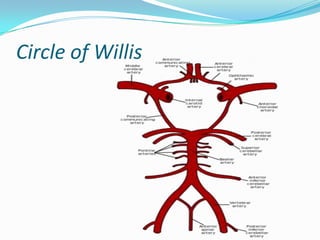
Circle of Willis
Anterior and posterior circulation
Stroke within the anterior
circulation
Due to occlusion of Internal carotid
artery and its branches
 Middle cerebral artery, Anterior
cerebral artery and Anterior
choroidal artery
Middle cerebral Artery
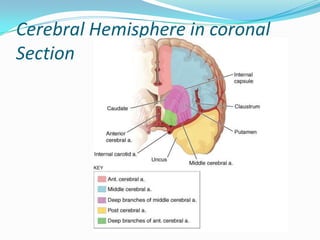
M1 segment(proximal)- deep
penetrating or lenticulostriate
branches– Internal capsule, caudate
nuclues, putamen and outer
pallidus
M1 segment
Cerebral Hemisphere in coronal
Section
M2 Segment
M2(distal)- superior and inferior
divisions- the entire superolateral
surface of frontal and parietal lobe
except frontal pole, strip along the
superomedial frontal and parietal
cortex, occipital lobe convolutions
and medial temporal cortex
M2 segment
Complete MCA syndrome
Contralateral hemiplegia
Contralateral hemianaesthesia
Contralateral homonymous hemianopia
Gaze preference to the ipsilateral side
If dominant hemisphere involved-Global
aphasia
If non dominant hemisphere involved-
Hemispatial neglect, anasognosia and
constructional apraxia
Partial syndromes
M1 syndrome-occlusion of
lenticulostriate branches-
If ischemia of internal capsule
produces pure motor or sensorymotor
stroke contralateral to the side of
lesion
If ischemia of putamen, pallidus-
predominantly parkinsonian features
Cerebral Hemisphere in coronal
Section
M2 syndromes
If superior division involved
 Brachial syndrome- weakness of hand and arm
 Frontal opercular syndrome-Brocas aphasia
with facial weakness with or without arm
weakness
 proximal part of the superior division involved-
clinical features of motor weakness, sensory
disturbances and brocas aphasia
M2 syndrome
If inferior division of M2 involved-
 If dominant hemisphere- Wernickes aphasia
without weakness with contralateral
homonymous superior quadrantanopia
 If non dominant hemisphere- Hemispatial
neglect , spatial agonosia without weakness
M2 segment
Anterior Cerebral artery
A1 segment- from internal carotid to
anterior communicating artery-
branches to anterior limb of internal
capsule, anteroinferior caudate,
anterior hypothalamus
A2 segment-distal to anterior
communicating artery- supplies
frontal pole, entire medial part of
cerebral hemispheres
Precommunal A1 segment
Post communal A2 segment
A1 segment
A1 segment occlusion rarely
produces clinical syndrome because
collateral flow through anterior
communicating artery and
collaterals from MCA and PCA
A2 syndrome
 Motor area for leg and foot-c/l paralysis of foot and
leg
 Sensory area for foot and leg-c/l cortical sensory
loss of foot and leg
 Sensorimotor area in paracentral lobule-urinary
incontinence
 Medial surface of posterior frontal lobe-c/l grasp
and suckling reflex
 Cingulate gyrus and the medial inferior portions of
frontal, parietal and temporal lobes-abulia
Anterior choroidal artery
Supplies posterior limb of internal
capsule, retrolentiform and sublentiform
parts
Complete syndrome rare due to collaterals
from MCA, PCA, and ICA
Syndrome comprises
 c/l hemiplegia
 c/l hemianaesthesia
 c/l homonymous hemianopia
Others
Internal carotid artery
Common carotid artery
Stroke within the posterior
circulation
Paired Vertebral arteries
Basilar artery
 Paired Posterior cerebral arteries
Gives small penetrating branches
and short and long circumferential
branches
Posterior circulation
Supplies
 Cerebellum
 Medulla
 Pons
 Midbrain
 Thalamus
 Subthalamus
 Hippocampus
 Medial part of temporal lobe
 Occipital lobe
Posterior cerebral artery
P1 segment-Precommunal-
Midbrain, thalamus and
subthalamus
P2 segment-Temporal and occipital
cortex
P1 syndromes
Due to the involvement of
ipsilateral subthalamus, cerebral
peduncles and midbrain
P1 syndrome
Midbrain
Claudes- 3rd nerve palsy with c/l ataxia-
Red nuclues
Webers- 3rd nerve palsy with c/l
hemiplegia-Cerebral peduncle
Subthalamus-c/l hemiballismus
Thalamus- Thalamic dejerine Roussy
syndrome- c/l hemisensory loss followed
later by severe agonising pain
Midbrain Syndromes
P2 syndromes
Infarction of medial temporal and
occipital lobes
Occipital lobe-c/l homonymous
hemianopia with macular sparing, if
visual association area spared, patient
aware of visual defect
Medial temporal lobe- Memory
impairement
Visual hallucinations
P2 syndromes
Antons syndrome-bilateral occlusion
in distal PCAs – bilateral occipital lobe
infarction- cortical blindness and
patient often unaware and even deny
it
Balints syndrome-bilateral visual
association areas- palinopsia and
asimultagnosia
P2 syndromes
Vertebral(V4) and PICA arteries
V4 and PICA
V1 and V4- prone for
atherothrombosis
If V1 occlusion
If occlusion is in subclavian artery
proximal to origin of vertebral
artery-subclavian steal syndrome
Lateral medullary
syndrome(Wallenburgs)
 Caused due to occlusion of V4 segment or PICA
 Descending tract and nucleus of trigeminal nerve- Pain,
numbness and abnormal sensation over one half of face
 Vestibular nucleus-Vertigo, nausea, vomiting and diplopia
 Issuing fibres of 9th and 10th nerve nucleus- Dysphagia,
hoarseness, palatal paralysis
 Restiform body, and cerebellar hemispheres-Ataxia of
limbs
 Descending sympathetic tract-Horners syndrome
 Spinothalamic tract- c/l loss of pain and temperature
Medullary syndromes
Medial medullary syndrome
Infarction of pyramid- c/l hemiplegia
of arm and leg, sparing face
If medial lemniscus-c/l loss of tactile
and proprioception
If hypoglossal nerve nucleus involved-
ipsilateral LMN hypoglossal nerve
palsy – atrophy of half of tongue.
Basilar Artery
Paramedian- wedge of pons in
midline
Short circumerential- lateral two
thirds of pons and middle and
superior cerebellar peduncles
 Long circumferential- Superior and
anterior inferior cerebellar
Basilar artery syndromes
Occlusion of basilar artery-b/l
brainstem signs
Occlusion of basilar branch artery-
unilateral motor, sensory and
cranial nerves
Basilar artery syndromes
Complete basilar artery
occlusion(Locked in state)-b/l long
tract(sensory/motor) with cranial
nerve and cerebellar dysfunction-
preserved
consciousness,quadriplegia and
cranial nerve signs
Basilar artery branch-syndrome of anterior inferior
cerebellar artery(lateral inferior pontine syndrome)
Anterior inferior cerebellar artery-
lateral part of inferior pons and
anterior part of inferior cerebellar
hemispheres
 Cerebellum-Ataxia of limb and gait
 7th nerve nuclues- Facial weakness
 8th nerve nucleus-Deafness, tinnitus, vertigo, nausea,
vomiting
 Spinothalamic tract-c/l loss of pain and temperature
Inferior pontine syndrome
Basilar artery branch-Syndrome of superior cerebellar
artery(Lateral superior pontine syndrome)
Superior cerebellar artery- lateral
part of superior pons and superior
surface of cerebellar hemispheres
 Superior and middle cerebellar peduncles and
superior cerebellar hemisphere-Ataxia of limb and
gait
 Vestibular nucleus-dizziness, nausea and vomiting
 Spinothalamic tract-c/l loss of pain and
temperature
Superior pontine syndrome
Medial pontine syndromes
Caused due to occlusion of
paramedian and short circumferential
branches of basilar artery
Corticobulbar and corticospinal-c/l
face, arm and leg paralysis
Cerebellar peduncles-ataxia of limb
and gait
Reference: Harrisons 18e

Stroke syndromes

  • 1.
    M2 Unit Presented byM.SATHISH KUMAR
  • 2.
    Stroke syndromes Cluster ofsigns and symptoms produced due to the occlusion of an artery(due to an atherothrombotic lesion or an emboli or dissection ) supplying a particular region of the brain
  • 3.
    classification Large vessel strokewithin the anterior circulation Large vessel stroke within the posterior circulation Small vessel disease of either vascular bed
  • 4.
    Cerebral circulation Anterior circulation-MCA, ACA, and Anterior choroidal artery Posterior circulation-Vertebral artery, Basilar artery and Posterior cerebral artery
  • 5.
  • 6.
  • 7.
    Stroke within theanterior circulation Due to occlusion of Internal carotid artery and its branches  Middle cerebral artery, Anterior cerebral artery and Anterior choroidal artery
  • 8.
    Middle cerebral Artery M1segment(proximal)- deep penetrating or lenticulostriate branches– Internal capsule, caudate nuclues, putamen and outer pallidus
  • 9.
  • 10.
    Cerebral Hemisphere incoronal Section
  • 11.
    M2 Segment M2(distal)- superiorand inferior divisions- the entire superolateral surface of frontal and parietal lobe except frontal pole, strip along the superomedial frontal and parietal cortex, occipital lobe convolutions and medial temporal cortex
  • 12.
  • 13.
    Complete MCA syndrome Contralateralhemiplegia Contralateral hemianaesthesia Contralateral homonymous hemianopia Gaze preference to the ipsilateral side If dominant hemisphere involved-Global aphasia If non dominant hemisphere involved- Hemispatial neglect, anasognosia and constructional apraxia
  • 14.
    Partial syndromes M1 syndrome-occlusionof lenticulostriate branches- If ischemia of internal capsule produces pure motor or sensorymotor stroke contralateral to the side of lesion If ischemia of putamen, pallidus- predominantly parkinsonian features
  • 15.
    Cerebral Hemisphere incoronal Section
  • 16.
    M2 syndromes If superiordivision involved  Brachial syndrome- weakness of hand and arm  Frontal opercular syndrome-Brocas aphasia with facial weakness with or without arm weakness  proximal part of the superior division involved- clinical features of motor weakness, sensory disturbances and brocas aphasia
  • 17.
    M2 syndrome If inferiordivision of M2 involved-  If dominant hemisphere- Wernickes aphasia without weakness with contralateral homonymous superior quadrantanopia  If non dominant hemisphere- Hemispatial neglect , spatial agonosia without weakness
  • 18.
  • 19.
    Anterior Cerebral artery A1segment- from internal carotid to anterior communicating artery- branches to anterior limb of internal capsule, anteroinferior caudate, anterior hypothalamus A2 segment-distal to anterior communicating artery- supplies frontal pole, entire medial part of cerebral hemispheres
  • 20.
  • 21.
  • 22.
    A1 segment A1 segmentocclusion rarely produces clinical syndrome because collateral flow through anterior communicating artery and collaterals from MCA and PCA
  • 23.
    A2 syndrome  Motorarea for leg and foot-c/l paralysis of foot and leg  Sensory area for foot and leg-c/l cortical sensory loss of foot and leg  Sensorimotor area in paracentral lobule-urinary incontinence  Medial surface of posterior frontal lobe-c/l grasp and suckling reflex  Cingulate gyrus and the medial inferior portions of frontal, parietal and temporal lobes-abulia
  • 24.
    Anterior choroidal artery Suppliesposterior limb of internal capsule, retrolentiform and sublentiform parts Complete syndrome rare due to collaterals from MCA, PCA, and ICA Syndrome comprises  c/l hemiplegia  c/l hemianaesthesia  c/l homonymous hemianopia
  • 25.
  • 26.
    Stroke within theposterior circulation Paired Vertebral arteries Basilar artery  Paired Posterior cerebral arteries Gives small penetrating branches and short and long circumferential branches
  • 27.
  • 28.
    Posterior circulation Supplies  Cerebellum Medulla  Pons  Midbrain  Thalamus  Subthalamus  Hippocampus  Medial part of temporal lobe  Occipital lobe
  • 29.
    Posterior cerebral artery P1segment-Precommunal- Midbrain, thalamus and subthalamus P2 segment-Temporal and occipital cortex
  • 30.
    P1 syndromes Due tothe involvement of ipsilateral subthalamus, cerebral peduncles and midbrain
  • 31.
    P1 syndrome Midbrain Claudes- 3rdnerve palsy with c/l ataxia- Red nuclues Webers- 3rd nerve palsy with c/l hemiplegia-Cerebral peduncle Subthalamus-c/l hemiballismus Thalamus- Thalamic dejerine Roussy syndrome- c/l hemisensory loss followed later by severe agonising pain
  • 32.
  • 33.
    P2 syndromes Infarction ofmedial temporal and occipital lobes Occipital lobe-c/l homonymous hemianopia with macular sparing, if visual association area spared, patient aware of visual defect Medial temporal lobe- Memory impairement Visual hallucinations
  • 34.
    P2 syndromes Antons syndrome-bilateralocclusion in distal PCAs – bilateral occipital lobe infarction- cortical blindness and patient often unaware and even deny it Balints syndrome-bilateral visual association areas- palinopsia and asimultagnosia
  • 35.
  • 36.
  • 37.
    V4 and PICA V1and V4- prone for atherothrombosis If V1 occlusion If occlusion is in subclavian artery proximal to origin of vertebral artery-subclavian steal syndrome
  • 38.
    Lateral medullary syndrome(Wallenburgs)  Causeddue to occlusion of V4 segment or PICA  Descending tract and nucleus of trigeminal nerve- Pain, numbness and abnormal sensation over one half of face  Vestibular nucleus-Vertigo, nausea, vomiting and diplopia  Issuing fibres of 9th and 10th nerve nucleus- Dysphagia, hoarseness, palatal paralysis  Restiform body, and cerebellar hemispheres-Ataxia of limbs  Descending sympathetic tract-Horners syndrome  Spinothalamic tract- c/l loss of pain and temperature
  • 39.
  • 40.
    Medial medullary syndrome Infarctionof pyramid- c/l hemiplegia of arm and leg, sparing face If medial lemniscus-c/l loss of tactile and proprioception If hypoglossal nerve nucleus involved- ipsilateral LMN hypoglossal nerve palsy – atrophy of half of tongue.
  • 41.
    Basilar Artery Paramedian- wedgeof pons in midline Short circumerential- lateral two thirds of pons and middle and superior cerebellar peduncles  Long circumferential- Superior and anterior inferior cerebellar
  • 42.
    Basilar artery syndromes Occlusionof basilar artery-b/l brainstem signs Occlusion of basilar branch artery- unilateral motor, sensory and cranial nerves
  • 43.
    Basilar artery syndromes Completebasilar artery occlusion(Locked in state)-b/l long tract(sensory/motor) with cranial nerve and cerebellar dysfunction- preserved consciousness,quadriplegia and cranial nerve signs
  • 44.
    Basilar artery branch-syndromeof anterior inferior cerebellar artery(lateral inferior pontine syndrome) Anterior inferior cerebellar artery- lateral part of inferior pons and anterior part of inferior cerebellar hemispheres  Cerebellum-Ataxia of limb and gait  7th nerve nuclues- Facial weakness  8th nerve nucleus-Deafness, tinnitus, vertigo, nausea, vomiting  Spinothalamic tract-c/l loss of pain and temperature
  • 45.
  • 46.
    Basilar artery branch-Syndromeof superior cerebellar artery(Lateral superior pontine syndrome) Superior cerebellar artery- lateral part of superior pons and superior surface of cerebellar hemispheres  Superior and middle cerebellar peduncles and superior cerebellar hemisphere-Ataxia of limb and gait  Vestibular nucleus-dizziness, nausea and vomiting  Spinothalamic tract-c/l loss of pain and temperature
  • 47.
  • 48.
    Medial pontine syndromes Causeddue to occlusion of paramedian and short circumferential branches of basilar artery Corticobulbar and corticospinal-c/l face, arm and leg paralysis Cerebellar peduncles-ataxia of limb and gait
  • 49.