Submitted by :
Apoorv Srivastava
Arjun Viswanath
Mohit Valentine Massey
Submitted to :
Ar. Raktim Saha
VERNACULAR ARCHITECTURE OF
KARNATAKA
ACKNOWLEDGEMENT
Any attempt at any level cannot be satisfactorily completed
without the support and guidance of learned people. We
would like to express our immense gratitude to Ar. Raktim
Saha for his constant support and motivations that has
encouraged us to come up with the assignment. We are also
thankful to other members of SPA, and our classmates who
have rendered their whole hearted support to all times for the
successful completion of the assignment.
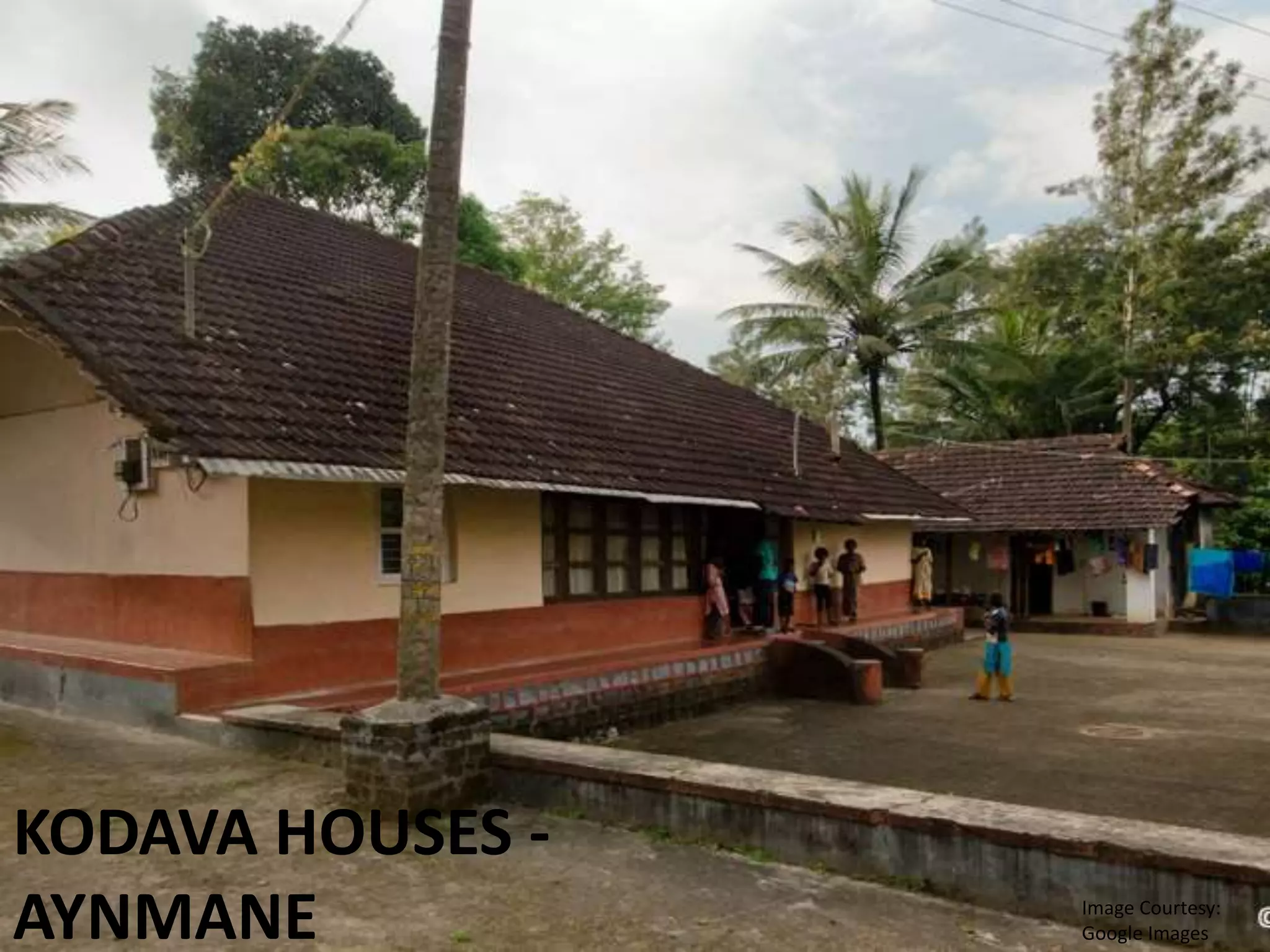
Image Courtesy:
Google Images
VERNACULAR
ARCHITECTURE
OF
KARNATAKA
Image Courtesy:
Google Images
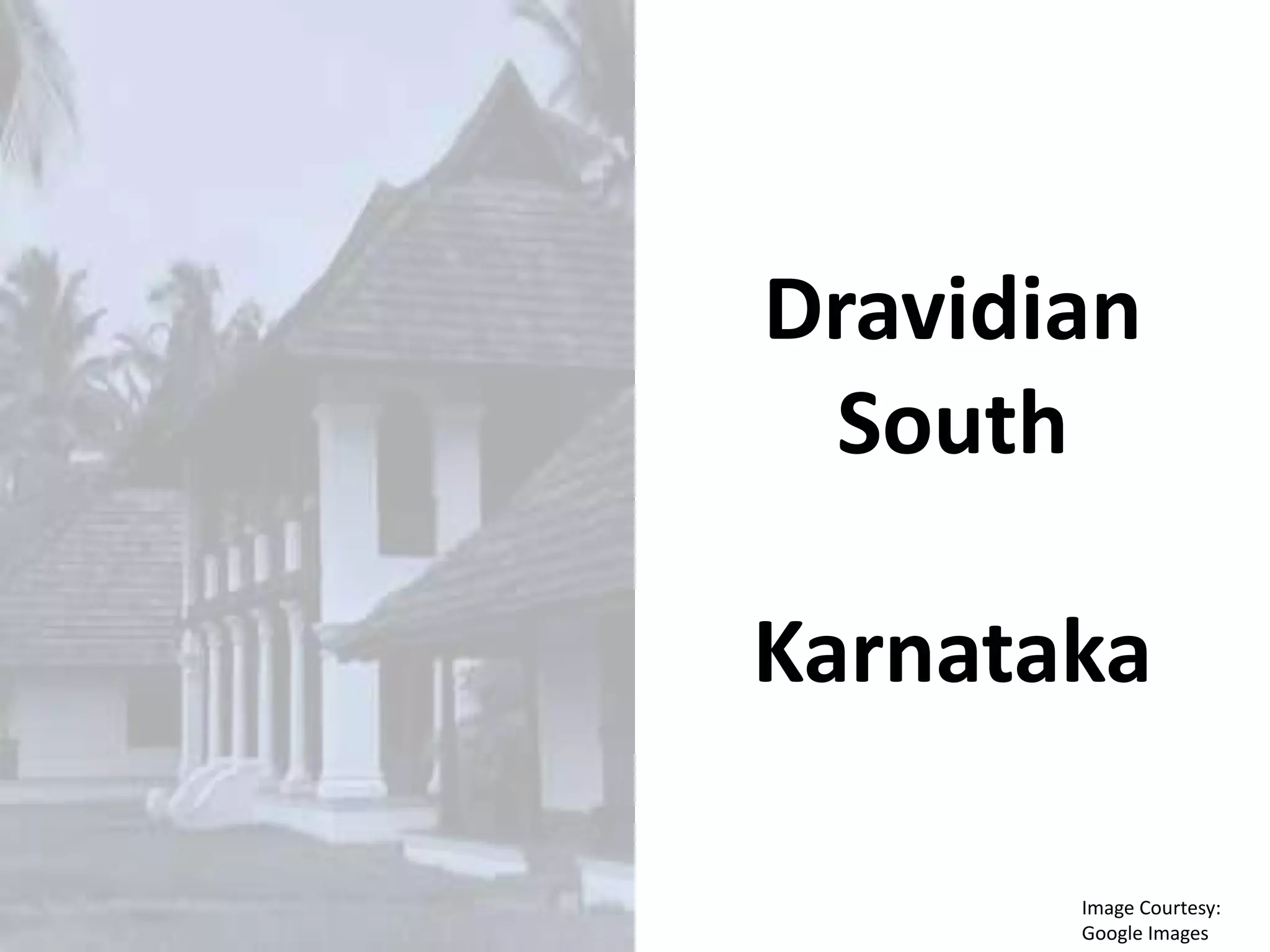
Dravidian
South
Karnataka
Image Courtesy:
Google Images
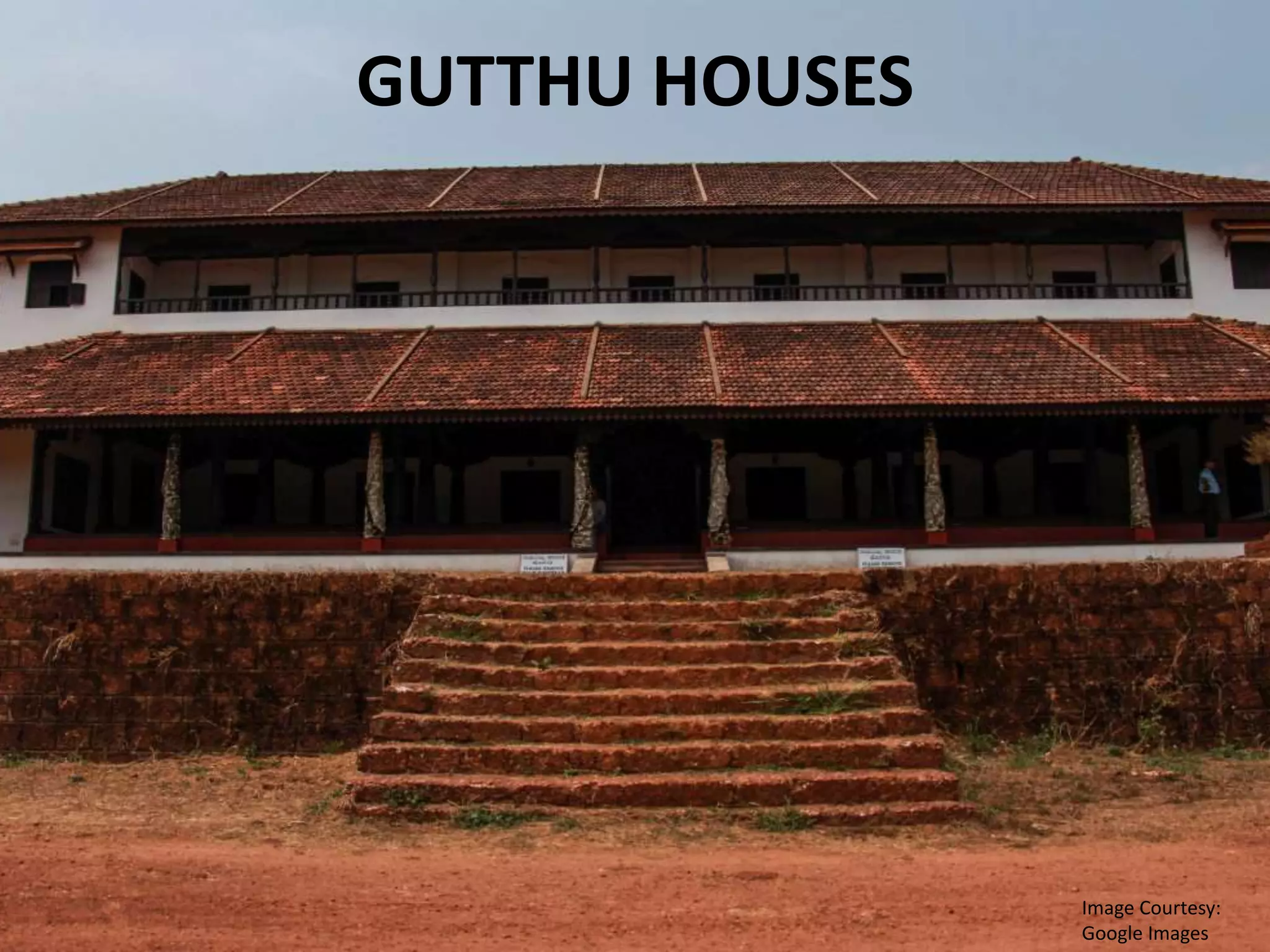
GUTTHU HOUSES
Image Courtesy:
Google Images
• The Gutthu Houses of the land
owning community of south Karnataka
are large, inward looking Hindu
Mansions.
• The typical Gutthu house has a
steeply pitched roof, combining single
& double storied blocks around a
courtyard.
• It is the isolated home of a well-to-do
family designed to deter attacks.
• The facade is usually symmetrical
around a central projection, the tallest
and most impressive feature of the
house.
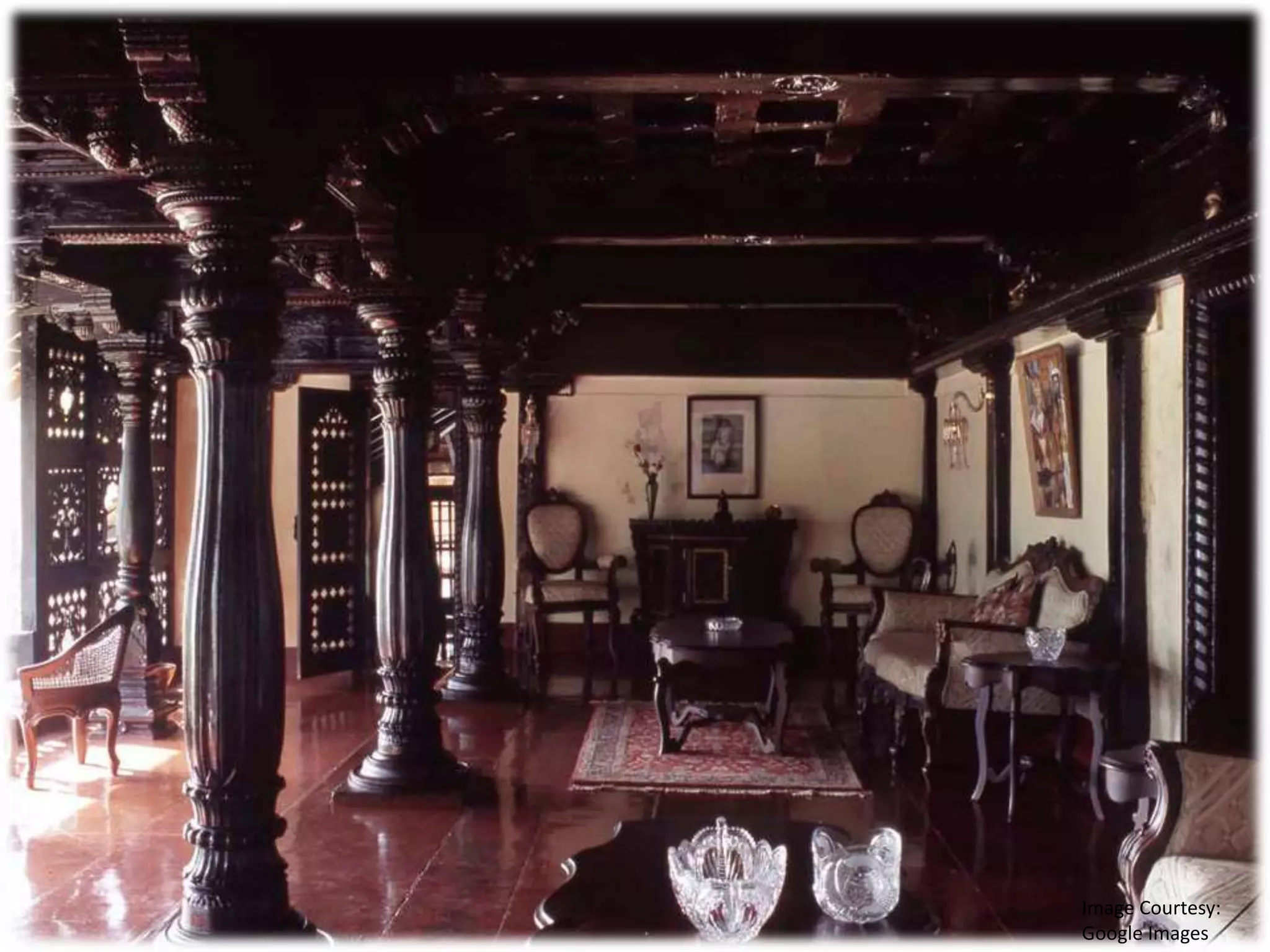
• The principal building material is
wood.
THE KHAMB-WOODEN PILLARS IN A TRADITIONAL
BUNT HOUSE CALLED GUTTHU MANE.
Image Courtesy:
Google Images
Source:
www.slideshare.com,
raju chettihar &
publishers,
Veerendran A.
Image Courtesy:
Google Images
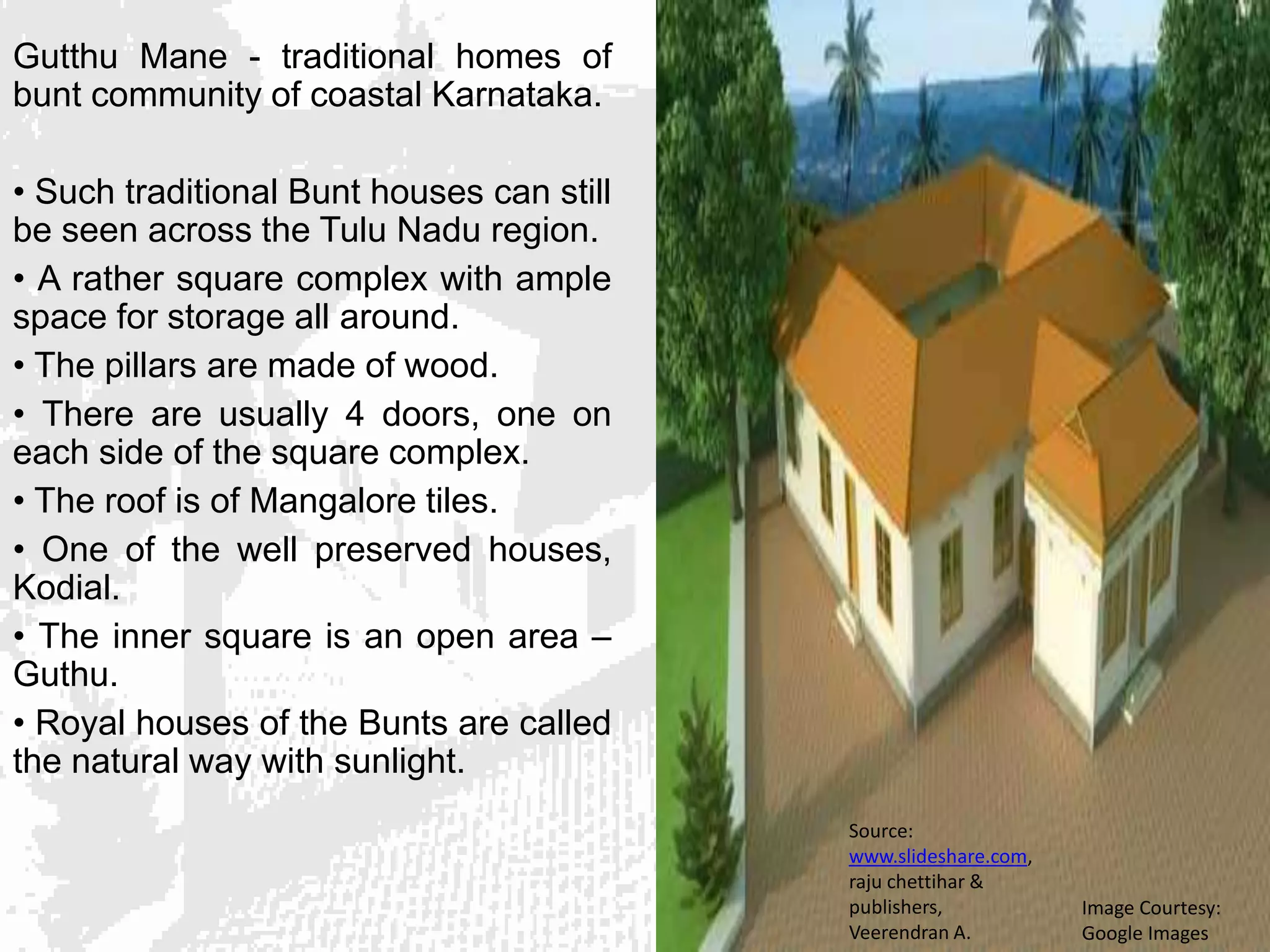
Gutthu Mane - traditional homes of
bunt community of coastal Karnataka.
• Such traditional Bunt houses can still
be seen across the Tulu Nadu region.
• A rather square complex with ample
space for storage all around.
• The pillars are made of wood.
• There are usually 4 doors, one on
each side of the square complex.
• The roof is of Mangalore tiles.
• One of the well preserved houses,
Kodial.
• The inner square is an open area –
Guthu.
• Royal houses of the Bunts are called
the natural way with sunlight.
Source:
www.slideshare.com,
raju chettihar &
publishers,
Veerendran A.
Image Courtesy:
Google Images
Image Courtesy:
Google Images
KODAVA HOUSES -
AYNMANE Image Courtesy:
Google Images
• The KODAGU (COORG) district in
Karnataka is the only region of the south
known for its martial people.
• Every Kodava belongs to a clan or Vokka.
There are more than 300 clans within the
community.
• Every clan lived in a Ain-Mane- Ancestral
house.
• The Patriarch and Matriarch of the clan
lived in the Ain house with their sons and
their families.
• However as families grew bigger there was
a need to build more living space. Usually
the younger sons moved away and built their
own houses.
• About 200 years ago these grand
homesteads bustled with activity.
• The granaries were filled with stocks of rice
to last a year.
• Firewood was chopped and stocked to see
them through the long monsoon. Image Courtesy:
Google Images
Source:
www.slideshare.com,
raju chettihar &
publishers,
Veerendran A.
Image Courtesy:
Google Images
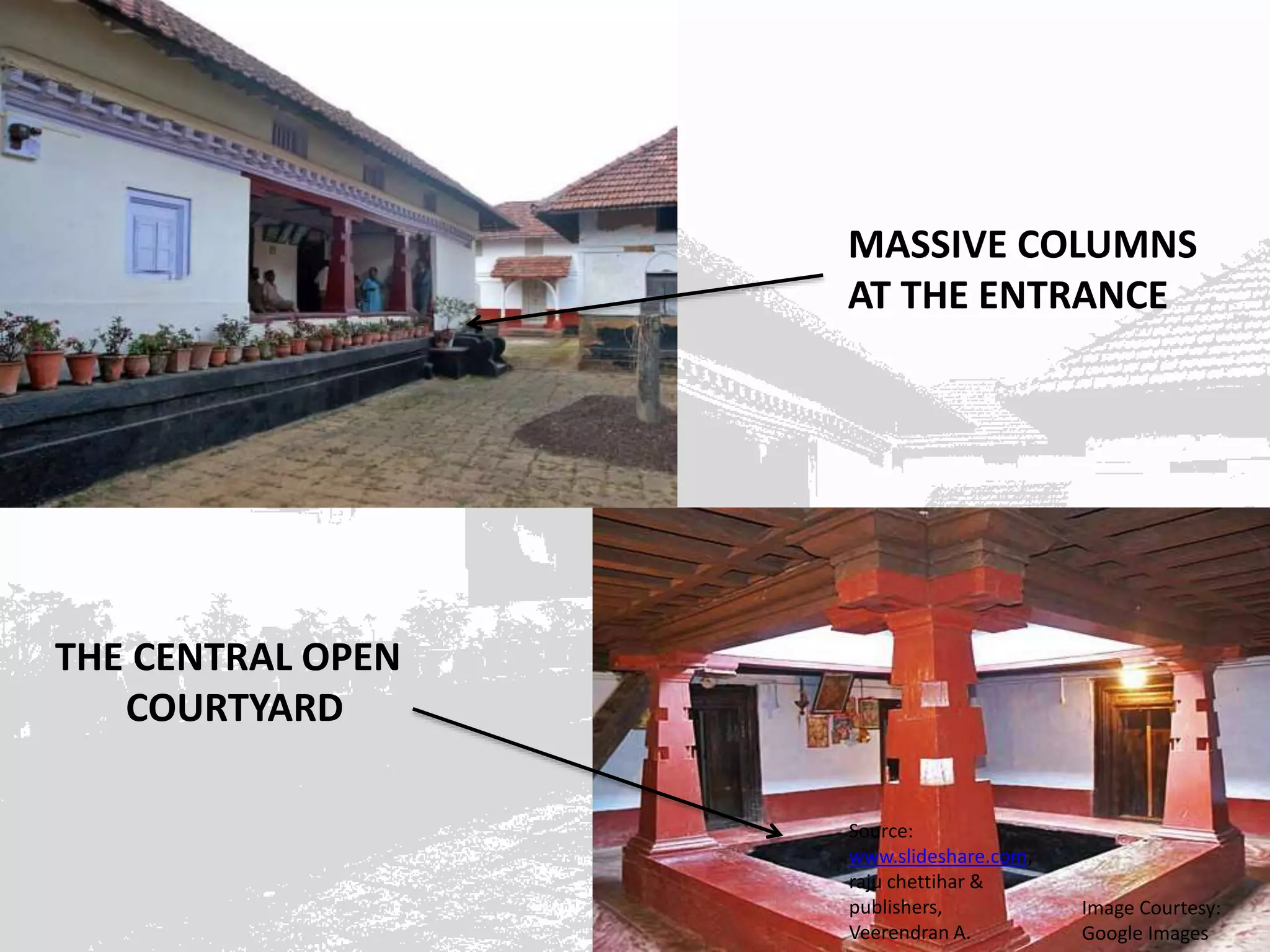
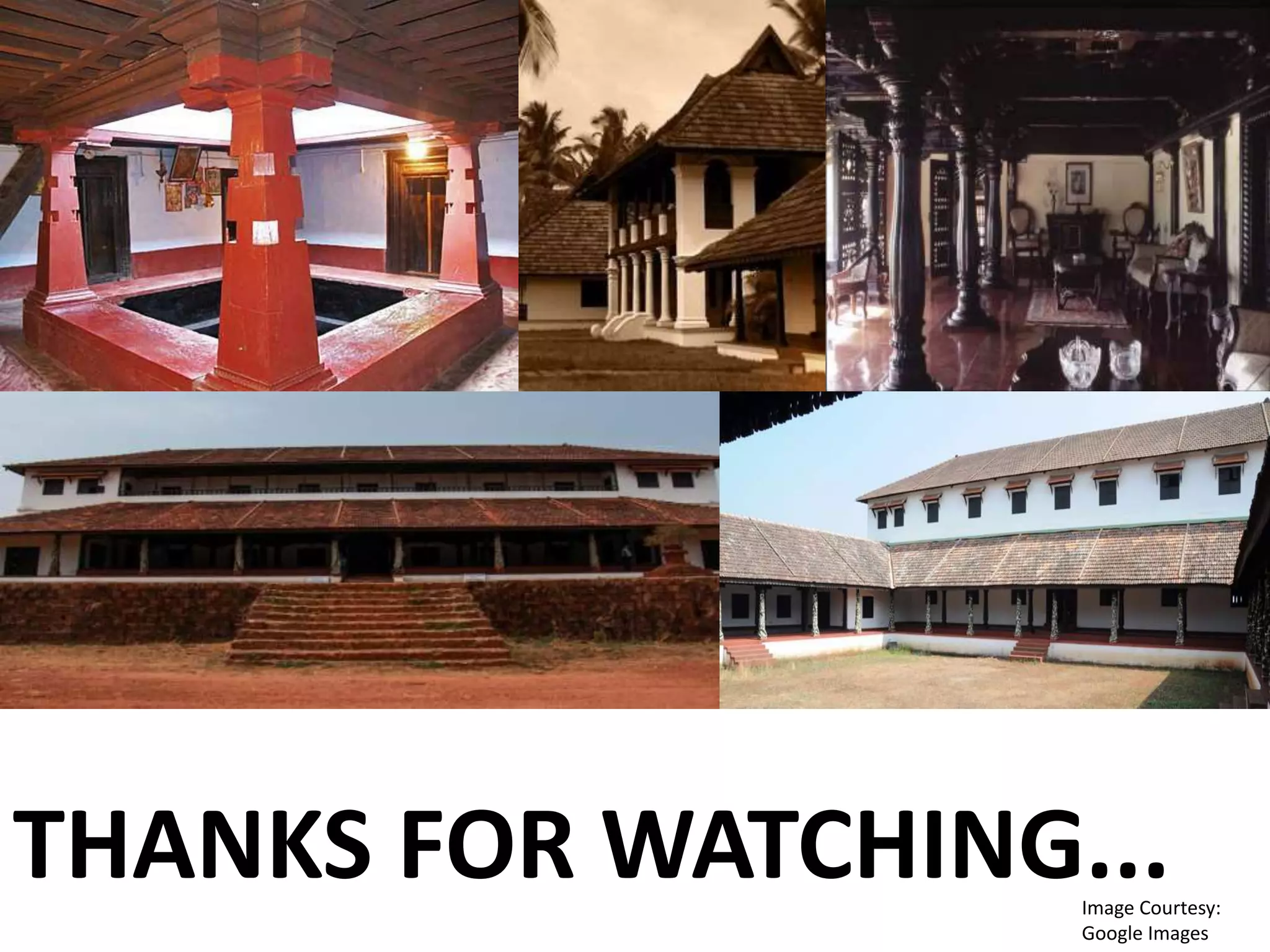
MASSIVE COLUMNS
AT THE ENTRANCE
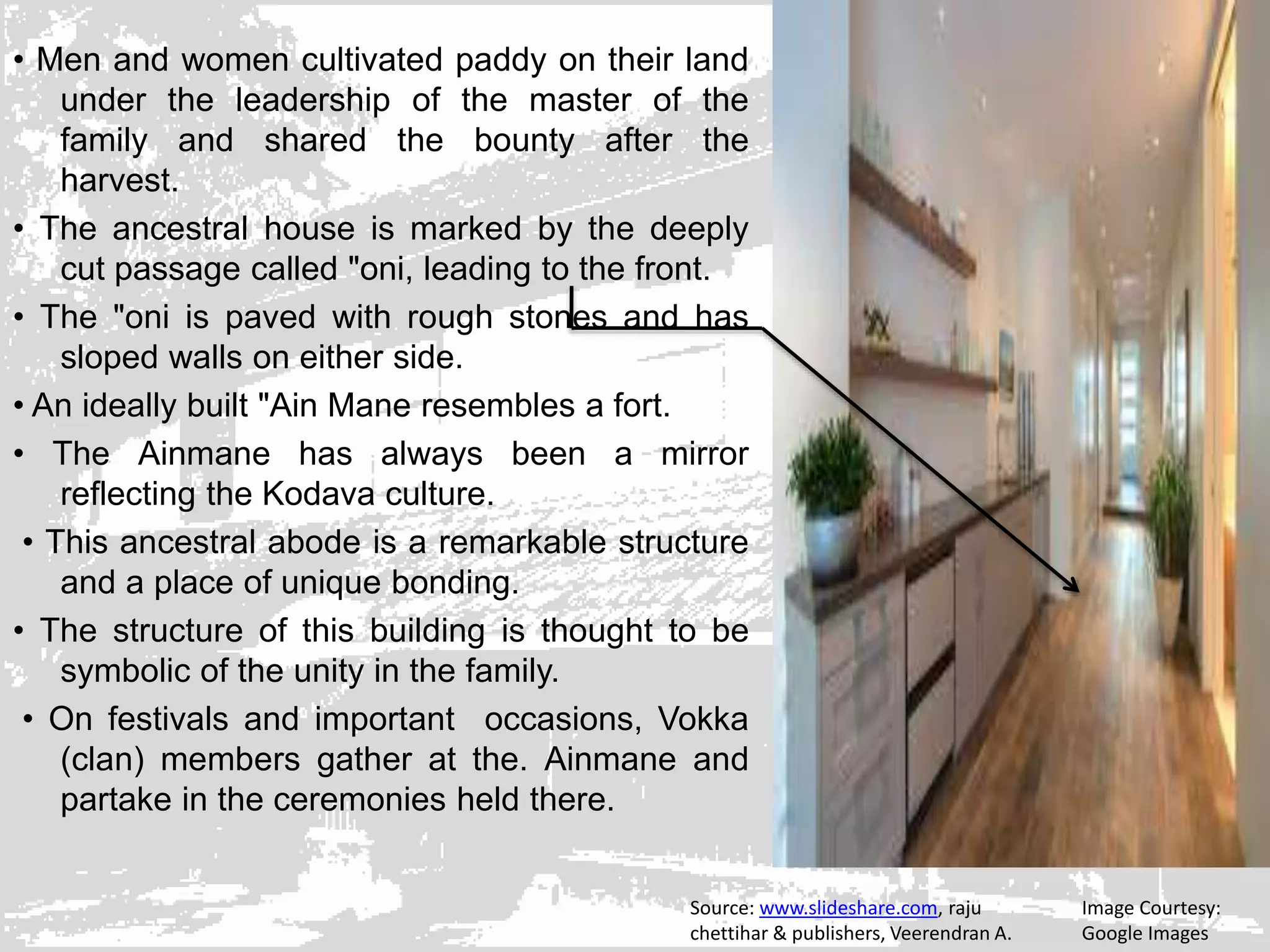
THE CENTRAL OPEN
COURTYARD
Source:
www.slideshare.com,
raju chettihar &
publishers,
Veerendran A.
• Men and women cultivated paddy on their land
under the leadership of the master of the
family and shared the bounty after the
harvest.
• The ancestral house is marked by the deeply
cut passage called "oni, leading to the front.
• The "oni is paved with rough stones and has
sloped walls on either side.
• An ideally built "Ain Mane resembles a fort.
• The Ainmane has always been a mirror
reflecting the Kodava culture.
• This ancestral abode is a remarkable structure
and a place of unique bonding.
• The structure of this building is thought to be
symbolic of the unity in the family.
• On festivals and important occasions, Vokka
(clan) members gather at the. Ainmane and
partake in the ceremonies held there.
Image Courtesy:
Google Images
Source: www.slideshare.com, raju
chettihar & publishers, Veerendran A.
• Also called the Gurukarana Mane or Gurumane, the Ainemane gives their
family name.
• Several family units put together comprise a Vokka. Each Vokka owns an
Ainemane.
• The Kings who ruled Kodagu built their Palaces following the architectural
style of the Taravad houses of the Nairs of Kerala- proof of the cordial
relations between Kodagu and Kerala.
• Typically the Ain Mane stands on hillock surrounded by paddy fields, swaying
areca nut and coffee plantations.
• There is a central courtyard which is open to the sky.
Image Courtesy:
Google Images
Source:
www.slideshare.com,
raju chettihar &
publishers,
Veerendran A.
• It has a sloping tiled roof to face the onslaught of the torrential monsoon.
• A narrow corridor runs all around the courtyard connecting to the rooms.
• Usually the kitchen is at the rear of the house or even a little away to keep
the smoke away.
• The toilet and bathing area is always away from the main building.
plantations.
• The Ain Mane, depending on the wealth of the clan stands surrounded by the
huts of the farm workers and animal sheds. A well provides fresh water.
Image Courtesy:
Google Images
Source:
www.slideshare.com,
raju chettihar &
publishers,
Veerendran A.
•The prime position at the Ainemane is held by the Karona , the head of the
family that owns this house.
• A one-storied square shaped building with an attic , the Ainemane has two
doors as its entrance.
•Always in an elevated position , it faces East. Steps lead to a Kayyale –
Verandah , where pillars supporting the tiled roof are attached to bench lke
planks.
•Ainmane has a open roof space in the middle, so that the rain water is collected
within and excess water is drained out.
•The house consists of two doors to go to the backyard.
• The front region of this ancestral house is a canopied open hall called the
Kaiyale.
•It consists of a 2 feet high seater of thick wooden plank which is used as a
bench , called Aimara.
•Daughters-in-law of the house are not allowed to sit on Aimara whereas married
daughters of the house can sit on it.
•Elders of the family usually sit here to exchange cordialities , discuss various
issues and take important decisions.
Image Courtesy:
Google Images
Source:
www.slideshare.com,
raju chettihar &
publishers,
Veerendran A.
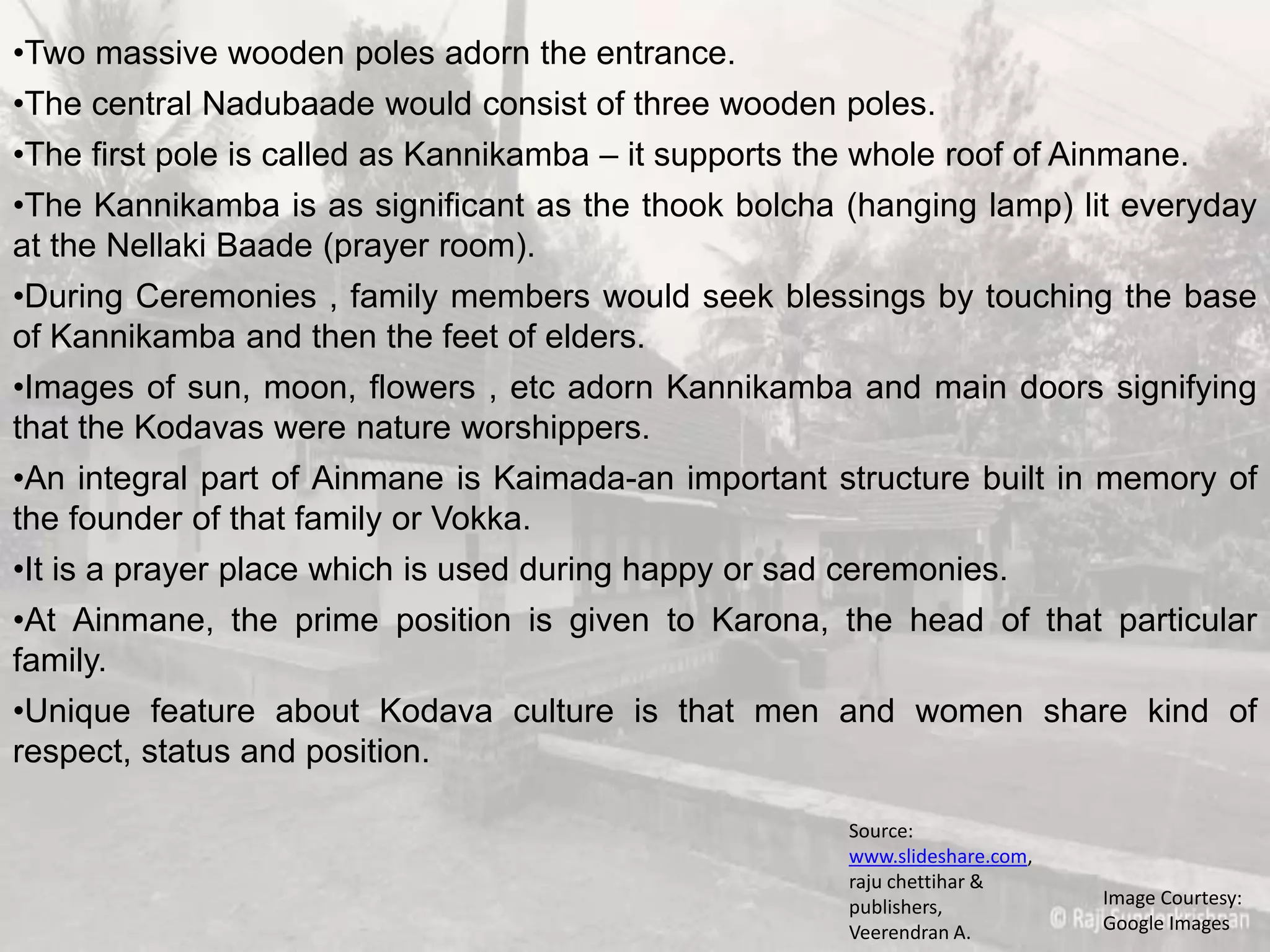
•Two massive wooden poles adorn the entrance.
•The central Nadubaade would consist of three wooden poles.
•The first pole is called as Kannikamba – it supports the whole roof of Ainmane.
•The Kannikamba is as significant as the thook bolcha (hanging lamp) lit everyday
at the Nellaki Baade (prayer room).
•During Ceremonies , family members would seek blessings by touching the base
of Kannikamba and then the feet of elders.
•Images of sun, moon, flowers , etc adorn Kannikamba and main doors signifying
that the Kodavas were nature worshippers.
•An integral part of Ainmane is Kaimada-an important structure built in memory of
the founder of that family or Vokka.
•It is a prayer place which is used during happy or sad ceremonies.
•At Ainmane, the prime position is given to Karona, the head of that particular
family.
•Unique feature about Kodava culture is that men and women share kind of
respect, status and position.
Image Courtesy:
Google Images
Source:
www.slideshare.com,
raju chettihar &
publishers,
Veerendran A.
•Padasala :
The rectangular hall around which the
rooms are arranged.
• Mundu :
The inevitable open courtyard in the
centre.
OLD-WORLD CHARM :
The Verandah of an Ain Mane, where
portraits of ancestors are displayed
• Kanni Kombara :
Prayer place , where a deity is installed.
Here , the Karona (family ancestor)
symbolized by a lamp is worshipped and
offered food at the festivals.
• Kitchen :
sacred , the mud oven / stove should
face East.
Image Courtesy:
Google Images
Source:
www.slideshare.com,
raju chettihar &
publishers,
Veerendran A.
BIBLIOGRAPHY
• Vernacular Architecture of Andhra Pradesh, Karnataka And Kerala;
Raju Chettiar & Publishers.
• Dravidian Houses and style of Architecture; www.slideshare.com
• Gutthu Houses, Aynmane; Veerendran Ayyaswamy; A Book About
Karnataka.
• Gutthu Houses, Anymane Image Courtesy; Vishnu V.; google
images.
Image Courtesy:
Google Images
THANKS FOR WATCHING...Image Courtesy:
Google Images

Vernacular architecture of karnataka

  • 1.
    Submitted by : ApoorvSrivastava Arjun Viswanath Mohit Valentine Massey Submitted to : Ar. Raktim Saha VERNACULAR ARCHITECTURE OF KARNATAKA
  • 2.
    ACKNOWLEDGEMENT Any attempt atany level cannot be satisfactorily completed without the support and guidance of learned people. We would like to express our immense gratitude to Ar. Raktim Saha for his constant support and motivations that has encouraged us to come up with the assignment. We are also thankful to other members of SPA, and our classmates who have rendered their whole hearted support to all times for the successful completion of the assignment. Image Courtesy: Google Images
  • 3.
  • 4.
  • 5.
  • 6.
    • The GutthuHouses of the land owning community of south Karnataka are large, inward looking Hindu Mansions. • The typical Gutthu house has a steeply pitched roof, combining single & double storied blocks around a courtyard. • It is the isolated home of a well-to-do family designed to deter attacks. • The facade is usually symmetrical around a central projection, the tallest and most impressive feature of the house. • The principal building material is wood. THE KHAMB-WOODEN PILLARS IN A TRADITIONAL BUNT HOUSE CALLED GUTTHU MANE. Image Courtesy: Google Images Source: www.slideshare.com, raju chettihar & publishers, Veerendran A.
  • 7.
    Image Courtesy: Google Images GutthuMane - traditional homes of bunt community of coastal Karnataka. • Such traditional Bunt houses can still be seen across the Tulu Nadu region. • A rather square complex with ample space for storage all around. • The pillars are made of wood. • There are usually 4 doors, one on each side of the square complex. • The roof is of Mangalore tiles. • One of the well preserved houses, Kodial. • The inner square is an open area – Guthu. • Royal houses of the Bunts are called the natural way with sunlight. Source: www.slideshare.com, raju chettihar & publishers, Veerendran A.
  • 8.
  • 9.
  • 10.
    KODAVA HOUSES - AYNMANEImage Courtesy: Google Images
  • 11.
    • The KODAGU(COORG) district in Karnataka is the only region of the south known for its martial people. • Every Kodava belongs to a clan or Vokka. There are more than 300 clans within the community. • Every clan lived in a Ain-Mane- Ancestral house. • The Patriarch and Matriarch of the clan lived in the Ain house with their sons and their families. • However as families grew bigger there was a need to build more living space. Usually the younger sons moved away and built their own houses. • About 200 years ago these grand homesteads bustled with activity. • The granaries were filled with stocks of rice to last a year. • Firewood was chopped and stocked to see them through the long monsoon. Image Courtesy: Google Images Source: www.slideshare.com, raju chettihar & publishers, Veerendran A.
  • 12.
    Image Courtesy: Google Images MASSIVECOLUMNS AT THE ENTRANCE THE CENTRAL OPEN COURTYARD Source: www.slideshare.com, raju chettihar & publishers, Veerendran A.
  • 13.
    • Men andwomen cultivated paddy on their land under the leadership of the master of the family and shared the bounty after the harvest. • The ancestral house is marked by the deeply cut passage called "oni, leading to the front. • The "oni is paved with rough stones and has sloped walls on either side. • An ideally built "Ain Mane resembles a fort. • The Ainmane has always been a mirror reflecting the Kodava culture. • This ancestral abode is a remarkable structure and a place of unique bonding. • The structure of this building is thought to be symbolic of the unity in the family. • On festivals and important occasions, Vokka (clan) members gather at the. Ainmane and partake in the ceremonies held there. Image Courtesy: Google Images Source: www.slideshare.com, raju chettihar & publishers, Veerendran A.
  • 14.
    • Also calledthe Gurukarana Mane or Gurumane, the Ainemane gives their family name. • Several family units put together comprise a Vokka. Each Vokka owns an Ainemane. • The Kings who ruled Kodagu built their Palaces following the architectural style of the Taravad houses of the Nairs of Kerala- proof of the cordial relations between Kodagu and Kerala. • Typically the Ain Mane stands on hillock surrounded by paddy fields, swaying areca nut and coffee plantations. • There is a central courtyard which is open to the sky. Image Courtesy: Google Images Source: www.slideshare.com, raju chettihar & publishers, Veerendran A.
  • 15.
    • It hasa sloping tiled roof to face the onslaught of the torrential monsoon. • A narrow corridor runs all around the courtyard connecting to the rooms. • Usually the kitchen is at the rear of the house or even a little away to keep the smoke away. • The toilet and bathing area is always away from the main building. plantations. • The Ain Mane, depending on the wealth of the clan stands surrounded by the huts of the farm workers and animal sheds. A well provides fresh water. Image Courtesy: Google Images Source: www.slideshare.com, raju chettihar & publishers, Veerendran A.
  • 16.
    •The prime positionat the Ainemane is held by the Karona , the head of the family that owns this house. • A one-storied square shaped building with an attic , the Ainemane has two doors as its entrance. •Always in an elevated position , it faces East. Steps lead to a Kayyale – Verandah , where pillars supporting the tiled roof are attached to bench lke planks. •Ainmane has a open roof space in the middle, so that the rain water is collected within and excess water is drained out. •The house consists of two doors to go to the backyard. • The front region of this ancestral house is a canopied open hall called the Kaiyale. •It consists of a 2 feet high seater of thick wooden plank which is used as a bench , called Aimara. •Daughters-in-law of the house are not allowed to sit on Aimara whereas married daughters of the house can sit on it. •Elders of the family usually sit here to exchange cordialities , discuss various issues and take important decisions. Image Courtesy: Google Images Source: www.slideshare.com, raju chettihar & publishers, Veerendran A.
  • 17.
    •Two massive woodenpoles adorn the entrance. •The central Nadubaade would consist of three wooden poles. •The first pole is called as Kannikamba – it supports the whole roof of Ainmane. •The Kannikamba is as significant as the thook bolcha (hanging lamp) lit everyday at the Nellaki Baade (prayer room). •During Ceremonies , family members would seek blessings by touching the base of Kannikamba and then the feet of elders. •Images of sun, moon, flowers , etc adorn Kannikamba and main doors signifying that the Kodavas were nature worshippers. •An integral part of Ainmane is Kaimada-an important structure built in memory of the founder of that family or Vokka. •It is a prayer place which is used during happy or sad ceremonies. •At Ainmane, the prime position is given to Karona, the head of that particular family. •Unique feature about Kodava culture is that men and women share kind of respect, status and position. Image Courtesy: Google Images Source: www.slideshare.com, raju chettihar & publishers, Veerendran A.
  • 18.
    •Padasala : The rectangularhall around which the rooms are arranged. • Mundu : The inevitable open courtyard in the centre. OLD-WORLD CHARM : The Verandah of an Ain Mane, where portraits of ancestors are displayed • Kanni Kombara : Prayer place , where a deity is installed. Here , the Karona (family ancestor) symbolized by a lamp is worshipped and offered food at the festivals. • Kitchen : sacred , the mud oven / stove should face East. Image Courtesy: Google Images Source: www.slideshare.com, raju chettihar & publishers, Veerendran A.
  • 19.
    BIBLIOGRAPHY • Vernacular Architectureof Andhra Pradesh, Karnataka And Kerala; Raju Chettiar & Publishers. • Dravidian Houses and style of Architecture; www.slideshare.com • Gutthu Houses, Aynmane; Veerendran Ayyaswamy; A Book About Karnataka. • Gutthu Houses, Anymane Image Courtesy; Vishnu V.; google images. Image Courtesy: Google Images
  • 20.
    THANKS FOR WATCHING...ImageCourtesy: Google Images