Standards for foreign languages (English) Luis Quishpe  B.A. In ENGLISH LINGUISTIC SPONSORED BY: [email_address]
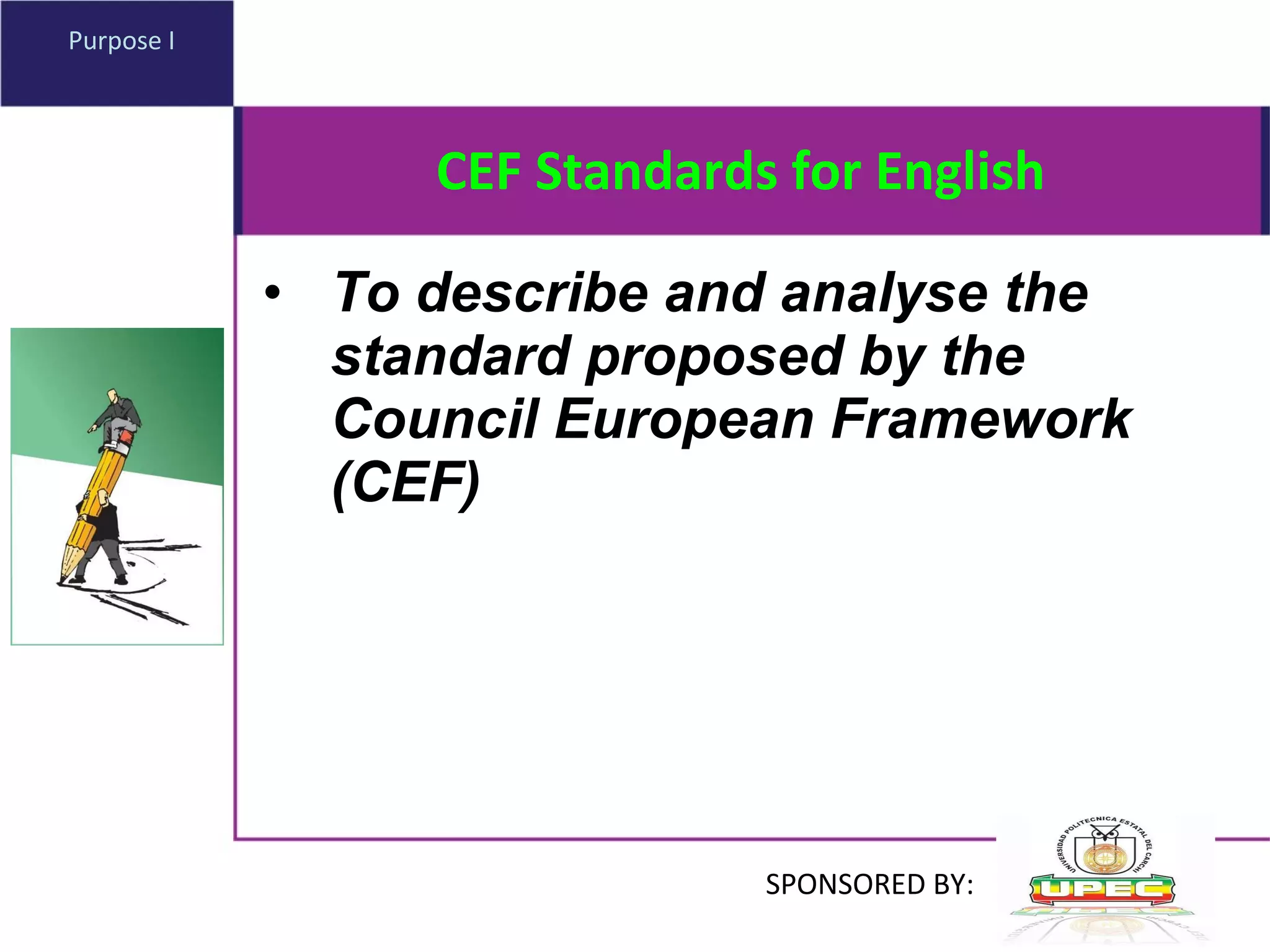
CEF Standards for English To describe and analyse the standard proposed by the Council European Framework (CEF) Purpose I SPONSORED BY:
CEF Standards for English To discuss implications of the CEF levels for testing, assessment, and evaluation of a program . To familiarize audience with diverse sources and references Purpose II SPONSORED BY:
CEF Standards for English The Council of Europe's Common European Framework of Reference for Languages: Learning, Teaching, Assessment project was one of the main components in Phase 2 of the more extensive project, Language Learning for European Citizenship (1989–1996). Framework Framework of Language Examinations.htm SPONSORED BY:
CEF Standards for English ALTE members were involved in various stages of the development work of the  CEF  and in particular ALTE was commissioned by the  EU  to prepare a supplementary document intended for people involved in language test development. ALTE SPONSORED BY:
CEF Standards for English Certain aspects of the CEF have already had an influence on the way ALTE members describe their examinations. In particular this relates to the specification of domains and communicative activities. Domains  SPONSORED BY:
CEF Standards for English In this conception of communication, the language users’ communicative competence is activated through various language activities which are themselves contextualized within domains. Domains SPONSORED BY:
CEF Standards for English These domains are broadly classified as fourfold:  personal,  public,  occupational and  educational .  Domains SPONSORED BY:
CEF Standards for English While  the communicative activities are sub-divided into those which are : productive,  receptive,  interactive   and  mediating. Communicative activities SPONSORED BY:
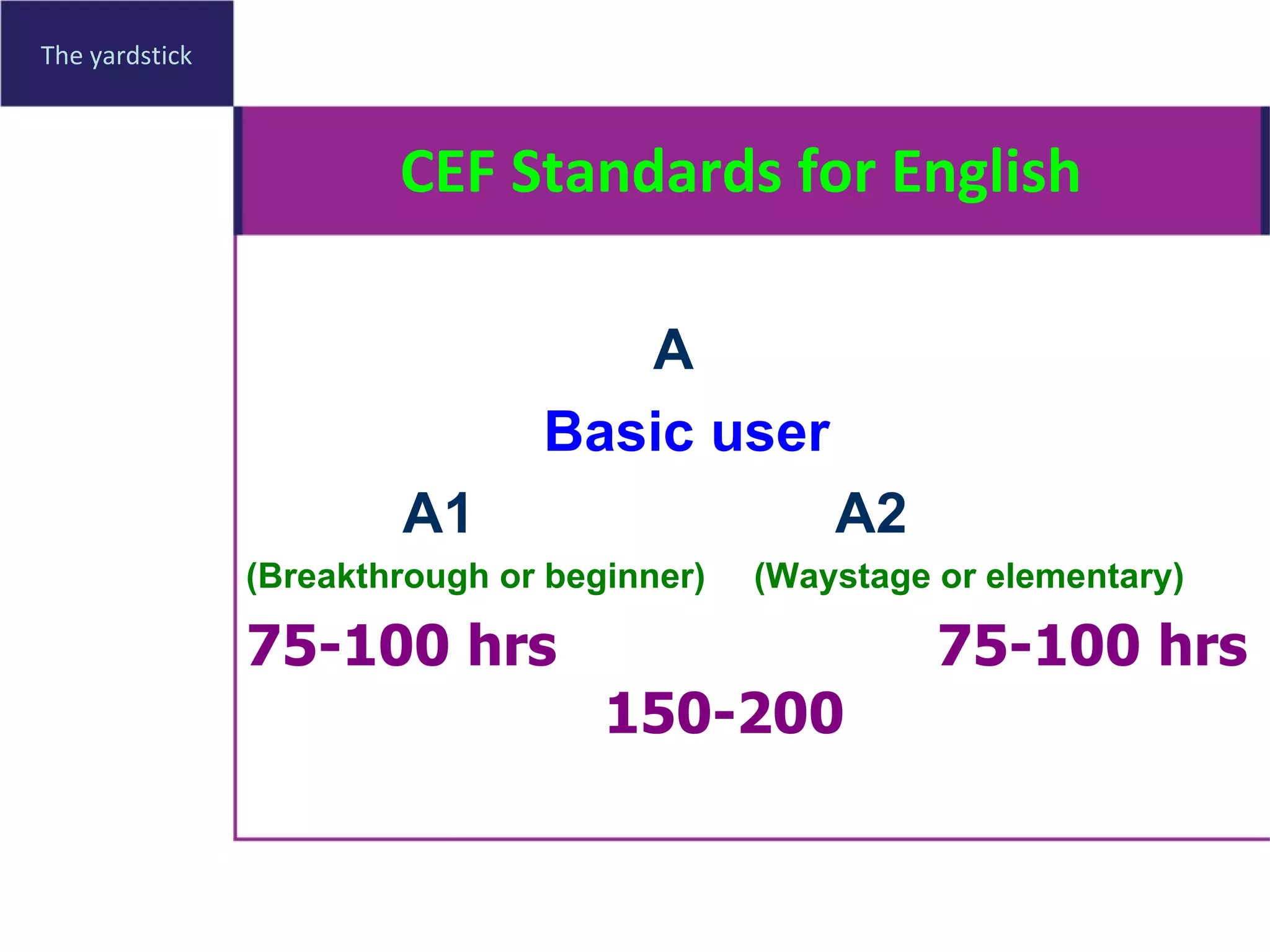
CEF Standards for English The yardstick A Basic user A1  A2 (Breakthrough or beginner)  (Waystage or elementary) 75-100 hrs  75-100 hrs   150-200
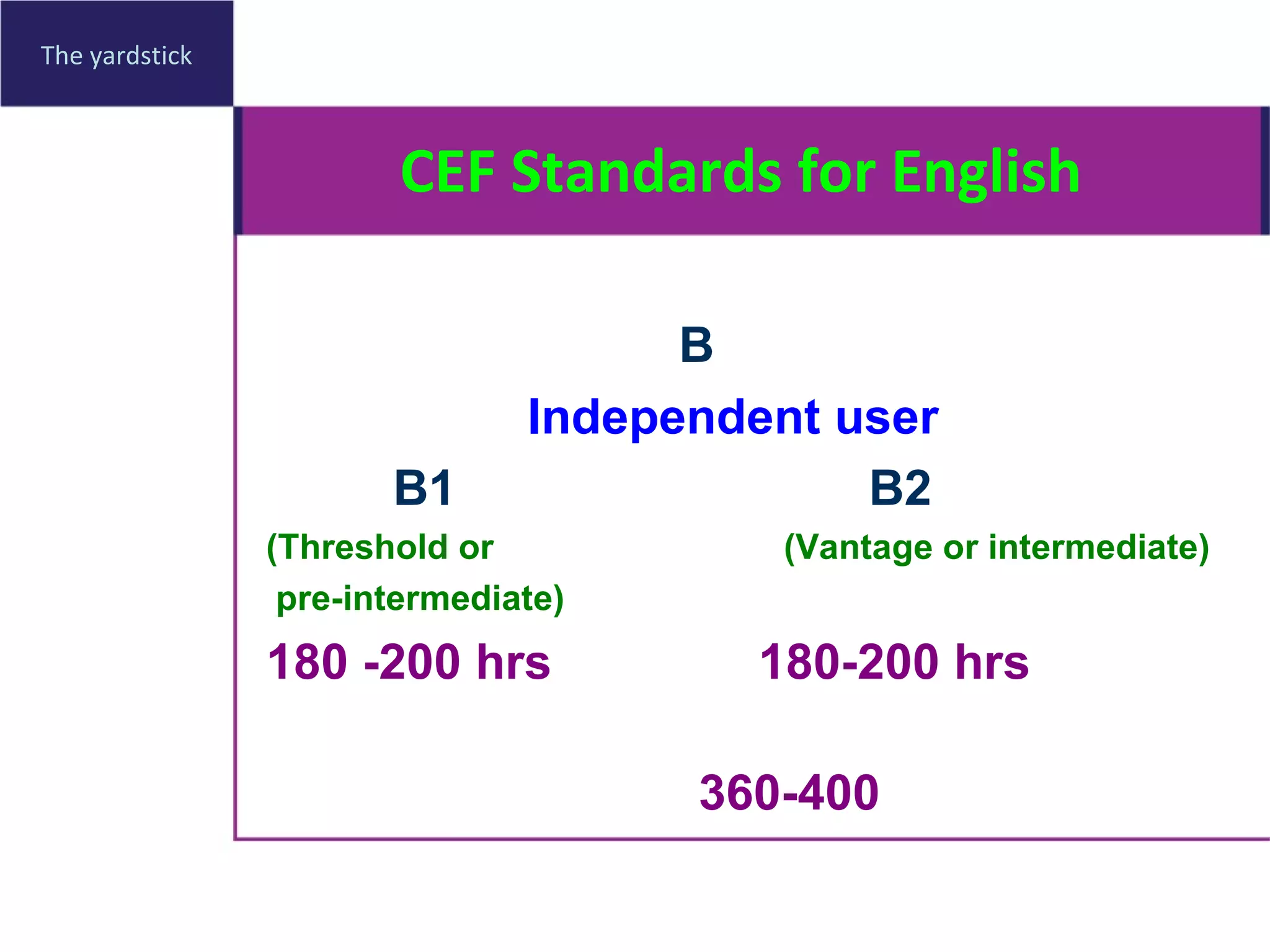
CEF Standards for English The yardstick B Independent user B1  B2 (Threshold or  (Vantage or intermediate)  pre-intermediate) 180 -200 hrs  180-200 hrs   360-400
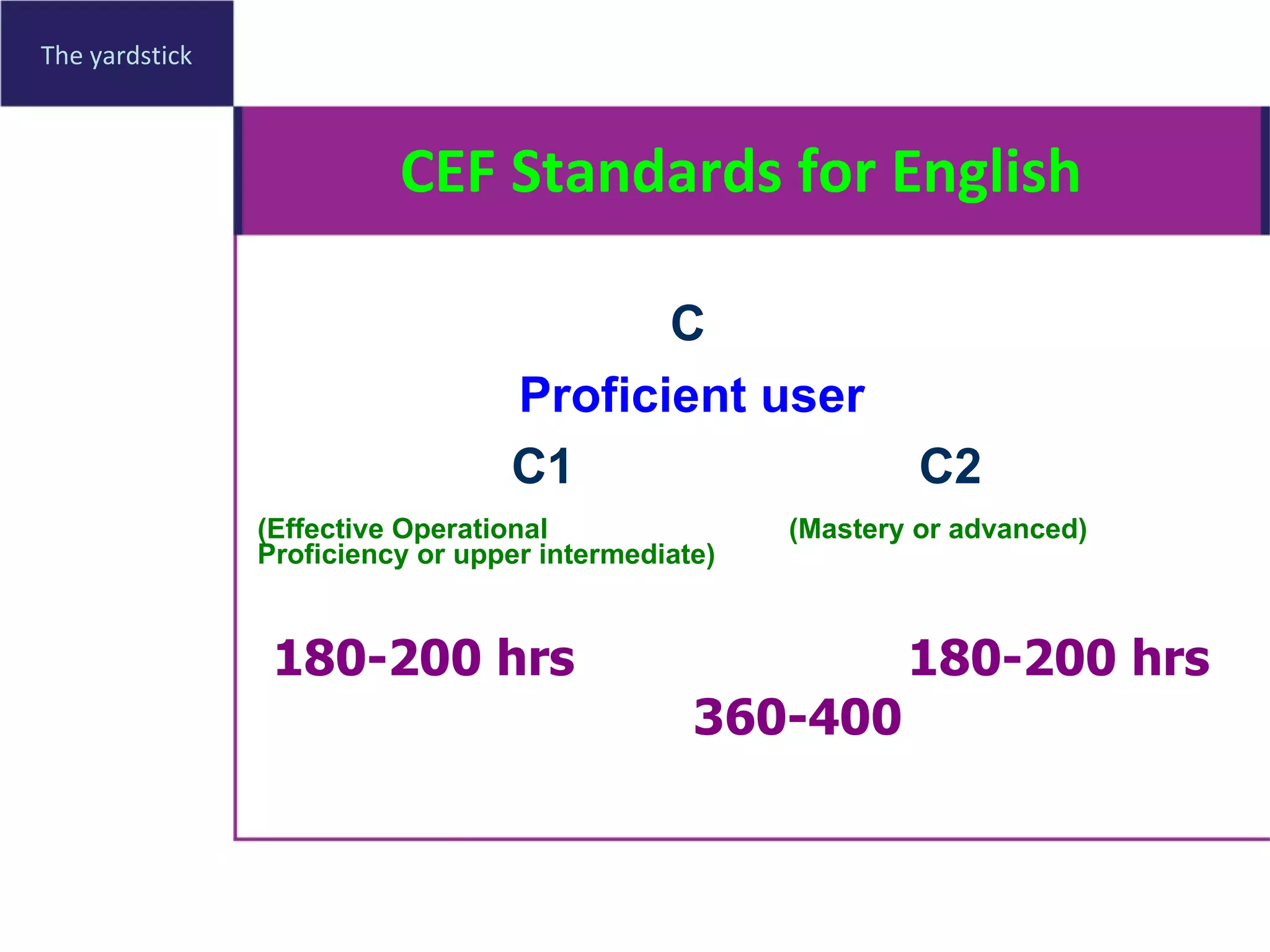
CEF Standards for English The yardstick C  Proficient user C1  C2 (Effective Operational    (Mastery or advanced) Proficiency or upper intermediate) 180-200 hrs  180-200 hrs 360-400
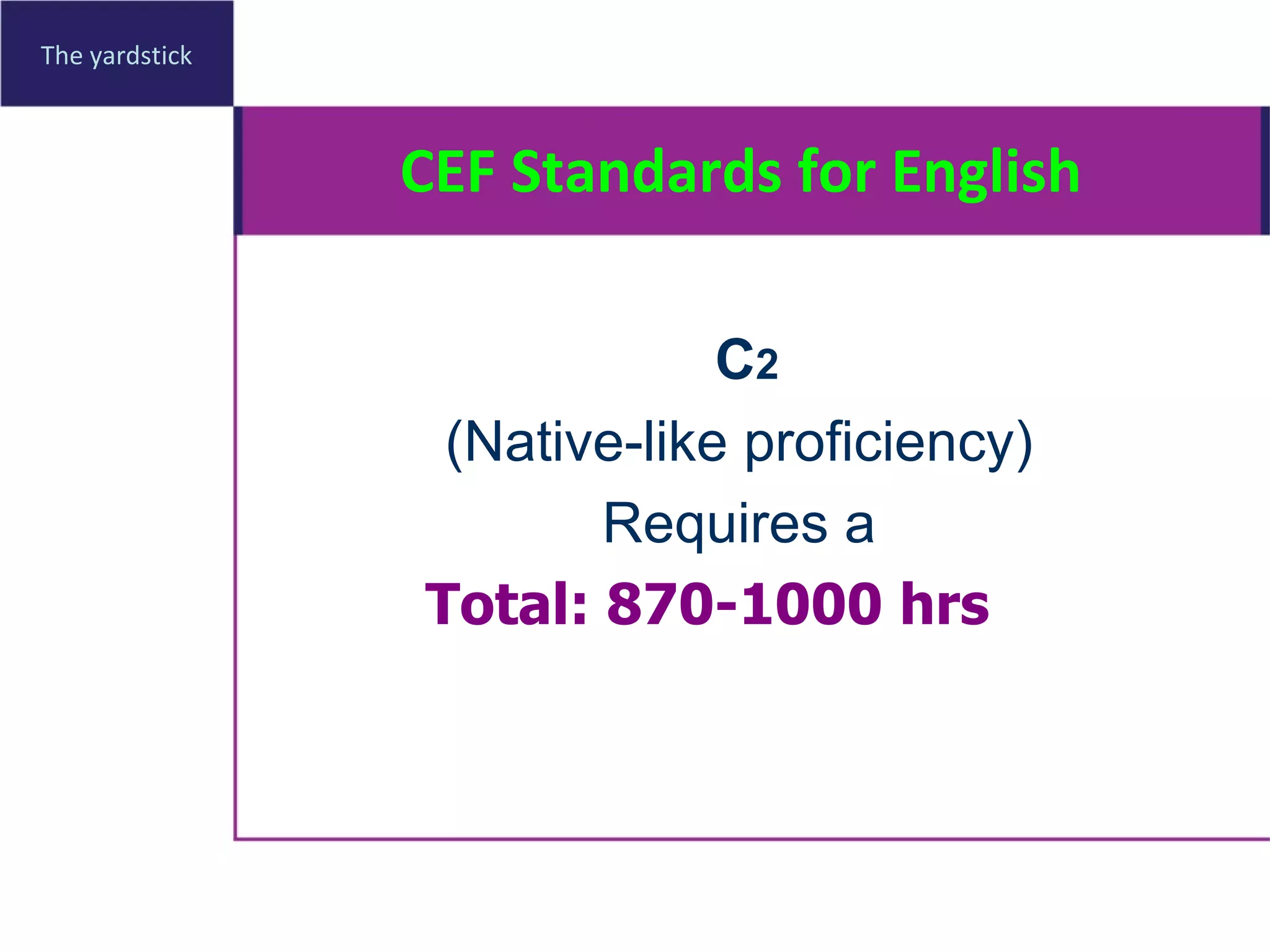
CEF Standards for English The yardstick C 2 (Native-like proficiency) Requires a   Total: 870-1000 hrs
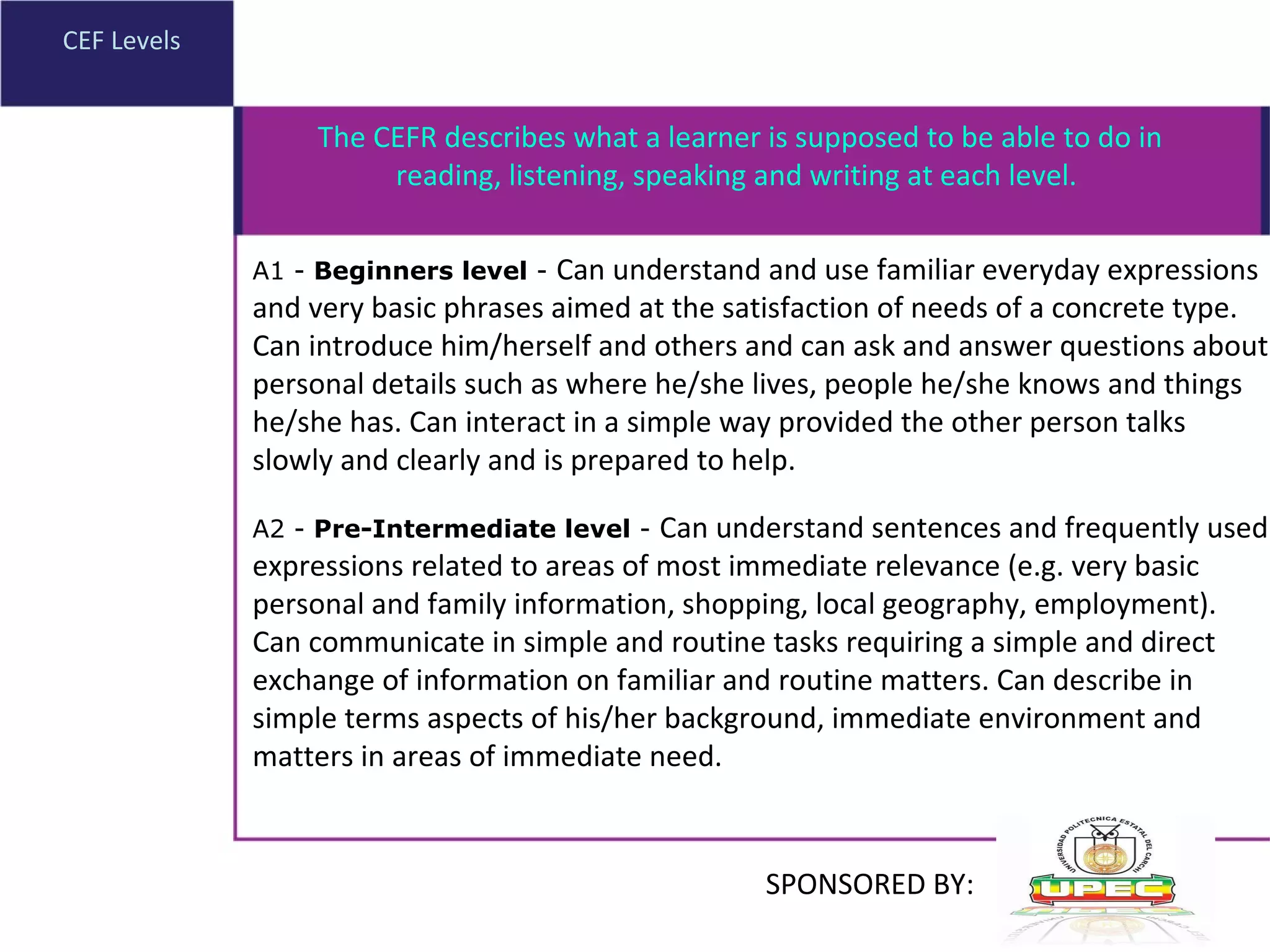
CEF Levels A1 -  Beginners level  -  Can understand and use familiar everyday expressions and very basic phrases aimed at the satisfaction of needs of a concrete type. Can introduce him/herself and others and can ask and answer questions about personal details such as where he/she lives, people he/she knows and things he/she has. Can interact in a simple way provided the other person talks slowly and clearly and is prepared to help.  A2 -  Pre-Intermediate level  -  Can understand sentences and frequently used expressions related to areas of most immediate relevance (e.g. very basic personal and family information, shopping, local geography, employment). Can communicate in simple and routine tasks requiring a simple and direct exchange of information on familiar and routine matters. Can describe in simple terms aspects of his/her background, immediate environment and matters in areas of immediate need.  The CEFR describes what a learner is supposed to be able to do in reading, listening, speaking and writing at each level.  SPONSORED BY:
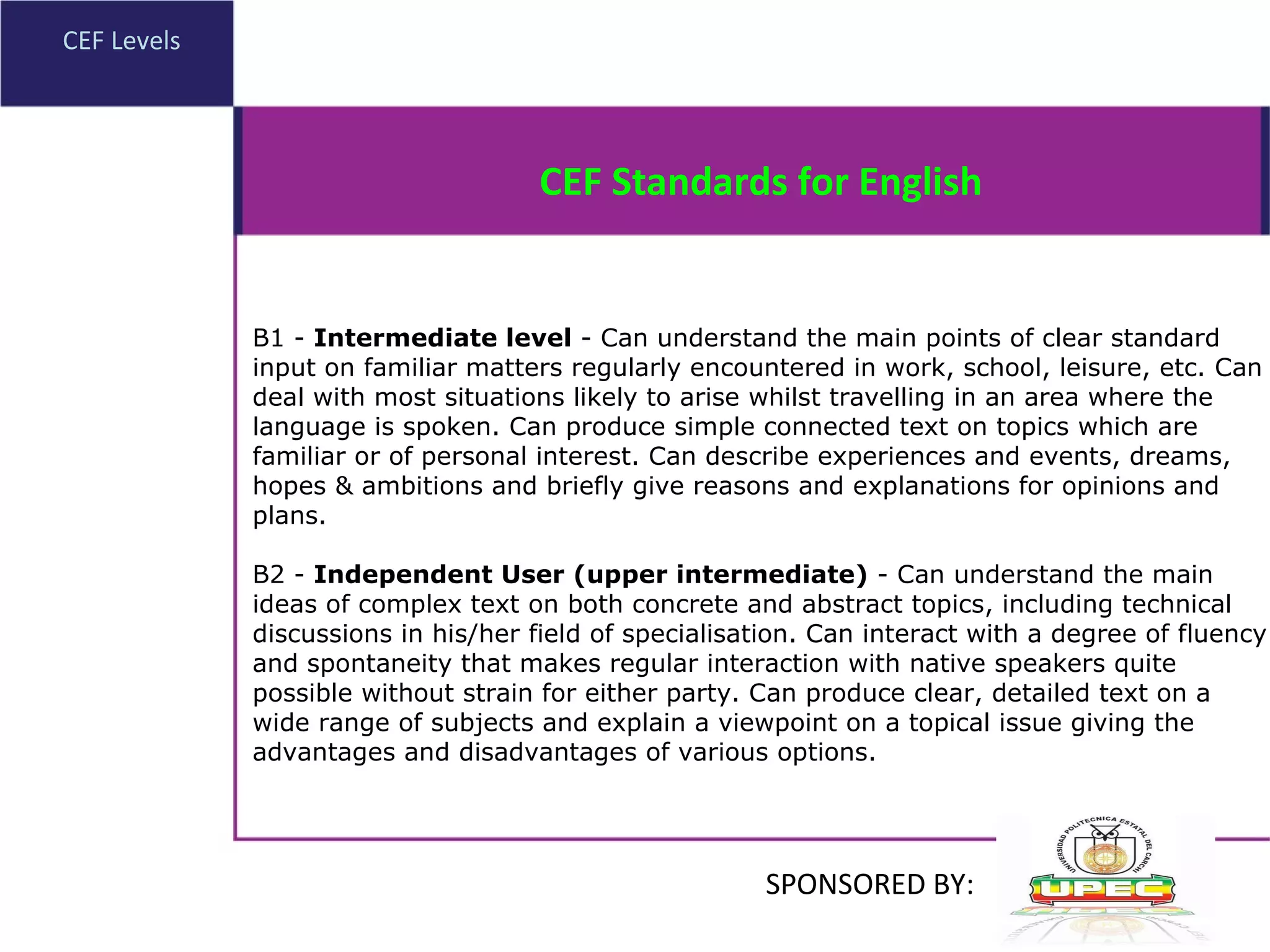
CEF Levels B1 -  Intermediate level  - Can understand the main points of clear standard input on familiar matters regularly encountered in work, school, leisure, etc. Can deal with most situations likely to arise whilst travelling in an area where the language is spoken. Can produce simple connected text on topics which are familiar or of personal interest. Can describe experiences and events, dreams, hopes & ambitions and briefly give reasons and explanations for opinions and plans. B2 -  Independent User (upper intermediate)  - Can understand the main ideas of complex text on both concrete and abstract topics, including technical discussions in his/her field of specialisation. Can interact with a degree of fluency and spontaneity that makes regular interaction with native speakers quite possible without strain for either party. Can produce clear, detailed text on a wide range of subjects and explain a viewpoint on a topical issue giving the advantages and disadvantages of various options. CEF Standards for English SPONSORED BY:
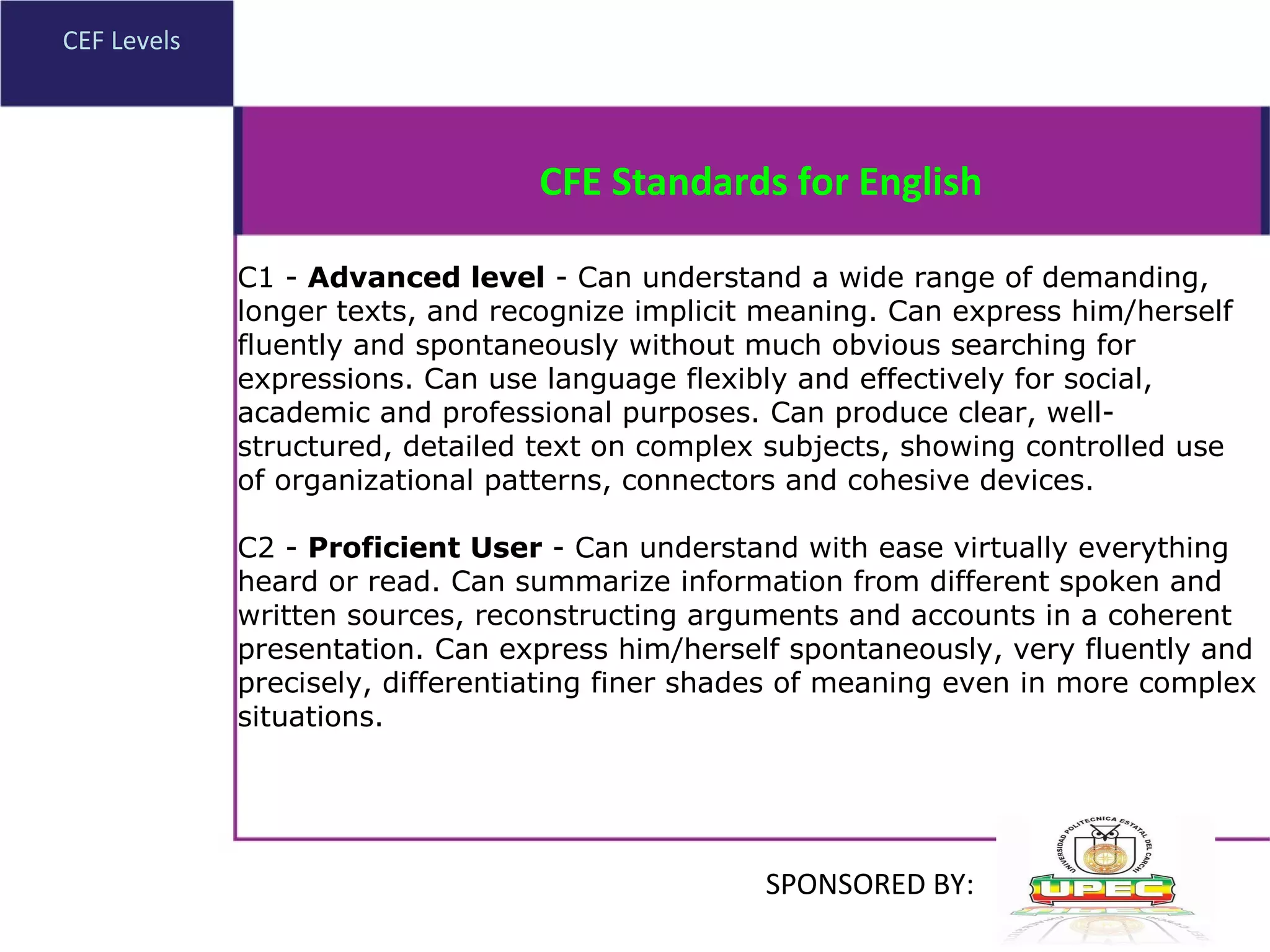
CEF Levels C1 -  Advanced level  - Can understand a wide range of demanding, longer texts, and recognize implicit meaning. Can express him/herself fluently and spontaneously without much obvious searching for expressions. Can use language flexibly and effectively for social, academic and professional purposes. Can produce clear, well-structured, detailed text on complex subjects, showing controlled use of organizational patterns, connectors and cohesive devices. C2 -  Proficient User  - Can understand with ease virtually everything heard or read. Can summarize information from different spoken and written sources, reconstructing arguments and accounts in a coherent presentation. Can express him/herself spontaneously, very fluently and precisely, differentiating finer shades of meaning even in more complex situations. CFE Standards for English SPONSORED BY:
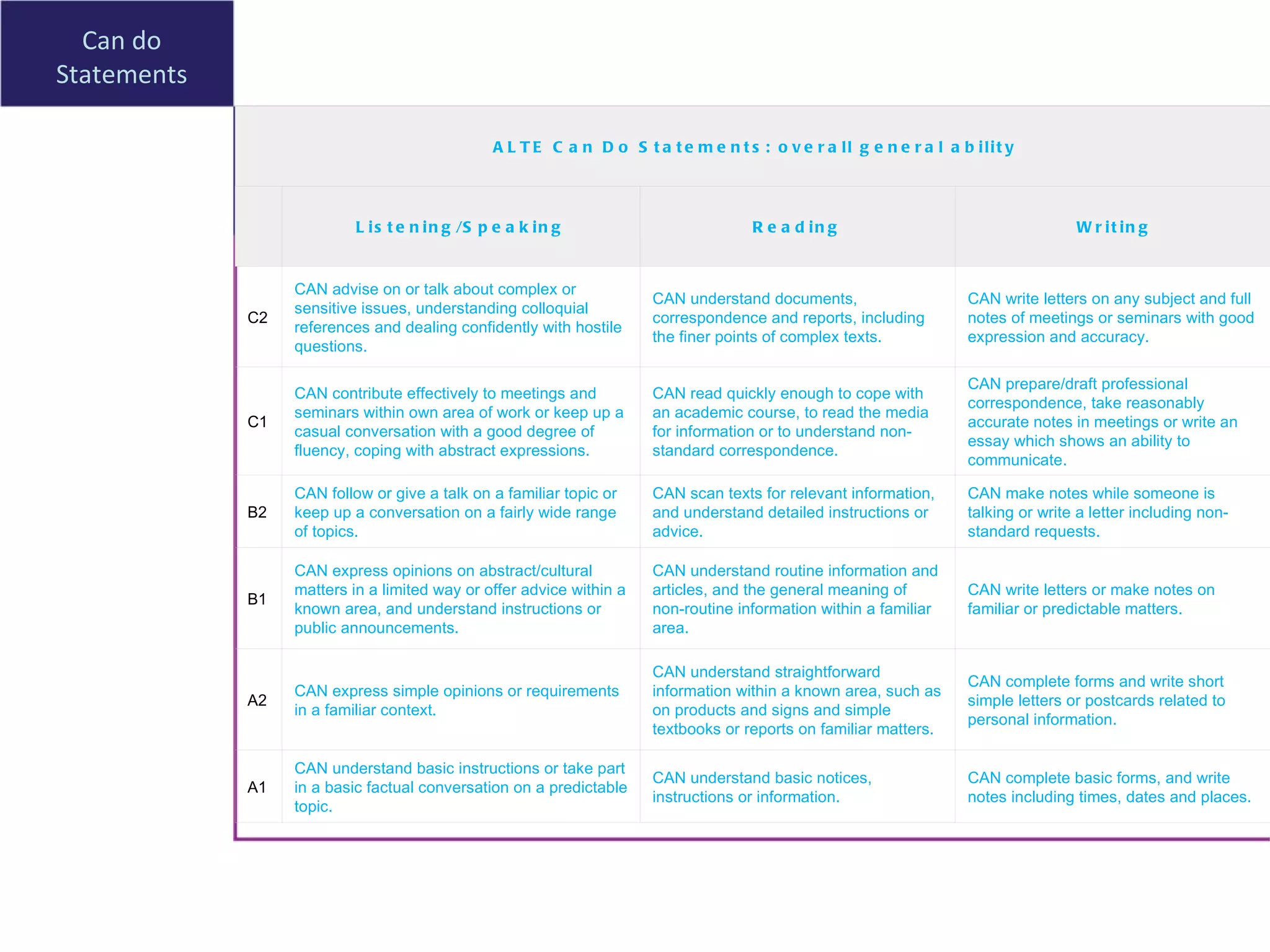
Can do Statements ALTE Can Do Statements: overall general ability Listening/Speaking Reading Writing C2 CAN advise on or talk about complex or sensitive issues, understanding colloquial references and dealing confidently with hostile questions. CAN understand documents, correspondence and reports, including the finer points of complex texts. CAN write letters on any subject and full notes of meetings or seminars with good expression and accuracy. C1 CAN contribute effectively to meetings and seminars within own area of work or keep up a casual conversation with a good degree of fluency, coping with abstract expressions. CAN read quickly enough to cope with an academic course, to read the media for information or to understand non-standard correspondence. CAN prepare/draft professional correspondence, take reasonably accurate notes in meetings or write an essay which shows an ability to communicate. B2 CAN follow or give a talk on a familiar topic or keep up a conversation on a fairly wide range of topics. CAN scan texts for relevant information, and understand detailed instructions or advice. CAN make notes while someone is talking or write a letter including non-standard requests. B1 CAN express opinions on abstract/cultural matters in a limited way or offer advice within a known area, and understand instructions or public announcements. CAN understand routine information and articles, and the general meaning of non-routine information within a familiar area. CAN write letters or make notes on familiar or predictable matters. A2 CAN express simple opinions or requirements in a familiar context. CAN understand straightforward information within a known area, such as on products and signs and simple textbooks or reports on familiar matters. CAN complete forms and write short simple letters or postcards related to personal information. A1 CAN understand basic instructions or take part in a basic factual conversation on a predictable topic. CAN understand basic notices, instructions or information. CAN complete basic forms, and write notes including times, dates and places.
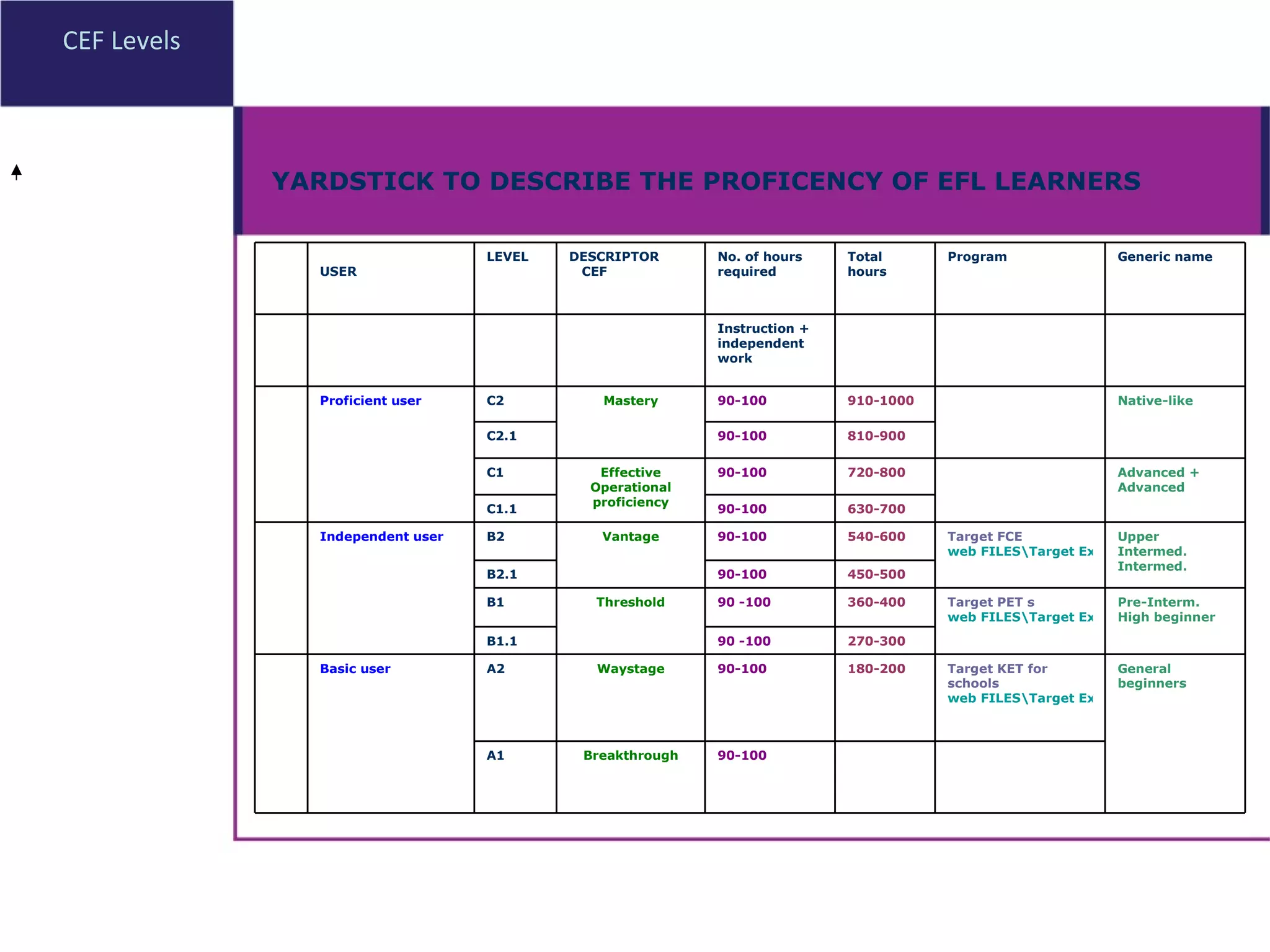
CEF Levels YARDSTICK TO DESCRIBE THE PROFICENCY OF EFL LEARNERS USER LEVEL DESCRIPTOR  CEF No. of hours required Total hours Program Generic name Instruction + independent work Proficient user C2 Mastery 90-100 910-1000 Native-like C2.1 90-100 810-900 C1 Effective Operational proficiency 90-100 720-800 Advanced + Advanced C1.1   90-100 630-700 Independent user B2 Vantage 90-100 540-600 Target FCE web FILES\Target Exams   Target FCE.htm Upper Intermed. Intermed. B2.1 90-100 450-500 B1 Threshold 90 -100  360-400 Target PET s web FILES\Target Exams   Target PET.htm Pre-Interm. High beginner B1.1 90 -100  270-300 Basic user A2 Waystage 90-100 180-200 Target KET for schools web FILES\Target Exams   Target KET for Schools.htm General  beginners A1  Breakthrough 90-100
CEF Standards for English Reflection on the act of reading Instructions: Just read the sentence straight through Warm-up Activity SPONSORED BY:
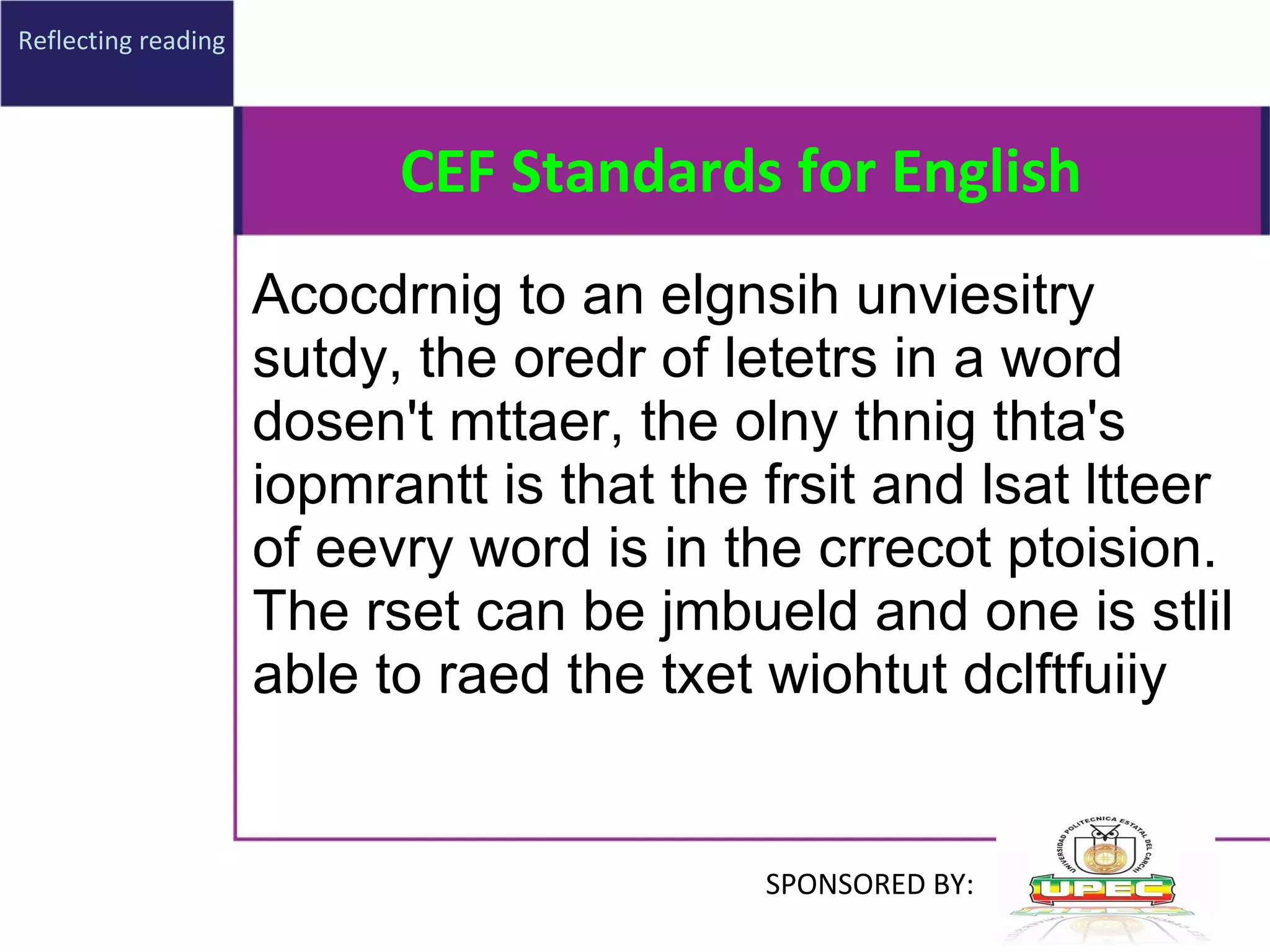
CEF Standards for English Acocdrnig to an elgnsih unviesitry sutdy, the oredr of letetrs in a word dosen't mttaer, the olny thnig thta's iopmrantt is that the frsit and lsat ltteer of eevry word is in the crrecot ptoision. The rset can be jmbueld and one is stlil able to raed the txet wiohtut dclftfuiiy   Reflecting reading SPONSORED BY:
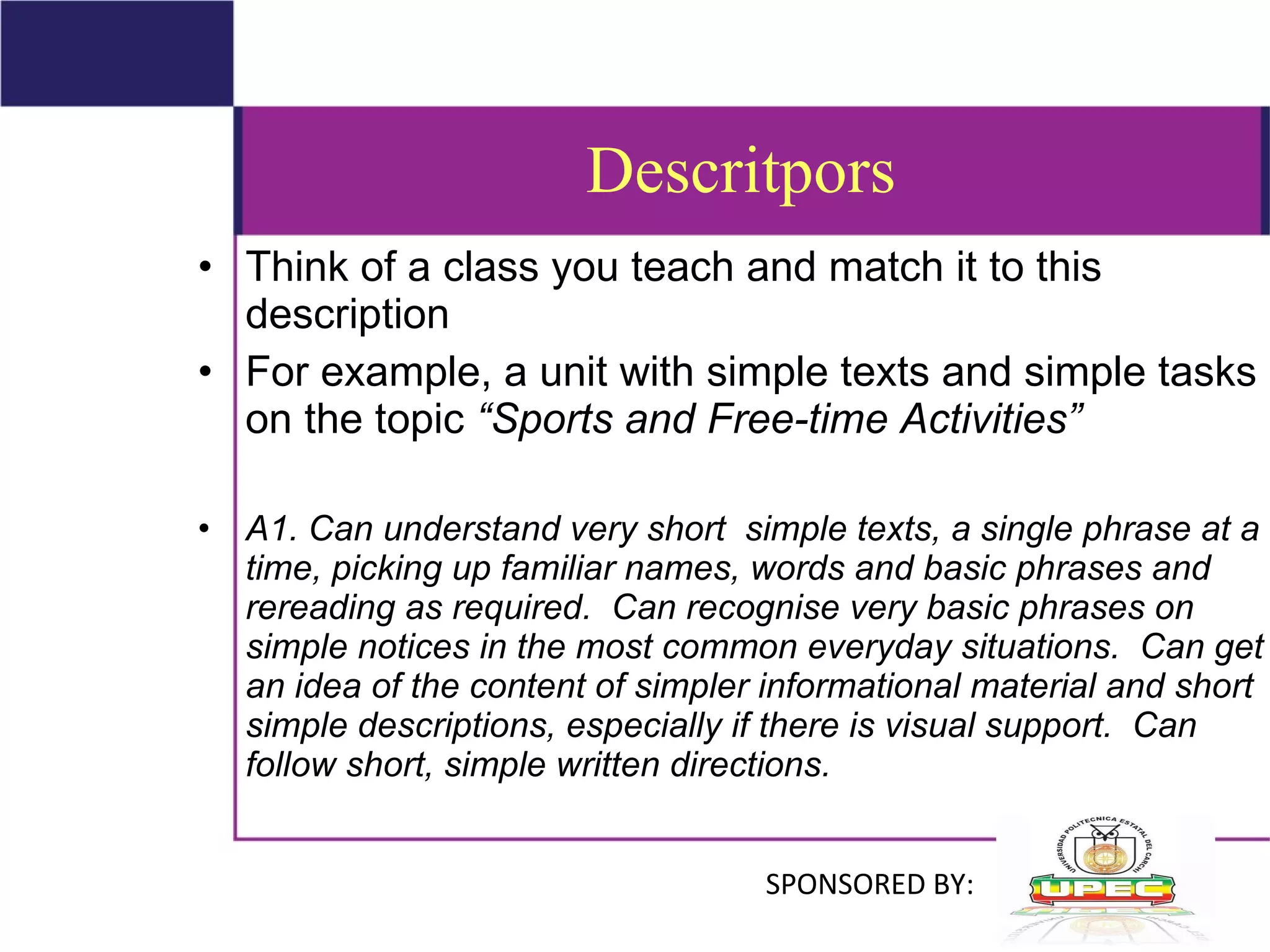
Descritpors Think of a class you teach and match it to this description  For example, a unit with simple texts and simple tasks on the topic  “Sports and Free-time Activities” A1. Can understand very short  simple texts, a single phrase at a time, picking up familiar names, words and basic phrases and rereading as required.  Can recognise very basic phrases on simple notices in the most common everyday situations.  Can get an idea of the content of simpler informational material and short simple descriptions, especially if there is visual support.  Can follow short, simple written directions.   SPONSORED BY:
References References The Council of Europe: a Common European Framework of Reference for Languages: Learning, Teaching, and Assessment. Cambridge University Press, 2000 Ek, V. & Trim.  Treshold level. Cambridge University Press, 1999 Ek, V. & Trim.  Waystage level. Cambridge University Press, 1999 CEF SPONSORED BY:

Cef standards

  • 1.
    Standards for foreignlanguages (English) Luis Quishpe B.A. In ENGLISH LINGUISTIC SPONSORED BY: [email_address]
  • 2.
    CEF Standards forEnglish To describe and analyse the standard proposed by the Council European Framework (CEF) Purpose I SPONSORED BY:
  • 3.
    CEF Standards forEnglish To discuss implications of the CEF levels for testing, assessment, and evaluation of a program . To familiarize audience with diverse sources and references Purpose II SPONSORED BY:
  • 4.
    CEF Standards forEnglish The Council of Europe's Common European Framework of Reference for Languages: Learning, Teaching, Assessment project was one of the main components in Phase 2 of the more extensive project, Language Learning for European Citizenship (1989–1996). Framework Framework of Language Examinations.htm SPONSORED BY:
  • 5.
    CEF Standards forEnglish ALTE members were involved in various stages of the development work of the CEF and in particular ALTE was commissioned by the EU to prepare a supplementary document intended for people involved in language test development. ALTE SPONSORED BY:
  • 6.
    CEF Standards forEnglish Certain aspects of the CEF have already had an influence on the way ALTE members describe their examinations. In particular this relates to the specification of domains and communicative activities. Domains SPONSORED BY:
  • 7.
    CEF Standards forEnglish In this conception of communication, the language users’ communicative competence is activated through various language activities which are themselves contextualized within domains. Domains SPONSORED BY:
  • 8.
    CEF Standards forEnglish These domains are broadly classified as fourfold: personal, public, occupational and educational . Domains SPONSORED BY:
  • 9.
    CEF Standards forEnglish While the communicative activities are sub-divided into those which are : productive, receptive, interactive and mediating. Communicative activities SPONSORED BY:
  • 10.
    CEF Standards forEnglish The yardstick A Basic user A1 A2 (Breakthrough or beginner) (Waystage or elementary) 75-100 hrs 75-100 hrs 150-200
  • 11.
    CEF Standards forEnglish The yardstick B Independent user B1 B2 (Threshold or (Vantage or intermediate) pre-intermediate) 180 -200 hrs 180-200 hrs 360-400
  • 12.
    CEF Standards forEnglish The yardstick C Proficient user C1 C2 (Effective Operational (Mastery or advanced) Proficiency or upper intermediate) 180-200 hrs 180-200 hrs 360-400
  • 13.
    CEF Standards forEnglish The yardstick C 2 (Native-like proficiency) Requires a Total: 870-1000 hrs
  • 14.
    CEF Levels A1-  Beginners level  - Can understand and use familiar everyday expressions and very basic phrases aimed at the satisfaction of needs of a concrete type. Can introduce him/herself and others and can ask and answer questions about personal details such as where he/she lives, people he/she knows and things he/she has. Can interact in a simple way provided the other person talks slowly and clearly and is prepared to help. A2 -  Pre-Intermediate level  - Can understand sentences and frequently used expressions related to areas of most immediate relevance (e.g. very basic personal and family information, shopping, local geography, employment). Can communicate in simple and routine tasks requiring a simple and direct exchange of information on familiar and routine matters. Can describe in simple terms aspects of his/her background, immediate environment and matters in areas of immediate need. The CEFR describes what a learner is supposed to be able to do in reading, listening, speaking and writing at each level. SPONSORED BY:
  • 15.
    CEF Levels B1-  Intermediate level  - Can understand the main points of clear standard input on familiar matters regularly encountered in work, school, leisure, etc. Can deal with most situations likely to arise whilst travelling in an area where the language is spoken. Can produce simple connected text on topics which are familiar or of personal interest. Can describe experiences and events, dreams, hopes & ambitions and briefly give reasons and explanations for opinions and plans. B2 -  Independent User (upper intermediate)  - Can understand the main ideas of complex text on both concrete and abstract topics, including technical discussions in his/her field of specialisation. Can interact with a degree of fluency and spontaneity that makes regular interaction with native speakers quite possible without strain for either party. Can produce clear, detailed text on a wide range of subjects and explain a viewpoint on a topical issue giving the advantages and disadvantages of various options. CEF Standards for English SPONSORED BY:
  • 16.
    CEF Levels C1-  Advanced level  - Can understand a wide range of demanding, longer texts, and recognize implicit meaning. Can express him/herself fluently and spontaneously without much obvious searching for expressions. Can use language flexibly and effectively for social, academic and professional purposes. Can produce clear, well-structured, detailed text on complex subjects, showing controlled use of organizational patterns, connectors and cohesive devices. C2 -  Proficient User  - Can understand with ease virtually everything heard or read. Can summarize information from different spoken and written sources, reconstructing arguments and accounts in a coherent presentation. Can express him/herself spontaneously, very fluently and precisely, differentiating finer shades of meaning even in more complex situations. CFE Standards for English SPONSORED BY:
  • 17.
    Can do StatementsALTE Can Do Statements: overall general ability Listening/Speaking Reading Writing C2 CAN advise on or talk about complex or sensitive issues, understanding colloquial references and dealing confidently with hostile questions. CAN understand documents, correspondence and reports, including the finer points of complex texts. CAN write letters on any subject and full notes of meetings or seminars with good expression and accuracy. C1 CAN contribute effectively to meetings and seminars within own area of work or keep up a casual conversation with a good degree of fluency, coping with abstract expressions. CAN read quickly enough to cope with an academic course, to read the media for information or to understand non-standard correspondence. CAN prepare/draft professional correspondence, take reasonably accurate notes in meetings or write an essay which shows an ability to communicate. B2 CAN follow or give a talk on a familiar topic or keep up a conversation on a fairly wide range of topics. CAN scan texts for relevant information, and understand detailed instructions or advice. CAN make notes while someone is talking or write a letter including non-standard requests. B1 CAN express opinions on abstract/cultural matters in a limited way or offer advice within a known area, and understand instructions or public announcements. CAN understand routine information and articles, and the general meaning of non-routine information within a familiar area. CAN write letters or make notes on familiar or predictable matters. A2 CAN express simple opinions or requirements in a familiar context. CAN understand straightforward information within a known area, such as on products and signs and simple textbooks or reports on familiar matters. CAN complete forms and write short simple letters or postcards related to personal information. A1 CAN understand basic instructions or take part in a basic factual conversation on a predictable topic. CAN understand basic notices, instructions or information. CAN complete basic forms, and write notes including times, dates and places.
  • 18.
    CEF Levels YARDSTICKTO DESCRIBE THE PROFICENCY OF EFL LEARNERS USER LEVEL DESCRIPTOR CEF No. of hours required Total hours Program Generic name Instruction + independent work Proficient user C2 Mastery 90-100 910-1000 Native-like C2.1 90-100 810-900 C1 Effective Operational proficiency 90-100 720-800 Advanced + Advanced C1.1 90-100 630-700 Independent user B2 Vantage 90-100 540-600 Target FCE web FILES\Target Exams Target FCE.htm Upper Intermed. Intermed. B2.1 90-100 450-500 B1 Threshold 90 -100 360-400 Target PET s web FILES\Target Exams Target PET.htm Pre-Interm. High beginner B1.1 90 -100 270-300 Basic user A2 Waystage 90-100 180-200 Target KET for schools web FILES\Target Exams Target KET for Schools.htm General beginners A1 Breakthrough 90-100
  • 19.
    CEF Standards forEnglish Reflection on the act of reading Instructions: Just read the sentence straight through Warm-up Activity SPONSORED BY:
  • 20.
    CEF Standards forEnglish Acocdrnig to an elgnsih unviesitry sutdy, the oredr of letetrs in a word dosen't mttaer, the olny thnig thta's iopmrantt is that the frsit and lsat ltteer of eevry word is in the crrecot ptoision. The rset can be jmbueld and one is stlil able to raed the txet wiohtut dclftfuiiy Reflecting reading SPONSORED BY:
  • 21.
    Descritpors Think ofa class you teach and match it to this description For example, a unit with simple texts and simple tasks on the topic “Sports and Free-time Activities” A1. Can understand very short simple texts, a single phrase at a time, picking up familiar names, words and basic phrases and rereading as required. Can recognise very basic phrases on simple notices in the most common everyday situations. Can get an idea of the content of simpler informational material and short simple descriptions, especially if there is visual support. Can follow short, simple written directions. SPONSORED BY:
  • 22.
    References References TheCouncil of Europe: a Common European Framework of Reference for Languages: Learning, Teaching, and Assessment. Cambridge University Press, 2000 Ek, V. & Trim. Treshold level. Cambridge University Press, 1999 Ek, V. & Trim. Waystage level. Cambridge University Press, 1999 CEF SPONSORED BY: