IDSA GUIDELINESDiagnosis and Management of Complicated Intra-abdominal Infection in Adults and Children: Guidelines by the Surgical Infection Society and the Infectious Diseases Society of America Clinical Infectious Diseases 2010; 50:133–64
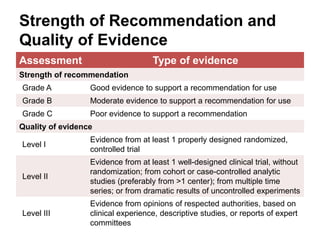
Strength of Recommendation and Quality of Evidence
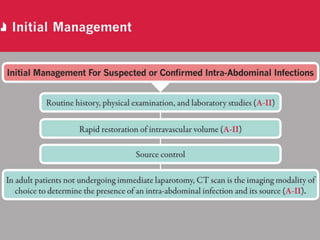
What Are the Appropriate Procedures for Initial Evaluation of Patients with Suspected Intra-abdominal Infection?
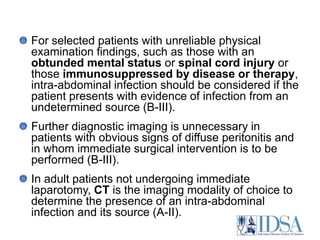
For selected patients with unreliable physical examination findings, such as those with an obtunded mental status or spinal cord injury or those immunosuppressed by disease or therapy, intra-abdominal infection should be considered if the patient presents with evidence of infection from an undetermined source (B-III). Further diagnostic imaging is unnecessary in patients with obvious signs of diffuse peritonitis and in whom immediate surgical intervention is to be performed (B-III). In adult patients not undergoing immediate laparotomy, CT is the imaging modality of choice to determine the presence of an intra-abdominal infection and its source (A-II).
When Should Fluid Resuscitation Be Started for Patients with Suspected Intra-abdominal Infection?
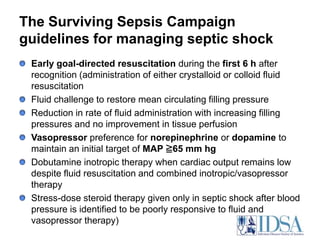
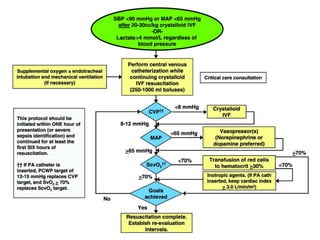
The Surviving Sepsis Campaign guidelines for managing septic shockEarly goal-directed resuscitation during the first 6 h after recognition (administration of either crystalloid or colloid fluid resuscitationFluid challenge to restore mean circulating filling pressureReduction in rate of fluid administration with increasing filling pressures and no improvement in tissue perfusionVasopressor preference for norepinephrine or dopamine to maintain an initial target of MAP ≧65 mm hgDobutamine inotropic therapy when cardiac output remains low despite fluid resuscitation and combined inotropic/vasopressor therapyStress-dose steroid therapy given only in septic shock after blood pressure is identified to be poorly responsive to fluid and vasopressor therapy)
When Should Antimicrobial Therapy Be Initiated for Patients with Suspected or Confirmed Intra-abdominal Infection?
Antimicrobial therapy should be initiated once a patient receives a diagnosis of an intra-abdominal infection or once such an infection is considered likely. 	For patients with septic shock, antibiotics should be administered as soon as possible (A-III). For patients without septic shock, antimicrobial therapy should be started in the ED (B-III).
On the basis of this study, sepsis guidelines have recommended that antibiotics be administered within 1 h of recognition of septic shock. In patients without hemodynamic or organ compromises, the Expert Panel members agreed that antibacterials should be administered within 8 h after presentation.
What Are the Proper Procedures for Obtaining Adequate Source Control?
An appropriate source control procedure to drain infected foci, control ongoing peritoneal contamination by diversion or resection, and restore anatomic and physiological function to the extent feasible is recommended for nearly all patients with intra-abdominal infection (B-II). Patients with diffuse peritonitis should undergo an emergency surgical procedure as soon as is possible, even if ongoing measures to restore physiologic stability need to be continued during the procedure (B-II). Where feasible, percutaneous drainage of abscesses and other well-localized fluid collections is preferable to surgical drainage (B-II).
What Are Appropriate Antimicrobial Regimens for Patients with Community-Acquired Intra-abdominal Infection of Mild-to-Moderate Severity and High Severity?
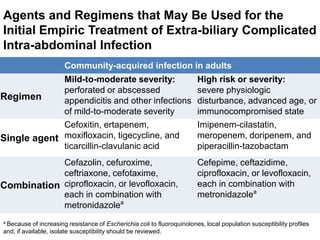
Agents and Regimens that May Be Used for the Initial Empiric Treatment of Extra-biliary Complicated Intra-abdominal Infectiona Because of increasing resistance of Escherichia coli to fluoroquinolones, local population susceptibility profiles and, if available, isolate susceptibility should be reviewed.
Ampicillin-sulbactam is not recommended for use because of high rates of resistance to this agent among community-acquired E. coli (B-II). Cefotetan and clindamycin are not recommended for use because of increasing prevalence of resistance to these agents among the Bacteroides fragilis group (B-II). Because of the availability of less toxic agents demonstrated to be at least equally effective, aminoglycosides are not recommended for routine use in adults with community-acquired intra-abdominal infection (B-II).
What Antimicrobial Regimens Should Be Used in Patients with Health Care-Associated Intra-abdominal Infection, Particularly with Regard to Candida, Enterococcus, and MRSA?
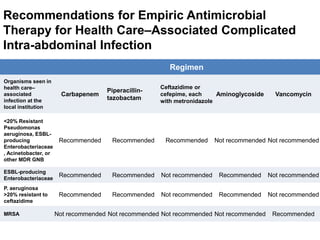
Recommendations for Empiric Antimicrobial Therapy for Health Care–Associated Complicated Intra-abdominal Infection
What Are Appropriate Diagnostic and Antimicrobial Therapeutic Strategies for Acute Cholecystitis and Cholangitis?
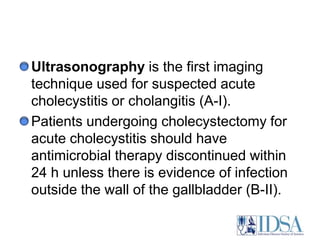
Ultrasonography is the first imaging technique used for suspected acute cholecystitis or cholangitis (A-I).Patients undergoing cholecystectomy for acute cholecystitis should have antimicrobial therapy discontinued within 24 h unless there is evidence of infection outside the wall of the gallbladder (B-II).
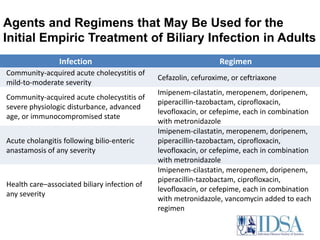
Agents and Regimens that May Be Used for the Initial Empiric Treatment of Biliary Infection in Adults
What Are Appropriate Antimicrobial Regimens for Pediatric Patients with Community-Acquired Intra-abdominal Infection?
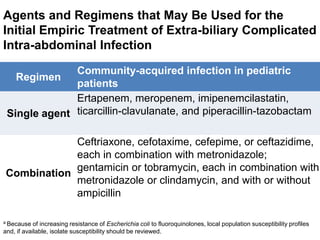
Agents and Regimens that May Be Used for the Initial Empiric Treatment of Extra-biliary Complicated Intra-abdominal Infectiona Because of increasing resistance of Escherichia coli to fluoroquinolones, local population susceptibility profiles and, if available, isolate susceptibility should be reviewed.
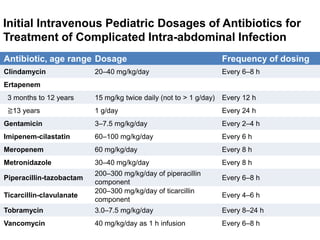
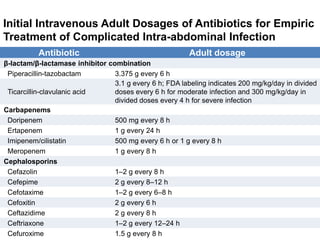
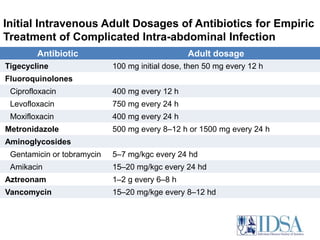
What Constitutes Appropriate Antibiotic Dosing?
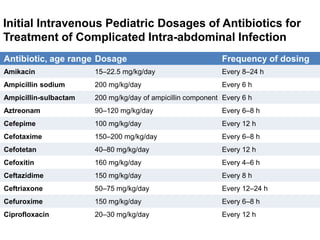
Initial Intravenous Pediatric Dosages of Antibiotics for Treatment of Complicated Intra-abdominal Infection
Initial Intravenous Adult Dosages of Antibiotics for Empiric Treatment of Complicated Intra-abdominal Infection
What Is the Appropriate Duration of Therapy for Patients with Complicated Intra-abdominal Infection?
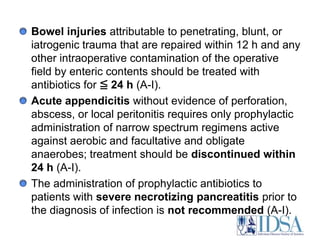
Bowel injuries attributable to penetrating, blunt, or iatrogenic trauma that are repaired within 12 h and any other intraoperative contamination of the operative field by enteric contents should be treated with antibiotics for ≦ 24 h (A-I). Acute appendicitis without evidence of perforation, abscess, or local peritonitis requires only prophylactic administration of narrow spectrum regimens active against aerobic and facultative and obligate anaerobes; treatment should be discontinued within 24 h (A-I). The administration of prophylactic antibiotics to patients with severe necrotizing pancreatitis prior to the diagnosis of infection is not recommended (A-I).
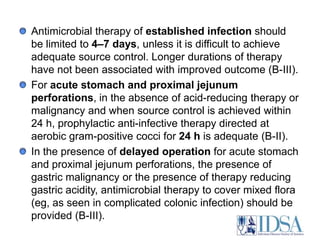
Antimicrobial therapy of established infection should be limited to 4–7 days, unless it is difficult to achieve adequate source control. Longer durations of therapy have not been associated with improved outcome (B-III). For acute stomach and proximal jejunum perforations, in the absence of acid-reducing therapy or malignancy and when source control is achieved within 24 h, prophylactic anti-infective therapy directed at aerobic gram-positive cocci for 24 h is adequate (B-II). In the presence of delayed operation for acute stomach and proximal jejunum perforations, the presence of gastric malignancy or the presence of therapy reducing gastric acidity, antimicrobial therapy to cover mixed flora (eg, as seen in complicated colonic infection) should be provided (B-III).
How Should Suspected Treatment Failure Be Managed?
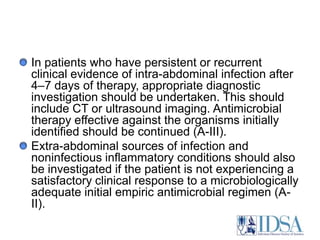
In patients who have persistent or recurrent clinical evidence of intra-abdominal infection after 4–7 days of therapy, appropriate diagnostic investigation should be undertaken. This should include CT or ultrasound imaging. Antimicrobial therapy effective against the organisms initially identified should be continued (A-III). Extra-abdominal sources of infection and noninfectious inflammatory conditions should also be investigated if the patient is not experiencing a satisfactory clinical response to a microbiologically adequate initial empiric antimicrobial regimen (A-II).
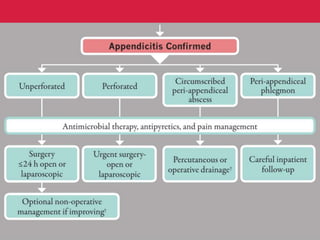
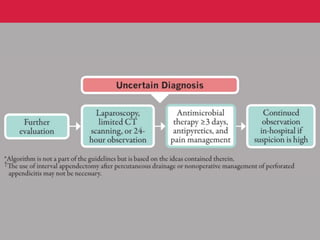
What Are the Key Elements that Should Be Considered in Developing a Local Appendicitis Pathway?
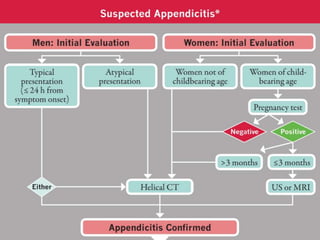
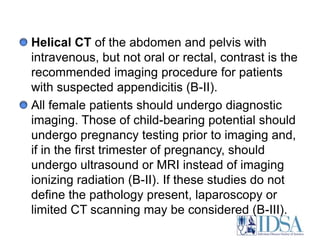
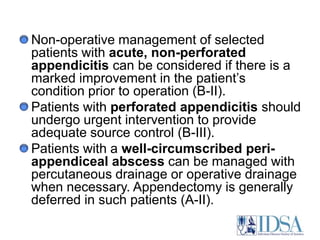
Helical CT of the abdomen and pelvis with intravenous, but not oral or rectal, contrast is the recommended imaging procedure for patients with suspected appendicitis (B-II).All female patients should undergo diagnostic imaging. Those of child-bearing potential should undergo pregnancy testing prior to imaging and, if in the first trimester of pregnancy, should undergo ultrasound or MRI instead of imaging ionizing radiation (B-II). If these studies do not define the pathology present, laparoscopy or limited CT scanning may be considered (B-III).
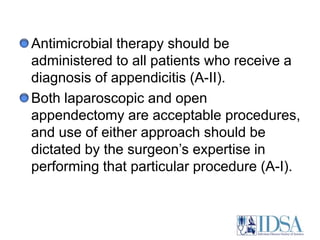
Antimicrobial therapy should be administered to all patients who receive a diagnosis of appendicitis (A-II).Both laparoscopic and open appendectomy are acceptable procedures, and use of either approach should be dictated by the surgeon’s expertise in performing that particular procedure (A-I).

Intra-abdominal Infection Guidelines 2010

  • 1.
    IDSA GUIDELINESDiagnosis andManagement of Complicated Intra-abdominal Infection in Adults and Children: Guidelines by the Surgical Infection Society and the Infectious Diseases Society of America Clinical Infectious Diseases 2010; 50:133–64
  • 2.
    Strength of Recommendationand Quality of Evidence
  • 3.
    What Are theAppropriate Procedures for Initial Evaluation of Patients with Suspected Intra-abdominal Infection?
  • 5.
    For selected patientswith unreliable physical examination findings, such as those with an obtunded mental status or spinal cord injury or those immunosuppressed by disease or therapy, intra-abdominal infection should be considered if the patient presents with evidence of infection from an undetermined source (B-III). Further diagnostic imaging is unnecessary in patients with obvious signs of diffuse peritonitis and in whom immediate surgical intervention is to be performed (B-III). In adult patients not undergoing immediate laparotomy, CT is the imaging modality of choice to determine the presence of an intra-abdominal infection and its source (A-II).
  • 6.
    When Should FluidResuscitation Be Started for Patients with Suspected Intra-abdominal Infection?
  • 7.
    The Surviving SepsisCampaign guidelines for managing septic shockEarly goal-directed resuscitation during the first 6 h after recognition (administration of either crystalloid or colloid fluid resuscitationFluid challenge to restore mean circulating filling pressureReduction in rate of fluid administration with increasing filling pressures and no improvement in tissue perfusionVasopressor preference for norepinephrine or dopamine to maintain an initial target of MAP ≧65 mm hgDobutamine inotropic therapy when cardiac output remains low despite fluid resuscitation and combined inotropic/vasopressor therapyStress-dose steroid therapy given only in septic shock after blood pressure is identified to be poorly responsive to fluid and vasopressor therapy)
  • 9.
    When Should AntimicrobialTherapy Be Initiated for Patients with Suspected or Confirmed Intra-abdominal Infection?
  • 10.
    Antimicrobial therapy shouldbe initiated once a patient receives a diagnosis of an intra-abdominal infection or once such an infection is considered likely. For patients with septic shock, antibiotics should be administered as soon as possible (A-III). For patients without septic shock, antimicrobial therapy should be started in the ED (B-III).
  • 11.
    On the basisof this study, sepsis guidelines have recommended that antibiotics be administered within 1 h of recognition of septic shock. In patients without hemodynamic or organ compromises, the Expert Panel members agreed that antibacterials should be administered within 8 h after presentation.
  • 12.
    What Are theProper Procedures for Obtaining Adequate Source Control?
  • 13.
    An appropriate sourcecontrol procedure to drain infected foci, control ongoing peritoneal contamination by diversion or resection, and restore anatomic and physiological function to the extent feasible is recommended for nearly all patients with intra-abdominal infection (B-II). Patients with diffuse peritonitis should undergo an emergency surgical procedure as soon as is possible, even if ongoing measures to restore physiologic stability need to be continued during the procedure (B-II). Where feasible, percutaneous drainage of abscesses and other well-localized fluid collections is preferable to surgical drainage (B-II).
  • 14.
    What Are AppropriateAntimicrobial Regimens for Patients with Community-Acquired Intra-abdominal Infection of Mild-to-Moderate Severity and High Severity?
  • 15.
    Agents and Regimensthat May Be Used for the Initial Empiric Treatment of Extra-biliary Complicated Intra-abdominal Infectiona Because of increasing resistance of Escherichia coli to fluoroquinolones, local population susceptibility profiles and, if available, isolate susceptibility should be reviewed.
  • 16.
    Agents and Regimensthat May Be Used for the Initial Empiric Treatment of Extra-biliary Complicated Intra-abdominal Infectiona Because of increasing resistance of Escherichia coli to fluoroquinolones, local population susceptibility profiles and, if available, isolate susceptibility should be reviewed.
  • 17.
    Ampicillin-sulbactam is notrecommended for use because of high rates of resistance to this agent among community-acquired E. coli (B-II). Cefotetan and clindamycin are not recommended for use because of increasing prevalence of resistance to these agents among the Bacteroides fragilis group (B-II). Because of the availability of less toxic agents demonstrated to be at least equally effective, aminoglycosides are not recommended for routine use in adults with community-acquired intra-abdominal infection (B-II).
  • 18.
    What Antimicrobial RegimensShould Be Used in Patients with Health Care-Associated Intra-abdominal Infection, Particularly with Regard to Candida, Enterococcus, and MRSA?
  • 19.
    Recommendations for EmpiricAntimicrobial Therapy for Health Care–Associated Complicated Intra-abdominal Infection
  • 20.
    What Are AppropriateDiagnostic and Antimicrobial Therapeutic Strategies for Acute Cholecystitis and Cholangitis?
  • 21.
    Ultrasonography is thefirst imaging technique used for suspected acute cholecystitis or cholangitis (A-I).Patients undergoing cholecystectomy for acute cholecystitis should have antimicrobial therapy discontinued within 24 h unless there is evidence of infection outside the wall of the gallbladder (B-II).
  • 22.
    Agents and Regimensthat May Be Used for the Initial Empiric Treatment of Biliary Infection in Adults
  • 23.
    What Are AppropriateAntimicrobial Regimens for Pediatric Patients with Community-Acquired Intra-abdominal Infection?
  • 24.
    Agents and Regimensthat May Be Used for the Initial Empiric Treatment of Extra-biliary Complicated Intra-abdominal Infectiona Because of increasing resistance of Escherichia coli to fluoroquinolones, local population susceptibility profiles and, if available, isolate susceptibility should be reviewed.
  • 25.
  • 26.
    Initial Intravenous PediatricDosages of Antibiotics for Treatment of Complicated Intra-abdominal Infection
  • 27.
    Initial Intravenous PediatricDosages of Antibiotics for Treatment of Complicated Intra-abdominal Infection
  • 28.
    Initial Intravenous AdultDosages of Antibiotics for Empiric Treatment of Complicated Intra-abdominal Infection
  • 29.
    Initial Intravenous AdultDosages of Antibiotics for Empiric Treatment of Complicated Intra-abdominal Infection
  • 30.
    What Is theAppropriate Duration of Therapy for Patients with Complicated Intra-abdominal Infection?
  • 31.
    Bowel injuries attributableto penetrating, blunt, or iatrogenic trauma that are repaired within 12 h and any other intraoperative contamination of the operative field by enteric contents should be treated with antibiotics for ≦ 24 h (A-I). Acute appendicitis without evidence of perforation, abscess, or local peritonitis requires only prophylactic administration of narrow spectrum regimens active against aerobic and facultative and obligate anaerobes; treatment should be discontinued within 24 h (A-I). The administration of prophylactic antibiotics to patients with severe necrotizing pancreatitis prior to the diagnosis of infection is not recommended (A-I).
  • 32.
    Antimicrobial therapy ofestablished infection should be limited to 4–7 days, unless it is difficult to achieve adequate source control. Longer durations of therapy have not been associated with improved outcome (B-III). For acute stomach and proximal jejunum perforations, in the absence of acid-reducing therapy or malignancy and when source control is achieved within 24 h, prophylactic anti-infective therapy directed at aerobic gram-positive cocci for 24 h is adequate (B-II). In the presence of delayed operation for acute stomach and proximal jejunum perforations, the presence of gastric malignancy or the presence of therapy reducing gastric acidity, antimicrobial therapy to cover mixed flora (eg, as seen in complicated colonic infection) should be provided (B-III).
  • 33.
    How Should SuspectedTreatment Failure Be Managed?
  • 34.
    In patients whohave persistent or recurrent clinical evidence of intra-abdominal infection after 4–7 days of therapy, appropriate diagnostic investigation should be undertaken. This should include CT or ultrasound imaging. Antimicrobial therapy effective against the organisms initially identified should be continued (A-III). Extra-abdominal sources of infection and noninfectious inflammatory conditions should also be investigated if the patient is not experiencing a satisfactory clinical response to a microbiologically adequate initial empiric antimicrobial regimen (A-II).
  • 36.
    What Are theKey Elements that Should Be Considered in Developing a Local Appendicitis Pathway?
  • 40.
    Helical CT ofthe abdomen and pelvis with intravenous, but not oral or rectal, contrast is the recommended imaging procedure for patients with suspected appendicitis (B-II).All female patients should undergo diagnostic imaging. Those of child-bearing potential should undergo pregnancy testing prior to imaging and, if in the first trimester of pregnancy, should undergo ultrasound or MRI instead of imaging ionizing radiation (B-II). If these studies do not define the pathology present, laparoscopy or limited CT scanning may be considered (B-III).
  • 41.
    Antimicrobial therapy shouldbe administered to all patients who receive a diagnosis of appendicitis (A-II).Both laparoscopic and open appendectomy are acceptable procedures, and use of either approach should be dictated by the surgeon’s expertise in performing that particular procedure (A-I).