Welcome to
Marketing Strategy
Strategic Marketing Perspectives Behind
Successful Corporates and Businesses
What is Strategy
?
A strategy is a fundamental
pattern of present and planned
objectives, resource deployments,
and interactions of an
organization with markets,
competitors, and other
environmental factors
Components of Strategy
 Scope
 Goals and objectives
 Resource deployments
 Identification of sustainable
competitive
 Advantage
 Synergy
The Hierarchy
of Strategies
Three major levels of strategy are:
1. Corporate strategy
2. Business-level strategy
3. Marketing strategy
Market
Oriented
Management
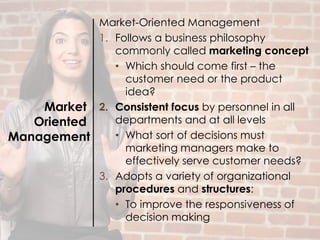
Market-Oriented Management
1. Follows a business philosophy
commonly called marketing concept
• Which should come first – the
customer need or the product
idea?
2. Consistent focus by personnel in all
departments and at all levels
• What sort of decisions must
marketing managers make to
effectively serve customer needs?
3. Adopts a variety of organizational
procedures and structures:
• To improve the responsiveness of
decision making
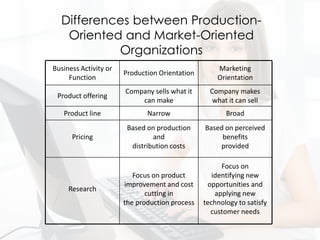
Differences between Production-
Oriented and Market-Oriented
Organizations
Business Activity or
Function
Production Orientation
Marketing
Orientation
Product offering
Company sells what it
can make
Company makes
what it can sell
Product line Narrow Broad
Pricing
Based on production
and
distribution costs
Based on perceived
benefits
provided
Research
Focus on product
improvement and cost
cutting in
the production process
Focus on
identifying new
opportunities and
applying new
technology to satisfy
customer needs
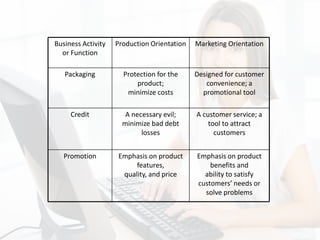
Business Activity
or Function
Production Orientation Marketing Orientation
Packaging Protection for the
product;
minimize costs
Designed for customer
convenience; a
promotional tool
Credit A necessary evil;
minimize bad debt
losses
A customer service; a
tool to attract
customers
Promotion Emphasis on product
features,
quality, and price
Emphasis on product
benefits and
ability to satisfy
customers’ needs or
solve problems
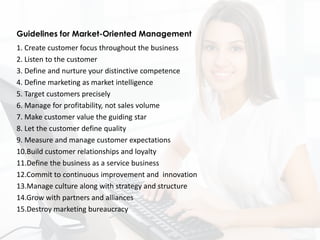
1. Create customer focus throughout the business
2. Listen to the customer
3. Define and nurture your distinctive competence
4. Define marketing as market intelligence
5. Target customers precisely
6. Manage for profitability, not sales volume
7. Make customer value the guiding star
8. Let the customer define quality
9. Measure and manage customer expectations
10.Build customer relationships and loyalty
11.Define the business as a service business
12.Commit to continuous improvement and innovation
13.Manage culture along with strategy and structure
14.Grow with partners and alliances
15.Destroy marketing bureaucracy
Guidelines for Market-Oriented Management
Factors that Mediate
Strategic Marketing's Role
1. Competitive factors affect a firm’s
market orientation
2. Influence of different development
stages across industries and global
markets
3. Strategic inertia
Formulating and
Implementing
Marketing Strategy
Process
1. Decision-Making Focus
2. Analysis of the four “Cs”
3. Integrating marketing strategy
with the firm's other strategies
and resources
4. Market opportunity analysis
- Understanding Market
Opportunities
- Measuring Market
Opportunities
- Market Segmentation,
Targeting, and Positioning
Decisions
5. Formulating strategies for
specific market situations
6. mplementation and control of
the marketing strategy
Marketing Plan
A marketing plan is a written
document detailing the current
situation with respect to customers,
competitors, and the external
environment
Contents of a Marketing Plan
• Executive summary
• Current situation and trends
• Performance review (for an existing good or
service only)
• Key issues
• Objectives
• Marketing strategy
• Action plans
• Projected profit-and-loss statement
• Controls
• Contingency plans

Strategic Marketing Perspectives

  • 1.
    Welcome to Marketing Strategy StrategicMarketing Perspectives Behind Successful Corporates and Businesses
  • 2.
  • 3.
    A strategy isa fundamental pattern of present and planned objectives, resource deployments, and interactions of an organization with markets, competitors, and other environmental factors
  • 4.
    Components of Strategy Scope  Goals and objectives  Resource deployments  Identification of sustainable competitive  Advantage  Synergy
  • 5.
    The Hierarchy of Strategies Threemajor levels of strategy are: 1. Corporate strategy 2. Business-level strategy 3. Marketing strategy
  • 6.
    Market Oriented Management Market-Oriented Management 1. Followsa business philosophy commonly called marketing concept • Which should come first – the customer need or the product idea? 2. Consistent focus by personnel in all departments and at all levels • What sort of decisions must marketing managers make to effectively serve customer needs? 3. Adopts a variety of organizational procedures and structures: • To improve the responsiveness of decision making
  • 7.
    Differences between Production- Orientedand Market-Oriented Organizations Business Activity or Function Production Orientation Marketing Orientation Product offering Company sells what it can make Company makes what it can sell Product line Narrow Broad Pricing Based on production and distribution costs Based on perceived benefits provided Research Focus on product improvement and cost cutting in the production process Focus on identifying new opportunities and applying new technology to satisfy customer needs
  • 8.
    Business Activity or Function ProductionOrientation Marketing Orientation Packaging Protection for the product; minimize costs Designed for customer convenience; a promotional tool Credit A necessary evil; minimize bad debt losses A customer service; a tool to attract customers Promotion Emphasis on product features, quality, and price Emphasis on product benefits and ability to satisfy customers’ needs or solve problems
  • 9.
    1. Create customerfocus throughout the business 2. Listen to the customer 3. Define and nurture your distinctive competence 4. Define marketing as market intelligence 5. Target customers precisely 6. Manage for profitability, not sales volume 7. Make customer value the guiding star 8. Let the customer define quality 9. Measure and manage customer expectations 10.Build customer relationships and loyalty 11.Define the business as a service business 12.Commit to continuous improvement and innovation 13.Manage culture along with strategy and structure 14.Grow with partners and alliances 15.Destroy marketing bureaucracy Guidelines for Market-Oriented Management
  • 10.
    Factors that Mediate StrategicMarketing's Role 1. Competitive factors affect a firm’s market orientation 2. Influence of different development stages across industries and global markets 3. Strategic inertia
  • 11.
    Formulating and Implementing Marketing Strategy Process 1.Decision-Making Focus 2. Analysis of the four “Cs” 3. Integrating marketing strategy with the firm's other strategies and resources 4. Market opportunity analysis - Understanding Market Opportunities - Measuring Market Opportunities - Market Segmentation, Targeting, and Positioning Decisions 5. Formulating strategies for specific market situations 6. mplementation and control of the marketing strategy
  • 12.
    Marketing Plan A marketingplan is a written document detailing the current situation with respect to customers, competitors, and the external environment
  • 13.
    Contents of aMarketing Plan • Executive summary • Current situation and trends • Performance review (for an existing good or service only) • Key issues • Objectives • Marketing strategy • Action plans • Projected profit-and-loss statement • Controls • Contingency plans