Marketing Management MBA CP 205
Developing Marketing  Strategies and Plans
Learning Objectives: Know how marketing affects customer value. Know how strategic planning is carried out at different levels of the organization.  Know the nature and contents of a marketing plan. Developing Marketing Strategies and Plans
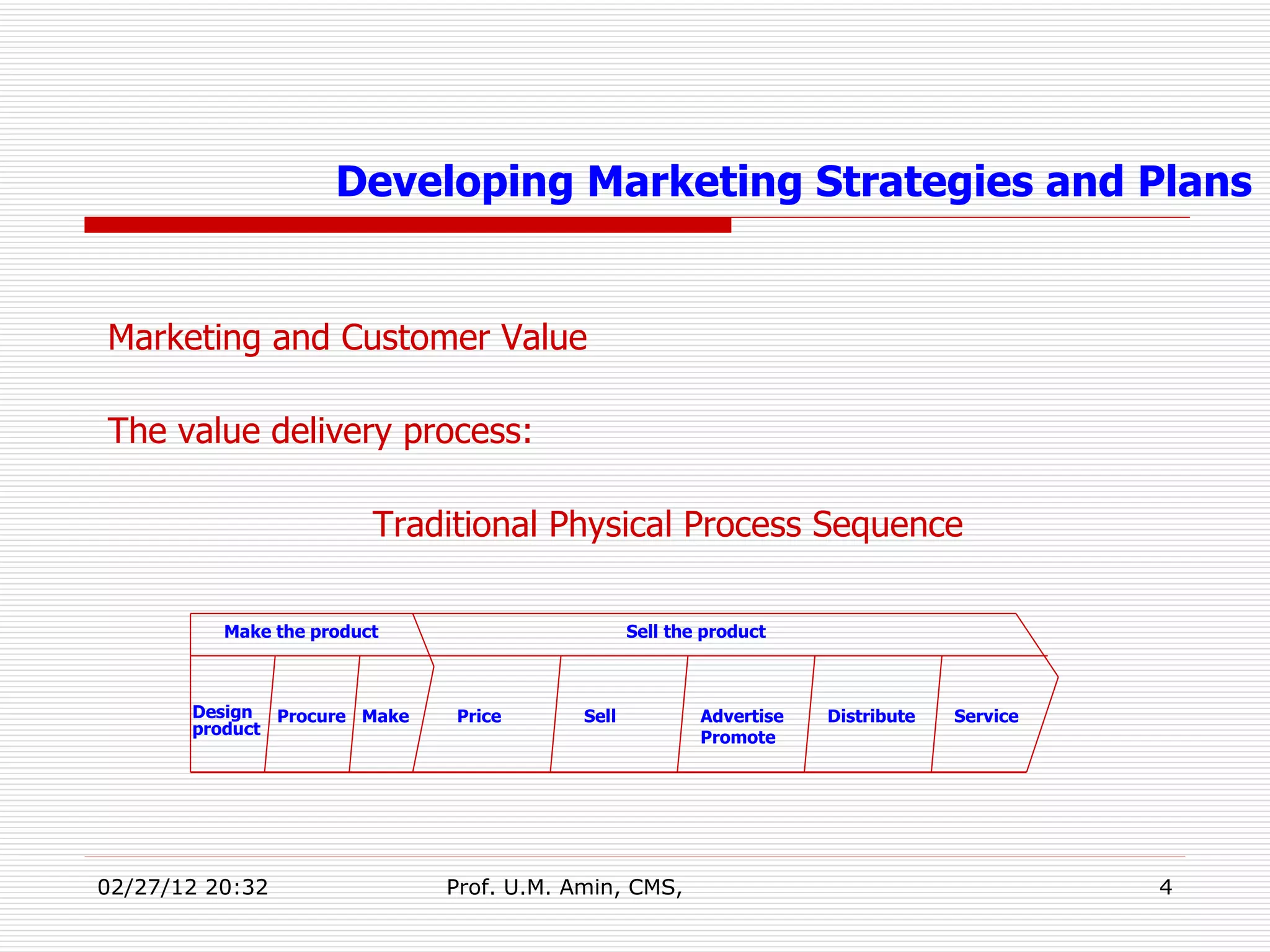
Marketing and Customer Value The value delivery process: Traditional Physical Process Sequence Make the product Sell the product Design product Procure Make Price Sell Advertise Promote Distribute Service Developing Marketing Strategies and Plans
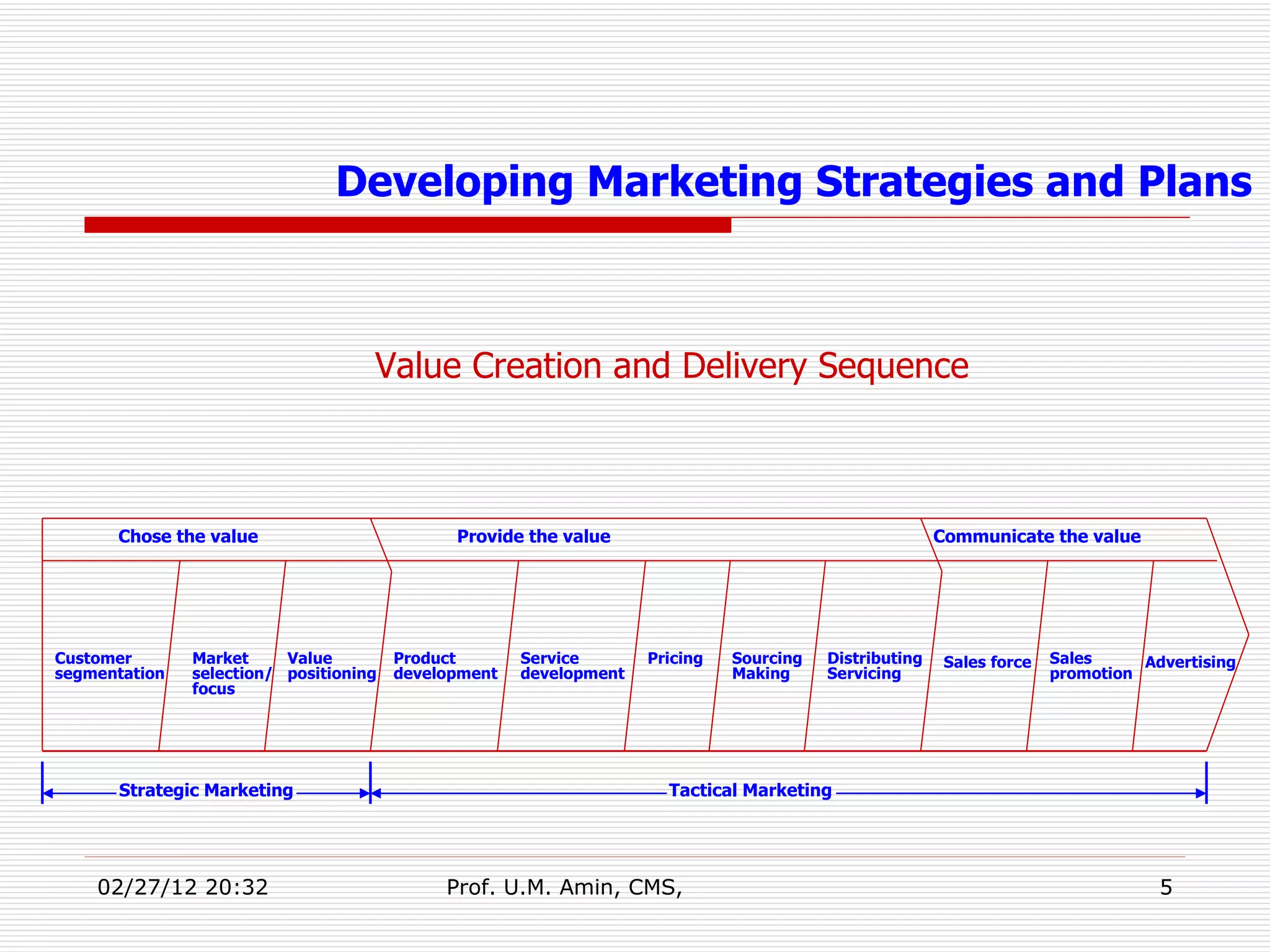
Value Creation and Delivery Sequence Chose the value Provide the value Communicate the value Customer segmentation Market selection/ focus Value positioning Product development Service development Pricing Sourcing Making Distributing Servicing Sales force Sales  promotion Advertising Strategic Marketing Tactical Marketing Developing Marketing Strategies and Plans
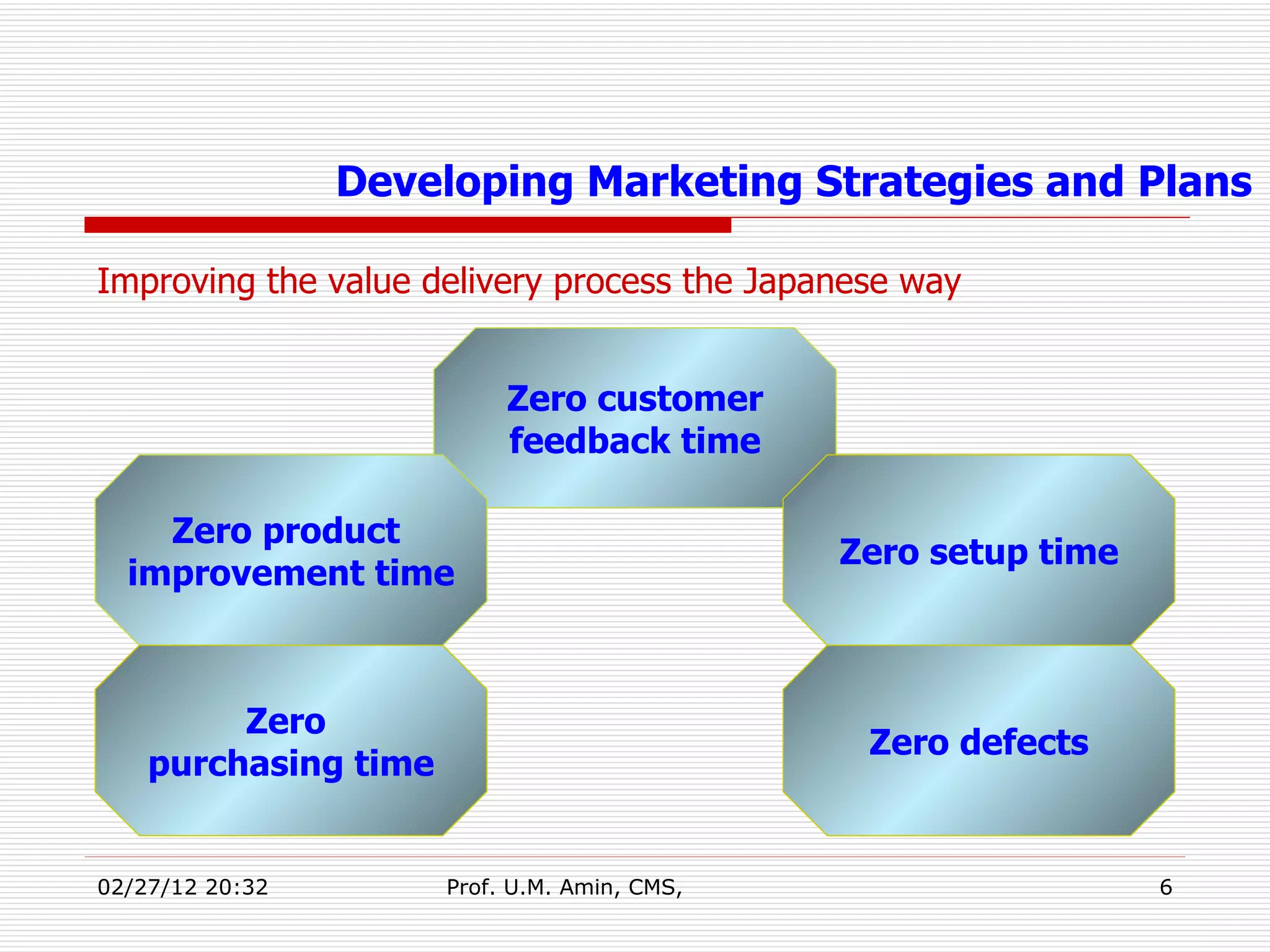
Improving the value delivery process the Japanese way Developing Marketing Strategies and Plans Zero customer feedback time Zero product  improvement time Zero  purchasing time Zero setup time Zero defects
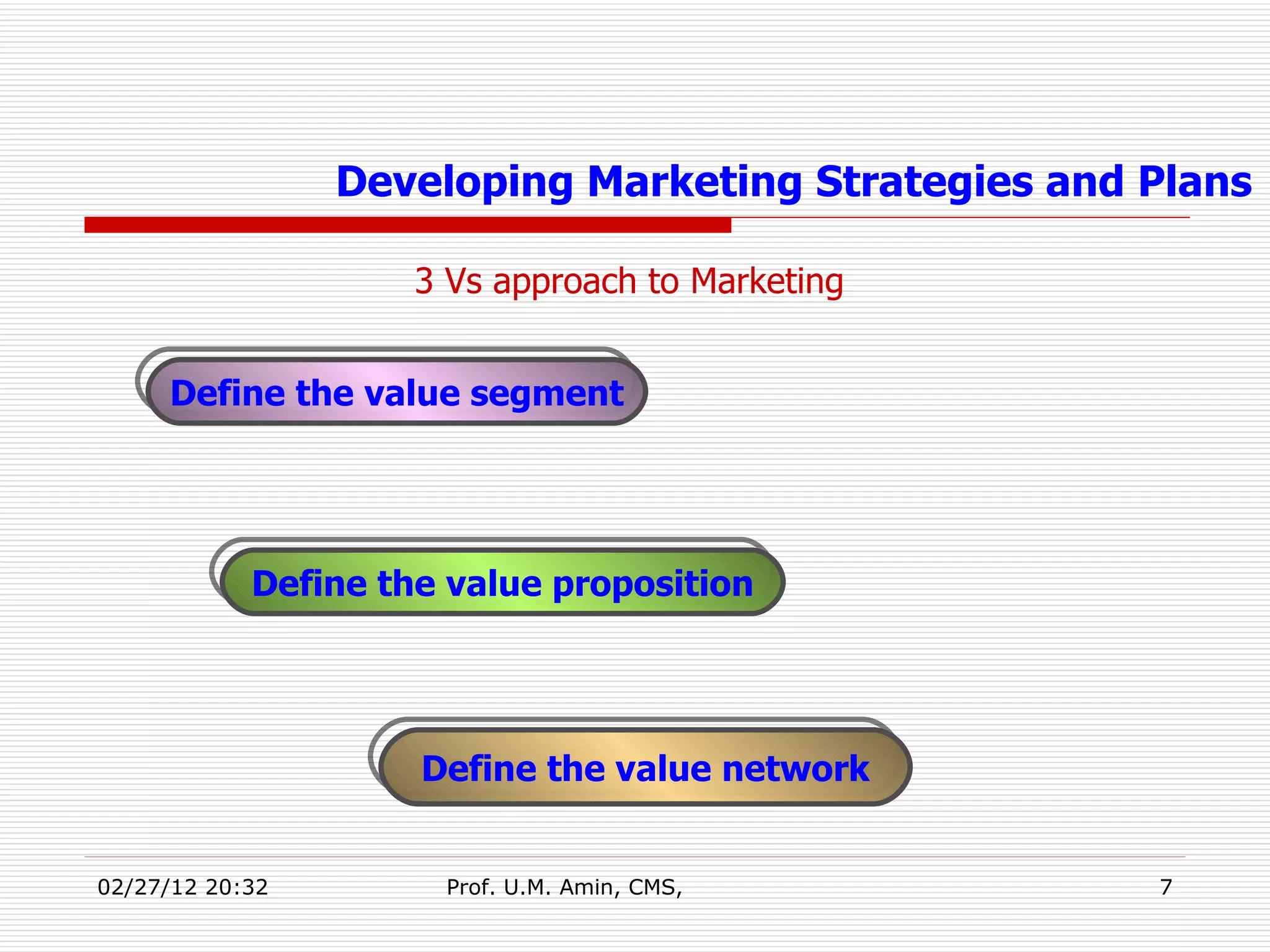
3 Vs approach to Marketing  Developing Marketing Strategies and Plans Define the value segment Define the value proposition Define the value network
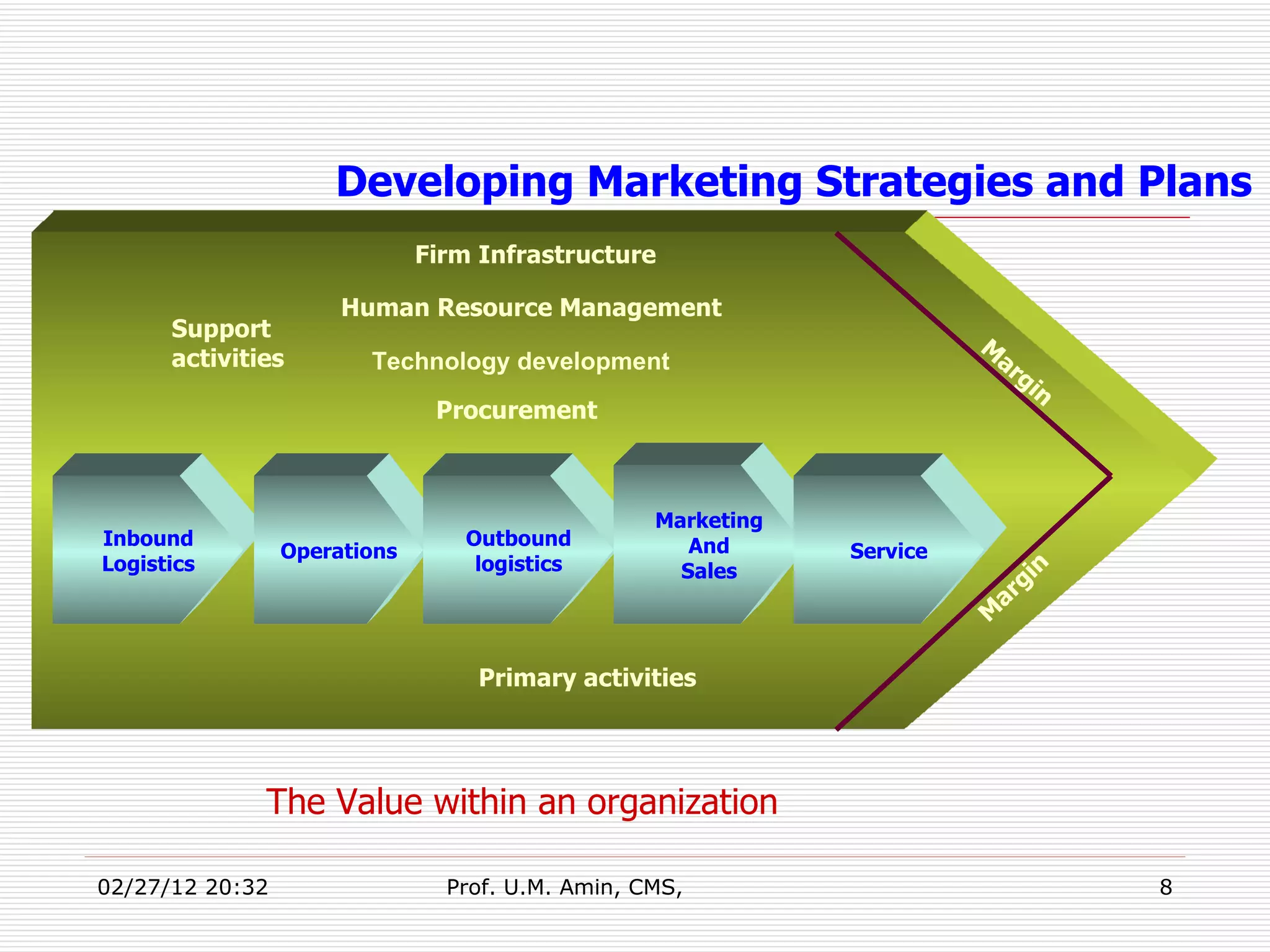
Inbound Logistics Operations Outbound logistics Marketing And Sales Service Firm Infrastructure Human Resource Management Technology development Procurement Support  activities Primary activities Margin Margin The Value within an organization Developing Marketing Strategies and Plans
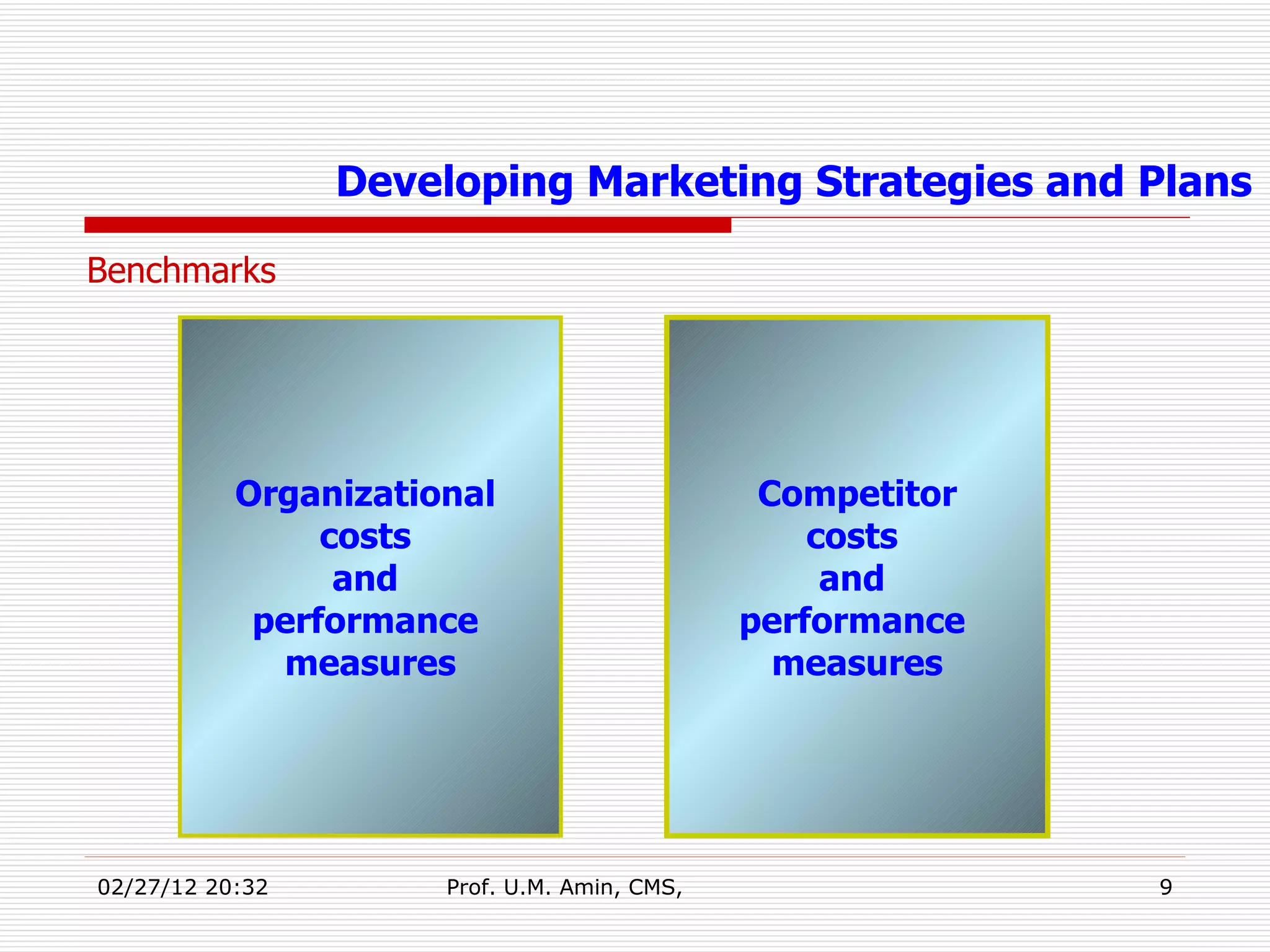
Developing Marketing Strategies and Plans Organizational  costs  and  performance  measures Competitor costs  and  performance  measures Benchmarks
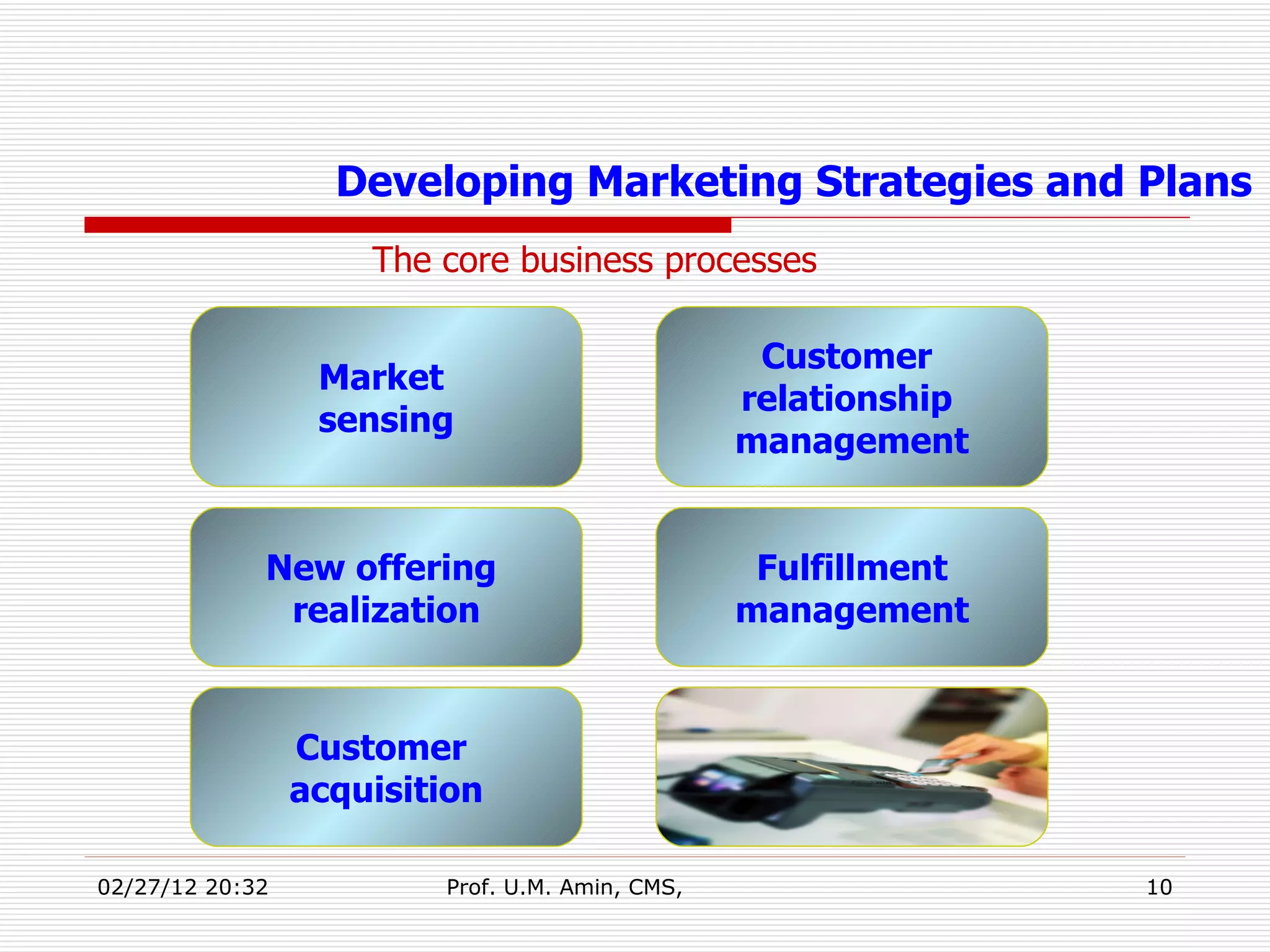
The core business processes  Developing Marketing Strategies and Plans Market  sensing Customer  acquisition New offering  realization Fulfillment management Customer  relationship  management
Core competence It refers to an activity that a firm performs better relative to other internal activities. Characteristics of Core competence A source of competitive advantage. Applications in a wide variety of markets. Difficult to imitate. Developing Marketing Strategies and Plans
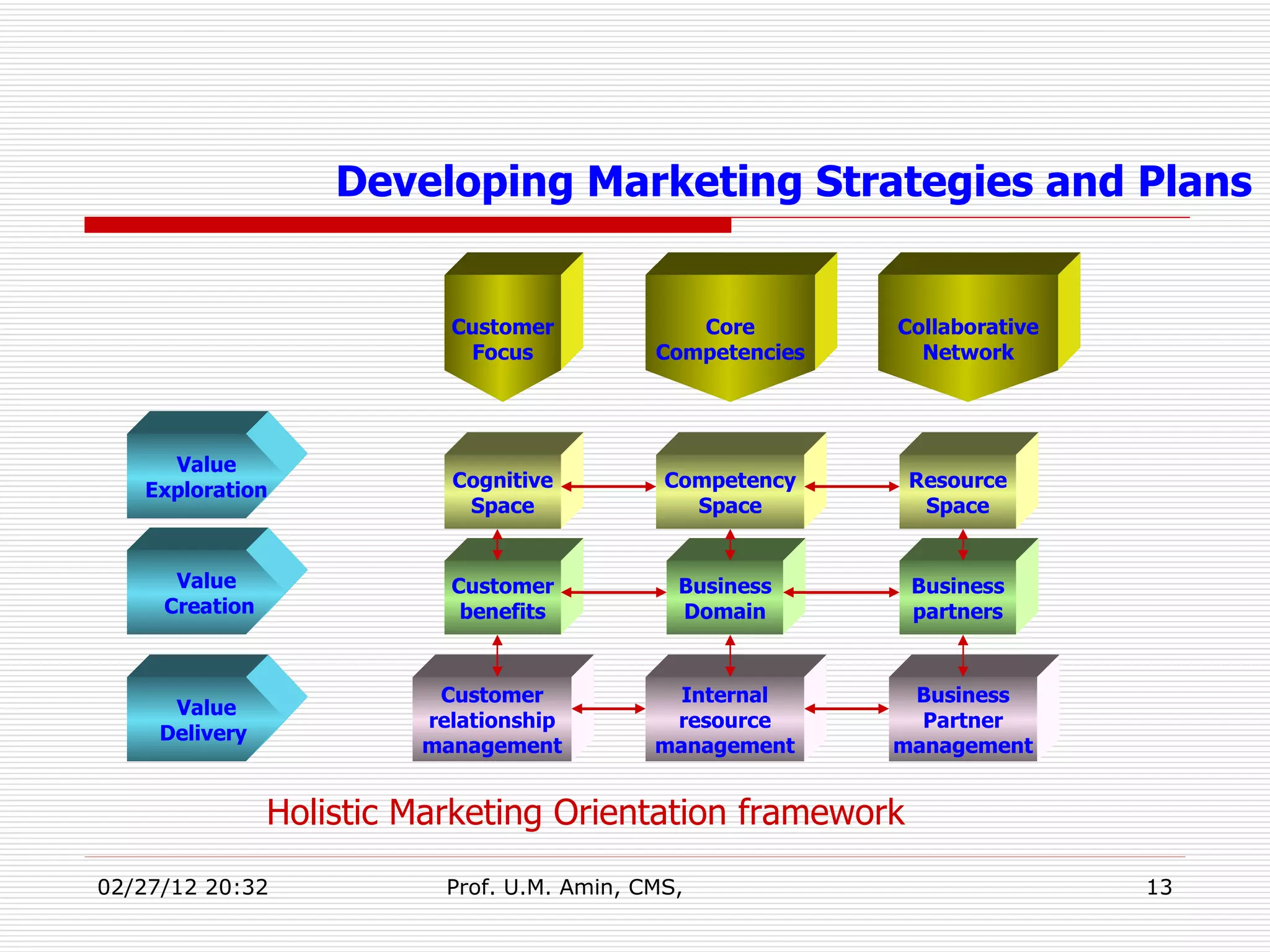
Holistic Marketing orientation and Customer value The holistic marketing framework is designed to address three key management questions: Value exploration – How can a company identify new value opportunities? Value creation – How can a company create more promising new value offerings efficiently? Value delivery – How can a company use its capabilities and infrastructure to deliver the new offerings more efficiently? Developing Marketing Strategies and Plans
Holistic Marketing Orientation framework Value Exploration Value Creation Value Delivery  Customer Focus Core Competencies Collaborative Network Cognitive Space Competency Space Resource Space Customer benefits Business Domain Business partners Customer relationship management Internal resource management Business Partner management Developing Marketing Strategies and Plans
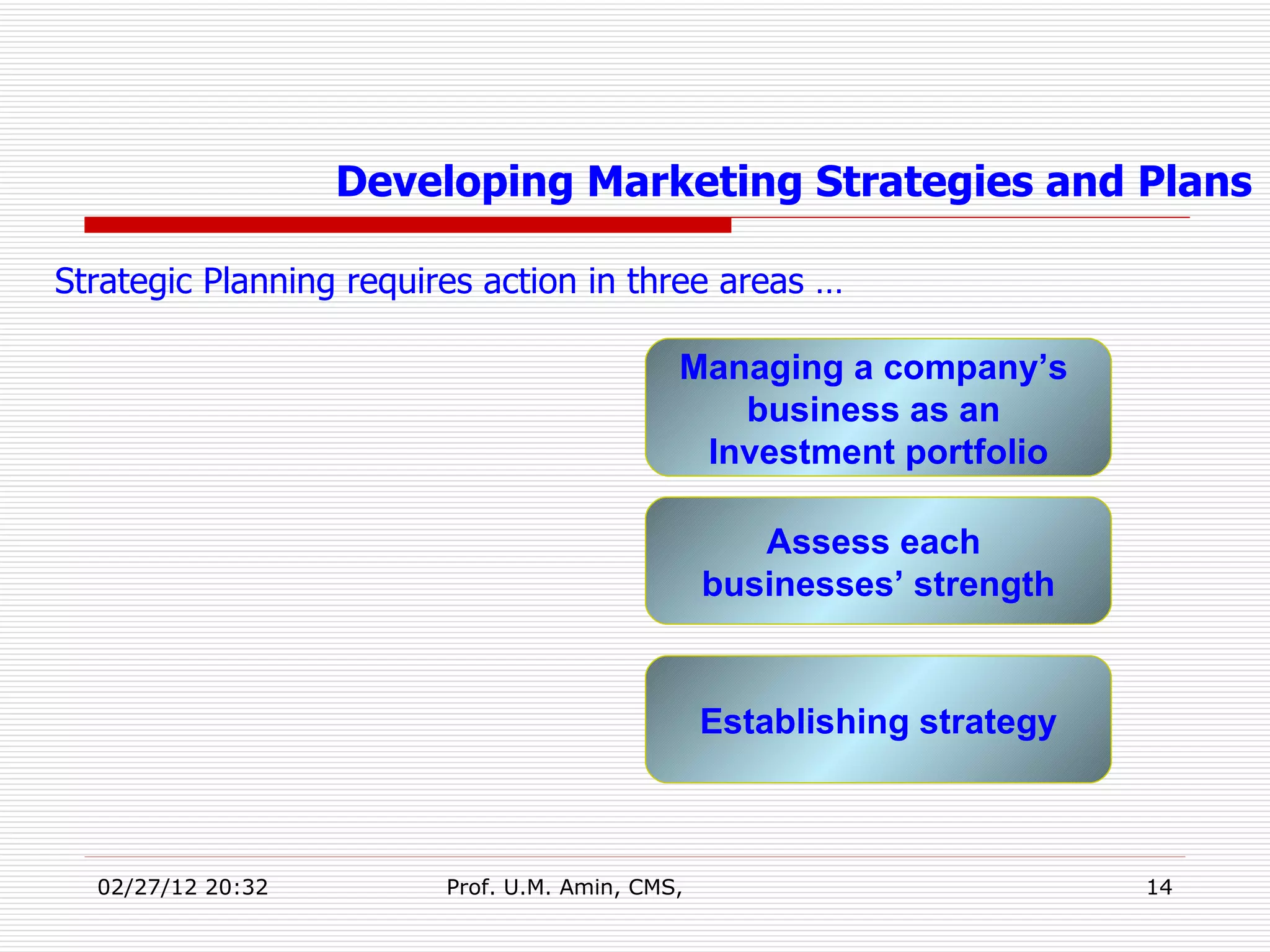
Strategic Planning requires action in three areas …  Developing Marketing Strategies and Plans Managing a company’s  business as an  Investment portfolio Assess each  businesses’ strength Establishing strategy
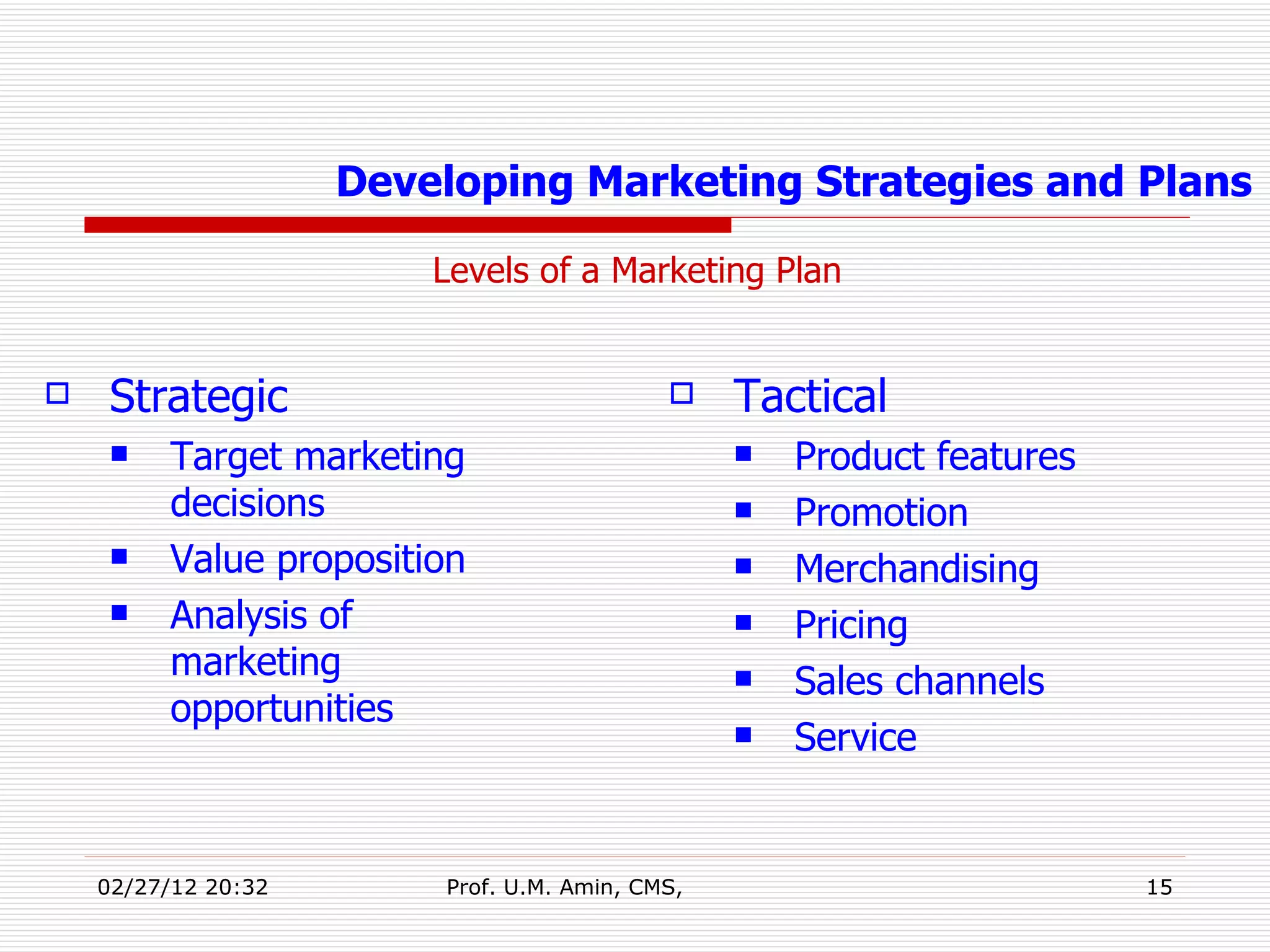
Levels of a Marketing Plan   Developing Marketing Strategies and Plans Strategic Target marketing decisions Value proposition Analysis of marketing opportunities Tactical Product features Promotion Merchandising Pricing Sales channels Service
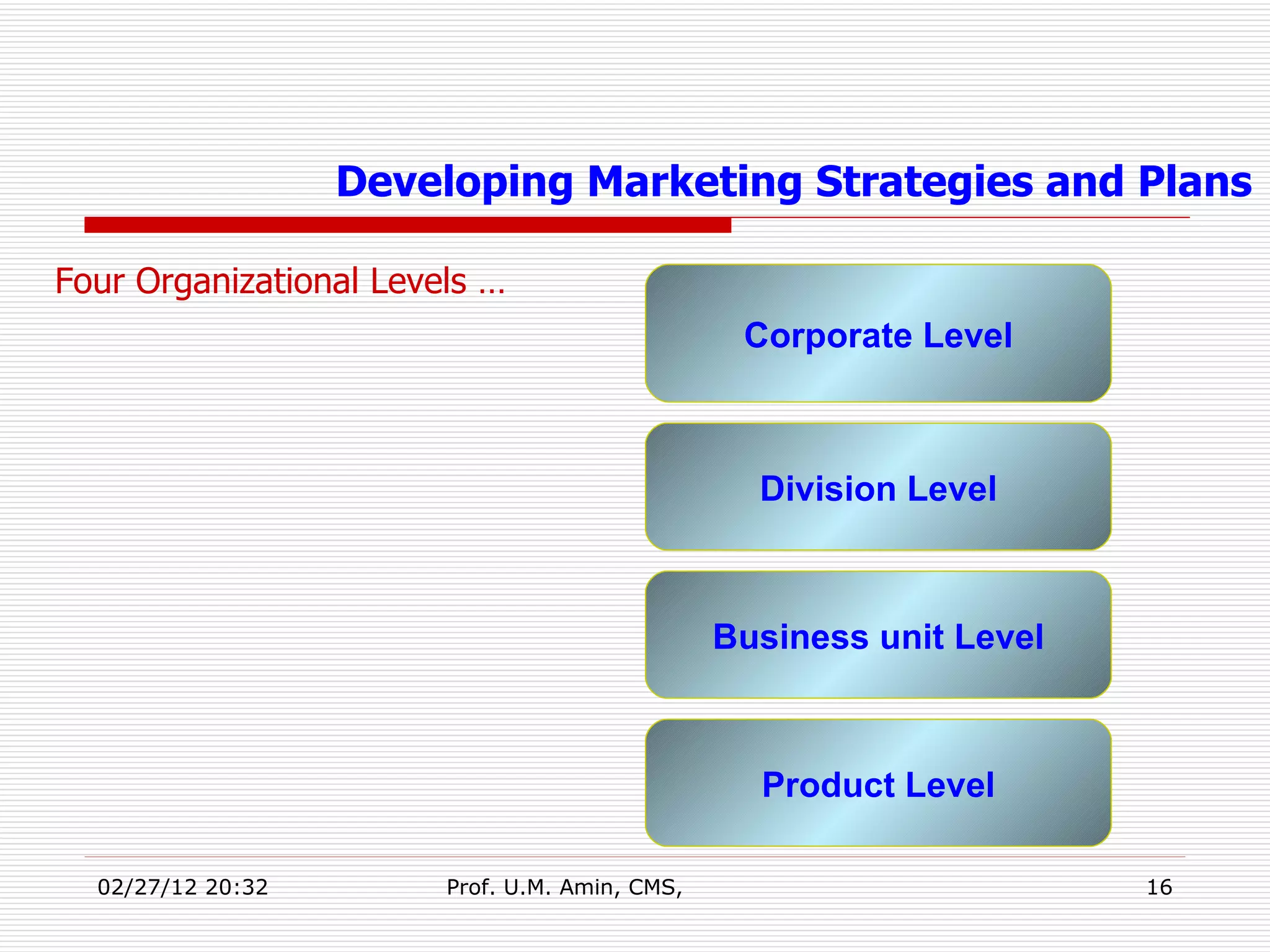
Four Organizational Levels …  Developing Marketing Strategies and Plans Corporate Level Division Level Business unit Level Product Level
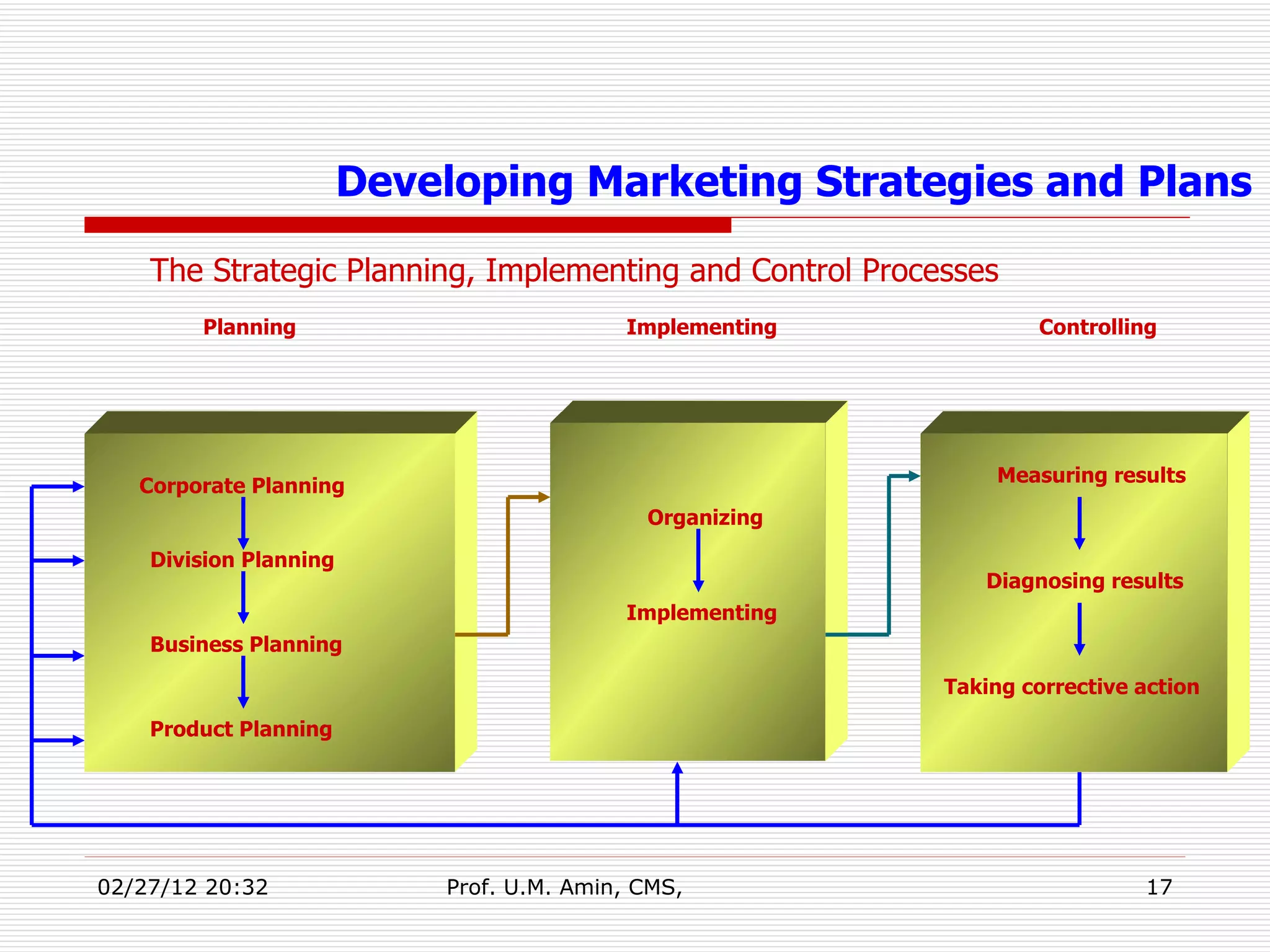
The Strategic Planning, Implementing and Control Processes  Corporate Planning Division Planning  Business Planning Product Planning Organizing Implementing Measuring results Diagnosing results Taking corrective action Planning Implementing Controlling Developing Marketing Strategies and Plans
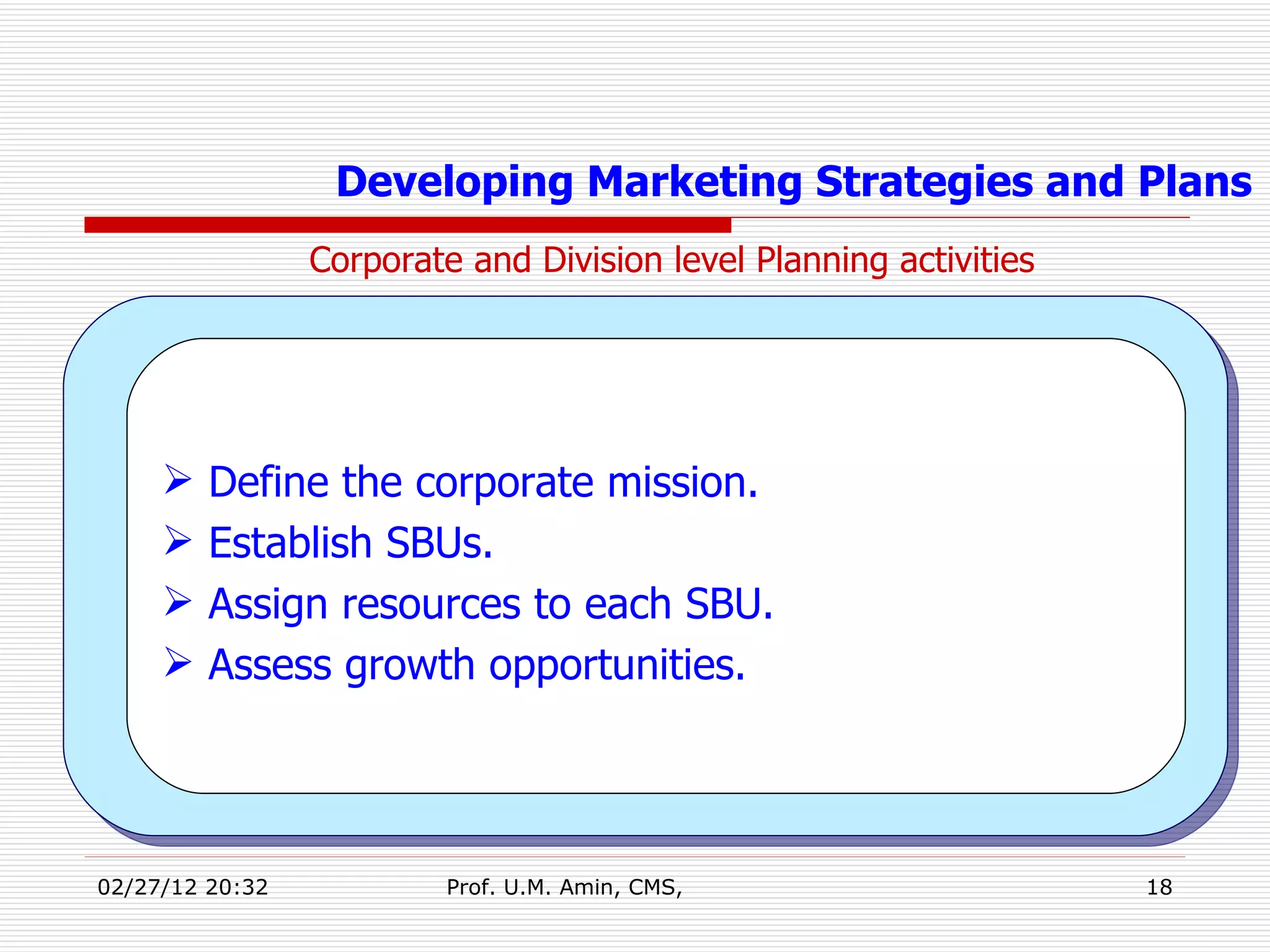
Corporate and Division level Planning activities Developing Marketing Strategies and Plans Define the corporate mission. Establish SBUs. Assign resources to each SBU. Assess growth opportunities.
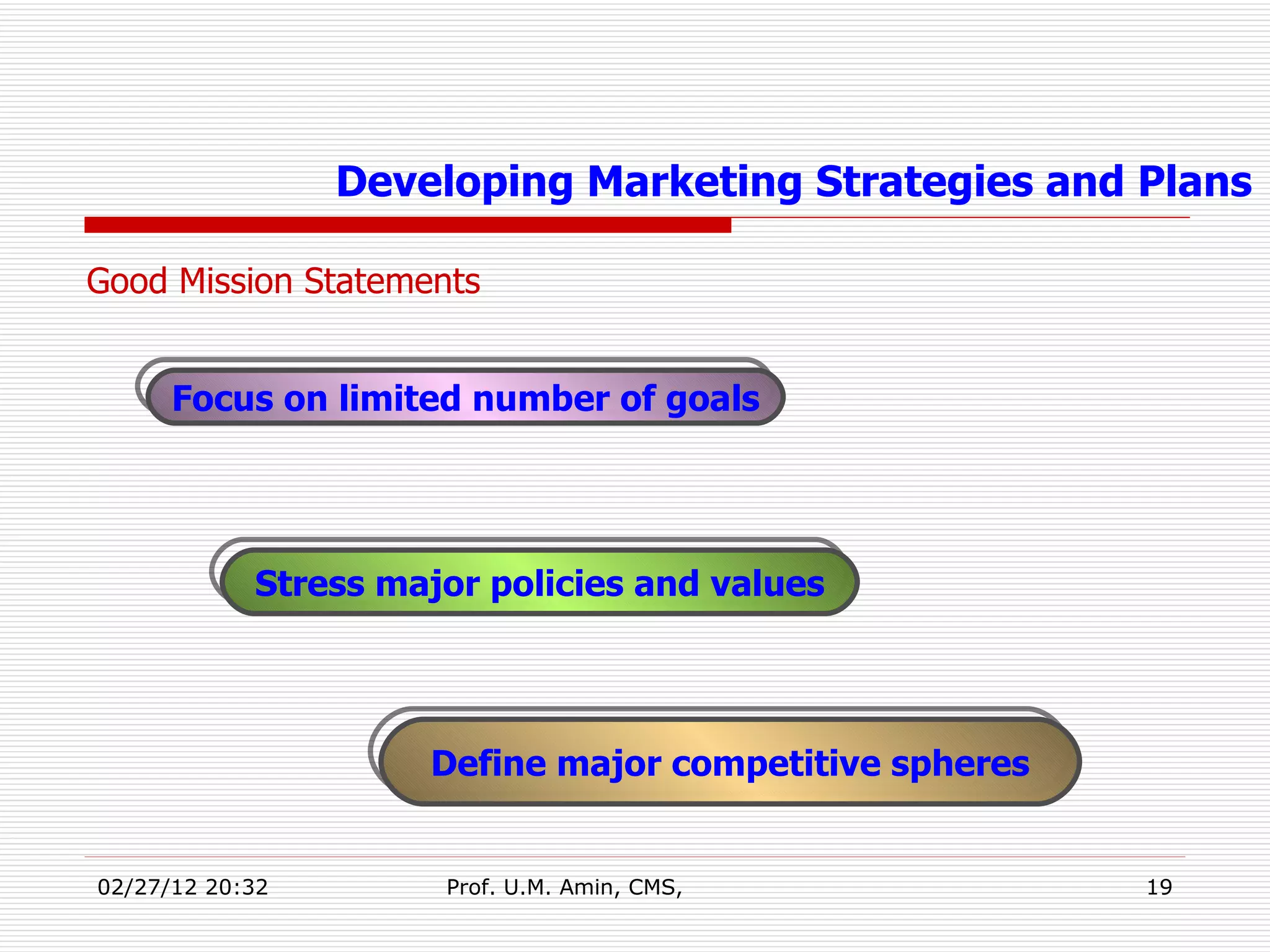
Good Mission Statements  Developing Marketing Strategies and Plans Focus on limited number of goals Stress major policies and values Define major competitive spheres
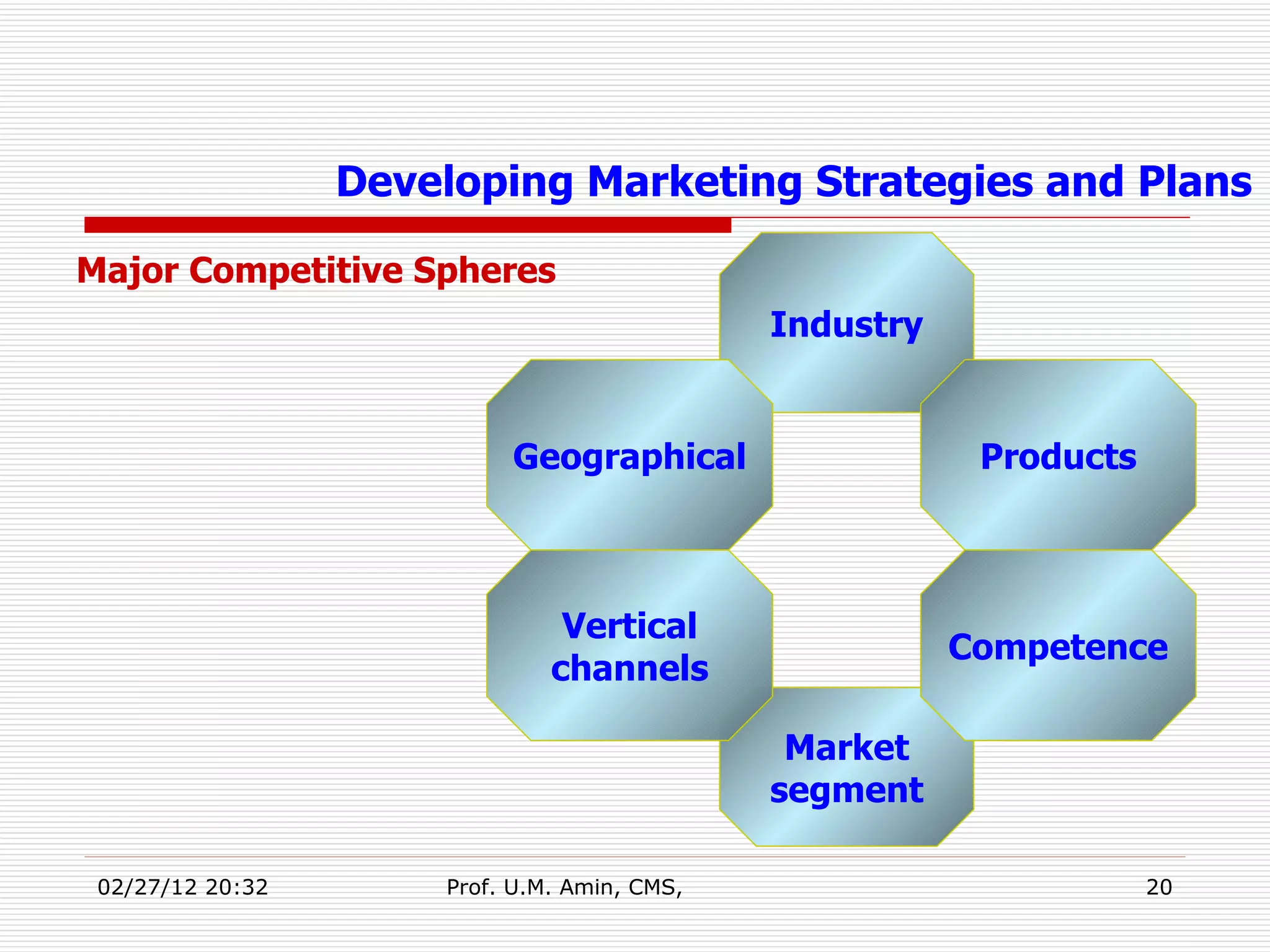
Developing Marketing Strategies and Plans Major Competitive Spheres Industry Products Market segment Geographical Competence Vertical channels
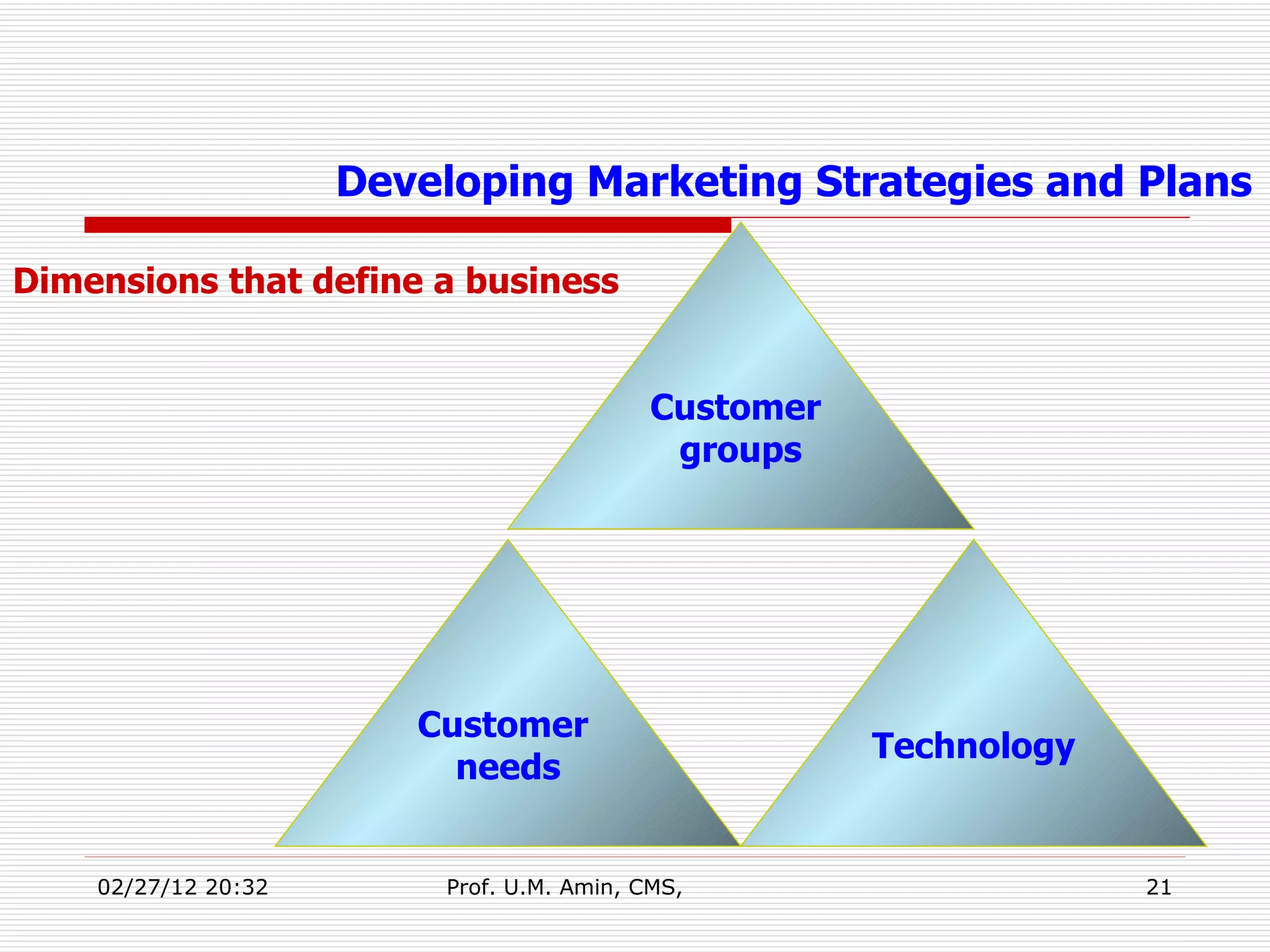
Dimensions that define a business   Developing Marketing Strategies and Plans Customer  groups Technology Customer  needs
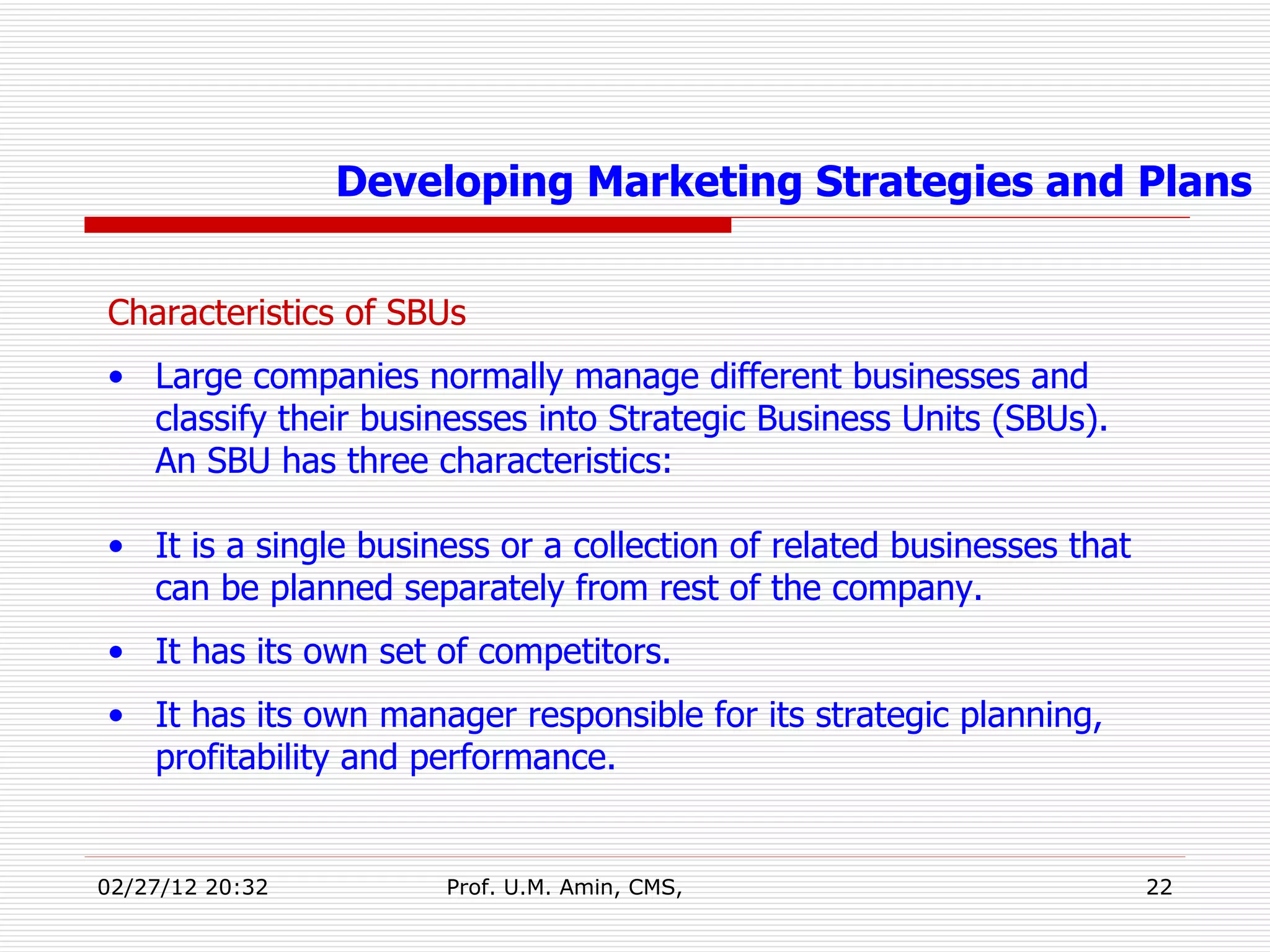
Characteristics of SBUs Large companies normally manage different businesses and classify their businesses into Strategic Business Units (SBUs).  An SBU has three characteristics: It is a single business or a collection of related businesses that can be planned separately from rest of the company. It has its own set of competitors. It has its own manager responsible for its strategic planning, profitability and performance.  Developing Marketing Strategies and Plans
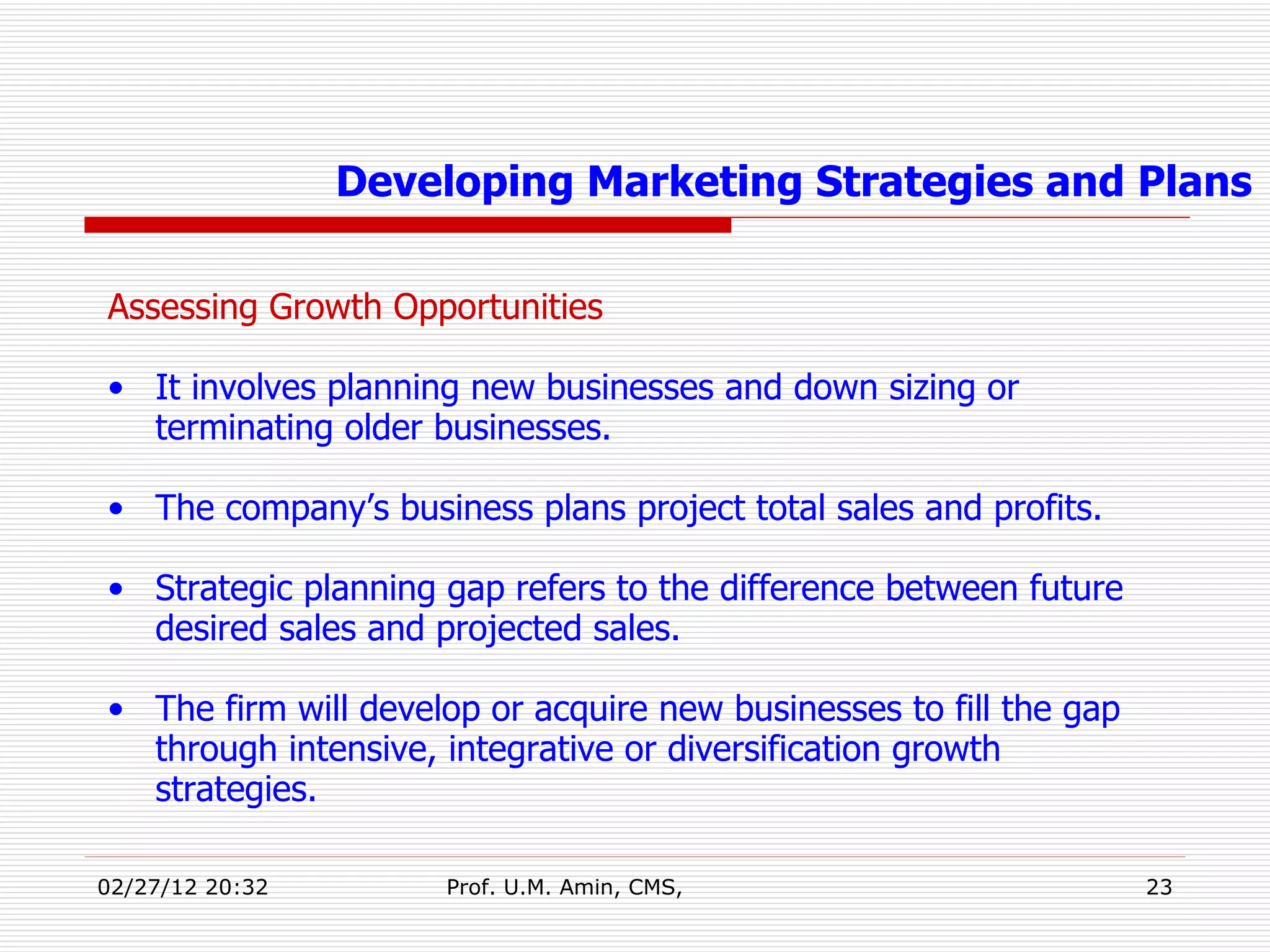
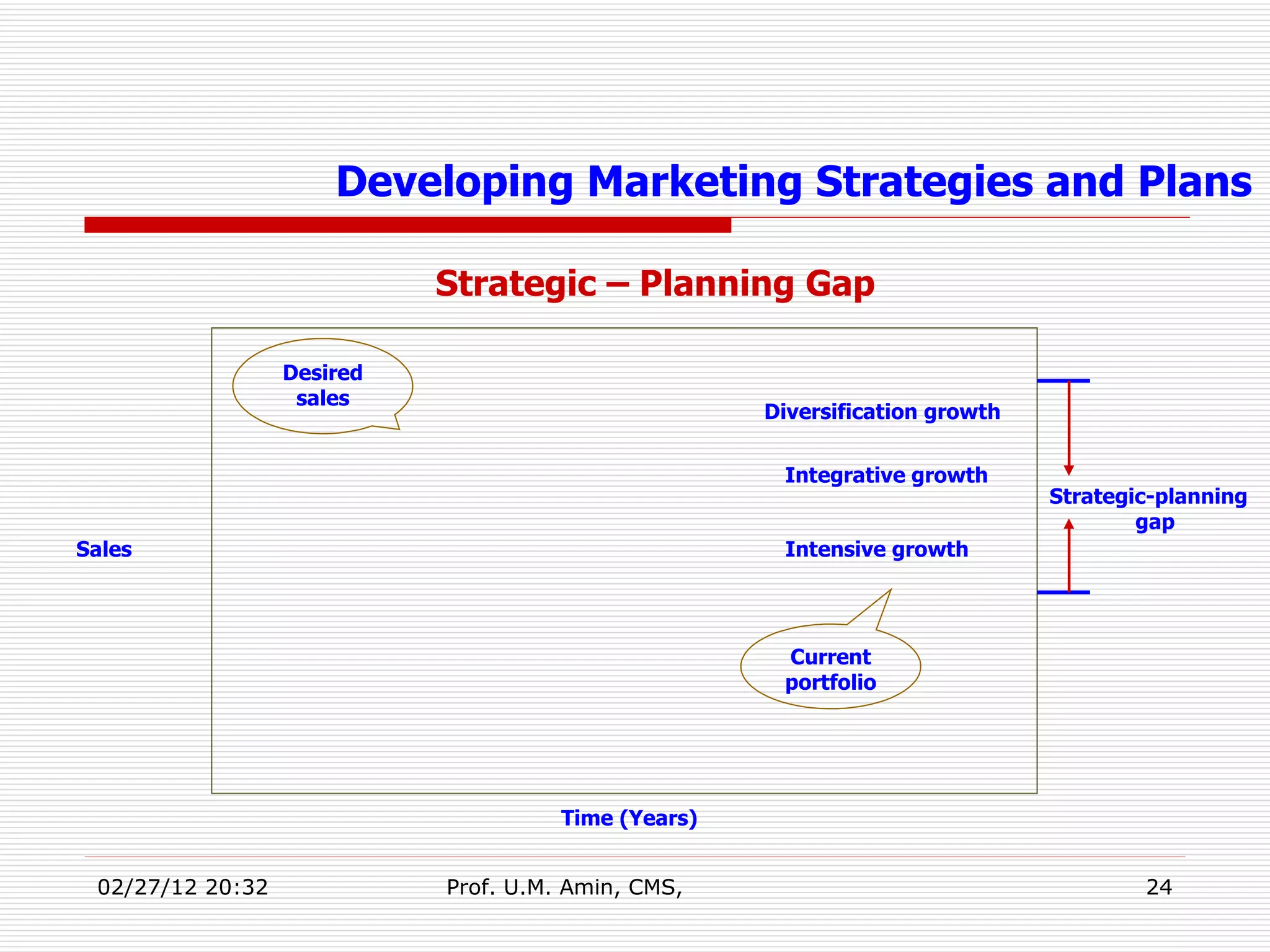
Assessing Growth Opportunities It involves planning new businesses and down sizing or terminating older businesses. The company’s business plans project total sales and profits. Strategic planning gap refers to the difference between future desired sales and projected sales.  The firm will develop or acquire new businesses to fill the gap through intensive, integrative or diversification growth strategies. Developing Marketing Strategies and Plans
Strategic – Planning Gap Time (Years) Sales Intensive growth Integrative growth Diversification growth Desired sales Current portfolio Strategic-planning  gap Developing Marketing Strategies and Plans
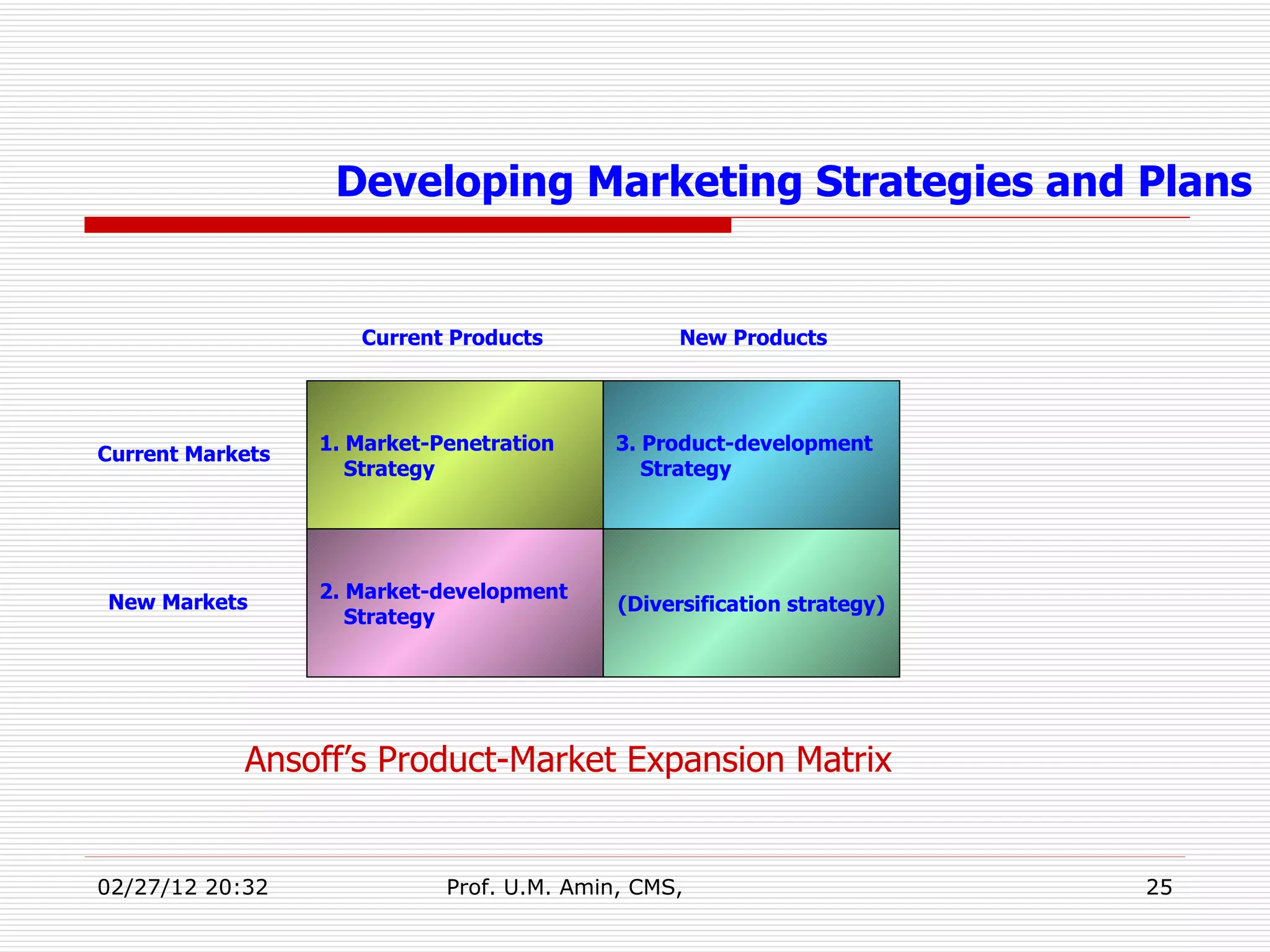
Ansoff’s Product-Market Expansion Matrix 1. Market-Penetration  Strategy 3. Product-development Strategy 2. Market-development Strategy (Diversification strategy) Current Markets  Current Products  New Markets  New Products  Developing Marketing Strategies and Plans
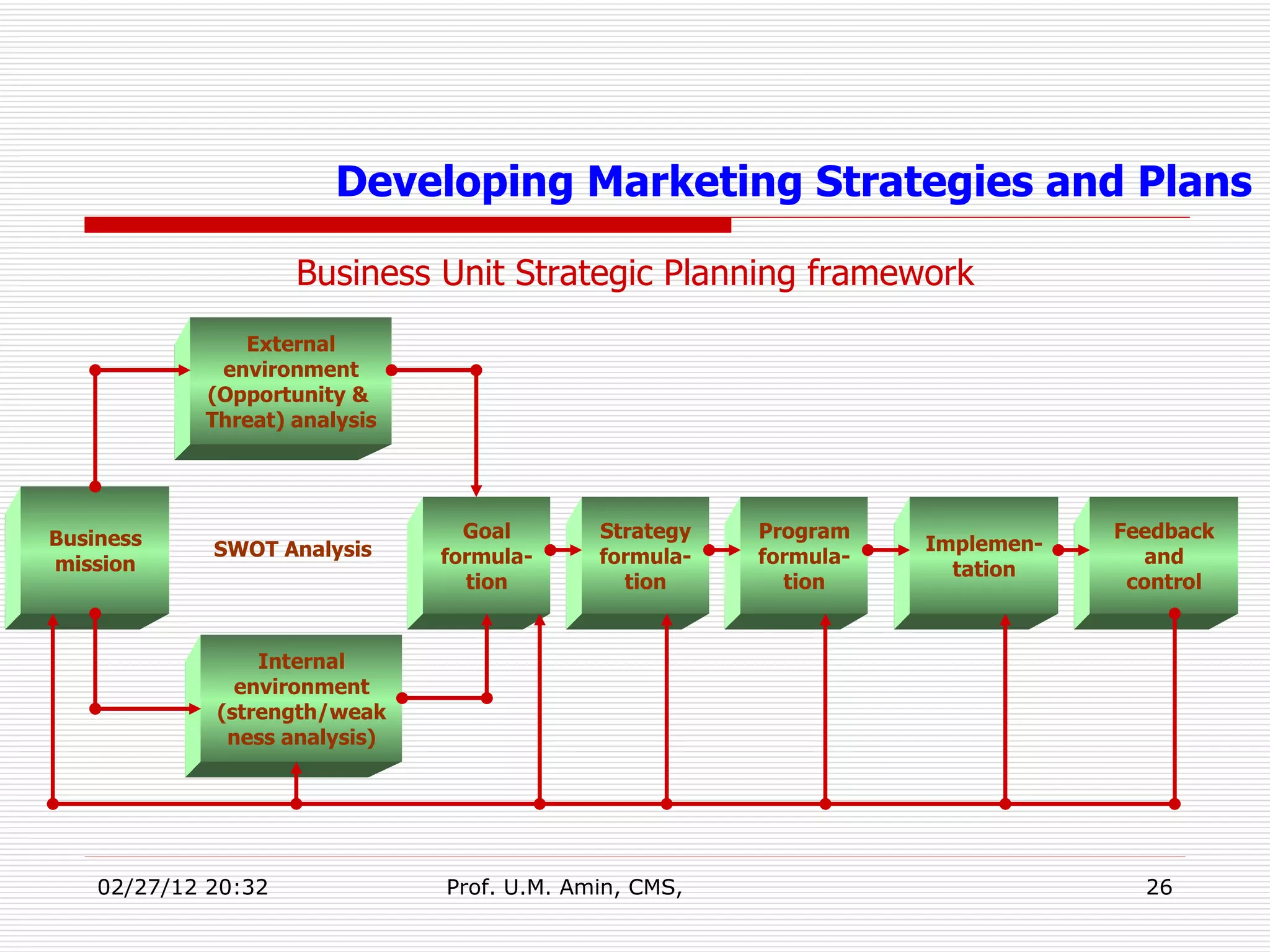
Business Unit Strategic Planning framework Business mission External environment (Opportunity &  Threat) analysis Goal formula- tion Implemen- tation Internal environment (strength/weak ness analysis) Strategy formula- tion Program formula- tion Feedback and control SWOT Analysis Developing Marketing Strategies and Plans
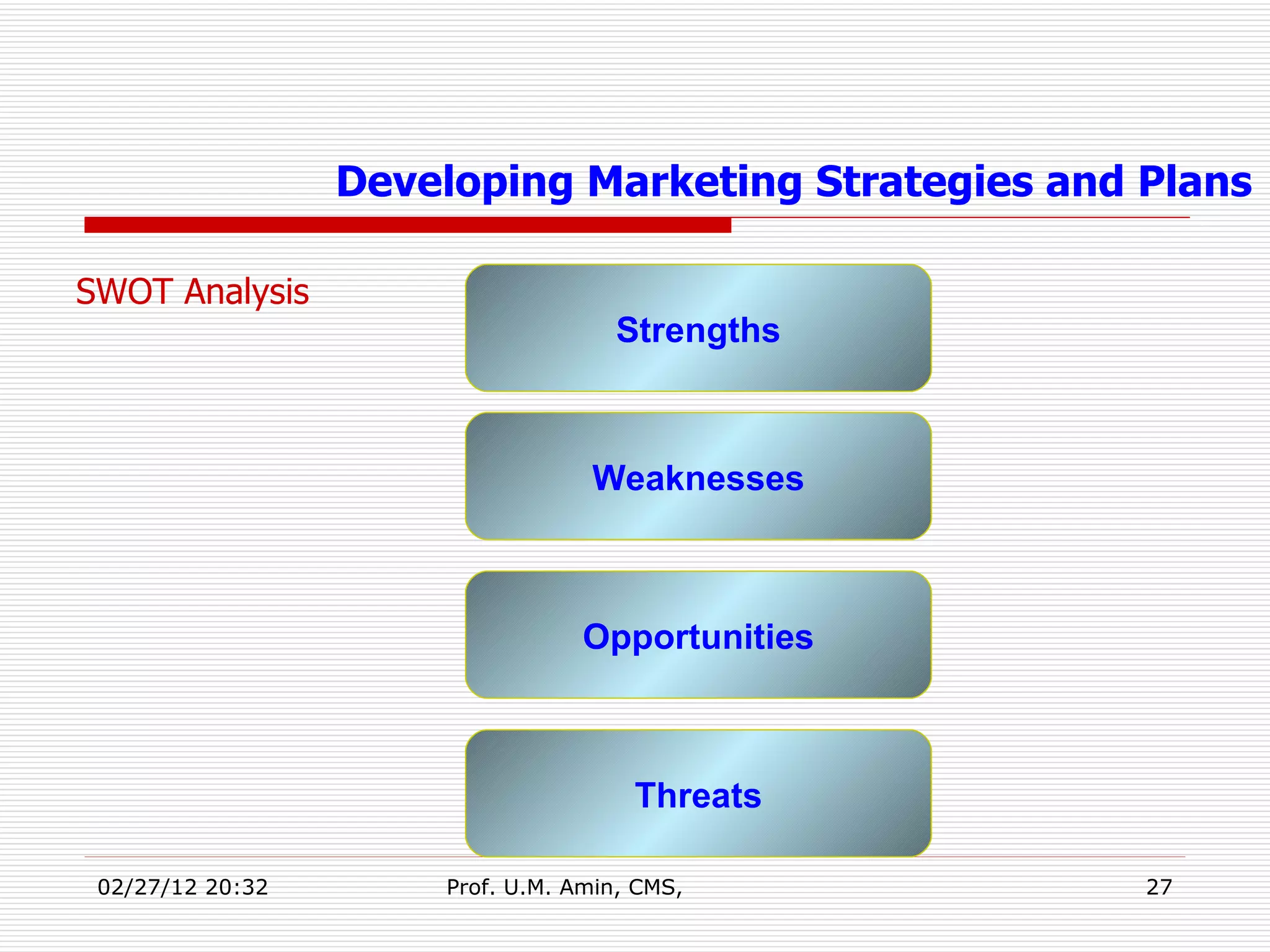
SWOT Analysis   Developing Marketing Strategies and Plans Strengths Weaknesses Opportunities Threats
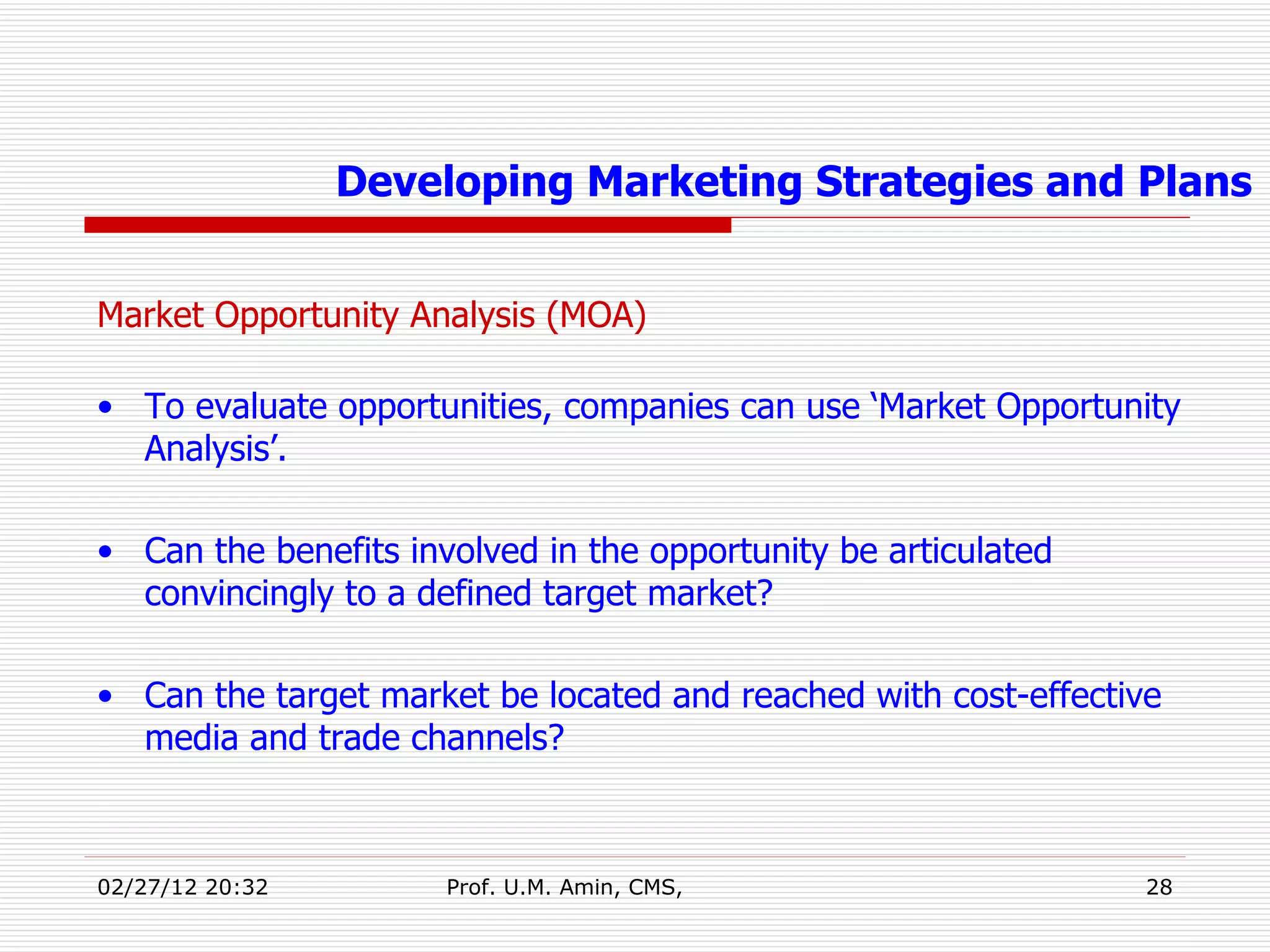
Market Opportunity Analysis (MOA) To evaluate opportunities, companies can use ‘Market Opportunity Analysis’. Can the benefits involved in the opportunity be articulated convincingly to a defined target market? Can the target market be located and reached with cost-effective media and trade channels? Developing Marketing Strategies and Plans
Market Opportunity Analysis (MOA – Contd.) Does the company possess or have access to the critical capabilities and resources needed to deliver the customer benefits?   Can the company deliver the benefits better than any actual or potential competitors? Will the financial rate of return meet or exceed the company’s required threshold for investment? Developing Marketing Strategies and Plans
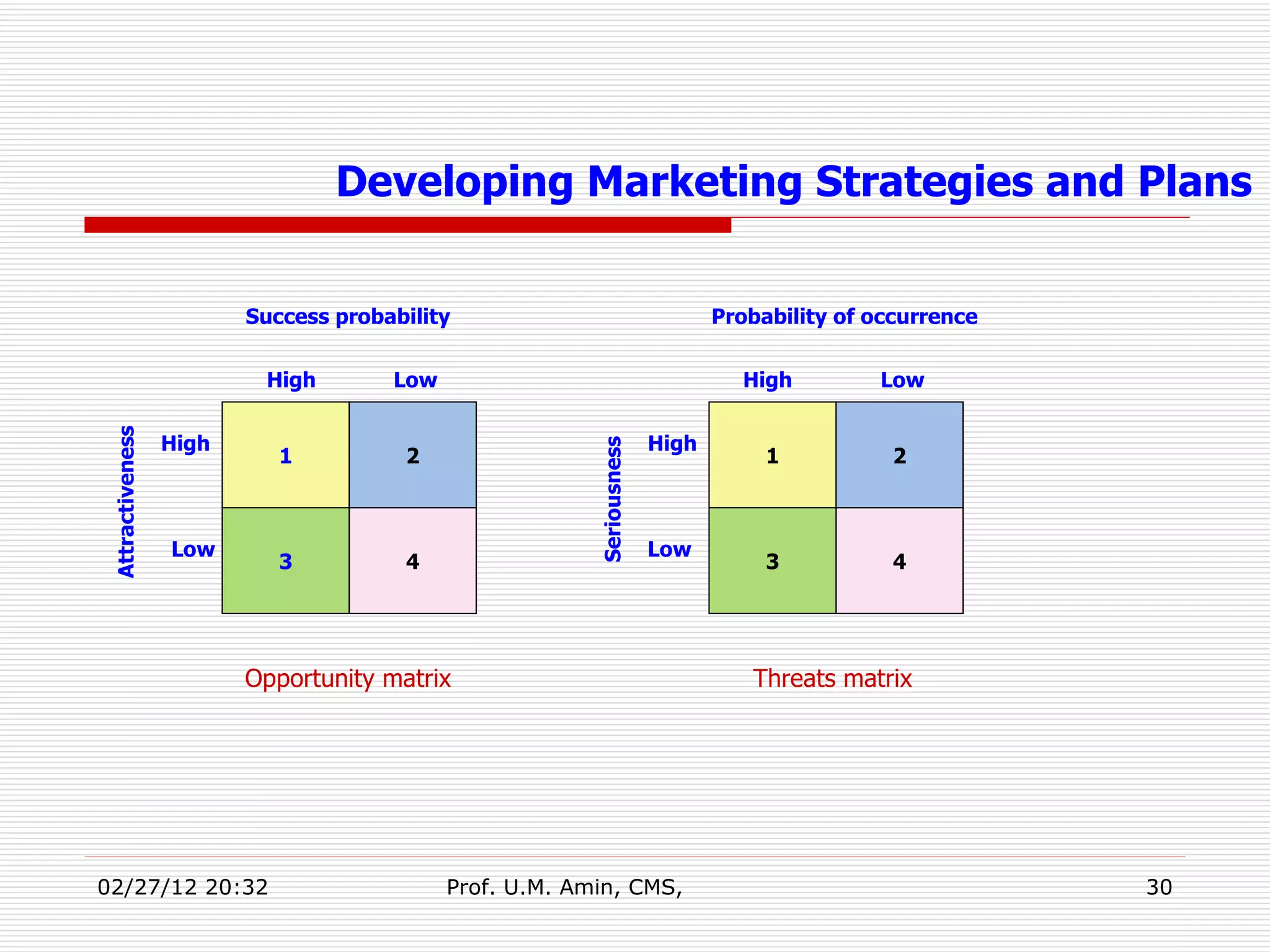
1 3 4 2 4 1 3 2 High High High High Low Low Low Low Success probability Probability of occurrence Opportunity matrix Threats matrix Attractiveness Seriousness Developing Marketing Strategies and Plans
Four outcomes are possible:  An  ideal business , is high in major opportunities and low in major threats. A  speculative business , is high in both opportunities and threats. A  mature business , is low in both opportunities and threats. A  troubled business , is low in opportunities and high in threats. Internal analysis involves identifying firm’s internal strengths and weaknesses. Developing Marketing Strategies and Plans
Goal Formulation and MBO Unit’s objectives must be hierarchical. Objectives must be quantitative. Objectives  should be realistic. Objectives must be consistent. Developing Marketing Strategies and Plans
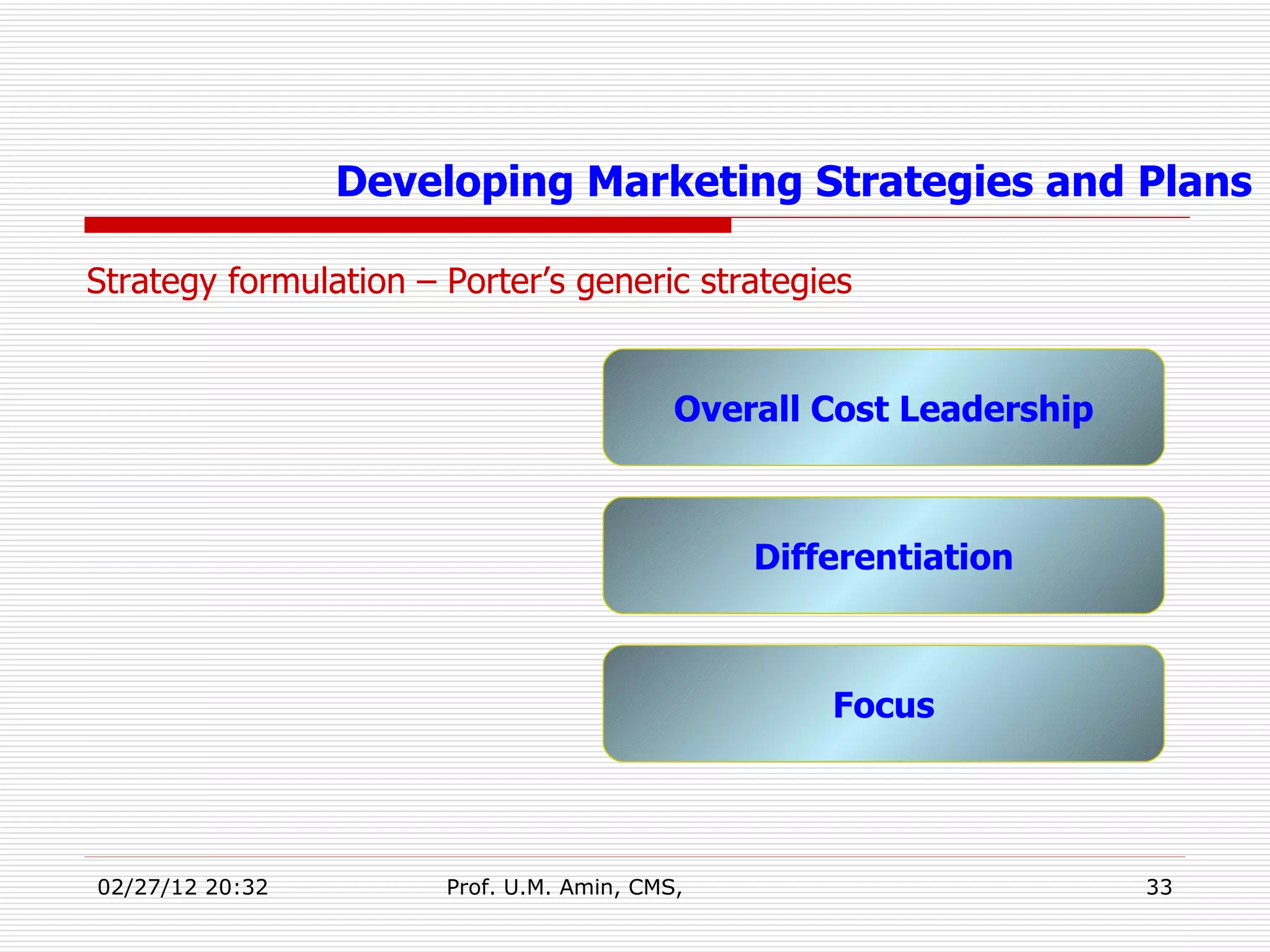
Strategy formulation – Porter’s generic strategies Developing Marketing Strategies and Plans Overall Cost Leadership Differentiation Focus
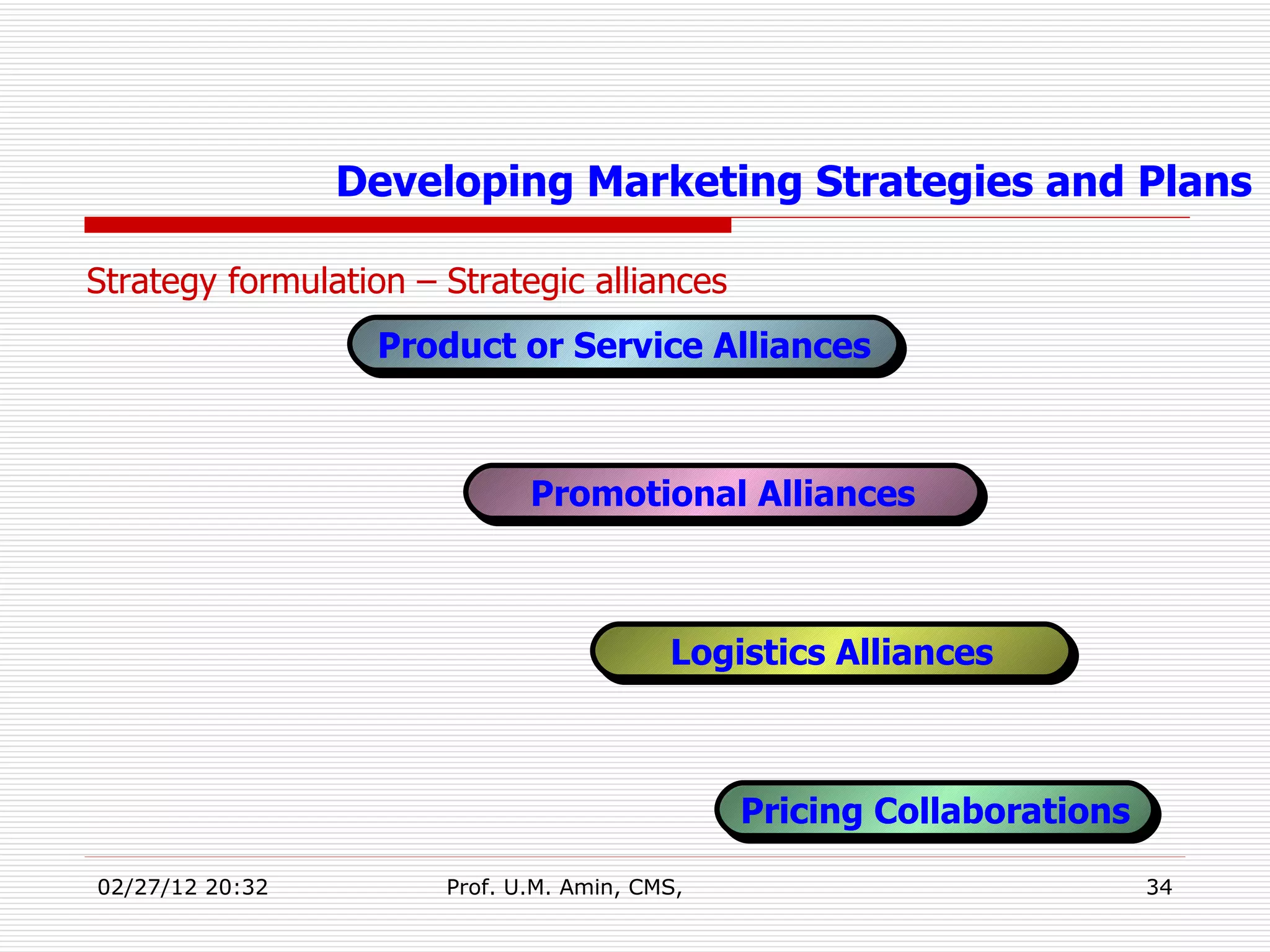
Strategy formulation – Strategic alliances Developing Marketing Strategies and Plans Product or Service Alliances Promotional Alliances Logistics Alliances Pricing Collaborations
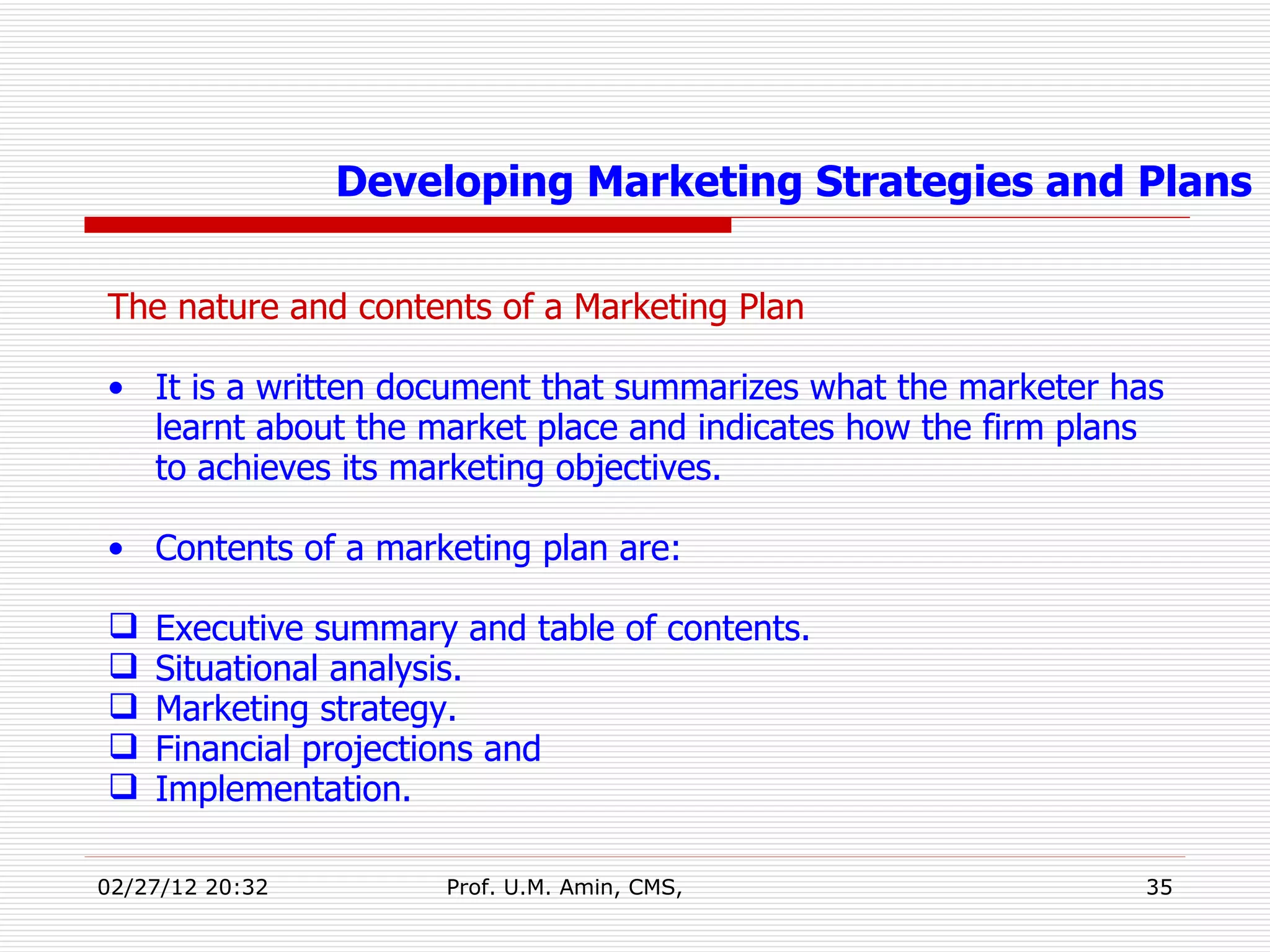
The nature and contents of a Marketing Plan It is a written document that summarizes what the marketer has learnt about the market place and indicates how the firm plans to achieves its marketing objectives. Contents of a marketing plan are: Executive summary and table of contents. Situational analysis. Marketing strategy. Financial projections and Implementation. Developing Marketing Strategies and Plans
Recap: How marketing affects customer value. How strategic planning is carried out at different levels of the organization.  The nature and contents of a marketing plan. Developing Marketing Strategies and Plans

Ii mm.02.10

  • 1.
  • 2.
    Developing Marketing Strategies and Plans
  • 3.
    Learning Objectives: Knowhow marketing affects customer value. Know how strategic planning is carried out at different levels of the organization. Know the nature and contents of a marketing plan. Developing Marketing Strategies and Plans
  • 4.
    Marketing and CustomerValue The value delivery process: Traditional Physical Process Sequence Make the product Sell the product Design product Procure Make Price Sell Advertise Promote Distribute Service Developing Marketing Strategies and Plans
  • 5.
    Value Creation andDelivery Sequence Chose the value Provide the value Communicate the value Customer segmentation Market selection/ focus Value positioning Product development Service development Pricing Sourcing Making Distributing Servicing Sales force Sales promotion Advertising Strategic Marketing Tactical Marketing Developing Marketing Strategies and Plans
  • 6.
    Improving the valuedelivery process the Japanese way Developing Marketing Strategies and Plans Zero customer feedback time Zero product improvement time Zero purchasing time Zero setup time Zero defects
  • 7.
    3 Vs approachto Marketing Developing Marketing Strategies and Plans Define the value segment Define the value proposition Define the value network
  • 8.
    Inbound Logistics OperationsOutbound logistics Marketing And Sales Service Firm Infrastructure Human Resource Management Technology development Procurement Support activities Primary activities Margin Margin The Value within an organization Developing Marketing Strategies and Plans
  • 9.
    Developing Marketing Strategiesand Plans Organizational costs and performance measures Competitor costs and performance measures Benchmarks
  • 10.
    The core businessprocesses Developing Marketing Strategies and Plans Market sensing Customer acquisition New offering realization Fulfillment management Customer relationship management
  • 11.
    Core competence Itrefers to an activity that a firm performs better relative to other internal activities. Characteristics of Core competence A source of competitive advantage. Applications in a wide variety of markets. Difficult to imitate. Developing Marketing Strategies and Plans
  • 12.
    Holistic Marketing orientationand Customer value The holistic marketing framework is designed to address three key management questions: Value exploration – How can a company identify new value opportunities? Value creation – How can a company create more promising new value offerings efficiently? Value delivery – How can a company use its capabilities and infrastructure to deliver the new offerings more efficiently? Developing Marketing Strategies and Plans
  • 13.
    Holistic Marketing Orientationframework Value Exploration Value Creation Value Delivery Customer Focus Core Competencies Collaborative Network Cognitive Space Competency Space Resource Space Customer benefits Business Domain Business partners Customer relationship management Internal resource management Business Partner management Developing Marketing Strategies and Plans
  • 14.
    Strategic Planning requiresaction in three areas … Developing Marketing Strategies and Plans Managing a company’s business as an Investment portfolio Assess each businesses’ strength Establishing strategy
  • 15.
    Levels of aMarketing Plan Developing Marketing Strategies and Plans Strategic Target marketing decisions Value proposition Analysis of marketing opportunities Tactical Product features Promotion Merchandising Pricing Sales channels Service
  • 16.
    Four Organizational Levels… Developing Marketing Strategies and Plans Corporate Level Division Level Business unit Level Product Level
  • 17.
    The Strategic Planning,Implementing and Control Processes Corporate Planning Division Planning Business Planning Product Planning Organizing Implementing Measuring results Diagnosing results Taking corrective action Planning Implementing Controlling Developing Marketing Strategies and Plans
  • 18.
    Corporate and Divisionlevel Planning activities Developing Marketing Strategies and Plans Define the corporate mission. Establish SBUs. Assign resources to each SBU. Assess growth opportunities.
  • 19.
    Good Mission Statements Developing Marketing Strategies and Plans Focus on limited number of goals Stress major policies and values Define major competitive spheres
  • 20.
    Developing Marketing Strategiesand Plans Major Competitive Spheres Industry Products Market segment Geographical Competence Vertical channels
  • 21.
    Dimensions that definea business Developing Marketing Strategies and Plans Customer groups Technology Customer needs
  • 22.
    Characteristics of SBUsLarge companies normally manage different businesses and classify their businesses into Strategic Business Units (SBUs). An SBU has three characteristics: It is a single business or a collection of related businesses that can be planned separately from rest of the company. It has its own set of competitors. It has its own manager responsible for its strategic planning, profitability and performance. Developing Marketing Strategies and Plans
  • 23.
    Assessing Growth OpportunitiesIt involves planning new businesses and down sizing or terminating older businesses. The company’s business plans project total sales and profits. Strategic planning gap refers to the difference between future desired sales and projected sales. The firm will develop or acquire new businesses to fill the gap through intensive, integrative or diversification growth strategies. Developing Marketing Strategies and Plans
  • 24.
    Strategic – PlanningGap Time (Years) Sales Intensive growth Integrative growth Diversification growth Desired sales Current portfolio Strategic-planning gap Developing Marketing Strategies and Plans
  • 25.
    Ansoff’s Product-Market ExpansionMatrix 1. Market-Penetration Strategy 3. Product-development Strategy 2. Market-development Strategy (Diversification strategy) Current Markets Current Products New Markets New Products Developing Marketing Strategies and Plans
  • 26.
    Business Unit StrategicPlanning framework Business mission External environment (Opportunity & Threat) analysis Goal formula- tion Implemen- tation Internal environment (strength/weak ness analysis) Strategy formula- tion Program formula- tion Feedback and control SWOT Analysis Developing Marketing Strategies and Plans
  • 27.
    SWOT Analysis Developing Marketing Strategies and Plans Strengths Weaknesses Opportunities Threats
  • 28.
    Market Opportunity Analysis(MOA) To evaluate opportunities, companies can use ‘Market Opportunity Analysis’. Can the benefits involved in the opportunity be articulated convincingly to a defined target market? Can the target market be located and reached with cost-effective media and trade channels? Developing Marketing Strategies and Plans
  • 29.
    Market Opportunity Analysis(MOA – Contd.) Does the company possess or have access to the critical capabilities and resources needed to deliver the customer benefits? Can the company deliver the benefits better than any actual or potential competitors? Will the financial rate of return meet or exceed the company’s required threshold for investment? Developing Marketing Strategies and Plans
  • 30.
    1 3 42 4 1 3 2 High High High High Low Low Low Low Success probability Probability of occurrence Opportunity matrix Threats matrix Attractiveness Seriousness Developing Marketing Strategies and Plans
  • 31.
    Four outcomes arepossible: An ideal business , is high in major opportunities and low in major threats. A speculative business , is high in both opportunities and threats. A mature business , is low in both opportunities and threats. A troubled business , is low in opportunities and high in threats. Internal analysis involves identifying firm’s internal strengths and weaknesses. Developing Marketing Strategies and Plans
  • 32.
    Goal Formulation andMBO Unit’s objectives must be hierarchical. Objectives must be quantitative. Objectives should be realistic. Objectives must be consistent. Developing Marketing Strategies and Plans
  • 33.
    Strategy formulation –Porter’s generic strategies Developing Marketing Strategies and Plans Overall Cost Leadership Differentiation Focus
  • 34.
    Strategy formulation –Strategic alliances Developing Marketing Strategies and Plans Product or Service Alliances Promotional Alliances Logistics Alliances Pricing Collaborations
  • 35.
    The nature andcontents of a Marketing Plan It is a written document that summarizes what the marketer has learnt about the market place and indicates how the firm plans to achieves its marketing objectives. Contents of a marketing plan are: Executive summary and table of contents. Situational analysis. Marketing strategy. Financial projections and Implementation. Developing Marketing Strategies and Plans
  • 36.
    Recap: How marketingaffects customer value. How strategic planning is carried out at different levels of the organization. The nature and contents of a marketing plan. Developing Marketing Strategies and Plans