Sales Territory


• A sales territory is a grouping of customers and
  prospects assigned to an individual salesperson
Reasons for Establishment of Sales
             Territories
• To obtain thorough coverage of the market.
• To establish a salesperson’s responsibility.
• To evaluate performance.
• To improve customer relations.
• To reduce sales expense.
• To allow better matching of salesperson to
       customer.
• To benefit salespeople and the company.
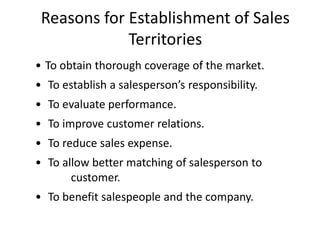
FACTORS TO CONSIDER WHEN DESIGNING
            TERRITORIES
                    DETERMINE     DETERMINE
 SELECT BASIC         SALES          BASIC
CONTROL UNIT       POTENTIAL IN   TERRITORIES
                    EACH UNIT


EVALUATE, REVISE    CUSTOMER         ASSIGN TO
   IF NEEDED       CONTACT PLAN     TERRITORIES
Selecting a Basic Geographical Control Unit:
• Starting point in establishment of territories
• Cities/District/States as the basis
• Trading Areas as the basis
  • A trading area consist of the geographical
    region surrounding a city that serves as the
    dominant retail or whole sale center or both
  • Vary from product to product
Determining Sales Potential present in each control
    unit:
•   Identification of the buyers as precisely as possible
•   Present & potential buyers indicate Market Potential
•   Determination of Sales Potential I.e unit’s market
    potential that the company has an opportunity to
    obtain
•   Market potential is converted to sales potential by
    analyzing the historical market share , adjusting for
    changes in company & competitor selling strategies
SIX STEPS TO CONSIDER WHEN DETERMINING A
                 FIRM’S BASIC TERRITORIES


1. Forecast sales and determine 4. Tentatively establish
sales potentials.               territories.
2. Determine the sales volume    5. Determine the number of
needed for each territory.       accounts for each territory.
3. Determine the number of       6. Finalize the territories, and
territories.                     draw the boundary lines.
ASSIGN TO TERRITORIES

Some salespeople can handle large territories
and the travel associated with them; some
can’t. Some territories require experienced
salespeople; some are best for new people.
Some people want to live in metropolitan
areas; others prefer territories with smaller
cities.
CUSTOMER CONTACT PLAN

The customer contact plan involves
scheduling sales calls and routing a
salesperson’s movement around the
territory.
Scheduling refers to establishing a fixed
time when the salesperson will be at a
customer’s place of business.

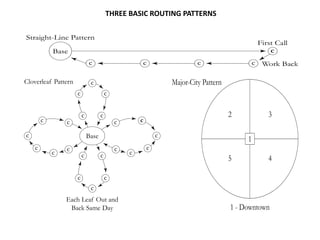
In theory, strict formal route designs enable the
salesperson to:
   1. Improve territorial coverage.
   2. Minimize wasted time.
   3. Establish communication between
      management and the sales force in terms
      of the location and activities of individual
      salespeople.
THREE BASIC ROUTING PATTERNS

Straight-Line Pattern
                                                                                               First Call
            Base                                                                                   c
                             c                      c                    c                 c    Work Back

Cloverleaf Pattern            c                                 Major-City Pattern
                     c                  c


                         c          c                                                2            3
        c       c                           c       c

c                            Base                           c
                                                                                          1
    c           c                           c           c
            c            c          c           c
                                                                                     5            4

                     c                  c
                              c
                Each Leaf Out and
                 Back Same Day                                                       1 - Downtown
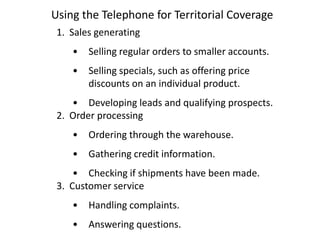
Using the Telephone for Territorial Coverage
 1. Sales generating
    •   Selling regular orders to smaller accounts.
    •   Selling specials, such as offering price
        discounts on an individual product.
    • Developing leads and qualifying prospects.
 2. Order processing
    •   Ordering through the warehouse.
    •   Gathering credit information.
     • Checking if shipments have been made.
 3. Customer service
    •   Handling complaints.
    •   Answering questions.
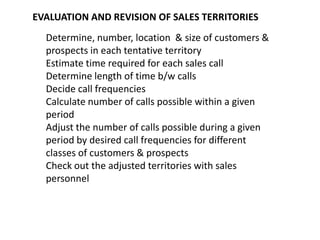
EVALUATION AND REVISION OF SALES TERRITORIES
  Determine, number, location & size of customers &
  prospects in each tentative territory
  Estimate time required for each sales call
  Determine length of time b/w calls
  Decide call frequencies
  Calculate number of calls possible within a given
  period
  Adjust the number of calls possible during a given
  period by desired call frequencies for different
  classes of customers & prospects
  Check out the adjusted territories with sales
  personnel
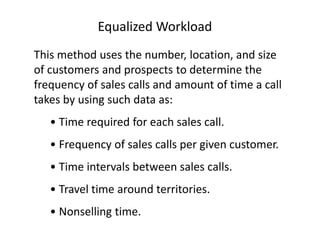
Equalized Workload
This method uses the number, location, and size
of customers and prospects to determine the
frequency of sales calls and amount of time a call
takes by using such data as:
   • Time required for each sales call.
   • Frequency of sales calls per given customer.
   • Time intervals between sales calls.
   • Travel time around territories.
   • Nonselling time.
• Adjusting for differences in Coverage Difficulty &
  Redistricting Tentative Territories:
   – Determine, number,location & size of customers & prospects
     in each tentative territory
   – Estimate time required for each sales call
   – Determine length of time b/w calls
   – Decide call frequencies
   – Calculate number of calls possible within a given period
   – Adjust the number of calls possible during a given period by
     desired call frequencies for different classes of customers &
     prospects
   – Check out the adjusted territories with sales personnel

Sales territory

  • 1.
    Sales Territory • Asales territory is a grouping of customers and prospects assigned to an individual salesperson
  • 2.
    Reasons for Establishmentof Sales Territories • To obtain thorough coverage of the market. • To establish a salesperson’s responsibility. • To evaluate performance. • To improve customer relations. • To reduce sales expense. • To allow better matching of salesperson to customer. • To benefit salespeople and the company.
  • 3.
    FACTORS TO CONSIDERWHEN DESIGNING TERRITORIES DETERMINE DETERMINE SELECT BASIC SALES BASIC CONTROL UNIT POTENTIAL IN TERRITORIES EACH UNIT EVALUATE, REVISE CUSTOMER ASSIGN TO IF NEEDED CONTACT PLAN TERRITORIES
  • 4.
    Selecting a BasicGeographical Control Unit: • Starting point in establishment of territories • Cities/District/States as the basis • Trading Areas as the basis • A trading area consist of the geographical region surrounding a city that serves as the dominant retail or whole sale center or both • Vary from product to product
  • 5.
    Determining Sales Potentialpresent in each control unit: • Identification of the buyers as precisely as possible • Present & potential buyers indicate Market Potential • Determination of Sales Potential I.e unit’s market potential that the company has an opportunity to obtain • Market potential is converted to sales potential by analyzing the historical market share , adjusting for changes in company & competitor selling strategies
  • 6.
    SIX STEPS TOCONSIDER WHEN DETERMINING A FIRM’S BASIC TERRITORIES 1. Forecast sales and determine 4. Tentatively establish sales potentials. territories. 2. Determine the sales volume 5. Determine the number of needed for each territory. accounts for each territory. 3. Determine the number of 6. Finalize the territories, and territories. draw the boundary lines.
  • 7.
    ASSIGN TO TERRITORIES Somesalespeople can handle large territories and the travel associated with them; some can’t. Some territories require experienced salespeople; some are best for new people. Some people want to live in metropolitan areas; others prefer territories with smaller cities.
  • 8.
    CUSTOMER CONTACT PLAN Thecustomer contact plan involves scheduling sales calls and routing a salesperson’s movement around the territory.
  • 9.
    Scheduling refers toestablishing a fixed time when the salesperson will be at a customer’s place of business. In theory, strict formal route designs enable the salesperson to: 1. Improve territorial coverage. 2. Minimize wasted time. 3. Establish communication between management and the sales force in terms of the location and activities of individual salespeople.
  • 10.
    THREE BASIC ROUTINGPATTERNS Straight-Line Pattern First Call Base c c c c c Work Back Cloverleaf Pattern c Major-City Pattern c c c c 2 3 c c c c c Base c 1 c c c c c c c c 5 4 c c c Each Leaf Out and Back Same Day 1 - Downtown
  • 11.
    Using the Telephonefor Territorial Coverage 1. Sales generating • Selling regular orders to smaller accounts. • Selling specials, such as offering price discounts on an individual product. • Developing leads and qualifying prospects. 2. Order processing • Ordering through the warehouse. • Gathering credit information. • Checking if shipments have been made. 3. Customer service • Handling complaints. • Answering questions.
  • 12.
    EVALUATION AND REVISIONOF SALES TERRITORIES Determine, number, location & size of customers & prospects in each tentative territory Estimate time required for each sales call Determine length of time b/w calls Decide call frequencies Calculate number of calls possible within a given period Adjust the number of calls possible during a given period by desired call frequencies for different classes of customers & prospects Check out the adjusted territories with sales personnel
  • 13.
    Equalized Workload This methoduses the number, location, and size of customers and prospects to determine the frequency of sales calls and amount of time a call takes by using such data as: • Time required for each sales call. • Frequency of sales calls per given customer. • Time intervals between sales calls. • Travel time around territories. • Nonselling time.
  • 14.
    • Adjusting fordifferences in Coverage Difficulty & Redistricting Tentative Territories: – Determine, number,location & size of customers & prospects in each tentative territory – Estimate time required for each sales call – Determine length of time b/w calls – Decide call frequencies – Calculate number of calls possible within a given period – Adjust the number of calls possible during a given period by desired call frequencies for different classes of customers & prospects – Check out the adjusted territories with sales personnel