Decision Making
Presented By :
Paghdar Shruti
Olakiya Romit
Decision making
The process of identifying & selecting suitable
course of action to solve specific problem.
 Present : Decision making connects
organizations present circumstances to
future.
 Past : Decision making also draws on past
experiences positive & negatives will help for
future.
 Future : Objectives for future based on past
experiences .
Problem & Opportunity
Finding Process
Problem : Situation that occurs when actual state
of affair differs from desire state of affairs.
William Pounds stated problem finding process :
 A deviation from past experience : This
years sales falling behind last years , expenses
have suddenly increased such events signals
to manager that problem has risen.
 A deviation from set plan : Department
exceeding its budget , project is off schedule
such events tells managers something must
get done to get plan back on course.
 Other people often bring problem
to manager : Late deliveries of
goods , employee resigns make
manager to daily involve problems .
 The performance of competitors :
When other company develop new
improvements in operating
procedures managers may have to
revaluate procedures in his
organization.
Opportunity Finding
 Opportunity : According to David Gleicher
;Situation that occurs when circumstances
offers a chance to organization to exceed
stated goals & objectives.
 Dialectical inquiry method : A method of
analysis in which decision maker determines &
negates his assumptions , creates
countersolutions based on negative
assumptions , its also called as devil”s
advocate method.
 Also Peter Drucker made clear that problems
rather than taking as a problem take it as
opportunity –key for managerial &
organizational success.
Thresholds for problem
recognition
Setting priorities
Is the problem easy to deal with ?
Might the problem resolve itself ?
Is this my decision to make ?
Nature of managerial
decision making
 Programmed decision : Solutions to routine
problems determined by rules, procedure & habits.
 E.g. Manager rarely have to worry about salary of
newly join employee because organization generally
have salary scale for all positions.
 Non programmed decisions: Specific solutions
created through unstructured process to deal with
non routine problems.
 E.g. Problems such as how to allocate
organizational resources, how community resources
Certainty, risk &
uncertainty
 Certainty: Decision making conditions in which
managers have accurate , measurable
alternative & reliable information about
outcomes of various alternatives under
consideration.
• Risk: Decision making condition in which
managers whether probability of a given
alternative will lead to desire goal or outcome.
 Probability: A statistical measure of chance a certain event
or outcome will occur.
 Uncertainty: Decision making condition in which managers
face unpredictable external conditions.
 Sources :
1) Manager may face external condition that are partially
beyond their control like weather.
2) Manager may not have access to key information.
Rational model of
decision making
Investigate the situation:
Develop Alternatives
Evaluate alternatives and select
the best one available
Implement and monitor the
decision
Rational model of
decision making
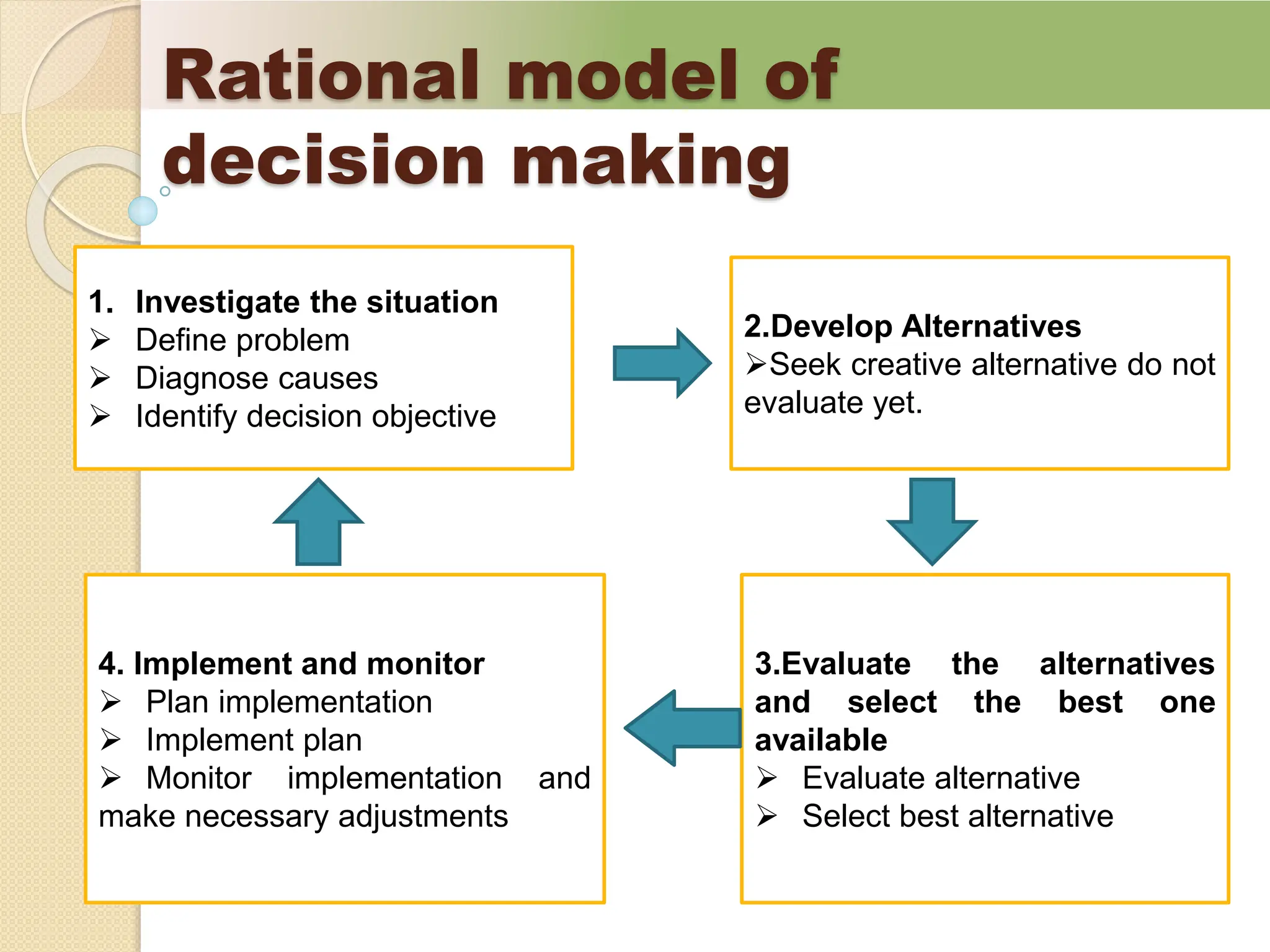
2.Develop Alternatives
Seek creative alternative do not
evaluate yet.
3.Evaluate the alternatives
and select the best one
available
 Evaluate alternative
 Select best alternative
4. Implement and monitor
 Plan implementation
 Implement plan
 Monitor implementation and
make necessary adjustments
1. Investigate the situation
 Define problem
 Diagnose causes
 Identify decision objective
Rational model of decision
making
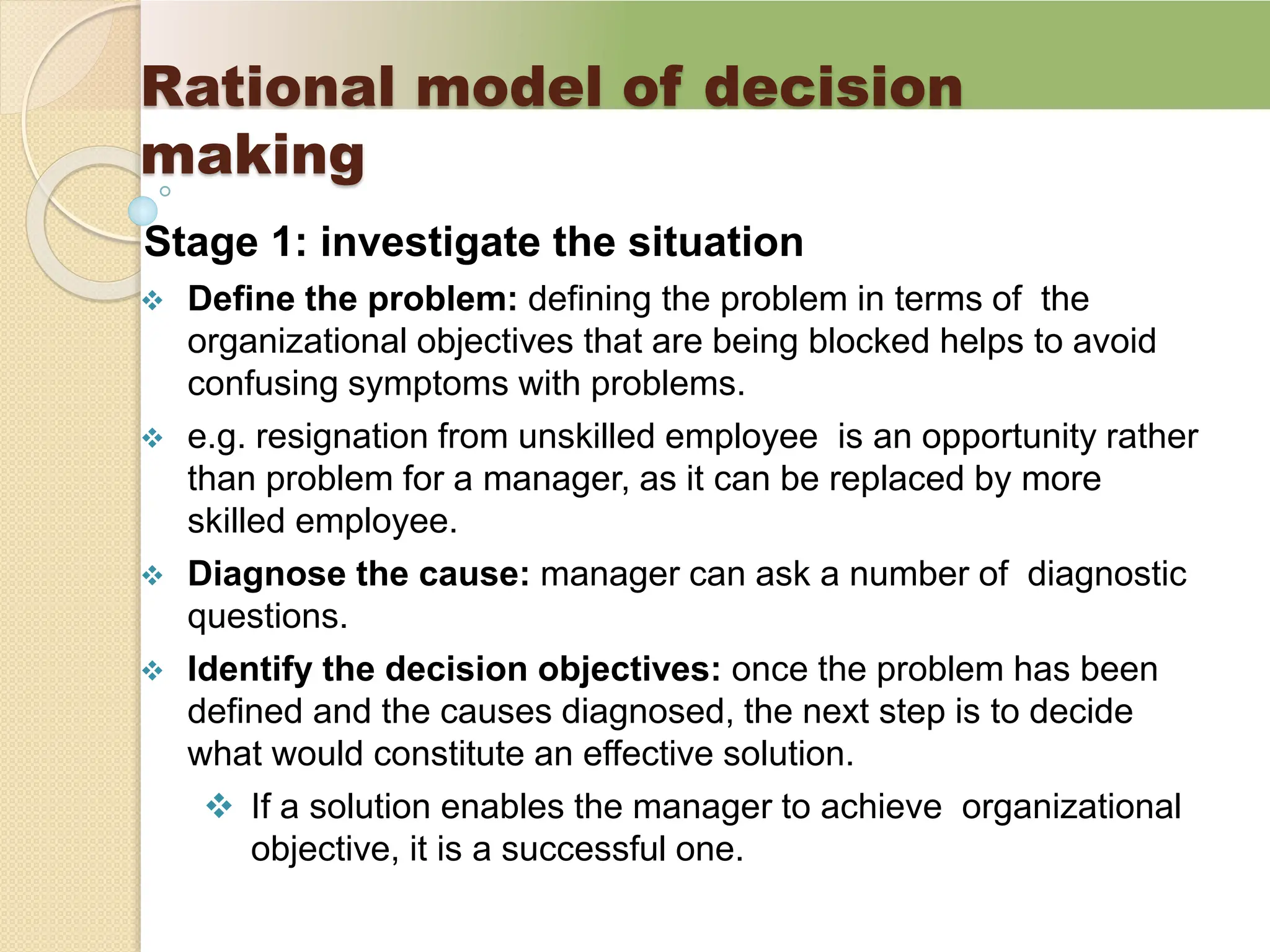
Stage 1: investigate the situation
 Define the problem: defining the problem in terms of the
organizational objectives that are being blocked helps to avoid
confusing symptoms with problems.
 e.g. resignation from unskilled employee is an opportunity rather
than problem for a manager, as it can be replaced by more
skilled employee.
 Diagnose the cause: manager can ask a number of diagnostic
questions.
 Identify the decision objectives: once the problem has been
defined and the causes diagnosed, the next step is to decide
what would constitute an effective solution.
 If a solution enables the manager to achieve organizational
objective, it is a successful one.
Rational model of decision
making
Stage 2: Develop alternative :
 Brainstorming : Decision making & problem solving
technique in which individuals or group members try
to improve by spontaneously proposing alternatives
without concern for reality or tradition.
a) Seek creative alternative
b)Do not evaluate yet
Rational model of decision
making
Stage 3: Evaluate alternatives & select
best one available :
a)Evaluate alternative
b)Select best alternative
Stage 4: Implement & monitor:
• Budgets
• Schedule
• Progress report etc.
Rational model in
Perceptive
 Bounded rationality: the concept that
managers make the most logical decision they
can within the constraints of limited
information and ability.
 Herbert Simon proposed the theory of
bounded rationality, points out that decision
maker must cope with inadequate information
about the nature of the problem and its
possible solution.
Rational model in
Perceptive
 Satisfice: decision making technique in
which manager accept the first satisfactory
decision they uncover.
 Heuristic principles: a method of
decision making that proceed along empirical
lines , using rules of thumb. To find solution
or answers.
Availability: people sometimes judge an event’s
likelihood by testing it against their memories.
Representativeness: people also tend to
assess the likelihood of an occurrence by trying to
match it with a preexisting category.
Anchoring & Adjustments: People do not
take decisions out of in a air.
 Game theory: the study of people making
interdependent choices.
 Chaos theory: the study of dynamics patterns in
large social system.
Thank You

ch 9 pptx about the dicision making......

  • 1.
    Decision Making Presented By: Paghdar Shruti Olakiya Romit
  • 2.
    Decision making The processof identifying & selecting suitable course of action to solve specific problem.  Present : Decision making connects organizations present circumstances to future.  Past : Decision making also draws on past experiences positive & negatives will help for future.  Future : Objectives for future based on past experiences .
  • 3.
    Problem & Opportunity FindingProcess Problem : Situation that occurs when actual state of affair differs from desire state of affairs. William Pounds stated problem finding process :  A deviation from past experience : This years sales falling behind last years , expenses have suddenly increased such events signals to manager that problem has risen.  A deviation from set plan : Department exceeding its budget , project is off schedule such events tells managers something must get done to get plan back on course.
  • 4.
     Other peopleoften bring problem to manager : Late deliveries of goods , employee resigns make manager to daily involve problems .  The performance of competitors : When other company develop new improvements in operating procedures managers may have to revaluate procedures in his organization.
  • 5.
    Opportunity Finding  Opportunity: According to David Gleicher ;Situation that occurs when circumstances offers a chance to organization to exceed stated goals & objectives.  Dialectical inquiry method : A method of analysis in which decision maker determines & negates his assumptions , creates countersolutions based on negative assumptions , its also called as devil”s advocate method.  Also Peter Drucker made clear that problems rather than taking as a problem take it as opportunity –key for managerial & organizational success.
  • 6.
    Thresholds for problem recognition Settingpriorities Is the problem easy to deal with ? Might the problem resolve itself ? Is this my decision to make ?
  • 7.
    Nature of managerial decisionmaking  Programmed decision : Solutions to routine problems determined by rules, procedure & habits.  E.g. Manager rarely have to worry about salary of newly join employee because organization generally have salary scale for all positions.  Non programmed decisions: Specific solutions created through unstructured process to deal with non routine problems.  E.g. Problems such as how to allocate organizational resources, how community resources
  • 8.
    Certainty, risk & uncertainty Certainty: Decision making conditions in which managers have accurate , measurable alternative & reliable information about outcomes of various alternatives under consideration. • Risk: Decision making condition in which managers whether probability of a given alternative will lead to desire goal or outcome.
  • 9.
     Probability: Astatistical measure of chance a certain event or outcome will occur.  Uncertainty: Decision making condition in which managers face unpredictable external conditions.  Sources : 1) Manager may face external condition that are partially beyond their control like weather. 2) Manager may not have access to key information.
  • 10.
    Rational model of decisionmaking Investigate the situation: Develop Alternatives Evaluate alternatives and select the best one available Implement and monitor the decision
  • 11.
    Rational model of decisionmaking 2.Develop Alternatives Seek creative alternative do not evaluate yet. 3.Evaluate the alternatives and select the best one available  Evaluate alternative  Select best alternative 4. Implement and monitor  Plan implementation  Implement plan  Monitor implementation and make necessary adjustments 1. Investigate the situation  Define problem  Diagnose causes  Identify decision objective
  • 12.
    Rational model ofdecision making Stage 1: investigate the situation  Define the problem: defining the problem in terms of the organizational objectives that are being blocked helps to avoid confusing symptoms with problems.  e.g. resignation from unskilled employee is an opportunity rather than problem for a manager, as it can be replaced by more skilled employee.  Diagnose the cause: manager can ask a number of diagnostic questions.  Identify the decision objectives: once the problem has been defined and the causes diagnosed, the next step is to decide what would constitute an effective solution.  If a solution enables the manager to achieve organizational objective, it is a successful one.
  • 13.
    Rational model ofdecision making Stage 2: Develop alternative :  Brainstorming : Decision making & problem solving technique in which individuals or group members try to improve by spontaneously proposing alternatives without concern for reality or tradition. a) Seek creative alternative b)Do not evaluate yet
  • 14.
    Rational model ofdecision making Stage 3: Evaluate alternatives & select best one available : a)Evaluate alternative b)Select best alternative Stage 4: Implement & monitor: • Budgets • Schedule • Progress report etc.
  • 15.
    Rational model in Perceptive Bounded rationality: the concept that managers make the most logical decision they can within the constraints of limited information and ability.  Herbert Simon proposed the theory of bounded rationality, points out that decision maker must cope with inadequate information about the nature of the problem and its possible solution.
  • 16.
    Rational model in Perceptive Satisfice: decision making technique in which manager accept the first satisfactory decision they uncover.  Heuristic principles: a method of decision making that proceed along empirical lines , using rules of thumb. To find solution or answers.
  • 17.
    Availability: people sometimesjudge an event’s likelihood by testing it against their memories. Representativeness: people also tend to assess the likelihood of an occurrence by trying to match it with a preexisting category. Anchoring & Adjustments: People do not take decisions out of in a air.  Game theory: the study of people making interdependent choices.  Chaos theory: the study of dynamics patterns in large social system.
  • 18.