Cost based pricing
    Managerial Economics
GROUP MEMBERS

o Mohan Xavier
o Muhammad Asif
o Nikita Anne Jacob
o Saichandra
o Sachin Bose
o Shamlu Shaji
price

 Price is the amount of money charged for a good or

  service

 It is the sum of all the values that consumers give up for

  the product.
pricing

Process of determining what a company will receive in
exchange of its product.
Pricing objectives

 Survival

 Profit Maximization

 Target Return on Investment (ROI)

 Market Share Goals

 Status Quo Pricing
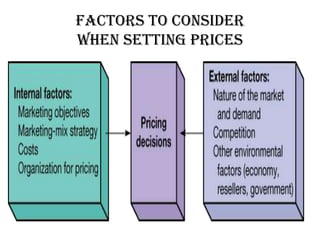
Factors to Consider
when Setting Prices
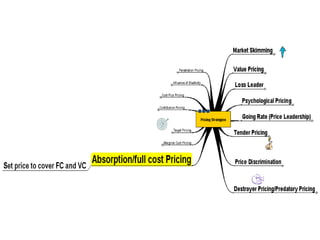
General Pricing Approaches

 Cost-Based Pricing

 Break-Even Analysis and Target Profit Pricing

 Value-Based Pricing

 Competition-Based Pricing
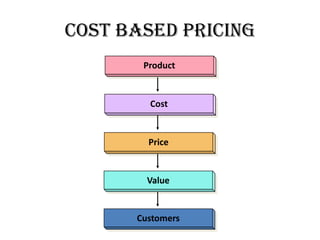
Cost based pricing

• Using the cost of production as the basis for pricing a product.

• Here the selling price of product a will be the cost to produce it.

• It includes :-

      Direct and indirect costs

       Additional amount to generate profit.
Cost based pricing
       Product


        Cost


        Price


        Value


      Customers
Advantages
 Super easy.

 Flexible.

 If costs go up, it is easy to adjust prices.

 Super simple to calculate.

 Is easy for a marketer to defend pricing.

 May suit a manufacturer with scalable production based on demand.
Disadvantages

 Ignores product demand or the influence price may have on demand.

 Ignores what competitors are doing with their pricing.

 If costs increase, so must the price.

 Ignores brand positioning so may forfeit additional profit.

 It provides no incentive to improve cost efficiency.
Classifications of cost based
           pricing

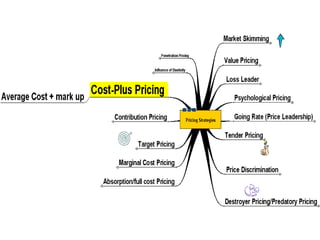
1. Cost plus pricing

2. Full cost pricing

3. Target profit pricing

4. Marginal cost pricing
Cost plus pricing


 A fixed percentage of profit will be added to the cost.

 The fixed percentage of profit will be taken by

  manufacturer, wholesaler and the retailer.
Egg:-
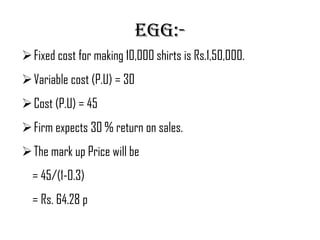
 Fixed cost for making 10,000 shirts is Rs.1,50,000.
 Variable cost (P.U) = 30
 Cost (P.U) = 45
 Firm expects 30 % return on sales.
 The mark up Price will be
  = 45/(1-0.3)
  = Rs. 64.28 p
Full cost pricing

 Also called absorption cost pricing.

 Attempting to set price to cover both fixed and variable costs

 Total cost will be computed by adding variable and fixed cost
  incurred in the product.
 The price of each product is dependant on how many costs it
 creates.
Egg:-

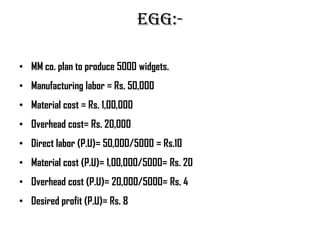
• MM co. plan to produce 5000 widgets.
• Manufacturing labor = Rs. 50,000
• Material cost = Rs. 1,00,000
• Overhead cost= Rs. 20,000
• Direct labor (P.U)= 50,000/5000 = Rs.10
• Material cost (P.U)= 1,00,000/5000= Rs. 20
• Overhead cost (P.U)= 20,000/5000= Rs. 4
• Desired profit (P.U)= Rs. 8
Cont.

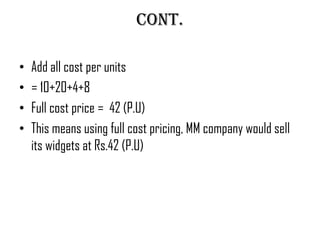
•   Add all cost per units
•   = 10+20+4+8
•   Full cost price = 42 (P.U)
•   This means using full cost pricing, MM company would sell
    its widgets at Rs.42 (P.U)
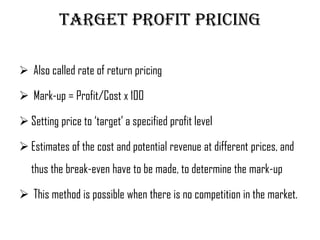
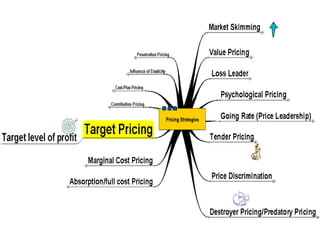
Target profit pricing

 Also called rate of return pricing

 Mark-up = Profit/Cost x 100

 Setting price to ‘target’ a specified profit level

 Estimates of the cost and potential revenue at different prices, and
   thus the break-even have to be made, to determine the mark-up

 This method is possible when there is no competition in the market.
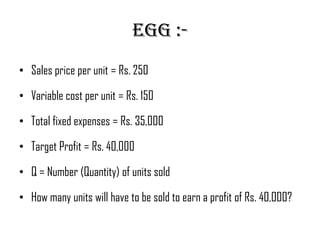
Egg :-
• Sales price per unit = Rs. 250

• Variable cost per unit = Rs. 150

• Total fixed expenses = Rs. 35,000

• Target Profit = Rs. 40,000

• Q = Number (Quantity) of units sold

• How many units will have to be sold to earn a profit of Rs. 40,000?
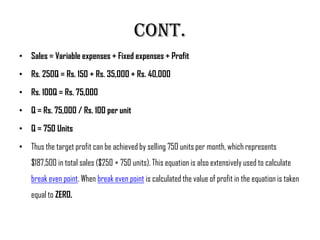
Cont.
• Sales = Variable expenses + Fixed expenses + Profit

• Rs. 250Q = Rs. 150 + Rs. 35,000 + Rs. 40,000

• Rs. 100Q = Rs. 75,000

• Q = Rs. 75,000 / Rs. 100 per unit

• Q = 750 Units

• Thus the target profit can be achieved by selling 750 units per month, which represents
    $187,500 in total sales ($250 × 750 units). This equation is also extensively used to calculate
    break even point. When break even point is calculated the value of profit in the equation is taken
    equal to ZERO.
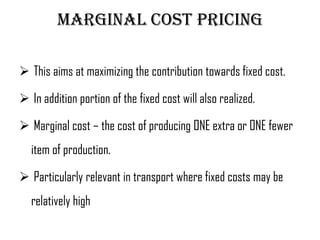
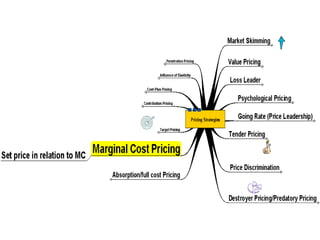
Marginal cost pricing

 This aims at maximizing the contribution towards fixed cost.

 In addition portion of the fixed cost will also realized.

 Marginal cost – the cost of producing ONE extra or ONE fewer
   item of production.

 Particularly relevant in transport where fixed costs may be
   relatively high
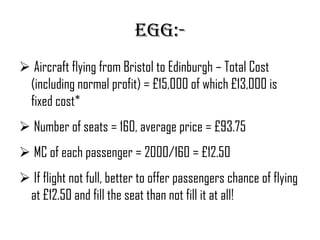
EGG:-
 Aircraft flying from Bristol to Edinburgh – Total Cost
 (including normal profit) = £15,000 of which £13,000 is
 fixed cost*
 Number of seats = 160, average price = £93.75
 MC of each passenger = 2000/160 = £12.50
 If flight not full, better to offer passengers chance of flying
 at £12.50 and fill the seat than not fill it at all!
Demand-Based pricing
• Pricing that is determined by how much customers are
  willing to pay for a product or service
• This method results in a high price when demand is strong
  and a low price when demand is weak
• May be differentiated based on considerations such as time
  of purchase, type of customer or distribution channel
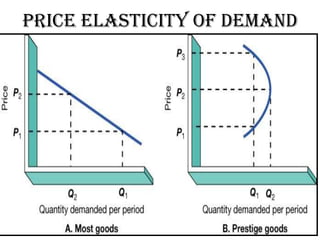
Price Elasticity of Demand
Competition-Based pricing
• Pricing that is determined by considering what competitors
  charge for the same good. Once you find out what your
  competition is charging, you must determine whether to
  charge the same, slightly more, or slightly less.
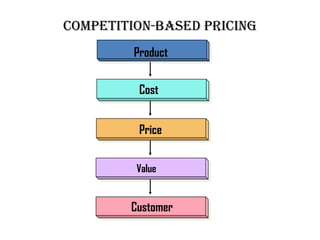
Competition-Based Pricing
         Product


          Cost


          Price


         Value


        Customer
Pricing Strategies
• New-Product Pricing Strategies

• Existing-Product Pricing Strategies

• Psychological Pricing

• Promotional Pricing
New-Product
           Pricing Strategies
• Prestige Pricing

• Market-Skimming Pricing

• Market-Penetration Pricing
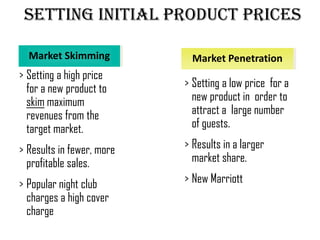
Setting Initial Product Prices

  Market Skimming            Market Penetration
> Setting a high price
  for a new product to     > Setting a low price for a
  skim maximum               new product in order to
  revenues from the          attract a large number
  target market.             of guests.

> Results in fewer, more   > Results in a larger
  profitable sales.          market share.

> Popular night club       > New Marriott
  charges a high cover
  charge
Existing-Product
              Pricing Strategies
• Product-Bundle Pricing
• Price-Adjustment Strategies
    – Volume Discounts
    – Discounts Based on Time of Purchase
    – Discriminatory Pricing
    – Yield Management

• Non-Use of Yield Management
• Last-Minute Pricing
Product-Bundling Pricing
• Transfer surplus reservation price (the maximum price a customer will
   pay for a product)
    – Customer A will pay $60 for a Disney pass and $120 for a hotel room.
       Customer B will pay $95 for the Disney pass and $80 for the hotel room – A
       hotel selling a two night package with pass for $350 will get both customer

• Price-bundling also reduces price competition – by making it hard to
   figure price of components
    – In an airline and hotel package it is difficult to determine the price of the
       room
Psychological Pricing
• Price-quality relationship

• Reference prices

• Rounding

• Length of the field
Promotional Pricing
• Temporary pricing of products below list price and
  sometimes below cost
   – Value Pricing

   – Price Sensitivity Measurement
COST BASED PRICING

COST BASED PRICING

  • 1.
    Cost based pricing Managerial Economics
  • 2.
    GROUP MEMBERS o MohanXavier o Muhammad Asif o Nikita Anne Jacob o Saichandra o Sachin Bose o Shamlu Shaji
  • 3.
    price  Price isthe amount of money charged for a good or service  It is the sum of all the values that consumers give up for the product.
  • 4.
    pricing Process of determiningwhat a company will receive in exchange of its product.
  • 5.
    Pricing objectives  Survival Profit Maximization  Target Return on Investment (ROI)  Market Share Goals  Status Quo Pricing
  • 6.
  • 7.
    General Pricing Approaches Cost-Based Pricing  Break-Even Analysis and Target Profit Pricing  Value-Based Pricing  Competition-Based Pricing
  • 8.
    Cost based pricing •Using the cost of production as the basis for pricing a product. • Here the selling price of product a will be the cost to produce it. • It includes :- Direct and indirect costs Additional amount to generate profit.
  • 9.
    Cost based pricing Product Cost Price Value Customers
  • 10.
    Advantages  Super easy. Flexible.  If costs go up, it is easy to adjust prices.  Super simple to calculate.  Is easy for a marketer to defend pricing.  May suit a manufacturer with scalable production based on demand.
  • 11.
    Disadvantages  Ignores productdemand or the influence price may have on demand.  Ignores what competitors are doing with their pricing.  If costs increase, so must the price.  Ignores brand positioning so may forfeit additional profit.  It provides no incentive to improve cost efficiency.
  • 12.
    Classifications of costbased pricing 1. Cost plus pricing 2. Full cost pricing 3. Target profit pricing 4. Marginal cost pricing
  • 13.
    Cost plus pricing A fixed percentage of profit will be added to the cost.  The fixed percentage of profit will be taken by manufacturer, wholesaler and the retailer.
  • 15.
    Egg:-  Fixed costfor making 10,000 shirts is Rs.1,50,000.  Variable cost (P.U) = 30  Cost (P.U) = 45  Firm expects 30 % return on sales.  The mark up Price will be = 45/(1-0.3) = Rs. 64.28 p
  • 16.
    Full cost pricing Also called absorption cost pricing.  Attempting to set price to cover both fixed and variable costs  Total cost will be computed by adding variable and fixed cost incurred in the product.  The price of each product is dependant on how many costs it creates.
  • 18.
    Egg:- • MM co.plan to produce 5000 widgets. • Manufacturing labor = Rs. 50,000 • Material cost = Rs. 1,00,000 • Overhead cost= Rs. 20,000 • Direct labor (P.U)= 50,000/5000 = Rs.10 • Material cost (P.U)= 1,00,000/5000= Rs. 20 • Overhead cost (P.U)= 20,000/5000= Rs. 4 • Desired profit (P.U)= Rs. 8
  • 19.
    Cont. • Add all cost per units • = 10+20+4+8 • Full cost price = 42 (P.U) • This means using full cost pricing, MM company would sell its widgets at Rs.42 (P.U)
  • 20.
    Target profit pricing Also called rate of return pricing  Mark-up = Profit/Cost x 100  Setting price to ‘target’ a specified profit level  Estimates of the cost and potential revenue at different prices, and thus the break-even have to be made, to determine the mark-up  This method is possible when there is no competition in the market.
  • 22.
    Egg :- • Salesprice per unit = Rs. 250 • Variable cost per unit = Rs. 150 • Total fixed expenses = Rs. 35,000 • Target Profit = Rs. 40,000 • Q = Number (Quantity) of units sold • How many units will have to be sold to earn a profit of Rs. 40,000?
  • 23.
    Cont. • Sales =Variable expenses + Fixed expenses + Profit • Rs. 250Q = Rs. 150 + Rs. 35,000 + Rs. 40,000 • Rs. 100Q = Rs. 75,000 • Q = Rs. 75,000 / Rs. 100 per unit • Q = 750 Units • Thus the target profit can be achieved by selling 750 units per month, which represents $187,500 in total sales ($250 × 750 units). This equation is also extensively used to calculate break even point. When break even point is calculated the value of profit in the equation is taken equal to ZERO.
  • 24.
    Marginal cost pricing This aims at maximizing the contribution towards fixed cost.  In addition portion of the fixed cost will also realized.  Marginal cost – the cost of producing ONE extra or ONE fewer item of production.  Particularly relevant in transport where fixed costs may be relatively high
  • 26.
    EGG:-  Aircraft flyingfrom Bristol to Edinburgh – Total Cost (including normal profit) = £15,000 of which £13,000 is fixed cost*  Number of seats = 160, average price = £93.75  MC of each passenger = 2000/160 = £12.50  If flight not full, better to offer passengers chance of flying at £12.50 and fill the seat than not fill it at all!
  • 27.
    Demand-Based pricing • Pricingthat is determined by how much customers are willing to pay for a product or service • This method results in a high price when demand is strong and a low price when demand is weak • May be differentiated based on considerations such as time of purchase, type of customer or distribution channel
  • 28.
  • 29.
    Competition-Based pricing • Pricingthat is determined by considering what competitors charge for the same good. Once you find out what your competition is charging, you must determine whether to charge the same, slightly more, or slightly less.
  • 30.
    Competition-Based Pricing Product Cost Price Value Customer
  • 31.
    Pricing Strategies • New-ProductPricing Strategies • Existing-Product Pricing Strategies • Psychological Pricing • Promotional Pricing
  • 32.
    New-Product Pricing Strategies • Prestige Pricing • Market-Skimming Pricing • Market-Penetration Pricing
  • 33.
    Setting Initial ProductPrices Market Skimming Market Penetration > Setting a high price for a new product to > Setting a low price for a skim maximum new product in order to revenues from the attract a large number target market. of guests. > Results in fewer, more > Results in a larger profitable sales. market share. > Popular night club > New Marriott charges a high cover charge
  • 34.
    Existing-Product Pricing Strategies • Product-Bundle Pricing • Price-Adjustment Strategies – Volume Discounts – Discounts Based on Time of Purchase – Discriminatory Pricing – Yield Management • Non-Use of Yield Management • Last-Minute Pricing
  • 35.
    Product-Bundling Pricing • Transfersurplus reservation price (the maximum price a customer will pay for a product) – Customer A will pay $60 for a Disney pass and $120 for a hotel room. Customer B will pay $95 for the Disney pass and $80 for the hotel room – A hotel selling a two night package with pass for $350 will get both customer • Price-bundling also reduces price competition – by making it hard to figure price of components – In an airline and hotel package it is difficult to determine the price of the room
  • 36.
    Psychological Pricing • Price-qualityrelationship • Reference prices • Rounding • Length of the field
  • 37.
    Promotional Pricing • Temporarypricing of products below list price and sometimes below cost – Value Pricing – Price Sensitivity Measurement