Advanced Management
Accounting
Chapter one
Introduction to Advanced Management Accounting
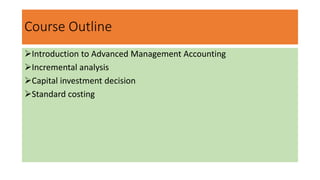
Course Outline
Introduction to Advanced Management Accounting
Incremental analysis
Capital investment decision
Standard costing
Overview
• Identify the features of managerial accounting and the
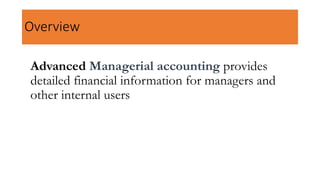
Advanced Managerial accounting provides
detailed financial information for managers and
other internal users
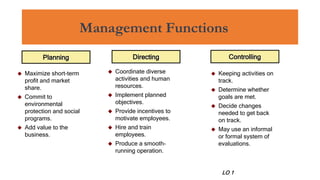
Planning
 Maximize short-term
profit and market
share.
 Commit to
environmental
protection and social
programs.
 Add value to the
business.
Directing Controlling
 Coordinate diverse
activities and human
resources.
 Implement planned
objectives.
 Provide incentives to
motivate employees.
 Hire and train
employees.
 Produce a smooth-
running operation.
 Keeping activities on
track.
 Determine whether
goals are met.
 Decide changes
needed to get back
on track.
 May use an informal
or formal system of
evaluations.
Management Functions
LO 1
Issues in Advanced Management Accounting
activity-based costing,
benchmarking,
re-engineering,
target costing,
Cont…
life-cycle costing,
economic value analysis,
total quality management
 value chain analysis for decision making.
Activity-based costing
• Activity-based costing (ABC) is a costing method that
assigns overhead to related products and services.
This accounting method of costing recognizes the relationship
between overhead costs, and manufactured products.
Benchmarking
Benchmarking is the search for the best practices within and across
industries. There are several reasons why organizations engage in
benchmarking:
For continuous improvement of internal operations
To become more externally competitive, or
For organizational survival.
Re-engineering
Business process reengineering (BPR) revises workflows to
optimize processes and eliminate non-value-added activities.
A comprehensive re-engineering project could result in the
complete replacement of an existing process, with a
substantial cost reduction. It is common for such a project to
fully integrate the use of the latest information technology, so
that automation can take the place of manual labor.
Target costing
• Target costing is a system under which a company plans in
advance for the price points, product costs, and margins that it
wants to achieve for a new product. If it cannot manufacture a
product at these planned levels, then it cancels the design
project entirely. With target costing, a management team has a
powerful tool for continually monitoring products from the
moment they enter the design phase and onward throughout
their product life cycles.
Life Cycle Costing
•Life cycle costing is the process of compiling all
costs that the owner or producer of an asset will
incur over its lifespan. These costs include the
initial investment, future additional investments,
and annually recurring costs, minus any salvage
value.
Total Quality Management
•Total quality management is a managerial
accounting concept where an organization strives
to produce higher quality products with few
defects being shipped to customers.
Value Chain Analysis
• A value chain is the full range of activities – including
design, production, marketing and distribution – that
businesses conduct to bring a product or service from
conception to delivery. For companies that produce
goods, the value chain starts with the raw materials to
make the products and consists of everything added
before the product is sold to consumers.
ANY QUESTION?
END
Cont…
•Value chain analysis finds any deficiencies in
these processes and improves them, saving
money, improving quality and expediting time
to market.

ch 1 advanced management accounting.pptx

  • 1.
  • 2.
    Course Outline Introduction toAdvanced Management Accounting Incremental analysis Capital investment decision Standard costing
  • 3.
    Overview • Identify thefeatures of managerial accounting and the Advanced Managerial accounting provides detailed financial information for managers and other internal users
  • 4.
    Planning  Maximize short-term profitand market share.  Commit to environmental protection and social programs.  Add value to the business. Directing Controlling  Coordinate diverse activities and human resources.  Implement planned objectives.  Provide incentives to motivate employees.  Hire and train employees.  Produce a smooth- running operation.  Keeping activities on track.  Determine whether goals are met.  Decide changes needed to get back on track.  May use an informal or formal system of evaluations. Management Functions LO 1
  • 5.
    Issues in AdvancedManagement Accounting activity-based costing, benchmarking, re-engineering, target costing,
  • 6.
    Cont… life-cycle costing, economic valueanalysis, total quality management  value chain analysis for decision making.
  • 7.
    Activity-based costing • Activity-basedcosting (ABC) is a costing method that assigns overhead to related products and services. This accounting method of costing recognizes the relationship between overhead costs, and manufactured products.
  • 8.
    Benchmarking Benchmarking is thesearch for the best practices within and across industries. There are several reasons why organizations engage in benchmarking: For continuous improvement of internal operations To become more externally competitive, or For organizational survival.
  • 9.
    Re-engineering Business process reengineering(BPR) revises workflows to optimize processes and eliminate non-value-added activities. A comprehensive re-engineering project could result in the complete replacement of an existing process, with a substantial cost reduction. It is common for such a project to fully integrate the use of the latest information technology, so that automation can take the place of manual labor.
  • 10.
    Target costing • Targetcosting is a system under which a company plans in advance for the price points, product costs, and margins that it wants to achieve for a new product. If it cannot manufacture a product at these planned levels, then it cancels the design project entirely. With target costing, a management team has a powerful tool for continually monitoring products from the moment they enter the design phase and onward throughout their product life cycles.
  • 11.
    Life Cycle Costing •Lifecycle costing is the process of compiling all costs that the owner or producer of an asset will incur over its lifespan. These costs include the initial investment, future additional investments, and annually recurring costs, minus any salvage value.
  • 12.
    Total Quality Management •Totalquality management is a managerial accounting concept where an organization strives to produce higher quality products with few defects being shipped to customers.
  • 13.
    Value Chain Analysis •A value chain is the full range of activities – including design, production, marketing and distribution – that businesses conduct to bring a product or service from conception to delivery. For companies that produce goods, the value chain starts with the raw materials to make the products and consists of everything added before the product is sold to consumers.
  • 14.
  • 15.
    Cont… •Value chain analysisfinds any deficiencies in these processes and improves them, saving money, improving quality and expediting time to market.