What Is the
Smart Grid and
Why Should We
    Care?   By: Roger Hicks
   For: Rachel Carson Middle School
           January 26, 2012
What is
Electric
Power?
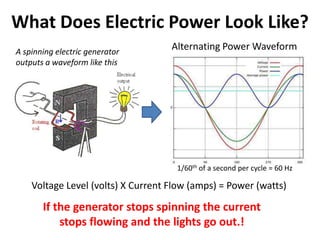
What Does Electric Power Look Like?
A spinning electric generator
                                    Alternating Power Waveform
outputs a waveform like this


                                     1/60th of a second per cycle = 60 Hz

    Voltage Level (volts) X Current Flow (amps) = Power (watts)

       If the generator stops spinning the current
           stops flowing and the lights go out.!
What is
the GRID?
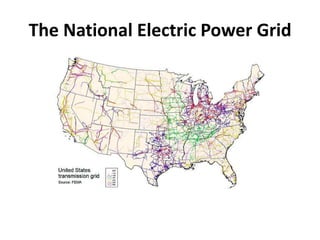
The National Electric Power Grid
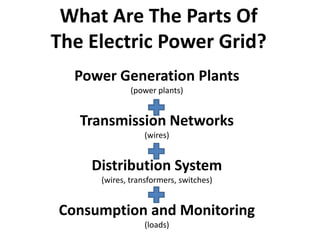
What Are The Parts Of
The Electric Power Grid?
  Power Generation Plants
             (power plants)


   Transmission Networks
                 (wires)


    Distribution System
     (wires, transformers, switches)


Consumption and Monitoring
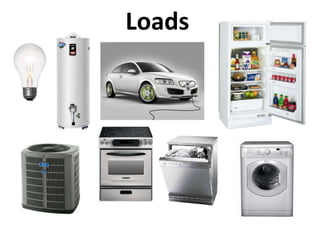
                 (loads)
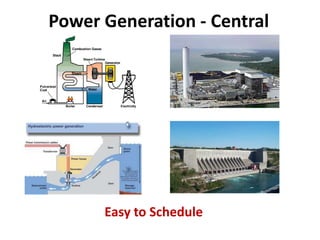
Power Generation - Central


      Easy to Schedule
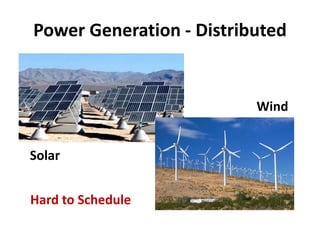
Power Generation - Distributed


                          Wind


Solar


Hard to Schedule
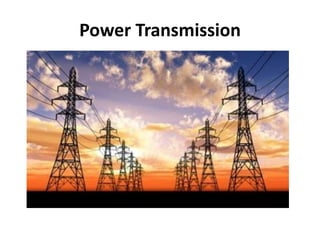
Power Transmission
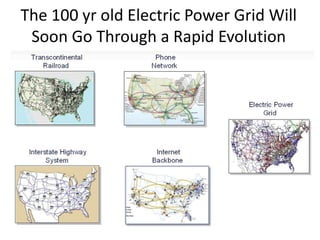
The 100 yr old Electric Power Grid Will
 Soon Go Through a Rapid Evolution
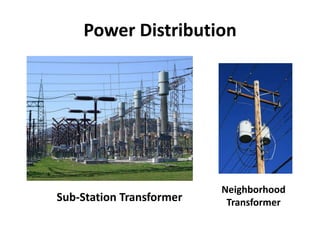
Power Distribution


                          Neighborhood
Sub-Station Transformer    Transformer
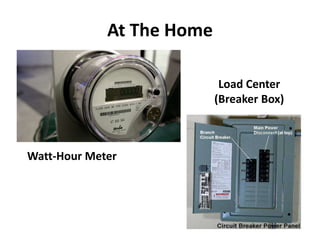
At The Home

                            Load Center
                           (Breaker Box)


Watt-Hour Meter
Loads
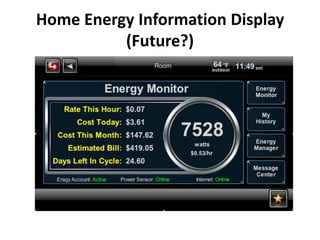
Home Energy Information Display
          (Future?)
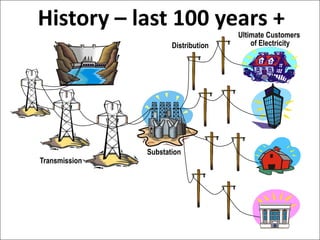
History – last 100 years +
                                     Ultimate Customers
                      Distribution       of Electricity


               Substation
Transmission
What are
 the Grid
Problems?
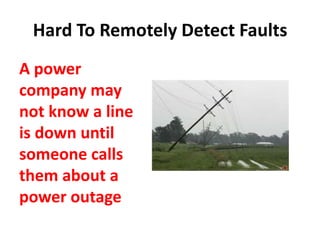
Hard To Remotely Detect Faults
A power
company may
not know a line
is down until
someone calls
them about a
power outage
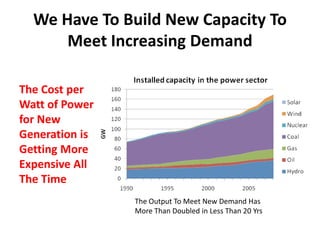
We Have To Build New Capacity To
      Meet Increasing Demand

The Cost per
Watt of Power
for New
Generation is
Getting More
Expensive All
The Time
                The Output To Meet New Demand Has
                More Than Doubled in Less Than 20 Yrs
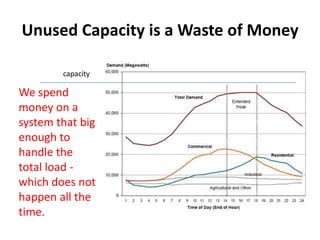
Unused Capacity is a Waste of Money

        capacity

We spend
money on a
system that big
enough to
handle the
total load -
which does not
happen all the
time.
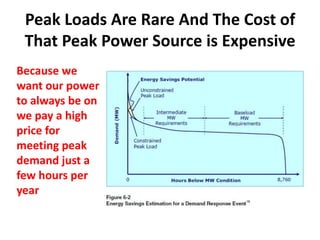
Peak Loads Are Rare And The Cost of
 That Peak Power Source is Expensive
Because we
want our power
to always be on
we pay a high
price for
meeting peak
demand just a
few hours per
year
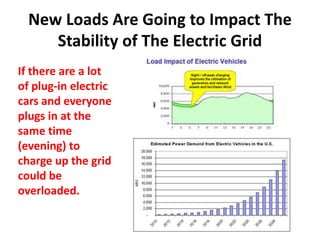
New Loads Are Going to Impact The
     Stability of The Electric Grid
If there are a lot
of plug-in electric
cars and everyone
plugs in at the
same time
(evening) to
charge up the grid
could be
overloaded.
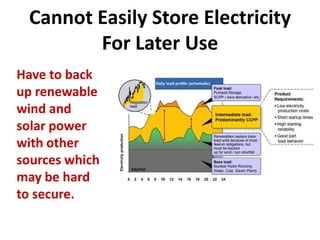
Cannot Easily Store Electricity
        For Later Use
Have to back
up renewable
wind and
solar power
with other
sources which
may be hard
to secure.
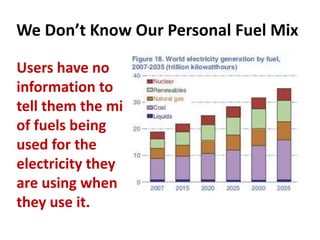
We Don’t Know Our Personal Fuel Mix

Users have no
information to
tell them the mix
of fuels being
used for the
electricity they
are using when
they use it.
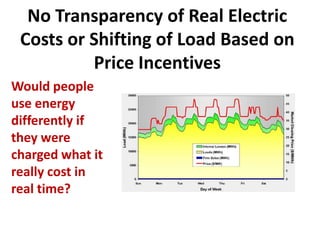
No Transparency of Real Electric
 Costs or Shifting of Load Based on
          Price Incentives
Would people
use energy
differently if
they were
charged what it
really cost in
real time?
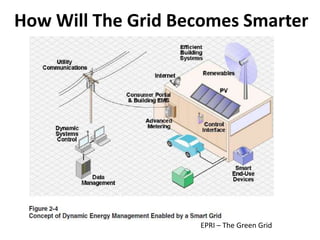
How Will The Grid Becomes Smarter


                    EPRI – The Green Grid
A Smarter Grid Will….
• Make it easier for people to get information
  about the electricity they use so they can make
  better choices about how they want to consume
  energy.
• Make it easier for power providers to know about
  the health of the grid and take actions to make it
  more reliable and efficient.
• Make it easier to fully integrate the intermittent
  power production from distributed renewable
  generation sources.
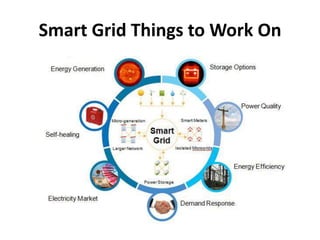
Smart Grid Things to Work On
It’s Time to Think Different

• While the Smart Grid will utilize the latest
  technology to achieve its goals, it is not just
  about technology.
• Implementation of the Smart Grid will require
  a complete rethinking of the public policy,
  utility business models, business processes
  and consumer behavior.
• This is a real paradigm shift!
Thank You
Extra
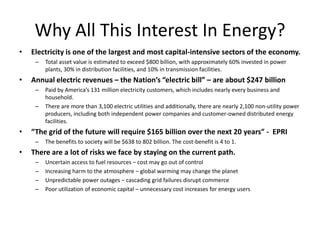
Why All This Interest In Energy?
•   Electricity is one of the largest and most capital-intensive sectors of the economy.
     –   Total asset value is estimated to exceed $800 billion, with approximately 60% invested in power
         plants, 30% in distribution facilities, and 10% in transmission facilities.
•   Annual electric revenues – the Nation’s “electric bill” – are about $247 billion
     –   Paid by America’s 131 million electricity customers, which includes nearly every business and
         household.
     –   There are more than 3,100 electric utilities and additionally, there are nearly 2,100 non-utility power
         producers, including both independent power companies and customer-owned distributed energy
         facilities.
•   “The grid of the future will require $165 billion over the next 20 years” - EPRI
     –   The benefits to society will be $638 to 802 billion. The cost-benefit is 4 to 1.
•   There are a lot of risks we face by staying on the current path.
     –   Uncertain access to fuel resources – cost may go out of control
     –   Increasing harm to the atmosphere – global warming may change the planet
     –   Unpredictable power outages – cascading grid failures disrupt commerce
     –   Poor utilization of economic capital – unnecessary cost increases for energy users
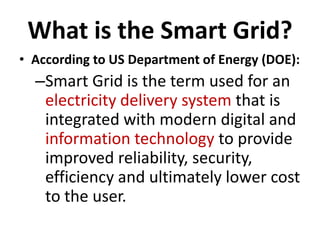
What is the Smart Grid?
• According to US Department of Energy (DOE):
  –Smart Grid is the term used for an
   electricity delivery system that is
   integrated with modern digital and
   information technology to provide
   improved reliability, security,
   efficiency and ultimately lower cost
   to the user.
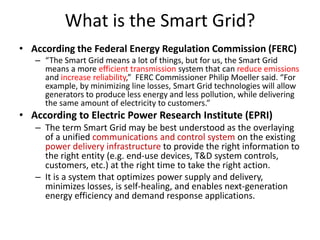
What is the Smart Grid?
• According the Federal Energy Regulation Commission (FERC)
   – “The Smart Grid means a lot of things, but for us, the Smart Grid
     means a more efficient transmission system that can reduce emissions
     and increase reliability,” FERC Commissioner Philip Moeller said. “For
     example, by minimizing line losses, Smart Grid technologies will allow
     generators to produce less energy and less pollution, while delivering
     the same amount of electricity to customers.”
• According to Electric Power Research Institute (EPRI)
   – The term Smart Grid may be best understood as the overlaying
     of a unified communications and control system on the existing
     power delivery infrastructure to provide the right information to
     the right entity (e.g. end-use devices, T&D system controls,
     customers, etc.) at the right time to take the right action.
   – It is a system that optimizes power supply and delivery,
     minimizes losses, is self-healing, and enables next-generation
     energy efficiency and demand response applications.
Goals and Characteristics, Which Together
            Characterize a Smart Grid
       From: FERC – Smart Grid Policy, March 2009

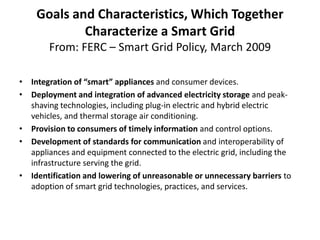
• Integration of “smart” appliances and consumer devices.
• Deployment and integration of advanced electricity storage and peak-
  shaving technologies, including plug-in electric and hybrid electric
  vehicles, and thermal storage air conditioning.
• Provision to consumers of timely information and control options.
• Development of standards for communication and interoperability of
  appliances and equipment connected to the electric grid, including the
  infrastructure serving the grid.
• Identification and lowering of unreasonable or unnecessary barriers to
  adoption of smart grid technologies, practices, and services.
Goals and Characteristics, Which Together
               Characterize a Smart Grid
           From: FERC – Smart Grid Policy, March 2009

• Increased use of digital information and controls technology to improve
  reliability, security, and efficiency of the electric grid.
• Dynamic optimization of grid operations and resources, with full cyber-
  security.
• Deployment and integration of distributed resources and generation,
  including renewable resources.
• Development and incorporation of demand response, demand-side
  resources, and energy efficiency resources.
• Deployment of “smart” technologies (real-time, automated, interactive
  technologies that optimize the physical operation of appliances and
  consumer devices) for metering, communications concerning grid
  operations and status, and distribution automation.
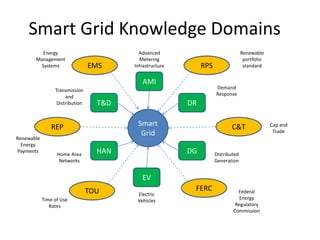
Smart Grid Knowledge Domains
         Energy                            Advanced                                Renewable
       Management                          Metering                                 portfolio
        Systems                  EMS     Infrastructure        RPS                  standard


                                            AMI
                                                                     Demand
                 Transmission
                                                                     Response
                      and
                  Distribution     T&D                    DR

               REP                        Smart                             C&T                 Cap and
                                           Grid                                                  Trade
Renewable
  Energy
 Payments
                  Home Area        HAN                    DG         Distributed
                   Networks                                          Generation


                                            EV
                                 TOU                       FERC                Federal
                                          Electric
            Time of Use                                                         Energy
                                          Vehicles
               Rates                                                          Regulatory
                                                                             Commission
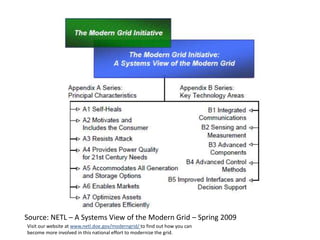
Source: NETL – A Systems View of the Modern Grid – Spring 2009
Visit our website at www.netl.doe.gov/moderngrid/ to find out how you can
become more involved in this national effort to modernize the grid.
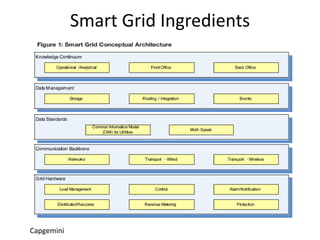
Smart Grid Ingredients


Capgemini
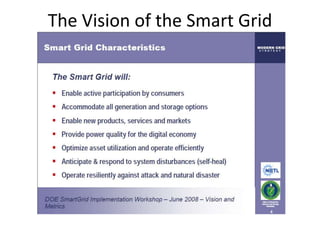
The Vision of the Smart Grid
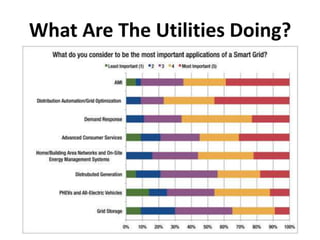
What Are The Utilities Doing?
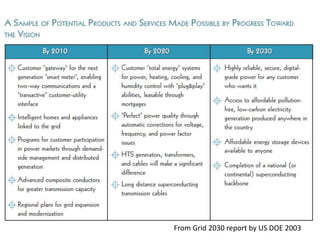
From Grid 2030 report by US DOE 2003
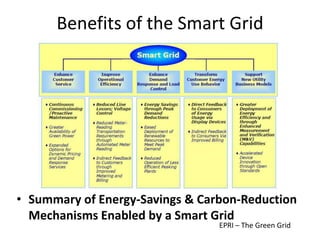
Benefits of the Smart Grid


• Summary of Energy-Savings & Carbon-Reduction
  Mechanisms Enabled by a Smart Grid
                                 EPRI – The Green Grid
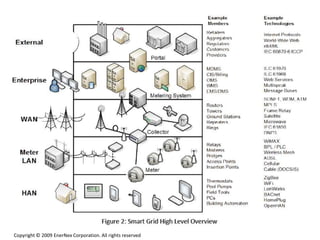
Copyright © 2009 EnerNex Corporation. All rights reserved
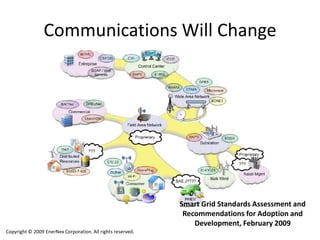
Communications Will Change


                                                             Smart Grid Standards Assessment and
                                                              Recommendations for Adoption and
                                                                 Development, February 2009
Copyright © 2009 EnerNex Corporation. All rights reserved.

Smart grid overview for rlc 1 26-12 rh

  • 1.
    What Is the SmartGrid and Why Should We Care? By: Roger Hicks For: Rachel Carson Middle School January 26, 2012
  • 2.
  • 3.
    What Does ElectricPower Look Like? A spinning electric generator Alternating Power Waveform outputs a waveform like this 1/60th of a second per cycle = 60 Hz Voltage Level (volts) X Current Flow (amps) = Power (watts) If the generator stops spinning the current stops flowing and the lights go out.!
  • 4.
  • 5.
  • 6.
    What Are TheParts Of The Electric Power Grid? Power Generation Plants (power plants) Transmission Networks (wires) Distribution System (wires, transformers, switches) Consumption and Monitoring (loads)
  • 7.
    Power Generation -Central Easy to Schedule
  • 8.
    Power Generation -Distributed Wind Solar Hard to Schedule
  • 9.
  • 10.
    The 100 yrold Electric Power Grid Will Soon Go Through a Rapid Evolution
  • 11.
    Power Distribution Neighborhood Sub-Station Transformer Transformer
  • 12.
    At The Home Load Center (Breaker Box) Watt-Hour Meter
  • 13.
  • 14.
    Home Energy InformationDisplay (Future?)
  • 15.
    History – last100 years + Ultimate Customers Distribution of Electricity Substation Transmission
  • 16.
    What are theGrid Problems?
  • 17.
    Hard To RemotelyDetect Faults A power company may not know a line is down until someone calls them about a power outage
  • 18.
    We Have ToBuild New Capacity To Meet Increasing Demand The Cost per Watt of Power for New Generation is Getting More Expensive All The Time The Output To Meet New Demand Has More Than Doubled in Less Than 20 Yrs
  • 19.
    Unused Capacity isa Waste of Money capacity We spend money on a system that big enough to handle the total load - which does not happen all the time.
  • 20.
    Peak Loads AreRare And The Cost of That Peak Power Source is Expensive Because we want our power to always be on we pay a high price for meeting peak demand just a few hours per year
  • 21.
    New Loads AreGoing to Impact The Stability of The Electric Grid If there are a lot of plug-in electric cars and everyone plugs in at the same time (evening) to charge up the grid could be overloaded.
  • 22.
    Cannot Easily StoreElectricity For Later Use Have to back up renewable wind and solar power with other sources which may be hard to secure.
  • 23.
    We Don’t KnowOur Personal Fuel Mix Users have no information to tell them the mix of fuels being used for the electricity they are using when they use it.
  • 24.
    No Transparency ofReal Electric Costs or Shifting of Load Based on Price Incentives Would people use energy differently if they were charged what it really cost in real time?
  • 25.
    How Will TheGrid Becomes Smarter EPRI – The Green Grid
  • 26.
    A Smarter GridWill…. • Make it easier for people to get information about the electricity they use so they can make better choices about how they want to consume energy. • Make it easier for power providers to know about the health of the grid and take actions to make it more reliable and efficient. • Make it easier to fully integrate the intermittent power production from distributed renewable generation sources.
  • 27.
  • 28.
    It’s Time toThink Different • While the Smart Grid will utilize the latest technology to achieve its goals, it is not just about technology. • Implementation of the Smart Grid will require a complete rethinking of the public policy, utility business models, business processes and consumer behavior. • This is a real paradigm shift!
  • 29.
  • 30.
  • 31.
    Why All ThisInterest In Energy? • Electricity is one of the largest and most capital-intensive sectors of the economy. – Total asset value is estimated to exceed $800 billion, with approximately 60% invested in power plants, 30% in distribution facilities, and 10% in transmission facilities. • Annual electric revenues – the Nation’s “electric bill” – are about $247 billion – Paid by America’s 131 million electricity customers, which includes nearly every business and household. – There are more than 3,100 electric utilities and additionally, there are nearly 2,100 non-utility power producers, including both independent power companies and customer-owned distributed energy facilities. • “The grid of the future will require $165 billion over the next 20 years” - EPRI – The benefits to society will be $638 to 802 billion. The cost-benefit is 4 to 1. • There are a lot of risks we face by staying on the current path. – Uncertain access to fuel resources – cost may go out of control – Increasing harm to the atmosphere – global warming may change the planet – Unpredictable power outages – cascading grid failures disrupt commerce – Poor utilization of economic capital – unnecessary cost increases for energy users
  • 34.
    What is theSmart Grid? • According to US Department of Energy (DOE): –Smart Grid is the term used for an electricity delivery system that is integrated with modern digital and information technology to provide improved reliability, security, efficiency and ultimately lower cost to the user.
  • 35.
    What is theSmart Grid? • According the Federal Energy Regulation Commission (FERC) – “The Smart Grid means a lot of things, but for us, the Smart Grid means a more efficient transmission system that can reduce emissions and increase reliability,” FERC Commissioner Philip Moeller said. “For example, by minimizing line losses, Smart Grid technologies will allow generators to produce less energy and less pollution, while delivering the same amount of electricity to customers.” • According to Electric Power Research Institute (EPRI) – The term Smart Grid may be best understood as the overlaying of a unified communications and control system on the existing power delivery infrastructure to provide the right information to the right entity (e.g. end-use devices, T&D system controls, customers, etc.) at the right time to take the right action. – It is a system that optimizes power supply and delivery, minimizes losses, is self-healing, and enables next-generation energy efficiency and demand response applications.
  • 36.
    Goals and Characteristics,Which Together Characterize a Smart Grid From: FERC – Smart Grid Policy, March 2009 • Integration of “smart” appliances and consumer devices. • Deployment and integration of advanced electricity storage and peak- shaving technologies, including plug-in electric and hybrid electric vehicles, and thermal storage air conditioning. • Provision to consumers of timely information and control options. • Development of standards for communication and interoperability of appliances and equipment connected to the electric grid, including the infrastructure serving the grid. • Identification and lowering of unreasonable or unnecessary barriers to adoption of smart grid technologies, practices, and services.
  • 37.
    Goals and Characteristics,Which Together Characterize a Smart Grid From: FERC – Smart Grid Policy, March 2009 • Increased use of digital information and controls technology to improve reliability, security, and efficiency of the electric grid. • Dynamic optimization of grid operations and resources, with full cyber- security. • Deployment and integration of distributed resources and generation, including renewable resources. • Development and incorporation of demand response, demand-side resources, and energy efficiency resources. • Deployment of “smart” technologies (real-time, automated, interactive technologies that optimize the physical operation of appliances and consumer devices) for metering, communications concerning grid operations and status, and distribution automation.
  • 38.
    Smart Grid KnowledgeDomains Energy Advanced Renewable Management Metering portfolio Systems EMS Infrastructure RPS standard AMI Demand Transmission Response and Distribution T&D DR REP Smart C&T Cap and Grid Trade Renewable Energy Payments Home Area HAN DG Distributed Networks Generation EV TOU FERC Federal Electric Time of Use Energy Vehicles Rates Regulatory Commission
  • 39.
    Source: NETL –A Systems View of the Modern Grid – Spring 2009 Visit our website at www.netl.doe.gov/moderngrid/ to find out how you can become more involved in this national effort to modernize the grid.
  • 40.
  • 41.
    The Vision ofthe Smart Grid
  • 42.
    What Are TheUtilities Doing?
  • 44.
    From Grid 2030report by US DOE 2003
  • 45.
    Benefits of theSmart Grid • Summary of Energy-Savings & Carbon-Reduction Mechanisms Enabled by a Smart Grid EPRI – The Green Grid
  • 46.
    Copyright © 2009EnerNex Corporation. All rights reserved
  • 47.
    Communications Will Change Smart Grid Standards Assessment and Recommendations for Adoption and Development, February 2009 Copyright © 2009 EnerNex Corporation. All rights reserved.