Stoma
logman mohammed alshaikh
1
introduction
The word ‘stoma’ refers to an
‘artificial opening’. When surgery
is required to remove part of the
bowel or bladder as a result of
disease or trauma, a stoma is
formed on the surface of the
abdomen to allow excretion of
faecal matter or urine. A
‘colostomy’ is an artificial
opening of the colon onto the
abdominal surface. It may originate
from:
CONT
● the sigmoid colon
● the descending colon
● the transverse colon
● the ascending colon.
cont
A colostomy is usually sited at
the left iliac fossa. If the
colostomy exits from the sigmoid
or descending colon, its output
will be formed with anormal
faecal odour.
If it is sited in the transverse or
ascending colon,
the output will be loose and
copious with a strong odour.
cont
An ‘ileostomy’ is an artificial
opening of the ileum onto the
abdominal surface. It is usually
sited in the right iliac fossa.
The output from an ileostomy
(‘effluent’) is very soft and fluid,
which necessitates emptying of the
appliance approximately six times
per day.
Characteristics of
Stomas
Normal stomal characteristics:
pink-red, moist, bleeds slightly when
rubbed, no feeling to touch, stool
functions involuntary, and
postoperative swelling gradually
decreases over several months.
6
cont
• Stoma classifications:
a. End stoma:
b. Double-barrel stoma
c. Loop stoma:
7
Indications of stoma
• Inflammatory Bowel Disease
• Primarily Ulcerative Colitis
• Perforating Diverticulitis
• Cancers, Tumors
• Rectovaginal Fistula
• Trauma
• Intestinal obstruction
8
Preoperative Management
and Nursing Care
1. Prepare the patient for general abdominal
surgery
2. Administer replacement fluid, as ordered,
before surgery due to possible increased output
during the postoperative phase.
3. Provide low-residue diet before NPO status.
4. Explain that the abdomen may be marked by
the ostomy specialty nurse or surgeon to ensure
proper positioning of the stoma.
Cnt
5. Other considerations when selecting a
stoma include:
a. Positioning within rectus muscle.
b. Avoidance of bony prominences.
c. Clearance from umbilicus, scars, and deep
creases,
observed in lying, sitting, and standing
positions.
d. Positioning on a flat pouching surface.
e. Avoidance of beltline when possible.
f. Positioning within patient’s visibility to
optimize
Postoperative Management
and Nursing Care
1. Administer general abdominal
surgery care .
2. Assess stoma every shift for
color and record findings:
a. Normal color: pink-red
b. Dusky: dark red; purplish hue
(ischemic sign)
c. Necrotic: brown or black; may be
dry (notify health care provider to
determine extent of necrosis)
Healthy Stoma
12
cont
3. Apply pouching system as close
to stoma as possible without it
being rubbed.
4. Check for abdominal distention,
which reduces blood flow to stoma
through mesenteric tension.
5. Evaluate and empty drains and
ostomy pouch frequently to
promote patency and maintain seal.
cont
6. Monitor intake and output with
extreme accuracy, because output
may remain high during early
postoperative period.
7. Suction and irrigate NG tube
frequently, as ordered, to relieve
pressure and decrease gastric
contents.
8. Offer continued support to
patient and family.
Complications
1. Mucocutaneous separation (between
skin and stoma)
2. Stomal ischemia
3. Stomal stricture or stenosis (usually a
long-term complication)
4. Stomal prolapse
5. Peristomal hernia
6. Peristomal skin breakdown from
exposure to fecal output, allergic reaction
to products, or infection, such as
candidiasis
Information about
appliances
In the initial post-operative period, a clear
plastic appliance (stoma pouch) is used to
allow observation of output. However,
opaque appliances may be used later.
Colostomy bags are available with flatus
filters and charcoal filters to decrease
odour.
A patient with an ileostomy will need to
use a drainable device, where the end is
sealed with a tie or plastic clip. These are
also available with filters.
17
changing a stoma bag
Equipment
● Warm water in sink.
● Soft wipes/gauze (not tissue or
toilet paper as this disintegrates
when wet).
● New appliance.
● Scissors.
● Template.
● Clip or tie fixed on bottom of
pouch if required.
● Plastic disposal bag.
● Protective sheet/tissue paper.
● Pen.
● Barrier cream if advised.
● Gloves and apron if nurse
assists.
Procedure
● Prepare equipment.
● Protect clothing.
● If patient is wearing a drainable
pouch he should empty it first to
avoid spillage.
● Remove soiled pouch by starting
at the top of the flange and gently
peeling from top to bottom. Use the
free hand to support
surrounding skin.
● Wash around stoma and
surrounding skin using soft wipes.
Place these in rubbish bag.
● Thoroughly dry skin with soft
wipes. Dispose of wipes.
● Check the condition of the
stoma and surrounding skin and
apply barrier cream if advised.
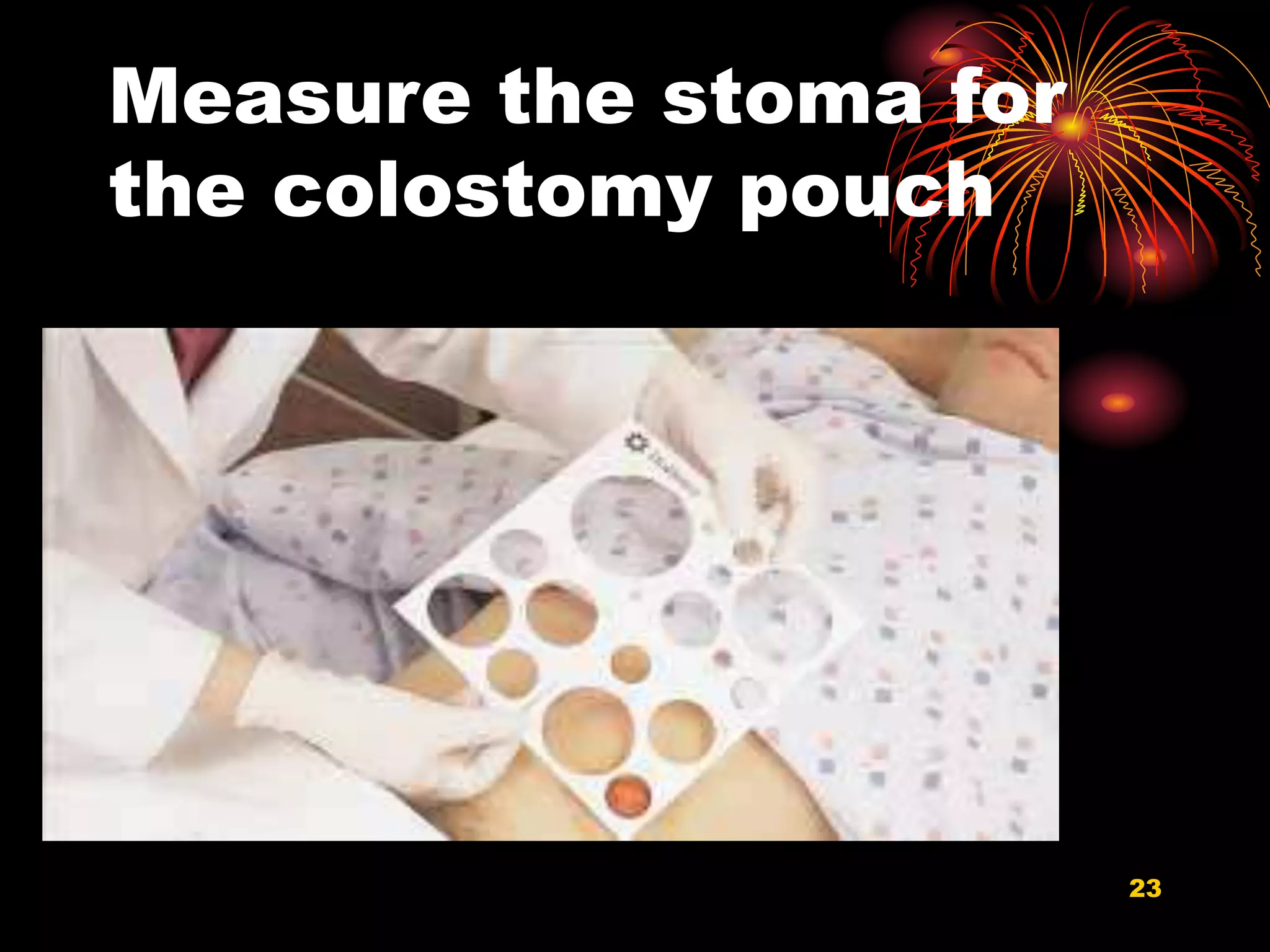
● If necessary, measure the size of the
stoma and make a template. Using the
template cut the flange to the correct
size. The flange should fit snugly around
the stoma. If it is too small, the edge of
the flange may cause bruising or
bleeding due to friction with the stoma.
If it is too big, excrement may spill onto
the surrounding skin causing soreness
and, potentially, skin breakdown.
Measure the stoma for
the colostomy pouch
23
● Remove backing paper from the
new stoma bag. Fold the bag in half
so that the flange is rounded.
Position the bag onto the stoma
by matching lower edge of opening
with bottom edge of stoma.Fold top
half of the flange over stoma and
press firmly on the skin.
Ensure that the stoma mucosa is
not covered with the flange.
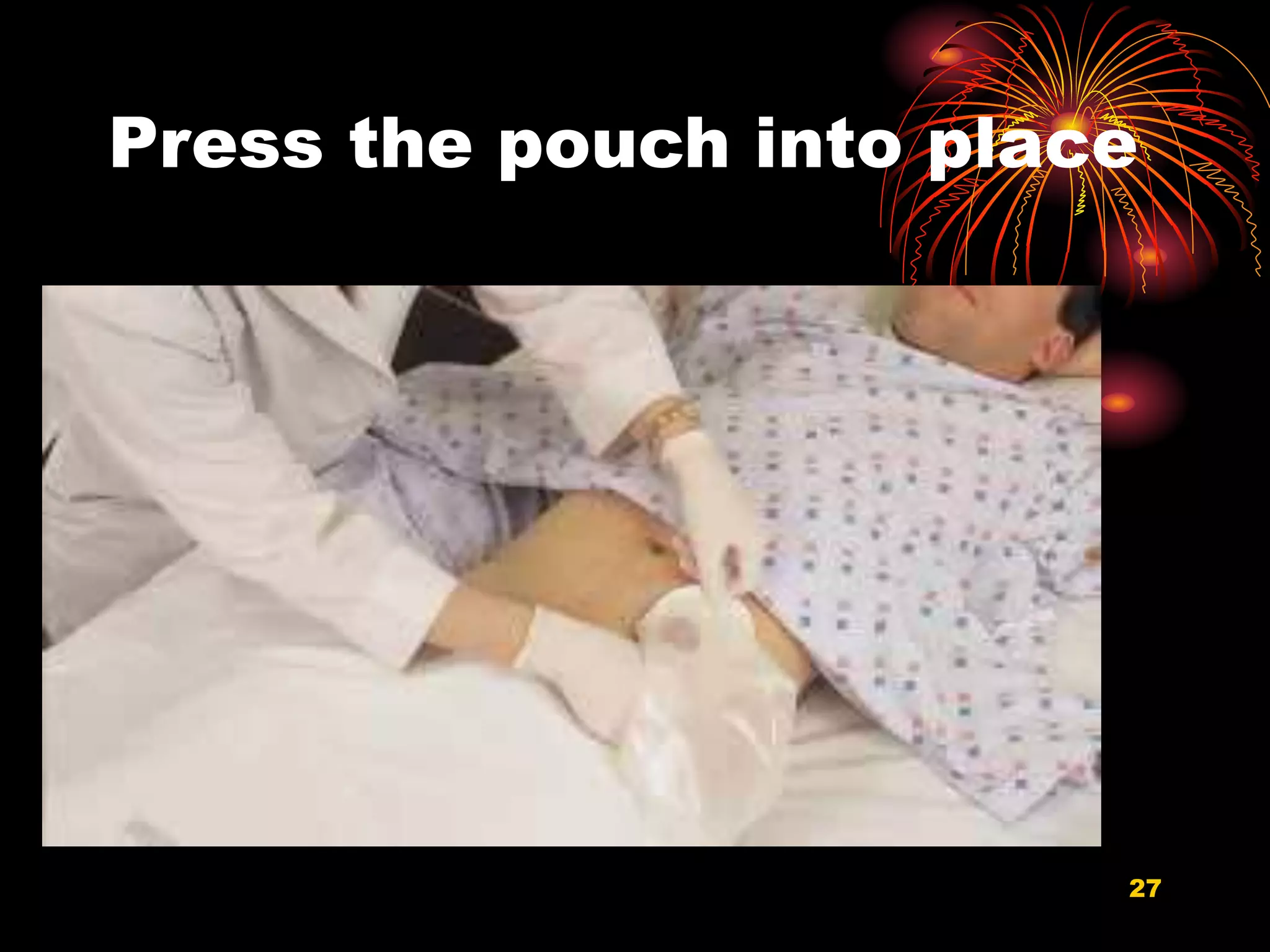
● Apply gentle pressure around the flange
ensuring that it adheres to the skin. Check
that it is free of creases as these may
cause leakage.
● Empty soiled pouch into toilet and
discard into rubbish bag.
● Wash hands.
● Document how patient coped with the
procedure and that the stoma bag has been
changed. Any problems should be reported
to a senior colleague.
Apply the skin barrier to
the stoma
26
Press the pouch into place
27
THANKS
‫عمسا‬ ‫مكنع‬ ‫لك‬ ‫ريخ‬
28

Stoma

  • 1.
  • 2.
    introduction The word ‘stoma’refers to an ‘artificial opening’. When surgery is required to remove part of the bowel or bladder as a result of disease or trauma, a stoma is formed on the surface of the abdomen to allow excretion of faecal matter or urine. A ‘colostomy’ is an artificial opening of the colon onto the abdominal surface. It may originate from:
  • 3.
    CONT ● the sigmoidcolon ● the descending colon ● the transverse colon ● the ascending colon.
  • 4.
    cont A colostomy isusually sited at the left iliac fossa. If the colostomy exits from the sigmoid or descending colon, its output will be formed with anormal faecal odour. If it is sited in the transverse or ascending colon, the output will be loose and copious with a strong odour.
  • 5.
    cont An ‘ileostomy’ isan artificial opening of the ileum onto the abdominal surface. It is usually sited in the right iliac fossa. The output from an ileostomy (‘effluent’) is very soft and fluid, which necessitates emptying of the appliance approximately six times per day.
  • 6.
    Characteristics of Stomas Normal stomalcharacteristics: pink-red, moist, bleeds slightly when rubbed, no feeling to touch, stool functions involuntary, and postoperative swelling gradually decreases over several months. 6
  • 7.
    cont • Stoma classifications: a.End stoma: b. Double-barrel stoma c. Loop stoma: 7
  • 8.
    Indications of stoma •Inflammatory Bowel Disease • Primarily Ulcerative Colitis • Perforating Diverticulitis • Cancers, Tumors • Rectovaginal Fistula • Trauma • Intestinal obstruction 8
  • 9.
    Preoperative Management and NursingCare 1. Prepare the patient for general abdominal surgery 2. Administer replacement fluid, as ordered, before surgery due to possible increased output during the postoperative phase. 3. Provide low-residue diet before NPO status. 4. Explain that the abdomen may be marked by the ostomy specialty nurse or surgeon to ensure proper positioning of the stoma.
  • 10.
    Cnt 5. Other considerationswhen selecting a stoma include: a. Positioning within rectus muscle. b. Avoidance of bony prominences. c. Clearance from umbilicus, scars, and deep creases, observed in lying, sitting, and standing positions. d. Positioning on a flat pouching surface. e. Avoidance of beltline when possible. f. Positioning within patient’s visibility to optimize
  • 11.
    Postoperative Management and NursingCare 1. Administer general abdominal surgery care . 2. Assess stoma every shift for color and record findings: a. Normal color: pink-red b. Dusky: dark red; purplish hue (ischemic sign) c. Necrotic: brown or black; may be dry (notify health care provider to determine extent of necrosis)
  • 12.
  • 13.
    cont 3. Apply pouchingsystem as close to stoma as possible without it being rubbed. 4. Check for abdominal distention, which reduces blood flow to stoma through mesenteric tension. 5. Evaluate and empty drains and ostomy pouch frequently to promote patency and maintain seal.
  • 14.
    cont 6. Monitor intakeand output with extreme accuracy, because output may remain high during early postoperative period. 7. Suction and irrigate NG tube frequently, as ordered, to relieve pressure and decrease gastric contents. 8. Offer continued support to patient and family.
  • 15.
    Complications 1. Mucocutaneous separation(between skin and stoma) 2. Stomal ischemia 3. Stomal stricture or stenosis (usually a long-term complication) 4. Stomal prolapse 5. Peristomal hernia 6. Peristomal skin breakdown from exposure to fecal output, allergic reaction to products, or infection, such as candidiasis
  • 16.
    Information about appliances In theinitial post-operative period, a clear plastic appliance (stoma pouch) is used to allow observation of output. However, opaque appliances may be used later. Colostomy bags are available with flatus filters and charcoal filters to decrease odour. A patient with an ileostomy will need to use a drainable device, where the end is sealed with a tie or plastic clip. These are also available with filters.
  • 17.
  • 18.
    changing a stomabag Equipment ● Warm water in sink. ● Soft wipes/gauze (not tissue or toilet paper as this disintegrates when wet). ● New appliance. ● Scissors. ● Template.
  • 19.
    ● Clip ortie fixed on bottom of pouch if required. ● Plastic disposal bag. ● Protective sheet/tissue paper. ● Pen. ● Barrier cream if advised. ● Gloves and apron if nurse assists.
  • 20.
    Procedure ● Prepare equipment. ●Protect clothing. ● If patient is wearing a drainable pouch he should empty it first to avoid spillage. ● Remove soiled pouch by starting at the top of the flange and gently peeling from top to bottom. Use the free hand to support surrounding skin.
  • 21.
    ● Wash aroundstoma and surrounding skin using soft wipes. Place these in rubbish bag. ● Thoroughly dry skin with soft wipes. Dispose of wipes. ● Check the condition of the stoma and surrounding skin and apply barrier cream if advised.
  • 22.
    ● If necessary,measure the size of the stoma and make a template. Using the template cut the flange to the correct size. The flange should fit snugly around the stoma. If it is too small, the edge of the flange may cause bruising or bleeding due to friction with the stoma. If it is too big, excrement may spill onto the surrounding skin causing soreness and, potentially, skin breakdown.
  • 23.
    Measure the stomafor the colostomy pouch 23
  • 24.
    ● Remove backingpaper from the new stoma bag. Fold the bag in half so that the flange is rounded. Position the bag onto the stoma by matching lower edge of opening with bottom edge of stoma.Fold top half of the flange over stoma and press firmly on the skin. Ensure that the stoma mucosa is not covered with the flange.
  • 25.
    ● Apply gentlepressure around the flange ensuring that it adheres to the skin. Check that it is free of creases as these may cause leakage. ● Empty soiled pouch into toilet and discard into rubbish bag. ● Wash hands. ● Document how patient coped with the procedure and that the stoma bag has been changed. Any problems should be reported to a senior colleague.
  • 26.
    Apply the skinbarrier to the stoma 26
  • 27.
    Press the pouchinto place 27
  • 28.