Colostomy and ileostomy care
Ostomy
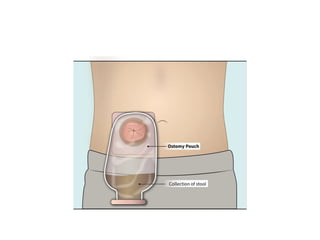
• An ostomy is a surgically created opening on
the abdomen that allows the discharge of
body waste when the normal elimination
route is no longer possible.
• The outermost part that is visible is a stoma.
• The stoma is the result of the large or small
bowel being brought to the outside of the
abdomen and sutured in place.
• When a stoma is created as a fecal diversion,
feces will drain through the stoma instead of
the anus
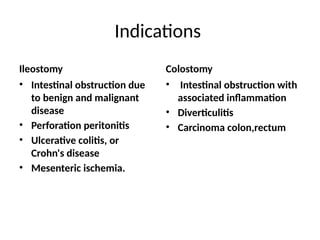
Indications
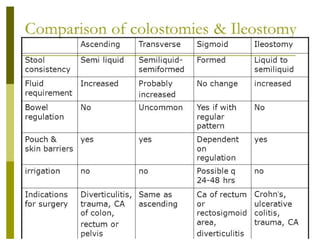
Ileostomy
• Intestinal obstruction due
to benign and malignant
disease
• Perforation peritonitis
• Ulcerative colitis, or
Crohn's disease
• Mesenteric ischemia.
Colostomy
• Intestinal obstruction with
associated inflammation
• Diverticulitis
• Carcinoma colon,rectum
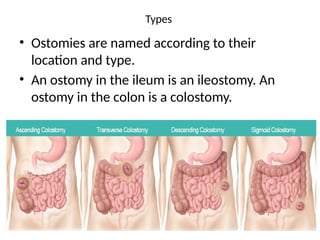
Types
• Ostomies are named according to their
location and type.
• An ostomy in the ileum is an ileostomy. An
ostomy in the colon is a colostomy.
• Ostomies may be temporary or permanent.
• Permanent ostomies may be continent or
traditional.
Permanent colostomy
Continent ileostomies
• Koch pouch
• Barnett Continent Ileal
Reservoir( use 40 to 45
cm of the terminal
ileum to fashion an
internal pouch, nipple
valve, and abdominal
stoma)
Traditional ostomies
• End stoma
• Double barreled stoma
• Loop ostomy.
End Stoma
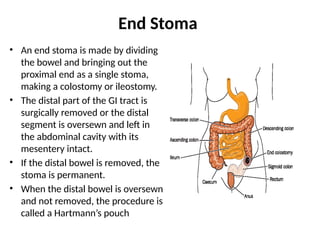
• An end stoma is made by dividing
the bowel and bringing out the
proximal end as a single stoma,
making a colostomy or ileostomy.
• The distal part of the GI tract is
surgically removed or the distal
segment is oversewn and left in
the abdominal cavity with its
mesentery intact.
• If the distal bowel is removed, the
stoma is permanent.
• When the distal bowel is oversewn
and not removed, the procedure is
called a Hartmann’s pouch
Loop Stoma
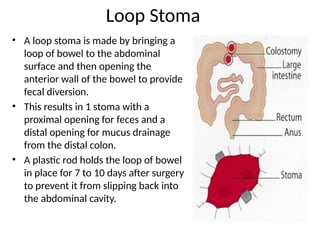
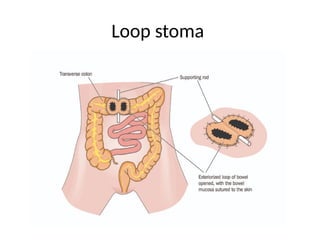
• A loop stoma is made by bringing a
loop of bowel to the abdominal
surface and then opening the
anterior wall of the bowel to provide
fecal diversion.
• This results in 1 stoma with a
proximal opening for feces and a
distal opening for mucus drainage
from the distal colon.
• A plastic rod holds the loop of bowel
in place for 7 to 10 days after surgery
to prevent it from slipping back into
the abdominal cavity.
Loop stoma
Double-Barreled Stoma
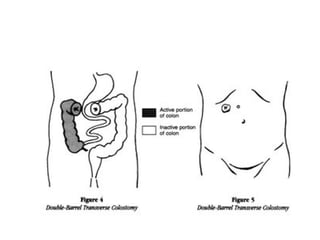
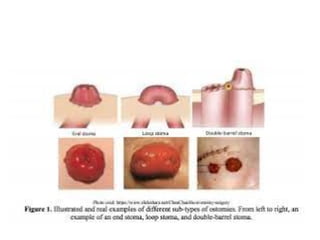
• To create a double-barreled stoma,the bowel
is divided and both the proximal and distal
ends are brought through the abdominal wall
as 2 separate stomas .
• The proximal stoma is the functioning stoma.
The distal, nonfunctioning stoma is a mucus
fistula.
• A double-barreled stoma is usually temporary.
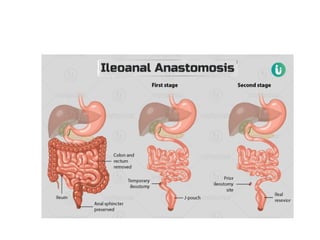
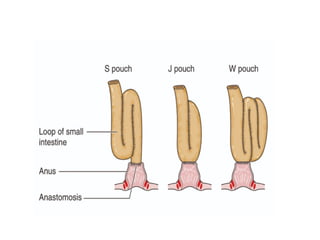
Ileoanal Pouch Anastomosis
• For clients who need to have colectomy for
treatment of ulcerative colitis
• Colon is removed, pouch is created from the
end of small intestine and attached to the
anus.
• Pouch provides collection of waste material ,
similar to rectum.
• Stool is evacuated by anus.
• When ileal pouch is created temporary
ileostomy to allow anastomosis to heal.
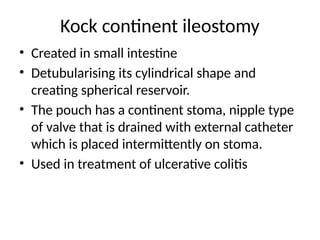
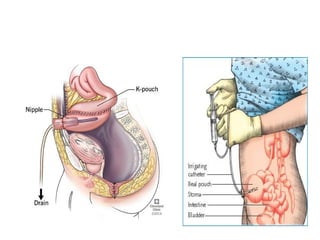
Kock continent ileostomy
• Created in small intestine
• Detubularising its cylindrical shape and
creating spherical reservoir.
• The pouch has a continent stoma, nipple type
of valve that is drained with external catheter
which is placed intermittently on stoma.
• Used in treatment of ulcerative colitis
Preoperative Care
• Selection of a flat site on the abdomen that
allows secure attachment of collection bag
• Selection of stoma site that will clearly visible
to the patient
• Criteria for selection of site include
• it should lie within the rectus muscle is a flat
crease-free surface
• Stoma placed outside rectus muscle increase
the chance of developing hernia.
• Bowel preparation: Empty the intestine before surgery
to decrease chance of infection caused by bacteria in
feces.
• Psychologic preparation and emotional support are
particularly important as the person begins to cope with
potential changes in body image and elimination.
• The patient and caregiver should understand the extent
of surgery planned.
• It is normal for the patient and caregiver to have
questions concerning the procedures.
• Provide the patient opportunities to share concerns and
questions.
Providing Postoperative Care
• Pain management during the immediate
postoperative period.
• Monitor the patient for complications
• Leakage from the site of the anastomosis
• Prolapse of the stoma
• Perforation, stoma retraction,
• Fecal impaction
• Skin irritation
• Pulmonary complications associated with
abdominal surgery.
• Assess the abdomen for returning peristalsis
and assesses the initial stool characteristics.
• Help patients with a colostomy out of bed on
the first postoperative day and encourage
them to begin participating in managing the
colostomy
Managing nutrition
• The diet is individualized as long as it is well balanced and does not
cause diarrhea or constipation.
• The return to normal diet is rapid.
• A complete nutritional assessment is important for patients with a
colostomy.
• The patient avoids foods that cause excessive odor and gas,
including foods in the cabbage family, eggs, fish, beans, and high-
cellulose products such as peanuts.
• Determine whether the elimination of specific foods is causing any
nutritional deficiency.
• Help the patient identify any foods or fluids that may be causing
diarrhea, such as fruits, high-fiber foods, soda, coffee, tea, or
carbonated beverages.
• For constipation, prune or apple juice or a mild laxative is effective.
• Encourage fluid intake of at least 2 L of fluid per day
Providing Wound Care
• Frequently examine the abdominal dressing during the
first 24 hours after surgery to detect signs of hemorrhage.
• It is important to help the patient splint the abdominal
incision during coughing and deep breathing to lessen
tension on the edges of the incision.
• Monitor temperature, pulse, and respiratory rate for
elevations, which may indicate an infectious process.
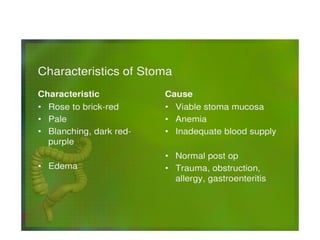
• If the patient has a colostomy, the stoma is examined for
swelling (slight edema from surgical manipulation is
normal), color (a healthy stoma is pink or red), discharge
(a small amount of oozing is normal), and bleeding (an
abnormal sign).
Irrigating The Colostomy
• A stoma does not have voluntary muscular control and may
empty at irregular intervals.
• Regulating the passage of fecal material is achieved by
irrigating the colostomy or allowing the bowel to evacuate
naturally without irrigations.
• The choice often depends on the individual and the type of
the colostomy.
• By irrigating the stoma at a regular time, there is less gas
and retention of the irrigant.
• The time for irrigating the colostomy should be consistent
with the schedule the person will follow after leaving the
hospital
Supporting A Positive Body Image
• The patient is encouraged to verbalize feelings
and concerns about altered body image and to
discuss the surgery and the stoma (if one was
created).
• A supportive environment and a supportive
attitude on the nurse’s part are crucial in
promoting the patient’s adaptation to the
changes brought about by the surgery.
• Assess the wound regularly and record
bleeding, excess drainage, and unusual odor.
• Monitor for edema, erythema, and drainage
around the suture line, as well as fever and a
high WBC count.
• Observe the skin around any drains for signs of
inflammation.
• Keep the area around the drain clean and dry.
• If an ostomy is present, assess the stoma and place
a clear pouching system that protects the skin and
contains drainage and odor.
• The stoma should be rosy pink to red and mildly
swollen
• A dusky blue stoma indicates ischemia; a brown-
black stoma indicates necrosis.
• Assess and document stoma color every 4 hours
and ensure that there is no excess bleeding.
• Report any sustained color changes or bleeding to
the HCP.
• Edema will resolve over the first 6 weeks.
• Complications
• Delayed wound healing
• Hemorrhage
• Fistulas
• Infections
• The colostomy starts functioning when peristalsis
returns.
• Record the volume, color, and consistency of the
drainage.
• When a colostomy is done on a colon that was not
cleaned out before surgery, stool will drain when
peristalsis returns.
• If the bowel was cleansed preoperatively, it will not
begin producing stool until a few days after the
patient is eating again
• Excessive amounts of gas are common during
the first 2 weeks.
• Because this can be distressing to patients,
assure them this is temporary
• In the first 24 to 48 hours after surgery, the
amount of drainage from an ileostomy may be
negligible.
• When peristalsis returns, ileostomy output
may be as high as 1500 to 1800 mL/24 hr.
• If the small bowel is shortened by surgery,
drainage may be greater.
• After intraoperative manipulation of the anal
canal, transient incontinence of mucus may
occur.
• Have the patient start Kegel exercises about 4
weeks after surgery to strengthen the pelvic
floor and sphincter muscles
• Perianal skin care is important to protect the
epidermis from mucous drainage and
maceration.
• Teach the patient to gently clean the skin with a
mild cleanser, rinse well, and dry thoroughly.

colostomy types , indications management and care

  • 1.
  • 2.
    Ostomy • An ostomyis a surgically created opening on the abdomen that allows the discharge of body waste when the normal elimination route is no longer possible. • The outermost part that is visible is a stoma. • The stoma is the result of the large or small bowel being brought to the outside of the abdomen and sutured in place. • When a stoma is created as a fecal diversion, feces will drain through the stoma instead of the anus
  • 4.
    Indications Ileostomy • Intestinal obstructiondue to benign and malignant disease • Perforation peritonitis • Ulcerative colitis, or Crohn's disease • Mesenteric ischemia. Colostomy • Intestinal obstruction with associated inflammation • Diverticulitis • Carcinoma colon,rectum
  • 5.
    Types • Ostomies arenamed according to their location and type. • An ostomy in the ileum is an ileostomy. An ostomy in the colon is a colostomy.
  • 7.
    • Ostomies maybe temporary or permanent. • Permanent ostomies may be continent or traditional.
  • 8.
    Permanent colostomy Continent ileostomies •Koch pouch • Barnett Continent Ileal Reservoir( use 40 to 45 cm of the terminal ileum to fashion an internal pouch, nipple valve, and abdominal stoma) Traditional ostomies • End stoma • Double barreled stoma • Loop ostomy.
  • 9.
    End Stoma • Anend stoma is made by dividing the bowel and bringing out the proximal end as a single stoma, making a colostomy or ileostomy. • The distal part of the GI tract is surgically removed or the distal segment is oversewn and left in the abdominal cavity with its mesentery intact. • If the distal bowel is removed, the stoma is permanent. • When the distal bowel is oversewn and not removed, the procedure is called a Hartmann’s pouch
  • 10.
    Loop Stoma • Aloop stoma is made by bringing a loop of bowel to the abdominal surface and then opening the anterior wall of the bowel to provide fecal diversion. • This results in 1 stoma with a proximal opening for feces and a distal opening for mucus drainage from the distal colon. • A plastic rod holds the loop of bowel in place for 7 to 10 days after surgery to prevent it from slipping back into the abdominal cavity.
  • 11.
  • 12.
    Double-Barreled Stoma • Tocreate a double-barreled stoma,the bowel is divided and both the proximal and distal ends are brought through the abdominal wall as 2 separate stomas . • The proximal stoma is the functioning stoma. The distal, nonfunctioning stoma is a mucus fistula. • A double-barreled stoma is usually temporary.
  • 15.
    Ileoanal Pouch Anastomosis •For clients who need to have colectomy for treatment of ulcerative colitis • Colon is removed, pouch is created from the end of small intestine and attached to the anus. • Pouch provides collection of waste material , similar to rectum. • Stool is evacuated by anus. • When ileal pouch is created temporary ileostomy to allow anastomosis to heal.
  • 18.
    Kock continent ileostomy •Created in small intestine • Detubularising its cylindrical shape and creating spherical reservoir. • The pouch has a continent stoma, nipple type of valve that is drained with external catheter which is placed intermittently on stoma. • Used in treatment of ulcerative colitis
  • 22.
    Preoperative Care • Selectionof a flat site on the abdomen that allows secure attachment of collection bag • Selection of stoma site that will clearly visible to the patient • Criteria for selection of site include • it should lie within the rectus muscle is a flat crease-free surface • Stoma placed outside rectus muscle increase the chance of developing hernia.
  • 23.
    • Bowel preparation:Empty the intestine before surgery to decrease chance of infection caused by bacteria in feces. • Psychologic preparation and emotional support are particularly important as the person begins to cope with potential changes in body image and elimination. • The patient and caregiver should understand the extent of surgery planned. • It is normal for the patient and caregiver to have questions concerning the procedures. • Provide the patient opportunities to share concerns and questions.
  • 24.
    Providing Postoperative Care •Pain management during the immediate postoperative period. • Monitor the patient for complications • Leakage from the site of the anastomosis • Prolapse of the stoma • Perforation, stoma retraction, • Fecal impaction • Skin irritation • Pulmonary complications associated with abdominal surgery.
  • 25.
    • Assess theabdomen for returning peristalsis and assesses the initial stool characteristics. • Help patients with a colostomy out of bed on the first postoperative day and encourage them to begin participating in managing the colostomy
  • 26.
    Managing nutrition • Thediet is individualized as long as it is well balanced and does not cause diarrhea or constipation. • The return to normal diet is rapid. • A complete nutritional assessment is important for patients with a colostomy. • The patient avoids foods that cause excessive odor and gas, including foods in the cabbage family, eggs, fish, beans, and high- cellulose products such as peanuts. • Determine whether the elimination of specific foods is causing any nutritional deficiency. • Help the patient identify any foods or fluids that may be causing diarrhea, such as fruits, high-fiber foods, soda, coffee, tea, or carbonated beverages. • For constipation, prune or apple juice or a mild laxative is effective. • Encourage fluid intake of at least 2 L of fluid per day
  • 27.
    Providing Wound Care •Frequently examine the abdominal dressing during the first 24 hours after surgery to detect signs of hemorrhage. • It is important to help the patient splint the abdominal incision during coughing and deep breathing to lessen tension on the edges of the incision. • Monitor temperature, pulse, and respiratory rate for elevations, which may indicate an infectious process. • If the patient has a colostomy, the stoma is examined for swelling (slight edema from surgical manipulation is normal), color (a healthy stoma is pink or red), discharge (a small amount of oozing is normal), and bleeding (an abnormal sign).
  • 29.
    Irrigating The Colostomy •A stoma does not have voluntary muscular control and may empty at irregular intervals. • Regulating the passage of fecal material is achieved by irrigating the colostomy or allowing the bowel to evacuate naturally without irrigations. • The choice often depends on the individual and the type of the colostomy. • By irrigating the stoma at a regular time, there is less gas and retention of the irrigant. • The time for irrigating the colostomy should be consistent with the schedule the person will follow after leaving the hospital
  • 30.
    Supporting A PositiveBody Image • The patient is encouraged to verbalize feelings and concerns about altered body image and to discuss the surgery and the stoma (if one was created). • A supportive environment and a supportive attitude on the nurse’s part are crucial in promoting the patient’s adaptation to the changes brought about by the surgery.
  • 31.
    • Assess thewound regularly and record bleeding, excess drainage, and unusual odor. • Monitor for edema, erythema, and drainage around the suture line, as well as fever and a high WBC count. • Observe the skin around any drains for signs of inflammation. • Keep the area around the drain clean and dry.
  • 32.
    • If anostomy is present, assess the stoma and place a clear pouching system that protects the skin and contains drainage and odor. • The stoma should be rosy pink to red and mildly swollen • A dusky blue stoma indicates ischemia; a brown- black stoma indicates necrosis. • Assess and document stoma color every 4 hours and ensure that there is no excess bleeding. • Report any sustained color changes or bleeding to the HCP. • Edema will resolve over the first 6 weeks.
  • 33.
    • Complications • Delayedwound healing • Hemorrhage • Fistulas • Infections
  • 34.
    • The colostomystarts functioning when peristalsis returns. • Record the volume, color, and consistency of the drainage. • When a colostomy is done on a colon that was not cleaned out before surgery, stool will drain when peristalsis returns. • If the bowel was cleansed preoperatively, it will not begin producing stool until a few days after the patient is eating again
  • 35.
    • Excessive amountsof gas are common during the first 2 weeks. • Because this can be distressing to patients, assure them this is temporary
  • 36.
    • In thefirst 24 to 48 hours after surgery, the amount of drainage from an ileostomy may be negligible. • When peristalsis returns, ileostomy output may be as high as 1500 to 1800 mL/24 hr. • If the small bowel is shortened by surgery, drainage may be greater.
  • 37.
    • After intraoperativemanipulation of the anal canal, transient incontinence of mucus may occur. • Have the patient start Kegel exercises about 4 weeks after surgery to strengthen the pelvic floor and sphincter muscles • Perianal skin care is important to protect the epidermis from mucous drainage and maceration. • Teach the patient to gently clean the skin with a mild cleanser, rinse well, and dry thoroughly.