Comparative Balance sheet
PRESENTED BY:
VIKASH BARNWAL
ASST. PROFESSOR
KASHI INSTITUTE OF TECHNOLOGY
Introduction:
 business organisations prepare financial statements in order to determine their
financial position for a particular period. The primary purpose of preparing
financial statements is to get an idea about the financial soundness of the
organisation.
 Comparative financial statements are one of the most commonly used tools for
undertaking the financial analysis of the statements generated by the business.
Defination
 A technique of comparing financial statements through which the balance sheet of
a company is analysed by comparing its Asset, and Equity and Liabilities for two or
more two accounting periods is known as Comparative Balance Sheet.
 It is a horizontal analysis of Balance Sheet, and with this tool, every item of Assets,
and Equity and Liabilities is analysed for two or more accounting periods. This
analysis can help in forming an opinion regarding the progress of the enterprise.
Definition by Author
Comparative Balance Sheet analysis is the study of the trend of the same items,
group of items, and computed items in two or more Balance Sheets of the same
business enterprise on different dates. -Foulka
Objectives of Comparative Balance Sheet:
 1. The basic objective of a comparative balance sheet is to analyse every item of
Assets, and Equity and Liabilities of two or more accounting years.
 2. It is also prepared to analyse an increase or decrease in every item of Equity and
Liabilities, and Assets in terms of percentage and rupees, and also to determine
the trend and effect of each item.
 3. Lastly, it is prepared to analyse and determine the reasons for any change in
financial position.
Advantages of Comparative Balance Sheet:
 1. More Realistic Approach: A Balance Sheet only shows the balances of Assets,
and Equity and Liabilities of a company after closing the books of accounts at a
certain date. However, a Comparative Balance Sheet not only shows the balances
of Assets, and Equity and Liabilities at a certain date, but also the extent to which
those figures have increased or decreased between these dates.
 2. Emphasis on Changes: A Balance Sheet emphasises on the status of the
company; however, a Comparative Balance Sheet emphasises on the change.
 3. Reflects Trend: A Comparative Balance Sheet allows the user to study the nature,
size, and trend of change in various items of a Balance Sheet. Therefore, it is more
useful than a Balance Sheet of a single year.
 4. Link between Balance Sheet and Statement of Profit & Loss: A Comparative
Balance Sheet acts as a link between the Balance Sheet and Statement of Profit &
Loss of a company as it shows the effects of business operations on its Assets, and
Equity and Liabilities.
 5. Facilitates Planning: A Comparative Balance Sheet helps an organisation in
determining the trends of its growth or decrease in the value of its Assets, and
Equity and Liabilities. The trends ultimately help in planning the future course of
action of the firm.
Preparation of Comparative Balance Sheet:
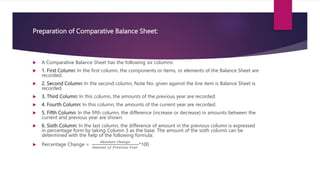
 A Comparative Balance Sheet has the following six columns:
 1. First Column: In the first column, the components or items, or elements of the Balance Sheet are
recorded.
 2. Second Column: In the second column, Note No. given against the line item is Balance Sheet is
recorded.
 3. Third Column: In this column, the amounts of the previous year are recorded.
 4. Fourth Column: In this column, the amounts of the current year are recorded.
 5. Fifth Column: In the fifth column, the difference (increase or decrease) in amounts between the
current and previous year are shown.
 6. Sixth Column: In the last column, the difference of amount in the previous column is expressed
in percentage form by taking Column 3 as the base. The amount of the sixth column can be
determined with the help of the following formula:
 Percentage Change =
𝐴𝑏𝑠𝑜𝑙𝑢𝑡𝑒 𝐶ℎ𝑎𝑛𝑔𝑒
𝐴𝑚𝑜𝑢𝑛𝑡 𝑜𝑓 𝑃𝑟𝑒𝑣𝑖𝑜𝑢𝑠 𝑌𝑒𝑎𝑟
*100
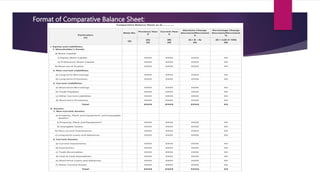
Format of Comparative Balance Sheet:
 *Schedule III of the Companies Act 2013, is amended. And according to this,
“Property, Plant and Equipment, and Intangible Assets” is used in place of Fixed
Assets, and “Property, Plant and Equipment” is used in place of Tangible Assets.
 Notes:
 1. If the current year’s value of a company has decreased, then show the Absolute
Change and Percentage Change in brackets to reflect the negative item.
 2. Accounting treatment or entries related to items like Money received against
Share Warrants, Application Money Pending Allotment, Deferred Tax Assets, etc.,
will not be asked in the examination.
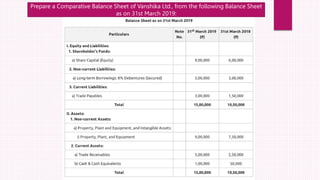
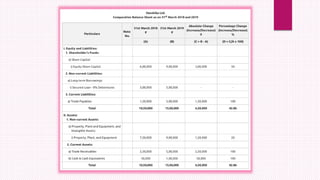
Prepare a Comparative Balance Sheet of Vanshika Ltd., from the following Balance Sheet
as on 31st March 2019:
Comparative Balance sheet.pptx

Comparative Balance sheet.pptx

  • 1.
    Comparative Balance sheet PRESENTEDBY: VIKASH BARNWAL ASST. PROFESSOR KASHI INSTITUTE OF TECHNOLOGY
  • 2.
    Introduction:  business organisationsprepare financial statements in order to determine their financial position for a particular period. The primary purpose of preparing financial statements is to get an idea about the financial soundness of the organisation.  Comparative financial statements are one of the most commonly used tools for undertaking the financial analysis of the statements generated by the business.
  • 3.
    Defination  A techniqueof comparing financial statements through which the balance sheet of a company is analysed by comparing its Asset, and Equity and Liabilities for two or more two accounting periods is known as Comparative Balance Sheet.  It is a horizontal analysis of Balance Sheet, and with this tool, every item of Assets, and Equity and Liabilities is analysed for two or more accounting periods. This analysis can help in forming an opinion regarding the progress of the enterprise.
  • 4.
    Definition by Author ComparativeBalance Sheet analysis is the study of the trend of the same items, group of items, and computed items in two or more Balance Sheets of the same business enterprise on different dates. -Foulka
  • 5.
    Objectives of ComparativeBalance Sheet:  1. The basic objective of a comparative balance sheet is to analyse every item of Assets, and Equity and Liabilities of two or more accounting years.  2. It is also prepared to analyse an increase or decrease in every item of Equity and Liabilities, and Assets in terms of percentage and rupees, and also to determine the trend and effect of each item.  3. Lastly, it is prepared to analyse and determine the reasons for any change in financial position.
  • 6.
    Advantages of ComparativeBalance Sheet:  1. More Realistic Approach: A Balance Sheet only shows the balances of Assets, and Equity and Liabilities of a company after closing the books of accounts at a certain date. However, a Comparative Balance Sheet not only shows the balances of Assets, and Equity and Liabilities at a certain date, but also the extent to which those figures have increased or decreased between these dates.  2. Emphasis on Changes: A Balance Sheet emphasises on the status of the company; however, a Comparative Balance Sheet emphasises on the change.  3. Reflects Trend: A Comparative Balance Sheet allows the user to study the nature, size, and trend of change in various items of a Balance Sheet. Therefore, it is more useful than a Balance Sheet of a single year.
  • 7.
     4. Linkbetween Balance Sheet and Statement of Profit & Loss: A Comparative Balance Sheet acts as a link between the Balance Sheet and Statement of Profit & Loss of a company as it shows the effects of business operations on its Assets, and Equity and Liabilities.  5. Facilitates Planning: A Comparative Balance Sheet helps an organisation in determining the trends of its growth or decrease in the value of its Assets, and Equity and Liabilities. The trends ultimately help in planning the future course of action of the firm.
  • 8.
    Preparation of ComparativeBalance Sheet:  A Comparative Balance Sheet has the following six columns:  1. First Column: In the first column, the components or items, or elements of the Balance Sheet are recorded.  2. Second Column: In the second column, Note No. given against the line item is Balance Sheet is recorded.  3. Third Column: In this column, the amounts of the previous year are recorded.  4. Fourth Column: In this column, the amounts of the current year are recorded.  5. Fifth Column: In the fifth column, the difference (increase or decrease) in amounts between the current and previous year are shown.  6. Sixth Column: In the last column, the difference of amount in the previous column is expressed in percentage form by taking Column 3 as the base. The amount of the sixth column can be determined with the help of the following formula:  Percentage Change = 𝐴𝑏𝑠𝑜𝑙𝑢𝑡𝑒 𝐶ℎ𝑎𝑛𝑔𝑒 𝐴𝑚𝑜𝑢𝑛𝑡 𝑜𝑓 𝑃𝑟𝑒𝑣𝑖𝑜𝑢𝑠 𝑌𝑒𝑎𝑟 *100
  • 9.
    Format of ComparativeBalance Sheet:
  • 10.
     *Schedule IIIof the Companies Act 2013, is amended. And according to this, “Property, Plant and Equipment, and Intangible Assets” is used in place of Fixed Assets, and “Property, Plant and Equipment” is used in place of Tangible Assets.  Notes:  1. If the current year’s value of a company has decreased, then show the Absolute Change and Percentage Change in brackets to reflect the negative item.  2. Accounting treatment or entries related to items like Money received against Share Warrants, Application Money Pending Allotment, Deferred Tax Assets, etc., will not be asked in the examination.
  • 11.
    Prepare a ComparativeBalance Sheet of Vanshika Ltd., from the following Balance Sheet as on 31st March 2019: