Improving efficiency for quality auditing
TIM SANDLE
Project Background
• Internal Quality audits are a requirement of all
Quality Management Systems (QMS) and legal
HTA requirements
• Confirm compliance to quality, technical & legal
requirements
• Highlight issues
• Facilitate improvements
Project identification -
Internal quality audit process
• Current system is paper heavy
• Labour intensive process
• Time consuming completing and collating
multiple documents
• Scanning and filing
• Duplication of work
Project link to business strategy
• Quality and governance underpins all aspects of our work, enabling us to
maintain our legal governance requirements, Quality Accreditation and
Certification status.
• Internal Quality audit provide assurance that our internal processes are
compliant and provide a mechanism for improvements and
benchmarking.
• Efficient auditing will provide staff and management assurance that their
areas are within compliance.
Reasons for project selection
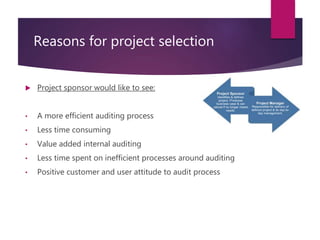
 Project sponsor would like to see:
• A more efficient auditing process
• Less time consuming
• Value added internal auditing
• Less time spent on inefficient processes around auditing
• Positive customer and user attitude to audit process
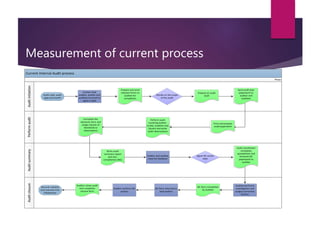
Measurement of current process
Current Internal Audit process
Perform
audit
Audit
initiation
Audit
summary
Audit
closure
Phase
Audit code, audit
type and month
Contact lead
auditor, auditor and
auditees by email to
agree a date
Decide on the scope
of the audit
Auditor and auditee
meet for feedback
Prepare and send
relevant forms to
auditee for
completion
Prepare an audit
brief
Send audit plan
paperwork to
auditor and
auditees
Print and prepare
audit paperwork
Perform audit and
write audit
observations
Complete the
elements form and
assign clauses of
Standards to
observations
Write audit
summary report
and non-
compliances (NC)
Agree NC action
date
Auditee performs
investigation and
assigns Corrective
Actions
NC form completed
by auditee
Audit coordinator
completes
spreadsheet and
forwards NC
paperwork to
auditee
NC form returned to
lead auditor
Auditor confirms NC
actions
Auditor closes audit
and completes
closure form
Records collated
and scanned onto
FileDirector
Prepare and send
relevant forms to
auditee for
completion
Prepare an audit
brief
Send audit plan
paperwork to
auditor and
auditees
Print and prepare
audit paperwork
Perform audit
involving auditor,
scribe, auditees and
Qualco and write
audit observations
Complete the
elements form and
assign clauses of
Standards to
observations
Audit coordinator
completes
spreadsheet and
forwards NC
paperwork to
auditee
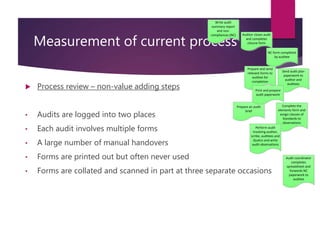
Measurement of current process
 Process review – non-value adding steps
• Audits are logged into two places
• Each audit involves multiple forms
• A large number of manual handovers
• Forms are printed out but often never used
• Forms are collated and scanned in part at three separate occasions
Prepare and send
relevant forms to
auditee for
completion
Prepare an audit
brief
Send audit plan
paperwork to
auditor and
auditees
Complete the
elements form and
assign clauses of
Standards to
observations
Print and prepare
audit paperwork
Perform audit
involving auditor,
scribe, auditees and
Qualco and write
audit observations
Write audit
summary report
and non-
compliances (NC)
Audit coordinator
completes
spreadsheet and
forwards NC
paperwork to
auditee
NC form completed
by auditee
Auditor closes audit
and completes
closure form
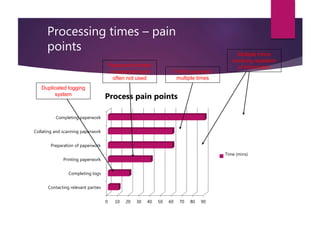
Processing times – pain
points
0 10 20 30 40 50 60 70 80 90
Contacting relevant parties
Completing logs
Printing paperwork
Preparation of paperwork
Collating and scanning paperwork
Completing paperwork
Process pain points
Time (mins)
Multiple forms
involving repetition
of information
Duplicated logging
system
Paperwork printed
in advanced and
often not used
Forms scanned
multiple times
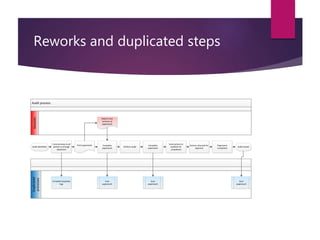
Reworks and duplicated steps
Audit process
Reworks
Duplicated
processes
Audit identified Audit closed
Print paperwork
Communicate to all
parties to arrange
date/time
Complete
paperwork
Reprint new
versions of
paperwork
Perform audit
Complete
paperwork
Scan
paperwork
Complete duplicate
logs
Scan
paperwork
Send actions to
auditees for
completion
Actions returned for
approval
Paperwork
completed
Scan
paperwork
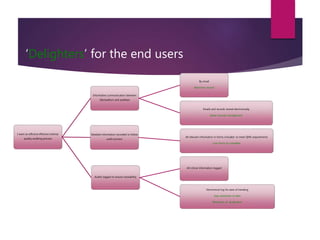
‘Delighters’ for the end users
I want an efficient effective internal
quality auditing process
Informative communication between
QA/auditors and auditees
By email
Electronic record
Emails and records stored electronically
Easier records management
Detailed information recorded to follow
audit process
All relevant information in forms included to meet QMS requirements
Less forms to complete
Audits logged to ensure traceability
All critical information logged
Electronical log for ease of trending
Easy extraction of data
Reduction of duplication
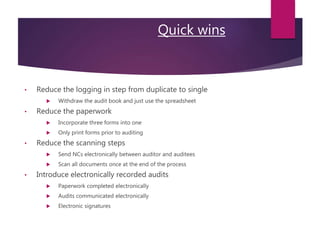
Quick wins
• Reduce the logging in step from duplicate to single
 Withdraw the audit book and just use the spreadsheet
• Reduce the paperwork
 Incorporate three forms into one
 Only print forms prior to auditing
• Reduce the scanning steps
 Send NCs electronically between auditor and auditees
 Scan all documents once at the end of the process
• Introduce electronically recorded audits
 Paperwork completed electronically
 Audits communicated electronically
 Electronic signatures
Positive drives
• Continuous improvement for quality systems
• Agency drive towards paperless systems
• Save users time
• Reduce manual steps
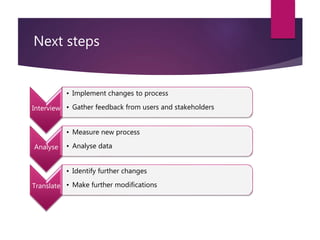
Next steps
Interview
• Implement changes to process
• Gather feedback from users and stakeholders
Analyse
• Measure new process
• Analyse data
Translate
• Identify further changes
• Make further modifications
Future plan – Electronic system
• Identify user and stakeholder requirements
• Improvements to processes:
 Fully traceable and transparent
 Easy input and extraction of data
 Consistency of data input
 Reduce manual processes
 Eliminate use of paper
 Storage of all records and data
• Define user requirement specification
“
”
Thank you for listening
Any questions?

Audit efficiency storyboard.pptx

  • 1.
    Improving efficiency forquality auditing TIM SANDLE
  • 2.
    Project Background • InternalQuality audits are a requirement of all Quality Management Systems (QMS) and legal HTA requirements • Confirm compliance to quality, technical & legal requirements • Highlight issues • Facilitate improvements
  • 3.
    Project identification - Internalquality audit process • Current system is paper heavy • Labour intensive process • Time consuming completing and collating multiple documents • Scanning and filing • Duplication of work
  • 4.
    Project link tobusiness strategy • Quality and governance underpins all aspects of our work, enabling us to maintain our legal governance requirements, Quality Accreditation and Certification status. • Internal Quality audit provide assurance that our internal processes are compliant and provide a mechanism for improvements and benchmarking. • Efficient auditing will provide staff and management assurance that their areas are within compliance.
  • 5.
    Reasons for projectselection  Project sponsor would like to see: • A more efficient auditing process • Less time consuming • Value added internal auditing • Less time spent on inefficient processes around auditing • Positive customer and user attitude to audit process
  • 6.
    Measurement of currentprocess Current Internal Audit process Perform audit Audit initiation Audit summary Audit closure Phase Audit code, audit type and month Contact lead auditor, auditor and auditees by email to agree a date Decide on the scope of the audit Auditor and auditee meet for feedback Prepare and send relevant forms to auditee for completion Prepare an audit brief Send audit plan paperwork to auditor and auditees Print and prepare audit paperwork Perform audit and write audit observations Complete the elements form and assign clauses of Standards to observations Write audit summary report and non- compliances (NC) Agree NC action date Auditee performs investigation and assigns Corrective Actions NC form completed by auditee Audit coordinator completes spreadsheet and forwards NC paperwork to auditee NC form returned to lead auditor Auditor confirms NC actions Auditor closes audit and completes closure form Records collated and scanned onto FileDirector Prepare and send relevant forms to auditee for completion Prepare an audit brief Send audit plan paperwork to auditor and auditees Print and prepare audit paperwork Perform audit involving auditor, scribe, auditees and Qualco and write audit observations Complete the elements form and assign clauses of Standards to observations Audit coordinator completes spreadsheet and forwards NC paperwork to auditee
  • 7.
    Measurement of currentprocess  Process review – non-value adding steps • Audits are logged into two places • Each audit involves multiple forms • A large number of manual handovers • Forms are printed out but often never used • Forms are collated and scanned in part at three separate occasions Prepare and send relevant forms to auditee for completion Prepare an audit brief Send audit plan paperwork to auditor and auditees Complete the elements form and assign clauses of Standards to observations Print and prepare audit paperwork Perform audit involving auditor, scribe, auditees and Qualco and write audit observations Write audit summary report and non- compliances (NC) Audit coordinator completes spreadsheet and forwards NC paperwork to auditee NC form completed by auditee Auditor closes audit and completes closure form
  • 8.
    Processing times –pain points 0 10 20 30 40 50 60 70 80 90 Contacting relevant parties Completing logs Printing paperwork Preparation of paperwork Collating and scanning paperwork Completing paperwork Process pain points Time (mins) Multiple forms involving repetition of information Duplicated logging system Paperwork printed in advanced and often not used Forms scanned multiple times
  • 9.
    Reworks and duplicatedsteps Audit process Reworks Duplicated processes Audit identified Audit closed Print paperwork Communicate to all parties to arrange date/time Complete paperwork Reprint new versions of paperwork Perform audit Complete paperwork Scan paperwork Complete duplicate logs Scan paperwork Send actions to auditees for completion Actions returned for approval Paperwork completed Scan paperwork
  • 10.
    ‘Delighters’ for theend users I want an efficient effective internal quality auditing process Informative communication between QA/auditors and auditees By email Electronic record Emails and records stored electronically Easier records management Detailed information recorded to follow audit process All relevant information in forms included to meet QMS requirements Less forms to complete Audits logged to ensure traceability All critical information logged Electronical log for ease of trending Easy extraction of data Reduction of duplication
  • 11.
    Quick wins • Reducethe logging in step from duplicate to single  Withdraw the audit book and just use the spreadsheet • Reduce the paperwork  Incorporate three forms into one  Only print forms prior to auditing • Reduce the scanning steps  Send NCs electronically between auditor and auditees  Scan all documents once at the end of the process • Introduce electronically recorded audits  Paperwork completed electronically  Audits communicated electronically  Electronic signatures
  • 12.
    Positive drives • Continuousimprovement for quality systems • Agency drive towards paperless systems • Save users time • Reduce manual steps
  • 13.
    Next steps Interview • Implementchanges to process • Gather feedback from users and stakeholders Analyse • Measure new process • Analyse data Translate • Identify further changes • Make further modifications
  • 14.
    Future plan –Electronic system • Identify user and stakeholder requirements • Improvements to processes:  Fully traceable and transparent  Easy input and extraction of data  Consistency of data input  Reduce manual processes  Eliminate use of paper  Storage of all records and data • Define user requirement specification
  • 15.
    “ ” Thank you forlistening Any questions?